How Kaia Is Building Asia’s On-Chain Capital Market

1. Three Core Components of On-Chain Capital Markets
2. Building Currency Rails with the Dollar and Local Stablecoins
3. Putting Stablecoin Liquidity to Work
4. Money Markets: Turning Stablecoins into Capital
5. Conclusion: Kaia’s Asian On-Chain Capital Market Takes Shape
1. Three Core Components of On-Chain Capital Markets
The Asia-Pacific region accounts for roughly 39% of global exports and is one of the world’s largest economic blocs, with annual remittance inflows alone reaching around $400 billion according to the World Bank. Yet its financial infrastructure remains fragmented across borders. Korea uses the won, Japan the yen, and Indonesia the rupiah, while payment systems and settlement structures also differ from country to country. Cross-border remittances still take several days, and the average retail remittance fee in Asia stands at 5–6% according to the World Bank. For transactions taking place within the same economic region, moving money across Asia remains far too slow and expensive.
Stablecoins have opened the possibility of changing this structure. According to rwa.xyz, total stablecoin supply has reached approximately $300 billion, while adjusted transaction volume processed in 2025 amounted to around $10.8 trillion. In April 2026 alone, adjusted transaction volume reached $1.25 trillion, a level that exceeds Visa’s annual payment volume when annualized. In this sense, stablecoins are moving beyond crypto-native utility and becoming financial infrastructure that is extending into real-world payments and settlement. Asia now has a tool that can connect its fragmented currencies and payment systems through a single on-chain rail.
This is why L1s are now competing to secure stablecoin liquidity. Native issuance of USDT and USDC, integrations with on/off-ramps, and partnerships with global payment providers have become baseline capabilities for layer 1 networks. Stablecoin liquidity is no longer a point of differentiation. It is core infrastructure for operating an on-chain economy.
The real question comes next. Once stablecoins enter a chain, what do they actually do there? In reality, on most chains, stablecoins remain “money in transit.” Exchange-to-exchange transfers, P2P remittances, and payments. They serve as pipes that move money from A to B, but it is still rare for that money to remain on-chain and be put to work. No matter how much transfer volume grows, volume alone does not create a capital market. To truly connect Asia’s fragmented financial system on-chain, stablecoins must do more than simply cross borders. They need to be deposited, collateralized, borrowed, and deployed on-chain. A stablecoin passing through a chain and a stablecoin working on a chain are fundamentally different things.
When RWA, or real-world asset tokenization, is added to this structure, the contours of a capital market become clearer. When traditional assets such as government bonds, ship financing, and microloans are tokenized and brought on-chain, they can be traded, used as collateral, and generate yield within the market structure provided by DeFi. RWA supplies the “assets” that can be brought into capital markets, while DeFi provides the “structure” through which those assets move. Stablecoins mediate value between the two. RWA yields are settled in stablecoins, while DeFi collateral and borrowing also revolve around stablecoins. Ultimately, an on-chain capital market is a state in which stablecoins, DeFi, and RWA are linked into a single capital cycle. How Kaia brings RWA on-chain has already been covered in our previous research.
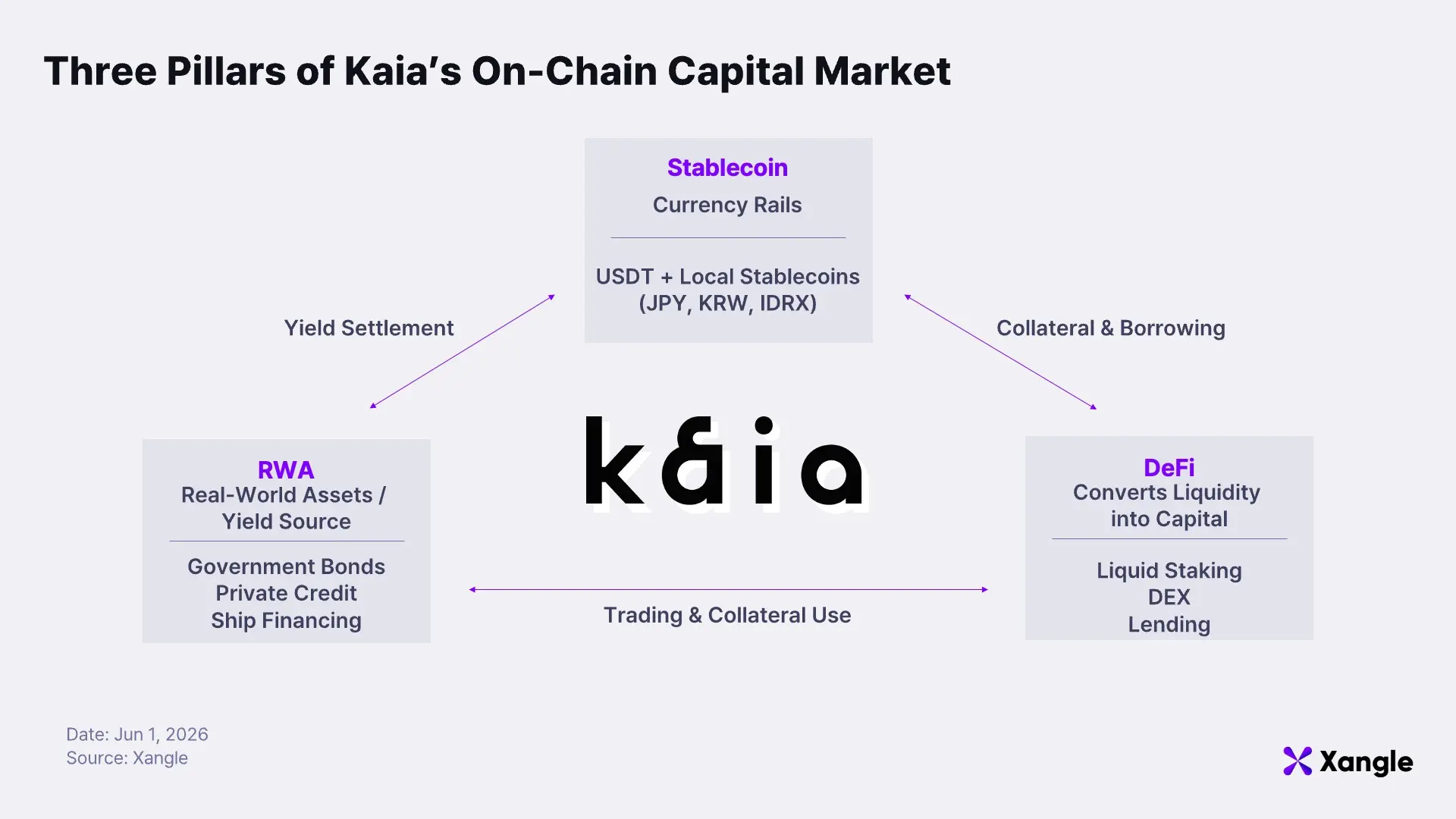
Kaia is attempting to build exactly this cycle. Its aim is not to create a transfer network where stablecoins merely move back and forth, but to build the foundation for a market where incoming capital is actually deposited, deployed, and used to generate yield. Kaia is shaping this vision around three elements: stablecoins, DeFi, and RWA. This article examines the DeFi flow Kaia is building within that broader structure. Specifically, it looks at i) how Kaia lays currency rails through Asian local stablecoins, ii) how liquidity is gathered on top of those rails, iii) how that liquidity is connected to networks and currencies beyond Kaia, and iiii) how liquidity is converted into capital through DeFi.
2. Building Currency Rails with the Dollar and Local Stablecoins
The first condition for an on-chain capital market is a currency rail. For capital to be deposited, collateralized, borrowed, and managed, both a reference currency within the market and local currencies actually used by real users must circulate together. In global DeFi, dollar stablecoins have served as this reference currency. By contrast, real-world payments and remittances in Asia move on local currencies such as the Korean won, Japanese yen, Indonesian rupiah, and Malaysian ringgit.
Kaia’s stablecoin strategy is to place these two layers on a single chain. It first secures global dollar liquidity through USDT, a dollar stablecoin, and then adds local stablecoin rails for each country on top. Kaia’s phrase “One chain, Multiple local rails” refers to this structure. USDT serves as the reference for exchange and settlement so that different local currencies do not remain isolated, while local stablecoins become the entry points that bring each country’s users and regional economies on-chain.
2-1. Dollar (USDT): The Reference Currency of On-Chain Capital Markets
Kaia’s on-chain capital market begins with a dollar stablecoin. Asian economies operate on local currencies such as the won, yen, rupiah, and ringgit, but the reference currency for on-chain liquidity remains the dollar. In global DeFi, the reference asset for collateral, borrowing, settlement, and liquidity pools is mostly dollar stablecoins. Among them, USDT is the world’s largest stablecoin, with a supply of $189 billion. Even if local currency stablecoins are brought on-chain, they become isolated if there is no counterpart asset that can immediately be used for exchange and settlement. USDT, the deepest source of dollar liquidity, serves precisely as that counterpart. This is why Kaia first had to secure the dollar, the global reference currency, before building out each country’s currency rails.
The asset playing this role on Kaia is USDT. In 2025, Tether deployed USDT natively on the Kaia network together with LINE NEXT and Kaia. As the issuer, Tether added Kaia as an officially supported chain, creating the foundation for users to directly hold, transfer, and use USDT on Kaia. Since then, USDT has been connected to the LINE app and wallet infrastructure, becoming an asset that users can use for payments, remittances, and DeFi within the LINE environment.
The native onboarding of USDT provided the reference liquidity needed to connect multiple local stablecoins into a single market. An on-chain capital market does not function merely because each country’s currency stablecoin is issued on-chain. For assets to be exchanged, priced, used as collateral, borrowed, and connected to yield strategies, a common reference asset is required. If yen, won, rupiah, and ringgit stablecoins bring each country’s payment and remittance demand on-chain, USDT becomes the exchange and settlement reference that prevents these assets from being isolated and connects them to global DeFi. This is the structure behind Kaia’s “One chain, multiple local rails.” It supplies global dollar liquidity on a single chain and places local currency rails from across Asia on top, thereby creating a multi-currency on-chain capital market.
2-2. Yen (JPY): JPYC and Distribution Within the LINE App
Japan was the first country in Asia to establish a legal framework for stablecoins denominated in its own currency. Through the 2023 amendment to the Payment Services Act, Japan limited eligible issuers to banks, funds transfer service providers, and trust companies, opening the door for regulated yen stablecoins to be legally issued. Unlike gray areas where issuer eligibility remains ambiguous, a market with a clear regulatory framework allows major financial institutions and platforms to handle such assets with confidence. From Kaia’s perspective, Japan is a market where the asset layer for its currency rail already has regulatory backing.
The representative yen stablecoin to emerge from this framework is JPYC. Circle, the issuer of USDC, the second-largest dollar stablecoin, participated as an investor. The fact that a dollar stablecoin leader is also targeting a yen stablecoin shows that stablecoin competition is spreading beyond the dollar into local currencies. JPYC was already issued on Ethereum, Avalanche, and Polygon, but in May, it added Kaia as its fourth issuance chain. The reason JPYC chose Kaia lies in distribution. Even if a yen stablecoin is issued, it has little meaning if it cannot reach users. Kaia has direct access to a channel that can connect issued assets to users immediately.
That channel is LINE. At the same time JPYC was issued on Kaia, it was adopted by Unifi, LINE NEXT’s digital asset wallet, enabling users to hold, send, and deposit yen stablecoins directly inside the LINE app, which is used by more than 100 million people in Japan, without installing a separate app. Taking this one step further, Unifi Mini, scheduled to launch in Japan in mid-June, will bring Unifi, which had previously been accessible only through the web and web apps, directly into LINE Messenger. This lays the groundwork for users to use yen stablecoins inside the messenger without having to switch to a browser. This integrated path of issuance (JPYC), transfer (Kaia), and distribution (LINE) is a strength of Kaia that is difficult for other networks that merely add more issuance chains to replicate.
Kaia’s moves are also extending beyond issuance and distribution into standard-setting discussions within Japan’s institutional financial sector. Kaia has joined Progmat DCC, a consortium joined by major trust banks that designs issuance and distribution standards for stablecoins and tokenized assets in Japan. Progmat DCC is also connected to trust-type yen stablecoin projects promoted by institutions such as SMBC. After securing a LINE distribution route through the funds-transfer-based JPYC, Kaia is expanding its touchpoints to trust-type structures as well. In Japan, Kaia is building currency rails not around a single coin, but across multiple branches of the institutional system.
2-3. Won (KRW): A Currency Rail Awaiting Institutionalization
Unlike Japan, Korea has yet to establish a formal framework for won-denominated stablecoins. Even so, technical validation is already moving ahead on Kaia before regulation is finalized. In May 2026, KB Kookmin Bank completed a PoC with Kaia that connected the issuance, payment, settlement, and overseas remittance of a won stablecoin into a single flow. iM Bank then followed with its own issuance and settlement pilot. In other words, multiple major banks are already testing won stablecoins on the same chain.
The most notable part of this validation is overseas remittance. In KB Kookmin Bank’s PoC, the won stablecoin was converted into a dollar stablecoin through USDT liquidity secured on Kaia and then delivered to an overseas account. For now, this has been tested as a remittance use case. But the same structure, where a local currency is converted into USDT and becomes deployable on-chain liquidity, can naturally extend to DeFi collateral, borrowing, and yield strategies.
The timing of regulation remains uncertain. However, because technical validation is already taking place on Kaia, the network is well positioned to respond quickly once the regulatory framework is in place. Korea and Japan differ in terms of issuers and stages of development, but they share one important feature: both markets are using Kaia as infrastructure for the issuance and settlement of local-currency stablecoins. Currency rails are beginning to take shape across two of East Asia’s core currency zones.
Kaia’s local stablecoin strategy is also expanding beyond Korea and Japan into Southeast Asia. IDRX, an Indonesian rupiah stablecoin, has already been issued on Kaia, while BLOX, the issuer of the Malaysian ringgit stablecoin MYRC, has joined as an official Kaia ecosystem partner and is preparing for issuance. Following the yen and won, stablecoins for the rupiah and ringgit are being added sequentially on Kaia, bringing major Asian currencies onto the network.
The core of Kaia’s currency rail strategy is not simply to issue each country’s stablecoin. It is to layer local currencies on top of USDT as the reference currency and allow these assets to coexist within the same network, where they can be exchanged, settled, and deployed. Still, having currency rails in place only means that the venue for capital to gather has been prepared. For this money to actually work on-chain, the gathered liquidity must be converted into capital through DeFi.
3. Putting Stablecoin Liquidity to Work
Once currency rails are in place, liquidity begins to accumulate on top of them. But liquidity accumulation alone is not enough. USDT sitting idle in wallets. KAIA locked in staking and unavailable for use. These are still forms of money that are either passing through or lying dormant. Liquidity that has gathered but is not being put to work is merely raw material for a capital market, not the market itself.
For a capital market to function, the liquidity it gathers must actually be activated. Assets locked in staking need to be unlocked and reused, different assets need to be freely exchangeable, and once capital is deployed, it should be able to work across multiple venues at the same time. This section examines how Kaia activates and puts gathered liquidity to use through two main channels: liquid staking, which unlocks tied-up assets, and DEXs, where those assets are exchanged.
3-1. Liquid Staking & Restaking: Flexible Capital, Stronger Security
Kaia uses a DPoS, or Delegated Proof of Stake, consensus structure. Instead of token holders validating blocks directly, they delegate KAIA to validators, who then participate in operating the network. Delegators receive staking rewards in return, but the KAIA delegated to validators remains locked. Rewards accrue, but the asset cannot be used elsewhere. From the user’s perspective, this creates a trade-off between staking yield and liquidity. Liquid staking is the foundational DeFi layer that removes this trade-off, and on Kaia, that role is played by Lair Finance.
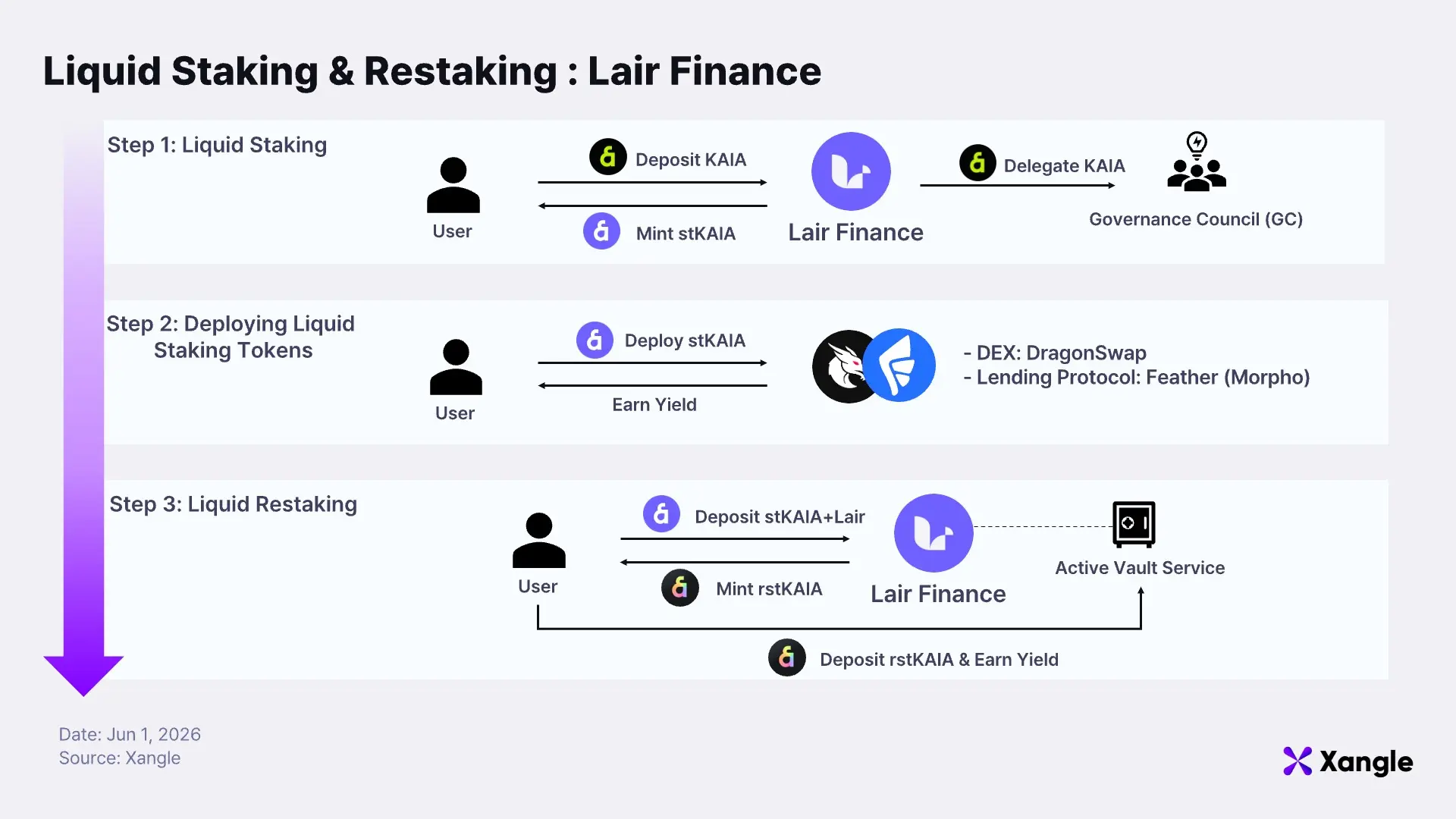
Lair Finance is Kaia’s first liquid staking service. When users stake KAIA, they receive stKAIA, or Staked Kaia, which represents their staked position. Unlike native staking, where the asset is locked, stKAIA is freely transferable and functions as a yield-bearing token whose value automatically accrues relative to KAIA over time. In other words, staking rewards continue to be reflected in the value of stKAIA, while users can redeploy that stKAIA into other DeFi activities such as collateralization, lending, and liquidity provision. It turns previously tied-up capital into flowing capital.
Lair Finance also incorporates a design tailored to the characteristics of the Kaia network. On Kaia, Governance Council, or GC, members serve as validators, each with different reward rates and governance voting power, which means staking yields also vary. If too much KAIA is delegated to a particular GC, network decentralization weakens, and inefficiencies emerge because other GCs that may offer higher yields remain underutilized. Lair Finance allows users to directly choose which GC to delegate their KAIA to. In other words, Lair Finance makes KAIA liquid while preserving user choice, helping prevent delegation from becoming overly concentrated among a small number of validators.
Lair Finance’s structure extends one step further. If staking KAIA to receive stKAIA is liquid staking, Lair Finance’s liquid restaking is a structure that redeploys stKAIA into an additional reward layer. Users can deposit stKAIA together with LAIR to mint rstKAIA, and then deposit rstKAIA into a restaking vault to earn additional rewards. While stKAIA continues to accrue staking yield, the position also functions as a restaking position that layers LAIR rewards, LINE Messenger game rewards, and mini-app partner token rewards on top.
Lair Finance does not leave KAIA as a simple holding or staking asset. It turns KAIA into capital that can continue to be used within Kaia DeFi. For an on-chain capital market to function, assets that contribute to network security must also be usable as liquidity, collateral, and a source of rewards. Lair Finance creates this starting point. Once KAIA moves from being a locked asset to flowing capital, Kaia’s DeFi ecosystem and LINE’s mini-app ecosystem can expand together on top of the same liquidity.
3-2. Where Liquidity Trades: DEXs
Liquid staking turns locked KAIA into stKAIA, but liquidity only becomes useful when it can move. The same applies to the stablecoins sitting on Kaia’s currency rails. For these assets to support payments, collateral, and broader on-chain deployment, they need markets where they can be exchanged against one another. This is the role of DEXs, or decentralized exchanges.
Kaia’s DEX layer can be understood in two parts. The first is the trading venue itself, where users swap assets. The second is the liquidity layer behind those venues, including Kaia’s native Consensus Liquidity, or CL, which allows capital to support both trading and network security.
1) DragonSwap and Swapscanner
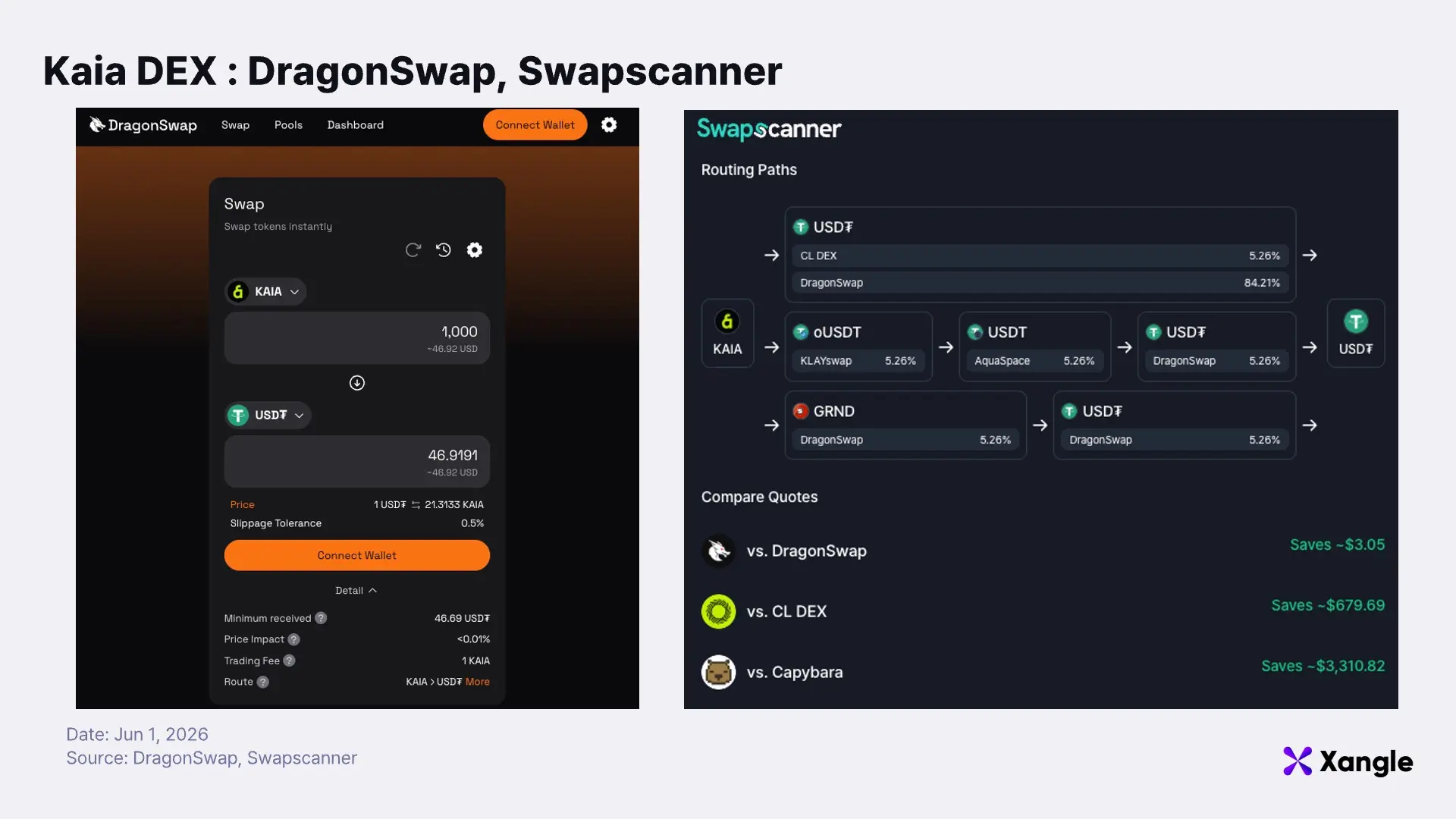
DragonSwap is Kaia’s flagship DEX, launched through D2I, Kaia Foundation’s DeFi support program. It accounts for more than half of Kaia’s total DEX liquidity and over 80% of its trading volume. Through DragonSwap, users can swap KAIA directly into USDT or other tokens from their wallets without relying on a centralized exchange. DragonSwap also supports concentrated liquidity, or V3, allowing liquidity providers to create deeper markets with less capital. This improves capital efficiency for providers and reduces slippage for traders, leading to better execution.
DragonSwap matters because it concentrates liquidity where much of Kaia’s on-chain activity already takes place. Swap aggregators, analytics platforms, and gaming projects are all connected to DragonSwap’s pools, meaning a large share of Kaia’s trading activity ultimately depends on this liquidity. As liquidity deepens in one venue, prices become more stable and large trades can be executed with less slippage. For this reason, DragonSwap does not simply function as a trading venue. Its liquidity also gives it the role of a price reference for other services across the Kaia ecosystem.
Still, Kaia’s liquidity is not limited to DragonSwap. It is spread across multiple DEXs, which makes it difficult for users to know where a trade should be routed to get the best price. This is where aggregators such as Swapscanner come in. Swapscanner connects liquidity fragmented across Kaia’s DEXs, compares routes through its own routing engine, and executes trades through the path with the most favorable price. By aggregating liquidity across venues, it can derive a more accurate market price than any single DEX and provide real-time charts and technical analysis tools on top. For users, the fragmented DEX market becomes a single trading interface. If DEXs are the venues where liquidity trades, aggregators are the routing layer that turns those venues into one market.
Swapscanner also plays a role that goes beyond aggregation. It operates CL DEX, a dedicated venue for Kaia’s Consensus Liquidity. Through CL DEX, users can earn staking rewards and trading fees at the same time using the same KAIA. This creates another liquidity supply mechanism on Kaia and introduces a structure that is rarely seen on other chains.
2) Consensus Liquidity: Liquidity Provision and Network Security in One Position
Every DEX needs liquidity providers. For KAIA holders, however, providing liquidity traditionally creates a trade-off. They can delegate KAIA to validators and earn staking rewards, but the delegated KAIA becomes locked and cannot be used as DEX liquidity. Or they can provide liquidity and give up staking rewards. In that structure, one unit of capital can only support one source of yield.
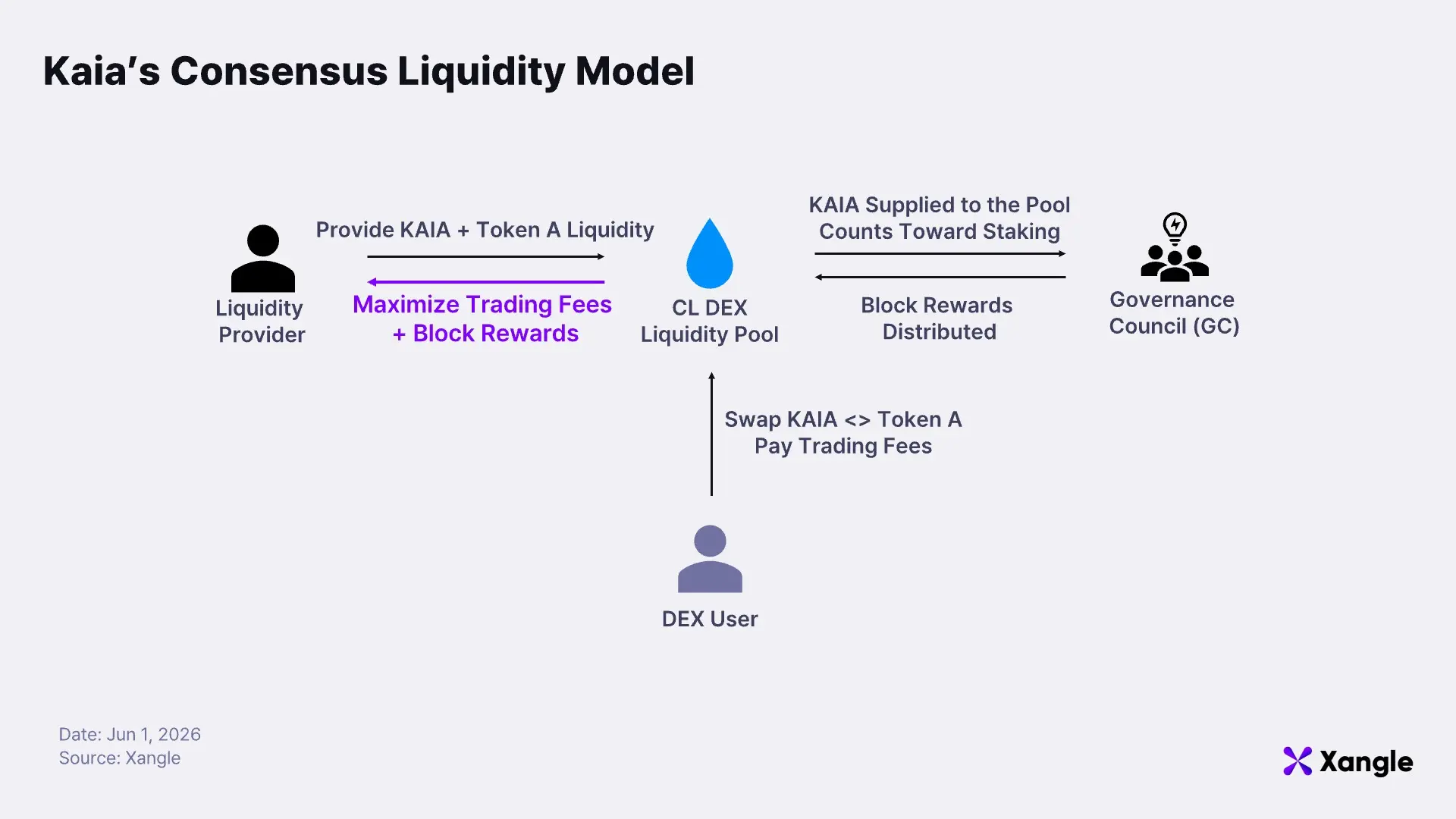
Liquid staking addresses this problem by changing the form of the asset. Users stake KAIA, receive stKAIA, and then use that liquid staking token in DeFi. Consensus Liquidity takes a different approach. It does not require KAIA to be converted into another asset. Instead, KAIA delegated to validators can remain staked while also being used as DEX liquidity. When a user deposits KAIA together with a paired token into a Consensus Liquidity DEX, the KAIA continues to count as staked and earns block rewards. At the same time, it also functions as trading liquidity and earns swap fees. In other words, the same unit of capital generates both block rewards and trading fees. A portion of fee revenue can then be burned or redeposited as liquidity, helping maximize the effective staking yield.
Consensus Liquidity is difficult to replicate on other chains because it requires changes at the consensus layer. For KAIA deposited in a liquidity pool to still be recognized as staked, the chain itself needs rules for what counts as stake and how rewards are distributed. This is not something a standard DeFi protocol deployed on top of a chain can implement on its own. External protocols do not have the authority to treat validator-delegated stake as DEX liquidity. Consensus Liquidity is possible because Kaia implemented it directly into the chain’s core logic.
On Kaia, validators must stake a certain amount of KAIA to participate in network security. Because KAIA supplied through Consensus Liquidity is also recognized as staked, it contributes to that security as well. User-supplied capital therefore does two things at once: it deepens trading liquidity and strengthens the network. Consensus Liquidity is currently operated through Swapscanner, with direct integration into Kaia Portal also underway. Rather than simply importing an external DeFi protocol, Kaia has connected its own staking design with DEX liquidity at the protocol level. This makes Consensus Liquidity one of Kaia’s most distinctive DeFi primitives.
3-3. How to Connect Liquidity Beyond Kaia, Wider and Farther
So far, we have followed the process of unlocking, exchanging, and using liquidity twice within Kaia. As a result, Kaia has built deep liquidity internally. However, what Kaia aims for is not a market that remains complete within a single chain, but a stablecoin payment and settlement layer for Asia. Settlement is, by nature, an act of crossing boundaries. No matter how deep the liquidity inside Kaia becomes, if it cannot reach capital and users outside Kaia or be exchanged with other currencies, that liquidity remains isolated within a single chain.
Outside Kaia, there are boundaries between networks and currencies. Global crypto capital is distributed across multiple chains such as Ethereum, BSC, and Arbitrum. If the USDT and KAIA liquidity accumulated on Kaia cannot move to and from those chains, it cannot meet external capital. At the currency boundary, even if won, yen, and rupiah stablecoins are placed on top of the currency rails, they remain separate assets even on the same chain if they cannot be exchanged with one another. Kaia presents a way to connect these two separate boundaries.
1) Cross-Chain: Stargate
Stargate is a bridge that connects liquidity across multiple chains in a single transaction. For users moving between Kaia and external networks, this means assets can move without bridge-hopping or manually going through multiple steps. Built on LayerZero, Stargate connects more than 80 chains through shared liquidity pools.
For Kaia, Stargate matters because it creates a two-way liquidity channel. Kaia joined Stargate V2 through Hydra, a mechanism that connects new chains to Stargate’s liquidity network. The key advantage is that Kaia does not need to build isolated liquidity pools from scratch for each external chain. Once connected, Kaia can immediately access the unified liquidity of Stargate’s broader network. This allows assets accumulated on Kaia to move outward, while also enabling capital from external networks to flow into Kaia.
A payment and settlement layer cannot function properly if it remains confined to a single chain. Even with deep internal liquidity, settlement would remain limited if that liquidity could not interact with external capital. By enabling assets to move between Kaia and other networks, Stargate gives Kaia the cross-chain connectivity it needs to function as a settlement hub for Asia.
2) FX Execution: Ratio
USDT may serve as the reference currency connecting multiple local stablecoins, but that does not automatically make won, yen, and rupiah directly exchangeable. USDT provides the shared liquidity layer where these currencies can converge. What is still needed is an execution layer that prices exchange rates and settles conversions on top of that liquidity. Ratio is a Kaia-incubated project targeting this FX layer for Asia.
Ratio functions as regulatory middleware between stablecoin issuers and financial institutions that need to move funds. Financial institutions connect to Ratio through a single API, while end-user KYC and local deposits and withdrawals are handled by on/off-ramp partners in each market. Ratio focuses specifically on FX conversion and settlement.
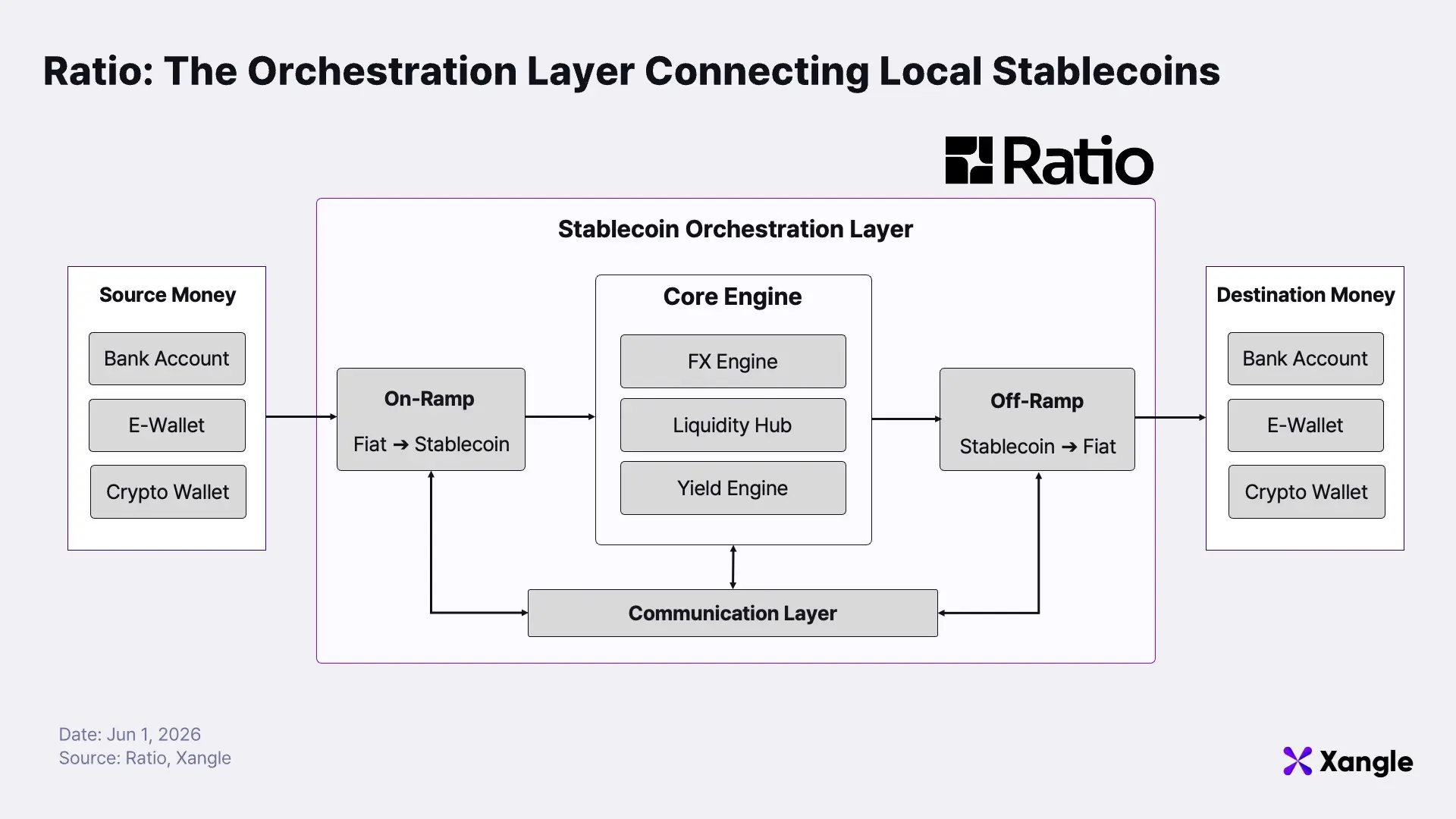
Ratio’s design is built around three core engines.
- FX Engine: Ratio uses oracle-based pricing from Pyth rather than AMM-based pricing. In an AMM, prices are determined by the asset ratios inside a pool, which means execution worsens as trade size increases. Oracle-based pricing is not affected by pool ratios in the same way, allowing Ratio to support institutional-grade transactions with tighter spreads.
- Liquidity Hub: Ratio maintains a single independent pool for each currency. In the conventional pair-pool model, every new currency pair requires a separate pool, causing the number of pools to grow rapidly and fragmenting capital across many pairs. Ratio avoids this inefficiency by using one pool per currency. Automatic rebalancing keeps liquidity available for trading, and adding one new currency pool opens exchange routes with all existing currencies.
- Yield Engine: Idle stablecoins that are not being used for FX execution are deployed into yield strategies, and the generated yield is distributed to liquidity providers who deposit funds into the pools. Deposited funds can be redeemed in real time.
Traditional FX transactions can involve settlement delays of up to three days and high costs. Ratio aims to provide instant settlement at lower cost. It is currently in Phase 1 with a number of institutional partners, and its API is scheduled to become publicly available in 2026.
Asia’s currencies remain fragmented across borders, and the FX and settlement rails connecting them have long been slow and expensive. If USDT provides the common rail where local stablecoins can converge, Ratio builds the execution layer that allows those currencies to actually be exchanged. Once this connection turns reference-currency liquidity into executable FX infrastructure, stablecoins on Kaia can move beyond assets that are simply stored or transferred. They can become settlement currencies that operate across borders within a unified on-chain environment.
4. Money Markets: Turning Stablecoins into Capital
In the process of connecting capital more efficiently, KAIA locked in staking has been made liquid, different assets have become exchangeable, and the same unit of capital has begun to work across multiple venues at once. But using liquidity and turning it into capital are not the same thing. For liquidity to become capital, there needs to be a market where deposited assets are borrowed by someone else and generate interest in return. This market for lending and borrowing is the money market, and it sits at the center of every DeFi economy. Deposits become the source of borrowing, borrowing creates leverage, and leverage then leads to hedging and arbitrage. Kaia’s money market consists of lending protocols that connect deposits and borrowing, as well as services built on top of them that allow users to earn yield simply by depositing, without having to manage the underlying complexity themselves.
4-1. Lending Infrastructure: Markets, Curators, and Oracles
Lending is a market where users borrow deposited assets and pay interest in return. Unlike traditional finance, where borrowing can be based on credit, DeFi lending is typically overcollateralized: borrowers must deposit assets worth more than the amount they borrow. A market where smart contracts handle deposits, collateral, borrowing, and liquidations without intermediaries such as banks is called a lending protocol, or money market. Lending is central to capital markets because many of the market’s core functions are built on top of it. Deposits become the source of borrowing, borrowing creates leverage, and leverage enables hedging and arbitrage. Without a market for lending and borrowing, assets are simply held.
On-chain lending generally depends on three components working together: the market where deposits and borrowing take place, the risk rules that determine collateral eligibility and liquidation thresholds, and the price data used to value collateral and debt. Safe lending only becomes possible when these three components operate in sync. On Kaia, this structure is built around Morpho, Feather, and RedStone.
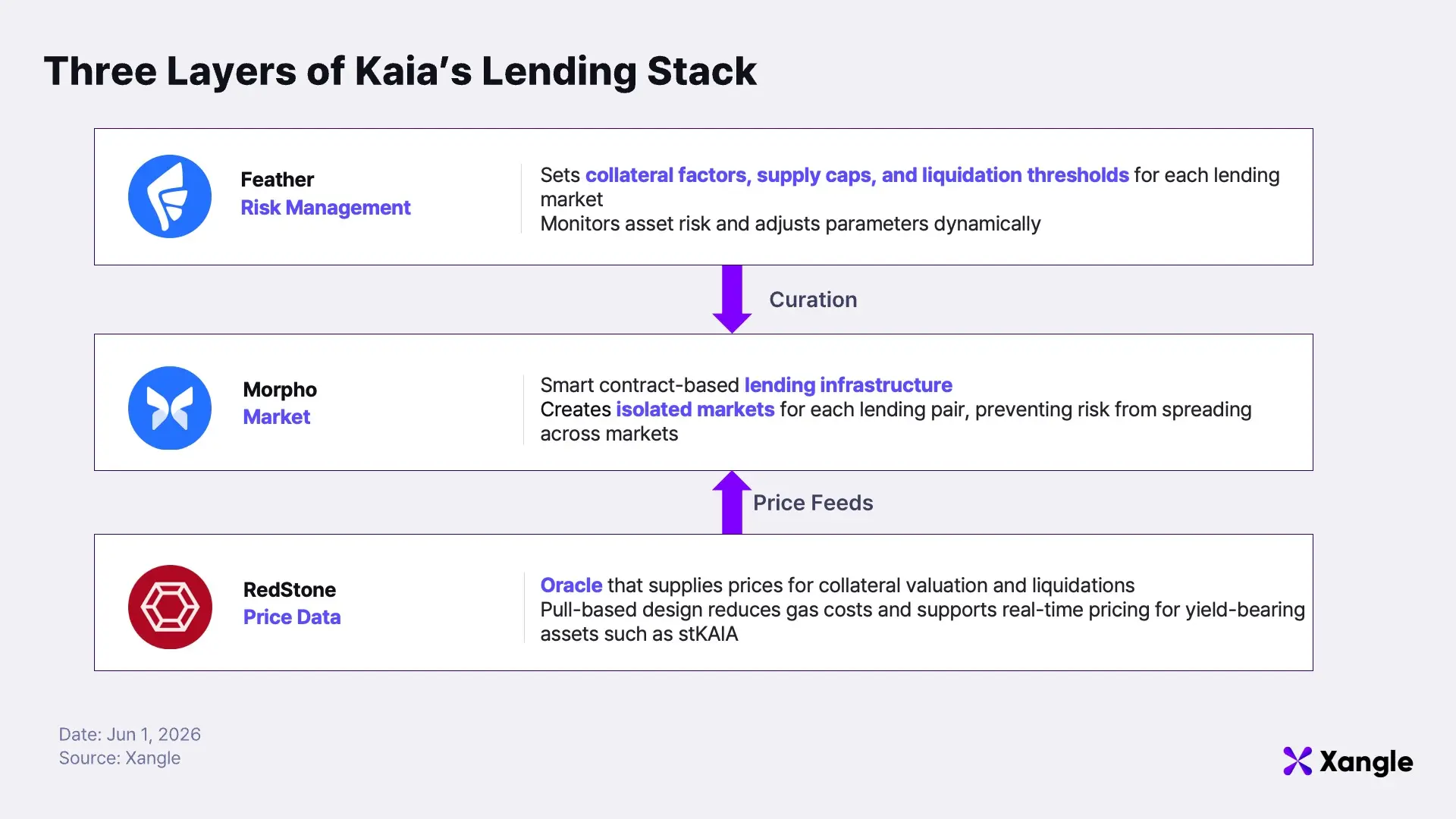
Morpho provides the market layer. It is the second-largest DeFi lending protocol after Aave and manages more than $10 billion in supplied assets as of May 2026. Starting from Ethereum mainnet, Morpho has expanded to multiple chains including Base, and its infrastructure has been validated to the point where Coinbase adopted it as the engine for its own on-chain lending service. In May 2026, this top-tier lending protocol was deployed natively on Kaia, laying the foundation for Kaia’s money market.
What sets Morpho apart from many other lending protocols is its isolated market structure. Traditional lending protocols such as Aave pool assets together in a shared liquidity market, which means a problem with one asset can spread across the broader pool. Morpho instead separates each lending pair into its own independent market, with its own collateral asset, loan asset, and risk parameters. If one market becomes impaired, the damage is contained and does not automatically spill over into other markets. In other words, Morpho isolates risk at the market level.
This distinction becomes clear in real incidents. In April 2026, the KelpDAO bridge exploit led to unbacked rsETH being used as collateral on Aave, creating more than $100 million in bad debt. Morpho was exposed to the same incident, but losses were limited to around $1 million across two isolated markets. The impairment of one market did not spread to others. This structure allows assets with very different risk profiles, from volatile crypto assets to institutional-grade RWAs, to coexist within the same network without directly contaminating one another.
The value of Morpho’s design becomes most apparent under stress. In April 2026, the KelpDAO bridge exploit caused unbacked rsETH to enter Aave as collateral, leaving the protocol with more than $100 million in bad debt. Morpho was exposed to the same incident, but losses were contained to roughly $1 million across two isolated markets. The failure did not cascade across the rest of the protocol. This is the core benefit of isolated markets: assets with very different risk profiles, from volatile crypto-native collateral to institutional-grade RWAs, can coexist on the same network without sharing the same risk surface.
That structure only works if each market is actively governed by its own risk parameters. This is where Feather comes in. Morpho provides the lending infrastructure, but it does not decide on its own which assets should be accepted as collateral, how much borrowing capacity each asset should receive, or where liquidation thresholds should be set. Those decisions fall to the curator: the risk manager responsible for defining and maintaining the operating conditions of each isolated market. On Kaia, Feather plays that role.
The final piece is RedStone, which provides the price data that lending markets depend on. In DeFi lending, oracle reliability is critical. If collateral prices are reported incorrectly, liquidations may fail to trigger in time, and losses can quickly flow back to users or the protocol. RedStone secures more than $10 billion in assets across over 110 chains and has not recorded a single pricing error. Its architecture also differs from Chainlink’s. While Chainlink generally uses a push model, where prices are posted on-chain at regular intervals, RedStone uses a pull model, where prices are retrieved only when needed. This reduces gas costs and is particularly well suited to high-frequency environments such as Kaia, where blocks are produced every second. RedStone is also important for pricing assets such as stKAIA. Liquid staking tokens can be difficult to price accurately because secondary-market liquidity may be thin and easier to manipulate. RedStone mitigates this by aggregating multiple data sources to produce a more robust price feed. For Kaia, where stKAIA is expected to become a core collateral asset, this makes oracle design a key part of the lending stack rather than a secondary component.
Together, Morpho, Feather, and RedStone give Kaia the core components of a functioning money market: isolated lending markets, active risk curation, and reliable collateral pricing. The KAIA/USDT market is the clearest example. Users can deposit KAIA as collateral and borrow USDT against it, gaining stablecoin liquidity without selling their KAIA. This is where passive holdings begin to function as productive capital. The borrowed USDT can then be redeployed into other DeFi strategies, including the yield products discussed in the next section.
4-2. Yield Services: Turning Liquidity into Returns
A lending market is only the foundation. Most users do not want to actively manage collateral, monitor liquidation thresholds, or decide which lending market offers the best risk-adjusted return. They simply want to deposit assets and earn yield. Yield products exist to bridge that gap, packaging complex DeFi strategies into a much simpler user experience.
On Kaia, a new generation of native protocols is emerging to serve that role. Some route capital through lending markets, others create entirely new liquidity, and some generate returns from assets that would otherwise sit idle. Despite their different approaches, they share a common objective: turning passive capital into productive capital while keeping the user experience as simple as possible.
The most prominent example is SuperEarn, Kaia’s flagship yield product and one of the ecosystem’s core DeFi initiatives. From a user perspective, the experience resembles a savings account: deposit stablecoins and earn yield. Behind the scenes, however, capital is allocated through Morpho vaults and managed by established risk curators such as Gauntlet, which optimize for risk-adjusted returns.
SuperEarn is built on top of lending infrastructure, but its ambitions extend beyond a single protocol. Over time, it is expected to allocate capital across multiple institutional-grade yield sources, including Pendle, which provides fixed-yield opportunities, and OpenEden, which offers exposure to tokenized U.S. Treasury products. Rather than relying on one venue, SuperEarn can direct liquidity toward whichever source offers the most attractive risk-return profile at a given moment.
Its strategic importance goes beyond yield generation itself. Through Project Unify, SuperEarn is expected to become accessible through the broader LINE ecosystem. This creates a direct connection between Kaia’s money markets and LINE’s consumer distribution network. Users may eventually be able to deposit stablecoins through familiar interfaces without needing to understand the underlying blockchain infrastructure, while lending markets and yield strategies operate invisibly in the background. In that scenario, DeFi yield is no longer limited to crypto-native participants—it becomes available to mainstream users through products they already use.
Hann Finance approaches the problem from a completely different angle. Instead of allocating existing liquidity, it creates new liquidity through a CDP (Collateralized Debt Position) system. Users can deposit assets such as KAIA or stKAIA and mint USDHN, Kaia’s native stablecoin, against that collateral. The distinction is important. In a lending market, borrowing depends on liquidity that another user has already supplied. A CDP system works differently: collateral is deposited and new stablecoins are issued directly against it. No lender is required on the other side of the transaction. In effect, Hann expands the supply of on-chain liquidity rather than redistributing liquidity that already exists.
This model becomes particularly powerful when combined with liquid staking. Because stKAIA can be used as collateral, users can continue earning staking rewards while simultaneously minting USDHN against the same position. The result is greater capital efficiency: one asset continues generating staking yield while also unlocking additional liquidity that can be deployed elsewhere in the ecosystem.
Spoon Finance represents a third approach. Whereas SuperEarn focuses on stablecoin yield and Hann focuses on liquidity creation, Spoon is designed to generate returns from volatile assets while reducing exposure to price swings through automated hedging strategies.
The goal is straightforward: capture the upside associated with higher-yielding assets without forcing users to bear the full volatility that typically accompanies them. When users deposit assets such as USDT, multiple sources of return can accrue simultaneously, including lending income and token incentives generated by underlying strategies. By combining several yield streams within a single product, Spoon reflects a broader theme across Kaia DeFi: maximizing the productivity of capital rather than relying on a single source of return.
Beyond their role as user-facing products, these protocols also matter at the network level. The value they generate remains within the Kaia ecosystem instead of being exported to external chains. This aligns closely with Kaia’s revised tokenomics framework introduced in 2026. Under the new Contribution Reward model, rewards are distributed according to measurable on-chain contributions, while rewards that are not justified by network activity are burned, reducing effective token inflation. As usage of native DeFi protocols grows, so does the volume of economic activity that contributes to these metrics. Over time, this creates a tighter connection between ecosystem growth and token value accrual. In other words, the more capital that circulates through Kaia’s own financial infrastructure, the stronger the potential link between network adoption and the long-term value of KAIA itself.
5. Conclusion: Kaia’s Asian On-Chain Capital Market Takes Shape
Kaia is pursuing a long-term vision: building an on-chain capital market for Asia. Across the region, currencies, payment systems, and regulatory frameworks remain largely segmented along national lines. Kaia’s approach is to create a shared on-chain financial environment where capital can move more freely across those boundaries.
The story is not about any single protocol. It is about how multiple pieces fit together into a broader financial system. Local Asian stablecoins provide the currency layer. Liquidity accumulated through those stablecoins can then flow into DeFi markets, connect with external networks and currencies, and eventually expand into real-world assets. Underlying the strategy is a simple premise: bringing money on-chain is only the first step. Capital also needs markets where it can be deployed, borrowed, exchanged, and put to productive use.
Much of that infrastructure remains under construction. Key components such as money markets and foreign-exchange rails are still developing, and the full capital cycle linking stablecoins, DeFi, cross-chain liquidity, and real-world assets has yet to reach maturity. For now, Kaia remains in the process of assembling the building blocks required to support that vision.
Still, the trajectory is becoming increasingly visible. As competition among layer 1 networks shifts beyond transaction speed and low fees toward attracting assets, concentrating liquidity, and creating productive financial activity, Kaia has steadily built around the idea of an Asian stablecoin economy. LINE remains its most distinctive advantage. Few blockchain ecosystems have access to a distribution channel capable of reaching both crypto-native participants and mainstream users at scale. Asia’s on-chain capital market has not fully emerged yet, but many of its foundations are already taking shape within the ecosystem Kaia is building.
Disclaimer
I confirm that I have read and understood the following: The information contained in this article is strictly the opinions of the author(s). This article was authored free from any form of coercion or undue influence. The content represents the author's own views and does not represent the official position or opinions of CrossAngle. This article is intended for informational purposes only and should not be construed as investment advice or solicitation. Unless otherwise specified, all users are solely responsible and liable for their own decisions about investments, investment strategies, or the use of products or services. Investment decisions should be made based on the user’s personal investment objectives, circumstances, and financial situation. Please consult a professional financial advisor for more information and guidance. Past returns or projections do not guarantee future results. This article was written at the request of Kaia. All content in this article was written independently by the author(s), and neither CrossAngle nor Kaia had any editorial control or influence over the content. The author(s) may hold the cryptocurrencies mentioned in this article at the time of writing.
Xangle or its affiliated partners own all copyrights of the written or otherwise produced materials and content provided on the platform. Any illegal reproduction of such content, including, but not limited to, unauthorized editing, copying, reprinting, or redistribution will result in immediate legal actions without prior notice.
![[CIS Partner Summit Highlights] Ault's Financial Super App Strategy: OnlyBulls](https://resource.xangle.io/files/content/C1A19E1DB41B7FB86076143803C40D8E_1790125531662.webp)
![[Xangle RWA Series] Solana RWA: A Look at the Key Players](https://resource.xangle.io/files/content/F779A005246C0299246537AACB3A39F2_1782287059970.webp)