The Future of Onchain Trading, Built by SynFutures

Table of Contents
1. The Growth of the Tokenized Stock Market and a New Opportunity
2. SynFutures: A Proven Decentralized Exchange
3. How Anchored Issues and SynFutures Distributes
4. An Expansion Strategy for the Unified Trading Layer
5. Conclusion: A Unified Trading Layer That Brings Everything Together, From Crypto to RWA
1. The Growth of the Tokenized Stock Market and a New Opportunity
In his 2025 annual letter to shareholders, Larry Fink, CEO of BlackRock, the world's largest asset manager, projected that every asset, from stocks and bonds to real estate, will eventually be tokenized. That projection is quickly becoming reality. Government bonds and money market funds moved onchain first, stablecoins established themselves as an everyday means of payment, and the same shift is now reaching equities.
Stocks are the most familiar asset of all, yet access to them has long been restricted. The names you could buy and the hours you could trade them depended on the country and the broker where you held your account. As capital pooled onchain has moved beyond DeFi yield toward real-world assets, demand has risen quickly to bring stocks onchain as tokens and trade them directly from a wallet. Among real-world assets (RWA), tokenized stocks are the category drawing attention fastest lately.
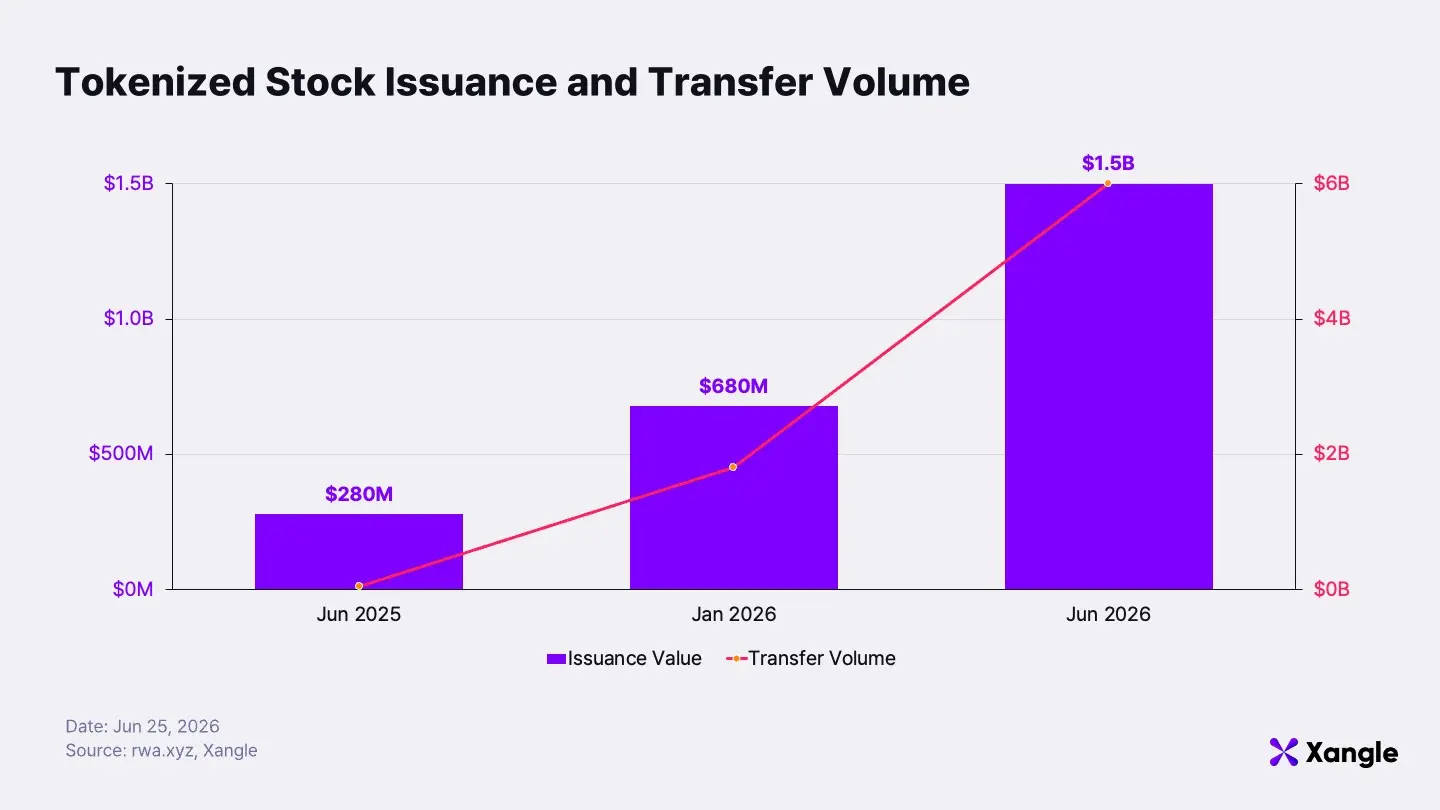
The onchain tokenized stock market grew more than fivefold in a single year, from roughly $280 million in June 2025 to about $1.5 billion in June 2026. Issuance was not the only thing to expand. Over the same period, the value of these tokens transferred onchain rose from around $53 million to approximately $6 billion. The tokens being issued are in active use onchain.
Several shifts have converged behind this growth. As stablecoins settled in as the default means of payment onchain, they opened a channel for trading assets in dollars. The passage of the GENIUS Act, which brought stablecoins into the regulated system in the United States, also advanced the regulatory conversation around real-world asset tokenization. Above all, as more operators began handling compliance, custody, and issuance within a regulatory framework, the conditions emerged to trade onchain assets with confidence.
That said, the value of a tokenized stock is not realized through issuance alone. It functions as a complete asset only when the primary market, where the token is issued, connects to the secondary market, where it actually trades. Today the two are separate: several issuers create stock tokens, while exchanges offer equity exposure synthetically, tracking the price alone without holding the underlying. The value of a tokenized stock becomes clear when an exchange where real trading happens handles tokens backed 1:1 by the underlying and joins the two markets directly.
SynFutures is the exchange that joins the two in a tokenized stock market where issuance and distribution had been disconnected. SynFutures brings a proven trading engine, and as Anchored, a specialist in tokenized stock issuance, connects to it, issuance and trading link into a single flow.
2. SynFutures: A Proven Decentralized Exchange
In the structure that joins issuance and distribution, the side SynFutures takes is distribution, which is to say trading. Whether it can carry that role is evident in its track record as an exchange. SynFutures has run a decentralized perpetual futures exchange (Perp DEX) onchain since 2021, advancing its trading engine across three major versions. After proving the engine on several chains, it now runs primarily on Base, Coinbase's Layer 2. Its cumulative volume stands at $340 billion, according to DefiLlama. Of that, $155 billion was traded on Base alone, making SynFutures the top perp DEX on Base by cumulative volume. It is a trusted exchange that has operated reliably through multiple market cycles.
Handling trading ultimately comes down to the trading engine, and implementing trading properly onchain has long been a hard problem. Onchain trading meant choosing one of two approaches, each with clear limits. With an AMM, anyone can supply liquidity by depositing into a pool and trade at any time, but the price moves with every trade, producing slippage. Traders cannot transact at exactly the price they want, and liquidity providers cannot set the trade price themselves. An order book, the approach traditional financial markets have used for decades, lets buyers and sellers post the prices they want and fills precisely at those prices. It is also what lets professional market makers post finely calibrated quotes and earn the spread between bid and ask.
Onchain, however, every order and every quote change is recorded in a block, so gas costs were high and processing was slow. Because of these limits, attempts to build an onchain order book had to compromise, moving matching logic offchain or capping quote depth, and in doing so they gave up onchain transparency, that is, verifiability.
SynFutures' trading engine, Oyster AMM, solved the problem by combining the two into a single model. It merges a fully onchain order book with AMM liquidity and runs them together within a single trade. When a user submits an order, limit orders resting at the same price fill first and exactly, and if the size at that price falls short, AMM liquidity covers the rest. This secures both the precise price execution of an order book and the deep liquidity of an AMM at once, while the entire matching logic stays onchain, so transparency is preserved.
On top of this sit mechanisms that protect the price. If a trade pushes the price well outside its normal range, an additional fee is charged to discourage it, and the reference price for liquidation and margin follows a broader spot market price fed in through an oracle rather than the price from any single trade. So even if someone momentarily moves the price with a single trade, or a particular exchange or pool fails and distorts the price, the basis for liquidation and margin calculation is unaffected.
Through this, SynFutures has delivered execution quality close to that of a centralized exchange, onchain. Traders who actively post quotes, professional market makers, and passive liquidity providers who deposit into pools all trade on the same engine. Its standing as the top perp DEX on Base is the result of this engine handling crypto derivatives such as Bitcoin and Ethereum.
Building on this track record in crypto trading, SynFutures is now extending what it trades to tokenized stocks. That tokenized stock trading draws on the liquidity of traditional markets through Anchored.
3. How Anchored Issues and SynFutures Distributes
What divides how crypto and tokenized stocks trade is where their liquidity comes from. With crypto, the asset exists onchain, so funds deposited into a pool become liquidity directly, and Oyster AMM handles it. A tokenized stock, by contrast, must have a real share standing behind it, that underlying must be issued in a 1:1 link with the token, and its price follows the traditional market. Its liquidity therefore comes from the quotes of market makers who have secured inventory in those traditional markets.
For a tokenized stock to trade, then, two things are needed that crypto does not require: issuing and holding the real share behind the token, and the liquidity that provides quotes for that token. Anchored sits at the center of the issuance workflow. It specializes in the infrastructure an exchange would find difficult to build on its own: token issuance and redemption, compliance workflows, underlying-asset connectivity, verification, and coordination with regulated service providers.
3-1. The Stock Tokenization Process Through Anchored
Anchored bundles the issuance, compliance, verification, liquidity, and custody coordination required for tokenization into a single offering, available to an exchange, wallet, or DeFi protocol. Anchored operates through a non-U.S. structure and connects to traditional-market infrastructure through regulated service-provider relationships, including brokerage infrastructure for the purchase and holding of underlying shares. This allows exchanges and wallets to access tokenized-stock infrastructure without building those broker, compliance, and operational connections themselves.
Issuance and redemption run on USDC. Deposit USDC and a matching amount of tokens is issued into your wallet; redeem, and the tokens are burned and returned to you in USDC at the share price at that moment. It all settles directly onchain, with no bank transfers, no multi-day settlement, and no currency conversion. Direct participation in issuance and redemption is subject to onboarding, KYC/KYB and AML checks, and applicable eligibility restrictions, including non-U.S. professional-investor requirements where relevant.
The token provides exposure to the price of the underlying stock, backed by real shares held on a 1:1 basis. When tokens are issued, the corresponding underlying shares are purchased and held through designated brokerage/custody arrangements with regulated service providers, including Alpaca, a FINRA-member broker-dealer, according to the applicable product structure. These arrangements are designed to keep the underlying-asset position separate from the issuer's operating assets. A third-party fund administrator calculates the net asset value (NAV) of the holdings daily, and Accountable, an independent verifier, is designed to check the underlying holdings against the tokens in circulation on a 1:1 basis and publish the result at 15-minute intervals. This continuous, independent attestation of the underlying against circulating supply is what anchors trust in the structure.
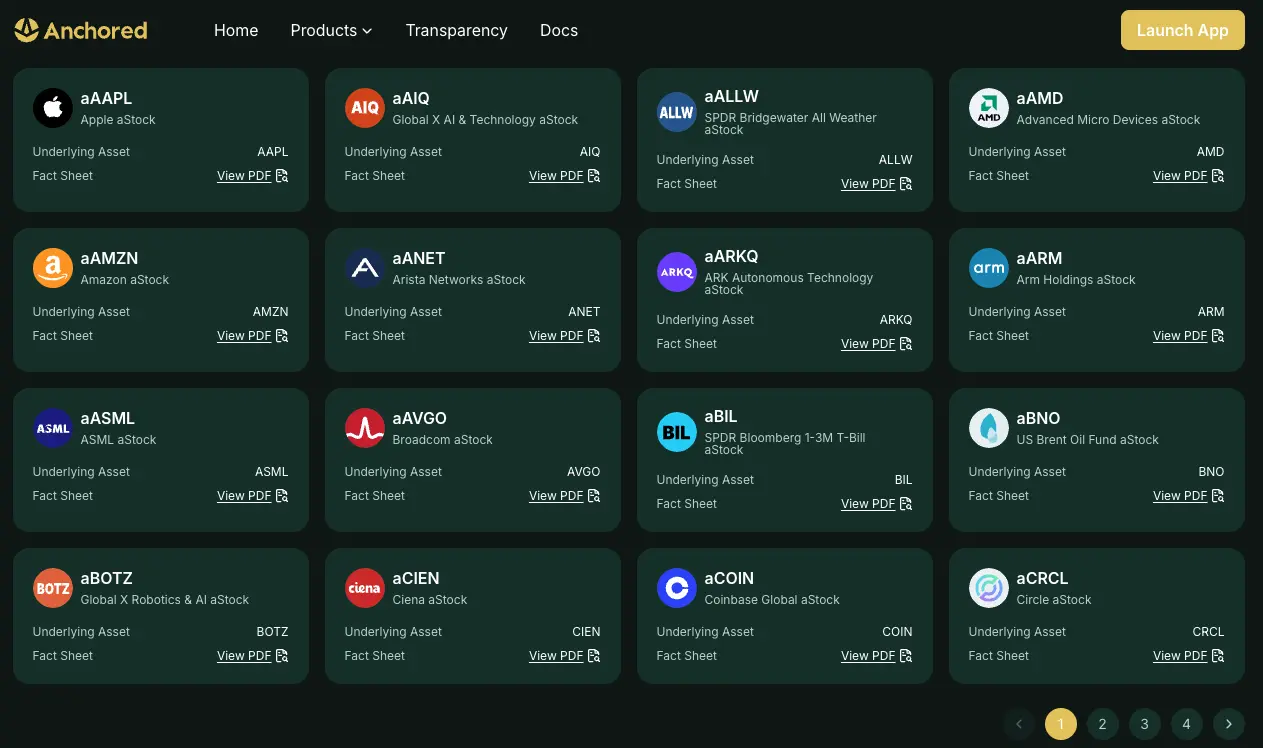
The boundaries of what a holder is entitled to are clear. The token provides economic exposure to the underlying stock price, pays out any dividends in USDC in proportion to holdings, and grants the right to redeem for USDC at any time. It does not, however, confer voting rights, shareholder rights, or legal ownership of the underlying shares. Being explicit about what is and is not guaranteed is itself part of the trust that infrastructure within a regulated system must provide.
The strength of a token issued this way is that it is an onchain asset. Because it is a standard ERC-20, it moves freely between ordinary wallets and can be swapped on a DEX, posted as collateral in a lending protocol, or put to work in a liquidity pool. These are uses made possible by being onchain and difficult with shares locked inside a brokerage account.
Anchored's issuance is open to the outside through an API, so any exchange, wallet, or protocol can connect and use it. Rather than building the issuance, custody, and verification infrastructure for tokenization in-house, a builder can simply connect to Anchored. The more the same token trades across multiple venues, the deeper its liquidity becomes, and the tokens trading on SynFutures share in that liquidity.
3-2. The Distribution of Tokenized Stocks Through SynFutures
For a token Anchored issues to lead to actual trading, there has to be a market users can reach. SynFutures connects that token and its users through trading. The primary market for direct issuance and redemption remains subject to onboarding, KYC/KYB, and anti-money-laundering (AML) checks and applicable eligibility restrictions. Secondary trading on SynFutures, by contrast, is designed to be wallet-based, subject to applicable jurisdictional restrictions, product controls, and SynFutures' compliance framework. From the user perspective, the goal is to remove the need for a separate traditional brokerage account at the trading-interface level, while preserving the controls required for tokenized real-world assets. Because issuance is limited to institutions, however, the liquidity for eligible users to trade against must be supplied through another channel.
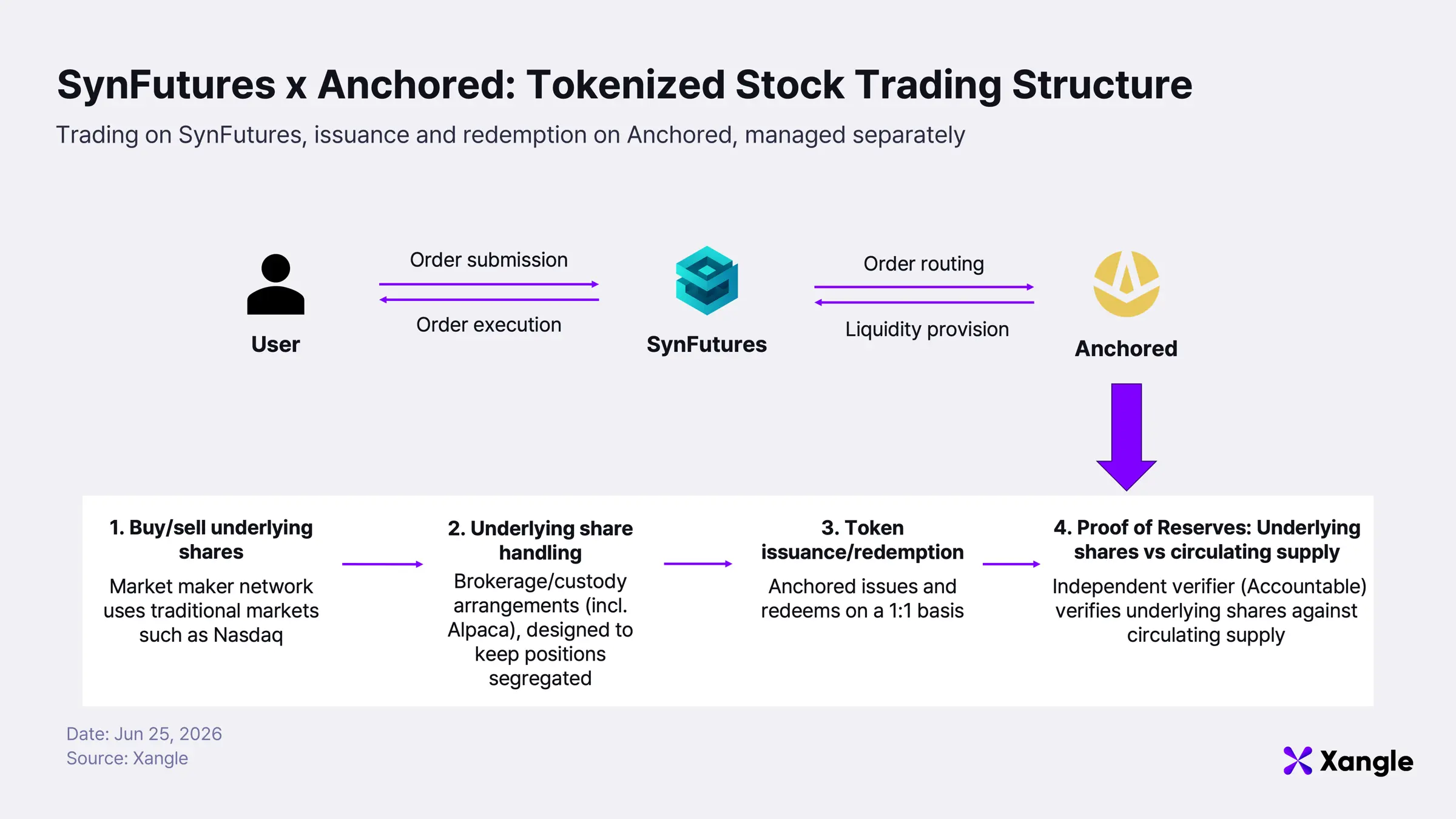
That liquidity is supplied by Anchored's market maker network. Drawing on inventory secured in traditional markets such as Nasdaq, the market makers post bid and ask quotes on SynFutures, and when a user places an order, a token backed by the underlying fills at those quotes. Anchored is responsible for issuing and redeeming the tokens and holding the underlying, while SynFutures handles trading and execution. Thanks to this division of labor, SynFutures offers quotes at the level of traditional markets from day one, without building its own liquidity separately. The liquidity gap a newly opened market so often faces is solved here with the issuer's network and the liquidity of traditional markets.
Tokenized stocks trade 24 hours a day on weekdays (24/5). On weekends and U.S. market holidays, though, the underlying market is closed, so trading stops as well, and any order submitted in the meantime fills only when the next trading session opens. This means that if the price moves while the market is closed, responding right away is hard. SynFutures is working with Anchored and the market maker network to extend this to a 24/7 schedule.
The power of dividing issuance and distribution this way lies in how it scales. When Anchored issues a new asset, SynFutures adds it to what can be traded. Anchored gains a venue where trading will happen and so a reason to widen issuance, while SynFutures takes on assets it did not issue itself as things to trade. A flywheel forms in which issuance calls forth trading and trading in turn calls forth issuance. It works because the three parties fill in one another's weak links. Anchored takes on the issuance and custody an exchange would struggle to build, SynFutures takes on the exchange and engine an issuer would find burdensome to stand up, and the market maker network supplies the liquidity that joins the two markets. As each focuses on its own area of expertise, eligible users gain wallet-based access to tokenized U.S. stock exposure through markets supported by underlying-asset infrastructure and professional liquidity providers.
4. An Expansion Strategy for the Unified Trading Layer
The direction SynFutures is working toward is a Unified Trading Layer, where a wide range of assets, crypto and tokenized stocks among them, trade from a single exchange and a single wallet. More than 50 tokenized stocks, centered on Nasdaq-listed names, currently trade on SynFutures. For the issuance-and-trading flywheel described above to grow larger, two things have to expand together: the range of assets that can be traded, and the infrastructure to support that trading. SynFutures' roadmap advances along both of these directions.
Consider first the expansion of tradable assets. The range SynFutures can offer depends on what Anchored, the party responsible for issuance, chooses to tokenize. After U.S. stocks, Anchored is widening its tokenization targets to Hong Kong (HKEX) stocks such as Tencent and Alibaba, and then to Korean and Taiwanese stocks, and it is extending its issued assets to ETFs, government bonds, and even tokenized funds that until now were accessible only through private banking. The more Anchored broadens issuance, the more assets become tradable on SynFutures, expanding toward a structure where stocks from many countries and a wide range of assets trade from a single wallet.
As assets multiply, the trading infrastructure has to grow with them. At the center of this are Entropy, SynFutures' next core upgrade, and its own mainnet. The onchain order book cost problem described earlier grows as an order passes through more price levels, and beyond a certain point the trade simply fails. Rather than storing the order book's state on the blockchain, Entropy computes it mathematically whenever needed, keeping the cost predictable and within a narrow range whether a small order crosses 10 price levels or a large one crosses 10,000. Trade size and execution cost are decoupled. The design has gone through formal verification and more than a million simulations, and is set to ship alongside the SynFutures mainnet and the next version, v4.
Once Entropy is in place, a fully onchain order book works regardless of scale, delivering execution quality close to that of a centralized exchange while preserving onchain transparency and self-custody. In particular, the way professional market makers post quotes at precise prices, refresh them in real time, and earn the spread becomes possible onchain as well. The more market makers there are, the tighter the spread and the deeper the quotes, which improves execution for every trader.
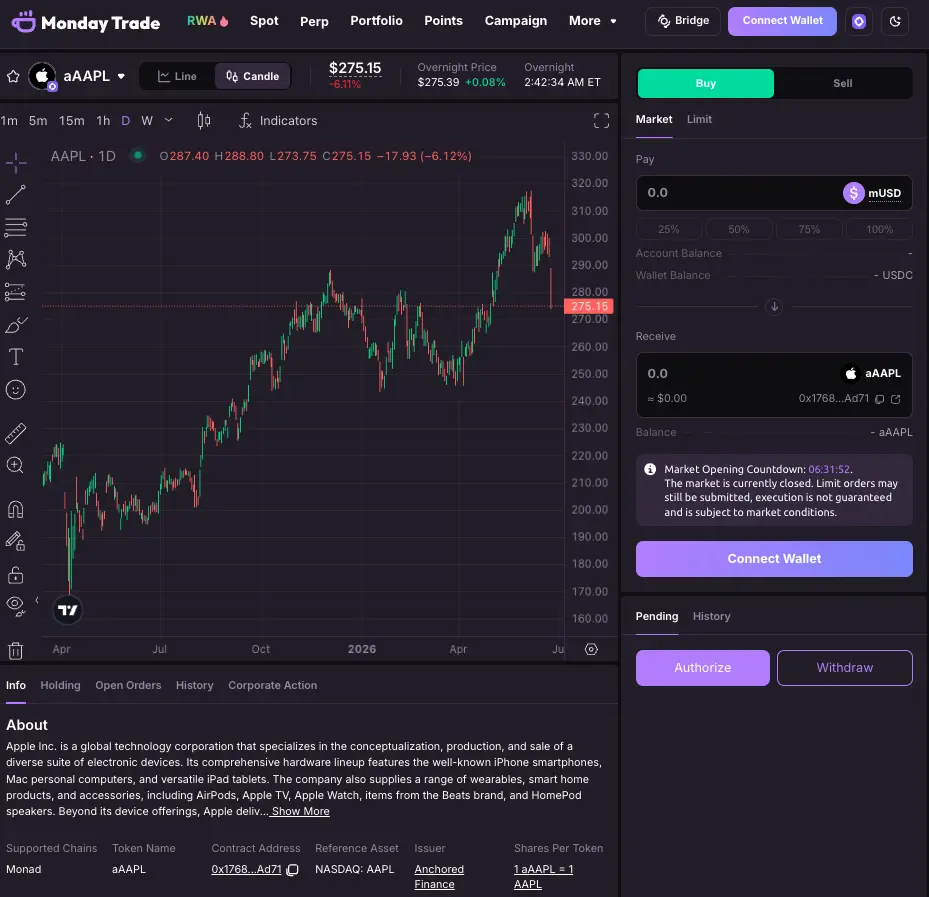
SynFutures opens this trading infrastructure to outside teams as well. Through the Builder Program, it lets other teams make use of it without building a chain of their own. The first such case, Monday Trade, is the first decentralized perpetual futures exchange built on Monad using SynFutures' Oyster AMM and onchain order matching engine. Inheriting a proven set of smart contracts and trading stack, it operated reliably from launch, and it plans to apply Entropy to its limit order functionality going forward. As more assets, a stronger engine, and the many participants running trading on top of it come together, the Unified Trading Layer, which began as an exchange for trading a broad range of assets in one place, widens into a common trading foundation that encompasses other services too.
5. Conclusion: A Unified Trading Layer That Brings Everything Together, From Crypto to RWA
The discussion so far comes down to two points. The first is that the value of a tokenized stock emerges only when issuance and distribution are properly connected. The second is that SynFutures resolves that connection by meshing a proven trading engine with Anchored's issuance.
At the center of this is the division of labor between Anchored, responsible for issuance, and SynFutures, responsible for distribution. As Anchored widens its issued assets through infrastructure open to many distribution venues and SynFutures makes a wide range of assets tradable, the flywheel described above keeps enlarging the breadth of assets. From a user's point of view, the change is unmistakable. Until now, access to stocks around the world was split by the country and the broker where you held an account. Now, without opening a separate brokerage account in each country or having to align with market hours, a single wallet lets you trade U.S. stocks backed by the underlying, and before long Hong Kong, Korean, and Taiwanese stocks as well, all in the same place as your crypto.
This expansion runs in more than one direction. Even as issued assets broaden from stocks into bonds and funds, the proven trading infrastructure itself is used as the foundation for other exchanges. A structure that separates issuing and verifying the underlying within a regulatory framework from trading onchain works the same way no matter which new asset is added or which new service is built on top of it.
There are, of course, tasks still ahead. The range over which tokenized stocks can be traded varies with each country's regulations, and the quote depth of the secondary market depends on how large the market maker network grows. Both are things to be worked out as the model scales. Even so, the line that once separated crypto from real-world assets has already begun to blur, and tokenization is still at an early stage. The more assets cross over onchain, the larger this market will grow, and SynFutures is laying the groundwork for that trading in advance, on both the trust side and the supply side. A Unified Trading Layer where every asset, from crypto to RWA, meets onchain: that is the direction in which SynFutures is moving.
Disclaimer
I confirm that I have read and understood the following: The information contained in this article is strictly the opinions of the author(s). This article was authored free from any form of coercion or undue influence. The content represents the author's own views and does not represent the official position or opinions of CrossAngle. This article is intended for informational purposes only and should not be construed as investment advice or solicitation. Unless otherwise specified, all users are solely responsible and liable for their own decisions about investments, investment strategies, or the use of products or services. Investment decisions should be made based on the user’s personal investment objectives, circumstances, and financial situation. Please consult a professional financial advisor for more information and guidance. Past returns or projections do not guarantee future results. This article was written at the request of SynFutures. All content in this article was written independently by the author(s), and neither CrossAngle nor SynFutures had any editorial control or influence over the content. The author(s) may hold the cryptocurrencies mentioned in this article at the time of writing.
Xangle or its affiliated partners own all copyrights of the written or otherwise produced materials and content provided on the platform. Any illegal reproduction of such content, including, but not limited to, unauthorized editing, copying, reprinting, or redistribution will result in immediate legal actions without prior notice.
![[CIS Partner Summit Highlights] Ault's Financial Super App Strategy: OnlyBulls](https://resource.xangle.io/files/content/C1A19E1DB41B7FB86076143803C40D8E_1790125531662.webp)
![[Xangle RWA Series] Solana RWA: A Look at the Key Players](https://resource.xangle.io/files/content/F779A005246C0299246537AACB3A39F2_1782287059970.webp)