Kite AI: Building the Payment Layer for the Agent Economy


1. The Rise of AI Agents and Agent-Native Payments
2. Kite AI’s Three-Layer Architecture for Agent Payments
3. AI Agent Use Cases Enabled by Kite
4. Korea: A High-Potential Market for Agent Payments
5. Kite AI as the Execution and Settlement Hub for the Agent Era
1. The Rise of AI Agents and Agent-Native Payments
Over the past few years, AI has been shifting from question-answering interfaces into agents that execute work on behalf of users. The first area where this shift is materializing as a market is commerce. Shopping is made up of repetitive decisions and actions, from product discovery and price comparison to payment, delivery tracking, and refunds, which makes it a user behavior that agents are well positioned to take over. Morgan Stanley Research has projected that AI shopping agents could account for 10% to 20% of online retail by 2030.
Yet for agentic commerce to become a real market, AI that simply recommends good products is not enough. The core of agentic commerce is not automated recommendation, but delegated transaction execution. For an agent to select a product and complete a purchase on behalf of a user, the entire transaction flow, from access to payment methods and purchase authorization to merchant trust, receipts, refunds, and dispute resolution, must work without human intervention. Visa’s survey, in which consumers cited data control, incorrect purchases, and loss of decision-making control as key concerns when using AI shopping agents, reflects the same underlying issue.
1-1. Why Human-Centric Payment Rails Break for Agents
The bottleneck does not stop at the checkout stage of online shopping. The same issue appears whenever an agent tries to call a paid API, purchase data, use SaaS features, or settle with another agent or service. Today’s internet payment and authentication flows are fundamentally built around screen-based human interactions. A person logs in, clicks a button, enters card information, passes secondary authentication or a CAPTCHA, and approves the transaction. Once the actor executing the task changes from a human to an agent, however, the flow breaks down. An agent cannot easily hold its own payment method; handing over a user’s card or private key as-is is dangerous; and requiring human approval for every transaction defeats the purpose of autonomous execution. In other words, the problem of agentic commerce is not a UX issue within a specific shopping service. It is a structural mismatch between human-centric payment infrastructure and agent-native transaction patterns.
Agents follow a fundamentally different payment pattern from humans. People pay occasionally, usually in relatively large amounts. They pay for monthly subscriptions, buy goods worth tens to hundreds of dollars, and use cards once or twice a day. Agents, by contrast, generate a constant stream of small, frequent payments. They call APIs, retrieve data, rent GPU capacity, and run short computations, producing a continuous flow of micropayments.
The fee structure of existing payment networks collides directly with this pattern. Credit card payments typically carry a fixed cost of about $0.30 per transaction, plus a fee of roughly 3%. Processing a one-cent transaction therefore costs more than 30 cents. Since the fee exceeds the value being transferred, an agent that calls an API thousands of times can lose the economics of the transaction to fees alone. Pre-funding larger balances to avoid per-transaction fees ties up capital and complicates settlement. Batching many transactions together introduces delays in time-sensitive decision-making. Both approaches move away from the “pay for what you use, when you use it” payment model that agents need. Once transactions cross borders, the problem compounds. International transfers involve costs and delays of several days regardless of the amount, and for agents that must work with suppliers across multiple continents at the same time, this combination of cost and latency can stop the task itself.
Another layer is added on top: existing money is not programmable. Card payments are simple transfers that move value from A to B. They cannot encode rules into the money itself, such as “only when this condition is met, only within this limit, and only to this counterparty.” Agents, however, are closer in nature to programmers. They know how to call APIs and use tools. They are intelligent actors, but they can also malfunction at any time. Actors like this need programmable money, where rules can be enforced in code. Blockchain, and the stablecoins built on top of it, are the best fit for that need.
1-2. Beyond Payments: Identity, Delegation, Accountability, and Fragmented Standards
The real challenge in agent payments is not just “sending money.” The deeper gap lies in identity, delegation, and accountability. Enterprises and users today face the same dilemma. Entrusting an agent with a card or private key is too risky. A wrong instruction from the user, a compromised tool used by the agent, or even a single prompt injection attack can immediately lead to a costly incident. At the same time, having a human approve every transaction is too slow. If an agent needs human approval every time it calls an API, it can no longer be called autonomous.
Existing authentication and authorization systems were not designed for agents either. If one agent uses 50 services, it needs 50 credentials. If 20 such agents are operated, the number of credentials to manage grows to 1,000. As agents and services scale, the number multiplies and quickly becomes unmanageable. Moreover, no service can cryptographically verify whether Alice’s trading agent really belongs to Alice or to someone impersonating her. Just as a person needs a credit score to take out a loan, an agent must be able to cryptographically prove its owner, constraints, and accountability. Without that proof, merchants ultimately have no choice but to block agent payments. Hence the need for KYA, or Know Your Agent, just as KYC, or Know Your Customer, is used to verify people.
Alongside the identity problem, the emergence of stablecoins on the payment side has accelerated the race to define agent payment standards. Coinbase has introduced x402, an HTTP-based payment standard; Stripe, together with Tempo, has introduced MPP, a machine payment standard; OKX has introduced APP, an agent payment protocol; and Google’s AP2 and OpenAI and Stripe’s ACP have also entered the field. In effect, different camps are offering different answers to the same problem.
The problem is that those standards are proliferating rather than converging. The market agrees on the importance of the problem, but it has not yet agreed on what the solution should look like. For the agent economy to function, a faster payment network alone is not enough. What is needed is a payment system designed from the ground up for agents, one that ties identity, delegation, and accountability together with payments while also supporting the fragmented standards emerging across the market.
2. Kite AI’s Three-Layer Architecture for Agent Payments
Three structural challenges have limited the development of agent payments: the constraints of existing payment networks, the lack of mechanisms for identity, delegation, and accountability, and the fragmentation of payment standards. Kite AI addresses these issues through a three-layer architecture consisting of the Kite Mainnet, which handles high-frequency stablecoin payments; Agent Passport, which manages identity and permissions; and an interoperability hub that connects emerging agent payment standards such as x402 and AP2. Together, these components are designed to serve as the payment infrastructure for the agent economy.
2-1. Kite Mainnet: A Payment-Optimized L1 for Agent Transactions
Kite AI chose to build a dedicated blockchain because agent transactions have fundamentally different characteristics from human transactions. Most blockchains are designed around the volume, frequency, and value of payments initiated by people. Agents, in contrast, generate a continuous stream of low-value transactions at much higher frequencies. When agent payments compete for the same blockspace as general-purpose activity, network congestion can drive up fees and reduce processing efficiency. To avoid this problem, Kite AI developed an EVM-compatible chain focused on payments and allocated dedicated payment lanes for agent traffic, isolating it from other network activity.
Payments on the Kite Mainnet are settled directly in stablecoins. Traditional card networks are poorly suited to microtransactions because they typically charge a fixed fee of around $0.30 per transaction in addition to a percentage-based fee of roughly 3%. By comparison, transactions on the Kite Mainnet can be processed with predictable fees below one cent. Stablecoin-denominated payments also eliminate the need for token conversions before settlement. Once a transaction is submitted, it is finalized immediately, allowing agents to continue executing tasks without waiting for payment confirmation.
A key feature of the Kite Mainnet is its use of state channels, which make high-frequency micropayments economically viable. Recording every payment onchain would quickly become inefficient, particularly when an agent repeatedly pays the same service. In many cases, transaction fees could exceed the value of the payments themselves. State channels reduce this overhead by limiting onchain activity to two events: opening a channel, which locks funds, and closing it, which settles the final balance. All intermediate payments are handled offchain through the exchange of signed balance updates. Because the cost of opening and closing a channel—approximately one cent in total—is distributed across potentially thousands of transactions, the effective cost per payment becomes negligible. Payment latency is also reduced to less than 100 milliseconds.
Security is maintained through a system of mutually signed balance updates. Whenever a payment occurs, both parties sign a new state reflecting the updated cumulative balance. Each newly signed state supersedes the previous one, ensuring that only the latest version remains valid. Since these updates are exchanged directly between participants rather than processed through network-wide consensus, payments can be completed instantly without waiting for block production. Onchain settlement occurs only when the channel is closed, at which point the final balance is recorded. Thousands of intermediate payments can therefore take place without generating individual onchain transactions. Any attempt to settle using an outdated balance state can be challenged by presenting a newer version signed by both parties, preventing fraudulent settlement attempts.
Stablecoin settlement represents only one part of the payment flow. Many merchants still operate exclusively within traditional fiat payment systems, making broader interoperability essential. Kite AI therefore supports two merchant categories: those that accept stablecoins directly and those that accept only fiat currency. Stablecoin-compatible merchants can receive payments directly onchain through standards such as x402. For merchants that operate solely in fiat, Kite AI is developing a virtual card model that converts stablecoin payments into fiat before settlement. As a result, merchants can accept agent-driven payments without modifying their existing payment infrastructure, while users who do not hold stablecoins can participate by funding their accounts through conventional payment methods such as credit cards.
2-2. Agent Passport: Unifying Identity, Delegation, Payments, and Visibility
Agent Passport is the mechanism that defines and enforces who is allowed to act on behalf of whom, up to what amount, and for which actions. It brings together four elements, identity, delegation, payments, and visibility, serving as a payment capability for agents and a control mechanism for users at the same time. In effect, Agent Passport packages how agents spend money and how users govern that spending into a single passport.
Agent Passport structures identity across three levels: User, Agent, and Session. The user is the root of all permissions, and the user’s private key is stored in a secure enclave, making it inaccessible not only to the agent but also to the Kite AI platform itself. The agent receives its own deterministic address derived from the user’s wallet. Anyone can verify that the agent belongs to a specific user, but the agent cannot access the user’s key. A session is a one-time key created each time a task is executed, and it becomes invalid once it expires after use. The three-level structure creates defense in depth. If a session is compromised, only one transaction is affected. Even if the entire agent is compromised, losses are limited to the thresholds set by the user. The only point where unlimited loss would be possible is the user key inside the secure enclave, which is effectively inaccessible.
Permissions at each level are enforced through three cryptographic proofs. A Standing Intent, signed by the user, defines what the agent can do, up to what amount, and until when. The agent uses a Delegation Token to delegate authority to a session for a specific task, and the session executes the transaction with a Session Signature. Every transaction is verified back to a valid Standing Intent, and any transaction that exceeds the limit is blocked by code at the time of execution. From the user’s perspective, the process is completed with a single setup. Once the user sets limits and conditions, such as “the grocery shopping agent can spend up to $2,000 per month, no more than $100 per transaction, and only at designated stores,” and signs once with a passkey, the agent can operate autonomously within that scope.
Agent Passport follows OAuth 2.1, an existing authentication standard. As a result, services can accept the passport as a means of identity verification without rebuilding their login systems, while the passport can be added as a “skill” to LLM and agent frameworks such as Claude Code and Codex with a single line of code. Reputation is added on top of this structure. The score rises when payments succeed and falls when payments fail or limits are violated, and the score is calculated automatically from the agent’s actual transaction history. Agents with low reputation may face restricted service access or stricter conditions, while agents with high reputation gain broader permissions and greater trust. Reputation is not accumulated separately for each service, but shared across the entire system. An agent that has built trust in one place can therefore carry that reputation into services it uses for the first time. A system that ties verifiable identity, delegation, and reputation together with payments forms the basis of KYA, or Know Your Agent.
Together, these components create a unified payment flow. Once a user defines the scope and signs once, the agent can work within that scope without repeated approvals. When payment is required, Agent Passport executes the payment on the user’s behalf and settles it on the Kite Mainnet. During the process, the user’s bank account, card number, and private key are not exposed to the agent or to the service receiving the payment. Every action, from session approval and payment to onramping and transfer, is recorded in a single activity log and can be reviewed in one place.
2-3. Unified Hub: Where Agent Payment Standards Converge
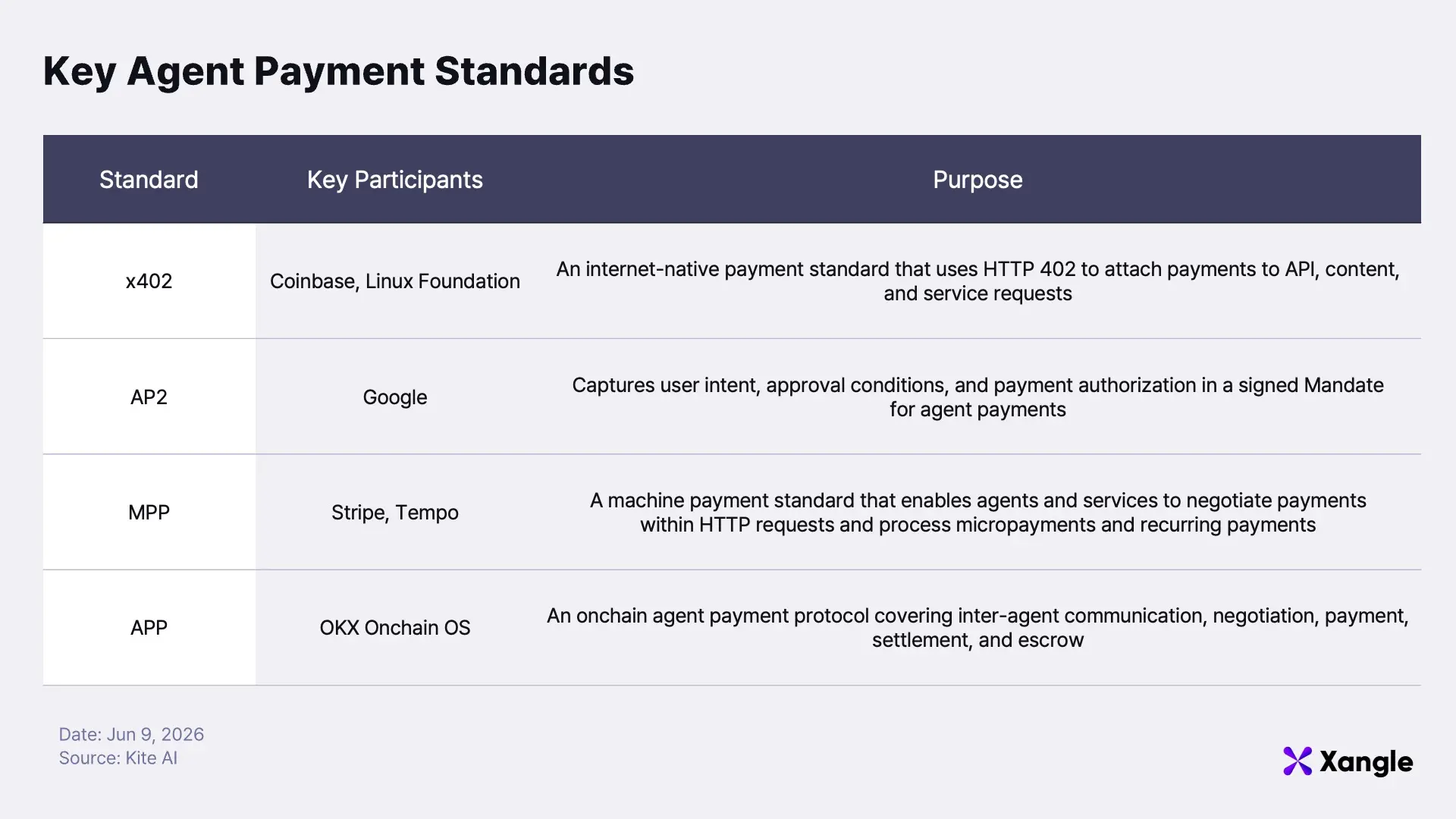
The agent payment market is fragmented across competing standards. Coinbase’s x402, Google’s AP2, Stripe and Tempo’s MPP, and OKX’s APP each define agent payments in different ways. As more standards emerge, developers and services are forced to choose among them, while payments initiated through one standard cannot easily interoperate with another. Kite AI does not add another standard to this landscape. Instead, it aims to serve as a universal execution layer where these standards can run on shared infrastructure. Messari’s description of Kite AI as an integrated hub connecting different payment standards follows the same logic.
Kite AI can take this position because standards and execution infrastructure operate at different layers. Standards such as x402 and AP2 are specifications that express “who pays, how much, and under what conditions” in a defined format. They describe payment intent and authorization, but they do not move funds by themselves. Google’s comparison of AP2 to ERC-20 and Kite AI, which executes that intent onchain, to Ethereum reflects the same idea. Just as a token standard alone does not create transactions and needs a chain to power it, payment instructions expressed through standards also need a separate foundation that can turn them into actual settlement.
Kite AI provides that foundation through the Passport and Mainnet described earlier. Regardless of which standard a payment request comes through, Agent Passport verifies the user’s identity and delegated authority, while the Kite Mainnet settles the payment in stablecoins. If standards are the “language” of payments, Kite AI is the infrastructure that verifies identity and delegation, then translates that language into actual movement of funds. A payment request exchanged through x402 when an agent calls a paid API can be settled on the Mainnet, while a payment instruction expressed through Google AP2 can be executed on the same foundation.
The level of integration differs by standard. At present, x402, AP2, and APP, developed together with OKX, operate in connection with the Mainnet and Agent Passport, while Stripe and Tempo’s MPP is being added as an integration target. The scope also extends beyond payment standards. Kite AI is compatible with agent-to-agent communication (A2A), model connectivity (MCP), and existing login methods such as OAuth 2.1. A2A allows agents to collaborate with agents from other ecosystems, while services that support OAuth 2.1 can connect with Kite AI’s agents without rebuilding their authentication systems.
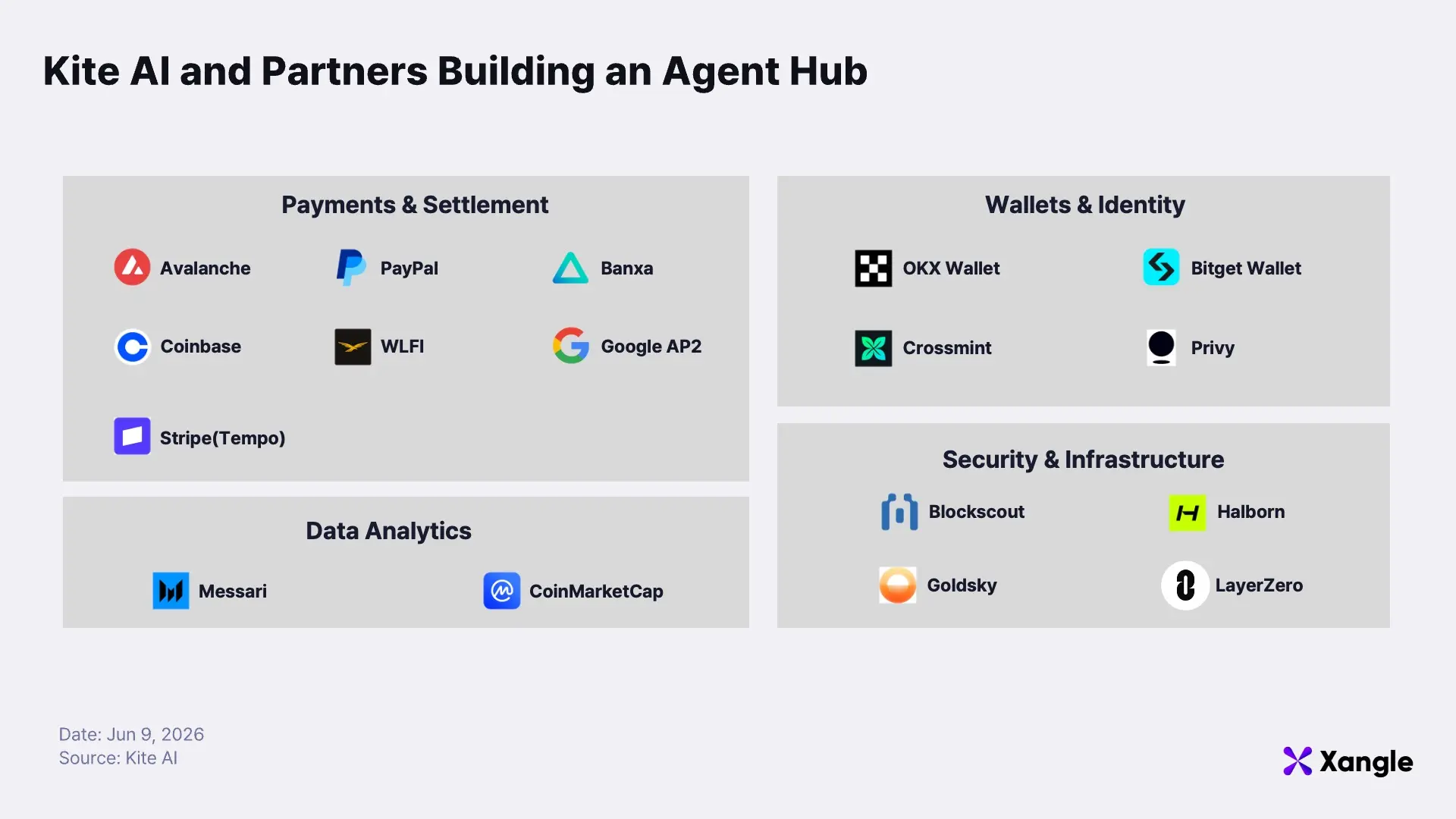
Kite AI’s hub position is also visible in its partner network. Around Kite AI are partners across payment and settlement, wallet and identity, data analytics, and security and infrastructure. This shows that Kite is not simply providing a single payment standard or a single chain. Rather, it is building an execution environment that brings together settlement, identity verification, wallet connectivity, data access, and security validation, all of which are required for agent payments to work in real-world services.
For agents, the value of this structure is straightforward. The standard or chain used by the counterparty does not matter. What matters is whether the user’s instruction can be processed, and where the resulting transaction is actually executed and settled. A payment network that supports only one standard cannot process transactions arriving through another standard. Kite AI, by accepting multiple standards and settling them in one place, is not bound by that constraint. This is the position Kite AI is trying to occupy.
3. AI Agent Use Cases Enabled by Kite
3-1. Agentic Commerce
Online shopping has long remained a human task. Users have had to search for products, compare prices and specifications, add items to a cart, enter card numbers and shipping addresses, and complete identity verification before a payment could be finalized. Even when an agent handled the earlier steps, the user still had to be brought back in at the final payment stage. Passing card information directly to an agent was too risky, and merchants could not determine whether the counterparty was a human or a bot.
Kite AI’s welcome kit demo shows how that final missing piece can be filled. The user only needs to express an intent, such as “Prepare a welcome kit for Alex, the engineer joining next week, within a budget of $50,” and then confirm the result. First, the user approves the limits the agent can operate within, such as the budget and deadline. The user then reviews the welcome kit proposed by the agent one more time.
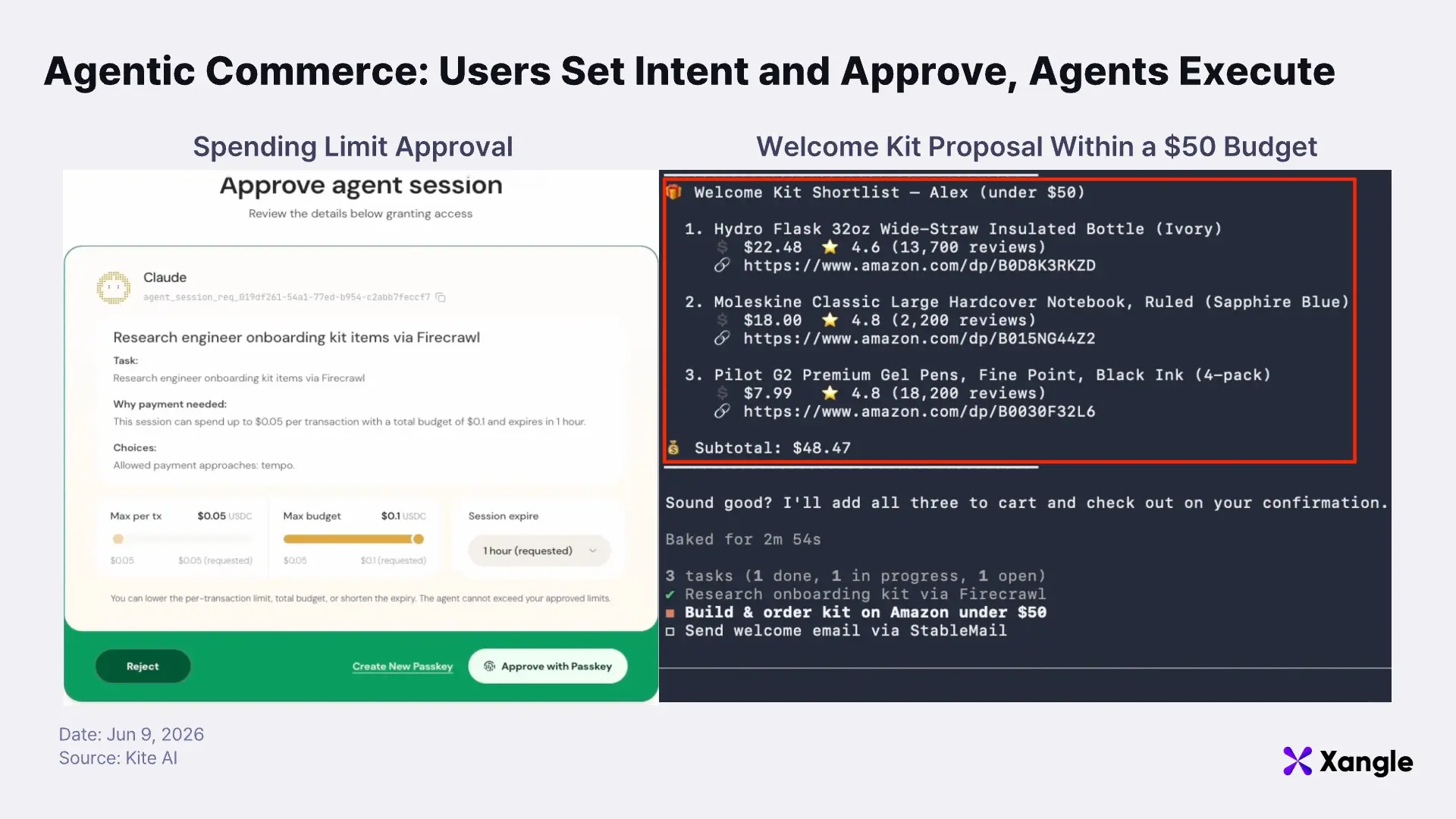
Once the user confirms the proposed kit, the agent uses the shopping tool in Kite AI Passport to add three items to the cart and complete the payment. The final order, including shipping, is processed within the approved limit, and the delivery date is scheduled. The user does not choose the products directly or enter a card number. Instead of card information, pre-signed delegated authority authenticates the payment, while any spending outside the approved limit is blocked at execution. The result is delegated execution with user-controlled guardrails. The order takes place at a merchant that does not accept stablecoins, such as Amazon. For merchants like this, payment is routed through a virtual card model that converts the agent’s stablecoin spend into a fiat card payment, allowing users to start the flow with a credit card alone, even without holding stablecoins.
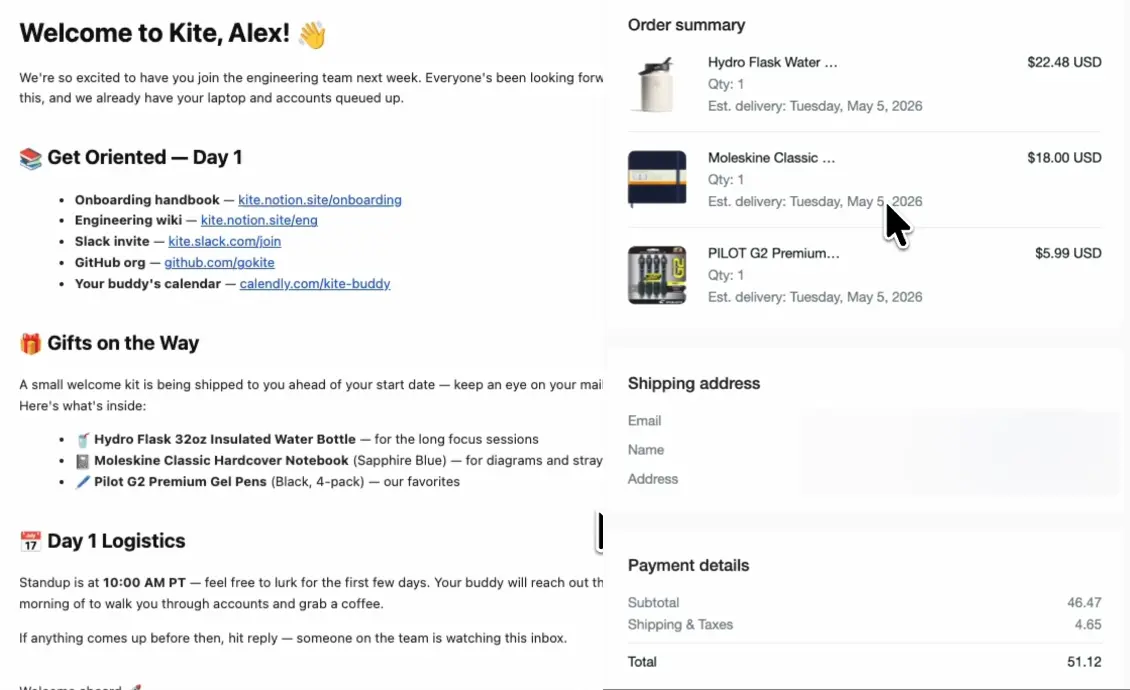
After the order is complete, the agent even sends Alex a welcome email containing the kit contents, delivery information, and first-day guidance. A purchase that previously required a person to move across different screens at each step is completed with one line of intent and two confirmations. The value of agentic commerce lies here. Humans retain the judgment over what to buy and how much to spend, while agents take over the work of turning that judgment into execution.
3-2. Research Agent: From Pay-Per-Call to Follow-Up Requests
For an agent to work on behalf of a user, it must also be able to pay for the resources required to complete the task. Most of the resources needed for agent work, including paid APIs, data, and content, are paid resources. In Kite AI, when an agent calls a paid endpoint, the server returns an HTTP 402 response, and the agent pays on the spot on a pay-per-call basis according to the x402 standard. For tasks where usage accumulates continuously, such as data feeds or remote browser sessions, streaming payments can also be processed over the same channel, with payments broken into small increments based on usage rather than charged per request. In either case, the agent does not need human approval every time, and costs are incurred only for actual usage instead of through a monthly subscription unrelated to usage.
Kite AI’s apartment search demo illustrates the process in practice. With a single instruction, “Find me a two-bedroom apartment in San Francisco for under $4,000 per month,” the agent breaks the task into three steps. First, it uses the web scraping tool Firecrawl to narrow the search to commute-friendly neighborhoods such as SoMa and Civic Center. It then uses the same tool to find three listings on Zillow that match the user’s criteria.
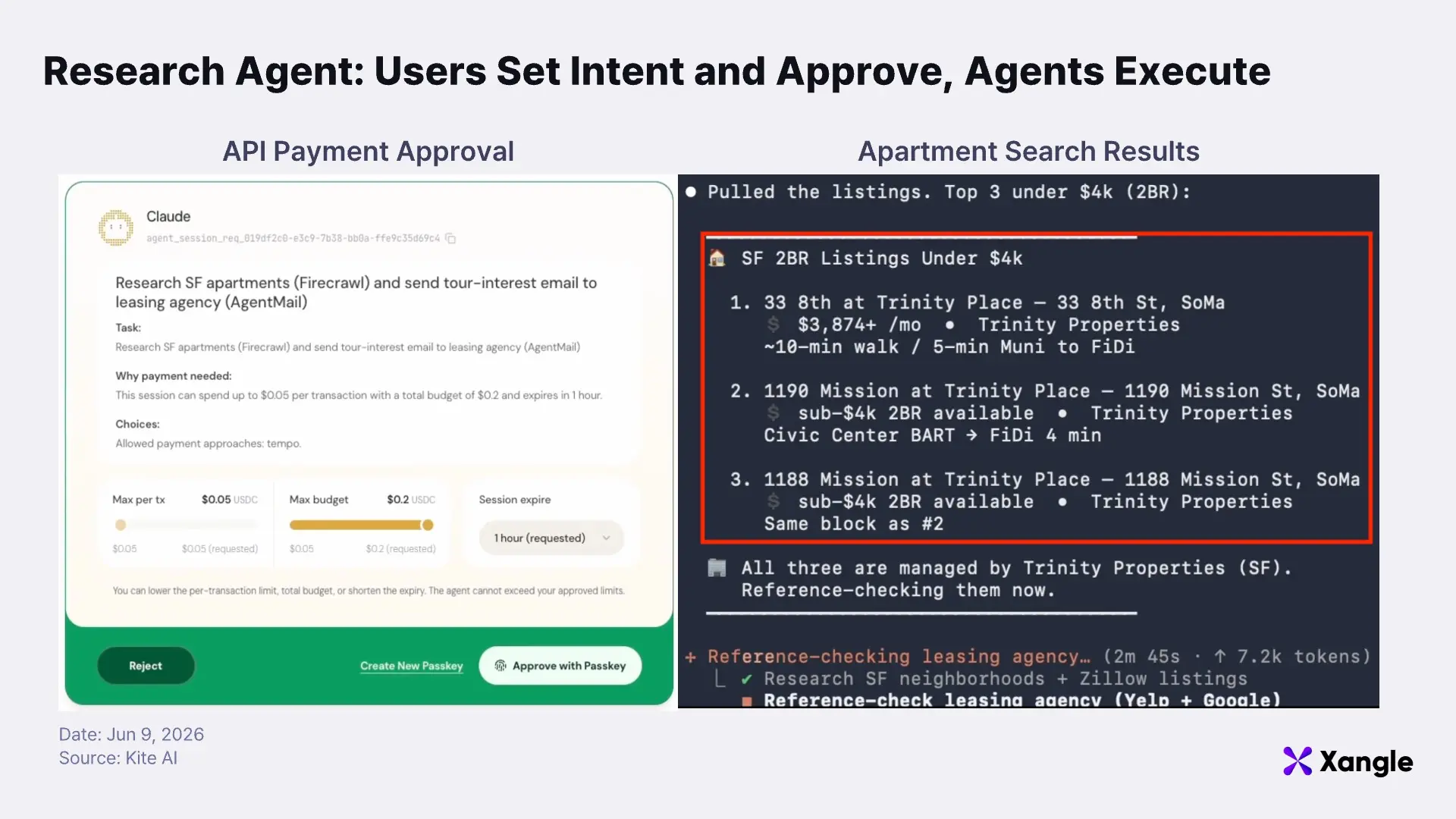
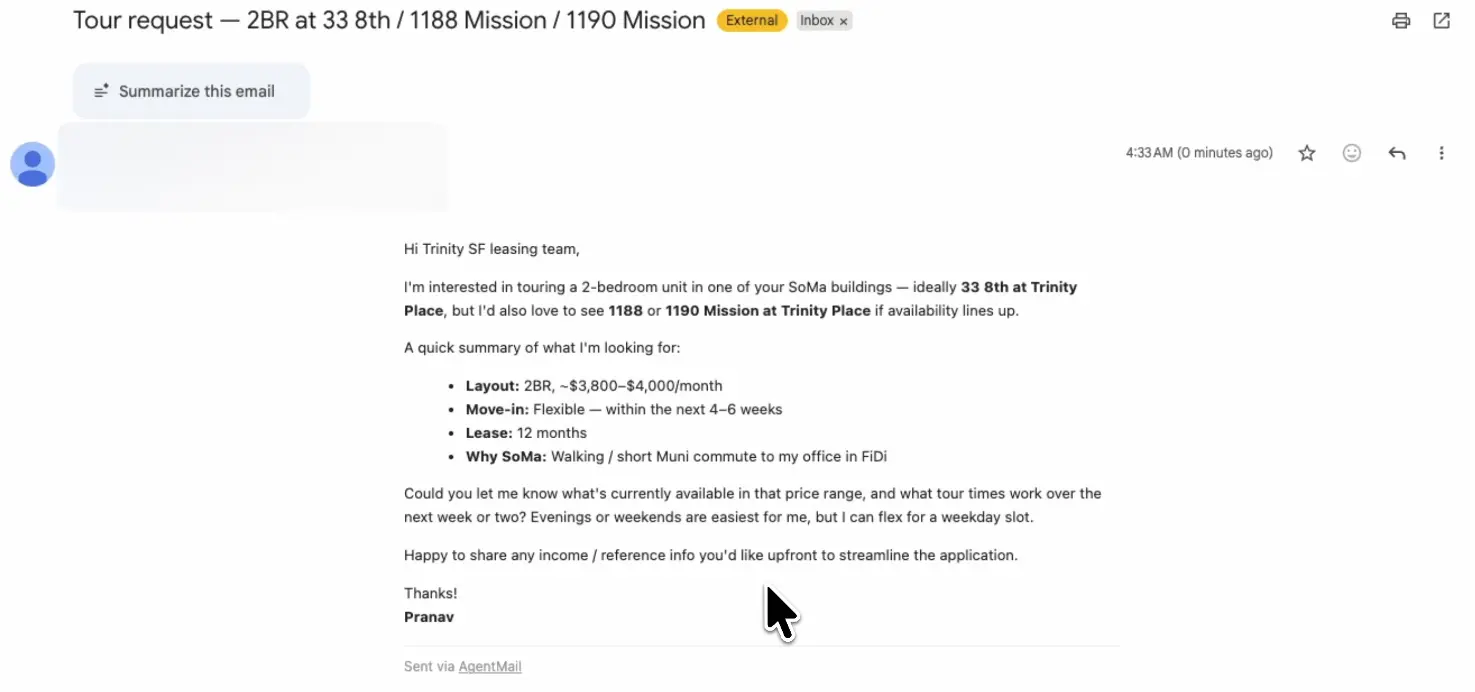
Once the listings are identified, the agent verifies the credibility of the brokers managing the properties using Yelp reviews and Google Search. It then uses the email tool AgentMail to send viewing requests to each broker. Search, scraping, reputation checks, and outreach are combined into a single workflow, eliminating the need for the user to register for multiple services or approve payments at every step.
Completing the task required six paid API calls, costing approximately 0.036 USDC in total. The payment was not for a product but for the tools needed to carry out the work. Traditional card payment systems were never designed for this type of expense. Paying for the same six calls by card, assuming a fixed transaction fee of $0.30 per payment, would result in $1.80 in fees alone—dozens of times higher than the actual cost of the services used.
All six API calls were executed within a session that the user approved in advance. For this demo, spending limits were configured at $0.05 per call, $0.20 in total, with a validity period of one hour. The agent completed the entire workflow while remaining within those predefined limits.
3-3. Agentic Trading and Investment
Finance is one of the fields where agent payments have the highest potential. Kite AI is developing this vertical together with financial institutions, exchanges, and tokenized stock platforms. Possible use cases include AI agents trading stocks without human intervention, moving funds between tokenized stocks and DeFi, and submitting perpetual futures orders according to conditions set by users.
The operating process is the same as the commerce and research examples explained earlier. If a user tells the agent, “I want to invest $100 in AI companies, so research three companies and recommend them,” the agent researches the stocks, presents candidate companies, and directly purchases the stock chosen by the user within the limits permitted by Agent Passport. The user only provides the intention of “what to invest in and how much.” The agent takes care of the execution layer, including company analysis to narrow down candidates and strategies such as dollar-cost averaging (DCA) that divide purchases over time. Trading authority remains tied to the limits established by the user, so, just like shopping, trades that go beyond the approved scope are not carried out. Onchain, the process becomes even more straightforward. On perpetual futures exchanges or decentralized exchanges, once the user delegates funds through Agent Passport, the agent can execute trades without the user needing to create and provide API keys as is required in a brokerage environment.
Finance is likely to be one of the first sectors where this model becomes established because the barriers to adoption are comparatively low. Commerce requires each merchant to support stablecoins and agent authentication, and it also relies on integrations with channel partners such as PayPal and Shopify. Trading, on the other hand, does not require onboarding merchants on the opposite side. Through a single signature that delegates funds via Agent Passport, the user can safely grant trading authority, making it possible for a chatbot-style agent to begin basic asset management tasks such as purchasing Bitcoin without complicated integrations. If commerce delegates the work of purchasing to agents, and research delegates the cost of carrying out tasks, trading goes one step further by entrusting agents with the analysis and strategy behind what to buy and sell. Agents move beyond simply purchasing products and become entities that directly allocate capital and manage assets.
4. Korea: A High-Potential Market for Agent Payments
So far, we have examined the problems Kite AI is designed to solve. The next question is where this infrastructure is most likely to translate into real demand first. Korea stands out as the leading candidate. For agent payments to translate into actual transactions, three conditions must come together: users willing to adopt agents, a commerce environment where those transactions can take place, and an institutional framework to support them. Korea is one of the few markets where demand-side conditions and regulatory momentum are forming at the same time. AI is spreading at one of the fastest rates in the world, online shopping is already among the most developed globally, and discussions around stablecoin institutionalization are advancing alongside preliminary validation from the financial sector. The size of the market that agent payments can address will also be determined on this same foundation.
4-1. Top-Tier AI Adoption Pace and Online Retail Penetration
Korea is one of the fastest markets for AI adoption. According to Microsoft, the number of generative AI users in Korea has increased by 81.4% since October 2024, more than twice the global average of around 35% and the U.S. figure of around 25% over the same period.
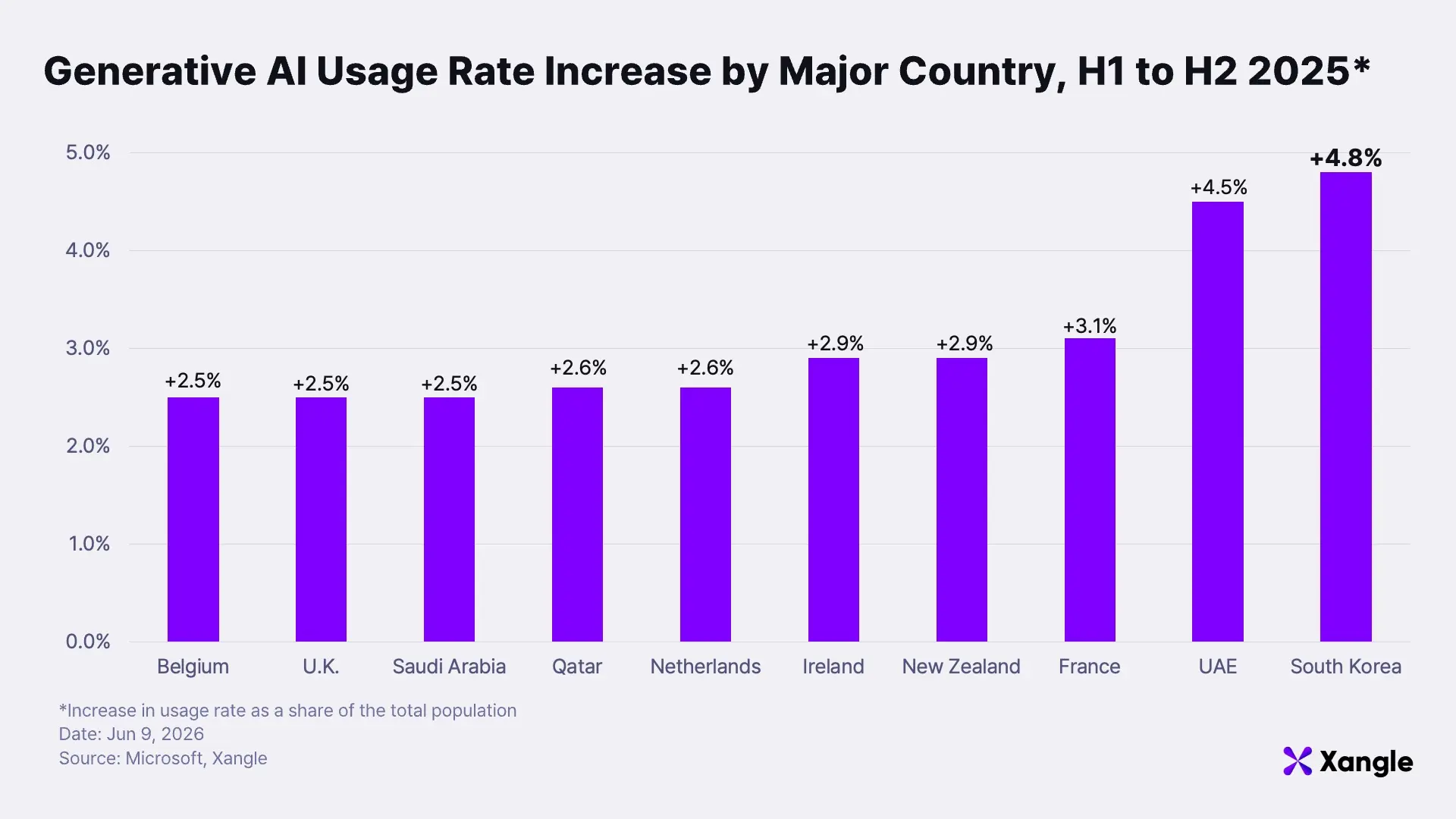
On a population-wide basis, Korea’s usage rate in the second half of 2025 rose by 4.8 percentage points from the first half, marking the largest increase among the surveyed countries. Its usage-rate ranking also climbed from 25th to 18th in just six months.
Rapid growth has been supported by national policy initiatives. The AI Basic Act was enacted, the National AI Strategy Committee was launched, and a broader institutional framework was established. At the same time, improvements in Korean-language models and the rollout of consumer-facing features have made AI increasingly relevant to everyday life. In a market where the AI user base is expanding this quickly—and where policy support continues to reinforce that trend—a substantial foundation already exists for the next stage of adoption, in which AI can make payments on behalf of users.
Korea is also a market where online shopping has become deeply embedded in daily life. According to Statista, e-commerce accounted for more than 44% of total retail sales in Korea in 2023, placing the country among the global leaders. Product discovery, price comparison, and payment already occur seamlessly on mobile devices. With nearly half of all retail activity taking place online, the addressable market for agent-driven payments is larger from the outset than in many other countries.
Few markets combine such rapid AI adoption with a consumer environment already accustomed to conducting commerce online. Agent payments sit at the intersection of these two trends. Users who are comfortable delegating tasks to AI can extend that trust to purchases they already make online. Korea, where both conditions are present, is therefore one of the markets where demand for agent payments is most likely to emerge first.
4-2. Stablecoin Institutionalization and Early Financial-Sector Entry
Beyond demand, the regulatory framework needed to support agent payments is also beginning to take shape. Korea is currently discussing Phase 2 of the Digital Asset Basic Act, which would establish a legal framework for the issuance of Korean won-denominated stablecoins. Legislative progress has been influenced by the political calendar, and during the June 3, 2026 local election period, the bill fell down the list of policy priorities. With the election now concluded, however, momentum has returned as the ruling party has indicated that it intends to prioritize the legislation. Following the United States with the GENIUS Act, the European Union with MiCA, and Japan with revisions to the Payment Services Act—all of which have already established issuance and operational standards—Korea is entering the final stages of bringing stablecoins into its formal regulatory framework.
Two key advantages distinguish Korea as regulation begins to take shape. First, the demand-side conditions are already in place. Rapid AI adoption and high levels of online consumption provide a foundation upon which regulated stablecoin-based transactions can emerge. Second, Korea has its own sovereign currency. Any KRW stablecoin would be anchored to the domestic monetary system, while Korea’s trade-oriented economy also creates natural demand for KRW–USD cross-border payments.
Major financial institutions that already operate payment and settlement infrastructure are moving ahead even before the regulatory framework is fully finalized. Their participation alone is likely to influence the pace of market adoption. When institutions with large user bases and extensive payment networks invest in stablecoin infrastructure, it signals that widespread consumer adoption may follow relatively quickly once regulation is in place.
A notable example emerged in May 2026, when Hana Financial Group acquired a stake in Dunamu, the operator of Upbit, Korea’s largest cryptocurrency exchange, becoming the first domestic commercial bank to hold a major ownership position in the company. Hanwha Investment & Securities became the third-largest shareholder, while Samsung also chose to invest in Dunamu through its affiliates. Similar moves have appeared across the financial sector, including Korea Investment & Securities’ acquisition of a stake in Coinone. A common rationale cited by these institutions is the emergence of new digital-asset businesses centered on Korean won stablecoins. On the issuance side, multiple banks are forming consortiums and conducting proof-of-concept projects involving blockchain-based foreign-exchange remittances and KRW stablecoin infrastructure.
Demand, regulation, and institutional participation are increasingly reinforcing one another in Korea. Banks responsible for payment and settlement, exchanges that provide onchain access to digital assets, and e-commerce and logistics companies that underpin commercial activity all have meaningful opportunities to participate. The foundational conditions for the payment layer Kite AI aims to build are already beginning to take shape in the Korean market.
5. Kite AI as the Execution and Settlement Hub for the Agent Era
Agents are moving into the execution phase, but they are running into the limits of payment and identity infrastructure built for humans. Kite AI addresses this bottleneck. Its payment-focused Mainnet processes high-frequency, low-value stablecoin transactions, while Agent Passport brings identity, delegation, payments, and visibility together, allowing agents to make payments autonomously within user-defined boundaries. Built on top of these two layers, Kite AI aims to become the hub where fragmented payment standards converge and where the payment flows expressed through those standards are executed and settled. Rather than competing to define another standard, Kite AI’s core strategy is to become the execution and settlement layer where transactions from all standards can settle.
The model enables more than payment efficiency. Once each API call can become a payment, new economic models that are currently impossible because of fees begin to open up. Transactions that do not make economic sense on existing payment networks become viable, including one-cent game item payments, IoT devices purchasing bandwidth by the packet, and knowledge markets settled on a per-call basis. As the market moves beyond KYC, which verifies people, toward KYA, which verifies agents, providing verifiable identity and accountability together with payments at the protocol level becomes a necessary condition for agents to perform real work.
Several variables remain open. The key question is how many merchants and services will accept agent payments, whether developers and agents will generate real transactions on top of that infrastructure, and whether that activity will feed back into usage of Kite AI. The final shape of stablecoin regulation across jurisdictions also remains uncertain. Even so, Kite AI’s significance is clear. It is bringing together payment standards proposed by different camps and the rapid growth of AI into a single execution and settlement hub. As an era approaches in which AI works and pays on behalf of people, Kite AI is preparing for that shift by building the payment rails that those transactions will move across. That is why its next steps are worth watching.
Disclaimer
I confirm that I have read and understood the following: The information contained in this article is strictly the opinions of the author(s). This article was authored free from any form of coercion or undue influence. The content represents the author's own views and does not represent the official position or opinions of CrossAngle. This article is intended for informational purposes only and should not be construed as investment advice or solicitation. Unless otherwise specified, all users are solely responsible and liable for their own decisions about investments, investment strategies, or the use of products or services. Investment decisions should be made based on the user’s personal investment objectives, circumstances, and financial situation. Please consult a professional financial advisor for more information and guidance. Past returns or projections do not guarantee future results. This article was written at the request of Kite AI. All content in this article was written independently by the author(s), and neither CrossAngle nor Kite AI had any editorial control or influence over the content. The author(s) may hold the cryptocurrencies mentioned in this article at the time of writing.
Xangle or its affiliated partners own all copyrights of the written or otherwise produced materials and content provided on the platform. Any illegal reproduction of such content, including, but not limited to, unauthorized editing, copying, reprinting, or redistribution will result in immediate legal actions without prior notice.
![[CIS Partner Summit Highlights] Ault's Financial Super App Strategy: OnlyBulls](https://resource.xangle.io/files/content/C1A19E1DB41B7FB86076143803C40D8E_1790125531662.webp)
![[Xangle RWA Series] Solana RWA: A Look at the Key Players](https://resource.xangle.io/files/content/F779A005246C0299246537AACB3A39F2_1782287059970.webp)