[Xangle RWA Series] Solana RWA: A Look at the Key Players

Table of Contents
1. The RWA Market Landscape and Solana
1-1. The Spread of Tokenization
1-2. Solana's Push Toward Internet Capital Markets
2. Issuance Players
2-1. Treasuries and Money Market Funds (MMF)
2-2. Equities
2-3. Private and Structured Credit
2-4. Alternative Assets (Gold, Collectibles)
3. Oracle and Data Players
4. Utilization Players
4-1. The Collateralized Lending Market
4-2. Trading and Liquidity
5. Closing Remarks
1. The RWA Market Landscape and Solana
1-1. The Spread of Tokenization
The tokenization of real-world assets (RWAs) is rapidly becoming part of mainstream finance. BlackRock's tokenized money market fund BUIDL, Apollo's private credit fund, and Janus Henderson's investment-grade credit fund already run on-chain, and the on-chain RWA market excluding stablecoins now exceeds $31 billion. Regulation is moving the same way. In July 2025, the SEC launched "Project Crypto," an effort to modernize digital-asset regulation. Then, in March 2026, the SEC and CFTC issued joint interpretive guidance that sorted tokens into categories, leaving only tokenized securities under SEC jurisdiction, while Nasdaq and the New York Stock Exchange approved tokenized stock trading. Issuers, assets, and regulation are all moving in the same direction at once, and every one of these currents ultimately runs over a single rail for issuance and settlement: the blockchain.
But there is no single blockchain. Tokenized assets are issued across many public chains, and measured by the RWA value distributed across investor wallets, Ethereum holds more than half the market at roughly $16.6 billion. BNB Chain (around $3.6 billion) and Solana (around $2.5 billion) come next. Judged purely by the amount issued on-chain, Solana ranks third, more than six times behind first-place Ethereum.
Yet a chain's significance for RWAs is not settled by issuance volume alone. Tokenized assets, treasuries and funds in particular, often sit untouched after issuance, parked in wallets managed by their issuer or custodian. On paper they exist on-chain, but they are locked value: never traded, never put to any other financial use. To assess a chain as a venue for RWAs, one has to look not only at how much is issued there, but at whether those assets are actually held, traded, and used as collateral on it.
By this measure, Solana's standing shifts. Solana is a public blockchain built around high throughput and low fees, and its strength lies in moving assets rather than parking them. It is, in fact, one of the chains where assets change hands most actively on-chain. Its total value locked (TVL) in DeFi is about $8 billion, roughly one-seventh of Ethereum's (around $55.6 billion), yet in decentralized exchange (DEX) trading volume it vies with Ethereum for the lead. In the first quarter of 2026 it accounted for 41% of on-chain spot trading volume, more than Ethereum and its Layer 2 networks combined. Underpinning this activity are block times of about 0.4 seconds and fees of less than a cent. Small, high-frequency trades that were uneconomical on Ethereum because of fees or block times become viable on Solana. If Ethereum is the ledger where capital is parked, Solana is where that capital trades.
This usage gap between chains is now carrying over into RWAs. The number of wallets holding RWAs on Solana overtook Ethereum's for the first time in March 2026, and as of June 2026 it exceeds 270,000, widening its lead over Ethereum's roughly 190,000. The average holding is small, but it points to a correspondingly broad base of participants. The clearest signal is in trading. Of the cumulative on-chain spot trading volume in tokenized equities, 97% has occurred on Solana. Its issuance value is smaller than Ethereum's, but Solana is where the actual trading happens. Over the past 30 days, more than $3 billion in RWAs changed hands on Solana, further evidence that these assets are not merely piling up on a ledger but are turning over.
1-2. Solana's Push Toward Internet Capital Markets
Behind this active use of tokenized assets on Solana lies one more foundation, alongside cost and speed: the deep DeFi liquidity built up through retail trading. A newly issued asset does not have to wait for a separate market to open; it plugs straight into already-deep lending and trading markets. The moment a token is issued, a place is ready for it to be pledged as collateral, traded, and fed into yield strategies. That is why RWAs on Solana move rather than sit on a ledger.
This direction aligns with the vision the Solana Foundation has been laying out since 2025. Foundation president Lily Liu has framed Solana as "Internet Capital Markets," a capital market where every asset is issued and traded on-chain and anyone with an internet connection can take part. That vision, which goes beyond issuing assets to having them traded and put to use on-chain, has come into sharper focus through 2026, led by RWAs and the institutions and financial firms gathering around them.
That assets are not merely issued but used on-chain implies, conversely, that working with RWAs on Solana is a matter of selecting and stitching together players across several functional stages. The issuer that turns an asset into a token, the oracle that supplies that asset's price on-chain, and the DeFi protocols where the issued asset can be traded and used for collateral and lending. For a single asset to be tokenized and fully put to work on-chain, every one of these stages must be filled.
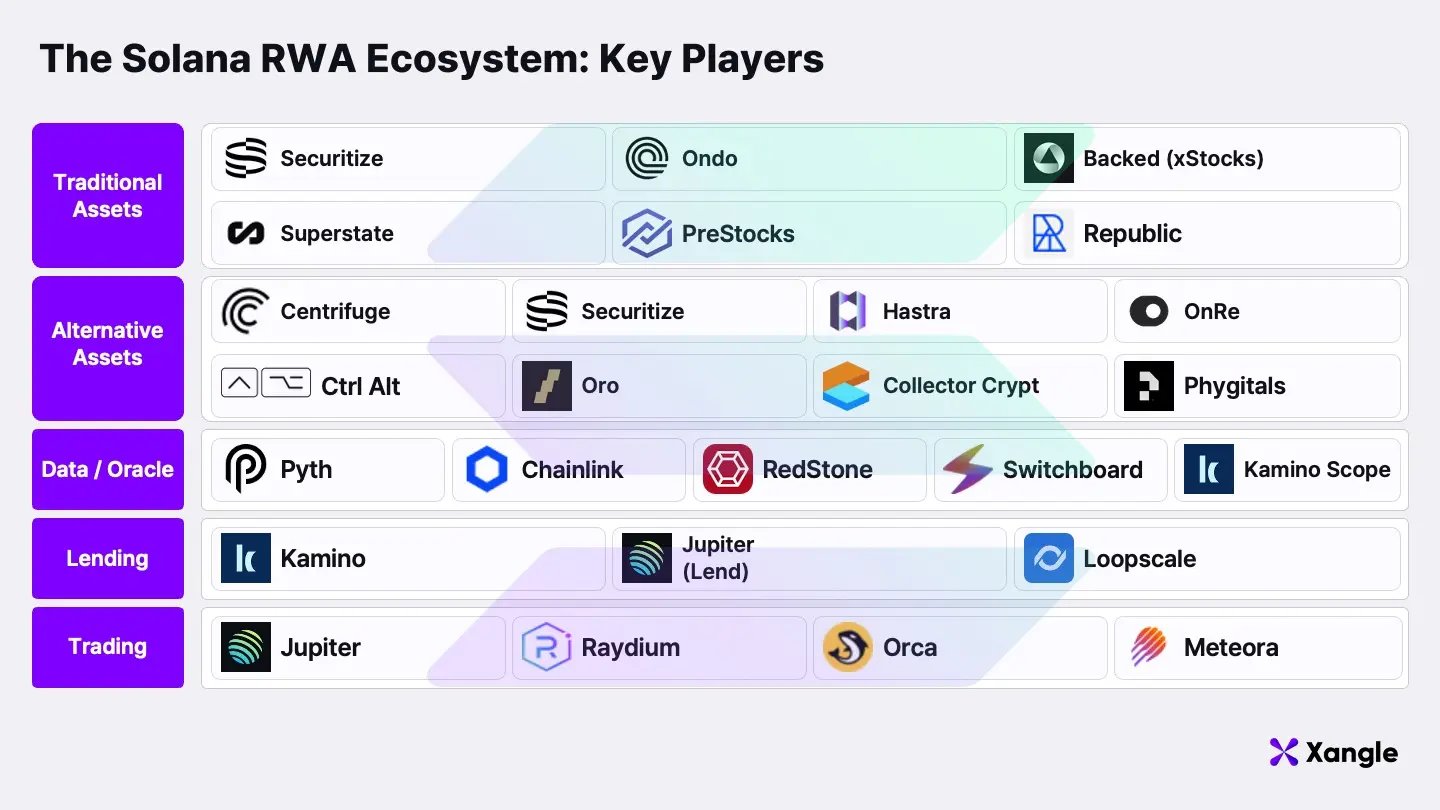
The map above arranges, by function, the players involved as an RWA moves through issuance, trading, and use as collateral on Solana, selecting those with meaningful scale or influence on the chain. An institution looking to issue RWAs on Solana can pick the player suited to its asset at each stage and design the whole as a single structure.
The map does not, however, capture every stage of RWAs. Tokenizing and issuing a real-world asset takes more than issuance, oracles, and DeFi; it also requires custody, compliance (KYC/AML), and the auditing that verifies what has been issued. The players at these stages span multiple chains and are not specific to Solana, so we will treat them in a separate report. This report focuses on the three stages rooted in Solana (issuance, oracles, and utilization) and examines the players at each in the order an asset passes through them.
2. Issuance Players
Issuance is the stage where an underlying asset becomes a token. Which asset, issued by whom, through what structure, and delivered to which users: that is the starting point of an RWA on Solana. The assets covered fall broadly into two groups: traditional asset classes such as treasuries and equities, and alternative asset classes such as private credit, commodities, and collectibles. How far tokenization has progressed varies sharply from one class to the next. Some assets have already drawn large institutions; others have only just seen their first issuance. We begin with the largest and most advanced of them: treasuries and money market funds.
2-1. Treasuries and Money Market Funds (MMF)
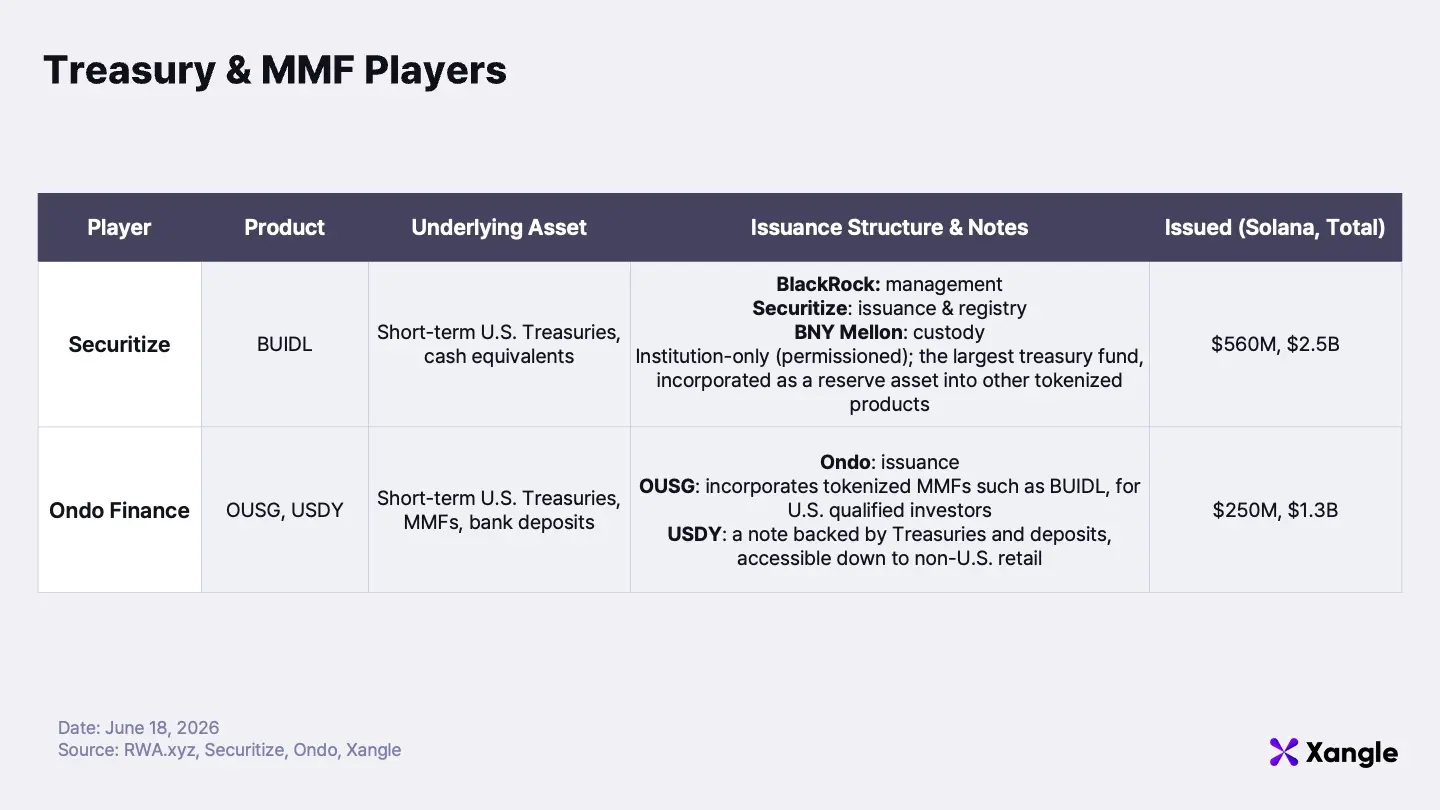
This is the asset class where tokenization came first and has gone deepest. The aim is the same, to capture the interest from short-term U.S. Treasuries in a token, but who issues it, and through what structure, differs. The two players that represent these two approaches on Solana are Securitize, which issues an institutional manager's fund directly as a token and brings it to institutions transacting in the millions of dollars, and Ondo Finance, which repackages those tokenized funds into smaller units so retail investors can access them too. The issuance structure determines which investors a token reaches.
1) Securitize
Securitize is a platform that issues tokenized securities and legally maintains the record of who holds them. It is a transfer agent registered with the U.S. SEC, the official party that records who owns how much of a given security. As a result, a token Securitize issues is not a mere digital marker but a legally recognized record of securities ownership. On Solana it issues BUIDL (the BlackRock USD Institutional Digital Liquidity Fund), the tokenized money market fund of the world's largest asset manager, BlackRock; BUIDL invests in cash-equivalent assets such as short-term U.S. Treasuries and repurchase agreements, preserving principal while earning interest.
A real fund managed by BlackRock comes first, and each share of that fund is matched to a token on Solana. When an investor opens an account with Securitize, clears know-your-customer (KYC) and anti-money-laundering (AML) checks, and subscribes dollars to the fund, those dollars flow into the BlackRock fund and are invested in Treasuries, while an equivalent amount of BUIDL is newly minted into the investor's approved wallet. For every dollar that enters the fund, one BUIDL is created, so the total supply of issued tokens always equals the value of the assets the fund holds. Redemption runs in reverse: the investor returns the tokens to Securitize's redemption wallet, those tokens are burned, and dollars are withdrawn from the fund and paid out to the investor. Securitize, as transfer agent, handles this minting and burning along with updating the holder registry.
In this structure, management, issuance, and custody are divided among separate institutions. BlackRock manages the fund's assets, Securitize issues the tokens and maintains the shareholder registry, and BNY Mellon holds the underlying Treasuries. The arrangement keeps a regulated security on a public blockchain while preventing it from being transferred to unauthorized wallets. The token is issued under Token-2022, the Solana token standard that can embed transfer restrictions and identity verification into the token itself, so it can move only between wallets that have passed Securitize's screening.
BUIDL's total issuance is about $2.5 billion, of which roughly $560 million sits on Solana, the largest of any asset Securitize issues there. What sets it apart from other treasury-type products is that it is not simply an on-chain wrapper around Treasuries: management, issuance, and custody are separated across distinct institutions, and the issuance is legally backstopped by Securitize as an SEC-registered transfer agent.
BUIDL is not the only thing Securitize issues on Solana. Using the same issuance-and-registry structure, Apollo's private credit fund ACRED and the investment-grade CLO fund STAC are issued there as well. What Securitize does on Solana is not to build a particular product but to issue any asset as a token, regardless of asset type, and maintain the record of who holds it.
2) Ondo Finance
Ondo Finance is an RWA platform that turns a range of traditional financial assets, from U.S. Treasuries and money market funds to equities and ETFs, into tokens and supplies them on-chain. On Solana, its treasury-and-MMF products are two: OUSG and USDY. Both return the interest from short-term U.S. Treasuries to token holders, but the legal structure by which each token is created differs. OUSG tokenizes shares in a fund that invests in Treasuries, while USDY tokenizes a note issued against Treasuries and bank deposits.
The way OUSG becomes a token reveals one facet of RWAs on Solana. What OUSG invests in is not only conventional Treasuries but also already-tokenized money market funds run by the likes of BlackRock, Franklin Templeton, and Fidelity (BUIDL among them), plus USDC and bank deposits for immediate liquidity. In other words, OUSG is not a fund that merely buys Treasuries directly; it is a fund-of-funds that pools and manages several already-tokenized treasury funds.
This structure lets OUSG handle instantly what would take a traditional fund several days: redemption. When an investor subscribes with USDC, a smart contract immediately mints an equivalent amount of OUSG and sends it to the investor's wallet; on redemption, USDC is paid out within the very same transaction in which the investor returns the OUSG. Unlike a traditional treasury fund, which typically must wait several days (T+2) to settle after selling assets, OUSG can be issued and redeemed instantly around the clock, because its underlying holdings are already tokenized, immediately redeemable funds and cash-equivalent assets. It is not, however, open to anyone from any wallet: an investor can participate only after clearing know-your-customer (KYC) and qualified-investor screening, and tokens can move only among verified wallets.
There are two ways the interest is reflected in the token. One keeps the token count fixed and lets the token's price rise as interest accrues (OUSG); the other holds the price at one dollar and increases the number of tokens by the amount of interest (rOUSG). Because the accounting and tax treatment, as well as how the token is used in DeFi, differ between them, the issuer offers both forms and lets holders convert freely between the two. USDY likewise comes in the same two forms (USDY and rUSDY). It differs from OUSG, though: where OUSG targets qualified investors within the United States, USDY is designed for use by individuals and institutions outside the U.S.
Ondo's OUSG and USDY together come to roughly $1.3 billion in total issuance, of which about $250 million is issued on Solana. Ondo has two defining traits. The first is that it is a multi-asset issuer, supplying treasury-yield products (OUSG and USDY) and tokenized equities (Ondo Global Markets, covered in the equities section) from a single platform. The second is its issuance model. Where Securitize issues an institutional fund like BUIDL directly, Ondo takes those already-tokenized funds and repackages them into smaller units that can be bought and sold instantly. Unlike BUIDL, which is institution-only and transacted in the millions, the OUSG that incorporates it can be accessed at a far lower threshold, showing how, even within the same treasury type, the two issuers play different roles.
2-2. Equities
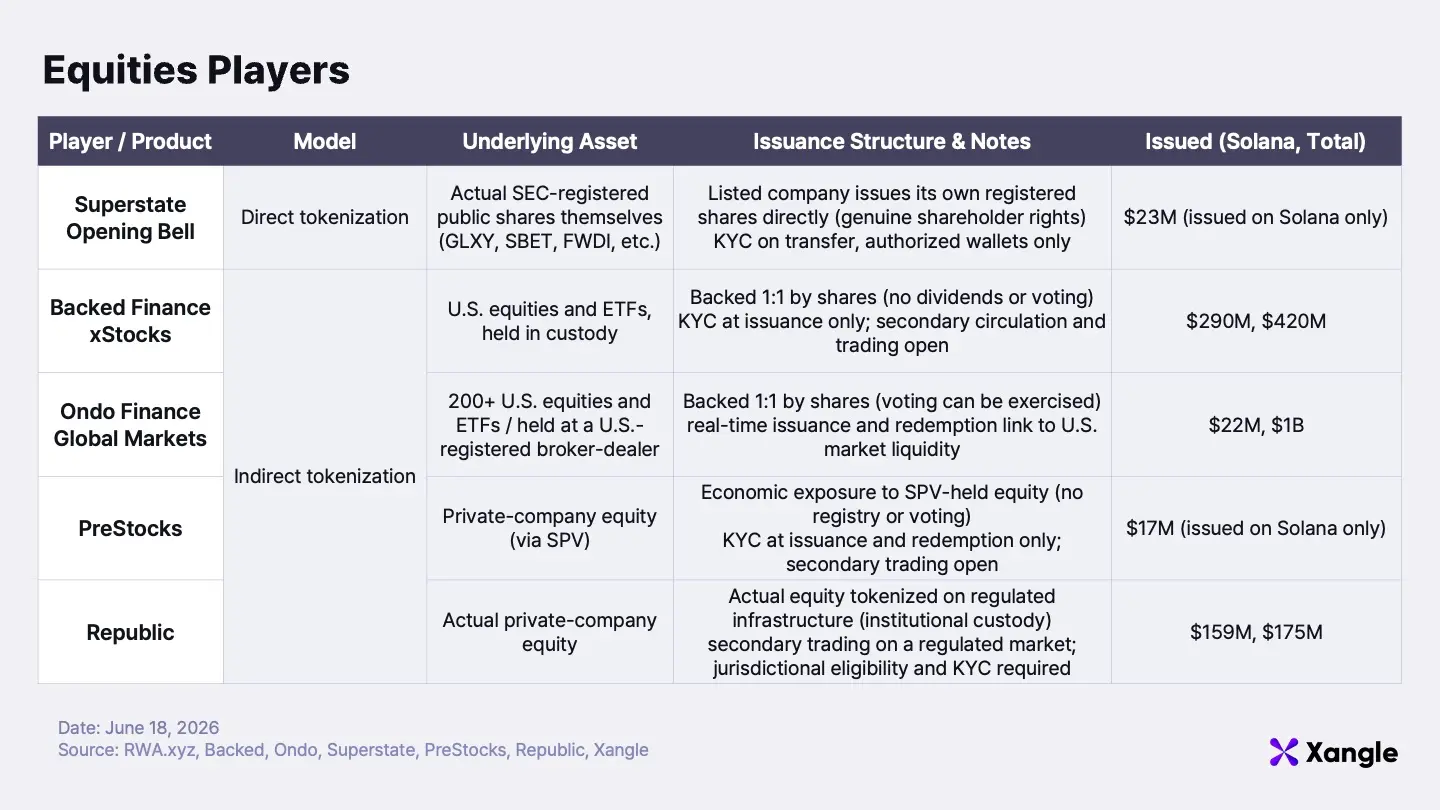
Equities are the asset class where Solana is furthest ahead. Of the cumulative on-chain spot trading volume in tokenized equities, 97% has occurred on Solana. When choosing where to issue a token, there is no criterion more important than the venue where that asset trades most actively. That said, equities are the asset class with the most complex tokenization structure of any RWA. The U.S. SEC sorts tokenized securities into four categories: Issuer-Sponsored tokenized securities, Linked Securities, Security-Based Swaps, and Tokenized Security Entitlements. Rather than follow this regulatory taxonomy directly, this report divides them by who issues the token, into two groups: the direct-issuance model and the indirect-issuance model.
In the direct-issuance model, a company issues its own shares as digital securities through a transfer agent. Because a transfer of the token is itself an update to the official shareholder registry, the holder's token is not a price-tracking product but the actual share itself. The holder is a legal shareholder entered on the register, with rights that include voting. This corresponds to the SEC's Issuer-Sponsored category. In the indirect-issuance model, by contrast, a third party issues tokens by buying and custodying or referencing real shares or ETFs. The holder is not entered on that stock's shareholder registry, and what the token confers is not the share itself but either price exposure to it or a claim on custodied shares. What divides the two is whether the issuer is the company itself or a third party, and therefore whether the holder becomes a legal shareholder. Both types are present on Solana.
The direct-issuance model, where the token is the actual share, is the archetype of equity tokenization, because it is the fullest form, one in which the holder becomes a legal shareholder on the register. But it is hard to deploy widely right away: each issuer must connect its shareholder registry to the chain through an SEC-registered transfer agent and build out an issuance structure company by company. As a result, most tokenized equities currently issued on Solana follow the indirect model. With a third party securing the real shares and porting only their price or rights into a token, the issuance burden is lighter, and that makes it possible to add names quickly.
1) Superstate — Opening Bell (direct tokenization)
Superstate Opening Bell is an issuance platform built so that public companies can tokenize their own shares directly. Superstate does not buy the shares and issue them; the party issuing the token is the listed company itself, Forward Industries or Galaxy, for instance, and Superstate provides the registry and regulatory infrastructure that makes it possible.
The result is the opposite of the indirect model. Where the indirect model packs a claim on, or exposure to, shares secured by a third party into a token, Opening Bell issues the share itself. What the holder owns is not a right tracking custodied shares but the company's actual registered stock. It is neither a derivative nor a wrapper, but common stock itself, with the attached rights intact.
What makes this possible is Superstate's position as a transfer agent. When a public company entrusts the recording and tokenization of its shares to Superstate, an SEC-registered transfer agent, Superstate connects the shareholder registry to the chain. For a company already listed, it links alongside the existing transfer agent; the shareholder moves their shares from a brokerage account to Superstate, then tokenizes them into a wallet of their choosing. Each time the token is transferred on-chain, that change is recorded in the official shareholder registry in real time, so whoever holds the token becomes a legal shareholder entered on the register. Unlike the indirect model, where the holder is not on the register, here they hold the rights of an actual shareholder, voting included. Beyond moving over existing shares, the same platform also opens a path for a public company to issue new shares directly on-chain and raise capital.
The trade-off is freedom of circulation. Unlike open tokens that move freely, an Opening Bell token is a genuine registered security, so the transfer agent must always know who holds it. Transfers happen only between wallets that have cleared KYC and made it onto an authorized list, and compliance conditions apply to every trade at the token level. Free circulation and legal shareholder status cannot both be packed into one token; Opening Bell is a structure that gives up circulation freedom in exchange for legal shareholder status.
The scale is small, but its weight lies elsewhere: what has been issued on the platform is not a token in name only, but the stock of an actual listed company, and the venue is Solana. Most of Opening Bell's issuance value sits on Solana, at about $23 million. Galaxy (GLXY) and SharpLink (SBET) tokenized their own shares through the platform, and Forward Industries (FWDI), Solana's largest digital asset treasury (DAT) company, issued its SEC-registered shares through the same platform. The FWDI tokenized shares are particularly notable: a non-U.S. holder can pledge them as collateral on the on-chain lending protocol Kamino and borrow stablecoins while keeping shareholder status and price exposure intact, showing that a regulated public company's stock can actually be used as collateral in DeFi.
2) Backed Finance — xStocks (indirect tokenization)
Backed Finance is a Swiss-based issuer that issues xStocks, tokenized U.S. equities and ETFs. Where Superstate was a structure for a company to issue its own shares directly, xStocks is the representative tracker of the indirect model, in which a third party secures the shares and issues against them. What the token holder owns is exposure to the price movement of the underlying stock, not the stock itself. More precisely, it is a claim on the issuer backed by real shares. Backed itself legally classifies xStocks as a "tracker certificate." What the token guarantees is the crux of the tracker approach, which makes the next question where that collateral sits, and how.
The collateral shares are held in a place separate from issuance. When a user deposits funds, Backed buys the actual shares or ETFs through a broker, and those shares go into a segregated account at a regulated custodian. Beyond the issuer and the custodian, an independent Security Agent is bound into this arrangement, so that even if the issuer goes bankrupt, the Security Agent preserves the collateral shares on behalf of holders. Tokens are issued only after the shares are secured, matched one-to-one to the quantity held, so the total supply of tokens in circulation always equals the number of custodied shares. The claim, in other words, is tied to real shares.
What the holder does and does not receive is equally clear. Price and dividends are tracked, but there is no voting right or shareholder status. When a dividend is paid, the issuer pays holders in USDC; when a stock splits, the token count is adjusted accordingly. The token price stays anchored to the real share price because authorized participants can, at any time, mint new tokens or redeem them in line with the underlying price. When the token grows more expensive than the share, new tokens are minted and sold; when it grows cheaper, they are bought up and redeemed, and this arbitrage pulls the token price back to the real share price. During hours when the U.S. market is closed, however, there is no reference price, so the gap can widen for a time.
Issuance and redemption are not open to just anyone. Only wallets that have completed KYC/AML and made it onto a whitelist can mint new tokens or redeem them, and redemption carries a minimum-size condition, so in practice it is mostly institutions that use it. Yet a token, once issued and out the door, becomes free the moment it leaves that entrance. It can move anywhere, including to unauthorized wallets, and anyone can trade it. Unlike tokens that restrict the transfer itself to authorized wallets, xStocks places regulation only at the issuance entrance and leaves the circulation that follows open. This openness is what distinguishes how xStocks is used: even as a token holding regulated stock, it can trade on DEXs like any ordinary token, be pledged as lending collateral, and enter liquidity pools.
This openness shows up in the numbers too. xStocks issued on Solana comes to about $290 million (roughly $420 million across all chains), making it the largest tokenized equity on Solana, though what is worth watching is not the amount issued but how much it has moved. Cumulative on-chain DEX volume has passed $1.6 billion, and in the second week of May, weekly volume topped $100 million, up nearly 60% from the prior week. Its use as collateral has grown as well: xStocks held on Kamino, Solana's largest lending market, rose from about $4.4 million in December 2025 to about $28 million by April 2026, a sixfold increase in four months. Set against the issuance amount it is still a fraction, but tokenized equities are genuinely being traded and used as collateral on Solana.
3) Ondo Finance — Global Markets (indirect tokenization)
Ondo Global Markets (GM) is the tokenized equity platform run by Ondo, the same Ondo from the treasury section, and its issuance structure matches that of xStocks. It custodies real shares and ETFs at a U.S.-registered broker-dealer and issues tokens matched one-to-one to that quantity; the token confers not ownership but price exposure, including dividends. That its issued tokens trade around the clock on Solana DEXs is no different from xStocks either. One thing alone divides the two: where the token's liquidity is drawn from.
Each time a trade occurs, GM issues and redeems tokens in real time by buying and selling the actual shares in the traditional stock market. Where xStocks supplies pre-issued tokens to on-chain liquidity pools and lets them trade within those pools, GM connects the user, right at the moment they buy or sell, to a real share trade on the New York Stock Exchange or NASDAQ. When a user buys a token with stablecoins, GM immediately buys the corresponding share and issues the token; when a token is redeemed, it sells that share and pays out in stablecoins. Because this buying and selling takes place on the relevant stock exchange, the token price follows the underlying stock market's price rather than on-chain supply and demand, and it draws directly on that market's deep liquidity. This is the basis for GM's claim to exchange-grade execution, in contrast to other tokenized equities whose shallow on-chain pools struggle to absorb large orders. The catch is that this structure works best while the exchange is open; over weekends and holidays, when the U.S. market is closed, the token price can drift from the real share price.
There is also one difference in holder rights. Price and dividend exposure remain central, just as elsewhere, but GM has partnered with the U.S. proxy-voting firm Broadridge to let token holders cast votes on shareholder-meeting agenda items and access the underlying security's disclosure materials. It brings in a portion of the shareholder rights a tracker typically omits.
By scale, GM is the largest of the tokenized equities. Its issuance across all chains is about $1 billion (an issuer share above 70%), and cumulative volume has passed $18 billion. On Solana, GM stands out for breadth. Having issued more than 200 stocks and ETFs, it is Solana's largest issuer by number of names, with about $22 million in issuance value on Solana alone. Where xStocks is a case of issuance value concentrated on Solana, GM is the reverse: more of its issuance value sits on Ethereum and BNB, but on Solana it carries the broadest list. Because its structure draws on traditional-market liquidity, it does not need to build a deep on-chain pool for each name separately, and so it can issue that many names on Solana.
4) PreStocks (indirect tokenization)
PreStocks is a Solana-based player that tokenizes exposure to the equity of companies not yet public. It makes private companies that cannot be bought on the open market, such as OpenAI, Anthropic, xAI, and Neuralink, tradable as tokens. Unlike the previous three, which port publicly traded shares onto the chain, PreStocks differs in the underlying asset itself: it turns private equity, once open only to institutions and qualified investors, into tokens that trade in small sizes around the clock.
The structure works through a special purpose vehicle (SPV). PreStocks secures equity through holding entities that have invested directly or indirectly in private companies, and issues tokens matched one-to-one to that value. The token is merely economic exposure to the equity those entities hold; it does not enter the company's shareholder registry and carries no voting right or dividend. The trading mechanics resemble a tracker: secondary trading of issued tokens on Solana DEXs requires no KYC and is open to anyone, but minting new tokens or redeeming them does require KYC. Here the point of divergence from the previous three becomes clear. xStocks buys real shares through a broker, GM also buys real shares, and Superstate has the company itself issue. All are structures in which the underlying stock or company is involved in some way. PreStocks, by contrast, secures the equity and creates the token without the involvement of the underlying company. This structure is what opens a path to private companies, but it also means that whether the token can be recognized as actual equity rests on the underlying company's policies.
The trading on Solana is real, and not small in scale. By on-chain counts, the number of wallets holding PreStocks tokens exceeds 25,000, cumulative volume tops $1.3 billion, and cumulative transactions number more than 4 million. The holder count more than tripled in under half a year, from the 8,000 range in early 2026, and trading takes place on Solana DEXs including Meteora. The supply recorded on-chain does not prove an equivalent amount of real equity, but what is clear is that private exposure once open only to institutions has formed a genuine retail secondary market on Solana, one where anyone can trade in small sizes, around the clock. This, ultimately, is where PreStocks's significance on Solana lies: not in the issuance itself, but in the fact that the token trades actively on Solana.
5) Republic (indirect tokenization)
Where PreStocks tokenizes equity exposure without the underlying company's involvement, Republic sits at the opposite pole. It deals in the same private equity, but tokenizes actual issued shares on top of regulated securities infrastructure. At its center is the equity of the Web3 investment firm Animoca Brands. Animoca, which has invested in more than 600 Web3 projects, is not listed on the open market, so its shares had traded only over the counter, until Republic tokenized that equity on Solana and made it tradable.
The structure makes Republic's divergence from PreStocks clear. When an existing Animoca shareholder tokenizes their shares through Republic, those tokens are issued and traded on Solana, but the underlying common stock is held by BitGo Bank & Trust, an OCC-chartered custodial bank, and secondary trading of the tokens runs through INX Securities, an SEC-registered alternative trading system (ATS). It does not stop at the blockchain issuance step; it uses regulated securities-market infrastructure as is. Where a PreStocks token was economic exposure to equity held by an SPV, a Republic token is a right to actual common stock held at a custodian. It differs from PreStocks's economic exposure in that real shares are custodied one-to-one, yet the token holder is not entered as a legal shareholder on Animoca's register. In that it trades a right to custodied shares without being on the register, Republic too belongs to the indirect model. Trading carries jurisdictional-eligibility and KYC/AML conditions, making its access different from PreStocks's open secondary trading.
By scale, the tokenized equities issued through Republic come to about $160 million on Solana, with the bulk of their issuance value there. It established itself quickly, growing more than 20% within a month of launch, and the Animoca equity alone comes to about $49 million. Where PreStocks unlocked private exposure through an open secondary market anyone can join, Republic tokenized actual issued shares on top of regulated securities infrastructure. Faced with the same asset, private equity, one chose accessibility, the other regulatory alignment.
2-3. Private and Structured Credit
If the traditional assets were treasuries and equities, alternative assets structure off-market assets and pack them into a token. The credit and insurance covered in this section span a wide range of underlying assets. Corporate credit bundling loans extended to many companies, private loans an asset manager has sourced directly, the catastrophe risk reinsurance takes on, and households' mortgages. These are assets traditional finance had kept in the institutional domain, and depending on what each takes as its underlying, the nature of the risk and yield a token carries differs from one to the next.
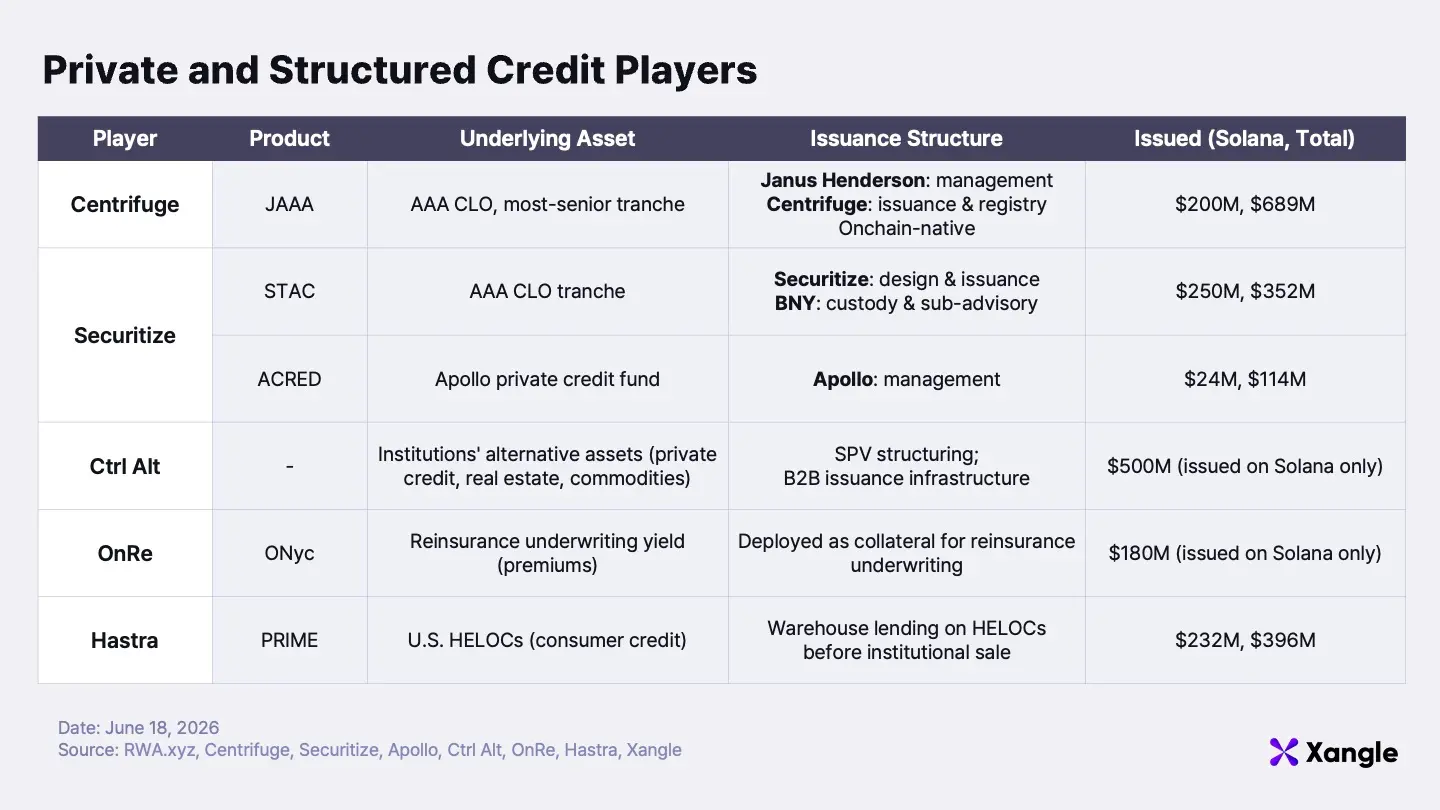
Nor is the issuance structure of a single kind. There is the infrastructure that takes a manager's fund and issues it as a token on their behalf (Centrifuge, Securitize); there are cases where the issuer designs the product itself and offers it under its own name (Securitize-STAC); and there are cases like reinsurance and mortgages where the issuer manages the asset directly and generates the yield itself (OnRe, Hastra). Further still, there is B2B infrastructure that structures and handles issuance for any asset type (Ctrl Alt). Faced with the same credit asset, who issues it and how diverges. On Solana, these issuers are present across the board, varying in their underlying assets and issuance structures.
1) Centrifuge
Centrifuge is RWA tokenization infrastructure that issues and manages asset managers' funds as on-chain products. One of the oldest protocols working to bring real-world assets on-chain, active since 2017, it has handled everything from treasuries to credit and structured products, with about $1.6 billion in assets held on-chain.
When a manager brings a fund strategy, Centrifuge constitutes that fund as a legally structured investment vehicle and issues tokens to manage holdings and redemptions. Roles are divided: the asset manager handles management, Centrifuge handles issuance and registry, so the manager can put its strategy on-chain without having to build the legal and technical work of tokenization itself. Through a method called deRWA, the issued token can be traded or used as collateral directly in DeFi across multiple chains, Solana among them. Centrifuge's flagship product on Solana is JAAA.
JAAA tokenizes the CLO strategy of Janus Henderson, the world's largest AAA CLO manager. The assets run under this strategy in traditional markets come to about $21 billion, and the same strategy has been ported on-chain. A CLO is a structured product built by bundling hundreds of loans made to many companies, and what JAAA holds is the lowest-risk slice of it: the AAA tranche. It invests in corporate credit, but in the most conservative segment.
The reason AAA is the safest lies in the order in which a CLO distributes gains and losses. Interest and principal from the underlying loans are distributed in sequence from the senior tranches down, while losses from defaults are deducted starting from the most junior tranche. AAA sits at the very top, collecting interest first, and losses reach it only after the junior tranches have absorbed and been exhausted by them. That is why, even on the same underlying corporate loans, the AAA tranche carries the lowest volatility and the highest credit rating.
The issuance approach also has a distinctive feature. Tokenized funds usually take a fund or ETF that was run off-chain and put it on-chain in tokenized form. BlackRock's BUIDL, seen earlier, is one such example, a tokenization of an existing money market fund. JAAA, by contrast, designed the same CLO strategy as an on-chain fund from the ground up. What sets it apart is that it did not merely tokenize a fund an institution had run off-chain, but built a fund that runs on-chain from the start. This is not unique to JAAA but Centrifuge's standard structure for issuing funds; it issues equity-index funds and treasury funds on-chain the same way.
Because the fund holds the actual AAA tranche and its shares are issued as tokens, the token's value is linked to the performance of the AAA CLO the fund holds. The interest earned is not distributed separately but accrues to the fund's net asset value and is reflected in the token price. Unlike PRIME, which distributes interest monthly, JAAA accumulates its return in the form of a rising token price. Participation is limited to non-U.S. professional investors; a wallet that has cleared identity verification with Centrifuge subscribes in USDC to be issued tokens, and redemptions are processed daily. The total fund size is about $690 million, of which about $200 million is issued on Solana.
2) Securitize — STAC
STAC holds the same AAA CLOs as JAAA, but its issuance structure differs. Where JAAA is Janus Henderson's strategy tokenized by Centrifuge, STAC is a product Securitize builds and issues itself. Its formal name says as much, the Securitize Tokenized AAA CLO Fund, and Securitize handles both the management strategy and the token issuance. Where BUIDL from the treasury section was BlackRock's fund issued by Securitize, STAC is a credit product that same issuance platform has put out under its own name.
The asset it holds is the same as JAAA's. Investing most of its assets, without leverage, in U.S. dollar-denominated AAA CLO tranches bought in the primary and secondary markets, it pursues floating-rate yield in the most conservative segment of corporate credit. That two products aim at the same AAA CLO market yet have different issuers shows that there is more than one path to tokenizing the same asset. A manager can tokenize its own strategy through external infrastructure (JAAA), or an issuance platform can design and issue the product itself (STAC).
What stands out in STAC's structure is that BNY comes in. BNY, the world's largest custodian bank, holds the underlying assets while also serving as the fund's sub-adviser. Qualified investors subscribe through Securitize's regulated platform, and the token is issued as a digital security that has passed KYC, AML, and qualified-investor screening.
STAC launched first on Ethereum, then expanded to Solana in June. With the Solana expansion, Ethena, the issuer of the stablecoin USDe, allocated about $250 million to STAC, and as those funds were issued on Solana, the Solana portion came to about $250 million, more than 70% of the total (about $350 million). It is the largest tokenized structured-credit issuance on Solana.
3) Securitize — ACRED
ACRED is a Securitize issuance like STAC, but its management is handled by the global private credit manager Apollo. Its formal name is the Securitize Tokenized Apollo Diversified Credit Fund, and it tokenizes Apollo's diversified credit fund. Apollo handles the management strategy and Securitize handles token issuance and registry, the same arrangement used to issue BlackRock's BUIDL. Where STAC is Securitize's own product, ACRED is a case of Securitize issuing an external manager's fund.
What ACRED holds is the private credit Apollo manages. It invests in a diversified credit strategy centered on private loans made directly to companies and spanning public and private debt; an investor gains exposure to this fund through the ACRED token, whose value moves with the fund's performance. Unlike AAA CLOs, which are structured products traded in the market, ACRED's credit is different in nature in that its underlying is private loans the manager sources and originates directly.
ACRED's total fund size is about $110 million, of which the Solana portion is still small. What is distinctive, though, is that on Solana ACRED is used as collateral in the lending markets Kamino and Loopscale. A holder can pledge ACRED as collateral to borrow stablecoins, then use the borrowed funds to buy more ACRED and add it as collateral, taking on leverage. It is a structure in which the private credit a manager sourced is put to work once more on Solana by way of a token.
4) Ctrl Alt
Ctrl Alt is not a place that manages assets or generates credit itself; it is B2B infrastructure that helps financial institutions issue their own alternative assets as tokens. It deals in off-market assets such as private credit, real estate, private funds, infrastructure, and commodities, and on top of structuring and issuance provides the entire tokenization process through an API and dashboard, from investor screening and compliance checks to post-issuance operations and reporting. It is an operator working within a regulatory framework, to the point of participating in the Bank of England's Digital Securities Sandbox, and it entered Solana recently by issuing its first tokenized structured product there.
The issuance process runs as follows. When an institution holding an asset wants to move it on-chain, Ctrl Alt places the asset into a dedicated special purpose vehicle (SPV), structures it, and issues the corresponding token on Solana. Investor onboarding and identity verification, compliance, and post-issuance distribution and reporting are handled by Ctrl Alt's systems. Its first case on Solana followed this structure as well. A regulated UK financial firm bundled a yield-bearing asset it held into a structured product and issued the token to qualified investors, raising funds on-chain on the strength of the asset it held. The amount issued on Solana through this structured product is about $500 million. Compared with the average issuance of a few million dollars per tokenized asset on Solana, it is the largest in its field.
Its defining feature lies not in what it issues but in how. The result is not a token traded in DeFi but an institutional product held by qualified investors, not separately traded on-chain after issuance. Unlike JAAA or ACRED, which brought a specific credit product on-chain, what Ctrl Alt provides is the capacity to structure and issue any type of asset. Beyond private credit, other alternative assets such as real estate and commodities can be tokenized the same way.
5) OnRe
OnRe is a reinsurer operating under the Bermuda Monetary Authority's Digital Asset Business Act (DABA), and it issues ONyc, a token capturing the yield generated from reinsurance underwriting, on Solana. Reinsurance is the market where an insurer passes a portion of the risk it has underwritten to another company to diversify it, and the premium received in return is the source of yield. The global reinsurance market exceeds $750 billion but has until now been the domain of large institutional investors; ONyc brings this market's yield on-chain.
The way ONyc generates yield is the reverse of a typical tokenized asset. Where treasuries or credit products move an already-existing asset into a token, ONyc deploys the funds gathered through the token as collateral for reinsurance underwriting to generate yield. When an investor buys ONyc with USDC, those funds become collateral backing the claims-paying ability of the reinsurance contracts OnRe underwrites, and the premiums received in return become the yield. When natural disasters are few and claim payouts low, premiums accumulate as yield; when a major disaster triggers a payout, the fund's net asset value falls by that much, leading to a loss for holders. That is why the yield is linked not to market interest rates but to actual catastrophe-occurrence rates. The assets received as collateral are held not in a smart contract but in a legally segregated account, and withdrawals are made only by multi-signature.
Yield accrues simply from holding the token. Premiums are not distributed separately but are reflected in the fund's net asset value and accumulate in the token price. The recent yield, in the 11% range, exceeds that of treasuries or credit products and is compensation for taking on catastrophe risk. New issuance and redemption are limited to qualified and institutional investors, and while subscription in USDC is immediate, redemption opens just once a quarter. A redemption requested during the 30-day notice period at the start of a quarter is processed at quarter-end, because reinsurance contracts are bound on a quarterly basis, which makes funds hard to recover immediately. Tokens issued this way, however, can be bought by anyone on the secondary market to gain exposure to the yield, and are used freely in DeFi as well.
ONyc's issuance on Solana is about $180 million, with the entire issuance value sitting on Solana. It does not stop at issuance; trading is active too, with monthly volume reaching $280 million, more than the amount issued, and trading happening mainly on the DEX Raydium. Where it is most actively used is Kamino, Solana's largest lending market, where a holder borrows USDC against ONyc and uses that USDC to buy more ONyc and add it as collateral, amplifying yield through looping. Driven by this collateral demand, ONyc deposited on Kamino rose 80% over the trailing 30 days to about $90 million.
6) Hastra — PRIME (consumer credit)
Hastra issues PRIME, a yield-bearing token built on U.S. mortgages originated by Figure, on Solana. Figure is a Nasdaq-listed company and the largest operator in on-chain lending, originating more than $1 billion in new loans each month and surpassing $22 billion cumulatively. What PRIME holds is the HELOC portion of that. It is not the mortgage taken out to buy a home, but a loan that someone who already owns a home takes out on top, drawing against the equity they have built up by paying down their mortgage.
How PRIME generates yield comes into view by following Figure's lending business. Figure originates HELOCs to homeowners but does not hold those loans to maturity. It bundles hundreds of loans and sells them to institutional investors such as pension funds and asset managers, then uses the proceeds to originate new loans, over and over. The catch is that there is a gap of roughly a month on average (about 42 days) between when a loan is originated and when it is sold to institutions. Figure pays the homeowner the loan amount on the origination date, but the institutional sale that would recoup those funds comes a month or so later. Funds are needed to bridge that interval.
The funds of PRIME holders play exactly that role. When an investor deposits a stablecoin issued by Figure into Hastra, they receive PRIME in return, and the deposited funds are supplied short-term to a bundle of performing HELOCs about to be sold to institutions. The interest homeowners pay in the meantime becomes the holder's yield. When the loans are sold to institutions, the funds are recouped and roll into the next bundle, again and again. Because it funds the inventory where completed loans sit briefly before being sold, this structure is called warehouse lending.
Its scale on Solana recently stands at about $230 million, having grown quickly in the roughly six months since its December 2025 launch. The yield a holder earns is not an artificial return like coin rewards but the mortgage interest of around 8% annually that homeowners actually pay, cash flow generated from real credit. This interest is not distributed separately but is reflected in the token's net asset value and accumulates in the price, so the number of tokens held stays the same while the value of a single PRIME rises over time. The yield rate itself is set by overall marketplace supply and demand in a Dutch auction held every hour.
On-chain, PRIME does not stop at issuance; it is traded and put to use. Secondary trading is available in the PRIME/USDC pool on the DEX Raydium, and with no eligibility restriction on transfer or holding, even small users transacting in $100 units can hold and trade it. On the lending side, through Kamino one can buy PRIME directly with USDC or pledge it as collateral to borrow other assets.
2-4. Alternative Assets (Gold, Collectibles)
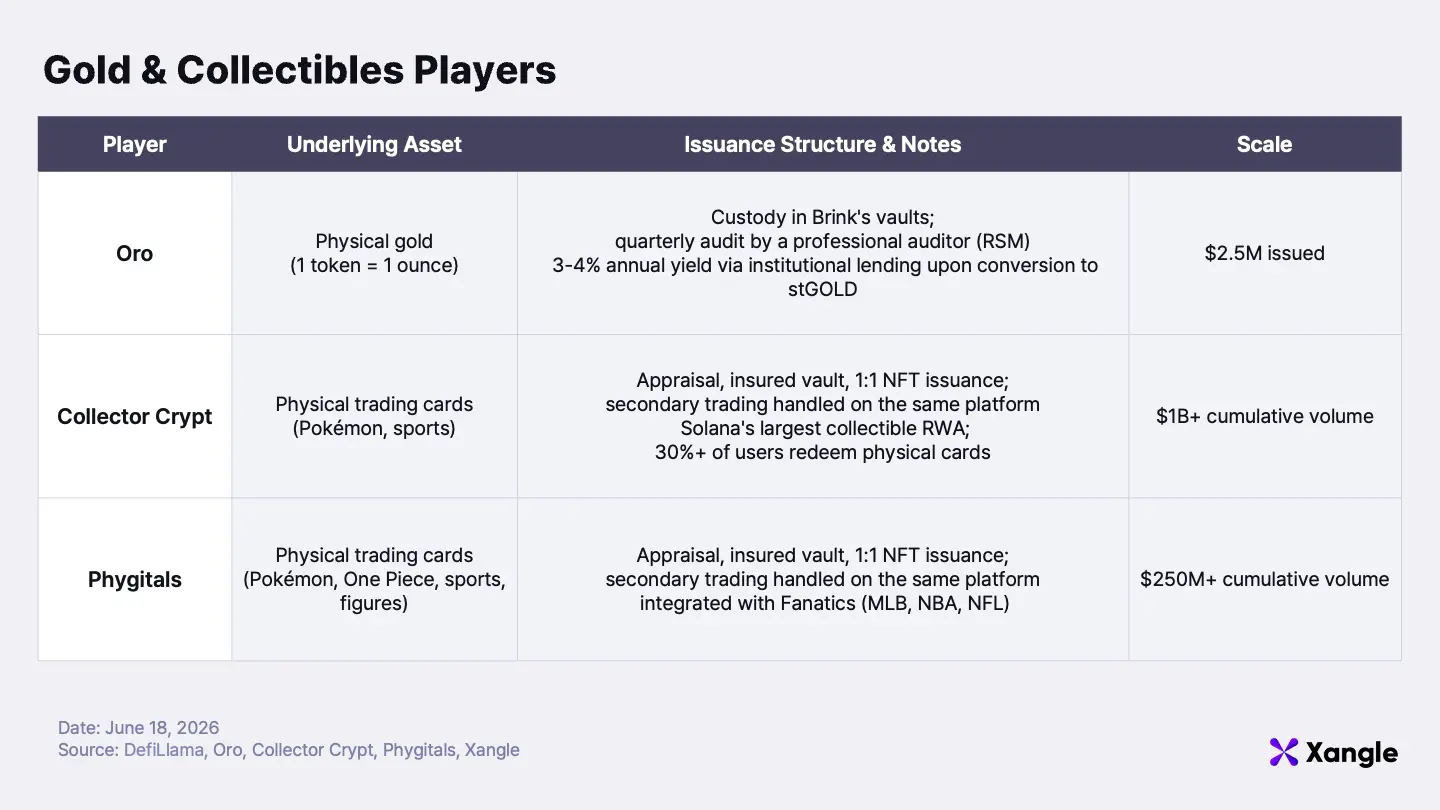
After credit and insurance, the remaining slots of alternative assets hold two of a different character. One is gold; the other is collectibles such as trading cards. Gold, an age-old store of value, and collectibles, once gathered as a personal hobby, may seem far apart, but they share a structure: the physical item is held in custody and a corresponding token is issued one-to-one against it. Where the financial-type assets above were products chasing yield, these tokenize the physical item itself and move its ownership and trading on-chain. What they become after tokenization, however, diverges. Gold goes beyond storage to lending it out and generating yield, while collectibles have settled into a consumer market where issuance and trading mesh on a single platform. Trading cards in particular have added a gacha mechanic, custodying the physical item, then opening it as a digital pack, and have become the most actively traded segment of Solana's consumer RWAs. The actual trading runs deep enough that a platform has surpassed $1 billion in cumulative volume. Starting from the same structure of physical tokenization, gold extended toward the utilization of the asset, collectibles toward a trading market.
1) Oro (gold)
Tokenizing gold is not itself new. Large gold tokens such as Tether's XAUT and Paxos's PAXG already exist at a scale of billions of dollars, and they too trade across multiple chains, centered on Ethereum, Solana among them. But these are tokens issued on other chains and bridged to Solana, whereas the gold project designed on Solana is Oro. Oro issues GOLD, a tokenization of physical gold, on Solana; GOLD is a token matched one-to-one to physical gold, with one token representing one ounce of gold. The gold is held in specialized custodial vaults such as Brink's, the accounting firm RSM verifies the physical holdings quarterly, and a legal structure keeps the gold segregated and protected on behalf of holders even if the platform goes bankrupt.
What sets Oro apart from other gold tokens is that it does not stop at storing gold. Where XAUT and PAXG are the custodial type, representing vaulted gold as a token, Oro adds a structure that puts that gold to work to generate yield. When a holder stakes GOLD to convert it into stGOLD, that gold is lent to institutional borrowers for a set period, and the holder receives interest in gold in return. It is a way of earning 3-4% annually on gold that had merely been stored, keeping exposure to the gold price while increasing the amount of gold held. Treating gold not as something to store but as a lending and collateral asset is Oro's distinguishing point. GOLD can be issued directly through the Oro app after clearing KYC, or bought and held on Solana DEXs such as Jupiter and Meteora.
By scale, Oro is still at an early stage. Its on-chain issuance is about $2.5 million, growing on a different trajectory than other asset classes like treasuries or credit, and because the tokenized gold market itself is concentrated in XAUT and PAXG, Solana-based gold is at a starting point in scale as well. Still, as an attempt to treat gold as an asset spanning issuance, trading, yield, and collateral on Solana, it points to the direction in which RWAs on Solana are expanding into commodities.
2) Collector Crypt (collectibles)
Moving to collectibles, the character of the asset changes again. The trading-card market is a collectibles market worth tens of billions of dollars worldwide, but trading has been slow, authentication cumbersome, and fees high. Moving this market on-chain so that cards can be traded instantly like tokens is what collectible RWAs are about, and at its center on Solana is Collector Crypt.
Collector Crypt is a Solana-based platform that tokenizes and trades physical trading cards. It deals mainly in graded Pokémon and sports cards, placing physical cards in custody and issuing corresponding NFTs so they can be traded on-chain. One card maps one-to-one to one token, and a token holder can redeem the physical card at any time. Whereas treasuries and equities separate where they are issued from where they trade, Collector Crypt provides token issuance and secondary trading together on a single platform. It is an issuer and a marketplace at once. Here we focus on the issuance side.
Three parties divide the work of turning a card into a token. First, professional grading agencies such as PSA, BGS, and CGC appraise the card's authenticity and condition and assign a grade from 1 to 10. This grade is what certifies that the card is genuine and in what condition, backing the value of the token to be issued. The graded card is placed in an insured, climate-controlled vault run by PWCC or ALT, and an NFT matched one-to-one to the stored card is issued on Solana. Grading agencies do the appraisal, specialized vaults the physical custody, and Collector Crypt the token issuance. That a professional agency's grading and insured custody guarantee the token's backing is what separates a card RWA from an ordinary NFT, which points only to an image with nothing physical behind it.
The issued NFT is both a certificate of ownership of the stored card and a means to trade the card without moving it. When ownership changes, the physical item stays in the vault and only the NFT transfers, so there is no need to ship it each time or re-verify authenticity. When the physical card is wanted, the NFT is burned and the card is shipped. In practice, more than 30% of users have withdrawn their tokens as physical cards.
Its scale is the largest among Solana's collectible RWAs. Cumulative volume recently passed $1 billion, and as a single month's revenue of $9 million in May 2026 shows, card RWAs have established themselves as the most active segment of Solana's consumer market.
3) Phygitals (collectibles)
Phygitals is likewise a Solana platform that tokenizes and issues physical trading cards and supports secondary trading on the same platform. Starting with Pokémon, it has extended to One Piece, sports cards, and figures. The process of turning a card into a token goes through appraisal and custody, as with Collector Crypt. Professional grading agencies such as PSA, CGC, and Beckett appraise the card's authenticity and condition and assign a grade; the physical item is placed in an insured vault run by PSA, Fanatics, or Alt; and an NFT matched one-to-one to the stored card is issued on Solana. Cumulative platform volume has passed $250 million, more than 100,000 cards have been tokenized, and a single month's revenue in May 2026 came to about $2.9 million.
What distinguishes Phygitals is that the tokens it issues connect directly to the traditional collectibles industry. Among the three custody providers, Fanatics is a major collectibles platform holding exclusive MLB, NBA, and NFL licenses, and Phygitals recently integrated directly with it. As a result, users can trade their tokenized cards on both the Solana and Fanatics markets. Issue a token once, and a channel opens for it to trade anywhere across the chain and the existing collectibles market. That token issuance does not end within Solana but carries into the vast collectibles industry is where it differs from Collector Crypt.
3. Oracle and Data Players
For an issued token to trade and serve as collateral on Solana, data about that asset has to be on-chain. A blockchain cannot read the outside world on its own, so it needs separate infrastructure to relay external prices and events on-chain, whether a stock price or a fund's net asset value. That work falls to the oracle. The oracle's weight in RWAs is especially heavy, because a blockchain does not stop. The U.S. stock market is open six and a half hours a day, but an asset that tokenizes those stocks trades around the clock, and a loan that holds that asset as collateral can be liquidated at any time. If the price is not updated during the hours the exchange is closed, a sound position can be liquidated at the wrong price, so bridging the gap between the legacy market's trading hours and the chain's around-the-clock operation is part of the oracle's job as well.
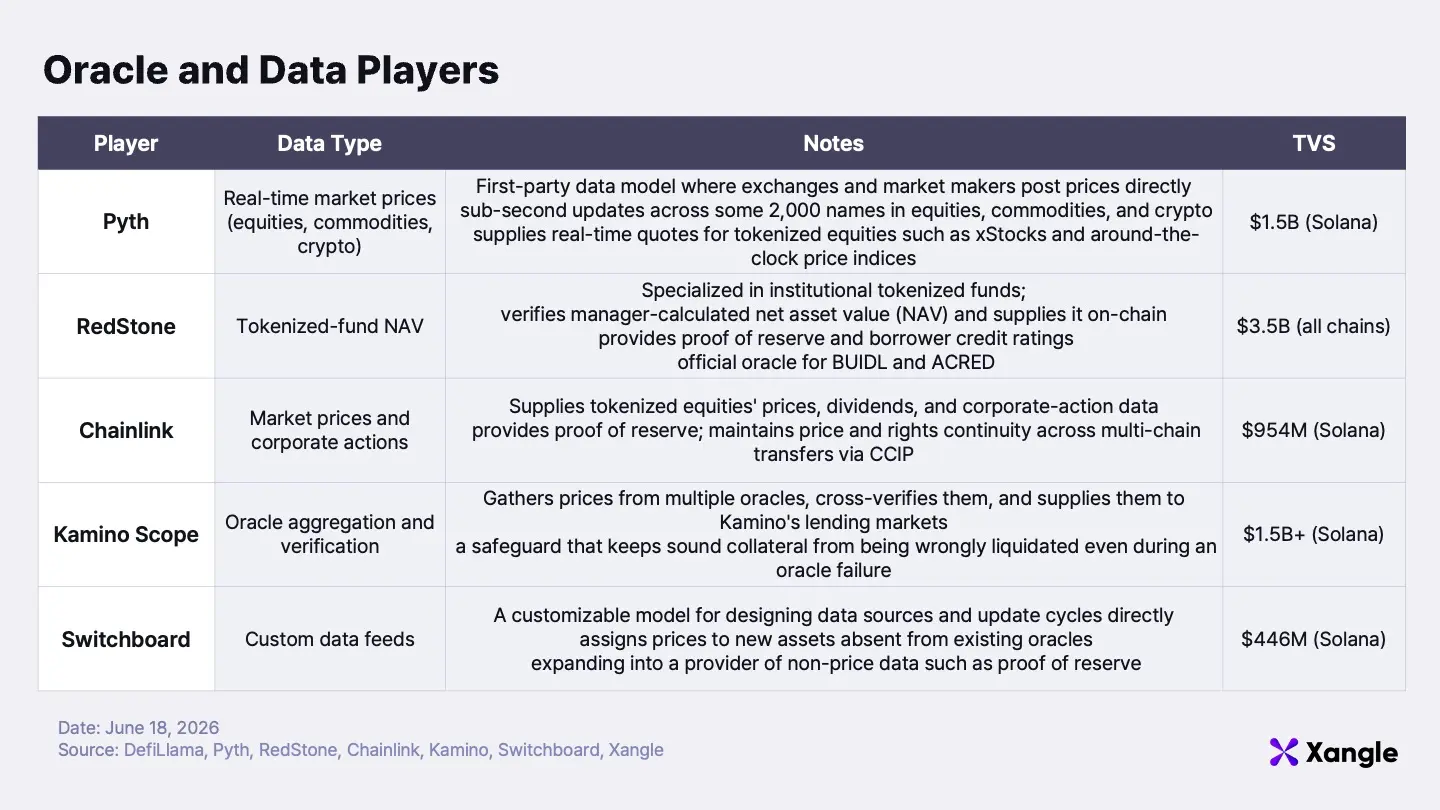
At first, the data an oracle handled was all price, but it broadened as RWAs diversified. There are prices formed in real time in the market, as with equities and commodities; there is net asset value (NAV), which a manager calculates once a day for treasury funds or private credit; and there are corporate actions such as dividends and stock splits, which also have to come on-chain. Since each asset needs different data, which oracle is suitable depends on what asset one is issuing. For equities and commodities, whose prices move in real time, the edge goes to Pyth (strong on real-time pricing) and Chainlink (which also handles corporate actions); for treasury funds and private credit valued by NAV, to RedStone (strong on institutional fund data); and for an asset with no feed in existing oracles, to Switchboard (which lets you design the data source and update method yourself).
1) Pyth
Pyth is an oracle network that originated on Solana, using a first-party data model in which exchanges and market makers put their own price data on-chain directly. Unlike other oracles, which gather data through intermediary nodes, the institutions that actually produce the prices are themselves the data providers. More than 100 institutions, from exchanges like Binance to traditional exchanges like the Chicago Board Options Exchange (Cboe), contribute data, and it runs more than 2,000 price feeds, from cryptocurrencies to Tesla stock to gold and crude oil.
Its price-delivery method is a pull model. Rather than the oracle supplying price data on a fixed cadence, an application pulls the latest price the moment it needs it. The update cycle is under a second, tuned to stocks whose prices move throughout the session and to derivatives trading where liquidations happen by the second. This is where Pyth fits in RWAs. It supplies real-time prices for tokenized equities issued through xStocks, and by running around-the-clock continuous price indices for U.S. stocks, gold, and crude oil, it supplies price data even during the hours the legacy exchanges are closed.
On Solana, Pyth is effectively the default price infrastructure. An oracle's scale is measured by Total Value Secured (TVS): not deposits, but the total value of assets operating on that oracle's prices, that is, the size of the funds affected if the price is wrong. By this measure, Pyth secures about $1.5 billion, ranking first on Solana, and Loopscale, which runs more than 100 lending markets, uses Pyth as its price infrastructure. Though it began on Solana, it now relays data to more than 100 chains and is broadening into government data as well, with work such as putting U.S. Department of Commerce economic indicators on-chain.
2) RedStone
RedStone is an oracle specialized in RWAs; on entering Solana in 2025, it partnered with Securitize and began supplying price data for tokenized funds. BlackRock's BUIDL, Apollo's ACRED, VanEck's VBILL, and Hamilton Lane's tokenized fund use RedStone as their official oracle. RedStone is the channel through which the prices of the institutional assets covered in the issuance chapter enter Solana DeFi.
The data RedStone handles differs in character from Pyth's. It is not a price formed by the second in the market, but the net asset value a fund manager calculates. Because fund-type tokens like BUIDL and ACRED are valued by NAV rather than an exchange quote, verifying that figure and putting it on-chain becomes the oracle's role. This is a domain of institutional-data integrity rather than a contest of speed. Since a fund-type RWA being used as collateral presupposes that its NAV is accurately reflected on-chain, the lending market for borrowing stablecoins against ACRED came into being only because this data is supplied.
Its scale should be read in keeping with the nature of its role. RedStone secures about $3.5 billion in asset value across all chains, but on Solana it covers not the whole market but the segments that need prices for fund-type assets, such as Kamino's RWA collateral markets. It is an oracle whose standing shows less in total volume than in which assets' prices it is responsible for. In 2025 it acquired the institutional credit-rating platform Credora, expanding toward putting institutional-finance data on-chain, from a fund's NAV to a borrower's credit rating.
3) Chainlink
Chainlink is the most widely used oracle in multi-chain environments, and on Solana it supplies tokenized equities' prices and corporate-action data. A stock is not an asset whose price merely changes; dividends are paid and shares split, and if such corporate actions are not reflected in time, the token's value drifts from the actual stock. Where Pyth handles real-time quotes, Chainlink has positioned itself in relaying these corporate actions on-chain, on top of the quote.
The role Chainlink plays in RWAs comes through clearly in xStocks. Chainlink joined the xStocks camp as an official oracle and runs a dedicated data feed, supplying not only prices but corporate actions such as dividends and splits, verified in real time. When a dividend occurs on a tokenized equity, for instance, the details are automatically reflected in the token balance, and when a stock splits, the holding quantity is adjusted accordingly, and Chainlink delivers the data that adjustment is based on. On top of this, Chainlink also handles proof of reserve for xStocks, verifying on-chain that the actual shares backing the issued tokens genuinely exist at the custodian. The price Kamino, Solana's largest lending market, uses when accepting xStocks as collateral also follows Chainlink's data standard.
Chainlink's other strength lies in connecting one chain to another. When the same tokenized equity exists on both Ethereum and Solana, Chainlink's Cross-Chain Interoperability Protocol (CCIP) ensures that corporate actions like dividends and splits follow without interruption even as the token moves from one chain to the other. It is infrastructure that lets a tokenized equity hold the same rights and value as the actual stock even as it moves across chains, rather than being confined to the chain it was issued on.
4) Kamino Scope
Scope is the oracle-aggregation infrastructure run by Kamino, Solana's largest lending market. It is not an independent oracle company but a consumption-side mechanism that gathers prices from multiple oracles (Pyth, Switchboard, RedStone, and others), verifies them, and then supplies them to Kamino's markets. It does not produce external data; it cross-checks data already posted and puts it to use.
Because price is the basis for liquidation in a lending market, if a single oracle posts a wrong price, it leads to an incident where sound collateral is liquidated. Scope reduces this risk by comparing prices from multiple sources to filter out outliers and by selecting the oracle suited to each asset. The entirety of Kamino's lending markets, with about $1.5 billion deposited, operates on top of this mechanism, and the prices of RWA collateral such as the ONyc and PRIME covered in the issuance chapter come in through Scope as well.
If an oracle is the infrastructure on the data-posting side, Scope is a case of the receiving side building its own safeguard on the data it consumes. As RWA collateral grows, so does the weight of price verification, so for an issuer, which oracle its asset passes through and what verification it undergoes becomes a practical condition for entering a lending market.
5) Switchboard
Switchboard is a Solana-based oracle whose defining feature is a permissionless model in which anyone can design and post the data feed they need. Where other oracles supply standard prices for a fixed set of assets, on Switchboard an issuer or protocol can define the data source, the aggregation method, and even the update cycle for itself, building the feed it needs directly. It is a structure in which the user designs which data to take, from where, and how to update it.
Where this flexibility is used in RWAs is for assets existing oracles do not reach. An asset recently tokenized, or one whose price is not formed in a single place, often has no feed fit for existing oracles, but on Switchboard one can design and use a feed suited to that asset. Beyond standard quotes, the same approach makes it possible to put on-chain the data that differs from one asset to the next, such as proof of reserve, so it is expanding into verifying that a token's underlying asset genuinely exists as well.
4. Utilization Players
4-1. The Collateralized Lending Market
Once an issued token has a price as well, the asset is finally put to use on Solana. The utilization of RWAs runs along two main branches. One is lending, pledging an asset as collateral to borrow other funds; the other is trading, buying and selling the asset.
The reason collateral use matters in RWAs is that it determines the value of tokenization. Turning treasuries or a fund into a token is, in itself, much like moving a paper certificate into digital form. It is when that token can be pledged as collateral to borrow other funds instantly that tokenization finally does something legacy finance could not. Pledging shares at a brokerage to take out a loan takes days, but a tokenized asset is pledged as collateral instantly and stablecoins land in the wallet instantly. If issuance is the entrance to an RWA, collateral use is the point where the asset actually begins to generate returns.
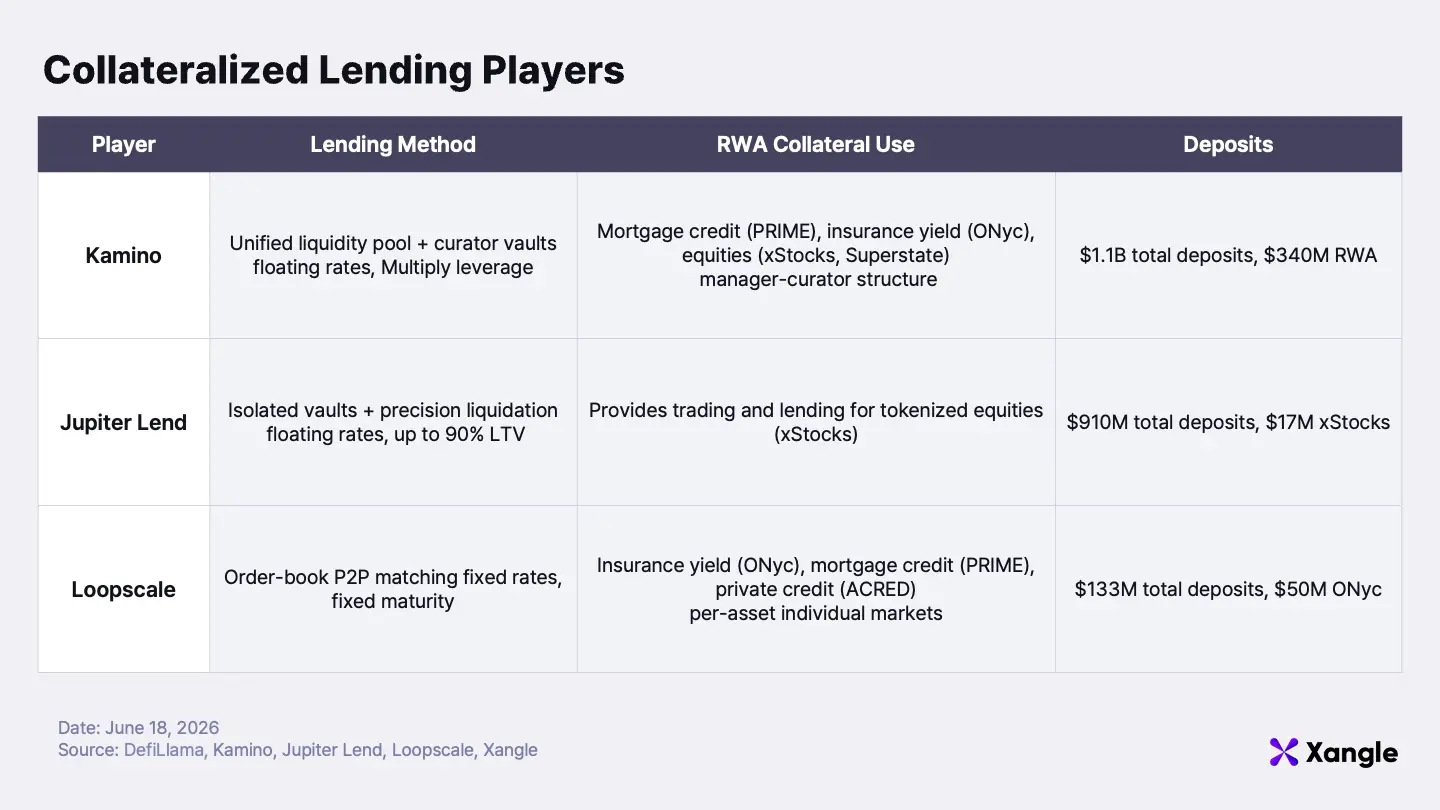
On Solana, this collateralized lending is concentrated in a few lending markets. Centered on the largest, Kamino, the main markets that accept RWA collateral are Jupiter Lend, which grew alongside a trading platform, and Loopscale, which chose a different approach in fixed rates. For an issued asset to be used as collateral, it must first be listed as collateral on these markets. The three differ in how they lend: Kamino, which accepts a broad range of assets with the deepest liquidity; Jupiter Lend, which links trading and collateral in one place; and Loopscale, which chose fixed rates over floating.
1) Kamino
Kamino is Solana's largest lending market. It holds about $1.1 billion in deposited assets, more than $4 billion in funds has passed through it cumulatively, and it has not had a single instance of unrecovered bad debt since launch. Its basic lending structure is a unified market that pools many assets into a single pool of liquidity; instead of splitting the market by asset and scattering liquidity, it gathers it together to raise capital efficiency.
Since a 2025 overhaul, the market has split into two branches. On one side, anyone can open a lending market for a specific asset; on the other, vetted professional managers run vaults that allocate funds across those markets. Rather than weighing the risk of each individual market, a depositor need only choose a desired yield and a manager, making it a channel through which institutional funds that demand sophisticated risk management come in. A market where a professional manager runs the tokenized private credit ACRED as a single asset is one example, and there are also vaults that distribute a user's USDC across multiple RWAs such as insurance and mortgage credit. It is a movement of RWA lending, which once gave a single rate to a single token, toward managed credit, where a manager constructs a portfolio and manages the risk.
Kamino is also where RWA collateral gathers most. The largest place is held by PRIME, which bundles the cash flows of mortgages, forming a lending market of about $180 million. Pledge it, and one can secure stablecoin liquidity equal to the value of that credit, so the issued credit is put to use once more within DeFi. The insurance-linked yield token ONyc serves as collateral at about $160 million as well, where yield is amplified through looping: pledging ONyc to borrow USDC, then using that USDC to buy more ONyc and add it as collateral. Kamino bundles this repeating process into one with its Multiply feature, executing the leverage strategy automatically.
It accepts equity-type tokens as collateral too. Kamino was the first among major lending platforms to accept tokenized equities as collateral, and xStocks, which tracks real shares one-to-one, and Superstate, which put registered shares on-chain, each form markets in the tens of millions of dollars. It is the place where insurance, mortgage credit, and equities serve in common as collateral, and whatever asset an issuer creates, for it to actually be used it must in the end be recognized as collateral in a lending market like this. That is why Kamino is the reference point for RWA collateral on Solana.
2) Jupiter Lend
To understand Jupiter Lend, one first has to know Jupiter. Jupiter is the most widely used gateway for trading tokens on Solana; starting from an aggregator that compares prices across multiple exchanges and connects swaps along the optimal route, it has built out a perpetual futures exchange, its own liquidity pool (JLP), a new-token launch platform, and a wallet. Solana users so often pass through Jupiter in some form when buying and selling tokens that, on the trading side, it counts as one of Solana's core players.
Jupiter Lend is the lending market that Jupiter launched in August 2025. As a flow took shape in which a trading user pledges that same token as collateral on the spot, deposits reached about $900 million within a few months of launch. What it puts forward is high collateral efficiency and low liquidation costs. One can borrow up to around 90% of collateral value while the penalty cost on liquidation is lowered to about 0.1% because, unlike the conventional approach of charging a large penalty all at once when collateral is liquidated, it liquidates precisely, a little at a time, only as much as the price falls. It places isolated vaults by asset so that trouble with one asset does not spread to others, and for depositors it separately provides vaults that automatically allocate funds to wherever the highest yield is.
Jupiter Lend's place comes through clearly in tokenized equities. SPYx, which tracks the S&P 500, forms a market of about $8.9 million, and QQQx, the Nasdaq 100, about $5.1 million, while names tracking Nvidia and Tesla are used as collateral too. Pledging these, one can borrow stablecoins, or take leverage of up to 3.8x for index types and 2.7x for high-volatility single names. The reason an index-tracking token is assigned a higher borrowing limit is that its price moves less than a single name, making it more stable as collateral. That a market accepting tokenized equities as collateral has opened at Jupiter Lend following Kamino, so that the same asset is now used across multiple lending markets at once, is a signal that the asset is settling into Solana DeFi.
3) Loopscale — order-book-based fixed rates
Loopscale is a market whose very lending method differs. Unlike Kamino or Jupiter Lend, which pool funds into a single pool and lend at floating rates, Loopscale connects borrowers and lenders directly through an order book. The lending side posts an order with its desired rate, term, and collateral to accept, and the borrowing side completes a loan on those terms, the same structure as a stock exchange matching bid and ask quotes to fill a trade.
This approach's difference shows up in two ways. One is that the rate and term are fixed at the moment of borrowing; unlike the pool approach, where the rate shifts constantly with supply and demand, here the terms both sides agree on stay fixed until maturity. The other is that a separate market is created for each asset; as long as there is someone willing to lend, a new market forms for any asset. It is a structure tuned to institutional assets and RWA credit, for which both rate predictability and asset variety matter. By scale, active loans stand at about $48 million, smaller than the two markets above, but it occupies the position of filling the gaps in RWA credit that standardized lending markets do not capture.
On top of this order book, Loopscale adds structured products beyond simple lending. The representative one is the Yield Loop, which bundles into one the process of using a yield-bearing token as collateral to borrow the same token and buy more of it; because the borrowing is at a fixed rate, one can take leverage without the risk of the rate spiking and inverting the yield.
The assets covered in the issuance chapter are actually used in this structure. The insurance-linked yield token ONyc is the most active. With about $30 million in the yield loop that borrows and rebuys the same token and about $19 million in the fixed-rate lending market, ONyc pledged as collateral reaches $50 million on its own, making it the largest asset on Loopscale. The mortgage-credit token PRIME serves as leveraged collateral the same way, and Apollo's private credit token ACRED serves as collateral the same way as well, with the step of swapping the stablecoin used for borrowing eliminated, cutting costs. With insurance, mortgage credit, and private credit all used in this structure, fixed rates and per-asset markets can serve as one more option for holding RWA credit.
4-2. Trading and Liquidity
If pledging as collateral to borrow is one branch of RWA utilization, the other is buying and selling. For a tokenized asset to trade at fair value, there has to be a market where buyers and sellers meet, and liquidity to support that trading. The place where issued RWAs change hands rather than sit in a wallet, the venue where that trading happens, is the decentralized exchange (DEX).
Solana's standing as a venue for trading is clear. Over the course of 2025, Solana's DEX volume was $1.52 trillion, the most of any blockchain and well ahead of second-place Ethereum's $900 billion. It is the chain where trading is most active. Whether for a trader buying and selling tokenized equities or an everyday user trading collectibles, Solana is where the market to actually exchange assets is best formed, evidence that it is a fitting environment for RWAs to be traded and used rather than merely issued.
In this trading, liquidity carries a meaning beyond mere volume. Whether tokenized equities or gold, when the gap between the buy price and the sell price, the spread, widens, that asset's trading cost rises and it gets shunned. Only when sufficient liquidity is gathered in one place does the spread stay narrow even on large trades and the execution price hold without slipping, and only then does it become a market that institutional investors trading in size can enter too. Solana's DEXs form this liquidity on the strength of fast throughput and low fees, making a market where RWAs trade around the clock.
On Solana, this trading is split across a few DEXs, and even among them, the roles differ. Jupiter is the gateway that gathers scattered liquidity and connects it at the best price; Raydium is Solana's flagship DEX, where the deepest liquidity gathers. Meteora places liquidity across price ranges to make a market of deeper liquidity with the same funds, while Orca separately runs permissioned pools for regulated securities that only qualified investors can trade. Freely circulating assets are supported by the first three, and transfer-restricted securities are handled by Orca, so where an asset trades depends on its character.
1) Jupiter — DEX aggregator
Jupiter is the gateway to trading on Solana. As an aggregator that gathers prices across multiple DEXs and connects users to the best price, it is the first entrance a user passes through to trade a token. Even for the same token, liquidity is split across pools on multiple DEXs, each with a different price and depth, and comparing them one by one is hard for a user. Jupiter compares the prices of more than 10,000 trading pairs in real time to find the most favorable route, and when needed, splits a single trade across multiple pools to fill it. Its monthly volume exceeds $15 billion and it has processed more than $1 trillion cumulatively, so a substantial share of the token trading on Solana passes through this route. It is distinguished from an individual DEX in that it holds no liquidity itself but gathers and connects scattered liquidity, and because it is not tied to any one exchange, it functions as the gateway to all trading on Solana.
The benefit this structure brings to RWAs becomes clearer the more an asset's trading is scattered. When the tokenized equity xStocks was issued, a user could trade at the best price through Jupiter without having to find which pool had the deepest liquidity. Even for the same TSLAx, liquidity is split across multiple pools (Raydium, Meteora, and others), each with a different price and depth, and Jupiter compares them to fill along the most favorable route. For an asset whose liquidity is spread thin across several places early in its trading life, as with tokenized equities, the execution price slips easily if only one pool is used, so the role of an aggregator that bundles scattered liquidity and finds the best price is all the greater.
2) Raydium
Raydium is Solana's flagship AMM and the center of its liquidity, the venue where a newly issued token first trades. An AMM, rather than matching buyers and sellers directly, is a model in which the price is set automatically by supply and demand within a pool that pairs two assets together. Anyone can pair two tokens to create a liquidity pool, and whoever puts funds into the pool shares in the fees each time a trade occurs. A newly issued token only begins to trade once such a pool is created and funds gather. With about $860 million in deposited liquidity, $4.3 billion in monthly volume, and its own launch feature to help issue new tokens, Raydium becomes where that first pool is created earliest. If an aggregator is on the side of gathering already-formed liquidity, Raydium is on the side where that liquidity is first formed.
When xStocks arrived on Solana, Raydium was precisely that first venue. Right after launch, xStocks's main on-chain liquidity gathered on Raydium, and Jupiter bundled the best price on top of it and connected users to it. As trading pairs for tokens tracking Apple and Tesla were created, a market formed where tokenized equities trade around the clock, and the insurance-linked yield token ONyc trades on Raydium too. The same route applies to RWAs issued going forward. Whether a tokenized treasury or a new collectible, issuance alone does not make it trade; a liquidity pool has to be created with that asset and a stablecoin, and funds have to gather, for it to reach users. That xStocks's cumulative DEX volume has passed $1.6 billion is, likewise, a result of that trading occurring on top of such AMM liquidity.
3) Meteora
Meteora is a DEX specialized in the efficiency of liquidity provision; the same AMM model, but diverging from Raydium in how it places liquidity. Unlike an ordinary AMM, which spreads liquidity evenly across the entire price range, Meteora's dynamic liquidity (DLMM) places funds in finely divided price bands and lets liquidity adjust as the market moves. It can make deeper liquidity with the same funds, so traders trade with lower slippage, and providers earn more in fees as their funds concentrate at the price band where trading actually occurs. Deposited liquidity is about $280 million, around a third of Raydium's, but its monthly volume of $4.3 billion rivals Raydium's. Absorbing that much trading with less liquidity demonstrates the efficiency of this placement method.
Where this precise placement proves its value is in assets with thin liquidity or a confined price range. Because an RWA whose price moves little, a tokenized treasury or gold, trades within a narrow range, Meteora's way of concentrating liquidity in that band makes a deep market even with modest funds. Liquidity pools for tokenized equities like xStocks are created on Meteora too, and when Jupiter routes a trade, Meteora's liquidity is bundled in along with the rest. If Raydium is where the first pool for a newly issued token is created, Meteora is where, within the same open model, the efficiency of liquidity is raised.
4) Orca — Permissioned RWA pools
Where Jupiter, Raydium, and Meteora support trading open to anyone, Orca takes on one further role in RWAs. Apart from liquidity pools open to the public, it runs permissioned pools for regulated assets.
What this pool solves is a problem unique to transfer-restricted tokenized securities. The tracker-type and yield-type tokens seen earlier have no restriction on circulation and trade freely in open pools anyone can enter and exit. But an asset that tokenizes a regulated security in the United States is different in character. Such a security may be sold only to investors qualified under federal securities law, and that eligibility requirement does not disappear once it becomes a token issued on a blockchain. It can be exchanged only between wallets that have passed qualified-investor screening and cleared KYC, and a single transfer to an unqualified wallet is itself a violation of securities law.
The problem is that the way an open pool works runs head-on into this condition. An AMM pool is designed so that anyone can freely add and remove funds, so a token placed into the pool circulates to the anonymous, indeterminate many who trade with it. That the pool does not screen who buys, that very indiscriminateness, is the principle by which an open pool makes deep liquidity. But the same property is fatal for a regulated security. The moment an unqualified wallet buys the token from the pool, compliance breaks, so for an issuer, the security it has issued cannot be traded in such a pool.
As a result, tokenized securities had been left in a state where they were issued but had nowhere proper to trade. Even with a primary window to buy and sell directly through the issuer, a secondary market where a buyer could freely resell when they wished was hard to build because it could not be listed in an open pool due to regulation, and yet there was no dedicated trading market with eligibility controls in place either. Tokenization's original promise was to make assets freely tradable around the clock, yet the very securities under the strictest regulation had been set apart from that promise.
Orca's permissioned pools solve this problem on top of Token-2022, Solana's token standard. As seen in the issuance chapter, Token-2022 is a standard that can embed compliance functions such as transfer restrictions and identity verification into the token itself. A wallet whose eligibility is unconfirmed is blocked from receiving the token from the outset, and only wallets that have passed the issuer's screening can hold and trade it. When an issuer manages an eligibility list through KYC and qualified-investor screening, each time the token moves, the receiving side is checked against that list, and if unqualified, the trade does not go through. Eligibility verification, in effect, is applied automatically at the moment the token changes hands rather than as a separate paperwork step.
The first asset to apply this structure on Solana is GLDY. A gold-based yield-bearing tokenized security, it trades in a dedicated pool that the issuer Streamex and Orca built together. When Streamex manages the KYC and qualified-investor list, the token account of a wallet whose eligibility is unconfirmed is created in a frozen state, so it cannot receive GLDY; only a wallet that has passed verification has its account unfrozen and can hold and trade the token. On top of that, Orca's pool infrastructure is where the actual trading takes place. This model is not limited to GLDY. The same infrastructure can host trading for other tokenized securities such as equities, bonds, and real estate, making it a channel through which transfer-restricted assets gain liquidity on Solana.
Freely circulating assets, like the tracker-type tokens seen in the issuance chapter, trade in the open pools of Raydium and Meteora, but securities with eligibility restrictions on transfer require permissioned pools like these. Even within DEX trading, trading divides into open and permissioned according to an asset's regulatory character, and Orca occupies the position of supporting RWA trading on the permissioned side.
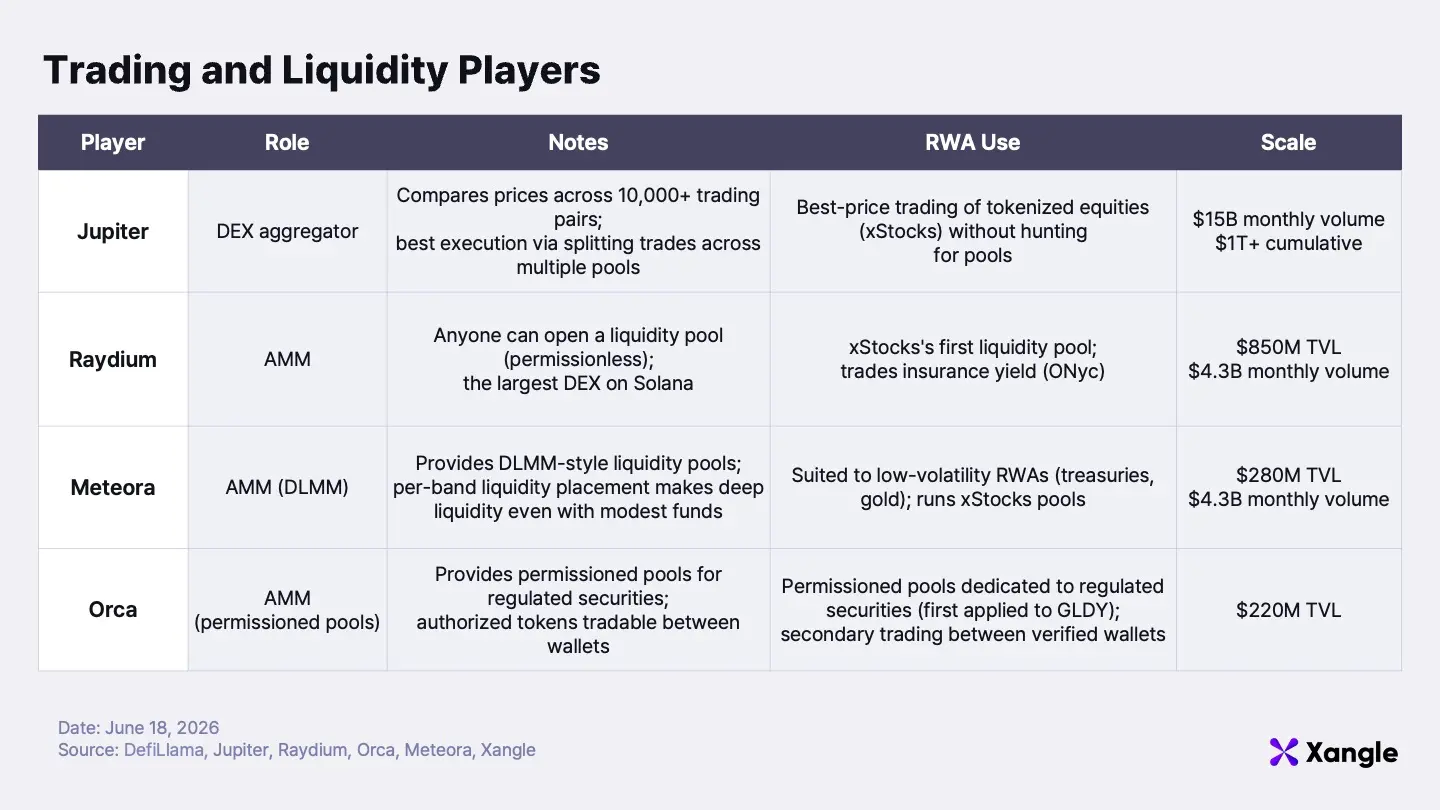
5. Closing Remarks
This report has followed the path an RWA travels on Solana in the order of issuance, data and oracles, and utilization, examining the players at each stage. In issuance, where an asset becomes a token, there were issuers of differing structure for each asset class, from treasuries to equities, credit and insurance, and gold and collectibles; and the oracles supplying prices to those tokens divided the work between real-time quotes and fund NAVs. Assets thus issued and priced served as collateral in lending markets and traded on DEXs, put to use within Solana.
What this process confirmed is that even for the same RWA, Solana's standing differs by asset class. In the asset class closest to traditional finance, treasuries and MMFs, Solana is not the leader. By issuance value, this domain is led by Ethereum and BNB Chain, and as BUIDL's roughly 23% share on Solana shows, Solana is one of several chains on which the flagship funds are issued.
The closer one moves toward trading and utilization, by contrast, the more the picture changes. For tokenized equities, 97% of cumulative on-chain spot volume occurs on Solana; for collectibles, a market has formed where issuance and trading take place on a single platform; and credit and insurance tokens enter collateral and yield loops immediately after issuance. Over the past 30 days, the value of RWAs issued across the entire market rose about 3.7%, while Solana's rose 17.7%. By issuance volume alone Solana ranks third, but in the utilization that has assets actually traded and used as collateral, its strength shows in its being the most active chain. This direction is also the result of the Solana Foundation's design under the banner of Internet Capital Markets, where every asset is issued and traded on-chain. The vision of not stopping at putting an asset on a ledger but having it move on top of that ledger is being borne out in the numbers, in RWAs.
This strength is possible because the players are filled in at every stage. Following a case of issuing tokenized equities on Solana makes the picture clear. With tokenized equities, Backed buys the actual shares through a broker, places those shares in custody at a regulated custodian, appoints a Security Agent to preserve the shares on behalf of holders even if the issuer goes bankrupt, and on the basis of the physical shares thus secured issues xStocks, the token matched one-to-one, on Solana. Once Backed has bundled and handled what issuance requires (purchasing, custodying, and the legal administration of the shares), the token moves straight to the next stage on Solana. Pyth supplies the real-time price; once the first liquidity is created on Raydium, Jupiter bundles the scattered liquidity at the best price; and Kamino and Jupiter Lend accept the token as collateral so that stablecoins can be borrowed against it.
From issuance to pricing, trading, and collateral, no stage is left blank, and when the character of the asset changes, only the names one selects differ while the skeleton stays alike. For private credit, Securitize handles issuance and RedStone, which handles NAV, handles pricing; for an insurance-yield token, the ONyc that OnRe issued trades on Raydium and enters the yield loops of Kamino and Loopscale. Only the issuer and the oracle change to suit the asset; the stages themselves, issuance to pricing to trading to collateral, stay alike.
This does not, of course, answer every question. Even within the actively used asset classes, maturity is uneven: tokenized gold is only just starting out in scale, and collectibles are a consumer market different in character from the financial-type assets. Tokenized equity trading is not yet offered in major regulated jurisdictions such as the United States, and in the absolute scale of issuance value, Ethereum is ahead. Leading in utilization does not erase these limits.
Still, if the criterion for choosing a chain in RWAs is not issuance balance alone, then the environment in which issued assets are traded and serve as collateral, and the presence of the players supporting each of those stages, deserves to be weighed just as heavily. By that criterion, Solana is the chain where assets move most actively, a chain with the players in place to accompany an asset from issuance through utilization. For anyone looking into RWAs on Solana, we hope this map can serve as a starting point.
Disclaimer
I confirm that I have read and understood the following: The information contained in this article is strictly the opinions of the author(s). This article was authored free from any form of coercion or undue influence. The content represents the author's own views and does not represent the official position or opinions of CrossAngle. This article is intended for informational purposes only and should not be construed as investment advice or solicitation. Unless otherwise specified, all users are solely responsible and liable for their own decisions about investments, investment strategies, or the use of products or services. Investment decisions should be made based on the user’s personal investment objectives, circumstances, and financial situation. Please consult a professional financial advisor for more information and guidance. Past returns or projections do not guarantee future results.
Xangle or its affiliated partners own all copyrights of the written or otherwise produced materials and content provided on the platform. Any illegal reproduction of such content, including, but not limited to, unauthorized editing, copying, reprinting, or redistribution will result in immediate legal actions without prior notice.
![[CIS Partner Summit Highlights] Ault's Financial Super App Strategy: OnlyBulls](https://resource.xangle.io/files/content/C1A19E1DB41B7FB86076143803C40D8E_1790125531662.webp)