Monad: Beyond a Fast Chain, Toward an Internet Financial Layer

1. Monad’s Shift: From Fast Chain to Internet Financial Layer
1-1. RWA Tokenization and Crypto’s Institutional Turn
1-2. Monad Is No Longer Just a “Fast Chain”
2. Monad as a Hub Chain
2-1. Fast Finality as Risk Management in Finance
2-2. Ethereum Compatibility and the Cost of Adoption
2-3. Low Fees and High Throughput Shape Product Design
3. Monad’s Financial Infrastructure Takes Shape
3-1. Stablecoin Payments and Settlement: Rails for Capital Inflows and Outflows
3-2. Tokenization and Credit: Expanding into Operational Financial Products
3-3. The Agent Economy: Execution Infrastructure for Automated Micropayments
4. Beyond a Fast Chain and Toward an Internet Financial Layer
1. Monad’s Shift: From Fast Chain to Internet Financial Layer
1-1. RWA Tokenization and Crypto’s Institutional Turn
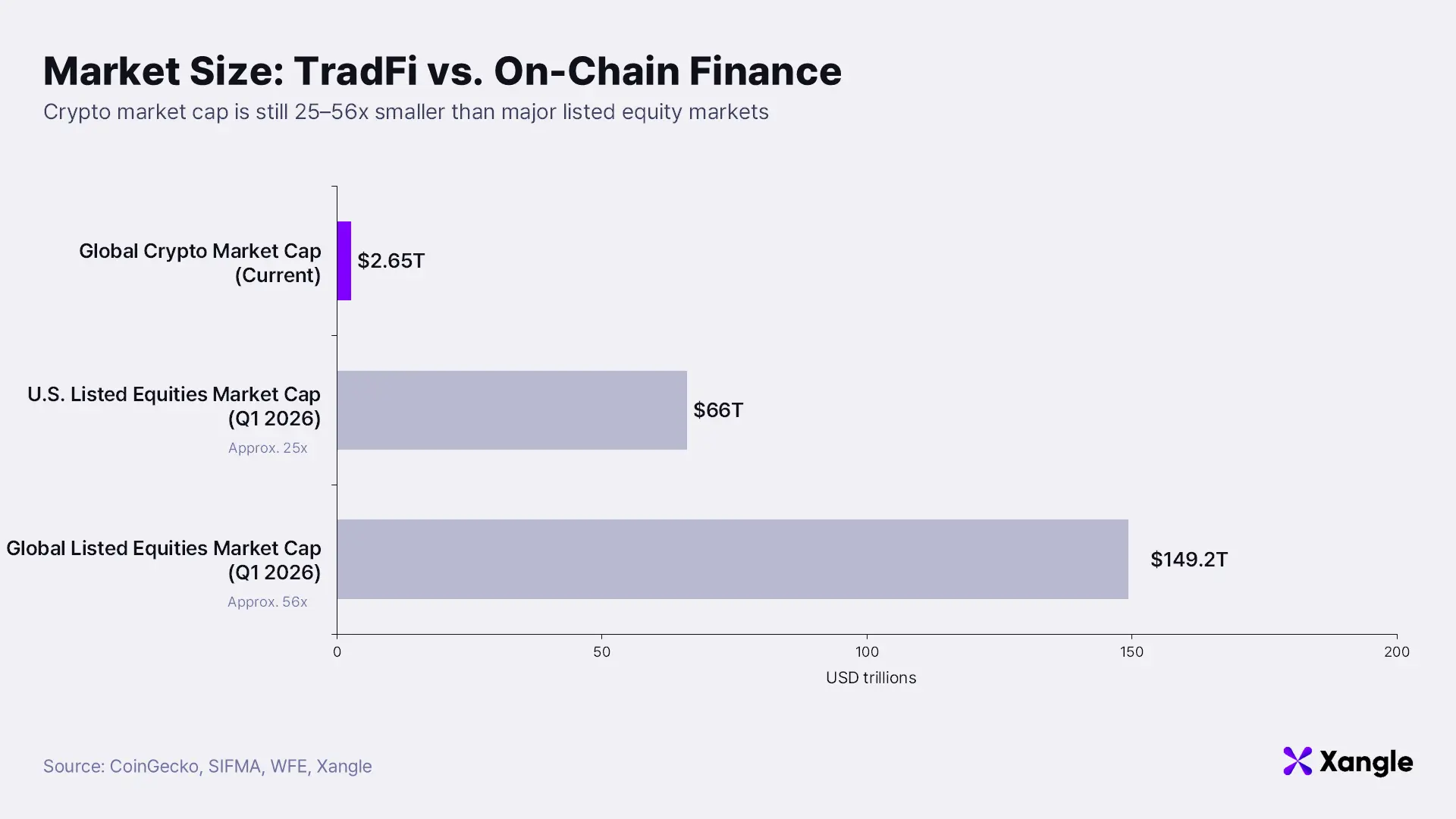
The global crypto market currently stands at roughly $2.65 trillion in total market capitalization. By comparison, U.S.-listed companies were worth approximately $66.0 trillion as of Q1 2026, while the global listed equities market reached about $149.2 trillion. Global debt, including bonds and loans, stood at roughly $353 trillion as of the end of March 2026. Even the U.S. public equity market alone is about 25 times larger than crypto’s total market cap, while the global listed equities market is roughly 56 times larger.
The gap in scale underscores the limits of an on-chain market driven only by crypto-native liquidity. The larger opportunity lies where traditional financial assets and capital flows begin to connect with on-chain infrastructure. Treasuries, credit products, stablecoins, FX, payment settlement, and automated micropayments are all becoming increasingly important parts of this transition.
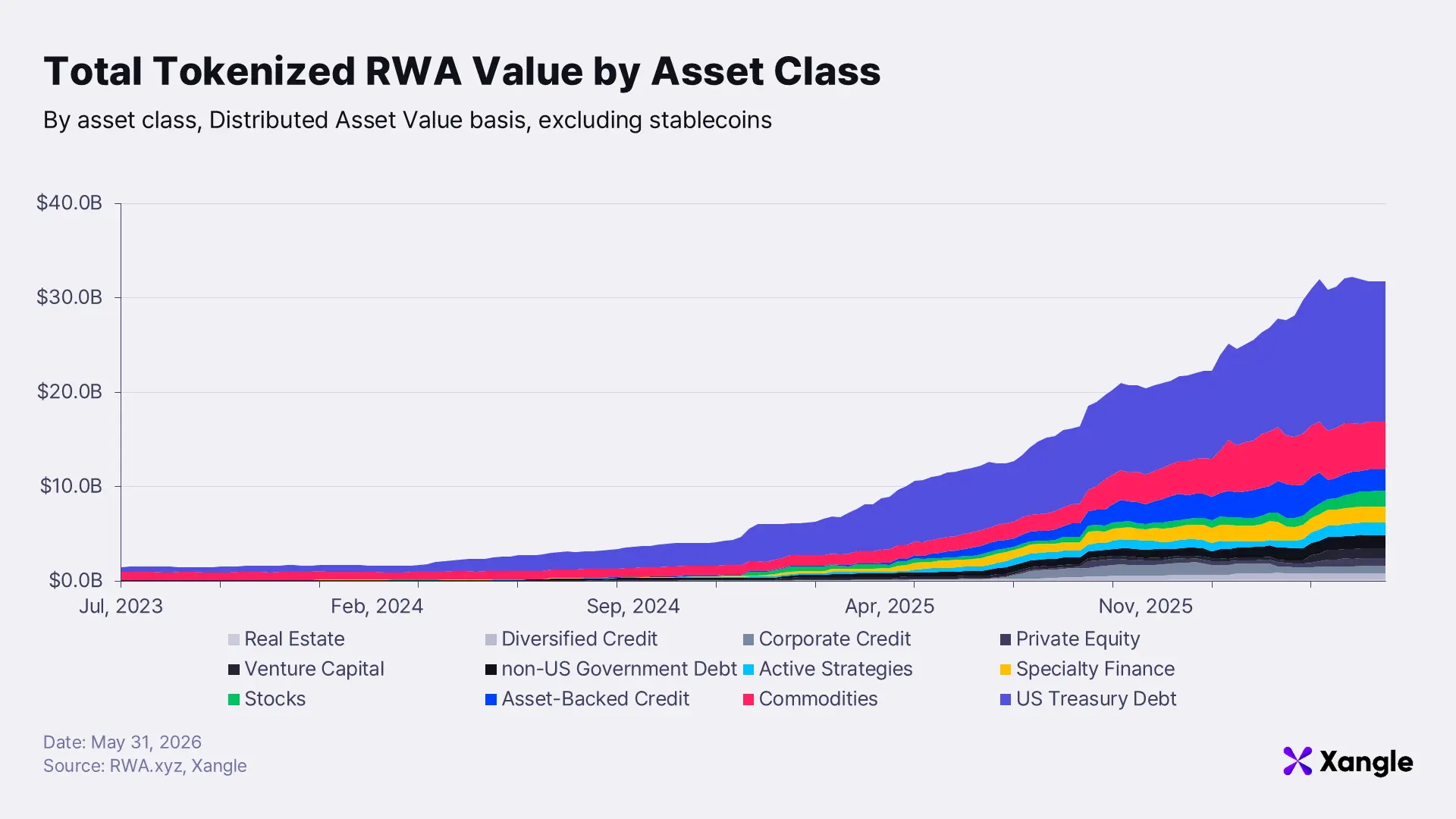
Real-world asset tokenization, or RWA, is one of the clearest expressions of this shift. According to RWA.xyz, tokenized real-world assets now account for approximately $31.8 billion in on-chain value, measured by Distributed Asset Value. The market was initially led by tokenized U.S. Treasuries and money market-style products, but it has since expanded into commodities, private credit, equities, institutional funds, and other asset classes.
The broader shift, however, should not be understood through RWA alone. At a higher level, crypto and blockchain infrastructure are moving toward a role where they can support institutional capital flows and real financial operations. Stablecoins are becoming payment and settlement instruments, tokenized assets are becoming financial products managed on-chain, and the agent economy is creating an environment where AI can pay for and consume services autonomously. As blockchain moves further into institutional finance, the core requirement is no longer just the token itself. What matters is the infrastructure that can reliably operate real financial products.
Monad’s recent positioning is worth reading in this context. The project is no longer focused only on the technical performance of a fast EVM chain. Instead, Monad is putting payments, tokenization, and the agent economy forward as its core institutional use cases. Each of these areas sits at the intersection of traditional financial flows and on-chain execution. Monad’s message, therefore, is not simply about high throughput or fast finality. It is about using that performance as the foundation for an internet financial layer capable of supporting stablecoin payments, tokenized asset management, institutional credit, and automated micropayments.
1-2. Monad Is No Longer Just a “Fast Chain”
Monad initially drew attention as a high-performance EVM chain. High throughput, short block times, fast finality, and compatibility with the Ethereum ecosystem were the core attributes used to define the project. Yet after successive waves of so-called Ethereum killers, the value of a blockchain can no longer be reduced to how many transactions it can process or how quickly it can process them. The more important question is what that performance enables.
An internet financial layer requires several core conditions. Capital needs to move without being constrained by borders or business hours. Payments and settlement need to happen without delay. Tokenized assets and credit products need to support ongoing operational workflows after issuance, including redemptions, collateral management, interest accrual, and investor reporting. In a world where AI agents can pay for and consume services directly, smaller transactions may also occur at much higher frequency. Under this model, chain performance is not just a technical benchmark. It becomes part of the operating foundation that allows financial products and services to function in the real world.
Monad’s differentiation lies in bringing these conditions together within a single execution environment. Fast finality matters for time-sensitive financial operations such as payment authorization, collateral updates, and redemption processing. Low fees and high throughput improve the economics of recurring settlement, micropayments, rebalancing, and reserve verification. Ethereum compatibility further reduces the adoption burden for new chains by allowing teams to reuse existing developer tools, smart contract patterns, audit experience, wallets, and custody infrastructure.
Monad is therefore better understood not simply as a “fast chain,” but as an execution layer for financial activity across the internet economy. Speed is only the starting point. The more important shift is Monad’s expansion into stablecoin payments, tokenized asset management, institutional credit, on-chain liquidity, and agent-based micropayments.
2. Monad as a Hub Chain
Monad’s view is that on-chain finance needs a shared execution layer to scale across multiple financial services. By “hub chain,” Monad refers to a structure where payments, deposits and withdrawals, bridging, settlement, liquidity management, and asset transfers are coordinated on a single chain. Payment companies, card issuers, exchanges, on/off-ramp providers, tokenized asset issuers, and on-chain finance applications all offer different services. In actual operations, however, they face the same set of problems: moving assets, checking balances, completing settlement, and managing liquidity.
In institutional finance, the value of a shared execution layer becomes clear because capital movement and settlement grow more complex as they are spread across more systems. When fiat currencies and stablecoins, tokenized assets and on-chain liquidity, exchanges and payment providers, and issuers and investors all operate in separate environments, every payment, deposit or withdrawal, rebalance, collateral update, and asset transfer can introduce latency and cost. If these processes can instead be connected on one execution layer, financial services can run faster and at lower cost.
Monad’s hub-chain thesis is rooted in this operating problem. Monad aims to provide a foundation where stablecoin payments, tokenized assets, institutional credit, on-chain liquidity, and agent-based micropayments can operate in the same environment, supported by fast finality, low fees, high throughput, and Ethereum compatibility. Monad’s hub chain strategy, then, is not merely to position the network as a faster transaction-processing layer. It is an attempt to connect the wide range of financial activities generated across the internet economy through a single on-chain execution layer.
Several conditions must be met for a chain to become a hub for institutional finance.
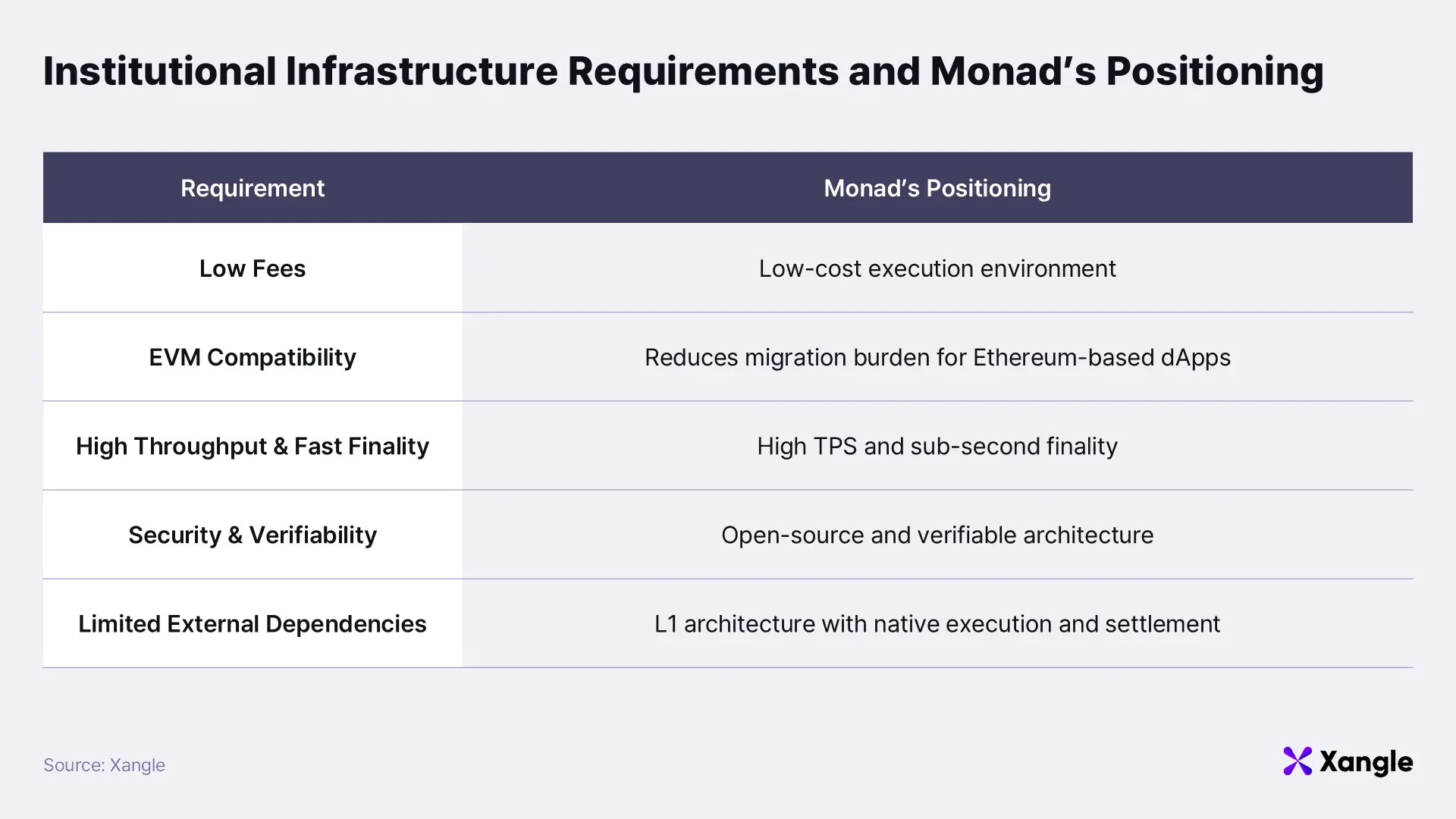
First, fees must be low. A hub chain does not only process one-off transactions. Payments, bridging, rebalancing, and treasury management recur continuously. Even small fees can affect an operator’s cost structure when they accumulate across thousands of coordination transactions each day.
Second, it must align with existing development standards. Institutions and enterprises are cautious about adopting new execution environments, programming languages, or audit procedures. An environment with proven contract patterns, developer tooling, audit experience, and available talent has a clear advantage. From this perspective, the EVM remains the standard with the broadest developer base and tooling ecosystem.
Third, high throughput and fast finality are essential. In institutional finance, the critical question is not only how quickly a transaction is submitted, but when its state becomes irreversible. In card issuance, the time between authorization and final settlement is directly tied to the amount of collateral or liquidity that must be held in reserve.
Fourth, security and verifiability are essential. A chain that carries institutional capital cannot depend solely on trust in its operator. Its code and infrastructure must be externally reviewable, and the process for discovering and fixing vulnerabilities must be transparent.
Fifth, sufficient decentralization and limited external dependencies are essential. A chain serving as a hub for payments and settlement must be structured in a way that is not overly exposed to changes in a specific company’s strategy or to fee and governance changes on a parent chain.
2-1. Fast Finality as Risk Management in Finance
Finality refers to the point at which a transaction state can be treated as practically irreversible. On blockchains, there is an important distinction between a transaction appearing quickly in an application UI and that transaction being final enough to support payment, settlement, accounting, or collateral decisions.
Ethereum illustrates the distinction. When a user submits a transaction, it first propagates through the network before a validator includes it in a block. Ethereum proposes a new block roughly every 12 seconds, so when fees are sufficient and the network is not congested, users can usually see their transaction included in a block within a short period of time. Inclusion, however, is not the same as finalization. On Ethereum, additional blocks and validator attestations build on top of the included block, and the block typically reaches a finalized state after roughly 12 to 15 minutes. Once finalized, the block is difficult to revert without a major network-level attack, making finality the state that financial institutions can more conservatively use as a reference point for payment, accounting, and collateral decisions.
In institutional finance, finality matters because transaction states become inputs for multiple downstream workflows. In card payments, for example, balance checks, payment authorization, and assessments of whether settlement can proceed need to happen within seconds after a user taps a card. In collateralized lending, collateral deposits or repayments need to be finalized before loan limits, liquidation decisions, and accounting treatment can be determined. The same applies to credit vaults and tokenized assets, where deposits, redemptions, interest accrual, and investor records need to be updated based on finalized states.
Slow finality forces financial institutions to absorb the uncertainty in the interim. Card issuers and payment providers need to hold more reserve liquidity until settlement is complete, and lending protocols need to set limits conservatively until collateral states are fully finalized. Faster finality allows the same transactions to be processed with less capital tied up, while downstream workflows such as payments, collateral updates, and redemptions can be linked more quickly. Finality, in other words, is not just a user-experience metric. It directly affects capital efficiency and risk management.
Monad’s focus on fast finality should be read in this context. Ethereum produces blocks roughly every 12 seconds, but finalization that financial institutions can conservatively rely on usually takes around 12 to 15 minutes. Monad, by contrast, targets roughly 400-millisecond block production and roughly 800-millisecond finality. On a time basis, Monad’s finality is equivalent to roughly 1/900 to 1/1,125 of Ethereum’s finalization time.
Monad’s fast finality also stands out relative to other high-performance chains such as Stellar, Solana, and Polygon. Stellar closes ledgers and finalizes transactions roughly every 5 to 6 seconds. Solana offers block times of around 400 milliseconds, but its practical finality is generally described as roughly 2 to 5 seconds. Polygon PoS offers block times of around 2 seconds, but checkpoint-based finality can take roughly 2 to 5 minutes.
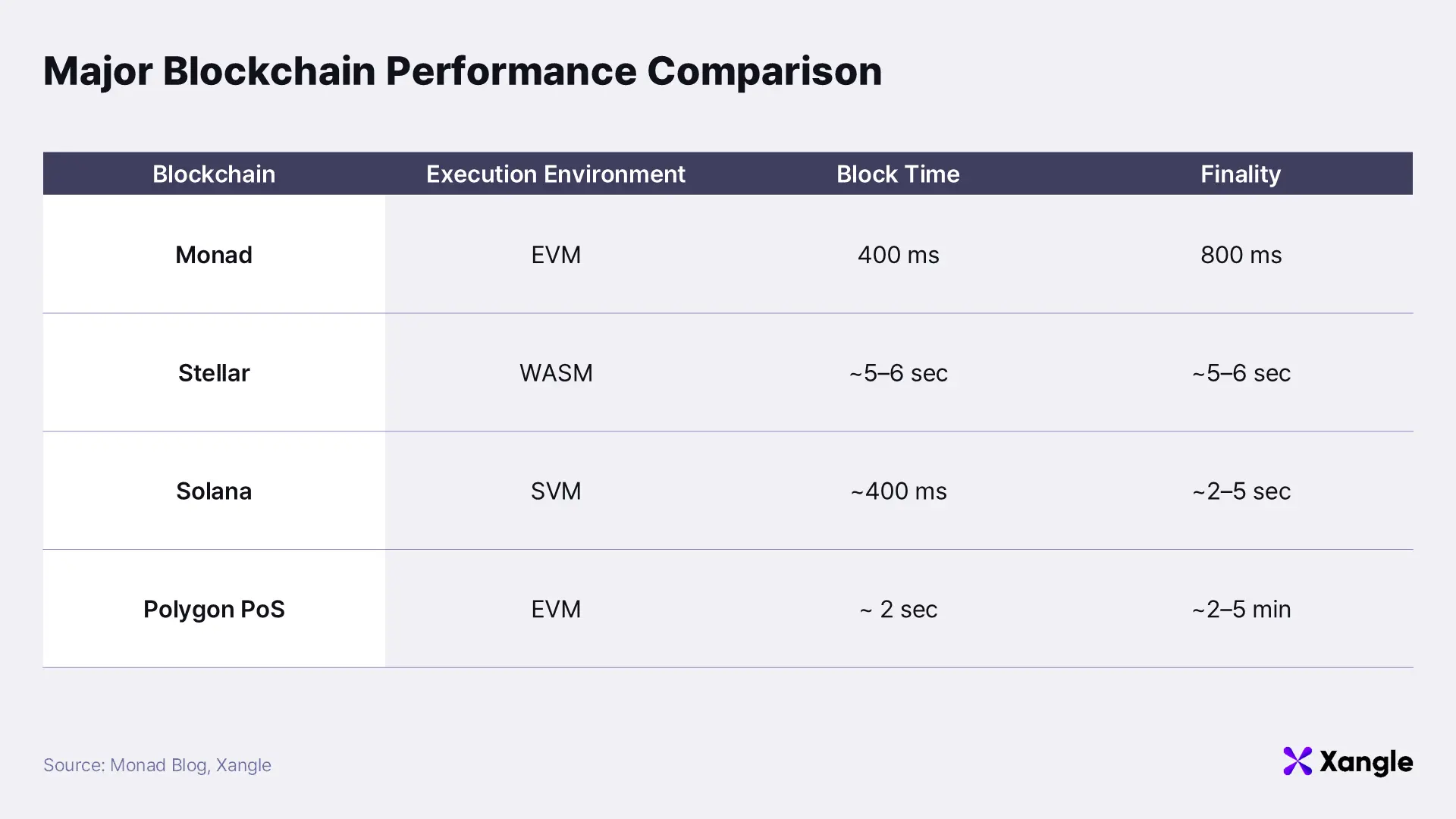
The difference matters for financial workflows in which multiple state changes need to be linked within a short window, including payment authorization, collateral updates, redemption processing, credit vault accounting, and agent-based micropayments. If Ethereum is the most proven settlement base, Monad is trying to build an execution environment better suited to real-time payments and recurring financial operations by preserving EVM compatibility while providing much shorter finality times.
2-2. Ethereum Compatibility and the Cost of Adoption
When institutions and enterprises evaluate a new chain, performance is only one part of the decision. On-chain financial services run on a broader operating stack that includes smart contracts, audit processes, wallet and custody infrastructure, price data, monitoring, and risk management systems. EVM compatibility lowers adoption costs at precisely this layer. The Ethereum ecosystem already has a mature base of proven developer tools, audit providers, and infrastructure services, allowing institutions building on-chain financial services to start from an environment that is both familiar and battle-tested.
On an EVM-compatible chain, developers can rely on Solidity-based contracts and existing tooling, while auditors can assess risk against contract structures and security patterns that have been reviewed over many years. Adjacent infrastructure, including wallets, custodians, oracles, indexing, multisigs, and analytics tools, has also been widely built around the EVM ecosystem. A completely different execution environment, by contrast, requires teams to learn new programming languages and contract structures, while also rebuilding audit standards and operational tooling. The issue is not simply developer convenience. It directly affects launch timelines, operating costs, and risk management costs.
Monad is EVM-compatible, which means existing Ethereum-based applications and infrastructure can be ported with relatively limited friction. EVM compatibility alone, however, is not enough to differentiate a chain, as many blockchains already offer it. Monad’s differentiation lies less in compatibility itself and more in the performance profile and operating conditions it combines with that compatibility.
Ethereum remains the most battle-tested EVM ecosystem, but its speed and cost profile can be burdensome for repetitive financial operations compared with Monad. Base and OP Stack L2s offer EVM compatibility and lower costs, but their L2 architecture introduces external dependencies, including Ethereum settlement, batching, and withdrawal flows. As a result, they remain more exposed to changes in the parent chain’s fees and governance. Solana is strong on throughput and cost, but it uses the SVM rather than the EVM. Existing Ethereum-based contracts, audit practices, developer tools, wallet integrations, and infrastructure connections therefore cannot be ported as-is, requiring institutions or development teams to build separate development, audit, and operating processes.
Monad sits between these reference points. It seeks to preserve Ethereum’s development standards and infrastructure compatibility, reduce external dependencies relative to Base and OP Stack L2s, and lower the migration costs associated with high-performance non-EVM chains such as Solana. Monad, in other words, is not simply another chain that supports the EVM. It is positioning itself as a high-performance financial execution layer that combines EVM compatibility with fast finality, low fees, and high throughput.
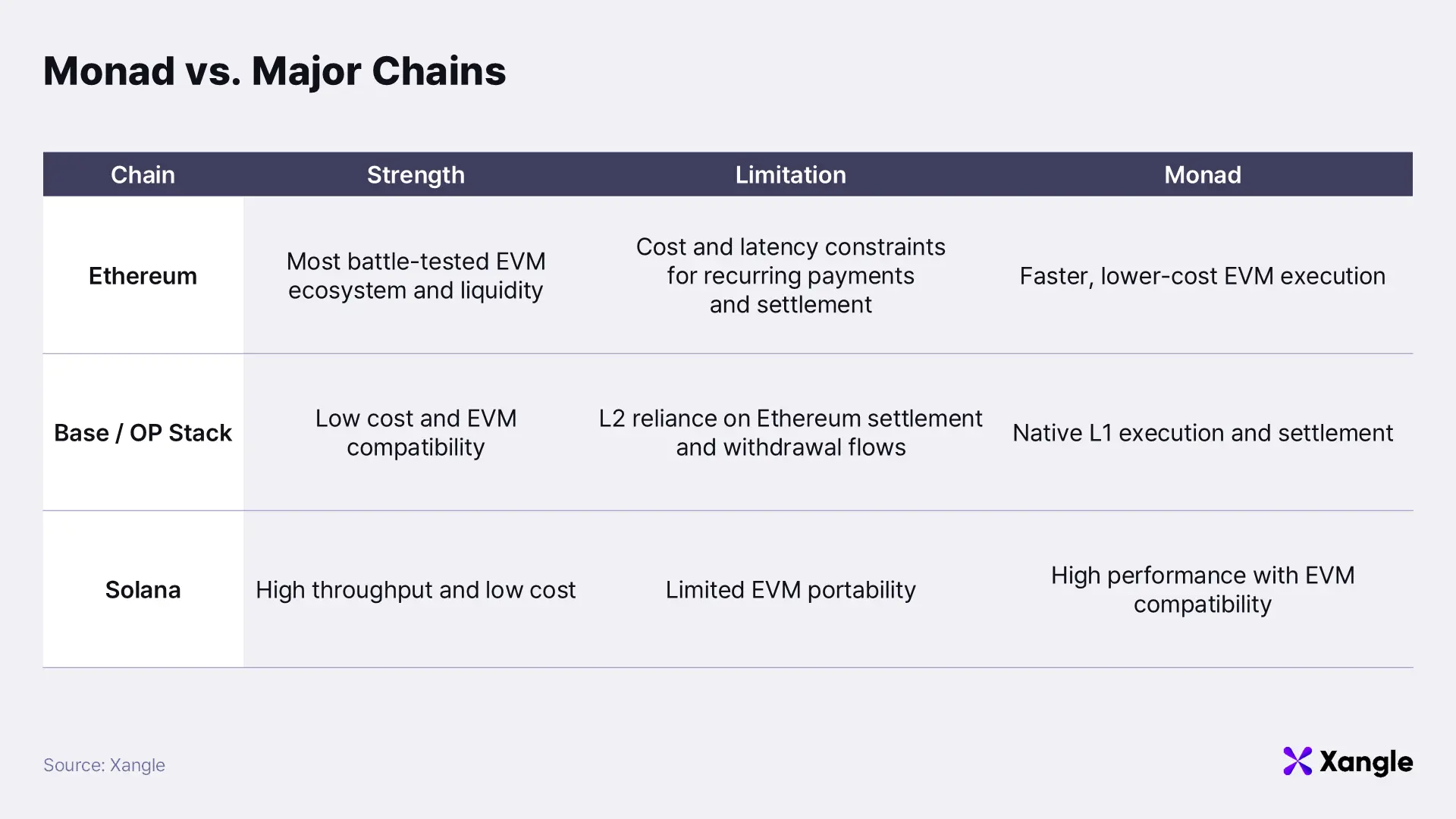
The table above compares Monad with Ethereum, Base/OP Stack, and Solana. The key takeaway is not simply that Monad supports the EVM, but that Monad is trying to use EVM compatibility as the basis for balancing speed, external dependencies, and adoption costs.
In practice, Ethereum compatibility is a prerequisite for Monad to attract institutional financial applications. Existing Ethereum projects can expand to Monad with fewer changes, while institutions building new on-chain financial services can rely on the tooling and infrastructure of the proven EVM ecosystem. Monad aims to add fast finality, low fees, and high throughput to that base, creating an environment where existing EVM financial applications can support higher-frequency payments, settlement, collateral management, and credit operations.
2-3. Low Fees and High Throughput Shape Product Design
Fees and throughput are not just network performance metrics. They are inputs that shape the unit economics and operating model of financial products. Payments, deposits and withdrawals, settlement, rebalancing, collateral status updates, reserve verification, redemption processing, and investor reporting are not one-off actions. As user counts grow and asset scale increases, the same operations repeat continuously. Total network cost then scales with the fee per transaction multiplied by the number of transactions.
- Total network cost = Fee per transaction × Number of transactions
As transaction sizes get smaller and transaction counts rise, the fee per transaction becomes a direct constraint on product profitability and usability. In micropayments, fees can become disproportionately large relative to the payment amount. In recurring settlement, per-transaction costs accumulate as operating expenses for the business. Tokenized assets and on-chain credit products face a similar constraint, as high fees make it difficult to update interest accrual, redemptions, and collateral states on a frequent basis. High fees ultimately force products into slower and simpler designs.
The scale of traditional financial infrastructure makes this point clear. Visa processed 257.5 billion transactions in 2025, while the ACH network processed 35.2 billion payments worth $93 trillion in 2025. Fedwire Funds, the U.S. large-value transfer system, processed 217 million transfers worth $1.148 quadrillion in 2025. DTCC’s NSCC processed an average of $2.219 trillion in transactions per day as of 2024. Financial infrastructure, in other words, is built to continuously handle large transaction volumes, recurring settlement, and high-value asset movement.
Scale in traditional finance provides a benchmark for what on-chain infrastructure must support as more financial functions move on-chain. Stablecoin payments would need to handle annual payment flows ranging from billions to hundreds of billions of transactions to replace card payments or merchant settlement at meaningful scale. Tokenized assets and on-chain credit products would need to process repeated state updates, including issuance, redemption, interest accrual, collateral updates, and investor reporting, in order to absorb existing capital market workflows. Agent payments could add another layer of demand, with small payments for API calls, data access, and compute requests occurring at a much higher frequency than human-initiated payments.
Monad positions low fees and high throughput as core requirements for this environment. A simple annualized conversion of Monad’s stated 10,000 TPS implies processing capacity of approximately 315.4 billion transactions per year. That is comparable in scale to the 257.5 billion transactions Visa processed in 2025. Designed throughput, of course, should not be conflated with actual usage or sustained utilization. Even so, the figure illustrates that Monad is not designed only for a small number of high-value transactions. It is positioned as infrastructure for high-frequency financial activity, including recurring settlement, micropayments, on-chain rebalancing, real-time collateral management, and agent-based payments.
3. Monad’s Financial Infrastructure Takes Shape
Monad’s institutional use cases span payments, tokenization, and the agent economy. Payments establish the paths for funds to enter and leave the network. Tokenization allows assets and credit products to be managed on-chain. The agent economy assumes a world in which software can pay for and consume services automatically. Monad’s fast finality, low fees, and high throughput are relevant across all three areas.
3-1. Stablecoin Payments and Settlement: Rails for Capital Inflows and Outflows
The first pillar of Monad’s institutional push is stablecoin payments. Even if a chain processes a large number of internal transactions, it cannot function as financial infrastructure connected to the real economy unless funds can move on and off the network. Payment infrastructure is not just about processing on-chain transactions quickly. It is about the end-to-end flow of funds across users’ fiat balances, corporate settlement accounts, the currencies merchants receive, and the operating systems of payment providers.
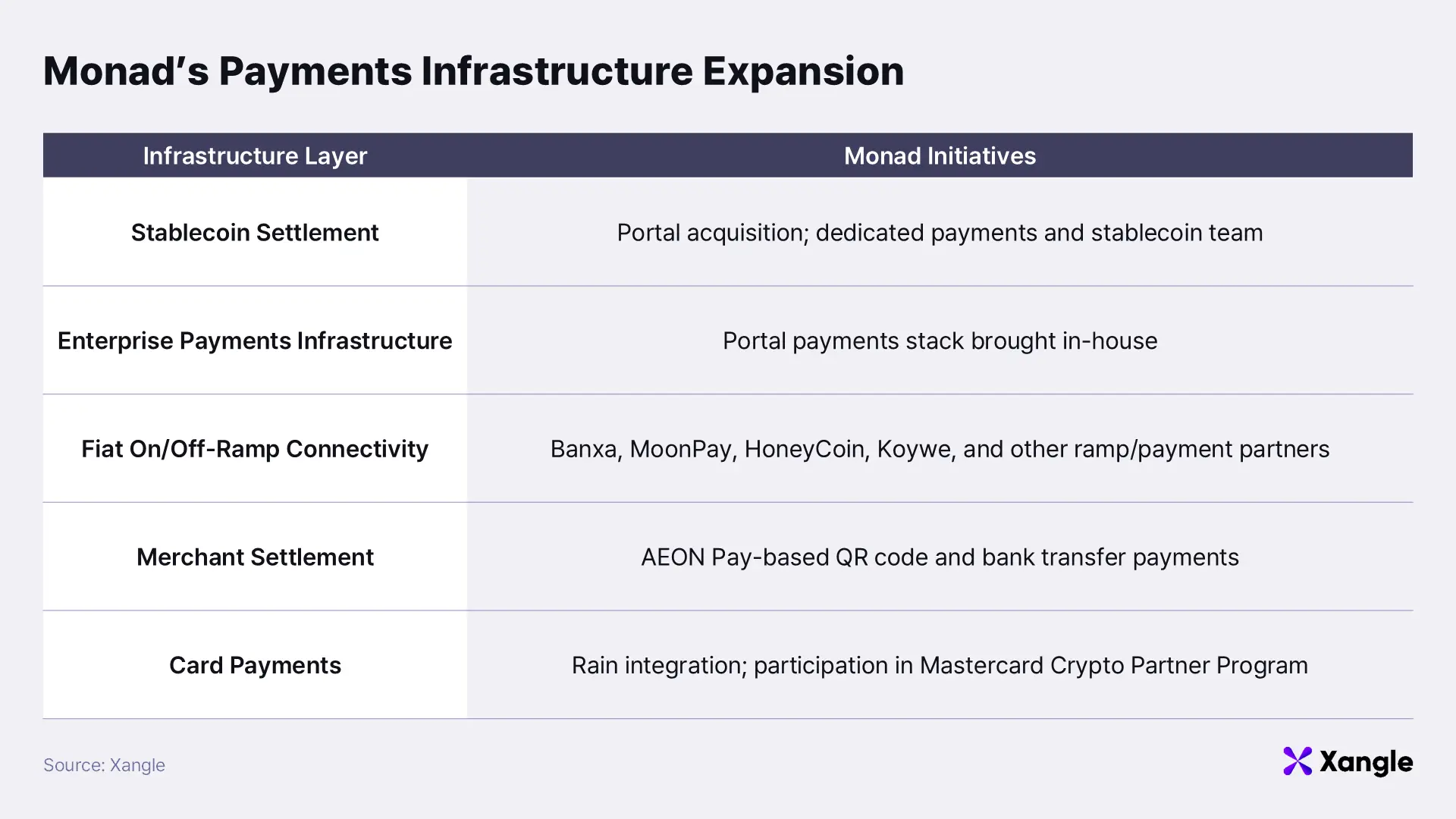
Portal is the clearest example of this strategy. In July 2025, the Monad Foundation acquired Portal, a stablecoin infrastructure company, and Raj Parekh, Portal’s co-founder and CEO, joined Monad as Head of Payments and Stablecoins. Portal is not a stablecoin issuer. It is a payments infrastructure company that provides APIs and SDKs that allow businesses to embed non-custodial wallets, stablecoin sending and receiving, settlement, and payment functions into their own applications. The acquisition effectively gave Monad a product layer for adding enterprise-grade stablecoin payment functionality to its fast EVM execution environment.
Stablecoin payment infrastructure, however, cannot be built with on-chain wallets and transfer functionality alone. For users to actually move funds in and out, it needs connectivity to local fiat currencies, bank accounts, cards, local payment methods, and mobile payment networks. Monad is addressing this by bringing on/off-ramp providers and payment infrastructure companies into its ecosystem, expanding the entry and exit routes between fiat and on-chain assets.
Monad’s ecosystem includes a broad set of on/off-ramp providers, including Banxa, Coinbase Onramp & Offramp, MoonPay, Ramp Network, Transak, Alchemy Pay, Onramper, HoneyCoin, Koywe, and zerohash. Each provider covers different regions and payment methods. Some offer global on-ramps through cards and bank transfers. Others connect mobile money and local payment methods in regions such as Latin America and Africa, while another group provides embedded APIs and payment widgets that allow app developers to integrate multiple ramps at once. Rather than relying on a single payment provider, Monad is taking an ecosystem-based approach that can combine different deposit and withdrawal routes across regions and payment methods.
Monad’s ecosystem-based approach is also visible in merchant payments. Regional payment providers across Southeast Asia, Africa, and Latin America often face challenges around cross-border settlement, FX, prefunded accounts, and manual treasury management. AEON Pay’s integration with Monad brings QR code- and bank transfer-based crypto payments to more than 50 million merchants, with a structure where merchants receive fiat without directly holding crypto. The broader direction is to connect on-chain stablecoins to actual user top-ups, merchant acceptance, and local payment networks.
Monad’s expansion into payment infrastructure is also visible in cards. Monad has integrated with Rain, a stablecoin-based card issuing and payments infrastructure company, and is also participating in Mastercard’s Crypto Partner Program. The direction is less about replacing existing card networks and more about connecting on-chain stablecoin settlement to the global payment rails already built by card networks and payment infrastructure providers. Rain integration and Mastercard program participation show that Monad’s payments strategy is moving beyond simple on-chain transfers and into existing payment flows such as card authorization, merchant acceptance, corporate settlement, and cross-border payouts.
Monad’s differentiated position versus a generic low-cost, high-speed payment chain lies in what payment capital can do once it is on-chain. Payment providers, card issuers, and corporate treasury teams need to hold a certain amount of stablecoin liquidity or working capital between authorization and final settlement. On many payment-focused chains, this capital is likely to remain as idle balances. On Monad, it can be routed into financial applications within the ecosystem, such as DeFi money markets, liquidity pools, and credit vaults, to generate yield.
Morpho’s total deposits on Monad have already exceeded $200 million, while Curvance has surpassed $100 million, indicating that lending markets where payment capital can be parked and deployed are already taking shape at meaningful scale. With the tokenized assets and institutional credit products discussed in the next section added to the picture, Monad’s capital deployment options become even broader. Payment capital on Monad does not have to remain as a balance waiting for settlement. It can become capital that is managed and reused in on-chain financial markets. In this sense, Monad’s payment infrastructure offers more than a cheaper and faster transfer rail. It provides a structure where payments and capital deployment can happen in the same environment.
3-2. Tokenization and Credit: Expanding into Operational Financial Products
If stablecoins establish the rails for payments and settlement, tokenized assets and credit products are where actual investment capital enters Monad and gets deployed. For tokenized assets to function as financial products, the operational work continues after issuance. Investors commit capital and receive tokens, issuers custody the real-world assets backing those tokens, and the records required for redemptions and yield distributions need to be updated continuously. The utility of a tokenized product is ultimately determined less by issuance itself and more by the operating workflows that follow.
 https://x.com/etherfuse/status/2013631354890486224
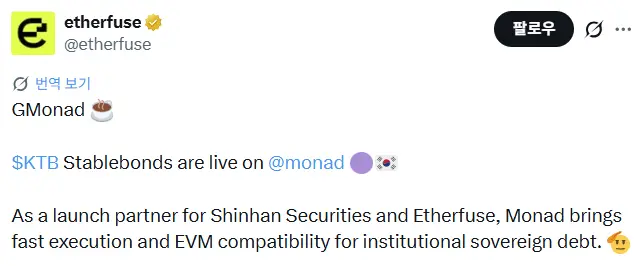
A useful example is Etherfuse and Shinhan Securities’ tokenization of Korean government bonds. Korean government bonds are liquid and stable fixed-income products, but direct access for foreign investors typically requires institutional brokerage in Korea and settlement processes in traditional financial markets. Market hours also limit access, making it difficult for global investors to enter or trade at the timing they want. Etherfuse, together with Shinhan Securities, brought Korean government bonds to Monad in the form of KTB Stablebond, presenting a structure where eligible investors can access Korean government bonds in smaller denominations and use 24/7 on-chain trading with sub-second settlement.
Under this structure, Shinhan Securities supports Korean government bond brokerage, as well as the acquisition and management of the real-world assets, while Etherfuse issues KTB tokens backed by those bonds. Monad provides the foundation for tokenized government bonds to function as 24/7-accessible on-chain products for eligible investors rather than remaining tied to traditional financial market hours. In other words, the acquisition and management of the underlying Korean government bonds take place within traditional financial infrastructure, while token transfers, settlement, and the use of on-chain liquidity take place on Monad.
The scope of institutional asset classes is also widening. Centrifuge’s integration with Monad brought Janus Henderson’s tokenized Treasury bills, JTRSY, the AAA CLO product JAAA, and Apollo’s diversified credit strategy ACRDX into the Monad ecosystem. The ecosystem also includes deRWA versions such as deJTRSY, deJAAA, and deCRDX. deRWA refers to DeFi-compatible RWA tokens designed to make real-world asset tokens easier to transfer and use within DeFi, creating room for tokenized assets to move beyond simple holding products and serve as underlying assets for collateral, liquidity, and lending markets. The broader implication is that Monad’s RWA strategy is extending beyond tokenized government bonds into institutional credit and asset management products.
 https://x.com/monad/status/2023852753727234084
In credit products, Valos and Accountable’s institutional credit vault is a representative case. The product is an on-chain credit vault in which investors deposit AUSD, Valos lends that capital to borrowers such as institutional-grade market makers, and investors receive yield generated from lending interest. Accountable provides data verification infrastructure for monitoring the vault’s fund flows, borrower status, and collateral coverage, while Monad serves as the execution infrastructure for deposits, withdrawals, yield settlement, and state updates. As of the end of April 2026, Valos and Accountable’s credit vault had surpassed $110 million in total deposits, indicating that credit products combining stablecoin settlement, institutional lending, and borrower verification are already operating on Monad.
The FalconX Credit Vault also illustrates Monad’s expansion into institutional credit. FalconX is a digital asset prime broker that provides crypto trading, liquidity, and lending services to institutional investors. FalconX’s institutional lending products are connected to Monad as on-chain credit vaults through Pareto and M11 Credit. The product is not merely a tokenized credit instrument that investors hold. It can also be used as collateral in Monad’s DeFi markets to unlock additional liquidity. The structure shows how institutional credit products can be reused on-chain as assets to hold, pledge as collateral, or borrow against.
3-3. The Agent Economy: Execution Infrastructure for Automated Micropayments
Payments and tokenization move the capital flows of people and institutions on-chain. The agent economy extends that logic to software itself. In this model, the economic actor is not a human user, but an AI agent that calls APIs, purchases data, uses compute resources, and invokes functions from other services. Individual payments are small, but they can occur at high frequency. As a result, the fee per transaction and time to finality become key conditions for the usability of agent-based services.
 https://x.com/monad/status/2042273779372470762
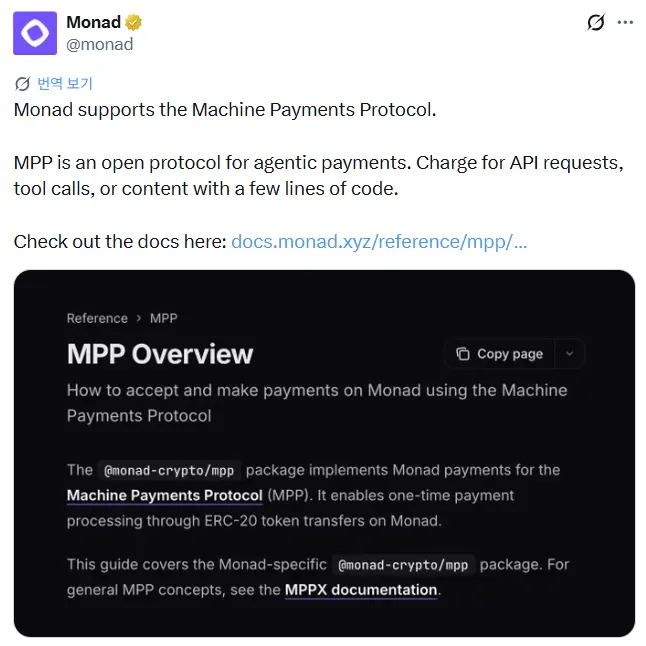
Monad supports this area through the Machine Payments Protocol, or MPP. MPP is an open agent payment protocol that adds on-chain payments to digital services such as API requests, tool calls, and content access. Developers can attach payment conditions to specific APIs or content, while agents can pay the required amount in stablecoins or ERC-20-based assets to access those resources. API providers and data providers can therefore monetize usage without relying on manual payment flows initiated by humans.
The flow is relatively straightforward. When an agent accesses a paid API or content, the service provider returns the required payment conditions. The agent executes the on-chain payment, and once the provider verifies the payment, it returns the response. At scale, activities such as data calls, model inference, cloud tasks, and agent-to-agent function usage can be handled as small-unit automated payments.
Monad is also expanding x402 support alongside MPP. x402 is a web-based payment protocol that uses HTTP’s “402 Payment Required” status code to add stablecoin payments to API, data, and content access. When a user or agent accesses a paid resource, the service provider returns the payment conditions, and once payment is confirmed, it provides the content or API response. Monad provides x402 support guides and a payment Facilitator, helping developers implement paid API and content access flows on Monad.
Monad’s x402 strategy becomes more concrete through its connection with Anyway. Anyway is an agent payment network that enables AI agents to pay, receive, and settle across multiple payment protocols and currency environments. AI agents can use it to pay on-chain for paid APIs, data, and services, or to receive payments directly. As a result, Monad’s agent payment strategy is expanding to cover both MPP-based payment environments and x402-based web payment flows.
The agent economy shows how Monad’s payment strategy can extend beyond card and merchant payments into software-native automated payments. Agent payments are less about a single large transfer and more about repeated small-value payments for API calls, data access, model inference, and the use of other agents’ functions. Monad’s low fees reduce the cost burden of recurring payments, sub-second finality reduces the delay between payment confirmation and service delivery, and high throughput supports an environment where many agents can submit requests at the same time. With MPP, x402 support, and x402 integrations such as Anyway, Monad is building an execution environment where stablecoin payments can be attached to APIs, data, content, and tool calls. As agents increasingly purchase internet-native resources directly, Monad can serve as an on-chain settlement layer for machine-to-machine payments.
4. Beyond a Fast Chain and Toward an Internet Financial Layer
Monad’s ambition is not limited to becoming a high-performance L1 that processes more transactions at higher speed. Built on fast finality, low fees, high throughput, and EVM compatibility, Monad aims to connect payments, deposits and withdrawals, tokenized assets, institutional credit, and agent payments within a single execution environment. The Portal acquisition, in particular, represents Monad’s attempt to integrate enterprise-grade stablecoin payment functionality into its execution layer. Its connections with on/off-ramp providers such as Banxa, Coinbase Onramp & Offramp, and MoonPay expand the entry and exit routes between fiat and on-chain assets. As use cases emerge across merchant payments, card infrastructure, tokenized government bonds, and institutional credit vaults, Monad is expanding beyond a simple payment chain into a financial execution layer where capital movement and capital deployment can happen together.
The internet financial layer Monad describes is not a plan to copy traditional finance onto blockchains wholesale. The concept is closer to the idea that finance can operate on a more open execution environment, much as the internet connected information and services beyond the constraints of borders, business hours, and closed networks. Users can pay with stablecoins, enterprises can use on-chain settlement, investors can access tokenized government bonds or credit products, and applications and AI agents can pay for digital services such as API calls, data access, and model inference on a usage basis. Rather than aiming to become a chain that simply aggregates many individual financial applications, Monad is positioning itself as a shared execution layer for processing capital movement and financial state changes across the internet economy in real time.
For this vision to become an actual internet financial layer, Monad needs to prove it through recurring capital flows. Fast finality and low fees create favorable conditions for payment authorization, settlement, collateral updates, redemption processing, and micropayments, but they do not complete the financial infrastructure on their own. In payments, actual merchant payment volume and on/off-ramp usage will matter. In tokenization and credit, reserve verification, custody structures, redemption stability, borrower verification, and secondary-market liquidity will be critical. In the agent economy as well, the key question is not simply whether MPP or x402 is supported, but how frequently micropayments actually occur across API, data, content, and tool-call use cases. Monad needs to prove not that it is a “fast chain,” but that financial services can operate on top of that performance in smaller, more frequent, and more automated units.
If these conditions are met, Monad’s role will not remain limited to that of a high-performance EVM chain. If stablecoin payments and on/off-ramp routes bring in users, tokenized assets and credit products keep capital in the ecosystem, and DeFi markets allow that capital to generate yield and be reused, Monad could move beyond a simple payment chain and come closer to an internet financial layer where capital movement and capital deployment occur in the same environment. Adding agent payments to this structure extends the thesis further. If stablecoin payments and on/off-ramp routes bring in users, tokenized assets and credit products keep capital in the ecosystem, and agent payments create new recurring payment demand, Monad could become shared infrastructure where financial activity is generated, settled, and reused on the internet. Monad’s core challenge is ultimately to convert technical performance into real capital flows and financial network effects. If enough of these flows accumulate, Monad could move beyond a fast EVM chain and establish itself as an internet financial layer with actual usage, capital flows, and automated payment demand.
Disclaimer
I confirm that I have read and understood the following: The information contained in this article is strictly the opinions of the author(s). This article was authored free from any form of coercion or undue influence. The content represents the author's own views and does not represent the official position or opinions of CrossAngle. This article is intended for informational purposes only and should not be construed as investment advice or solicitation. Unless otherwise specified, all users are solely responsible and liable for their own decisions about investments, investment strategies, or the use of products or services. Investment decisions should be made based on the user’s personal investment objectives, circumstances, and financial situation. Please consult a professional financial advisor for more information and guidance. Past returns or projections do not guarantee future results. This article was written at the request of Moand. All content in this article was written independently by the author(s), and neither CrossAngle nor Moand had any editorial control or influence over the content. The author(s) may hold the cryptocurrencies mentioned in this article at the time of writing.
Xangle or its affiliated partners own all copyrights of the written or otherwise produced materials and content provided on the platform. Any illegal reproduction of such content, including, but not limited to, unauthorized editing, copying, reprinting, or redistribution will result in immediate legal actions without prior notice.
![[CIS Partner Summit Highlights] Ault's Financial Super App Strategy: OnlyBulls](https://resource.xangle.io/files/content/C1A19E1DB41B7FB86076143803C40D8E_1790125531662.webp)
![[Xangle RWA Series] Solana RWA: A Look at the Key Players](https://resource.xangle.io/files/content/F779A005246C0299246537AACB3A39F2_1782287059970.webp)