[CIS Partner Summit Highlights] R25, Vault Infrastructure for the Next Generation of Finance


Table of Contents
1. Introduction: Understanding the Vault
2. Key Characteristics of On-Chain Vaults
3. R25 Vault Structure and Expansion
4. Closing Remarks: Vault Infrastructure Connecting Diverse Investment Strategies
1. Introduction: Understanding the Vault
Investment strategies from different areas of finance are increasingly reaching investors on-chain, including interest from government bonds, interest earned by lending to companies or individuals, and returns from managing crypto assets. A Vault packages each of these strategies into a single investment product. R25 provides the infrastructure to create these Vaults and connect them with investors.
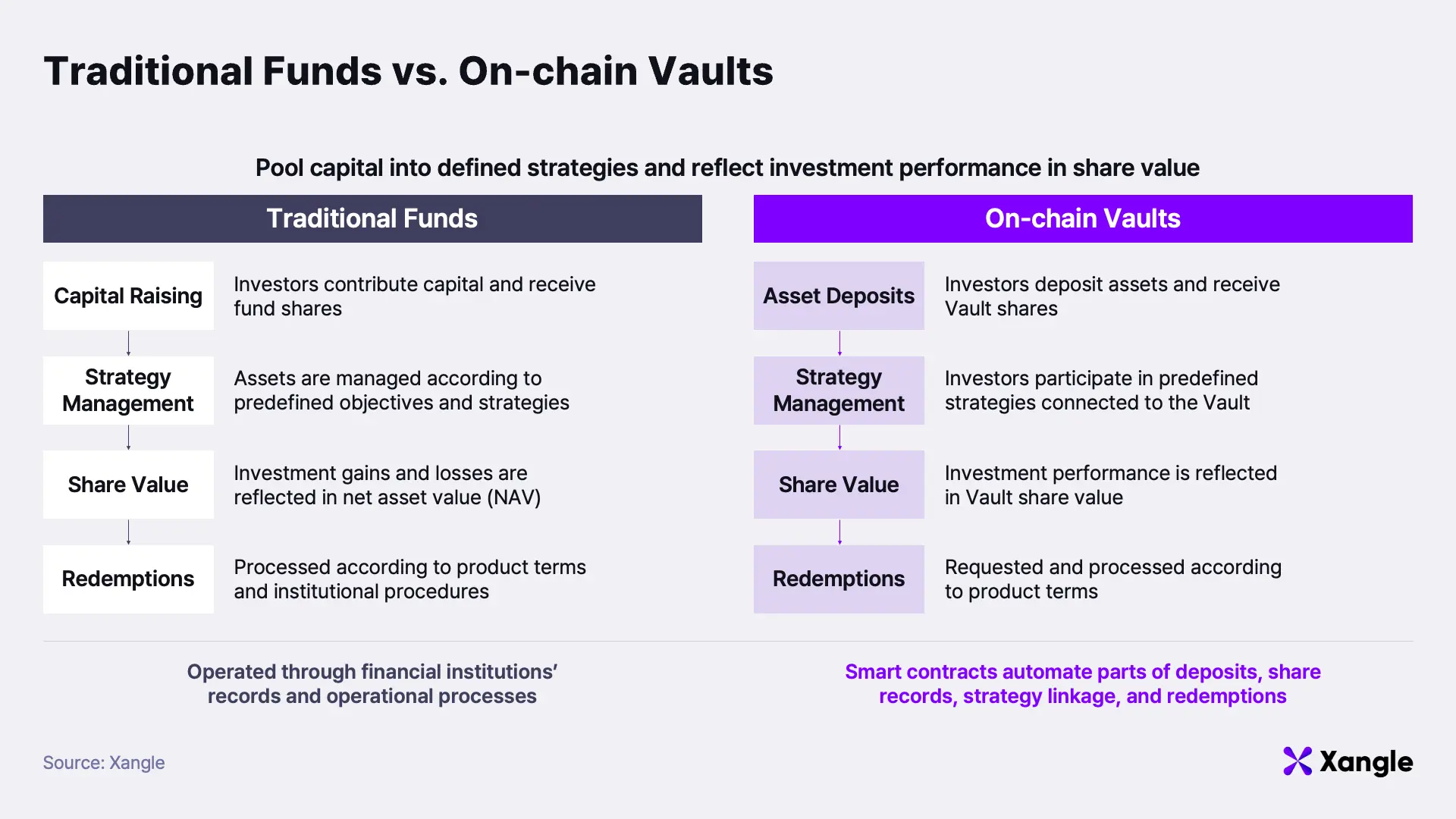
The basic structure of a Vault is easier to understand when compared with a traditional investment fund. A fund pools capital from multiple investors and invests in assets such as equities, bonds, and loans according to a defined objective and strategy. Rather than selecting and managing individual assets themselves, investors hold shares in the fund. Gains and losses generated through portfolio management are reflected in the fund's net asset value (NAV), which in turn changes the value of each investor's holdings.
On-chain Vaults operate in a similar way. Investors deposit assets and receive Vault shares, while the deposited assets are managed according to a predefined strategy. Because investment performance is reflected in the value of the Vault shares, investors can gain exposure to the strategy without managing each underlying investment directly.
Traditional funds and on-chain Vaults perform similar core functions, but they implement them differently. Traditional funds manage assets and investor shares through the systems and operating processes of financial institutions such as asset managers and custodians. Vaults implement some of these functions through smart contracts, including asset deposits, investor share records, connections to investment strategies, and redemptions. They are called "on-chain Vaults" because parts of the investment product are recorded and processed on a blockchain.
Vaults have long been used in DeFi for strategies such as lending assets to earn interest, staking assets to support network operations and receive rewards, and providing trading liquidity in exchange for fees. More recently, they have also been applied to assets that generate returns off-chain, including government bonds and private credit. By connecting strategies that invest in these assets to a Vault, investors can gain exposure to the performance of traditional financial assets through an on-chain product.
R25 is Vault infrastructure that enables a range of assets and investment strategies to be packaged into Vaults and distributed to investors. Strategy operators can use R25's infrastructure to turn investment strategies into products, while wallets and financial services serve as distribution channels to investors. This report first examines the key characteristics of on-chain Vaults, then uses R25's structure and representative products to show how assets and investment strategies are packaged into products and delivered to investors.
2. Key Characteristics of On-Chain Vaults
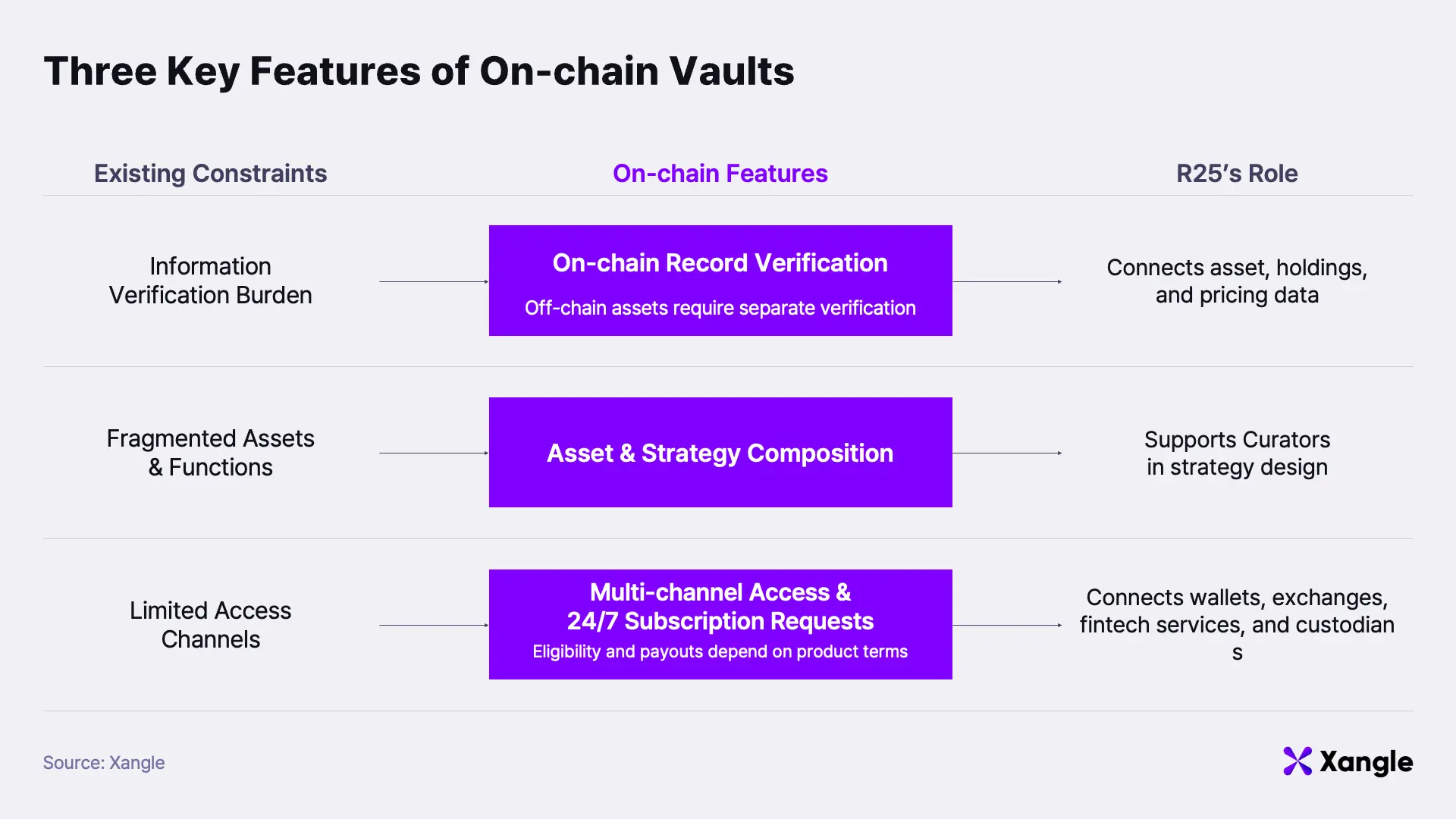
Turning an investment strategy into an on-chain Vault changes how the product can be managed and accessed. The basic principle of pooling and managing capital is similar to a fund, but blockchain infrastructure can expand how operating information can be reviewed, how financial functions are combined, and how products are distributed to investors. These changes can be understood through three characteristics: transparency and verifiability, composability, and global 24/7 access.
2.1 On-Chain Transparency and Verifiability
When investment holdings and management activity are not sufficiently disclosed, investors have less information with which to understand the product and assess the credibility of the strategy operator. Requesting additional materials and verifying the underlying facts also takes time and resources.
With an on-chain Vault, investors can review asset holdings and transaction history through records published on the blockchain. They can see which tokens are held, in what amounts, and where funds have moved, then compare this activity with the strategy described by the operator. To the extent that the relevant information is available on-chain, investors can assess the Vault's operations without waiting for separate reporting.
R25 connects assets across RWA, crypto, and DeFi while also supporting the use of information on investable assets, holdings, and prices. Curators can use this information to assess potential investments, while investors can review the assets linked to a Vault and its management activity.
For investments in off-chain assets such as government bonds or private credit, custody records and asset valuation materials supplement on-chain information. Reviewing these materials alongside token holdings and transfer records provides a more complete view of a Vault's fund flows and the assets supporting them.
2.2 Composability Across Assets and Strategies
When investable assets and financial functions are fragmented across multiple services, combining them into a single strategy becomes difficult. Operators may need to connect separately to venues for sourcing assets and to services providing lending or trading functions, which can limit the strategies they are able to implement.
On-chain infrastructure makes it possible to connect assets and financial functions from different services into a single investment strategy. By combining asset holdings with lending or derivatives trading, operators can design strategies that also incorporate financing and risk management.
For example, if a lending service accepts a government bond-linked token as collateral, an investor can obtain financing while continuing to hold the token. A strategy can also hold crypto assets while using derivatives that gain value when prices fall, reducing exposure to market volatility.
R25 connects a range of assets and strategies to a standardized Vault structure so Curators can make use of this composability. Supported approaches include thematic asset portfolios, quantitative strategies, and DeFi strategies. Curators determine portfolio weights, the portfolio management approach, and risk controls based on the available assets and services, while R25 provides the technical foundation to implement the strategy as a single product.
2.3 Global, 24/7 Investment Access
Once a strategy has been packaged into a product, investors need a way to access it. If a product is tied to the distribution network of a particular service or region, the strategy operator's potential investor base is limited. Investors are likewise constrained to the products available through the services they already use.
On-chain Vaults can be distributed through a range of channels, including wallets, exchanges, fintech services, and custodians. Connecting the same Vault to multiple services expands distribution for the strategy operator and allows investors to access new investment products through the services they already use.
R25 supports this distribution by connecting traditional financial services with Web3 services. Vaults created by Curators can be offered not only through wallets and exchanges, but also through fintech services and custodians. Participation by services across different regions can further expand investor reach. Actual availability, however, depends on an investor's place of residence and the eligibility requirements of each product.
The always-on nature of blockchain infrastructure also affects when investors can access a product. Depending on the product terms, Vaults distributed through R25 can accept deposit and redemption requests during weekends or outside normal business hours. Request submission and actual settlement remain separate processes, however. The timing of redemption payments depends on the business days of the underlying asset market and each product's processing schedule.
On-chain Vaults therefore expand the scope of information investors can verify, combine diverse assets and financial functions into a single strategy, and broaden the channels through which investors can access products. R25 provides a common infrastructure layer that applies these characteristics to product creation, operation, and distribution, allowing a wider range of investment strategies to reach investors on-chain.
3. R25 Vault Structure and Expansion
R25's architecture is divided into the roles of connecting assets, constructing strategies, and distributing products to investors. Looking at how these roles connect helps explain how a Vault is created and brought to market.
3.1 Core Structure of an R25 Vault
R25 supports the creation and distribution of Vaults that invest in a range of assets, including private credit and corporate bonds. Its infrastructure connects three layers: the Asset Layer, which links investable assets; the Strategy Layer, which constructs the investment strategy; and the Capital Layer, which distributes the product to investors.
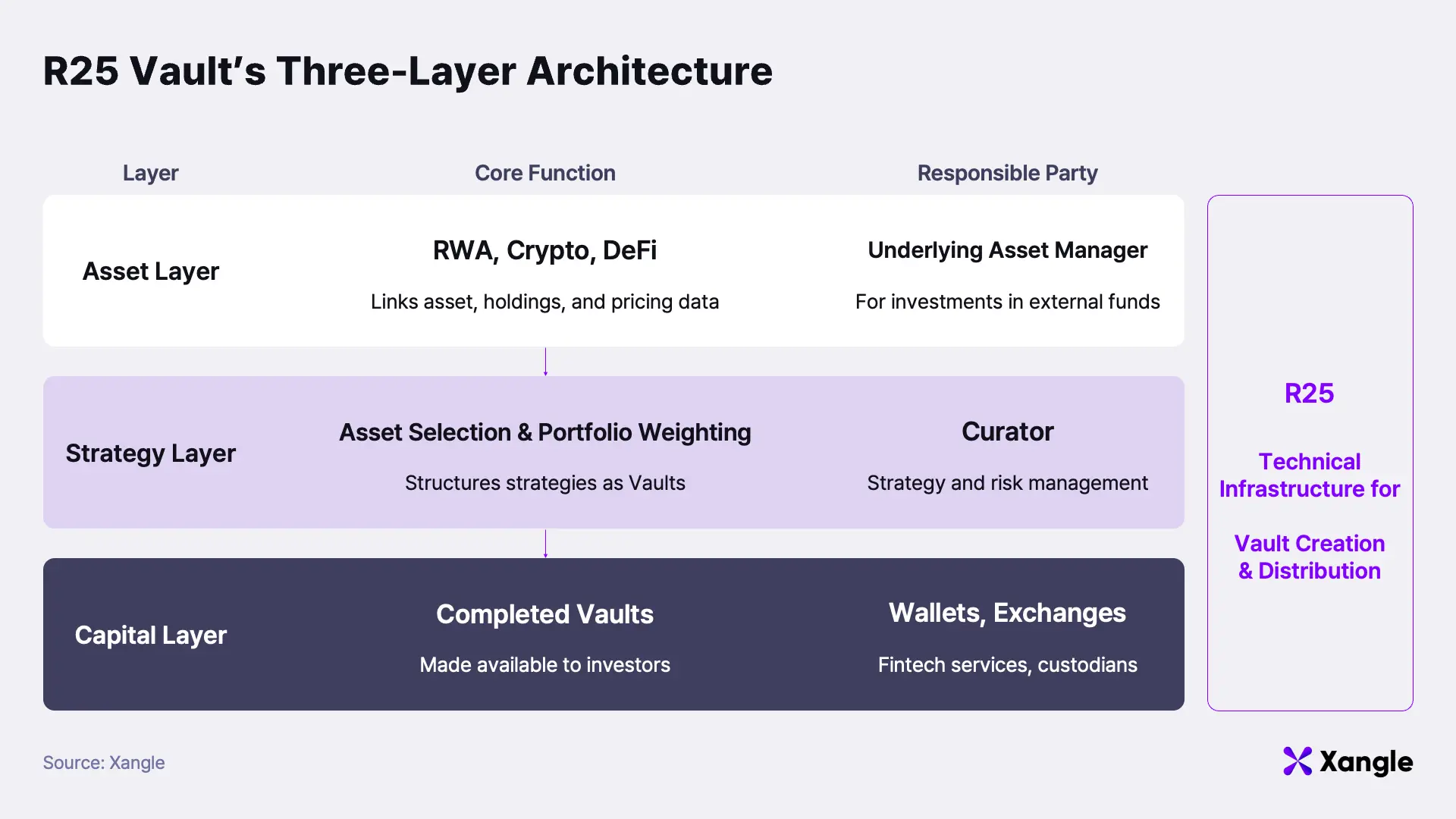
- Asset Layer connects the assets that a Vault can invest in. These include real-world assets (RWA) and crypto assets, along with information needed for management, such as holdings and asset prices.
- Strategy Layer is where the Curator selects investments and determines portfolio weights, management methods, and risk management parameters. These decisions are used to construct a Vault that investors can participate in.
- Capital Layer connects completed Vaults to the services investors use. Wallets, exchanges, fintech services, and custodians can serve as distribution channels for the product.
Together, the three layers show how assets are transformed into an investment product and ultimately distributed to investors through R25. Once investable assets are connected through the Asset Layer, the Curator selects from those assets and constructs a management strategy in the Strategy Layer. The completed Vault is then connected to multiple services through the Capital Layer, allowing investors to access the strategy through the services they already use.
In this structure, R25 provides the technical infrastructure, while the Curator is responsible for the investment strategy and risk management. When a Vault invests in an external fund, the manager of that fund manages the underlying assets.
3.2 Comparison of R25's Major Vaults
R25 Vaults can be structured into different investment products depending on the assets they hold and the strategy designed by the Curator. Their return drivers, redemption terms, and key risks therefore vary. APC and pRNH, two products currently available, illustrate these differences.
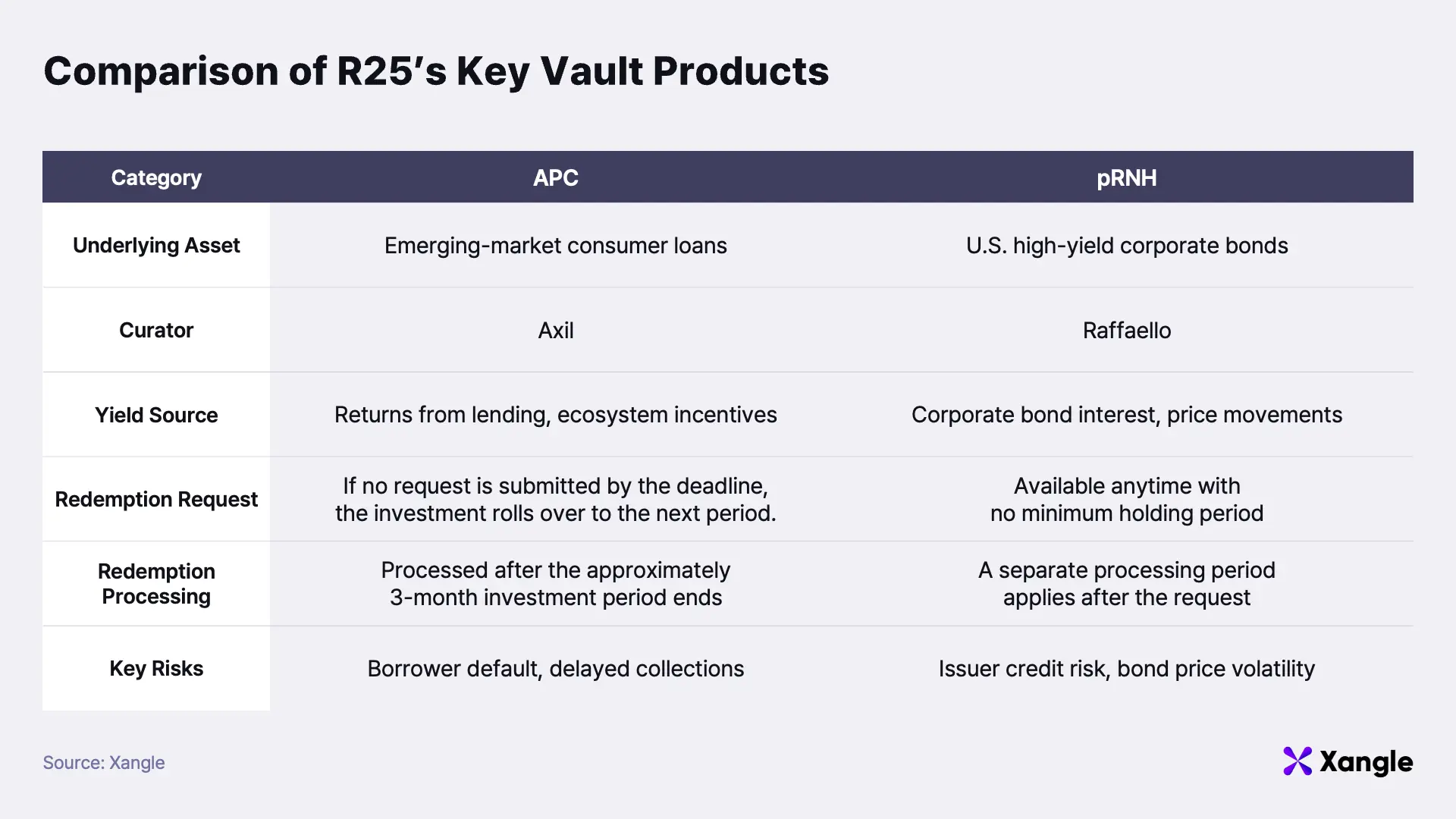
The representative APC Vault invests in small, short-term consumer loans across multiple emerging markets. Its Curator, Axil, is a DeFi curator focused on on-chain risk management for RWA strategies and is responsible for APC's investment strategy and risk management. Investors deposit USDC and receive Vault shares, while the capital is routed through a strategy constructed by Axil into a private credit fund. Returns are primarily derived from interest on the underlying loans and may be supplemented by ecosystem incentives. The resulting investment performance is reflected in the value of the Vault shares.
pRNH invests in U.S. high-yield corporate bonds. Raffaello serves as Curator and is responsible for the investment strategy and risk management. Investors deposit USDC and receive Vault shares, while the deposited capital is routed to NYLIM Anemoy's HYB fund. The fund follows a corporate bond strategy managed by U.S. asset manager NYLIM, with returns driven by bond interest and price movements. This investment performance is reflected in the value of the Vault.
The redemption mechanisms also differ. APC is structured around an investment period of approximately three months. Redemption requests submitted within the designated window are processed after the investment period ends; otherwise, the position rolls into the next investment period. pRNH does not impose a fixed mandatory holding period, but there is a separate processing period between a redemption request and the actual payment of proceeds.
The products also carry different risks based on their underlying investments. APC is exposed to borrower delinquency or default and delays in loan recovery. pRNH is exposed to the credit quality of corporate bond issuers, interest rates, and bond price movements driven by market conditions. For both products, the performance of the underlying assets and the ability to recover invested funds can affect Vault share value and redemptions.
3.3 R25's Expansion Roadmap
R25 began by launching Vaults with a select group of Curators and plans to expand toward a model in which more strategy operators can turn their own strategies into products and distribute them to investors through a wider range of services. This direction is reflected in R25's three-stage roadmap: initial product launches, product creation support for external Curators, and broader ecosystem expansion.
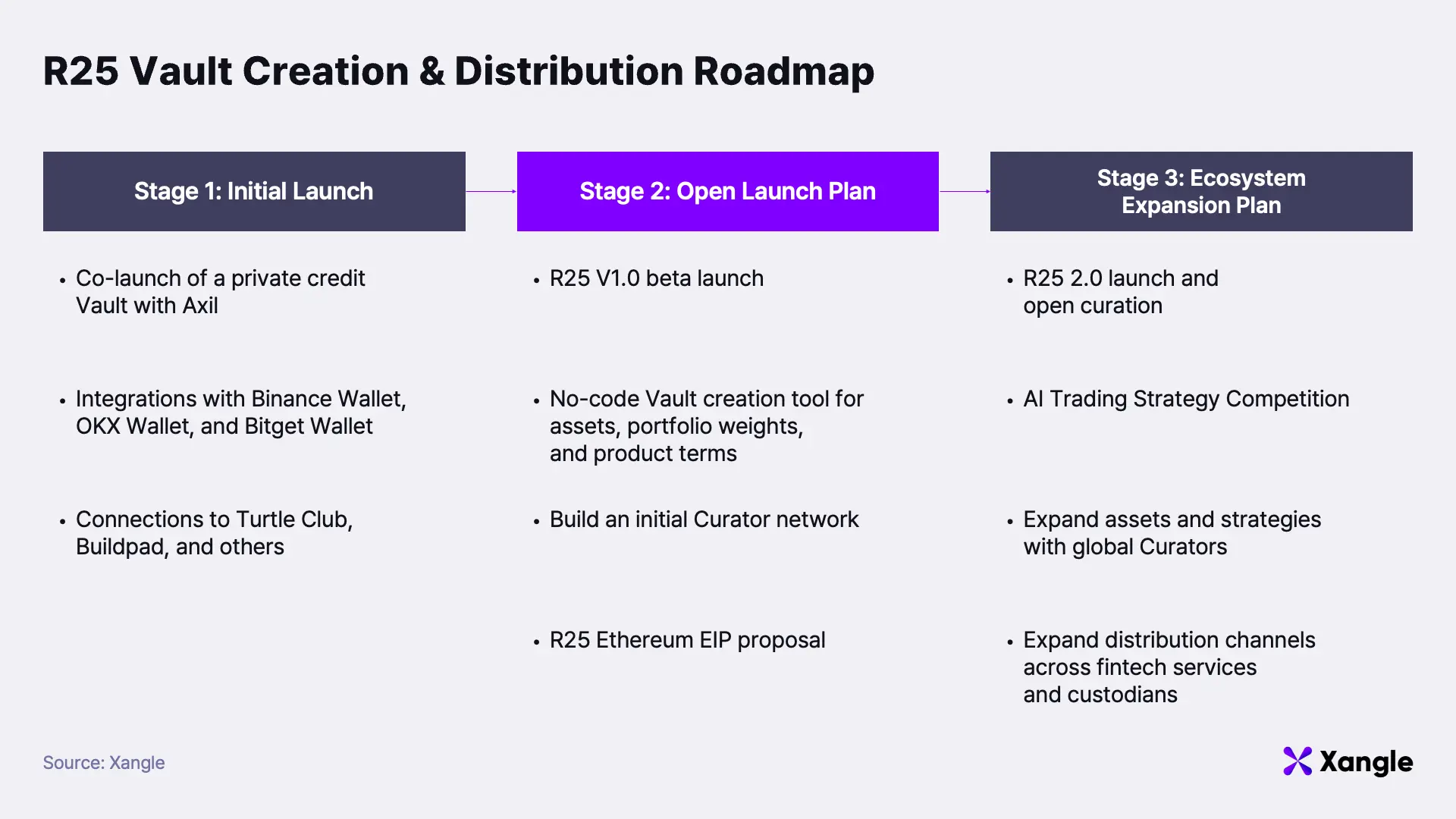
Stage 1 focused on launching the initial products and establishing distribution. R25 co-launched a private credit Vault with Axil and integrated it with major wallets including Binance Wallet, OKX Wallet, and Bitget Wallet. It also expanded connectivity to services such as Turtle Club and Buidlpad, creating additional access points for investors. This put R25's model into practice: the Curator supplies the investment strategy, R25 implements it as a Vault, and the product is distributed across multiple services. The focus at this stage was to build both the operating foundation for the product and the distribution channels needed to reach investors.
Stage 2 is designed to let external Curators create Vaults directly. The roadmap includes the beta launch of R25 V1.0 and the introduction of Strategy Studio, a no-code product creation tool. Strategy Studio is designed to let Curators configure and deploy Vaults by setting investment assets, portfolio weights, and product terms such as deposits and redemptions without writing separate code. This reduces the need to build new technical infrastructure for every product and allows Curators to focus on refining investment strategies and operating parameters.
R25 is also building an initial Curator network alongside these creation tools. On September 30 in Seoul, R25 plans to host the Genesis Curator Meetup, featuring a Strategy Studio demonstration and hands-on sessions where participants can test and deploy Vaults themselves. The event is designed to let early Curators try the creation tools and connect with capital and distribution partners.
Stage 3 plans to expand participation through the release of R25 2.0 and open curation. R25 has targeted Q4 2026 for the release of 2.0, with the goal of enabling more strategy operators to use shared infrastructure to create and manage Vaults. R25 also plans to expand participation by global Curators and broaden the range of assets and strategies available to them. As product supply increases, distribution is expected to expand further into fintech services and custodians. The direction is to grow participation on both sides of the market, allowing Curators to turn more strategies into products and enabling services to offer those products to their existing customers.
4. Closing Remarks: Vault Infrastructure Connecting Diverse Investment Strategies
As the scope of on-chain investment products expands from DeFi into areas such as private credit and corporate bonds, the market needs infrastructure that can package diverse assets and management strategies into products and distribute them to investors. R25 connects investment assets, Curator strategies, and distribution channels such as wallets and financial services through a common Vault infrastructure. APC, which invests in emerging-market consumer loans, and pRNH, which invests in U.S. high-yield corporate bonds, show how different strategies can be delivered as products on the same foundation.
R25's value lies in helping Curators turn investment strategies into products and enabling wallets and fintech companies to offer those products to their customers. Curators define the investment universe, portfolio weights, management approach, and risk controls, then use R25's technical infrastructure to implement the strategy as a Vault. Wallet and fintech providers can connect these Vaults to their existing services and offer customers new investment products. As creation tools and distribution networks expand, the burden of bringing strategies to market and reaching investors may also decline.
Companies considering R25 need to select investment strategies that are appropriate for their customers and determine how product-specific eligibility requirements, deposit terms, and redemption conditions will be applied within their own services. After launch, it is important to monitor whether the Curator is managing the strategy and its risks appropriately, whether investors receive the information they need, and whether redemptions are processed according to the stated terms. As R25's infrastructure supports these operations and connects products to actual investment activity across a wider range of financial services, its value as infrastructure linking product creation and distribution can increase.
R25 plans to participate in the CIS Seoul Partner Summit, a private forum for executives and infrastructure providers working on RWA initiatives. Participants will be able to discuss concrete opportunities with R25 around packaging investment strategies into Vault products, integrating them with existing financial services, and expanding product distribution.
Disclaimer
I confirm that I have read and understood the following: The information contained in this article is strictly the opinions of the author(s). This article was authored free from any form of coercion or undue influence. The content represents the author's own views and does not represent the official position or opinions of CrossAngle. This article is intended for informational purposes only and should not be construed as investment advice or solicitation. Unless otherwise specified, all users are solely responsible and liable for their own decisions about investments, investment strategies, or the use of products or services. Investment decisions should be made based on the user’s personal investment objectives, circumstances, and financial situation. Please consult a professional financial advisor for more information and guidance. Past returns or projections do not guarantee future results.
Xangle or its affiliated partners own all copyrights of the written or otherwise produced materials and content provided on the platform. Any illegal reproduction of such content, including, but not limited to, unauthorized editing, copying, reprinting, or redistribution will result in immediate legal actions without prior notice.