Mantle: The Core Layer for CeDeFi and On-Chain Finance

1. DeFi Bottlenecks and CeDeFi Integration
2. Mantle’s Differentiation: Exchange-Native CeDeFi Architecture
3. Extending On-Chain Finance to Real-World Assets: xStocks
4. Institutional Access Layer: MI4 (Mantle Index Four Fund)
5. From Liquidity to Usage: Ecosystem Activation via Global Hackathon
6. Closing Remarks: Mantle as a Distribution Layer for On-Chain Finance
1. DeFi Bottlenecks and CeDeFi Integration
Decentralized finance (DeFi) has grown rapidly over the past several years. Most of the core financial functions the market needs—lending, asset deposits, leveraged strategies, and stablecoin yield products—are now available on-chain. What remains insufficient is not the functionality itself, but the access structure that allows large-scale capital to actually use it. A wide range of products already exists on-chain; however, using them still requires users to set up wallets, switch networks, use bridges, and understand the mechanics of individual protocols. For users already familiar with DeFi, that process may feel routine. For capital already sitting inside exchange environments with ample liquidity and convenience, however, it remains a meaningful barrier to entry.
CeDeFi is the framework aimed at narrowing that gap. It preserves the user experience and distribution reach of centralized exchanges and platforms, while shifting actual asset management and yield generation to on-chain protocols. Users can subscribe to products or trade assets within a familiar exchange environment; in the background, DeFi protocols handle lending, deposits, staking, and liquidity strategies. The key point is not some abstract compromise between centralization and decentralization, but the ability to connect already-formed user flows and capital pools to DeFi.
Why CeDeFi matters comes down to where the capital already sits. Global cryptocurrency exchanges hold roughly $226 billion in reserve assets, whereas total DeFi TVL stands at around $93 billion—less than half the capital parked on exchanges. More importantly, this is not simply capital that has yet to enter the market. It is already in crypto; it already sits in trading accounts; it already holds stablecoins; and it already has clear demand for yield and trading. The constraint is not interest, but the mechanism of connection. Users need a way to access on-chain finance without leaving the exchange experience, and the balances and demand already inside exchanges need to flow naturally into DeFi.
If connecting exchange liquidity to DeFi via CeDeFi is the starting point for expanding on-chain finance, the next step is to broaden both the asset universe and the nature of capital coming on-chain. Real-world assets need to move on-chain for the scope of on-chain finance to expand, and institutional capital needs to enter for the market itself to scale further. Mantle is building a structure that connects exchange liquidity, real-world assets, and institutional capital in sequence. The sections that follow examine that process step by step.
2. Mantle’s Differentiation: Exchange-Native CeDeFi Architecture
There is an opportunity at the inflection point where the boundaries between CEX (centralized exchanges) and DEX (decentralized exchanges) are increasingly blurring. Users can now access DeFi directly through CEXs and also utilize CeDeFi products within DeFi protocols. – Emily Bao
The statement captures the direction Mantle and Bybit are jointly shaping. Emily Bao serves as Head of Spot Trading at Bybit and a key advisor to Mantle, operating across both exchange-side liquidity and user flows, as well as CeDeFi product design and ecosystem strategy. This overlap makes one point clear: CeDeFi is not being framed as a conceptual vision, but as a strategy being executed in coordination between the two.
Mantle approaches this problem through a structural linkage with Bybit. The objective is not to push exchange-held capital on-chain through deposits and withdrawals, but to integrate Mantle-native DeFi products and on-chain trading directly within the exchange environment. Users are not required to set up wallets, bridge assets, or navigate on-chain infrastructure. Instead, exchange balances and user demand are designed to flow directly into Mantle’s DeFi products and on-chain trading.
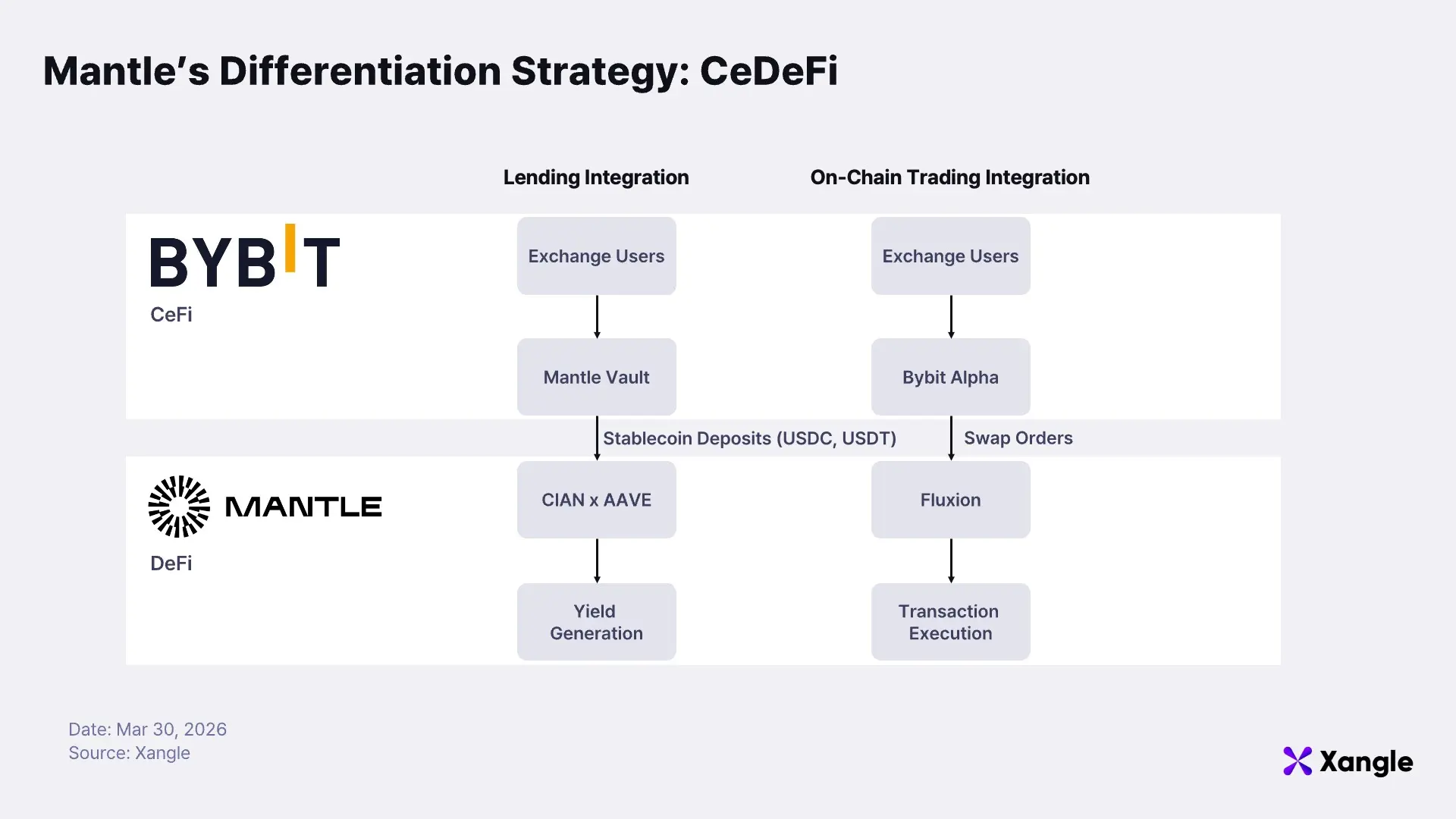
At a structural level, the system operates along two primary pathways. One channels stablecoin yield demand within the exchange into Mantle’s lending layer; the other routes on-chain trading demand into liquidity across the Mantle ecosystem. The former flows through Mantle Vault into lending protocols such as Aave and CIAN. The latter connects via Bybit Alpha to the decentralized exchange Fluxion. Rather than leaving capital idle within exchange accounts, Mantle maps two core user intents, yield and trading, directly into on-chain execution.
2-1. Bybit Mantle Vault: Routing Stablecoin Yield into the Lending Layer
Generating yield from stablecoins in DeFi typically involves multiple steps. A common approach is the looping strategy, where assets are deposited, borrowed against as collateral, and redeposited repeatedly to amplify returns. The structure itself is straightforward; execution, however, requires navigating across multiple protocols and actively managing positions. Even for users familiar with DeFi, this process can be operationally burdensome. For users who remain within exchange environments, it presents a significantly higher barrier to entry.
Within this setup, Aave functions as the core lending layer where asset deposits and borrowing take place. Users can earn interest by supplying stablecoins or borrow other assets against deposited collateral. CIAN builds on top of this liquidity as an on-chain yield infrastructure, automating looping strategies at the protocol level. Instead of manually repeating deposit and borrowing cycles, users rely on CIAN to handle execution and rebalancing, allowing the yield structure to be implemented in a continuous and automated manner.
Bybit’s Mantle Vault brings this structure into the exchange environment as a delta-neutral strategy product. A delta-neutral approach avoids directional exposure to asset prices and instead focuses on capturing interest income and incentive-based returns while minimizing volatility exposure. When users deposit stablecoins such as USDT or USDC, CIAN’s execution layer on the Mantle chain runs looping strategies based on Aave’s liquidity pools. Collateral ratio management, yield compounding, and position rebalancing are fully automated. From the user’s perspective, the process is reduced to selecting a product and allocating capital within the exchange interface.
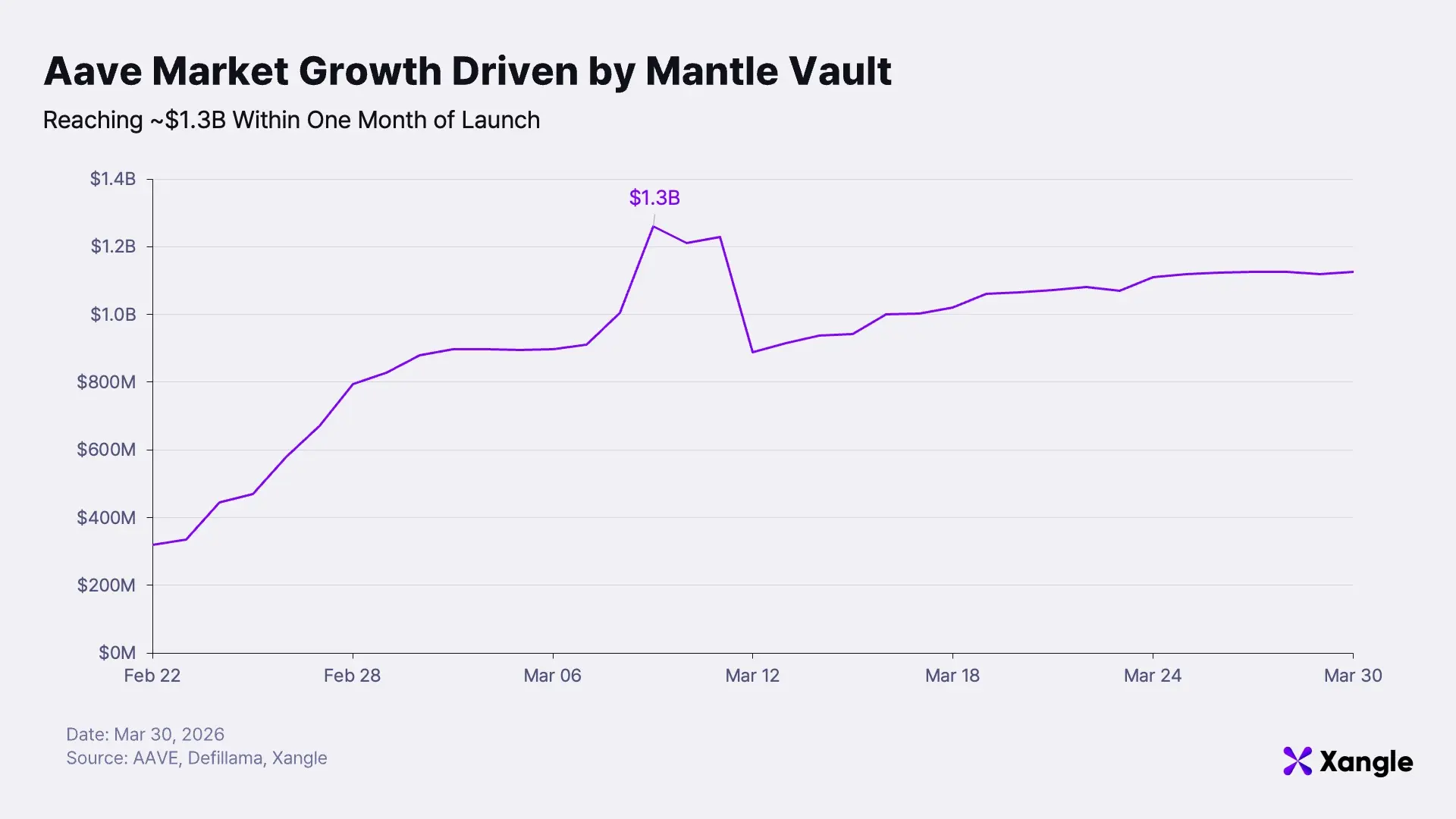
Early traction has been reflected in on-chain metrics. The Aave market on Mantle reached approximately $1.3 billion in size within about one month of launch, with more than $200 million in stablecoins flowing in through Mantle Vault. Stablecoin yield demand that previously remained within exchanges is now being converted into on-chain capital via Mantle Vault. The result is a clear signal that Mantle’s CeDeFi strategy is not only conceptual, but already translating into measurable liquidity expansion and capital deployment.
2-2. Bybit Alpha: Bridging Exchange Trading Flow to On-Chain Liquidity
If Mantle Vault channels stablecoin yield demand within exchanges into Mantle’s DeFi protocols, Bybit Alpha serves as the complementary pathway, routing on-chain trading demand within exchanges into liquidity across the Mantle ecosystem.
Fluxion plays a central role in this structure. As Mantle’s flagship decentralized exchange, it provides the core venue where on-chain trading is executed and liquidity is formed. Bybit Alpha builds on top of this by enabling users to access on-chain trading without setting up separate wallets or holding gas tokens. Users remain within their Bybit accounts and familiar trading interface, while interacting with on-chain liquidity under the hood.
Traditional on-chain trading involves multiple layers of friction. Users must identify which venue to trade on, verify token contract addresses, connect wallets, and prepare gas tokens before execution. The process introduces meaningful onboarding friction, particularly for users accustomed to exchange-native environments. Bybit Alpha abstracts this complexity into a single exchange account. Trading appears similar to a conventional exchange interface; in practice, it is executed against the liquidity and infrastructure provided by Fluxion on Mantle.
What Bybit Alpha brings to Mantle is not incremental liquidity, but trading activity itself. Every instance of buying and selling on-chain tokens within the exchange is ultimately settled on the Mantle network. Mantle Vault connects idle capital within exchanges to DeFi liquidity; Bybit Alpha converts exchange-native trading activity into on-chain execution. Both capital flows and trading flows are therefore routed through Mantle, reinforcing its role as the underlying execution layer.
3. Extending On-Chain Finance to Real-World Assets: xStocks
To date, on-chain finance has evolved primarily around stablecoins and crypto-native assets. Traditional assets such as U.S. equities and ETFs, however, have remained confined within conventional securities infrastructure. Accessing these assets requires opening brokerage accounts and navigating trading hours, account systems, and tax reporting requirements directly. The assets themselves are familiar; the access model continues to follow the conventions of traditional finance.
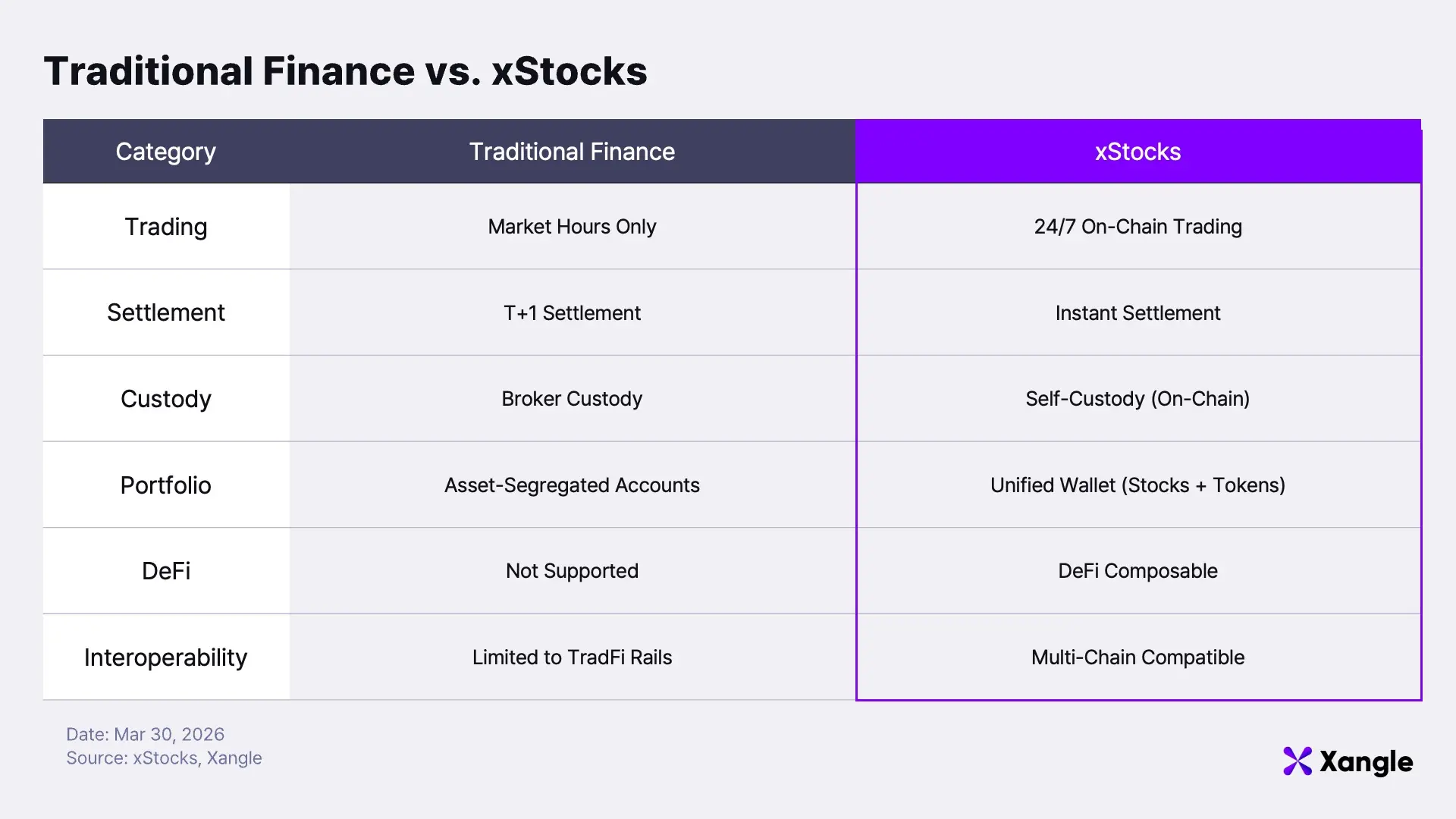
xStocks introduces a structure that reduces this friction. Each token is issued on a 1:1 basis against a corresponding stock or ETF, with the underlying assets held by regulated custodians. As a result, tokens traded on-chain are not merely price-referencing instruments, but are backed by actual underlying assets. Corporate actions such as dividends, stock splits, and reverse splits are reflected at the token level, allowing balances to adjust automatically without requiring user intervention.
From the user’s perspective, the primary shift is accessibility. xStocks can be traded on Bybit and supports deposits and withdrawals, allowing exchange users to access U.S. equities and ETFs without opening separate overseas brokerage accounts. Fractional ownership and transfers are supported, and assets purchased on the exchange can be moved to on-chain wallets or bridged across other networks. More than 140 tokenized assets are currently available, with cumulative trading volume exceeding $25 billion.
If Mantle Vault connects stablecoins within exchanges to DeFi yield strategies, xStocks extends the same CeDeFi framework into real-world assets. Initially, usage is centered around trading. Over time, as these assets begin to be utilized as collateral and liquidity within DeFi, the composition of assets on Mantle evolves. What was once a crypto-native asset base expands to include tokenized real-world assets, marking a structural shift in the scope of on-chain finance.
4. Institutional Access Layer: MI4 (Mantle Index Four Fund)
If the CeDeFi strategy outlined earlier established a pathway connecting exchange user capital to Mantle, the next step is to extend this liquidity structure to a broader capital base. Exchange-driven capital alone is insufficient to form a deep and durable capital foundation. Mantle expands its strategy by enabling institutions to access both core crypto asset exposure and DeFi-based yield structures within a single product. The result is MI4.
Institutional access to crypto assets has historically followed three primary routes. The first is single-asset exposure through products such as spot Bitcoin ETFs. The second is equity exposure via crypto treasury companies such as MicroStrategy. The third is direct acquisition of assets on exchanges, followed by independent custody. Each approach carries structural limitations. ETFs are restricted to single-asset exposure. Treasury equities introduce additional layers of risk tied to corporate financing structures and equity premiums. Direct custody requires institutions to manage storage, rebalancing, and yield strategies internally. Tokenized fund structures have also faced constraints: unclear custodial arrangements, weak legal ownership protections, and insufficient security frameworks. Even when returns are attractive, these risks act as barriers to institutional participation.
MI4 is structured to address this gap. Investment shares are issued as tokens on the Mantle network, while preserving the legal structure of a traditional fund and enabling ownership transfers on-chain. The design combines the advantages of on-chain products with institutional-grade requirements for legal clarity, custody, and regulatory compliance.
The fund adjusts asset allocation on a quarterly basis in response to market conditions. In the Q4 2025 rebalancing, USD exposure was reduced from 15% to 10%, with the freed 5% reallocated to BTC, ETH, and SOL. This highlights that MI4 is not a static basket, but a strategy that actively manages risk exposure in response to macro conditions and liquidity dynamics. For institutions, this provides a more adaptive alternative to passive buy-and-hold structures.
The advantages of MI4 are clear. Asset exposure is broader than single-asset ETFs, more direct than crypto treasury equities, and operationally lighter than direct custody. Institutions can access diversified crypto exposure and integrated yield strategies through a single product, without managing individual tokens or building internal infrastructure. Asset allocation, yield generation, and legal structuring are consolidated within one framework.
5. From Liquidity to Usage: Ecosystem Activation via Global Hackathon
Mantle’s focus to date has been clear: bringing assets and liquidity on-chain. Exchange liquidity has been connected, institutional entry points have been established, and traditional assets have been introduced onto the chain. Yet onboarding assets alone does not complete an ecosystem. For a market to form, those assets must be actively utilized, and that usage must generate new demand in return. The rationale behind the hackathon follows from this shift in focus. The priority is no longer additional connections, but enabling already-connected assets and liquidity to translate into real usage within the network.
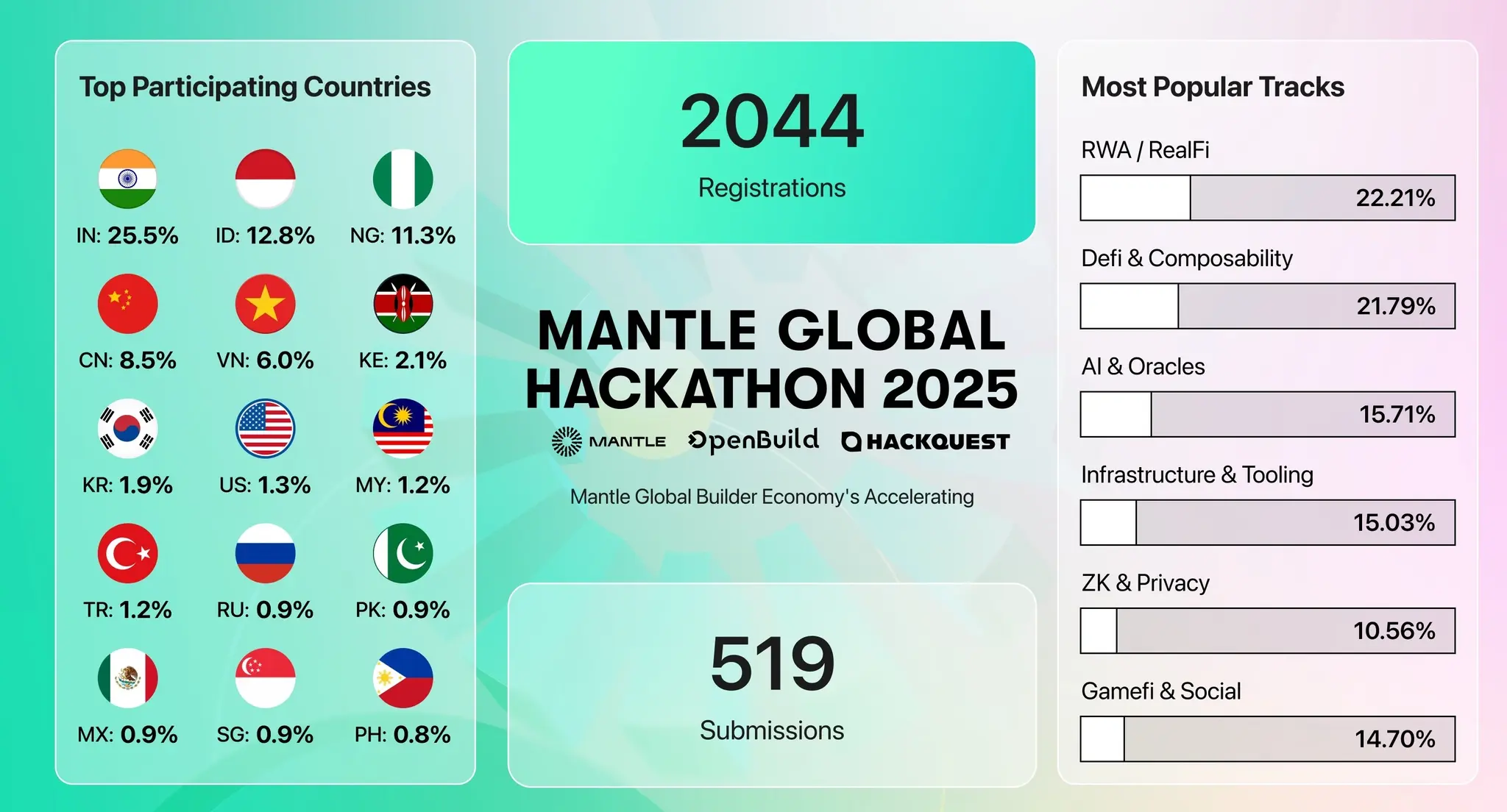
The global hackathon provides a clear signal of where Mantle is concentrating its efforts. Across six tracks, including real-world assets (RWA), DeFi, and AI, approximately 44% of submissions were concentrated in the RWA and DeFi categories. This reflects a strong alignment between Mantle’s strategic priorities and builder activity. The outcome of the competition reinforces the same direction. Top-ranked teams did not focus solely on technical novelty, but proposed structures that extend from asset inflows to yield generation and user utilization on top of Mantle’s existing infrastructure. The grand prize winner, Cicada Finance, illustrates this approach. By combining RWA tokenization with on-chain yield strategies, it delivers a service that integrates the lifecycle of assets brought on-chain, from deployment to active utilization. The direction Mantle has been building through CeDeFi and RWA is directly reflected in the winning projects.
The hackathon serves as a validation layer for Mantle’s broader strategy. It tests whether the assets and liquidity connected through CeDeFi and RWA can evolve into real services and use cases, while attracting teams capable of expanding the ecosystem on top of this foundation. The implication is clear: Mantle is moving beyond a chain that connects assets, toward an on-chain financial ecosystem where those assets are actively deployed and utilized.
6. Closing Remarks: Mantle as a Distribution Layer for On-Chain Finance
Mantle’s trajectory can be framed as an answer to a single question: how to connect capital already sitting within exchanges and assets embedded in traditional financial systems to on-chain finance. Through Bybit, exchange liquidity has been linked to DeFi yield strategies and on-chain trading. Real-world equities and ETFs have been tokenized and connected across both exchange and on-chain environments. Institutional access has been introduced through dedicated product structures. Each initiative targets a different segment of capital and assets; the direction, however, is singular: expanding the scope of on-chain finance.
As these connections accumulate, Mantle’s position is evolving. It is no longer defined solely as a Layer 2 chain, but as a distribution layer through which exchange liquidity, real-world assets, and institutional capital can move on-chain. This positioning is not incidental. It is enabled by Mantle’s structural alignment with Bybit as a concrete distribution channel from its early stages, creating a level of integration that is difficult for other Layer 2 ecosystems to replicate.
The basis of competition is shifting. Performance metrics such as speed and fees remain relevant, but are no longer sufficient on their own. What matters increasingly is which assets can be brought on-chain, how those assets are distributed, and what forms of usage can be built on top. In this context, Mantle presents a clearly defined strategy by advancing both CeDeFi and real-world asset integration in parallel.
If the expansion of on-chain finance is ultimately defined by the scale of assets and users moving onto blockchain networks, Mantle is building that expansion across four axes: exchange liquidity, institutional capital, real-world assets, and the builder ecosystem. The direction of growth is already visible; the connections Mantle is constructing today sit close to the center of that trajectory.
Disclaimer
I confirm that I have read and understood the following: The information contained in this article is strictly the opinions of the author(s). This article was authored free from any form of coercion or undue influence. The content represents the author's own views and does not represent the official position or opinions of CrossAngle. This article is intended for informational purposes only and should not be construed as investment advice or solicitation. Unless otherwise specified, all users are solely responsible and liable for their own decisions about investments, investment strategies, or the use of products or services. Investment decisions should be made based on the user’s personal investment objectives, circumstances, and financial situation. Please consult a professional financial advisor for more information and guidance. Past returns or projections do not guarantee future results. This article was written at the request of Mantle. All content in this article was written independently by the author(s), and neither CrossAngle nor Mantle had any editorial control or influence over the content. The author(s) may hold the cryptocurrencies mentioned in this article at the time of writing.
Xangle or its affiliated partners own all copyrights of the written or otherwise produced materials and content provided on the platform. Any illegal reproduction of such content, including, but not limited to, unauthorized editing, copying, reprinting, or redistribution will result in immediate legal actions without prior notice.
![[CIS Partner Summit Highlights] R25, Vault Infrastructure for the Next Generation of Finance](https://resource.xangle.io/files/content/6957A34223D0EE05827E59990EB751D2_1790656054398.webp)