BOB: Bitcoin Financial Infrastructure Beyond Passive Custody

1. Why Bitcoin Remains Underutilized in DeFi
2. Bank of Bitcoin: Putting BTC to Work
3. BOB Gateway: Execution Rails from Native BTC to DeFi
4. BOB Bitcoin Vault: Turning Native BTC into Collateral and Yield
5. Bitcoin Liquidity Is the Next On-Chain Opportunity
1. Why Bitcoin Remains Underutilized in DeFi
In January 2024, spot Bitcoin ETFs were approved in the United States. By April 2026, roughly two years after launch, the 11 U.S. spot Bitcoin ETFs had reached approximately $100 billion in total assets under management (AUM), with holdings of around 1.31 million BTC. In other words, 6.5% of Bitcoin’s total circulating supply, approximately 19.9 million BTC, now sits inside ETFs. Including Bitcoin held by corporations, ETFs and corporate treasuries together account for 12.8% of Bitcoin’s total supply.
The 1.31 million BTC held in ETFs, however, remains idle. It is not posted as collateral, deployed in lending markets, or used to generate yield. It simply stays locked inside fund structures. Investors gain price exposure to Bitcoin while paying annual management fees of 0.15% to 1.5%, but they do not have the right to actually use the underlying asset. The result is a structure where investors pay to hold Bitcoin, yet cannot do anything with the Bitcoin itself.
The issue is not limited to ETFs. A similar dynamic exists on-chain. BTC actively used in BTCFi accounts for only around 0.3% of the total circulating supply. Demand is not the problem. Exchanges process approximately $800 billion in BTC trading volume every month. What is missing is a pathway for that demand to move on-chain. Using Bitcoin in DeFi still requires too many steps, and the security risks and costs that come with those steps have long acted as barriers to entry.
The Bitcoin network was designed to transfer value. It does not support the deployment of general-purpose smart contracts that automatically execute once predefined conditions are met. To use Bitcoin in DeFi, BTC must be moved to another chain where smart contracts can operate, and that process involves multiple layers of friction. Users typically have to deposit BTC into an exchange, move it to another chain through a bridge, convert it in most cases into a wrapped asset such as wBTC (Wrapped BTC) or cbBTC (Coinbase Wrapped BTC), separately acquire the gas token of the destination chain, find the desired protocol, and deposit the asset again.
The costs involved in this process go beyond simple transaction fees. When executing a BTC swap, users must wait for confirmations on the Bitcoin network, and that waiting period can take as long as roughly 30 minutes. If the BTC price moves during that time, a gap emerges between the initial quote and the actual amount received. When the market moves in the user’s favor, most of the upside is captured by the solver or protocol executing the swap. When it moves against the user, the loss is passed on to them. Once custody risk from the wrapping process and the possibility of bridge security incidents are taken into account, keeping Bitcoin on an exchange can end up looking like the safer default for BTC holders.
Ultimately, the bottleneck in BTCFi is not that DeFi protocols do not exist on Bitcoin. The problem is that connecting the largest crypto asset to on-chain finance remains inconvenient, expensive, slow, and burdened by security concerns. Behind that bottleneck, however, lies a massive latent market. Bitcoin has the largest market capitalization and the deepest liquidity of any crypto asset, yet only 0.3% of it is actually used on-chain. The largest asset is also one of the least active. That gap itself is the potential market for BTCFi.
2. Bank of Bitcoin: Putting BTC to Work
BOB (Build on Bitcoin) was launched to close this gap. Under its “Bank of Bitcoin” vision, BOB aims to expand Bitcoin beyond an asset that simply sits in custody into a financial asset that can be swapped, deposited, borrowed against, and used for payments.
Bitcoin has the largest market capitalization, the deepest liquidity, and the strongest institutional trust among crypto assets. Yet in on-chain finance, Bitcoin has largely remained a secondary asset brought into Ethereum DeFi through wrapping. Today, DeFi is built primarily around ETH and stablecoins as base assets. Collateral, liquidity, and gas markets mostly revolve around those two asset types. Bitcoin has been incorporated into that system, but it has never been at the center. Bank of Bitcoin aims to invert that relationship. Rather than wrapping Bitcoin to fit another chain, it uses the security and verification of the Bitcoin network as the reference point and runs financial activity around that foundation.
BOB is a Layer 2 chain that enables smart contract execution anchored to the Bitcoin network. Technically, it is an OP Stack-based, EVM-compatible Layer 2. It is called a Hybrid Chain because it places the basis for final settlement and trust on the Bitcoin network. The key design element is the Bitcoin light client embedded into the chain. With this structure, smart contracts on BOB can directly verify transactions that occur on Bitcoin mainnet. Instead of relying on a third party to prove that a given user transferred BTC, the BOB chain reads and verifies Bitcoin block data directly.
BOB is gradually redesigning the existing route where users had to entrust BTC to someone else through wrapping. Two products divide this redesign between them. Gateway uses wrapped BTC, but provides a path for users to redeem back into native BTC at any time without relying on a trusted third party by directly verifying Bitcoin network block data. Vault goes one step further by designing a structure that lets users keep native BTC on the Bitcoin network while using only its value in DeFi, without going through wrapping at all.
If this direction is realized, Bitcoin will no longer remain an asset that is only bought and held. It will create an environment where users can borrow stablecoins against BTC, earn yield with BTC itself, and trade tokenized gold or other real-world assets on top of the Bitcoin network. If the stack expands further into payments, Bitcoin could perform most of the core functions of a bank on-chain. In that sense, Bitcoin can evolve beyond digital gold into digital capital.
3. BOB Gateway: Execution Rails from Native BTC to DeFi
For Bank of Bitcoin, exchange is the starting point. Without a path for BTC to move on-chain, neither deposits nor lending can begin. Gateway serves as that entry point. Starting from native BTC, it functions as an execution layer that connects users to assets or DeFi positions on other chains in a single fast, low-cost transaction.
3-1. The Effective Cost Gap in BTC Swaps
The effective cost borne by users in a BTC swap is not limited to fees. After sending BTC, users must wait 10 to 30 minutes until the Bitcoin network confirms the transaction. During that time, price movement can create a gap between the initial quote and the actual amount received. That gap is slippage. When custody risk from the wrapping process is added on top, all of these factors accumulate as invisible costs.
The problem is that slippage grows in proportion to waiting time. Based on 30 days of on-chain BTC swap data as of March 2026, the price difference by waiting time widens to -0.14% at 10 minutes, -0.22% at 20 minutes, and -0.28% at 30 minutes. In other words, longer waiting times translate into larger losses. A structural asymmetry also exists. When the price moves in a favorable direction, the solver or protocol captures the upside. When the price moves unfavorably, the user bears the loss.
Additional costs accumulate during the waiting period, but the gap that appears even at the quote stage before a transaction is submitted is also significant. When comparing quotes for swapping 1 BTC into USDC across protocols at the same point in time, a substantial difference already appears in the deducted amount once fees, spreads, and routing costs are included.
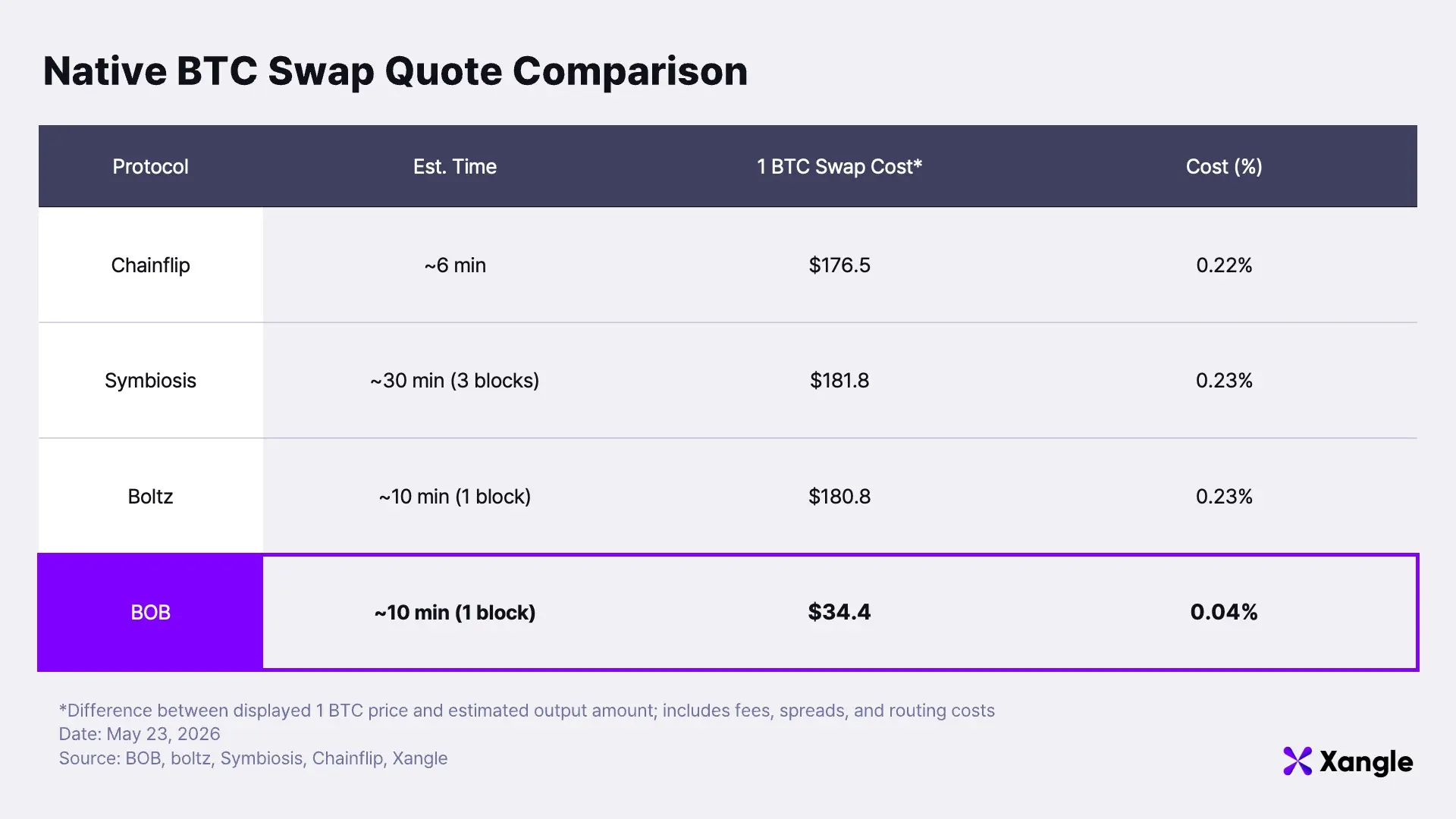
Even for the same 1 BTC quoted at the same point in time, BOB’s transaction cost is around $34, roughly one-fifth that of other protocols. Once slippage during the waiting period is also factored in, the gap in total cost actually borne by users becomes even wider. The difference comes from Gateway reducing intermediate steps with intent-based routing. Gateway is also moving one step further by attempting to remove the waiting time itself, which is the root cause of slippage. Fixed-rate instant execution, or zero-conf, executes trades immediately at a predetermined exchange rate without waiting for Bitcoin confirmations. Once applied, slippage caused by price movement during the waiting period would disappear structurally. Although still under development, the approach belongs to a different category from current routing optimization because it removes the cause of slippage rather than merely reducing it.
3-2. Gateway Architecture
Most existing bridges receive a user’s BTC off-chain and then rely on a third party to attest that a specific user sent BTC. The process is fast, but it introduces a persistent dependency on third-party trust. Gateway addresses this by verifying transactions based on the data recorded on the Bitcoin network itself, rather than relying on a third-party guarantee.
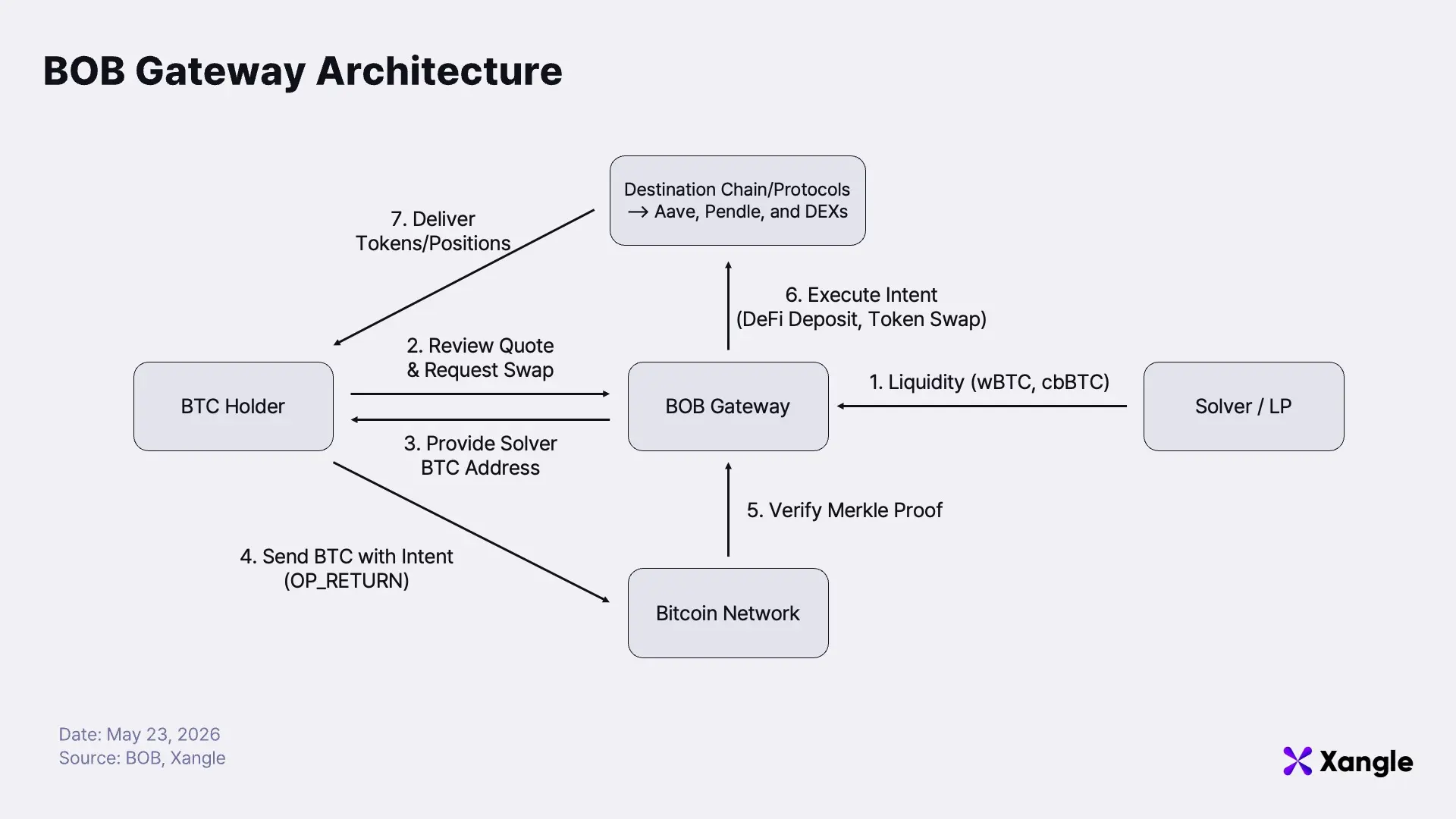
The key idea is that the Bitcoin transaction itself becomes proof of the user’s intent. When a user sends BTC, BOB needs to verify that the transaction was actually included in a Bitcoin block. Instead of downloading the entire Bitcoin chain, the light client embedded in the BOB chain verifies a Merkle proof. A Merkle proof shows that a specific transaction was included in a block using a short piece of evidence, rather than the full block. Merkle proofs can verify the transfer record, but they do not by themselves show where the Bitcoin was sent from, where it was sent to, or what the user intended to do. Gateway fills that gap with OP_RETURN, which allows a small data payload to be embedded in a Bitcoin transaction in addition to the transfer details. The payload contains a compressed value representing the asset and address the user wants to receive. When a relayer submits the Merkle proof, the order value encoded in OP_RETURN is checked against the actual transaction details. Once the two match, BOB can verify, without a trusted third party, that the user sent BTC as promised.
After OP_RETURN encodes the user’s intent and the Merkle proof confirms the transfer, the next step is execution. If the user specifies an Aave deposit, the full flow from BTC transfer to Aave deposit is processed as a single transaction. Across 11 major chains, including Ethereum and Base, complex strategies such as entering Pendle markets or creating LP positions can be executed in the same way. The user sends BTC, but may receive a lending position or a yield strategy. That is why Gateway is described as an execution layer rather than a simple bridge.
The same execution structure is also available to external applications via the Gateway SDK and API. Wallets, exchanges, and aggregators that integrate the SDK can offer the same one-click BTC-to-DeFi flow inside their own services. Gateway is therefore both a user-facing product and B2B infrastructure.
Gateway’s verification model still has limitations. Unlike a full node, which directly verifies every transaction in a block, the light client currently used by Gateway checks whether a specific transaction was included using only block headers and Merkle proofs. As a lightweight verification method, or SPV, it is not equivalent to Bitcoin full-node verification. Still, breaking the current structure would require enormous computational power and cost, while the potential gain would be limited. As long as the value secured by Gateway remains below the cost of attack, there is little incentive to attack it. Over the long term, BOB plans to narrow this limitation by transitioning to a full client that verifies all block headers.
3-3. Beyond Swaps: Expanding Asset Coverage and Access Channels
Gateway initially connected native BTC to wBTC, stablecoins, and DeFi positions. Its starting point was to bring Bitcoin on-chain and connect it to yield opportunities. Yet the value of an on-ramp is determined not only by its own execution quality, but also by the assets and services it unlocks. As Bitcoin gains access to more assets and more services, the same Gateway gives users a broader set of actionable choices. That expansion is now unfolding along two dimensions at once: the destinations Gateway can reach, and the access channels users can enter from.
On the destination side, Gateway is expanding from digital assets into real-world assets, while also broadening its chain coverage. Gateway recently began supporting swaps for PAXG (Paxos Gold) and XAUt (Tether Gold), both tokenized gold assets. Previously, users had to deposit BTC into an exchange, sell BTC, buy tokenized gold, and withdraw the asset again. Gateway compresses that multi-step flow into a single Bitcoin transaction. BTC holders can now convert directly from native BTC into an on-chain asset linked to the price of gold without going through an exchange. Technically, the update does not introduce a new architecture. It adds another destination asset to the existing Gateway flow. Its significance lies in what it signals: Gateway’s reach is moving beyond DeFi yield positions into a traditional store-of-value asset.
Chain coverage is also widening. Gateway currently connects native BTC to 11 major chains, including Ethereum and Base, with Tron and Solana expected to be added next. Both ecosystems sit outside the EVM, yet each has substantial liquidity of its own. Tron is one of the most active chains for USDT payments and stablecoin circulation, while Solana has built a deep, independent DeFi and trading ecosystem. Once added, the range of assets and liquidity reachable with a single native BTC transfer will extend well beyond the EVM landscape.
Access is expanding beyond the BOB app as well. Gateway is available not only as a standalone service, but also as an SDK and API, allowing external platforms to embed native BTC swaps directly into their own applications. For external platforms, building Bitcoin payment verification, cross-chain execution, and liquidity sourcing in-house creates a heavy operational and technical burden. Integrating Gateway lets them offer BTC swaps to their users without absorbing that complexity. Cross-chain DeFi aggregator DZap and cross-chain bridge infrastructure Router Protocol have already integrated Gateway and begun offering native BTC swaps inside their respective apps. Multichain trading platform ShapeShift is also working on the same integration. Each service brings a distinct user base, and each Gateway integration expands the number of user touchpoints for native BTC.
As a result, users can access native BTC swaps inside the services they already use, without needing to visit the BOB app separately. Gateway’s role as both a user-facing product and B2B infrastructure is therefore beginning to materialize in the form of actual adoption.
3-4. Bank of Bitcoin’s Private Banking Model
While Gateway expands across assets, chains, and external services, BOB is also moving in another direction. In addition to broadening the reach of its infrastructure, BOB is building direct relationships with the users who use that infrastructure most actively.
For products such as swaps, many of the most important improvement points only surface in live usage. Quotes may expire before execution, confirmation times may drag on, or certain routes may be unusually expensive. The users who have used the product most often tend to understand these pain points with the highest precision. That is why BOB curates its most active power users into Inner Circle, an invite-only group. The goal is to bring users with a clear view of where the market falls short directly into the product-building process.
Members receive a direct channel to the product team and fee waivers. They get early access to roadmap drafts and prototypes, and can directly weigh in on what should be built and what should be discontinued. Inner Circle is not a survey or feedback form. It is a channel whose input can be reflected in actual product decisions. The objective is not to build a large community, but to bring together a small group of the right users who can move quickly.
The structure resembles private banking in traditional finance, where banks provide dedicated access and preferential terms to a small group of high-net-worth clients. Managing the most valuable customers separately and reflecting their needs first has long been one of the operating principles of banking. BOB is not simply launching products and waiting for users to arrive. It is incorporating the needs of its heaviest users into product direction and building out Bank of Bitcoin from the inside. In that sense, BOB is beginning to adopt the operating logic of a “bank” at the customer-relationship layer as well.
4. BOB Bitcoin Vault: Turning Native BTC into Collateral and Yield
Gateway created a structure for verifying and executing BTC’s path into DeFi without relying on a third party. Yet the problem after BTC reaches DeFi still remains. Today, using BTC as collateral mostly requires wrapped assets such as wBTC, and that structure introduces problems BTC holders may find difficult to accept.
First, wrapped BTC depends on a third-party custodian holding the actual Bitcoin. If the custodian is hacked or if reserve integrity is compromised, the value of the token can be shaken. The custody risk that Gateway removes at the entry stage effectively reappears at the collateral stage. Second, if the custodian does not cooperate, users cannot force the return of their own BTC. Control over one’s own assets, a core principle of Bitcoin, disappears the moment BTC is wrapped. Third, if a sharp decline in the BTC price triggers liquidation in BTC-backed lending, settlement can take several days because of the settlement characteristics of the Bitcoin network. During that time, losses can expand or bad debt can accumulate in the protocol.
4-1. Bitcoin Vault
BOB’s Bitcoin Vaults, hereafter Vault, are being developed to address these three issues directly. The design keeps BTC on the Bitcoin network, locked in place, while allowing only its value to be used in DeFi. Vault is currently in the development stage.
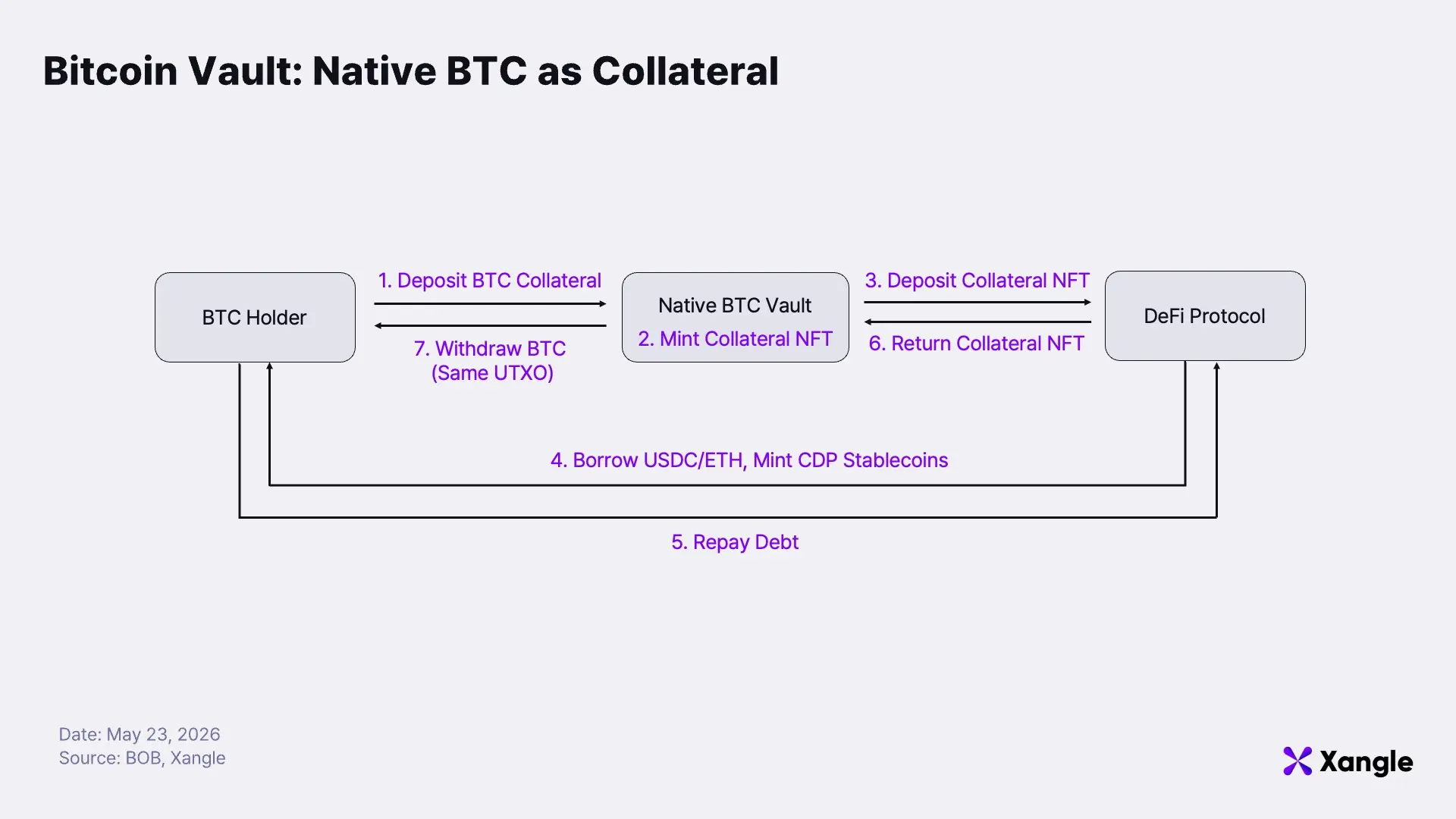
The flow is straightforward. When a user locks BTC in a vault on Bitcoin, a collateral NFT representing the value of that BTC is issued on a DeFi chain. The user can use this NFT as collateral to borrow stablecoins such as USDC or crypto assets such as ETH, or to mint CDP-based stablecoins. The NFT does not represent an undifferentiated claim on a pooled balance. It points to the exact Bitcoin, or UTXO, that the user locked. Once the borrowed assets are fully repaid, the user can return the NFT and receive back the exact BTC initially deposited.
BitVM is the technology that enables collateral usage without third-party intermediation in this structure. BitVM enables complex verification on Bitcoin and can prevent fraud as long as at least one participant acts honestly. With this structure, users can force BTC withdrawals without relying on the cooperation of a bridge operator or custodian. The custody risk and inability to force recovery discussed earlier can therefore be addressed.
4-2. Liquidation Engine: Separating Execution from BTC Settlement
When BTC is locked in a vault on the Bitcoin network, a sharp drop in collateral value creates a time gap between liquidation and settlement. In DeFi lending, liquidation must proceed quickly the moment the collateral ratio falls below the required threshold, but existing BTC Vault structures have struggled to meet this requirement. Settlement can take anywhere from several hours to several days, the entire collateral position is liquidated at once, and the set of liquidation participants is limited to a small group designated in advance. Under that structure, capital-efficient liquidation using flash loans is impossible, and liquidation bonuses must be higher, increasing the burden on borrowers. For Bitcoin Vaults to function as DeFi collateral, solving this bottleneck is essential.
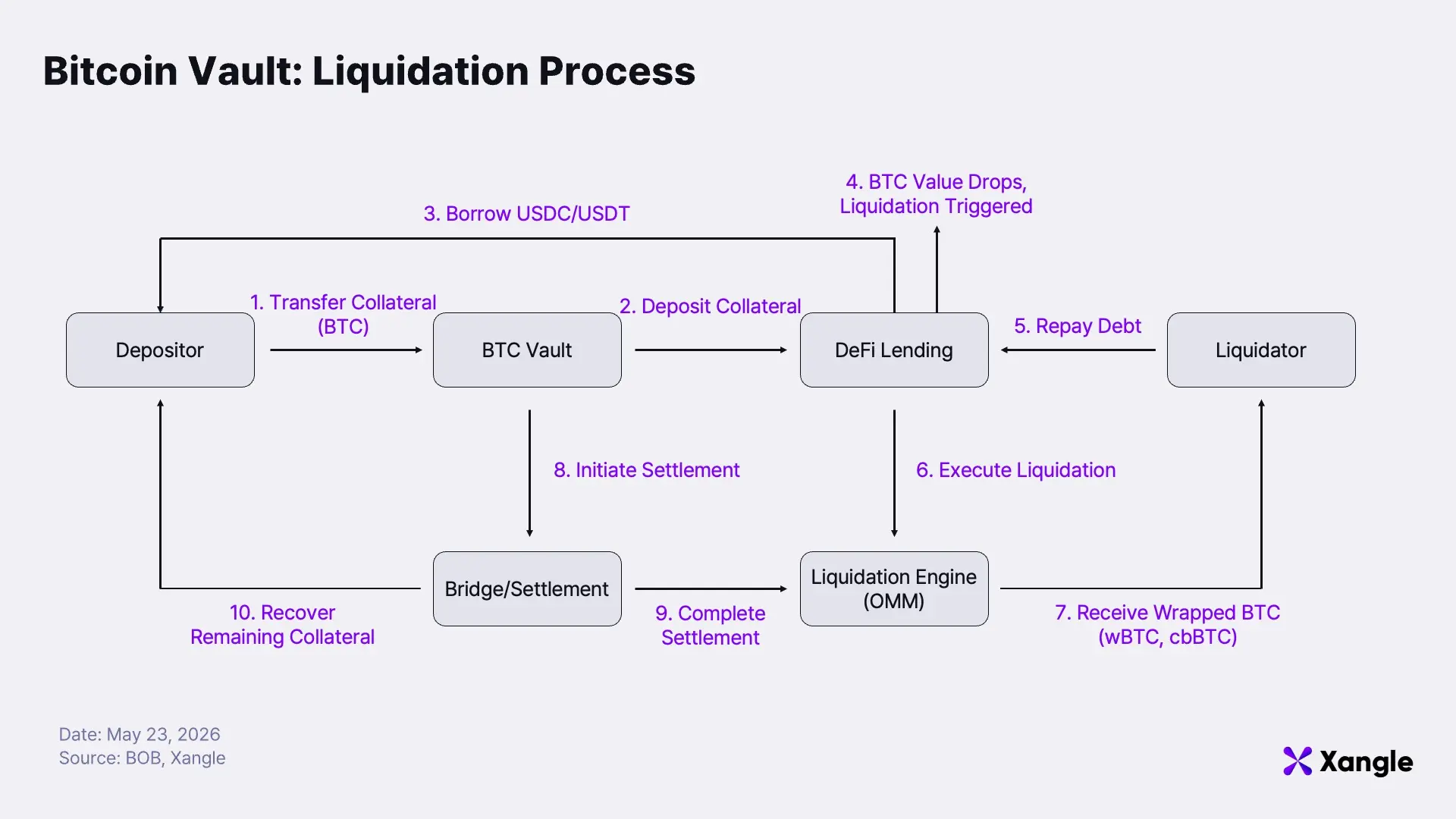
BOB’s liquidation engine addresses the bottleneck by separating liquidation execution from BTC settlement. The key component is the OMM (Onchain Market Maker). When the collateral ratio falls below the threshold, a liquidator borrows USDC through a flash loan and repays the borrower’s debt on their behalf. At that point, based on the vault’s collateral position, the OMM borrows wBTC liquidity from the lending market and immediately pays wBTC to the liquidator. The liquidator then swaps that wBTC into USDC on a DEX, repays the flash loan, and keeps the liquidation bonus as profit. The entire process is executed within a single transaction.
Settlement then proceeds asynchronously. Once the native BTC locked in the vault is transferred through the bridge, it is converted into wBTC and used to repay the loan that the OMM previously borrowed. The liquidator's profit is secured instantly, while BTC settlement completes separately in the background.
Partial liquidation is implemented with Quantized Splits. At the time of deposit, a single BTC vault is split into N parallel vaults of equal size. For example, if a 30% liquidation is needed to restore the collateral ratio, only 3 out of 10 vaults are liquidated, while the remaining 7 stay with the borrower. If the LTV continues to decline, additional vaults are liquidated sequentially. The structure resolves the existing problem of liquidating the entire collateral position at once and reduces unnecessary collateral losses for borrowers. The number of splits varies depending on deposit size: smaller deposits use a single vault, while larger deposits apply more splits.
BOB Bitcoin Vault has not launched yet and remains in development. After launch, its operating model is expected to transition in phases. In the initial phase, an institutional security committee will handle dispute resolution. If a dispute arises around withdrawal or liquidation, the committee will determine the validity of the request through an m-of-n multisig structure. In Phase 2, BOB plans to replace the verification process with BitVM-based zero-knowledge proofs (ZK proofs), moving toward a structure that automatically determines the validity of liquidations based on on-chain collateral state. The goal is not only to build a feature used inside BOB’s own products, but to create shared liquidation infrastructure that allows existing lending protocols such as Aave, Morpho, and Euler to accept native BTC as collateral.
Gateway and Vault together form the core execution rails of Bank of Bitcoin. Gateway converts native BTC into stablecoins, wBTC, and DeFi positions, while Vault makes native BTC usable as collateral inside DeFi protocols. Gateway handles BTC movement and exchange. Vault handles BTC collateralization. When the two products are connected, BOB expands Bitcoin from a passively held asset into an on-chain financial asset. Users can move from native BTC into swaps, deposits, and borrowing without leaving BTC on an exchange or wrapping it themselves. Under this structure, Bitcoin evolves from a held asset into an on-chain financial asset connected to movement, collateral, and yield opportunities.
5. Bitcoin Liquidity Is the Next On-Chain Opportunity
BOB is building a unified financial stack under the Bank of Bitcoin vision. Gateway opens movement rails for native BTC and expands its destinations beyond wBTC and stablecoins into real-world assets such as tokenized gold (XAUt). Vault keeps BTC on the Bitcoin network while extending it into collateral, lending, and yield-bearing use cases in DeFi, and also designs liquidation infrastructure that allows existing lending protocols to accept native BTC. From exchange to yield, lending, and real-world asset access, each function of the “Bank of Bitcoin” is being built step by step.
BOB’s objective is clear. It aims to create an environment where Bitcoin holders can exchange, deposit, borrow, and make payments within a single interface without selling their BTC or entrusting it to a third party. Until now, Bitcoin had to be wrapped in order to be used in DeFi. The moment BTC was wrapped, users had to give up both the security of the Bitcoin network and control over their own assets.
BOB’s direction reverses that structure. Rather than modifying Bitcoin to fit other chains, it uses the Bitcoin network as the reference point and runs finance around it. The result is an environment where Bitcoin preserves its store-of-value role as digital gold while also allowing users to borrow, earn, and exchange with that gold. Gateway and Vault are building the path for Bitcoin to expand from a passively held asset into a financial asset that actually works on-chain.
Disclaimer
I confirm that I have read and understood the following: The information contained in this article is strictly the opinions of the author(s). This article was authored free from any form of coercion or undue influence. The content represents the author's own views and does not represent the official position or opinions of CrossAngle. This article is intended for informational purposes only and should not be construed as investment advice or solicitation. Unless otherwise specified, all users are solely responsible and liable for their own decisions about investments, investment strategies, or the use of products or services. Investment decisions should be made based on the user’s personal investment objectives, circumstances, and financial situation. Please consult a professional financial advisor for more information and guidance. Past returns or projections do not guarantee future results. This article was written at the request of BOB. All content in this article was written independently by the author(s), and neither CrossAngle nor BOB had any editorial control or influence over the content. The author(s) may hold the cryptocurrencies mentioned in this article at the time of writing.
Xangle or its affiliated partners own all copyrights of the written or otherwise produced materials and content provided on the platform. Any illegal reproduction of such content, including, but not limited to, unauthorized editing, copying, reprinting, or redistribution will result in immediate legal actions without prior notice.
![[CIS Partner Summit Highlights] R25, Vault Infrastructure for the Next Generation of Finance](https://resource.xangle.io/files/content/6957A34223D0EE05827E59990EB751D2_1790656054398.webp)