CARV and the Rise of the Agentic Social Economy

1. The Structural Failure of SocialFi Incentive Design
Over the past decade, Web3 has undertaken a continuous series of experiments aimed at redirecting incentives—previously monopolized by centralized platforms—back to users. Numerous SocialFi models emerged during this process, each proposing to redistribute the value of social activity to users and creators. Yet with sufficient time to assess the results, it is difficult to argue that these models delivered the outcomes the ecosystem anticipated. The limitation has never been technical capacity; the fundamental issue lies in the structural disconnect between social behavior and on-chain value flows. User influence and participation remain confined within Web2 platforms such as X, TikTok, and Discord, while rewards, transactions, and governance operate separately on-chain. This bifurcation is not a superficial UX concern; it has functioned as a foundational barrier that distorts the very architecture of incentive design.
The same structural discontinuity appears in newer paradigms such as Yapping. By reframing user attention and conversation as an economic primitive, Yapping succeeded in opening an entirely new market; however, the constraints are equally pronounced. Most meaningful activity continues to reside on Web2 infrastructure, and social signals still fail to connect in a coherent way to on-chain identity or economic reward vectors. The concept of “monetizing conversation itself” was powerful, but the value it produced never evolved into a framework in which conversation could be verified, rewarded, and accumulated on-chain. As a result, reward flows disproportionately favored automated bots rather than genuine contributors, shifting participation dynamics into a competitive farming cycle rather than fostering authentic engagement. Users optimized for reward extraction by generating excessive noise, and projects lacked any reliable mechanism to distinguish noise from legitimate signal. In effect, the Social Ledger (behavior, influence, reputation) and the Economic Ledger (capital, rewards, transactions) remained isolated systems with no shared interpretive layer.
At the center of the problem is this linguistic mismatch between the two ledgers. Mechanical connections between social signals and on-chain capital flows, without contextual interpretation, inevitably lead to misaligned incentives and inefficient reward distribution. What emerges is not a marginal allocation issue but a systemic failure of incentive design—akin to a “tragedy of the commons” that saturates social ecosystems with noise and results in fatigue for both users and projects.
Addressing this structural failure requires more than quantifying user actions; it calls for an integrated evaluative architecture that incorporates contextual intent and accumulated reputation. Put another way, Web3 needs infrastructure capable of translating human behavioral signals into a blockchain-native value language without erasing identity or context. CARV is the project that most directly advances this solution. By translating social signals into a coherent on-chain framework of identity, proof, and execution, CARV attempts to resolve the incentive misalignment that has constrained Web3 for the better part of a decade.
2. Logos, Pathos, Ethos: CARV’s Integrated Framework for Incentive Evaluation
As outlined earlier, CARV represents the first large-scale ID–Context–Execution infrastructure capable of enabling end-to-end incentive evaluation and execution for social activity. Its role extends far beyond onboarding or linking Web2 accounts to the blockchain; CARV is constructing a new value chain in which human influence is translated into on-chain economic outcomes. Behavioral signals become programmable assets, AI interprets their context, and the blockchain resolves them into on-chain rewards and economic execution—an architecture fundamentally unattainable in Web2.
Building such a system requires a tightly integrated set of identity, context, and execution layers. The question, then, is how CARV resolves this challenge. Aristotle’s triad—logos (reason), pathos (emotion), ethos (character)—offers a useful analytical lens. Any claim is evaluated not only on logical consistency (logos), but also on the context in which it is made (pathos) and the reputation or credibility of the speaker (ethos). The same logic applies on-chain: effective incentive design demands an understanding of who a user is (ethos), the intention and situational context behind their actions (pathos), and the appropriate economic consequences those actions should trigger (logos).
CARV’s identity layer serves as the ethos dimension. CARV ID (ERC-7231) combines Web2 accounts—X, Twitch, YouTube—with Web3 wallets and gameplay or activity histories into a unified identity, consolidating a user’s fragmented online presence into a coherent reputation system. As a result, relationships such as “Twitter @user = 0x123 = the identity of an AI Being” emerge naturally, forming the foundational mapping that allows Cashie 2.0 to execute and distribute on-chain rewards from social behavior.
The context layer maps to pathos. Shielded Mind is a protected AI runtime designed to process contextual information—preferences, behavioral patterns, conversational data—without exposing it, enabling agents to act with situational awareness. What emerges is not a simple automation tool, but a context-aware agent capable of interpreting user intention before performing economic execution.
The execution layer completes the triad as logos, embodied by Cashie 2.0. Cashie acts as the execution engine that links the Social Ledger with the Economic Ledger in a meaningful way; it detects social activity, verifies that predefined conditions are met, and distributes rewards automatically. The x402 (ERC-3009) pledge and execution structure fully automates incentive logic and synchronizes human influence with on-chain capital flows in real time.
Taken together, CARV weaves identity, context, and execution into a cohesive infrastructure that translates social behavior into economic value with fidelity. CARV ID establishes trust by unifying identity; Shielded Mind interprets intention and situational nuance; Cashie 2.0 converts those inputs into real rewards and economic flows. By implementing the ethos–pathos–logos framework directly on-chain, CARV becomes the first system to establish a complete, end-to-end pathway through which human influence is executed as economic value.
3. CARV’s Technical Stack: The x402–ID–Agent Execution Pipeline
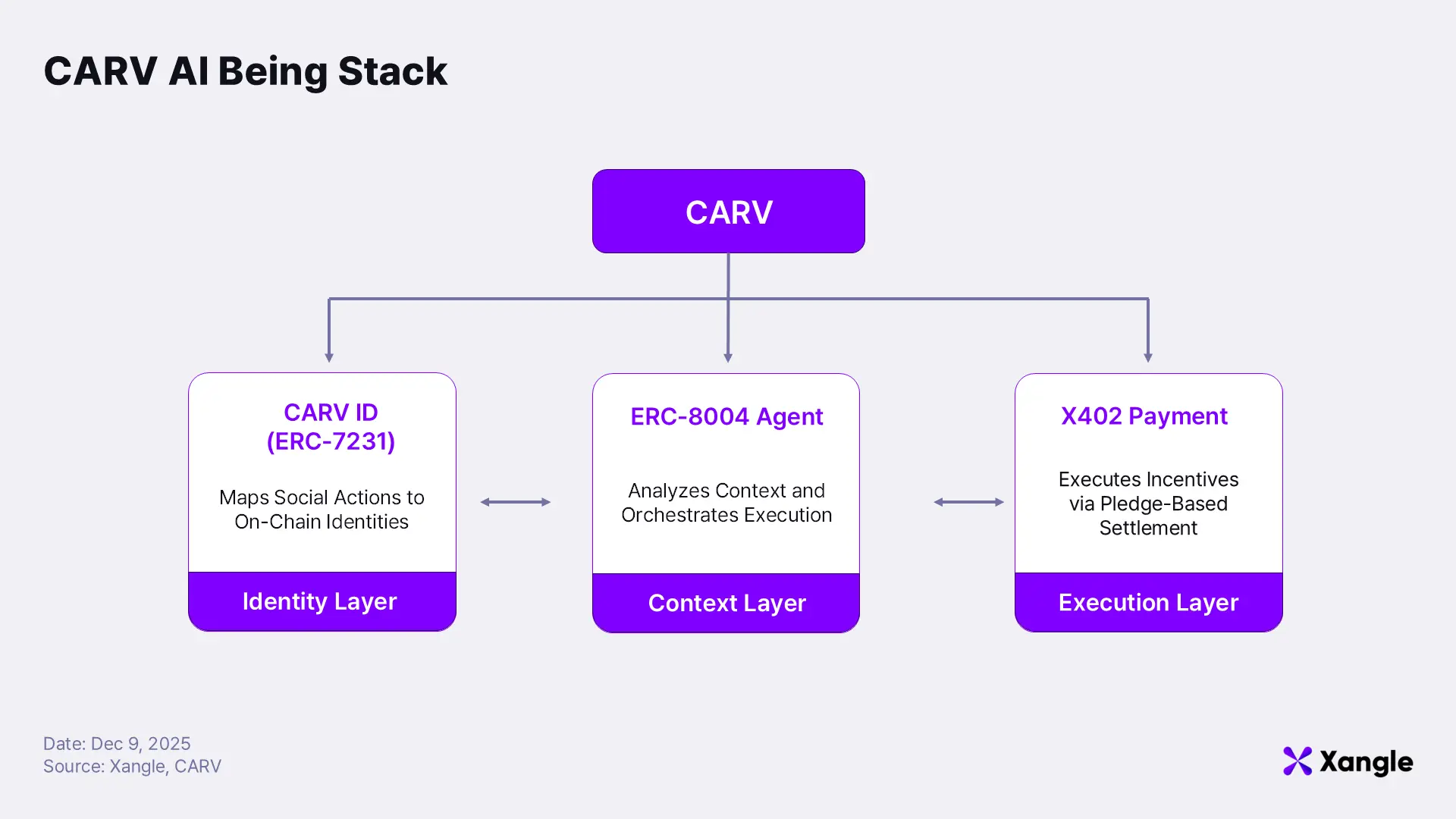
Understanding how CARV’s conceptual framework materializes in practice requires a closer examination of its technical mechanics. The stack is architected so three core components—identity, context analysis, and automated execution—operate as a single, continuous flow. When these layers interlock, user actions are interpreted by AI in real time and immediately resolved into on-chain rewards, forming a closed incentive loop. The essential point is that fund commitments, identity mapping, and execution do not exist as discrete operations; they converge into a unified economic process.
CARV ID anchors the system by consolidating identity. Acting as an identity oracle, it links a user’s social behavior to their on-chain address. When a user retweets content on X, for example, CARV ID maps the social handle to a specific wallet so an AI agent can interpret the action as a contribution originating from that address. This translation of the Social Ledger into a blockchain-readable format becomes the foundational substrate of any incentive architecture.
Once identity is unified, the ERC-8004–based AI agent evaluates behavioral context. The agent automates the entire pipeline: monitoring social data, verifying actions, determining whether conditions are satisfied, and triggering reward distribution. Incentive structures—quests, raffles, conditional payouts—can be composed modularly, and external AI agents can “hire” Cashie to run campaigns on their behalf. Rather than functioning as a basic automation script, the agent acts as an execution engine capable of contextual reasoning and economic decision-making.
With identity mapped and context interpreted, the x402 Payment layer (ERC-3009) finalizes execution by converting intent into settlement. Projects and KOLs can commit to reward payments with a single cryptographic signature, without transferring funds upfront. The signature itself represents the payment promise, incurs no gas cost, and is executed automatically once predefined conditions are met. The Cashie Facilitator manages nonces and prevents replay attacks, ensuring secure and deterministic reward execution.
As these components operate together, a full incentive flow emerges: CARV ID maps social interactions to wallet addresses; the AI agent verifies those interactions and assesses eligibility; the x402 commitment—pre-signed by the project—is executed automatically, distributing rewards with no manual intervention. Social behavior is, in effect, converted into capital flows through a fully automated Web3 protocol. The result is a real-time economic architecture that transforms human participation into programmable on-chain value, replacing legacy incentive models that were fragmented, manual, and inefficient.
CARV’s roadmap, however, extends well beyond improving user–project interactions. The long-term objective is to engineer an agentic economy in which incentive flows themselves are initiated, managed, and optimized by AI agents—positioning agents not as tools, but as autonomous economic actors.
4. The Agentic Economy: CARV’s Long-Term Design for Autonomous Incentives
CARV’s emerging ecosystem moves well beyond simple interactions between users and projects. The architecture is designed to support an entirely new economic model in which AI agents hire one another, deploy budgets, and design as well as operate incentive systems. The shift represents a clear departure from human-centered SocialFi and points toward an Agent-to-Agent economy in which agents operate as independent economic actors.
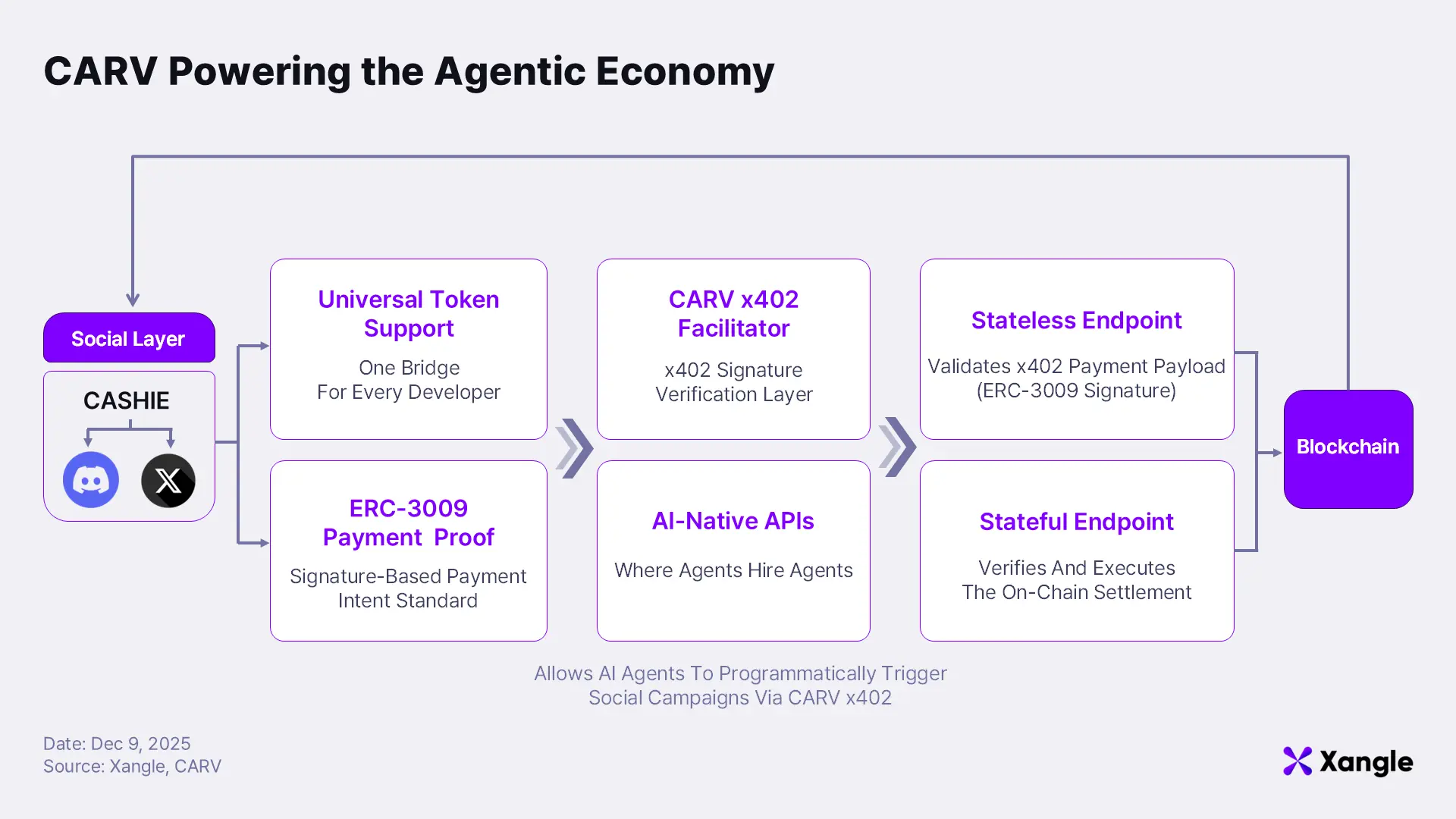
At the core of this architecture lies the x402 Payment Required API. When an AI agent initiates an API call to the Cashie agent, Cashie returns a 402 Challenge requesting a payment signature. Once the initiating agent submits a signature drawn from its allocated budget, Cashie executes the campaign on top of those committed funds. Budgeting and execution—previously handled manually by humans—transition into a contractual, agent-to-agent workflow. Agents autonomously manage budgets, launch campaigns, and distribute rewards, establishing a new economic order driven by machine coordination.
A progression emerges as these mechanisms take hold: SocialFi evolves naturally into AgentFi. Humans continue to generate participation signals; AI systems evaluate those signals; agents take responsibility for execution and settlement; and the protocol provides verification. Centralized marketing and onboarding pipelines gradually lose relevance as AI systems become capable of interpreting context, allocating marketing budgets, and designing incentive structures without human intervention.
The system’s scalability is reinforced by CARV’s Universal ERC-20 architecture. Support extends beyond x402-compatible tokens—any ERC-20 asset can be activated via txHash verification. Incentive design therefore becomes flexible across the entire Base ecosystem, and AI agents gain the ability to structure reward programs using any token standard. Constraints tied to token specifications effectively disappear, giving agents a broad palette for economic activity.
Taken as a whole, CARV is not simply developing a next-generation social rewards protocol. It is designing an on-chain economy in which contracts, execution, and settlement occur automatically among AI agents. The model marks the entrance into AgentFi—an agent-driven economic environment that extends far beyond the boundaries of human-centered SocialFi.
The implications extend far beyond an expansion of SocialFi. CARV is generating a new asset class by converting human influence into programmable, on-chain value, while simultaneously laying the groundwork for AI systems that can conduct economic activity independently. The architecture represents something that could never emerge within traditional web ecosystems; once social signals acquire direct economic weight, a new economic layer—shaped jointly by humans and AI—begins to form.
5. Closing Thoughts: CARV’s Breakthrough in On-Chain Incentive Architecture
The transformation introduced by CARV and Cashie 2.0 signals a decisive shift for both users and developers. For users, reward friction is effectively removed; social behavior naturally converts into on-chain value as the default experience. Whether a KOL or an everyday participant, anyone can receive automatic rewards simply by engaging, and those rewards anchor directly to one’s on-chain identity via CARV ID. Shielded Mind safeguards personal data and intent, ensuring that participation does not come at the expense of privacy.
A comparable paradigm shift unfolds for developers. Social incentive design ceases to be a manually executed marketing tactic and instead becomes a programmable system operated by agents. With x402 and CARV ID eliminating the need to collect wallet addresses, developers can use the Cashie API to build automated campaigns, raffles, bounties, and agent-driven reward layers. Running a custom x402 Facilitator allows builders to define their own social and economic logic; forthcoming releases of the Cashie SDK and the on-chain Social Growth SDK will introduce even deeper levels of composability across ecosystems.
Cashie 2.0 remains early in its lifecycle, yet adoption across a diverse range of projects and creators in the Base ecosystem already demonstrates strong initial traction. CARV’s long-term vision, however, extends far beyond current deployments. AI agents capable of launching campaigns by detecting trend shifts or sentiment changes, enterprise-grade B2B integrations that automate marketing workflows, and reusable incentive structures that operate across communities—all point toward CARV positioning itself as both the foundational layer interlinking social behavior and on-chain systems, and the emergent hub of a new economic landscape.
In its essence, Cashie 2.0 converts human attention and behavior into programmable economic assets. The architecture forms the basis of a social economy in which intentional agents can make economic decisions, users receive rewards with fairness and transparency, and builders gain the latitude to design new modes of collaboration. The system moves beyond bots and auxiliary tools toward a fundamentally new model of incentive-driven coordination.
As CARV’s AI Being roadmap advances, Cashie is poised to become the trustless engine connecting humans and AI, influence and value. A pivotal shift is underway: human actions and social signals are beginning to carry full economic consequence on-chain.
Disclaimer
I confirm that I have read and understood the following: The information contained in this article is strictly the opinions of the author(s). This article was authored free from any form of coercion or undue influence. The content represents the author's own views and does not represent the official position or opinions of CrossAngle. This article is intended for informational purposes only and should not be construed as investment advice or solicitation. Unless otherwise specified, all users are solely responsible and liable for their own decisions about investments, investment strategies, or the use of products or services. Investment decisions should be made based on the user’s personal investment objectives, circumstances, and financial situation. Please consult a professional financial advisor for more information and guidance. Past returns or projections do not guarantee future results.
Xangle or its affiliated partners own all copyrights of the written or otherwise produced materials and content provided on the platform. Any illegal reproduction of such content, including, but not limited to, unauthorized editing, copying, reprinting, or redistribution will result in immediate legal actions without prior notice.
![[CIS Partner Summit Highlights] R25, Vault Infrastructure for the Next Generation of Finance](https://resource.xangle.io/files/content/6957A34223D0EE05827E59990EB751D2_1790656054398.webp)