Jito: The Final Piece in Solana’s Transition to an On-Chain Financial Market


1. Introduction: Can Solana Become the On-Chain Capital Market?
Solana has long framed itself as an “on-chain Nasdaq,” consistently investing in real-world asset (RWA) tokenization and institution-friendly financial infrastructure atop a public blockchain optimized for high throughput, low latency, and large-scale transaction processing. Within this trajectory, the Solana Foundation formally announced a mid- to long-term roadmap on July 24, 2025, outlining its ambition to position Solana as core infrastructure for Internet Capital Markets (ICM) by 2027. The announcement signals more than incremental DeFi expansion; it represents a strategic intent to migrate the core functions of traditional capital markets on-chain.
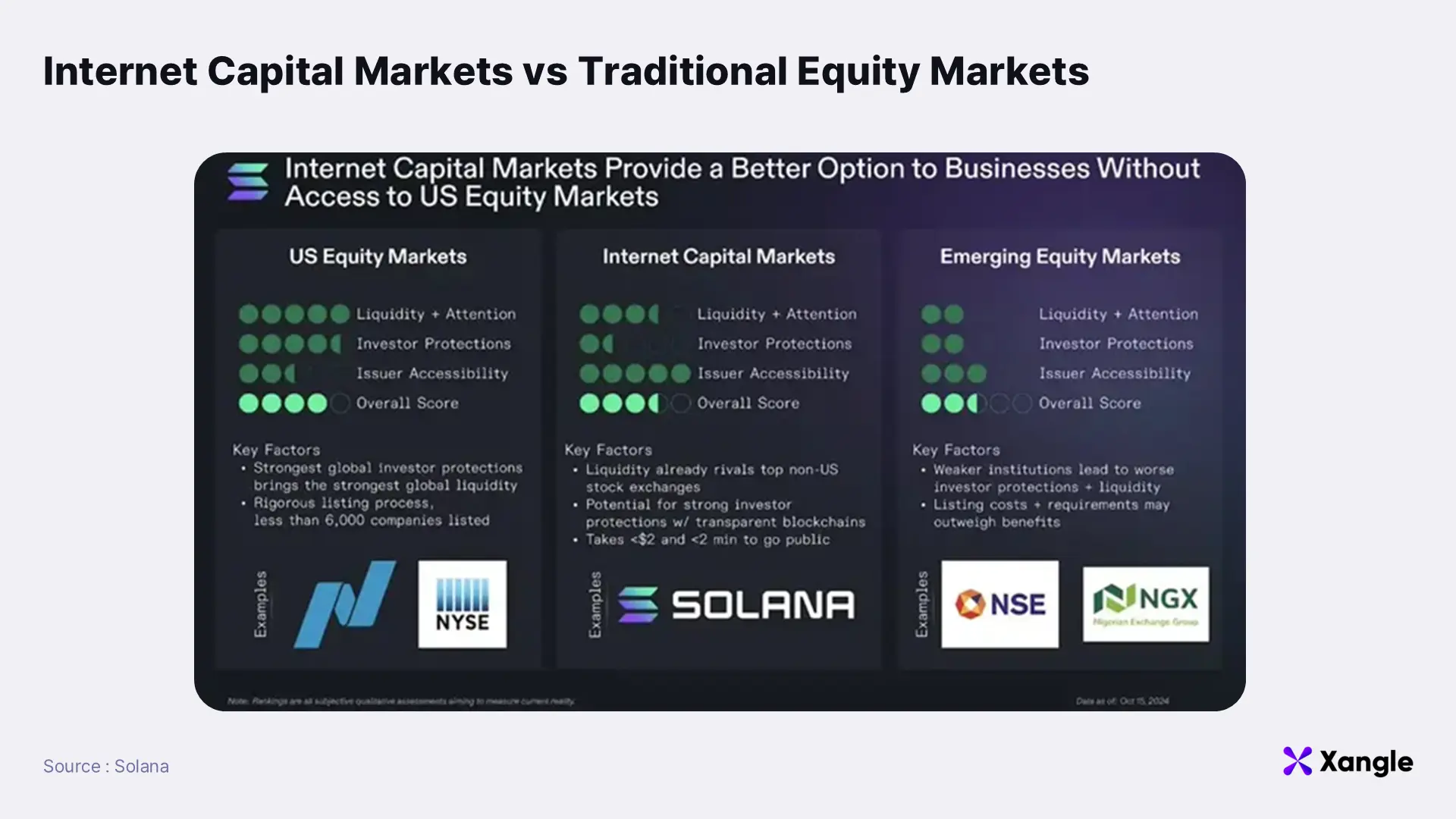
ICM, a concept proposed by Akshay, a former core developer at the Solana Foundation, envisions a unified system in which entities, currencies, and cultural assets are tokenized and represented on a single ledger. Under this model, global access to capital markets is possible through the internet alone. Issuance, trading, settlement, and clearing—previously fragmented across siloed financial infrastructure—are consolidated into a programmable ledger designed to maximize accessibility and efficiency. Solana’s sustained emphasis on RWA, on-chain order books, and institutional participation aligns directly with this architectural vision.
Embedded within this ambition, however, is a structural risk that cannot be ignored: Maximal Extractable Value (MEV). In an environment defined by ultra-fast and high-frequency execution, competition over transaction ordering and inclusion intensifies. Under these conditions, MEV ceases to be a marginal source of additional revenue and instead becomes a variable capable of undermining market fairness, distorting price discovery, and eroding network trust. As Solana increasingly positions itself as an on-chain capital market through the ICM framework, the question of how MEV is governed and institutionalized emerges as a core infrastructure challenge, comparable in importance to performance and scalability.
At its core, MEV represents the latent value that block producers can extract by selectively including, excluding, or reordering transactions during block construction. From a user’s perspective, this manifests through front-running, back-running, and sandwich attacks, with the associated costs passed on in the form of increased slippage, distorted execution prices, and heightened uncertainty around transaction outcomes. Crucially, MEV is not an anomaly driven by a small set of malicious actors. Rather, it is a structural phenomenon that naturally arises in any public blockchain where transactions compete for limited block space.
The implications are particularly pronounced in Solana’s architecture, which prioritizes low latency, high throughput, and parallel execution. Extreme compression of transaction-level competition causes MEV to evolve from a secondary side effect into a structural variable that can materially affect validator incentives, network stability, and overall user experience. Persistent concerns have emerged around scenarios in which specific validators or infrastructure providers exert disproportionate influence over transaction flows, potentially undermining Solana’s foundational principle of fair execution. Within this context, the Solana ecosystem has increasingly converged on a different approach. Rather than suppressing or eliminating MEV, the focus has shifted toward making it explicit, transparent, and aligned with protocol-level incentives. At the center of this transition stands Jito Labs.
2. MEV: the Invisible Hand of On-Chain Transactions
What, then, is MEV in precise terms? MEV was originally defined as Miner Extractable Value, referring to the additional value miners could capture during block construction in a Proof-of-Work (PoW) environment. As Proof-of-Stake (PoS) systems became more prevalent, the concept expanded beyond any single consensus mechanism and was redefined as Maximal Extractable Value, encompassing the broader class of structural phenomena that arise across the entire block production process. This evolution reflects a fundamental shift in how block producers are understood: no longer merely transaction processors, but economic decision-makers within the network.
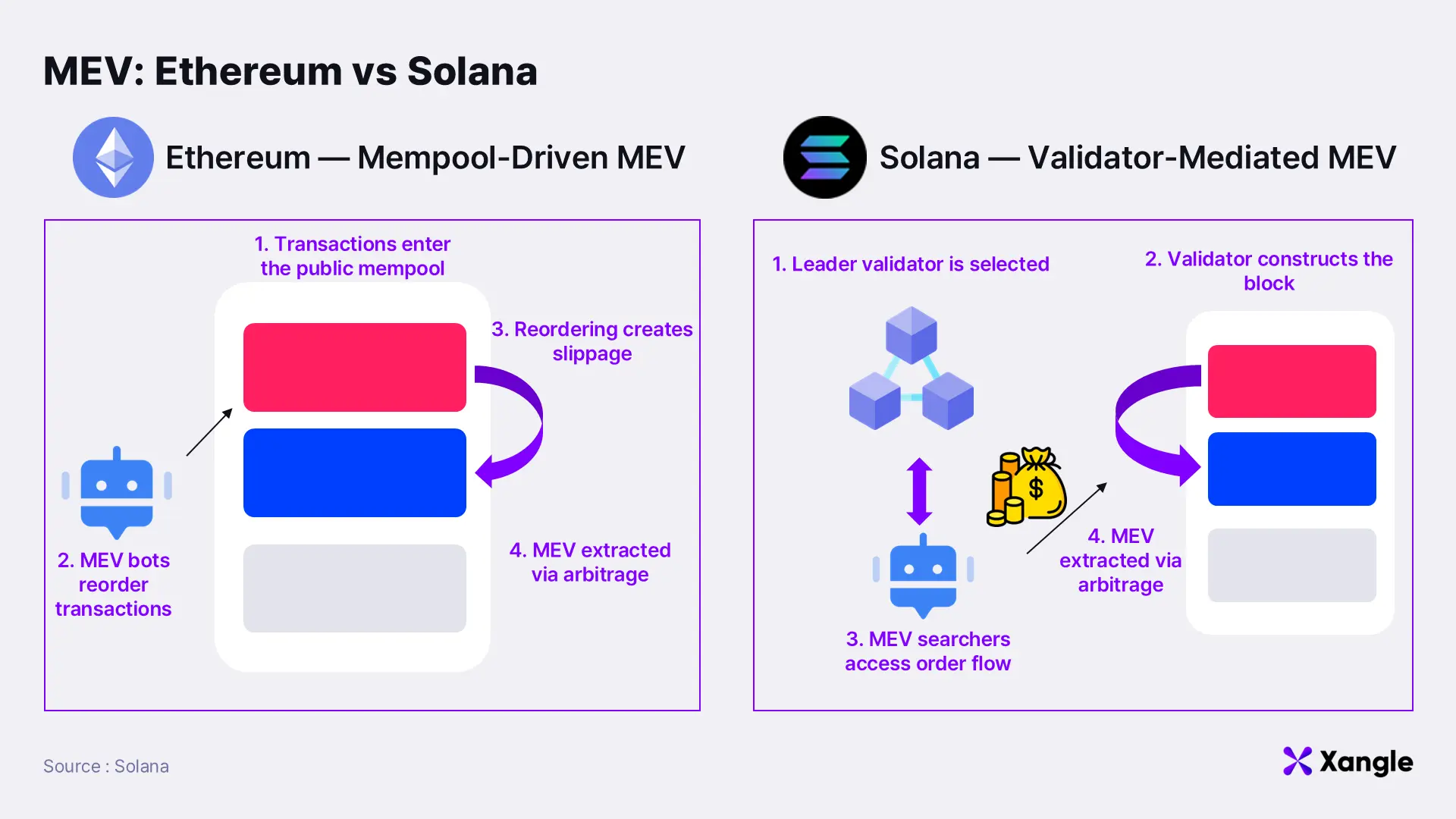
The essence of MEV lies in the authority held by block producers, namely validators, over transaction inclusion, exclusion, and reordering. This authority is not a matter of technical discretion alone; under competitive market conditions, it becomes an economic option set through which profit can be maximized. Typical MEV strategies include front-running, in which a validator inserts its own transaction ahead of a user’s trade; sandwich attacks, where buy and sell orders are positioned before and after a target transaction; and back-running, which captures profits generated by state changes following execution. For users, these practices translate into inferior execution terms and heightened uncertainty. At the network level, they accumulate into erosion of trust.
MEV on Solana follows a markedly different trajectory from that observed on Ethereum-based chains. The reason lies in Solana’s architectural choices: short block times, a leader-based block production model, and a transaction processing pipeline designed around parallel execution. On Solana, a pre-designated leader validator is responsible for producing each slot. This leader aggregates incoming transactions from the network and determines the composition of the block it proposes.
Within this structure, certain validators or infrastructure providers gain an informational advantage by observing specific transaction flows earlier than others. That advantage directly translates into the ability to preempt front-running or back-running opportunities. Large swaps, oracle price updates, and liquidation transactions on decentralized exchanges (DEXs) or on-chain order books therefore become primary targets for MEV extraction.
For this reason, MEV on Solana is difficult to characterize as an incidental vulnerability or a byproduct of protocol design, as it is often framed in discussions around Ethereum. Instead, it more closely resembles a mechanism that validators have intentionally designed for and adopted in response to a high-speed execution environment and a competitive block production regime. In this sense, Solana’s MEV should be understood not as a weakness discovered ex post, but as a revenue-generating structure that emerged organically from the network’s incentive design.
The most illustrative example of this dynamic is the jito client developed by Jito Labs. Rather than extracting MEV through opaque or informal means, the client explicitly integrates MEV strategies into the block assembly process, with the stated objective of systematizing validator revenue.
3. Jito: Turning MEV into Explicit Infrastructure
Jito’s foundational problem framing does not treat MEV itself as the issue. The concern lies instead in the opacity of the extraction process and the concentration of MEV capture among a narrow set of actors. In response, Jito has pursued an approach that brings MEV into the open and subjects it to explicit, rule-based management and distribution, with the objective of improving network stability and execution predictability for users. Central to this strategy is the construction of a dedicated MEV infrastructure layer positioned between validators and users. In practical terms, Jito built a system functionally analogous to Ethereum’s mempool and leveraged it as a mechanism for structuring incentives at the validator level.
3-1. JitoSOL: Embedding MEV into the Staking Yield Model
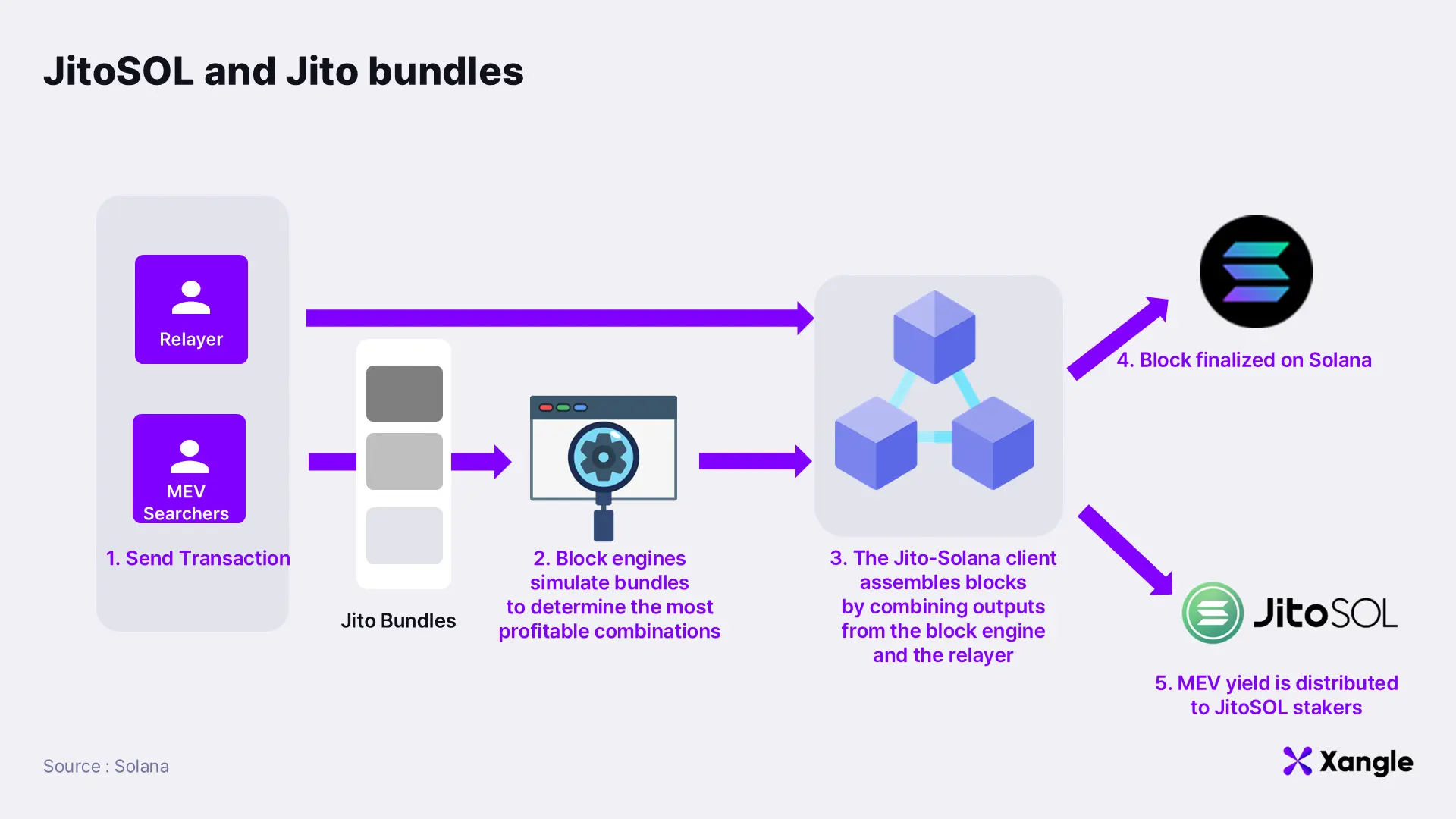
JitoSOL is a Solana-based liquid staking token that internalizes MEV revenue within the same staking structure as conventional SOL staking rewards. Users retain liquidity while staking SOL, and JitoSOL reflects accumulated returns through a design in which total supply remains fixed while the exchange rate against SOL increases over time. Within this framework, MEV is redefined not as informal, incremental income captured by individual validators, but as a shared revenue stream distributed across the entire staker base. As a result, MEV transitions from an external variable that degrades user experience into a predictable reward component shared through participation in staking.
3-2. Jito Bundles and Validator Infrastructure
Jito implements MEV strategies in an explicit and controllable form by enabling transactions to be grouped and executed atomically at the bundle level rather than as isolated transactions. Under this model, specific MEV opportunities no longer emerge from implicit competition between individual transactions; instead, competition is shifted toward predefined bundles. From the validator’s perspective, this provides a rational mechanism for optimizing revenue during block assembly. At the network level, the same structure reduces indiscriminate transaction spam and alleviates contention driven by mempool-based competition. In effect, Jito Bundles reframe MEV from a hidden side effect into a market mechanism embedded directly within the block production process, forming infrastructure that is structurally aligned with Solana’s high-speed execution environment.
Within the Jito Client, bundle-based execution makes MEV competition visible and legible, lifting what had previously functioned as a shadow market into an open and observable domain. At the same time, distributing the client directly to validators created a natural pathway for validator participation within the Jito ecosystem. MEV revenue served as a concrete adoption incentive, drawing validators into the Jito stack. Importantly, these incentives were not captured unilaterally by validators. Instead, MEV-derived revenues were shared with stakers, allowing Jito to scale into the largest liquid staking protocol in the Solana ecosystem.
Clear limitations remained despite these advances. Transparency at the bundle level alone was insufficient for Solana to secure meaningful competitiveness in the forthcoming ICM era. Although block bundles became visible through on-chain pathways, the authority to determine which bundles were included in a block and in what order remained concentrated with validators. Put differently, while the bundle construction process was exposed, the most critical stage of ordering competition continued to operate within a partially opaque domain. Addressing this structural constraint required moving beyond bundle-level transparency toward a more fundamental reorganization of block construction. In response, Jito proposed a next-generation block-building layer: BAM (Block Assembly Marketplace).
4. BAM: Bringing MEV into an Explicit Market
BAM is a next-generation block-building and transaction-processing architecture proposed by Jito Labs for the Solana ecosystem. Its starting premise is the conversion of MEV into a fully transparent and efficient form of competition. Rather than allowing the ordering competition and informational advantages that inevitably arise during block production to persist in opaque and informal ways, BAM elevates them into an explicit market mechanism, with the objective of improving both efficiency and fairness at the network level.
A key aspect of BAM’s design is its pragmatic deployment model. Introduction is possible via an upgrade to the existing Jito-Solana client, without imposing new consensus rules or fundamentally altering the validator architecture. This allows for gradual adoption across the network. Such an approach signals that BAM is not conceived as a discrete feature addition, but as an infrastructure layer intended to reorganize Solana’s block production flow over the long term.
4-1. BAM Architecture and Auction-Based Design
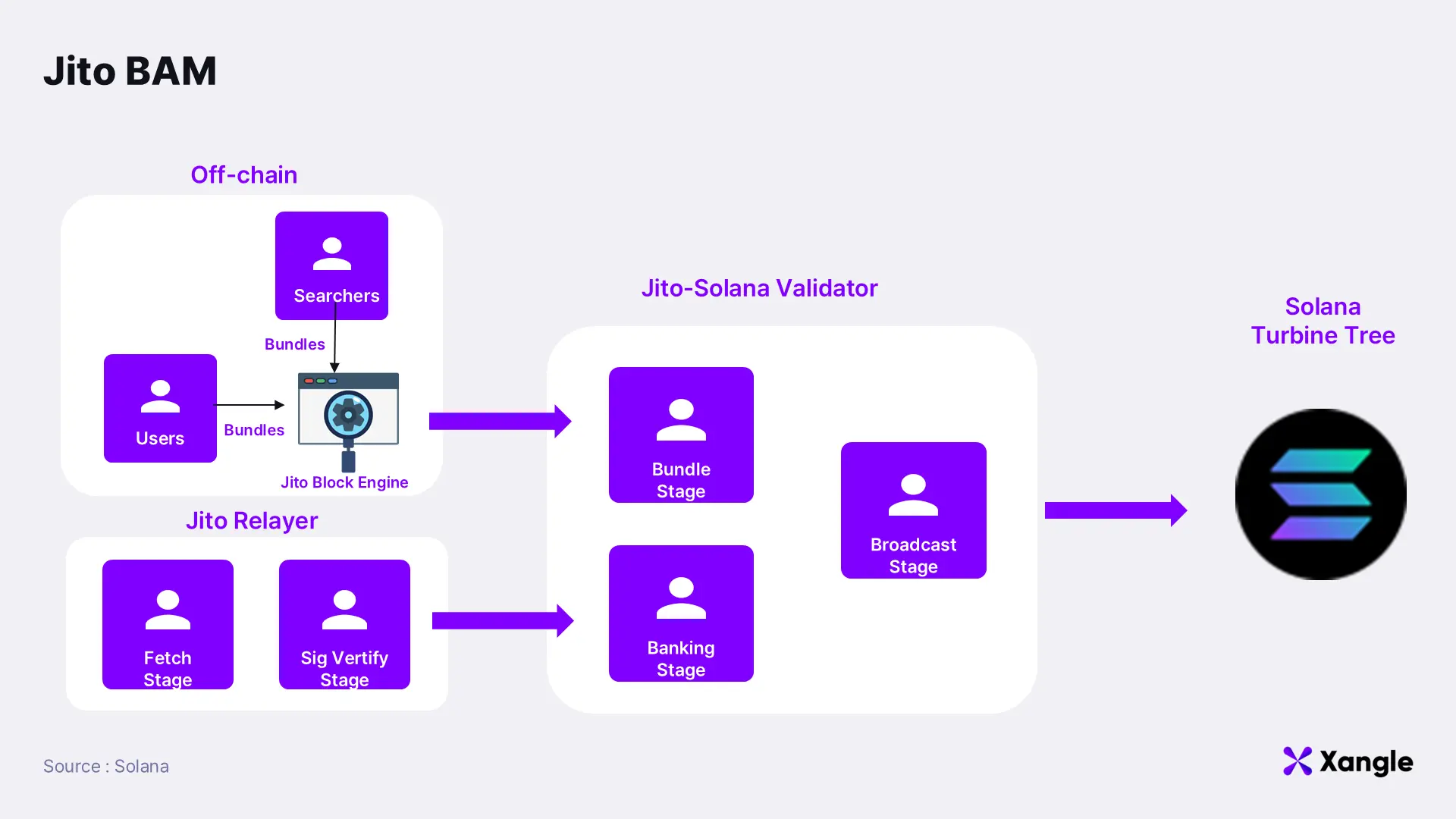
The defining characteristic of BAM lies in its reconstruction of block building around an auction-based mechanism. Transactions or bundles competing for block inclusion do so within a private environment, governed by programmable rules. Outcomes are designed to be verifiable ex post, limiting the ability of any participant to extract unfair advantages via information asymmetry or informal coordination. This represents a structural departure from the opaque ordering manipulation commonly associated with mempool-based systems.
Auction-based block construction operates on a role-segmented architecture composed of Relayer–Block Engine–Jito-Solana. The Relayer functions as a stable ingress layer, collecting and forwarding general transactions from users and applications without direct involvement in ordering competition or MEV evaluation. MEV bundles constructed by specialized bots are routed to the Block Engine, where they are aggregated in a private environment, checked for conflicts and rule compliance, and evaluated under predefined auction logic to determine the highest-value combination. The Jito-Solana validator client then assembles the block by combining relayed user transactions with the bundles selected by the Block Engine, following auction outcomes rather than exercising arbitrary reordering discretion. Functional separation at each stage clearly delineates network propagation, MEV competition, and block proposal, structurally constraining opportunities for discretionary abuse or informal intervention.
Within this structure, MEV no longer operates as a concealed activity but becomes an explicit competitive domain in which prices are clearly formed. Block producers select bundles based on economic value rather than subjective sequencing decisions, with behavior bounded by transparent rules. Information asymmetries that previously characterized transaction sequencing are reduced, and MEV extraction shifts away from individual discretion toward market-determined outcomes. As a result, block building is redefined not merely as a technical optimization problem, but as an economic process governed by explicit incentive structures.
4-2. Network-Level Effects
The network-level impact expected from BAM extends beyond improvements to revenue distribution alone. As MEV-driven competition becomes structured, excessive transaction resubmission and cancellation decline, improving overall block space utilization. The same block resources can therefore accommodate a greater volume of valid transactions, easing network congestion. For users, higher predictability around execution outcomes follows, reducing both execution distortion and uncertainty.
BAM also introduces meaningful changes from the validator’s perspective. MEV revenues are no longer determined by informal technical sophistication or infrastructure advantages, but instead emerge within an explicit competitive framework. Revenue dynamics become more stably aligned, which can moderate excessive competition and limit the accumulation of disparities among validators. Over time, this contributes to the sustainability of participation incentives across the network. Deployment of BAM on the Solana mainnet began in mid-2025, and validator onboarding is currently progressing on a gradual basis. This trajectory signals a broader convergence toward standardized block-building and MEV-handling practices within the Internet Capital Markets infrastructure Solana aims to establish.
5. BAM and the Feasibility of Perp DEXs on Solana
BAM is more than an auxiliary tool for mitigating MEV or organizing transaction ordering. Its fundamental contribution lies in establishing an execution environment in which transaction order, execution conditions, and price references are defined ex ante, while execution outcomes remain verifiable ex post. Designs that were structurally infeasible in earlier on-chain environments, or that could only be implemented in an inherently unstable manner, are elevated into realistic architectural options. In this sense, BAM operates as a block-building layer that moves on-chain execution away from probabilistic outcomes toward a process approaching determinism.
Beyond incremental performance gains, BAM materially expands the design space available for on-chain market structures. Rules and protective mechanisms that previously proved difficult to enforce under MEV pressure and uncertain sequencing are translated into explicit conditions governed by market mechanisms. The practical implication is concrete: BAM allows the prerequisites required for a trading-grade execution environment on Solana to be defined at the structural level rather than approximated through application-layer workarounds.
Viewed through this lens, Solana exhibits several clear constraints when assessed against the requirements of stable perpetual DEX infrastructure such as Hyperliquid or Lyra. Priority for limit (maker) orders lacks consistent enforcement, oracle pricing fails to meet strict real-time execution standards, fee dynamics remain difficult to forecast, and order cancellations occur with high frequency. These sources of uncertainty have historically represented structural weaknesses in positioning Solana as a precision financial engine. A meaningful shift becomes possible once MEV competition is transformed from an opaque, adversarial process into a rule-bound market mechanism. Under such conditions, the foundational assumptions governing Solana’s suitability for advanced trading infrastructure change at the system level.
5-1. Maker Priority: A Market Structure Where Cancelled Orders Are Protected
One of the most fundamental structural issues in existing on-chain DEX environments lies in the persistent exposure of makers to adverse selection, even at the moment an order is cancelled. When a cancellation transaction is delayed within a block, execution can still occur after market prices have already moved against the maker, creating a structurally disadvantageous trading environment. The problem extends well beyond user experience; it has been a primary driver of shallow liquidity across on-chain markets.
Fully controllable transaction sequencing under BAM enables the structural prioritization of cancellation orders ahead of execution orders. From a risk management perspective, makers gain clear visibility into when market exit is guaranteed, which directly reinforces confidence in order placement. Capital commitment by makers increases as a result, order book depth thickens, and bid–ask spreads narrow through a self-reinforcing cycle. Traditional financial markets rely on maker protection rules as a foundational pillar of liquidity formation; BAM introduces, for the first time, the structural conditions required to implement the same principle on-chain.
5-2. Just-in-Time Oracle Updates and Price Integrity
A substantial share of on-chain trades today executes against oracle prices that are already stale. Oracle updates occur at block intervals, while user transactions continue to be processed between updates, allowing price distortion, unnecessary slippage, and incremental MEV opportunities to emerge organically. Exposure to these effects becomes particularly acute for large orders and high-frequency trading strategies.
Explicit execution conditions within a BAM environment allow user transactions to require that the latest price information be incorporated in advance. Oracle updates satisfying these conditions are executed first, followed by the associated trades. The result is not merely technical optimization, but a structural reduction in the temporal gap between real-world price formation and on-chain execution. Price risk declines accordingly, and execution conditions align with institutional requirements for price integrity.
5-3. Dynamic Fee Markets and Cost Predictability
Accurate observation of fee dynamics has historically been close to impossible in on-chain environments. Transactions propagate across multiple pathways, while the relationship between fees and execution timing remains opaque. Users have therefore faced persistent inefficiencies, either overpaying by setting excessively high fees or repeatedly failing to execute transactions due to fees set too low.
Consolidation of transactions into a single block-building market under BAM changes this dynamic. Fee distributions at specific points in time, execution probabilities by priority tier, and strategy-level execution success rates become quantitatively observable. Percentile-based analysis of fees becomes feasible, enabling the design of optimal fee strategies tailored to different execution objectives. Block space can therefore be analyzed as an economic resource rather than a black box, improving cost predictability for institutions and professional traders. Over time, this observability forms the basis for more advanced fee-derived strategies and financial products that treat block space itself as an underlying asset.
5-4. Pre-Execution Trust: Deterministic Transaction Submission
Another critical capability introduced by BAM lies in the ability to establish a degree of execution certainty before a transaction is submitted. This concept is commonly described as Pre-MPS (Pre-Message Processing Signal). Execution order, execution conditions, and acceptable price ranges become knowable in advance. Transactions that fail to meet predefined criteria can be withheld entirely, rather than entering the network and failing post submission.
System-level efficiency improves as a direct consequence. Failed transactions decline, network congestion eases, and the surface area for MEV extraction contracts structurally. Pre-execution trust carries particular significance from an institutional standpoint, where internal controls and risk management frameworks require predictable execution guarantees. By shifting on-chain execution away from probabilistic outcomes toward a manageable, rule-defined process, BAM expands the practical foundation of the Internet Capital Markets infrastructure that Solana aims to establish.
6. Closing Thoughts: BAM and Solana’s Transition to a Deterministic Financial Engine
Solana combines several structural strengths, including high throughput, low latency, and an execution model based on a single state machine. Considered on their own, these characteristics suggest an environment well suited to financial application development. The most fundamental limitation Solana has faced to date stems from a different source. The network was not originally designed around the assumptions embedded in centralized exchange matching engines, such as those used by CEXs or Nasdaq.
As a result, core market requirements have remained structurally unstable. Guaranteed priority for limit orders, real-time oracle pricing, predictable fee dynamics, and reliable mechanisms for order cancellation and protection have been difficult to enforce consistently. This challenge is not primarily a matter of individual protocol design choices. It reflects a deeper constraint at the level of block building and sequencing, where the requirements of financial markets have not been fully internalized.
BAM changes this architectural baseline. Execution conditions, governing rules, price references, and transaction ordering can be explicitly defined before block construction begins. Execution on Solana no longer depends on the outcome of uncertain, adversarial competition. Instead, it follows market rules that are specified in advance and enforced at the block-building layer.
Within this context, BAM extends far beyond incremental improvements to MEV handling. It functions as the final structural layer required to move Solana from a general-purpose high-performance chain toward an on-chain financial engine built around deterministic execution. The framework proposed by Jito therefore represents more than an additional feature. It marks a turning point that will determine whether Solana can credibly operate as foundational infrastructure for on-chain financial markets at Internet Capital Markets scale.
Disclaimer
I confirm that I have read and understood the following: The information contained in this article is strictly the opinions of the author(s). This article was authored free from any form of coercion or undue influence. The content represents the author's own views and does not represent the official position or opinions of CrossAngle. This article is intended for informational purposes only and should not be construed as investment advice or solicitation. Unless otherwise specified, all users are solely responsible and liable for their own decisions about investments, investment strategies, or the use of products or services. Investment decisions should be made based on the user’s personal investment objectives, circumstances, and financial situation. Please consult a professional financial advisor for more information and guidance. Past returns or projections do not guarantee future results.
Xangle or its affiliated partners own all copyrights of the written or otherwise produced materials and content provided on the platform. Any illegal reproduction of such content, including, but not limited to, unauthorized editing, copying, reprinting, or redistribution will result in immediate legal actions without prior notice.
![[CIS Partner Summit Highlights] R25, Vault Infrastructure for the Next Generation of Finance](https://resource.xangle.io/files/content/6957A34223D0EE05827E59990EB751D2_1790656054398.webp)