
[CIS Partner Summit Highlights] Dinari: Bringing Tokenized Stocks to Financial Services


Table of Contents
1. Stock Tokens and the Rights Behind Them
2. Dinari’s Approach: Connecting Securities with On-Chain Services
3. Dinari’s Core Services
4. Expanding Use Through Partners and Products
5. Closing Remarks: Lowering the Barriers to Tokenized Stock Adoption
1. Stock Tokens and the Rights Behind Them
Tokens that track the same company’s share price can give investors different rights. Even when they reference the same stock, they may confer a right to hold shares, a claim for payment against the token issuer, or a contractual entitlement to gains and losses from price movements. Understanding a stock token therefore requires examining both the stock it tracks and the rights its holder can exercise, including the party against which those rights are enforceable.
The relationship between a stock and its token can be classified into four types, according to the rights held by the token owner.
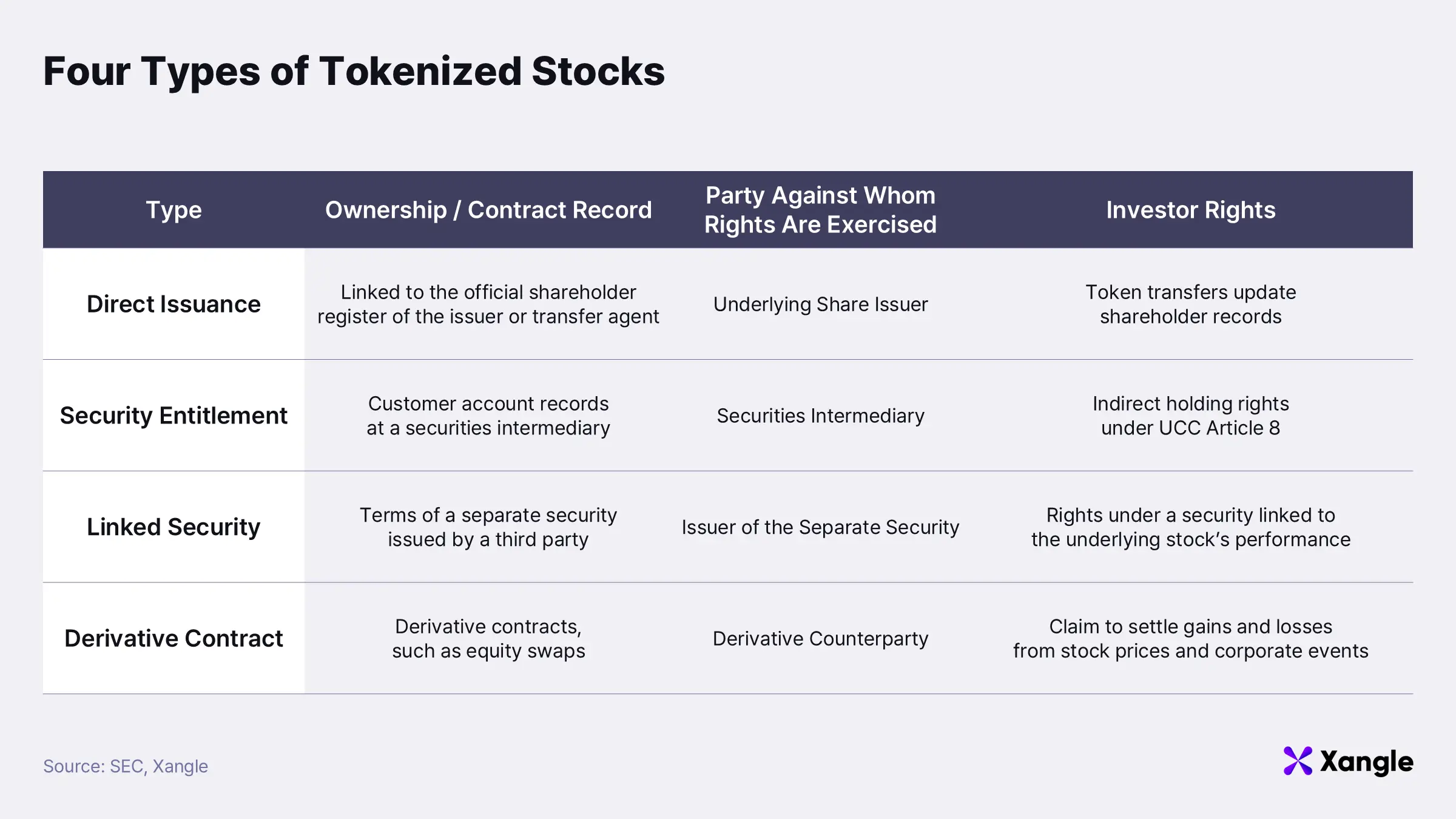
- Direct Issuance: The token is linked to the official shareholder register maintained by the issuing company or its transfer agent. Token transfers are reflected in shareholder records, and investors hold shareholder rights against the company that issued the underlying stock.
- Security Entitlement: The token represents an indirect holding recorded in a customer account at a securities intermediary. This structure is based on Article 8 of the U.S. Uniform Commercial Code (UCC). Investors exercise their rights through the intermediary rather than being listed directly on the underlying company’s shareholder register.
- Linked Security: A third party issues a separate security linked to the economic performance of the underlying stock. Investors hold rights under the terms of that security and exercise them against the third-party issuer.
- Derivative Contract: The token represents a derivative contract, such as an equity swap. Under the contract’s terms, investors have the right to settle gains and losses arising from share-price movements or corporate events with the derivative counterparty.
For a detailed comparison of these structures and their associated rights, see '[Xangle RWA Series] Tokenized Stocks'.
Dinari turns these rights structures into stock investment services. Its dShares, issued against underlying securities secured on a 1:1 basis, enable financial apps and wallets to offer access to U.S. stocks and ETFs. dShares are offered in U.S. and non-U.S. versions under the regulations of each jurisdiction, with different legal structures. U.S. dShares fall into the security entitlement category: tokens represent rights to shares held in brokerage accounts. Non-U.S. products governed by over-the-counter swap contracts fall into the derivative contract category, with the performance of the underlying shares settled under contractual terms. Delivering these structures as services requires an operating framework that connects trading and custody of the underlying securities with token issuance and redemption. This report examines how Dinari connects these processes and how financial institutions and platforms can use its infrastructure, drawing on its main services and adoption examples.
2. Dinari’s Approach: Connecting Securities with On-Chain Services
Since its founding in 2021, Dinari has built securities infrastructure for offering U.S. stocks and ETFs as tokens. It launched dShares in 2023. In 2025, its subsidiary Dinari Securities registered with the U.S. SEC as a broker-dealer and became a FINRA member, establishing the basis for providing brokerage services to U.S. customers. Dinari Securities now handles customer accounts, orders, and other brokerage functions in the United States, while Dinari expands its overseas distribution through partners such as financial apps, exchanges, and wallets.
2.1 Rights and Operations Linked to Underlying Securities
In the U.S. securities market, a brokerage firm that manages customer accounts and orders may work with another firm that handles clearing, settlement, and asset custody. Customer holdings are recorded in brokerage accounts, and executed trades are routed through the clearing broker to NSCC’s clearing infrastructure and DTC’s securities transfer and settlement systems. Dinari also uses this established market infrastructure to trade and hold the underlying shares.
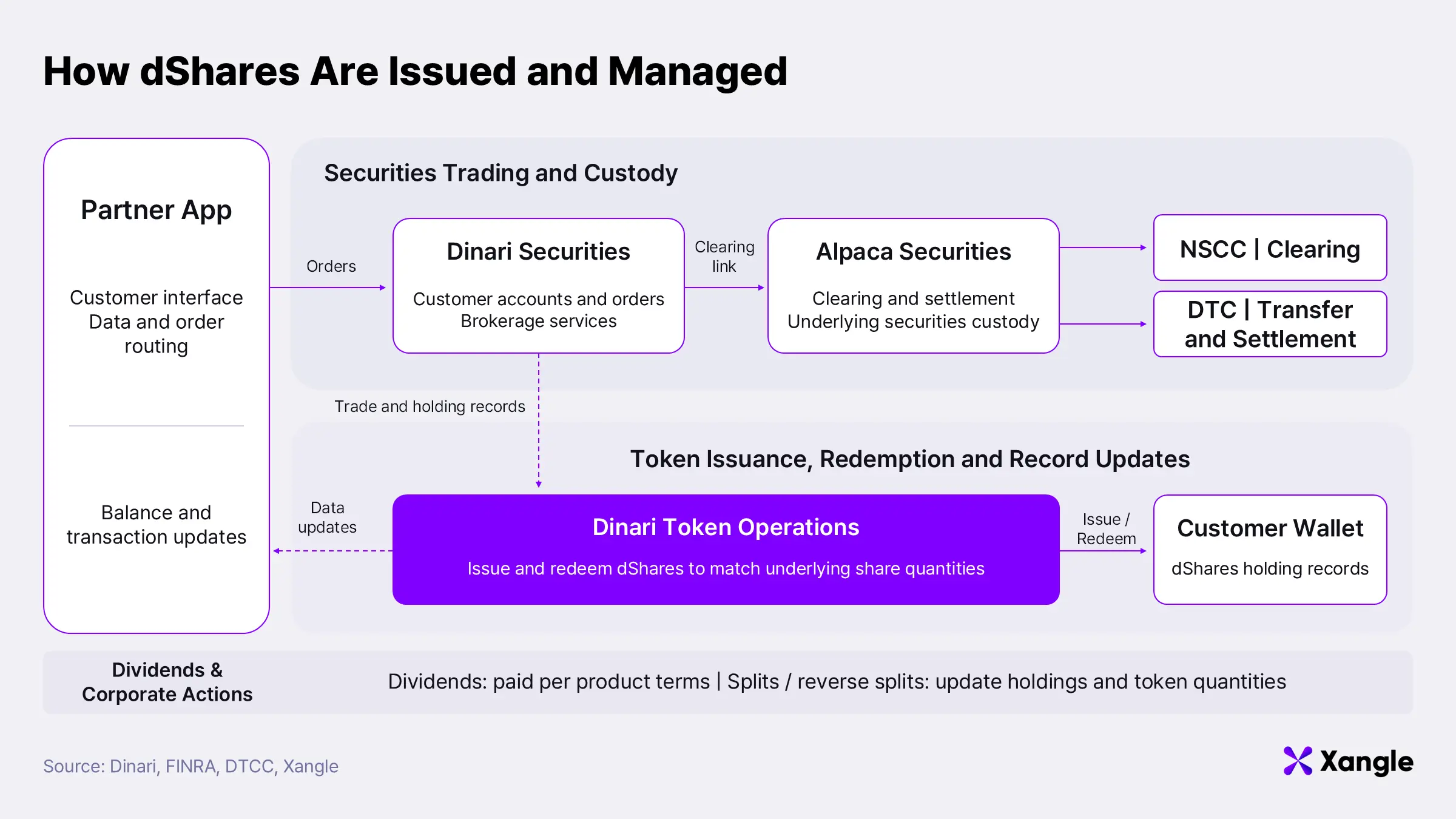
dShares connects token issuance and redemption to this securities market structure. Dinari’s subsidiary Dinari Securities handles brokerage functions, including customer accounts and orders, while Alpaca Securities acts as the clearing broker, handling clearing, settlement, and custody of the underlying securities. Using the resulting trade and holding records, Dinari issues dShares to customer wallets in quantities corresponding to the shares secured. Customers can view dShares in their apps and wallets, while the underlying shares remain managed within the existing securities market infrastructure.
Dividends and corporate actions during the holding period are processed through the same connections. Dividends are paid to customers according to the relevant product terms. Stock splits and reverse splits lead to corresponding adjustments in holding records and token quantities. Partner apps connected to Dinari receive this information and update customer balances and transaction histories. A single integration can therefore provide the functions needed to manage underlying securities, issue and redeem tokens, and process dividends and corporate actions.
2.2 Integrating the Operations Needed to Launch Stock Services
Dinari brings together customer verification, account opening, order management, and holdings management so financial institutions can introduce tokenized stock services through a single API integration. When dividends or stock splits occur, it connects securities records, token balances, and the data needed for customer interfaces. Financial institutions can integrate these functions into their own apps or platforms through Dinari’s API and offer tokenized stock investing to their customers.
Consider a financial app adding U.S. stock investing. The app connects its buy button and balance screen to Dinari’s API. When a user selects a security and quantity and submits a purchase request, the app uses the API to check customer verification status and account balances, then submits the order. It receives the execution result and the quantity of dShares issued and displays them on the user’s balance screen. When dividends or stock splits occur, the app receives the relevant records and updated balances and refreshes the screen. Dinari’s API thus lets the app integrate the functions needed from order processing through holdings management.
This reduces the development work involved in separately connecting brokerage accounts, order systems, and token issuance systems and reconciling their records. Businesses can integrate order processing and holdings management through Dinari’s API and focus development on features their users interact with directly, such as stock and ETF browsing, asset overviews, and notifications.
2.3 Delivery Models for Different Platforms
Dinari enables financial apps, digital asset wallets, brokers, and banks to add tokenized stock investing to their existing apps. Partners retain their own branding and customer interfaces while connecting the required functions through Dinari’s API. The resulting services can take the following forms, depending on the platform.
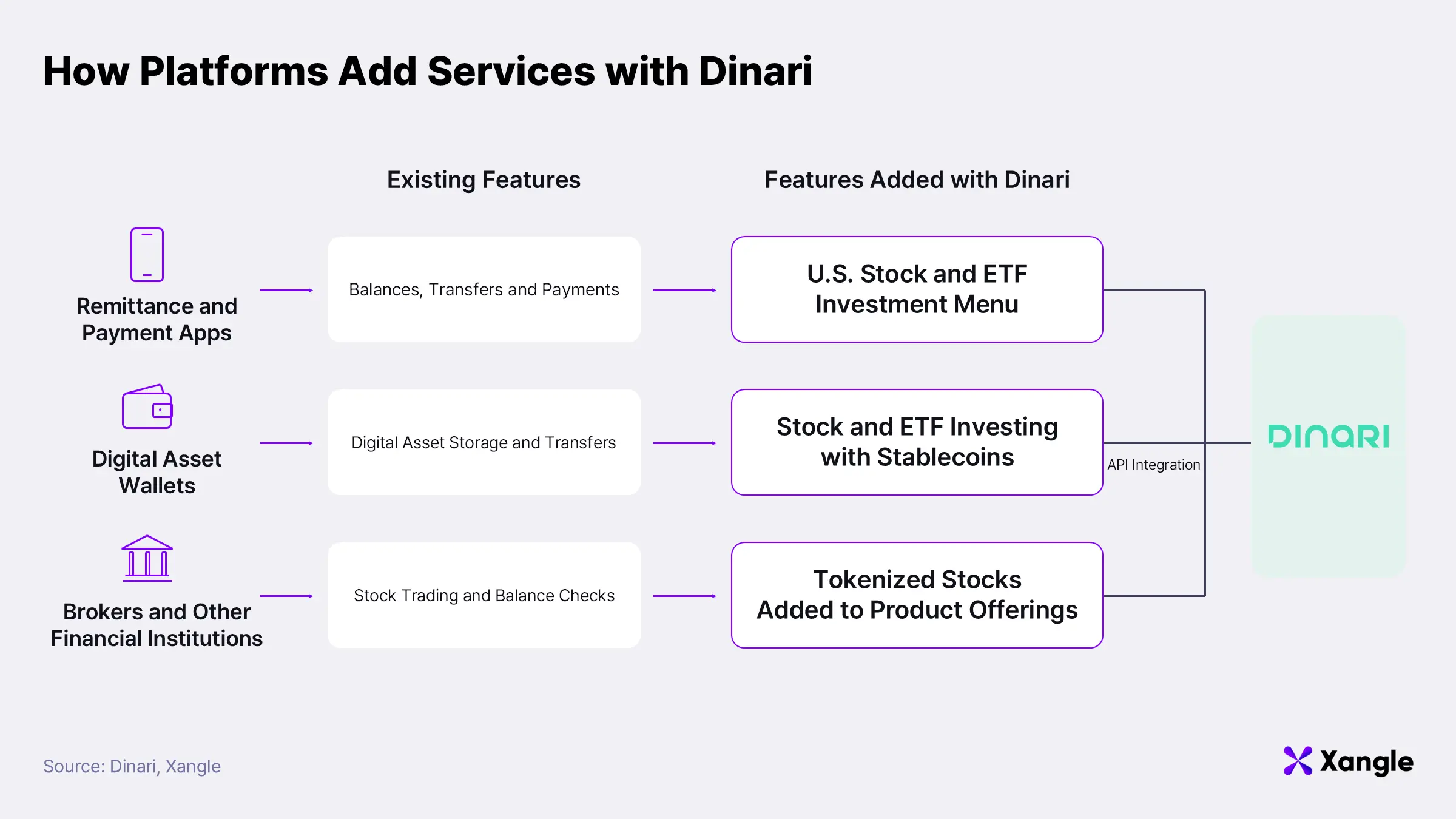
Remittance and payment apps can add a U.S. stock and ETF investment menu alongside balance checks, transfers, and payments. Users complete customer verification and account opening within the app, fund their account through a supported method, and buy their chosen securities. Purchase results and holdings appear in the app’s asset overview. Users can therefore invest through the app they already use for transfers and payments and view their existing balances alongside their investments.
Digital asset wallets can add stablecoin-funded stock and ETF investing to token storage and transfer functions. For example, a user selecting a U.S. ETF from a wallet’s investment menu completes the required customer verification and account opening, then funds the investment with a supported stablecoin. After purchase, the user can view the issued dShares and holdings in the connected wallet. Wallet providers can integrate these functions so users can move from digital asset management to stock investing without switching to a separate investment app.
Brokers and other financial institutions can add tokenized stocks to their product offering while retaining their existing customers and service interfaces. Offering tokenized stocks requires connecting conventional stock trading with token issuance and redemption, holding records, and dividend and corporate action processing. Dinari supports integration of these functions into existing services, reducing the burden of building and connecting each system separately.
Partners design investment menus and asset overview screens for their services, then use Dinari’s API to receive and display order records, holdings, dividends, and corporate action information. For API-integrated services serving U.S. customers, Dinari Securities is responsible for securities brokerage, while partners provide customer interfaces and transmit information. Available functions and funding methods may vary with customer location and product terms.
3. Dinari’s Core Services
3.1 dShares: Buying, Holding, and Redeeming Stocks and ETFs
dShares are tokens corresponding to individual U.S. stocks or ETFs and are offered in U.S. and non-U.S. versions. U.S. dShares connect a customer’s brokerage account with a dedicated wallet and serve as a secondary ledger, representing the shareholdings recorded in the brokerage account. Non-U.S. dShares are intended for eligible overseas users and support wallet-to-wallet transfers and use in external services, subject to product terms. They have four states based on wrapping and customer verification status. This section first examines the U.S. account structure and the basic purchase and holding process, then explains how non-U.S. dShares differ.
1) U.S. dShares: Connecting Brokerage Accounts and Dedicated Wallets
U.S. dShares are designed to meet the regulatory requirements for offering securities to U.S. investors. Existing securities-law obligations and investor protections continue to apply even when shares are represented as tokens. Dinari records customers’ holdings of underlying securities in brokerage accounts and reflects those records in tokens held in dedicated wallets as a secondary ledger. The rights represented by the tokens are tied to customers’ actual holdings of the underlying securities, placing this structure in the security entitlement category described above.
Customers complete identity verification, open individual brokerage accounts in their own names, and connect dedicated wallets. Dinari Securities manages accounts and provides brokerage services, while Alpaca Securities handles clearing, settlement, and custody of the underlying securities. U.S. dShares currently restrict transfers to other wallets, wrapping, and DeFi use. Trading and the exercise of rights take place through existing brokerage accounts and broker systems. Issuance, redemption, and corporate actions are handled as follows.
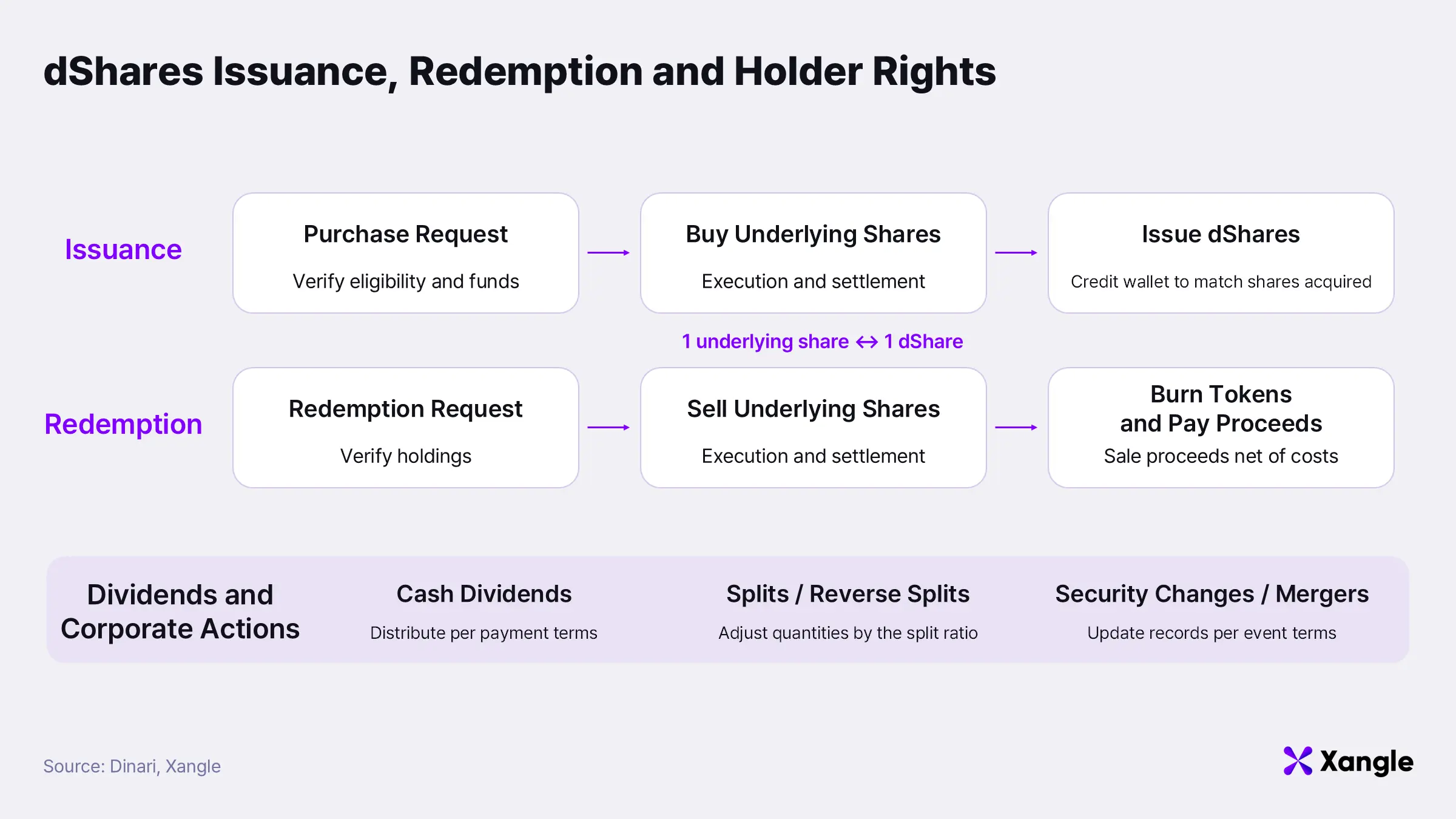
- Issuance: After a customer selects a security and specifies an amount or quantity, eligibility and funds are checked before the underlying stock order is processed. dShares are issued and reflected in the customer’s wallet in quantities corresponding to the shares secured through that trade. Securing one Apple share results in the issuance of the corresponding token; no tokens are issued for unfilled quantities.
- Redemption: When a customer requests redemption of dShares, the corresponding underlying shares are sold and the tokens are burned. The customer receives the proceeds based on the actual sale price, net of applicable costs. Order submission, execution, settlement, and the update to the balance available for withdrawal each follow their respective processing steps.
- Dividends and Corporate Actions: Cash dividends are distributed according to the applicable payment terms, while stock splits and reverse splits adjust holdings by the relevant ratio. For example, a 10-for-1 stock split increases the token quantity tenfold. Changes to the security and mergers are also processed according to the event terms, and partner apps receive the information to update balances and dividend records.
2) Rights by State for Non-U.S. dShares
Non-U.S. dShares can be used in external wallets and services, but the conditions for exercising dividend, redemption, and other rights depend on wrapping and customer verification status. Wrapping converts a token into a form usable by an external trading system or smart contract. Customer verification establishes whether the holder meets the requirements for exercising rights. These two criteria produce four states.
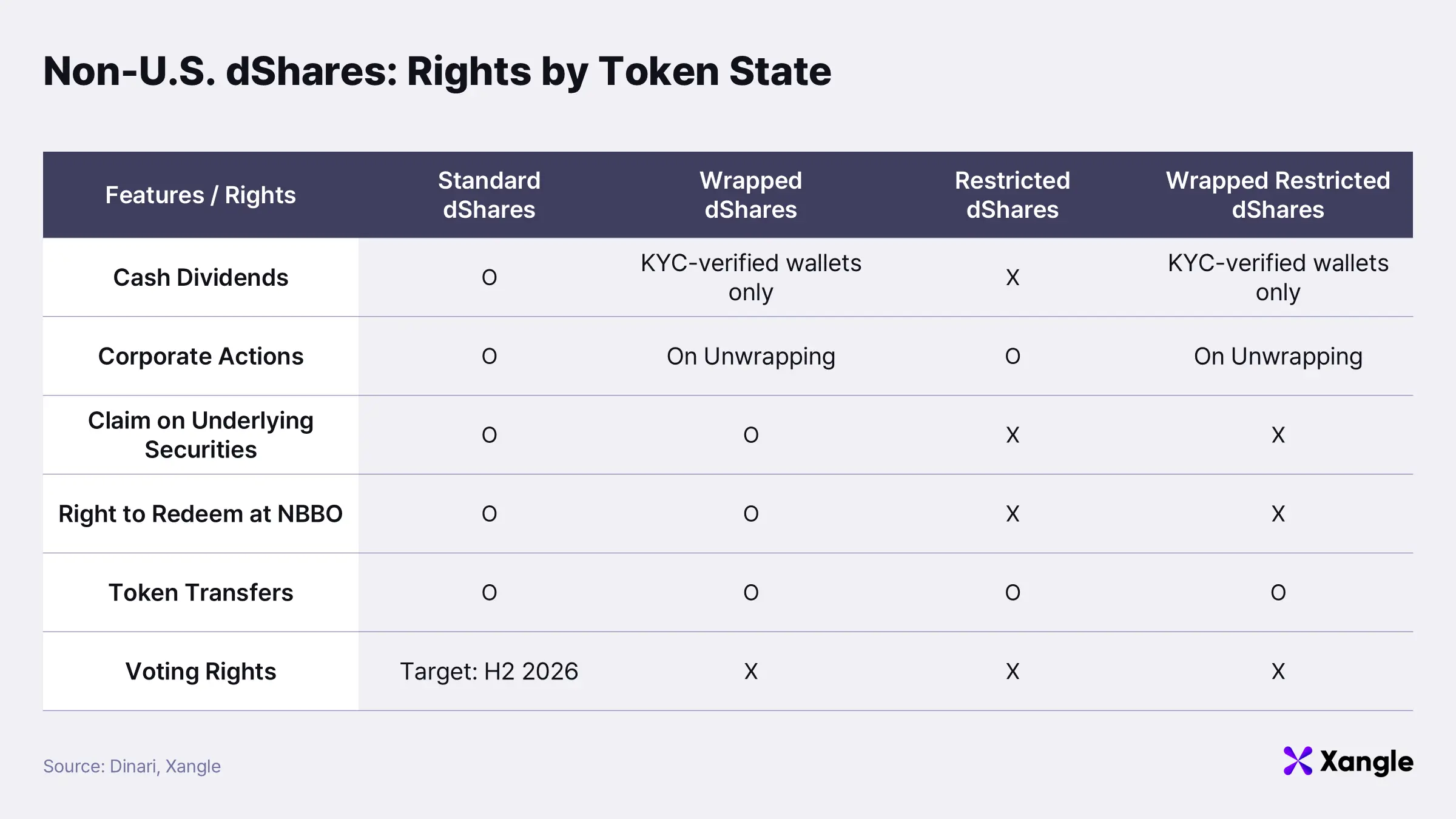
- Standard dShares: An eligible wallet that has completed customer verification holds unwrapped tokens. Cash dividends, claims to the underlying securities, and redemption at NBBO are available, and corporate actions such as stock splits are reflected in token quantities. NBBO, or National Best Bid and Offer, refers to the best bid and ask prices in the U.S. market.
- Wrapped dShares: An eligible wallet holds wrapped tokens. Cash dividends remain available, but unwrapping is required to reflect quantity changes from corporate actions or to make claims to the underlying securities and redeem tokens.
- Restricted dShares: Tokens are held by a wallet that has not met customer verification or other conditions for exercising rights. Token transfers and corporate action adjustments remain available, but cash dividends, claims to underlying securities, and redemption are restricted. Rights may be restored once customer verification and other required conditions are met.
- Wrapped Restricted dShares: Both rights restrictions and wrapping apply. Restoring dividend, claim, and redemption rights requires customer verification and any other applicable conditions to be met. Unwrapping is also required for corporate action adjustments, claims, and redemption.
Customer verification status determines eligibility to exercise rights, while wrapping determines the steps required for corporate action adjustments, claims, and redemption. However, restoration may be denied for tokens that have passed through blacklisted wallets or been involved in fraud. The dividends available and the procedures required for redemption therefore vary with the state in which dShares are held.
3.2 Enterprise API and Hosted Trading: From Accounts to Trading Interfaces
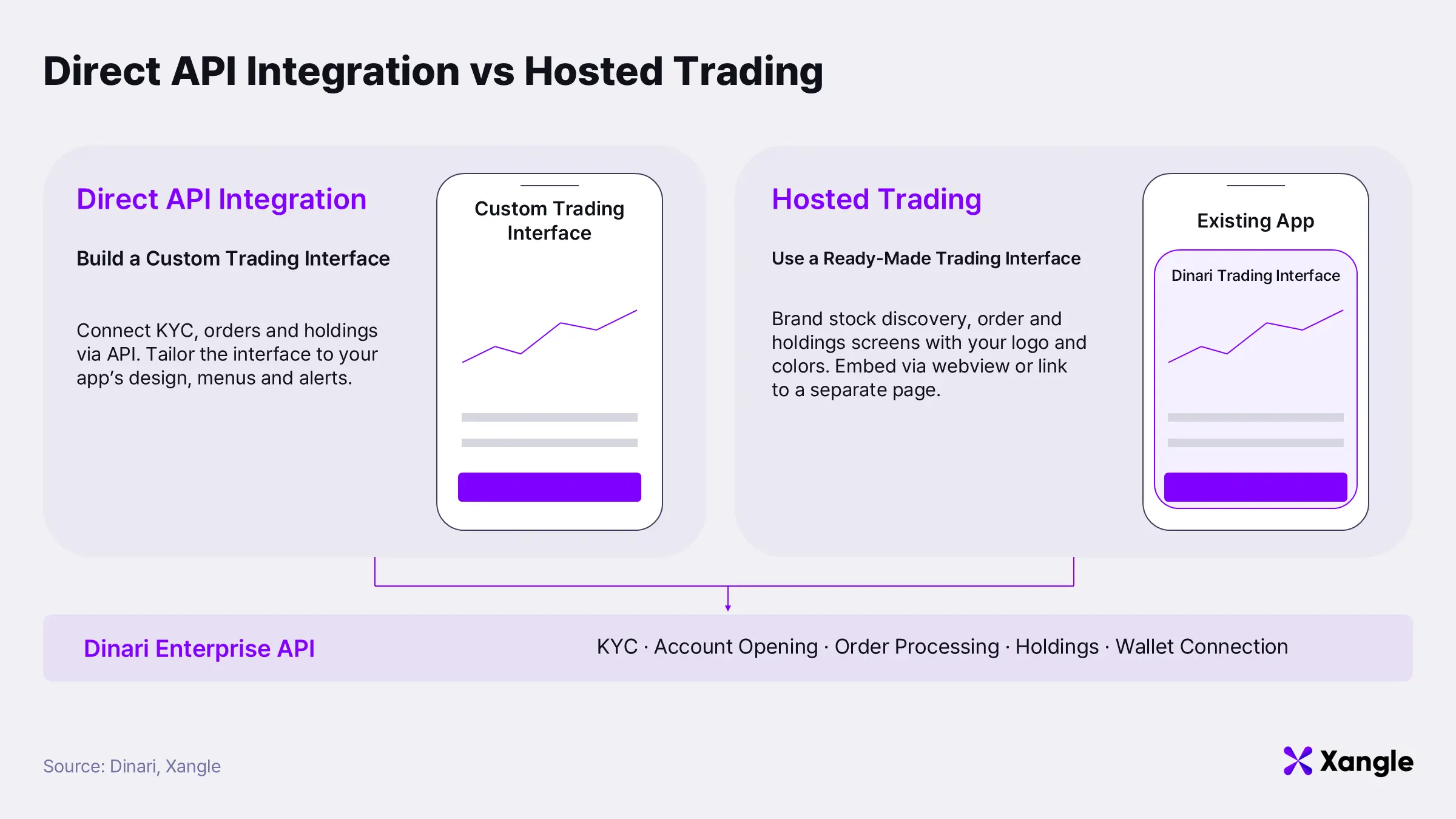
Dinari offers direct API integration and Hosted Trading for businesses introducing tokenized stock services. With direct API integration, businesses develop their own trading interfaces and connect the required functions. Hosted Trading uses trading interfaces provided by Dinari. Both approaches are built on the same Enterprise API.
Direct API integration suits businesses that want to design investment screens and user flows around their existing apps. Partners integrate customer verification, account opening, wallet connections, funding, and orders into their apps. They build trading screens using security lists, market prices, and bid and ask quotes, then display execution results and holdings after orders are placed. This allows investment features to match the existing app’s design, menus, and notification system.
Hosted Trading suits businesses that want to reduce interface development work by using ready-made trading screens. Partners can apply their own logos and colors to stock and ETF browsing, order entry, and holdings screens, then connect them through an in-app webview or a separate trading page. Dinari can host the interface, or partners can host it themselves. By connecting these ready-made screens to their existing services, businesses can add investment features without building order entry and portfolio screens from scratch.
3.3 Stablecoin Deposits and Withdrawals, and USD+
Dinari offers tools for funding stock investments with stablecoins, alongside USD+, which allows users to earn returns on dollar-denominated funds held before and after investing. Stablecoin deposits and withdrawals support transfers between wallets and brokerage accounts. USD+ is a token product that passes returns generated by reserve assets to holders.
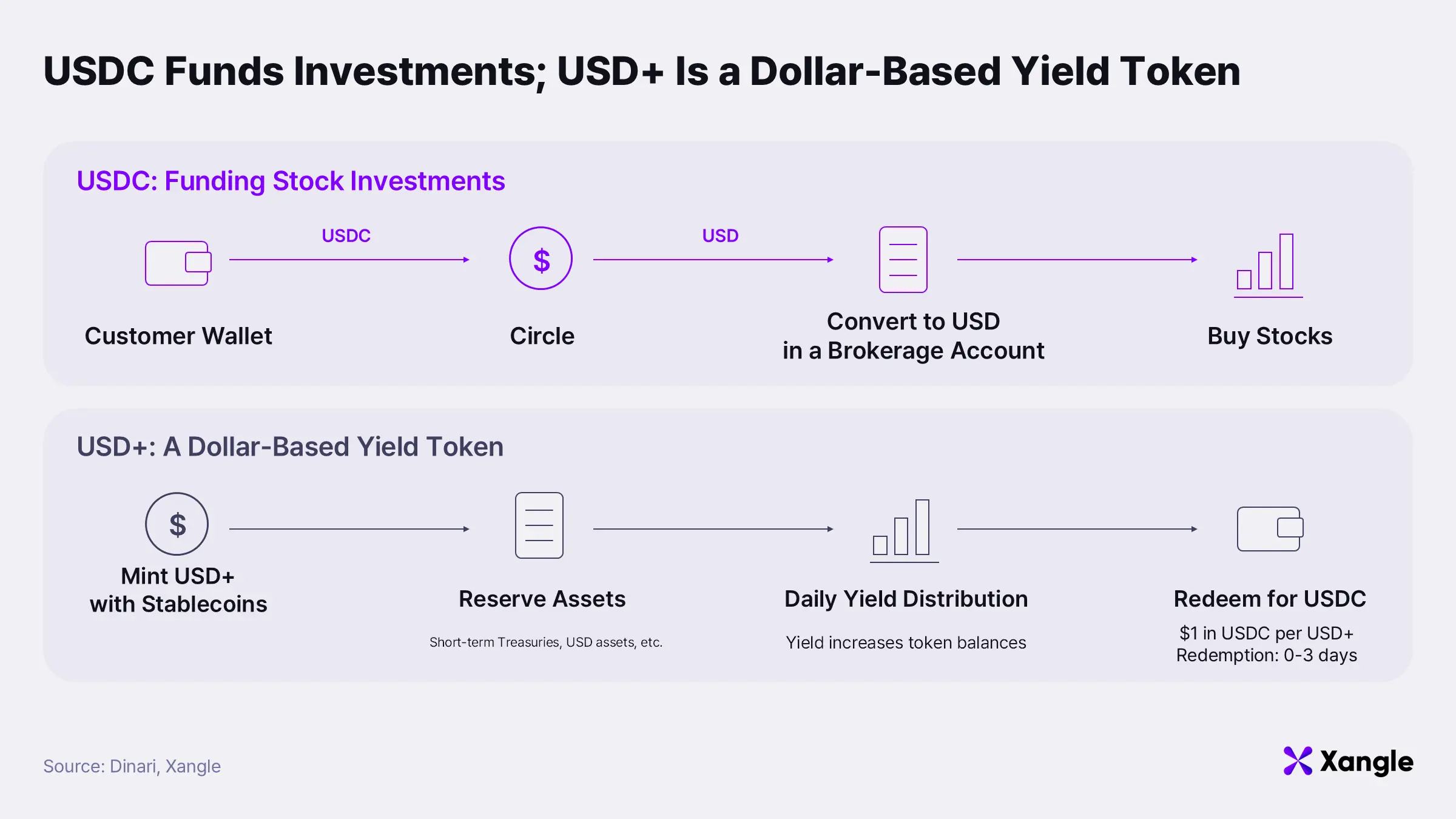
Stablecoin deposits and withdrawals allow users to invest funds held in their wallets in stocks. For U.S. accounts, USDC is converted through Circle into dollar funds in a brokerage account. Eligible investors can also opt to receive cash dividends in USDC. Within supported services, users can thus fund investments with stablecoins and reuse the funds they receive.
USD+ is a dollar-based yield-bearing token backed by reserve assets such as short-term U.S. Treasuries and dollar assets. Returns from the reserves are reflected through a daily rebase that increases holders’ token quantities. Returns appear in wallet balances without separate staking or reward claims, allowing users to put dollar-denominated funds to work while they wait to make their next investment.
USD+ issuance and redemption work as follows.
- Issuance: When an eligible user deposits a supported asset, such as USDC, into the issuance contract, new USD+ is issued for the corresponding dollar value. The deposited funds are used to build the reserve assets.
- Redemption: When a user requests redemption, the USD+ is burned and USDC worth $1 is paid for each USD+ redeemed. There is no mandatory holding period, but processing may take 0 to 3 days depending on the redemption size and reserve liquidity.
Businesses can introduce stablecoin deposits and withdrawals and USD+ according to their customers’ eligibility, integrating investment funding, withdrawals, and the management of idle funds between investments into their own services.
3.4 Extended Trading Hours and On-Chain Use
Platforms that integrate Dinari can offer trading 24 hours a day, seven days a week for supported non-U.S. products. Users can invest outside regular U.S. market hours and trade supported securities on weekends. This extends service hours for platforms serving customers across time zones or offering both digital assets and stocks.
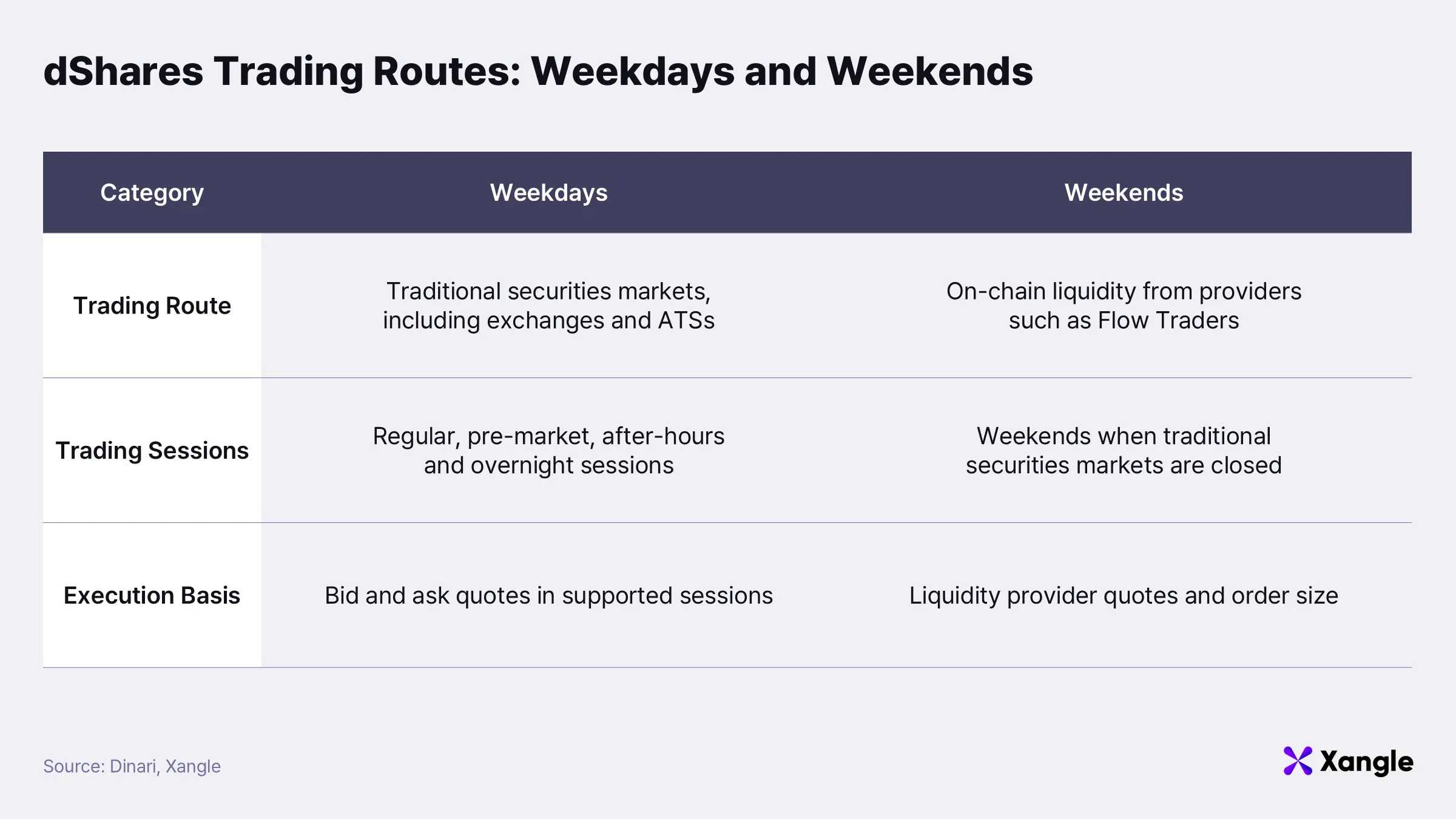
Extended trading hours are enabled by connecting traditional securities market trading channels with on-chain liquidity. On weekdays, trading uses regular, pre-market, after-hours, and overnight sessions. On weekends, when traditional markets are closed, the service connects to on-chain bid and ask quotes from liquidity providers such as Flow Traders. This provides counterparties for token purchases and sales outside U.S. exchange operating hours.
However, 24/7 trading does not guarantee execution at all times for every security and order. The range of supported securities and available liquidity are limited on weekends, and execution and pricing depend on order size and prevailing quotes. Outside regular market hours, market orders may be converted to limit orders or only partially filled. Holiday trading also depends on each security’s operating schedule.
Non-U.S. dShares can be connected to supported external wallets and on-chain trading services. Users can transfer tokens to another wallet or move them between supported chains through a bridge and use them in trading services on the destination network. Integration methods vary by service, and wrapping may be required for use in external smart contracts or trading systems.
One example is the Hyperliquid integration. dShares for supported securities are wrapped and bridged to HyperCore for trading. Users can also access tokenized stocks through partner services that support dShares, including RWAX Exchange. Supported securities, chains, and trading methods vary across services.
Even when tokens are used in external services, dividend, claim, and redemption conditions depend on the token’s state. Eligible wallets that have completed customer verification can receive cash dividends while holding wrapped tokens, but claims to the underlying securities and redemption require unwrapping. Wallets that have not met customer verification or other eligibility conditions may have these rights restricted. Separate transfer and wrapping restrictions apply to U.S. dShares.
4. Expanding Use Through Partners and Products
4.1 Adoption by Financial Apps and Platforms
Dinari’s adopters range from exchanges to payroll services and financial apps. Each platform uses dShares to add U.S. stock investing while retaining its existing customers and service interface.
- Cadana: A global payroll and payments provider. Cadana integrated Dinari to add U.S. stock investing, allowing customers who receive their salaries through the service to access investments in the same place.
- Offramp: A financial platform for receiving, holding, and spending funds. Offramp uses Dinari’s dShares to offer U.S. stock investing, letting users view their investments in the account they already use to manage their money.
- Liminal: A financial platform offering multicurrency money management and investing through an AI interface. Liminal integrated Dinari to provide access to U.S. stocks and ETFs through a conversational interface, adding investment features to its existing money management service.
- RWAX Exchange: A trading platform for real-world asset tokens. RWAX Exchange integrated Dinari’s dShares to add tokenized U.S. stocks and ETFs to its existing offerings, including commodities and stablecoins. Users can invest in a range of real-world asset tokens and U.S. securities on one platform.
These adopters illustrate how the purpose of tokenized stock integration varies with a platform’s existing services. Cadana and Offramp connect investing to the receipt of salaries and other funds, while Liminal adds investment features to a conversational money management interface. RWAX Exchange broadens investment choices by adding U.S. stocks and ETFs to its existing real-world asset token offering.
4.2 Expansion Through SPDM and the Dinari Financial Network
Dinari is expanding from tokenizing individual stocks to creating tokens that represent investment products combining multiple assets. SPDM is one example: an index token product that combines equities and crypto assets. Its underlying benchmark, the S&P Digital Markets 50 Index, comprises 35 U.S. companies associated with the digital asset ecosystem and 15 crypto assets. Dinari has presented a product structure that uses dShares for the equity component and combines them with crypto assets.
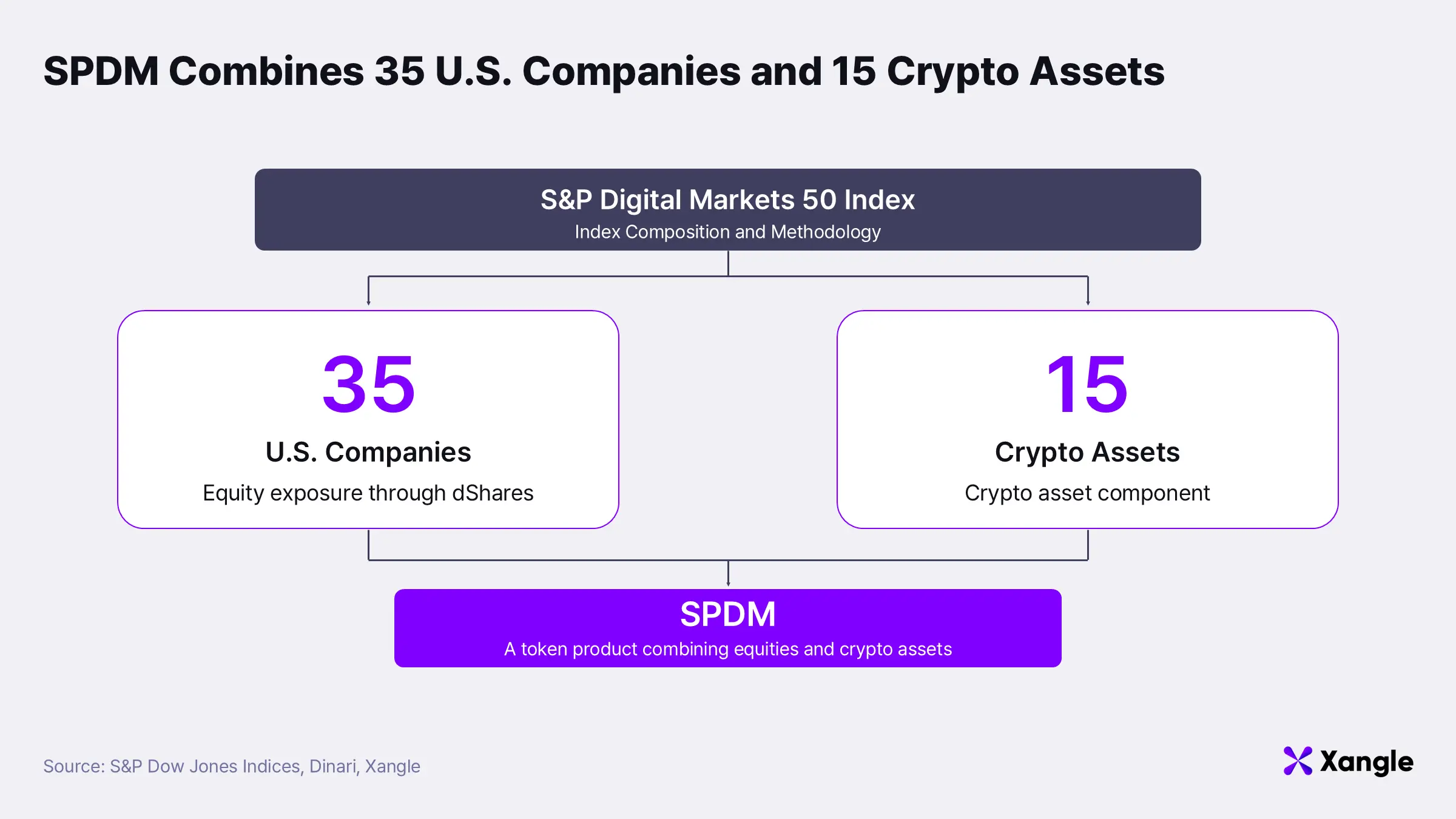
In this structure, S&P Dow Jones Indices is responsible for index composition and methodology, while Dinari implements the index as a token product. This enables asset managers and investment platforms to construct products combining equities and crypto assets, extending beyond integrations for individual stocks.
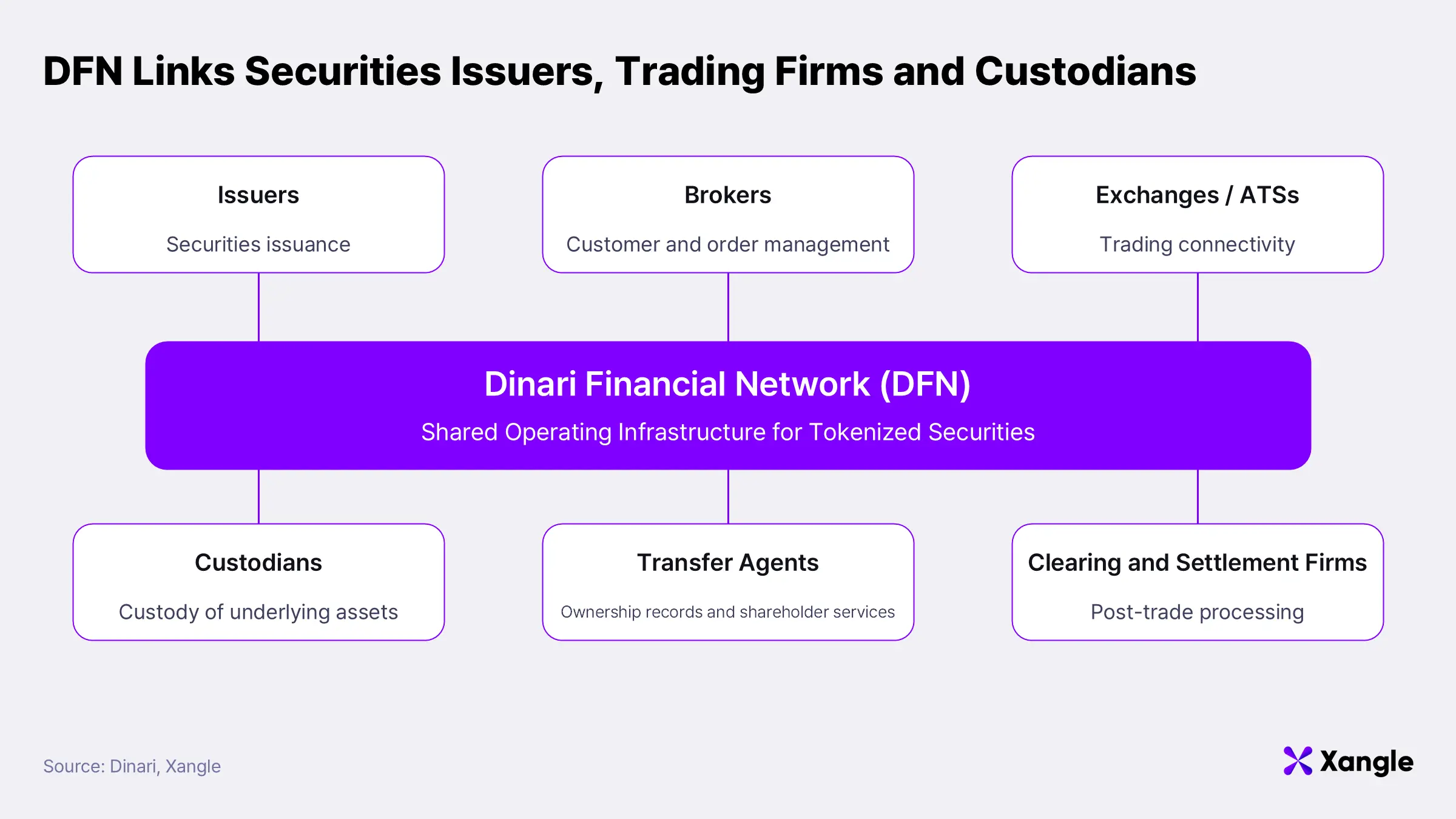
Alongside expanding its product range through SPDM, Dinari is pursuing a framework for connecting operations across institutions. The Dinari Financial Network (DFN) is an institutional operating framework intended to connect brokers, exchanges, issuers, custodians, transfer agents, and other participants. It aims to link issuance, trading, settlement, and holdings management through a common approach, allowing each institution to handle tokenized securities while maintaining its own customer relationships and supervisory framework. Transfer agents maintain securities ownership records and handle related functions.
The partnership with tZERO announced in July 2026 gives concrete form to these institutional connections. tZERO provides digital securities infrastructure supporting issuance, trading, and custody. The two companies plan to combine Dinari’s dShares technology with tZERO’s securities operations to build a framework through which other brokers can offer tokenized U.S. stocks. The scope of cooperation includes round-the-clock trading on supported exchanges, fractional orders, shareholder services, and future permissioned on-chain finance.
Dinari’s existing API and corporate action processing support stock services for individual partners. DFN is intended to extend these functions into an operating framework shared by multiple institutions. DFN-level incentives and some financial functions have yet to be introduced. If institutions begin to transact and manage assets regularly within this framework, Dinari could expand its role from providing access to stocks through to post-trade operations.
5. Closing Remarks: Lowering the Barriers to Tokenized Stock Adoption
Financial institutions introducing tokenized stocks need to connect trading and custody of the underlying securities with token issuance, redemption, dividends, and corporate action processing. Dinari provides the functions needed for these operations together, reducing the burden of building and integrating each system separately. Financial apps, wallets, and institutions can add tokenized stock investing to existing services by connecting APIs or using ready-made trading interfaces.
Partners are adapting these functions to their own services. Cadana and Offramp connect investing with payroll and money management, while Liminal adds investment features to a conversational financial interface. RWAX Exchange adds U.S. stocks and ETFs to its existing real-world asset token offering. Businesses can use the operating functions that connect securities and tokens while focusing on the investment menus and user flows their customers need. Stablecoin funding and extended trading hours can also be included for supported products, with the scope of the service determined by customer location and each product’s rights and eligibility conditions.
Dinari is also expanding its scope through SPDM’s multi-asset product structure and DFN’s connections between institutions. This direction extends beyond adding stock investing to individual platforms, aiming to connect multiple financial institutions in product construction, trading, and holdings management. The key question is whether these connections lead to actual service launches and sustained customer use. Reliable support for trading and the exercise of rights after adoption could further enable financial institutions to offer tokenized stocks.
Dinari plans to participate in the CIS Seoul Partner Summit, where Korean financial institutions and global infrastructure providers will discuss the development of digital financial services and opportunities for cooperation. This closed-door forum brings together executives from leading companies pursuing real-world asset (RWA) businesses and infrastructure providers. Participants can discuss concrete collaboration opportunities directly with Dinari, including tokenized stock products and adoption models suited to their customers, the scope of integration with existing systems, and the division of responsibilities among institutions.
Disclaimer
I confirm that I have read and understood the following: The information contained in this article is strictly the opinions of the author(s). This article was authored free from any form of coercion or undue influence. The content represents the author's own views and does not represent the official position or opinions of CrossAngle. This article is intended for informational purposes only and should not be construed as investment advice or solicitation. Unless otherwise specified, all users are solely responsible and liable for their own decisions about investments, investment strategies, or the use of products or services. Investment decisions should be made based on the user’s personal investment objectives, circumstances, and financial situation. Please consult a professional financial advisor for more information and guidance. Past returns or projections do not guarantee future results. This article was written at the request of Dinari. All content in this article was written independently by the author(s), and neither CrossAngle nor Dinari had any editorial control or influence over the content. The author(s) may hold the cryptocurrencies mentioned in this article at the time of writing.
Xangle or its affiliated partners own all copyrights of the written or otherwise produced materials and content provided on the platform. Any illegal reproduction of such content, including, but not limited to, unauthorized editing, copying, reprinting, or redistribution will result in immediate legal actions without prior notice.
![[CIS Seoul Partner Summit] Anchorage Digital: A Starting Point for Institutional Digital Assets](https://resource.xangle.io/files/content/0659D651970125CC9D95F3066EACD686_1790818652341.webp)
![[Xangle RWA Series] On/Off-Ramps](https://resource.xangle.io/files/content/BCFC2BA6D6526E381F40ECAB4905CA4C_1787034686767.webp)