
[CIS Seoul Partner Summit] Anchorage Digital: A Starting Point for Institutional Digital Assets


Table of Contents
1. Why Institutions Need Custody Infrastructure for Digital Asset Businesses
2. Anchorage Digital: An Institutional Custody Platform Built on Regulation, Security and Asset Use
3. Anchorage Digital's Core Services and Institutional Use Cases
4. Closing Remarks: Custody Infrastructure for Institutional Digital Asset Businesses
1. Why Institutions Need Custody Infrastructure for Digital Asset Businesses
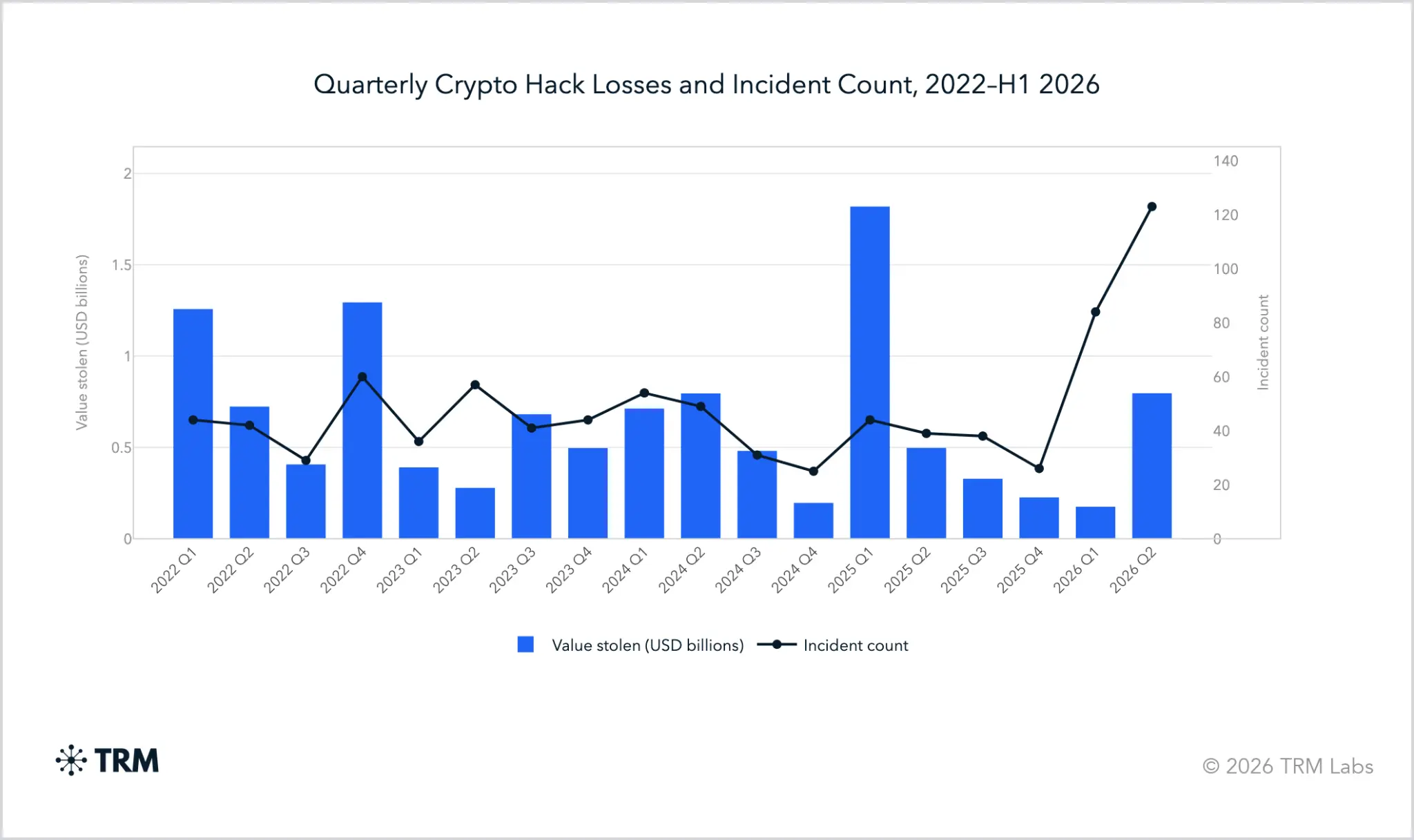
The first challenge for institutions entering the digital asset business is keeping assets safe. According to research by blockchain analytics firm TRM Labs, 207 hacks resulted in approximately $972 million in stolen crypto assets in the first half of 2026. Losses fell from a year earlier, but the number of incidents rose from 83 to 207. Attacks targeting asset control systems, access credentials and signing infrastructure accounted for about 76% of total losses. This highlights the importance of operational controls over transaction approval and asset transfers, alongside secure private key storage. For institutions managing large volumes of client and corporate assets, a security incident can lead to service disruptions and loss of trust as well as financial losses.
Managing these risks requires both technology to generate, store and recover private keys securely and an operational framework that determines who can approve transactions and transfer assets. Institutions must also segregate client assets, maintain audit records and meet the regulatory requirements that apply to their services and operating jurisdictions. Building and maintaining these capabilities internally is demanding. It requires security technology, compliance and operations staff, and ongoing adaptation to changes in the business and regulatory environment.
Specialist custody services reduce this burden by taking responsibility for asset safekeeping and control. Institutions can use a custodian's security framework, transaction approval procedures and reporting capabilities to establish an asset management environment suited to their business. This reduces the time and cost of building custody infrastructure from scratch and allows them to focus on customer services and business operations.
Once assets can be held securely, the next question is how to use them. Institutions may trade assets in custody and settle the proceeds, earn staking rewards, or pledge assets as collateral to access liquidity. These activities still require oversight of asset transfers, transaction approvals and collateral status, extending the custodian's role into asset use. By connecting asset protection controls with trading, settlement and investment processes, custodians help institutions apply consistent standards across custody and use.
Anchorage Digital is a custody provider serving these institutional needs. This report examines how Anchorage Digital connects trading, settlement and asset use with its regulatory and security foundations. Its services and client use cases illustrate the practical role of institutional custody in digital asset businesses.
2. Anchorage Digital: An Institutional Custody Platform Built on Regulation, Security and Asset Use
Founded in 2017, Anchorage Digital provides financial infrastructure for institutional digital assets. Its clients include asset managers, funds, corporations and digital asset businesses. Its services span custody and self-custody wallets, trading and settlement, staking and collateral management, token launch and management, and stablecoin issuance. In 2021, Anchorage Digital Bank, N.A. received a federal trust bank charter from the U.S. Office of the Comptroller of the Currency (OCC) and began providing institutional custody services under federal banking supervision.
Anchorage Digital combines regulatory foundations established through local authorizations with a security framework developed through years of custody operations. It also connects custody with the functions institutions need to trade, settle and use their assets. This section examines the legal authorizations and security controls that support Anchorage Digital’s custody business, and how they enable an integrated process from safekeeping to asset use.
2.1 The Regulatory Foundation for Institutional Custody
The authorizations required for digital asset custody and trading vary by jurisdiction. Institutions therefore need to assess both a provider's custody capabilities and its legal authorization and supervisory framework for offering the services they intend to use in each market. Anchorage Digital addresses these local requirements through its federally chartered U.S. bank and licensed entities in New York and Singapore, which provide institutional clients with custody, trading and other digital asset services.
- U.S. federal charter (Anchorage Digital Bank, N.A.): In January 2021, the OCC conditionally approved its conversion to a federal trust bank. The entity provides institutional custody and related services subject to capital, liquidity and risk management requirements.
- New York (Anchorage Digital NY, LLC): The entity obtained a BitLicense from the New York State Department of Financial Services (NYDFS) in December 2024. It provides digital asset trading services to institutions in New York and connects these services with the bank entity's custody and settlement capabilities.
- Singapore (Anchorage Digital Singapore Pte. Ltd.): Following in-principle approval in August 2024, the entity announced in November that it had obtained a Major Payment Institution (MPI) license from the Monetary Authority of Singapore (MAS). It provides global institutional clients with custody, staking, trading, settlement and fiat on- and off-ramp services.
The U.S. federal charter is particularly significant. In January 2021, Anchorage Digital Bank became the first federally chartered digital asset bank in the United States. Other major digital asset companies received subsequent conditional approvals for federal trust bank charters from the OCC in December 2025, nearly five years later. Anchorage Digital has been able to build experience in custody operations and internal controls under federal supervision since that earlier date. Its Singapore MPI license also enables it to extend custody, trading and settlement services to institutional clients outside the United States.
2.2 A Security Framework for Institutional Assets
Drawing on its experience operating custody services, Anchorage Digital has developed both technology to protect private keys and approval and operational procedures to govern asset transfers. Protecting institutional assets requires defenses against key theft, misuse of authority, commingling of client assets and operational errors.
These functions provide a useful way to examine Anchorage Digital's security framework across four areas: key protection, transaction approval, client asset segregation and internal controls.
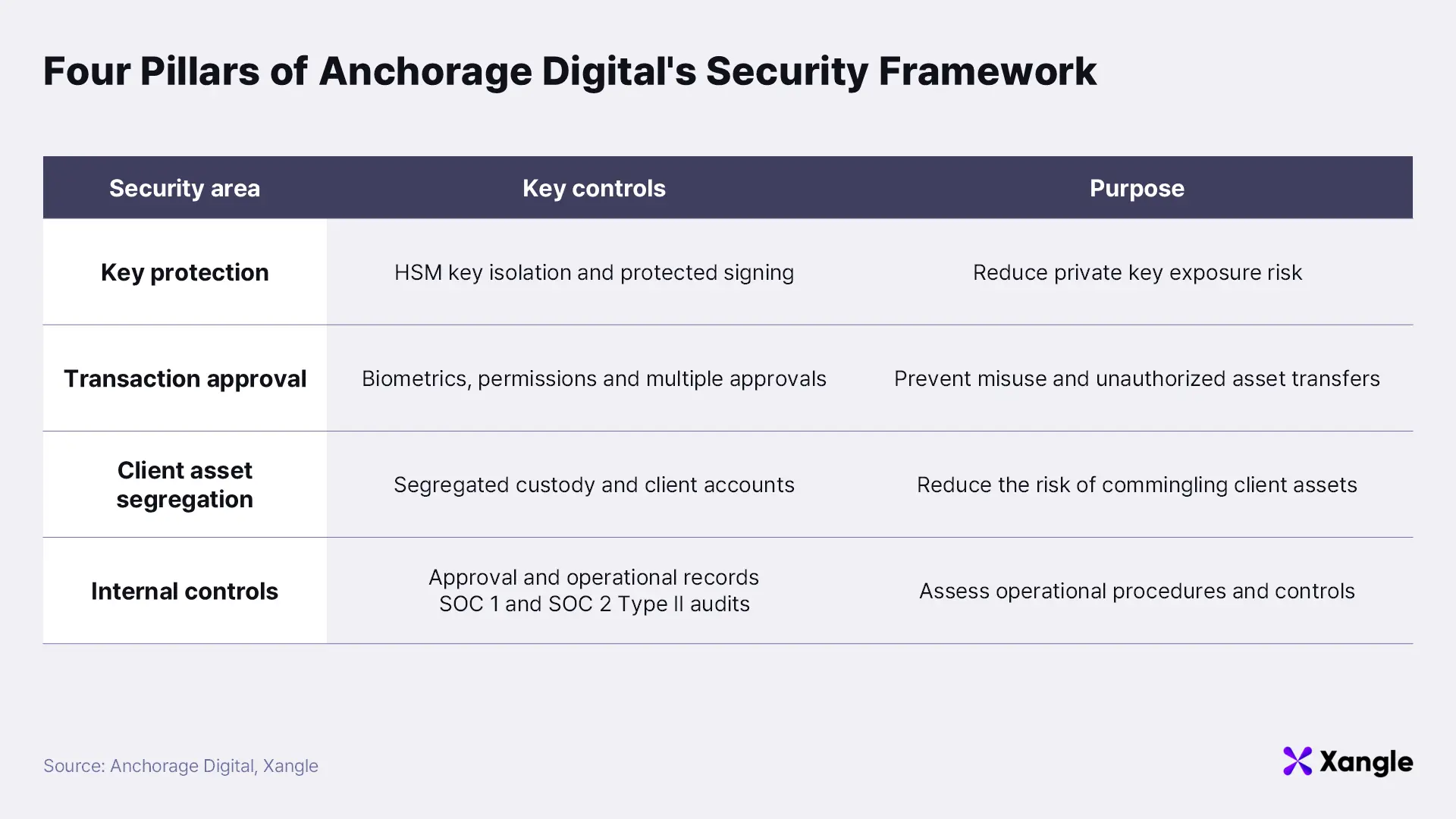
- Key protection: Anchorage Digital uses hardware security modules (HSMs), dedicated devices that protect private keys and signing operations. HSMs separate the environment in which staff process transactions from the environment in which private keys are stored, reducing the risk of exposing keys externally.
- Transaction approval: Biometric authentication and organization-specific approval policies govern who can request and authorize asset transfers. Institutions can configure user permissions and permitted destinations, and require a specified number of approvers to authorize a transaction before execution.
- Client asset segregation: Assets in custody are held separately for each client, with holdings and transfers managed at the account level. Institutions can track where assets are held and how they have moved, including their status when used for staking or as collateral.
- Internal controls: Transaction approval records, personnel changes, incident response and recovery procedures help maintain controls in both routine operations and exceptional situations. Institutions can review the SOC 1 and SOC 2 Type II audit reports disclosed by the company to assess whether these controls are appropriately designed and operated.
These security measures work together when assets move. Transaction requests pass through the organization's approval process before being signed with protected keys, and the results are reflected in client accounts and audit records. Permission changes and recovery procedures support continuity when personnel change or access is disrupted. Anchorage Digital manages how assets are held and transferred through these processes, extending the same controls to trading, settlement and asset use.
2.3 Connecting Custody, Trading and Settlement
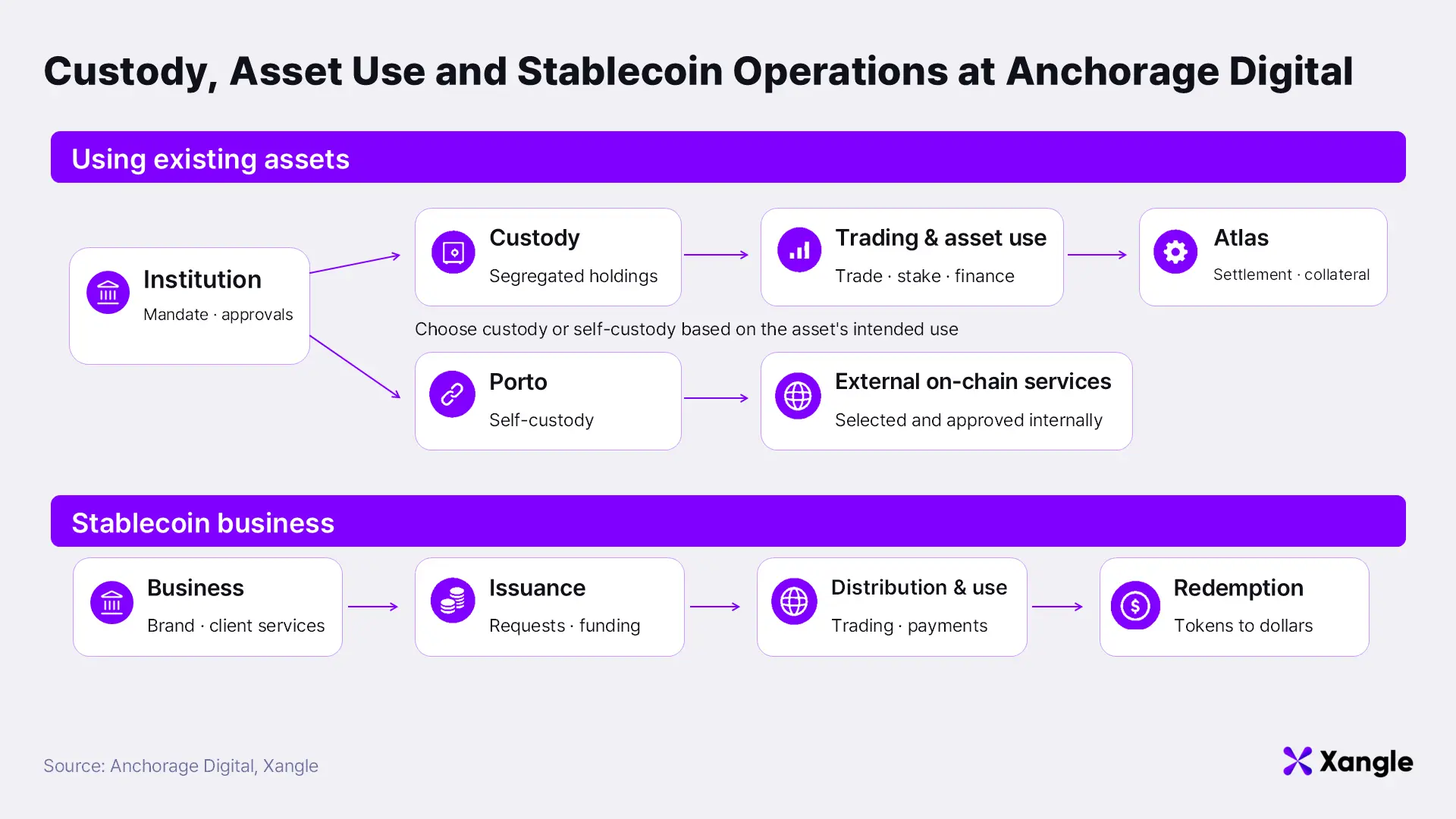
How an institution uses Anchorage Digital depends on why it holds assets and how it intends to use them. It can entrust assets to Anchorage Digital and access trading and asset-use services, or retain direct control while accessing external on-chain services. Companies introducing their own stablecoins into their businesses can also use Anchorage Digital Bank’s infrastructure across issuance and redemption.
Institutions entrusting assets to Anchorage Digital hold them in Custody and use those assets for trading, staking and financing. They may trade holdings, stake them to earn rewards, or pledge them as collateral to obtain liquidity. Atlas, a network for institutional asset transfers and trade settlement, supports the movement of assets and funds arising from trades as well as collateral status management.
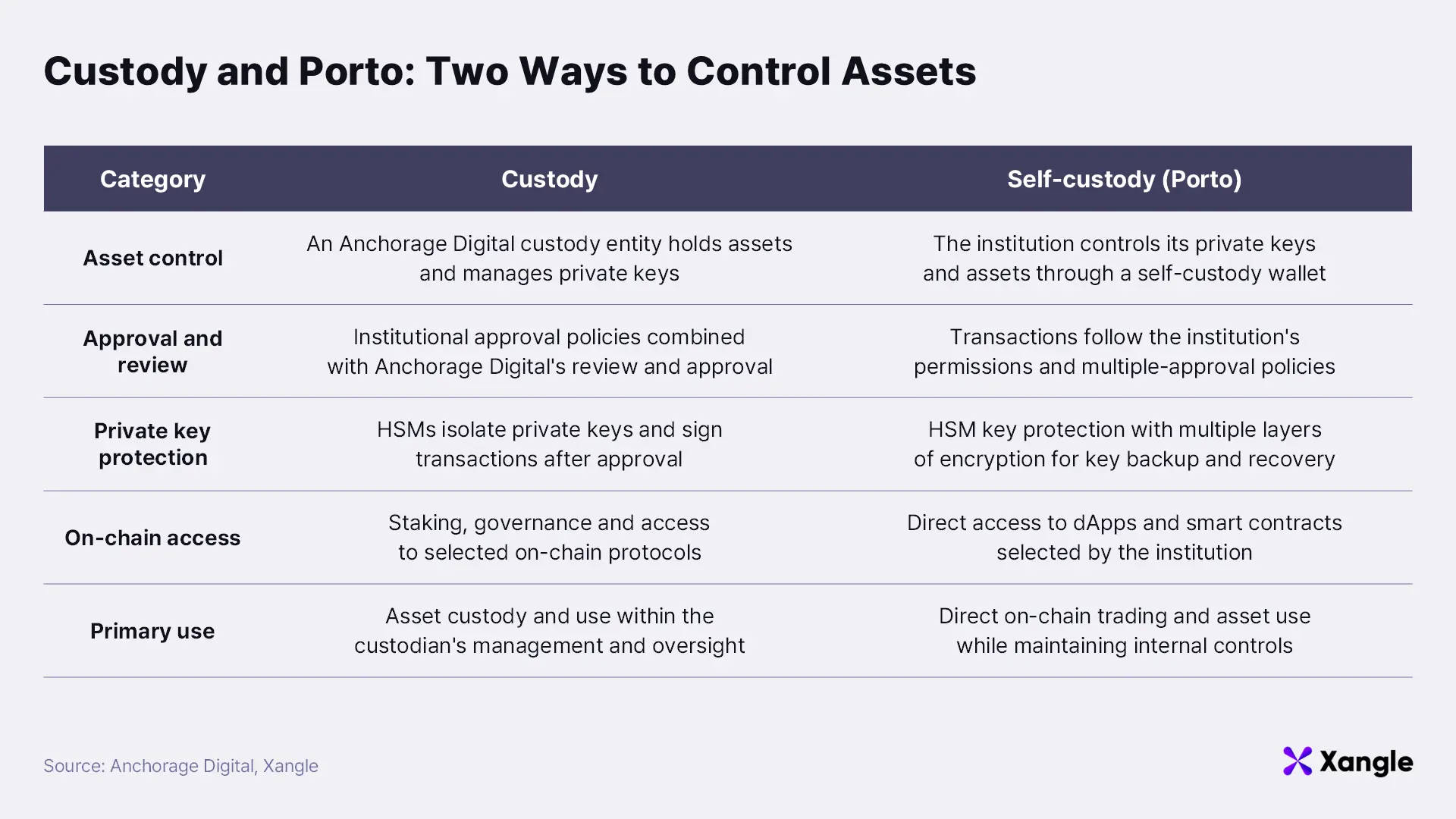
Institutions seeking direct control of assets while using external on-chain services can use Porto, Anchorage Digital's self-custody wallet. Porto supports organization-level asset management by allowing institutions to configure user permissions, transfer destinations and approvals from multiple staff members. These internal approvals can help institutions access external applications and smart contracts more securely. Custody and Porto provide third-party custody and self-custody, respectively, allowing institutions to use each approach according to an asset's purpose and the level of control required.
Companies developing stablecoin businesses combine Anchorage Digital Bank's issuance infrastructure with their own brands and customer services. Anchorage Digital Bank supports issuance requests and funding processes, while the company introduces the stablecoin into its services and distributes it for customer trading or payments. Redemption requests then trigger the process of converting tokens back into dollars. Anchorage Digital Bank handles issuance, redemption and reserve management, and the company connects these capabilities with customer-facing payment and remittance services.
3. Anchorage Digital's Core Services and Institutional Use Cases
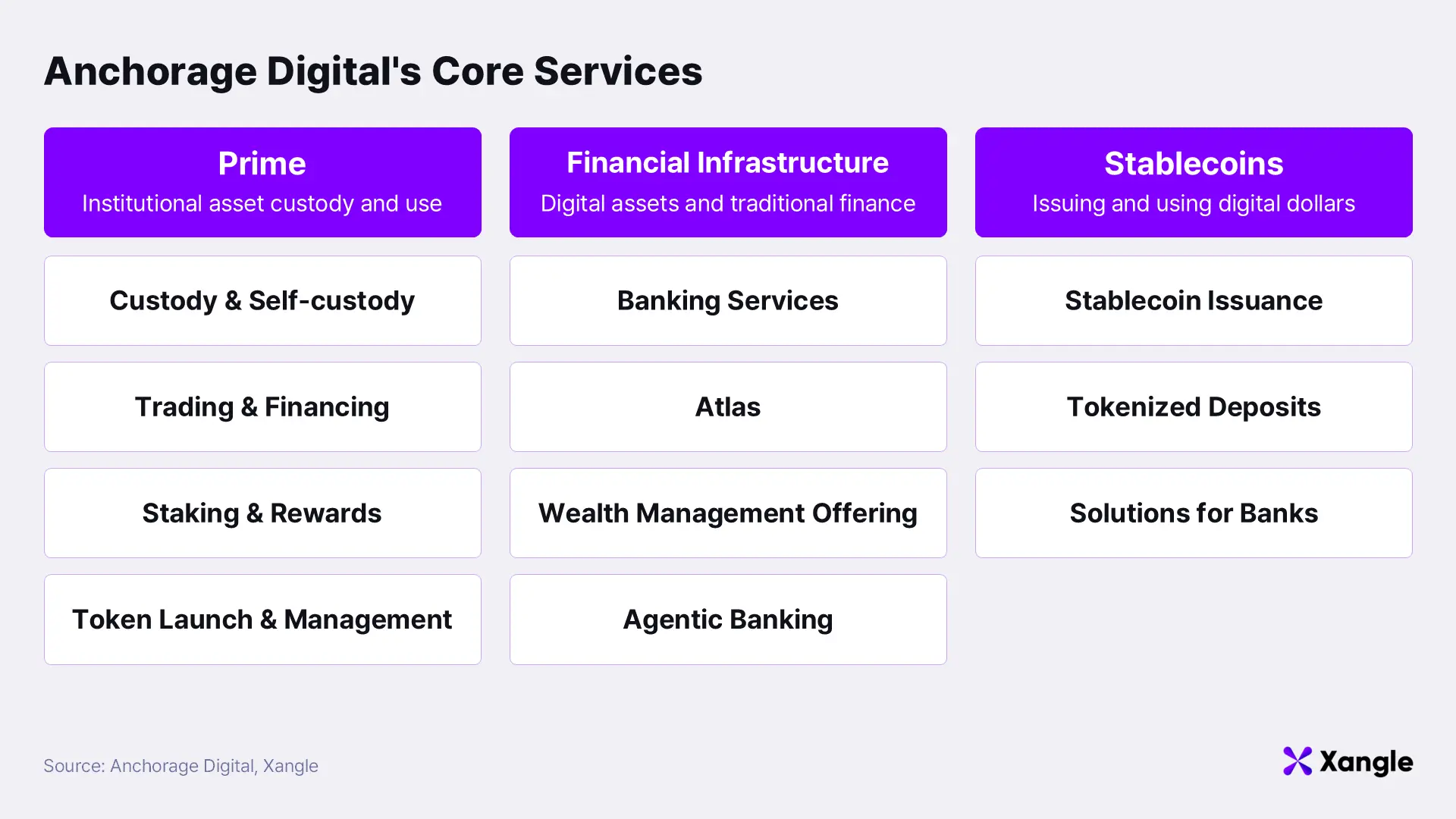
The previous section examined Anchorage Digital's regulatory and security foundations and the operating structure that connects custody with asset use. This section looks more closely at the individual services and how institutions use them. Anchorage Digital organizes its services into three areas: Prime, Financial Infrastructure and Stablecoins. Prime supports institutional asset custody, trading and financing activities.
Financial Infrastructure connects fiat finance with digital assets, while Stablecoins supports stablecoin issuance and banks' on-chain payments and settlement. Institutions can select the functions needed to manage their own assets or incorporate them into financial services for clients.
3.1 Prime: Custody and Use of Institutional Assets
Prime brings together the capabilities institutions need to hold and use digital assets: custody and self-custody, trading and financing, staking and rewards, and token launch and management. Asset managers can combine functions for trading and staking their holdings, while token projects can use them to safeguard treasury assets and manage token distributions.
- Custody: This core service holds and manages assets on behalf of clients. Through entities including Anchorage Digital Bank, which is subject to U.S. federal banking supervision, Anchorage Digital applies client asset segregation, HSM key protection and organization-specific approval procedures. Institutions can access trading, settlement, staking and governance voting within this custody environment, while managing dollars and digital assets within the same offering.
- Self-custody: Institutions retain direct control of their assets through Porto, Anchorage Digital's institutional wallet. Porto combines HSM key protection, user permissions and multiple-approval policies to prevent authority from becoming concentrated in one person. Institutions can use external applications and smart contracts within this approval framework and review transaction simulations before signing. Recovery procedures also address device loss and personnel changes.
- Trading and financing: These services support digital asset trading, price risk management and trade financing. Institutions can split large orders into smaller executions using algorithms or use options and other instruments to protect against declines in the value of their holdings.
Anchorage Digital connects custody with trading and Atlas settlement, reducing the need to move assets between multiple wallets or exchanges for each trade. Margin financing also allows institutions to borrow against their holdings to fund additional trades without selling existing assets.
- Token launch and management: These services support token launches and distributions to team members and investors. Ahead of a token generation event (TGE), Anchorage Digital assists with custody readiness, liquidity strategy and identifying potential market makers. After launch, it manages recipient allocations, distribution schedules, lockups and vesting terms. Tokens can also be distributed to recipients without Anchorage Digital accounts.
3.2 Financial Infrastructure: Connecting Digital Assets and Traditional Finance
Through Anchorage Digital Bank, a federal trust bank, Anchorage Digital provides digital asset custody alongside dollar safekeeping, payments and transfers. Financial Infrastructure connects these banking capabilities with trade settlement, collateral management and client wealth management, helping institutions manage digital assets and dollar funds together. It also includes agentic banking, which governs AI agents' authority to use funds.
- Banking services: Anchorage Digital offers interest-bearing dollar accounts, domestic U.S. payments and international SWIFT transfers alongside digital asset custody and settlement. Institutions can manage deposits for asset purchases, proceeds from sales and operating expense payments within one offering. Virtual accounts with unique deposit identifiers help distinguish cash flows and make deposit and withdrawal records available for accounting and reconciliation.
- Atlas settlement network: Atlas processes institutional asset transfers and trade settlement within Anchorage Digital's custody environment. When institutions trade bitcoin, for example, it arranges for the bitcoin and dollar payment to move together under the agreed terms. This atomic settlement model reduces the risk of one party transferring assets without receiving payment, and settlement within the network is available around the clock. Atlas also supports collateral management, allowing assets in custody to be pledged or released as borrowing collateral and reallocated where needed.
- Wealth management offering: This service helps investment advisers and wealth managers add digital assets to client portfolios and manage those positions. It connects client onboarding and cash or digital asset deposits with custody, trading, portfolio rebalancing, fee billing and reporting. Providers can add digital assets to existing wealth management services while reducing the burden of integrating separate systems for each task.
- Agentic banking: This banking service enables AI agents to manage funds and make payments and transfers on a company's behalf. Companies can define permitted counterparties and spending limits in advance, and remotely stop an agent when necessary. Agents make payments through stablecoin and fiat payment networks, while recorded actions and transactions allow companies to review whether funds were used for the intended purposes and within authorized limits. The service is currently in beta.
3.3 Stablecoins: Issuing and Using Digital Dollars
Institutions offering on-chain financial services to customers need capabilities to issue, distribute and redeem digital money alongside those used to manage their own holdings. Stablecoins supports corporate stablecoin launches and operations, bank deposit tokenization, and interbank transfers and settlement using stablecoins. Companies and banks can use Anchorage Digital's issuance and management infrastructure while retaining their brands and customer relationships.
- Stablecoin issuance: Anchorage Digital Bank acts as the issuer, while the client company contributes its brand, distribution network and payment or remittance services. Tether's USA₮ and Western Union's USDPT use this model. Anchorage Digital Bank connects reserve management, token minting and burning, smart contracts and access controls with corporate systems through APIs. Tokens are issued against dollar deposits, then burned at redemption when dollars are returned. Anchorage Digital Bank also provides monthly reserve attestation reports and a network of exchanges and financial institutions for distribution.
- Tokenized deposits: Bank deposits are represented as tokens on a blockchain for use in payments and settlement. Anchorage Digital Bank helps banks maintain a one-to-one link between deposits and tokens while keeping their existing systems and deposit ledgers. Banks can process token issuance, burning and transfers, as well as payments triggered by predefined conditions. Technology supporting multiple currencies and both public and private blockchains can reduce the burden of developing these capabilities internally.
- Stablecoin solutions for banks: These services help overseas banks use stablecoins for dollar transfers and settlement. Through Anchorage Digital Bank, banks can hold and convert stablecoins and dollars, and access issuance and redemption for stablecoins issued by Anchorage Digital Bank. This can shorten cross-border settlement times and reduce the need to prefund overseas accounts. On-chain transfers are available outside bank operating hours, while dollar deposits and withdrawals through external banks remain subject to the processing times of the relevant payment networks.
3.4 Use Cases by Institution Type
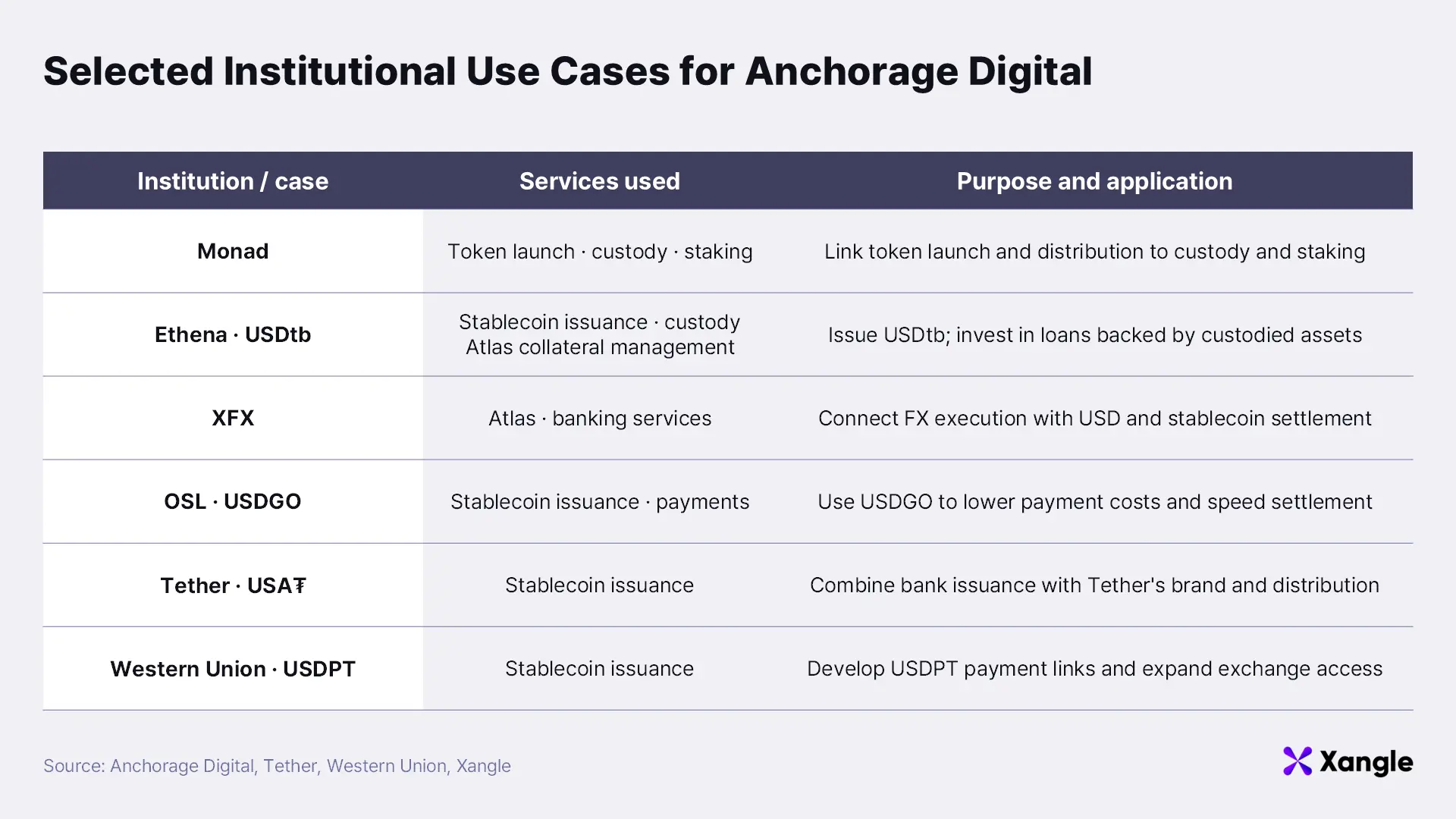
Institutions adopt Anchorage Digital for different purposes depending on the assets they manage and the activities they need to perform. Asset managers strengthen custody arrangements and investment execution, while corporations manage their holdings or use them as collateral. Payment providers and stablecoin businesses connect Anchorage Digital's banking and issuance infrastructure with their own customer networks.
Blockchain projects: Token launches and stablecoin issuance
- Monad: Ahead of its token launch, Monad selected Anchorage Digital as a partner to handle custody, fiat on- and off-ramps, and token distributions to each investor. Anchorage Digital supported MON custody at mainnet launch and subsequently expanded into staking, connecting launch preparation with token custody and use.
- Ethena: Ethena partnered with Anchorage Digital Bank for USDtb issuance and reserve management in the United States. The relationship later expanded to investment in loans to institutions that hold collateral with Anchorage Digital, using Atlas's collateral management capabilities.
FX and payment providers: Connecting fiat and stablecoin settlement
- XFX: Institutional FX and settlement provider XFX adopted Atlas to connect foreign exchange execution with dollar and stablecoin settlement. Its focus was to reduce the need to prefund payments by using Anchorage Digital's banking infrastructure and round-the-clock settlement network.
- OSL: OSL selected Anchorage Digital Bank for the issuance of its own stablecoin, USDGO, and for corporate payments. By connecting Anchorage Digital Bank's issuance and banking infrastructure with its payment services, OSL reduced cross-border payment costs and shortened settlement times.
Stablecoin brands and distributors: Combining issuance infrastructure with customer networks
- Tether USA₮: Tether launched USA₮ in January 2026 for the U.S. market. It is a separate product from USDT, with Anchorage Digital Bank issuing the stablecoin under federal banking supervision and Tether contributing its brand and distribution network.
- Western Union USDPT: Western Union launched its own dollar stablecoin, USDPT, in May 2026. Anchorage Digital Bank issues it on Solana. Western Union is developing services that connect USDPT with its existing remittance network for settlement between headquarters and global agents, as well as cross-border fund transfers.
4. Closing Remarks: Custody Infrastructure for Institutional Digital Asset Businesses
An institutional digital asset business begins with secure custody and extends into trading, financing activities and financial services for customers. Anchorage Digital supports this process through its local authorizations and custody operating experience. It connects asset protection and approval controls with trading, settlement and asset use, and provides stablecoin issuance and payment infrastructure so institutions can configure services around their business objectives.
Anchorage Digital's strength lies in its ability to combine the financial functions an institution needs with the business foundations it already has. Asset managers and corporate digital asset holders can use its custody infrastructure to strengthen safekeeping and put their assets to work. Payment providers and stablecoin businesses connect the bank's issuance and settlement capabilities with their own brands and customer networks. Institutions can focus on products and customer services while reducing the burden of building their own security and asset management systems.
Anchorage Digital's future expansion will depend on how reliably and efficiently these connections work in practice. The value of integrated infrastructure can grow as assets in custody support trading and collateral use, and issued stablecoins become part of everyday payments and settlement. The cases discussed in this report show custody developing into a foundation for both institutional asset management and the creation of new financial services.
Anchorage Digital plans to participate in the CIS Seoul Partner Summit, a private forum for executives of companies pursuing real-world asset (RWA) businesses and infrastructure providers. Attendees will be able to discuss specific ways to apply Anchorage Digital's custody, trading, settlement and stablecoin issuance infrastructure to their own businesses.
About Anchorage Digital
Anchorage Digital is the proven infrastructure layer for modern financial markets that gives institutions a single platform to participate in digital assets, including prime services, tokenization, stablecoins, and the governance framework for agentic finance. Home to Anchorage Digital Bank, N.A., America’s first federally regulated digital asset bank, Anchorage Digital also serves institutions through Anchorage Digital Singapore, licensed by the Monetary Authority of Singapore; Anchorage Digital NY, which holds a BitLicense from the New York Department of Financial Services; and self-custody wallet Porto by Anchorage Digital. Anchorage Digital Bank also offers fiat custody services through an FDIC-insured, licensed sub-custodian. Anchorage Digital is funded by leading institutions including Andreessen Horowitz, GIC, Goldman Sachs, KKR, and Visa, with a valuation of $4.2 billion. Founded in 2017 in San Francisco, California, Anchorage Digital has offices in New York, New York; Porto, Portugal; Singapore; and Sioux Falls, South Dakota. Learn more at anchorage.com, X, YouTube, and LinkedIn.
Disclaimer
I confirm that I have read and understood the following: The information contained in this article is strictly the opinions of the author(s). This article was authored free from any form of coercion or undue influence. The content represents the author's own views and does not represent the official position or opinions of CrossAngle. This article is intended for informational purposes only and should not be construed as investment advice or solicitation. Unless otherwise specified, all users are solely responsible and liable for their own decisions about investments, investment strategies, or the use of products or services. Investment decisions should be made based on the user’s personal investment objectives, circumstances, and financial situation. Please consult a professional financial advisor for more information and guidance. Past returns or projections do not guarantee future results. This article was written at the request of Anchorage Digital. All content in this article was written independently by the author(s), and neither CrossAngle nor Anchorage Digital had any editorial control or influence over the content. The author(s) may hold the cryptocurrencies mentioned in this article at the time of writing.
Xangle or its affiliated partners own all copyrights of the written or otherwise produced materials and content provided on the platform. Any illegal reproduction of such content, including, but not limited to, unauthorized editing, copying, reprinting, or redistribution will result in immediate legal actions without prior notice.
![[CIS Partner Summit Highlights] Dinari: Bringing Tokenized Stocks to Financial Services](https://resource.xangle.io/files/content/44F77D1727A765045015596C9652011C_1789696427279.webp)
![[Xangle RWA Series] On/Off-Ramps](https://resource.xangle.io/files/content/BCFC2BA6D6526E381F40ECAB4905CA4C_1787034686767.webp)