
Business Models in the Tokenized Stock Market

Table of Contents
1. Growth and Competition in the Tokenized Stock Market
2. The Tokenized Stock Value Chain
3. Business Models by Operating Structure
4. Conclusion: Building Scalable Revenue Models
1. Growth and Competition in the Tokenized Stock Market
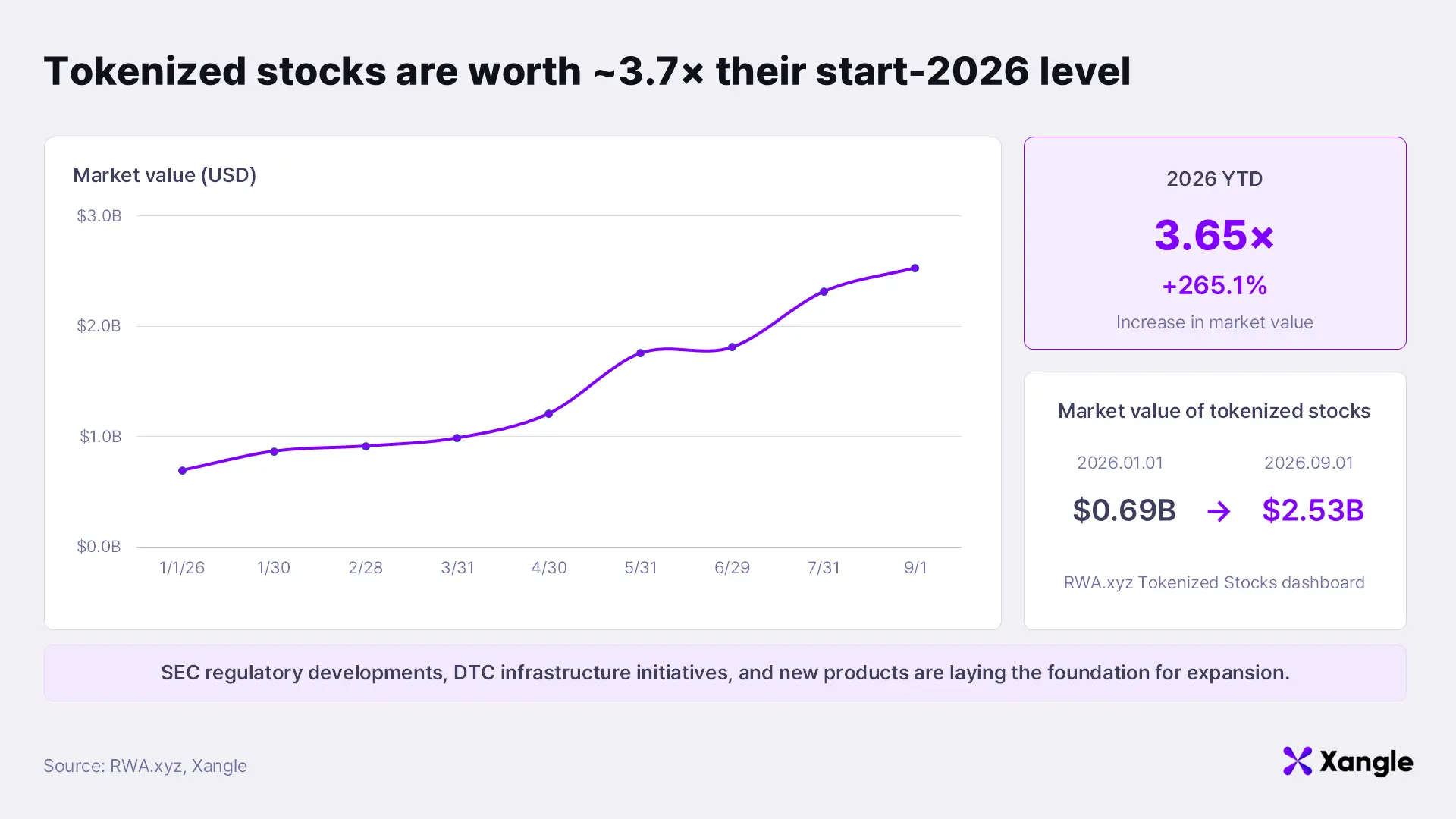
The tokenized stock market has expanded rapidly in 2026. According to RWA.xyz, the total value of tokenized stocks issued and circulating on blockchains rose from $693 million on January 1 to $2.53 billion on September 1, roughly 3.7 times its January level. The SEC has provided greater clarity on how tokenized stocks differ depending on the issuer and the rights attached to the token, while DTC is preparing a service that would allow securities held in its depository system to be represented onchain pursuant to SEC no-action relief. Together, regulatory progress and the participation of traditional market infrastructure are laying the groundwork for further growth.
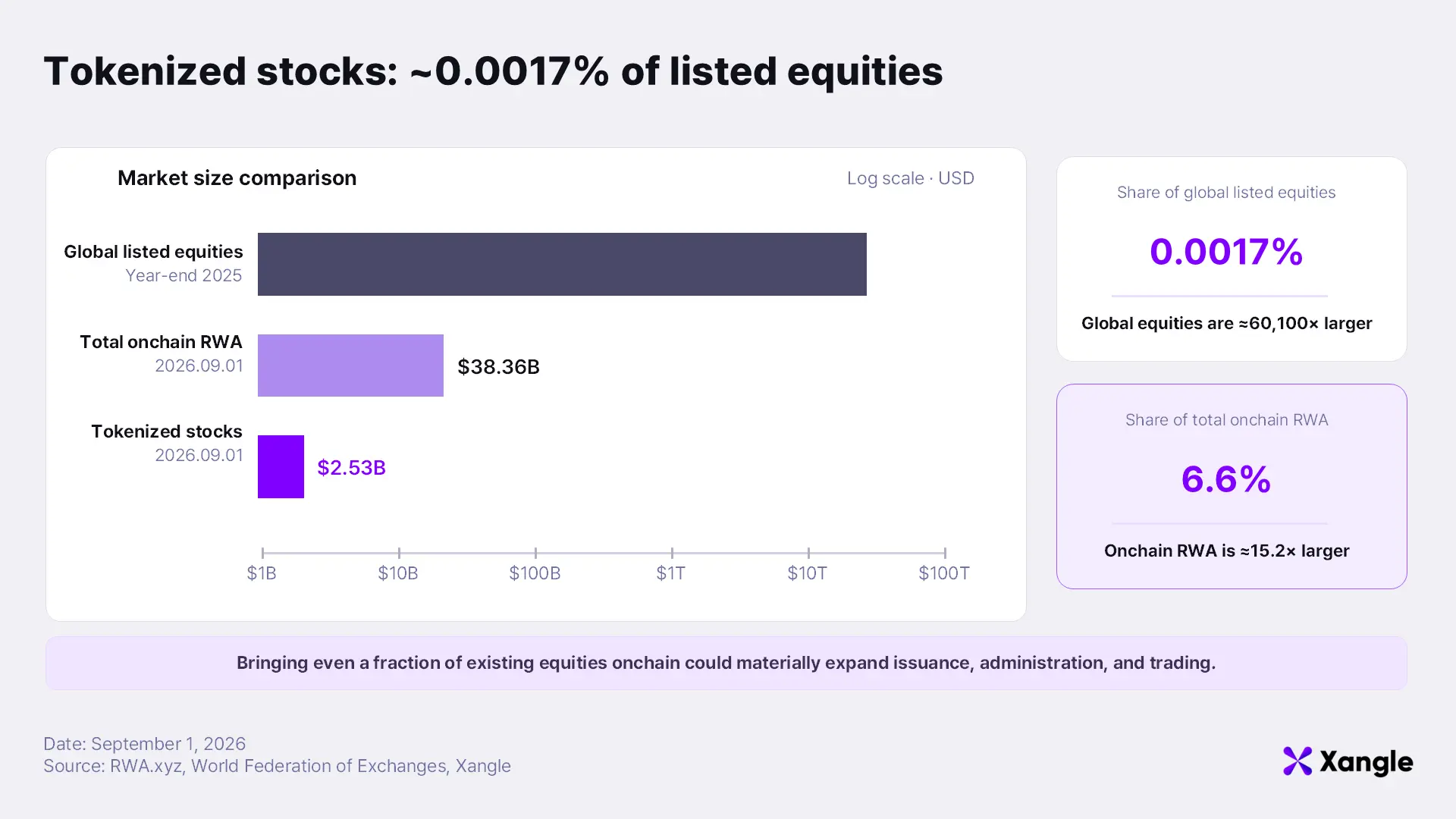
The market nevertheless remains at an early stage. As of September 1, 2026, RWA.xyz reported approximately $38.36 billion in RWAs circulating onchain, of which tokenized stocks accounted for $2.53 billion, or roughly 6.6%. Compared with the $151.94 trillion market capitalization of global listed equities at year-end 2025, tokenized stocks represented only about 0.0017%. The current base is small, but moving even a fraction of existing equities onchain could materially expand the markets for issuance, administration, and trading.
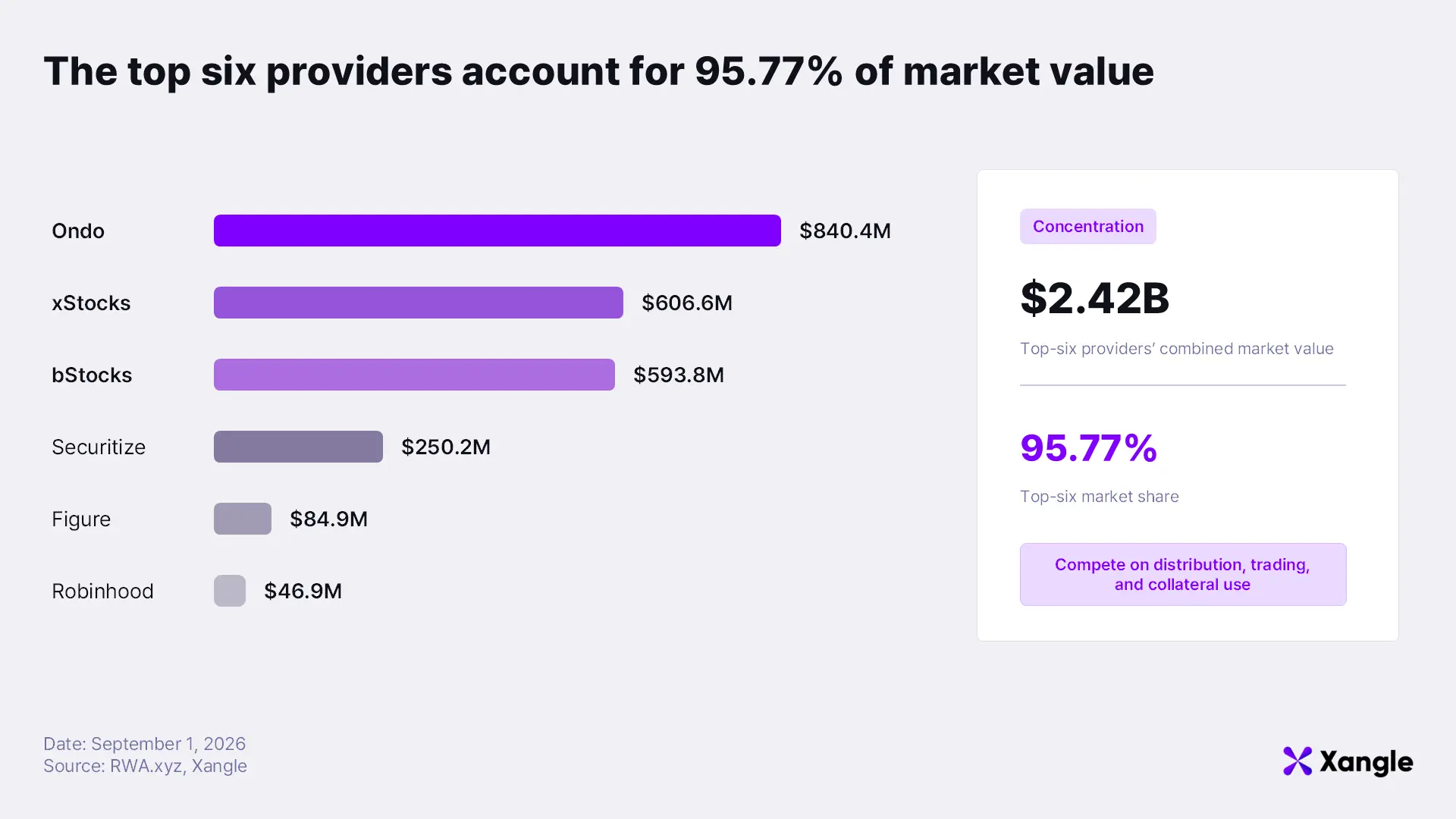
That potential is drawing a growing number of competitors. Tokenization infrastructure providers, securities firms, crypto exchanges, derivatives venues, lending protocols, and other traditional and onchain businesses are entering different parts of the issuance, distribution, and utility stack. As of September 1, 2026, tokenized stock market value by issuer or operating platform stood at approximately $840 million for Ondo, $607 million for xStocks, $594 million for bStocks, $250 million for Securitize, $85 million for Figure, and $47 million for Robinhood, followed by Superstate at $43 million. The top six platforms accounted for 95.77% of the market, indicating that assets and liquidity are already concentrating around a small number of providers.
Understanding tokenized-stock economics requires examining market value alongside the underlying business model. Economics vary according to who holds the underlying shares, what rights the token holder receives, and which entity administers and distributes the asset after issuance. Two platforms with the same amount of assets in circulation may monetize those assets through very different mechanisms, including administration fees, issuance and redemption fees, bid-ask spreads, or the indirect value of directing customers and trading activity into adjacent services.
This report first maps the tokenized stock value chain and identifies where economic value and revenue are created. It then examines how representative companies in each business model combine services and pricing mechanisms.
2. The Tokenized Stock Value Chain
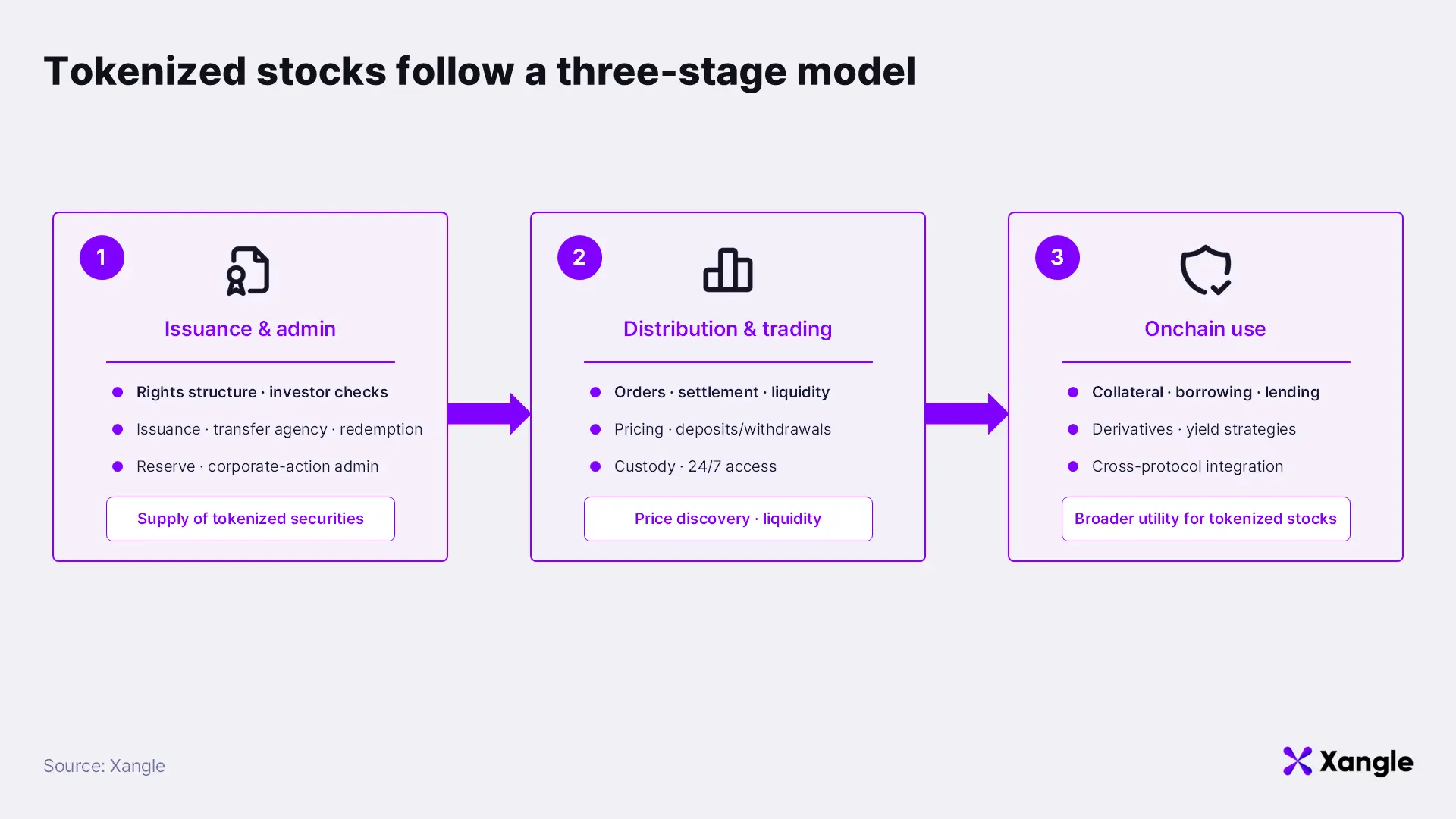
The tokenized stock value chain can be understood in three stages: issuance and administration, distribution and trading, and onchain use. In the first stage, a stock is represented as a token and the legal rights, custody arrangement, and redemption mechanism are established. The token is then connected to investor orders and liquidity in the distribution and trading stage. Finally, it can be used onchain for collateral, borrowing, and liquidity provision. These stages are not entirely separate, and a single company may operate across more than one of them. This section outlines the role of each stage and the types of businesses and revenue streams associated with it.
2.1 Issuance and Administration
Issuance and administration cover the creation of an onchain representation of a stock and the ongoing maintenance of the legal and operational link between the token and the underlying asset. A transfer agent maintains the official shareholder register and administers corporate actions, while a custodian safeguards the underlying shares. The token issuer mints and redeems tokens while keeping the reserve assets aligned with the amount outstanding. The central task is to combine these functions into a coherent legal and operating structure.
Token structures can be grouped into four categories based on the rights conveyed to holders. In a direct issuance structure, the issuer or its transfer agent links the official shareholder register to the onchain ledger so that token transfers are reflected in the formal ownership record. A security entitlement represents an investor's indirect holding rights in financial assets held by a securities intermediary. This structure is based on Article 8 of the U.S. Uniform Commercial Code, and the token holder is not recorded directly on the underlying company's shareholder register. A linked security is a separate security issued by a third party that holds the underlying shares and passes through their economic performance. A derivative contract settles gains and losses by reference to the share price and corporate events. A fuller discussion of these distinctions is available in “[Xangle RWA Series] Tokenized Stocks”.
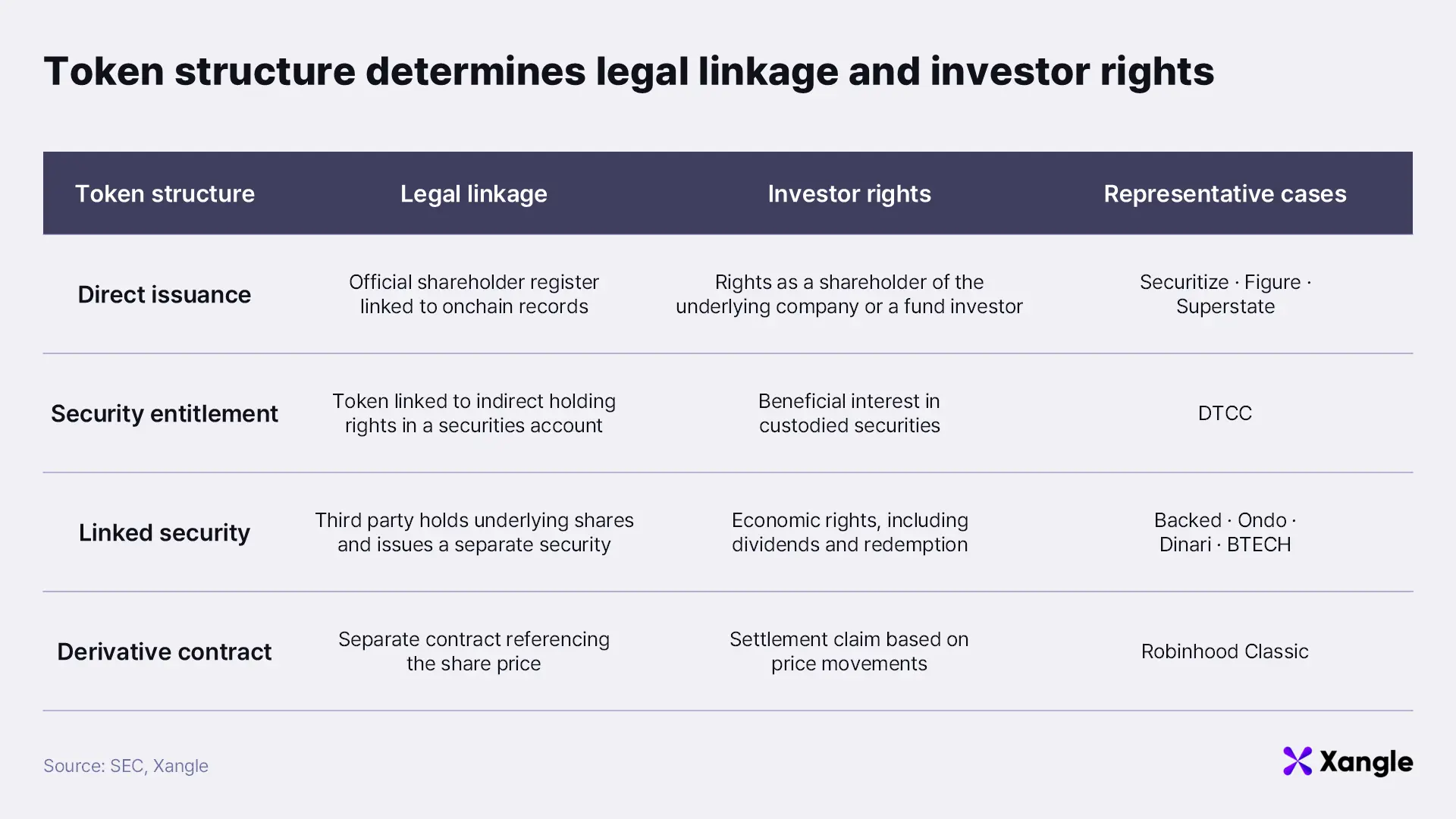
These structures also align with the roles taken by market participants. Tokenization infrastructure providers such as Securitize, Figure, and Superstate primarily support direct issuance in cooperation with the issuing company, linking the official shareholder register to onchain records. Tokenized securities issuers such as Backed, Ondo, Dinari, and BTECH more commonly use linked-security structures backed by shares purchased and held by a third party. Direct issuance can improve consistency between legal ownership records and corporate-action processing. Linked securities can be launched without the direct participation of the underlying company and can generally be integrated into DeFi more flexibly. Section 3 examines the services and revenue models developed by these two groups.
2.2 Distribution and Trading
Distribution and trading connect issued tokens to investor orders and market liquidity. Securities brokers and crypto exchanges process orders, settlement, deposits, and withdrawals within customer accounts, while decentralized exchanges enable onchain trading between external wallets. Investor access and the range of permitted transfers depend more on the issuance terms and transfer restrictions of the product than on the trading venue alone. Securities brokers and crypto exchanges generally require KYC and AML checks, and some products are limited to eligible or accredited investors. Directly issued tokens may also be restricted to transfers between verified wallets when traded through a DEX. Linked securities can circulate more freely onchain, although investor, jurisdiction, and wallet restrictions may still apply under their issuance terms and local regulations.
Robinhood illustrates how a traditional securities broker can extend its existing capabilities to onchain assets. Coinbase, Binance, and Kraken take the opposite route, using their crypto customer bases, order flows, and wallet infrastructure to distribute tokenized stocks. The line between issuance and distribution is also becoming less distinct. Robinhood and Coinbase are building proprietary tokenized products and networks, while Ondo is expanding from issuance into trading, derivatives, and lending. Across these models, companies are combining adjacent parts of the value chain to capture more trading revenue and retain customer balances within their ecosystems.
2.3 Onchain Use
Onchain use turns tokenized stocks into collateral and liquidity assets. Traditional markets already support securities-backed lending and stock borrowing, but access is limited and trading, settlement, and collateral management are spread across multiple intermediaries. Tokenization can broaden this utility. Investors may borrow stablecoins against tokenized stocks through protocols such as Morpho, Euler, and Kamino, provide liquidity on decentralized exchanges, or connect the assets to derivatives and structured-yield products. Smart contracts can also automate collateral posting, liquidation, interest calculation, and settlement.
This composability is one of the primary reasons to tokenize stocks. As a tokenized stock is repeatedly used across wallets and protocols for trading, collateral, and settlement, its liquidity and capital efficiency can improve. Issuers, brokers, and exchanges may also extend their revenue beyond issuance and trading fees into securities lending, collateral finance, network activity, and other onchain services.
Korea does not yet have a clear regulatory framework for using tokenized stocks in DeFi. The remainder of this report therefore focuses on the business models of tokenization infrastructure providers, tokenized securities issuers, and securities brokers and crypto exchanges.
3. Business Models by Operating Structure
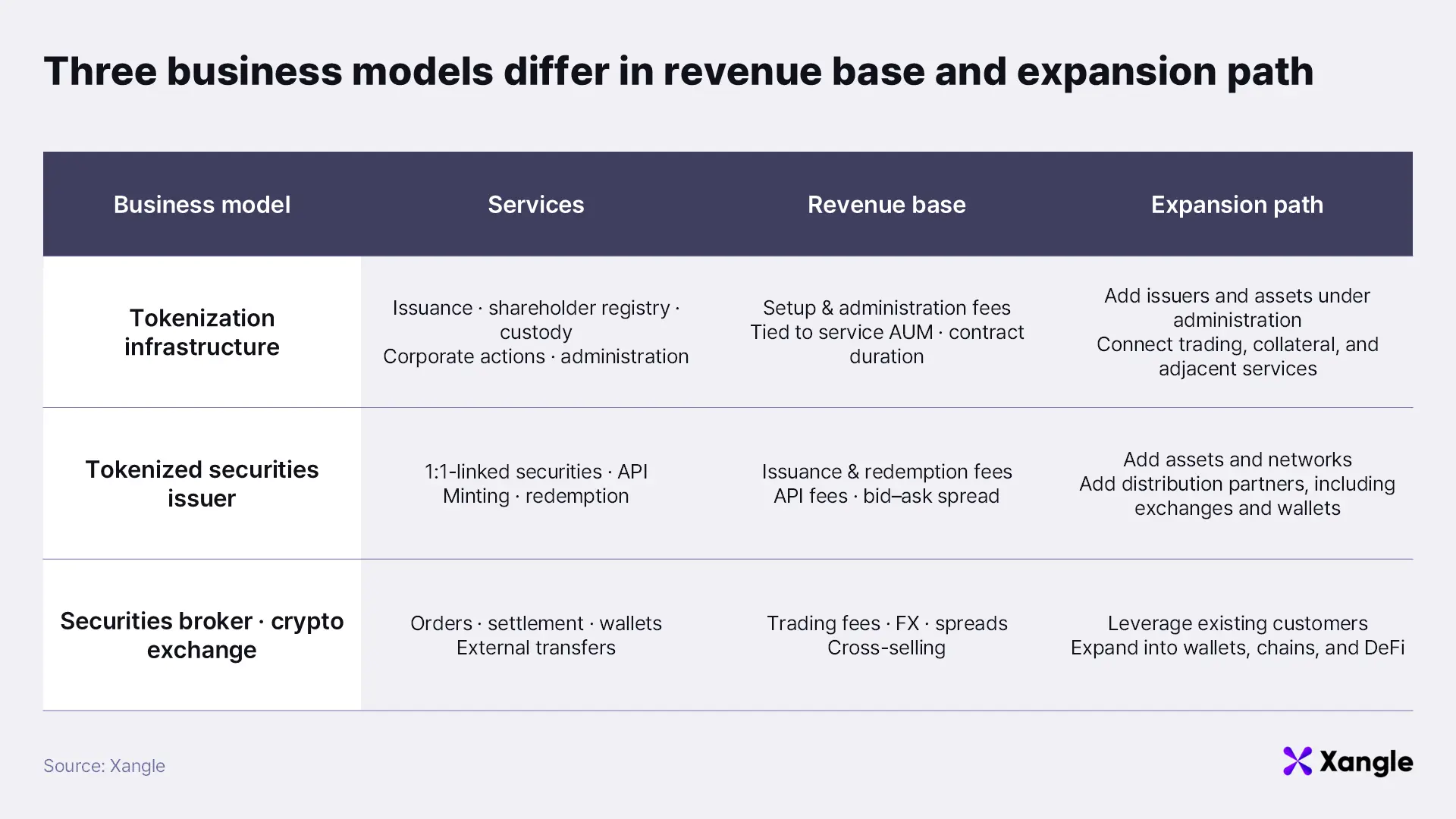
The tokenized stock market can be divided into three broad business models: tokenization infrastructure, tokenized securities issuance, and securities brokerage or crypto exchange distribution. Infrastructure providers supply the technology, regulatory coverage, and operational services that allow an issuer to tokenize its own shares or funds. Tokenized securities issuers purchase and custody existing shares, then issue a separate security linked to their value. Brokers and exchanges connect these products to investor orders and liquidity and earn revenue from trading, foreign exchange, and cross-selling.
Each model therefore needs to be assessed against a different revenue base. For infrastructure providers, the key considerations are initial implementation revenue and recurring services such as transfer agency and asset administration. For tokenized securities issuers, economics are driven by minting and redemption fees, management fees, and spreads. For brokers and exchanges, trading fees and the broader use of customer balances are more relevant. The following sections compare representative companies by their core services, revenue sources, operating performance, and expansion paths.
3.1 Tokenization Infrastructure Providers: Securitize, Figure, and Superstate
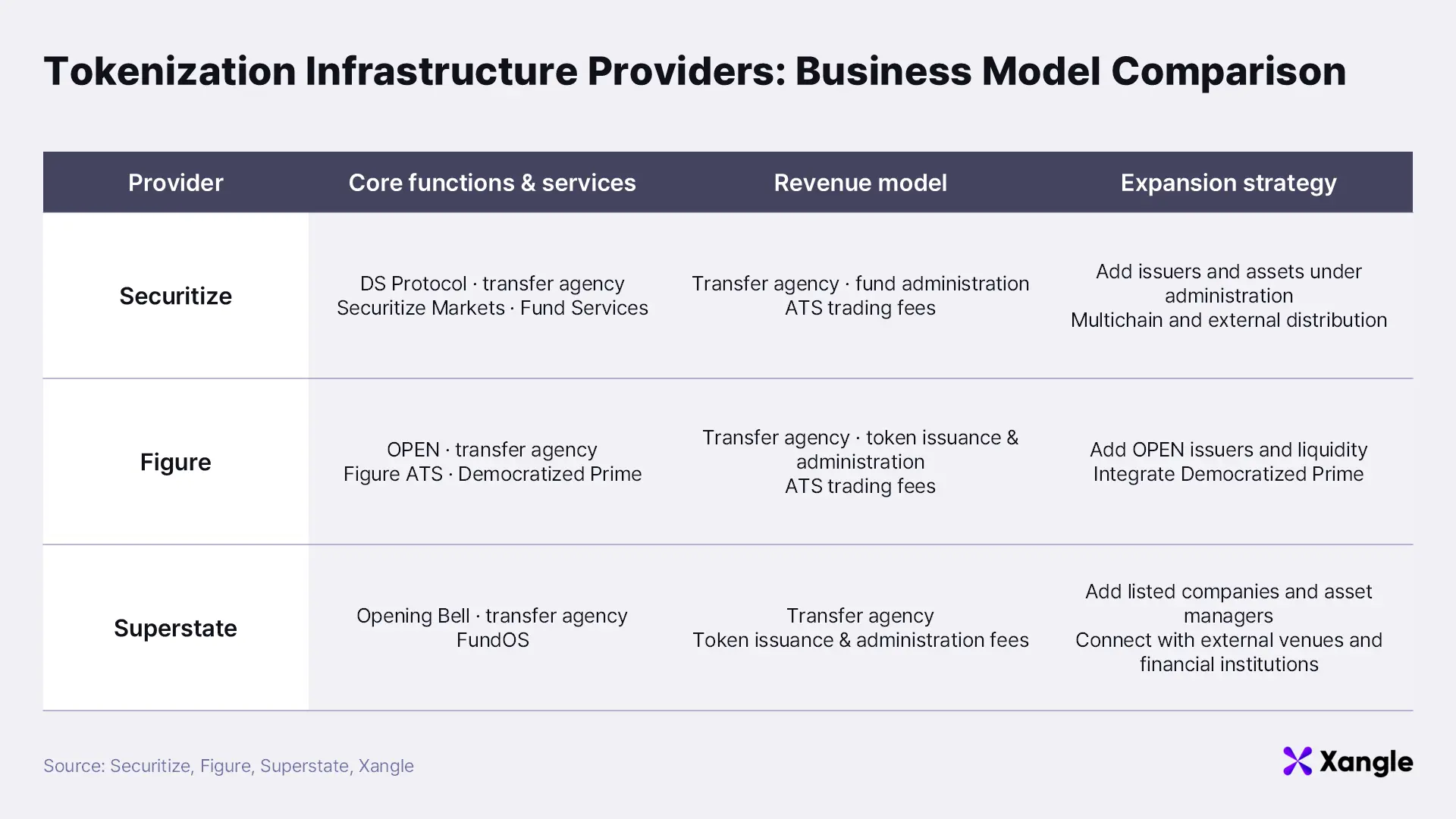
Tokenization infrastructure providers combine issuance technology, regulatory licenses, investor administration, and post-issuance operations. Long-term economics depend on the breadth of recurring services—such as transfer agency, corporate-action administration, fund administration, and trading—that can be layered on top of initial implementation fees.
Securitize
Securitize is a regulated tokenization infrastructure provider that covers the full lifecycle of a tokenized security, from structuring and issuance to investor onboarding, transfer agency, distribution, and fund administration. Within its regulated entities and proprietary systems, Securitize integrates security structuring, KYC and AML, token issuance, the official shareholder register, corporate actions, capital raising, and ATS trading. Securitize Fund Services provides accounting, NAV calculation, and investor reporting, while issued tokens can connect to multiple blockchains, external custodians, market makers, and onchain protocols. This integrated model reduces the need for issuers to appoint separate providers at each stage and allows administration and trading to remain on the same platform after launch.
Based on its second-quarter 2026 disclosures, Securitize reports revenue in two segments: tokenization and asset services.
- Tokenization — implementation and onboarding fees: Revenue from structuring securities, onboarding investors, issuing tokens, and integrating systems for new issuers and funds.
- Tokenization — infrastructure and issuance revenue: Revenue from infrastructure maintenance over the contract term and from token issuance and distribution.
- Asset services — transfer agency fees: Recurring revenue from maintaining the official shareholder register, investor records, transfers, and corporate actions.
- Asset services — fund administration fees: Revenue from fund accounting, NAV calculation, investor reporting, and, under some contracts, fees tied to assets under administration.
Of Securitize's $14.436 million in second-quarter 2026 revenue, tokenization contributed $7.839 million, or 54.3%, and asset services contributed $6.597 million, or 45.7%. Average tokenization AUM increased by 16.1% during the period, but tokenization revenue declined as the number of completed onchain integrations fell. This indicates that revenue in the tokenization segment can depend heavily on the timing and completion of new projects. Asset-services revenue from transfer agency and fund administration, by contrast, can recur after issuance and expand with the number of clients and the volume of assets administered. Combining one-time implementation and issuance revenue with recurring post-issuance administration and trading makes the revenue base more stable and allows growth in clients and assets to translate more readily into long-term revenue.
Figure
Figure is a financial technology company that operates lending and onchain capital-markets services on Provenance Blockchain. Its core businesses have historically included loan origination, distribution of loan assets, and collateral finance. Figure is now extending that infrastructure into tokenized stocks through OPEN. The platform links blockchain-native share issuance with the official shareholder register maintained by Figure Equity Solutions and with trading and settlement through Figure ATS. It also supports conversions between conventional shares and OPEN shares and stablecoin settlement. Figure is pursuing a further connection to Democratized Prime so that OPEN shares may eventually be used for securities lending and collateral finance. Like Securitize, Figure integrates issuance, transfer agency, and ATS trading in a single structure; its distinguishing feature is the planned connection between tokenized stocks and its existing lending and collateral-finance infrastructure.
OPEN's proposed revenue model has three components:
- Issuance and administration fees: Figure has presented a long-term target of 10–50 basis points on issuance volume for share issuance, transfer agency, and settlement services.
- ATS trading and network fees: A long-term target of approximately 3 basis points on secondary-market trading volume and network processing through Figure ATS.
- Collateral-finance fees: A long-term target of approximately 50 basis points on financed balances for borrowers using assets such as shares through Democratized Prime.
Figure presented these take rates as long-term assumptions in a filing submitted to the SEC in January 2026. OPEN's actual fees and revenue have not been disclosed.
Figure is much larger at the company level. It reported $167 million of consolidated revenue in the first quarter of 2026, roughly 8.6 times Securitize's $19.5 million for the same period. Tokenized stock scale tells a different story: as of August 20, 2026, Securitize had approximately $240.5 million across three tokenized equity assets, compared with Figure's $86.8 million in one asset, making Securitize about 2.8 times larger in this segment. Figure is attempting to close that gap by connecting OPEN to the asset origination, distribution, and financing capabilities developed in its lending business. If OPEN shares are integrated into Democratized Prime, Figure could add recurring revenue tied to trading volume and financed balances to issuance, transfer agency, and transaction fees. The strategy is designed to expand both the utility and revenue base of tokenized stocks through infrastructure the company already operates.
Superstate
Superstate provides infrastructure for the onchain issuance and administration of stocks and funds. Opening Bell supports the conversion of existing shares into onchain form, new share issuance, the official shareholder register, and corporate actions. Superstate does not operate its own broker-dealer or ATS, so secondary trading takes place through external exchanges and DEXs. Its model consequently emphasizes issuance, transfer agency, and tokenization platform services rather than the end-to-end issuance and trading stack operated by Securitize and Figure.
Superstate generates revenue from three main areas:
- Issuance and implementation fees: Fees paid by issuers for tokenizing existing shares and conducting new issuance through Opening Bell's Direct Issuance Program.
- Transfer agency fees: Recurring fees for maintaining shareholder records, approved wallets, transfers, and corporate actions after issuance.
- FundOS platform fees: Platform and integration fees for providing asset managers with onchain subscriptions and redemptions, stablecoin settlement, register administration, and protocol connectivity.
Because Superstate has no in-house ATS, secondary-trading fees accrue to external venues and liquidity providers. Its direct revenue is concentrated in issuance, transfer agency, and FundOS platform contracts. As of September 1, 2026, Superstate's tokenized stocks had approximately $43 million in market value, while tokenized funds supported by FundOS held more than $1 billion in assets. On a simple comparison of the disclosed figures, its tokenized fund footprint is more than 20 times larger than its tokenized stock footprint. Superstate is applying the onchain register, investor, and wallet administration capabilities built around FundOS to share issuance and transfer agency through Opening Bell. FundOS differs from Securitize Fund Services in an important respect: it connects asset managers to onchain subscription, redemption, settlement, and register workflows, while traditional fund accounting, NAV calculation, custody, and other core administration functions remain with existing service providers.
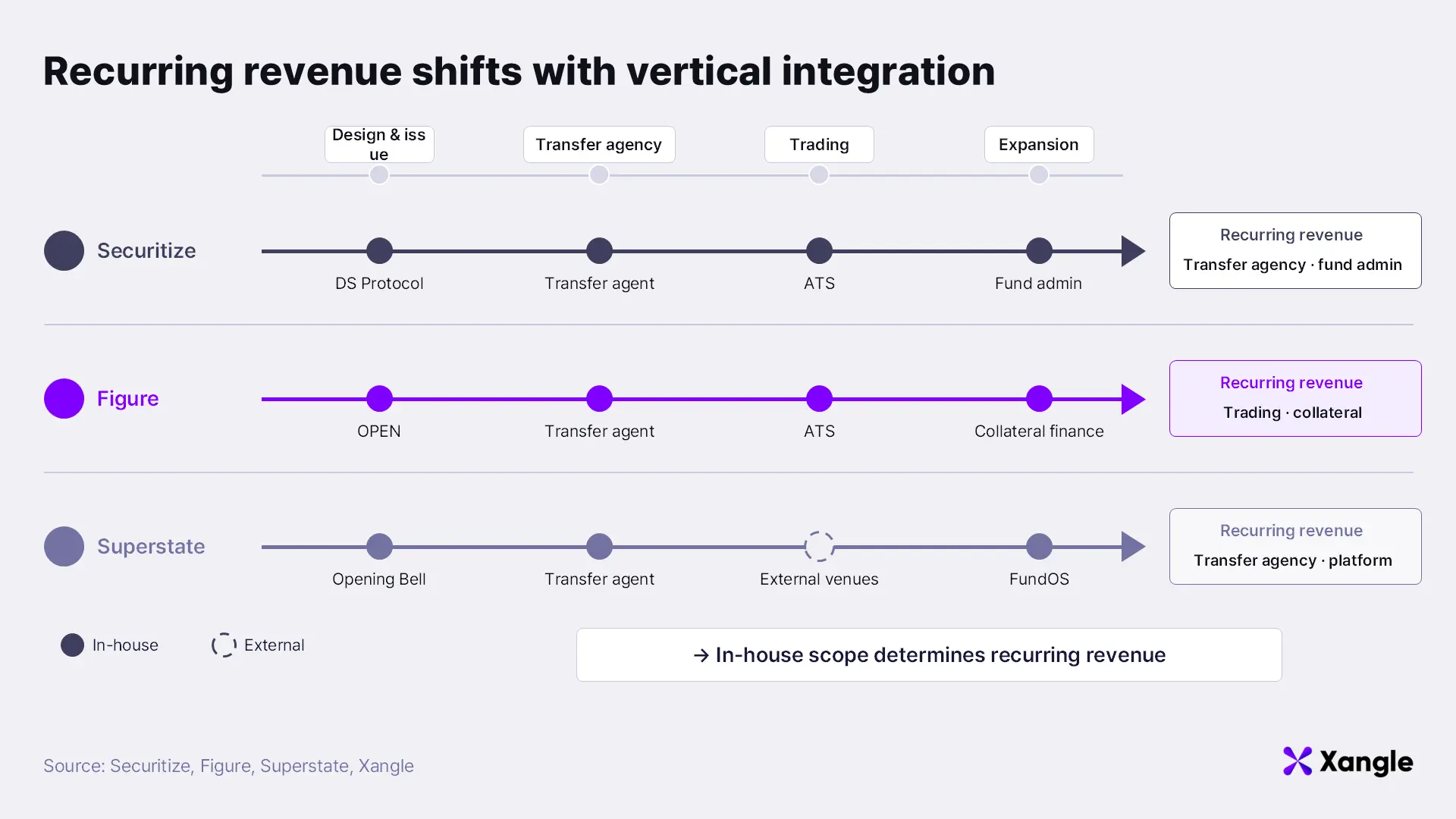
All three companies support token issuance and the official shareholder register, but their recurring revenue depends on how much of the post-issuance stack they operate directly. Securitize and Figure connect issuance to their own ATSs, giving them a path to monetize administration, trading, and adjacent financial services. Securitize extends into fund administration, while Figure is building toward collateral finance. Superstate operates without an in-house ATS and remains more focused on issuance, transfer agency, and platform services; its current business base is also substantially larger in tokenized funds than in tokenized stocks.
3.2 Tokenized Securities Issuers: Backed, Ondo, Dinari, and BTECH
Tokenized securities issuers manage the purchase and custody of underlying shares, token minting and redemption, dividends and corporate actions, and deployment across blockchains. Secondary-trading fees often accrue to exchanges and liquidity providers, so the economics of the issuer depend on issuance and redemption volume, average balances, B2B contracts, and access to proprietary distribution channels.
Backed
Backed issues xStocks backed by existing stocks and distributes them across exchanges, wallets, and onchain applications. Backed Assets (JE) purchases and holds the underlying shares and issues a tokenized tracker certificate for each asset. Holders receive economic rights and a redemption claim but are not recorded directly on the underlying company's shareholder register.
Backed earns direct revenue primarily from issuance and redemption:
- Issuance and redemption fees: Up to 0.50% of transaction value may be charged when xStocks are issued or redeemed for underlying shares or cash.
- Management fee: The current rate is 0%, but product terms permit an annual rate of up to 0.25% in the future.
After issuance, fees from secondary trading in xStocks accrue to the crypto exchanges, DEXs, and liquidity providers that execute the trades rather than to Backed. Growth in xStocks trading volume therefore does not translate directly into proportional revenue for the issuer. A management fee could provide recurring revenue, but Backed's contemplated fee would be implemented through rebasing that reduces token balances. Such an approach can affect investor returns and increase integration complexity for exchanges, wallets, and DeFi protocols, which may limit its practical use.
Backed announced an acquisition agreement with Kraken parent Payward in December 2025, and the transaction closed in January 2026. Bringing the issuer and exchange into one group created a vertically integrated model in which Backed handles issuance and redemption while Kraken provides trading and distribution. The group can therefore capture issuance and redemption revenue alongside secondary-trading revenue and extend xStocks into Kraken's custody, payments, wallet, and trading services.
Ondo
Ondo issues Ondo Stocks backed by U.S. stocks and ETFs and distributes them through exchanges, wallets, and onchain applications. The underlying securities are held with a U.S.-registered broker-dealer, while Ondo manages product design, issuance and redemption, pricing, and multichain deployment. Its API and SDK allow partners to embed the same issuance and redemption engine in their own services.
Ondo generates revenue from the issuance and redemption flow for Ondo Stocks and from its proprietary derivatives platform:
- Issuance and redemption spread: Ondo primarily earns the difference between the buy or sell quote shown to the customer and the execution price of the underlying security, rather than charging a fixed percentage fee.
- API order revenue: When orders from exchanges and wallets flow through the Ondo API into the issuance and redemption engine, Ondo can repeatedly capture the quoted spread on order volume.
- Ondo Perps revenue: Ondo can earn trading, liquidation, platform fees, and spreads on its perpetual-futures platform. Specific rates and revenue have not been disclosed.
- External secondary-market fees: Fees generated on third-party exchanges and DEXs accrue to those venues and their liquidity providers.
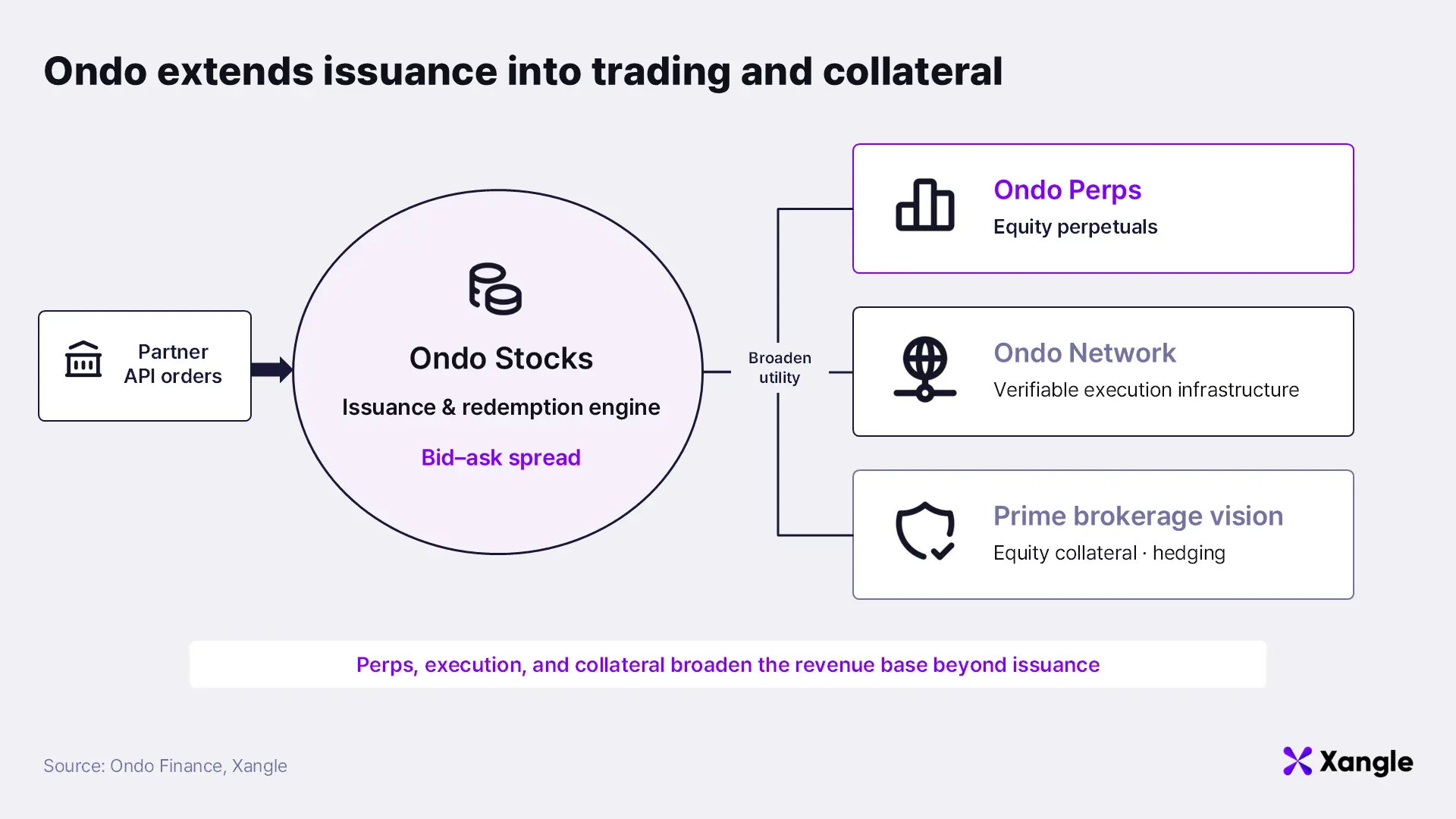
Ondo Stocks initially earned direct revenue mainly from the quoted spread on issuance and redemption. Once tokens entered circulation, repeated trading on external exchanges and DEXs generated fees for those venues and their liquidity providers, limiting the issuer's direct participation in distribution volume. Ondo addressed this limitation by designing and launching Ondo Perps, bringing perpetual-futures activity tied to the same equity demand onto its own platform. This expands the monetization scope from issuance and redemption spreads to trading, liquidation, and platform fees. Ondo Network is already operating as the execution infrastructure for Perps, and the company also plans to develop onchain prime-brokerage functionality that would use Ondo Stocks as collateral and connect spot holdings with hedging and leverage. Ondo is therefore extending an issuance and redemption engine into a broader stack spanning derivatives and collateral finance.
Dinari
Dinari issues dShares backed by U.S. stocks and ETFs and supplies trading and settlement APIs to financial apps and exchanges. Partners can use Dinari's API and SDK to embed investor verification, underlying-security orders, token minting and burning, and settlement into their own services. When an end user places a buy order, Dinari purchases the underlying security and issues a token; when the user sells, Dinari burns the token and pays out the proceeds from selling the underlying asset.
Dinari's revenue is tied more directly to B2B infrastructure contracts than to token issuance volume itself:
- API subscription: Partners pay from $2,000 per month for investor accounts, order execution, token minting and burning, and settlement functions.
- Platform and integration contracts: Dinari provides securities operating infrastructure according to the scope and scale of each partner integration. Company-specific terms are not publicly disclosed.
- End-user trading fees: Dinari does not charge a separate standard trading fee to end users. Partner platforms set and retain their own customer pricing.
Ondo and Dinari both allow exchanges and financial apps to embed equity orders and token issuance and redemption through APIs and SDKs, but they monetize those relationships differently. Ondo captures the quoted spread when API orders flow into its issuance and redemption engine. Dinari focuses on recurring B2B subscription and integration revenue from partners, while the partner platform sets and earns end-user trading fees. Dinari's base revenue therefore grows with the number of API partners and the scope of their contracts, and each partner can separately monetize its customer trading activity. Dinari also launched 724 stocks and ETFs in the United States in August 2026 and is expanding its operating relationships with brokers, exchanges, custodians, and transfer agents through the Dinari Financial Network.
BTECH Holdings
BTECH Holdings is an ADGM-based special-purpose issuer that issues bStocks within the Binance group. Regulated custodians hold the underlying shares, and BTECH issues tokens on BNB Smart Chain that represent a 1:1 economic interest in those assets. Binance group entities divide responsibility for tokenization and corporate actions, investor access, spot trading, and clearing.
BTECH does not disclose its own issuance fees or revenue, so the economics of bStocks are more appropriately assessed at the Binance group level:
- Underlying-share trading revenue: Binance Stocks users pay Nest Trading a $0.35 platform fee for orders of $350 or less and a 0.10% spread on larger orders.
- bStocks conversion fee: No separate fee is charged to convert between shares held through Binance Stocks and bStocks.
- bStocks spot-trading fees: When bStocks trade on Binance Spot, maker and taker fees based on the user's account tier accrue to Binance.
- Withdrawal, BNB Chain, and onchain trading costs: Asset-specific withdrawal fees may apply. When bStocks are transferred or traded on BNB Smart Chain, BNB gas fees accrue to network validators, while DEX trading fees accrue to the relevant protocol and liquidity providers. Although recipients differ, the resulting network activity and fee flows remain within the BNB Chain ecosystem.
bStocks are best understood as part of Binance's integrated distribution model rather than as a standalone issuer business. Free conversion increases the supply of bStocks and helps establish liquidity on Binance Spot. The Binance group earns revenue from trading the underlying shares before conversion and from bStocks spot trading afterward. Binance Alpha and Wallet also connect bStocks and tokenized stocks from outside issuers to onchain trading within the Binance app, extending monetization opportunities into the wallet and BNB Chain ecosystem. The model keeps trading activity and liquidity within Binance and BNB Chain, allowing both group entities and ecosystem participants to capture revenue.
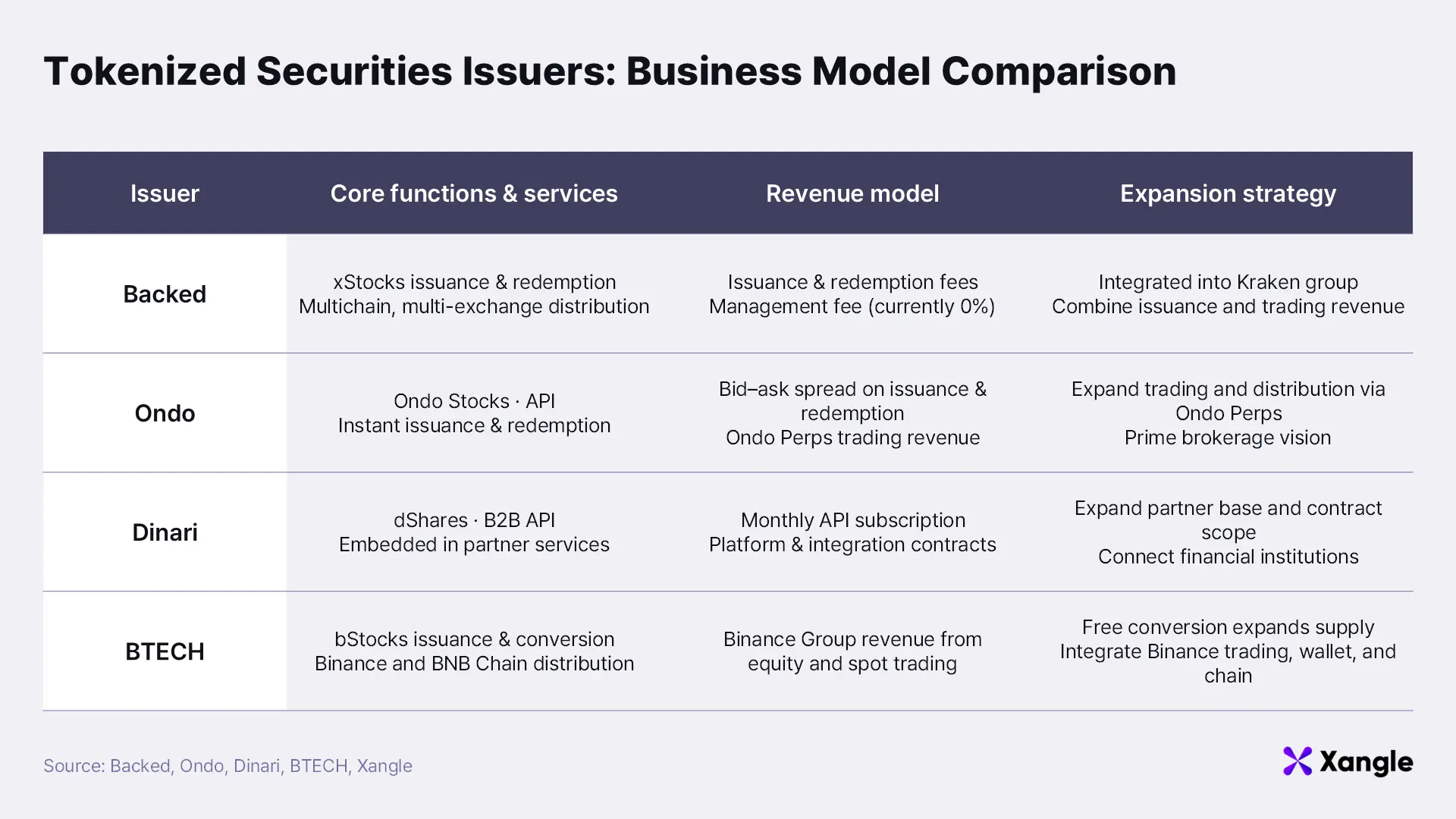
The four issuers are expanding beyond issuance and redemption into adjacent areas such as trading, distribution, and financial services in pursuit of recurring revenue. Their specific paths reflect the infrastructure and partnerships available to each company. Backed integrated issuance and trading by joining the Kraken group. Ondo launched Perps and is pursuing a broader expansion into execution, settlement, and collateral finance. Dinari connects financial apps, brokerages, and custodians through its B2B API and Dinari Financial Network. BTECH relies on Binance's underlying-share trading, spot market, Wallet, and BNB Chain. The central strategic choice is whether to operate post-issuance distribution and financial utility directly, internalize it through acquisition, or connect it through partners and affiliated ecosystems.
3.3 Securities Brokers and Crypto Exchanges: Robinhood, Coinbase, Kraken, and Binance
Securities brokers and crypto exchanges use their existing customer accounts, order flows, settlement assets, and wallets to distribute tokenized stocks. Adding a proprietary issuer and blockchain can extend the revenue base beyond trading fees into issuance, foreign exchange, network activity, and adjacent financial services.
Robinhood
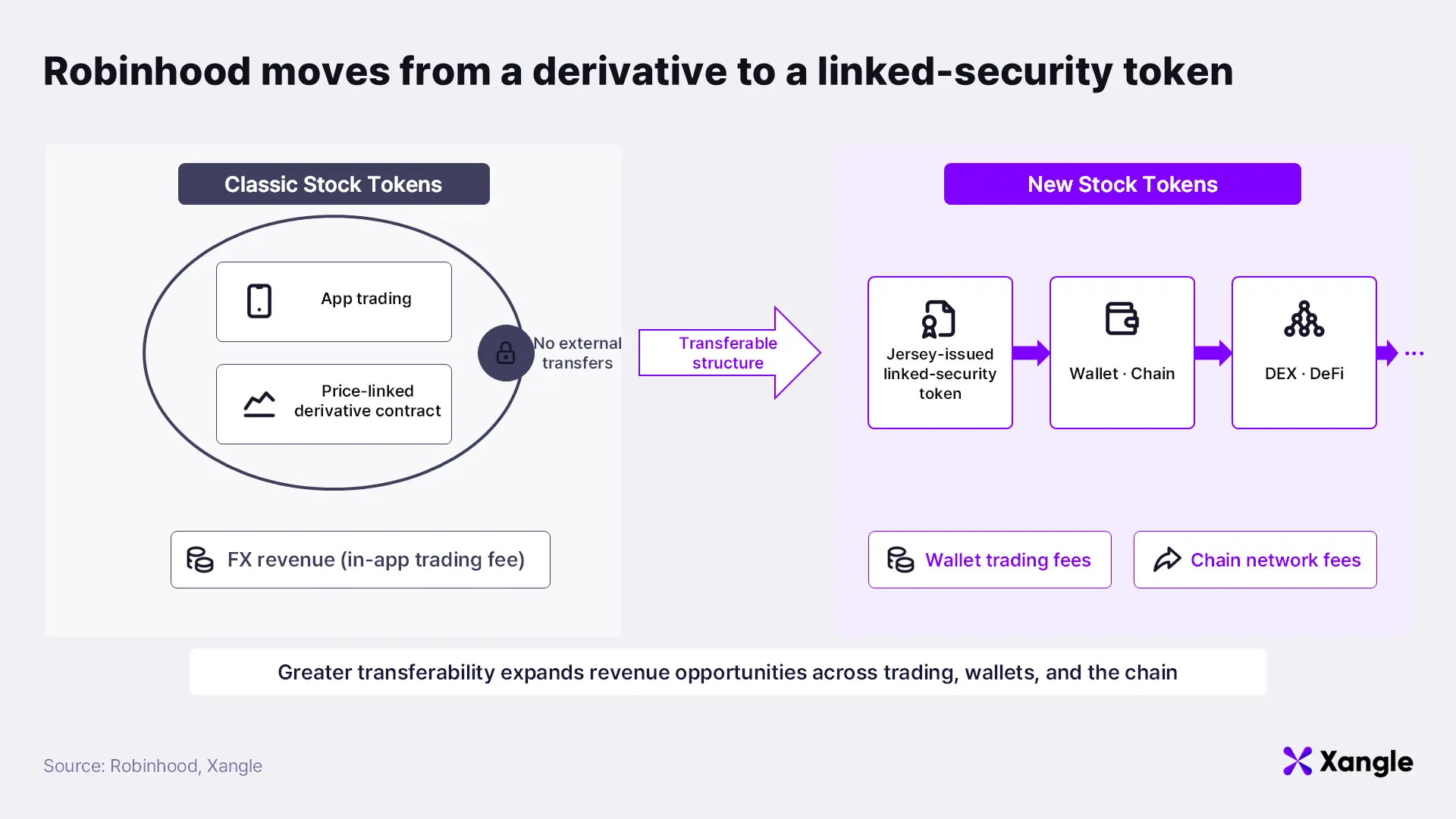
Robinhood is a digital securities platform that has extended its U.S. brokerage business into price-linked equity products and onchain Stock Tokens for overseas investors. Its original Classic Stock Tokens in the European app are non-transferable derivative contracts. The Stock Tokens launched in 2026 are tokenized debt securities issued by Robinhood Assets (Jersey) and linked to the economic performance of the underlying shares it holds. Because they are separate securities issued by an intermediary rather than shares issued directly by the underlying company, they use a linked-security structure. Robinhood can therefore distribute them through its own chain and external wallets and support trading, transfers, and use as collateral in DeFi protocols.
Robinhood's revenue varies by product and distribution channel:
- App foreign-exchange fee — Classic Stock Tokens: A 0.10% charge applies whenever a user buys or sells the product in euros. Robinhood classifies this as a EUR–USD foreign-exchange fee rather than a trading commission.
- Wallet trading fee — Stock Tokens: Robinhood Wallet currently charges 0.80% of transaction value for onchain swaps of Stock Tokens.
- Chain network fees — Robinhood Chain: Trading, transfers, and collateral activity on Robinhood Chain generate gas fees paid in ETH. Robinhood operates the sequencer and receives the network fees, while 10% of net protocol revenue is allocated to the Arbitrum ecosystem under the technology agreement.
Classic Stock Tokens generate revenue through in-app foreign exchange, while the new Stock Tokens add Wallet trading and Robinhood Chain network activity. By operating its own chain, Robinhood can keep trading and financial activity on its network even after Stock Tokens move beyond the core platform into external DEXs, lending markets, and derivatives protocols. Fees are shared among Robinhood, protocols, and liquidity providers, allowing Robinhood Chain to grow with the services built around it. The strategy connects the wallet, chain, and financial applications into a single ecosystem and turns growth in both the network and its applications into a broader revenue base.
Coinbase
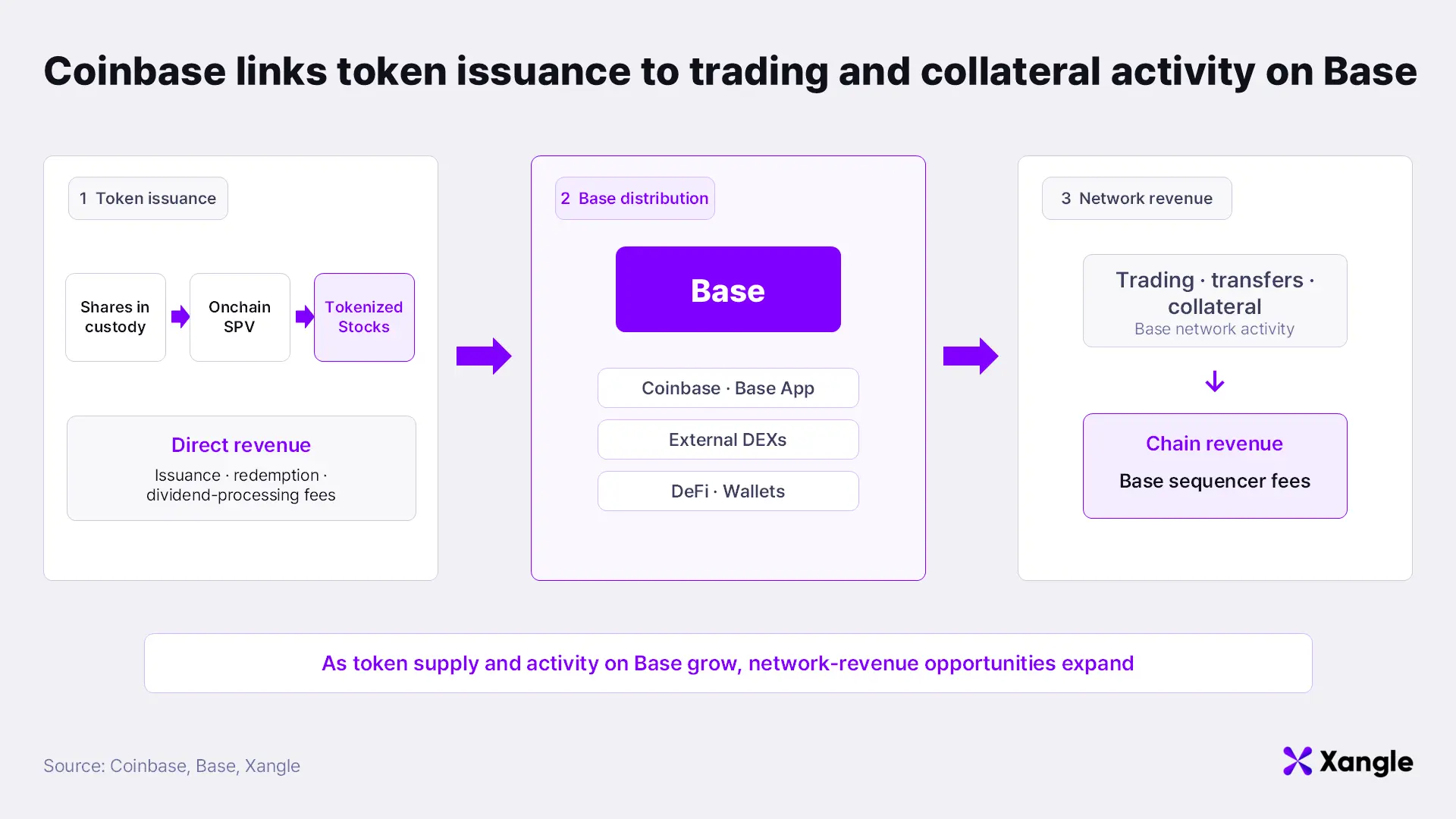
Coinbase is expanding from a crypto exchange and operator of the Base L2 into conventional equity brokerage, equity perpetual futures, and tokenized stocks. Coinbase Tokenized Stocks, launched in August 2026, are issued by Coinbase Onchain SPV against underlying shares held in a segregated custody account at Alpaca. Each stock token is implemented under the B20 standard and represents an economic interest in the corresponding underlying shares, making it a linked security. Like Robinhood, Coinbase uses a separate issuer to structure issuance, redemption, and transfers, while its own blockchain provides the distribution layer. Investors can trade and transfer the tokens on Base and use them as collateral through external wallets and DeFi protocols.
Publicly disclosed fee flows for Coinbase Tokenized Stocks include:
- Issuance and redemption fees — Coinbase Tokenized Stocks: Coinbase Onchain SPV receives 0.01% of issuance value when an authorized participant deposits underlying shares and mints stock tokens. Redemption into shares, cash, or stablecoins incurs a 0.05% fee.
- Dividend-processing fee — Coinbase Tokenized Stocks: When the underlying shares pay dividends or distributions, Coinbase Onchain SPV receives 5% of the gross amount before tax and reinvestment expenses. The remainder is reinvested in the underlying shares and reflected in the token's economic interest.
- Wallet trading fee — Base App: DEX swaps of Coinbase Tokenized Stocks through Base App may incur a fee of up to 1% of swap value. Fees charged by DEX aggregators and liquidity pools may also apply depending on the route.
- Chain network fees — Base: Trading, transfers, and collateral activity on Base generate network fees. As the operator of the Base sequencer, Coinbase can earn revenue from this onchain activity.
Coinbase uses a low issuance fee to increase the supply of Coinbase Tokenized Stocks and connects that supply to trading in Base App and the Coinbase app, as well as to Base sequencer revenue. When the tokens are used through external trading and lending protocols such as Aerodrome, Aave, Morpho, and Euler, the resulting transactions and collateral activity still take place on Base. Fees are distributed among Coinbase, protocols, and liquidity providers, while growth in external services also increases Base network activity and inflows into Coinbase's wallet, trading, and financial products. The model links token issuance, trading, and collateral use within the Base ecosystem and turns the growth of both applications and network activity into an expanding revenue base.
Kraken
Kraken is a crypto exchange that offers conventional stocks and ETFs alongside xStocks issued by Backed. Eligible non-U.S. users can trade xStocks through the Kraken app and Kraken Pro and withdraw them to external wallets. Kraken separates simple app trading from its professional order book and applies a different pricing model to each channel.
Revenue from xStocks varies by trading channel:
- Issuance and redemption fees — xStocks: Issuance and redemption may each incur a fee of up to 0.50%. The fee accrues to Backed, but Backed's acquisition by Kraken parent Payward allows the group to combine issuance and redemption revenue with trading revenue.
- App trading spread — Kraken app: xStocks prices include a 1% spread to the market price. Trades funded with USD or USDG do not incur a separate trading fee, while other fiat currencies or crypto assets may incur an additional 1% Instant Buy/Sell fee.
- Trading fees — Kraken Pro: The order book applies maker and taker fees based on trailing trading volume. The standard taker fee is 0.10%, with lower rates available to higher-volume institutional users.
- Onchain trading fees — Nado: Nado, an order-book DEX running on Ink, applies volume-based maker and taker fees to xStocks spot and perpetual-futures trading.
- Chain network fees — Ink: Nado orders and positions settle on Ink, where users pay gas in ETH. Kraken operates the Ink sequencer, receives the gas fees, and covers Ethereum data-posting costs.
As discussed in the Backed section, Payward's acquisition brought xStocks issuance and redemption into the same group as Kraken's exchange business. Kraken has also built Ink, a DeFi-focused L2, and uses Nado, an order-book DEX on Ink, to connect xStocks spot markets with collateralized borrowing and perpetual-futures trading. Users can borrow against xStocks or manage derivatives positions without selling the underlying token. Nado Points and xPoints further reward holding and trading xStocks, creating incentives for assets and liquidity to remain within the Ink ecosystem.
This design can create a reinforcing loop: greater xStocks issuance expands Nado's spot liquidity and collateral base, while deeper trading and financial utility can increase demand to hold and issue xStocks. Robinhood and Coinbase are likewise developing ecosystems around proprietary chains, but Kraken already connects the issuer, crypto exchange, L2, and onchain spot and derivatives venue within one flow. Its degree of vertical integration is therefore broader.
Binance
Binance is a global crypto exchange that offers conventional stocks and ETFs, bStocks, and equity perpetual futures within a single account. Users can purchase underlying shares through Binance Stocks and convert them into bStocks or trade bStocks directly on Binance Spot. Binance Alpha and Wallet also offer tokenized stocks from external issuers such as Ondo through DEX routing.
Binance's equity-related revenue flows include:
- Underlying-share trading fee — Binance Stocks: Nest Trading charges a $0.35 platform fee on orders of $350 or less and a 0.10% spread on larger orders.
- Token conversion fee — bStocks: No separate fee is charged to convert between shares held through Binance Stocks and bStocks. Free conversion supports bStocks supply and trading liquidity on Binance Spot.
- Spot-trading fees — Binance Spot: Maker and taker fees based on the user's account tier and trading volume accrue to Binance when bStocks trade on Binance Spot.
- Wallet trading fee — Binance Alpha and Wallet: Onchain swaps through Binance Wallet may incur a service fee depending on token classification and access channel. Some pairs are currently free, while other routes may charge up to 0.50%.
- Chain network fees — BNB Chain: Transfers and onchain trades in bStocks generate BNB gas fees for network validators. DEX fees accrue to the relevant protocols and liquidity providers. These are not direct revenue to the Binance legal entity, but the network activity and related fee flows remain within the BNB Chain ecosystem.
Binance distributes both BTECH's bStocks and products from external issuers such as Ondo, broadening the range of tokenized equities available through its interfaces. Free conversion increases bStocks supply and supports recurring trading fees on Binance Spot. Binance Alpha and Wallet extend access to products traded on external DEXs and help retain users and liquidity within the broader Binance and BNB Chain ecosystem.
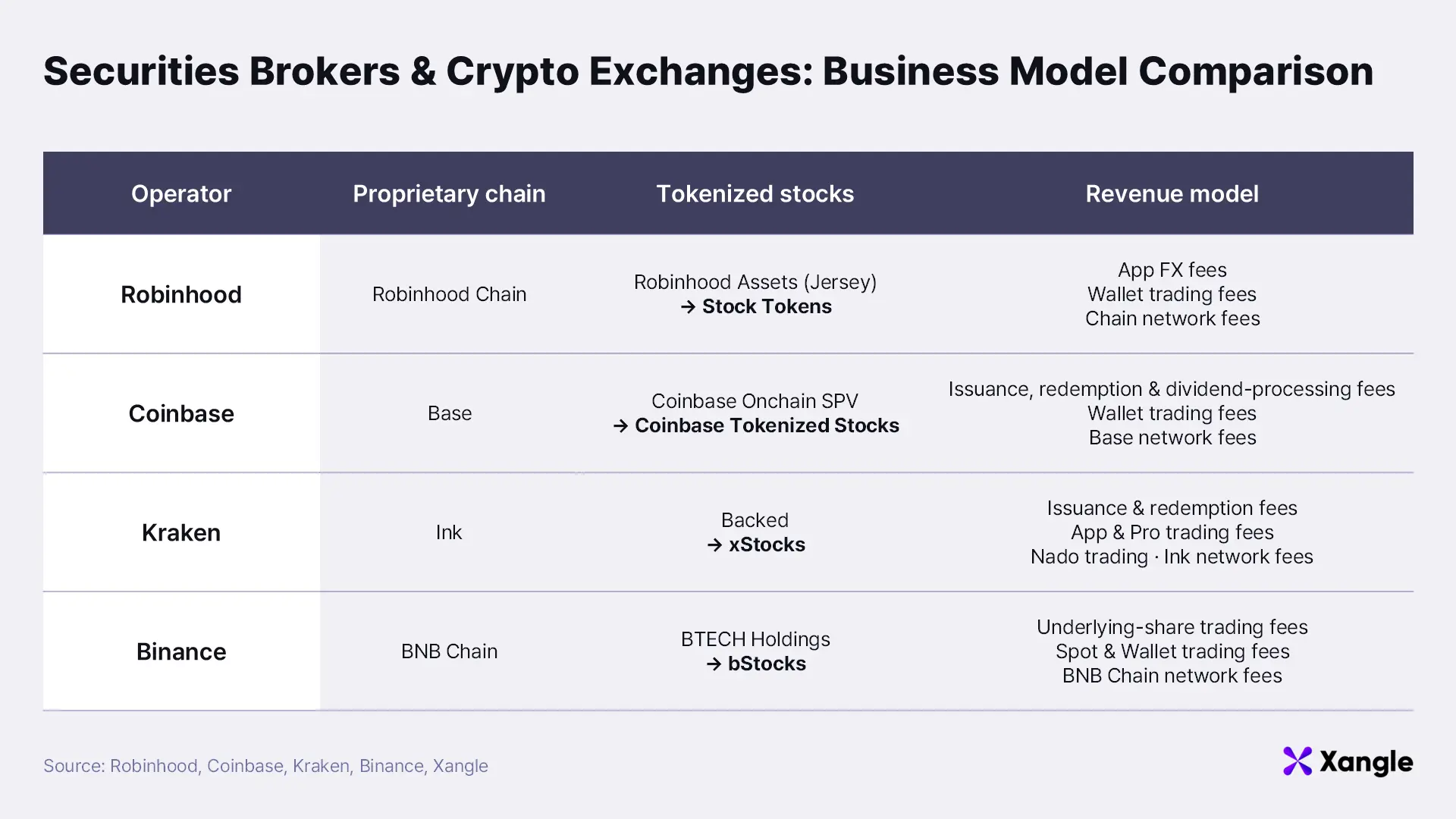
These four companies follow a common strategy: they connect existing customers and order flows to tokenized stocks, then combine issuance, foreign exchange, trading, wallets, blockchains, and other adjacent functions to monetize the same asset at multiple points. They add issuance and redemption, wallet swaps, network fees, and derivatives to conventional trading revenue and seek to keep users, assets, and liquidity within their ecosystems even when tokens move into external financial applications. Robinhood connects its securities customers to Wallet and Robinhood Chain. Coinbase combines Coinbase Tokenized Stocks issuance with app trading and Base sequencer revenue. Kraken links issuance, exchange trading, an L2, and onchain perpetual futures through Backed, Ink, and Nado. Binance connects underlying-share trading, the bStocks spot market, Wallet, and BNB Chain. The scalability of each model depends on how effectively it converts post-issuance activity into recurring ecosystem revenue.
4. Conclusion: Building Scalable Revenue Models
The tokenized stock market is building a broader foundation for growth as regulation advances and traditional financial infrastructure moves onchain. As the market expands, competitive advantage will depend on more than issuance volume. The stronger models will be those that can convert post-issuance administration, trading, and onchain use into durable revenue.
Leading companies are already combining adjacent parts of the value chain. Infrastructure providers are extending beyond issuance into transfer agency, fund administration, trading, and collateral finance. Issuers and exchanges are connecting issuance and redemption with distribution, proprietary chains, and derivatives. The objective is to keep customers and assets active within proprietary or partner ecosystems and expand the number of revenue streams generated by each token.
Companies evaluating tokenized stocks should therefore consider the initial product structure together with the administration, distribution, and financial functions they may operate directly or connect through partners. The service scope and pricing models examined in this report show how licenses, customer relationships, and technical infrastructure can be developed into recurring and scalable revenue models.
Overseas, tokenization infrastructure providers, securities firms, and crypto exchanges are experimenting with different models built around their respective strengths. In Korea, the market and regulatory discussion also needs to expand to cover post-issuance administration, distribution, onchain utility, and revenue sharing among participants. Those interested in exploring these developments and the potential of Korea's tokenization market can continue the discussion at EastPoint 2026.
Disclaimer
I confirm that I have read and understood the following: The information contained in this article is strictly the opinions of the author(s). This article was authored free from any form of coercion or undue influence. The content represents the author's own views and does not represent the official position or opinions of CrossAngle. This article is intended for informational purposes only and should not be construed as investment advice or solicitation. Unless otherwise specified, all users are solely responsible and liable for their own decisions about investments, investment strategies, or the use of products or services. Investment decisions should be made based on the user’s personal investment objectives, circumstances, and financial situation. Please consult a professional financial advisor for more information and guidance. Past returns or projections do not guarantee future results.
Xangle or its affiliated partners own all copyrights of the written or otherwise produced materials and content provided on the platform. Any illegal reproduction of such content, including, but not limited to, unauthorized editing, copying, reprinting, or redistribution will result in immediate legal actions without prior notice.
![[CIS Seoul Partner Summit] Anchorage Digital: A Starting Point for Institutional Digital Assets](https://resource.xangle.io/files/content/0659D651970125CC9D95F3066EACD686_1790818652341.webp)
![[CIS Partner Summit Highlights] Dinari: Bringing Tokenized Stocks to Financial Services](https://resource.xangle.io/files/content/44F77D1727A765045015596C9652011C_1789696427279.webp)
![[Xangle RWA Series] On/Off-Ramps](https://resource.xangle.io/files/content/BCFC2BA6D6526E381F40ECAB4905CA4C_1787034686767.webp)