[Xangle RWA Series] Tokenized Stocks

1. Tokenized Stocks: Tokens or Stocks?
2. Five Models of Stock Tokenization
3. Key Players and Product Structures by Category
4. Strengths, Limitations, and Considerations by Tokenization Model
1. Tokenized Stocks: Tokens or Stocks?
1-1. Purpose of This Report
In our previous report, “RWA Tokenization Ecosystem Overview” we provided a broad overview of the real-world asset (RWA) tokenization ecosystem across underlying assets such as fiat currencies, equities, bonds, real estate, and commodities. That report focused on mapping the overall RWA market, which limited the depth with which it could examine how each asset class and subsector works. Going forward, Xangle plans to analyze the major sectors that make up the RWA ecosystem one by one, with more detailed explanations and analysis.
The first topic in this series is stock tokenization. Tokenized stocks may look similar on the surface, but in practice they can operate in entirely different ways depending on the rights investors hold and the structure of the product. This report aims to provide individual investors with a framework for understanding the structure and risks of tokenized stocks, while giving institutions preparing RWA businesses a guide to the types of infrastructure and market participants they should consider.
1-2. Substance Matters More Than Form
When analyzing an RWA token, the most important question is not “what has been tokenized,” but “what rights does this token give its holder?” Even when two tokens are both based on stocks, one may be linked to actual share ownership records, another may represent a security entitlement on the books of an intermediary, another may be a stock-linked security issued by a third party, and another may simply be a derivative contract that settles the difference in stock price. Investors need to distinguish the rights and risks embedded in each token, while institutions need to select issuance, custody, and trading structures that fit the purpose of the service they intend to offer.
This report uses the SEC’s taxonomy of tokenized securities as a starting point, then reorganizes stock tokenization products under a more intuitive framework. It also covers stock-based perpetual futures, which are not directly included in the SEC’s taxonomy but are now actively traded on centralized exchanges and in on-chain derivatives markets. This framework should help investors understand the rights they obtain and the risks they assume when holding each product. It should also help institutions preparing RWA businesses compare the strengths, limitations, regulatory burdens, and key players across each structure.
2. Five Models of Stock Tokenization
2-1. How U.S. Securities Are Held: A Foundation for Understanding Stock Tokenization
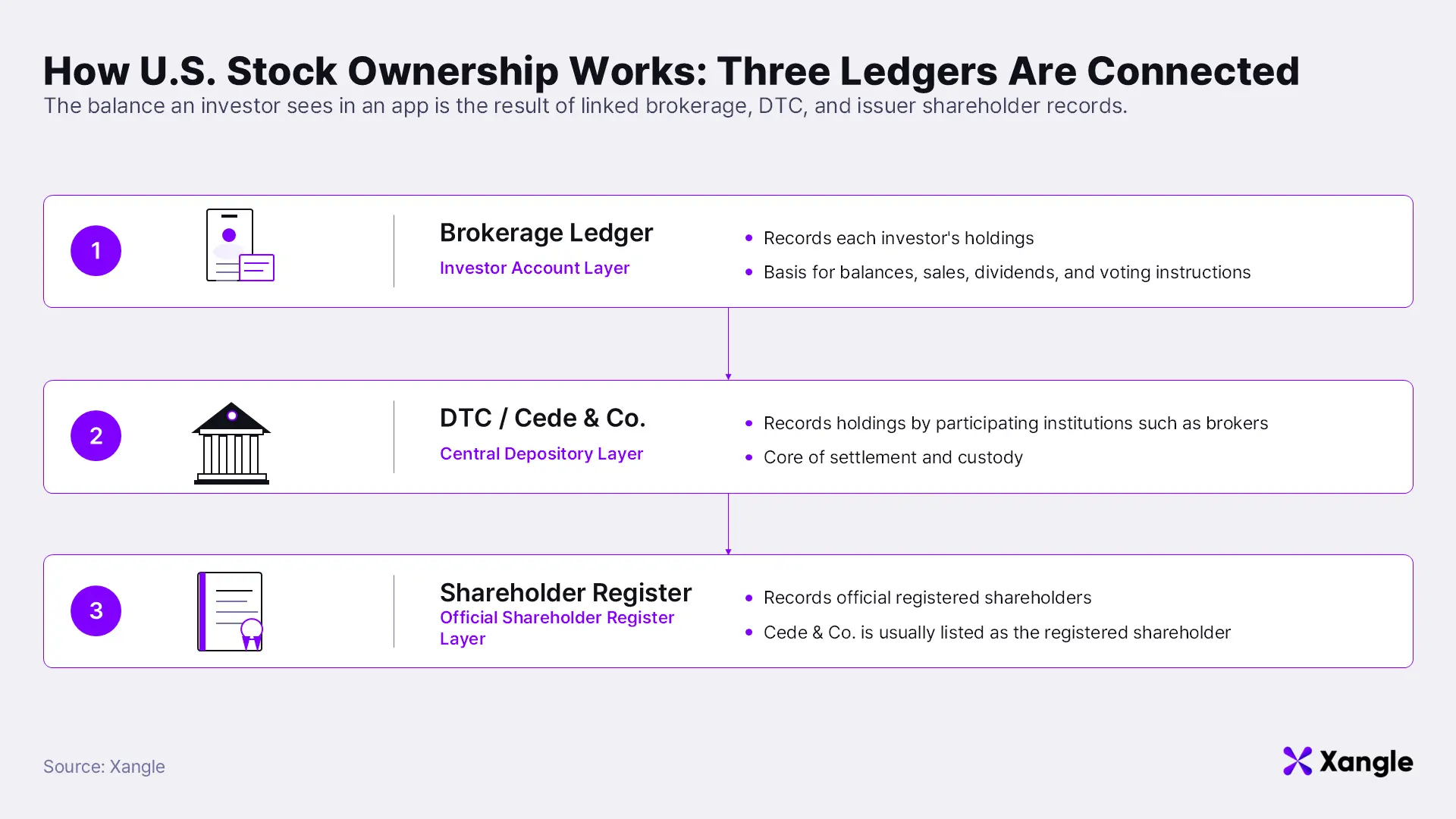
To understand stock tokenization, we first need to look at how U.S. stocks are actually held and recorded. When an ordinary investor buys AAPL through a brokerage app, the investor’s name typically does not appear directly on Apple’s official shareholder register. From the investor’s perspective, the app may show “10 shares of AAPL,” but behind the scenes, several layers of records are linked together to track that holding.
The U.S. stockholding structure can be divided into three layers of records, ordered by proximity to the investor. The first is the brokerage’s internal account records, which track holdings by customer. The second is the DTC records, which track holdings by DTC participants such as broker-dealers. The third is the official shareholder register maintained by the issuer or its transfer agent. Ordinary investors are recorded as beneficial owners in their brokerage accounts, while Cede & Co., DTC’s nominee holder, is typically listed as the registered shareholder on the official shareholder register.
*Transfer Agent: An institution that manages shareholder registers, share transfers, dividends, and corporate action records on behalf of the issuer.
The record closest to the investor is the brokerage’s internal account ledger. When an investor buys 10 shares of AAPL through a brokerage app, both the app interface and the brokerage’s records show that the investor holds 10 shares of AAPL. Based on this record, the investor can check the balance, place sell orders, receive dividends, and submit voting instructions. This record, however, does not mean the investor’s name has been entered directly into Apple’s shareholder register. The investor is recorded as a beneficial owner in the brokerage account.
The next layer is the DTC ledger. DTC is the central securities depository for the U.S. securities market, and it records holdings primarily at the level of DTC participants such as broker-dealers rather than at the level of individual investors. For example, if the customers of Brokerage A collectively hold 1 million shares of AAPL, DTC’s records show Brokerage A’s aggregate AAPL position. At this layer, the focus is on participant-level holdings such as “Brokerage A, 1 million shares of AAPL,” rather than investor-level balances such as “Alice, 10 shares of AAPL.”
The final layer is the issuer’s shareholder register. The official shareholder register of an issuer such as Apple is typically maintained by a transfer agent. However, each time an ordinary investor buys or sells shares through a brokerage app, the investor’s name is not newly added to Apple’s shareholder register. A large portion of U.S.-listed shares is registered in aggregate on the official shareholder register under Cede & Co., DTC’s nominee holder. As a result, Cede & Co. often appears as the registered shareholder on many issuers’ shareholder registers.
Suppose an investor buys 10 shares of AAPL through a brokerage app. The brokerage’s records show that the investor holds 10 shares of AAPL. DTC’s records reflect the brokerage’s AAPL position. The investor’s name is not newly added to Apple’s shareholder register, and Cede & Co. remains the registered shareholder. What the investor actually sees is a balance in the brokerage app, but that balance is the result of linked records across the brokerage, DTC, and the official shareholder register.
Not all U.S. shareholding necessarily passes through DTC. Through the Direct Registration System, or DRS, investors can register shares directly in their own name on the shareholder register rather than holding them through a brokerage account. In this case, the investor comes closer to being a directly registered shareholder. In practice, however, registering and trading through DRS is cumbersome, and the brokerage and DTC record structure remains the standard model. This is why the structure matters so much in discussions of stock tokenization.
Once this structure is clear, it becomes easier to see why the stock tokenization models discussed in the next section differ from one another. Some models try to connect the token ledger directly to the official shareholder register maintained by the issuer or transfer agent. Others represent indirect holding rights recognized on the books of DTC and brokerages as tokens. Still others do not transfer stock rights themselves, but instead provide specific economic exposure, such as stock price performance or dividends, through a separate product or contract. In stock tokenization, the key classification criterion is therefore which layer of records the token’s rights are linked to.
2-2. The SEC’s Classification of Tokenized Securities
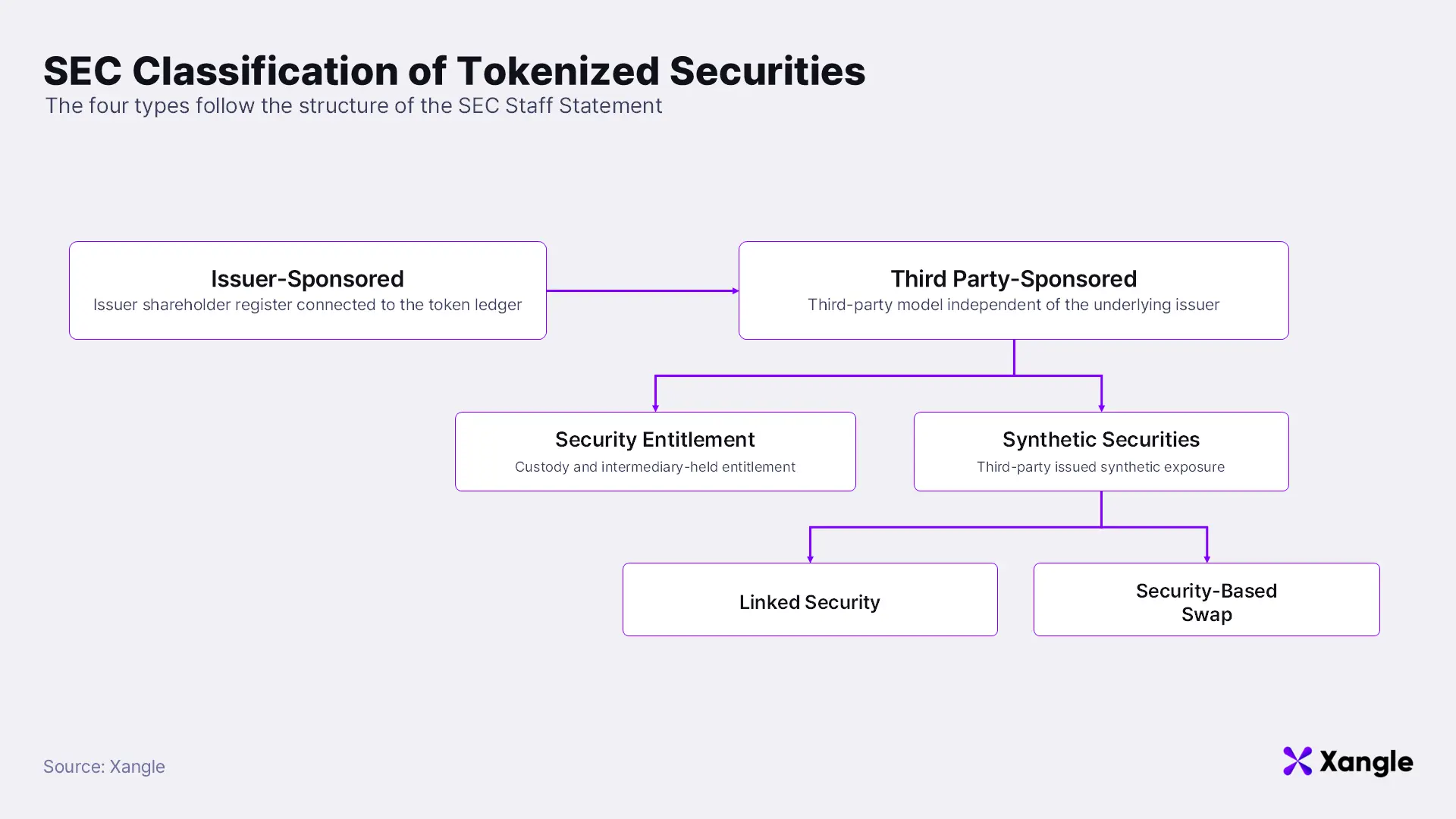
The classification in this section is based on a joint statement on tokenized securities issued on January 28, 2026, by three SEC divisions: the Division of Corporation Finance, the Division of Investment Management, and the Division of Trading and Markets. The SEC first divides tokenized securities into two broad categories based on who sponsors the tokenization.
- 1. Issuer-Sponsored Tokenized Securities: Tokenized securities in which the issuer of the underlying security, or its agent, directly performs the tokenization.
- 2. Third Party-Sponsored Tokenized Securities: Tokenized securities in which a third party unrelated to the issuer of the underlying security tokenizes the security itself or its economic exposure.
Put simply, the issuer of AAPL stock is Apple. A structure in which Apple’s official shareholder register is directly linked to a blockchain token ledger, so that a token transfer results in a change of ownership on the actual shareholder register, falls under issuer-sponsored tokenized securities. In this case, the token is closer to a digital security linked to actual Apple share ownership records than to a product that merely tracks Apple’s stock price.
By contrast, if a third party with no direct relationship to Apple purchases and custodies AAPL shares, or constructs a separate product that provides economic exposure to Apple’s stock price and then issues it as a token, the structure falls under third party-sponsored tokenized securities. For example, when Backed issues Apple xStock (AAPLx) based on AAPL shares, AAPLx is not a stock token issued directly by Apple. It is a third-party tokenized product linked to Apple’s stock price. Holders therefore do not become direct shareholders of Apple. Instead, they obtain economic exposure to Apple’s stock price through a product issued by a third party.
Third party-sponsored tokenized securities can be divided into three subtypes.
- 1. Tokenized Security Entitlement: A structure that represents, in token form, security entitlements held indirectly through DTC, brokerages, custodians, and similar intermediaries.
- 2. Linked Security: A tokenized security in which a separate security is issued to track the price or return of a specific stock or ETF.
- 3. Security-Based Swap: A tokenized security that represents, in token form, a swap contract that settles gains and losses based on the price of a specific stock or issuer event.
A tokenized security entitlement represents indirect holding rights recognized on the records of DTC, brokerages, and custodians in token form. A representative example is the DTC Tokenization Service, a tokenization model that allows participating institutions to record and transfer, in token form, their security entitlements in securities held at DTC.
A linked security is a structure in which a third party issues a separate security linked to the price performance of a specific stock or ETF. Even if a third party issues a price-linked product based on AAPL shares, as in Backed’s AAPLx, holders are not direct shareholders of Apple and do not have voting rights or shareholder rights against Apple.
A security-based swap does not involve holding actual shares or a stock-linked security. It is a structure that settles contractual gains and losses based on a specific stock price or issuer event. A total return swap (TRS), in which the investor receives a settlement payment from the counterparty when AAPL rises and makes a payment when AAPL falls, is an example of this type of structure.
The SEC’s classification provides a useful legal reference point for understanding tokenized securities. In the real market, however, stock tokenization products do not fit neatly into these four buckets alone. Some products settle contractual gains and losses based on stock prices but are difficult to classify strictly as security-based swaps. In addition, stock-based perpetual futures, which are not included in the tokenized securities taxonomy in the SEC statement, are actively traded on exchanges and in on-chain derivatives markets.
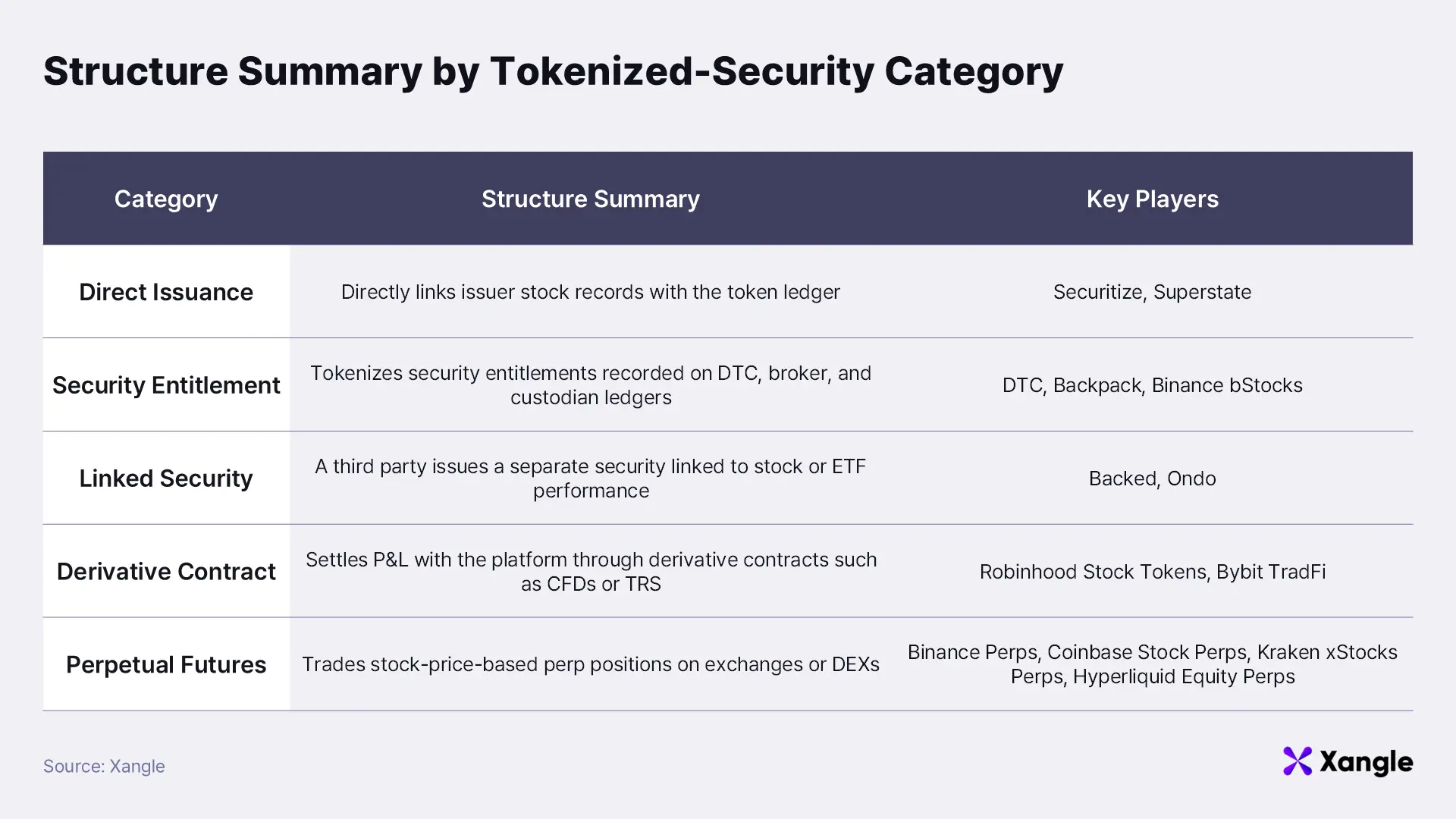
This report therefore uses the SEC’s taxonomy as a starting point, but reorganizes stock tokenization products into five types based on how projects are actually implemented in the market. Issuer-sponsored tokenized securities are classified as ① direct issuance models. Tokenized security entitlements are classified as ② security entitlement models. Linked securities are classified as ③ linked security models. Because security-based swaps can be too narrowly tied to the specific legal form of a swap, this report groups CFD, over-the-counter derivative, and financial derivative contract structures with similar settlement economics under ④ derivative contract models. Finally, it adds ⑤ perpetual futures models, which are not directly included in the SEC’s tokenized securities taxonomy but are actively traded in the market. This framework allows us to compare whether each product transfers actual shares, tokenizes book-entry rights, or provides only contractual exposure to stock prices.
3. Key Players and Product Structures by Category
This section examines projects across five categories: ① direct issuance models, ② security entitlement models, ③ linked security models, ④ derivative contract models, and ⑤ perpetual futures models. Even when stock tokenization products are based on the same underlying stock, the rights and risks investors actually hold can vary significantly. In one structure, the token may be directly linked to shareholder register records. In another, it may represent book-entry rights at a broker or custodian, a security issued by a third party, a stock-linked contract, or a derivatives position on an exchange. This section therefore looks at the legal and operational structures through which major players provide stock exposure, and how each structure differs in terms of investor rights and product utility.
3-1. Direct Issuance Model
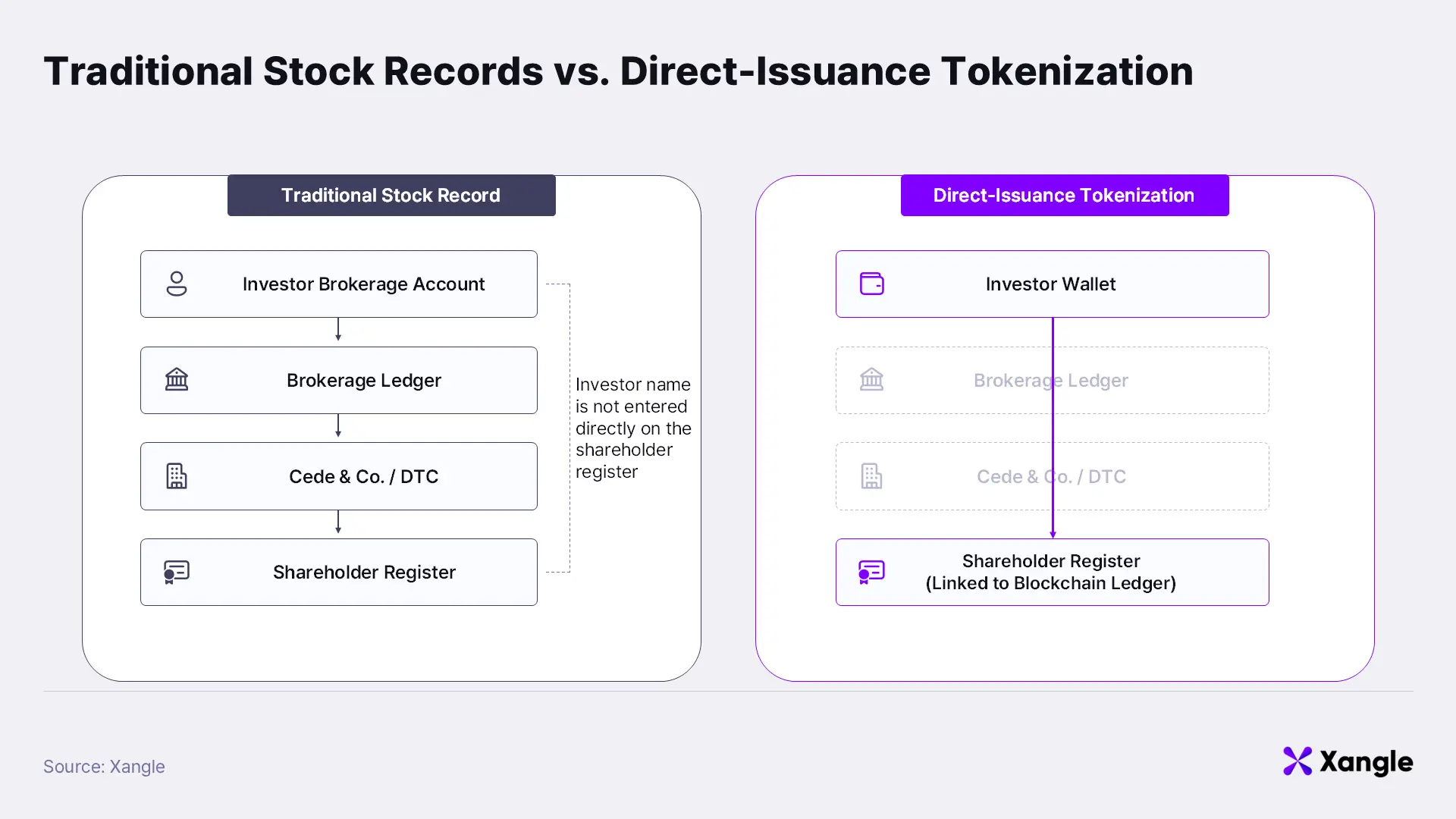
The direct issuance model corresponds to the SEC’s issuer-sponsored tokenized securities category. In this structure, the token is directly linked to the issuer’s official share ownership records. As discussed earlier, when an investor buys stock through a typical brokerage app, the investor’s name is usually not entered directly into the issuer’s shareholder register. In a direct issuance model, those intermediary brokerage records are removed, and the holding is recorded directly in the issuer’s shareholder register linked to the blockchain ledger.
When an investor holds the token, the holding is matched with the official share ownership records maintained by the transfer agent or issuer. Rights such as dividends, voting rights, stock splits, and record date determinations are allocated on that basis. A token transfer is therefore more than a change in wallet balance. It also changes, or continuously synchronizes with, the official record of who holds the rights to the relevant shares.
Because the token is linked to actual stock rights, however, a direct issuance token cannot usually be transferred freely to any wallet like an ordinary token. Requirements such as know-your-customer checks, approved investors, whitelisted wallets, transfer restrictions, jurisdictional restrictions, and sanctions screening typically apply. The token may have on-chain utility, but that utility is designed to operate within a regulated framework.
Securitize
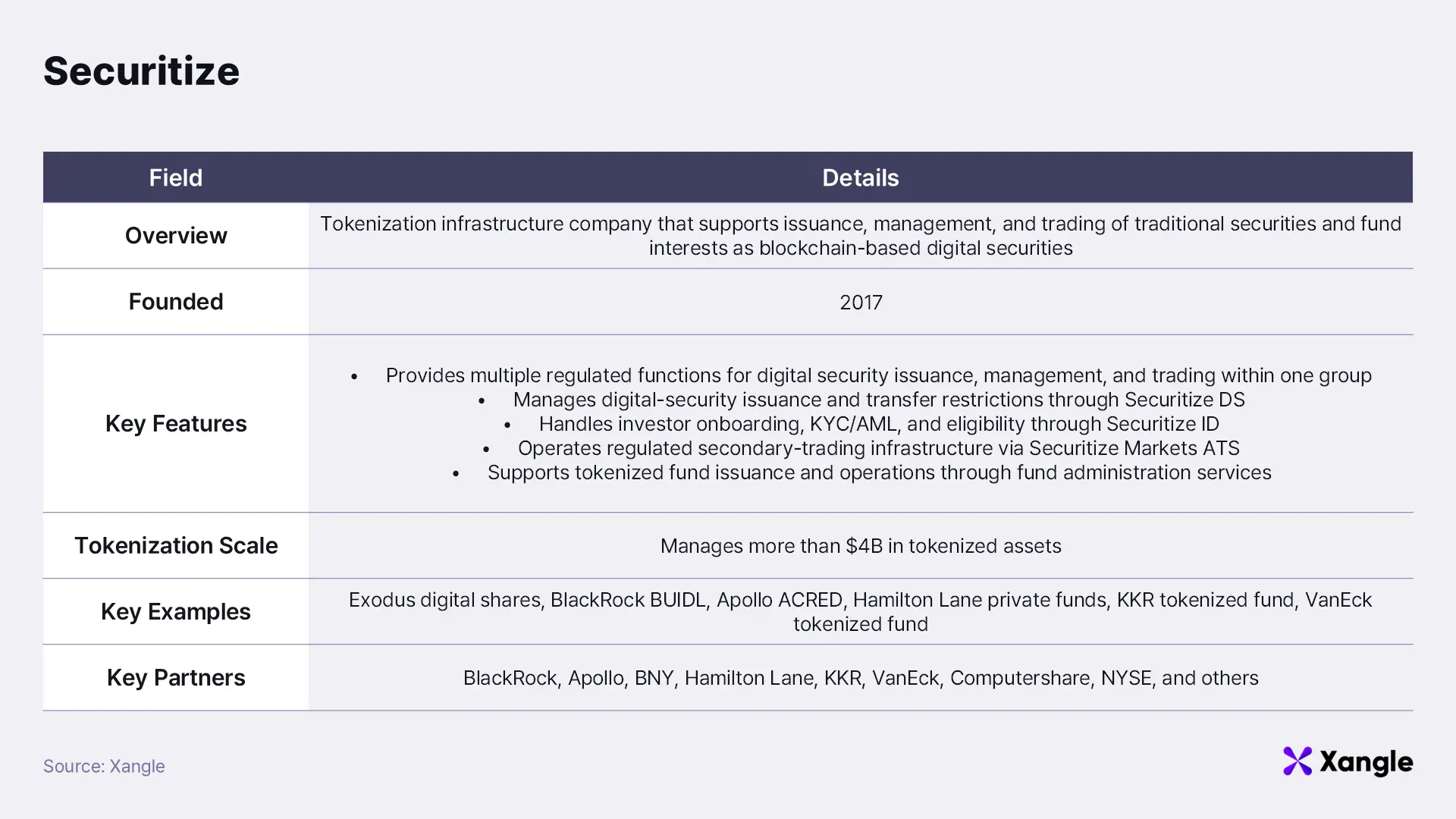
Securitize is a tokenization infrastructure company that enables traditional securities and fund interests to be issued, managed, and traded as blockchain-based digital securities. It is not a wrapping-style issuer that simply purchases an underlying asset and wraps it into a token. Rather, it is a comprehensive platform that connects investor onboarding, KYC/AML, token issuance and burning, holder registry management, transfer restrictions, and secondary trading services so that issuers and asset managers can issue securities directly in digital form.
Securitize’s competitive strength lies in its ability to connect the functions required for digital securities issuance, transfer agency, investor verification, transfer restrictions, and secondary trading within a single group. Securitize DS supports issuance, transfer restrictions, and compliance logic for security tokens. Securitize ID handles investor onboarding, KYC/AML, and investor eligibility checks. Securitize Markets is an SEC-registered broker-dealer and FINRA member that operates Securitize Markets ATS, a regulated alternative trading system. By combining these capabilities with SEC-registered transfer agency functions and fund administration services, Securitize allows issuers to operate the key functions needed after token issuance within one infrastructure stack.
Securitize has built tokenized fund and digital securities infrastructure in collaboration with traditional financial institutions such as BlackRock, Apollo, BNY, Hamilton Lane, KKR, and VanEck. As of April 2026, it disclosed that it managed more than $4 billion in tokenized assets. Representative examples include BlackRock BUIDL, Apollo ACRED, Hamilton Lane private funds, KKR tokenized funds, VanEck VBILL, and Exodus digital shares. More recently, Securitize partnered with global transfer agent Computershare to establish a structure that allows U.S.-listed companies to issue tokenized shares alongside existing shares and DRS holdings. In March 2026, it also signed an MOU with NYSE to develop the tokenized securities market and is expected to serve as transfer agent for blockchain-based securities issuance by companies and ETFs on NYSE’s planned digital trading platform.
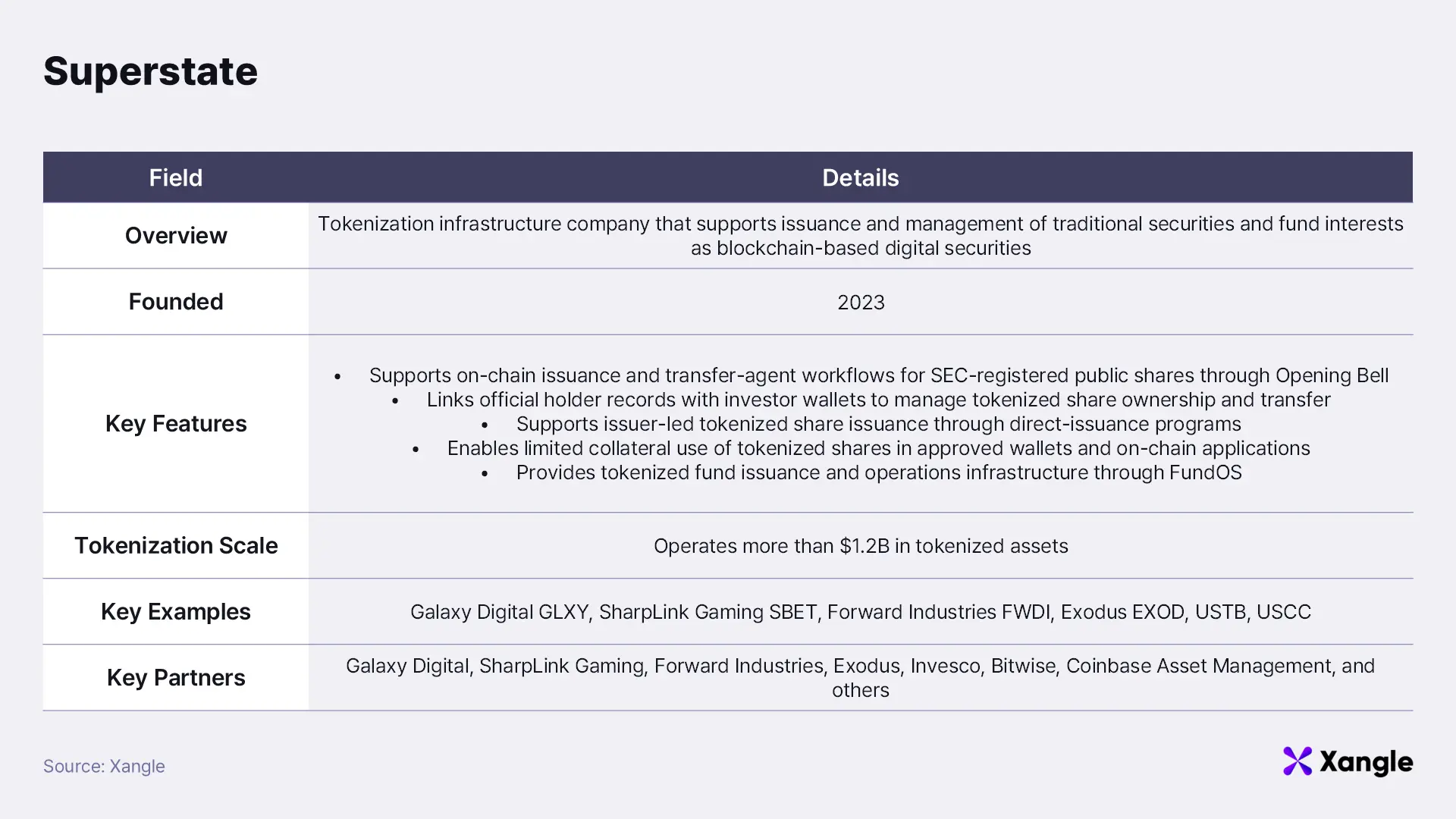
Superstate
Superstate is a tokenization infrastructure company that enables traditional securities and fund interests to be issued and managed as blockchain-based digital securities. Like Securitize, it provides digital securities infrastructure across issuance, transfer agency, investor onboarding, and fund interest management. It operates Opening Bell, a listed-stock tokenization platform, and FundOS, a fund tokenization platform. Opening Bell helps public companies issue and manage their shares on blockchain, while FundOS enables private fund, mutual fund, and ETF interests to be issued and managed in token form.
One of Superstate’s distinctive features is Opening Bell’s Direct Issuance Program. This structure allows listed companies to issue new shares in token form, sell them directly to eligible investors, and receive payment in stablecoins such as USDC. The issuer sets the issuance size, investor requirements, pricing terms, and other conditions, while investors receive tokenized shares according to those terms. Through this infrastructure, companies can handle new share issuance, investor onboarding, payment, token allocation, and holder record updates within the same system. Since the tokens are linked to actual stock rights, conditions under securities regulations and issuer policies, such as investor eligibility, approved wallets, transfer restrictions, and jurisdictional restrictions, also apply.
Superstate has built on-chain issuance and transfer agency infrastructure for stocks and funds through tokenized shares of public companies such as Galaxy Digital (GLXY), SharpLink Gaming (SBET), Forward Industries (FWDI), Exodus Movement (EXOD), and Solana Company (HSDT), as well as tokenized fund infrastructure for products such as USTB, USCC, and CUSHY. More than $1.2 billion in tokenized assets are issued and managed through Superstate’s infrastructure. Going forward, Superstate plans to expand issuer-led tokenized stock issuance and stablecoin-based payment through Opening Bell, while using FundOS to provide existing private fund, mutual fund, and ETF interests in token form so they can be held and managed across multiple blockchains.
3-2. Security Entitlement Model
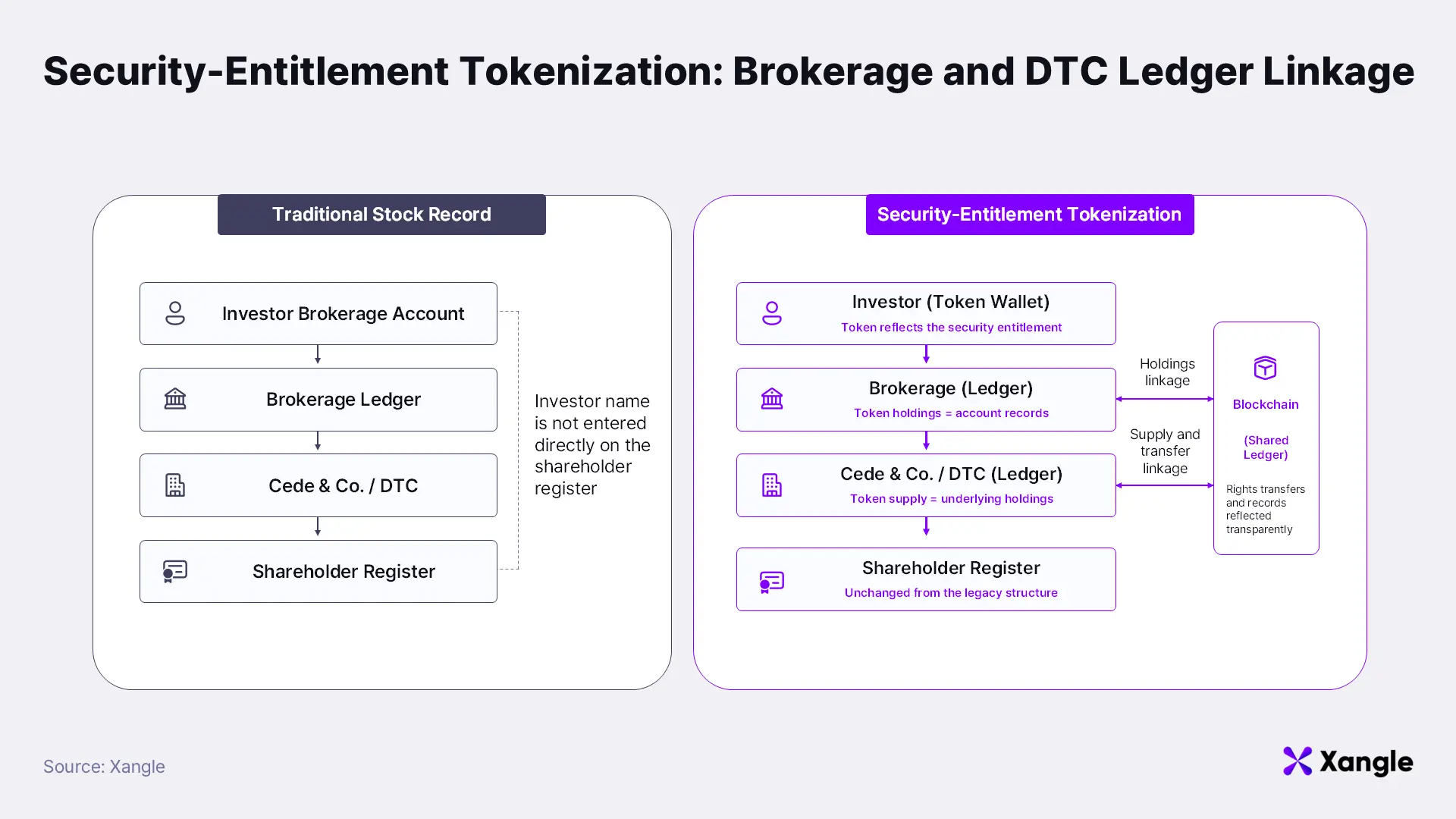
The security entitlement model corresponds to the SEC’s tokenized security entitlement category. The security entitlement here is not the stock itself reflected directly in the issuer’s shareholder register or transfer agent records, as in the direct issuance model. It is closer to the indirect holding rights that ordinary investors have when they buy and hold U.S. stocks through a brokerage app. In other words, the investor does not have their name entered directly into the issuer’s shareholder register. Instead, the investor holds rights to the shares through the books of a broker and DTC. The security entitlement model connects these intermediary book-entry rights to tokens or on-chain records, seeking to make the recording and transfer of rights more efficient within the existing securities market structure.
This approach differs from the direct issuance model, which reduces or bypasses parts of the existing securities market intermediary infrastructure. The security entitlement model preserves the existing chain of issuer, transfer agent, central securities depository, and broker, while connecting the rights records and transfer processes managed within that structure to a tokenized ledger. Rather than redesigning the issuance and holding structure of stocks, it adds an on-chain recordkeeping and transfer layer on top of existing regulated infrastructure. Its scope for structural innovation is more limited than that of direct issuance, but it offers higher compatibility with existing market infrastructure and a relatively lower implementation burden.
A representative example is DTC’s tokenization service. Through an SEC no-action letter, DTC received confirmation that DTC participants may tokenize security entitlements in eligible securities held through DTC under certain conditions. A no-action letter is a letter in which the SEC states that, based on specific facts and conditions, it would not recommend enforcement action. It reduces regulatory uncertainty under a limited set of conditions.
More recently, transitional models such as Backpack Securities and Binance bStocks have emerged, connecting traditional securities holdings and tokenized holdings within the same service. In these models, users can hold stocks in the form of a traditional securities account within the scope supported by the platform, convert them into on-chain tokens, and then hold or transfer them in a wallet. When needed, conversion and redemption procedures are also provided so users can return to traditional securities account holdings. However, the rights in tokenized form are defined by the platform’s terms and its conversion and redemption structure. To exercise security entitlements, users must convert the tokens back into traditional securities holdings. Backpack and bStocks can therefore be viewed as transitional security entitlement models that provide mobility between traditional securities infrastructure and on-chain tokens.
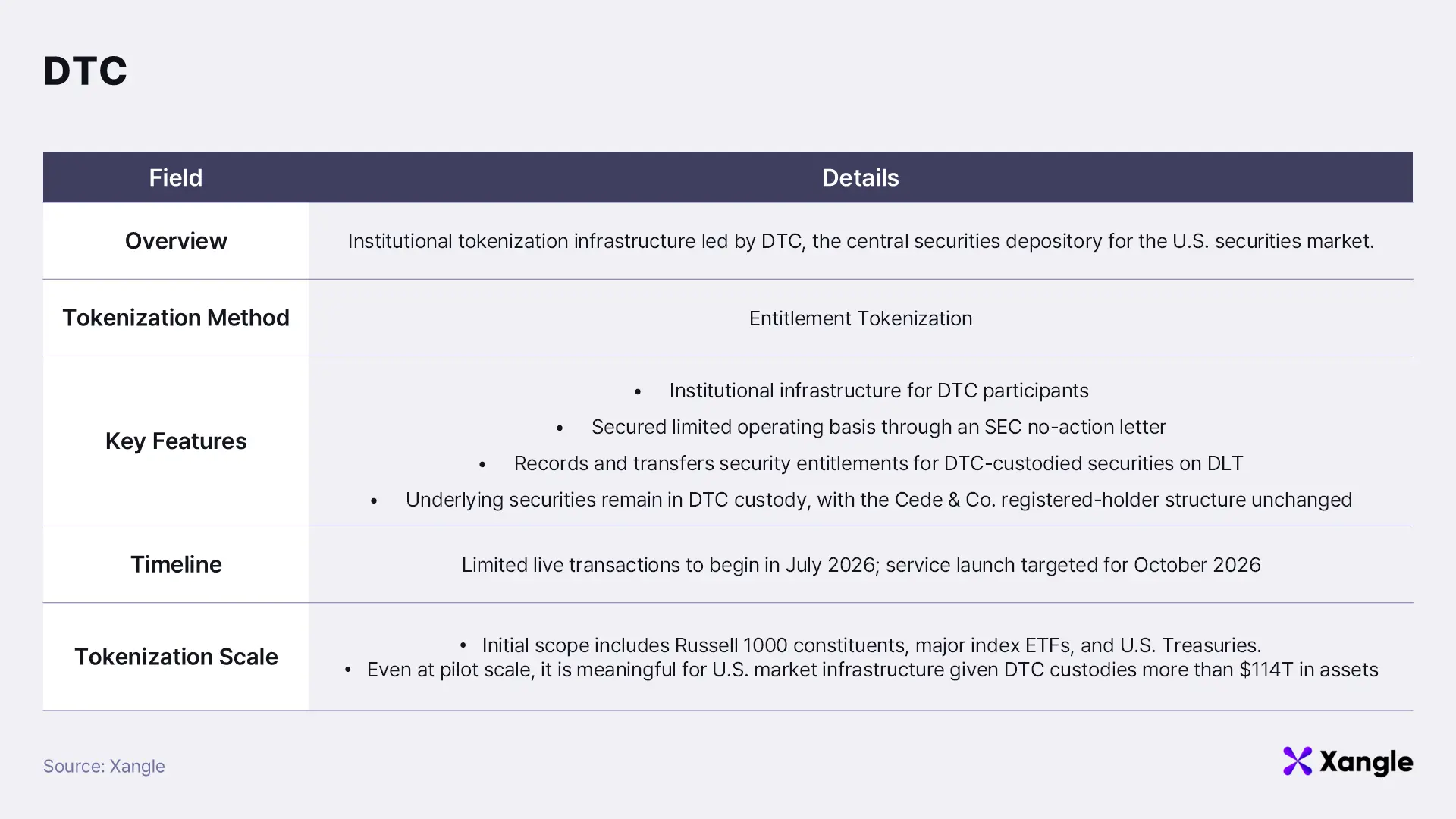
DTC
DTC(The Depository Trust Company) is the central securities depository for the U.S. securities market. A large share of U.S.-listed equities is registered in aggregate under the name of Cede & Co., DTC’s nominee holder, rather than directly in the names of individual investors on shareholder registers. Ordinary investors are recorded as beneficial owners in brokerage accounts rather than being listed directly on issuers’ shareholder registers. Rights associated with stock ownership, such as dividends, disposition, and voting rights, are therefore exercised through brokerages and DTC.
DTC is building the DTC Tokenization Service on top of this structure. It is an institutional tokenization service that allows DTC participants to convert book-entry security entitlements in securities held through DTC into tokenized rights on a distributed ledger and transfer them between registered wallets. During this process, the registered name of the underlying securities does not change, and the securities remain within DTC’s existing custody system. What changes is not the ownership structure of the shares themselves, but the way DTC participants record and transfer the security entitlements they hold.
After receiving an SEC no-action letter in December 2025, DTC outlined a schedule to begin limited live transactions in July 2026 and launch the service in October 2026. Initial eligible assets are expected to include Russell 1000 constituents, major index-tracking ETFs, and U.S. Treasuries. The no-action letter is limited to three years from the start of the service, so this should not be viewed as a full on-chain transformation of the entire U.S. securities market from the outset. Even so, given that DTC custodies more than $114 trillion in assets, this effort carries much greater significance than a standalone product experiment. It marks the beginning of an institutional test in which core U.S. securities market infrastructure records and transfers tokenized rights within the regulated system, and its potential impact on future market structure could be substantial.
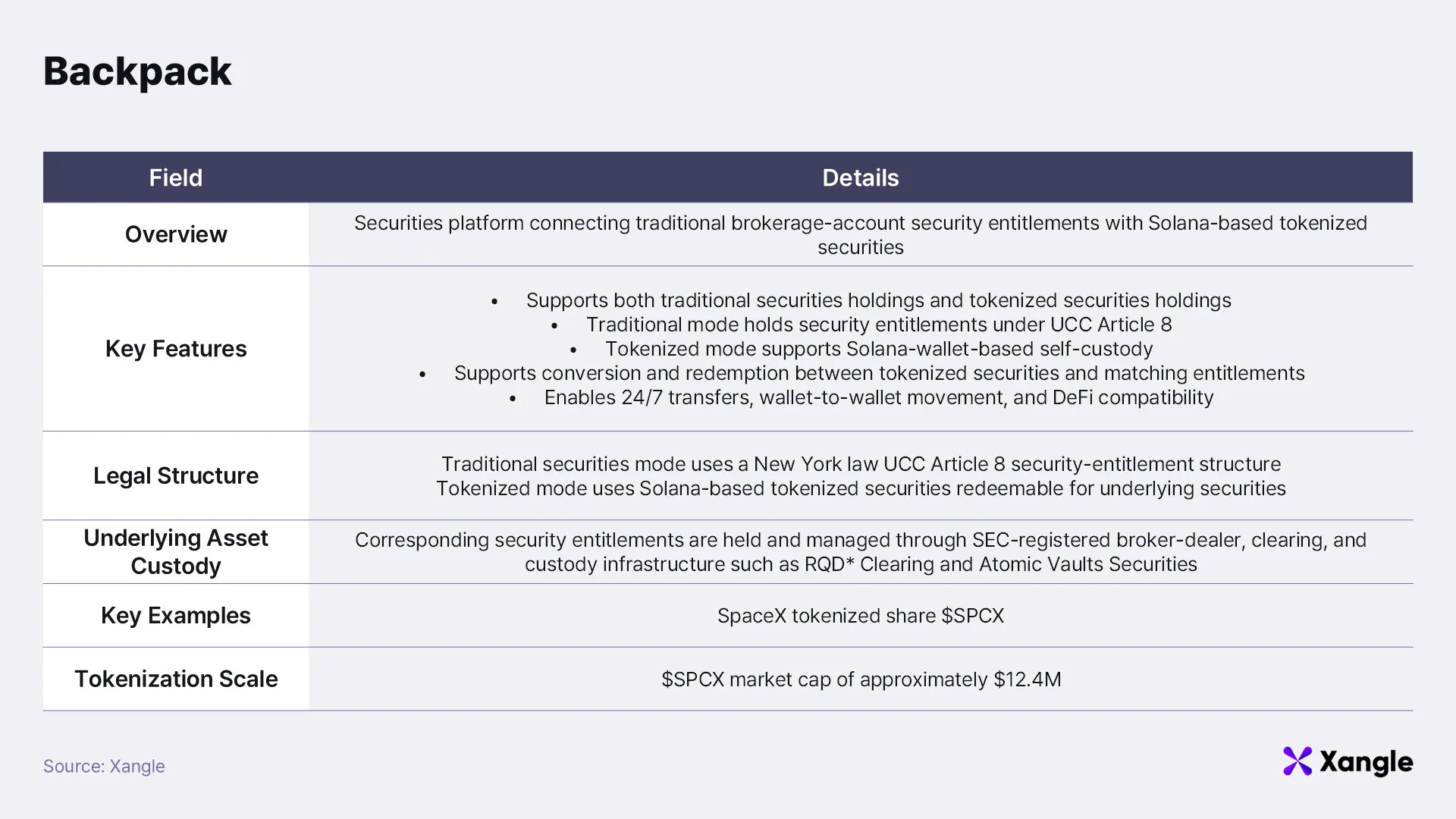
Backpack
Backpack is a global crypto exchange and wallet infrastructure project that began in the Solana ecosystem. It started in 2022 when Solana developer Armani Ferrante created the self-custody Backpack Wallet, and later expanded into Backpack Exchange. Since its beta launch in November 2023, Backpack Exchange has broadened its product lineup around an integrated portfolio experience that combines spot trading, perpetual futures, lending, yield products, and a self-custody wallet.
Backpack’s recently announced Stocks product is a hybrid model that seeks to connect traditional brokerage-based securities holdings with Solana-based tokenized securities. Users can hold U.S. stocks and ETFs on Backpack in traditional securities form, convert them into Solana-based tokenized securities, or redeem them back into traditional securities rights. Traditional securities holdings are structured as security entitlements under UCC Article 8 of New York law, similar to the indirect holding structure that applies when investors hold stocks in brokerage accounts. The actual clearing and custody layer is connected to SEC-registered traditional brokers such as RQD Clearing and Atomic Vault Securities. This allows users to access traditional securities holding functions, including dividends, corporate action processing, and transfers to external brokerages, alongside on-chain transfer and self-custody functions.
Backpack’s recently issued $SPCX on Solana attracted attention as a tokenized security representing SpaceX shares, with the ability to be redeemed into security entitlements in the underlying shares. $SPCX is jointly issued by Backpack and Sunrise. It can be self-custodied in Solana wallets and supports 24/7 trading, wallet-to-wallet transfers, and DeFi use. After launch, it rapidly absorbed liquidity in the Solana-based tokenized stock market. During a period when 24-hour spot trading volume for Solana tokenized stocks reached $187.9 million, $SPCX volume exceeded $105 million and accounted for more than half of the total. This shows that Backpack’s security entitlement model was able to capture a high share of trading in a short period in a tokenized stock market that had previously centered on Backed’s xStocks.
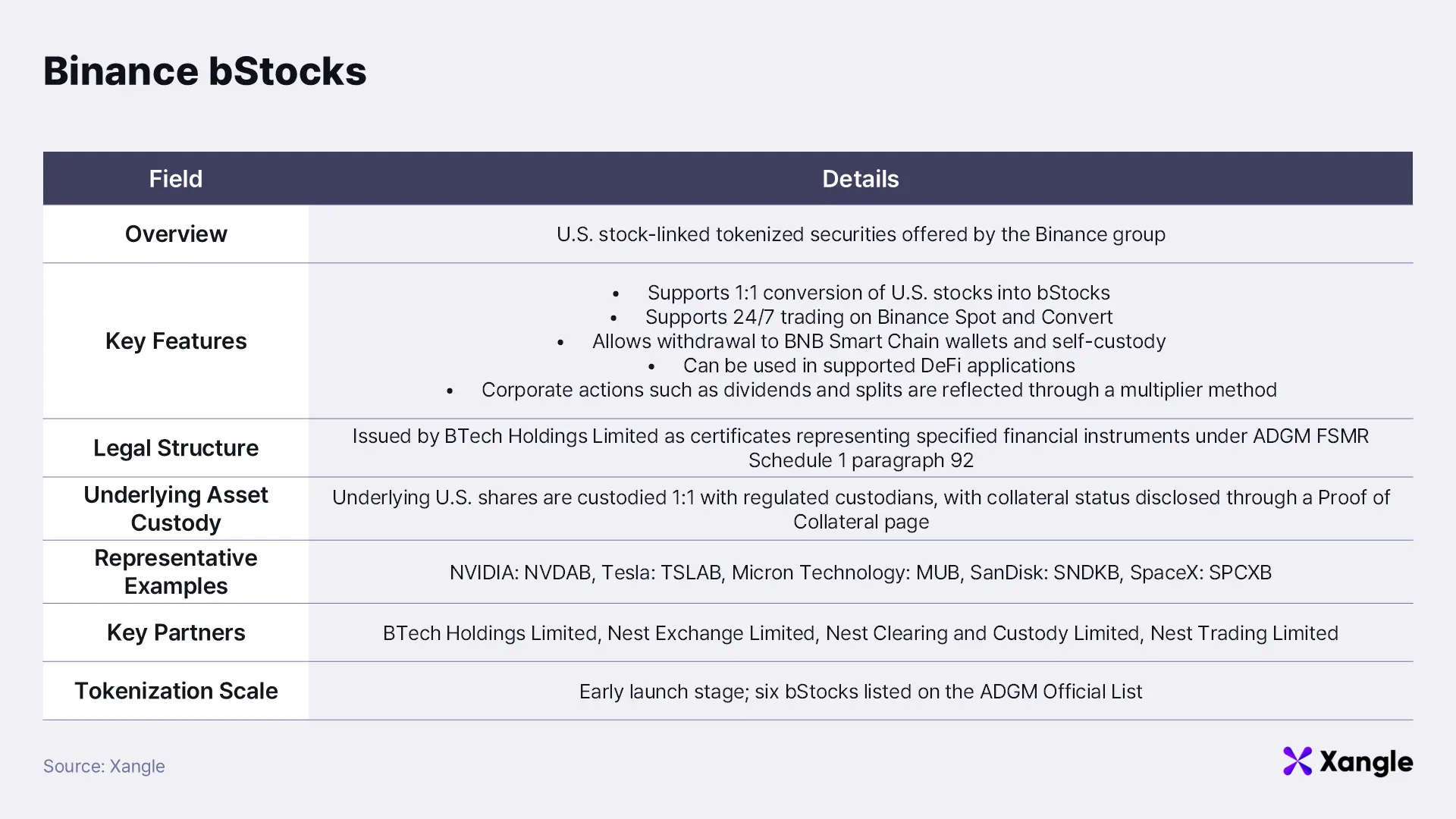
Binance bStocks
Binance bStocks are U.S. stock-linked tokenized securities launched by Binance in June 2026. bStocks are issued by BTech Holdings Limited, a Binance group affiliate, and offered based on a prospectus approved in ADGM. Each bStock represents an interest in the underlying U.S. shares held by the issuer, and holders have rights as holders of tokenized securities issued by BTech. The underlying shares are held 1:1 with regulated custodians, and Binance discloses collateral status through its Proof of Collateral page.
A key feature of bStocks is that they connect Binance’s existing stock trading functionality with BNB Smart Chain-based on-chain distribution. Eligible users can convert U.S. stocks held on Binance into bStocks at a 1:1 ratio, or purchase bStocks through Spot and Convert channels. Once issued, bStocks can be traded 24/7 within Binance, withdrawn to BNB Smart Chain-compatible wallets for self-custody, and used in supported DeFi applications. Corporate actions such as dividends and stock splits are automatically reflected in token balances or value through the Multiplier mechanism. The Multiplier is an adjustment factor applied to a user’s original on-chain token amount. When dividend reinvestment or a stock split occurs, the displayed balance and calculated holding value are adjusted automatically.
3-3. Linked Security Model
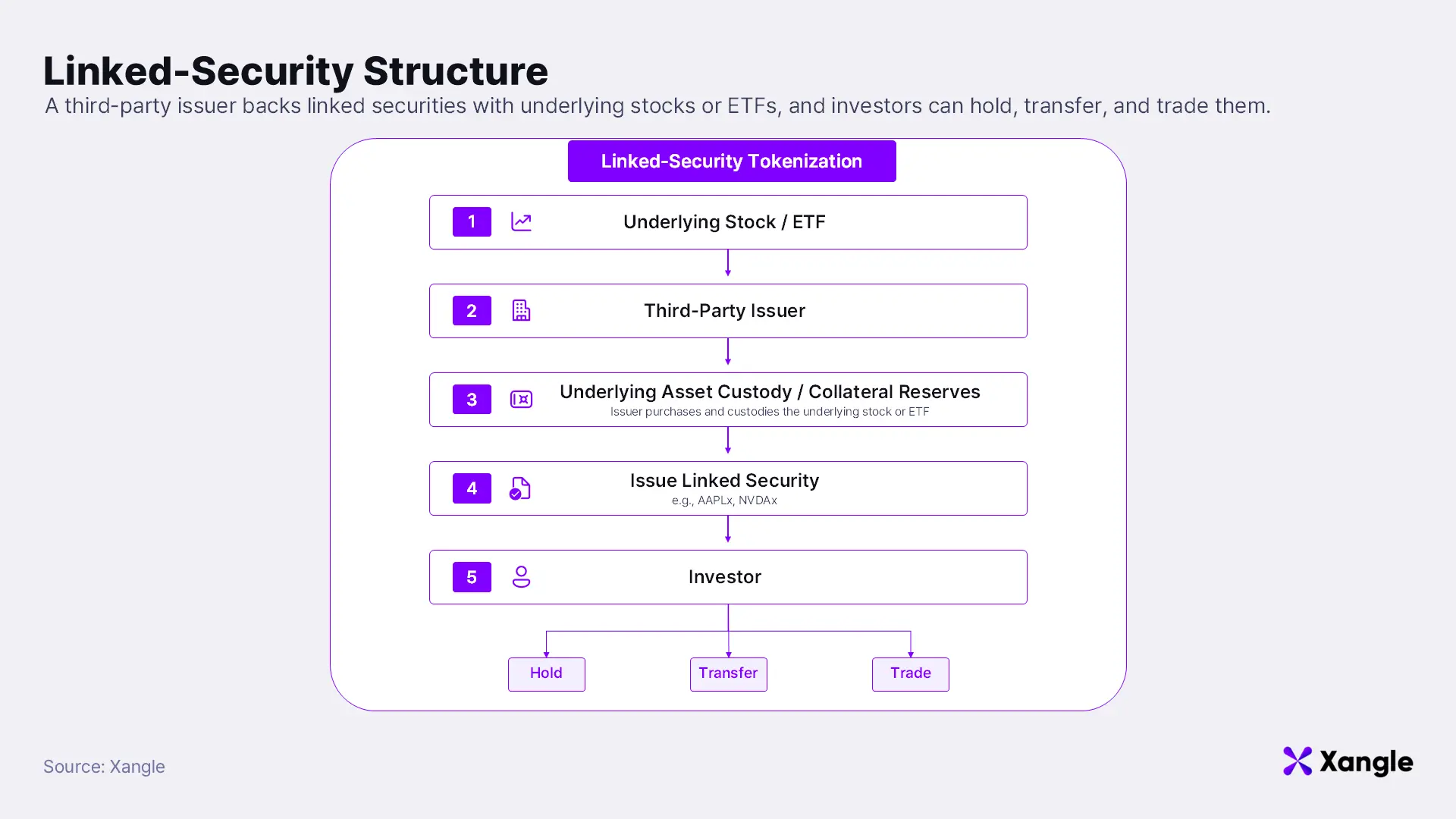
The linked security model corresponds to the SEC’s linked security category. In this model, a third party other than the stock issuer issues a separate security linked to the price, return, dividends, or corporate actions of an underlying asset such as Apple, Nvidia, Tesla, or an S&P 500 ETF, and provides it in token form. Investors gain exposure to the economic performance of the underlying asset through the token, but their claims are against the issuer of the linked security, not the underlying company such as Apple or Nvidia. What investors hold is therefore not a direct right in the underlying company’s shares, but the rights defined by the linked security or tokenized product issued by a third party.
In this structure, the underlying shares or ETFs are generally held as collateral or reserve assets. For example, when an issuer issues a token such as AAPLx, it can hold actual AAPL shares or equivalent assets with a custodian and design the token’s price and rights treatment to reflect AAPL’s price, dividends, and corporate actions. Events such as dividends, stock splits, reverse splits, delistings, and redemptions are reflected in the token price, token quantity, cash payments, or redemption value according to the terms and operating procedures set by the linked security issuer. Investors do not claim this treatment directly from the underlying company. They claim it against the linked security issuer under the product terms.
When assessing a linked security model, investors therefore need to look beyond which stock the token tracks and examine the collateral, issuer, and redemption structure behind it. Key questions include whether the underlying asset is actually held, how the collateral ratio is maintained, who the custodian is, whether investors can redeem in cash or for the value of the underlying asset, and how dividends and corporate actions are reflected. Investor eligibility, approved wallets, jurisdictional restrictions, and on-chain distribution channels also matter. Representative projects in the linked security category include Backed and Ondo.
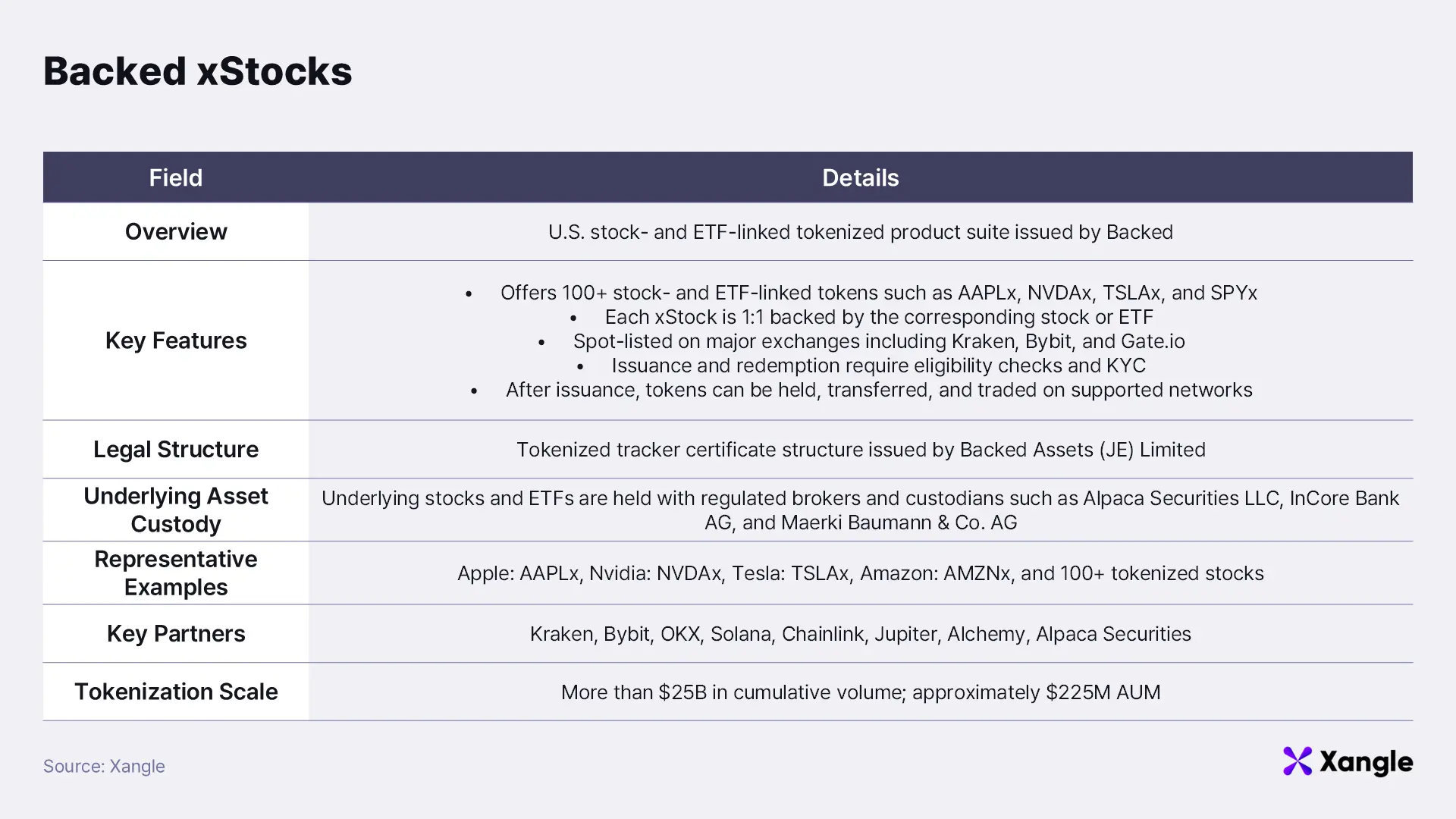
Backed xStocks
Backed xStocks are stock and ETF-linked tokenized products issued by Backed. Backed is a tokenization infrastructure company founded in 2021, and it launched xStocks to allow U.S. stocks and ETFs to be held and traded on-chain. In December 2025, Kraken agreed to acquire Backed Finance AG, the company that led the issuance of xStocks. Through the acquisition, Kraken plans to integrate xStocks issuance, trading, and settlement infrastructure more deeply into its ecosystem. xStocks offer more than 100 stock and ETF-linked tokens, including AAPLx, NVDAx, TSLAx, and SPYx, and are structured as tokenized tracker certificates issued by Backed Assets (JE) Limited. Each token is collateralized 1:1 by the underlying stock or ETF, the underlying assets are held in segregated custody accounts, and reserve asset attestations are disclosed.
At the issuance and redemption stages, xStocks require relatively strict eligible investor checks and KYC procedures. The process of issuing new xStocks collateralized by underlying stocks or ETFs, or redeeming held xStocks for assets corresponding to the value of the underlying assets, is available to onboarded investors. Once issued, however, xStocks are designed to be held, transferred, and traded on-chain in token form. During on-chain distribution, users do not need to complete KYC with the issuer every time. Instead, the tokens can be used like ordinary tokens in wallets, decentralized exchanges, and lending protocols. The rights of xStocks holders are defined by the terms of the tokenized product issued by Backed, and corporate actions such as dividends and stock splits are reflected in token quantity, price adjustments, redemption value, or other mechanics according to those terms and operating procedures.
Ondo Global Markets
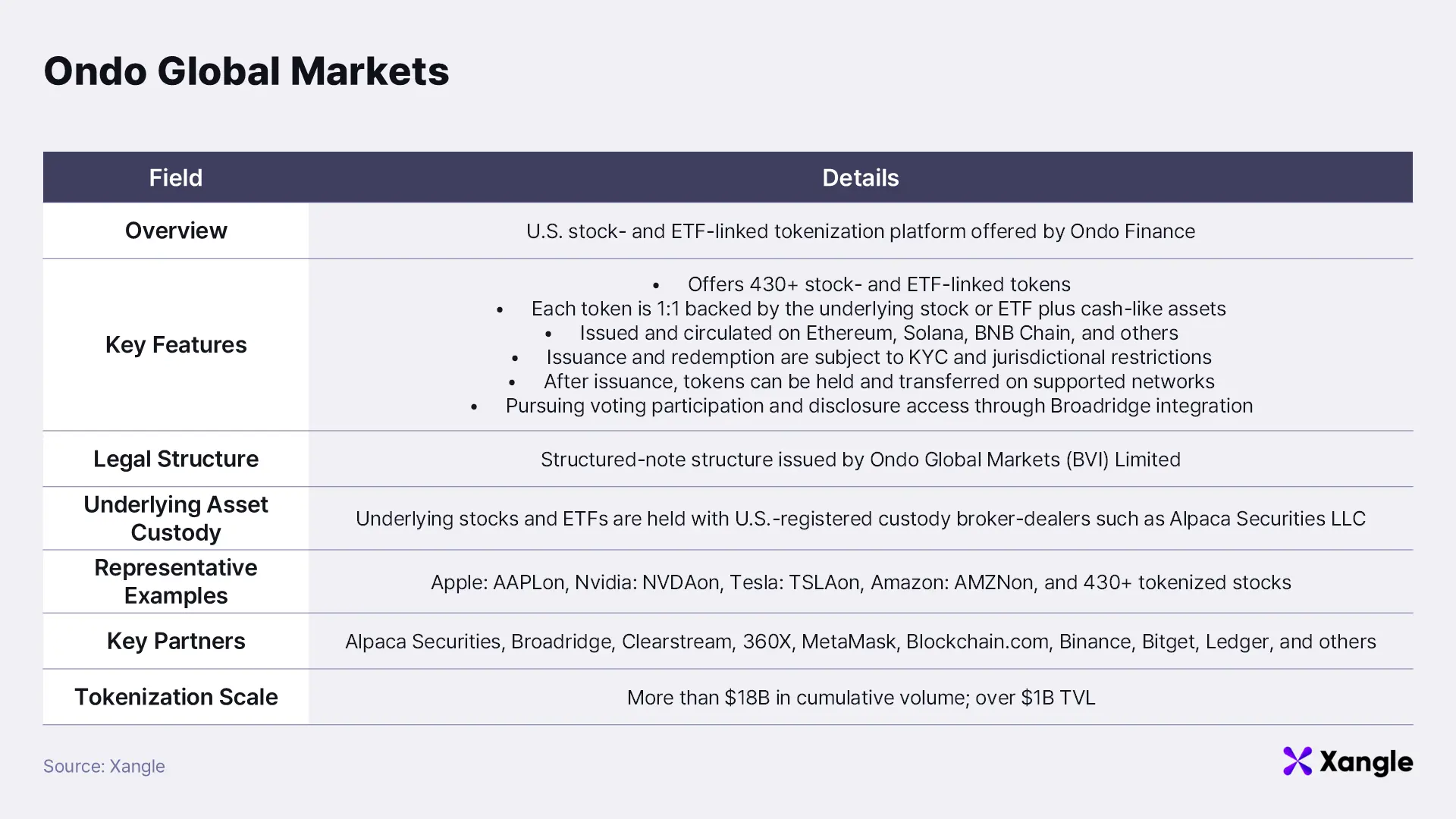
Ondo Global Markets is a U.S. stock and ETF tokenization platform provided by Ondo Finance. Ondo is a tokenization infrastructure company known for U.S. Treasury-based tokenized products such as OUSG and USDY, and it has expanded its on-chain product scope to public-market equities and ETFs through Global Markets. Ondo Global Markets’ tokenized stocks are structured as notes issued by Ondo Global Markets (BVI) Limited, with each token tracking the economic performance of the corresponding underlying stock or ETF based on price, dividends, and corporate actions. The underlying stocks and ETFs are held through U.S.-registered custodial broker-dealers, and the tokens are collateralized 1:1 by the corresponding underlying assets and cash-like assets.
Ondo Global Markets initially offered more than 100 U.S. stocks and ETFs, and has recently expanded to more than 430 tokenized assets across Ethereum, Solana, BNB Chain, and other networks. Issuance and redemption are subject to KYC and jurisdictional restrictions, and U.S. persons and investors located in the United States are excluded. Like Backed’s xStocks, issued tokens can be transferred on supported blockchains and used on-chain. Token holder rights arise under the terms of the structured notes, and shareholder rights in the underlying companies are not provided. However, through integration with Broadridge, a proxy voting and shareholder communications infrastructure provider, Ondo is adding functionality that enables token holders to access proxy voting, regulatory disclosures, and communications related to the underlying securities.
3-4. Derivative Contract Model
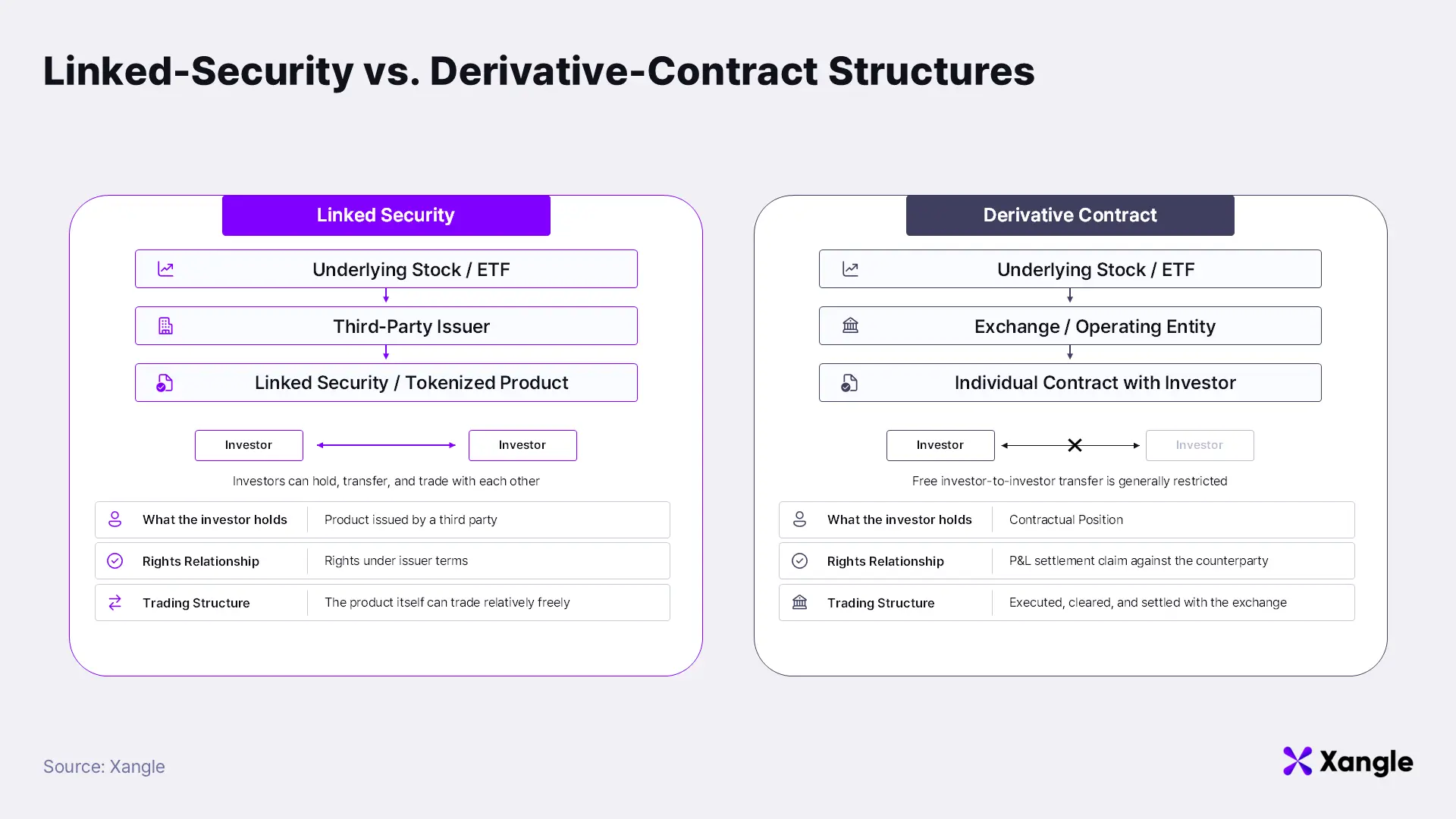
The derivative contract model settles contractual gains and losses using stocks or ETFs as underlying assets. The SEC category that most directly corresponds to this model is the security-based swap, but this report treats products with similar economic structures, including total return swaps (TRS), contracts for difference (CFDs), over-the-counter derivatives, and financial derivative contracts, as derivative contract models. Investors do not hold the underlying shares, rights in a securities account, or a separate security. Instead, they receive settlement of gains and losses from changes in stock price or returns under a contract with a counterparty.
In the linked security model, a third party issues a new security, certificate, or tokenized product linked to an underlying stock or ETF, and investors can hold, transfer, and trade that product with relatively few frictions. In the derivative contract model, the investor enters into an individual contract with a counterparty, such as an exchange or its operating entity, and settles gains and losses under that contract based on the price, dividends, and corporate events of the underlying asset. If an investor enters into a CFD contract based on AAPL, the investor does not hold AAPL shares or an AAPL-linked certificate. The investor holds a contractual position that exchanges gains and losses with the counterparty based on movements in AAPL’s price. The investor may close or settle the position with the counterparty, but the contract itself is generally restricted from being freely transferred to another investor like an ordinary token.
Robinhood Stock Tokens
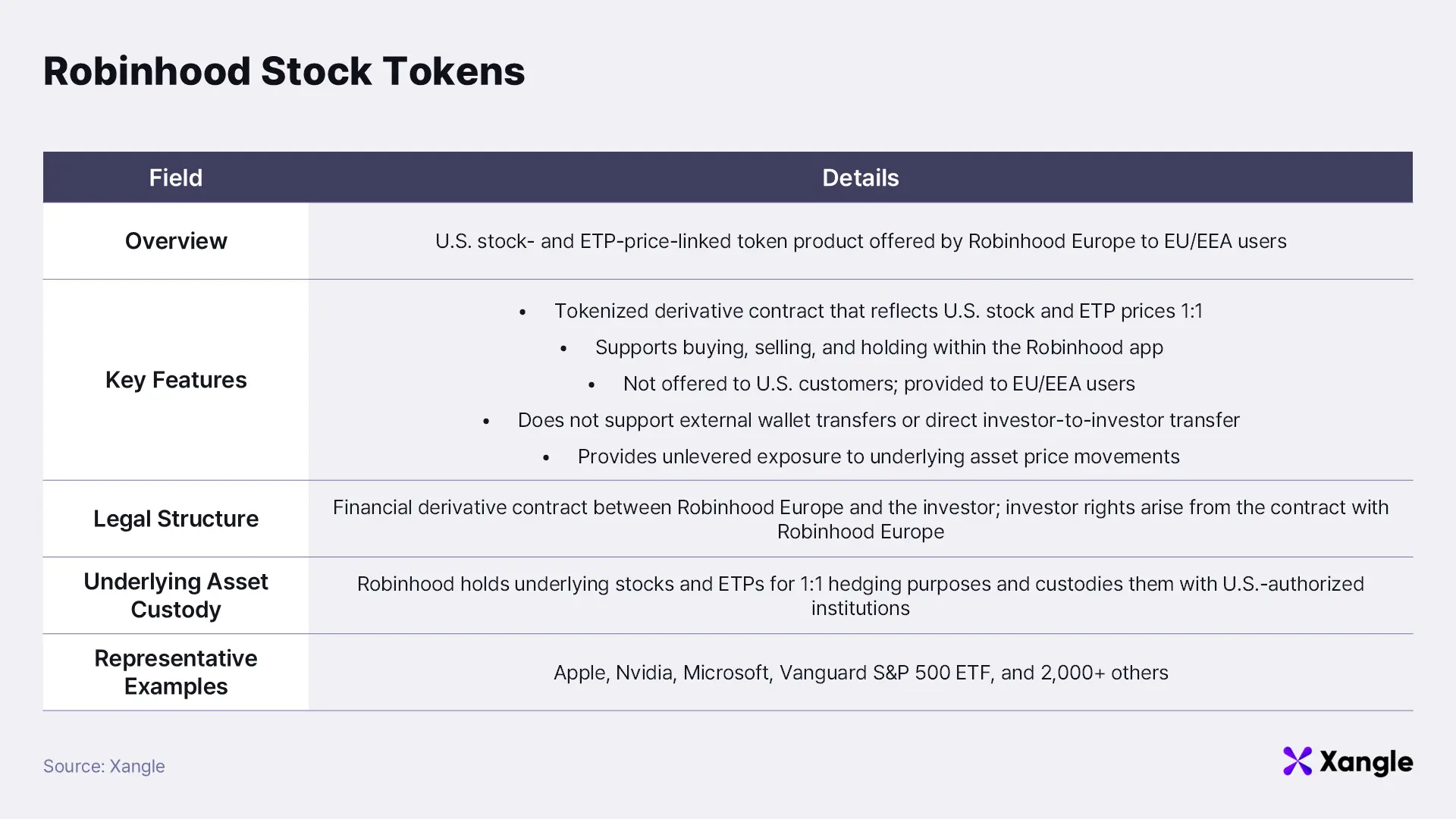
Robinhood Stock Tokens are derivative contract products offered by Robinhood Europe to EU users, linked to the prices of U.S. stocks and exchange-traded products (ETPs). When an investor buys Stock Tokens, they do not hold actual U.S. stocks or ETFs. Instead, they enter into a financial derivative contract with Robinhood Europe that is linked to the price of the underlying asset. The contractual rights are represented by blockchain tokens, and each token is designed to reflect the price movement of one share or one unit of the selected underlying stock or ETP.
Investors can buy, sell, and hold Stock Tokens within the Robinhood app, but transfers to external wallets or other platforms are not currently supported. Stock Tokens therefore should not be viewed as a structure in which investors can directly transfer and trade the assets with one another like ordinary on-chain assets. They are used by opening and closing positions within the Robinhood app. Robinhood states that it offers more than 2,000 Stock Tokens linked to U.S. stocks and ETPs, with representative underlying assets including Apple, Nvidia, Microsoft, and the Vanguard S&P 500 ETF. Corporate actions such as dividends and stock splits are reflected in cash payments, displayed prices, holding quantities, or trading availability according to the contract terms with Robinhood Europe.
Bybit TradFi
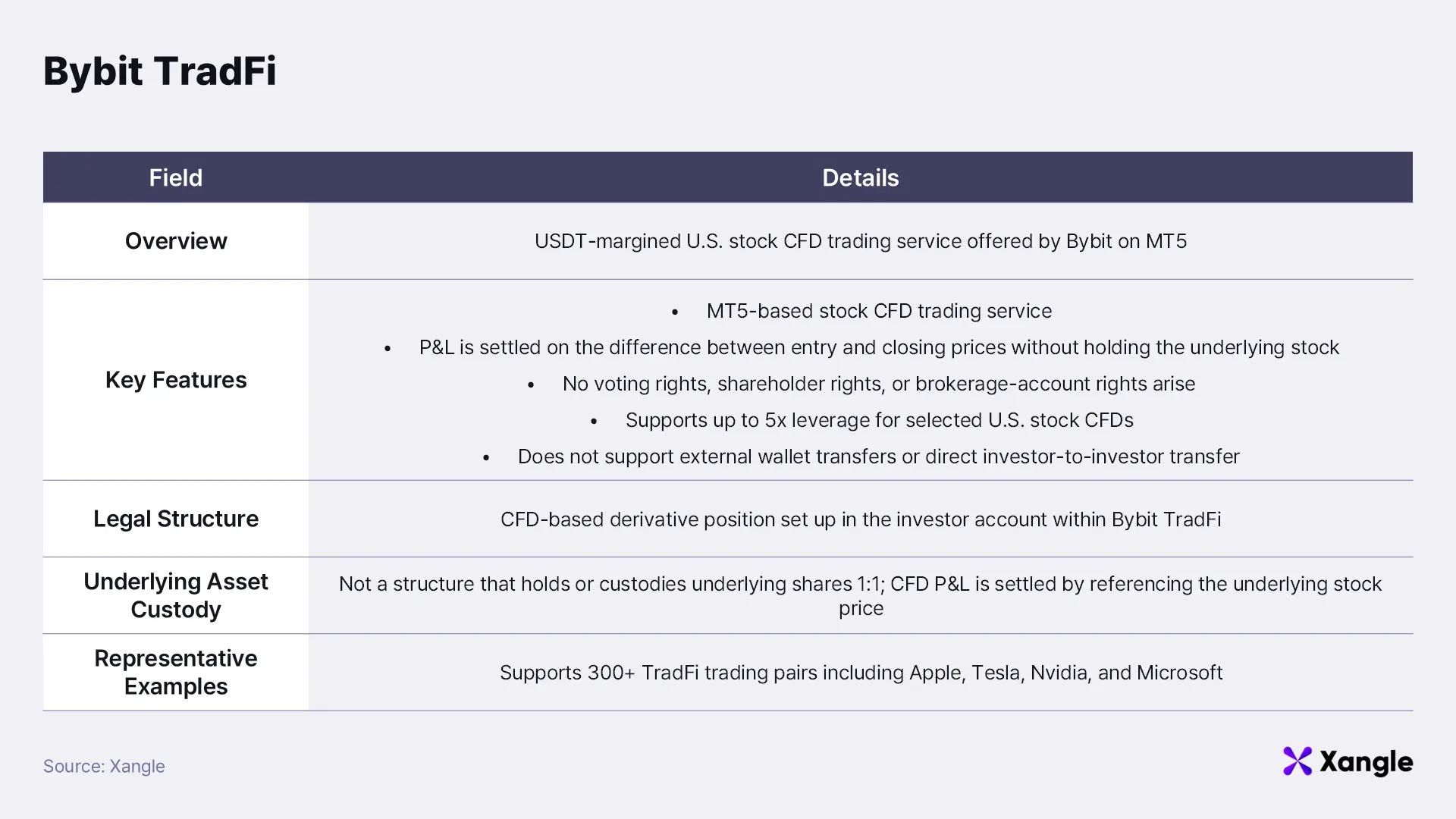
Bybit TradFi is a U.S. stock trading service offered by Bybit. In this context, stock trading does not mean acquiring actual U.S.-listed shares. It means trading CFD positions based on the prices of U.S.-listed stocks. The service is provided on MT5. MT5 is a professional trading program offered by MetaQuotes that supports charting, order execution, and position management for products such as foreign exchange, commodities, indices, and stock CFDs. Bybit uses this trading infrastructure to provide TradFi services that allow crypto users to access traditional asset prices using USDT as margin.
If an investor places a buy order equivalent to five shares of Apple through Bybit TradFi’s U.S. stock CFD service, Bybit TradFi creates a long CFD position in the investor’s account that settles gains and losses based on the price movement of five Apple shares. If Apple’s stock price rises, the marked value of the position increases. If it falls, the marked value declines. When the investor closes the position, gains or losses are finalized based on the difference between the entry price and the closing price. In this process, the investor does not directly hold the underlying shares and therefore does not receive voting rights, shareholder rights, or rights in a securities account. U.S. stock CFDs support up to 5x leverage, and certain stocks can be traded 24/5. Similar to Robinhood’s structure, these positions are not distributed through transfers to external wallets or direct transfers between investors. They are managed as derivative contract positions opened and closed within Bybit TradFi.
3-5. Perpetual Futures Model
The perpetual futures model is a structure in which investors trade long and short positions on centralized or decentralized exchanges based on the prices of stocks or ETFs. Investors do not hold the underlying stocks or ETFs. Instead, they gain exposure to price movements through perpetual futures positions opened on an exchange or protocol. These positions are therefore not linked to voting rights, dividends, or rights on a shareholder register. Gains and losses are settled based on entry price, closing price, margin, leverage, funding fees, and liquidation rules.
Perpetual futures broadly fall under derivatives, but their trading structure differs from the derivative contract model discussed above. In the derivative contract model, the central feature is a contractual right to settle gains and losses between the investor and the service provider. In a CFD or swap-type product, for example, the investor settles gains and losses from increases or decreases in a particular stock price within a contractual relationship with the platform. In a perpetual futures model, by contrast, the exchange or protocol provides trading infrastructure such as order matching, margin management, and settlement, while long and short positions between market participants interact within the same market.
Perpetual futures also have no maturity date, and funding fees help keep the contract price from diverging too far from the reference price. Investors therefore do not hold a contract until a specified maturity. They can maintain long or short exposure until they close the position or are liquidated. Because perpetual futures infrastructure is already widely used in crypto markets, exchanges can use existing systems to expand relatively quickly into stock price-based products. This is why many exchanges have adopted the model. Representative examples include Binance Perps, Coinbase Stock Perps, Kraken xStocks Perps, and Hyperliquid Equity Perps.
Binance Perps
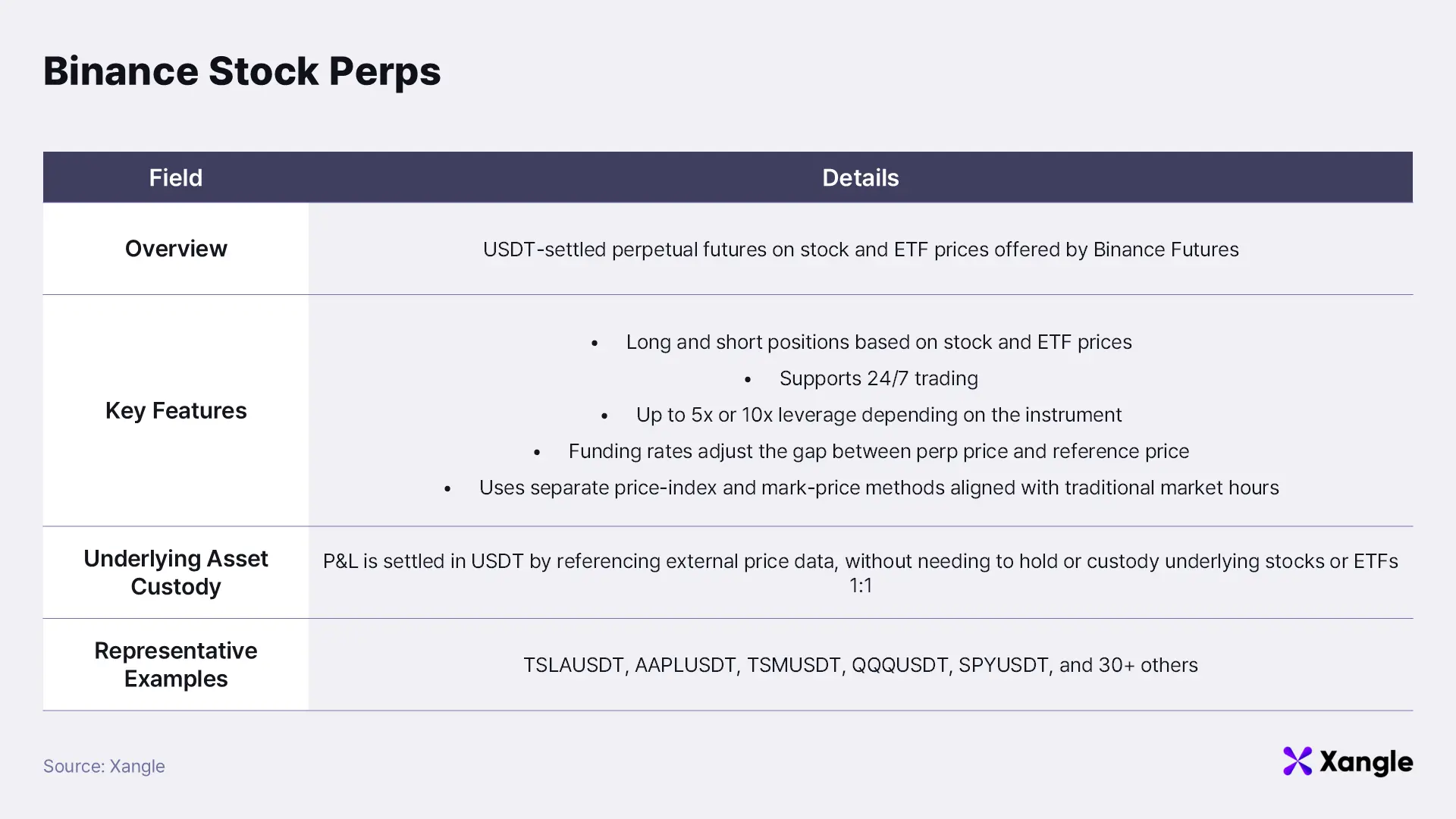
Binance Perps are stock and ETF price-based perpetual futures products offered on Binance Futures. Users can open long or short positions based on the prices of individual stocks such as Tesla, Apple, and TSMC, or ETFs such as QQQ and SPY. Trading works similarly to Binance’s existing crypto perpetual futures, using stablecoins such as USDT as margin. Users hold derivative positions within Binance Futures rather than the underlying stocks or ETFs.
Binance applies a dedicated pricing methodology for TradFi Perps, reflecting the fact that traditional assets and crypto assets have different trading hours. The price index and mark price methodology differ across regular market hours, pre-market, after-hours, overnight sessions, and market holidays. During periods of low liquidity or limited external price data, Binance uses adjustments based on EWMA (exponentially weighted moving average) and price divergence limits. This allows the platform to support 24/7 trading while managing the risk that perpetual futures prices diverge excessively from underlying stock or ETF prices.
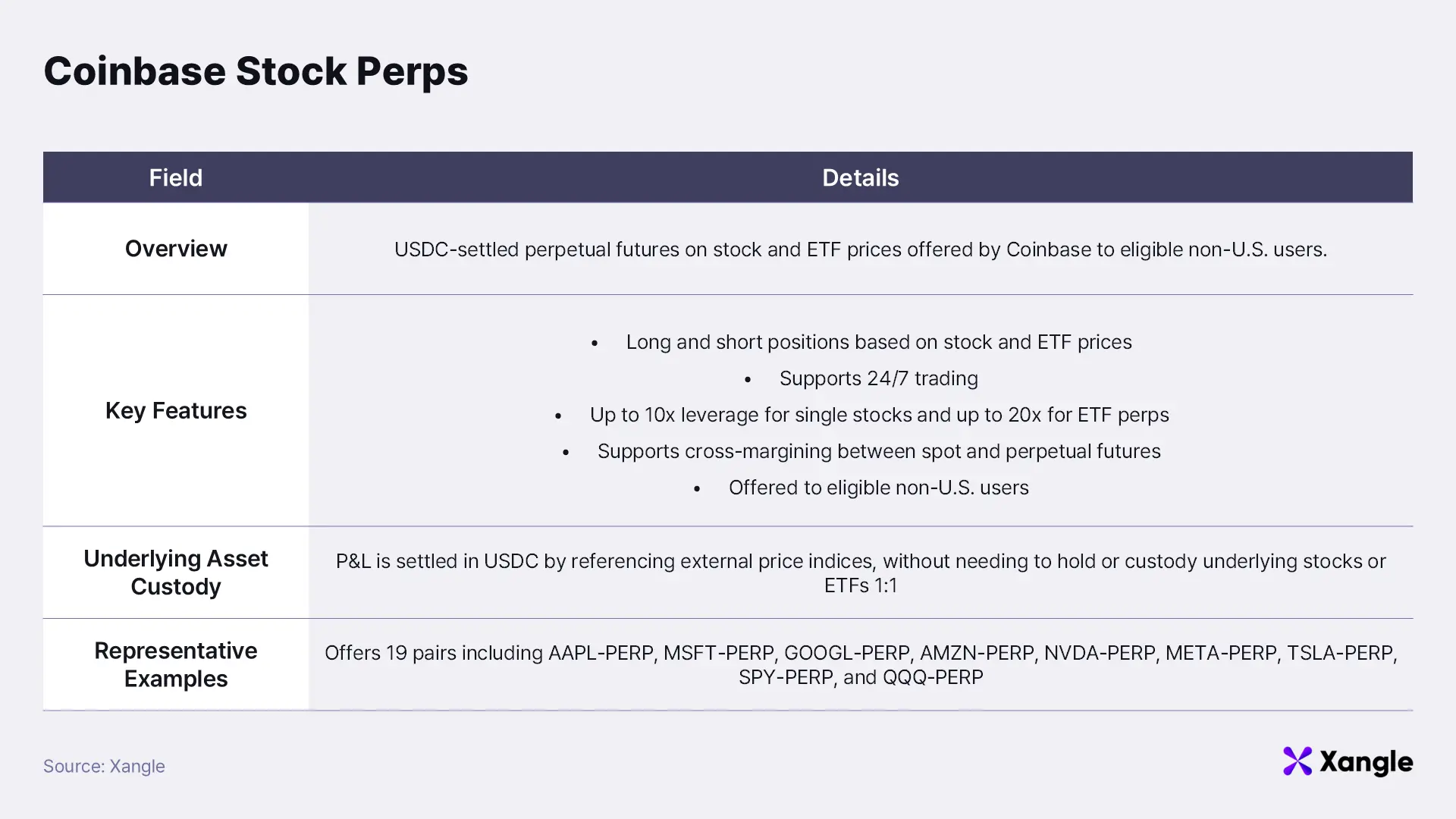
Coinbase Stock Perps
Coinbase Stock Perps are USDC-settled stock and ETF price-based perpetual futures products offered by Coinbase to eligible non-U.S. users. Users can open long and short positions based on the prices of major U.S. stocks such as Apple, Microsoft, Alphabet, Amazon, Nvidia, Meta, and Tesla, as well as ETFs such as SPY and QQQ. Trading is built on Coinbase’s existing crypto perpetual futures infrastructure.
Through Stock Perps, Coinbase provides synthetic exposure to stock prices outside regular U.S. stock market trading hours. The products support 24/7 trading, with leverage of up to 10x for single stocks and up to 20x for ETF Perps. Positions are settled in USDC and use Coinbase’s perpetual futures engine, risk management system, and cross-margin structure. However, because users do not hold the underlying stocks or ETFs, they do not receive voting rights, dividend rights, or rights on a shareholder register. Gains and losses are settled based on the price index, mark price, margin, leverage, funding fees, and liquidation rules.
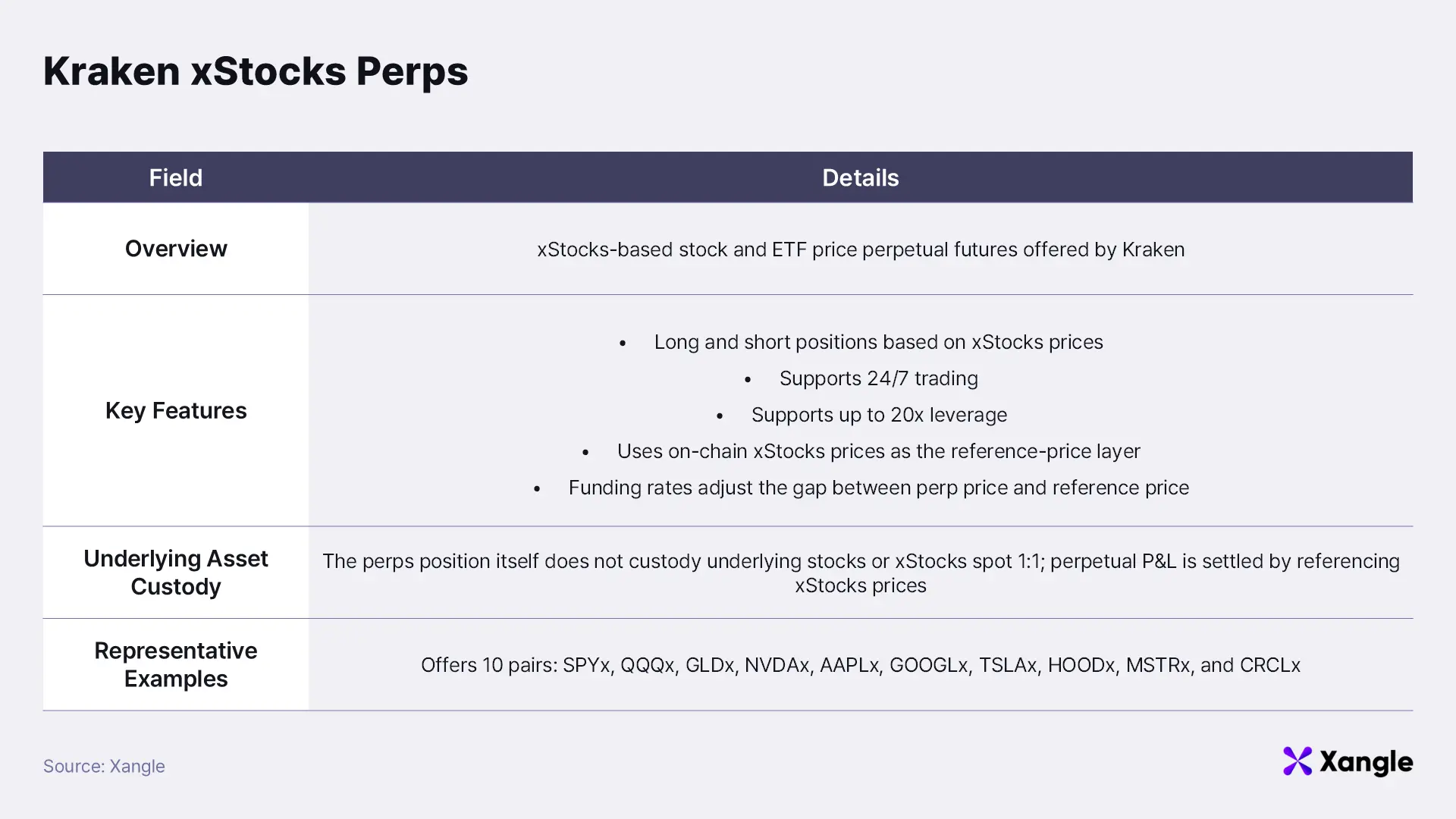
Kraken xStocks Perps
Kraken xStocks Perps are xStocks-based stock and ETF price perpetual futures products offered by Kraken. Users can open long and short positions based on the prices of xStocks such as SPYx, QQQx, GLDx, NVDAx, AAPLx, GOOGLx, and TSLAx. Spot xStocks are 1:1 underlying asset-backed tokenized products issued by Backed, but in xStocks Perps, users hold perpetual futures positions opened in Kraken’s derivatives market rather than spot xStocks.
Kraken explains that using xStocks as the reference price layer enables 24/7 price formation even when traditional stock markets are closed. In ordinary stock markets, price discovery becomes limited after regular trading hours end, but xStocks continue trading on-chain and can be used to determine reference prices for perpetual futures. Funding fees help prevent xStocks Perps prices from diverging too far from reference prices, and users can trade long and short positions with up to 20x leverage
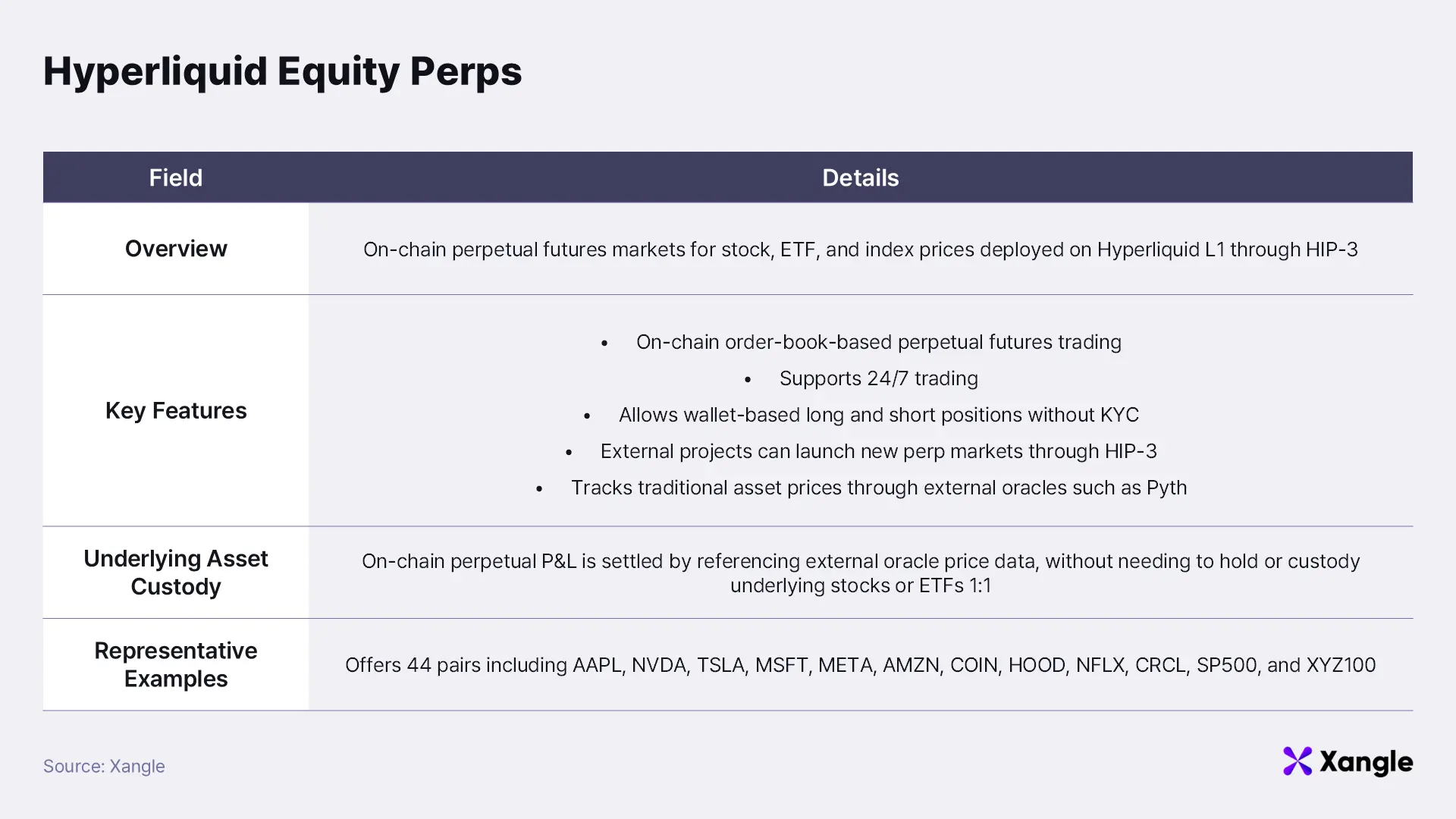
Hyperliquid HIP-3-Based Perps
Hyperliquid is an on-chain order book-based decentralized exchange that processes perpetual futures trading on its own L1. The Binance, Coinbase, and Kraken examples discussed above trade within derivatives accounts on centralized exchanges. Hyperliquid HIP-3-based Perps differ because trading and settlement occur in on-chain perpetual futures markets on Hyperliquid L1. Investors can open wallet-based long and short positions that track stock, ETF, and index prices without a separate traditional securities account or underlying stock holdings.
The mechanism that enables this structure is Hyperliquid’s HIP-3. HIP-3 allows external developers or projects to deploy new perpetual futures markets using Hyperliquid’s core trading engine. Hyperliquid provides common trading infrastructure such as order processing, margin management, settlement, and liquidation. Market deployers such as Trade[XYZ] then operate individual markets that track traditional asset prices, including AAPL, NVDA, TSLA, and SPX, on top of that infrastructure.
Market deployers decide which assets to list, which price data to use, and how to set leverage and open interest limits. For example, if Trade[XYZ] deploys an AAPL or NVDA market, that market references external oracle prices such as Pyth to track the value of one underlying share, while gains and losses between users’ long and short positions are processed through Hyperliquid’s settlement and liquidation system. As of the current Trade[XYZ] view, 44 active XYZ contracts are deployed on Hyperliquid, covering not only stocks, ETFs, and indices, but also commodities and FX.
4. Strengths, Limitations, and Considerations by Tokenization Model
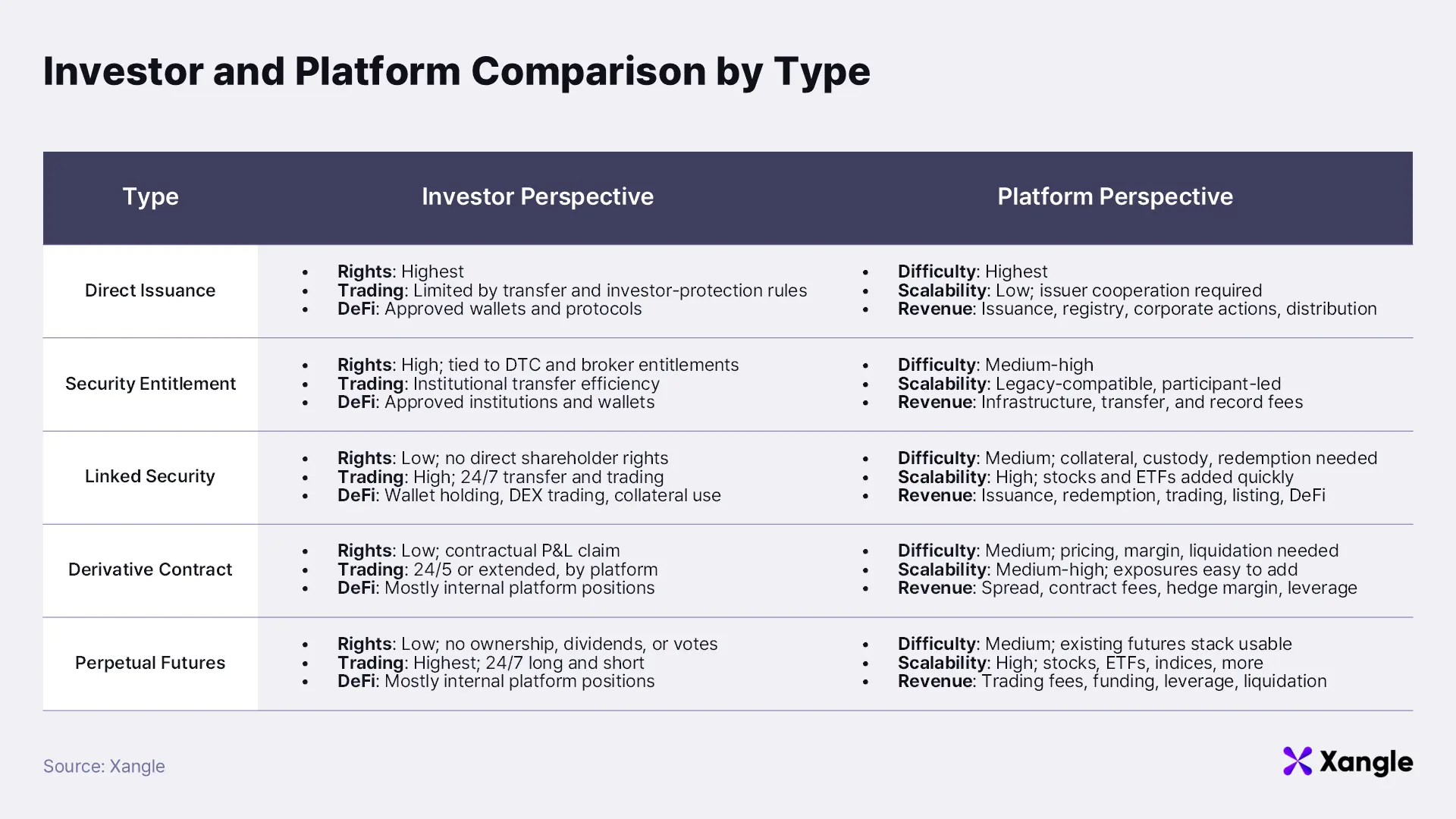
From the investor’s perspective, stock tokenization models can be compared across three criteria: ① linkage to stock rights, ② trading availability, and ③ DeFi usability. Linkage to stock rights refers to how directly token holdings are connected to corporate actions such as dividends, voting rights, and stock splits. Trading availability indicates whether transfers, trades, or position openings are possible outside regular market hours. DeFi usability refers to whether the token can be used in on-chain applications such as external wallets, DEXs, and lending protocols. Even when products provide exposure to the same names, such as AAPL, NVDA, or TSLA, one structure may be strongly linked to stock rights but subject to significant transfer restrictions, while another may offer 24/7 trading and high on-chain usability without providing direct shareholder rights in the underlying shares.
From the platform’s perspective, the models can be assessed based on ① implementation complexity, ② scalability, and ③ revenue structure. Implementation complexity includes the legal and operational burdens required to operate the product, such as issuer cooperation, transfer agency, investor verification, custody, pricing, hedging, and clearing. Scalability refers to how quickly the product can be expanded across multiple names and markets. Revenue structure shows how the platform generates revenue, including issuance, management, and transfer fees, trading fees, spreads, funding fees, and DeFi-linked revenue. Section 4 therefore compares the utility each structure provides to investors alongside the implementation costs, scalability, and monetization potential for platforms.
4-1. Direct Issuance Model
The direct issuance model manages stock ownership by linking the token ledger with the official holder records maintained by the issuer or transfer agent. Because investors’ token holdings are connected to official holder records, stock-related rights such as dividends, voting rights, stock splits, and record date determinations can be processed alongside the existing stock structure.
In existing U.S. stock trading, an investor places an order through a broker, and that order is executed on an exchange or another execution venue. After execution, a clearing agency such as NSCC calculates the money and securities owed between brokers, while a settlement institution such as DTC reflects the final securities positions and cash settlement. The investor’s app shows the balance immediately after purchase, but behind the scenes, the broker’s books, the clearing agency, and the central securities depository continue to reconcile their records. The T+1 settlement period is tied to this back-office processing structure.
The direct issuance model can significantly simplify this process. If the token ledger is linked with the official holder records maintained by the issuer or transfer agent, the system can be designed so that token transfers lead to updates in holder records. This reduces the burden of verifying rights across multiple intermediary ledgers and allows transfers between investors to be reflected more quickly. However, because the structure is linked to actual stock rights, conditions such as KYC-completed investors, approved wallets, jurisdictional restrictions, and transfer restrictions apply. The strengths and limitations of this structure can be viewed from the perspectives of investor utility and platform implementation.
Investor Perspective
- High linkage to stock rights: Because token holdings are linked to official holder records, token holders receive rights comparable to those of direct shareholders.
- Expanded trading availability: Token transfers and holder record updates can be processed outside traditional exchange operating hours, creating room to expand trading availability.
- Potentially faster settlement: Reducing the need to reconcile records across brokers, central securities depositories, and transfer agents makes faster reflection than the existing T+1 structure possible.
- Potential cost reduction: If some intermediary steps in brokerage, custody, and settlement are reduced, investor fee costs may also decline.
- Limited DeFi usability: Because the asset is linked to actual stock rights, DeFi use may also be subject to investor eligibility, approved wallets, and jurisdictional restrictions. Use cases are likely to be limited primarily to approved applications.
Platform Perspective
- High implementation complexity: The structure requires issuer cooperation, transfer agency, investor verification, transfer restrictions, corporate action processing, and regulated distribution infrastructure to work together. Initial buildout costs are therefore high, and players that already have the necessary infrastructure are advantaged.
- Significant regulatory burden: Traditional financial regulations covering stock issuance, holder record management, investor eligibility checks, and securities distribution apply, resulting in a relatively heavy regulatory burden.
- High barriers to entry: Players that already have transfer agency, digital securities issuance, and investor verification infrastructure are better positioned. Companies that can provide issuance, management, and distribution functions together, such as Securitize and Superstate, have an advantage.
- Limited scalability: Because the model requires direct issuer cooperation and security-specific design for rights, transfer restrictions, and investor requirements, it is not well suited to quickly listing many names and scaling trading volume.
- Efficiency-based revenue structure: By replacing parts of the existing broker, custody, settlement, and transfer agency process with tokenization infrastructure, platforms can generate revenue from issuance, holder management, corporate action processing, and regulated distribution fees.
4-2. Security Entitlement Model
The security entitlement model connects security entitlements recognized on the books of existing brokers, custodians, and DTC with tokens or distributed ledger records. Because it preserves existing securities market infrastructure while improving the recording and transfer of rights using a blockchain ledger, changes such as broader trading availability or DeFi usability are unlikely to be highly visible from the investor’s perspective. Its strength lies instead in improving institutional record management, rights transfers, and settlement processes. For platforms, it offers high compatibility with existing regulated infrastructure, but on-chain usability may remain limited.
Investor Perspective
- Existing holding structure preserved: The underlying securities remain within the existing depository and custody system, while tokens or distributed ledger records reflect book-entry rights in those securities. Investors maintain the indirect holding relationship through existing brokerage account structures.
- Limited expansion of trading availability: Because the existing broker, custodian, and DTC structure is preserved, order execution is unlikely to immediately expand to 24/7 availability.
- More efficient institutional settlement: Processing the recording and transfer of security entitlements through an integrated distributed ledger can improve record management and settlement procedures between institutions.
- Low DeFi usability: Because the structure is connected to the existing central depository and brokerage system, open-ended DeFi use is likely to be limited.
Platform Perspective
- High compatibility with existing infrastructure: Platforms can connect security entitlement records managed by DTC, brokers, and custodians to a distributed ledger without redesigning the structure from scratch.
- Moderate to high implementation complexity: The burden is lower than in direct issuance, but DTC participant requirements, registered wallets, central depository rules, and broker and custodian integrations are still required.
- High regulatory burden: Regulations related to brokerage, clearing, custody, customer asset protection, and security entitlement transfers apply. The model must satisfy the operating rules of existing securities market infrastructure.
- Efficiency-based revenue structure: By streamlining the recording and transfer of security entitlements through a shared ledger, platforms can generate institutional infrastructure usage fees and rights transfer fees.
4-3. Linked Security Model
In the linked security model, a third-party issuer issues a separate security or tokenized product linked to an underlying stock or ETF and distributes it on-chain. Investors do not directly receive shareholder rights in the underlying company, but they can hold issued tokens in wallets, transfer and trade them 24/7, or connect them to DeFi applications. From a platform perspective, scalability is high because a platform can quickly expand exposure across a wide range of stocks and ETFs without directly partnering with issuers. However, in the United States, tokenized securities may be treated under the same regulatory framework as existing securities, creating significant securities regulatory burdens across issuance, sale, and distribution.
Investor Perspective
- Low direct linkage to stock rights: Investors do not become direct shareholders of the underlying shares. Their rights arise from the terms of the linked security or tokenized product created by the third-party issuer.
- Significantly broader trading availability: Issuance and redemption are affected by the trading hours of the underlying stock market, but already issued tokens can be transferred and traded 24/7 on supported networks.
- Fast settlement: Because tokens are transferred on public blockchains, wallet-to-wallet movement and trade reflection can be near-instant.
- High DeFi usability: These tokens can be relatively easily and flexibly connected to a range of on-chain applications, including wallet holding, DEX trading, and lending collateral.
- Issuer and custodian risk: Custody of the underlying assets, collateral management, and redemption processing depend on trust in the issuer and custodian.
Platform Perspective
- Moderate implementation complexity: Tokens for multiple names can be issued relatively easily using underlying stocks or ETFs as collateral, without issuer cooperation or shareholder register integration. Collateral management, redemption, and corporate action processing are still required.
- High regulatory burden: The token may be treated as a separate security, and restrictions such as excluding U.S. persons, limiting access to professional investors, and jurisdiction-specific sales restrictions may apply. Global distribution requires managing regulatory requirements across countries.
- High scalability: Third-party issuers can tokenize exposure to multiple stocks and ETFs, while exchanges, wallets, and DeFi protocols can integrate them to expand product lines and distribution channels quickly.
- Diverse revenue structure: Platforms can monetize through issuance and redemption fees, trading fees, listing fees, collateral utilization revenue, and DeFi-linked revenue.
4-4. Derivative Contract Model
The derivative contract model settles gains and losses from stock price movements through contracts based on underlying stocks. Investors do not hold actual stock rights, but they can obtain stock price exposure and open or close positions relatively easily within the platform. From a platform perspective, products can be launched quickly without share delivery or shareholder register integration. However, derivative regulations such as those for CFDs or security-based swaps may apply, creating regulatory burdens. The structure also tends to restrict transfers, making on-chain expansion difficult.
Investor Perspective
- Low linkage to stock rights: Voting rights, dividend rights, and rights on the shareholder register do not arise. What the investor holds is a contractual position that settles gains and losses based on price differences.
- Expanded trading availability: Depending on the platform, 24/5 or extended trading hours may be available. Actual trading hours vary depending on platform policy and the pricing methodology for the underlying asset.
- Fast position processing: Since actual share delivery or shareholder register updates are not required, position opening, closing, and gain and loss reflection can be fast.
- Low DeFi usability: Most positions are managed inside the platform, so transfers to external wallets, direct transfers between investors, and on-chain collateral use are limited.
- Counterparty risk: Pricing, hedging, margin management, and loss handling depend on the service provider’s operations and ability to perform under the contract.
Platform Perspective
- Moderate implementation complexity: Share delivery or shareholder register integration is not required, but the platform must design operating structures for pricing, margin management, hedging, and liquidation.
- High regulatory burden: Products that settle gains and losses based on the price of a single stock or ETF may be subject to CFD, security-based swap, or OTC derivatives regulations depending on the jurisdiction.
- Limited on-chain scalability: Since positions are opened and closed within the platform, they are difficult to connect directly to wallets, DEXs, or lending protocols.
- Trading and spread-based revenue structure: Platforms can generate revenue from spreads, fees, and hedging margins.
4-5. Perpetual Futures Model
The perpetual futures model is a derivatives structure in which investors trade long and short positions based on stock or ETF prices. Investors do not hold actual stocks or ETFs. They hold perpetual futures positions that track the prices of those assets. Most products support 24/7 trading and leverage, making them strong in terms of trading availability and capital efficiency. However, they are not linked to stock rights and introduce funding fee, liquidation, and price divergence risks.
Investor Perspective
- Low linkage to stock rights: Actual stock ownership, dividend rights, and voting rights do not arise. Investors hold only the gains and losses of a perpetual futures position, not the underlying stock.
- Significantly broader trading availability: Most products support 24/7 trading, allowing investors to open long and short positions regardless of regular traditional stock market hours.
- High capital efficiency: Leverage and cross-margin allow investors to create larger price exposure with less capital.
- Fast gain and loss reflection: Settlement occurs in real time through gain and loss reflection on derivative positions, rather than through stock settlement.
- High derivatives risk: Funding fees, leverage, forced liquidation, price divergence, and oracle risks all apply.
Platform Perspective
- Ease of implementation: Exchanges that already have crypto perpetual futures infrastructure can expand their product lineup quickly.
- Strong product scalability: Markets can be created based on various price indices, including individual stocks, ETFs, indices, and commodities.
- Moderate regulatory burden: Because most perpetual futures are offered to eligible users outside the United States, many are currently designed to avoid direct application of U.S. securities and derivatives regulations.
- Volume-based revenue structure: Platforms can generate revenue based on trading volume, including trading fees and market-making.
- Market infrastructure risk: If price indices, oracles, funding fees, liquidation engines, and market-making structures are poorly designed, price divergence and forced liquidation risks can increase.
5. Closing Remarks: Stock Tokenization Is Moving Toward Regulated Markets
Taken together, the five models discussed above show that the stock tokenization market is not moving in a single direction. Within the U.S. regulatory framework, direct issuance models such as Securitize and Superstate and DTC’s security entitlement model are being developed in connection with existing securities market infrastructure. Because these models are connected to issuers, transfer agents, central securities depositories, and brokerage infrastructure, they can more readily handle stock rights such as dividends, voting rights, and corporate action processing within regulated structures. At the same time, they must accommodate existing securities regulatory requirements such as investor verification, transfer restrictions, approved wallets, and jurisdictional restrictions, which limits open on-chain distribution and unrestricted DeFi use.
Outside the United States, by contrast, linked security models such as Backed and Ondo and derivative or perpetual futures products from players such as Bybit, Binance, Kraken, and Hyperliquid are expanding rapidly. These products often use issuance and licensing structures in non-U.S. jurisdictions, while connecting order execution and custody for U.S. stocks to U.S.-registered brokers and custodians such as Alpaca Securities. This allows platforms to quickly expand diverse stock exposure into on-chain or exchange-traded products, but it makes direct offering to U.S. investors difficult and does not provide direct shareholder rights in the underlying stocks.
Given these trends, non-U.S. experimental markets and the U.S. regulated market are likely to coexist in the short term. In non-U.S. markets, models with faster product launch and distribution cycles, such as linked securities, derivative contracts, and perpetual futures, may grow first. In the U.S. regulated market, models with clearer rights, custody, and transfer structures, such as direct issuance and security entitlements, are more likely to establish themselves first. The former will validate demand for stock tokenization and the commercial viability of these products, while the latter will help create standardized structures that can attract institutional capital.
Over the long term, stock tokenization is also likely to expand within regulated frameworks. Two trends support this view. First, U.S. regulators are aware that high-demand digital asset products have often grown overseas first because of regulatory uncertainty. In May 2026, when the CFTC outlined its policy direction on the listing of perpetual futures, it noted that the perpetual futures market had grown outside the United States and that most trading had taken place on offshore exchanges. This reflects a concern that if products cannot be offered within regulated markets, trading volume and market leadership may shift overseas.
Second, institutional investors and traditional financial firms need products with clear frameworks for customer asset protection, custody, accounting treatment, internal controls, disclosures, and investor suitability requirements. Technical innovation alone will not be enough for capital from pension funds, asset managers, banks, and brokerages to enter at scale. Legal certainty over rights, underlying asset custody structures, investor protection mechanisms, and regulated distribution channels must also be in place. The expansion path for stock tokenization is therefore likely to align with regulated on-chain finance built around KYC/AML-cleared investors, approved wallets, and regulated distribution channels.
Stocks are one of the most intuitive asset classes in the RWA tokenization market, but they are also among the most complex in terms of rights structures and regulatory requirements. As the discussion around stock tokenization matures, the market will move beyond simple stock price-tracking products toward the question of how rights records, custody, transfers, corporate actions, disclosures, and investor protection should be reconfigured for an on-chain environment.
Disclaimer
I confirm that I have read and understood the following: The information contained in this article is strictly the opinions of the author(s). This article was authored free from any form of coercion or undue influence. The content represents the author's own views and does not represent the official position or opinions of CrossAngle. This article is intended for informational purposes only and should not be construed as investment advice or solicitation. Unless otherwise specified, all users are solely responsible and liable for their own decisions about investments, investment strategies, or the use of products or services. Investment decisions should be made based on the user’s personal investment objectives, circumstances, and financial situation. Please consult a professional financial advisor for more information and guidance. Past returns or projections do not guarantee future results.
Xangle or its affiliated partners own all copyrights of the written or otherwise produced materials and content provided on the platform. Any illegal reproduction of such content, including, but not limited to, unauthorized editing, copying, reprinting, or redistribution will result in immediate legal actions without prior notice.
![[CIS Seoul Partner Summit] Anchorage Digital: A Starting Point for Institutional Digital Assets](https://resource.xangle.io/files/content/0659D651970125CC9D95F3066EACD686_1790818652341.webp)
![[CIS Partner Summit Highlights] Dinari: Bringing Tokenized Stocks to Financial Services](https://resource.xangle.io/files/content/44F77D1727A765045015596C9652011C_1789696427279.webp)