RWA Tokenization Ecosystem Overview
1. Introduction
2. Stablecoins
2-1. Stablecoin Ecosystem
2-2. Fiat-Backed Stablecoins
2-3. Crypto-Collateralized Stablecoins
2-4. Synthetic/Delta-Neutral Stablecoins
3. Traditional Asset Tokenization
3-1. Overview of the Traditional Asset Tokenization Ecosystem
3-2. Directly Issued Stocks
3-3. Indirectly Issued Stocks
3-4. Directly Issued Bonds
3-5. Bond Funds / Tokenized Treasury Funds
4. Alternative Asset Tokenization
4-1. Overview of the Alternative Asset Tokenization Ecosystem
4-2. Direct Real Estate Rights and Registry-Linked Structures
4-3. Indirect Real Estate Equity Structures
4-4. Physically Custodied Commodities
4-5. Private Credit Fund Interest Structures
4-6. Physically Custodied Collectible NFTs
5. Conclusion
1. Introduction
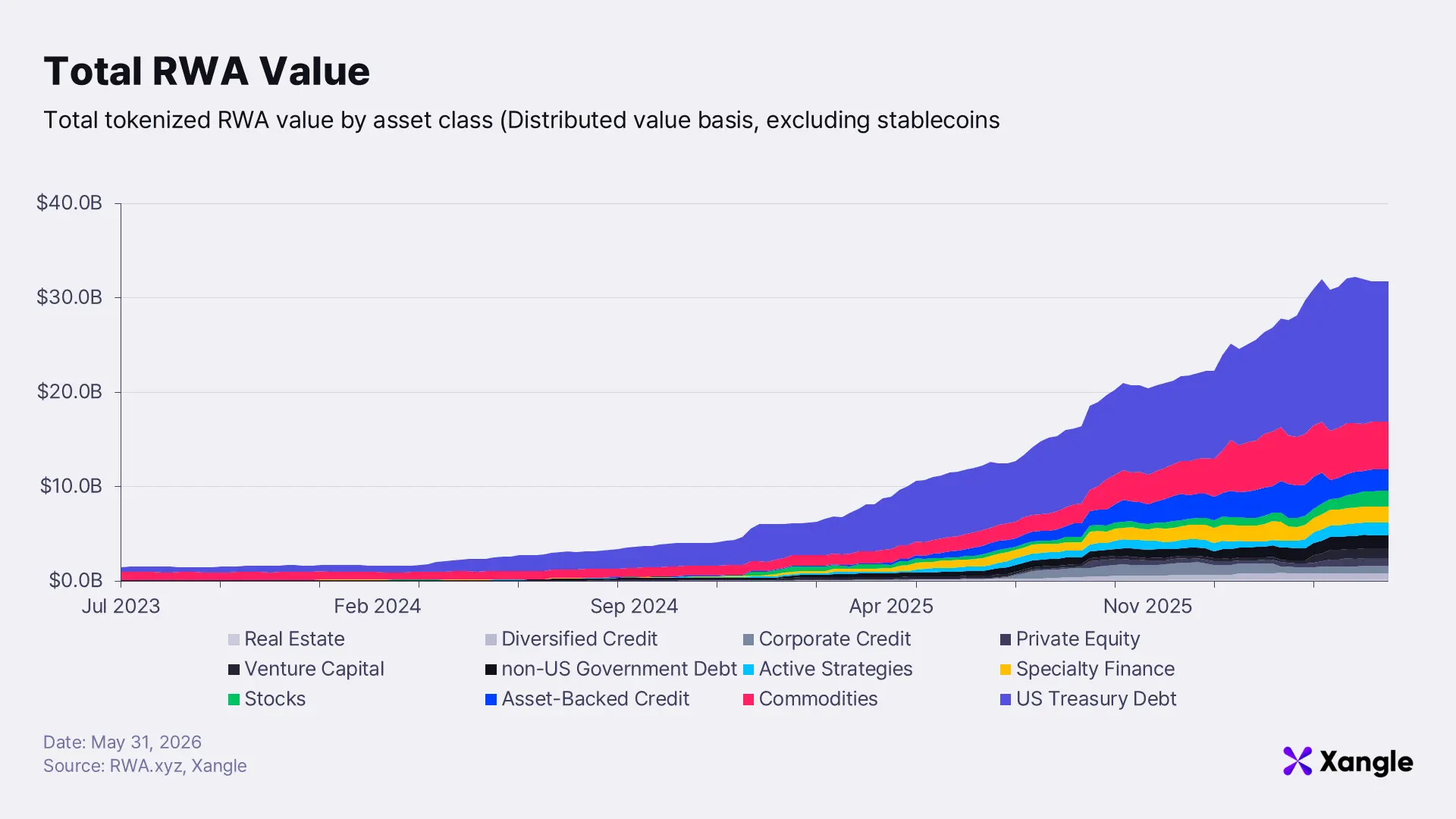
RWA tokenization can no longer be understood simply as “putting real-world assets on the blockchain.” The market has not only grown in size; the range of tokenized assets and the structures used to represent them are also becoming increasingly diverse. According to RWA.xyz, as of the end of May 2026, the tokenized RWA market, measured by distributed asset value, stood at $33.72 billion. When RWAs that record only asset rights or ownership records on-chain are also included as represented asset value, the total expands to $364.49 billion. Separately, the value of stablecoins has reached $303.46 billion. Real estate tokenization remains small in scale, but the asset class is also broadening, with 90 assets across 11 countries now being tracked.
The RWA market has not simply expanded in scale. While the early market was built primarily around fiat-backed stablecoins and products based on short-term U.S. Treasuries, tokenization is now extending into stocks, bonds, fund interests, real estate, commodities, private credit, collectibles, and more. The underlying structures are also becoming more complex. Some tokens represent redemption rights against reserve assets, while others represent interests in funds that invest in debt instruments. Some are linked to an issuer’s shareholder register or creditor records. Others represent economic rights to returns from real estate projects, withdrawal rights to physical commodities held in vaults, or ownership and redemption rights tied to collectibles. In other words, even under the single label of RWA, multiple markets are forming at once, each with distinct underlying assets, rights structures, custody models, and repayment or redemption mechanisms.
A proper understanding of RWAs therefore requires looking beyond the asset itself and examining the rights structure attached to the token. The type of asset being tokenized determines the market’s character and potential use cases, but the rights represented by the token, and the structure supporting those rights, determine the investor’s actual claims and risks. Some tokens represent redemption claims against an issuer, some represent fund interests, and others are linked to ownership or withdrawal rights over physical assets. By contrast, some tokens do not provide direct ownership of the underlying asset at all, but instead offer only price performance or economic exposure. Although they are grouped under the same RWA label, their operating models and investor risk profiles can differ significantly.
This research sets out a structural map for navigating the increasingly complex RWA ecosystem. It first categorizes RWA tokenization by underlying asset type into stablecoins, traditional assets, and alternative assets. It then breaks down each asset class across the key layers through which RWAs function in practice, including issuance, custody, management, ledger, data, liquidity, utility, and regulation.
The goal is to clarify how different assets are tokenized, how the tokens are issued, where the underlying assets are held, who manages them, how data is verified, and through which channels investors can trade tokens, exercise repayment claims, or redeem their positions. Rather than assessing the investment merits of individual projects, this research provides a foundational framework for understanding the broader structure of the RWA ecosystem.
2. Stablecoins
2-1. Stablecoin Ecosystem
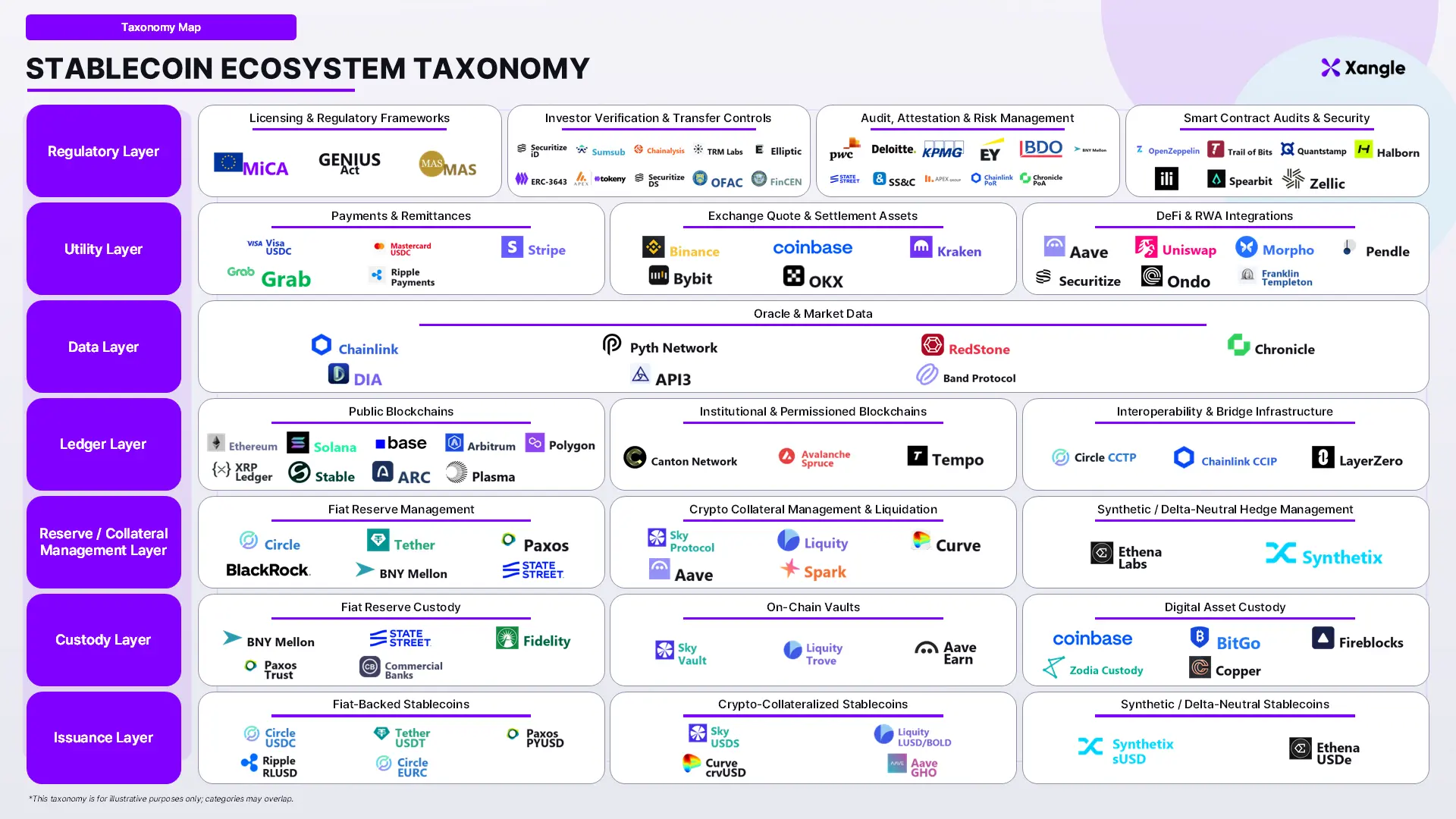
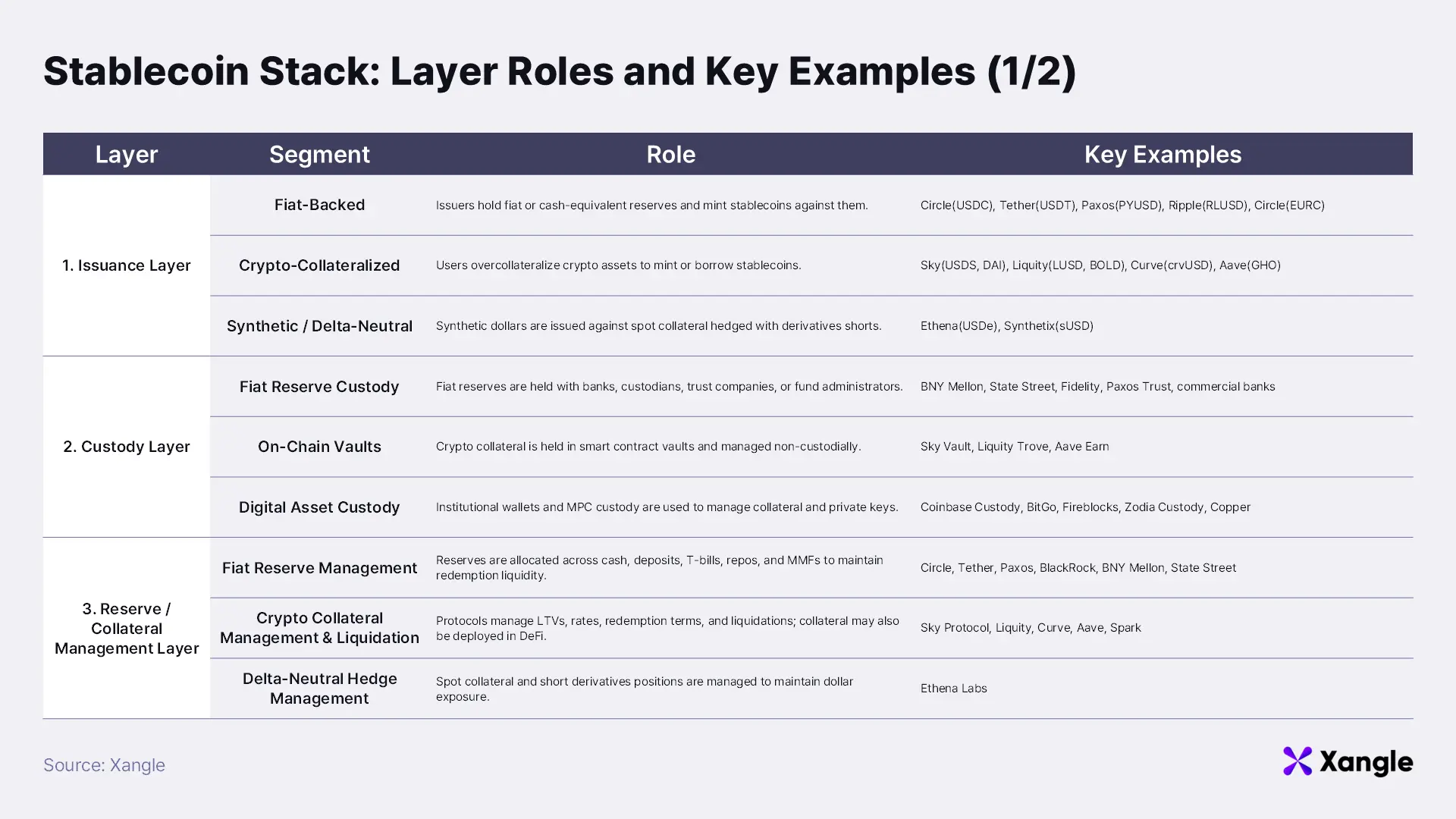
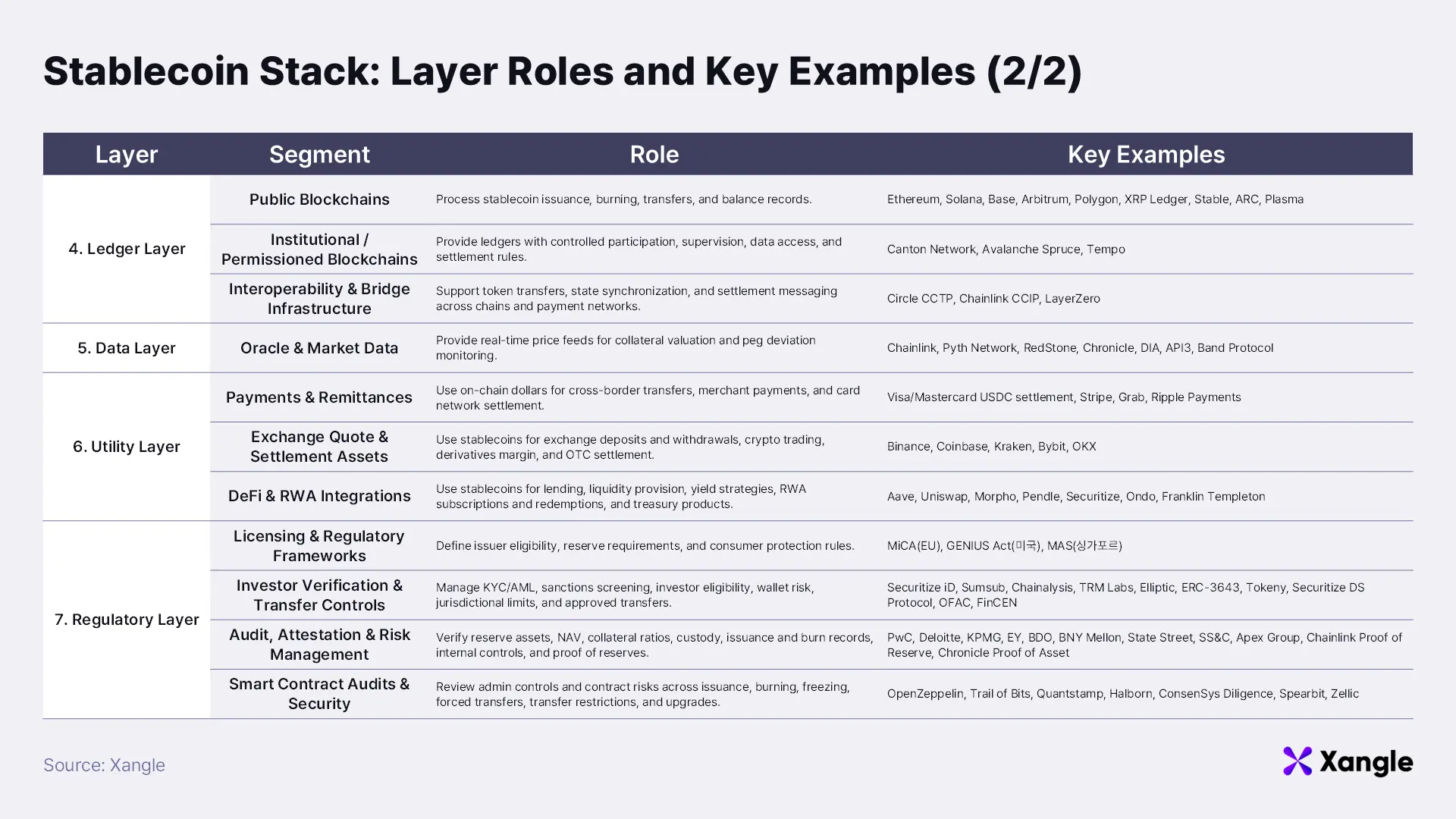
Stablecoins are digital assets designed to track the value of fiat currencies such as the U.S. dollar or another reference asset. Most crypto assets are too volatile to function effectively as payment instruments or units of account, whereas stablecoins are designed to maintain relatively stable value and are therefore used across trading, remittances, payments, collateral, and liquidity provision. On exchanges, they serve as quote currencies for crypto trading. In DeFi, they function as core assets for lending, deposits, liquidity provision, and derivatives margin. In cross-border remittances and digital payments, they play a role close to that of an on-chain cash-equivalent asset.
Stablecoins can broadly be grouped by issuance model into fiat-backed, crypto-collateralized, and synthetic/delta-neutral stablecoins. Fiat-backed stablecoins are issued by entities that hold cash-like reserves such as cash, bank deposits, short-term Treasuries, repurchase agreements, and money market funds, and issue tokens against those reserves. Crypto-collateralized stablecoins are issued when users deposit crypto assets such as Bitcoin or Ethereum as on-chain collateral and mint stablecoins worth less than the value of that collateral. Synthetic/delta-neutral stablecoins are issued when users deposit collateral assets, which the issuer then manages through a combination of spot crypto assets and short positions in futures or perpetual futures.
The ecosystem map above organizes the structure through which stablecoins are issued and used in practice into seven layers: issuance, custody, collateral management, ledger, data, utility, and regulation.
1) Issuance Layer
The issuance layer defines how stablecoins are created. In fiat-backed models, issuers hold cash-like reserves and issue corresponding tokens. In crypto-collateralized models, users deposit on-chain collateral and either mint or borrow stablecoins worth less than the collateral value. In synthetic/delta-neutral models, synthetic dollar tokens are issued against a portfolio that combines spot collateral with short derivatives positions.
2) Custody Layer
The custody layer concerns where the reserves or collateral backing the stablecoin are held. In fiat-backed models, cash, bank deposits, short-term Treasuries, and similar assets are held by banks or custodians. In crypto-collateralized models, collateral is deposited into smart contract-based on-chain vaults. In synthetic models, spot collateral is managed through digital asset custodians, institutional wallets, or off-exchange settlement infrastructure.
3) Collateral Management Layer
The collateral management layer covers how reserves and collateral portfolios are managed to preserve stablecoin stability. Issuers maintain liquidity primarily in cash-like assets and short-term Treasuries in order to meet redemption demand, and in some structures, reserve management is delegated to external asset managers. In on-chain collateral-based models, collateral soundness is managed through protocol parameters such as collateral ratios, borrowing limits, interest rates, and liquidation thresholds. In delta-neutral models, spot collateral is managed together with short positions in futures or perpetual futures to reduce volatility in the overall collateral value.
4) Ledger Layer
The ledger layer is where stablecoin issuance, burning, transfers, and balance records are processed on blockchains. Public chains such as Ethereum, Solana, Base, Arbitrum, Polygon, and XRP Ledger are commonly used, while stablecoin payment-specific chains and institutional or permissioned ledgers are also emerging. Stablecoins circulating across multiple chains rely on interoperability infrastructure such as Circle CCTP, Chainlink CCIP, and LayerZero for cross-chain transfers or state synchronization.
5) Data Layer
The data layer provides the information required for collateral valuation, peg deviation detection, liquidation decisions, and reserve verification. For fiat-backed stablecoins, key data includes reserve size and composition, token supply, redemption capacity, and third-party attestation reports. For crypto-collateralized stablecoins, collateral prices, collateral ratios, liquidation thresholds, and oracle price data are essential. For synthetic/delta-neutral stablecoins, derivatives market data such as futures prices, funding rates, basis, and liquidity data are also required alongside spot prices.
6) Utility Layer
The utility layer captures how stablecoins are used in the market as payment, trading, and asset management instruments. Stablecoins are used for cross-border remittances, merchant payments, card network settlement, exchange quote currencies, derivatives margin, and OTC settlement. They are also used in DeFi lending, liquidity provision, yield strategies, RWA subscriptions and redemptions, and as settlement assets for tokenized Treasury products.
7) Regulation Layer
The regulation layer covers issuer licensing, reserve requirements, redemption obligations, consumer protection, KYC, AML, sanctions screening, audits, and smart contract security. For fiat-backed stablecoins, reserve and redemption regulation is central. For crypto-collateralized stablecoins, smart contract, oracle, and liquidation risk management is critical. For synthetic stablecoins, the main areas of oversight include custodians, exchange counterparties, derivatives positions, redemption restrictions, and operational risk.
Assessing the stablecoin ecosystem requires more than asking whether a token reliably tracks the value of its reference asset. It is also necessary to examine how the token is issued, where its reserves or collateral are held, what mechanism supports price stability, which chains and markets it is used across, and what regulatory and verification frameworks govern its operation. Based on this structure, the following sections examine fiat-backed, crypto-collateralized, and synthetic/delta-neutral stablecoins in turn.
2-2. Fiat-Backed Stablecoins
1) Overview of Fiat-Backed Stablecoins
Fiat-backed stablecoins are issued by entities that hold fiat currency, such as the U.S. dollar, or cash-equivalent reserves, and mint stablecoins against those reserves. When a user deposits dollars with the issuer, the issuer mints tokens of equivalent value. Upon redemption, the issuer burns the tokens and pays out the corresponding amount in fiat currency.
The core of this model lies in reserves and redeemability. Issuers hold cash-equivalent assets such as cash, bank deposits, short-term Treasuries, repurchase agreements, and money market funds to maintain the token’s one-dollar value. As a result, the stability of fiat-backed stablecoins depends heavily on the quality of reserves, the credibility of custodians, redemption procedures, transparency reporting, and regulatory compliance.
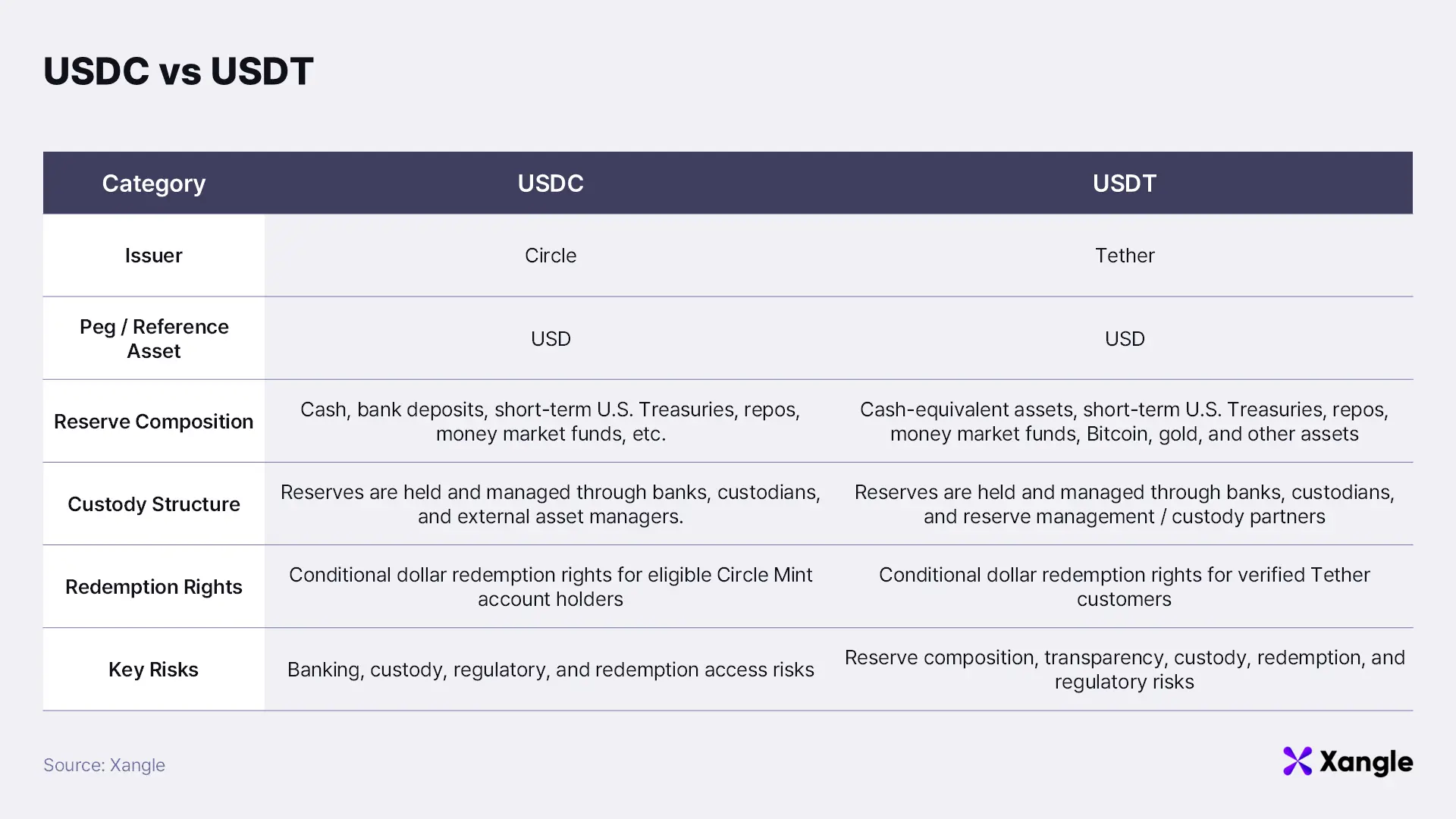
Representative examples include USDC and USDT. USDC, issued by Circle, is a regulation-oriented stablecoin that emphasizes cash-equivalent reserves and redeemability. USDT, issued by Tether, is the largest stablecoin by market size and has deep liquidity across global exchanges, OTC markets, and emerging-market payment flows.
2) Comparison of Representative Examples
3.) Issuance and Management Process
- Issuance Layer: Issuers such as Circle and Tether mint USDC or USDT in response to dollar deposits from eligible customers. When users redeem, the tokens are burned and the corresponding fiat currency is paid out.
- Custody Layer: The reserves backing the stablecoins are held and managed through banks, custodians, fund administrators, and similar institutions. These reserves consist of cash, bank deposits, short-term Treasuries, repurchase agreements, MMFs, and comparable instruments. In representative structures, institutional financial firms such as BNY Mellon, State Street, Fidelity, and Paxos Trust provide custody, settlement, accounting, and asset management support.
- Collateral Management Layer: The issuer manages the liquidity and stability of the reserve portfolio. Reserves are allocated across cash, bank deposits, short-term Treasuries, repurchase agreements, MMFs, and similar instruments, with sufficient liquidity maintained to meet large-scale redemption requests.
- Ledger Layer: USDC and USDT are issued, transferred, and burned across multiple blockchains, including Ethereum, Solana, Base, Arbitrum, Polygon, and XRP Ledger. Interoperability infrastructure such as Circle CCTP, Chainlink CCIP, and LayerZero may be used to support cross-chain movement.
- Data Layer: Circulating supply, reserve size, reserve composition, issuance and burn history, and peg status are tracked and managed. This data is used for reserve verification, peg monitoring, DeFi collateral valuation, and risk management.
- Utility Layer: USDC and USDT are used across the market as payment, trading, and asset management instruments. Key use cases include payments and remittances, exchange quote currencies, derivatives margin, OTC settlement, DeFi lending, liquidity provision, and settlement assets for RWA subscriptions and redemptions.
- Regulation Layer: Issuer licensing, reserve requirements, redemption obligations, KYC/AML, sanctions screening, audits, and attestation reports are managed at this layer. Issuers and custodians oversee the issuance, custody, and redemption structure, while auditors and third-party attestation providers verify reserve holdings and operating status. On-chain analytics providers such as Chainalysis, TRM Labs, and Elliptic are used to assess wallet risk and monitor sanctioned addresses.
2-3. Crypto-Collateralized Stablecoins
1) Overview
Crypto-collateralized stablecoins are issued or borrowed when users deposit various crypto assets such as Bitcoin or Ethereum as collateral and mint stablecoins worth less than the collateral value. When a user deposits collateral into a smart contract vault, the protocol calculates the amount of stablecoins that can be issued based on the collateral value and collateralization ratio.
The core of this structure is overcollateralization. Since the prices of collateral assets are highly volatile, collateral with a greater value than the issued stablecoins is required. If the collateralization ratio falls below the required threshold, liquidation occurs, and part or all of the collateral is sold to repay the debt.
Therefore, the trust foundation of crypto-collateralized stablecoins lies in the protocol’s collateral structure and liquidation mechanism, rather than in a direct redemption claim against the issuer. While fiat-backed stablecoins depend on bank accounts, reserves, and the issuer’s redemption obligations, crypto-collateralized stablecoins maintain stability through smart contracts, oracles, collateralization ratios, liquidation engines, and governance.
Representative examples include Sky USDS, Liquity LUSD/BOLD, Curve crvUSD, and Aave GHO. All of them issue stablecoins based on on-chain collateral, but the types of accepted collateral, liquidation mechanisms, interest rate structures, and peg maintenance mechanisms differ by protocol.
2) Comparison of Representative Examples
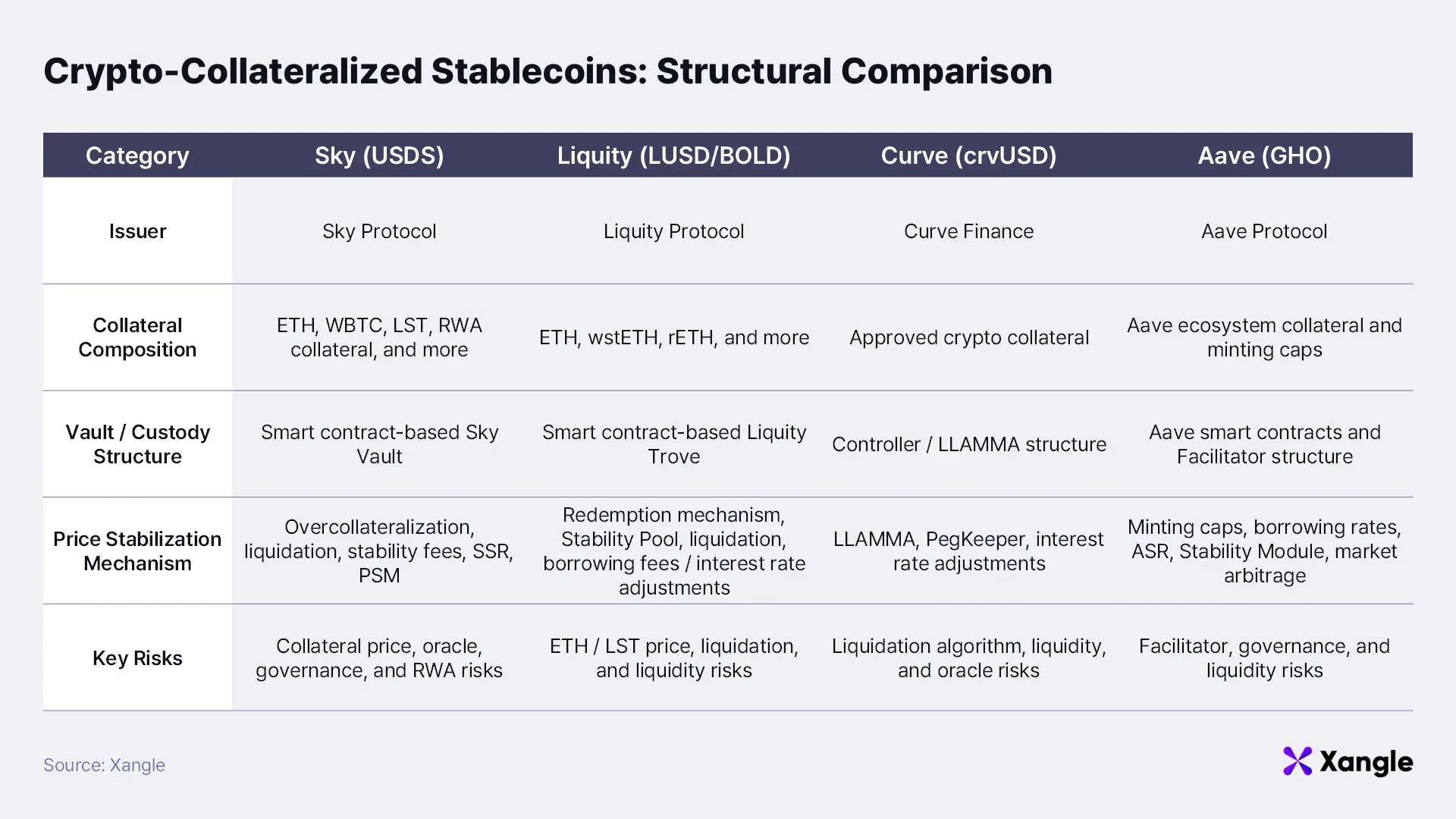
3) Issuance and Management Process
- 1. In the issuance layer, users deposit protocol-approved crypto assets such as Ethereum, Bitcoin, and liquid staking tokens as collateral, and issue or borrow stablecoins worth less than the collateral value. In this structure, stablecoins are created based on overcollateralization rather than fiat reserves.
- 2. In the custody layer, collateral assets are deposited into smart contract-based on-chain vaults such as those of Sky, Liquity, Curve, and Aave. Collateral and debt positions are managed in a non-custodial manner according to pre-defined protocol rules, rather than by centralized custodians.
- 3. In the collateral management layer, the protocol manages collateralization ratios, borrowing limits, interest rates, redemption conditions, and liquidation thresholds. If the collateral value falls below the required threshold, liquidation occurs, and part or all of the collateral is sold to repay the debt created by the issued stablecoins.
- 4. In the ledger layer, the issuance, burning, transfer, and balance records of the issued stablecoins are processed across various blockchains. Users can use this ledger to transfer stablecoins between wallets or use them across multiple on-chain applications.
- 5. In the data layer, oracles provide the price data required for collateral valuation and peg deviation detection. Since protocols use this data to calculate collateralization ratios and determine liquidation eligibility, the accuracy and reliability of oracles are critical.
- 6. In the utility layer, the issued stablecoins are used as exchange quote currencies, DeFi collateral, liquidity provision assets, bridged assets, payment instruments, and more.
- 7. In the regulation layer, smart contract security, collateral status verification, liquidation risk, sanctioned address management, and governance authority are the main areas of oversight. For crypto-collateralized stablecoins, the transparency of on-chain collateral and protocol risk management are more important than reserve audits.
2-4. Synthetic/Delta-Neutral Stablecoins
1) Overview
Crypto-collateralized stablecoins are issued or borrowed when users deposit crypto assets such as Bitcoin, Ethereum, and other eligible digital assets as collateral, and mint stablecoins worth less than the value of that collateral. Once collateral is deposited into a smart contract vault, the protocol calculates the amount of stablecoins that can be issued based on the collateral value and the required collateralization ratio.
The core of this model is overcollateralization. Because the value of crypto collateral can fluctuate significantly, the collateral posted must exceed the value of the stablecoins issued against it. If the collateralization ratio falls below the required threshold, liquidation is triggered, and part or all of the collateral is sold to repay the outstanding debt.
As a result, the trust foundation of crypto-collateralized stablecoins lies less in a direct redemption claim against an issuer and more in the protocol’s collateral structure and liquidation mechanism. Whereas fiat-backed stablecoins rely on bank accounts, reserves, and the issuer’s redemption obligations, crypto-collateralized stablecoins maintain stability through smart contracts, oracles, collateralization ratios, liquidation engines, and governance.
Representative examples include Sky USDS, Liquity LUSD/BOLD, Curve crvUSD, and Aave GHO. All of these protocols issue stablecoins against on-chain collateral, but they differ in terms of accepted collateral types, liquidation mechanisms, interest rate models, and peg stabilization designs.
2) Representative Example: Ethena USDe
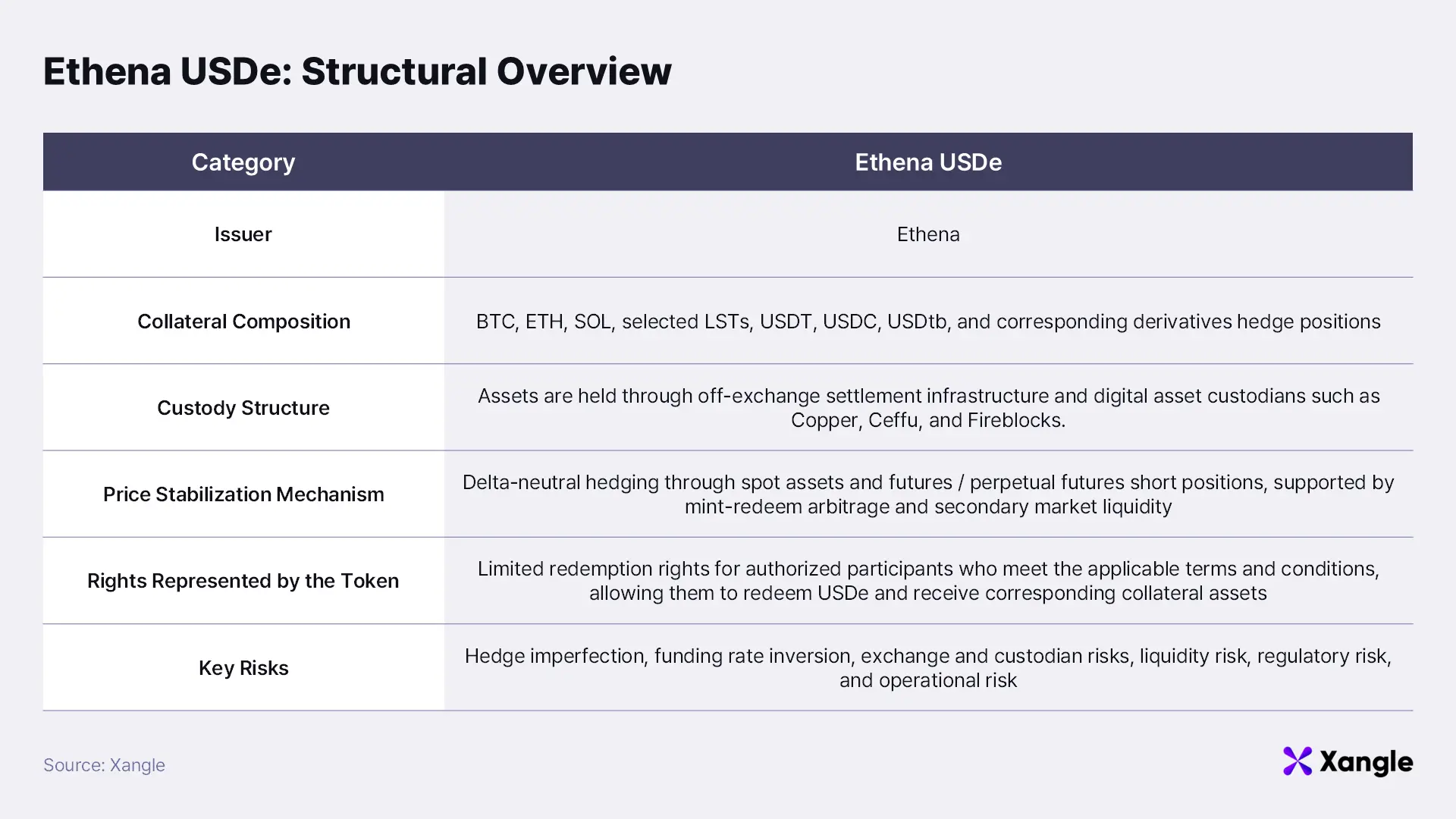
3) Issuance and Management Process
- 1. Issuance Layer: Users deposit protocol-approved crypto assets such as Ethereum, Bitcoin, and liquid staking tokens as collateral, and either mint or borrow stablecoins worth less than the value of that collateral. In this model, stablecoins are created against overcollateralized positions rather than fiat reserves.
- 2. Custody Layer: Collateral assets are deposited into smart contract-based on-chain vaults operated by protocols such as Sky, Liquity, Curve, and Aave. Collateral and debt positions are managed non-custodially according to predefined protocol rules, rather than by centralized custodians.
- 3. Collateral Management Layer: The protocol manages collateralization ratios, borrowing limits, interest rates, redemption conditions, and liquidation thresholds. If collateral value falls below the required threshold, liquidation is triggered, and part or all of the collateral is sold to repay the debt associated with the issued stablecoins.
- 4. Ledger Layer: Issuance, burning, transfers, and balance records for the stablecoins are processed across various blockchains. Users can transfer stablecoins between wallets or use them across multiple on-chain applications through these ledger records.
- 5. Data Layer: Oracles provide the price data required for collateral valuation and peg deviation detection. Because protocols rely on this data to calculate collateralization ratios and determine liquidation eligibility, oracle accuracy and reliability are critical.
- 6. Utility Layer: The issued stablecoins are used as exchange quote currencies, DeFi collateral, liquidity provision assets, bridged assets, payment instruments, and more.
- 7. Regulation Layer: Smart contract security, collateral status verification, liquidation risk, sanctioned address management, and governance authority are the main areas of oversight. For crypto-collateralized stablecoins, transparency of on-chain collateral and protocol-level risk management are more important than reserve audits.
3. Traditional Asset Tokenization
3-1. Overview of the Traditional Asset Tokenization Ecosystem
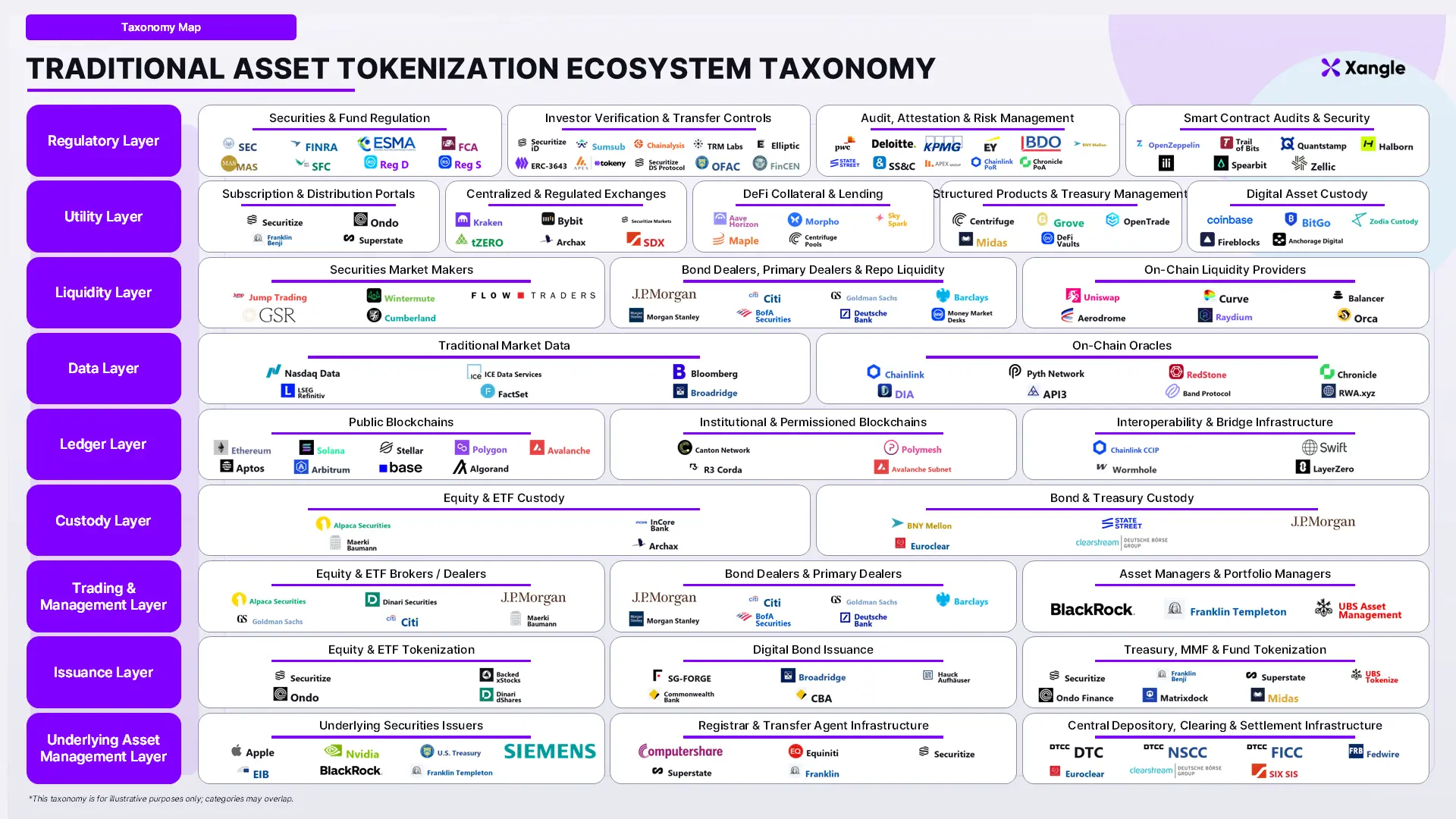
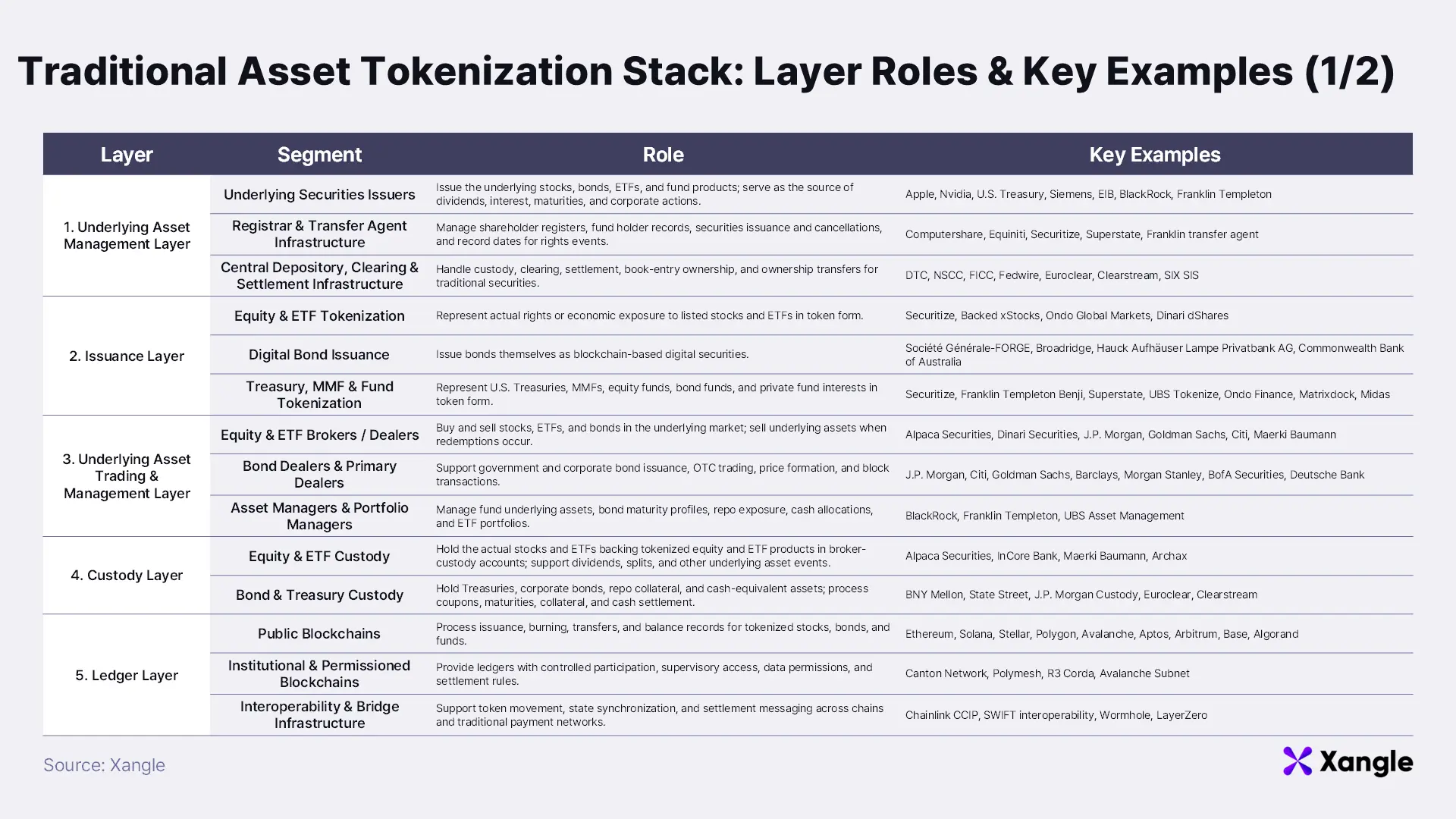
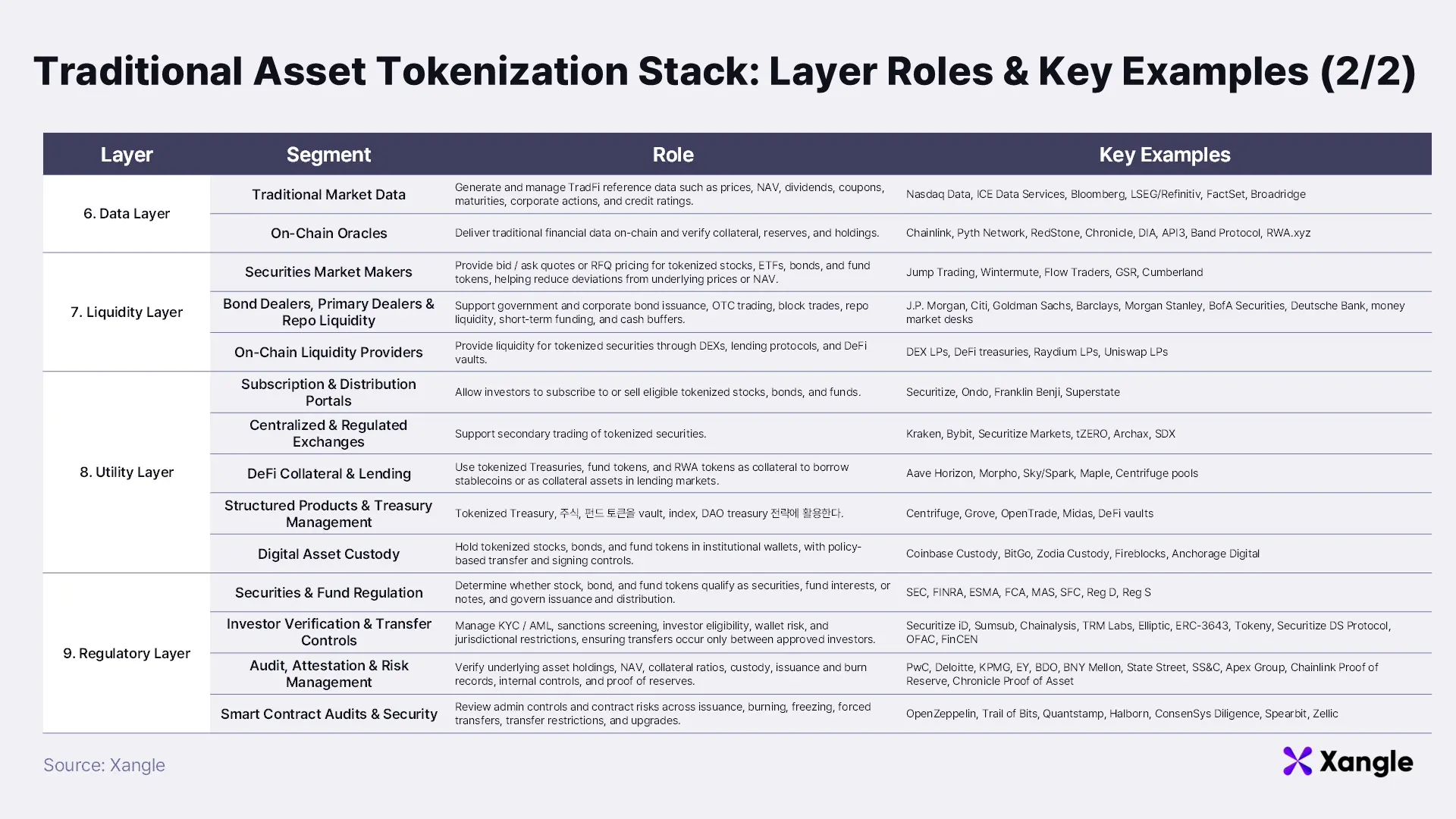
Traditional asset tokenization refers to the process of bringing assets issued and managed within existing financial markets—such as stocks, ETFs, bonds, government bonds, money market funds, and fund interests—onto blockchain ledgers so they can be issued, transferred, traded, and used on-chain. Because traditional assets already operate within established systems of issuers, transfer agents, custodians, central securities depositories, clearing and settlement infrastructure, market data providers, and regulatory frameworks, the key challenge in tokenization is how to connect existing financial infrastructure with on-chain ledgers.
Traditional asset tokenization can first be categorized by the nature of the underlying asset into stocks, bonds, and fund interests. Stock tokenization represents either a company’s actual shares or economic exposure to those shares in token form. Bond tokenization manages the ownership records and transfer structure of bonds issued by governments, institutions, or corporations on a digital ledger. Fund interest tokenization represents interests in funds that invest in government bonds, short-term Treasuries, repurchase agreements, cash-equivalent assets, and similar instruments in token form.
Among these, stock tokenization is particularly complex. The U.S. SEC classifies tokenized securities into four categories: Issuer-Sponsored Tokenized Securities, Linked Securities, Security-Based Swaps, and Tokenized Security Entitlements. Rather than reproducing this regulatory classification in full, this research explains stock tokenization through two operating models that are more useful for understanding the RWA ecosystem: direct issuanceand indirect issuance.
Directly issued stocks refer to a structure in which the official shareholder register is connected to the token, and the shares themselves are issued and managed as digital securities. Under the SEC’s classification, this corresponds to issuer-sponsored tokenized securities. The tokens held by investors are not simply price-tracking products, but digital representations of actual shares. As a result, investors hold the same economic rights and shareholder rights as existing shareholders.
By contrast, indirectly issued stocks refer to a structure in which a third-party issuer purchases, custodies, or references existing stocks or ETFs, and provides price performance or economic exposure to those assets in token form. Investors are not direct shareholders of the underlying equity issuer and are not connected to the official shareholder register. Depending on the legal structure, these products may fall under linked securities or security-based swaps in the SEC’s classification. In this research, however, structures that provide indirect economic exposure to underlying stocks or ETFs through a third party are broadly grouped as indirectly issued stocks.
Tokenized security entitlements are not treated separately in this research. This model is closer to upgrading the ledger and settlement functions of existing securities infrastructure, such as DTC, through DLT, rather than creating a standalone equity-like token product that replaces existing securities market structures. In addition, DTCC’s tokenization service is scheduled for official launch after October 2026, and its actual service model and specific use cases have not yet been sufficiently established. For that reason, this research focuses on directly issued and indirectly issued stocks.
The ecosystem map above organizes the structure through which traditional assets are tokenized, traded, and used in practice into nine layers: underlying asset management, issuance, underlying asset trading and management, custody, ledger, data, liquidity, utility, and regulation.
1) Underlying Asset Management Layer
The underlying asset management layer is where the traditional financial assets that serve as the source of tokenization are issued and managed. Stocks are issued by companies such as Apple and Nvidia, bonds are issued by corporations and institutions such as Siemens and the EIB, and government bonds are issued by governments. Fund interests arise from fund structures created by asset managers such as BlackRock and Franklin Templeton.
This layer is also where the source of rights and reference data is established, including dividends, interest, maturities, voting rights, stock splits, and fund net asset value. Transfer agents such as Computershare, as well as central depository, clearing, and settlement infrastructure such as DTC and Euroclear, manage holder records and settlement structures on traditional financial ledgers.
2) Issuance Layer
The issuance layer defines how traditional assets are tokenized. Digital securities linked to issuer records may be issued, as in the case of Securitize’s direct issuance model. The economic exposure of existing listed stocks or ETFs may also be represented in token form, as in Backed xStocks’ indirect issuance model. Another structure tokenizes interests in funds that invest in Treasury-like assets, as seen in BlackRock BUIDL.
The key question at this stage is what the token represents. The legal nature of the token and the rights granted to investors differ depending on whether the token is linked to the issuer’s official shareholder register or creditor records, represents economic exposure to underlying assets held by a third party, or represents a fund interest.
3) Underlying Asset Trading and Management Layer
The underlying asset trading and management layer is where brokers, dealers, bond dealers, and asset managers carry out the actual buying and selling of underlying assets, primary market allocations, and portfolio management.
4) Custody Layer
The custody layer is where the underlying assets or rights records backing the tokens are held and managed. In indirectly issued stock and ETF tokens, the actual shares or ETFs are held in broker or custodian accounts, and consistency between token supply and underlying asset holdings is maintained.
For bond, government bond, and fund-type products, custodians such as BNY Mellon and State Street hold government bonds, corporate bonds, cash-equivalent assets, and repurchase agreement collateral, while supporting coupon, maturity, and cash settlement processing. Directly issued stocks and bonds do not involve separately purchasing and custodying existing assets. Instead, the issuer issues the securities themselves in digital form, while a transfer agent or registrar manages the official holder records.
5) Ledger Layer
The ledger layer processes token issuance, burning, transfers, and balance records on blockchains. Public blockchains such as Ethereum, Solana, and Stellar may be used, while permissioned ledgers such as Canton Network and R3 Corda are used for institutional issuance and settlement.
Tokens circulating across multiple chains rely on interoperability and bridge infrastructure for cross-chain transfers or state synchronization. For example, Chainlink CCIP and SWIFT interoperability experiments can be used to move tokenized assets across multiple networks and traditional financial messaging systems, or to share settlement status between them.
6) Data Layer
The data layer provides the reference data from traditional financial markets that is required for token issuance and operations. Stock tokens require share prices, dividends, stock splits, and corporate action data. Bond tokens require coupon, maturity, accrued interest, yield, and credit rating data. Fund tokens require net asset value, holdings, subscription and redemption reference prices, and distribution data. These data points are provided and verified through traditional market data providers such as Bloomberg and Nasdaq Data, or through oracles such as Chainlink and Chronicle.
7) Liquidity Layer
The liquidity layer provides the buy-side and sell-side liquidity needed for tokenized assets to trade in the market. Market makers such as Wintermute and Flow Traders provide quotes or RFQ pricing for stock, ETF, bond, and fund tokens, helping reduce deviations from the underlying asset price or net asset value. Some tokenized assets may also access liquidity through DEXs and lending protocols.
8) Utility Layer
The utility layer captures how tokenized assets are used by investors and on-chain financial applications. Investors can subscribe to or redeem tokenized stocks, bonds, and funds through issuance platforms, and can trade them in secondary markets within permitted boundaries through regulated trading infrastructure.
Some tokenized assets can also be used as collateral, lending assets, liquidity provision assets, or treasury management assets. In these cases, tokens are not merely held passively; they are connected to DeFi protocols, institutional wallets, or custody infrastructure, improving operational efficiency.
9) Regulation Layer
The regulation layer determines the legal nature and distribution conditions of traditional asset tokens. Depending on whether a token qualifies as a stock, bond, fund interest, note, or derivative, the issuance method, eligible investor base, disclosure obligations, sales restrictions, transfer restrictions, and secondary trading eligibility may differ.
Investor verification, KYC, AML, sanctions screening, holder record management, underlying asset verification, net asset value confirmation, and issuance and burn record checks are also handled at this layer. Because traditional asset tokenization often operates within existing securities regulations, the regulation layer is a core domain that determines both investor protection and the extent to which on-chain utility can be enabled.
Building on this structure, the following sections examine directly issued stocks, indirectly issued stocks, directly issued bonds, and bond funds/tokenized Treasury funds in turn.
3-2. Directly Issued Stocks
1) Overview of Directly Issued Stocks
Directly issued stock tokenization refers to a structure in which shares issued by the company itself are issued and managed as digital securities, or where the existing official shareholder register and transfer agent records are linked to on-chain token records. In this model, the tokens held by investors are not merely price-tracking assets, but digital securities connected to the issuer’s official holder records.
The core of directly issued stocks is consistency between the shareholder register and the on-chain token records. The number of shares held by an investor is reflected in the official ledger, and the corresponding tokens are allocated to approved wallets. If the tokens are transferred thereafter, the official holder records must also be updated accordingly.
Directly issued stocks therefore do not involve a third-party issuer purchasing the underlying shares, holding them with a separate custodian, and issuing tokens against those shares. Instead, the issuer or transfer agent directly connects the official shareholder register with the token ledger, and manages share issuance, ownership, and transfer through investor verification, transfer restrictions, token issuance and burning, and regulated trading infrastructure. Securitize’s Exodus EXIT token is a representative example of this directly issued stock tokenization model.
2) Overview of Securitize
Securitize is a tokenization infrastructure company that enables traditional securities and fund interests to be issued, managed, and traded as blockchain-based digital securities. It is not a wrapping-type issuer that simply purchases underlying assets and wraps them into tokens. Rather, it is closer to an integrated platform that connects investor onboarding, KYC/AML, token issuance and burning, holder registry management, transfer restrictions, secondary trading, and fund administration, allowing issuers and asset managers to issue securities directly in digital form.
Securitize’s core competitive advantage lies in its ability to bring together, within a single group, multiple regulated functions required for the issuance, management, and trading of digital securities. Securitize Markets is an SEC-registered broker-dealer and FINRA member, and operates Securitize Markets ATS, an alternative trading system. Securitize also supports holder record management, transfer restrictions, and tokenized fund operations through its SEC-registered transfer agent capabilities and fund administration services.
Securitize has worked with traditional financial institutions such as BlackRock, Apollo, BNY, Hamilton Lane, KKR, and VanEck to build tokenized funds and digital securities infrastructure. As of April 2026, Securitize disclosed that it manages more than approximately $4 billion in tokenized assets. Representative examples include BlackRock BUIDL, Apollo ACRED, Hamilton Lane-affiliated private funds, and Exodus digital shares.
A particularly important recent development in stock tokenization is Securitize’s collaboration with Computershare. Computershare is one of the world’s largest transfer agents, managing more than 25,000 corporate accounts and servicing approximately 58% of S&P 500 companies. In April 2026, Securitize announced a technology agreement with Computershare to support U.S.-listed companies in issuing issuer-sponsored tokens based on existing shares and holdings under the Direct Registration System, or DRS.
3) Representative Directly Issued Token: Exodus Class A Common Stock Token
A representative directly issued stock example from Securitize is Exodus Movement’s Class A common stock token, also known as the EXIT token. In 2021, Exodus issued Class A common stock under SEC Regulation A+, and these shares were made available in token form through Securitize’s infrastructure.
The key feature of the EXIT token is that it is connected to the official shareholder records of the issuer’s stock. The EXIT token is not a price-tracking token like Apple xStocks. It is a digital security that represents ownership of Exodus Class A common stock on-chain.
Common Stock Tokens are issued under the Securitize DS Protocol* and can only be transferred between approved accounts on blockchain networks approved by the transfer agent. The Exodus EXIT token was initially issued on Algorand, and a Solana-based common stock token structure was later introduced as well. Unlike ordinary tokens that can be freely transferred to unapproved addresses, this token must satisfy investor identity, jurisdictional, and transfer restriction requirements. Trading also takes place within regulated infrastructure and an approved account structure.
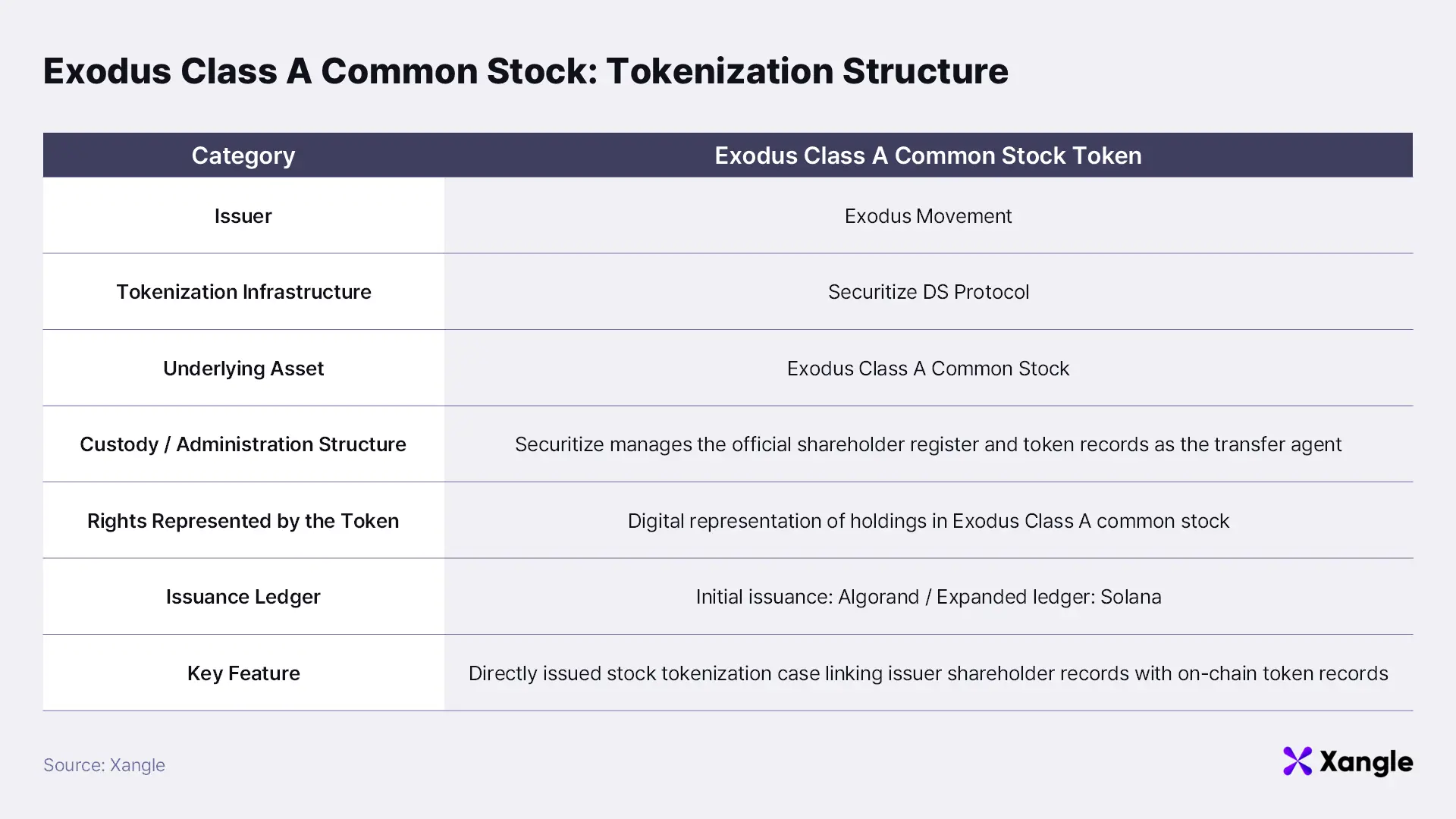
*Securitize DS Protocol: Securitize’s smart contract protocol for digital securities issuance and transfer management, designed to allow security tokens to be issued, transferred, and burned while complying with regulatory requirements.
4) Issuance and Management Process
- 1. Underlying Asset Management Layer: An issuer such as Exodus issues Class A common stock. At this stage, the asset that serves as the basis for tokenization is not separately purchased shares, but common stock issued directly by the company itself.
- 2. Issuance Layer: Securitize designs the structure that enables the shares to be issued and managed as digital securities. This is where the eligible investor base, applicable regulations, transfer restrictions, token standard, blockchain network, and method for connecting the transfer agent ledger with the token ledger are determined.
- 3. Ledger Layer: EXIT tokens corresponding to an investor’s holdings of Exodus Class A common stock are issued on the Algorand network and allocated to approved wallets.
- 4. Data Layer: Data related to stock events such as dividends, record dates, voting rights, stock splits, and reverse splits is managed. For example, when a dividend or voting record date occurs, eligible holders are determined based on the official shareholder register and token holder records.
- 5. Liquidity Layer: Directly issued stock tokens are not structured to allow ordinary market makers, DEX LPs, or OTC desks to freely provide liquidity. Because they are digital securities connected to actual shares, liquidity is formed only within a limited scope among approved investors and permitted regulated market participants.
- 6. Utility Layer: Investors can trade EXIT tokens within permitted boundaries through regulated broker-dealers or alternative trading systems such as Securitize Markets. The EXIT token is not an asset that can be freely traded on centralized or decentralized exchanges like an ordinary crypto asset. It is a digital security that can only be traded between investors who have completed KYC and satisfy the relevant transfer restrictions.
- 7. Regulation Layer: Investor eligibility, transfer restrictions, issuance and burn records, consistency between the official shareholder register and on-chain records, smart contract authority management, and audit and verification procedures are controlled at this layer. Securitize iD handles investor onboarding, KYC, and AML procedures, while on-chain analytics solutions such as Chainalysis, TRM Labs, and Elliptic are used for wallet risk assessment and transaction monitoring.
3-3. Indirectly Issued Stocks
1) Overview of Indirectly Issued Stocks
Indirectly issued stock tokenization refers to a structure in which a third-party issuer purchases and custodies existing listed stocks or ETFs, and issues tokenized products that track the price or economic performance of those underlying assets.
In this structure, investors do not become direct shareholders of underlying equity issuers such as Apple or Nvidia. Instead, they gain economic exposure to the underlying stocks or ETFs through tracker certificates, structured notes, or tokenized securities created by tokenization issuers such as Backed, Ondo, or Dinari.
The core of indirectly issued stocks is consistency between the amount of underlying assets held and the amount of tokens issued. The issuer purchases actual stocks or ETFs through a broker-dealer and holds them with a custodian or in a broker-custody account. It then issues tokens corresponding to the amount of underlying assets held. Backed Finance’s xStocks are a representative example of this type of indirectly issued stock tokenization.
2) Overview of Backed Finance / xStocks
Backed Finance is an RWA tokenization company that enables traditional financial assets such as stocks and ETFs to be traded, held, and utilized on blockchains. Its core purpose is to connect assets from existing securities markets to on-chain environments, allowing investors to access equity-like assets through digital asset exchanges or on-chain wallets.
Backed’s representative product line is xStocks. xStocks provides on-chain exposure to major U.S. stocks and ETFs, including Apple, Nvidia, Tesla, the S&P 500 ETF, and the Nasdaq 100 ETF. Supported assets have expanded to a total of 131 assets, including 100 stocks, 27 ETFs, and 4 other assets, and can be accessed through centralized exchanges, on-chain wallets, and DeFi protocols.
In terms of scale, xStocks is also one of the fastest-growing examples of indirectly issued products in the tokenized stock market. Since launch, it has recorded more than $25 billion in total trading volume and more than $3.5 billion in on-chain trading volume. Its on-chain asset size exceeds $225 million, and the number of unique on-chain holders stands at more than 80,000.
However, xStocks are not stock tokens directly issued by Apple or Nvidia. Backed purchases the underlying stocks or ETFs, holds them with custodians, and issues tokens in the form of tracker certificates that track the prices of those assets. Therefore, xStocks are not directly issued stocks connected to the issuer’s shareholder registry, but can be seen as a representative example of indirectly issued stock tokenization.
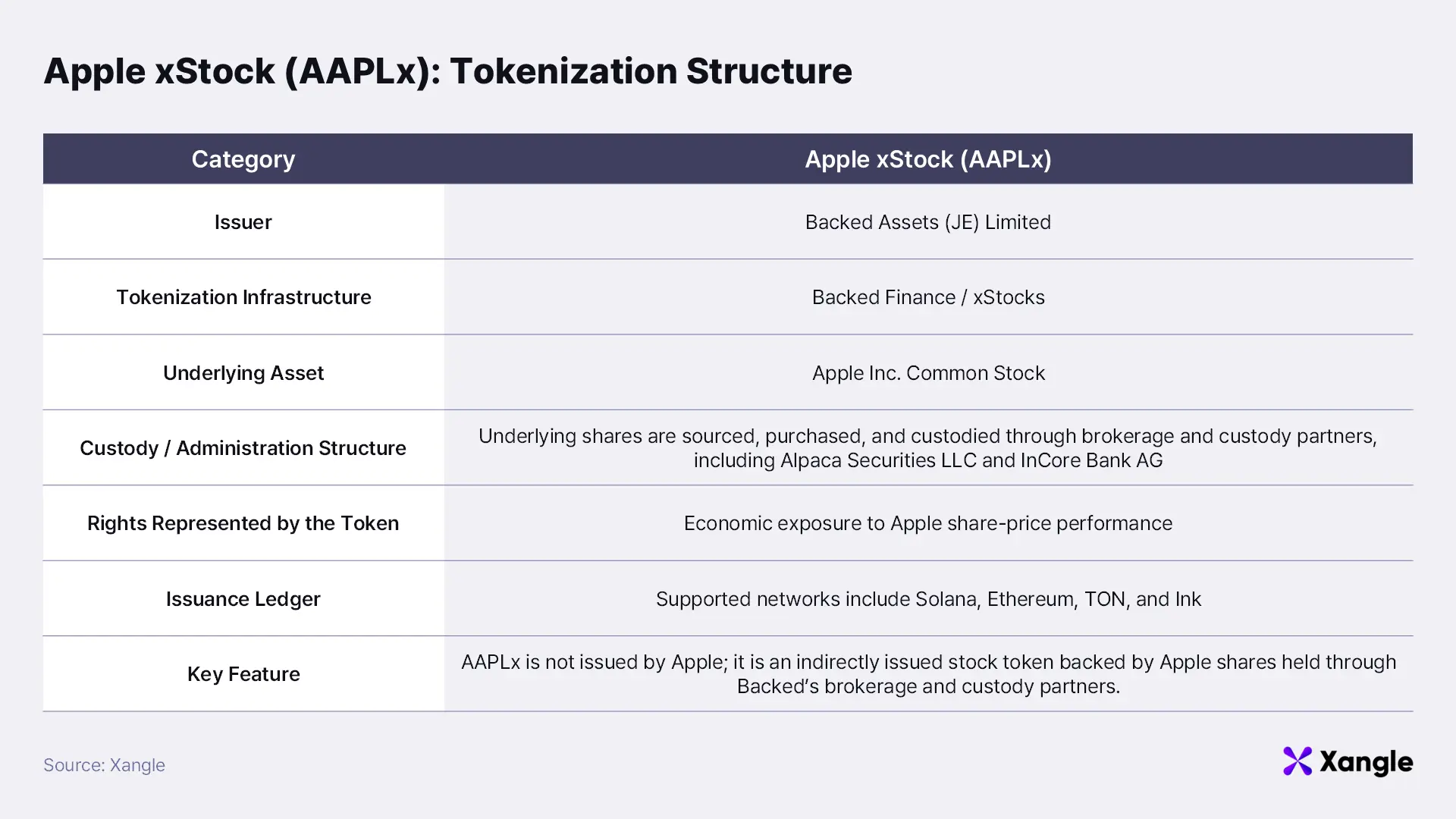
3) Representative Indirectly Issued Token: Apple xStock, AAPLx
A representative example of Backed Finance’s xStocks is Apple xStock, or AAPLx. AAPLx is not a stock token directly issued by Apple, but a tracker certificate issued by Backed that tracks the share price of Apple Inc. Therefore, AAPLx holders are not direct shareholders of Apple and do not have voting rights or direct claims against Apple.
4) Issuance and Management Process
- 1. In the underlying asset management layer, Apple Inc. issues AAPL, its listed stock, and the stock is traded and settled within the U.S. equity market and DTC and brokerage infrastructure. At this stage, AAPL becomes the source underlying asset tracked by AAPLx.
- 2. In the issuance layer, Backed Assets (JE) Limited designs a tracker certificate structure based on AAPL as the underlying asset. At this stage, AAPLx is defined not as Apple stock itself, but as an indirectly issued token that provides economic exposure to Apple’s stock price performance.
- 3. In the underlying asset trading and management layer, brokers and custodians such as Alpaca Securities LLC carry out the purchase and sourcing of AAPL shares. The underlying shares secured through this process become the collateral backing the issuance of AAPLx.
- 4. In the custody layer, the purchased AAPL shares are held in broker-custodian accounts such as those of Alpaca Securities LLC. xStocks are collateralized 1:1 by the underlying assets of each product, and the collateral is segregated from the collateral of other products through dedicated sub-accounts.
- 5. In the ledger layer, AAPLx is issued based on the secured AAPL collateral in the form of Solana SPL tokens and EVM-based ERC-20 tokens. The on-chain ledger processes the issuance, transfer, and ownership records of AAPLx.
- 6. In the data layer, reference data related to Apple stock, such as the AAPL price, dividends, stock splits, ticker changes, and delistings, is managed. This data is used to calculate issuance and redemption reference prices for AAPLx, assess price deviations, reflect dividends, and incorporate underlying asset events such as stock splits.
- 7. In the liquidity layer, exchanges, market makers, and on-chain liquidity providers provide buy and sell liquidity for AAPLx. If the AAPLx price diverges significantly from the actual AAPL price, eligible investors or liquidity providers can reduce the price gap through issuance and redemption channels.
- 8. In the utility layer, AAPLx can be traded, held, and utilized on exchanges such as Kraken and Bybit, on-chain wallets, and DeFi protocols. Because xStocks support self-custody, users can withdraw them to compatible wallets and hold them directly on-chain.
- 9. In the regulation layer, investor jurisdictional restrictions, restrictions on sales to U.S. persons, underlying asset collateral verification, proof of reserves, custody verification, and issuance and redemption history verification are managed. Collateral control is supported by Security Agent Services AG, and Chainlink Proof of Reserve is used for on-chain collateral verification. xStocks are not offered in the United States or to U.S. persons, and are provided only through eligible customers and permitted distribution channels.
3-4. Directly Issued Bonds
1) Overview of Directly Issued Bonds
Directly issued bond tokenization refers to a structure in which the bond itself is issued as a digital security, with ownership records recorded on a blockchain or DLT-based ledger. DLT, or distributed ledger technology, refers to a distributed recordkeeping system that allows multiple participants to share and verify the same transaction and ownership records.
In this structure, investors hold bondholder rights against the issuer. As with conventional bonds, they are entitled to principal repayment and interest payments. The token represents the bond’s issuance, ownership, and transfer records on a digital ledger. A representative example is the EIB Digital Bond, where the issuer issued the bond itself directly in digital security form.
2) Overview of EIB
The EIB, or European Investment Bank, is a policy finance institution jointly owned by EU member states. It provides long-term financing to projects aligned with European policy objectives, including infrastructure, climate, innovation, SMEs, and sustainable finance. The EIB is a leading supranational issuer that raises large-scale funding in traditional bond markets, while also serving as one of the institutions experimenting with the digitalization of capital market infrastructure through digital bond issuance.
3) Representative Directly Issued Bond: EIB Digital Bond
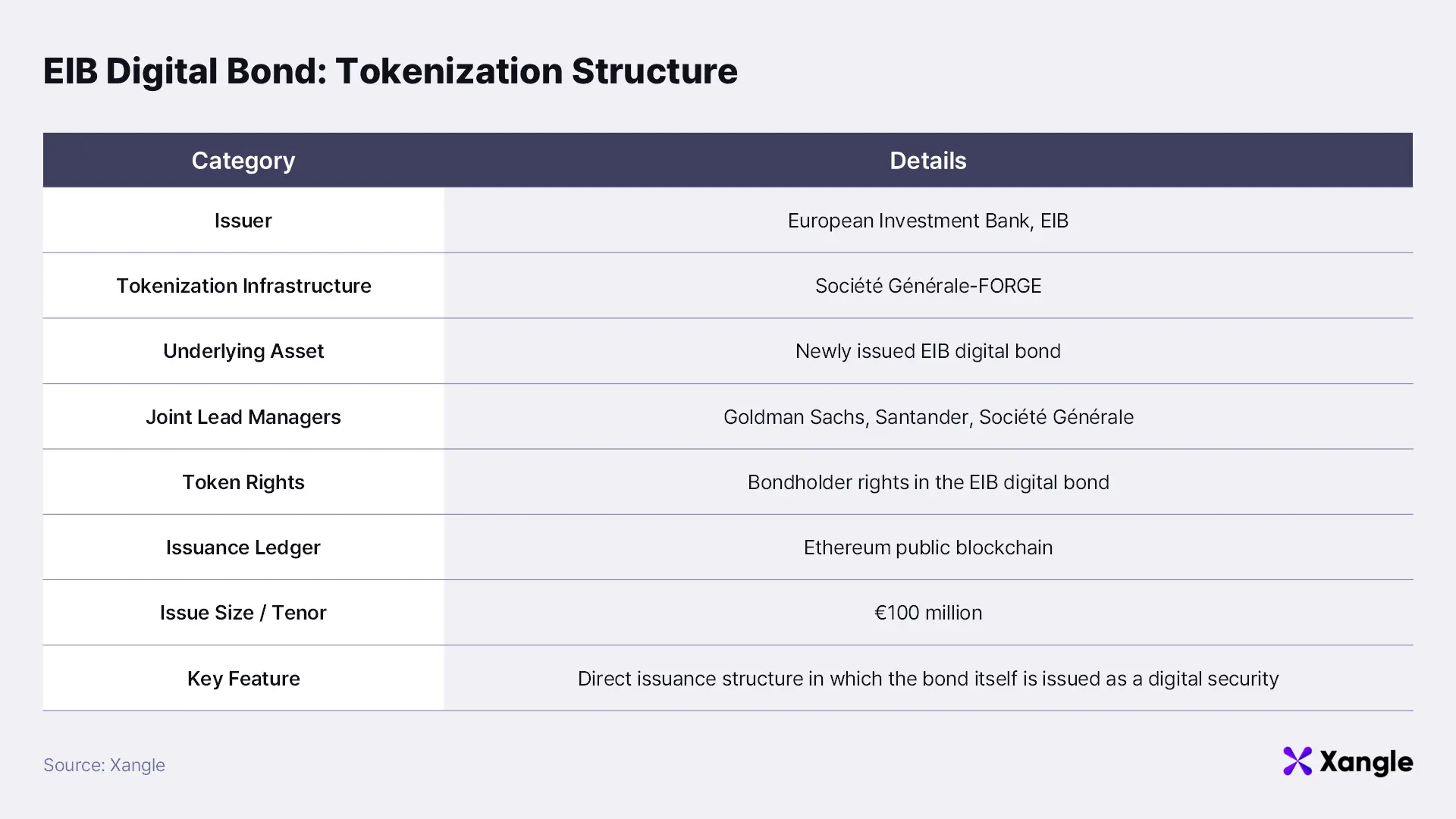
The EIB Digital Bond is a representative example of directly issued bond tokenization. The EIB did not purchase existing bonds separately and hold them as collateral. Instead, it issued its own bond directly in digital security form. This bond represents claims to principal and interest against the EIB, and investors become creditors of the EIB by holding the digital bond.
In 2021, the EIB Digital Bond was issued with a size of €100 million and a two-year maturity. Goldman Sachs, Santander, and Société Générale participated as joint lead managers, while Société Générale-FORGE was responsible for the registration and settlement infrastructure related to the digital bond.
4) Issuance and Management Process
- 1. Underlying Asset Management Layer: The EIB determines the bond issuance terms. The issuance size, maturity, interest rate, currency, payment dates, governing law, and investor scope are determined at this stage. The asset being tokenized is not an existing bond purchased separately, but the newly issued bond itself.
- 2. Issuance Layer: The EIB structures the bond as a digital security. The EIB is the issuer responsible for principal and interest payments, while Société Générale-FORGE serves as the infrastructure provider supporting the registration, settlement, and ledger connectivity of the digital bond.
- 3. Underlying Asset Trading and Management Layer: Joint lead managers such as Goldman Sachs, Santander, and Société Générale support primary market allocation, investor placement, and payment of issuance proceeds.
- 4. Ledger Layer: The issuance, ownership, and settlement records of the EIB Digital Bond are recorded on a digital ledger based on the Ethereum public blockchain. This token is not a wrapped token collateralized by an existing bond; it is a structure that records the newly issued EIB bond itself on a digital ledger.
- 5. Data Layer: The issuance terms, interest payment dates, maturity date, redemption terms, and holder records of the EIB Digital Bond are managed at this layer. This data is used for coupon payments, maturity redemption, and holder verification. In secondary trading or collateral use cases, market data such as bond prices, yields, and credit ratings may also be used as supplementary inputs.
- 6. Liquidity Layer: Directly issued bond tokens are not structured to allow ordinary market makers, DEX LPs, or OTC desks to freely provide liquidity. Because they are digital securities connected to actual bonds, liquidity forms only within a limited scope among approved investors and permitted regulated market participants.
- 7. Utility Layer: Investors can hold the EIB Digital Bond within permitted boundaries and receive interest payments and principal repayment at maturity. Secondary trading or collateral use may also be possible within regulated infrastructure.
- 8. Regulation Layer: Even when issued on a blockchain, the EIB Digital Bond is legally treated as a European bond issued by the EIB. The France-based digital securities and settlement structure is connected to the supervisory frameworks of the AMF, ACPR, and Banque de France, while ESMA and EU securities market regulations provide the broader supervisory framework at the European level.
3-5. Bond Funds / Tokenized Treasury Funds
1) Overview of Bond Funds / Tokenized Treasury Funds
Bond funds or tokenized Treasury funds refer to a structure in which interests in funds that invest in government bonds, short-term Treasuries, repurchase agreements, cash-equivalent assets, and similar instruments are represented as tokens. In this model, investors do not directly hold a specific Treasury bill or government bond. Instead, they hold interests in a fund managed by an asset manager. The token represents the issuance, transfer, redemption, and distribution records of those fund interests on-chain.
The core components of bond fund tokenization are fund interests, net asset value, subscription and redemption, distributions, custody, and fund accounting. The asset manager allocates subscription proceeds across cash, short-term Treasuries, repurchase agreements, and similar instruments, while the custodian holds the fund assets. The transfer agent and tokenization platform manage investor-level fund interests, wallet addresses, subscription and redemption records, and token issuance and burn records. BlackRock BUIDL is a representative example of this bond fund and tokenized Treasury fund structure.
2) Overview of BlackRock/BUIDL
BlackRock is one of the world’s largest asset managers, offering a broad range of traditional financial products across ETFs, bonds, money market funds, alternative investments, and other asset classes. BUIDL, officially named the BlackRock USD Institutional Digital Liquidity Fund, is a representative example of BlackRock extending its asset management capabilities into a blockchain-based fund structure.
3) Representative Tokenized Fund: BlackRock BUIDL
BUIDL does not tokenize bonds themselves. Rather, it tokenizes interests in a fund that invests in cash, U.S. Treasury bills, repurchase agreements, and similar instruments. The BUIDL token therefore does not directly represent individual U.S. Treasuries, but instead represents a fund share in a digital liquidity fund managed by BlackRock. BUIDL seeks to maintain a stable value of $1 per token, and income generated by the fund is distributed to investor wallets each month in the form of new tokens.
The key participants in BUIDL are separated by role. BlackRock Financial Management manages the fund, while BNY Mellon serves as the custodian and administrator of the fund assets. Securitize acts as both transfer agent and tokenization infrastructure provider, managing the issuance, transfer, redemption, and distribution records of the fund interests. Securitize Markets serves as the distribution and subscription channel through which eligible investors access BUIDL.
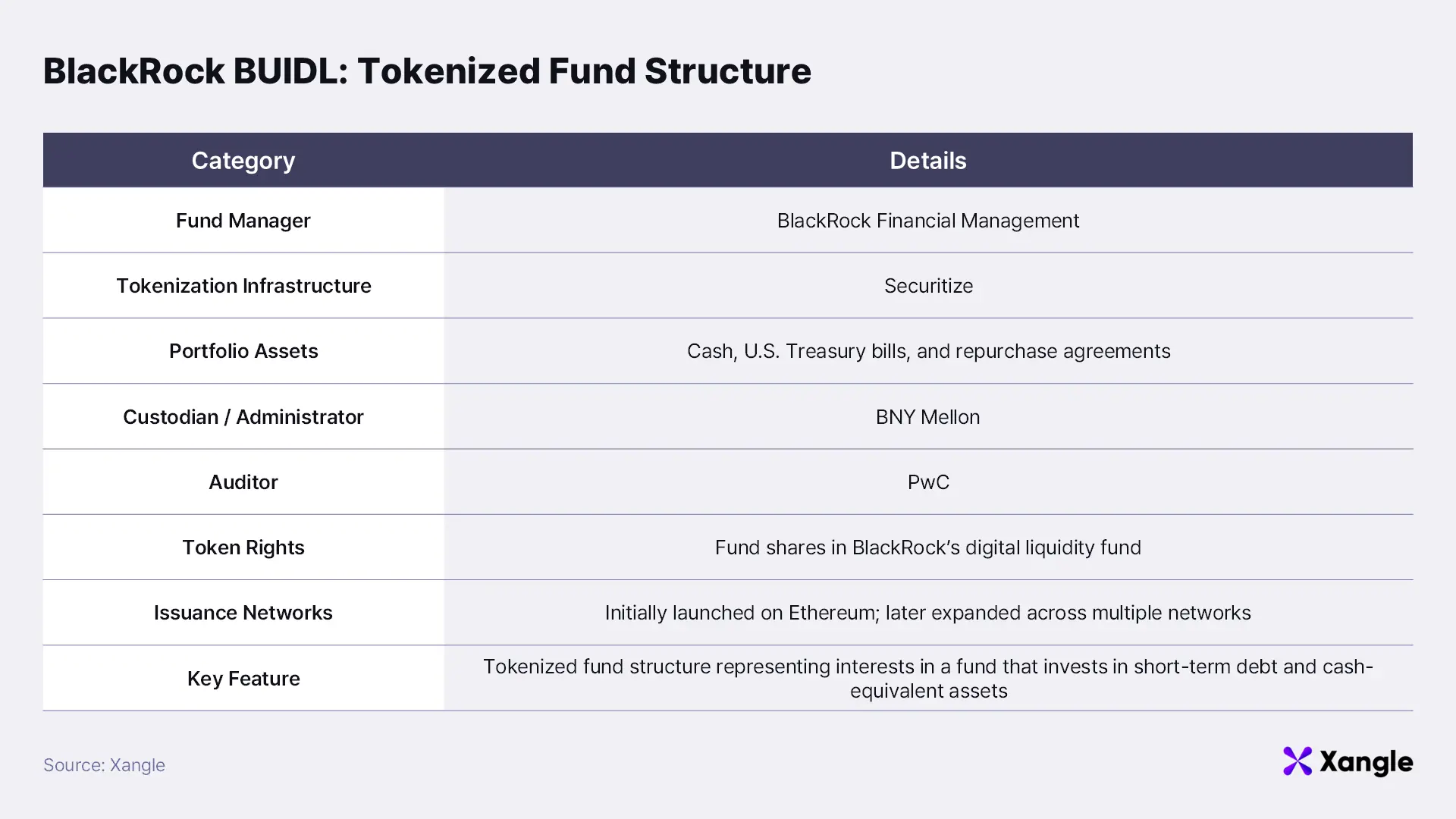
4) Issuance and Management Process
- 1. Underlying Asset Management Layer: U.S. Treasury bills, repurchase agreements, and cash-equivalent assets serve as the investment targets of BUIDL. BUIDL is not a product that tokenizes these assets directly, but a structure that tokenizes interests in a fund investing in them.
- 2. Issuance Layer: BlackRock structures BUIDL as an institutional digital liquidity fund, while Securitize provides the infrastructure that enables the fund interests to be issued, transferred, and managed in token form. This stage defines the eligible investor base, subscription conditions, transfer restrictions, wallet registration requirements, and token issuance structure.
- 3. Underlying Asset Trading and Management Layer: BlackRock, as the fund manager, allocates subscription proceeds across cash, U.S. Treasury bills, repurchase agreements, and similar instruments. BUIDL investors do not directly hold individual Treasury bills; they hold interests in a fund managed by BlackRock.
- 4. Custody Layer: BNY Mellon serves as the custodian and administrator of the fund assets. The fund’s underlying assets, including Treasury bills, repurchase agreements, and cash-equivalent assets, are held and accounted for within traditional financial infrastructure.
- 5. Ledger Layer: BUIDL tokens are issued to the wallets of approved investors. BUIDL was first launched on Ethereum and is designed to allow token transfers between approved investors under restricted conditions.
- 6. Data Layer: BUIDL’s net asset value, holdings, distribution history, subscription and redemption reference prices, and fund accounting data are managed at this layer. BlackRock manages investment and portfolio data, BNY Mellon manages custody, fund accounting, and net asset value data, and Securitize manages investor-level fund interests, subscriptions and redemptions, distributions, and token issuance and burn records.
- 7. Liquidity Layer: BUIDL is not freely traded in ordinary DEX pools. Instead, it provides on-chain liquidity to approved investors through UniswapX’s request-for-quote structure. In this process, pre-approved market participants such as Flowdesk, Tokka Labs, and Wintermute provide BUIDL/USDC trade quotes, and trades are settled atomically through smart contracts.
- 8. Utility Layer: BUIDL can be subscribed to and redeemed through Securitize, transferred between approved investors, and held through institutional wallets or digital asset custody infrastructure. BUIDL is also used as a reserve asset or underlying asset for on-chain financial products such as Ethena USDtb.
- 9. Regulation Layer: Investor onboarding, KYC, AML screening, investor eligibility verification, and wallet registration are conducted through Securitize iD. This layer also manages investor eligibility, transfer restrictions, subscription and redemption records, net asset value and distribution records, custody verification, audits, smart contract authority management, and verification of token issuance and burn records. Securitize manages investor records and token transfer restrictions, while PwC serves as the auditor of the BUIDL fund and verifies fund operations and financial reporting.
4. Alternative Asset Tokenization
4-1. Overview of the Alternative Asset Tokenization Ecosystem
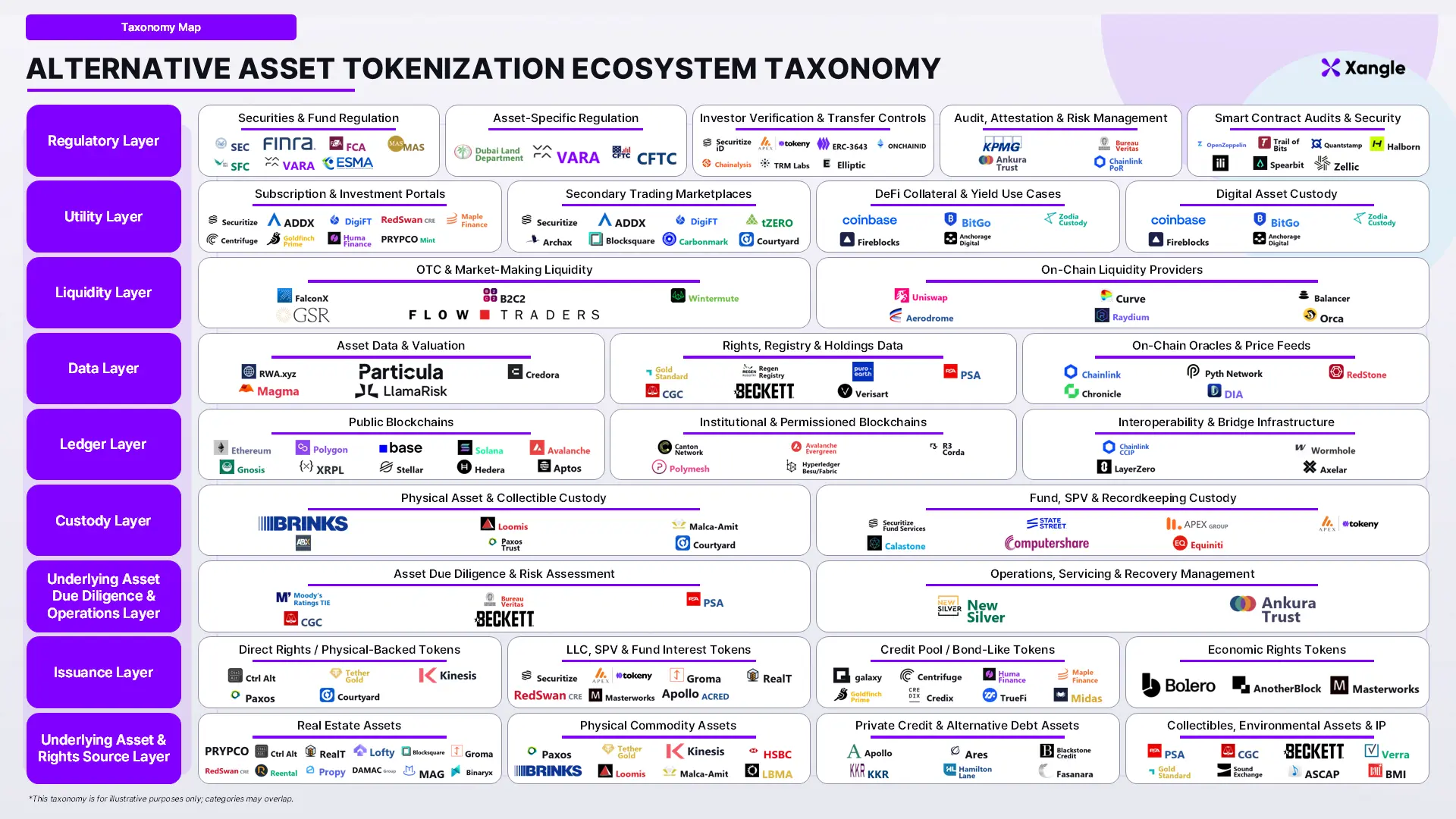
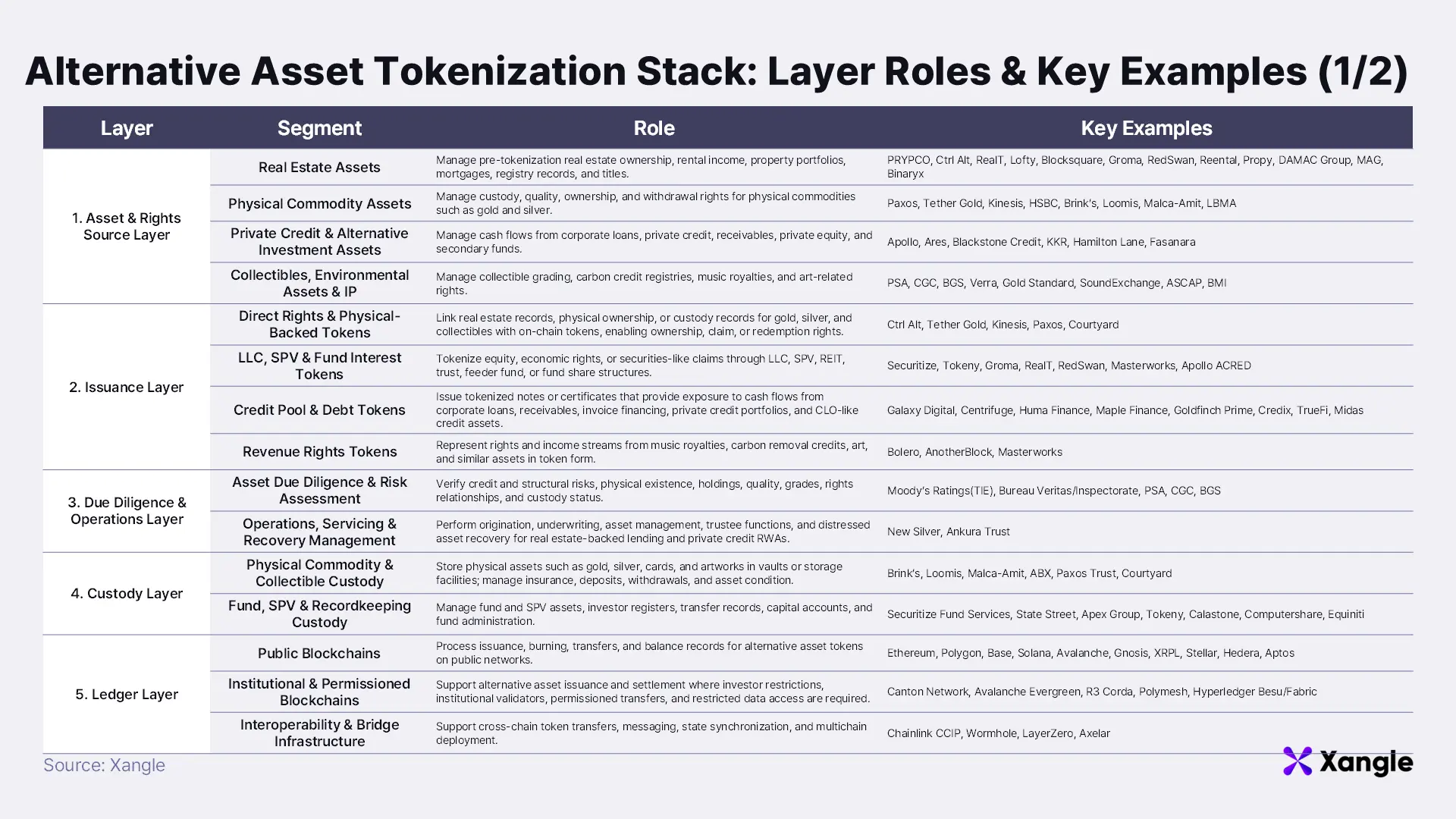
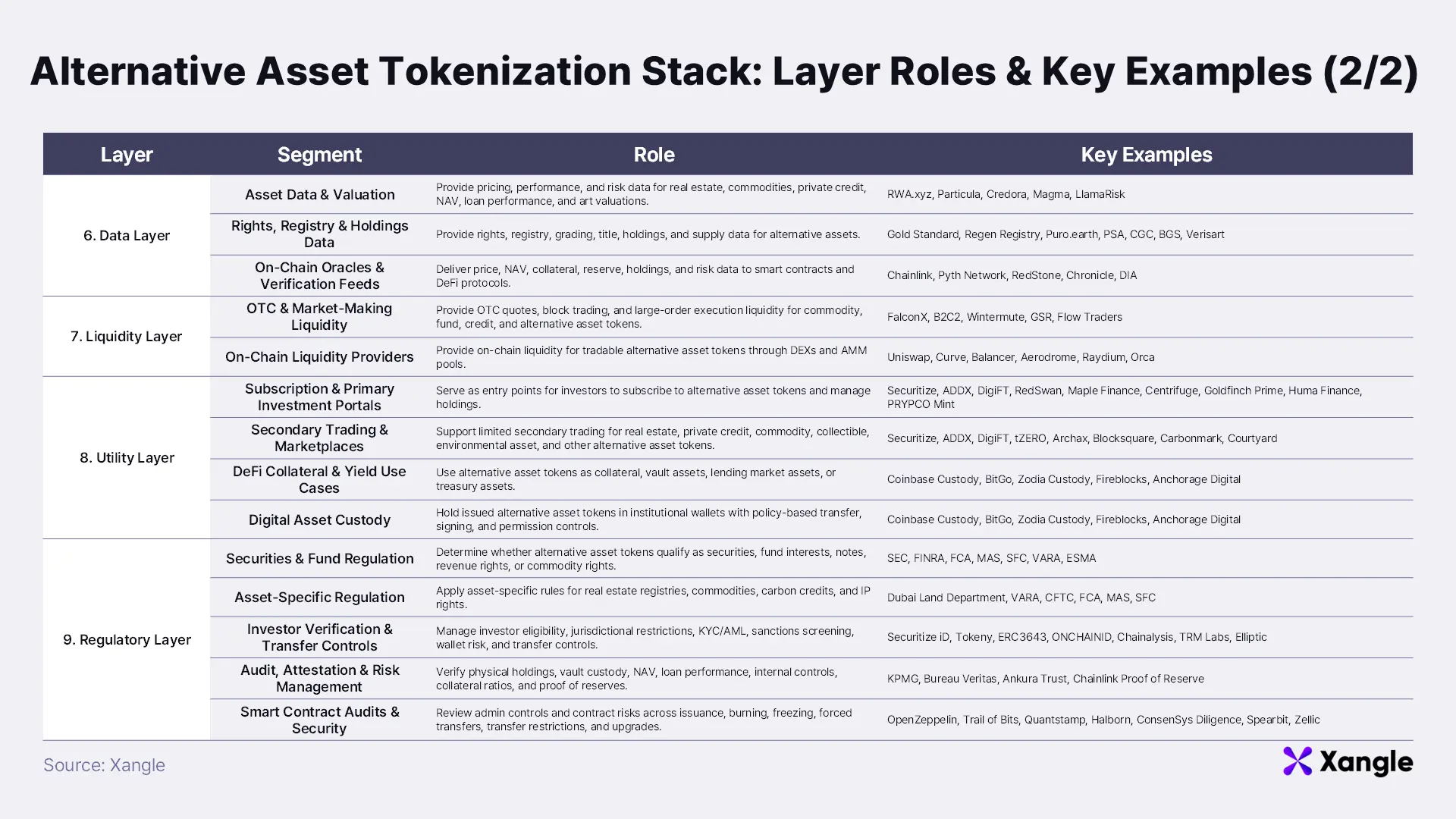
Alternative asset tokenization refers to a structure that allows assets with low liquidity or complex rights structures—such as real estate, commodities, private credit, collectibles, environmental assets, and IP—to be held, transferred, and used on blockchain ledgers.
Alternative asset tokenization can be broadly divided into direct real estate rights and registry-linked structures, indirect real estate equity structures, physically custodied commodity structures, private credit fund interest structures, and physically custodied collectible structures. In direct real estate rights structures, consistency between registry or title records and on-chain token records is critical. Indirect real estate equity structures tokenize equity interests or economic rights in corporations, funds, or projects that hold real estate. Physically custodied commodity structures store physical assets such as gold or silver in vaults and represent the associated rights in token form. Private credit fund interest structures bring fund interests backed by private credit portfolios on-chain, while physically custodied collectible NFTs represent ownership and redemption rights over physical collectibles held in storage facilities.
The ecosystem map above organizes the structure through which alternative assets are tokenized and used in practice into nine layers: underlying asset and rights source, issuance, underlying asset due diligence and operations, custody, ledger, data, liquidity, utility, and regulation.
1) Underlying Asset and Rights Source Layer
The underlying asset and rights source layer is where the original assets and rights that exist before tokenization are managed. For real estate, this includes ownership rights, rental income, real estate portfolios, mortgage loans, and registry or title records. For commodities, it includes the custody, quality, ownership, and withdrawal rights of physical assets such as gold and silver.
For private credit and alternative investment assets, asset managers such as Apollo and Ares manage cash flows from corporate loans, private credit, receivables, and private funds. In collectibles, environmental assets, and IP, institutions such as PSA, Verra, and SoundExchange provide the reference standards for source rights and data, including collectible grading, carbon credit registration, and music royalties.
2) Issuance Layer
The issuance layer defines how the rights and cash flows of alternative assets are represented in token form. For alternative assets, the rights represented by a token vary depending on the nature of the asset. For assets where physical custody is central, such as gold, silver, and collectibles, tokens represent ownership of or withdrawal rights to the stored physical asset. For assets that require legal structures, such as real estate and funds, equity interests, trust interests, fund interests, or economic rights in a corporation, trust, or fund are tokenized. For cash flow-driven assets such as corporate loans, receivables, and private credit portfolios, rights to principal, interest, and repayment cash flows are pooled and tokenized.
3) Underlying Asset Due Diligence and Operations Layer
The underlying asset due diligence and operations layer verifies the existence, ownership, value, rights relationships, grade, cash flow, and credit risk of the assets being tokenized. For real estate, appraised value, lease status, liens, and rights relationships are important. For commodities, physical holdings, quality, storage location, and withdrawal availability are key.
In private credit, credit assessment and recoverability are central. For collectibles, authenticity verification and grading data from grading agencies such as PSA, CGC, and BGS are important. Even after tokenization, ongoing operations remain necessary, including lease management, loan repayment management, receivables collection, collateral management, and non-performing loan recovery procedures.
4) Custody Layer
The custody layer is where the physical assets, fund records, or SPV records backing the tokens are held and managed. Physical assets such as gold, silver, cards, and artworks are stored in vaults and storage facilities operated by firms such as Brink’s and Loomis, while insurance, deposits and withdrawals, condition management, and secure transport are also handled.
5) Ledger Layer
The ledger layer processes the issuance, burning, transfers, and balance records of alternative asset tokens. Public blockchains such as Ethereum, Polygon, Solana, and XRP Ledger may be used, while institutional or permissioned ledgers such as Canton Network and Avalanche Evergreen may be used when investor restrictions or permissioned transfers are required.
When cross-chain token movement, messaging, or state synchronization is needed, interoperability infrastructure such as Chainlink CCIP, Wormhole, and LayerZero may be used. This layer serves as the foundation for managing on-chain ownership records and transfer history for alternative asset tokens.
6) Data Layer
The data layer provides price, performance, rights, holdings, and risk data for alternative assets. Data such as real estate appraisals, commodity prices, credit ratings, private market performance, net asset value, rental income, loan performance, and artwork valuations is used for pricing and investment decisions.
Carbon credit registries such as Verra and Gold Standard, collectible grading agencies such as PSA, and artwork authentication infrastructure such as Verisart also serve as reference sources for rights, registration, and holdings data. Oracles such as Chainlink, RedStone, and Chronicle deliver price, net asset value, collateral, reserve, and holdings data to smart contracts and DeFi protocols.
7) Liquidity Layer
The liquidity layer provides limited trading liquidity for alternative asset tokens. OTC and market-making firms such as FalconX, Wintermute, and GSR can provide liquidity for commodity tokens, certain fund and credit tokens, and other alternative asset tokens.
Some tradable alternative asset tokens may also access on-chain liquidity through DEXs and AMM pools such as Uniswap, Curve, and Balancer. However, because alternative assets are generally less liquid, deep secondary markets comparable to equities cannot always be assumed.
8) Utility Layer
The utility layer captures how investors subscribe to, hold, and trade alternative asset tokens, and how certain tokens are used as collateral, lending assets, yield strategy assets, or treasury management assets. In many cases, however, alternative asset tokens are not freely usable like ordinary crypto assets. Their utility is often constrained by investor eligibility, transfer restrictions, redemption conditions, and regulatory requirements.
9) Regulation Layer
The regulation layer determines whether an alternative asset token qualifies as a security, fund interest, note, economic right, or commodity right, and applies issuance, sales, and trading regulations accordingly. Supervisory authorities such as the SEC, FCA, MAS, and VARA, together with securities and fund regulations in each jurisdiction, affect the eligible investor base, distribution methods, disclosure requirements, and trading restrictions.
Asset-specific regulation is also important. Real estate is subject to registry authorities such as the Dubai Land Department and land regulations. Commodities are subject to commodity regulations such as those administered by the CFTC. Carbon credits are governed by registries and retirement procedures, while IP is governed by copyright registration and royalty management systems. Investor verification, transfer restrictions, physical holdings verification, net asset value verification, proof of reserves, and smart contract security reviews are also required throughout the process.
Building on this structure, the following sections examine direct real estate rights and registry-linked structures, indirect real estate equity structures, physically custodied commodity structures, private credit fund interest structures, and physically custodied collectible NFTs in turn.
4-2. Direct Real Estate Rights and Registry-Linked Structures
1) Overview of Direct Real Estate Rights and Registry-Linked Structures
Direct real estate rights and registry-linked tokenization refers to a structure that connects official rights records—such as real estate title deeds, registry records, and titles—with on-chain token records. Instead of purchasing an entire property outright, investors hold fractional ownership or rights tokens linked to registry and rights records. The tokens can be transferred on-chain, with those transfers connected to actual real estate rights records.
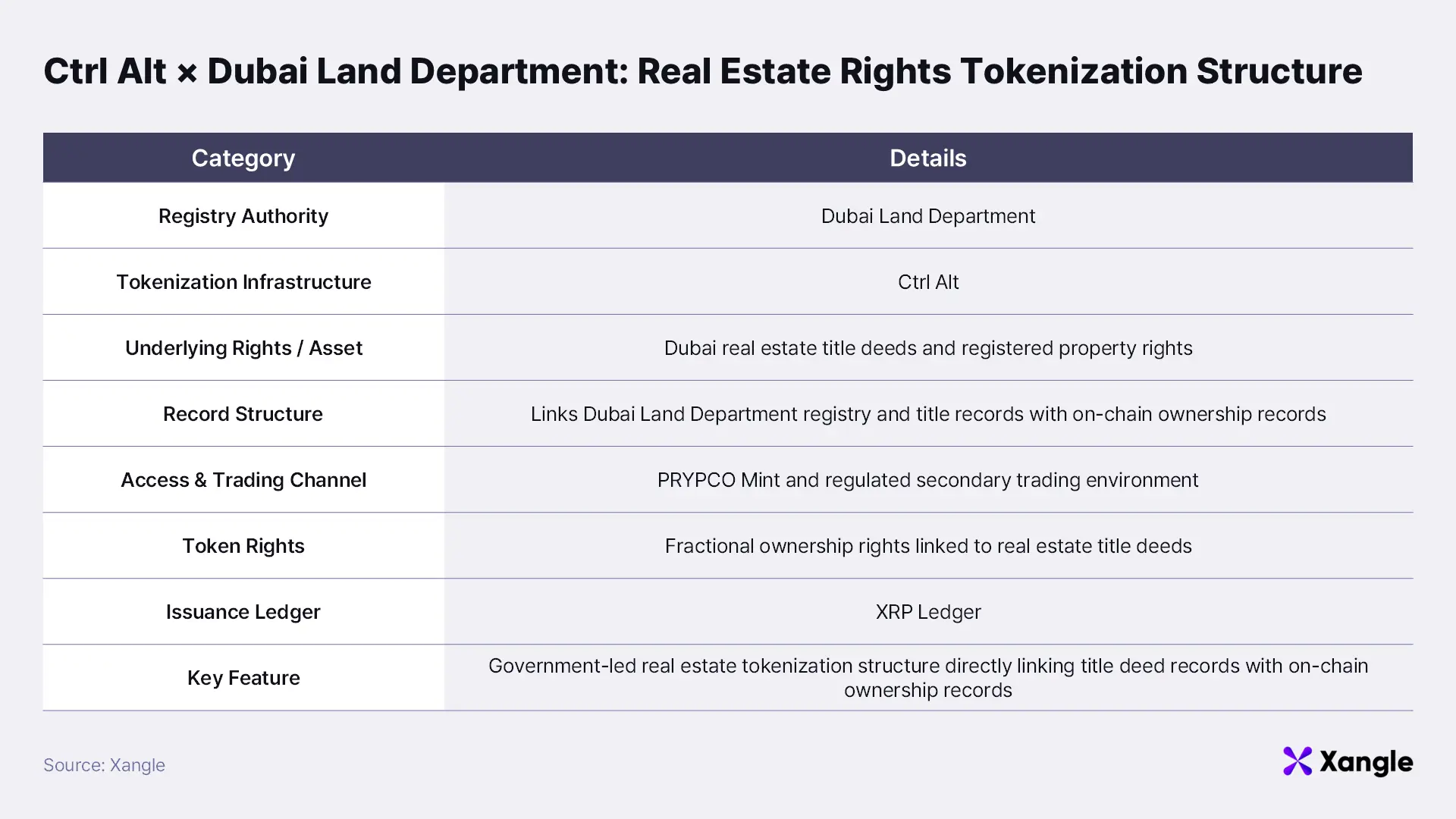
In this model, real estate registry authorities, tokenization infrastructure, investor verification systems, and ledger infrastructure operate together. Token supply, holder records, and transfer history are recorded on-chain, while real estate rights records remain connected to the registry system. A representative example is the Dubai real estate tokenization project led by the Dubai Land Department and Ctrl Alt. This project connected rights records managed by Dubai’s government real estate registry authority with XRP Ledger-based on-chain token records, representing real estate title deeds in the form of fractional ownership tokens.
2) Overview of Ctrl Alt / Dubai Land Department
Ctrl Alt is a tokenization infrastructure company that connects the rights structures of real-world assets and financial assets with on-chain token records. It supports the issuance and management of assets such as real estate, funds, and alternative investments in the form of digital securities or rights tokens. In the Dubai real estate tokenization project involving the Dubai Land Department, Ctrl Alt was responsible for structuring, issuing, deploying on-chain, and integrating title deed-based tokens with the existing registry system. The company is not widely known as a platform with a publicly cited assets-under-management figure; in this case, its role as infrastructure provider for the Dubai real estate tokenization project is the key point.
The Dubai Land Department is the government authority responsible for managing real estate registration and rights records in Dubai. It serves as the reference institution for property ownership, registration, title deeds, and transaction records. In this tokenization structure, it played the role of connecting on-chain token records with existing registry records. The significance of this case lies in the fact that it was not a tokenization initiative pursued solely by a private real estate investment platform, but a regulated real estate tokenization project involving a government registry authority.
3) Representative Case: Ctrl Alt × Dubai Land Department
A representative case is the Dubai real estate tokenization pilot project involving the Dubai Land Department, with Ctrl Alt providing the tokenization infrastructure. This structure connects the Dubai Land Department’s real estate registration and rights records, PRYPCO Mint’s investment channel, and an XRP Ledger-based ledger, linking real estate title deeds with on-chain ownership records. Investors are closer to holding fractional ownership tokens connected to DLD’s official rights records, rather than shares in a company or fund that holds real estate.
4) Issuance and Management Process
- 1. Underlying Asset Management Layer: The Dubai Land Department manages the real estate subject to tokenization and the corresponding title deed and registry records.
- 2. Issuance Layer: Ctrl Alt designs the structure through which real estate title deeds can be issued as fractional ownership tokens. The eligible investor base, transfer restrictions, token structure, and method for connecting the registry system with the on-chain ledger are determined at this stage.
- 3. Underlying Asset Due Diligence and Operations Layer: The title deed, ownership, appraised value, investment documents, and platform registration procedures of the real estate subject to tokenization are verified.
- 4. Ledger Layer: The real estate rights tokens are issued on XRP Ledger. The on-chain ledger records each investor’s holdings and transfer history.
- 5. Data Layer: Real estate registry information, token supply, investor holdings, transfer history, and registry status are managed and provided.
- 6. Utility Layer: Platforms such as PRYPCO Mint serve as the entry point for investors to subscribe, hold, and trade. These tokens are traded within a permitted investor base and regulated trading environment.
- 7. Regulation Layer: The Dubai Land Department’s registry framework, VARA regulation, investor verification, transfer restrictions, secondary trading controls, and smart contract authority management are applied.
4-3. Indirect Real Estate Equity Structures
1) Overview of Indirect Real Estate Equity Structures
Indirect real estate equity tokenization refers to a structure that tokenizes equity interests or economic rights in a corporation, fund, SPV, or project that holds real estate. Investors are not recorded as direct owners on the real estate registry. Instead, they hold equity interests or economic rights in the structure that owns or operates the real estate.
This model is well suited to large-scale assets such as commercial real estate, multifamily properties, hotels, logistics centers, and real estate portfolios. Multiple investors can participate in a single commercial real estate project or portfolio, while the token represents the holding, transfer, and trading records of those interests on-chain. Investors’ economic returns come from rental income, operating income, asset sale proceeds, or the secondary trading price of their interests.
Platforms that offer commercial real estate projects in the form of digital securities are representative examples of this model. Rather than transferring registry ownership of the real estate itself, this structure represents equity interests and economic rights in the legal vehicle that holds the real estate in token form.
2) Overview of RedSwan Digital Real Estate
RedSwan Digital Real Estate is a U.S.-based commercial real estate tokenization platform. It offers institutional-grade commercial real estate assets, including multifamily properties, hotels, and industrial and logistics assets, in the form of digital real estate investment securities. This allows investors to access large real estate projects or portfolios in smaller units.
RedSwan is one of the relatively larger examples in the real estate tokenization market. The platform has approximately $4 billion in tokenized real estate assets, a $5.2 billion pipeline of planned projects, and more than 13,000 registered global users. It has also secured an exclusive agreement to onboard and distribute a $4 billion real estate portfolio in the Gulf Cooperation Council region, consisting of 36 mixed-use properties, onto blockchain.
RedSwan provides investor onboarding, KYC, KYB, AML screening, investment product review, subscription, and wallet connection within its platform. RedSwan PC serves as the platform and technology provider as well as an investment adviser, while securities transactions are conducted through RedSwan Markets, a registered broker-dealer and FINRA/SIPC member.
3) Representative Case: Rhythm & Blues Oak Park
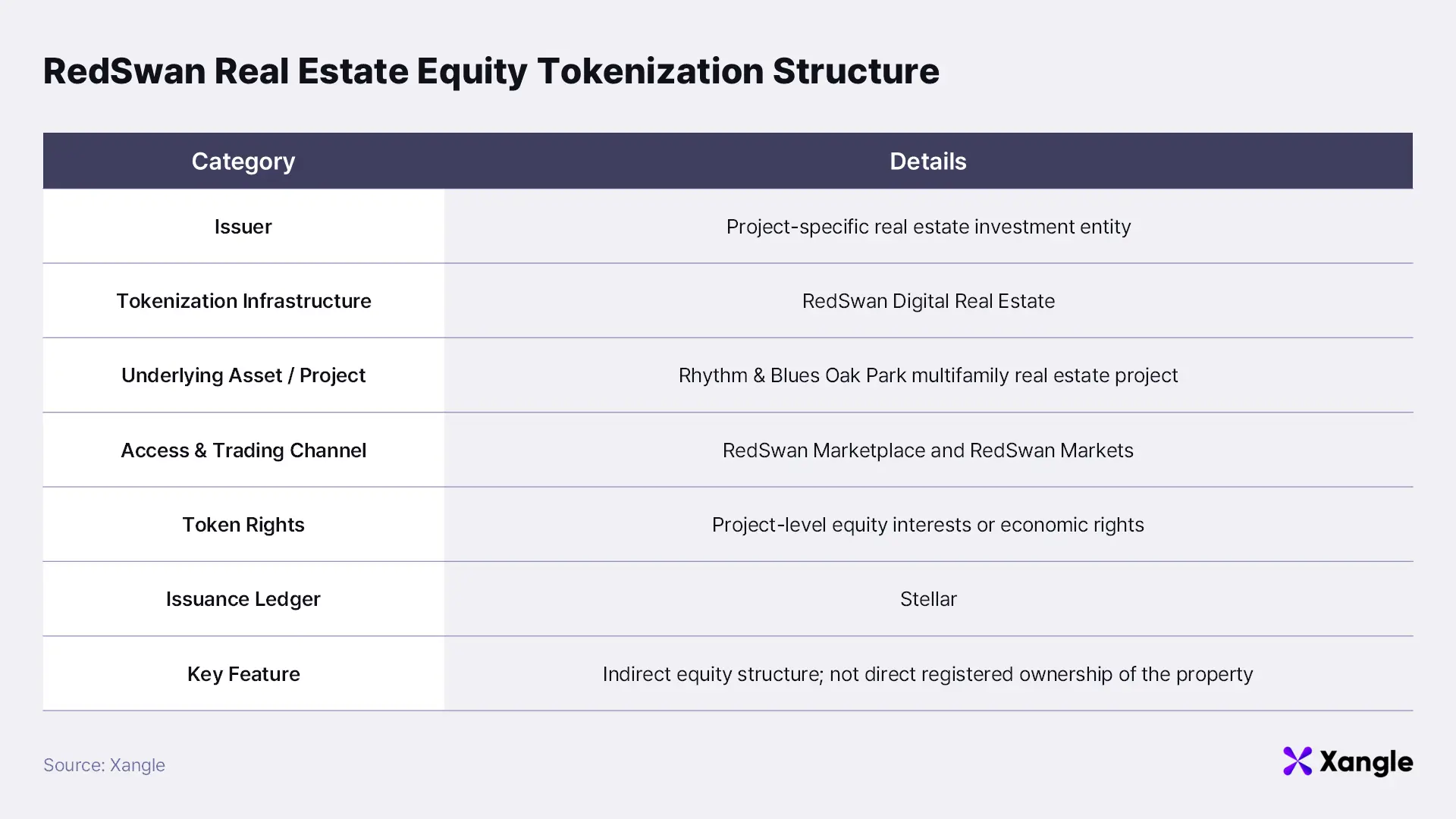
A representative example of RedSwan’s indirect real estate equity structure is Rhythm & Blues Oak Park. Rhythm & Blues Oak Park is a tokenized real estate investment opportunity based on a modern apartment property located in Oak Park, Illinois. RedSwan presents this project as an example of tokenized access to a high-quality multifamily asset, allowing investors to participate in a large real estate asset in smaller units.
In this structure, investors do not become direct owners recorded on the registry of the apartment property. Instead, they hold economic rights connected to the real estate project in the form of digital securities. Rhythm & Blues Oak Park presents a token price of $1, a target investor IRR of 9%, a target average cash yield of 7.05%, and a target equity multiple of 1.5x. Therefore, Rhythm & Blues Oak Park can be viewed as an indirect real estate equity tokenization case, where the economic rights of a specific real estate project are issued and distributed as digital securities, rather than transferring registry ownership of the real estate itself.
4) Issuance and Management Process
- 1. Underlying Asset and Rights Source Layer: A multifamily property such as Rhythm & Blues Oak Park becomes the subject of tokenization. At this stage, the property’s location, ownership structure, lease status, operating performance, cash flows, and asset value are reviewed.
- 2. Issuance Layer: RedSwan offers the real estate project in the form of digital real estate investment securities. The token represents equity interests or economic rights arising from the project structure, rather than ownership of the real estate registry itself.
- 3. Due Diligence and Operations Layer: The real estate sponsor, operator, and asset manager review occupancy rates, rental income, operating expenses, asset management status, expected cash flows, and target returns.
- 4. Custody Layer: Equity records, investor ledgers, subscription documents, and project documents for the corporation, fund, or project structure that holds the real estate are managed at this layer. The physical real estate itself is managed within the registry and legal ownership structure, while investors hold economic rights in the project structure rather than direct registered ownership of the property.
- 5. Ledger Layer: Investors’ equity interests or economic rights are recorded as digital securities. The on-chain or digital ledger represents investor-level holdings and transfer records, while the actual legal rights and investment documents are managed together with the books and records of the project’s legal structure.
- 6. Data Layer: Appraised value, occupancy rates, rental income, operating expenses, expected cash flows, target returns, distribution history, and investment documents are managed at this layer. This data is used for investor reporting, income distribution, pricing, and risk management.
- 7. Liquidity Layer: RedSwan does not currently guarantee an active secondary market, but aims to build a marketplace that supports limited secondary trading among approved investors in the future.
- 8. Utility Layer: Investors subscribe to and hold real estate projects such as Rhythm & Blues Oak Park through the RedSwan marketplace. Rental income, operating income, and asset sale proceeds are distributed to investors.
- 9. Regulation Layer: Securities issuance, investor eligibility verification, KYC, KYB, AML screening, transfer restrictions, holding periods, and secondary trading eligibility are managed at this layer. RedSwan Markets supports regulatory requirements related to securities offerings and distribution as a registered broker-dealer and FINRA/SIPC member.
4-4. Physically Custodied Commodities
1) Overview of Physically Custodied Commodities
Physically custodied commodity tokenization refers to a structure in which physical commodities such as gold and silver are stored in vaults or custody facilities, and ownership rights, claims, or withdrawal rights to those physical assets are represented as tokens.
Investors hold rights connected to the stored physical assets. The physical assets are held in vaults, while the tokens represent ownership rights or claims to those assets on-chain. Representative examples include products that store gold or silver in vaults and issue tokens representing claims or ownership rights to the stored assets. Tether Gold, Paxos Gold, and Kinesis are representative examples of this model.
2) Overview of Tether Gold
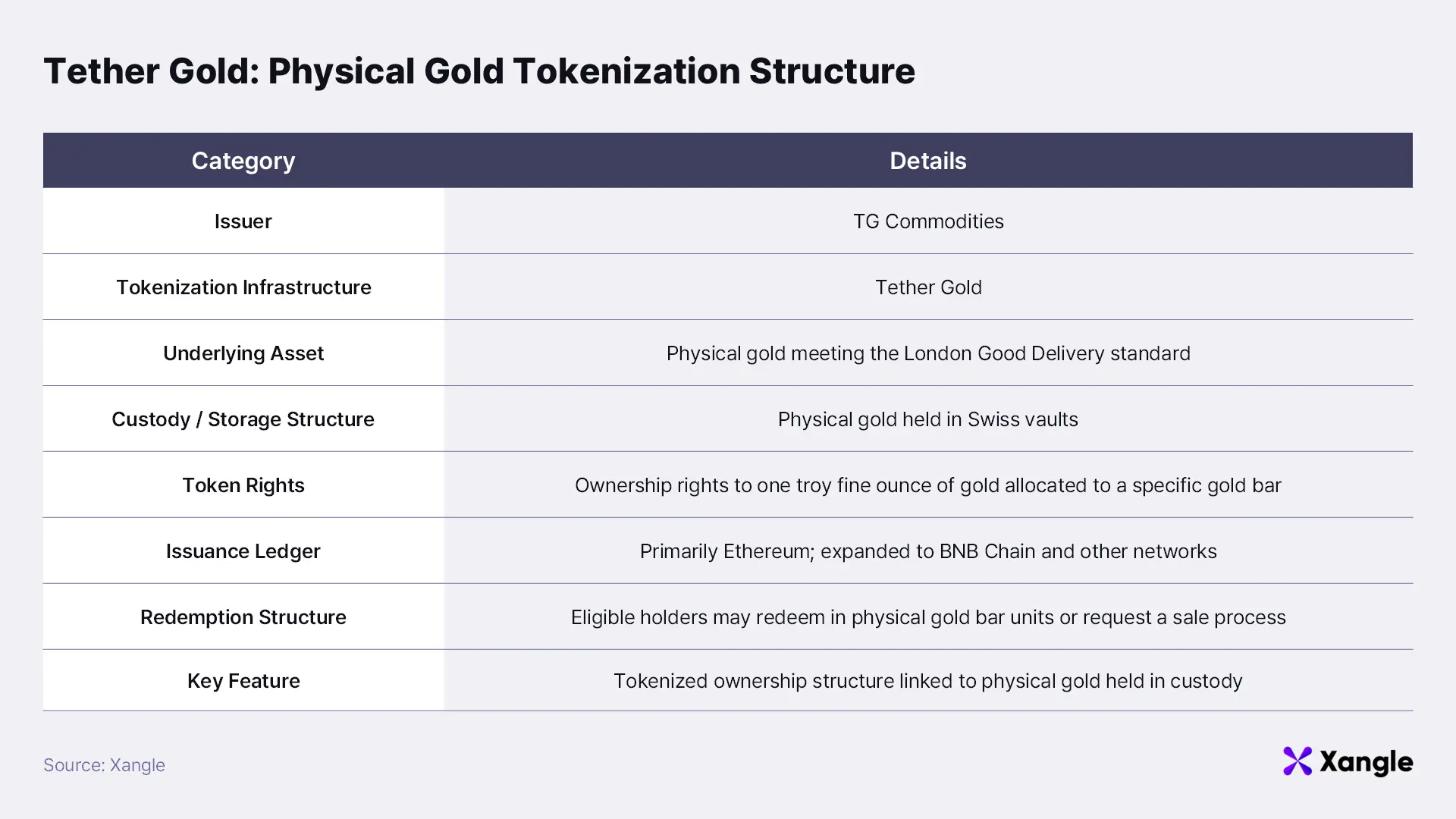
Tether Gold is a commodity tokenization product backed by physical gold. The issuer is TG Commodities, and each XAU₮ represents the right to one troy fine ounce of gold contained in a London Good Delivery gold bar. The gold is stored in vaults, and each gold bar is identified by serial number, purity, and weight. In this structure, investors gain on-chain access to gold price exposure while holding a token connected to physical gold.
In terms of scale, XAU₮ is one of the representative products in the tokenized gold market. Tether Gold has established itself as one of the largest product lines in the gold-backed token market and has maintained a significant share of the broader gold-backed stablecoin market.
Tether Gold holders can redeem their tokens in units of physical gold bars or proceed with a sale process if they meet the required conditions. XAU₮ was initially issued primarily as an Ethereum ERC-20 token and later expanded to networks such as BNB Chain, making it a case study in multi-chain distribution for commodity tokens.
3) Representative Case: Tether Gold / XAU₮
4) Issuance and Management Process
- 1. Underlying Asset Management Layer: Physical gold that meets the London Good Delivery standard becomes the subject of tokenization. This standard refers to the gold bar quality and weight criteria used in the global gold market, and forms the standard for the physical gold connected to XAU₮.
- 2. Issuance Layer: TG Commodities structures rights to one troy ounce of gold as XAU₮. Each XAU₮ represents the right to one troy fine ounce of gold contained in London Good Delivery gold bars stored in vaults.
- 3. Due Diligence and Operations Layer: Gold bar deposits, purity verification, weight verification, and serial number management are performed at this layer. Each gold bar is managed through unique identifying information, which serves as the basis for verifying consistency between token supply and actual gold holdings.
- 4. Custody Layer: Physical gold bars are stored in Swiss vaults through custodians contracted by TG Commodities. Official reports do not specifically disclose the name of the custodian and refer to it as the “Custodian.” This custodian holds the gold reserves on behalf of XAU₮ holders.
- 5. Ledger Layer: XAU₮ is issued as an Ethereum ERC-20 token and can be transferred and held on-chain. As it has since expanded to other networks such as BNB Chain, it has a structure that enables physical gold-backed tokens to circulate across multiple blockchain environments.
- 6. Data Layer: TG Commodities manages gold holdings, XAU₮ circulating supply, the number and weight of gold bars, gold bar identifying information, and reserve report data. The custodian is responsible for the custody, deposit, and inventory records of the physical gold bars.
- 7. Liquidity Layer: Exchanges and OTC desks provide buy and sell liquidity for XAU₮. This allows investors to buy and sell XAU₮ in the market and adjust their exposure to gold prices without directly withdrawing physical gold.
- 8. Utility Layer: Investors can hold XAU₮ in wallets or trade it on exchanges. If they satisfy TG Commodities’ KYC procedures and jurisdictional restrictions, and hold enough XAU₮ corresponding to one gold bar, they can proceed with physical gold bar redemption or a sale process through the Swiss gold market.
- 9. Regulation Layer: Issuer terms, KYC, sanctions screening, jurisdictional restrictions, redemption conditions, custodian risk, and reserve verification are managed at this layer. BDO Advisory Services acts as the external verification provider and reviews the consistency between reserve reports and the amount of tokens issued on-chain.
4-5. Private Credit Fund Interest Structures
1) Overview of Private Credit Fund Interest Structures
Private credit is a non-bank credit market in which asset managers or private fund managers lend directly to companies or provide loans secured by specific assets, rather than relying on bank loans or public bond markets. This includes corporate direct lending, asset-backed lending, structured credit, and receivables financing. Investors earn returns from the interest and principal repayment cash flows generated by these loans, while also bearing the borrower’s credit risk and default risk.
Private credit fund interest tokenization refers to a structure in which interests in funds that invest in private credit portfolios are represented as tokens. Investors do not directly hold individual loan claims. Instead, they participate in a private credit fund structured by a professional manager by holding fund interests. In this structure, the token represents the holding, transfer, and redemption records of those fund interests on-chain.
In some cases, investors do not invest directly in the main fund, but instead hold interests in a feeder fund that invests into the main fund. Structures such as Apollo ACRED, which tokenizes interests in a fund that invests in Apollo’s private credit fund, fall into this category. Through the token, investors gain exposure to the returns and risks of a private credit portfolio, while redemptions and transfers are processed according to the fund terms and investor eligibility requirements.
2) Overview of Apollo ACRED / Securitize
Apollo is a global alternative asset manager with strategies across private equity, credit, real assets, and other alternative investments. Apollo’s total assets under management have surpassed $1 trillion, and credit is one of the firm’s core strategic pillars. The Apollo Diversified Credit Fund invests across a range of private credit strategies, including corporate direct lending, asset-backed lending, performing credit, dislocated credit, and structured credit.
ACRED is a tokenized feeder fund that invests in the Apollo Diversified Credit Fund. A feeder fund is a structure in which investors do not invest directly in the underlying fund, but instead hold interests in a separate fund that invests into that underlying fund. In other words, ACRED investors do not directly hold individual loan claims or the Apollo Diversified Credit Fund itself. They access Apollo’s private credit strategy through tokenized interests in ACRED, which invests in that fund.
ACRED can also be used in DeFi through sACRED. sACRED is closer to a wrapper token designed to allow ACRED to be used as collateral in on-chain money markets such as Morpho and Drift Institutional. This allows eligible holders to borrow USDC or participate in additional yield strategies while maintaining exposure to ACRED.
3) Representative Case: Apollo ACRED
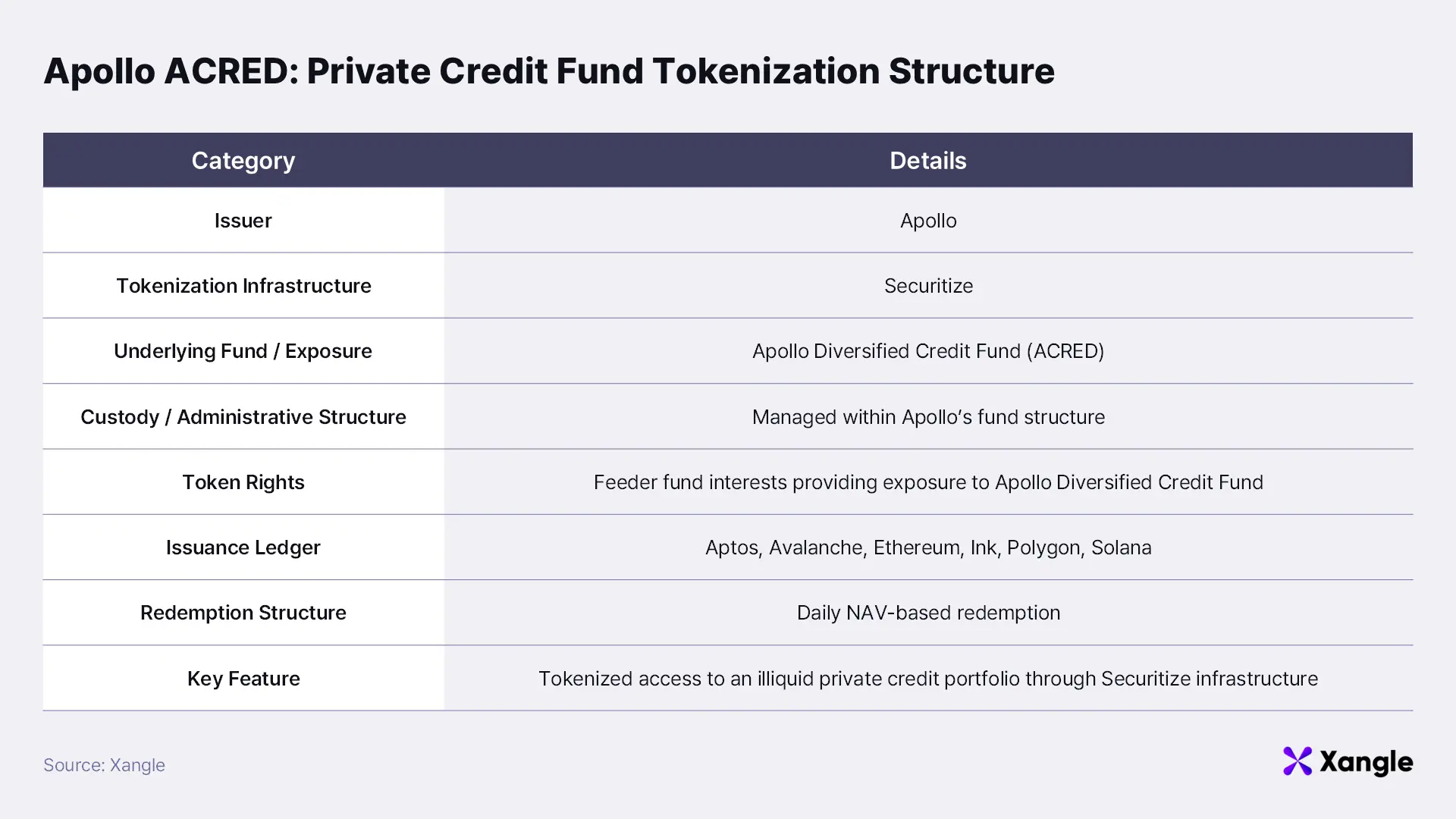
4) Issuance and Management Process
- 1. Underlying Asset Management Layer: The Apollo Diversified Credit Fund manages the underlying private credit portfolio.
- 2. Issuance Layer: Apollo and Securitize structure ACRED as a tokenized feeder fund that invests in the Apollo Diversified Credit Fund. Investors do not invest directly in the Apollo Diversified Credit Fund, but instead hold tokenized interests in ACRED, which invests into that fund.
- 3. Underlying Asset Due Diligence and Operations Layer: Apollo is responsible for investment selection, credit analysis, loan valuation, portfolio construction, and risk management for the underlying private credit portfolio.
- 4. Custody Layer: Fund holdings, investor registers, capital accounts, subscription and redemption records, distribution records, and net asset value calculation materials are managed at this layer.
- 5. Ledger Layer: Tokenized interests in ACRED can be issued and transferred across multiple public blockchains, including Aptos, Avalanche, Ethereum, Ink, Polygon, and Solana.
- 6. Data Layer: ACRED’s net asset value, subscription and redemption reference prices, investor-level holding records, distribution history, token issuance and burn records, and underlying fund performance data are managed at this layer. At the DeFi utilization stage, RedStone Oracles provides sACRED price feeds and collateral valuation data.
- 7. Utility Layer: Eligible investors can subscribe to ACRED through Securitize and hold tokenized interests in approved wallets. Some holders can use sACRED to use their ACRED exposure as collateral in DeFi money markets such as Morpho and borrow USDC, subject to eligible investor status and permitted wallet requirements.
- 8. Regulation Layer: Qualified investor restrictions, KYC/AML, jurisdictional restrictions, transfer restrictions, fund documents, transfer agent records, and fund accounting are applied at this layer.
4-6. NFT Physically Custodied Collectible NFTs
1) Overview of Physically Custodied Collectible NFTs
Physically custodied collectible NFTs refer to a structure in which specific physical collectibles, such as trading cards, sports cards, Pokémon cards, and artworks, are stored in vaults, and ownership and redemption rights to those assets are represented as NFTs. In this structure, investors hold a digital certificate of ownership for a specific physical collectible stored in a vault. The physical item remains in custody, while the NFT representing ownership of that item is transferred on-chain.
The key elements are authenticity, grade, condition, insurance, and the one-to-one linkage between the NFT and the physical item. Even the same card can vary significantly in value depending on grade, condition, scarcity, serial number, and edition, making consistency between the underlying data and the physical item especially important. Representative examples include platforms that store graded physical collectibles in vaults and allow NFTs linked to those assets to be issued, traded, and redeemed.
2) Overview of Courtyard
Courtyard is a physical-backed NFT platform that stores physical collectibles in vaults and issues ownership and redemption rights to those assets as non-fungible tokens. Its main targets include graded physical collectibles such as Pokémon cards, sports cards, comic books, and watches graded by PSA, CGC, BGS, and similar agencies. Courtyard connects physical collectible custody, token issuance, on-chain trading, and physical redemption into a single flow.
Courtyard has created one of the relatively larger issuance and trading cases in the on-chain collectibles market. The platform has recorded token supply in the millions, and initially launched 1,000 graded Pokémon cards as its first tokenized product through a partnership with Brink’s. Since then, it has expanded the scope of tokenized assets to sports cards, Pokémon cards, comic books, watches, and more.
3) Representative Case: Courtyard
The core of Courtyard’s model is that it enables ownership to transfer on-chain while the physical asset remains in storage, rather than requiring the physical item to be shipped each time it is traded. Physical assets are held by custody partners such as Brink’s, and investors hold tokens linked to those assets. If a user wants to withdraw the physical item, they can burn the token and receive delivery of the stored asset.
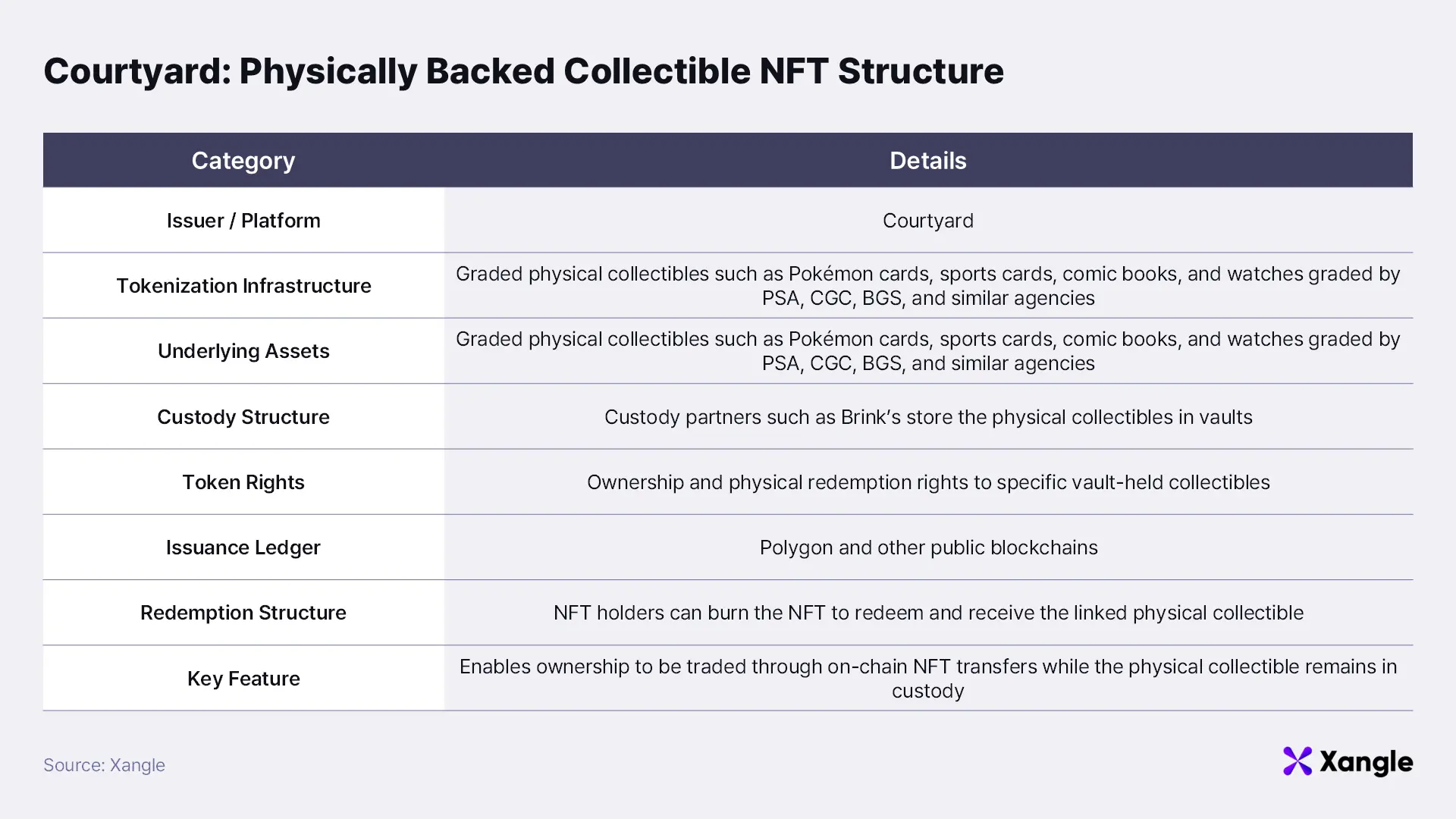
4) Issuance and Management Process
- 1. Underlying Asset Management Layer: Physical cards and collectibles graded by PSA, BGS, CGC, and similar agencies become the subject of tokenization.
- 2. Issuance Layer: Courtyard issues NFTs corresponding to those physical collectibles. These NFTs represent ownership and physical redemption rights to specific items stored in vaults.
- 3. Underlying Asset Due Diligence and Operations Layer: The authenticity, grade, condition, serial number, and storage eligibility of the physical asset are verified.
- 4. Custody Layer: Physical collectibles are stored in vaults operated by specialized custody partners such as Brink’s. Custody partners are responsible for secure storage, insurance, deposits and withdrawals, condition management, and secure transport, providing the trust foundation that the physical assets represented by the NFTs are actually held in custody.
- 5. Ledger Layer: NFTs corresponding to physical collectibles are issued on Polygon.
- 6. Data Layer: Grading agencies such as PSA, BGS, and CGC provide card grades and serial number information, while Courtyard manages images, NFT metadata, and redemption status. Brink’s is responsible for custody, deposits and withdrawals, and delivery status.
- 7. Liquidity Layer: The Courtyard marketplace and NFT marketplaces provide secondary trading liquidity. Investors can buy and sell NFTs linked to physical assets stored in vaults without directly shipping or re-verifying the physical cards.
- 8. Utility Layer: Investors can buy and sell collectible NFTs on Courtyard or ERC-721-compatible marketplaces. If they want to withdraw the physical item, they can burn the NFT and redeem the physical asset stored in the vault.
- 9. Regulation Layer: Physical custody, insurance, authenticity verification, grading information, vault operations, redemption procedures, and the one-to-one linkage between the NFT and the physical item are managed at this layer.
5. Conclusion
The core takeaway from the analysis is that RWA tokenization should not be understood as a single, unified market. Across stablecoins, traditional assets, and alternative assets, tokenization depends on different combinations of issuance, custody, asset management, ledger infrastructure, data, liquidity, utility, and regulation. Stablecoins are anchored primarily by reserves and redemption structures. Traditional assets such as stocks, bonds, and funds depend on the alignment between existing financial records and on-chain token records. Alternative assets such as real estate, commodities, private credit, and collectibles rely more heavily on physical verification, custody, due diligence, income distribution, and redemption processes.
The stablecoin section examined how fiat-backed, crypto-collateralized, and synthetic models differ in the way they are issued and managed. The traditional asset section clarified the distinction between directly issued stocks, indirectly issued stocks, directly issued bonds, and tokenized Treasury funds. The alternative asset section analyzed how physical assets and on-chain ledgers are connected through direct real estate rights and registry-linked structures, indirect real estate equity structures, physically custodied commodities, private credit fund interest structures, and physically custodied collectible NFTs. Although all of these structures fall under the broad RWA category, the rights embedded in each token can differ substantially. Some tokens represent redemption rights, some represent fund interests, and others are linked to ownership or withdrawal rights over physical assets. Others do not provide direct ownership of the underlying asset at all, but instead offer only price performance or economic exposure.
A proper analysis of the RWA ecosystem therefore needs to look beyond the most visible players, such as stablecoin issuers, tokenization infrastructure providers like Securitize, or asset managers like BlackRock. Custodians that hold underlying assets, administrators that manage fund accounting and NAV, data providers that supply asset status and pricing information, market makers that support trading and redemption liquidity, and compliance infrastructure that manages investor eligibility, transfer restrictions, and redemption procedures are all core parts of the stack. As the market develops, the more important question will not simply be which assets have been tokenized, but which players create trust, liquidity, and utility across each layer. For investors and researchers who believe in the long-term growth of RWAs, the focus should therefore extend beyond issuance to the broader infrastructure layers around custody, data, liquidity, regulation, and utility.
The research so far has focused on mapping the broader RWA landscape. Future research will take a closer look at individual segments, as each asset class has its own growth drivers, rights structures, liquidity formation mechanisms, and regulatory challenges. Follow-up reports will examine which assets are being brought on-chain in each segment, which players control the critical infrastructure, how tokens are being used in real financial activity, and what structural limitations remain. RWAs should ultimately be tracked not merely as the tokenization of stocks or individual assets, but as a longer-term infrastructure shift in which traditional finance and on-chain finance continue to converge.
Disclaimer
I confirm that I have read and understood the following: The information contained in this article is strictly the opinions of the author(s). This article was authored free from any form of coercion or undue influence. The content represents the author's own views and does not represent the official position or opinions of CrossAngle. This article is intended for informational purposes only and should not be construed as investment advice or solicitation. Unless otherwise specified, all users are solely responsible and liable for their own decisions about investments, investment strategies, or the use of products or services. Investment decisions should be made based on the user’s personal investment objectives, circumstances, and financial situation. Please consult a professional financial advisor for more information and guidance. Past returns or projections do not guarantee future results.
Xangle or its affiliated partners own all copyrights of the written or otherwise produced materials and content provided on the platform. Any illegal reproduction of such content, including, but not limited to, unauthorized editing, copying, reprinting, or redistribution will result in immediate legal actions without prior notice.
![[CIS Seoul Partner Summit] Anchorage Digital: A Starting Point for Institutional Digital Assets](https://resource.xangle.io/files/content/0659D651970125CC9D95F3066EACD686_1790818652341.webp)

![[CIS Partner Summit Highlights] Dinari: Bringing Tokenized Stocks to Financial Services](https://resource.xangle.io/files/content/44F77D1727A765045015596C9652011C_1789696427279.webp)