[Xangle RWA Series] On/Off-Ramps

Table of Contents
1. Introduction: How Are On/Off-Ramps Evolving?
2. Core Structures for Understanding On/Off-Ramps
3. When and How Are On/Off-Ramps Used for RWAs?
4. Major On/Off-Ramp Providers
5. Conclusion
1. Introduction: How Are On/Off-Ramps Evolving?
To use fiat currency on a blockchain, funds from the traditional financial system must first be connected to the on-chain economy. Converting fiat from a bank account or card into a crypto asset or stablecoin is called an on-ramp, while converting an on-chain asset into fiat and paying it out to a bank account or another destination is called an off-ramp. Put simply, on/off-ramps are infrastructure that connects money in the traditional financial system with money on blockchains.
The on/off-ramp market is expanding from one-off crypto purchases into money movement infrastructure that continuously connects fiat currencies and stablecoins. As a result, competition can no longer be explained by the convenience of a purchase interface alone. The ability to connect to banking and payment rails across jurisdictions, convert smoothly between fiat and stablecoins, maintain the required regulatory status, and automate collection, conversion, and payout has become increasingly important.
Early ramp products focused on the experience of making a one-time Bitcoin or Ethereum purchase by card inside a wallet or Web3 service. More recently, the market has expanded to products that issue customer-specific virtual accounts, automatically convert incoming fiat into stablecoins, and allow businesses to use stablecoins for recurring global payments and settlement. Stripe's acquisition of Bridge and Mastercard's acquisition of BVNK also illustrate the convergence of traditional payment rails and stablecoin infrastructure.
The ways in which ramps are integrated into services have also diversified. Some external ramp providers deliver a complete purchase interface, while wallets and fintech companies can keep their own frontend and use ramp infrastructure in the background. Aggregators / Routers have also emerged, comparing and connecting multiple ramps within a single service and selecting suitable transaction routes based on jurisdiction, payment method, price, and likelihood of approval.
For RWAs, the need for and role of on/off-ramps depend on the product's payment structure. Even when a tokenized fund or stock is issued on a blockchain, investors may fund the investment using fiat, stablecoins, or other methods. If an investor subscribes by sending fiat directly to a designated account, a separate on-ramp may not be necessary. If fiat must first be converted into an on-chain settlement asset such as a stablecoin, an on-ramp is required in between. Even for the same RWA, the necessary funding infrastructure changes depending on the asset used for subscription and redemption.
This report therefore takes a broader view of on/off-ramps than simply treating them as "crypto purchase services." It first examines how fiat is converted into on-chain assets, then reviews the licenses, service delivery models, and virtual accounts that make this possible. It next looks at the payment structures in which RWAs require on/off-ramps and how those ramps can be integrated. Finally, it compares the major market participants, from transaction execution providers to aggregators / routers that connect multiple transaction routes and the wallets / platforms that distribute these functions to end users.
2. Core Structures for Understanding On/Off-Ramps
On/off-ramps exchange fiat and crypto assets, but in practice they connect fiat moving through bank and card networks with crypto assets moving on blockchains as a single transaction flow. Understanding ramps therefore requires looking at how users pay, who actually receives and converts the funds, and how ramp functionality is embedded into a service.
2.1 Fund Flows in On/Off-Ramps
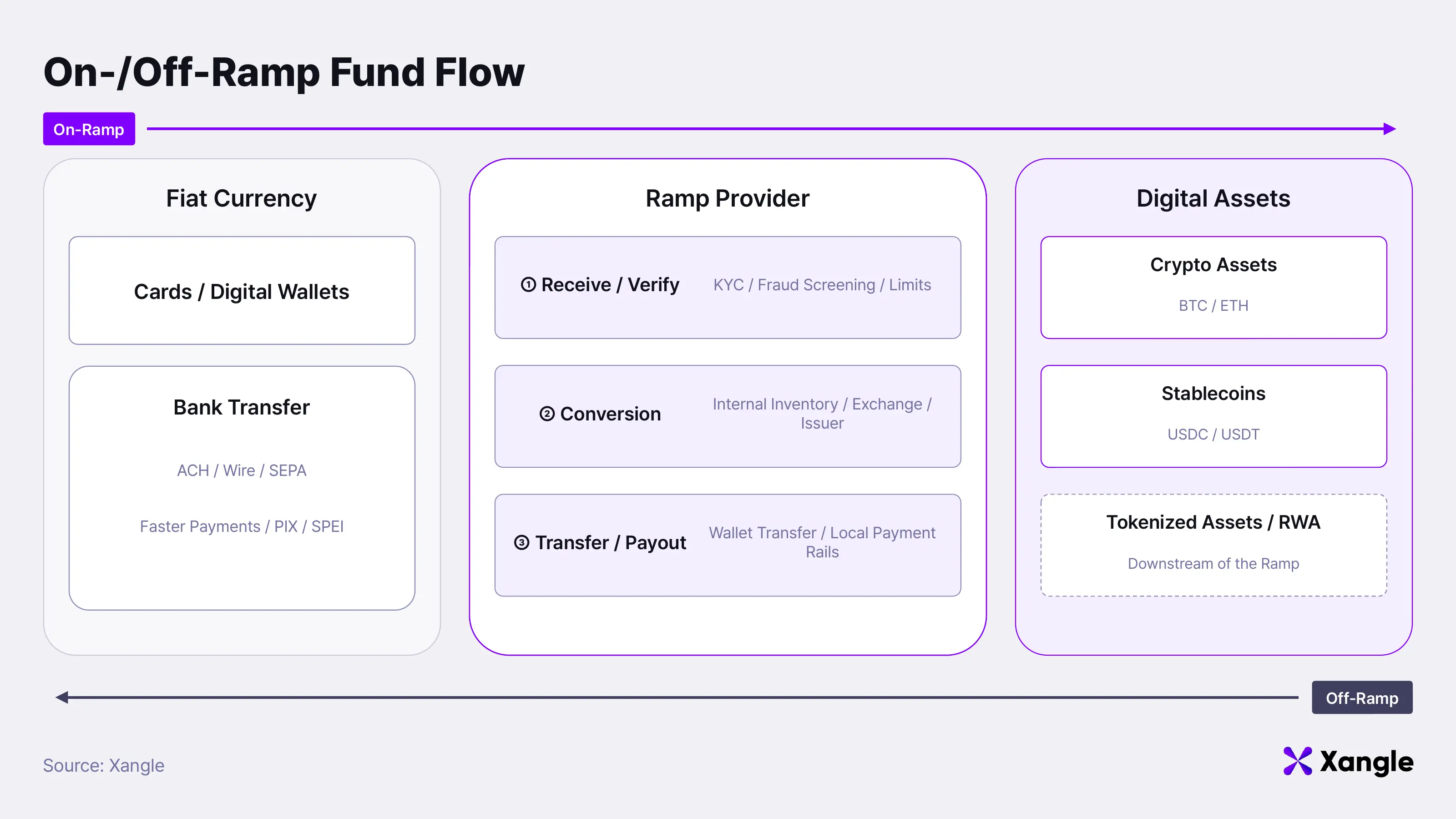
The basic on-ramp flow consists of fiat payment → conversion → crypto asset transfer. When a user pays in dollars, the ramp provider converts the funds into a crypto asset such as USDC and sends it to the designated blockchain wallet.
Cards and bank transfers are the two primary ways to fund online on-ramps with fiat. Card payments include credit / debit cards and digital wallets such as Apple Pay / Google Pay. Bank transfers rely on local banking rails. Common examples include ACH* and Wire* in the United States, SEPA* in Europe, Faster Payments in the United Kingdom, PIX in Brazil, and SPEI in Mexico. They may all appear to the user as a "bank transfer," but the underlying funds move through different local payment rails.
*ACH (Automated Clearing House): An interbank electronic transfer network widely used in the United States for payroll, direct debit, bank transfers, and similar payments
*Wire Transfer: A method of transferring funds between banks on a transaction-by-transaction basis, with Fedwire as a major example in the United States
*SEPA (Single Euro Payments Area): A payment framework that processes euro-denominated bank transfers across Europe under a common set of rules
What makes a transaction an on-ramp is not the payment method itself, but the conversion that occurs afterward. Even when a bank transfer is used, no on-ramp as defined in this report occurs if fiat is paid directly as the purchase price for an investment product. An on-ramp occurs when fiat is converted into a crypto asset or stablecoin and moved on-chain.
Once fiat is received, the ramp provider sources an equivalent amount of the crypto asset. It may deliver assets from its own inventory or use exchanges / liquidity providers, while institutional providers may mint / redeem stablecoins directly with issuers. The sourced asset is then transferred to the user's wallet over a blockchain such as Ethereum or Solana.
A key consideration is that fiat payments and on-chain transfers have different settlement characteristics. Card payments can be charged back and bank transfers can fail or be returned, while confirmed blockchain transfers are generally difficult to reverse. Ramp providers therefore operate payment authorization, fraud detection, payment holds, and refund / return procedures alongside the conversion itself. These operational capabilities also affect transaction success rates and costs.
An off-ramp reverses the flow. The ramp provider receives stablecoins or crypto assets sent by the user, converts them into fiat, and pays the proceeds to the recipient's account through local banking rails. Enterprise infrastructure can combine this with Payout* functionality to make recurring payments to multiple recipients.
*Payout: A function that allows a business to send funds to multiple recipients. It is used for payroll, settlement, vendor payments, and similar purposes.
In short, the "dollar → USDC" transaction visible to the user combines three distinct processes: movement of fiat through card / banking rails, conversion between fiat and crypto assets, and movement of crypto assets over a blockchain.
2.2 Licensing and Business Structure
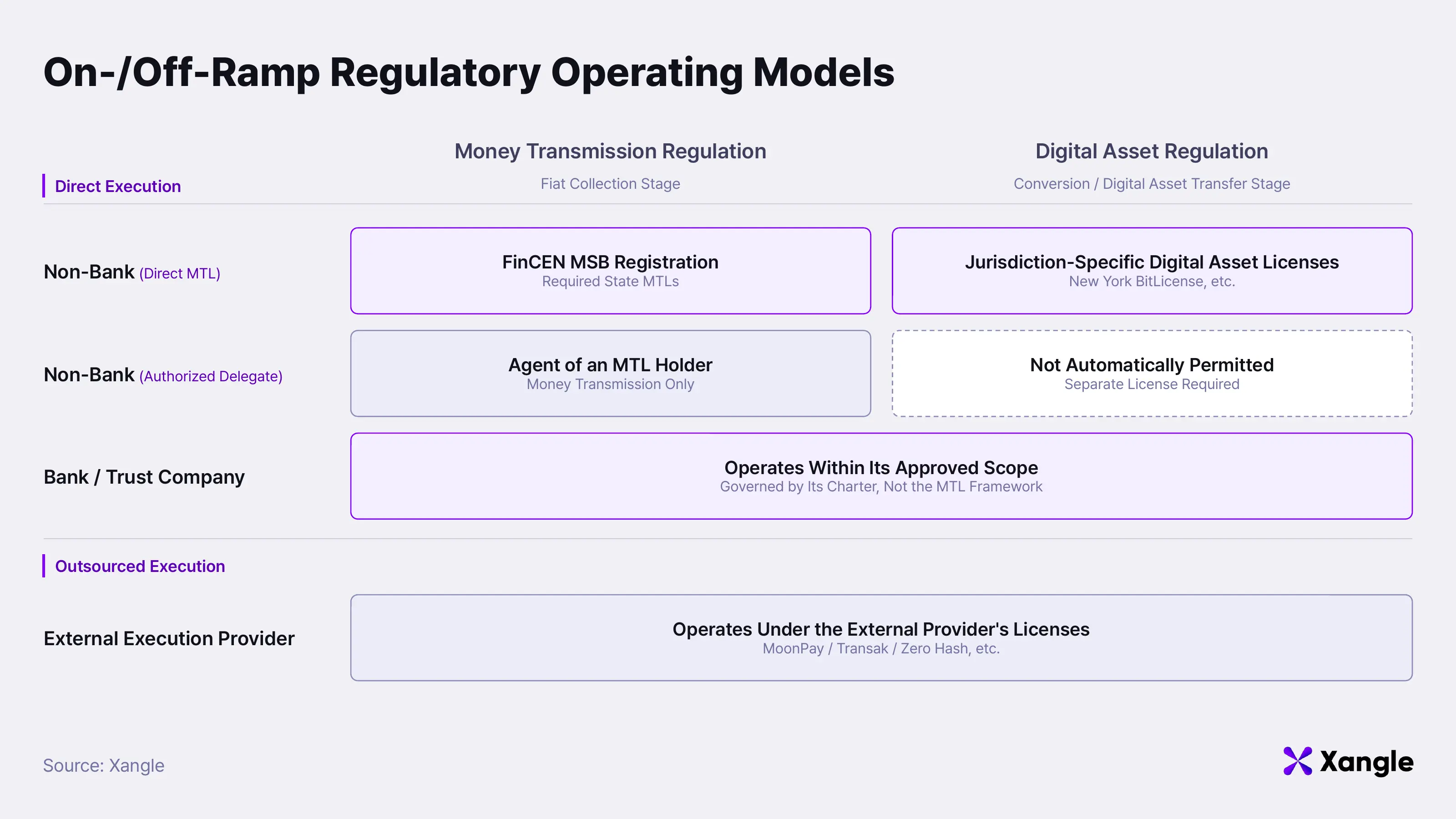
When implementing the fund flow described above as an actual service, the key question is who executes the on/off-ramp transaction and bears the regulatory responsibility. Broadly, a service provider can either execute the transaction directly or use an external transaction execution provider that already holds the required licenses. Direct execution can then be divided into two paths: a non-bank provider that obtains the necessary money transmission and crypto regulatory permissions, or a regulated financial institution such as a bank / trust company operating within its approved scope of activities.
(1) Direct execution by the service provider
This route is further divided into a non-bank path and a bank / trust company path, depending on the provider's regulatory status.
If a non-bank provider directly receives customers' fiat, converts it into crypto assets, and delivers those assets, it must satisfy the money transmission and crypto regulatory requirements applicable to those activities. In the United States, this typically includes federal FinCEN* MSB* requirements and the necessary state Money Transmitter Licenses (MTL*). Jurisdictions that separately regulate crypto activity, such as New York, may also require a BitLicense or similar authorization.
*FinCEN (Financial Crimes Enforcement Network): A bureau of the U.S. Department of the Treasury responsible for anti-money laundering and combating financial crime
*MSB (Money Services Business): A regulatory classification under FinCEN for businesses that provide money services such as money transmission and currency exchange
*MTL (Money Transmitter License): A money transmission license administered by individual U.S. states
In some states, a company may conduct money transmission as an Authorized Delegate of an MTL holder instead of obtaining its own MTL. This structure makes the company an agent of the licensed money transmitter and does not automatically authorize activities that require separate crypto licenses.
Regulated financial institutions such as banks / trust companies, by contrast, may provide on/off-ramp functions within their approved scope of activities. In this case, the regulatory structure is assessed based on the institution's charter and approved activities rather than simply applying the MTL framework used for non-bank providers.
(2) Using an external transaction execution provider
A wallet, fintech company, or RWA platform can avoid becoming the direct transaction counterparty and instead integrate a provider such as MoonPay / Transak / Zero Hash that already has the necessary regulatory status and transaction infrastructure. The external provider handles KYC, fiat collection, asset conversion, and payout, while the service provider integrates those functions into its user experience.
Even in this model, the contract must clearly distinguish who the end user transacts with, who receives the fiat, and who bears responsibility for KYC and refunds. If the service provider directly handles funds or performs separate regulated activities, the requirements applicable to those roles must be reviewed independently.
Ultimately, the central choice in licensing and business structure is whether to execute transactions directly or delegate them to an external provider. A company that chooses direct execution must then decide whether to obtain the necessary licenses as a non-bank provider or rely on the regulatory status of a financial institution such as a bank / trust company. Separately, the question of who provides the actual user interface is addressed in the service delivery model below.
2.3 Service Delivery Models
On/off-ramp integrations can broadly be understood as Hosted or Headless. The distinction lies in which provider designs and implements the user experience and transaction flow.
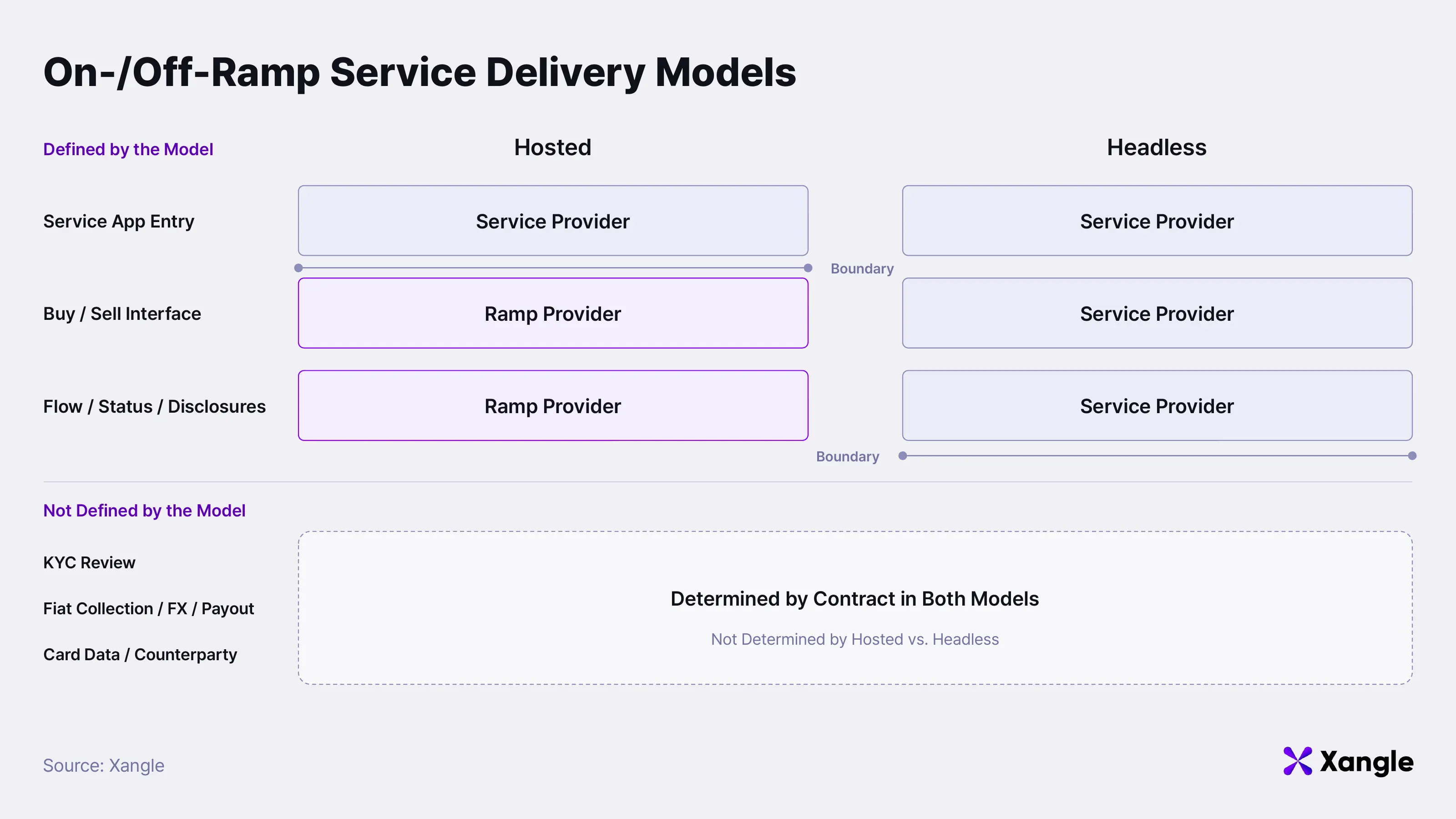
Hosted means the ramp provider supplies a complete buy / sell flow. Users select the asset and amount, complete KYC, and make payment through an interface designed by the ramp provider. The service provider can integrate the ramp with relatively little development, but has limited flexibility to modify the interface and transaction process.
Headless means the service provider builds its own interface and flow for price quotes, asset selection, KYC input, payment, and transaction status, while connecting the underlying conversion / payout functions to the ramp provider's infrastructure. Users can complete the transaction without leaving the wallet or fintech interface, making it easier to maintain a consistent user experience. The tradeoff is that the service provider must implement a broader set of functions, including error handling and transaction status management.
The important point is that Hosted and Headless describe how the frontend user experience is delivered. A Headless integration does not necessarily mean the service provider itself performs KYC review, receives fiat, or executes asset conversion / payout. In a typical external ramp integration, the ramp provider handles the transaction and regulatory functions in both Hosted and Headless models, while Headless allows the service provider to surface those functions within its own interface. Specific responsibilities can vary by product and contract, for example when existing KYC results are passed through and reused.
The actual integration structure becomes clearer when the interface, KYC, fiat collection, and transaction counterparty are considered separately. A transaction may occur entirely within one service interface while an external ramp provider executes it in the background, or the service provider may process it directly using its own infrastructure.
2.4 Bank Transfer-Based On-Ramps
Cards and bank transfers are familiar payment methods in online commerce, and the same is true for on-ramps, where cards / digital wallets and bank transfers are common ways to make fiat payments. Bank transfer-based on-ramps can generally be divided into an order-based model, where the user creates a purchase order before sending funds, and a virtual account model, where a deposit into a pre-issued virtual account serves as the starting point for the transaction.
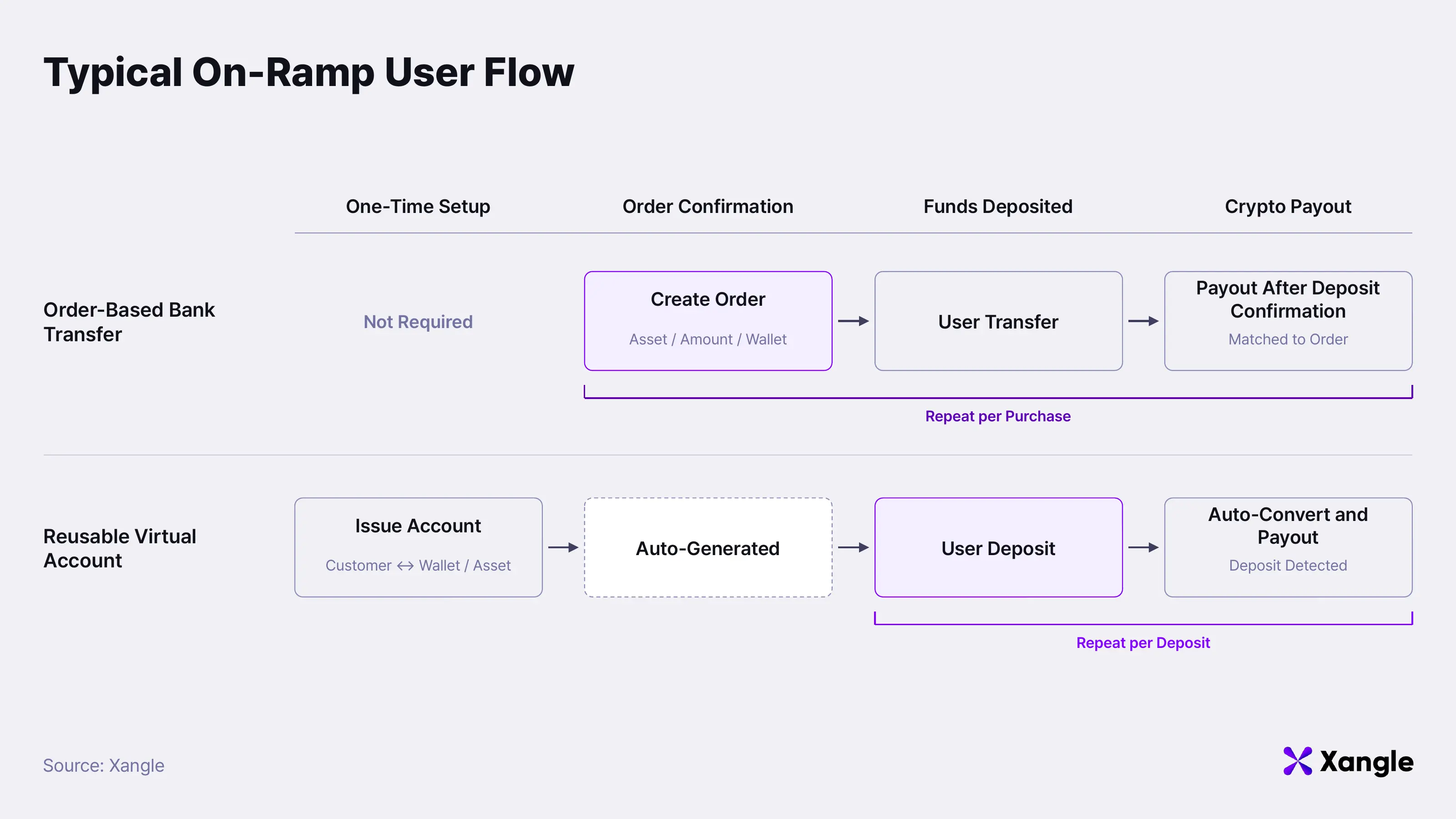
In a typical order-based bank transfer, the user first creates an order by specifying the crypto asset, amount, and wallet address. After the user sends funds to the provided bank account, the ramp provider matches the incoming payment to the existing order and delivers the crypto asset. In other words, each purchase repeats the sequence of order creation → transfer → order and deposit reconciliation.
A reusable virtual account, by contrast, links a specific account number to a customer in advance so that subsequent deposits can be mapped directly to that customer. Once the account is linked, the provider can identify whose funds have arrived without requiring a new purchase order each time. Depending on the provider, the flow can continue through conversion of the deposited fiat into a designated stablecoin or crypto asset and delivery to a wallet.
The value of virtual accounts therefore lies less in adding another deposit method than in automating recurring deposit identification and downstream processing for bank transfer-based ramps.
3. When and How Are On/Off-Ramps Used for RWAs?
As discussed above, on/off-ramps handle conversions between fiat and crypto assets / stablecoins. For RWAs, whether a ramp is needed depends on the form in which subscription and redemption proceeds move.
3.1 When Are They Needed?
Consider a tokenized fund. In products such as BlackRock's BUIDL or Franklin Templeton's BENJI, investors contribute capital to a fund and hold the fund interests they receive in return as blockchain-based tokens. In the Franklin OnChain U.S. Government Money Fund, one BENJI token represents one share of the fund. BUIDL is likewise a fund for which Securitize supports the issuance / administration of tokenized interests. From the investor's perspective, the structure can therefore be understood as subscribing to a fund with capital and receiving an RWA representing the resulting fund interest.
Whether an on-ramp is required depends less on the fact that the fund interest is tokenized than on the asset used to pay the subscription amount. An investor may subscribe by sending USD directly from a bank account, or may first convert USD into a stablecoin such as USDC and use that stablecoin to fund the subscription. Redemptions can likewise be paid directly in fiat or paid in stablecoins that are subsequently converted into fiat.
Ondo's OUSG demonstrates these alternatives within a single product. Eligible investors can invest in OUSG using not only USD Bank Wire but also USDC / PYUSD / RLUSD, and redemption proceeds can be received in fiat or through supported stablecoin options. Even within the same RWA, the point at which a ramp is required can therefore change depending on the investor's choice of settlement asset.
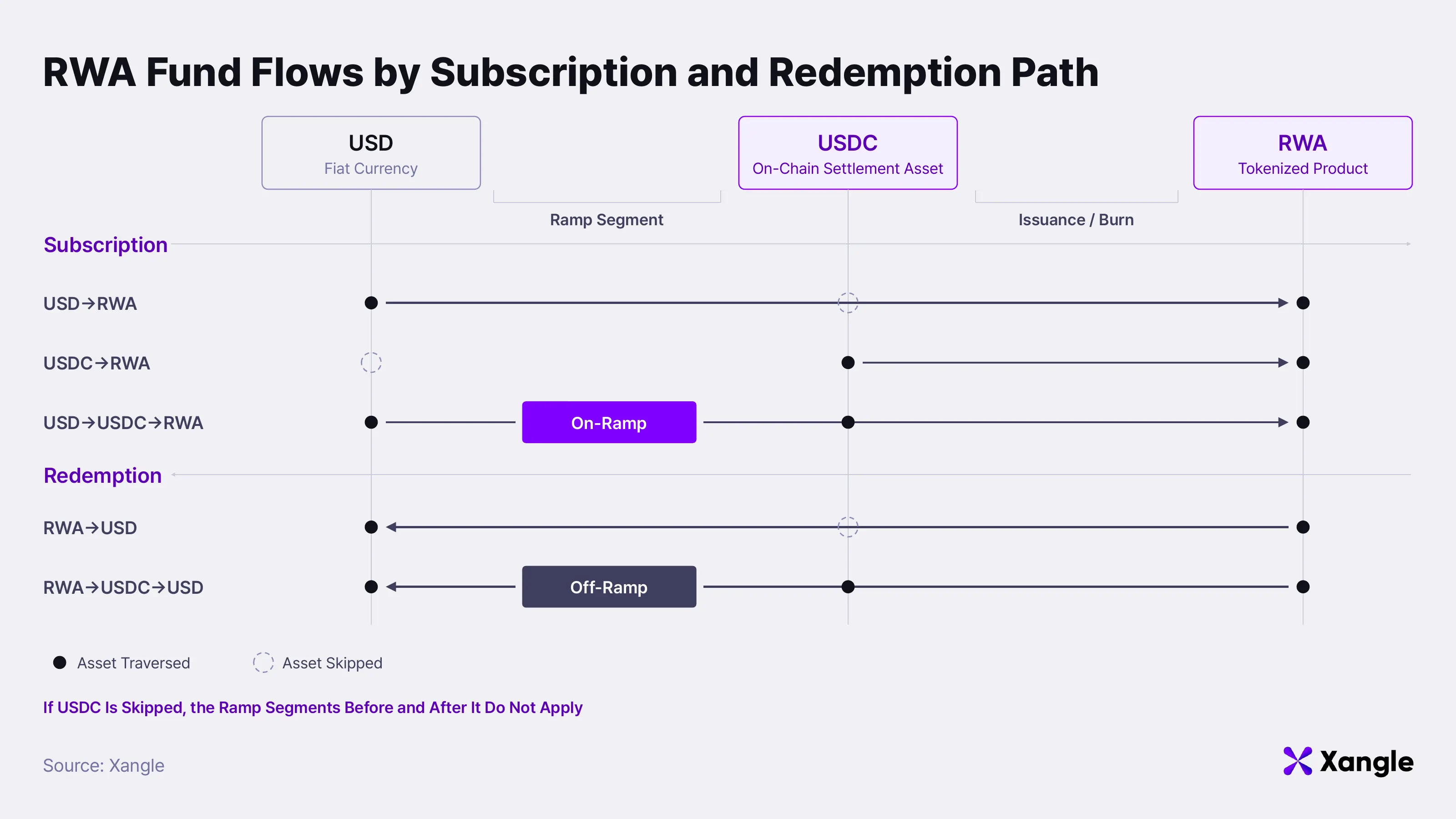
If an investor subscribes to an RWA by paying fiat directly, banking rails and RWA subscription / issuance infrastructure are required, but no separate on-ramp occurs because the fiat is not converted into a crypto asset. If the investor first converts USD into USDC and then subscribes to the RWA using that USDC, an on-ramp is required for the USD → USDC leg.
The same logic applies to redemptions. If an RWA is redeemed directly into USD, a separate Crypto Off-ramp is not required. If it is redeemed into USDC and the investor then converts the USDC into USD in a bank account, an off-ramp is required for the USDC → USD leg. An investor who already holds stablecoins may not need a separate on-ramp at the time of purchasing the RWA. The investor may have originally acquired those stablecoins through an exchange or ramp, but that is a separate transaction from the RWA subscription itself.
Terminology can also vary by provider. In 2024, Circle described a smart contract that converts BUIDL interests into USDC as a "BUIDL off-ramp." In that case, the funds remain on-chain in USDC. This report distinguishes between an RWA → stablecoin conversion and an off-ramp that continues from stablecoin → fiat.
For RWAs, the need for on/off-ramps can therefore be summarized by one question: does the subscription or redemption process require a conversion between fiat and an on-chain settlement asset?
3.2 How Are They Integrated?
Once the need for conversion between fiat and crypto assets has been established, the implementation question is how to connect that conversion to the RWA subscription and redemption process. In a conventional ramp, the transaction may end once the asset has been converted and delivered to the user's wallet or account. For RWAs, however, the converted funds are subsequently used as subscription proceeds or paid out as redemption proceeds, so the asset conversion process must be linked to the product's issuance / redemption workflow.
The integration between Securitize and Zero Hash for BUIDL illustrates this structure. When an eligible institution invests in BUIDL using USDC, Zero Hash converts the USDC into USD and Securitize links that USD to the BUIDL subscription. To the investor, this may appear to be one investment process. In practice, it consists of two sequential steps: the asset conversion USDC → USD, followed by USD → BUIDL subscription / issuance. The funds converted by the ramp then become the input to the RWA subscription process.
This integration question is separate from whether the ramp is outsourced to an external provider or handled internally. With an external ramp, as in the BUIDL example, the output of the ramp conversion must be passed into the RWA platform's subscription / redemption system. Even if the conversion is handled internally, the system must still connect the status of the funds conversion with the status of product issuance / redemption. This is why, for RWAs, ramps increasingly function as infrastructure embedded into the payment leg of subscriptions and redemptions rather than as standalone purchase features.
Close integration into a single transaction flow does not mean that the ramp and the RWA product infrastructure perform the same roles. The scope of responsibility for each layer must still be distinguished.
3.3 Where Does the Ramp's Role End?
The scope of an on/off-ramp is the movement of funds into and out of an RWA and the conversion of settlement assets. RWA product infrastructure that covers issuance of the investment product and investor administration is a separate layer.
An on/off-ramp receives fiat and, where necessary, converts it into an on-chain settlement asset and delivers it to a blockchain wallet. In the opposite direction, it receives an on-chain settlement asset, converts it into fiat, and pays it to a bank account. As part of this fund movement, the ramp may perform KYC / AML, sanctions screening, transaction monitoring, and other controls.
An RWA product, by contrast, must determine whether an investor is eligible to buy the product, complete the subscription, and issue / burn tokenized interests or securities based on the result. Depending on the product, it may also require an investor registry, transfer restrictions, freezes / recovery, and similar functions.
Even when both sides verify the same investor's identity, the purpose of each verification can differ. Passing the ramp provider's KYC does not automatically make an investor eligible to invest in a particular security or fund. The ramp's KYC is customer verification for the movement of funds, while RWA eligibility screening determines whether the investor may invest in the specific product.
In the BUIDL example above, Zero Hash handles the conversion between USDC and USD, while Securitize and its affiliates provide functions such as broker-dealer / ATS / SEC-registered Transfer Agent services and tokenization infrastructure. Even within a single investment flow, responsibility remains divided between the ramp and the RWA product infrastructure.
This distinction also determines the design sequence for an RWA provider. The first step is to decide which assets will be accepted for subscriptions and redemptions and where conversions between fiat and on-chain settlement assets will occur. The provider then determines who will execute those conversions and connects the ramp's fund movement process with the RWA's investor eligibility / subscription / transfer agency process.
4. Major On/Off-Ramp Providers
The on/off-ramp market includes not only transaction execution providers that actually exchange fiat and crypto assets, but also aggregators / routers that connect multiple ramps and distribution / frontend providers that make those functions available to end users.
Transaction execution providers receive user funds, convert them into the asset on the other side of the transaction, and deliver the result while handling the relevant KYC / AML and settlement. Aggregators / routers select suitable routes among multiple transaction execution providers, while wallets or platforms integrate these functions into the end-user experience. Because one company may perform multiple roles, the categories below are based on the role played in the actual transaction rather than the company name itself.
4.1 Transaction Execution Providers
Transaction execution providers also differ based on where their products started and which use cases they emphasize. MoonPay, Transak, and Banxa originated in fiat-based crypto buying / selling for retail users, while Bridge, BVNK, and Zero Hash place relatively greater emphasis on recurring collection / conversion / payout for businesses and financial institutions.
The two areas are increasingly overlapping. Purchase / conversion-focused providers are expanding into virtual accounts and enterprise functions, while business money movement providers are adding customer-level on/off-ramps. The following sections therefore divide them into two groups based on the current center of gravity of their products.
(1) Purchase / Conversion-Focused Ramps
Purchase / conversion-focused ramps combine payment processing, KYC, conversion, and asset delivery in a single transaction flow so that retail users can buy and sell crypto assets with cards or bank accounts. They are typically integrated into wallets, exchanges, and Web3 services, allowing users to purchase crypto with fiat or cash out without leaving the service.
MoonPay
MoonPay is one of the most widely integrated providers in the consumer on/off-ramp market, serving more than 180 countries and supplying infrastructure to over 300 businesses and services. It is available in major wallets including Ledger, Trust Wallet, and Bitcoin.com, making it a common route for buying crypto assets with cards or bank transfers directly inside a wallet.
Its product supports both a Hosted model, where MoonPay provides the complete purchase interface, and a Headless model, where the partner builds its own frontend. With Headless, a wallet or fintech can preserve its own user experience while using MoonPay's payment, KYC, and conversion infrastructure in the background. The interface seen by the consumer may differ, but MoonPay remains the provider executing the actual transaction.
More recently, MoonPay has expanded beyond consumer purchases into business money movement. Building on its 2025 acquisition of Iron, it added virtual accounts and stablecoin payment / settlement functions, broadening its product suite for businesses that want to convert fiat into stablecoins or use stablecoins for global payouts. MoonPay's recent direction has therefore been to extend the payment and regulatory infrastructure built through its consumer ramp into enterprise stablecoin money movement.
Transak
Transak has grown by focusing on embedding on/off-ramps inside wallets and exchanges. It is integrated into more than 450 apps and has served more than 10 million users in total. It is also used by major wallets such as MetaMask, Ledger, and Trust Wallet, making it a widely used route for buying crypto directly from a wallet without first opening a separate centralized exchange account.
Transak offers both a Widget with a complete transaction flow and a Whitelabel API that allows the service provider to build its own UI. With Whitelabel, partners can customize the frontend from price quotes and asset selection through transaction status, while Transak handles KYC / compliance, payments, liquidity, fraud management, and related functions in the background. It also supports reusing KYC information from an existing service to reduce duplicate verification.
More recently, Transak has expanded from one-off, card-centric purchases into account-based ramps. It supports flows in which fiat deposited into a customer-specific Virtual Account is converted into a designated crypto asset and delivered to a wallet, expanding its use cases for wallets and fintech companies that need recurring flows between bank accounts and on-chain assets.
Banxa
Banxa has operated on/off-ramp services since 2014 and currently supports more than 180 countries. It is integrated with a wide range of wallets and trading services including MetaMask, Ledger, and OKX, and emphasizes broad support for local bank transfers and payment methods in addition to cards.
In global ramp services, the payment methods available for purchasing the same crypto asset can vary substantially by country. Banxa connects cards and Apple Pay / Google Pay as well as local bank payment methods through a single infrastructure layer, reducing the need for global wallets or exchanges to build separate payment integrations in each market.
Banxa also provides both Hosted Checkout and a Native API. In the Hosted model, Banxa operates the transaction flow including the interface and KYC. In the Native model, the partner builds its own UI and user flow. Banxa also uses customer / transaction-specific Virtual Accounts to identify incoming bank transfers and automate reconciliation. More recently, it has expanded from consumer ramps into B2B by adding high-value stablecoin on/off-ramps and enterprise services.
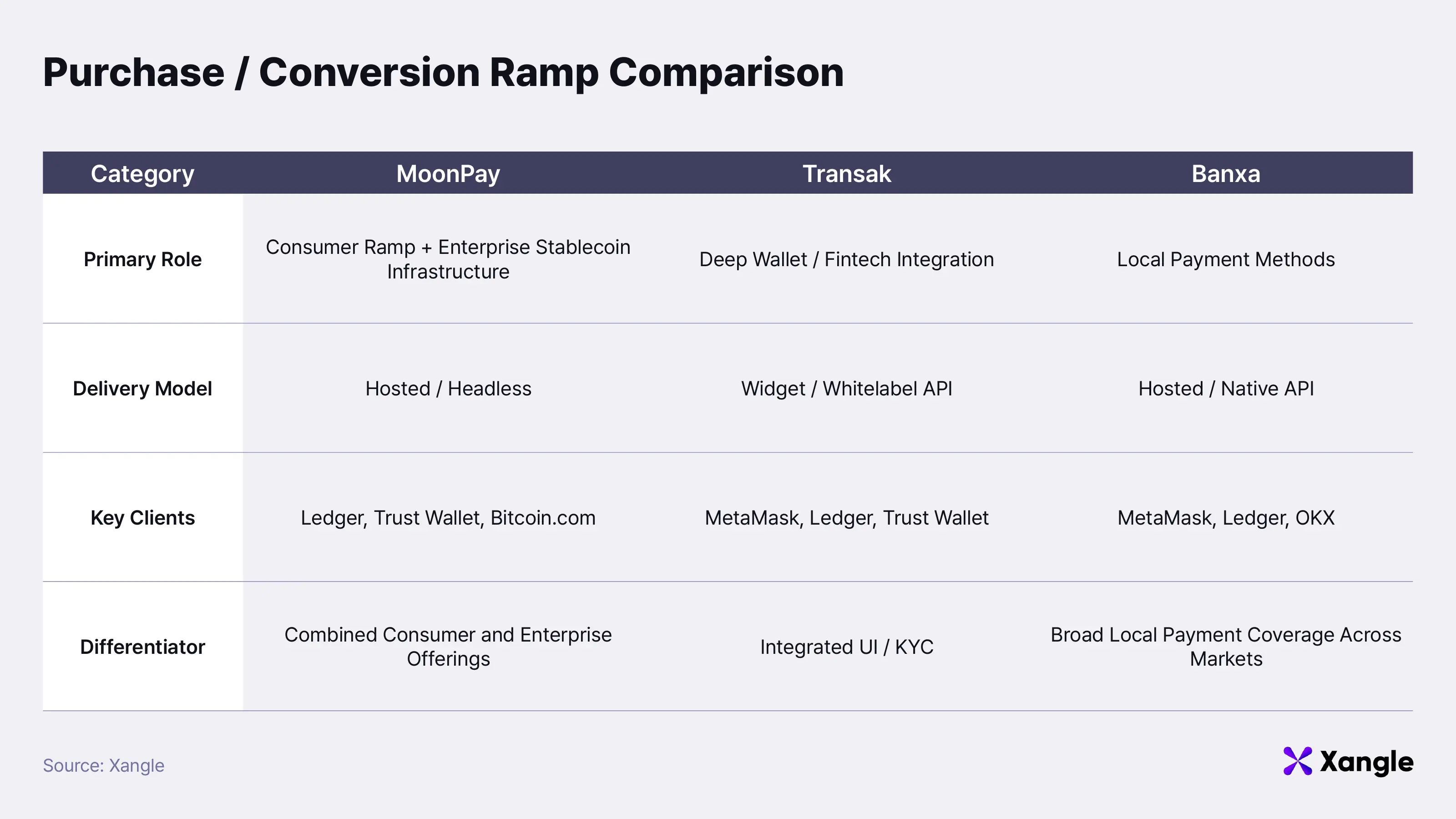
All three providers handle retail on/off-ramp transactions inside wallets and services, but their core roles differ. MoonPay is extending its large consumer distribution network into enterprise stablecoin infrastructure. Transak is particularly focused on deep integration into the native user experience of wallets and fintech products. Banxa places relatively greater emphasis on connecting local payment methods across many countries.
(2) Business Money Movement-Focused Ramps
Business money movement providers focus less on the one-time experience of buying crypto and more on the recurring process by which businesses receive / convert / pay out fiat and stablecoins. This is why APIs, accounts, wallets, recurring payouts, and treasury functions feature more prominently than purchase interfaces.
Bridge
Bridge is money movement infrastructure that uses stablecoins to connect fiat payment rails across countries. Through its Orchestration API, businesses can build flows that convert fiat received in a bank account into stablecoins or, in the opposite direction, convert stablecoins into local currency and pay the proceeds into a recipient's bank account.
By connecting virtual accounts, wallets, conversion, and local payouts through a single API layer, Bridge reduces the need for businesses to build local banking rails and blockchain infrastructure separately. Global payment providers such as Payoneer also use Bridge to offer stablecoin functionality to business customers.
Integration with existing payment infrastructure has accelerated since Stripe acquired Bridge in 2025. Bridge connects stablecoins with local payment rails, while Stripe already operates a global merchant and payment network. Together, they are expanding the product scope toward combining fiat payments and on-chain money movement within a single payment infrastructure.
BVNK
BVNK is payment infrastructure that allows businesses to receive, hold, convert, and pay out fiat and stablecoins within the same treasury management environment.
Businesses can use BVNK directly to manage funds, while fintech companies and payment providers can also use its Embedded model to offer BVNK infrastructure to their own customers. Global payments and payroll providers such as Corpay and Deel are representative examples of companies using BVNK for stablecoin payouts and settlement.
BVNK has stated that its annualized processing volume reached $30 billion in 2026, with payment service providers and fintech companies accounting for a significant share of that activity. This indicates that BVNK is used not only by businesses managing stablecoins themselves, but also extensively as backend infrastructure that enables other financial services to offer stablecoin functionality to their customers.
Mastercard's acquisition of BVNK in 2026 marked a further step toward integration with traditional global payment rails. As BVNK's fiat and stablecoin collection and payout infrastructure moves into Mastercard's global payment and settlement network, its role in connecting traditional payment rails with on-chain money movement is becoming more significant.
Zero Hash
Zero Hash is backend infrastructure that provides trading, liquidity, payments, and settlement behind the scenes so that banks, brokerages, fintech companies, and payment providers can embed crypto trading and stablecoin functionality into their own services.
Financial institutions such as Interactive Brokers use Zero Hash to offer crypto trading within customer accounts, while enterprise platforms such as Gusto use it for global stablecoin payouts. A defining feature is that the same infrastructure can sit behind very different financial services, ranging from crypto trading at a brokerage to corporate payments.
Stablecoin usage is also growing rapidly. Zero Hash has stated that stablecoin transaction volume processed on its platform increased substantially year over year in 2025, and it is expanding from a crypto trading backend into money movement infrastructure that includes account funding, payouts, and settlement.
Its USD Virtual Account currently provides customer-specific account and routing numbers. Incoming USD can either be held as a balance or converted into stablecoins and sent to approved wallets. Zero Hash has also secured regulatory status in both the United States and Europe. Another distinguishing feature is its focus on banks, brokerages, and fintech companies, where regulatory requirements are especially important.
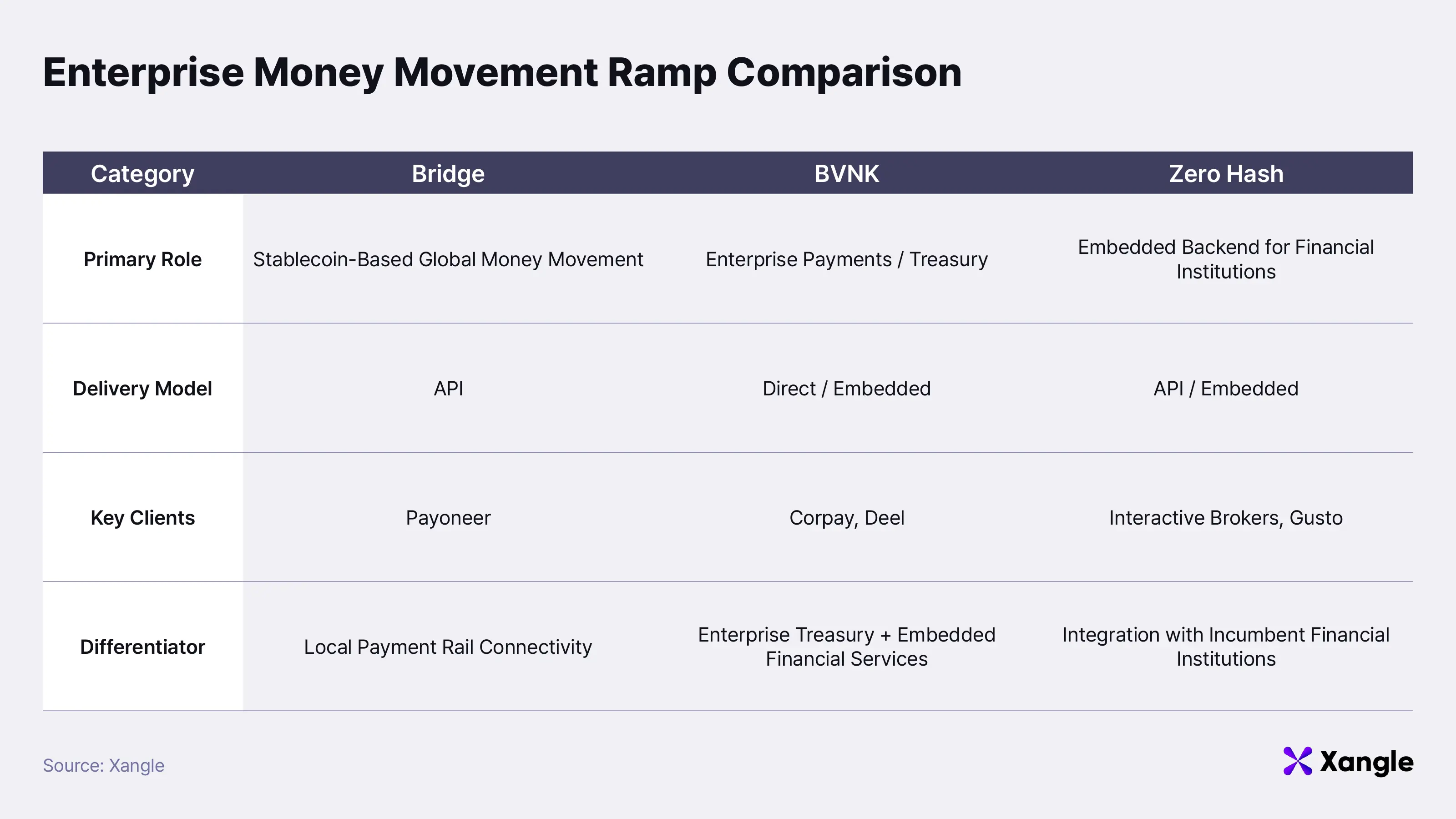
All three providers support movement between fiat and stablecoins for businesses, but they occupy different positions in the stack. Bridge places relatively greater emphasis on the money movement layer connecting local payment rails with stablecoins. BVNK focuses more on combining enterprise payments, treasury, and customer-facing accounts. Zero Hash is positioned more as backend infrastructure providing trading and stablecoin functions behind existing financial institutions.
4.2 Aggregators / Routing Providers
If a service integrates only one ramp, it becomes dependent on that provider's supported countries, payment methods, assets, pricing, and transaction availability. The more global the service, the greater the need to compare multiple ramps and maintain alternative routes.
Onramper
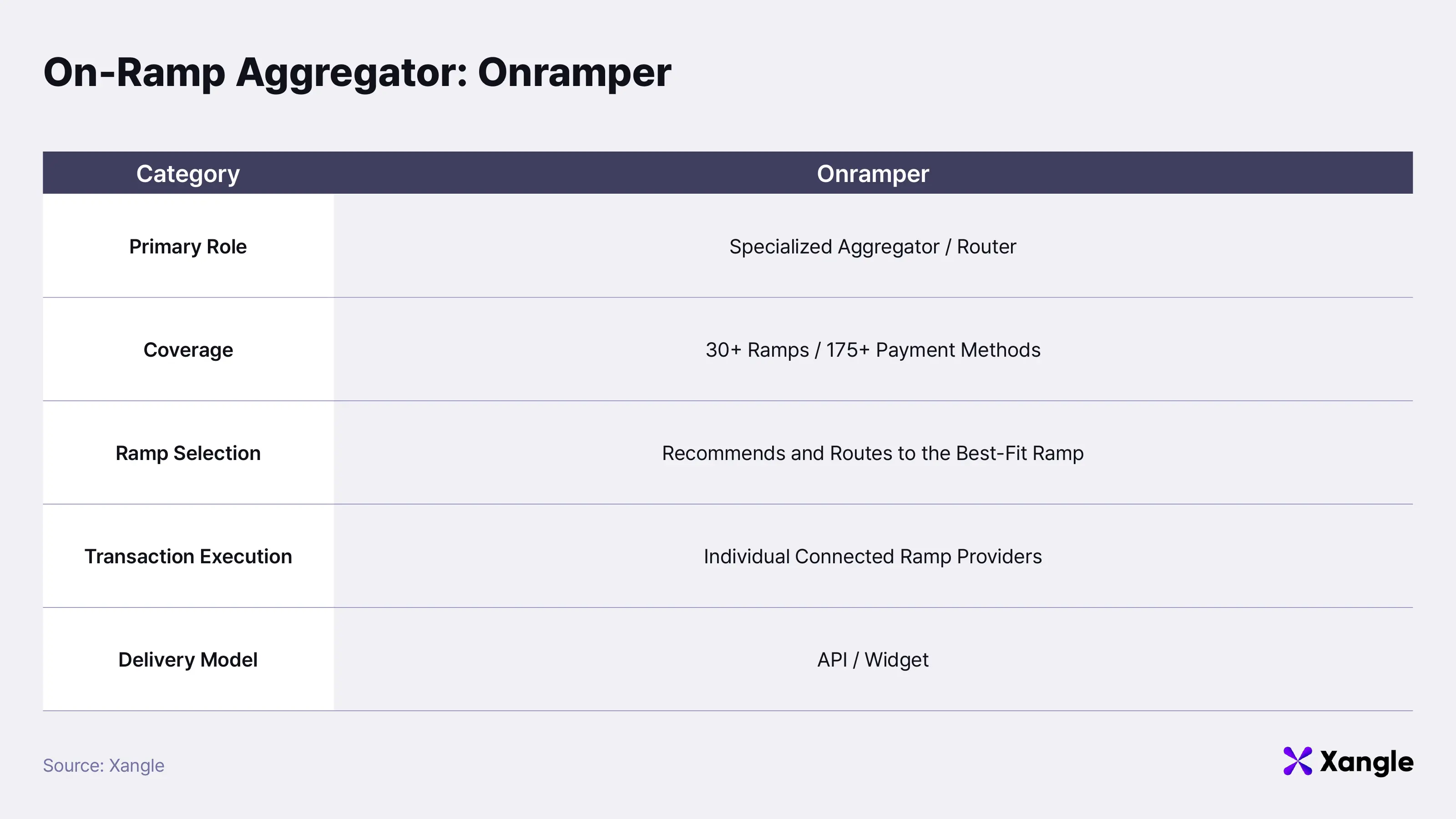
Onramper is a specialized aggregator that connects multiple on/off-ramp providers through a single API and Widget. One integration currently provides access to more than 30 on-ramps and over 175 payment methods, while also connecting multiple off-ramp providers. A service provider can therefore offer multiple transaction execution providers through Onramper without integrating each ramp individually.
Its role goes beyond displaying a list of providers. Onramper recommends and routes users to suitable ramps based on factors including country, currency, payment method, price, KYC burden, and likelihood of transaction success. Even when buying the same USDC, for example, the best provider may differ between a user paying by card in Korea and a user making a bank transfer in Europe.
Wallets and trading services including Exodus use this type of structure. The user starts a purchase in a single wallet, but the actual transaction is executed by an individual transaction execution provider connected through Onramper. Onramper therefore occupies a separate layer that combines routes across multiple ramps rather than competing directly with ramps that receive fiat and convert it into crypto assets themselves.
4.3 Distribution / Frontend Channels
End users often encounter on/off-ramps through the wallet or trading app they already use rather than through a ramp provider's own website. Exodus and MetaMask are representative services that do not directly process every fiat and crypto transaction themselves, but instead connect multiple external transaction execution providers and make them available to users.
To the user, this may appear as a single Buy / Sell function, but different providers may execute the transaction depending on the country and payment method. The wallet may compare quotes from multiple providers directly or use a specialized aggregator such as Onramper as an intermediary.
Exodus
Exodus is a self-custody wallet supporting multiple chains and assets, with approximately 1.5 million monthly active users as of June 2026. For a ramp provider, distributing through Exodus means reaching users inside a wallet with an existing user base rather than acquiring them solely through the provider's own website.
Within the Exodus Buy function, users can choose among available external providers to purchase crypto assets. The transaction begins in Exodus, while the selected provider handles KYC, payment, and conversion. Some routes also include Onramper as an intermediary, creating a structure such as user → Exodus → Onramper → transaction execution provider, where the frontend, aggregator, and execution layers all participate in the same transaction.
In May 2026, Exodus reorganized its existing XO Pay product as XO Ramp. The underlying transaction infrastructure still relies on external platforms. Rather than building every ramp function itself, the wallet is integrating external providers more deeply into its own brand and user experience.
MetaMask
MetaMask is one of the world's most widely used self-custody wallets and a major distribution point through which on/off-ramps reach end users. Its Buy / Sell functions offer transaction routes from multiple Providers and show available options based on the user's country and currency.
Some ramps are integrated more deeply into MetaMask, allowing users to complete the purchase without moving to an external page. The interface remains inside MetaMask, while the connected transaction execution provider handles the actual fiat collection, KYC, and conversion. This is how the Headless or native integrations discussed earlier can appear in a real wallet product.
This distribution role is also emerging for RWAs. MetaMask has integrated Ondo Stocks, allowing users in supported regions to access tokenized stocks, ETFs, commodities, and other assets from within the wallet. Users can trade RWAs with stablecoins and use the wallet's existing ramp routes when moving funds in from fiat. The example shows that when RWAs are distributed through established wallets, issuers may be able to connect to existing funding infrastructure rather than building a separate on-ramp for every product.
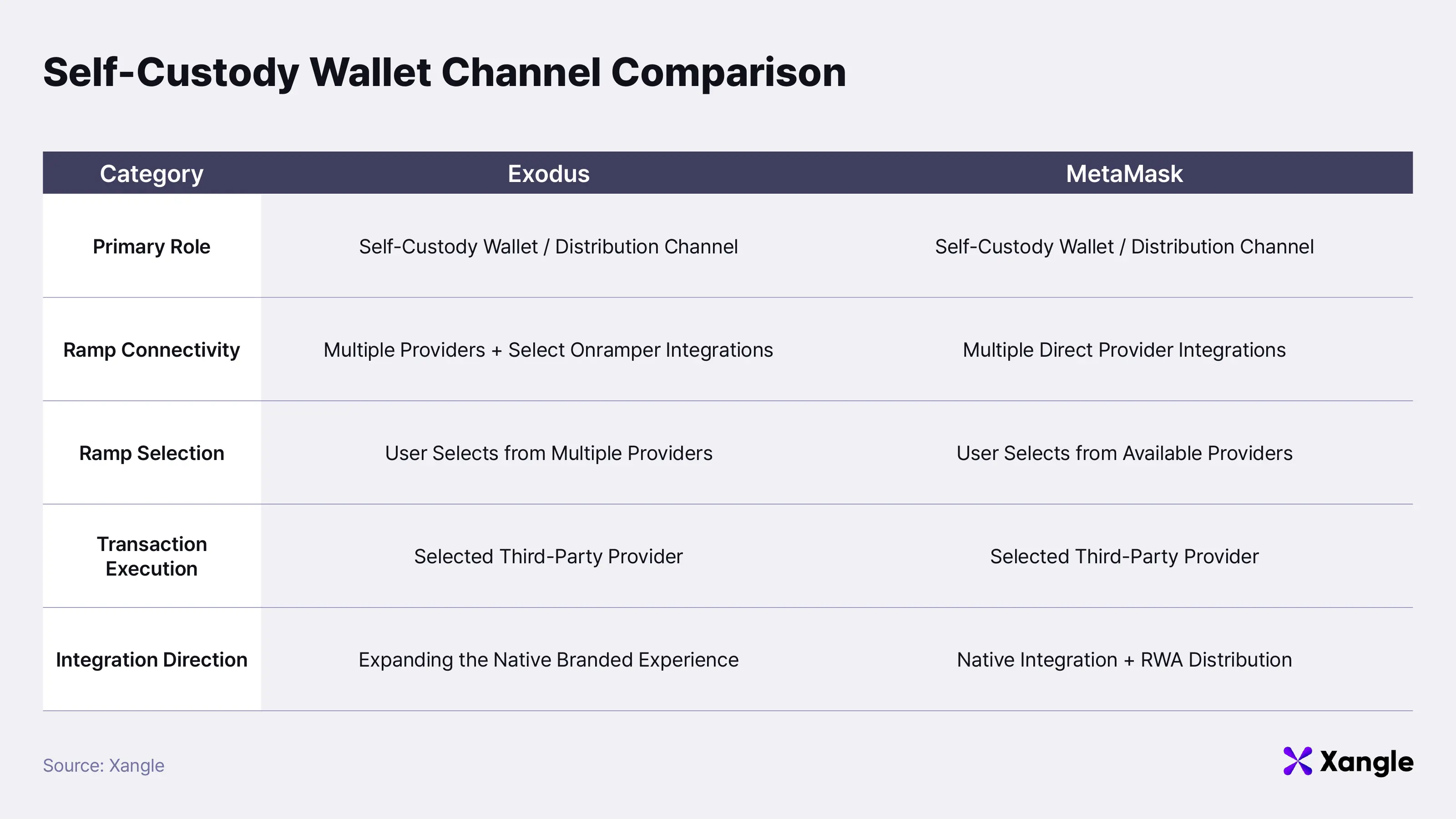
The functions of aggregators and wallets can partially overlap. A specialized aggregator provides the multi-ramp connection function itself to other services, while a wallet uses similar functionality as part of the purchase experience for its own users. To understand the actual transaction structure, it is more useful to distinguish who receives and converts the funds, who selects among multiple routes, and which service provides the final user interface than to focus on the label attached to each company.
4.4 Provider Comparison and Selection Criteria
On/off-ramp providers play different roles across transaction execution, route selection, and the user interface. In an actual service, these roles can be separated, with providers suited to each function combined as needed.
- Transaction execution: Who will receive fiat and perform the conversion / payout?
- Route selection: Will the service use one transaction execution provider or connect multiple providers?
- User interface: Through which service and interface will the ramp function be offered?
For services that want to offer retail users crypto buying / selling through cards or bank accounts, purchase / conversion-focused ramps such as MoonPay, Transak, and Banxa may be considered first. For businesses that need to receive / convert / pay out fiat and stablecoins repeatedly and connect those flows with treasury management, business money movement infrastructure such as Bridge, BVNK, and Zero Hash may be more suitable. A single service can also use different providers for customer-facing ramps and internal corporate money movement.
If the service must support many countries and payment methods, it can add an aggregator / routing provider such as Onramper to connect multiple transaction execution providers. These ramp functions can then be delivered to end users through a wallet, fintech service, or RWA platform, with a Hosted or Headless integration used to create the appropriate user experience.
The same modular approach applies to RWAs. Investor funding / withdrawals, the provider's fiat and stablecoin treasury flows, and the connection of multiple transaction routes can each be separated and supported by different infrastructure. The starting point for provider selection is therefore not choosing one company, but identifying the roles required within the subscription and redemption fund flow.
5. Conclusion
The on/off-ramp market is expanding from one-off crypto purchase functionality into money movement infrastructure that connects the collection / conversion / payout of fiat and stablecoins. As a result, the major competitive criteria are increasingly the range of financial rails and payment methods supported across countries, the way transaction and regulatory responsibilities are structured, and the ability to process recurring money movement reliably.
For RWAs, the need for on/off-ramps depends on the settlement asset used for subscriptions and redemptions. A structure in which investors subscribe directly with fiat and receive redemption proceeds in fiat may not require a separate ramp. If fiat is converted into stablecoins for subscription, or stablecoin redemption proceeds are converted into fiat for withdrawal, an on/off-ramp is required for those specific legs. The ramp handles these money movements, while investor eligibility checks, token issuance / burning, transfer agency, and related functions are handled in connection with the RWA product infrastructure.
An RWA provider should first design the settlement assets and fund flows used for subscriptions and redemptions, then identify where on/off-ramps are required. It can then decide whether to perform those functions directly or delegate them to an external transaction execution provider, whether to connect multiple transaction routes, and how to integrate the user experience. Going forward, the competitiveness of on/off-ramp providers is likely to diverge more clearly based on the breadth of financial rails and payment methods they can connect, their regulatory and settlement capabilities, and the depth of their integration with traditional financial and RWA infrastructure.
Disclaimer
I confirm that I have read and understood the following: The information contained in this article is strictly the opinions of the author(s). This article was authored free from any form of coercion or undue influence. The content represents the author's own views and does not represent the official position or opinions of CrossAngle. This article is intended for informational purposes only and should not be construed as investment advice or solicitation. Unless otherwise specified, all users are solely responsible and liable for their own decisions about investments, investment strategies, or the use of products or services. Investment decisions should be made based on the user’s personal investment objectives, circumstances, and financial situation. Please consult a professional financial advisor for more information and guidance. Past returns or projections do not guarantee future results.
Xangle or its affiliated partners own all copyrights of the written or otherwise produced materials and content provided on the platform. Any illegal reproduction of such content, including, but not limited to, unauthorized editing, copying, reprinting, or redistribution will result in immediate legal actions without prior notice.
![[CIS Seoul Partner Summit] Anchorage Digital: A Starting Point for Institutional Digital Assets](https://resource.xangle.io/files/content/0659D651970125CC9D95F3066EACD686_1790818652341.webp)
![[CIS Partner Summit Highlights] Dinari: Bringing Tokenized Stocks to Financial Services](https://resource.xangle.io/files/content/44F77D1727A765045015596C9652011C_1789696427279.webp)