[Xangle RWA Series] DeFi - DEX

Table of Contents
1. Trading Tokenized Assets
2. Types of DEX Structures
3. Key Considerations When Designing a Tokenized Asset Market
4. Spot DEX Protocols
5. Perpetual Futures DEX Protocols
6. Conclusion: Tokenized Asset Markets Remain at an Early Stage
1. Trading Tokenized Assets
The purpose of tokenizing a real-world asset is to make it usable on a blockchain. Blockchains operate around the clock, and code can verify predefined conditions before executing a transaction. When both the asset and the means of payment are on-chain, payment and asset transfer can be linked and completed simultaneously within a single transaction. Code can also connect post-trade actions, such as executing an order when a price threshold is reached or using a purchased asset immediately as collateral. This is one of the key ways blockchain infrastructure differs from traditional financial systems.
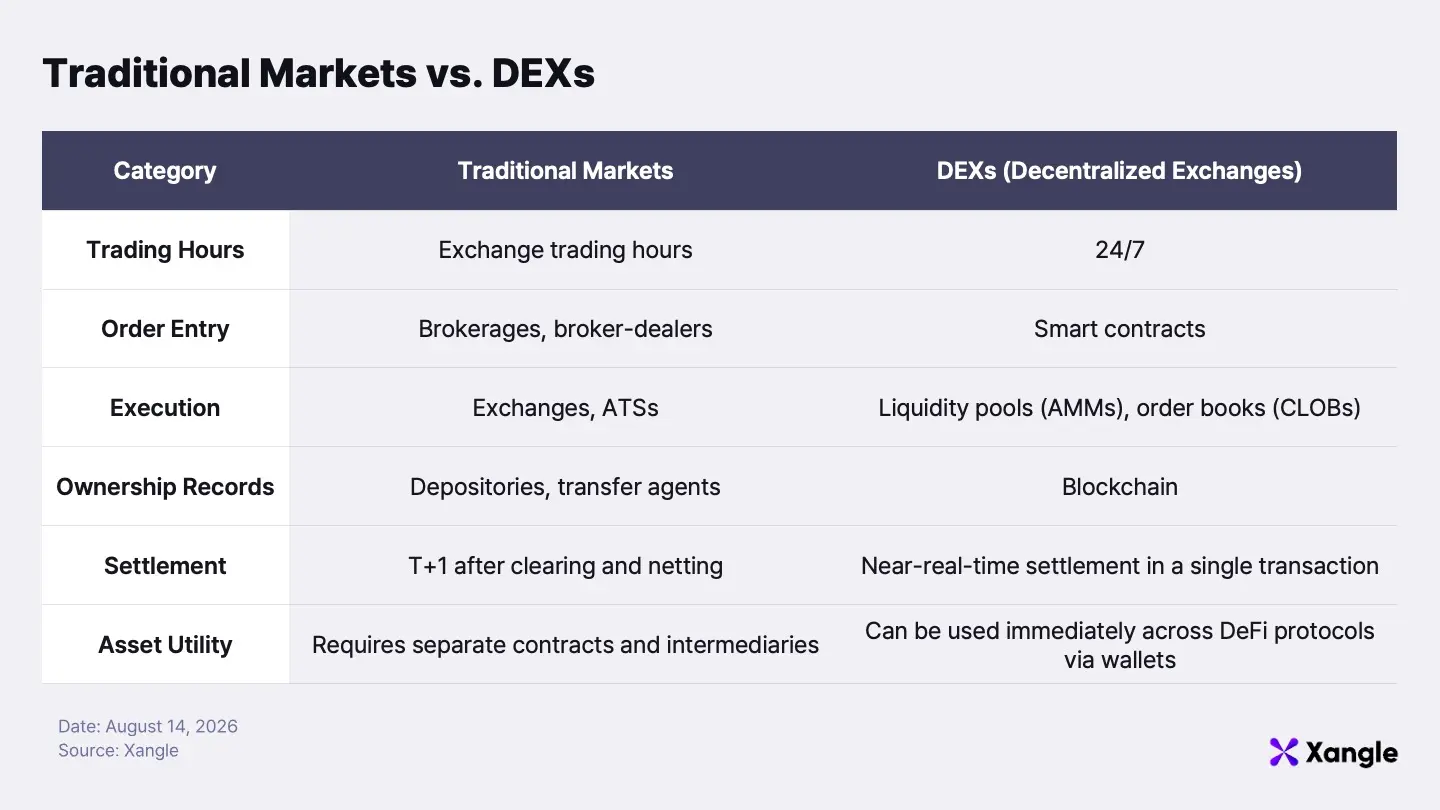
A conventional equity trade passes through multiple institutions. A broker receives the order and routes it to an exchange or alternative trading system (ATS). A clearing house then nets completed trades and calculates the securities and cash obligations to be settled. Depositories and financial institutions update their account records, while the transfer agent maintains the issuer's shareholder register. In the US equity market, final settlement takes place on a T+1 cycle, and each institution reflects the outcome of the same transaction in its own ledger.
Blockchain can connect some of the processes involved in execution, asset transfer, settlement, and register updates on a shared ledger. A trader submits an order through a wallet, a smart contract executes it according to predefined rules, and the token's ownership state is updated on the same ledger once settlement is complete. This does not eliminate every function performed by traditional financial institutions. Rather, it links selected processes that were previously handled sequentially across multiple systems within a single execution environment.
A decentralized exchange (DEX) is one of the primary venues where these transactions take place on-chain. An exchange connects buyers and sellers and facilitates price formation. A DEX implements much of this functionality through smart contracts. Instead of depositing assets with a centralized exchange before placing an order, traders can transact directly from their own wallets, with asset transfer following on-chain once the order is executed.
Trading activity in tokenized assets is expanding alongside this infrastructure. Across the broader market, including centralized exchanges, trading volume in perpetual futures linked to tokenized assets and tokenized gold had already exceeded their respective full-year 2025 totals by the first quarter of 2026. Tokenized equities also recorded more trading volume in the first quarter than during the entire second half of 2025, underscoring the rapid expansion of activity across the sector.
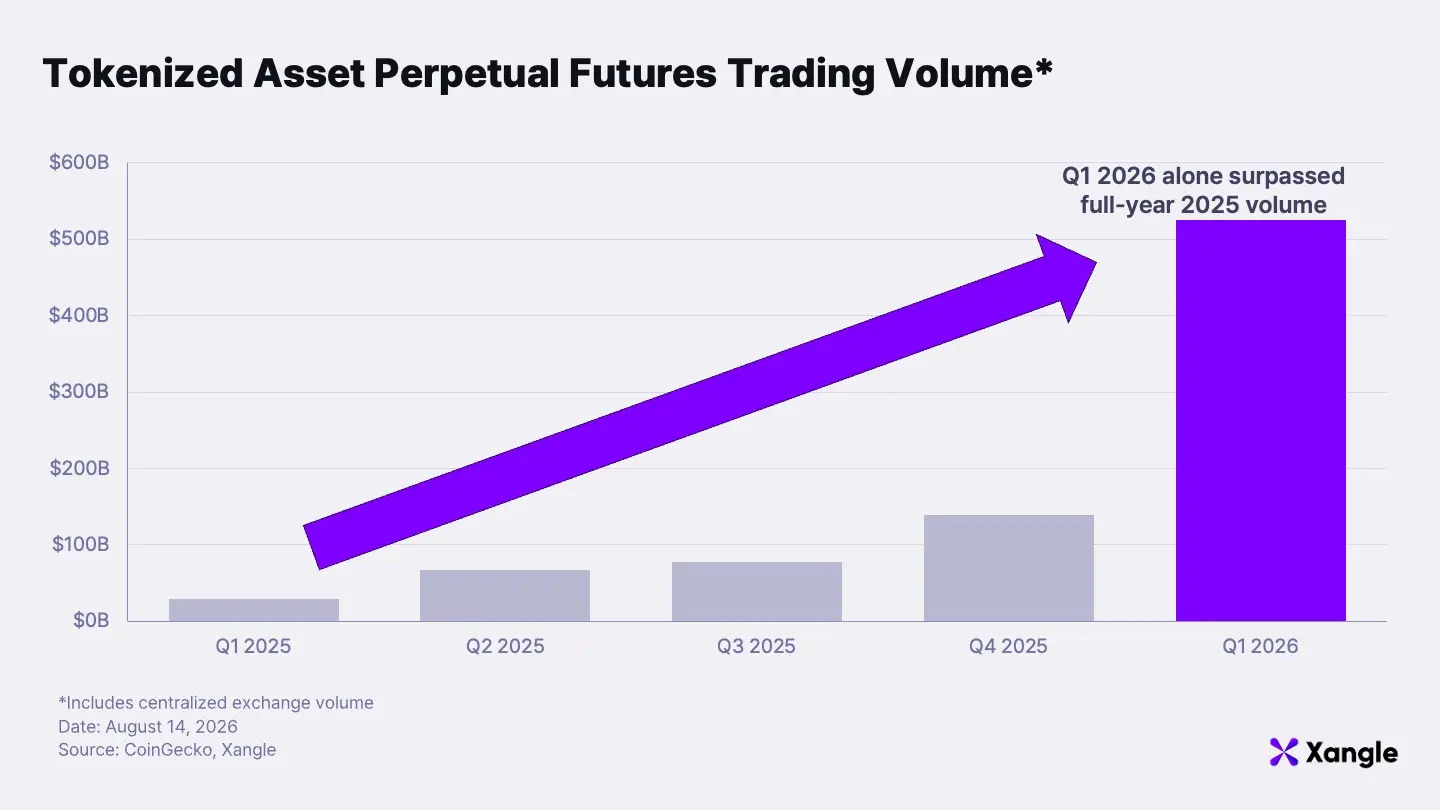
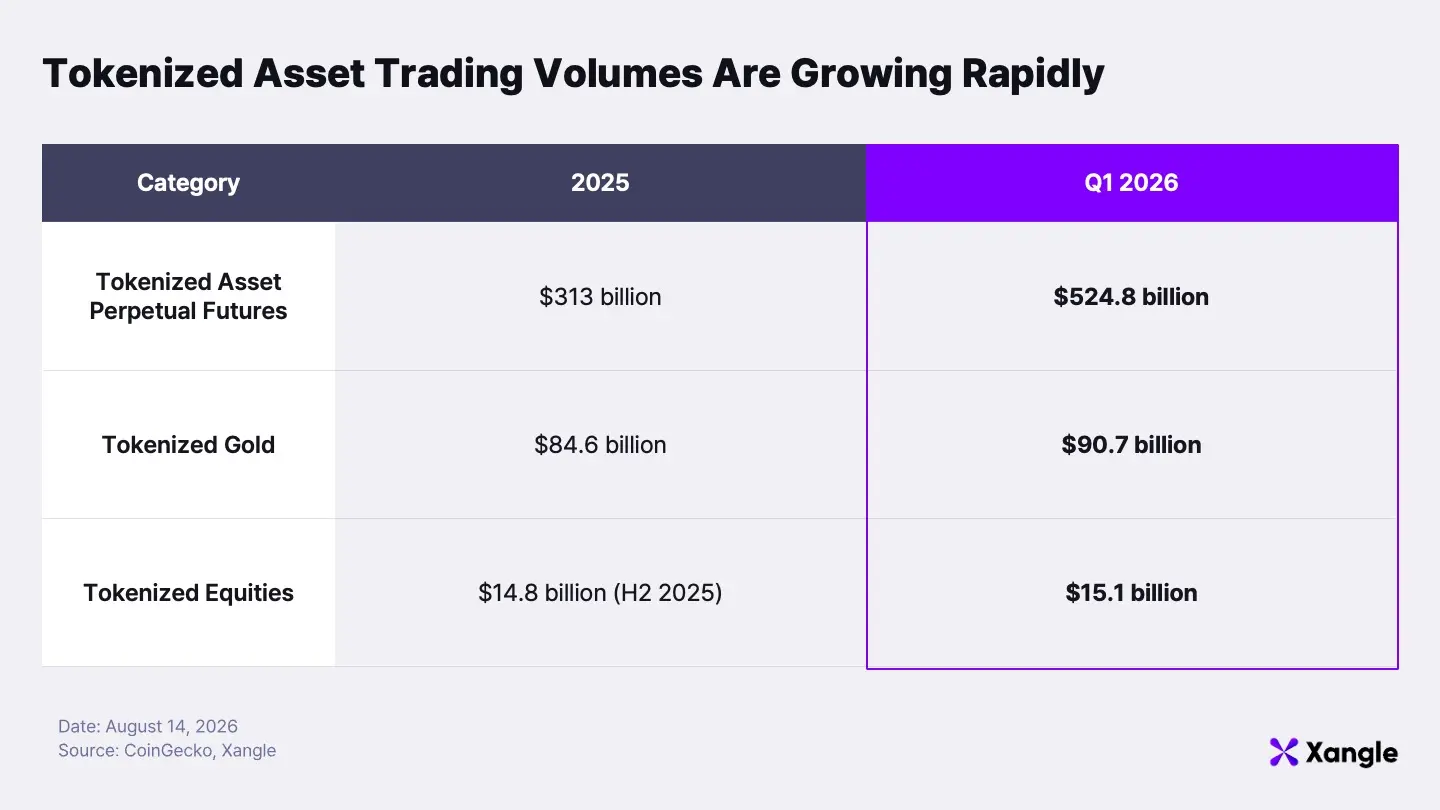
Tokenized-asset markets matter because trading can lead directly to other forms of financial activity. A tokenized Treasury acquired on-chain can be posted as collateral to borrow stablecoins, or several tokenized assets can be combined and managed within a single product. The provision of financial services through smart contracts rather than an intermediary's systems is known as decentralized finance (DeFi).
These activities feed back into the trading market. If collateral value falls below a certain threshold, assets may need to be sold to repay a loan. A product composed of multiple assets must buy and sell its holdings to maintain target weights. Lending, asset management, and other financial services therefore require a market where the underlying assets can be traded reliably. In this sense, DEXs are a core piece of infrastructure for connecting tokenized assets to on-chain finance.
2. Types of DEX Structures
On-chain trading can broadly be divided by what is being traded. Spot trading transfers ownership of the token itself, while perpetual futures allow traders to take profit-and-loss exposure to an underlying asset without holding it directly. The two markets have also developed different structures for sourcing counterparties and executing orders.
2.1 Spot Trading
The most widely used structure in on-chain spot markets is the automated market maker (AMM). On a traditional exchange, a trade occurs when buy and sell orders meet. In an AMM, a liquidity pool holding the two assets serves as the counterparty. Rather than waiting for an opposing order, a trader deposits one asset into the pool and receives the other.
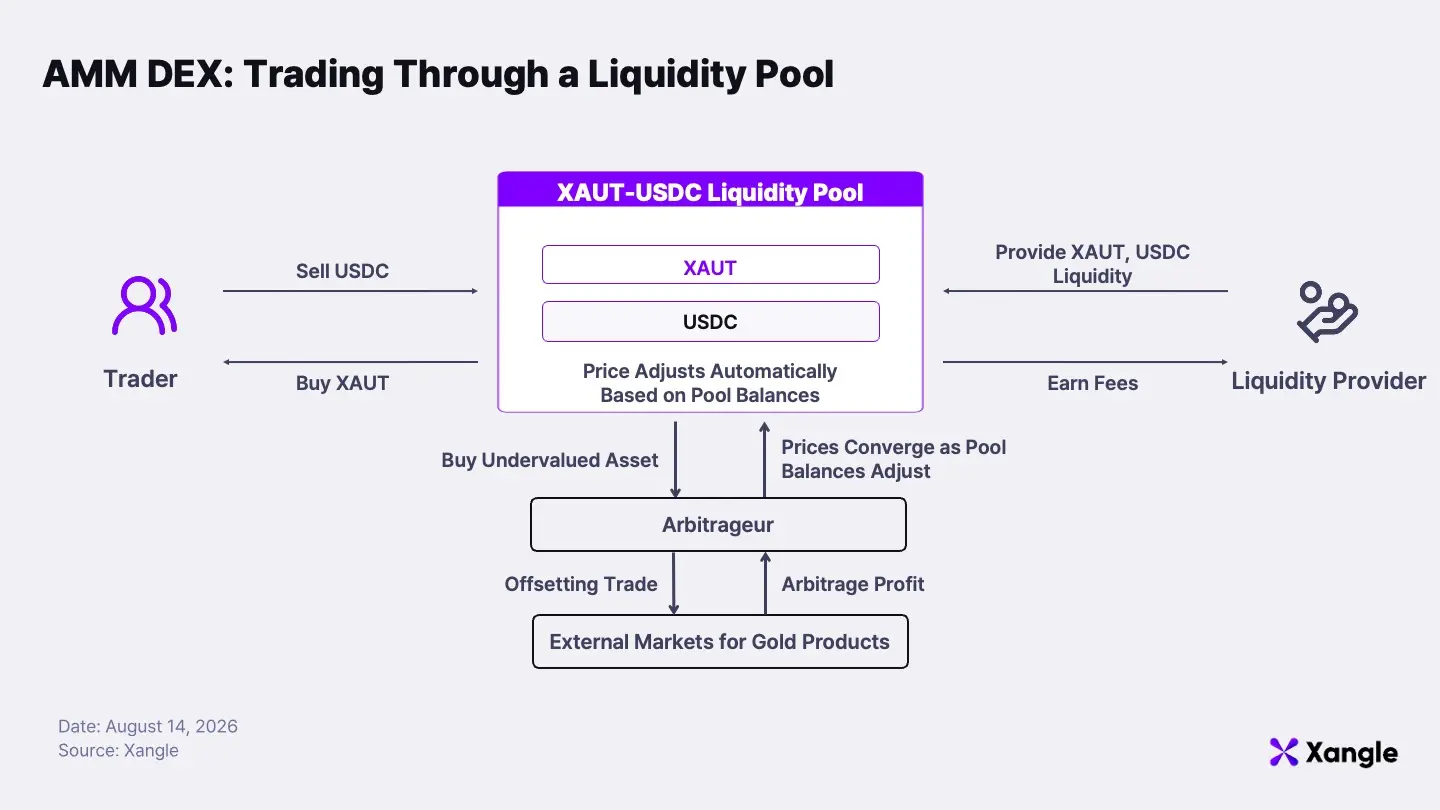
Instead of relying on a participant to quote bid and ask prices continuously, an AMM uses a formula embedded in the contract. As trades change the balances of the two assets in the pool, the price applied to the next trade also changes. A larger order in one direction moves the execution price further against the trader. The difference between the expected price at submission and the actual execution price is known as slippage. The deeper the pool's liquidity, the smaller the impact of a given order on pool balances and the lower the resulting slippage.
An AMM does not simply import the prevailing price from an external market. Its price can therefore diverge from the price of the same asset on another exchange. Arbitrageurs buy in the cheaper market and sell in the more expensive one, earning a profit while narrowing the gap. AMM price formation is therefore the combined result of the contract's pricing formula and arbitrage activity.
The capital that enables these trades is supplied by liquidity providers (LPs). In a typical permissionless AMM, anyone can select two tokens and deposit capital to create a new pool or join an existing one. In return for making their assets available for trading, LPs receive a share of the fees generated by the pool.
While an AMM trades against a liquidity pool, a central limit order book (CLOB) resembles a traditional exchange. Buy and sell orders accumulate in an order book and execute when their conditions match. Traders can specify their desired price and size, creating a familiar order-book experience. Maintaining the registration, cancellation, and modification of large numbers of orders on-chain requires high throughput. CLOB-based DEXs therefore use high-performance blockchains or process parts of order management in a separate environment while completing final settlement on-chain.
As the number of DEXs grew and liquidity fragmented across pools and order books, a separate execution layer emerged to identify where a trade could obtain the best price. Aggregators and intent-based trading are two leading examples. An aggregator compares prices and liquidity across multiple DEXs, selects the most favorable route, and can split a single order across several markets when needed.
An intent allows the trader to specify the desired outcome, such as the asset and amount to be received, rather than a precise execution route. Professional execution providers known as solvers or fillers then combine liquidity from multiple DEXs or use their own inventory to satisfy those conditions. Both approaches reduce the burden of comparing markets manually. Aggregators primarily calculate routes across existing on-chain liquidity, while intent systems give professional executors a more active role in completing the trade. The distinction is examined in more detail in the protocol sections below.
2.2 Perpetual Futures Trading
Futures contracts in traditional markets have fixed maturities. Each contract has a settlement date, and the position expires when that date arrives. Maintaining the same exposure requires rolling the position into a later-dated contract. Perpetual futures remove this maturity date, allowing traders to keep a position open while settling only the profit or loss generated by movements in the underlying asset, without taking delivery of that asset.
On-chain perpetual markets typically use dollar-pegged stablecoins as margin. A trader deposits collateral and opens either a long position to benefit from a price increase or a short position to benefit from a decline. Leverage creates price exposure larger than the margin posted. If losses reduce collateral below a required threshold, the position is forcibly closed in a process known as liquidation.
Dated futures converge toward the spot price at maturity, but perpetual futures have no such convergence point. Instead, they use a funding rate to manage the gap between the perpetual price and the underlying reference price. In general, when the perpetual trades above the reference price, long positions pay short positions. When it trades below, the payment direction reverses. By adjusting the cost of maintaining a position, the funding mechanism discourages prolonged and substantial divergence from the underlying price.
This process requires a reliable price for the underlying asset. Because a blockchain cannot read external financial-market data on its own, an oracle is used to deliver prices on-chain. The oracle aggregates data from exchanges or data providers to construct a reference price, which the protocol uses to calculate funding, value positions, and determine whether liquidation is required.
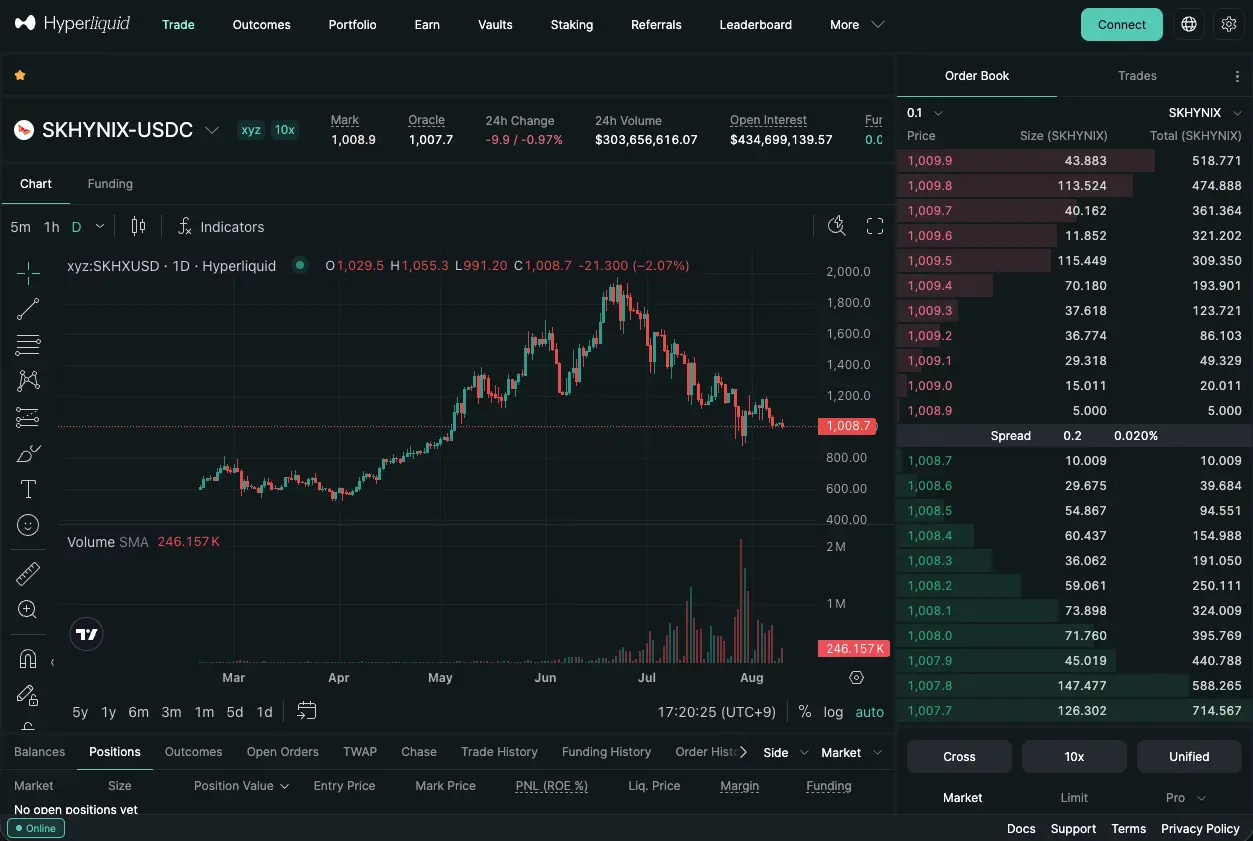
Source: Hyperliquid
Perpetual futures DEXs commonly use CLOBs for execution. Traders submit bids and offers much as they would on a traditional exchange, while the protocol handles post-trade processes such as margin management, profit and loss calculation, and liquidation. A growing number of protocols now use dedicated high-performance blockchains or separate execution environments to provide an order-book experience similar to that of centralized exchanges.
The most important distinction from spot markets is that a perpetual market can be created without an underlying token. A spot market requires the traded token to have been issued and a supply of that token to be available for sale. A perpetual transfers no ownership in the underlying asset and trades only its price movements. A market can therefore be established as long as it has a reliable reference price and a collateral and liquidity structure capable of settling position profits and losses. This makes it possible to create on-chain perpetual markets for equities, indices, and commodities that have not themselves been tokenized.
DEX 정리
3. Key Considerations When Designing a Tokenized Asset Market
The DEXs discussed above developed primarily around cryptoassets such as Bitcoin and Ethereum, which generally impose few eligibility restrictions on holders and are priced around the clock across multiple markets. Tokenized assets operate under different conditions. Tokenizing an equity or bond does not remove the underlying investor regulations or the trading hours of the reference market. On-chain pricing and liquidity also remain connected to traditional financial markets. Designing a DEX market therefore requires simultaneous consideration of investor verification, market creation, liquidity provision, and user access.
- Investor verification: Conventional cryptoassets can generally be traded on a DEX with only a wallet, but some tokenized securities may be held only by eligible investors or investors in specified jurisdictions. When transfer restrictions are embedded in the token, not only the trader but also the liquidity pool and related contracts that hold or transfer the token must satisfy those requirements. An issuer must therefore confirm whether the DEX supports permissioned trading and whether its existing investor-verification framework and token transfer restrictions can be extended to the secondary market.
- Market creation: The issuer must also determine where and how the tokenized asset will trade. A conventional AMM allows a party to create a pool by supplying the token, a settlement asset, and initial liquidity. A permissioned market must additionally incorporate investor-verification controls, while the use of a professional market maker or liquidity service requires cooperation with the relevant provider. The path to creating a perpetual market also varies depending on whether an external operator can launch the market directly, the protocol selects the asset, or validator or governance approval is required.
- Liquidity provision: Once the market is created, it needs liquidity to absorb actual buy and sell orders. In an AMM, the issuer or an external LP can supply the token and settlement asset to the pool. A professional market maker can quote directly using its inventory and external-market prices. Because tokenized assets are constrained by the operating hours of the underlying market and the availability of issuance and redemption, opportunities to correct price gaps may be limited. The identity of the liquidity provider, the method used to reflect underlying prices, and the management of inventory and hedging risk are therefore critical.
- User access: On-chain, the venue where liquidity resides may differ from the wallet or application through which the user trades. Even a well-funded market may attract limited participation if it is not connected to aggregators, wallets, and trading applications. The issuer must therefore consider which aggregators route its liquidity, which wallets and applications expose the market, and whether users across multiple chains can access it.
The relative importance of these four factors differs between spot and perpetual markets. Spot trading transfers the token itself, making investor verification, market creation, liquidity provision, and user access direct requirements for the market. Perpetuals do not transfer ownership of the underlying asset. As a result, the more important questions are who creates the market, which oracle and market makers it uses, and how margin and liquidation risk are managed.
4. Spot DEX Protocols
The preceding considerations define what an institution should evaluate before creating a tokenized asset market. The next step is to examine how spot DEXs implement those requirements in practice. Building a spot market involves more than choosing a single DEX. The issuer must design where liquidity will reside, who will manage it, how orders will execute, and which route will ultimately connect the market to users.
The most basic approach is to deposit the token and a settlement asset into an AMM liquidity pool. An issuer that cannot manage liquidity directly can use a professional market maker or liquidity service. It can also avoid building a large standalone pool by allowing professional executors to fill orders with their own inventory or liquidity sourced from multiple markets. The resulting markets and quotes are then distributed to end users through aggregators, wallets, and applications.
These structures are not mutually exclusive. A single tokenized asset can maintain baseline liquidity in an AMM, engage a professional market maker, source additional quotes through an intent protocol, and distribute those routes across multiple user channels through an aggregator. The following sections examine four approaches: creating a market directly with a liquidity pool, outsourcing liquidity management to a specialist, using quotes from professional executors, and connecting multiple trading routes to users.
4.1 Creating a Market Directly with a Liquidity Pool
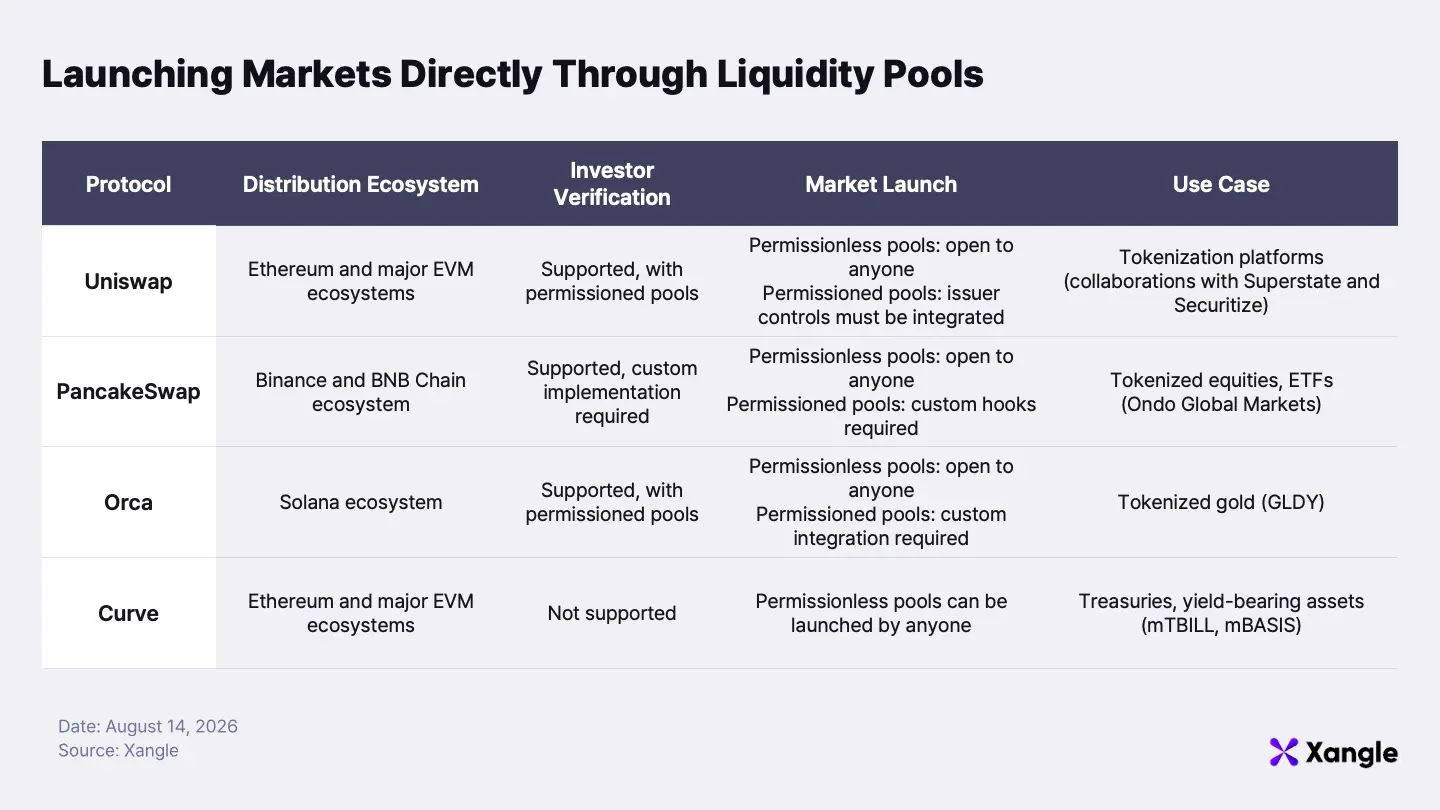
The most direct approach is to deposit the issued token and a settlement asset such as USDC into an AMM liquidity pool. Once the issuer or an external LP supplies the initial liquidity, the contract uses those assets to process buy and sell orders. The appropriate protocol depends on whether the market is permissionless, restricted to approved investors and LPs, or designed for assets with particular pricing characteristics.
4.1.1 Uniswap: From a General-Purpose AMM to Permissioned Markets
Uniswap is the most versatile option among the protocols examined. A standard liquidity pool can be created without a listing review once the two traded tokens and initial liquidity are supplied. A tokenized asset with no separate holding or transfer restrictions can therefore establish a permissionless market in the same way as a conventional cryptoasset.
Uniswap v4 Permissioned Pools, introduced in July 2026, extend the model to assets with investor-eligibility restrictions. By connecting an issuer-managed allowlist to the contracts, the system can verify the permissions of traders and LPs separately. It can prevent unauthorized investors and LPs from participating and unwind the positions of participants who lose eligibility. Tokenization platforms including Superstate and Securitize joined as launch partners.
The principal advantage is that issuers can consider both permissionless and permissioned pools within the same Uniswap ecosystem. Using a permissioned pool requires the issuer to link its existing know-your-customer (KYC) and investor-eligibility system to on-chain trading permissions. This is more complex than deploying a permissionless pool, but it allows on-chain trading while preserving the investor restrictions attached to the security.
4.1.2 PancakeSwap: A Core Venue in the Binance and BNB Chain Ecosystem
PancakeSwap is a leading AMM centered on BNB Chain. An issuer can create a market directly by supplying the two traded tokens and initial liquidity. Its latest version, Infinity, allows the price range and fee structure to be tailored to the asset, while hooks can add custom conditions before or after a trade. This architecture can be used to implement tokenized-asset rules such as underlying-market hours, oracle-status checks, trading limits, and investor verification.
The integration with Ondo Global Markets is the leading tokenized-asset example. Ondo connected hundreds of tokenized equities and exchange-traded funds (ETFs) issued on BNB Chain to PancakeSwap. Some assets have dedicated AMM pools, while user orders can also access professional market-maker quotes and multiple on-chain liquidity sources through PancakeSwapX, discussed later in this report.
BNB Chain was created by Binance, and PancakeSwap is the ecosystem's leading DEX. Binance is also expanding its tokenized-equity business through bStocks. PancakeSwap therefore combines the ability to create AMM liquidity pools directly with access to a broader distribution base spanning PancakeSwapX, Binance, and wallets and services across BNB Chain.
4.1.3 Orca: Permissioned Liquidity Pools
Orca is a leading Solana AMM that concentrates liquidity within specified price ranges. Its importance for tokenized assets lies in the fact that it has implemented a live permissioned market in which only approved investors and LPs can participate, alongside conventional permissionless pools.
The leading example is Streamex's GLDY. GLDY is a digital security linked to physical gold. Investors must complete KYC and accredited-investor verification before they can hold the token and trade it on Orca. Streamex manages investor eligibility and token transfer conditions, while Orca provides the liquidity pool through which approved investors trade. Metalayer, a professional liquidity provider, supplies GLDY and the quote asset to create market liquidity.
The GLDY market demonstrates that an AMM can preserve the investor-eligibility and transfer restrictions applied to a conventional security. Orca's presence on Solana is another differentiating factor. Solana has an active ecosystem for tokenized equities and retail on-chain trading, allowing tokenized assets to reach a broader range of users through existing wallets and distribution infrastructure such as Jupiter.
4.1.4 Curve: A Pricing Model Suited to Treasuries and Yield-Bearing Assets
Curve provides an AMM specialized for assets whose prices move closely together. StableSwap is designed to concentrate liquidity around the reference price more efficiently than a conventional constant-product AMM, enabling lower-slippage trading. Although it has been used primarily for stablecoins, the structure is also well suited to tokenized Treasuries and yield-bearing assets that trade around net asset value (NAV) and redemption value rather than exhibiting the wider price movements of individual equities.
On Curve, mTBILL and mBASIS are paired with stablecoins in liquidity pools. mTBILL is linked to returns on short-term US Treasuries, while mBASIS reflects returns from a basis-trading strategy. Both assets trade freely in permissionless secondary markets.
Curve's strength lies in matching the AMM structure to the pricing behavior of the asset. Treasuries and yield-bearing assets whose reference values change gradually can use capital more efficiently by concentrating liquidity around a narrower price range. As tokenized assets expand from equities into Treasuries and managed products, different AMM designs can be selected according to each asset's pricing characteristics.
4.2 Outsourcing Liquidity Management to Specialist Providers
An issuer can create a liquidity pool directly, but continuously managing price and inventory against the underlying asset requires additional capital and operational capabilities. Proprietary AMMs and Liquidity as a Service (LaaS) are two leading models for outsourcing this function to specialist providers.
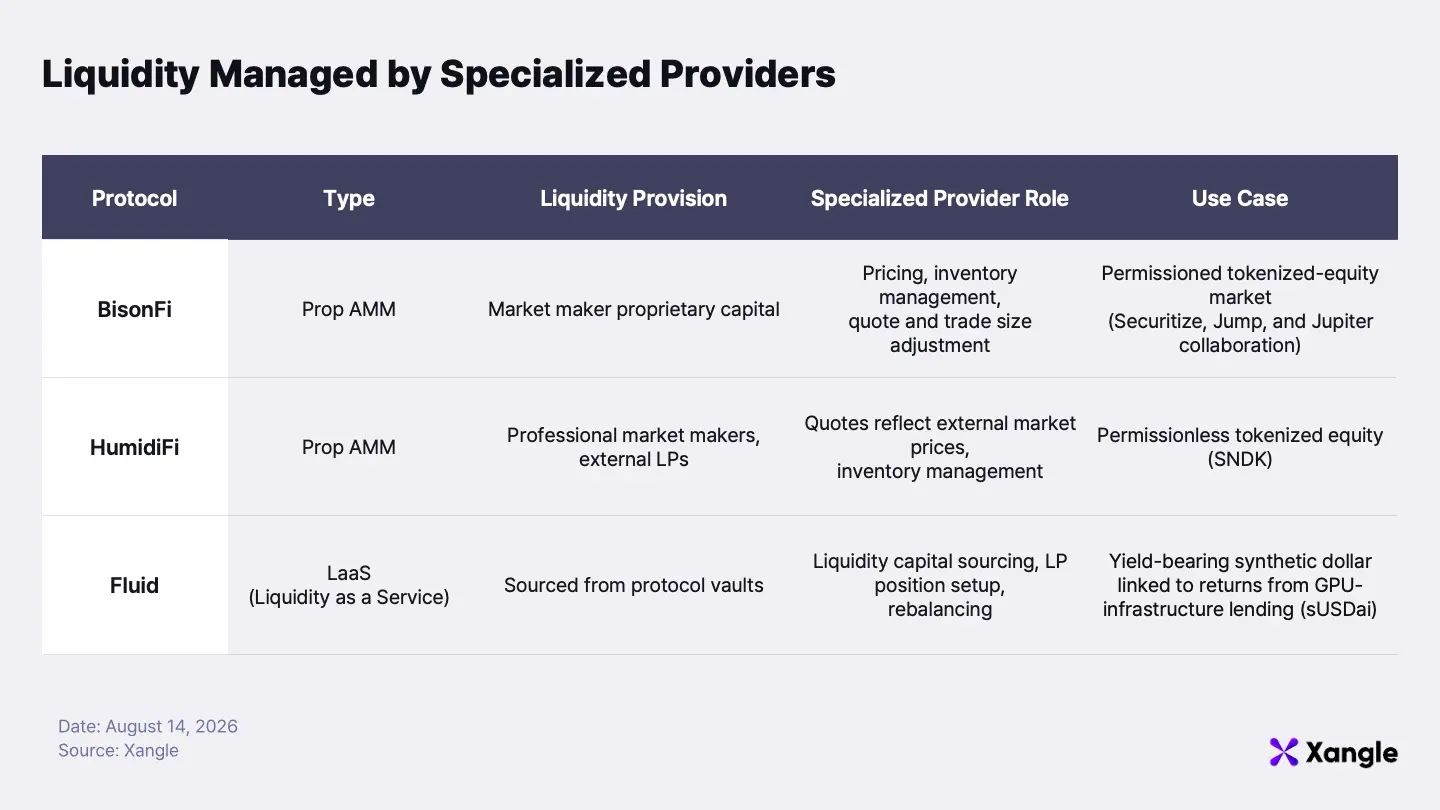
A proprietary AMM (Prop AMM) differs from a conventional AMM, which applies a predefined formula to liquidity supplied by general users. In a Prop AMM, a professional market maker manages dedicated capital and a proprietary pricing algorithm. It continuously adjusts bid and ask prices and available trade size based on real-time external-market prices, volatility, the inventory of each asset, and the direction and size of incoming orders.
Execution and settlement occur on-chain, but pricing incorporates the market maker's proprietary strategy. Conventional AMMs disclose their pricing curves and contract structures, while Prop AMMs often keep their pricing models and risk-management algorithms private. The executed price and quantity remain visible on-chain, but the full process that produced the quote is not necessarily disclosed.
4.2.1 BisonFi: Bringing Jump's Market-Making Capabilities On-Chain
BisonFi is a Solana-based Prop AMM operated by Jump Crypto, the digital-asset arm of global trading firm Jump Trading Group. Jump Trading has long provided algorithmic trading and liquidity across traditional and crypto markets. BisonFi applies this market-making model to on-chain spot markets.
BisonFi rapidly reflects external-exchange prices while adjusting its executable price and size according to pool inventory and incoming order flow. If repeated user sales leave the pool holding more of a token than its target allocation, BisonFi can reduce available depth or offer a less favorable price for additional sell orders. It can offer more liquidity in the opposite direction to rebalance its inventory.
In May 2026, Securitize launched a regulated tokenized-equity trading service on Solana with Jump Trading Group and Jupiter. Securitize provides the regulatory infrastructure, including securities issuance and investor verification. Jump's Prop AMM provides liquidity and price discovery, while Jupiter gives investors a route to discover and trade the assets. The model connects a professional market maker's pricing and liquidity-management capabilities to permissioned tokenized-equity trading.
4.2.2 HumidiFi: Asset-Specific Market-Making Strategies
HumidiFi is a Solana-based Prop AMM that uses a proprietary pricing model combining external-market data with high-frequency signals. It continuously adjusts quotes and executable size according to market conditions, inventory, and expected order flow. Its liquidity is supplied primarily by professional market makers and liquidity providers rather than general users.
HumidiFi can work with projects to create new pools and apply a separate market-making strategy to each asset. Because the protocol operates new pools and issuer-specific strategies, it can build liquidity markets tailored to the underlying price and trading characteristics of each asset. End users access these markets through Solana aggregators including Jupiter.
For tokenized assets, SNDK, a tokenized representation of Sandisk shares, trades on HumidiFi. The market demonstrates how a professional market maker can manage spot liquidity for a tokenized equity by incorporating both external pricing and its own inventory.
4.2.3 Fluid: LaaS Combining Liquidity Capital and Position Management
Fluid is an on-chain liquidity protocol that operates a DEX, lending markets, and vaults on a shared liquidity layer. Its relevant product for tokenized-asset trading is Liquidity as a Service (LaaS). Rather than using a market maker's proprietary algorithm to generate quotes, as a Prop AMM does, Fluid provides the capital and manages the LP positions required by an AMM market.
The leading example is USD.AI's sUSDai. sUSDai is a yield-bearing synthetic dollar that finances AI-infrastructure loans backed by GPUs and distributes the resulting income to holders. In June 2026, USD.AI and Fluid entered into an agreement to provide up to $100 million of DEX liquidity for the sUSDai market.
Instead of requiring USD.AI to source USDC and operate the pool itself, Fluid draws capital from the USDC Lite Vault, which holds USDC deposited by users, and deploys it into the sUSDai market. Fluid also manages the LP position, including the price range, liquidity size, and adjustments made as market conditions change. USD.AI does not provide separate LP capital and pays Fluid an agreed LaaS fee.
BisonFi and HumidiFi apply professional market makers' pricing and inventory-management capabilities. Fluid instead provides the trading capital and management of the AMM position as a service. It illustrates how liquidity provision can be structured as a separate professional service for credit-linked and yield-bearing assets that exhibit relatively limited price volatility and accumulate income over time.
4.3 Using Quotes from Professional Executors
A market can also rely on professional executors to propose a price and execution method when an order arrives, rather than pre-funding a single liquidity pool with all required assets. The user submits conditions such as the desired asset and quantity. Multiple executors then generate quotes using their own inventory or external liquidity such as AMMs, and the trade is completed using the most favorable available terms.
This removes the need to concentrate all trading liquidity in a single pool. For assets such as tokenized equities, which have an underlying market and issuance and redemption channels, a professional market maker can use those resources to construct quotes and distribute them across DEXs, wallets, and other trading channels.
4.3.1 UniswapX: Intent Trading That Puts Multiple Liquidity Sources in Competition
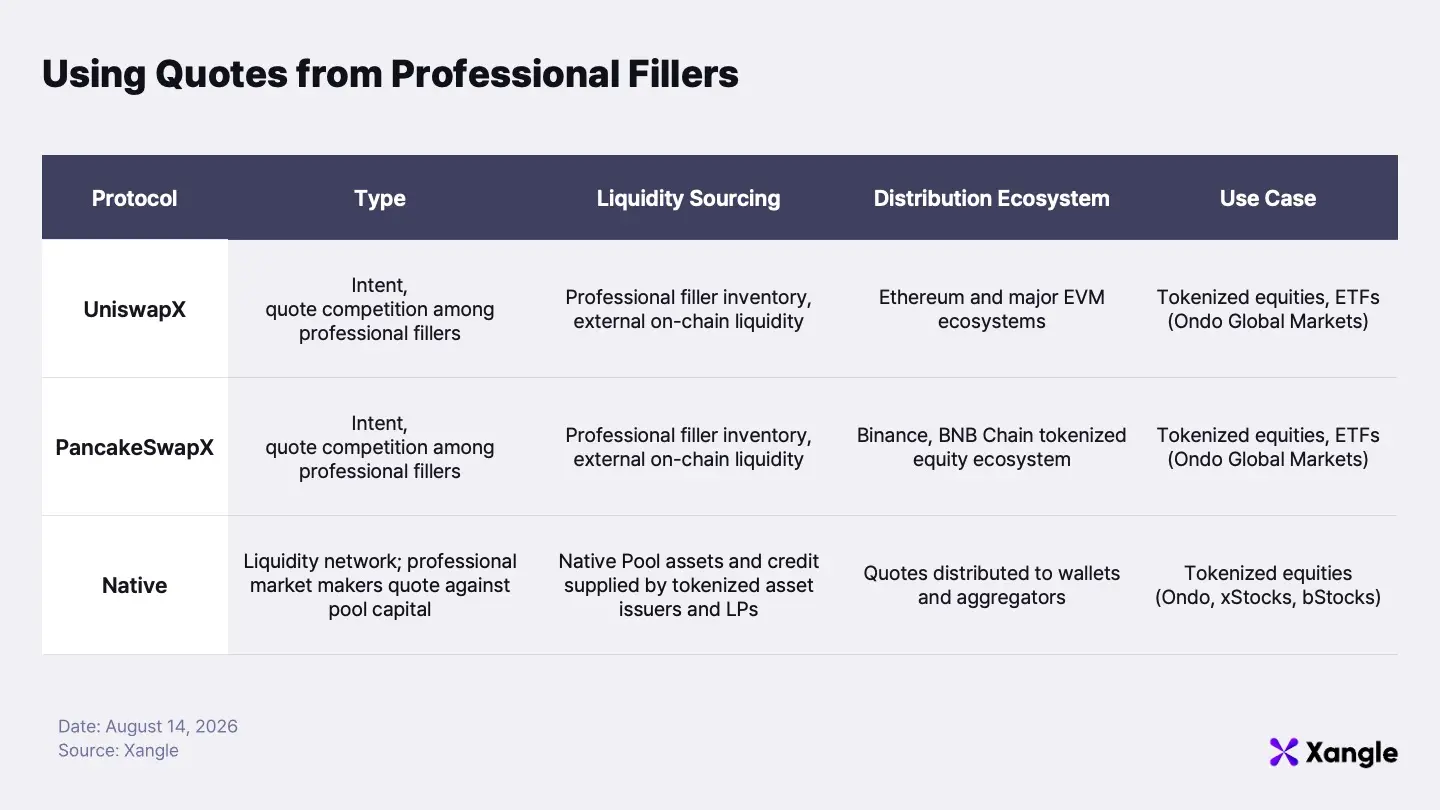
UniswapX is an intent-based trading protocol developed by Uniswap. When a user submits the desired trading conditions, the protocol requests quotes from professional executors and gives the best bidder an initial opportunity to fill the order. If the order remains unfilled, it proceeds to a Dutch auction in which other executors can participate. The selected executor can use its own inventory or source the required asset from Uniswap AMMs and other on-chain markets.
UniswapX does not primarily create new liquidity pools. Its role is to connect liquidity that already exists across multiple venues to a single order and place those sources in competition. The user specifies the desired outcome rather than selecting a pool, while the executor searches across liquidity sources to complete the trade. A key advantage is access to Uniswap's broad liquidity and user base across Ethereum and other major EVM chains.
In June 2026, Ondo connected more than 430 tokenized equities and ETFs to Uniswap on Ethereum and BNB Chain. Assets linked to Tesla, NVIDIA, SPY, QQQ, and many others can access multiple liquidity sources through UniswapX, allowing them to use the existing EVM trading ecosystem without requiring a large standalone AMM pool for every asset.
4.3.2 PancakeSwapX: Connecting to the Binance and BNB Chain Tokenized-Equity Ecosystem
PancakeSwapX uses an intent-based execution structure similar to UniswapX. It requests quotes from registered professional market makers and gives priority to the executor offering the best terms. If the order is not filled, it moves to an open auction in which other executors may participate. Executors can use their own inventory or external liquidity such as AMMs to complete the order.
PancakeSwapX is differentiated less by its execution mechanics than by its connection to the Binance and BNB Chain ecosystem. PancakeSwap is integrated with major user applications including Binance Wallet and Binance Alpha, while more than 400 tokenized equities and ETFs from Ondo Global Markets use PancakeSwapX as a primary trading route. Binance's bStocks also trade on PancakeSwap. The protocol can therefore connect tokenized assets to BNB Chain's retail users and broader tokenized-equity ecosystem.
4.3.3 Native: A Liquidity Network Connecting Capital Providers and Professional Market Makers
Native differs from intent protocols such as UniswapX and PancakeSwapX, where executors search for existing external liquidity. In Native, an issuer or LP supplies assets to a Native Pool, and a professional market maker uses those assets or credit extended by the pool to generate quotes. Native therefore connects executors to the liquidity they need within the protocol itself.
Quotes produced by professional market makers pass through Native's price-discovery and order-matching infrastructure before being distributed to multiple wallets and aggregators. Native links the supply of liquidity capital, market-maker pricing, external quote distribution, and on-chain settlement within a single structure. Its distinguishing feature is that it provides both the capital required for market making and the distribution of the resulting quotes, rather than merely placing executors in competition.
Native currently supports liquidity for tokenized equities from Ondo, xStocks, and bStocks. The resulting quotes are delivered to aggregators used directly by end users. A single liquidity structure can therefore be distributed across multiple aggregators and user applications.
4.4 Connecting Multiple Trading Routes to Users
On-chain liquidity is not concentrated in a single exchange. The same asset may trade through AMMs, Prop AMMs, intent protocols, and professional market makers, while assets issued on multiple chains also have liquidity fragmented by network. Aggregators compare these dispersed liquidity sources and quotes, then connect a user's order to an executable route.
4.4.1 Jupiter: Unifying Solana Liquidity into a Single Trading Route
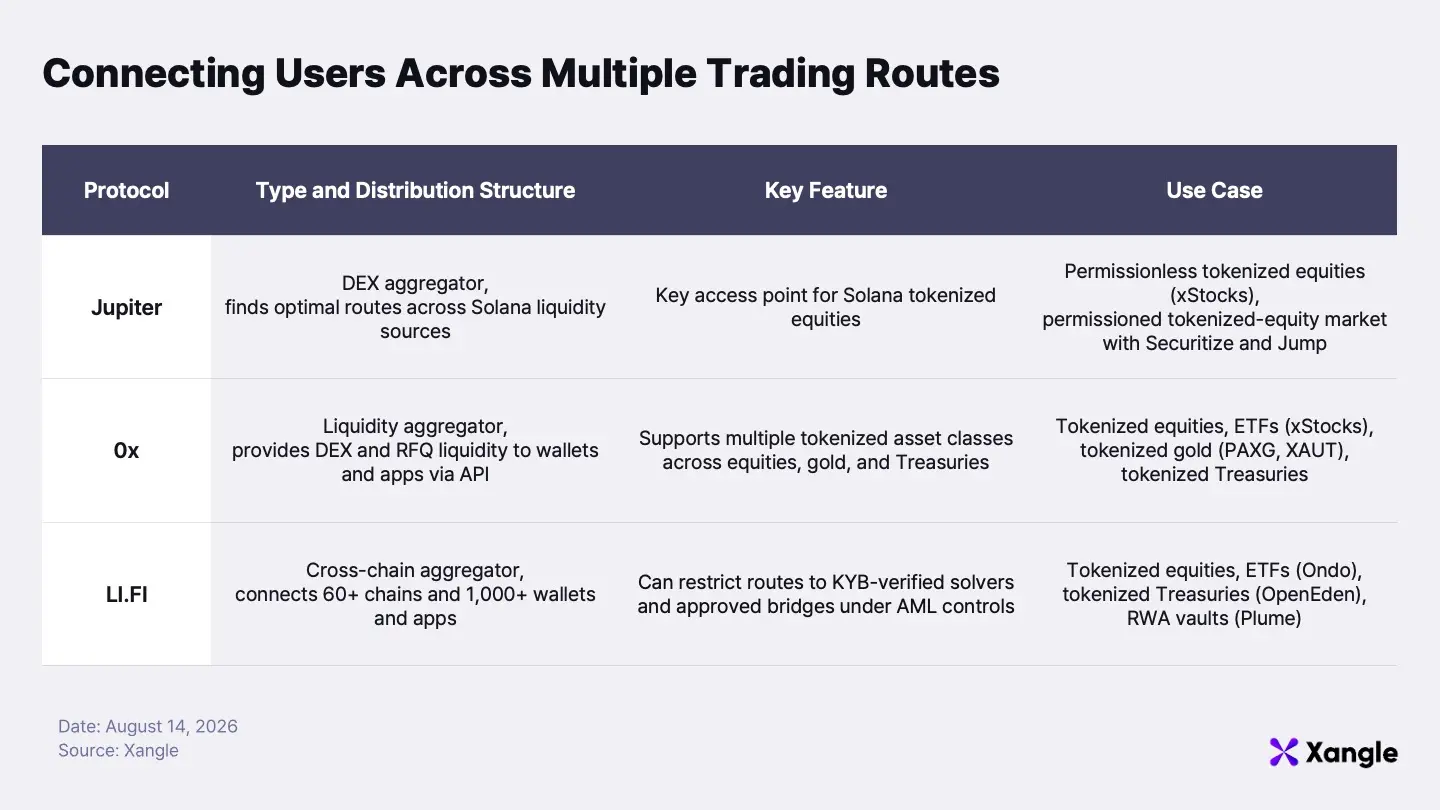
Jupiter is Solana's leading DEX aggregator. Rather than operating its own liquidity pools, it connects liquidity from multiple trading venues across Solana. Its routes include AMMs such as Orca, Prop AMMs, and quotes from professional market makers. Users submit orders through Jupiter's interface or services integrated with Jupiter, while the underlying liquidity is supplied by external markets connected to the aggregator.
When a user enters the asset and amount to trade, Jupiter queries prices and liquidity across connected markets. It compares routes that execute in a single market, split the order across multiple markets, or use an intermediate token. The selected route then executes on Solana using liquidity from the relevant AMM or market maker.
xStocks are available through Jupiter. In the permissioned tokenized-equity market announced by Securitize, Jump Trading Group, and Jupiter in May 2026, Jupiter also provides the user interface and distribution layer. Securitize handles issuance and investor-verification infrastructure, Jump supplies Prop AMM liquidity, and Jupiter connects the market to existing Solana users.
4.4.2 0x: Delivering Aggregated Liquidity to External Wallets and Applications
0x is trading infrastructure that aggregates liquidity from DEXs and professional market makers across Ethereum and other blockchains, then delivers it to external services. In addition to conventional AMM and DEX liquidity, it uses quotes submitted directly by market makers through 0x RFQ. Wallets, exchanges, and applications integrating the 0x Swap API or Cross-Chain API can provide the same trading infrastructure within their own products.
When a user requests a trade through a wallet or application integrated with 0x, the service forwards the trading conditions to 0x. The protocol compares connected DEX liquidity with RFQ market-maker quotes, constructs an execution route, and returns the transaction data to the application. Once the user approves the transaction, the trade executes on-chain against the selected DEX or market maker.
For tokenized assets, 0x supports xStocks and provides trading routes to integrated services including Coinbase and Robinhood. Approximately $300 million of tokenized gold, including Pax Gold (PAXG) and Tether Gold (XAUT), was routed through 0x across 13 chains over the past year. Tokenized Treasuries and yield-bearing assets are also included in trading routes across nine chains. 0x is therefore used to connect tokenized equities, gold, Treasuries, and other asset types to users of existing services.
4.4.3 LI.FI: Multichain Distribution Infrastructure with Compliance-Aware Routing
LI.FI is multichain liquidity infrastructure that integrates DEXs, aggregators, bridges, and intent systems to construct both same-chain and cross-chain trading routes. When a user wants to purchase a tokenized asset on another chain, LI.FI can combine the conversion of the source asset, the cross-chain transfer, and the purchase on the destination chain into a single route. It can also connect the subsequent deposit of the purchased asset into a vault when required.
For tokenized assets, compliance requirements can be applied to the execution route itself. LI.FI provides routing optimized for tokenized Treasuries and money market funds (MMFs), and can restrict routes to whitelisted solvers and bridges that meet KYC and anti-money laundering (AML) requirements under the relevant jurisdictional settings. This allows both asset purchases and cross-chain transfers to use only approved execution providers and routes.
Ondo's tokenized equities and ETFs are connected to the LI.FI partner network on Ethereum and BNB Chain. OpenEden uses LI.FI to convert assets from multiple chains into USDC before investing in a tokenized Treasury product. LI.FI's distinguishing feature is its ability to connect tokenized-asset purchases, cross-chain transfers, and subsequent deployment within a single user flow while also screening the solvers and bridges used for execution.
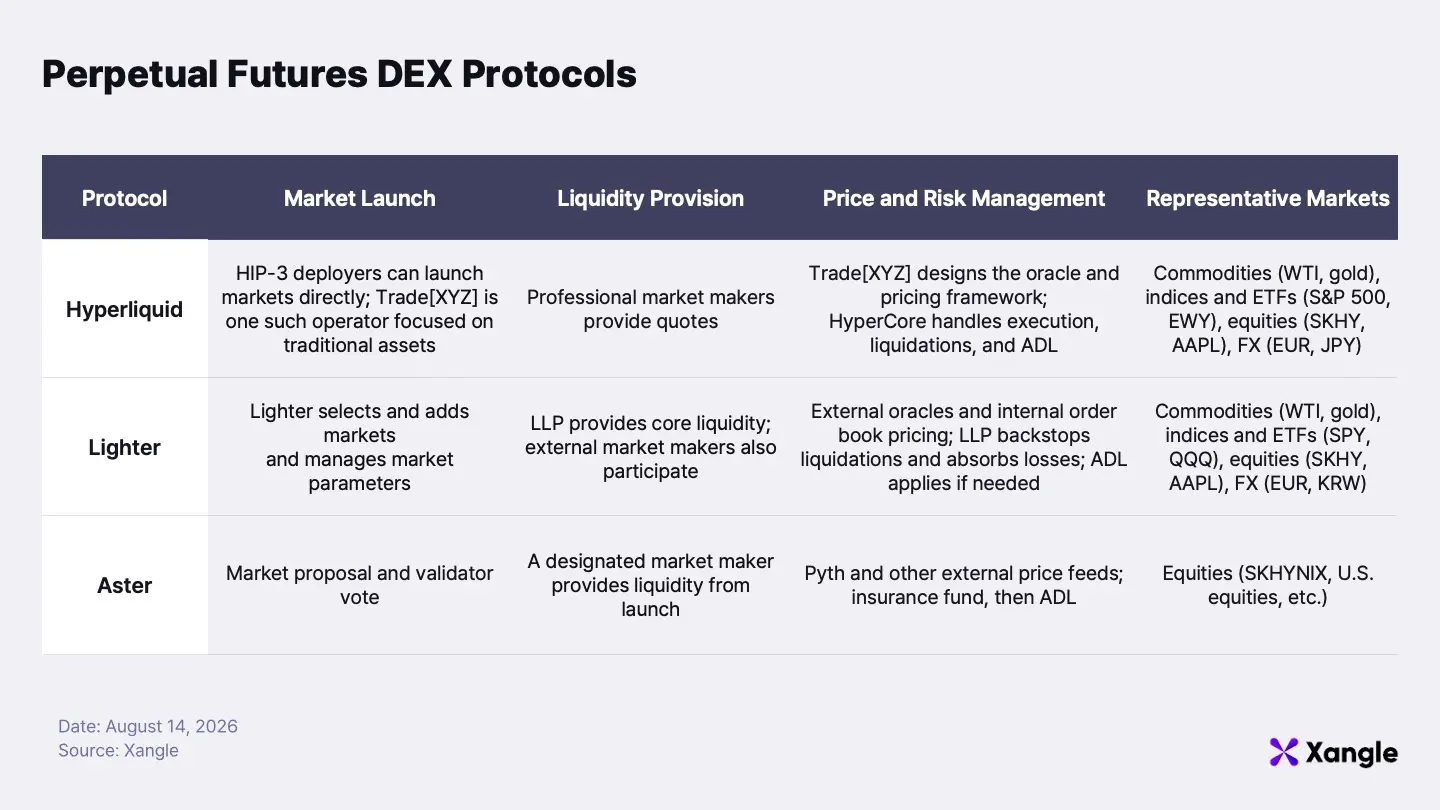
5. Perpetual Futures DEX Protocols
A spot market for a tokenized asset requires the actual token and liquidity with which to trade it. Perpetual futures do not transfer ownership of the underlying asset and instead trade profit and loss generated by price movements. They can therefore support markets for equities, indices, and commodities even when no corresponding token has been issued. The trade-off is that the market needs an oracle to deliver the underlying price, market makers to provide bids and offers, and collateral and risk-management structures to settle profit, loss, and liquidations.
5-1. Hyperliquid: External Deployers Can Launch and Operate Markets Directly
HyperCore is the core trading engine that processes perpetual futures on Hyperliquid. It maintains bids and offers in an order book, matches them by price-time priority, and manages trader margin, positions, funding, profit and loss, and liquidation. An external operator can use HyperCore's trading infrastructure to launch a new perpetual market without building a separate matching or settlement system.
HIP-3 enables this model. An external operator stakes 500,000 HYPE to become a HIP-3 deployer, then configures the traded asset, collateral, leverage, open-interest limits, and other parameters before launching the market directly. After launch, the deployer must secure professional market makers to supply quotes and establish a market-specific backstop structure and capital plan. The deployer also determines the oracle and how prices will be handled during regular-market closures, trading halts, stock splits, dividends, and other events. HyperCore provides the shared execution and liquidation infrastructure, while the deployer manages the pricing, liquidity, and market-specific risk framework.
Staking 500,000 HYPE, approximately $28 million, and building the required oracle and market-making infrastructure demand substantial capital and operational capacity. Rather than developing every component internally, an institution can also work with an established specialist deployer. A representative example is Trade[XYZ], which operates HyperCore markets linked to equities, indices, and commodities including the S&P 500, WTI, Brent crude, and SK hynix. Its S&P 500 market was launched under an official license from S&P Dow Jones Indices, demonstrating how a traditional financial institution can work with a specialist HIP-3 deployer to extend an index into an on-chain perpetual futures market.
An institution can become a HIP-3 deployer and launch and operate its own market, or use the existing trading infrastructure and operating capabilities of a specialist such as Trade[XYZ]. Direct deployment provides greater control but also makes the institution responsible for the oracle, liquidity, and risk management. Working with a specialist deployer can reduce the capital and operating burden of bringing the market live.
5-2. Lighter: A Protocol-Led Market Operating Model
Lighter does not allow an external operator to deploy a perpetual market directly. Instead, Lighter manages the creation of new markets and their operating conditions. The protocol determines which assets to list, which oracle to use, and key risk parameters such as maximum leverage and open-interest limits. Unlike Hyperliquid, where an external project can become the market operator, Lighter integrates the requested market into its existing trading infrastructure. Orders execute through Lighter's order book, while zero-knowledge proofs (ZK proofs) verify that state changes, including execution, margin updates, and liquidations, followed the protocol's rules.
The protocol also plays a central role in market operations. Alongside conventional market makers, the Lighter Liquidity Pool (LLP) supplies liquidity to major markets and acts as a backstop for liquidation positions that cannot be absorbed by the order book. LLP capital is divided across strategies for cryptoassets, foreign exchange, and traditional assets, limiting the direct transmission of losses from one strategy to the capital supporting another. An external project seeking a new market can therefore use Lighter's existing liquidity and risk-management framework rather than building a separate market-making and backstop system from scratch.
For traditional assets, Lighter combines external prices from providers such as Pyth and Chainlink with prices formed in its own order book, enabling trading when the underlying market is closed. Its markets include SKHY, linked to the SK hynix American depositary receipt listed on Nasdaq, as well as USDKRW foreign exchange, XAU and XAG commodities, and the SPY and QQQ ETFs. Users in selected regions can also access Lighter perpetual markets through Robinhood Wallet. Robinhood provides the interface and access channel, while Lighter handles execution and liquidation.
5-3. Aster: Market Creation through Decentralized Governance
Aster's AOS-2 framework allows external projects to propose perpetual futures markets. Unlike Hyperliquid, however, depositing a specified amount of capital does not lead directly to deployment. An applicant must lock 1 million ASTER, approximately $600,000, for four years, secure a market maker, and pass a validator vote. Once approved, Aster's risk team sets market parameters including margin and leverage. The model combines external market proposals, validator governance, and protocol-level risk management.
AOS-2 requires the liquidity provider to be identified at the proposal stage. The applicant's designated market maker supplies bids and offers from the time of listing, while oracles such as Pyth deliver external-market data for pricing. If collateral falls below maintenance margin and a position is liquidated, the insurance fund absorbs the loss first. If the fund is insufficient, auto-deleveraging (ADL) reduces profitable opposing positions to cover the remaining shortfall. The applicant therefore supplies capital and secures the market maker, while relying on Aster for execution, margin, liquidation, and other market-operating infrastructure.
Aster operates perpetual futures linked to US equities as well as Korean equities including SAMSUNG and SKHYNIX. Its main distinction is that external projects can propose markets with a lower infrastructure burden than becoming a HIP-3 deployer directly on Hyperliquid, while still retaining a direct role in market selection, unlike Lighter's protocol-led model.
6. Conclusion: Tokenized Asset Markets Remain at an Early Stage
On-chain trading in tokenized assets is expanding rapidly, but maturity still varies substantially by asset class. DEX spot trading is concentrated most heavily in tokenized equities, while Treasuries, MMFs, and credit assets remain focused on holding, issuance, and redemption rather than trading, despite their substantial issuance volumes. Quote assets are also dominated by dollar stablecoins such as USDC and USDT. Rather than a market in which traditional assets broadly trade on-chain, the sector remains at a stage where secondary markets are forming first around selected assets using the dollar liquidity already established in crypto markets.
Permissioned asset markets are at a similar stage. Infrastructure capable of controlling investor eligibility has emerged, including Uniswap's permissioned pools and PancakeSwap hooks, while live examples such as Orca's GLDY market restrict participation to eligible investors. These structures have not yet become standardized markets that multiple issuers can adopt repeatedly. Issuers still often need to connect the DEX, market maker, and investor-verification system on an asset-by-asset basis, leaving permissioned spot infrastructure in the early stages of development.
The tokenized-equity trading structure developed by Securitize, Jump, and Jupiter indicates how this market may evolve. Securitize handles securities issuance and investor verification. Jump uses a Prop AMM to provide market making and liquidity, while Jupiter provides the user-access channel. Rather than relying on a single protocol to perform every function, specialized providers divide responsibility for regulatory compliance, liquidity, execution, and distribution to create a single trading market. Although the available assets and trading performance disclosed to date remain limited, the model is significant because the components institutions need to build tokenized-asset secondary markets are becoming more clearly defined.
The next stage for tokenized assets is to build markets in which issued assets lead to actual trading and broader use. Until now, bringing assets on-chain has itself been a central challenge. Going forward, the more important task will be creating liquid trading markets and connecting them to a wider range of financial services. As trading activity expands, tokenized assets may also see greater use across DeFi, including collateralized lending and asset management. DEXs will play an increasingly important role as the tokenized-asset market moves beyond issuance toward active trading and broader financial use.
Disclaimer
I confirm that I have read and understood the following: The information contained in this article is strictly the opinions of the author(s). This article was authored free from any form of coercion or undue influence. The content represents the author's own views and does not represent the official position or opinions of CrossAngle. This article is intended for informational purposes only and should not be construed as investment advice or solicitation. Unless otherwise specified, all users are solely responsible and liable for their own decisions about investments, investment strategies, or the use of products or services. Investment decisions should be made based on the user’s personal investment objectives, circumstances, and financial situation. Please consult a professional financial advisor for more information and guidance. Past returns or projections do not guarantee future results.
Xangle or its affiliated partners own all copyrights of the written or otherwise produced materials and content provided on the platform. Any illegal reproduction of such content, including, but not limited to, unauthorized editing, copying, reprinting, or redistribution will result in immediate legal actions without prior notice.