The Evolution of Crypto Exchanges — GRVT at the Frontier

Table of Contents
1. The Evolution of Crypto Exchanges: From Internal Competition to Challenging TradFi
2. GRVT Overview
3. Platform Update: ONE Balance Engine and Aave Integration
4. Dissecting the Revenue Model: How Sustainable Is It?
5. Redefining Capital Efficiency: One Pool of Capital, Two Functions
6. Closing Remarks: The Next Phase of Exchange Competition
1. The Evolution of Crypto Exchanges: From Internal Competition to Challenging TradFi
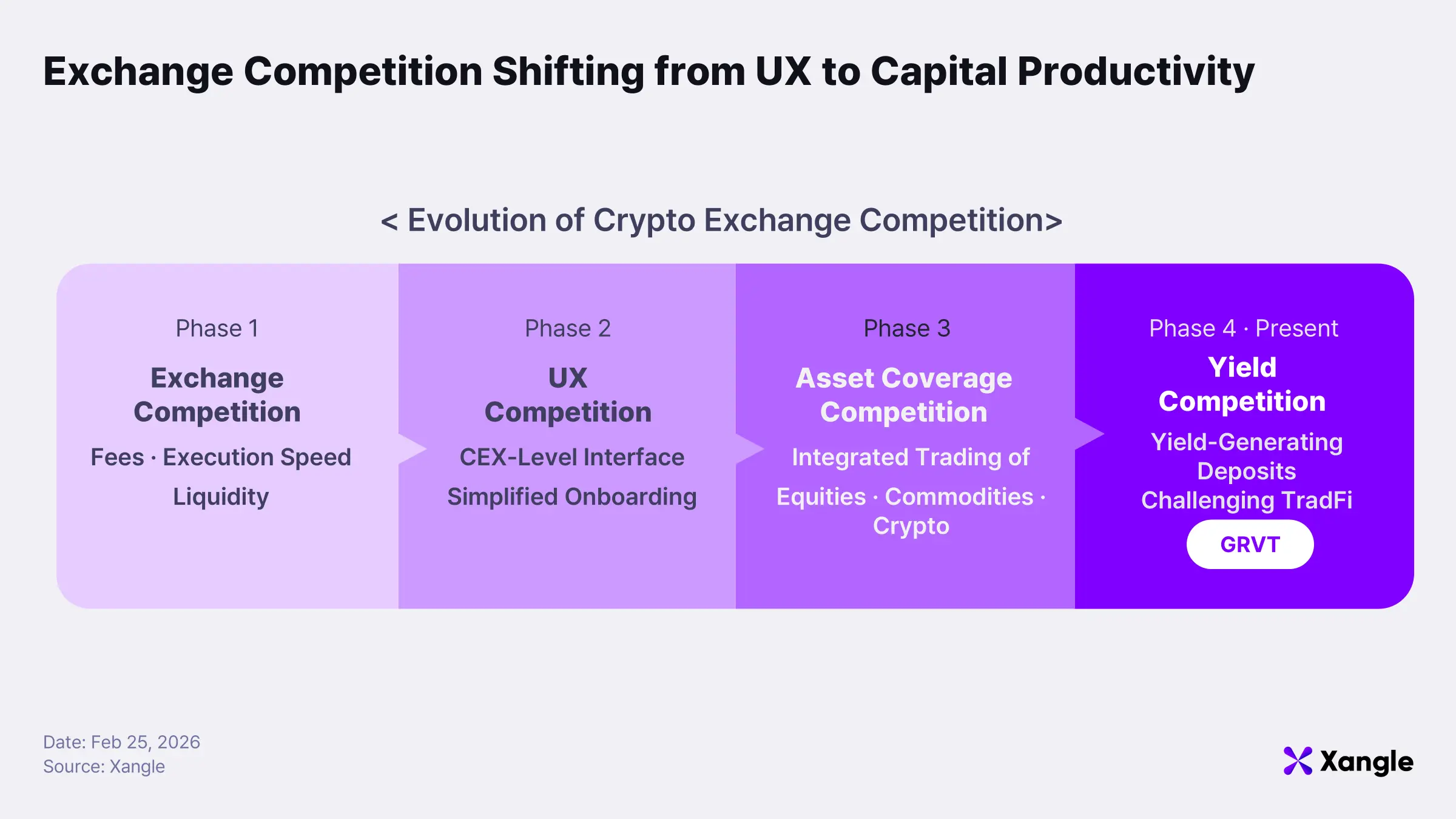
Competition among crypto exchanges has long been inward-facing. In the early days, the formula was simple: list more assets and charge lower fees. Later, faster execution and deeper liquidity became the defining metrics. Binance cemented its position as the global leader in trading volume, followed by OKX and Bybit, which divided much of the remaining market. On-chain, dYdX pioneered the PerpDEX (perpetual futures exchange) market, while Hyperliquid quickly replaced it by offering CEX-level speed and user experience. The axis of competition remained strikingly simple throughout: “Who is the better crypto exchange.”
Yet this competitive structure rested on a single underlying assumption: users come to these platforms primarily to trade crypto. Fee competition only matters if users’ capital first enters the platform. In reality, however, most personal financial assets worldwide remain parked inside bank and brokerage accounts. Bank deposits generate interest; brokerage accounts provide access to equities and commodities; surplus capital is typically allocated to investment funds.
Here the next phase of exchange competition begins. Crypto exchanges are no longer remaining platforms solely for crypto trading. Instead, they are expanding into areas long considered the domain of traditional finance (TradFi): offering yield on deposits, enabling futures trading across equities and commodities, and implementing fund investment products directly on-chain. The competitive battlefield is shifting outward; competition is moving from internal rivalry within the crypto market toward the broader service domain of TradFi.
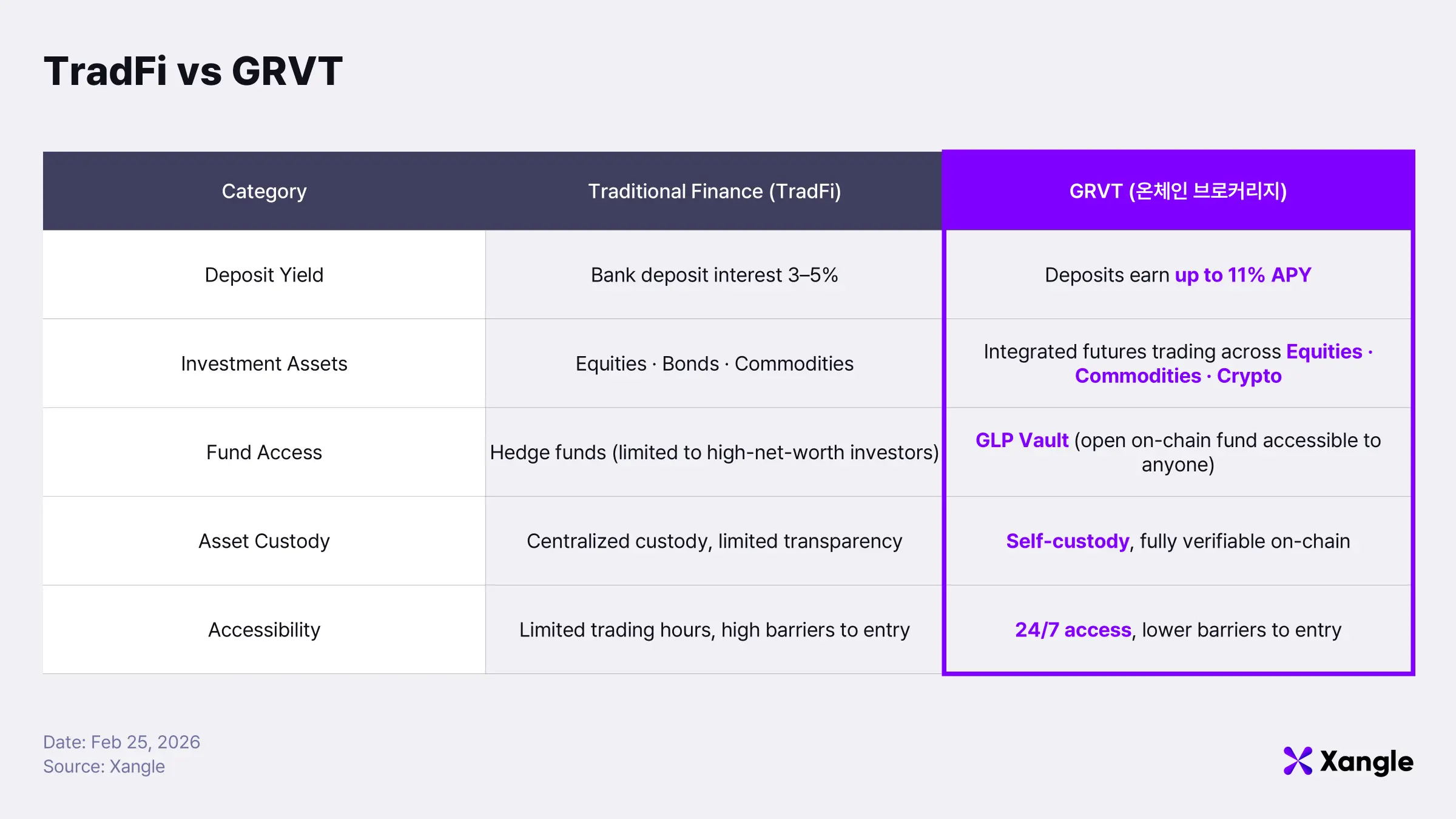
The clearest example of this shift is GRVT. With deposit yields of up to 11% APY, integrated futures trading across equities, commodities, and crypto assets, and on-chain funds (GLP Vault) managed by verified strategy managers, GRVT competes not as a traditional crypto exchange but under the logic of a TradFi brokerage.
2. GRVT Overview
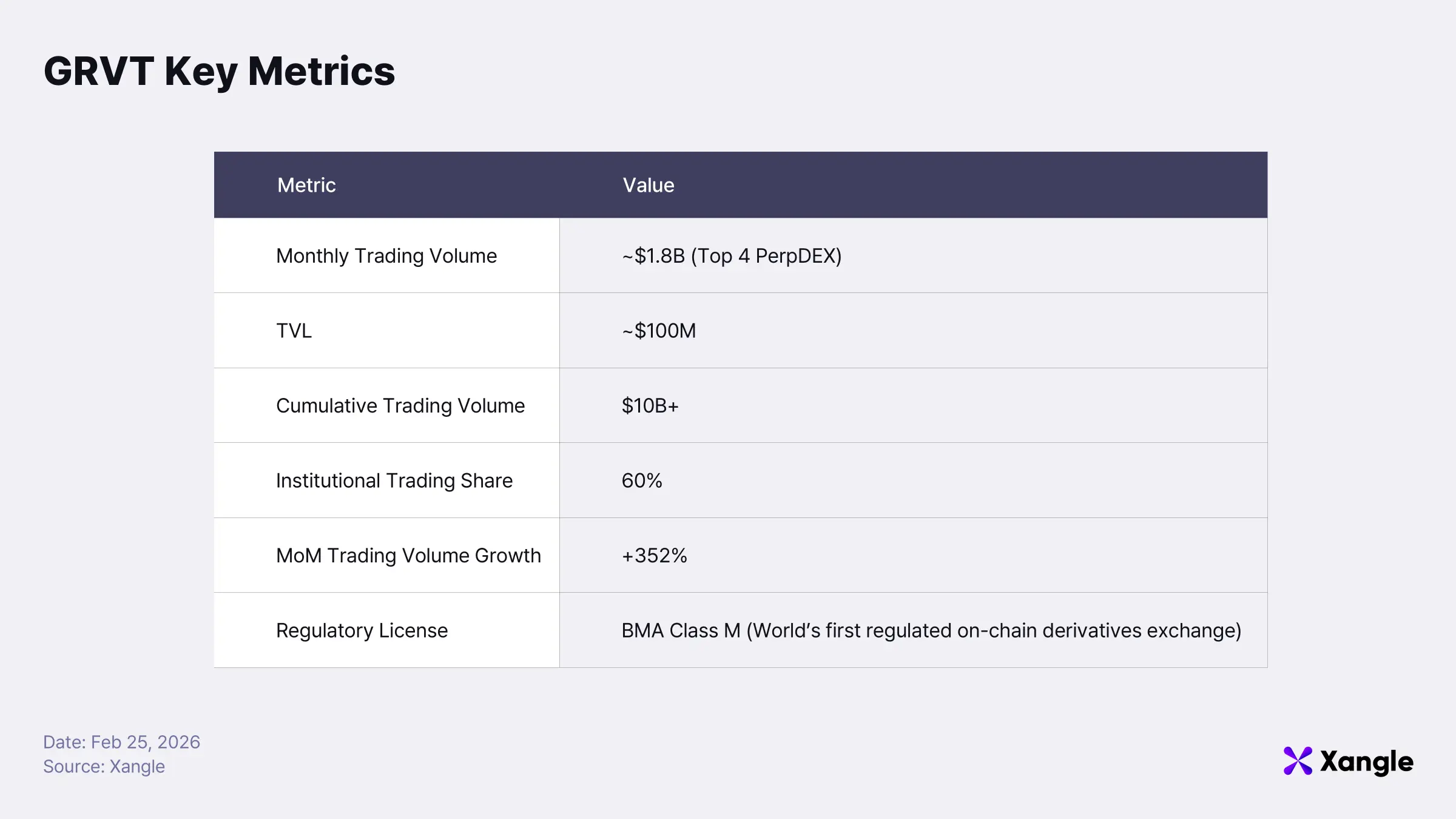
GRVT (Gravity) is a hybrid on-chain derivatives exchange founded by experts from Goldman Sachs, DBS Bank, and Meta. In December 2024, the platform obtained a Class M Digital Asset Business license from the Bermuda Monetary Authority (BMA), becoming the world’s first officially regulated on-chain derivatives exchange.
Technically, the platform adopts a Validium architecture built on zkSync Atlas. The system follows a hybrid design: ultra-high-speed order matching, reaching up to 600,000 transactions per second, occurs off-chain, while settlement is finalized on-chain. Position information is protected through zero-knowledge proofs (ZKP), and user assets remain in a non-custodial state at all times.
3. Platform Update: ONE Balance Engine and Aave Integration
ONE Balance Engine
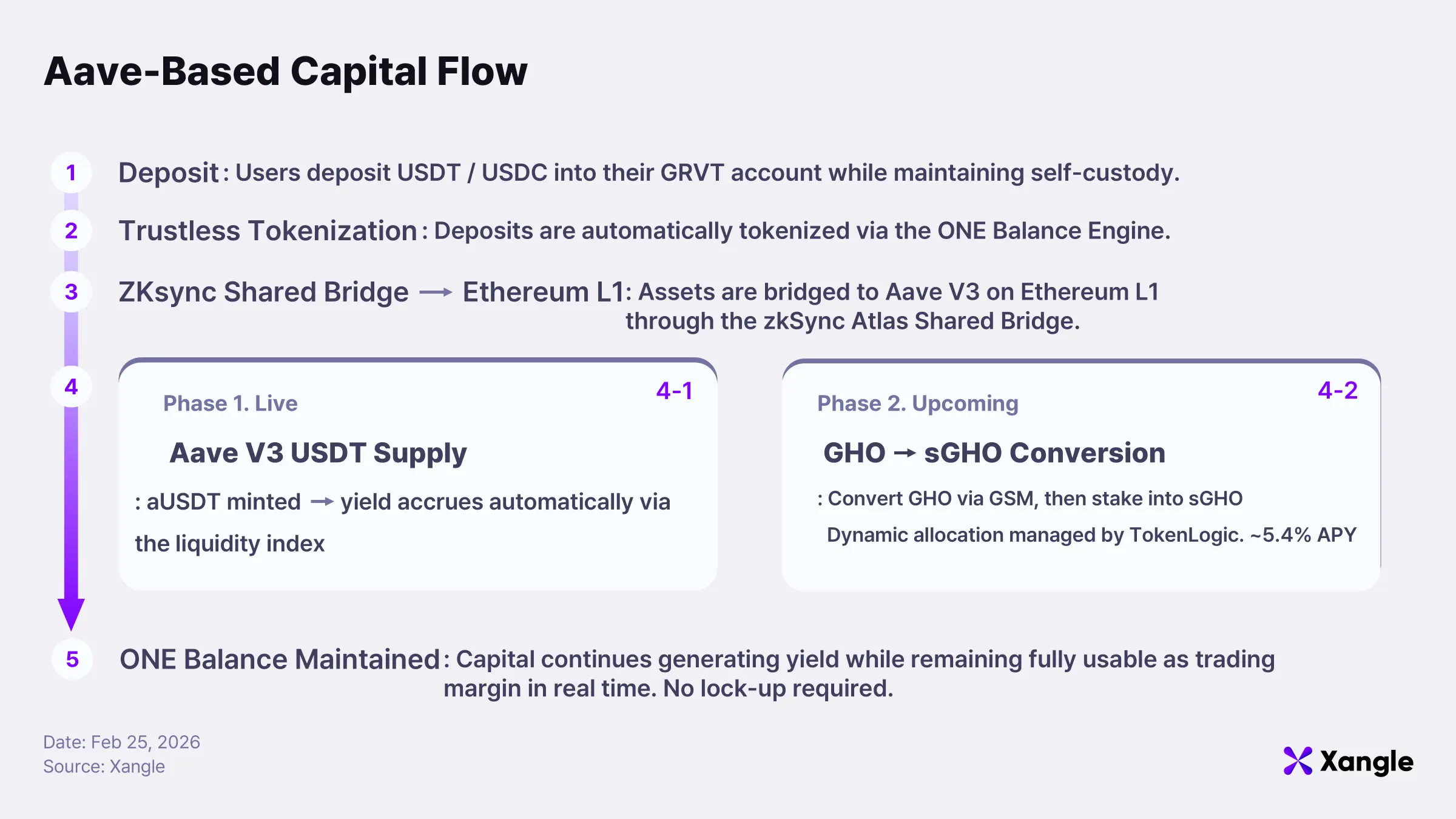
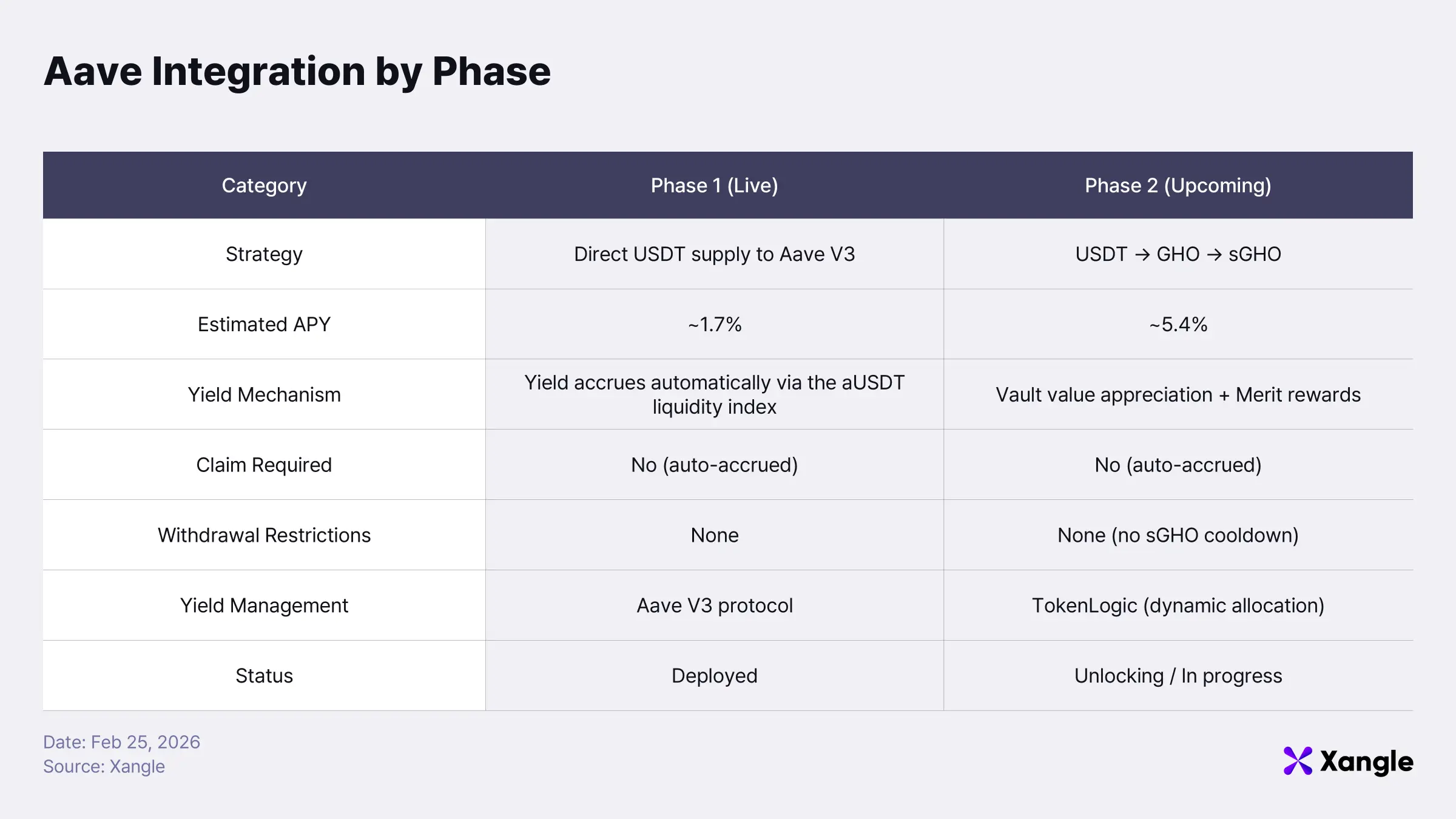
The central component of the February 26 update is the ONE Balance Engine. In conventional exchanges, collateral functions as a passive element that simply supports trading positions. Under the ONE Balance design, collateral can generate yield through external DeFi protocols while remaining immediately available as trading margin. Capital therefore remains continuously productive without becoming locked or segregated.
Such a structure is enabled by GRVT’s deployment on zkSync Atlas. Liquidity on Ethereum L1 becomes accessible via the zkSync Shared Bridge, while the trading environment of GRVT’s app-chain remains independently maintained.
Complete Redesign of the Mobile App
GRVT also introduced a full redesign of its mobile application. The updated interface prioritizes faster navigation, clearer portfolio visibility, and stronger risk controls. A single application now supports trading across crypto assets, commodities, and equity futures, while the onboarding flow has been rebuilt to meet fintech-level usability standards, allowing users unfamiliar with crypto to enter the platform more easily.
4. Dissecting the Revenue Model: How Sustainable Is It?
The critical question in this integration is not the headline figure of “up to 11% APY,” but the origin of that yield.
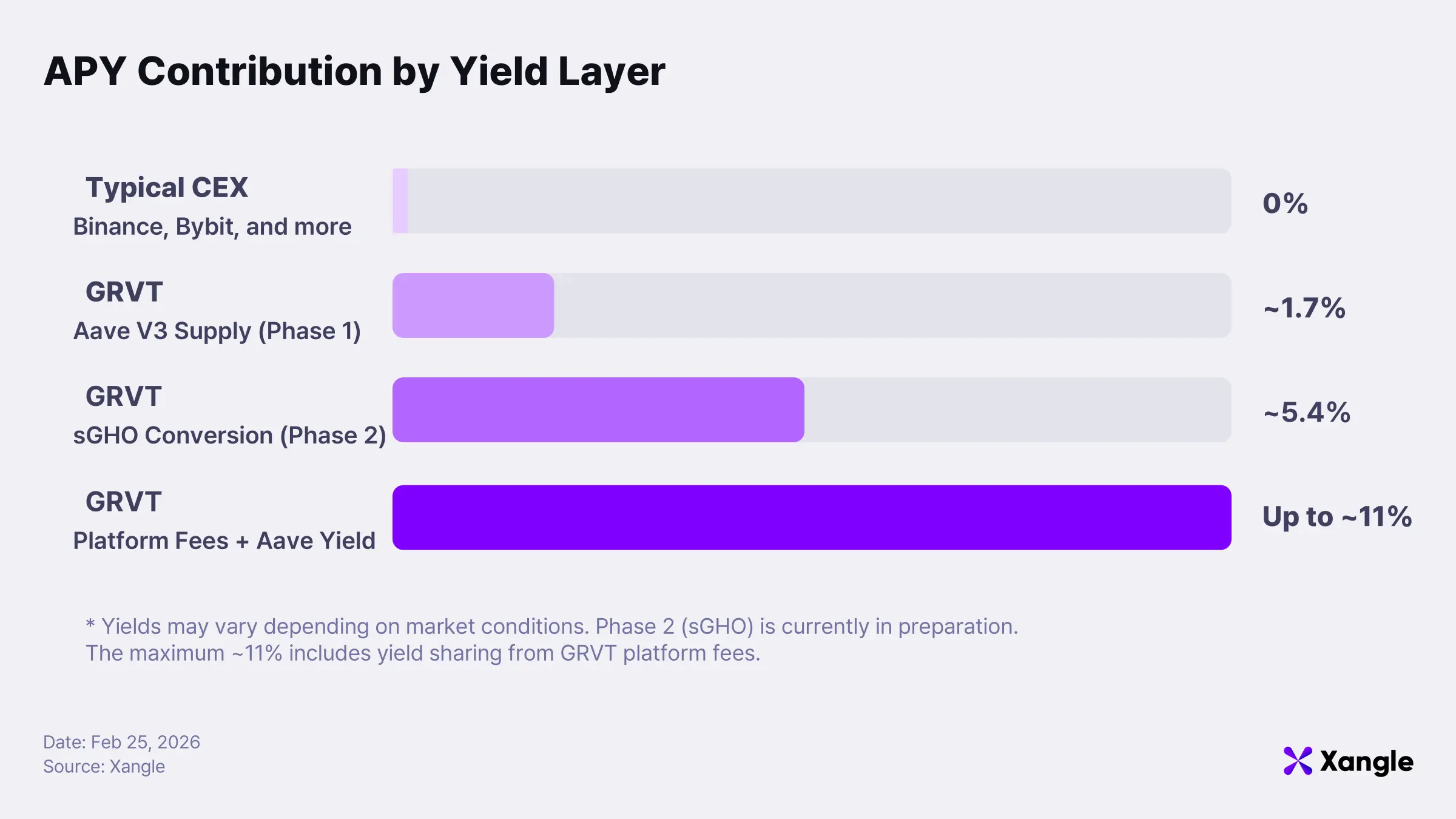
Both components of the yield are verifiable on-chain. The supply interest generated through Aave reflects real borrowing demand, while the platform fee component scales with GRVT’s trading volume. This structure differs fundamentally from yield models that rely on token inflation or platform subsidies.
That said, several caveats remain. Only Phase 1 is currently active, and Aave contributes roughly 1.7% of the total yield. Returns may increase following the Phase 2 transition to sGHO, but extrapolating current figures directly would be premature. Smart contract risk, bridge risk, and interest rate volatility must also be considered.resent.
5. Redefining Capital Efficiency: One Pool of Capital, Two Functions
CEX vs GRVT Comparison
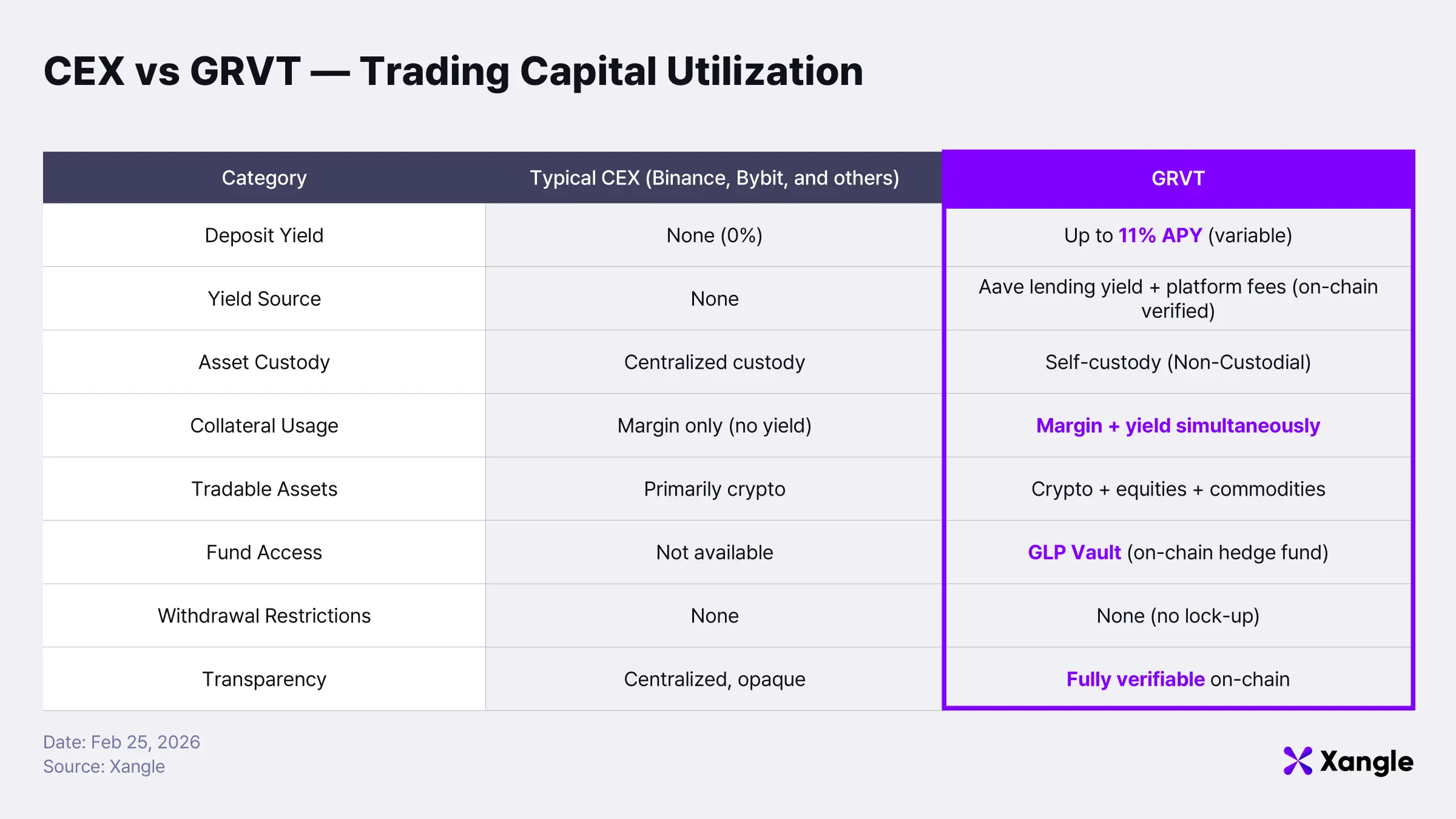
6. Closing Remarks: The Next Phase of Exchange Competition
A clear pattern emerges in the history of exchange competition. As interface gaps narrow, competition shifts to fees; once fees compress toward zero, the ability to return value to users becomes the key differentiator. GRVT is positioning itself for this next phase. Crucially, the source of that user return is not opaque platform subsidies but verifiable on-chain DeFi yield—a distinction that separates this model from simple incentive-driven marketing.
The Aave integration represents the first concrete implementation of this strategy. Beginning with Aave, GRVT plans to build a “Composable Yield Stack” by connecting multiple DeFi protocols to the ONE Balance Engine. Aave V4 and Horizon, an RWA-based institutional lending market, are among the candidates currently under consideration for future integration.
Even without a completed TGE, GRVT has already demonstrated measurable traction: monthly trading volume has grown by 352%, institutional participants account for 60% of activity, and the Aave integration is already live. The token community allocation stands at 22%. Because the underlying platform is built on an already functioning revenue structure, the eventual activation of the token economy may introduce a meaningful point of differentiation.
Disclaimer
I confirm that I have read and understood the following: The information contained in this article is strictly the opinions of the author(s). This article was authored free from any form of coercion or undue influence. The content represents the author's own views and does not represent the official position or opinions of CrossAngle. This article is intended for informational purposes only and should not be construed as investment advice or solicitation. Unless otherwise specified, all users are solely responsible and liable for their own decisions about investments, investment strategies, or the use of products or services. Investment decisions should be made based on the user’s personal investment objectives, circumstances, and financial situation. Please consult a professional financial advisor for more information and guidance. Past returns or projections do not guarantee future results. This article was written at the request of GRVT. All content in this article was written independently by the author(s), and neither CrossAngle nor GRVT had any editorial control or influence over the content. The author(s) may hold the cryptocurrencies mentioned in this article at the time of writing.
Xangle or its affiliated partners own all copyrights of the written or otherwise produced materials and content provided on the platform. Any illegal reproduction of such content, including, but not limited to, unauthorized editing, copying, reprinting, or redistribution will result in immediate legal actions without prior notice.
![[Xangle RWA Series] DeFi - DEX](https://resource.xangle.io/files/content/EA4C1A723876A93DDBB60B1694F2F92E_1787015213570.webp)