Odos: The Infrastructure Behind DEX Mainstream Adoption
1. The Path to Mainstream DEX Adoption
2. Odos: Aggregation as Execution Infrastructure
3. Odos’ Growth and Expansion Strategy
4. Odos Beyond Aggregation: The Next Layer
5. Conclusion
1. The Path to Mainstream DEX Adoption
1-1. Structural Limitations of CEXs and the Rise of DEXs
The primary advantage of centralized exchanges (CEXs) is convenience. Users do not need to manage their own wallets and can access trading, custody, lending, and derivatives within a single platform without navigating complex on-chain processes. At the same time, liquidity is concentrated in large exchanges, allowing for a faster and more familiar trading experience. The trade-off is structural: both convenience and liquidity rely on trust. Control over assets is delegated to the exchange, and execution, price discovery, custody, withdrawals, and liquidation logic are all governed by internal systems. While users appear to hold assets, verifying how those assets are managed or how trades are processed remains difficult in practice.
Under this structure, the scope for user intervention when issues arise is extremely limited. The FTX collapse illustrates what happens when that trust breaks down. Users had deposited assets but had no visibility into how those assets were being used, and the failure of FTX translated directly into risk for user funds. The incident was not simply a case of operator misconduct; it exposed the structural vulnerability of centralized systems where custody and execution are fully internalized. Even outside extreme scenarios such as fraud or embezzlement, users cannot control key mechanisms such as execution order, price reflection, liquidation logic, or withdrawals, and therefore remain dependent on the exchange’s credibility and operational integrity.
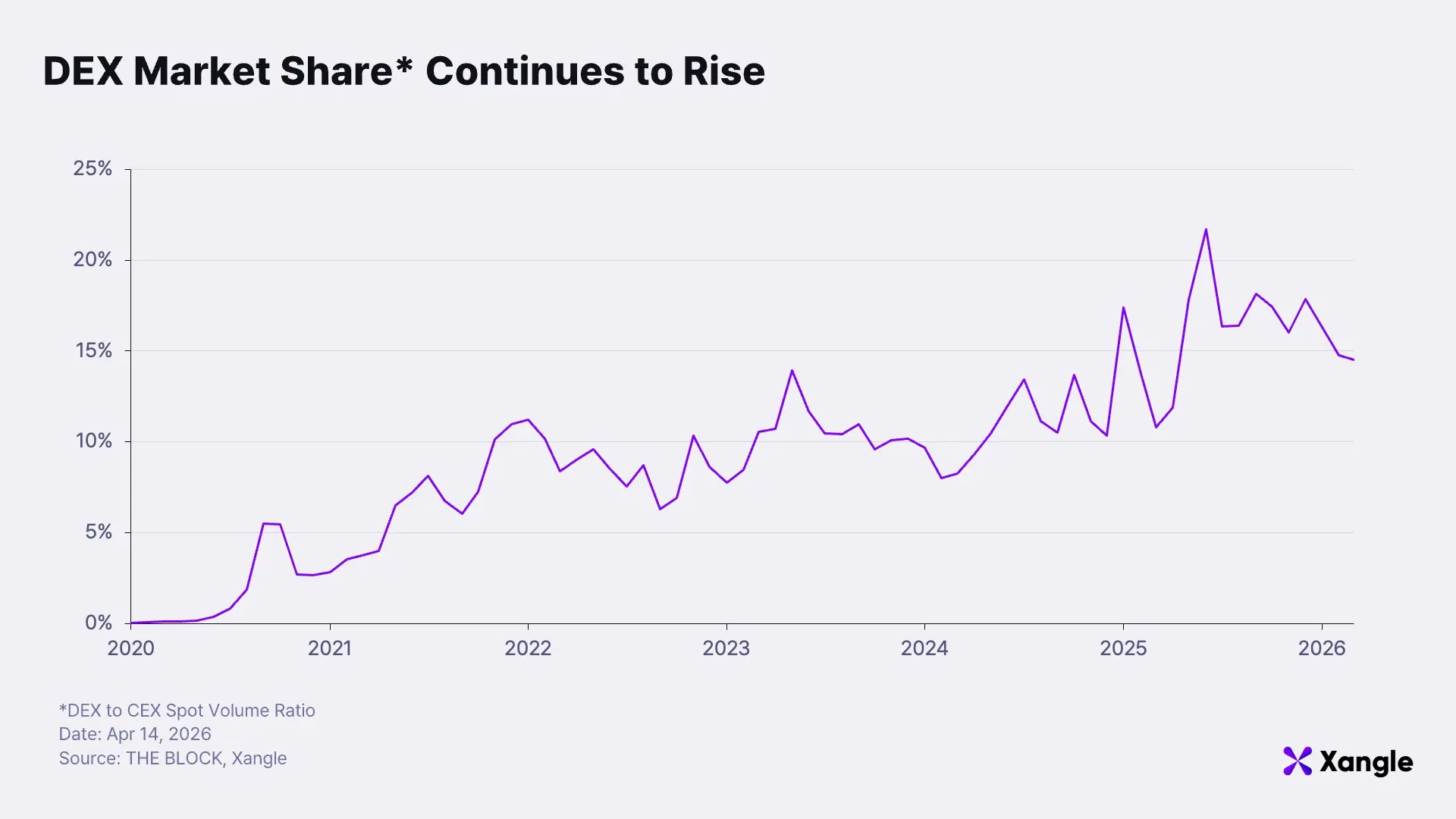
Decentralized exchanges (DEXs) invert this structure. Assets remain in user wallets rather than exchange accounts, trades are executed on-chain through smart contracts, and both execution and outcomes are recorded on the blockchain. Users retain direct ownership of their assets, and transaction results can be verified through on-chain records rather than platform-provided explanations. Limitations still exist, including complex user flows and liquidity fragmentation. These constraints, however, arise from blockchain structure and usability rather than from reliance on trust. The fundamental distinction between CEXs and DEXs lies in control and verifiability: CEXs operate on institutional trust, while DEXs shift that trust into code and user-controlled wallets.
1-2. UX as the Bottleneck to DEX Adoption
Decentralized exchanges return asset control and transaction verifiability to users. This shift away from platform-dependent trust marks a clear structural advantage over centralized exchanges. DEX presence has grown rapidly in recent years. However, trading volume alone is not enough to signal mainstream adoption. Despite strong advantages in ownership and on-chain verification, user experience remains complex, and execution quality is still heavily shaped by fragmented liquidity.
Accessibility is the first major constraint. On a centralized exchange, logging in, selecting an asset, and submitting an order completes the trade. DEX usage requires multiple steps even before execution begins. Users typically purchase assets on a centralized exchange, transfer them to a personal wallet, connect that wallet, and repeat approval and signing flows. Cross-chain activity introduces additional steps, including bridging and managing network selection, gas fees, and bridge risk. These processes may feel routine for experienced users, but for most users, they create friction before a trade even begins. Even if asset control is the core advantage, excessive complexity in the user flow limits DEXs from becoming a default choice.
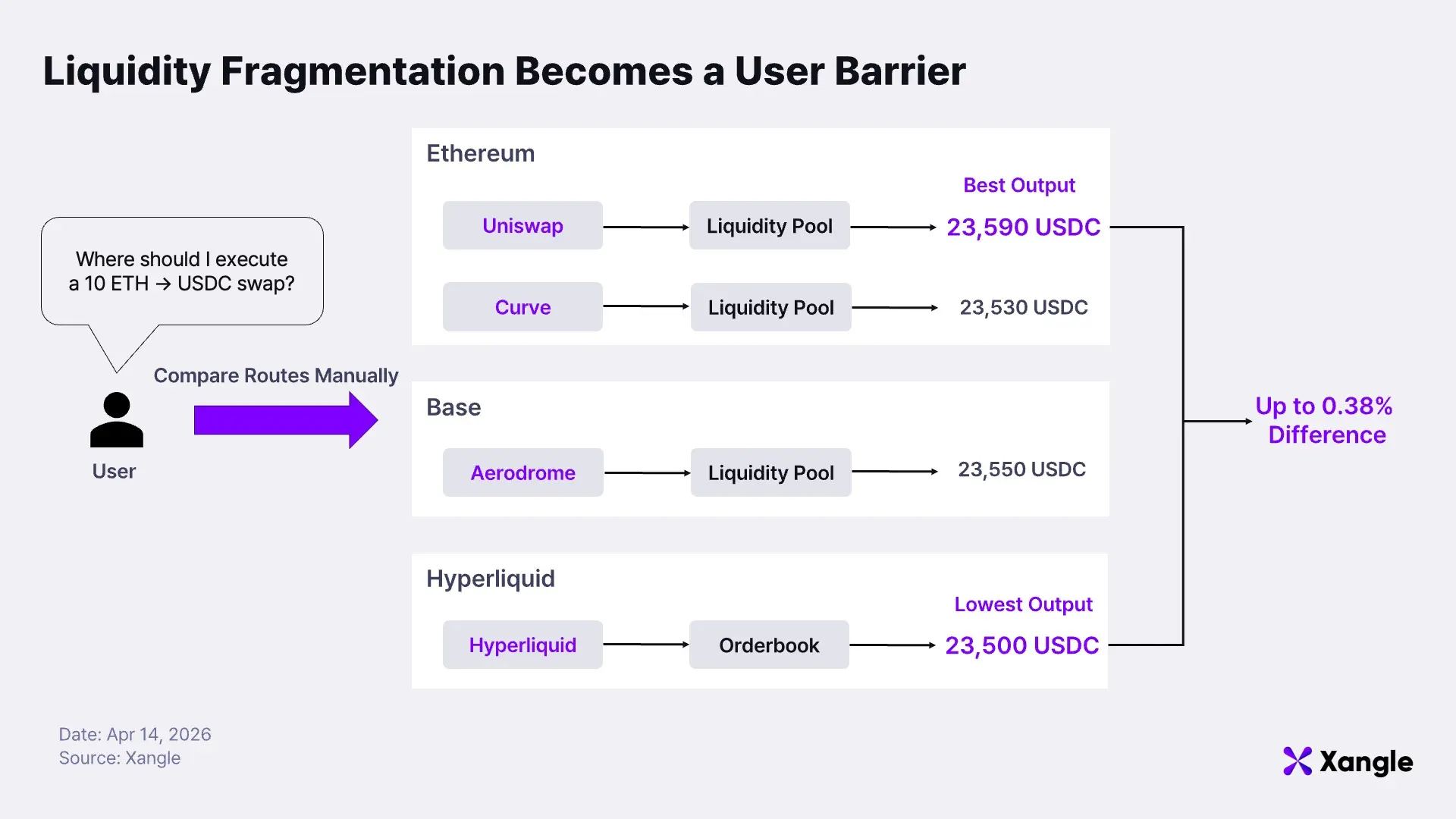
Liquidity fragmentation forms the second constraint. In the current on-chain market, liquidity is not concentrated within a single chain, exchange, or execution model. The same asset is distributed across multiple chains, and within each chain, liquidity is further split across AMM pools, orderbook DEXs, and other structures. Bridges and messaging protocols vary across environments, so execution price and quality depend on which chain, which venue, and which route is selected. The issue is not tied to any specific trading mechanism. The core friction comes from the need for users to discover and compare fragmented liquidity themselves.
These two constraints reinforce each other. As processes become more complex, users gravitate toward simpler platforms. As liquidity becomes more fragmented, execution quality becomes less consistent. New users then perceive DEXs as both difficult and inefficient, which slows adoption. Moving trust into code and wallets is not sufficient on its own. Real adoption requires infrastructure that reduces complexity while connecting fragmented liquidity into a unified execution layer. The next phase of DEX evolution is less about adding new protocols and more about removing the need for users to manage this complexity directly.
For decentralized exchanges to establish themselves as mainstream trading infrastructure, barriers to entry must be lowered and user experience must evolve to integrate and optimize fragmented liquidity. Access needs to be simple, execution needs to be seamless, and liquidity needs to function as a connected system. Only under these conditions can DEXs evolve into a true alternative to centralized exchanges.
2. Odos: Aggregation as Execution Infrastructure
The two limitations discussed above—complex accessibility and liquidity fragmentation—ultimately point to the same underlying issue: users are required to discover and compare fragmented liquidity themselves. Each DEX differs in liquidity depth and fee structure, so even identical swaps can produce different outcomes depending on where they are executed. In practice, comparing all possible routes is not feasible. Odos addresses this problem as a DEX aggregator. It scans hundreds of liquidity sources in real time to identify optimal execution paths, and supports limit orders, cross-chain swaps, liquidity provisioning, and MEV protection within a single interface. Rather than requiring users to navigate a fragmented DEX landscape, Odos absorbs that complexity at the infrastructure level.
2-1. Smart Order Routing and Execution Optimization
Swap outcomes vary depending on where execution takes place. Just as the same asset trades differently across Binance and Upbit due to differences in order books and execution conditions, decentralized exchanges exhibit the same behavior. Swapping USDC into ARB can yield different results depending on whether the trade is executed on Uniswap or Curve. Liquidity is distributed across hundreds of pools and protocols, which makes execution path selection a critical variable. DEX aggregators exist to solve this fragmentation. Similar to how navigation systems identify the fastest route among many options, aggregators evaluate hundreds of liquidity sources in real time and route trades toward the most efficient execution.
Smart Order Routing sits at the core of Odos. The system scans more than 1,000 liquidity sources in real time, but does not rely on selecting a single optimal pool. Orders can be split across multiple routes, executed through intermediate tokens in multi-hop paths, or distributed across parallel paths, with gas costs incorporated into the calculation. The objective is to maximize final output, not simply minimize spot price. The search domain also extends beyond standard AMM pools to include orderbook DEXs, lending markets, staking venues, and private RFQ systems. Fragmented liquidity is therefore aggregated across a much broader execution surface. This multi-dimensional routing approach defines the key distinction between Smart Order Routing and simple price comparison aggregators.
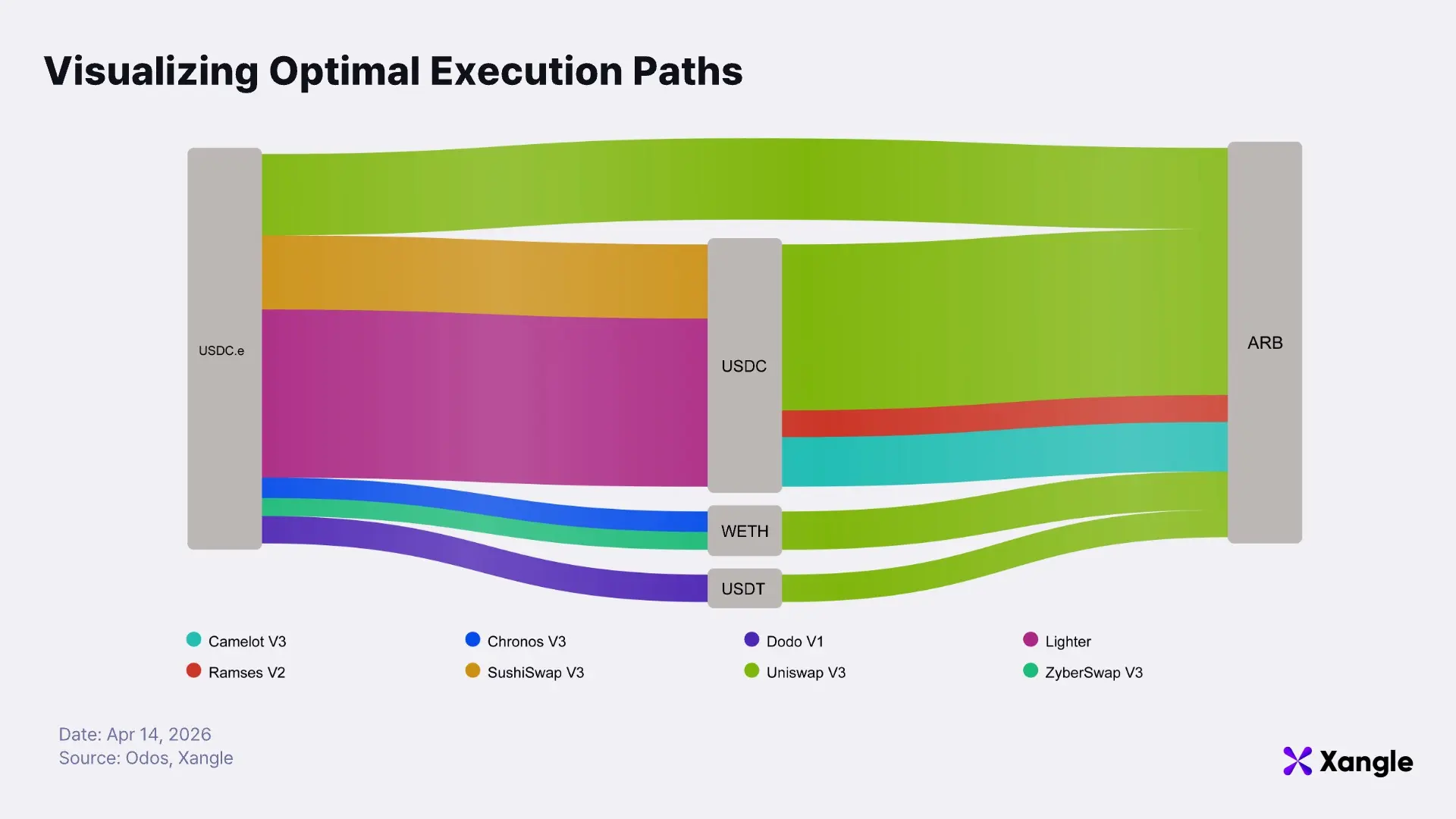
Odos presents these execution paths visually, allowing users to see how USDC.e is routed through intermediate assets such as USDC, WETH, and USDT before reaching ARB. Unlike centralized exchanges, where execution remains opaque within internal systems, the routing path itself is exposed. Execution quality is further reinforced by the structure of the underlying algorithm. The routing engine is built on a patented, closed-source pathfinding system. While competing aggregators typically publish their routing logic as open-source, Odos keeps its core algorithm proprietary. The advantage in routing performance is therefore not just technical, but structurally protected.
2-2. Closing the UX Gap with Advanced Trading Features
For decentralized exchanges to serve as true alternatives to centralized platforms, trading functionality must reach a comparable level of completeness. Centralized exchanges allow users to set target prices and rely on order books to execute trades automatically when conditions are met, while supporting seamless trading across multiple assets within a single interface. Cross-chain movement or bridging is abstracted away from the user experience.
DEXs operate under a different structure. Prices are determined algorithmically by AMMs based on liquidity pool curves, and trades execute immediately at the prevailing market price. Conditional execution at a target price is not natively supported, which makes traditional limit orders structurally unavailable. Users seeking a specific execution price must monitor the market manually, and in volatile conditions, trades may execute at unfavorable levels or incur significant slippage. Cross-chain fragmentation adds another layer of complexity. Trading across networks such as Ethereum, Arbitrum, and Base requires bridging assets between chains and executing swaps separately on each destination network. The process introduces both operational friction and additional risks, including bridge security exposure and incremental gas costs.
Odos addresses both constraints through limit orders and cross-chain swaps. Limit orders allow users to define a target price, after which Odos’ routing engine monitors conditions and executes automatically when criteria are met. Orders are submitted via off-chain signatures and are executed only at the specified price or better. No gas cost is incurred at the signing stage, and assets remain in the user’s wallet while the order is pending. In some cases, those assets can continue generating yield, preserving capital efficiency.
Cross-chain swaps are compressed into a single transaction through integration with the Across Protocol. Users specify the asset to send on the source chain and the asset to receive on the destination chain, while Odos handles routing across both environments. Bridging and swapping are executed as a unified flow, rather than as separate steps. Multi-input functionality is also supported, allowing multiple assets to be converted into a single asset on another chain within a single transaction. Complex operations such as portfolio rebalancing or asset consolidation can therefore be executed through a single order within a single interface.
2-3. Liquidity Zap and Capital Efficiency Abstraction
A defining advantage of DEXs is open participation in liquidity provision. Any user can supply assets to liquidity pools, facilitate trading, and earn fees and incentive rewards in return. A function historically reserved for a small group of institutional market makers is now accessible at the user level. Participation, however, remains limited in practice. Liquidity provision is still a complex process that requires an understanding of pool mechanics.
Asset composition is the first constraint. When holdings do not match a pool’s required ratio, part of the position must be swapped before providing liquidity. Moving capital across pools introduces additional friction. A typical flow involves withdrawing existing liquidity, swapping assets, and supplying liquidity again, requiring at least three separate transactions. Each step introduces gas costs, slippage, and exposure to price volatility. Misaligned ratios can leave residual assets unused or result in unintended losses. Even for experienced users, liquidity provisioning is operationally complex; for most users, it remains difficult to execute with confidence.
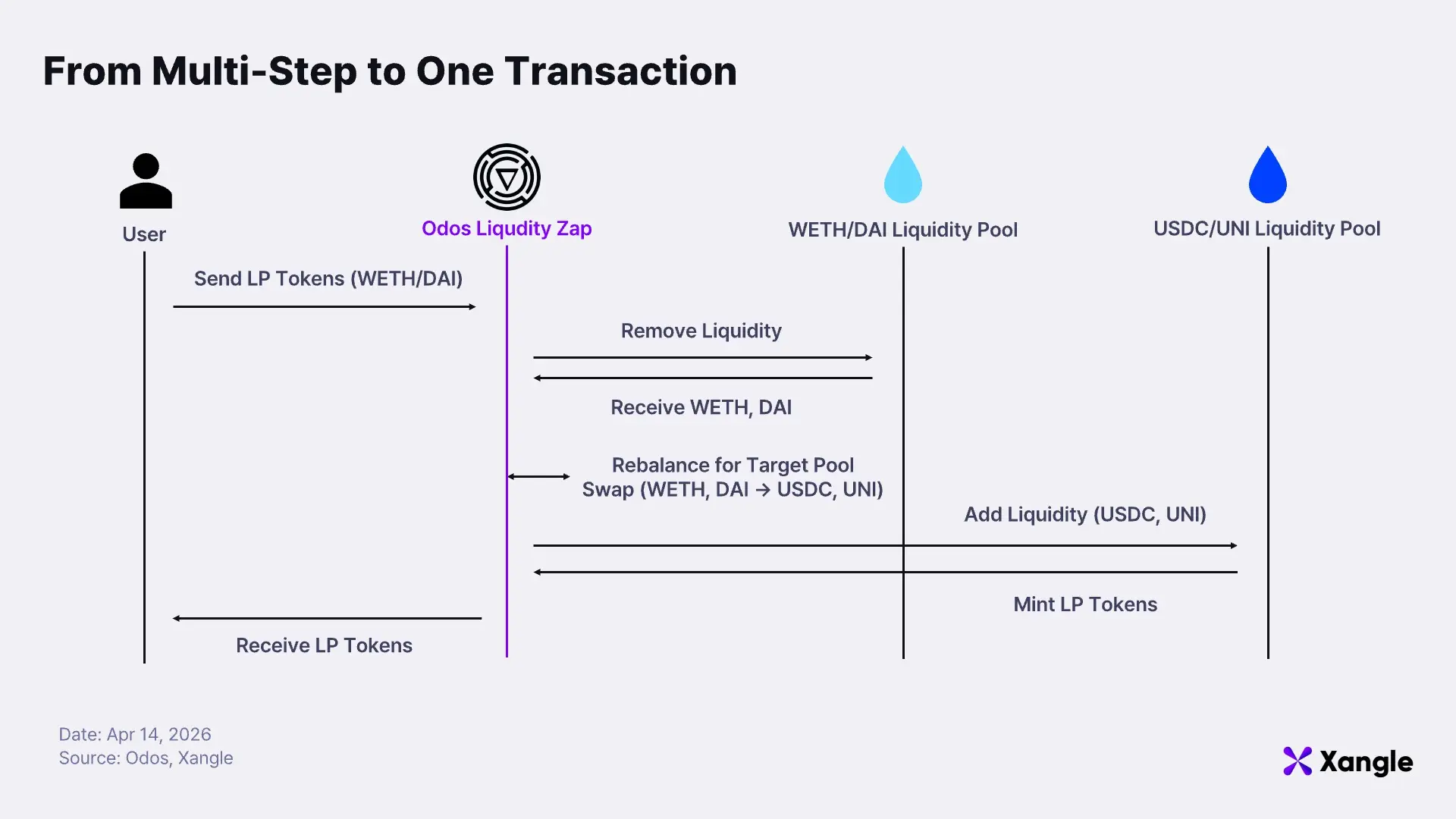
Odos abstracts this process through Liquidity Zap. Direct interaction with pool mechanics is no longer required. The system analyzes a user’s asset state, including single tokens, multiple tokens, or existing LP positions, and converts them into optimal ratios for execution. Liquidity can be supplied or withdrawn in a single transaction. For example, when supplying WETH and USDC into a target pool, Odos calculates the precise allocation based on real-time pricing and pool conditions, ensuring capital is fully deployed without residual balances.
Pool migration follows the same principle. What previously required multiple transactions is consolidated into a single execution flow, reducing gas costs and limiting exposure to price movement during the process. Support extends beyond Uniswap and Solidly-style pools to include Curve StableSwap LPs. Multiple tokens or LP positions can be aggregated into a single pool, or distributed across different assets within one transaction. Liquidity Zap removes the operational overhead associated with liquidity provisioning and lowers the barrier for broader participation in DEX liquidity.
2-4. Protected Swaps and MEV-Resistant Execution
According to Dune Analytics, transactions above $100,000 on Ethereum-based DEXs accounted for only 1.3% of total transaction count in 2025, yet represented 68.9% of total trading volume. Trade frequency is low, but large orders drive the majority of market liquidity. On centralized exchanges, these trades are executed internally, which limits the ability for external actors to intervene. On-chain execution introduces a different dynamic. Large transactions are exposed in the mempool, a public transaction queue, before inclusion in a block. Transparency is a core property of blockchains, but at scale, it becomes a source of execution risk.
MEV (Maximal Extractable Value) exploits this structure. By reordering transactions during block production, bots extract value from pending trades. Large transactions entering the mempool are detected in real time, and bots insert their own transactions before and after the target trade to capture arbitrage. The larger the trade, the greater the price impact and the larger the extractable value. A concrete example occurred in March 2026, when a $50 million swap was executed through the Aave interface. A routing error directed the order to a pool with minimal liquidity. The transaction was exposed in the mempool, MEV bots intervened, and the user received approximately $36,000, resulting in a 99.9% loss. Large-scale on-chain execution requires protection against this structural vulnerability.
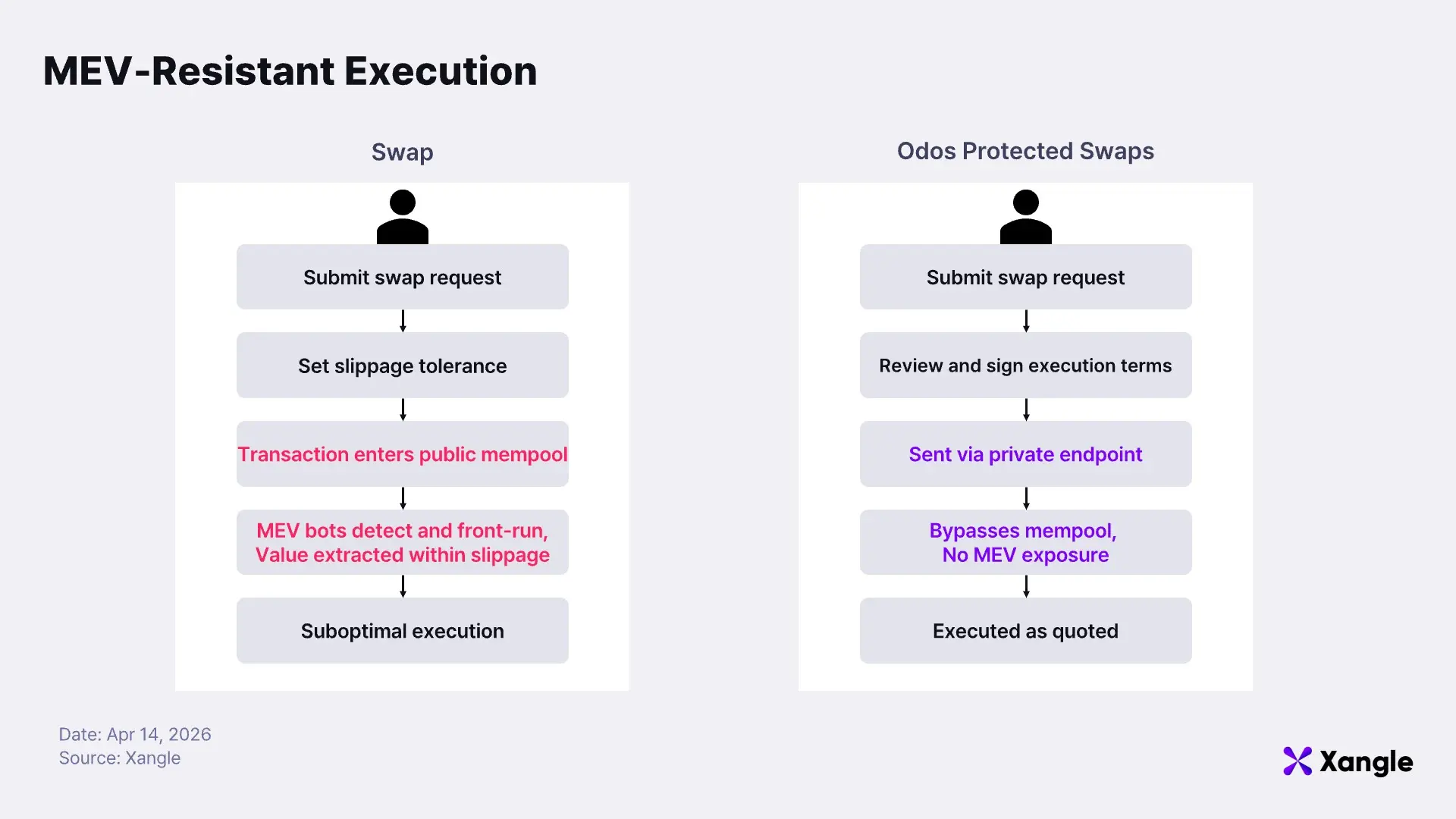
Protected Swaps address this risk at the execution layer. When a swap is requested, Odos generates a quote that incorporates gas costs, fees, and slippage. The user reviews the quote and signs the transaction. Once signed, the transaction is submitted directly through an MEV-protected endpoint, bypassing the public mempool. Execution conditions are fixed prior to submission, and the transaction is routed through a protected channel, removing the window for bot detection and intervention. On-chain execution occurs only if the signed parameters are met exactly, ensuring that the final outcome matches the quoted result.
The preference of whales and institutions for centralized exchanges has been driven by this exact risk. Large orders submitted on-chain become visible targets, and routing optimization alone cannot prevent value extraction during execution. Protected Swaps remove the point of exposure. Price efficiency alone is not sufficient for institutional participation. Execution must also guarantee that orders remain private until settlement. Protected Swaps provide the infrastructure required to establish that trust.
3. Odos’ Growth and Expansion Strategy
3-1. Revenue as a Signal of Product-Market Fit
Technical sophistication alone does not ensure survival in crypto markets. Products can appear structurally sound and feature-rich, yet lose relevance quickly without sustained user adoption. Many projects fail not because of weak design, but because they never achieve product-market fit. Evaluating protocol sustainability therefore starts with a simple question: is the product being repeatedly chosen in the market? Revenue provides the most direct signal. Metrics such as transaction count or active addresses can be inflated by bots, spam, or short-term incentives, whereas revenue reflects actual usage converted into economic value.
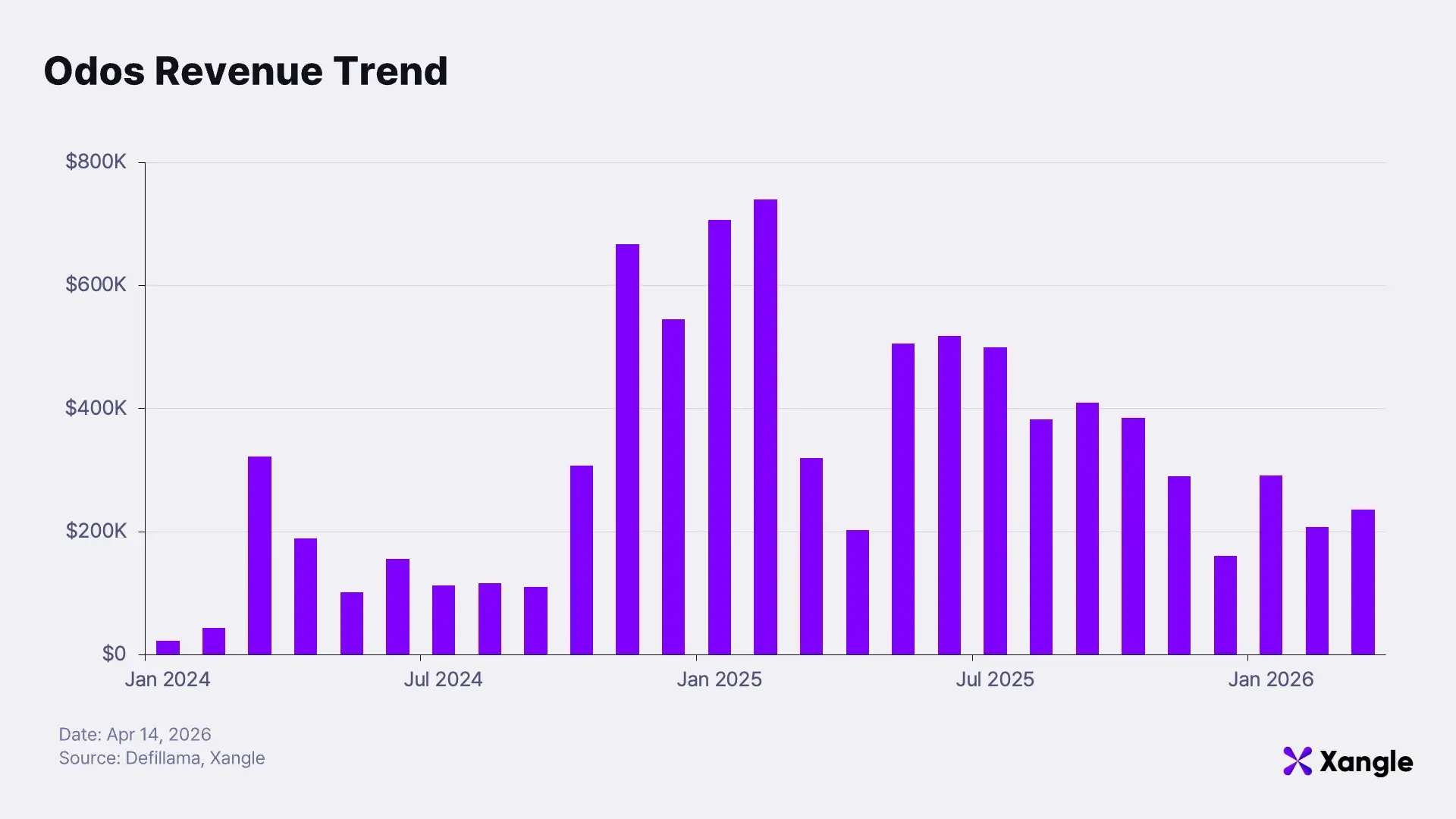
Odos shows clear traction on this metric. According to DefiLlama, the protocol generated approximately $740,000 in revenue in February 2025, and cumulative trading volume surpassed $100 billion by 2026. Scale alone is not the key takeaway. Aggregators operate with structurally low fee rates; generating meaningful revenue implies that a significant volume of real transactions is being executed, with users repeatedly selecting Odos as their execution layer.
The signal becomes more pronounced during market contractions. In strong bull markets, many protocols expand transaction volume and user counts, but activity driven by sentiment or incentives tends to fade in downturns. Following October 2025, the broader crypto market entered a period of contraction, and Odos’ revenue declined from its peak. Even so, revenue remained consistent throughout the downturn. Usage is therefore not limited to periods of elevated demand, but embedded in recurring trading activity. From a revenue sustainability perspective, Odos demonstrates clear product-market fit.
3-2. Expanding the Revenue Surface
Odos continues to generate steady revenue even during market downturns. The next step is expansion. Revenue growth is driven through two primary channels: a loyalty program that incentivizes repeat usage among individual users, and a Swap API that allows external services to embed Odos’ routing engine directly into their own products.
The loyalty program is designed for active users of the platform. Rewards are calculated based on revenue generated from activities such as swaps and limit orders, and can be claimed in ODOS tokens at the end of each 30-day epoch. Activity tracking begins automatically once a wallet is connected, with no separate onboarding process required. Tier levels increase based on ODOS token holdings, with higher tiers receiving improved rebate rates. The structure is not a one-time airdrop, but a system that compounds rewards through repeated usage. Users executing swaps are naturally incentivized to route activity through Odos, reinforcing transaction volume and revenue generation.
A second growth vector is the Swap API. In addition to direct usage via its own dApp, Odos enables external wallets, portfolio managers, and DeFi protocols to integrate its routing engine through API access. The platform is currently transitioning from V2 to V3. The V3 router is deployed with a unified contract address across supported EVM chains, reducing integration overhead. A partner code system allows integrators to define their own fee structure, enabling monetization while leveraging Odos’ routing performance. Enterprise plans extend this model further, supporting requirements such as high request throughput, low latency, and infrastructure isolation. The routing engine is therefore not limited to Odos’ native interface; it operates as embedded infrastructure across external applications.
Odos is also the only DEX aggregator with SOC 2 Type II certification. Data security, system availability, and transaction integrity have been independently audited by a third party. For institutional partners evaluating API integrations, validated controls across access management, change tracking, and incident response represent a meaningful trust layer.
3-3. Cross-Ecosystem Expansion via Solana
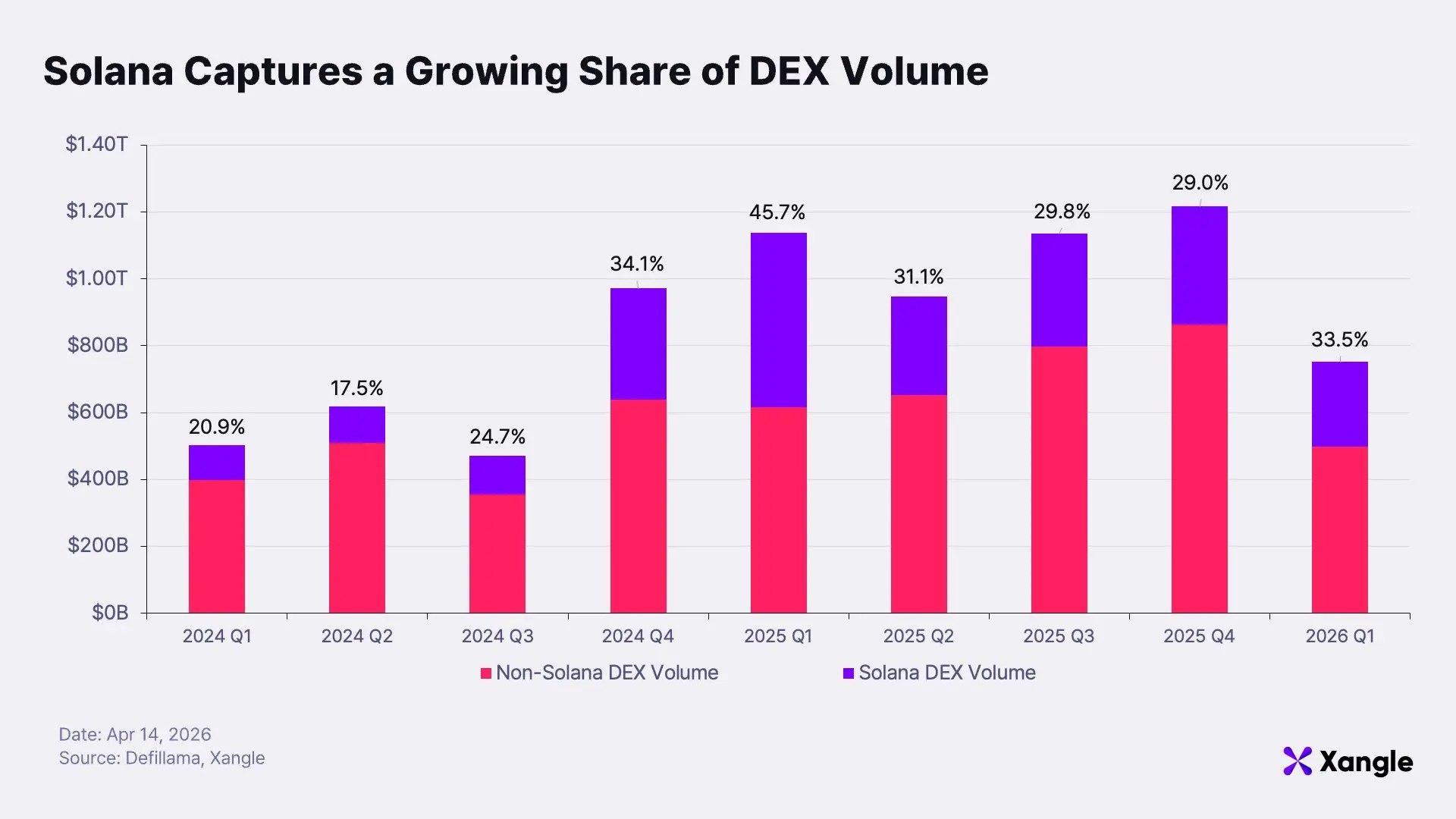
Odos currently operates across EVM-based chains. The center of gravity in DEX markets, however, is no longer confined to the EVM ecosystem. Solana accounted for 45.7% of DEX trading volume in Q1 2025, and continues to sustain approximately 30% share even after the decline of the memecoin cycle. On-chain trading infrastructure is evolving beyond a single ecosystem. For a DEX aggregator positioned as a cross-market liquidity layer, Solana is a necessary expansion frontier.
Odos’ core strength has been the ability to unify fragmented liquidity across multiple EVM chains into a single execution layer. Extending this model to Solana moves the protocol beyond a multi-chain aggregator toward cross-ecosystem infrastructure. As a routing layer, Odos already aggregates price and liquidity data across venues that individual DEXs cannot observe. Integrating Solana expands both the observable data set and the optimization surface for execution.
Solana introduces a fundamentally different technical environment. Differences span programming language, MEV structure, liquidity sources, swap mechanics, and token standards, making direct code portability from EVM systems infeasible. Odos’ accumulated experience—integrating over 1,000 liquidity sources across 15 EVM chains, operating a patented Smart Order Routing engine, and maintaining an API-first architecture—remains transferable at the design and operational level. Implementation changes, but system architecture and execution logic carry forward. Solana integration is currently in beta and approaching public release.
4. Odos Beyond Aggregation: The Next Layer
Interest in on-chain AI agents is accelerating across the crypto market, while the RWA (tokenized real-world assets) sector has expanded more than threefold over the past year, extending the scope of on-chain finance. Odos is positioning itself along these trends. The next phase centers on three directions: automating protocol operations, converting routing data into intelligence products, and expanding into execution infrastructure for RWA markets.
4-1. Dark Factory and Autonomous Operations
The concept of a “Dark Factory” originates from manufacturing, describing a fully automated facility that operates without human involvement. Odos applies this concept to protocol operations. The objective is not to eliminate the team, but to shift operational maintenance to AI agents, allowing the team to focus on product development instead of infrastructure upkeep.
The underlying issue is structural. Most crypto protocols rely on token treasuries to fund operations. During strong market conditions, treasuries remain sustainable. Prolonged downturns, however, lead to capital depletion, team contraction, and in some cases, halted development. Aggregators face the same constraint. Teams typically range from 30 to 80 people, with 70–85% of resources allocated to maintaining existing systems. As protocols scale, the number of supported chains, liquidity sources, and infrastructure components increases, driving operational complexity and cost.
Odos’ ability to pursue a Dark Factory model is rooted in its protocol design. First, the system is non-custodial. User assets are not held within the protocol, so even incorrect agent decisions result in inefficient routing rather than loss of funds. Second, Smart Order Routing is an optimization problem. Data ingestion, path calculation, and transaction construction follow a structured pipeline, making the system suitable for automation. Third, router and execution contracts are already deployed across 15 chains and operate in a maintenance-stable state, requiring minimal modification. Automation is implemented through five specialized AI agents.
- Sentinel: Monitors over 1,000 liquidity sources in real time and disables abnormal pools at the block level. Tasks previously handled manually are automated, improving both response time and operational efficiency.
- Integrator: Detects newly deployed AMM pools and classifies them against known architectures. Since 85–90% of new AMMs follow existing patterns, integration logic can be generated automatically. Only novel designs require human review.
- Operator: Manages cloud infrastructure and RPC nodes across 15 chains. Handles failover, capacity scaling, and alert filtering in real time.
- Advisor: Analyzes DAO proposals, models impact, and publishes results. Decision authority remains with the DAO.
- Treasurer: Executes routine protocol operations within DAO-approved parameters and guardrails.
These agents are introduced sequentially across four phases over an estimated 12-month timeline.
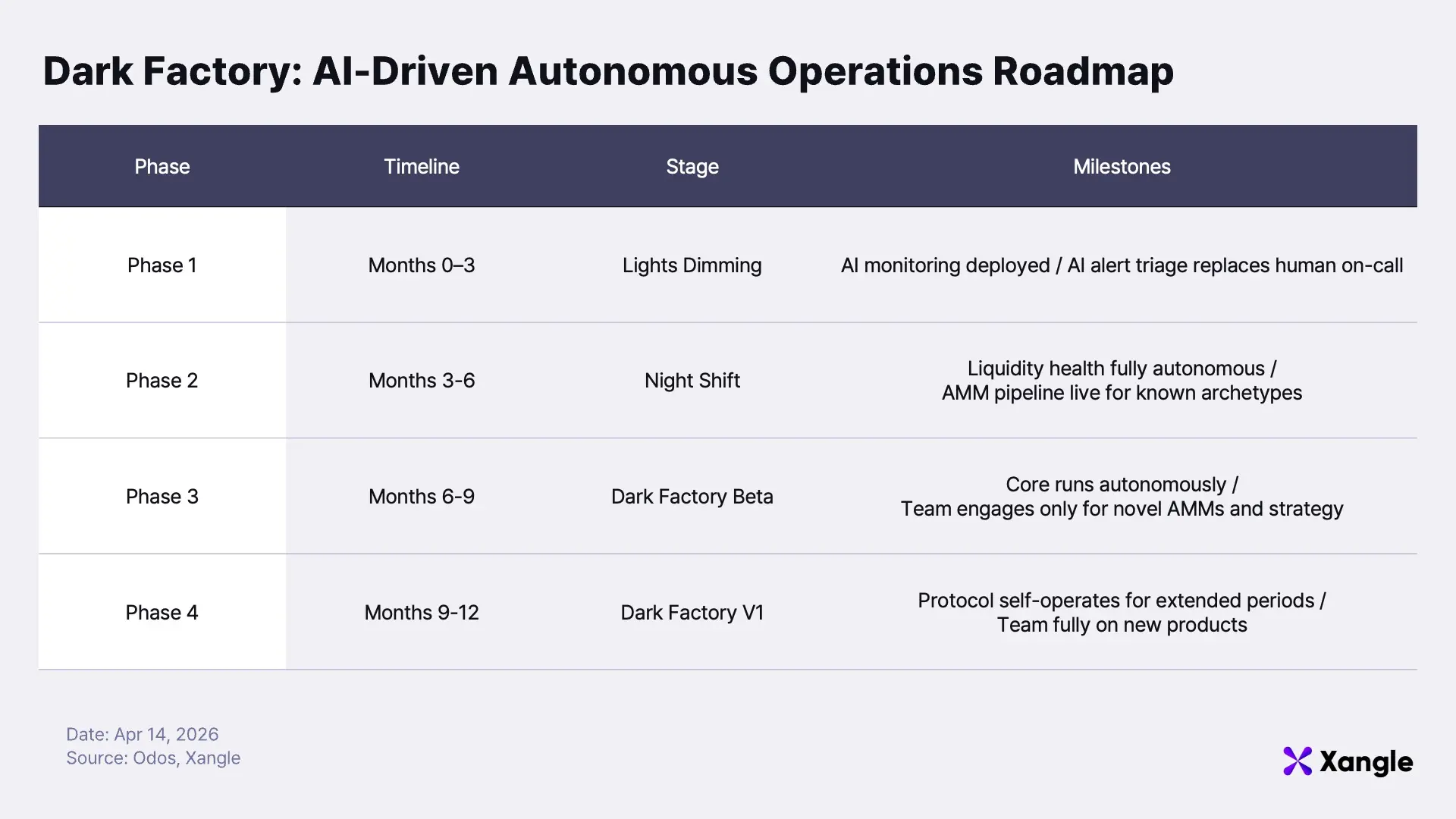
Full-scale autonomous protocol operations have not yet been realized in DeFi. Dark Factory represents an initial attempt in this direction. The objective is to move beyond treasury-dependent organizations toward self-sustaining infrastructure. The implication extends beyond Odos, pointing to a broader model for protocol sustainability across crypto. Dark Factory is not a terminal state. Data and operational capabilities generated through automation form the foundation for the next layer: the Intelligence Network.
4-2. Odos Intelligence Network and Invisible Data Advantage
Dark Factory addresses operational automation. The Intelligence Network focuses on monetizing data generated from Odos’ position as a routing layer. The objective is a shift from a pure aggregator to a data intelligence platform.
The foundation of this model is structural. Routers and individual exchanges operate with fundamentally different data visibility. A typical DEX observes only activity within its own pools—Uniswap sees Uniswap liquidity, Curve sees Curve liquidity. Odos operates at a different layer. Each quote request evaluates more than 1,000 liquidity sources simultaneously, capturing cross-venue information on depth, flow, and execution quality for a given trade size. This perspective cannot be replicated by any single DEX, regardless of scale. The limitation is structural, not competitive.
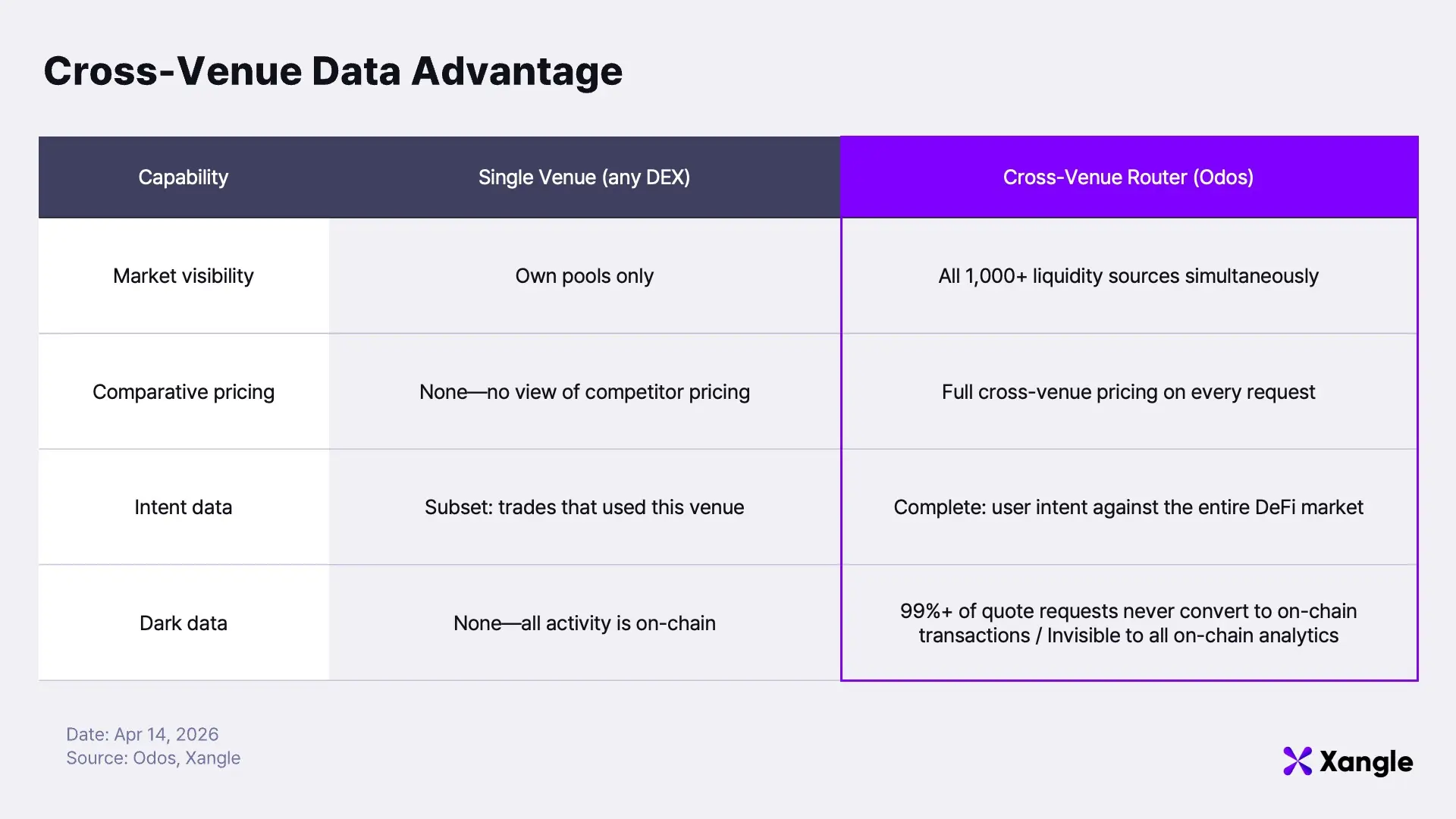
Two categories of data are particularly important. The first is dark data. Every quote request captures token pairs, direction, trade size, wallet, and chain. Less than 1% of these requests convert into on-chain transactions. More than 99% remain off-chain, representing users who checked prices but did not execute. This data is invisible to on-chain analytics platforms, which only track completed transactions. It reveals intent: which assets are being considered, what trade sizes are being evaluated, and how positioning decisions are forming. Unexecuted intent becomes a proxy for latent demand.
The second is the slippage curve. For each quote request, Odos calculates expected slippage across pools at different trade sizes—e.g., $100K versus $500K. Plotting these values produces a curve that directly reflects liquidity depth. Deep pools show flat curves even at large sizes, while pools losing liquidity exhibit sharp inflections at smaller thresholds. TVL is a static snapshot and can be artificially inflated; slippage curves are dynamic and observed in real time during routing evaluation. This makes them a leading indicator, capable of detecting liquidity outflows before they appear in TVL metrics.
These datasets expand the scope of extractable intelligence:
- Liquidity flow detection: Slippage curve shifts signal inflows and outflows ahead of TVL changes
- Pool health scoring: Combines price consistency, slippage stability, and execution rates, generated as a byproduct of the Dark Factory's Sentinel agent
- DEX competitiveness mapping: Extends pool-level analysis to venue-level execution quality
- Latent demand detection: Identifies assets with high quote activity but low execution rates, derived from dark data
- Market sentiment indicators: Measures directional sentiment based on token-to-stablecoin vs. stablecoin-to-token quote ratios
- Agent consensus signals: Identifies directional alignment across independent AI agent activity
The structure is analogous to Bloomberg in traditional finance. Bloomberg does not operate exchanges, yet builds a multi-billion-dollar business by aggregating and processing cross-venue data into actionable intelligence. Odos occupies a similar position within DeFi. In addition to cross-venue visibility, it holds proprietary datasets, dark data and slippage curves, that cannot be reproduced by standard on-chain analytics.
The rise of AI agents amplifies this advantage. Agents are emerging as active participants in DeFi, with two core infrastructure requirements: execution and intelligence. Execution is handled through routing and swapping; intelligence comes from market signals and liquidity data. Odos provides both within a single system. Increased agent activity generates more quote data, richer datasets improve intelligence quality, and improved intelligence attracts additional agent usage. Data compounds over time, creating a reinforcing feedback loop. Early accumulation becomes a structural advantage. Odos already holds years of historical quote data and routing evaluations across more than 1,000 liquidity sources, forming a moat that is difficult to replicate.
4-3. Positioning for Institutional and RWA Markets
The RWA market is growing rapidly. According to rwa.xyz, the total value of tokenized real-world assets increased from approximately $8.4 billion in April 2024 to approximately $29.2 billion in April 2025, more than tripling in just one year. With stablecoin supply also surpassing $280 billion, both protocol treasuries and institutional capital are searching for distributed yield opportunities on-chain. Assets are moving on-chain at a rapid pace, but the execution infrastructure required to actually trade those assets remains underdeveloped.
Trading RWAs introduces structural complexity. Unlike standard tokens, RWAs carry an underlying NAV, creating potential divergence between intrinsic value and market price. Capital moves on-chain continuously, while settlement of the underlying assets can take days or weeks. Execution paths are fragmented. Trades may occur through DEX liquidity, issuer mint/burn mechanisms, or OTC negotiation. Price, speed, and liquidity differ across each route, making real-time routing essential for optimal execution.
Odos extends its multi-chain routing capabilities into this environment through four infrastructure layers:
- NAV-aware Smart Order Routing: Integrates NAV as a routing variable, allowing simultaneous evaluation of DEX pools, issuer mint/burn paths, and OTC liquidity. Execution can be split across routes—for example, 60% via DEX liquidity and 40% via issuer pathways—to optimize cost.
- Vault integration: Curators such as Steakhouse and Gauntlet manage multi-billion-dollar portfolios across Morpho and Aave, with increasing RWA collateral exposure. These vaults require execution infrastructure for rebalancing and position management; Odos’ routing engine can serve as that layer.
- Leverage loop execution: RWAs used as collateral enable recursive strategies—collateral deposit, stablecoin borrowing, and reinvestment. Each cycle introduces swap activity, all of which routes through the execution engine.
- On-chain liquidity intelligence: RWA tokens often exhibit thin and time-sensitive liquidity. Monitoring slippage curves enables time-aware execution decisions, identifying optimal venues and timing.
The RWA market remains shaped by regulatory uncertainty, issuer design, and evolving liquidity structures. That uncertainty also reflects an open competitive landscape. Odos enters with established routing infrastructure, multi-chain integration, and proprietary liquidity intelligence built over time. As RWA markets mature and institutional capital moves on-chain, execution infrastructure becomes a critical layer. In that context, routing may serve a role comparable to order books in traditional markets.
5. Conclusion
Odos is systematically addressing the requirements for DEXs to function as mainstream trading infrastructure. Its patented Smart Order Routing consolidates fragmented liquidity into a single execution outcome. Limit orders and cross-chain swaps bring CEX-level trading functionality on-chain, while Protected Swaps enable large-scale execution without exposure to MEV. Market validation is reflected in revenue. Sustained revenue generation, even during periods of market contraction, indicates that Odos operates with clear product-market fit.
Most DEX aggregators compete at the pricing layer. When market conditions weaken, development slows and user activity often declines alongside incentives. Odos follows a different trajectory. Revenue remains stable during downturns, while new layers—Dark Factory, the Intelligence Network, and RWA infrastructure—are developed in parallel. The strategy extends beyond price optimization. It captures the full value of the routing layer, treating execution data not as a byproduct but as a core asset. Converting that data into intelligence and distributing it to AI agents introduces a structural direction not commonly pursued by other aggregators.
The differentiation is not limited to strategy. A patented closed-source routing algorithm and SOC 2 Type II certification position Odos as infrastructure that can meet institutional standards for reliability and integration. This trust layer becomes increasingly relevant as RWAs and institutional capital move on-chain. Execution, data, and trust converge at the routing layer. Odos is building across all three. The roadmap remains subject to execution risk, but the trajectory is clear: expansion continues beyond aggregation into infrastructure that underpins the next phase of on-chain markets.
Disclaimer
I confirm that I have read and understood the following: The information contained in this article is strictly the opinions of the author(s). This article was authored free from any form of coercion or undue influence. The content represents the author's own views and does not represent the official position or opinions of CrossAngle. This article is intended for informational purposes only and should not be construed as investment advice or solicitation. Unless otherwise specified, all users are solely responsible and liable for their own decisions about investments, investment strategies, or the use of products or services. Investment decisions should be made based on the user’s personal investment objectives, circumstances, and financial situation. Please consult a professional financial advisor for more information and guidance. Past returns or projections do not guarantee future results. This article was written at the request of Odos. All content in this article was written independently by the author(s), and neither CrossAngle nor Odos had any editorial control or influence over the content. The author(s) may hold the cryptocurrencies mentioned in this article at the time of writing.
Xangle or its affiliated partners own all copyrights of the written or otherwise produced materials and content provided on the platform. Any illegal reproduction of such content, including, but not limited to, unauthorized editing, copying, reprinting, or redistribution will result in immediate legal actions without prior notice.
![[Xangle RWA Series] DeFi - DEX](https://resource.xangle.io/files/content/EA4C1A723876A93DDBB60B1694F2F92E_1787015213570.webp)