[Xangle RWA Series] DeFi : Lending

Table of Contents
1. The Purpose of Tokenization Is Utilization
2. What Sets On-Chain Lending Apart
3. Protocols That Take Tokenized Assets as Collateral
4. Closing Remarks: The Line Between Traditional Finance and DeFi Is Blurring
1. The Purpose of Tokenization Is Utilization
Tokenization converts real-world assets into tokens that can be traded on a blockchain. Treasuries, funds, equities, real estate, and commodities are all being tokenized. Yet turning an asset into a token is not the objective in itself. Tokenization is a means of putting assets to work, and once an asset becomes a token, it can be handled in ways that were not previously possible.
In traditional finance, raising funds against assets already held requires several institutions. A custodian verifies the asset, contracts are reviewed, and clearing and settlement take days. On a blockchain, this process runs automatically through code known as a smart contract. Depositing an asset, disbursing funds, and liquidating collateral all proceed according to preset rules, without human judgment or institutional intermediation. This is where the case for tokenization lies. Once an asset becomes a token, the entire sequence from deposit through settlement to liquidation can be handled in code, and putting the asset to work, not merely buying and selling it, takes place inside automated finance.
A market in which smart contracts perform financial functions without intermediaries is DeFi (Decentralized Finance). Within DeFi, there are broadly two ways to put an asset to work. The first is exchanging or trading it against other assets, which covers decentralized exchanges (DEX) and derivatives such as perpetual futures. The second is raising funds against assets already held, and this report addresses the latter.
Tokenization on its own is not enough. If an asset is tokenized and sold but the investor holding the token can do nothing with it, the advantage of tokenization disappears. Raising funds against existing holdings is routine in traditional finance as well, and repo (repurchase agreement) is the standard example. An institution holding Treasuries pledges them to a counterparty as collateral rather than selling them, draws funds, and repays with interest on a set date, retaining its exposure while securing only the liquidity it needs. In the United States alone, daily volumes reach trillions of dollars, making it the short-term funding market of the financial system.
DeFi offers two ways to raise funds against an asset. The first is lending, in which the borrower draws stablecoins that other participants have deposited. The second is a CDP (Collateralized Debt Position), in which the protocol issues new stablecoins once an asset is posted. The two differ in whether a counterparty supplies the funds, and that difference also determines what caps the amount available. In both cases the asset is returned upon repayment, so exposure is retained.
Lending is the larger of the two. Of approximately $76 billion deposited across DeFi protocols, around $40 billion sits in lending. The collateral flowing in, however, remains predominantly crypto, and the volume of real-world assets such as tokenized Treasuries or funds serving as collateral is still a small fraction of the total. Of roughly $32 billion in real-world assets tokenized on-chain, about $3.8 billion is deposited or used as collateral in DeFi, a mere 12%.
2. What Sets On-Chain Lending Apart
2-1. Lending Protocols That Take Crypto as Collateral
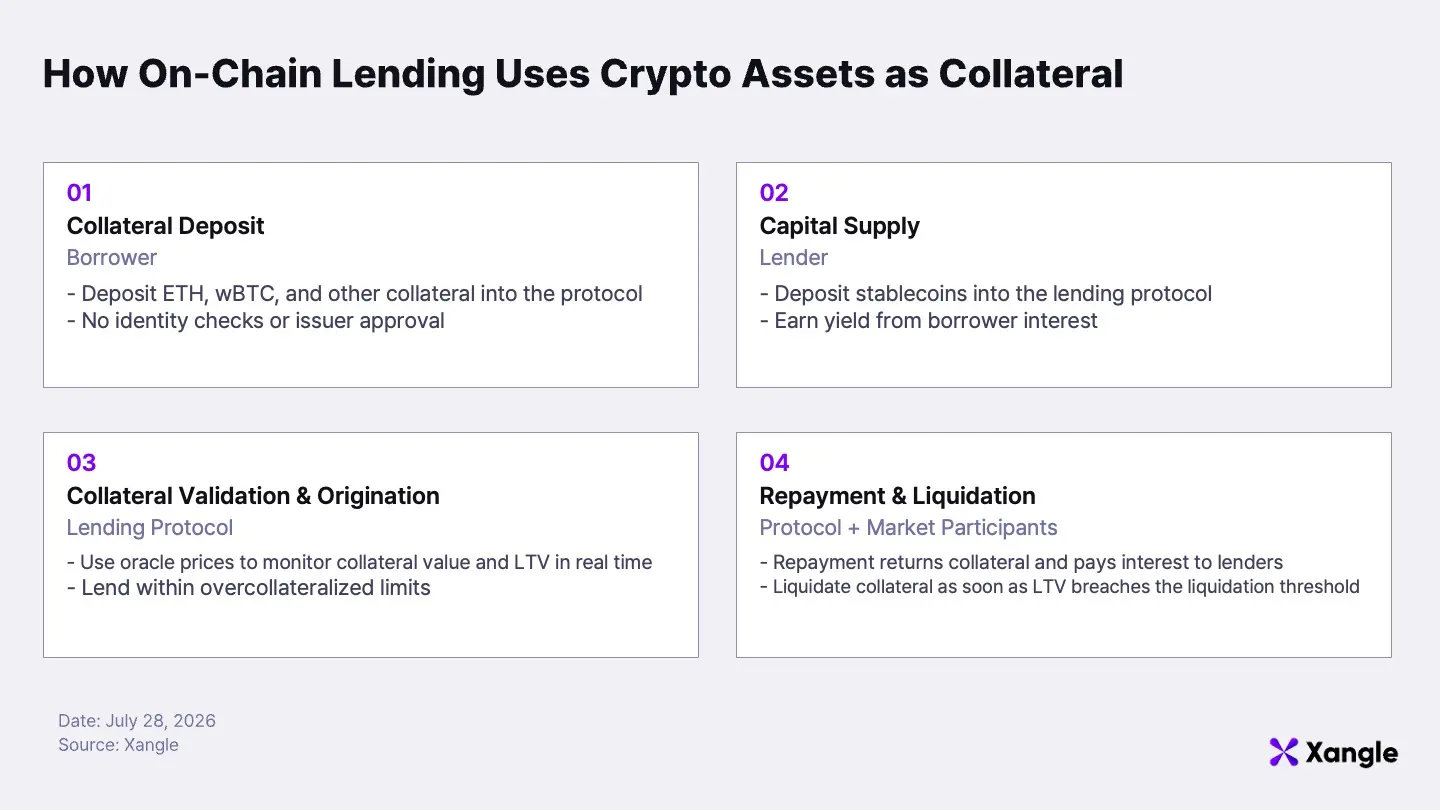
Whether it is a bank loan or a repo, funding in traditional finance takes place with full knowledge of who the counterparty is. On-chain, there is no counterparty to verify. The party raising funds is a wallet address with no disclosed identity, anyone can open a wallet instantly, and there is little recourse if repayment never comes. With no creditworthiness to assess, on-chain lending is overcollateralized, meaning the value of the collateral exceeds the amount borrowed.
If the collateral cannot be assessed, how much of it counts has to be set in advance. For every crypto asset it accepts as collateral, a protocol sets two ratios. The loan-to-value (LTV) ratio determines how much can be borrowed, and the liquidation threshold determines when the collateral is sold. With an LTV of 80% and a liquidation threshold of 85%, $100 worth of Ethereum posted as collateral supports up to $80 in borrowing, and if the price of Ethereum falls until the debt reaches 85% of the collateral value, the collateral is liquidated automatically. Judging both ratios requires a collateral price, so a mechanism for relaying prices from multiple markets is designated alongside them. This is called an oracle.
The unit created by designating a collateral asset and a borrowable asset, along with the collateral terms that allow lending to take place, is called a market, and creating one is called opening a market. Some protocols hold multiple collateral assets in a single market, while others open a separate market for each combination of collateral asset and borrowable asset.
Once a market has been opened, users supplying funds deposit the borrowable asset and liquidity builds up, while users seeking funds post collateral and borrow against that liquidity. The interest the borrower pays becomes the return for the user who supplied the funds, and the collateral is released upon repayment. Once the collateral value reaches the liquidation threshold, a liquidator takes over the collateral and repays the debt on the borrower's behalf.
Because smart contracts handle this process, it runs automatically around the clock. There is no review or approval step for depositing, borrowing, repaying, or liquidating, and liquidation executes the moment the collateral price hits the threshold. What takes days in traditional finance completes in a single transaction on-chain.
Interest rates and maturities, on the other hand, behave differently from traditional finance. The rate moves in real time with how much of the deposited capital has been borrowed. As the borrowed share rises, the rate climbs, drawing in deposits and discouraging borrowing; as the share falls, the rate declines. A fixed formula derives the rate from the borrowed share, and that formula is called the interest rate model. No maturity is set either, since depositors can withdraw at any time and borrowers can repay at any time.
The ceilings on both ratios vary by asset and by lending protocol. The test is whether selling the collateral would recover an amount equal to the debt. Prices can fall further between the moment liquidation conditions are met and the moment the collateral is actually sold, and the volume being sold can itself push the market price down. The margin between collateral value and debt absorbs that loss, so the more volatile the asset and the thinner its liquidity, the lower the ceiling is set to preserve stability.
2-2. What Changes When Real-World Assets Serve as Collateral
When crypto serves as collateral, the only things a protocol has to judge are volatility and liquidity. Any crypto asset can be held by anyone, prices form the same way on exchanges, and liquidation sells into the same venues. Reflect those two factors in the LTV ratio and the liquidation threshold, and collateral management follows an identical procedure.
Tokenized assets are different. Some can only be held by accredited investors, and both the method of pricing and the time required to convert to cash vary from asset to asset. A protocol has to assess each asset individually, and both the assessment procedure and the way its conclusions feed into collateral terms differ across protocols. As a result, the same tokenized asset may serve as collateral on one protocol and not on another. We have classified protocols along the three criteria below.
1) Lending and CDP
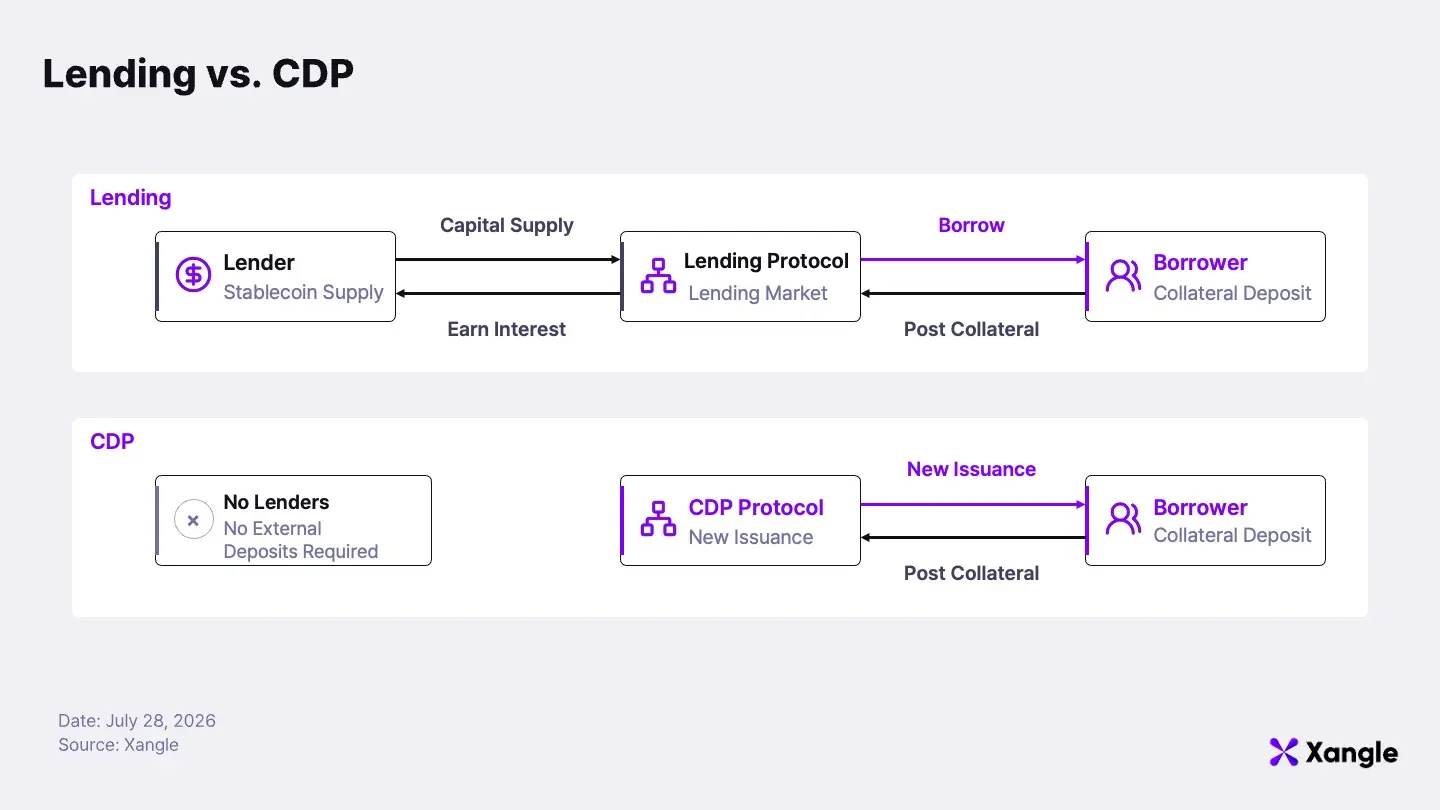
Lending is a structure in which the borrower draws funds that other participants have deposited. Users supplying funds deposit stablecoins, borrowers post collateral and draw on those funds, and the interest borrowers pay becomes the depositors' return. The amount available is bounded by the funds on deposit, so even ample collateral will not produce a loan if no deposits remain. Crypto assets draw on markets where deposits have already accumulated, whereas a real-world asset has to be approved as collateral and then attract depositors willing to supply funds against it.
A CDP resembles lending in that collateral is posted to raise funds and recovered upon repayment. What differs is that the funds raised are stablecoins the protocol issues anew. Posting collateral mints stablecoins in proportion to it, and repayment burns them and releases the collateral. With no counterparty supplying funds, the borrowing limit is set by collateral value alone. The issued stablecoin must circulate in the market, however, for the funds raised to be genuinely usable.
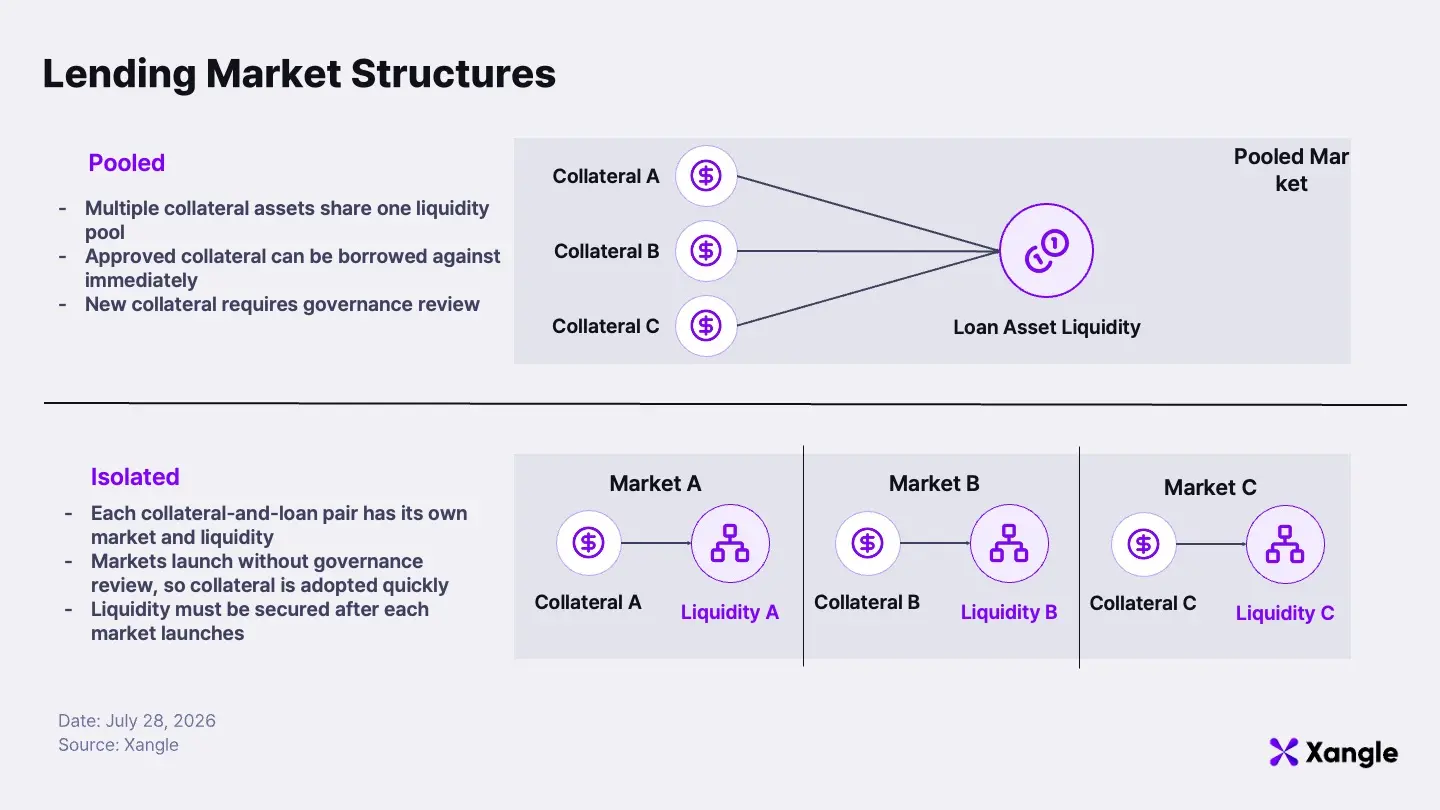
2) Pooled Markets and Isolated Markets
The LTV ratio and the liquidation threshold are calibrated to whether selling the collateral would recover an amount equal to the debt. For real-world assets, the route to cash differs by asset. Tokenized equities and gold can be sold on exchanges, but equities lose any reference price once the underlying market closes, and gold requires a minimum quantity and investor verification for physical withdrawal. Treasury funds go through a redemption request to the issuer, and products divide between those that settle immediately and those that take a day or more. When a tokenized asset serves as collateral, then, the time and cost of redemption join price volatility as inputs to the ratios.
Because a separate set of ratios has to be determined for each asset, the question becomes who determines them, and lending protocols divide into pooled markets and isolated markets according to how they run their deposits.
A pooled market holds multiple collateral assets within a single market. The LTV ratio and liquidation threshold are set individually for each asset, but deposits are shared, so whichever asset is posted, the funds come from the same pool. Some pooled markets apply restrictions to permissioned assets alone and leave everything else open. Because deposits gather in one place, the amount available to borrow is large, and several collateral assets can be posted together and managed as a single position. A newly added collateral asset also draws on deposits that have already accumulated rather than raising funds of its own, so borrowing becomes possible from the moment the asset is approved.
The trade-off is that a shortfall on one collateral asset passes through as a loss shared by all depositors, so the terms are set at the protocol level rather than by individual participants. The common arrangement has a risk management firm propose per-asset ratios and caps for governance to review and confirm, and that review is why approval as collateral takes time.
An isolated market opens a separate market for each combination of collateral asset and borrowable asset. The same collateral paired with a different borrowable asset constitutes a distinct market with its own deposits, so any shortfall stays contained within that market. Opening a market is open to anyone, and the terms are set by whoever opens it at the moment of creation and fixed from then on. Opening a market and setting its terms is sometimes done by the issuer or a partner directly, and sometimes handled by an outside firm that specializes in risk management. Such a firm is called a curator, and it also runs the vaults that supply funds to markets. Skipping governance review means assets are adopted as collateral quickly, but once a market is open, the liquidity to fund it has to be secured separately.
Most funds reach individual markets through curators. The arrangement resembles entrusting money to a fund instead of picking bonds yourself. A curator opens a vault that gathers capital, and users deposit stablecoins into that vault rather than selecting individual markets themselves. The curator reviews each market's collateral asset, liquidation threshold, and price-relaying oracle to assess its risk and yield, then sets an allocation cap and distributes the pooled capital across markets accordingly. Interest paid by borrowers returns to the vault and is distributed to depositors, with the curator taking a portion as a fee.
3) Permissionless and Permissioned
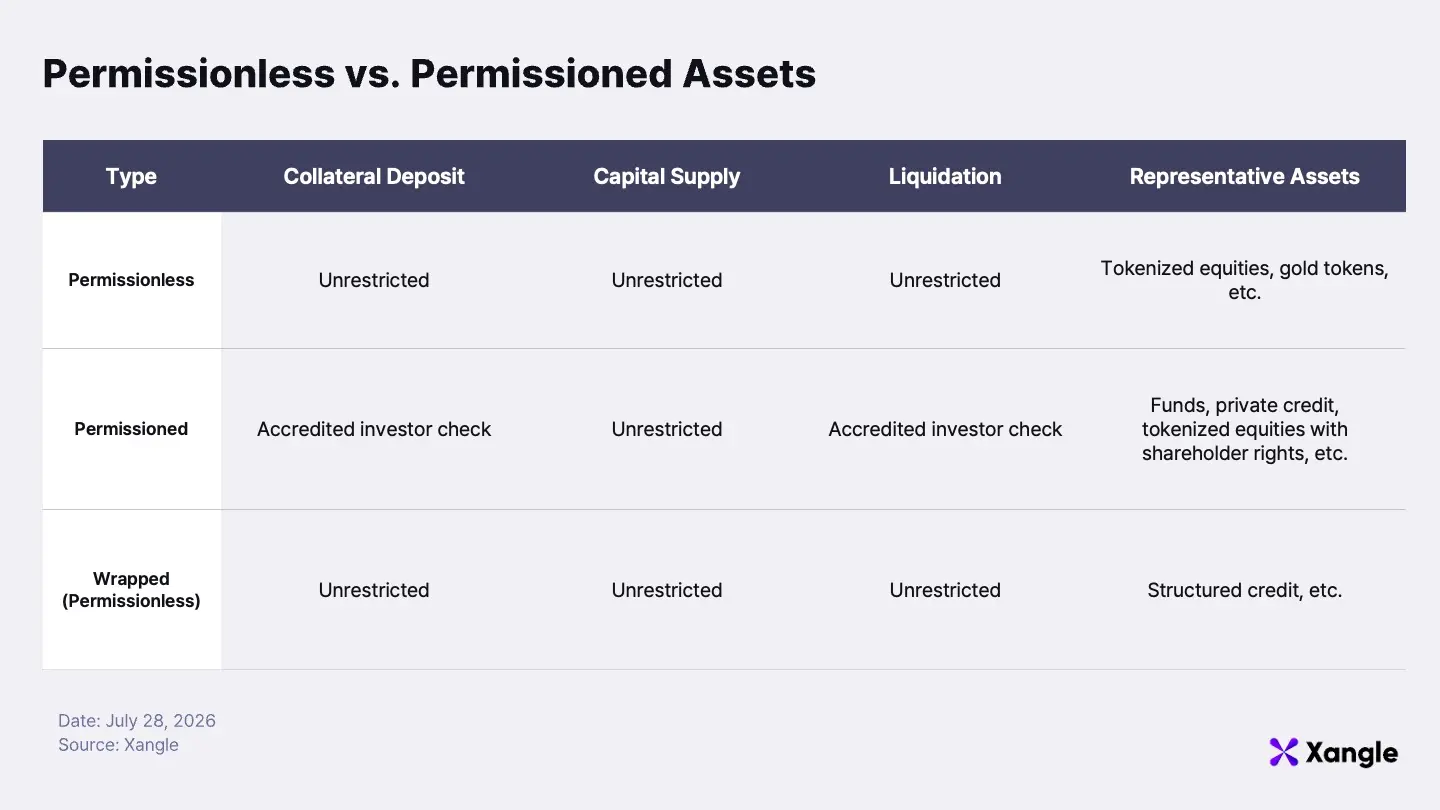
Tokenized assets divide in two according to who is eligible to hold them. Permissionless assets can be held and transferred by anyone. Tokenized equities backed by underlying shares held at a custodian and gold tokens representing ownership of physical gold are the representative cases, and because anyone can post them as collateral and acquire them through liquidation, they are used exactly as ordinary crypto assets are.
Permissioned assets can only be held by verified accredited investors. Certain funds, private credit, and some tokenized equities carrying legal shareholder status fall into this category. Because the asset transfers both when collateral is posted and when it is acquired through liquidation, the eligibility of the receiving wallet is checked. Verification is handled by the issuer or a tokenization infrastructure provider, which screens identity and eligibility and permits only verified investors to hold and transfer the asset. Lending protocols that accept permissioned assets therefore require accredited investor status from the investor posting collateral and from the liquidator seeking to acquire it.
A permissioned asset can also serve as collateral on a permissionless protocol if it is wrapped into a token carrying no transfer restriction. The approach is to establish an entity that holds the permissioned token and to issue a wrapped token representing a claim on that holding. Either the party that tokenized the asset issues a separate permissionless version of the same strategy, or a special purpose vehicle holds the permissioned token and its equity interest is issued as a token. The party issuing the wrapped token must itself be a wallet approved by the issuer, so an investor cannot construct this arrangement independently to circumvent the transfer restriction.
3. Protocols That Take Tokenized Assets as Collateral
A tokenized real-world asset can be put to work by connecting it as collateral to a DeFi protocol already in operation. The machinery for accepting collateral, disbursing funds, and handling liquidation is already running, so the issuer does not have to build it. We examine the protocols currently accepting real-world assets as collateral, divided into lending and CDP.
3-1. Lending: Posting Collateral to Borrow Funds
1) Aave Horizon: A Permissioned Lending Protocol
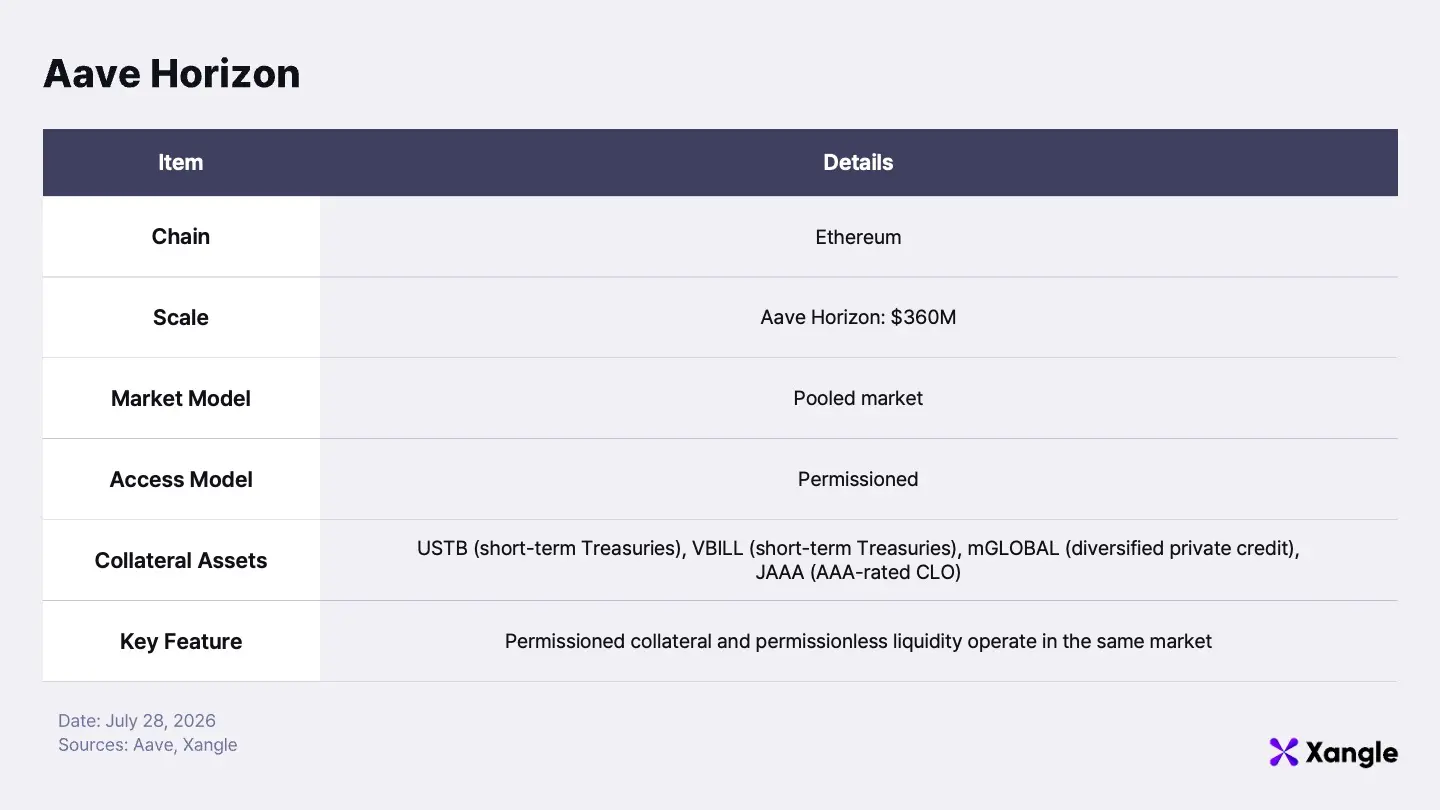
Aave is the largest lending protocol, accounting for roughly half of all DeFi lending deposits, with $14.3 billion in assets deposited. It has long handled permissionless crypto assets as collateral across multiple chains, and in August 2025 it opened Horizon as a separate instance on Ethereum in order to bring real-world assets in as collateral. Horizon holds approximately $360 million.
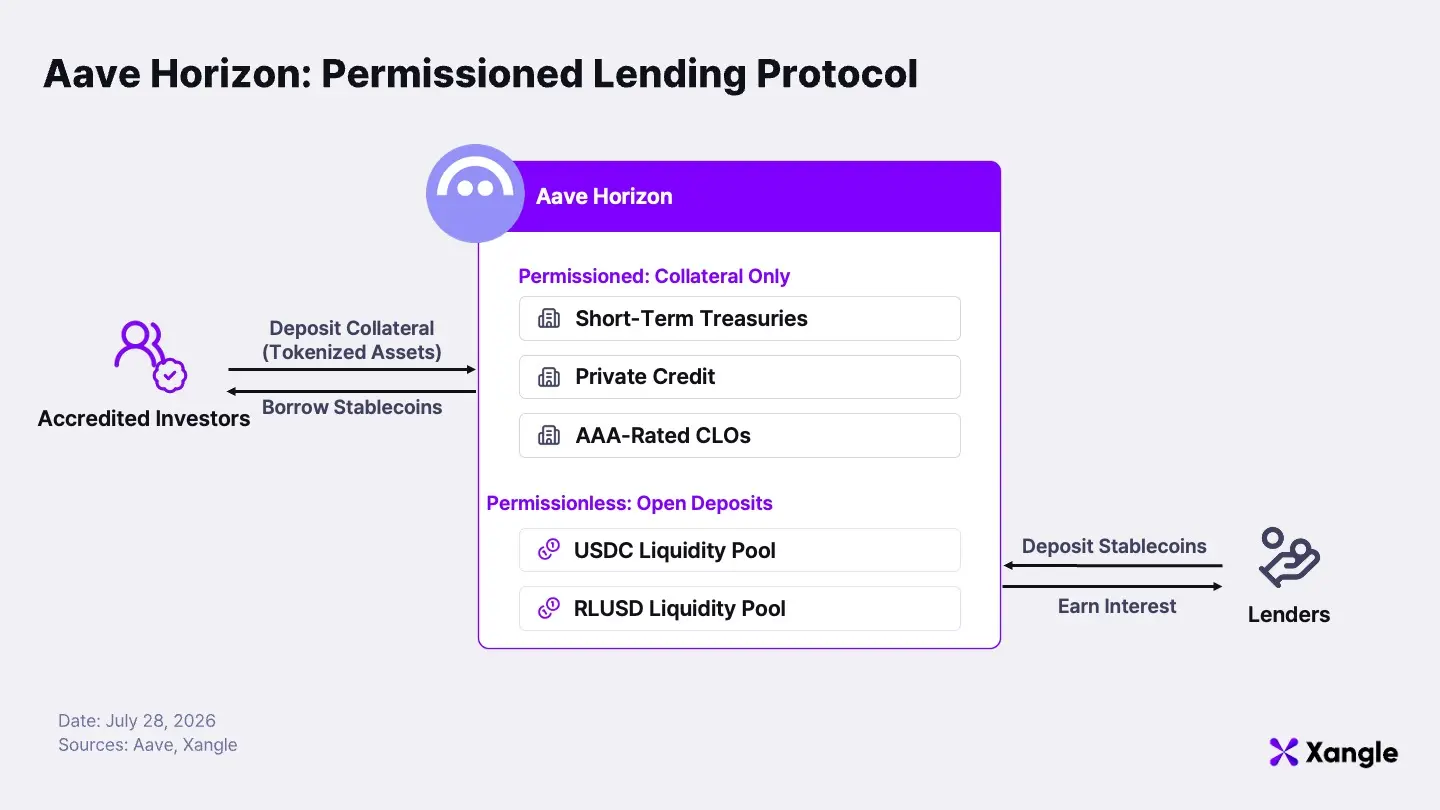
Horizon is a market for borrowing stablecoins against tokenized real-world assets. Users seeking to post collateral must be accredited investors approved by the asset's issuer, while users supplying stablecoins face no restriction. Permissioned collateral and permissionless liquidity operate within the same market, which places screening on the collateral side while drawing funds from the broader permissionless market. It is a pooled market in which multiple collateral assets share a single market, and when a new collateral asset is added, a risk management firm proposes the LTV ratio and cap for governance to review and confirm.
Three categories of asset can serve as collateral: Treasuries, private credit, and structured credit. Ranking first by collateral volume is USTB, a short-duration US Treasury fund managed by Invesco and tokenized by Superstate, followed by mGLOBAL, a private credit product composed of fintech receivables and small business loans. In structured credit, JAAA, an AAA-rated collateralized loan obligation fund for which Janus Henderson runs the investment strategy and Centrifuge handles tokenization, is used as collateral.
2) Morpho: An Isolated-Market Lending Protocol
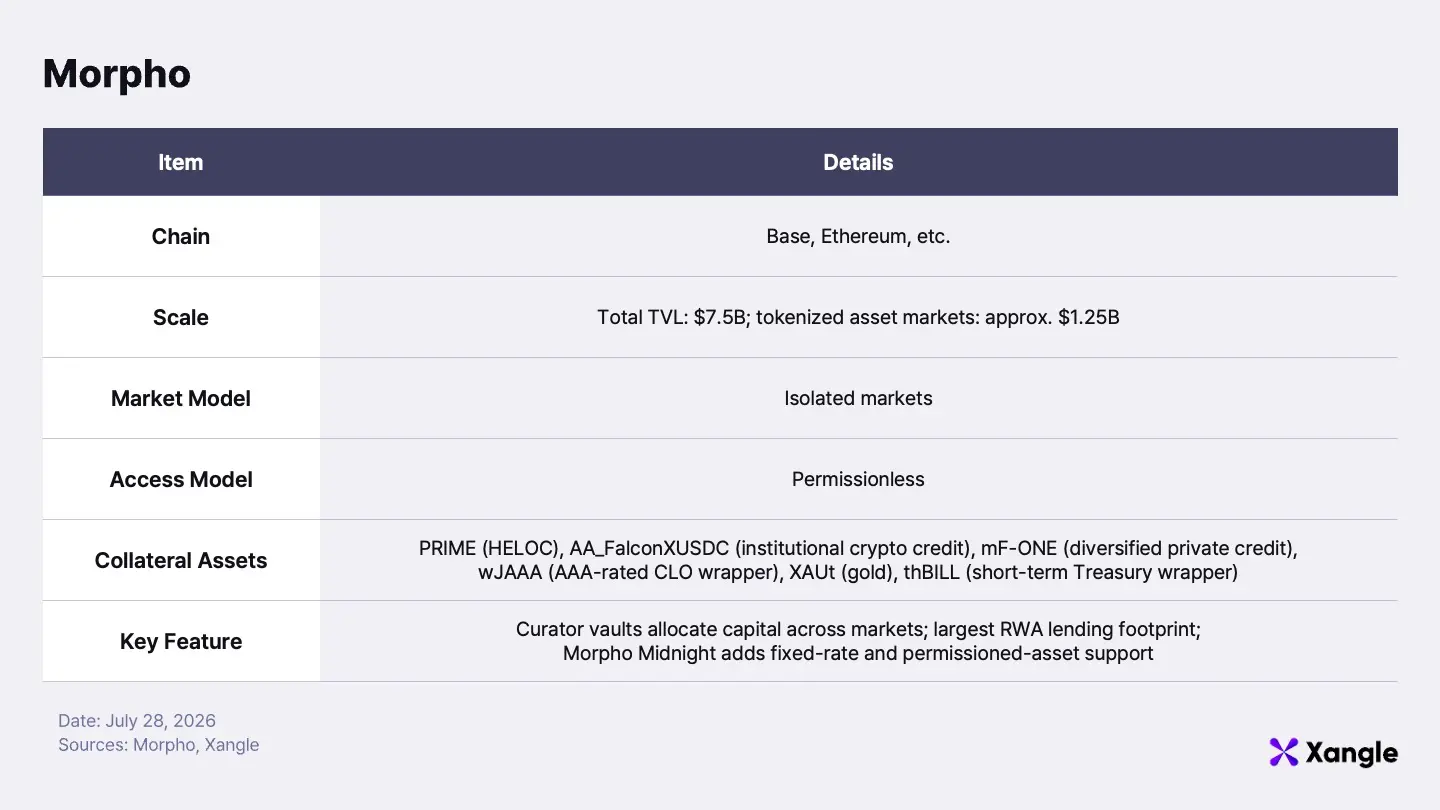
Morpho is a lending protocol operating across multiple chains and ranks second in size after Aave. It holds $7.5 billion in deposited assets, of which markets for tokenized assets account for approximately $1.25 billion.
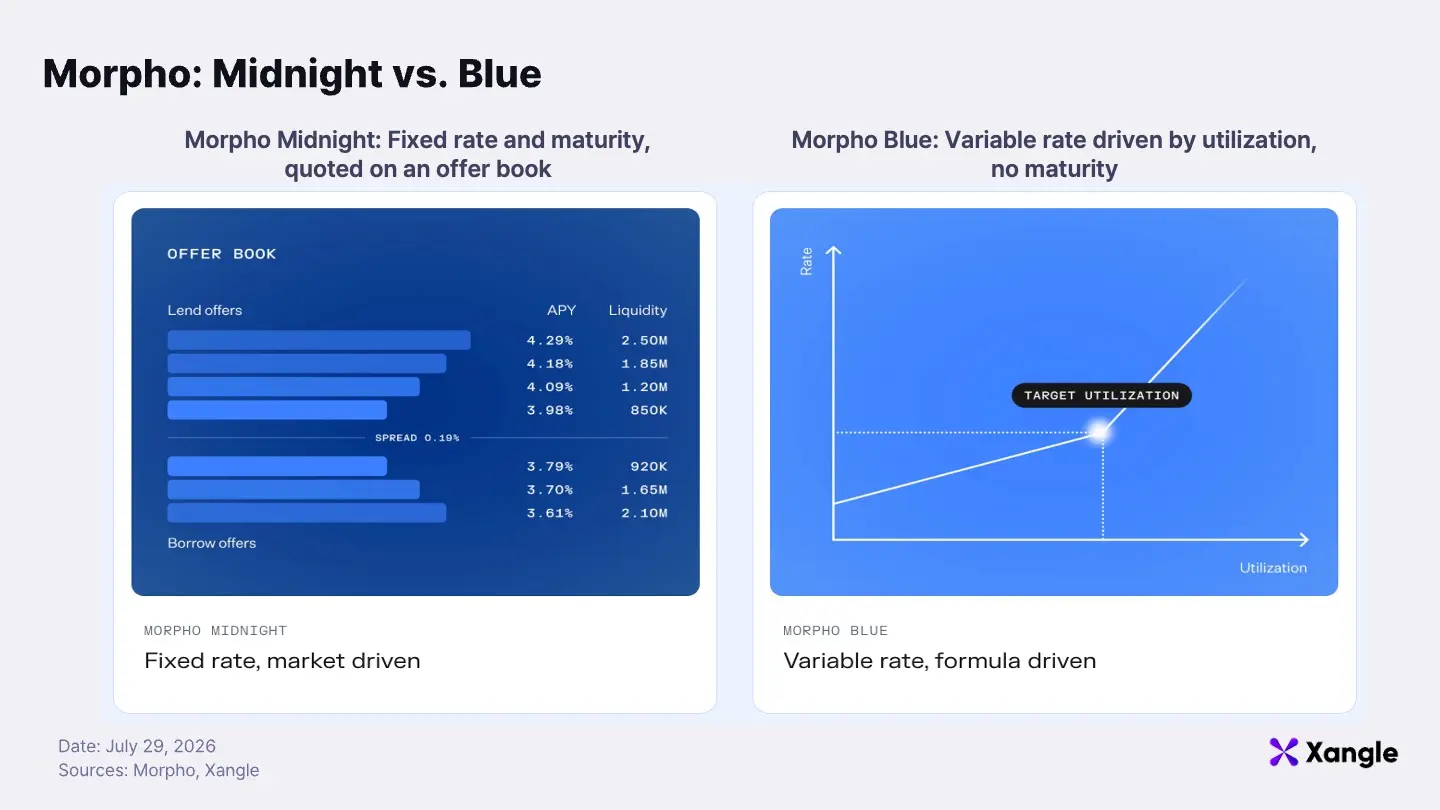
Morpho Blue is an isolated structure that opens a market by pairing a collateral asset with a borrowable asset. Adding collateral requires no governance approval, so new assets are adopted as collateral quickly. A market consists of five components: the collateral asset, the borrowable asset, the oracle relaying the collateral price, the liquidation threshold, and the interest rate model. The same collateral paired with a different borrowable asset constitutes a distinct market, and PRIME, a tokenized set of home equity lines of credit, backs four separate markets distinguished by borrowable asset.
Morpho Midnight, unveiled in July 2026, is a fixed-maturity lending protocol that Morpho built separately. Lending takes place through trading units that settle at maturity at a discounted price, and since that discount becomes the interest rate, both rate and maturity are fixed at execution. Maturity can be set against a specific calendar date, and positions can be increased or reduced before maturity by trading the units. Markets can also apply a permissioned structure that restricts investor eligibility at the market level.
The assets available as collateral are concentrated in credit. In mortgage lending, PRIME, a tokenized set of US home equity lines of credit originated by Figure, ranks first by collateral volume. In private credit, mF-ONE, composed of fintech receivables, small business loans, and real estate secured credit, is used. In structured credit, wJAAA, a transferable form of Janus Henderson's AAA-rated collateralized loan obligation fund JAAA, can also serve as collateral.
3) Kamino: Solana's Largest Lending Protocol
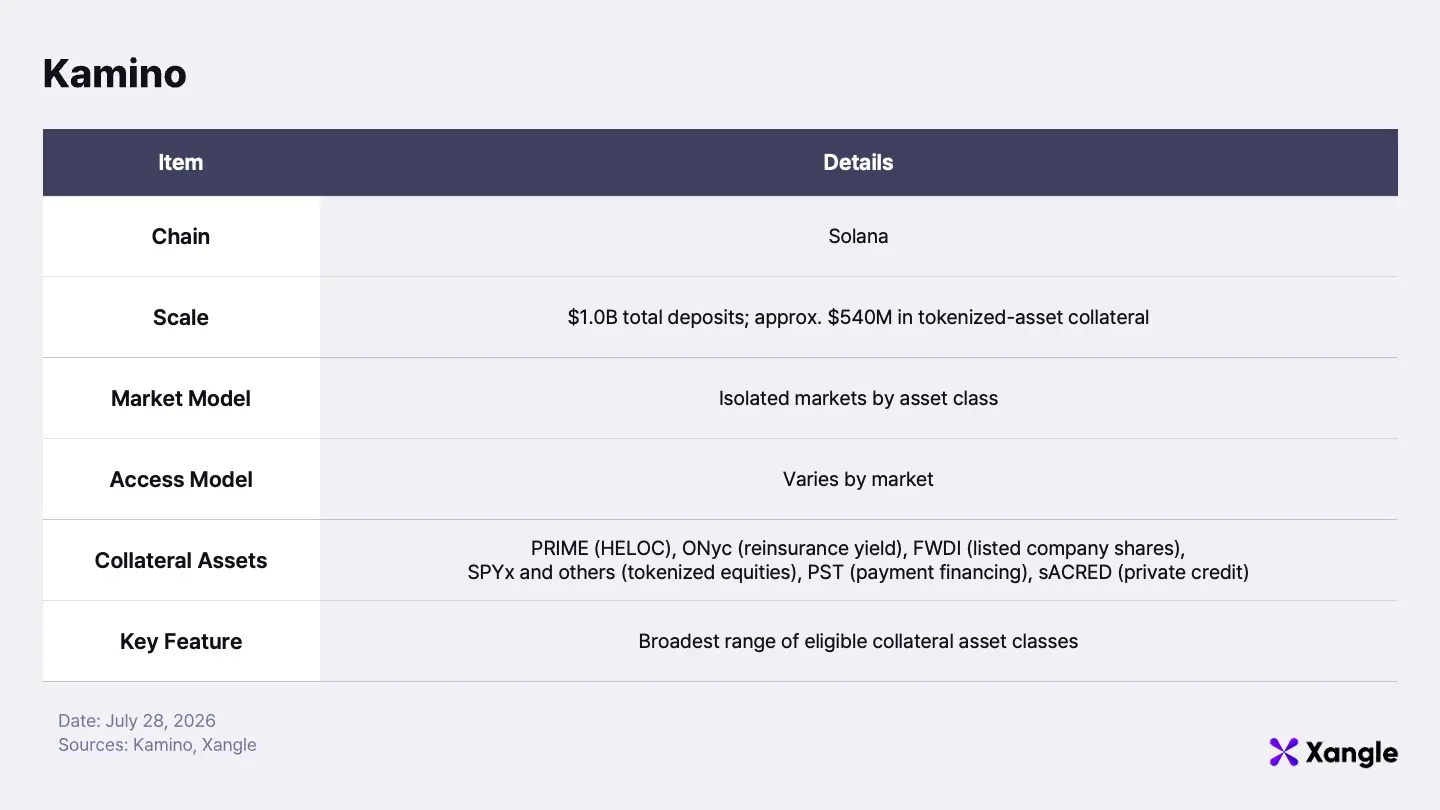
Kamino is the largest lending protocol on Solana, with $1 billion in deposited assets. Tokenized assets posted as collateral come to approximately $540 million, second only to Morpho.
Kamino runs pooled and isolated structures side by side. Adding a new collateral asset to the pooled market or changing its terms goes through a governance vote, while isolated markets are opened directly by curators applying their own terms. In a curator-opened market, the curator sets the LTV ratio, liquidation threshold, interest rate, and oracle directly, and can also specify a wallet allowlist or accredited investor verification. Most of Kamino's tokenized asset markets are opened as isolated markets.
The assets available as collateral span six asset classes, the widest range of any protocol here. In mortgage lending, PRIME, a tokenized set of US home equity lines of credit originated by Figure, ranks first by collateral volume, followed by ONyc, which is based on reinsurance underwriting income. Equities of listed companies, tokenized equities, payment financing, and private credit can also serve as collateral.
4) Jupiter Lend: A Lending Protocol for Tokenized Equities
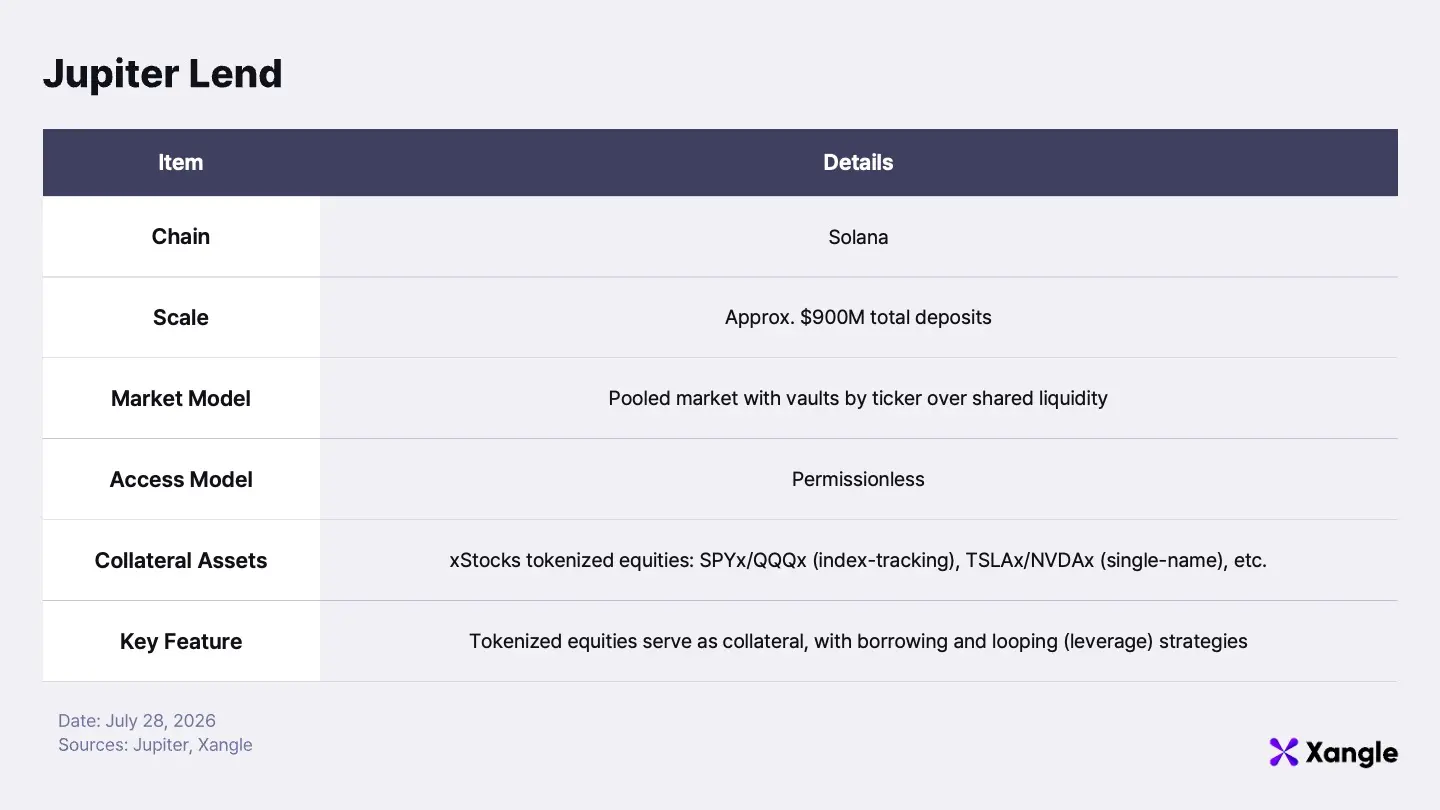
Jupiter Lend is a lending protocol launched in August 2025 by Jupiter, Solana's largest trading platform, and holds approximately $900 million in deposited assets. It added tokenized equities as collateral in April 2026, and that collateral now comes to around $20 million.
Jupiter Lend is a pooled market that manages liquidity in one place. A program managing all liquidity as a single pool records deposits and borrowings and enforces debt ceilings and withdrawal limits, and vaults where collateral is posted and funds are borrowed operate on top of it. Each vault sets its own LTV ratio and liquidation threshold, but the funds borrowed come from the shared liquidity pool. At present only permissionless tokenized assets can serve as collateral.
The asset available as collateral is xStocks, a tokenized equity product. Holders have no voting rights or entitlement to dividends, but dividends are reflected through an increase in token balance, so posting the token as collateral preserves exposure to the share price while dividends continue to accrue. Jupiter Lend builds on this characteristic to offer borrowing alongside looping, or leverage, strategies. A separate vault is opened for each ticker, the LTV ceiling is 75%, and looping, in which borrowed funds repurchase the same ticker, can expand exposure up to 3.8 times.
5) Loopscale: A Lending Protocol Where Rate and Maturity Are Specified
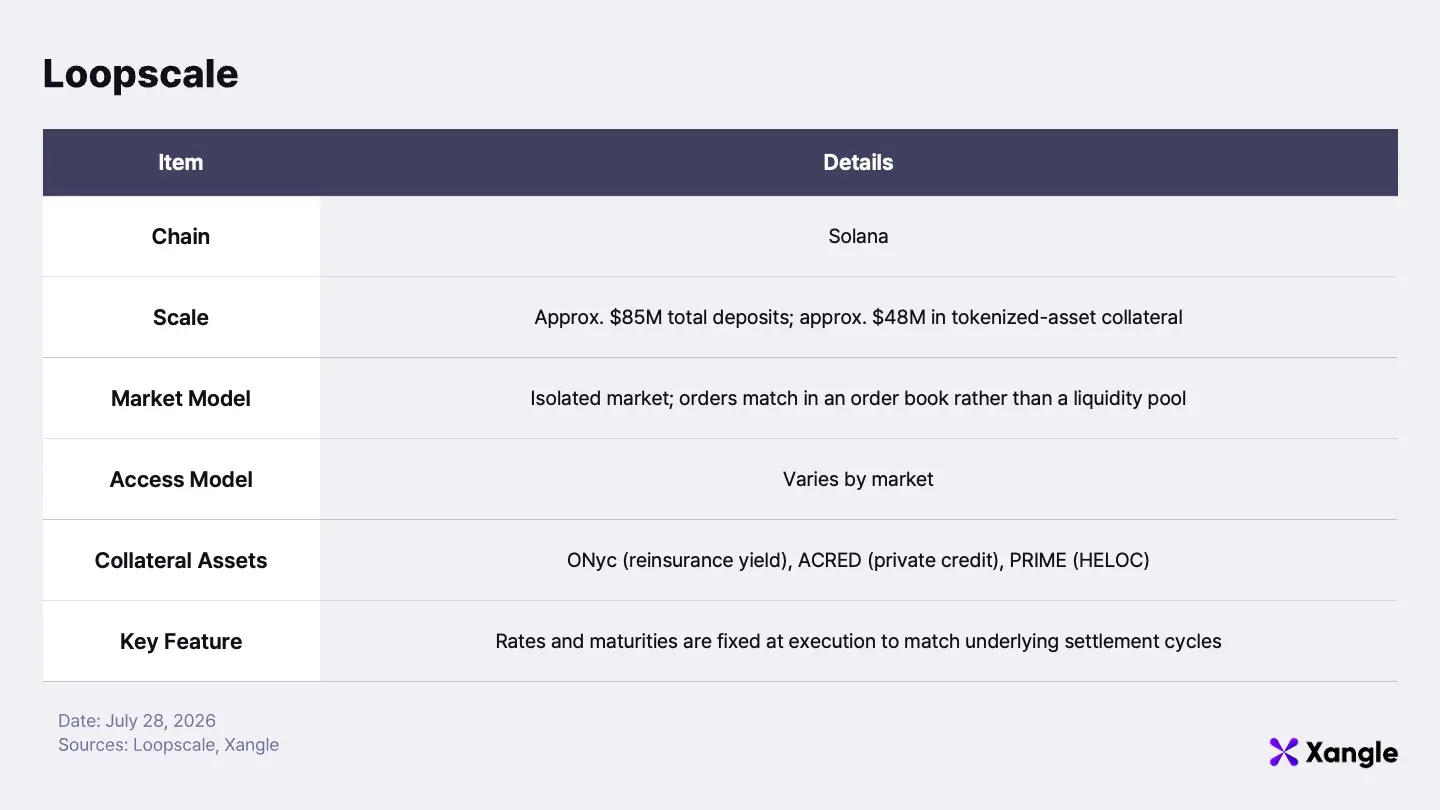
Loopscale is an order-book-based lending protocol on Solana with approximately $85 million in deposited assets. Tokenized assets posted as collateral come to around $48 million, more than half the total.
Rather than maintaining a liquidity pool, Loopscale is an isolated market that matches orders directly on an order book. Users supplying funds submit orders to the book specifying which assets they will accept as collateral along with the rate and the term, and borrowers execute against orders that meet their conditions. Rate and maturity are fixed at execution, making this a fixed-rate structure in which borrowing costs do not move with the share of deposits that has been borrowed. Verified assets are opened as isolated markets, and once demand forms on both the supply and borrowing sides, a market opens without a governance vote. Permissioning is applied differently by asset. ACRED, a permissioned asset that only accredited investors may hold, is one example: only users who have cleared the issuer-administered accredited investor check can post it as collateral and borrow against it.
For users who prefer not to submit orders themselves, curator-managed vaults are also available. A vault allocates deposits across multiple fixed-rate markets, with the curator determining which assets to accept as collateral along with LTV ratios, rate curves, and allocation by term. Idle capital sitting in a vault can be allocated to variable-rate markets to earn a return until an order is filled.
The assets available as collateral are concentrated in credit with long settlement cycles. ONyc, based on reinsurance underwriting income, ranks first by collateral volume, with ACRED, a tokenized version of Apollo's diversified credit fund, serving in private credit and PRIME in mortgage lending. Loopscale's design premise is that a tokenized asset only becomes genuinely usable once it can function as collateral, and that fixed rates, fixed maturities, and asset-specific pricing are what create those conditions.
3-2. Protocols That Issue Stablecoins Against Posted Collateral
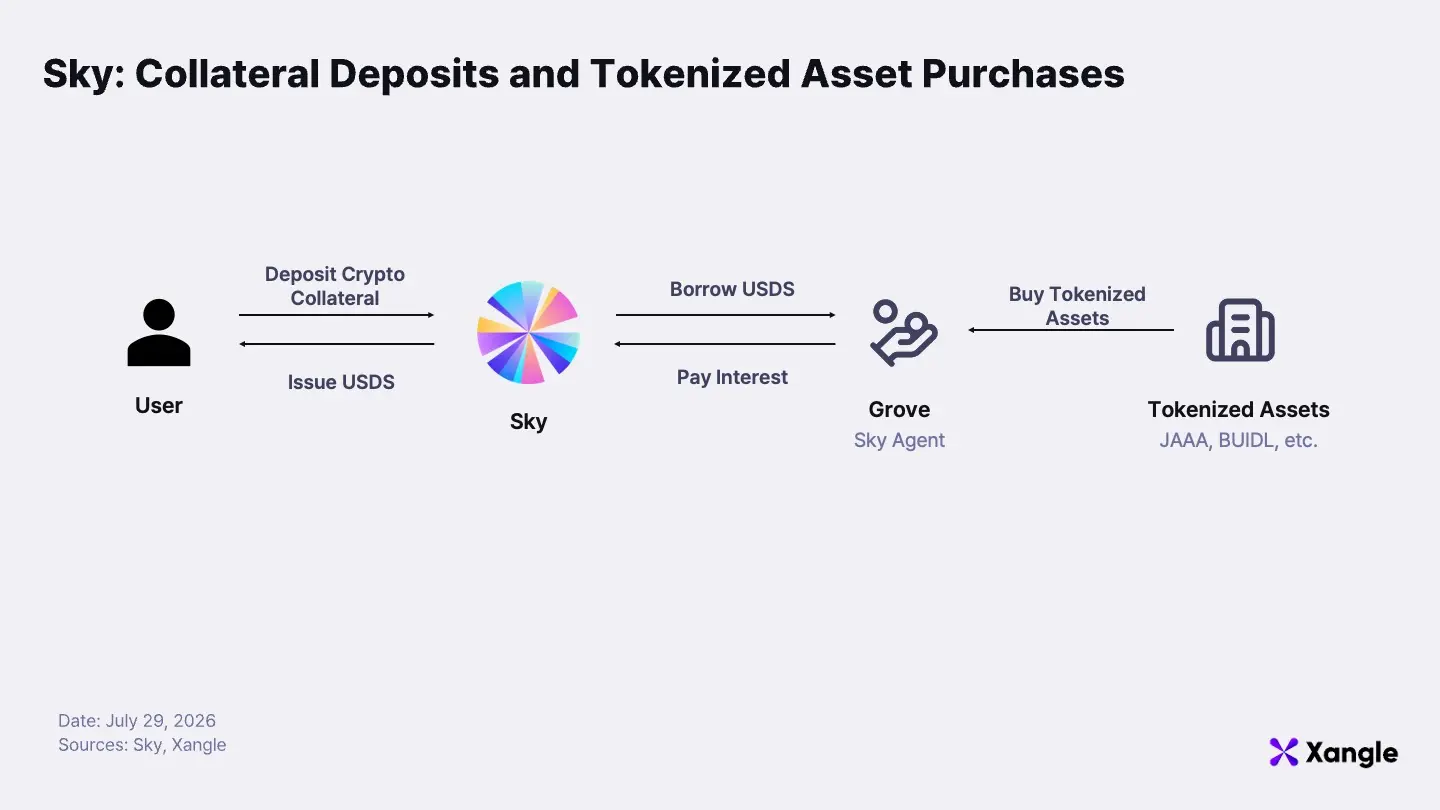
What distinguishes this category from the previous one is the absence of a counterparty supplying funds. Posting collateral causes the protocol to issue new stablecoins, and repayment burns them. The borrowing limit is not constrained by how much other participants have deposited, but the issued stablecoin must circulate in the market for the funds raised to be genuinely usable. Tokenized assets enter in two forms: allocators approved by the protocol borrow stablecoins and purchase the assets, or users post them as collateral directly.
Sky: A CDP Where Allocators Purchase Tokenized Assets
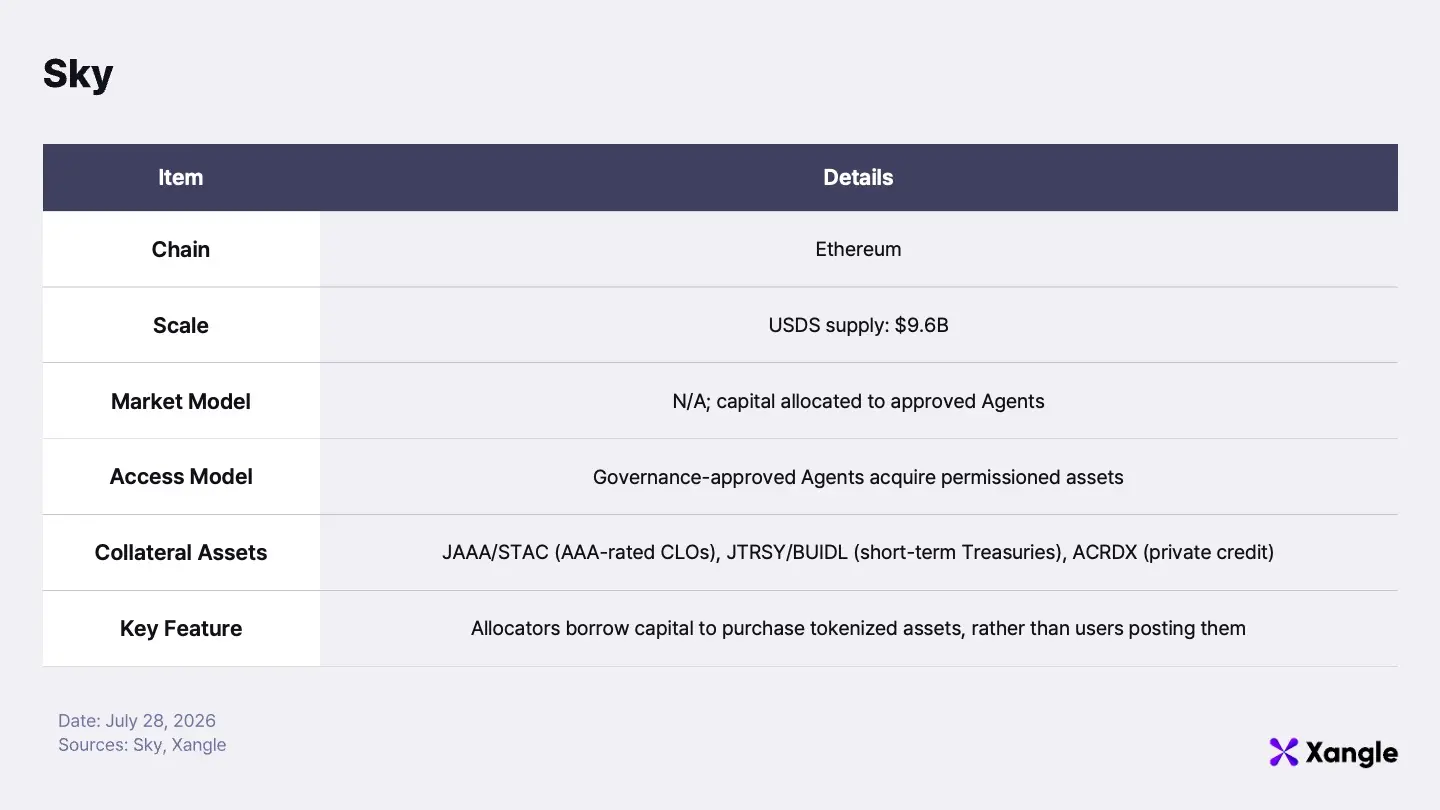
Sky was the first protocol to implement the structure of issuing stablecoins against posted collateral. It issues USDS, whose circulating supply stands at $9.6 billion.
When a user posts collateral, USDS is issued in proportion to it, and repayment burns the USDS and releases the collateral. With no counterparty supplying funds, the interest rate is likewise set by governance token holders rather than by market demand. The largest source of protocol revenue is fees generated as Agents allocate capital into credit strategies, followed by stability fees paid by borrowers and returns on reserve assets.
How Sky handles tokenized assets, however, differs fundamentally from other protocols. The collateral users post consists of crypto assets in the Ethereum and Bitcoin families; tokenized assets are not accepted as collateral. Instead, independent capital allocators approved by governance borrow USDS and purchase tokenized assets, and the assets so purchased are recorded as protocol collateral. Rather than posting collateral first and then drawing funds, in other words, the assets bought with borrowed funds become the collateral. These allocators are called Agents, and governance approves each Agent and sets its borrowing limit. The Agent responsible for credit is Grove, which allocates on-chain capital into regulated credit products with a focus on collateralized loan obligations.
The tokenized assets brought in center on Treasuries and structured credit. In Treasuries, Janus Henderson's JTRSY and BlackRock's BUIDL are included. In structured credit, the largest position is JAAA, an AAA-rated collateralized loan obligation fund that Grove brought on at a scale of $1 billion at launch, followed by STAC, a CLO fund of the same rating tokenized by Securitize. ACRDX, a tokenized version of Apollo's diversified credit fund, is also included.
Falcon Finance: A CDP Protocol That Accepts Tokenized Assets as Collateral Directly
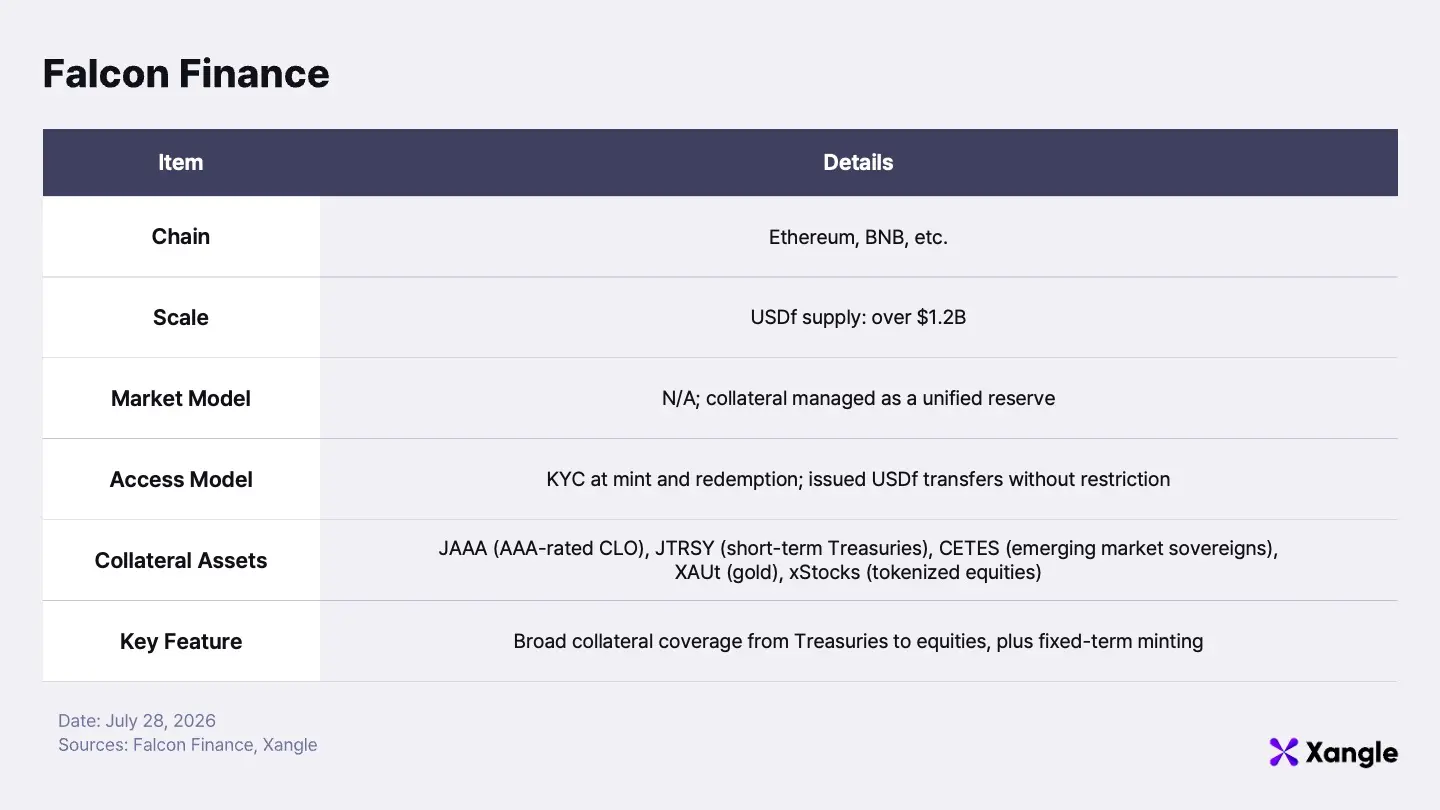
Falcon Finance is a protocol issuing the stablecoin USDf on Ethereum and BNB Chain, with USDf circulating supply at $1.2 billion.
When a user posts collateral, USDf is issued, and the design is overcollateralized so that collateral value always exceeds the USDf outstanding. The overcollateralization ratio is calibrated per asset, reflecting volatility, liquidity, price impact on sale, and historical price behavior. USDf itself is permissionless and can be used freely in the market, but minting or redeeming it directly requires identity verification, and redemption carries a seven-day waiting period.
A distinguishing feature is that Falcon offers two minting methods. The standard method posts collateral that can be withdrawn at any time, while the other commits collateral for a fixed term. In the latter, the amount minted is calculated conservatively, reflecting the commitment period, strike price multiplier, and capital efficiency level, and liquidation procedures apply if prices move sharply during the term.
The assets available as collateral span Treasuries, structured credit, commodities, and equities. In structured credit, JAAA, a tokenized AAA-rated collateralized loan obligation fund, is included, and in Treasuries, JTRSY, a tokenized short-duration US Treasury fund. Emerging market sovereigns are represented by CETES, tokenized Mexican government bonds, and commodities by Tether Gold, tokenized physical gold. The tokenized equity product xStocks can also serve as collateral.
4. Closing Remarks: The Line Between Traditional Finance and DeFi Is Blurring
DeFi began as a permissionless market open to anyone. It does not screen counterparties, negotiate rates, or set maturities. Because deposits, borrowings, and liquidations execute automatically in code around the clock, there was never a counterparty to verify or a desk to negotiate with. This is the opposite of how traditional finance works. As the tokenization of traditional assets has advanced, however, that line has begun to blur.
DeFi is moving toward traditional finance first. Aave Horizon opened a separate market so that permissioned tokenized assets following private placement structures could also be accepted as collateral, and Morpho Midnight and Loopscale introduced fixed-rate, fixed-maturity structures. When traditional finance lends against collateral, it confirms that the counterparty is eligible and sets maturity and rate in advance, with repo as the standard example. In the course of accepting tokenized assets as collateral, on-chain collateralized lending has begun to take on a similar shape.
Movement from traditional finance into DeFi has been especially pronounced this year. In February, BlackRock enabled its tokenized Treasury fund BUIDL to trade on the decentralized exchange Uniswap and disclosed a strategic investment in the Uniswap ecosystem. That same month, Apollo Global Management signed an agreement allowing it to purchase up to 90 million MORPHO tokens, or 9% of total supply, over 48 months. In June, Morpho raised $175 million at a $2 billion valuation from investors including Paradigm, a16z crypto, Apollo, and VanEck, and in July, Standard Chartered opened research coverage on the tokens of three protocols: Uniswap, Aave, and Morpho. The ways in which traditional finance engages with DeFi are widening.
Where the two movements meet is that DeFi is becoming financial infrastructure institutions can actually use. Protocols are adopting the conditions institutions require: permissioned collateral, accredited investor verification, fixed rates and fixed maturities. Traditional financial institutions, for their part, are folding DeFi into their business through investment, product integration, and research coverage. Taken together, it amounts to an effort to reconstitute traditional finance's investor verification and risk management on-chain, by way of putting tokenized assets to work in DeFi.
Tokenization is only now moving past the issuance stage. Which assets to issue and in what structure has begun to settle, while what an issued asset can actually do on-chain remains far less clear. The protocols examined in this report are each working out that answer in their own way. Which approach becomes the standard is still unknown, but it is clear that multiple routes for tokenized assets to serve as collateral are opening up.
Disclaimer
I confirm that I have read and understood the following: The information contained in this article is strictly the opinions of the author(s). This article was authored free from any form of coercion or undue influence. The content represents the author's own views and does not represent the official position or opinions of CrossAngle. This article is intended for informational purposes only and should not be construed as investment advice or solicitation. Unless otherwise specified, all users are solely responsible and liable for their own decisions about investments, investment strategies, or the use of products or services. Investment decisions should be made based on the user’s personal investment objectives, circumstances, and financial situation. Please consult a professional financial advisor for more information and guidance. Past returns or projections do not guarantee future results.
Xangle or its affiliated partners own all copyrights of the written or otherwise produced materials and content provided on the platform. Any illegal reproduction of such content, including, but not limited to, unauthorized editing, copying, reprinting, or redistribution will result in immediate legal actions without prior notice.
![[Xangle Valuation Series] ④ Lending Protocol](https://resource.xangle.io/content/thumbnails/711/content_711_thumbnail_adb18197.webp)