Stable: Reinforcing the Stablecoin Infrastructure Layer with the v1.2.0 Mainnet Upgrade

Table of Contents
1. Why Stablecoins Matter — And Why Stable
2. Stable v1.2.0 Mainnet Upgrade — From Architecture to Production
3. Stable’s Architecture in an Institutional Context
4. Ecosystem Expansion and Strategic Partnerships
5. Outlook
1. Why Stablecoins Matter — And Why Stable
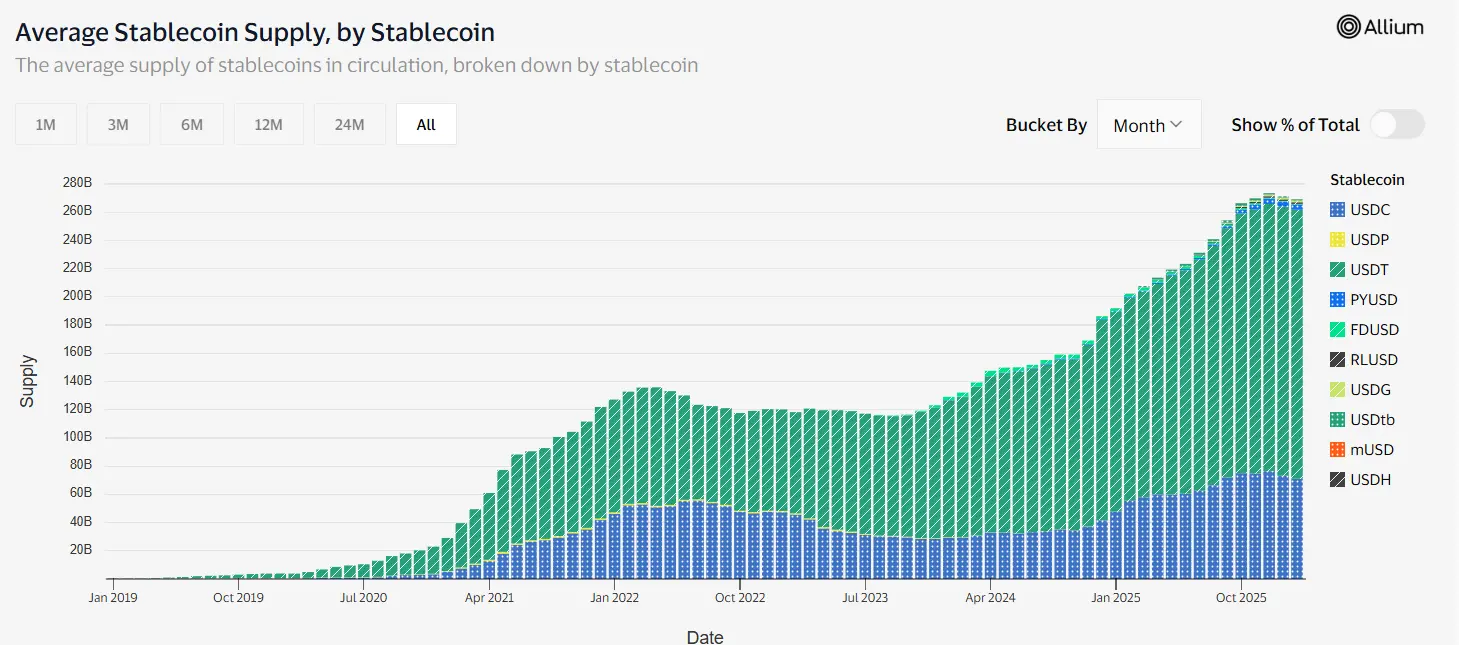
The environment surrounding stablecoins has undergone a structural shift since 2025. Stablecoins historically functioned as the base currency of on-chain transactions and as a liquidity medium. A different interpretation is now emerging as the United States begins incorporating stablecoins directly into the institutional financial framework and redefining them as strategic assets. Policymakers increasingly treat stablecoins not as a loosely governed crypto experiment but as a regulatable dollar infrastructure. Legislative initiatives are therefore moving toward formalizing issuance rules, reserve requirements, and supervisory oversight.
Within this broader transition, stablecoins are gradually being perceived as more than simple on-chain payment instruments. A growing narrative frames them as potential infrastructure capable of reinforcing U.S. financial dominance. Such a role would require far more than liquidity provision alone. Stablecoins would need to operate as part of the payment and settlement system itself. Digital dollars used for trading or remittances represent only the first step; the longer-term objective is a settlement rail capable of complementing, and in some cases replacing, existing card networks and interbank clearing systems.
Recent developments provide a clear directional signal. Visa has expanded stablecoin settlement activity in the United States, and by late November 2025 roughly $3.5 billion in transactions were being processed on a monthly run-rate basis using stablecoins. The figure rose to approximately $4.5 billion by January 2026. Despite this growth, the scale remains modest when compared with Visa’s $14.2 trillion annual payment volume. A substantial gap therefore remains before stablecoins could meaningfully replace existing payment infrastructure.
The underlying constraint lies not in issuance scale, which is easily observed through headline figures, but in the infrastructure required for stablecoins to function as real financial rails. Several conditions must be satisfied for stablecoins to operate as payment and settlement infrastructure: predictable cost structures; low operational complexity; institution-grade observability; and a controllable user experience. Systems where execution costs fluctuate sharply, where users must manage separate gas tokens, or where settlement states are difficult to track programmatically introduce friction for institutional adoption. Expansion of stablecoins will therefore depend less on token supply and more on the chain architecture and operational layers that support them.
An important question follows from this discussion: how far has Stable, previously introduced by Xangle as a payment-oriented infrastructure chain, progressed toward that objective? Stable upgraded its network to Stable v1.2.0 mainnet on March 4. The release represents more than a simple feature addition; it is a structural update designed to strengthen the network’s overall production readiness. The next step is to examine what has actually changed.
2. Stable v1.2.0 Mainnet Upgrade — From Architecture to Production
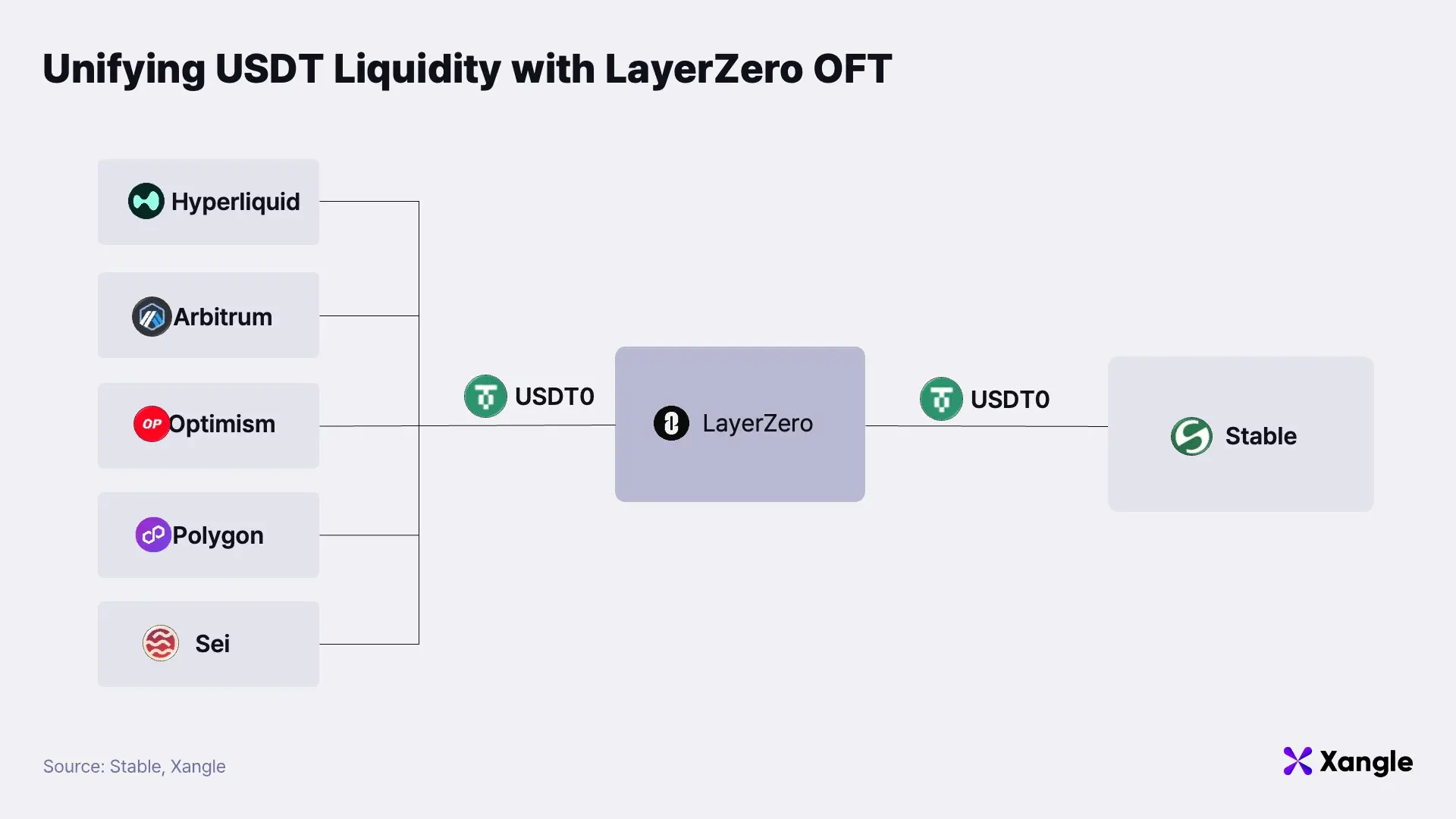
The most significant change is the transition of USDT0 into the native gas token. USDT0 is an omnichain stablecoin launched in January 2025 through a collaboration between Tether and LayerZero. Designed to move freely across chains at a native level without separate wrapping or complex bridging, the asset enables seamless cross-chain mobility. Such architecture prevents issues like liquidity fragmentation or cross-chain incompatibility; as a result, the system operates in a manner that is considerably easier for institutions to adopt and use.
Earlier versions of Stable used gUSDT, a separately wrapped form of USDT, alongside USDT0. Beginning with v1.2.0, USDT0 becomes the official gas asset of the network, fully replacing gUSDT. The transition eliminates the need to wrap or unwrap gas assets, allowing both transaction fees and settlement flows to occur within a single stablecoin denomination. Wallet UX becomes significantly simpler, while integrated payment architecture and accounting processes benefit from greater clarity. From the perspective of institutions and payment infrastructure providers, aligning the gas unit with the settlement asset represents a crucial step toward reducing operational complexity.
Staking functionality also received important upgrades. Version 1.2.0 introduces explicit on-chain signaling of the unstaking process through a dedicated event. Applications and indexers can therefore confirm the completion of the staking lifecycle directly from on-chain data, without relying on additional estimation logic. Operational automation and risk management benefit directly from this improvement. The enhancement primarily strengthens observability at the chain level; integration into the Stable Hub UI will be supported in a separate release.
The release also resolves Solidity compatibility issues related to Stable tokens. Several function-level issues that appeared under specific legacy compiler environments have been addressed, improving reliability for teams migrating existing smart contracts. The update should be interpreted not merely as a bug fix but as a measure aimed at securing long-term compatibility across the broader EVM ecosystem.
Further improvements target onboarding and payment usability. Stable has strengthened its gasless transaction functionality in v1.2.0 by introducing API-managed gasless transactions. Application developers can therefore design environments in which users do not directly bear gas costs within specific services. The model is not an unlimited subsidy system; instead, it operates under clearly defined control mechanisms such as per-transaction limits, per-block caps, and rate limits. User experience improves while safeguards remain in place to prevent network abuse and manage operational risk. Such design choices align closely with the control requirements typically expected in institutional environments.
Additional updates include dependency upgrades and stability improvements. While less visible externally, these changes represent foundational work required to maintain consistent production performance and operational resilience across the network. Long-term reliability of the chain depends heavily on such incremental improvements.
Several preparation steps are recommended for partners and infrastructure operators. Verification of USDT0-based gas handling logic across signing, fee estimation, and transaction submission processes should be completed first. Indexers and analytics systems must also update their pipelines to capture the newly introduced undelegation completion event. Integrations involving Stable tokens should be revalidated as well, particularly in environments running older Solidity compiler versions. Any workflows still built around assumptions involving gUSDT should be removed or modified accordingly.
The Stable team plans to release additional documentation and technical notes ahead of the upgrade activation to support partner migrations. Version 1.2.0 ultimately moves Stable closer to a stablecoin-centered execution layer, while simultaneously advancing the network toward institution-grade production infrastructure.
3. Stable’s Architecture in an Institutional Context
What implications do these upgrades carry for Stable as a chain positioned as stablecoin infrastructure? As discussed in previous research, Stable’s greatest strategic asset lies in USDT’s dominant market position and the structural advantages that accompany it. USDT already operates as a de facto global dollar liquidity rail connecting on-chain and off-chain markets. Stable occupies a position where that dollar liquidity can be absorbed directly at the level of chain architecture. Large-scale institutional capital flows, however, depend on two fundamental conditions: deep liquidity and the safe movement of assets across the system.
Full conversion of USDT0 into the native gas token reinforces this structure further. Gas payments and value transfers now occur within the same asset denomination; wallet UX becomes simpler and integrated payment design becomes significantly more intuitive. Accounting processes also align around a single dollar unit, reducing operational complexity for institutions and payment infrastructure providers. Systems where gas tokens and settlement assets must be managed separately have long created structural friction for payment-rail expansion. Integrating the two removes that barrier.
Solidity compatibility fixes and expanded gasless transaction functionality also improve both usability and system performance from the perspective of stablecoin infrastructure. Stronger Solidity compatibility makes migration of dApps from other chains significantly easier, while simultaneously improving developer experience and end-user usability.
The v1.2.0 upgrade therefore represents more than incremental technical refinement. Institutional design considerations are being incorporated in a systematic manner. Stable begins to move beyond the role of a chain where stablecoins are merely used and starts to emerge as a candidate infrastructure layer for payment and settlement systems. According to the Stable team, v1.2.0 forms part of a long-term roadmap aimed at making StableChain easier to integrate, easier to operate, and capable of functioning reliably in large-scale environments.
A broader ambition becomes visible in that trajectory. Stable is positioning itself not only as a payment layer but as a core rail within the financial system. Stablecoins are increasingly being reframed as dollar-based digital settlement infrastructure. Within that shift, Stable is gradually building the capabilities required of the execution layer supporting such a system.
4. Ecosystem Expansion and Strategic Partnerships
Stable’s strategy is not centered on short-term TVL competition; the objective instead is the construction of a complete financial layer for stablecoins. Ecosystem expansion therefore focuses on partnerships built around payments, settlement, and operational infrastructure. A representative example is support for USDT0, a multi-chain token enabled through collaboration with LayerZero. Mobility of USDT0 across LayerZero forms a key strategic moat for Stable. Maintaining unified dollar liquidity without fragmentation across chains represents a critical prerequisite for enabling institutional participation from the earliest stages.
Infrastructure capable of sustaining unified dollar liquidity also lays the groundwork for the next phase of digital economic activity. Stable is positioning itself for the emerging AI agent–driven economy, where autonomous agents increasingly participate in economic transactions. Developments such as the recent OpenClaw case illustrate how quickly agent-based systems are moving from experimentation to practical deployment. A future in which AI agents—rather than humans—autonomously conduct transactions is approaching rapidly. One of the most prominent mechanisms designed for this environment is the x402 protocol.
The x402 protocol, developed by Coinbase, is an open payment framework designed to support autonomous payments and settlement between AI agents. The design extends the traditional HTTP 402 (Payment Required) response code into a Web3-compatible architecture. AI agents can therefore automatically pay service fees, purchase data, renew subscriptions, and even execute contractual agreements without direct human involvement.
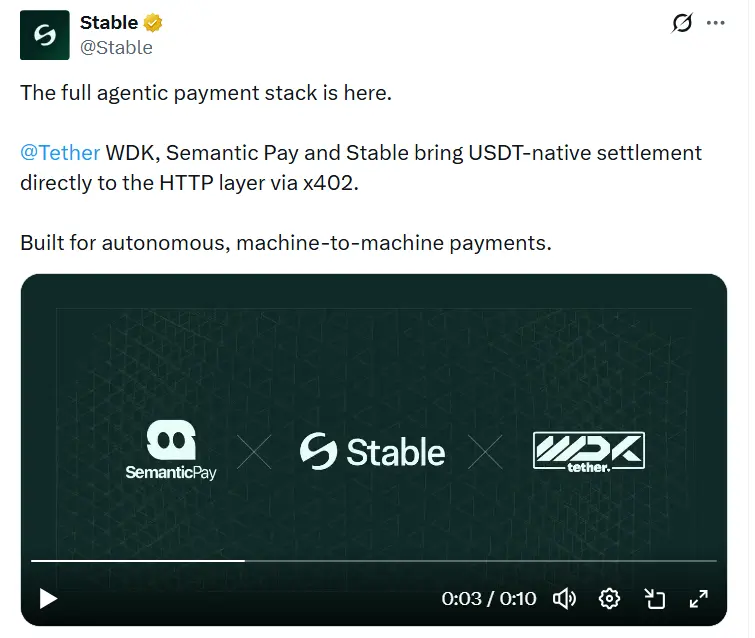
Stable announced on February 24 that collaboration with Tether WDK and Semantic Pay had enabled direct payments at the HTTP layer using the x402 protocol. Programmable wallets now allow agents to autonomously process transactions within this framework.
The resulting stack moves beyond the structural limitations of traditional financial systems. Sub-second settlement becomes possible, improving the efficiency of economic activity conducted by AI agents while strengthening the foundations of decentralized commerce. Particular attention is drawn to the combination of Semantic Pay’s verification mechanism and Stable’s reliable network, which together deliver both security and execution speed.
Expansion of the agentic economy will likely determine Stable’s long-term importance within this architecture. Payment requests initiated through x402 and the autonomous wallet capabilities provided by Tether WDK allow AI agents to execute real-time transactions without human intervention. Infrastructure of this type could become a key catalyst accelerating the convergence of DeFi and AI, while also driving broader innovation across the global stablecoin ecosystem.
5. Outlook
Within the broader shift toward U.S.-led stablecoin regulation, Stable (StableChain) is emerging as more than an on-chain payment network. The protocol increasingly functions as dollar-based settlement and operational infrastructure. The v1.2.0 mainnet upgrade represents an important step in that evolution: USDT0 has been fully adopted as the network’s native gas token, integrating gas and settlement assets into a single denomination. Eliminating the wrap/unwrap process simplifies wallet UX while significantly reducing operational complexity for institutions. Predictable transaction costs and accounting aligned around a single dollar unit further strengthen the network’s appeal as payment infrastructure. At the same time, collaboration with LayerZero enables USDT0 (Tether’s omnichain version) to operate as a native settlement asset, while integration with Semantic Pay introduces x402-based payment functionality. Together, these developments lay the groundwork for infrastructure capable of supporting an increasingly AI-driven blockchain economy.
Long-term relevance will depend less on token supply expansion and more on the evolution of chain architecture and operational layers designed for institutional use. Progress along this path suggests the potential for Stable to function as a digital dollar rail supporting U.S. financial dominance. Several developments will likely determine the next phase of growth: the emergence of large-scale real-world use cases through institutional partnerships; widespread deployment of gasless transactions across applications; and expansion beyond a payment layer toward a broader settlement and AI-economy operational layer.
Disclaimer
I confirm that I have read and understood the following: The information contained in this article is strictly the opinions of the author(s). This article was authored free from any form of coercion or undue influence. The content represents the author's own views and does not represent the official position or opinions of CrossAngle. This article is intended for informational purposes only and should not be construed as investment advice or solicitation. Unless otherwise specified, all users are solely responsible and liable for their own decisions about investments, investment strategies, or the use of products or services. Investment decisions should be made based on the user’s personal investment objectives, circumstances, and financial situation. Please consult a professional financial advisor for more information and guidance. Past returns or projections do not guarantee future results. This article was written at the request of Stable. All content in this article was written independently by the author(s), and neither CrossAngle nor Stable had any editorial control or influence over the content. The author(s) may hold the cryptocurrencies mentioned in this article at the time of writing.
Xangle or its affiliated partners own all copyrights of the written or otherwise produced materials and content provided on the platform. Any illegal reproduction of such content, including, but not limited to, unauthorized editing, copying, reprinting, or redistribution will result in immediate legal actions without prior notice.
![[CIS Partner Summit Highlights] Ault's Financial Super App Strategy: OnlyBulls](https://resource.xangle.io/files/content/C1A19E1DB41B7FB86076143803C40D8E_1790125531662.webp)
![[Xangle RWA Series] Solana RWA: A Look at the Key Players](https://resource.xangle.io/files/content/F779A005246C0299246537AACB3A39F2_1782287059970.webp)