Ault: Bridging Traditional Finance and DeFi


Table of Contents
1. Traditional Finance Requires New Settlement Infrastructure
2. How Ault Enables Settlement in Traditional Finance
3. Ault’s Expansion Strategy
4. Conclusion: Ault as Institutional-Grade Settlement Infrastructure
1. Traditional Finance Requires New Settlement Infrastructure
Financial and data infrastructures have long evolved on top of centralized systems. Within this structure, trust is maintained by institutions and intermediaries that act as guarantors. Over time, however, the same architecture has also produced rising costs, delays, and operational complexity. Financial transactions separate execution from settlement, and processing moves across the systems of multiple institutions. Data is rarely consolidated in a single location and instead remains distributed across numerous internal systems within organizations. As a result, transactions and data move slowly, repeatedly passing through reconciliation and settlement processes between institutions.
Settlement delays directly affect operational efficiency and risk management. Until settlement is completed, capital and collateral remain locked. When data is fragmented across multiple systems, verifying the status of a transaction in real time becomes difficult. When problems occur, identifying the cause and assigning responsibility also takes longer. A new settlement infrastructure must therefore shorten the path through which transaction and data states are processed while ensuring that recording and verification proceed consistently within the same operational flow.
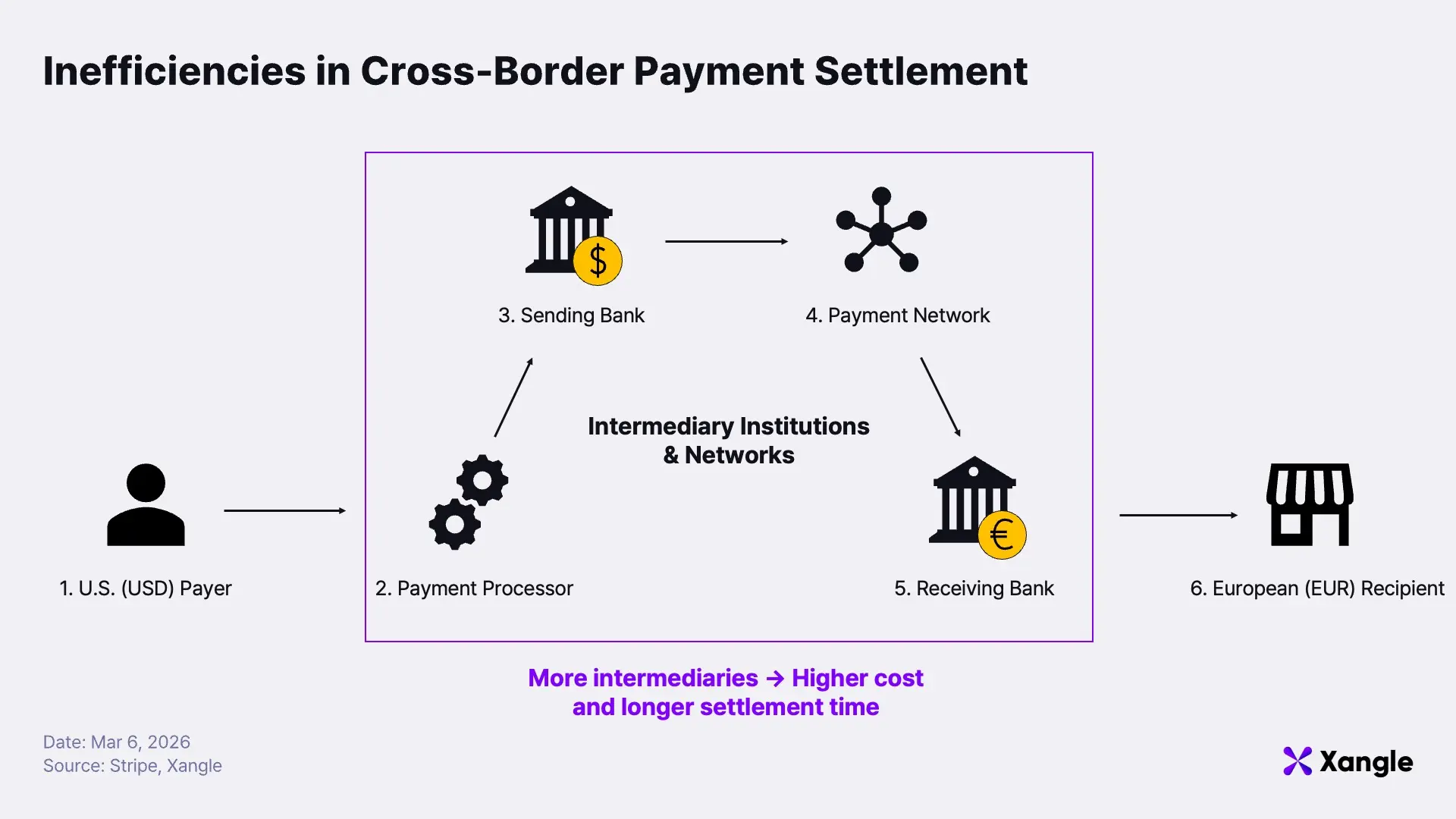
Traditional finance secures trust by distributing responsibilities across specialized institutions. Exchanges, payment networks, custodians, and accounting systems each perform distinct roles. This structure provides stability and clear accountability, but settlement takes time. Global securities settlement commonly still follows a T+2 cycle, and cross-border payments often require several days. During this period, capital and collateral remain immobilized. As settlement delays lengthen, institutional operating efficiency declines and costs increase.
Operational costs also arise structurally. The same transaction is often recorded across multiple ledgers, which requires reconciliation to ensure that records match. As scale increases, the costs of reconciliation and error resolution grow as well, and discrepancies may only be discovered after the fact. Traditional finance has developed robust structures to create trust, but those same structures have also produced delays and structural costs.
Limitations of General-Purpose Blockchains as Settlement Infrastructure
Blockchain initially appeared to offer an alternative: transactions could be recorded and settled on a single ledger. From the perspective of traditional financial institutions, however, blockchain ultimately becomes part of the operational infrastructure. Once integrated into operational systems, outages, regulatory changes, or cost fluctuations can translate directly into financial losses and internal control risks. Institutions therefore approach adoption cautiously, prioritizing accountability and operational risk. In practice, institutional evaluation tends to focus on three core criteria.
First, institutions require infrastructure that remains consistently stable. Even during spikes in transaction volume, throughput and finality must remain predictable so that settlement and risk management processes can operate reliably. Financial services also depend on continuous external data inputs. When critical information such as prices, exchange rates, or interest rates relies on external oracle networks or indexing protocols, settlement may occur on-chain but still depends on third parties. This dependency introduces additional risk and makes such systems difficult to use as settlement rails.
Second, institutions place significant weight on governance risk. The possibility that decision-making can change in token-based DAOs is itself a concern. If the procedures governing upgrades or policy changes are unclear, including who is responsible, how decisions are executed, and how collusion risks are controlled, adoption becomes difficult. When uncertainty remains during policy changes or upgrades, institutions must manage not only technical risk but also policy risk.
The third concern lies in tokenomics. Many blockchains distribute tokens across multiple allocations, including teams, advisors, foundations, marketing budgets, treasuries, and reserves. Tokens controlled by foundations may enter the market depending on the decisions of operating entities. Under such a structure, supply and reward distributions can shift abruptly at specific points in time, while network fees may become exposed to high volatility.
Even so, blockchain continues to be discussed as a potential settlement infrastructure for traditional finance for a clear reason. It offers a shorter path for addressing settlement inefficiencies. Settlement, collateral management, and post-trade risk processes can be connected within a unified record system. When combined with DeFi’s 24-hour liquidity and programmable capital deployment, tokenized assets (RWA) and stablecoins can circulate more efficiently along settlement rails. In other words, blockchain has the potential not only to improve settlement processes in traditional finance, but also to expand asset management models through integration with DeFi.
Ault addresses these requirements by identifying three structural barriers that have historically limited the adoption of general-purpose blockchains as settlement infrastructure: performance and stability, governance risk, and tokenomics. The protocol restructures these elements directly at the design level within a purpose-built Layer 1 architecture. Its objective is to establish settlement rails capable of operating in traditional financial environments while remaining connected to DeFi.
2. How Ault Enables Settlement in Traditional Finance
2-1. Removing Consensus Bottlenecks with Off-Chain Services
In most blockchains, transactions modify the shared state of the entire network, and finality is established through verification and consensus among a validator set. This design offers strong security and decentralization, but it creates structural bottlenecks for financial operations such as real-time payments, margin calculations, risk re-evaluation, and large-scale concurrent transaction processing. Financial systems place greater importance on consistent performance and rapid block finality than on average throughput alone. When finality becomes irregular due to network congestion or changes in the number of participants, uncertainty remains until a transaction is confirmed, as results may still be reversed before finalization. As this uncertainty grows, downstream processes become more difficult to execute with confidence. Payment and settlement are delayed, and margin and risk calculations follow with additional lag.
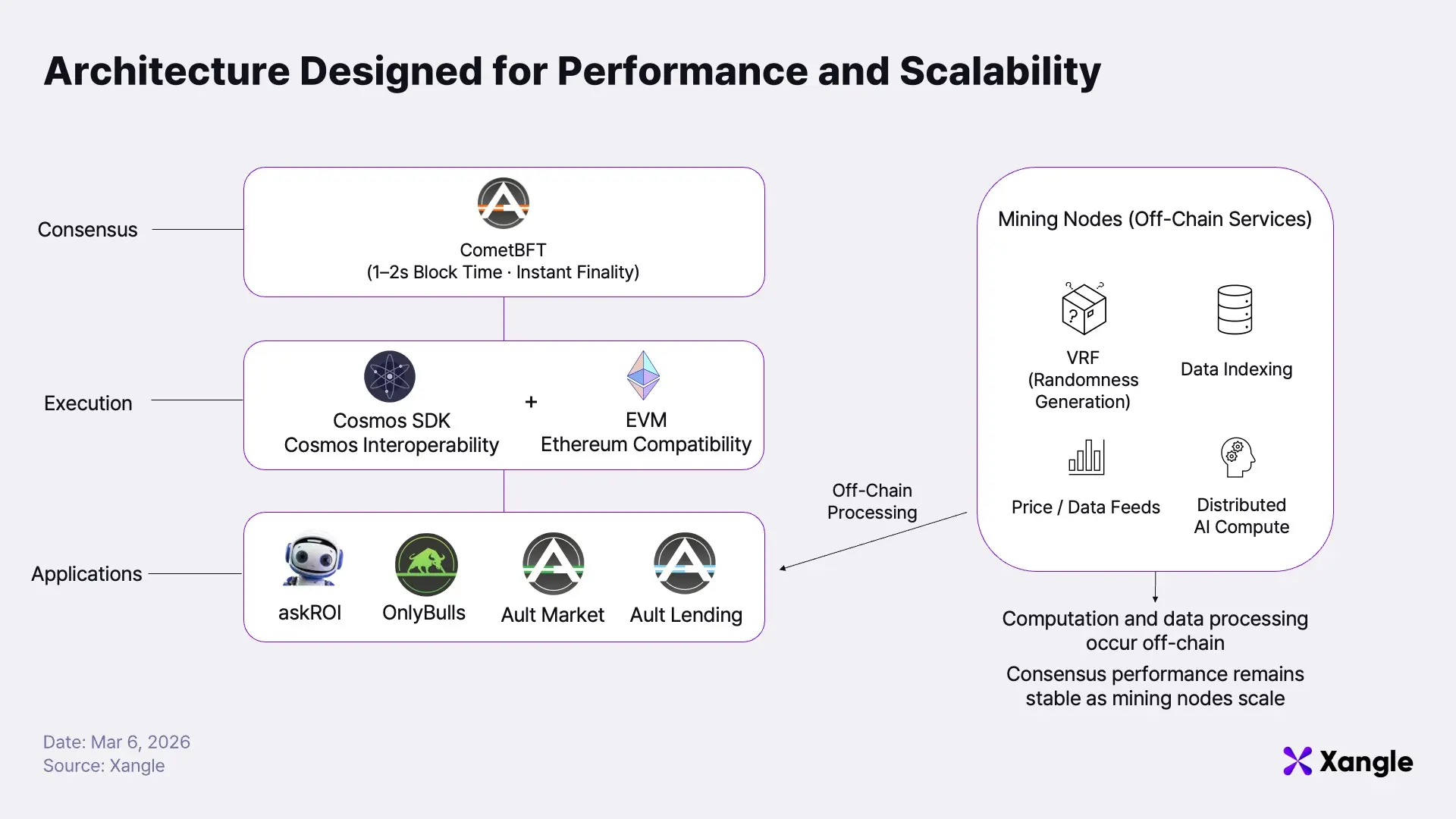
Ault addresses these limitations by structurally separating consensus from execution. Block production and transaction finalization are handled by a CometBFT-based consensus engine, which delivers a one-second block time and immediate finality. CometBFT belongs to the PBFT (Practical Byzantine Fault Tolerance) family of BFT consensus engines, where a predefined validator set agrees on blocks through a process of proposal, voting, and commitment. Only blocks signed by more than two-thirds of validators are considered valid. Once this threshold is reached, the block becomes final immediately without probabilistic waiting. Immediate finality of this kind aligns well with the stable execution environments required by financial systems.
Resource-intensive tasks that are not directly required for consensus are separated into off-chain services. Licensed Mining Nodes perform functions such as VRF (Verifiable Random Function)-based random beacon generation, off-chain data processing, data indexing, and distributed AI computation within a mining node pool that does not participate in consensus. Instead of outsourcing off-chain services to external protocols, this structure assigns those responsibilities to participants within the Ault network. Results are submitted to the chain in cryptographically verifiable form. Because these nodes do not function as block validators, the network can scale to hundreds of thousands of nodes without affecting consensus performance or finality. Security and trust concerns that typically arise when relying on external oracle protocols are addressed through this mining node–driven off-chain service architecture.
2-2. Governance Designed for Institutional Trust
Many existing public blockchains determine chain rules and upgrades through governance systems centered on anonymous participants. Under such structures, the entity responsible for decision-making becomes ambiguous, and responding to regulatory changes or legal disputes becomes difficult to coordinate. Institutions must therefore evaluate protocol changes and potential regulatory conflicts independently, which increases both decision-making costs and operational risk.
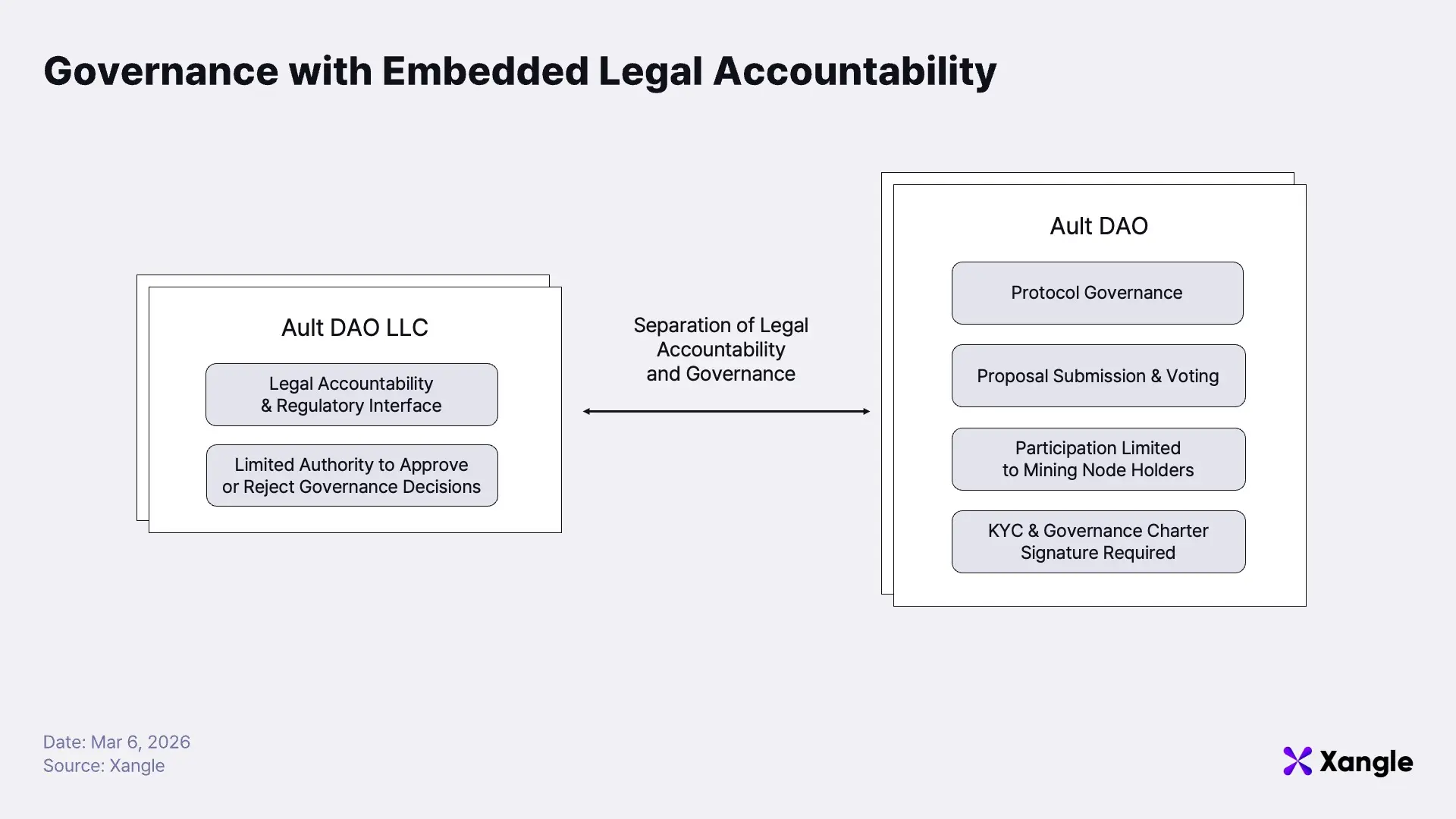
Ault structures governance as an on-chain consensus system in which decisions are recorded and executed, while separating a legal entity capable of handling contracts and regulatory responses in the real world. Governance itself cannot possess legal personality or contractual authority. For this reason, Ault DAO LLC, a limited liability company established under Wyoming DAO LLC law, functions as the entity responsible for legal accountability and as the interface for off-chain execution. Governance participants are explicitly defined as having no rights to the equity, profits, or assets of Ault DAO LLC. This provision prevents governance participation from being interpreted as ownership or profit rights in the company and clearly separates the legal responsibility entity, Ault DAO LLC, from the governance system responsible for decision-making. As a minimal safeguard within the decision-making process, Ault DAO LLC retains the authority to approve or reject proposals at the final stage. That authority is strictly limited to specific circumstances, including legal violations, malicious code, or threats to network integrity, ensuring that regulatory and dispute risks remain controlled.
Participation in governance is restricted to mining node holders who have completed KYC identity verification and agreed to the governance charter. This structure strengthens accountability for governance decisions and improves the network’s ability to respond to regulatory requirements. Voting follows the principle of “1 mining node : 1 vote,” and limits are applied to the number of votes a single participant may exercise. Node licenses are also non-transferable for the first two years after launch, structurally reducing the risk of vote trading or concentration of power during the network’s early stages.
As a result, Ault aims to build a decentralized infrastructure designed around regulation, identity verification, and accountability. By integrating legal governance and compliance mechanisms directly at the protocol level, the network seeks to balance the institutional trust requirements of traditional finance with the principles of decentralized infrastructure.
2-3. Tokenomics Simplified for Predictability
In many blockchain token models, validator rewards operate alongside treasury expenditures for marketing and ecosystem expansion. This structure makes it difficult to model changes in effective circulating supply and potential sell pressure in advance. When combined with the unlocking of tokens allocated to teams and investors, supply can surge at specific points in time, increasing volatility in supply, rewards, and network fees. Institutions, however, require predictable cost structures for budgeting, accounting treatment, and internal control. As the number of tokenomic variables increases, both the decision-making costs associated with adoption and the operational risk borne by institutions inevitably rise.
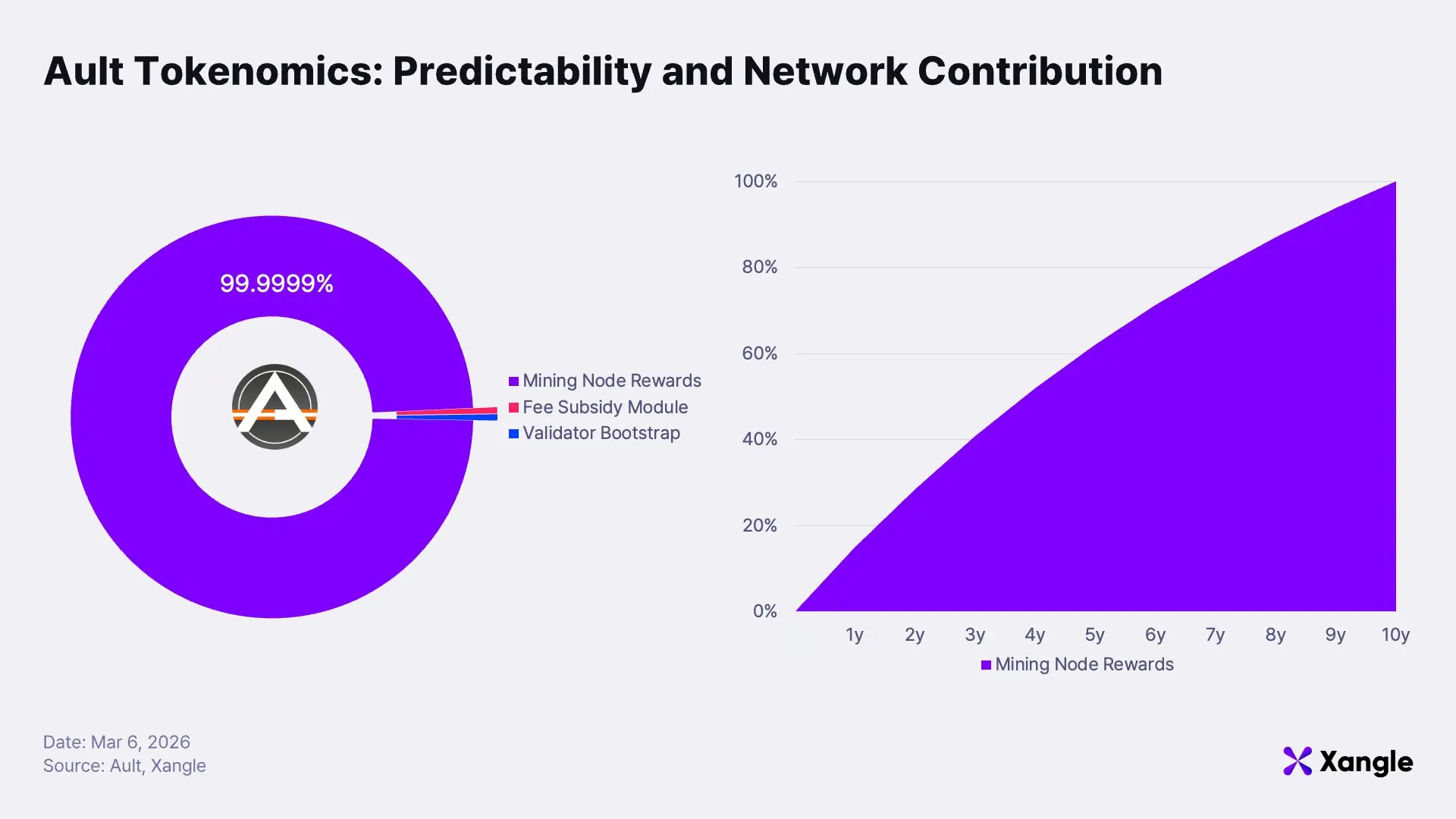
Ault reduces these variables by allocating the vast majority of total token issuance (99.99..%) to mining node rewards and separating reward sources into two distinct streams. Validator rewards are designed to originate exclusively from network fees, while mining node rewards are distributed according to a predefined compensation plan tied to off-chain task execution. This structure simplifies the tokenomics model.
Validators responsible for network security receive rewards derived from network usage fees. Validators receive 100% of priority fees and 90% of base fees, while the remaining 10% of base fees is allocated to the DAO treasury. Under this structure, validator rewards and treasury funding fluctuate based on actual network usage rather than inflationary issuance.
Rewards for mining nodes performing off-chain tasks follow a predefined reward schedule. Mining nodes can only be operated by contributors who have purchased node licenses, and they submit verifiable off-chain task outputs, such as VRF-based results, to the network. Submissions are recognized as valid contributions only after passing a defined verification process. During each epoch, selected nodes perform assigned tasks and submit results, accumulating work credits. Rewards are distributed proportionally based on accumulated credits, ensuring that nodes consistently performing tasks receive compensation.
Under this structure, variables such as discretionary token sales by foundations or stakeholder lock-up releases have far less influence on circulating supply dynamics. Circulating supply changes and cost structures become easier to model in advance, reducing operational risks related to budgeting, accounting treatment, and internal control from an institutional perspective.
2-4. Ault as Settlement Infrastructure for Institutional Finance
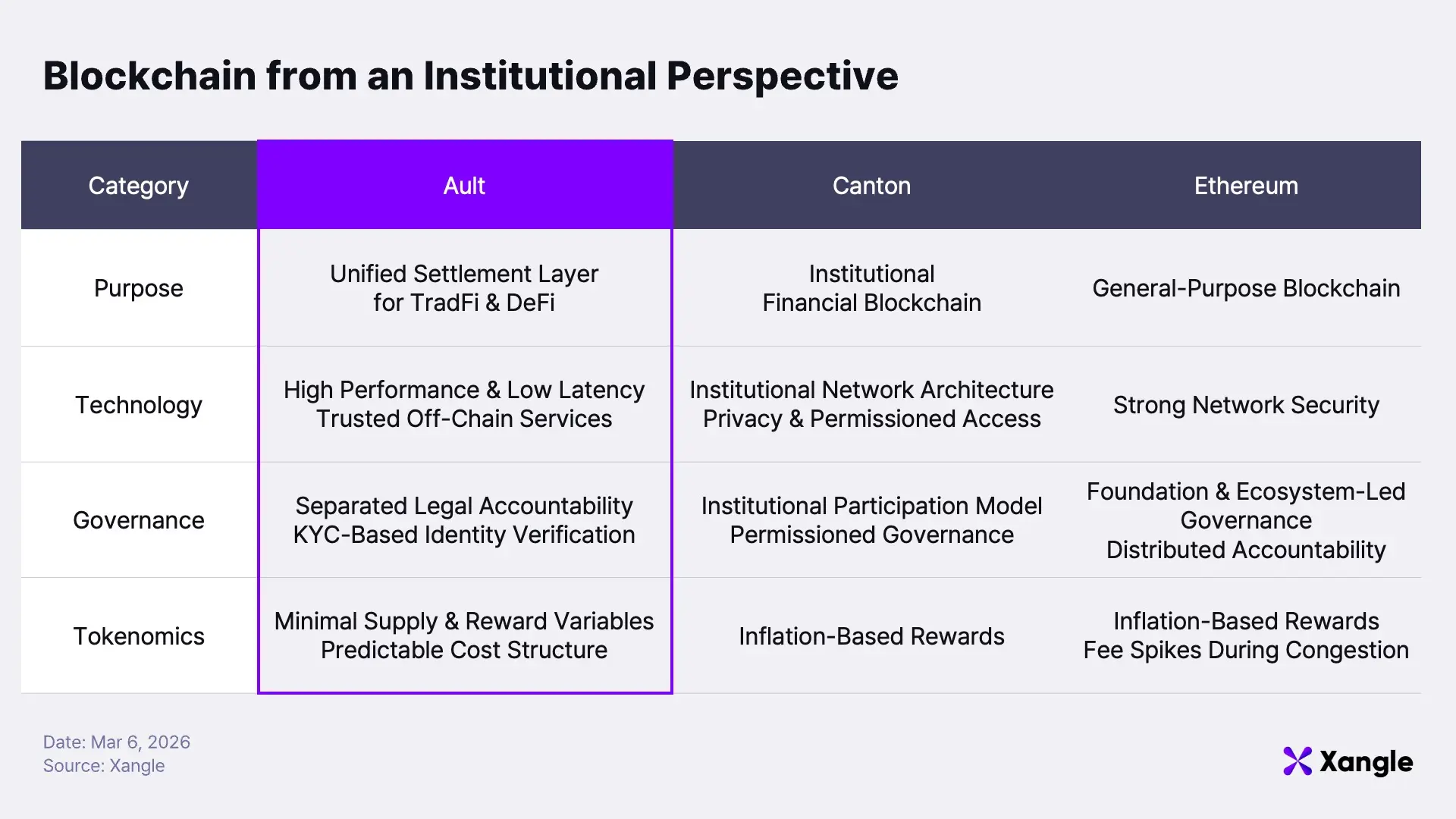
The three core structural components of Ault discussed above reflect design choices that incorporate the conditions traditional finance requires from settlement infrastructure. For traditional financial institutions, the primary considerations when evaluating settlement infrastructure are operational stability and the ability to control risk. General-purpose blockchains offer strong potential in terms of liquidity and scalability; however, unclear accountability and volatility in performance and cost structures make them difficult to align with internal control and compliance standards.
Within this framework, Ault enables tokenized traditional assets to move on-chain, where trading and settlement can occur using on-chain payment instruments such as stablecoins. These processes can then connect with DeFi services including collateralization and lending, allowing post-trade activities to be handled within a single layer. Ultimately, Ault aims to extend beyond settlement in traditional finance and establish a unified settlement layer that connects asset tokenization, trading, collateralization, and lending.
3. Ault’s Expansion Strategy
3-1. An Application-Led Ecosystem Expansion Strategy
Ault’s expansion strategy differs from the conventional model in which a blockchain first builds infrastructure and then attempts to populate the ecosystem. Instead, applications with established user bases are connected to the ecosystem alongside the transition to mainnet. These applications create user flows that begin with information discovery and extend to trade execution and position management, while Ault ensures that these flows translate into on-chain transactions and liquidity. The objective is to convert existing application users and usage patterns into on-chain activity. The resulting liquidity and continuous 24-hour trading environment provide the foundation for regulated assets and institutional demand from traditional finance to enter the ecosystem.
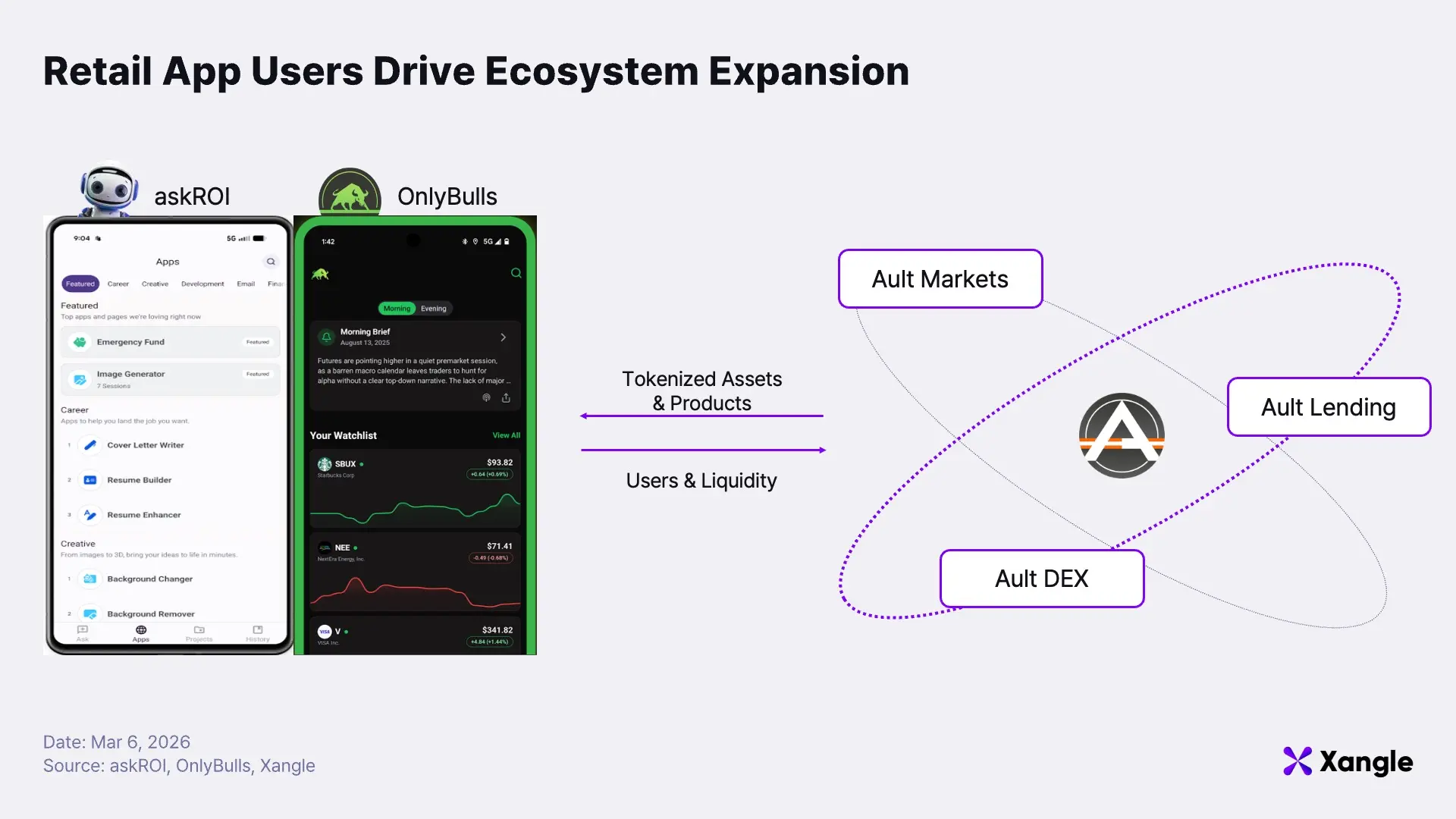
- askROI (Information Services): An AI market data and analytics application built on both closed-source and open-source LLMs. The app has surpassed one million downloads on the Google Play Store and maintains a substantial user base. Users can query market information through prompts and receive summaries, indicators, and insights that support investment decision-making.
- OnlyBulls (Trading): A consumer-focused trading application covering both stock and crypto markets. AI continuously tracks price movements, news, and social sentiment across markets on a 24/7 basis, detecting changes in volatility. When volatility is identified, the application provides contextual explanations alongside the signal and delivers a daily summary of key market news each morning. Users can monitor stock and crypto markets within the app and manage trades and positions.
- Ault Markets (Tokenized Asset Trading): Currently preparing for launch, this application is designed to support institutional trading of tokenized assets. It will provide “1 token = 1 real share” exposure alongside 24/7 trading access. Real shares can be custodied through financial partners via the StableShare service. Real-world assets such as real estate and fine art can also be tokenized, enabling fractional ownership and continuous market access. The platform will also introduce an RWA Marketplace that incorporates legal documentation, valuation procedures, and compliance checks during the asset verification stage.
- Ault Lending (Collateral and Lending): Currently preparing for launch, this application is designed for institutional use and provides secured and unsecured debt financing to companies under California financial law. Planned financial products include convertible bonds, bridge financing, accounts receivable financing, equipment leasing, and microloans.
- Ault DEX (Exchange): A decentralized exchange where anyone can trade crypto assets. The platform is designed to leverage Ault’s infrastructure to support deep liquidity, low-latency execution, and real-time settlement.
The central idea of this strategy is to bring retail traffic and institutional assets into the same environment. Retail applications continuously generate user activity through information discovery and trading, forming liquidity. That liquidity then supports trading in tokenized traditional assets, and as more traditional assets are onboarded, both the range of tradable assets and overall demand expand.
A particularly important aspect is the post-trade stage. Tokenized assets can be traded on-chain around the clock, and when connected with collateral and lending services they can also function as underlying assets for financial products. Institutions can manage both asset circulation and financing within the Ault ecosystem, while retail participants gain access to a broader set of tradable assets and financial products. Rather than growing independently, the applications create a connected structure in which trading, collateralization, and lending operate within Ault, reinforcing one another and generating ecosystem-wide synergies.
3-2. A Roadmap Integrating Traditional Finance and DeFi
Ault’s roadmap is structured around three major phases: 1) infrastructure and liquidity development, 2) onboarding of traditional assets and expansion of financial products, and 3) strengthening institutional adoption. The approach begins by establishing the conditions necessary for trading and settlement. The next stage expands the onboarding of traditional assets and related financial products, followed by the final phase, which broadens the distribution and operational pathways through which institutions can participate.
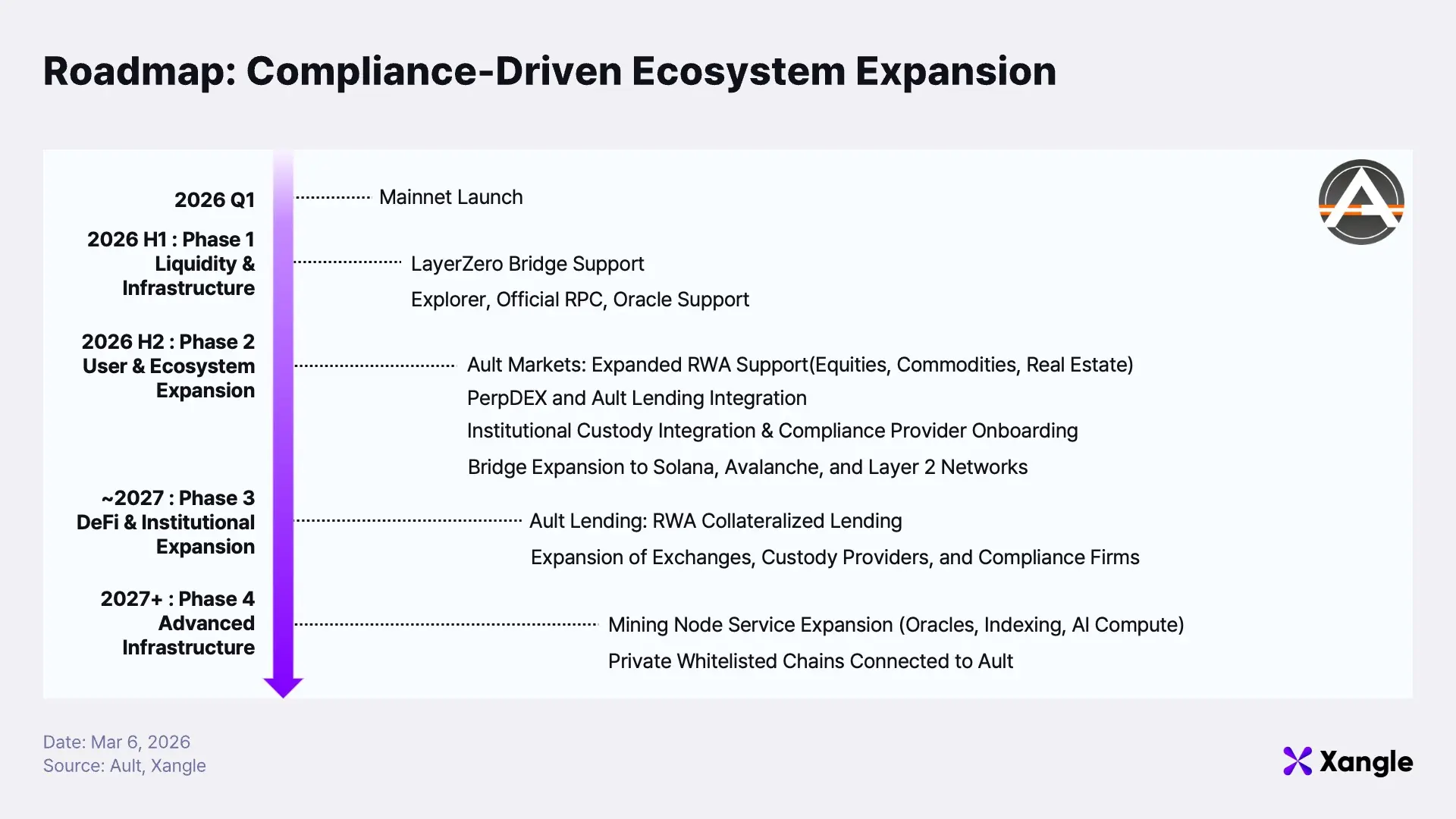
A defining feature of this roadmap is the application of the same standards of accountability and regulatory compliance across both the protocol and ecosystem applications. The protocol operates under a governance structure that incorporates legal accountability and mechanisms for regulatory response. At the ecosystem layer, applications such as Markets, Lending, and DEX, developed under Ault’s leadership, are designed to support the onboarding and trading of traditional assets within regulatory and compliance frameworks. This structure clarifies the responsibility and operational conditions required when institutions tokenize traditional assets while ensuring that post-trade financialization can continue within a unified settlement layer.
Institutions can therefore capture the advantages of on-chain settlement while reducing operational risk. At the same time, users gain confidence that tokenized asset trading operates within a framework of regulatory compliance and clearly defined legal accountability. The protocol and ecosystem applications together provide the trust conditions necessary for onboarding traditional assets.
4. Conclusion: Ault as Institutional-Grade Settlement Infrastructure
The Web3 ecosystem continues to experiment with industry applications such as tokenization and stablecoin adoption as traditional financial institutions increasingly enter the space. Within this broader trend, Ault stands apart from many existing projects. Rather than functioning as a general-purpose Layer 1 blockchain, it has been designed from the outset as a Layer 1 optimized for settlement in traditional financial environments.
Ault’s defining characteristic lies in the careful integration of technology and regulatory structure. At the protocol level, off-chain services are provided directly by mining nodes, reducing reliance on external oracle networks. Execution and consensus are structurally separated so that increases in task requests do not translate into degradation in network performance. The governance model has also been redesigned to operate within a limited liability company structure under Wyoming state law. Governance authority is granted only to mining node operators who have completed KYC verification and signed the DAO charter, clearly establishing the entity responsible for legal accountability.
Clear challenges nevertheless remain. A business model centered on RWA and tokenization services is compelling, but large-scale adoption by financial institutions remains an open challenge for the broader Web3 industry and continues to sit within an experimental phase. Beyond achieving initial vertical integration through retail-focused applications following the mainnet launch, a key determinant of future growth will be whether Ault can expand horizontally by integrating external ecosystems and third-party applications.
Ault represents a rare attempt to secure both technological trust and legal stability within the same infrastructure. The project ultimately aims to demonstrate that blockchain can function not merely as a speculative instrument but as a practical settlement infrastructure. Whether Ault can establish a new standard for blockchain by balancing regulatory compliance, technological innovation, and the integration of traditional finance with DeFi will become clearer as adoption unfolds.
Disclaimer
I confirm that I have read and understood the following: The information contained in this article is strictly the opinions of the author(s). This article was authored free from any form of coercion or undue influence. The content represents the author's own views and does not represent the official position or opinions of CrossAngle. This article is intended for informational purposes only and should not be construed as investment advice or solicitation. Unless otherwise specified, all users are solely responsible and liable for their own decisions about investments, investment strategies, or the use of products or services. Investment decisions should be made based on the user’s personal investment objectives, circumstances, and financial situation. Please consult a professional financial advisor for more information and guidance. Past returns or projections do not guarantee future results. This article was written at the request of Ault. All content in this article was written independently by the author(s), and neither CrossAngle nor Ault had any editorial control or influence over the content. The author(s) may hold the cryptocurrencies mentioned in this article at the time of writing.
Xangle or its affiliated partners own all copyrights of the written or otherwise produced materials and content provided on the platform. Any illegal reproduction of such content, including, but not limited to, unauthorized editing, copying, reprinting, or redistribution will result in immediate legal actions without prior notice.
![[CIS Partner Summit Highlights] Ault's Financial Super App Strategy: OnlyBulls](https://resource.xangle.io/files/content/C1A19E1DB41B7FB86076143803C40D8E_1790125531662.webp)
![[Xangle RWA Series] Solana RWA: A Look at the Key Players](https://resource.xangle.io/files/content/F779A005246C0299246537AACB3A39F2_1782287059970.webp)