x402 and SKALE: The Private Execution Layer for Agentic Payments


Table of Contents
1. Why x402 Is Necessary
2. SKALE: The Execution Layer for x402
3. Privacy Infrastructure: The BITE Protocol
4. Ecosystem
5. Conclusion
1. Why x402 Is Necessary
The primary actors of the internet economy are rapidly shifting from humans to autonomous AI agents as the agent era begins to take shape. What is emerging is an agentic economy in which thousands of agents simultaneously conduct research, purchase data, secure compute resources, execute trades, and orchestrate workflows autonomously.
In such an economy, payments can no longer be processes decided and executed by humans. Instead, they must function as machine-native protocols exchanged in real time. Existing web payment systems—accounts, subscriptions, and card billing—were never designed for this environment. API key issuance, user registration, KYC verification, invoice processing, and refund handling all remain fundamentally human-centric processes.
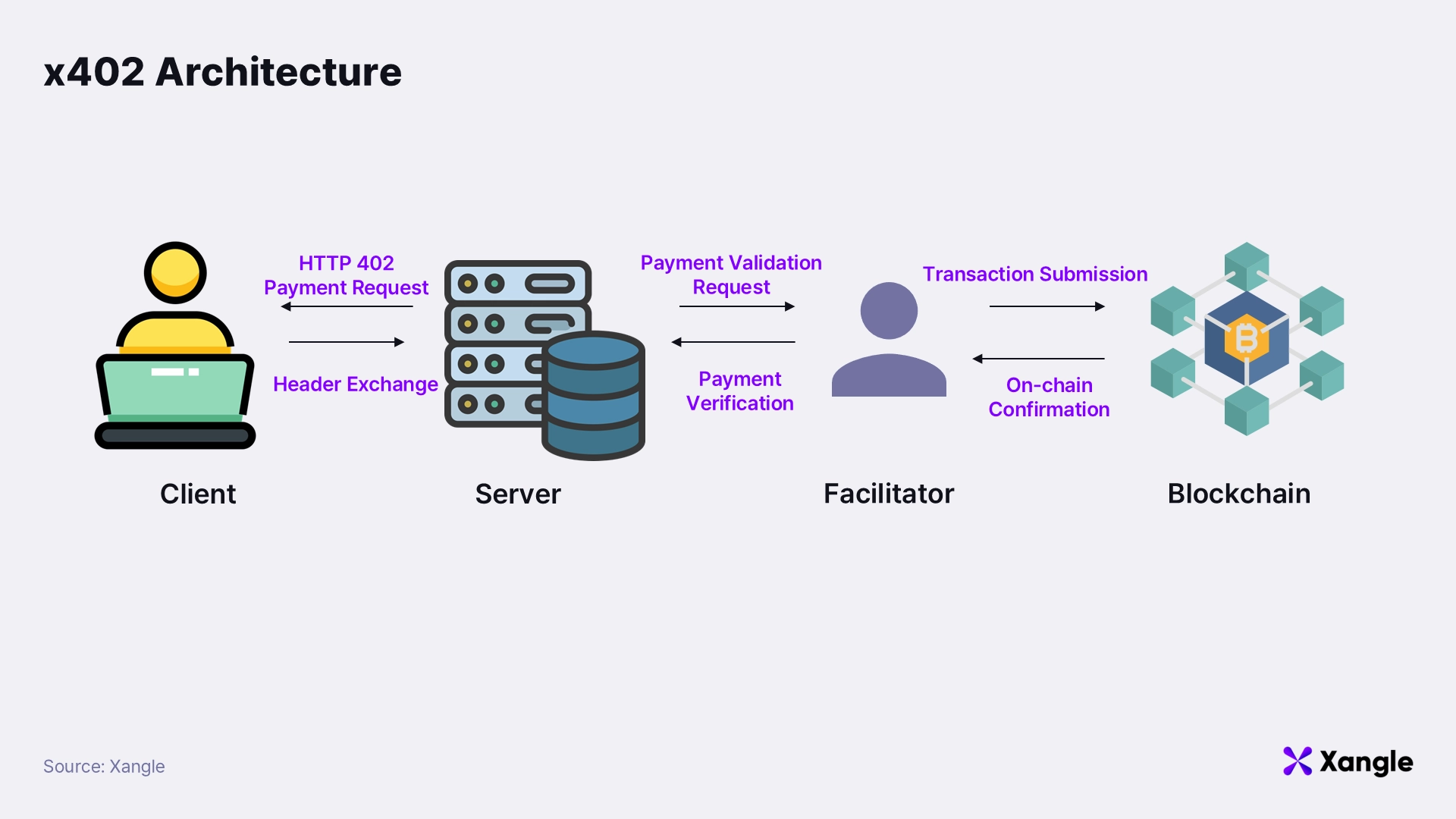
The protocol proposed to address this structural limitation is x402. Developed by Coinbase, x402 is an open payment protocol designed to support autonomous payments and settlement between AI agents. The protocol extends the HTTP 402 (Payment Required) response code used in traditional web payment architecture and adapts it to the Web3 environment. As a result, AI agents can automatically pay service fees, purchase data, renew subscriptions, and even execute contracts without human intervention.
However, x402 defines only the payment rules. For hundreds of millions of micropayments to be processed without gas fees, finalized within one second, and executed with strong privacy guarantees, an optimal execution layer is required. The Layer-1 network increasingly attracting attention as such an execution layer is SKALE.
2. SKALE: The Execution Layer for x402
The x402 protocol itself can be used on any chain. As long as the HTTP 402 response contains the token address, amount, and recipient, payments can technically be executed on any EVM chain. In practice, however, theory and reality diverge. The essence of agentic payments is that tens or even hundreds of micropayments per second—typically averaging 0.01–0.5 USDC—occur in real time without human intervention. In such an environment, chain selection is ultimately determined by three factors: 1) gas fees; 2) finality; and 3) privacy. These three elements fundamentally determine the payment UX.
Even gas fees as low as $0.001 can become prohibitive when transactions reach tens of thousands per day, rapidly eroding the economic viability of agents. Finality delays exceeding three seconds can disrupt agent decision-making and payment algorithms. A lack of privacy presents an equally serious issue: balances, spending patterns, and counterparties all become publicly visible, exposing the agent’s entire strategy.
Major Layer-1 networks today, including Ethereum and Solana, struggle to satisfy all three requirements simultaneously. SKALE, however, takes a different approach. The network was originally designed to build the first blockchain capable of completely eliminating MEV by encrypting transactions using PoE (Proof-of-Encryption) within the BITE protocol. More recently, SKALE has begun attracting attention as a chain that possesses the full set of characteristics required to effectively run the x402 protocol. (For a technical explanation of SKALE, refer to the Xangle Research report “SKALE: Opening the Era of FAIR DeFi Without MEV.”)
As noted earlier, the key requirements for x402 are low gas fees, fast finality, and privacy. In this context, SKALE is particularly well positioned. The first is gas cost. SKALE replaces the traditional gas fee model with a Compute Credit model, in which chain operators (dApps or projects) pre-purchase compute capacity through monthly subscriptions paid in SKL or stablecoins. Credits are consumed based on usage, similar to cloud services, and agents executing transactions incur no gas fees. As a result, even if facilitators process millions of x402 payments per day, the effective cost for agents approaches zero.
Fast finality is another key strength. SKALE operates with an architecture where block production and finalization occur almost simultaneously. Finality is achieved in under one second, typically around 0.4–0.8 seconds in real operating environments. Horizontal computation and effectively unlimited scalability are additional strengths. However, SKALE’s most critical differentiator lies elsewhere: the BITE protocol, which guarantees full privacy.
3. Privacy Infrastructure: The BITE Protocol
On public blockchains, making a payment effectively means revealing one’s entire financial profile. Balances, spending patterns, counterparties, transaction frequency, and even strategic behavior become permanently visible. In an agent payment environment, this problem becomes particularly critical. Booking a hotel exposes location and schedule, creating potential security risks. Buying a cup of coffee allows the merchant to infer an entire pattern of consumption. Managing assets exposes the entire account. From neighbors to malicious attackers, anyone can observe what we are doing. As a result, building consumer-facing applications becomes nearly impossible, because the fundamental assumption—that neighbors or attackers cannot see what we are doing—no longer holds.
Consider how payments work in the real world. When buying coffee, we do not reveal our entire account balance. The barista only needs proof that the payment has been approved; our salary, last month’s spending history, and account balance remain private. Existing blockchains fail this test. Because every transaction is transparent, both counterparties and external observers inevitably gain more information than necessary.
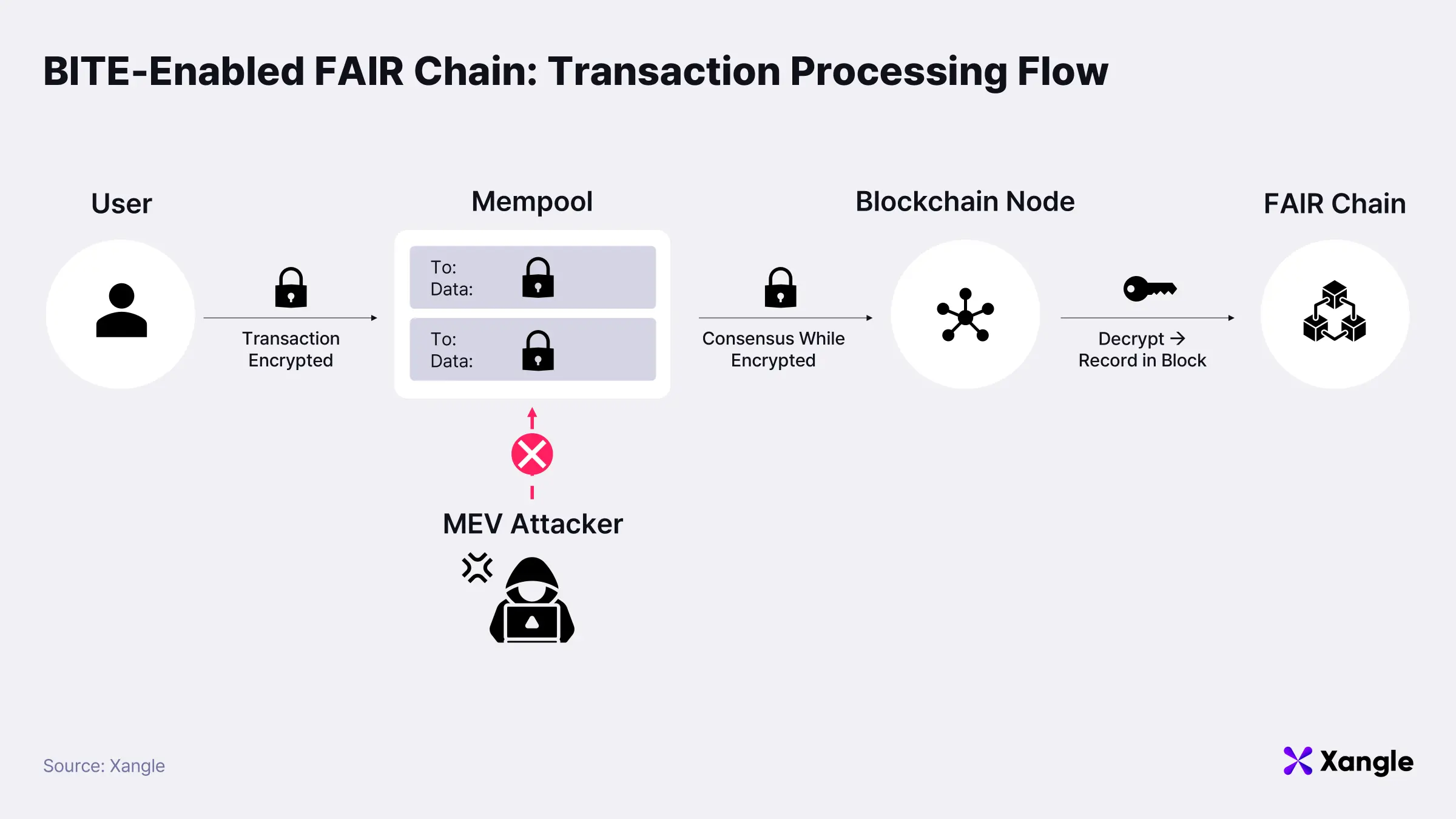
SKALE’s proposed solution is the BITE Protocol. BITE (Blockchain Integrated Threshold Encryption) is a threshold encryption protocol integrated directly into the consensus layer, enabling payments that are verifiable yet not publicly exposed. Transactions are encrypted on the client side before submission, meaning that even validators cannot view the contents before they enter the mempool. Only after consensus is finalized does the leader validator aggregate the keys required for decryption. The encrypted state also remains visible on block explorers and can only be accessed through the dedicated BITE JSON-RPC. Verifiability is preserved while MEV extraction, strategy replication, and intent leakage are fundamentally prevented.
BITE’s core capabilities can be summarized in three areas. First is Confidential Balances. Token amounts and balances are transmitted in encrypted form, ensuring that budgets, spending limits, and transactional relationships remain fully protected. Second is Encrypted Execution. Because the transaction itself is encrypted, both MEV attacks and strategy replication by competing agents become impossible. Third is Conditional & Autonomous Transactions. SKALE supports native if/then execution flows, allowing multi-stage workflows—such as “data purchase → automated analysis → subsequent payment”—to connect seamlessly without human intervention.
As discussed earlier, x402 without privacy remains incomplete. Even if low gas fees and fast finality are achieved, the true potential of the agentic economy cannot be realized without privacy. SKALE, which natively supports the BITE protocol, is therefore particularly well positioned to implement this model. In the emerging era of the x402 protocol and the agentic economy, SKALE has the potential to evolve beyond a simple execution layer and become core infrastructure for protecting trust and strategy.
4. Ecosystem
SKALE is actively leveraging x402 while rapidly expanding its ecosystem. Rather than simply adopting the protocol, the network is bringing in a range of projects to ensure that the architecture operates in practice and to strengthen the execution layer. Notably, several projects in this ecosystem go beyond formally “integrating” x402 and are already functioning as execution units that generate real traffic and revenue flows. A representative example is PayAI.
PayAI is an application built on a multi-chain facilitator architecture that supports major public chains simultaneously, including Solana, Base, and Avalanche. When a payment request occurs, PayAI first performs verification and, once the required conditions are met, also handles the on-chain settlement on the respective network. Developers can therefore receive payments across multiple networks through a single integration, without needing to build chain-specific infrastructure.
As of early 2026, PayAI has processed more than 28 million cumulative transactions and recorded over $7 million in total settlement volume. On January 12, the project also announced a collaboration to support PayAI infrastructure on the SKALE network, expanding the scope of x402-based payment processing into the SKALE ecosystem.
SKALE also announced a strategic partnership with Khorus on December 12, 2025. Khorus is an infrastructure platform that enables developers to build, deploy, and tokenize on-chain agents using the ERC-8004 standard. The project plans to launch its own application within the SKALE on Base environment.
Khorus currently has more than 4,500 beta users and has rapidly expanded its presence, accounting for roughly 10% of circulating ERC-8004 agents. As demand for autonomous on-chain computing increases, the combination of Khorus, which manages the agent issuance and operation layer, and SKALE, which provides the execution infrastructure, illustrates the structural direction of the emerging agentic economy.
Beyond PayAI and Khorus, a number of other projects are also experimenting with the x402 protocol. For example, ubounty.ai is developing a system in which agents can autonomously accept tasks and receive immediate rewards upon submitting results. Projects such as Kobaru, nullshot, Dexter, Corbits, and 1Shot API are also pushing x402 toward real-world usage in areas including data relaying, cross-chain settlement, automated API execution, and AI tool chaining.
x402 is therefore no longer limited to being a payment specification. It is evolving into an economic infrastructure in which data, compute resources, model calls, content, and financial strategies are priced per request and settled instantly. Such a system requires reliable processing of dozens or even hundreds of micropayments per second while preventing exposure of strategic intent. In an environment characterized by rapidly increasing request volumes, real-time settlement requirements, and strong privacy demands, SKALE’s architecture—combining gasless transactions, ultra-low-latency finality, and encrypted execution—positions the network as a natural execution layer for the x402 ecosystem.
5. Conclusion
The x402 protocol is more than a payment specification; it represents a transition from a human-centered web economy to a machine-driven agentic economy. Realizing that potential requires an execution layer that eliminates gas fee burdens, provides sub-second finality, and prevents the exposure of strategies and assets. As an infrastructure layer capable of meeting these conditions simultaneously, SKALE is emerging as one of the few networks positioned to fulfill this role. Its Compute Credit–based gas-free architecture, ultra-low-latency finality, and consensus-level encryption through the BITE protocol together provide the technical foundation required for this model.
The agentic economy demands more than faster payments. It requires a transaction environment that remains invisible while still being verifiable. In an ecosystem where thousands of endpoints and tens of millions of payments are already operating, few chains are capable of supporting both scalability and privacy at the same time. As AI agents increasingly exchange data, compute resources, and financial assets in real time, the combination of x402 and SKALE, optimized for its execution, has the potential to evolve beyond a simple technical collaboration and emerge as a standard infrastructure layer for next-generation internet payments.
Disclaimer
I confirm that I have read and understood the following: The information contained in this article is strictly the opinions of the author(s). This article was authored free from any form of coercion or undue influence. The content represents the author's own views and does not represent the official position or opinions of CrossAngle. This article is intended for informational purposes only and should not be construed as investment advice or solicitation. Unless otherwise specified, all users are solely responsible and liable for their own decisions about investments, investment strategies, or the use of products or services. Investment decisions should be made based on the user’s personal investment objectives, circumstances, and financial situation. Please consult a professional financial advisor for more information and guidance. Past returns or projections do not guarantee future results. This article was written at the request of SKALE. All content in this article was written independently by the author(s), and neither CrossAngle nor SKALE had any editorial control or influence over the content. The author(s) may hold the cryptocurrencies mentioned in this article at the time of writing.
Xangle or its affiliated partners own all copyrights of the written or otherwise produced materials and content provided on the platform. Any illegal reproduction of such content, including, but not limited to, unauthorized editing, copying, reprinting, or redistribution will result in immediate legal actions without prior notice.
![[CIS Partner Summit Highlights] Ault's Financial Super App Strategy: OnlyBulls](https://resource.xangle.io/files/content/C1A19E1DB41B7FB86076143803C40D8E_1790125531662.webp)
![[Xangle RWA Series] Solana RWA: A Look at the Key Players](https://resource.xangle.io/files/content/F779A005246C0299246537AACB3A39F2_1782287059970.webp)