ZetaChain(ZETA) 4Q24 Review

Table of Contents
1. Project Overview
2. 4Q24 Key Highlights
2-1. Gateway Upgrade: Bridging multiple chains and assets
2-2. The first chain to connect Bitcoin, Ethereum, and Solana
3. On-Chain Performance
4. Ecosystem Review – Expansion into the Bitcoin Ecosystem
1. Project Overview
ZetaChain is a proof-of-stake (PoS) blockchain network built on Cosmos SDK and the Tendermint PBFT consensus algorithm, offering a block generation speed of under five seconds and instant finality.
Designed as an omnichain network to facilitate cross-chain interactions, ZetaChain utilizes zEVM, its own execution layer with built-in omnichain smart contracts, to provide innovative cross-chain functionalities. The network is composed of validators that ensure security and data integrity, observers that verify the state of external chains, and TSS signers that sign external messages. For more details on ZetaChain, refer to Xangle’s research report: “ZetaChain: Navigating Chain Abstraction with Native Bitcoin.”
2. 4Q24 Key Highlights
2-1. Gateway Upgrade: Bridging multiple chains and assets
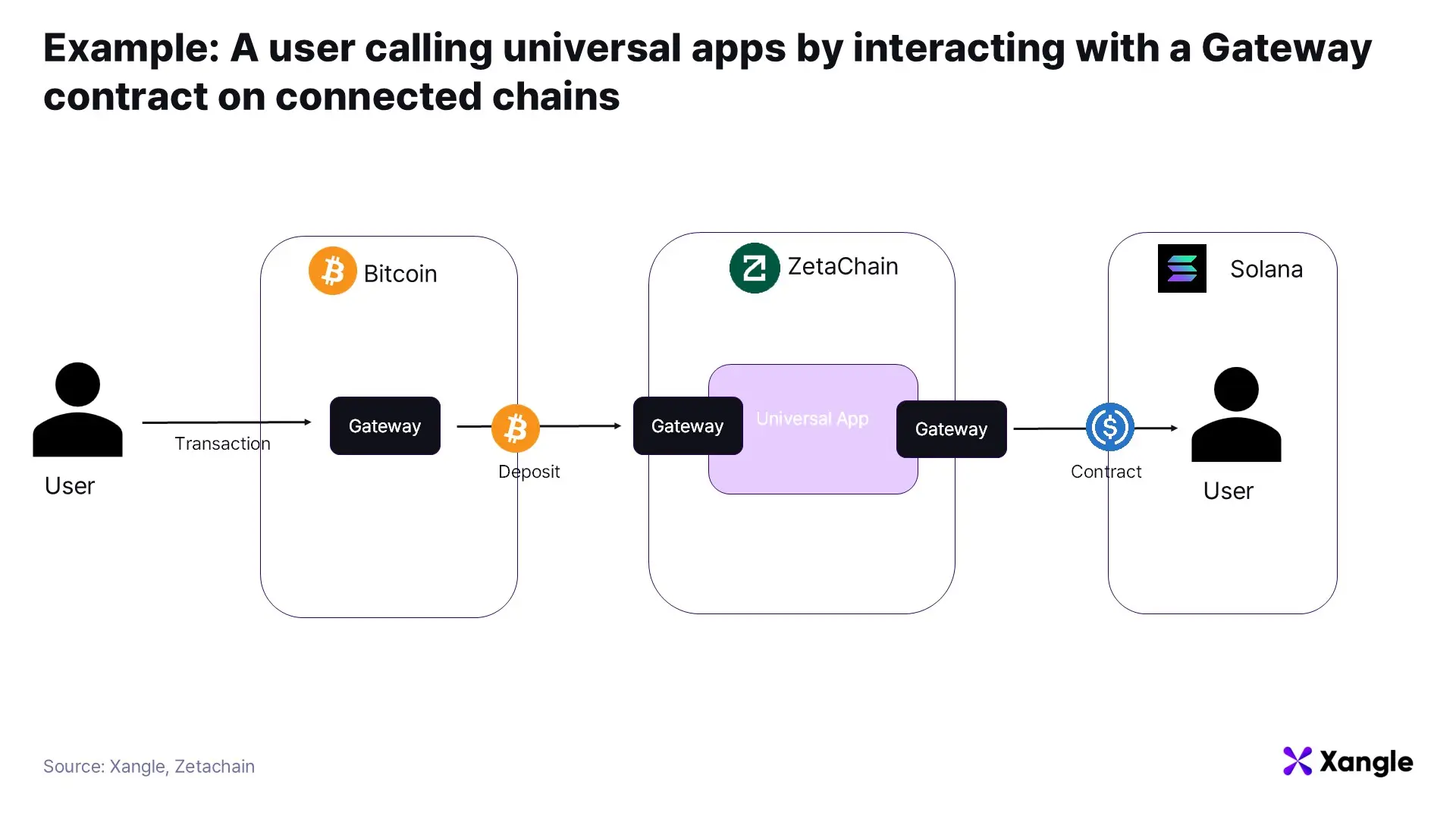
ZetaChain’s universal app is an application that removes the boundaries between blockchain networks and simplifies complex operations across multiple chains. While traditional smart contracts operate on a single blockchain, universal apps can control data and assets across different chains. For instance, users can use Bitcoin as collateral for Ethereum-based DeFi services or access Solana’s NFT marketplace.
In Q4, ZetaChain significantly enhanced the functionality of its universal apps through the Gateway Upgrade. Before this upgrade, developers had to manually manage TSS addresses, custody contracts, and connector contracts to enable cross-chain functionality. The upgrade streamlined these components into a single API, allowing developers to call, deposit, and manage assets seamlessly.
This upgrade introduced three key features:
- Single Gateway Interface: Standardized communication methods across multiple chains, enabling a unified interface to control all chains.
- Direct Management of External Chain Assets and Contracts by Universal App: The
withdrawAndCallcontract now allows assets from external chains (including EOAs) to be withdrawn, called, and reverted upon failure. This eliminates the need for users to manually sign transactions across multiple chains, as the app can autonomously transfer and manipulate assets. - Introduction of Universal NFT and Universal Token Standards: Universal NFT enables native transfers and ownership across multiple chains, while Universal Token introduces a new standard that allows developers to define custom cross-chain logic (minting, burning, transferring) beyond the lock-and-release mechanism of ZRC-20 tokens. This reduces cross-chain complexity and enhances interoperability.
2-2. The first chain to connect Bitcoin, Ethereum, and Solana
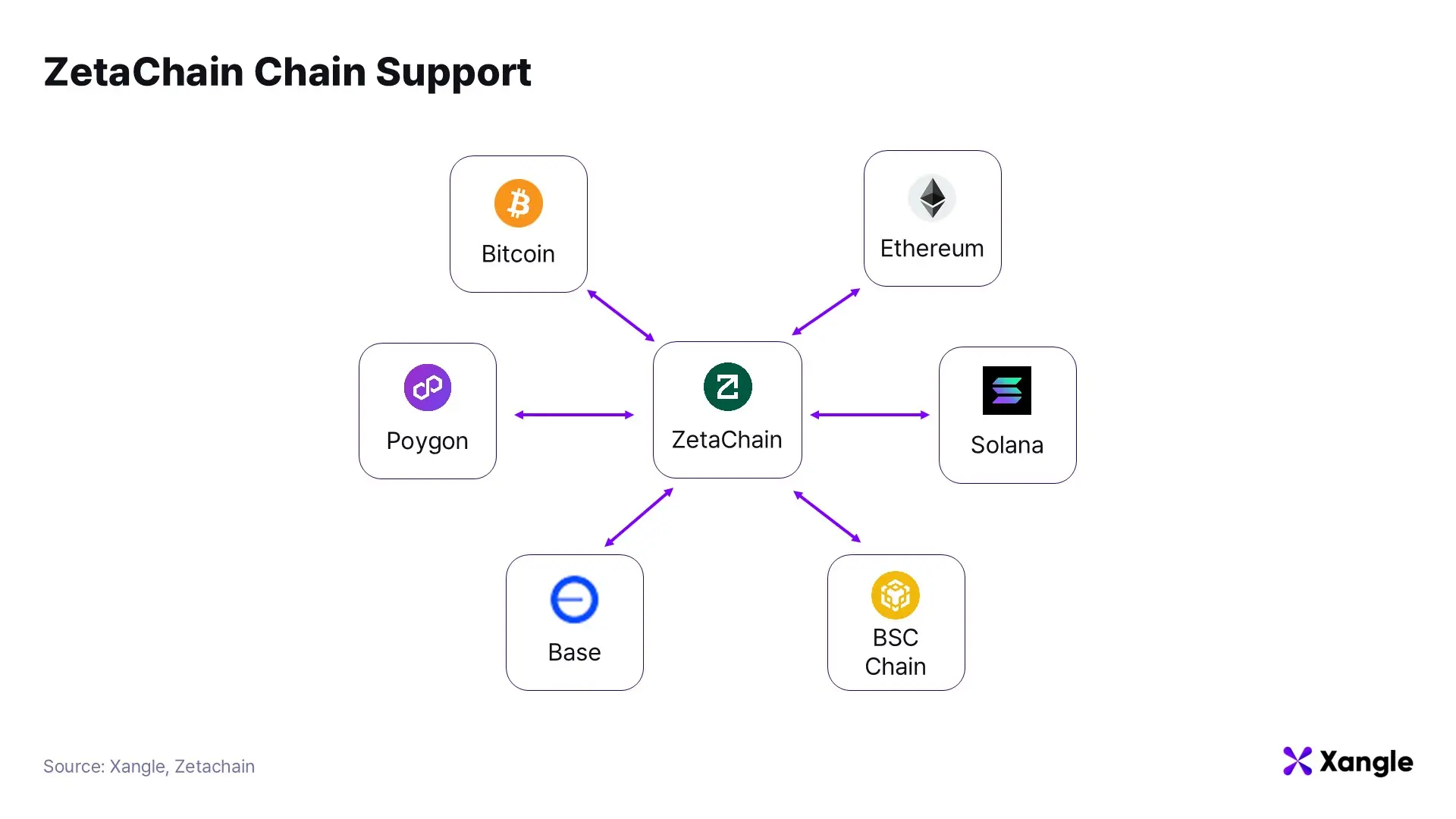
With the integration of Solana, ZetaChain has become the first Layer 1 (L1) blockchain to connect Bitcoin, Ethereum, and Solana—three of the most influential blockchain networks. This integration aligns with ZetaChain’s vision to overcome blockchain fragmentation and enhance interoperability across chains by enabling the seamless use of native assets.
Solana’s contract structure differs from Ethereum’s, presenting interoperability challenges. To address this, ZetaChain introduced signature scheme compatibility and interaction model abstraction for Solana. A signature scheme is a cryptographic method used to authenticate transactions and smart contract executions while maintaining security. Ethereum employs the ECDSA scheme, whereas Solana uses EdDSA—two fundamentally different mechanisms that are inherently incompatible. To bridge this gap, ZetaChain deployed a gateway contract on the Solana network, which verifies ZetaChain-generated signatures and converts them into a format Solana can recognize.
Additionally, ZetaChain has abstracted Solana’s and Ethereum’s primitives into a unified framework. Primitives refer to fundamental blockchain operations such as account creation, asset transfers, and smart contract execution. Since these functions differ across blockchains, ZetaChain standardizes them through a unified interface, allowing users to interact with Solana without manually creating Solana accounts.
By implementing these solutions, ZetaChain enables seamless interaction with Solana without requiring users to switch networks or navigate complex signing processes. Solana’s high throughput and low transaction costs have attracted significant liquidity and user activity, demonstrating strong network performance. This integration is expected to facilitate the inflow of Solana’s liquidity and user base into the ZetaChain ecosystem.
3. On-Chain Performance
Source: ZetaChain
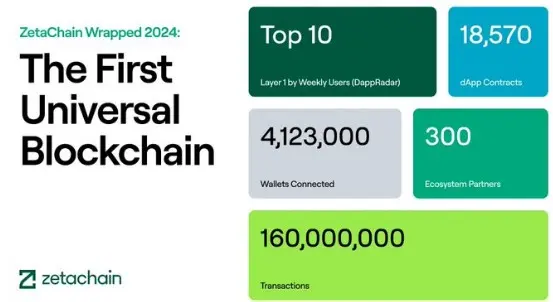
Throughout 2024, the ZetaChain ecosystem recorded several significant milestones. According to DappRadar, ZetaChain ranked 10th among all Layer 1 networks in terms of weekly active users, with over 4 million wallets connected. The network processed more than 160 million transactions and established partnerships with 300 ecosystem projects.
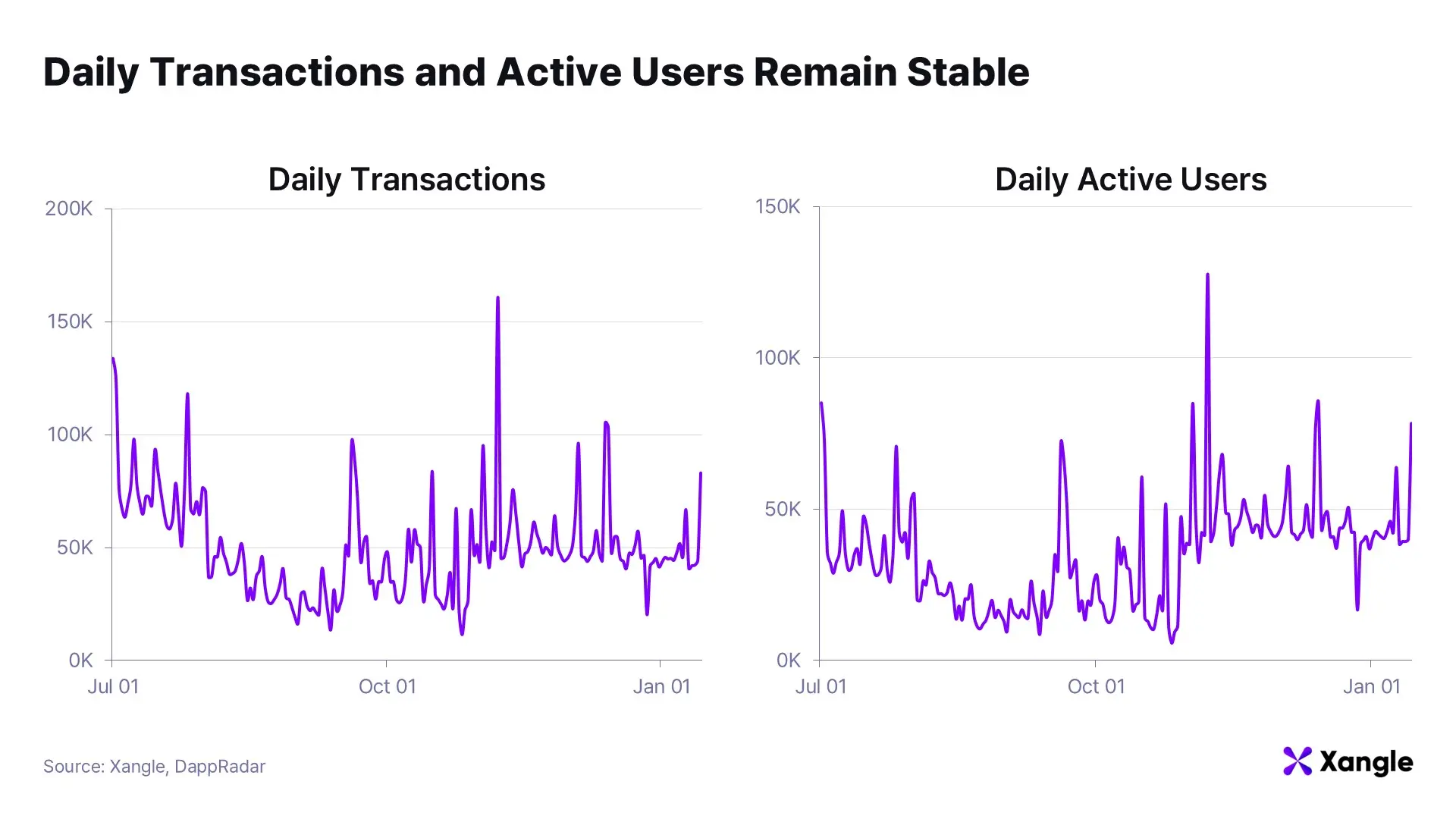
In Q4, ZetaChain’s network performance reflected mixed trends. Daily active users increased by 40% QoQ, while transaction volume saw a slight 3% decline.
Notably, both daily transactions and active users have remained stable since Q4. This trend is largely attributed to ZetaHub’s ongoing rewards program. ZetaHub serves as the central platform within the ZetaChain ecosystem, offering loyalty programs, staking, asset transfers, and data verification. Currently, ZetaHub is running an Instant Rewards program, which allows users to claim rewards immediately upon completing quests. Unlike traditional airdrop programs that drive short-term user spikes, this initiative has contributed to sustained user engagement and retention.
4. Ecosystem Review – Expansion into the Bitcoin Ecosystem
While the ZetaChain ecosystem has been growing rapidly, it is still in its early stages. Throughout 2024, TVL has steadily increased but remains at approximately $18M as of January 21. Additionally, daily transaction volume and active users have generally remained below 100,000, indicating that strategic efforts are needed to drive further expansion.
However, a positive indicator is that active initiatives to expand the ecosystem have been consistently underway. In particular, ZetaChain made a swift expansion into the Bitcoin ecosystem during Q4 and is now set to extend into other sectors, such as social applications and gaming.
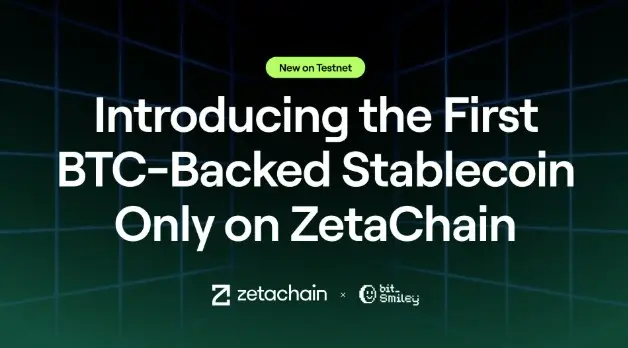
To accelerate its expansion into the Bitcoin ecosystem, ZetaChain has partnered with BitSmiley and Avalon Finance. BitSmiley is a Bitcoin-based stablecoin issuer that allows users to mint bitUSD by depositing native BTC. ZetaChain’s partnership with BitSmiley enables native BTC to be used seamlessly, without requiring wrapped assets or intermediaries. Users who mint bitUSD can deploy it across various cross-chain DeFi applications, such as borrowing against it in the Ethereum ecosystem or swapping it for BNB on the BSC chain.
Source: ZetaChain Blog
Avalon Finance is a DeFi protocol that leverages Bitcoin for lending and stablecoin issuance. Avalon currently holds over $1B in TVL, with $5M on ZetaChain. By utilizing ZetaChain’s Universal Apps, Avalon enables frictionless cross-chain DeFi interactions, such as depositing native BTC as collateral on ZetaChain and borrowing USDC directly to an Ethereum wallet and using native BTC as collateral to borrow SOL, staking the borrowed SOL, and using staking rewards to repay BTC-backed loans.
Source: ZetaChain Blog
These efforts by ZetaChain represent a major step toward breaking down the silos between blockchain ecosystems, allowing native assets to be utilized across multiple chains. In particular, BitSmiley and Avalon Finance play a crucial role in channeling Bitcoin liquidity into ZetaChain, making this expansion highly significant. As these integrations take hold, the ecosystem is poised to become even more robust, with further growth and innovation anticipated.
Disclaimer
I confirm that I have read and understood the following: The information contained in this article is strictly the opinions of the author(s). This article was authored free from any form of coercion or undue influence. The content represents the author's own views and does not represent the official position or opinions of CrossAngle. This article is intended for informational purposes only and should not be construed as investment advice or solicitation. Unless otherwise specified, all users are solely responsible and liable for their own decisions about investments, investment strategies, or the use of products or services. Investment decisions should be made based on the user’s personal investment objectives, circumstances, and financial situation. Please consult a professional financial advisor for more information and guidance. Past returns or projections do not guarantee future results. This article was written at the request of ZetaChain. All content in this article was written independently by the author(s), and neither CrossAngle nor ZetaChain had any editorial control or influence over the content. The author(s) may hold the cryptocurrencies mentioned in this article at the time of writing.
Xangle or its affiliated partners own all copyrights of the written or otherwise produced materials and content provided on the platform. Any illegal reproduction of such content, including, but not limited to, unauthorized editing, copying, reprinting, or redistribution will result in immediate legal actions without prior notice.
![[CIS Partner Summit Highlights] Ault's Financial Super App Strategy: OnlyBulls](https://resource.xangle.io/files/content/C1A19E1DB41B7FB86076143803C40D8E_1790125531662.webp)
![[Xangle RWA Series] Solana RWA: A Look at the Key Players](https://resource.xangle.io/files/content/F779A005246C0299246537AACB3A39F2_1782287059970.webp)