How Tokenization Is Reshaping Stock Trading: Threats and Opportunities for Financial Institutions

Table of Contents
1. Growth and Potential of the Tokenized Stock Market
2. A Tokenized Stock Market Growing Around Crypto Exchanges and DeFi
3. Threats and Opportunities Facing Financial Institutions
4. How Traditional Financial Institutions Are Responding and Regulation Is Taking Shape
5. Conclusion: Why Financial Institutions' Participation Is Becoming Inevitable
1. Growth and Potential of the Tokenized Stock Market
As the Trump administration has made fostering digital assets a policy priority, blockchain-based businesses are expanding quickly in US financial markets, and the regulatory foundation is being built alongside them. The GENIUS Act, which sets rules for the issuance, reserve management and supervision of payment stablecoins, was enacted in July 2025 and takes effect on January 18, 2027. The CLARITY Act, which defines the market structure for digital assets and the supervisory scope of the SEC and CFTC, has passed the House and is pending in the Senate.
Regulators are going a step further by spelling out the conditions under which financial services can be performed onchain. In September 2026, the SEC temporarily and conditionally allowed trading of tokenized US-listed stocks, and the CFTC set out standards for tokenizing assets eligible for customer fund investment and for keeping records on blockchains. Businesses that want to issue and distribute stocks and funds on blockchains are also getting clearer rules for operating within the regulated system.
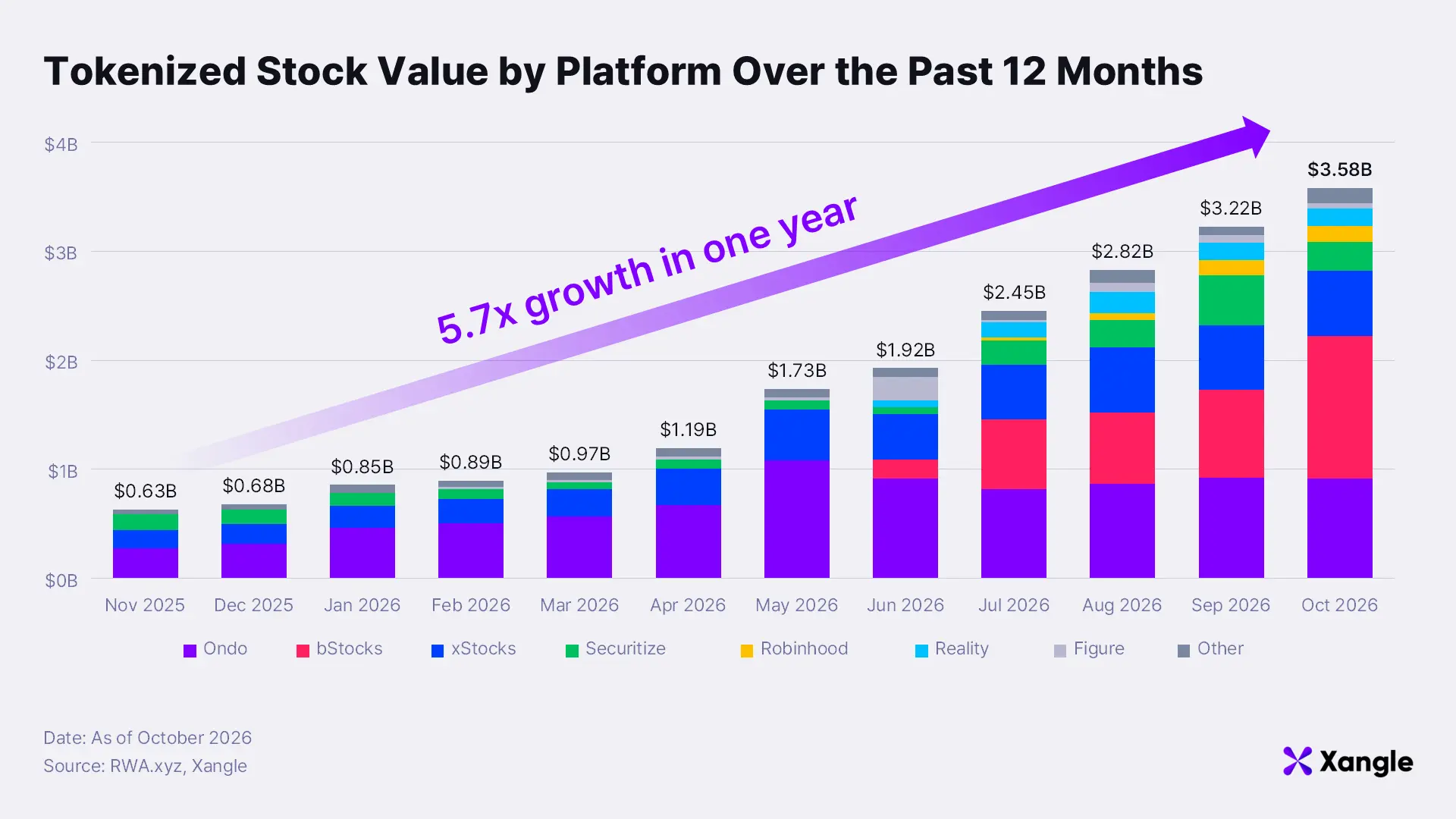
Alongside these regulatory developments, more tokenization platforms are handling tokenized stocks and ETFs. The value issued on these platforms reached $3.58 billion at the end of October 2026, up 5.7x in one year. As issuance grows, so do the services for trading and using stock tokens.
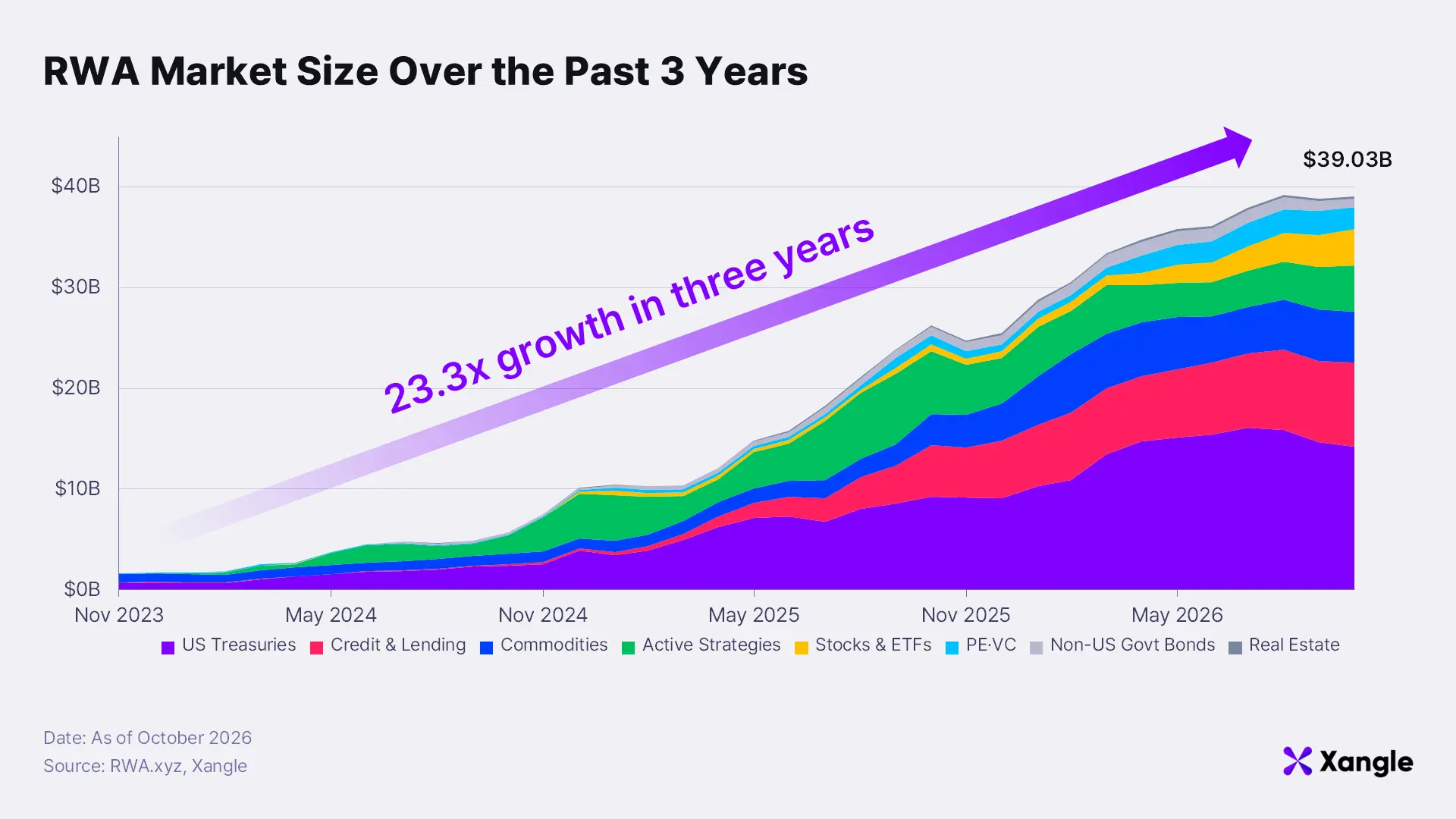
Beyond stocks, other financial assets such as government bonds and funds are also being tokenized. Including these assets, the onchain distributed value of real-world assets (RWAs), excluding stablecoins, has grown about 23.3x over the past three years.
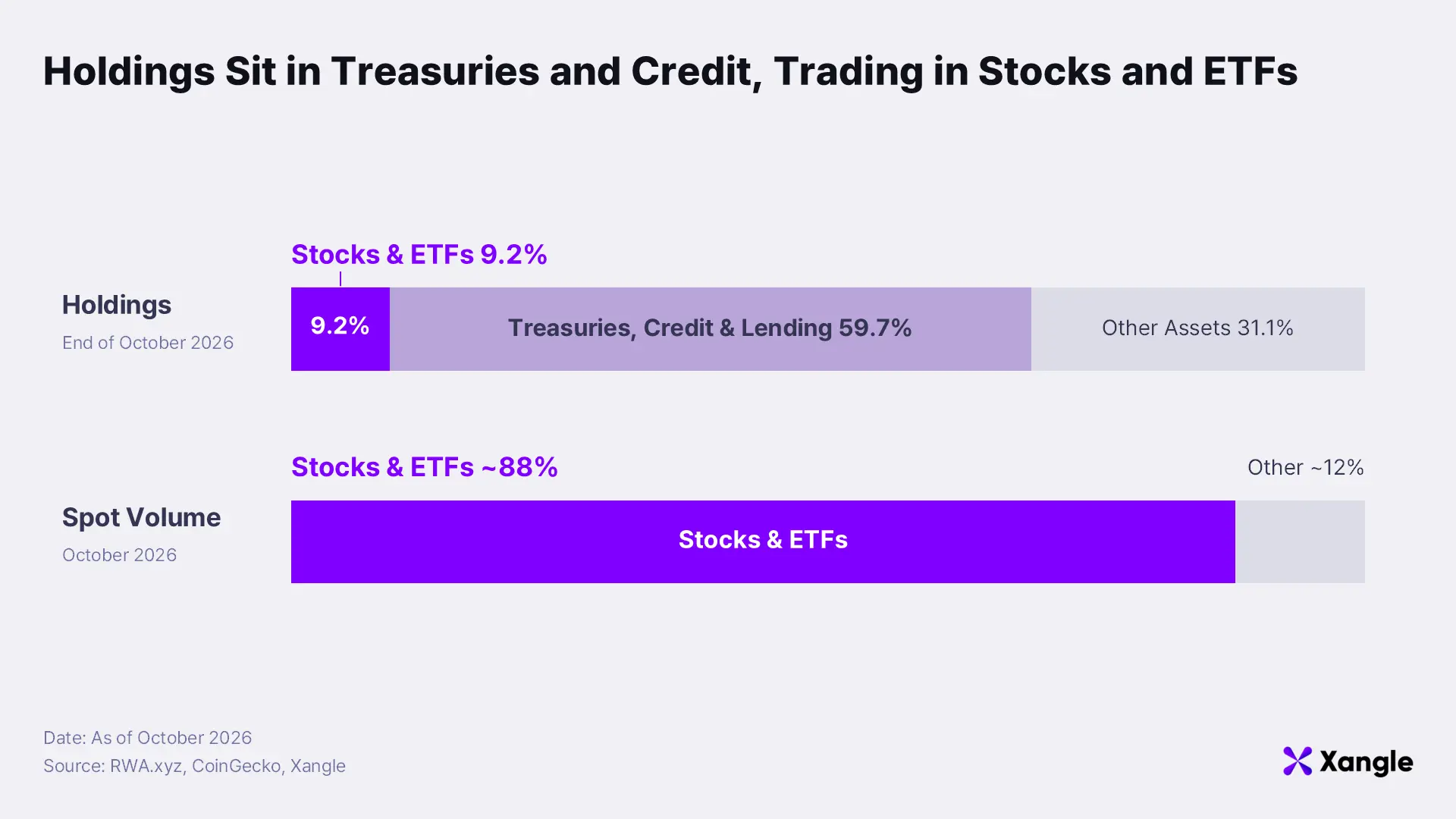
Among these, stocks and ETFs stand out for how actively they trade relative to their issued value. At the end of October, government bonds and credit and lending assets made up about 60% of the distributed value of tokenized assets, but stocks and ETFs accounted for about 88% of RWA spot trading volume in the same month. Because trading demand is strong and can be turned into recurring revenue such as trading fees, financial institutions and trading platforms are paying close attention to the tokenized stock and ETF market.
As more companies handle tokenized stocks and ETFs, competition between brokerages and crypto platforms for customers is intensifying. For incumbent brokerages, new products and services open up opportunities to grow revenue, but if customers move to other platforms, they could also lose existing trading revenue. Whether to seize the opportunity or to retain customers, financial institutions are finding it increasingly difficult to ignore this market.
This report first looks at where tokenized stocks trade and how much, and compares that volume with trading at incumbent brokerages. It then outlines the threats and revenue opportunities this market presents for financial institutions, before reviewing how financial institutions are actually responding and where regulation stands in the US and Korea.
2. A Tokenized Stock Market Growing Around Crypto Exchanges and DeFi
2.1. Spot Trading of Tokenized Stocks
Crypto exchanges and DeFi are the main channels through which investors access tokenized stocks. When issuing platforms such as Ondo, xStocks and bStocks issue tokens backed by US stocks and ETFs, those tokens trade on centralized exchanges (CEXs) and decentralized exchanges (DEXs). Users can buy and sell stock tokens right away with funds already in their trading accounts or blockchain wallets.
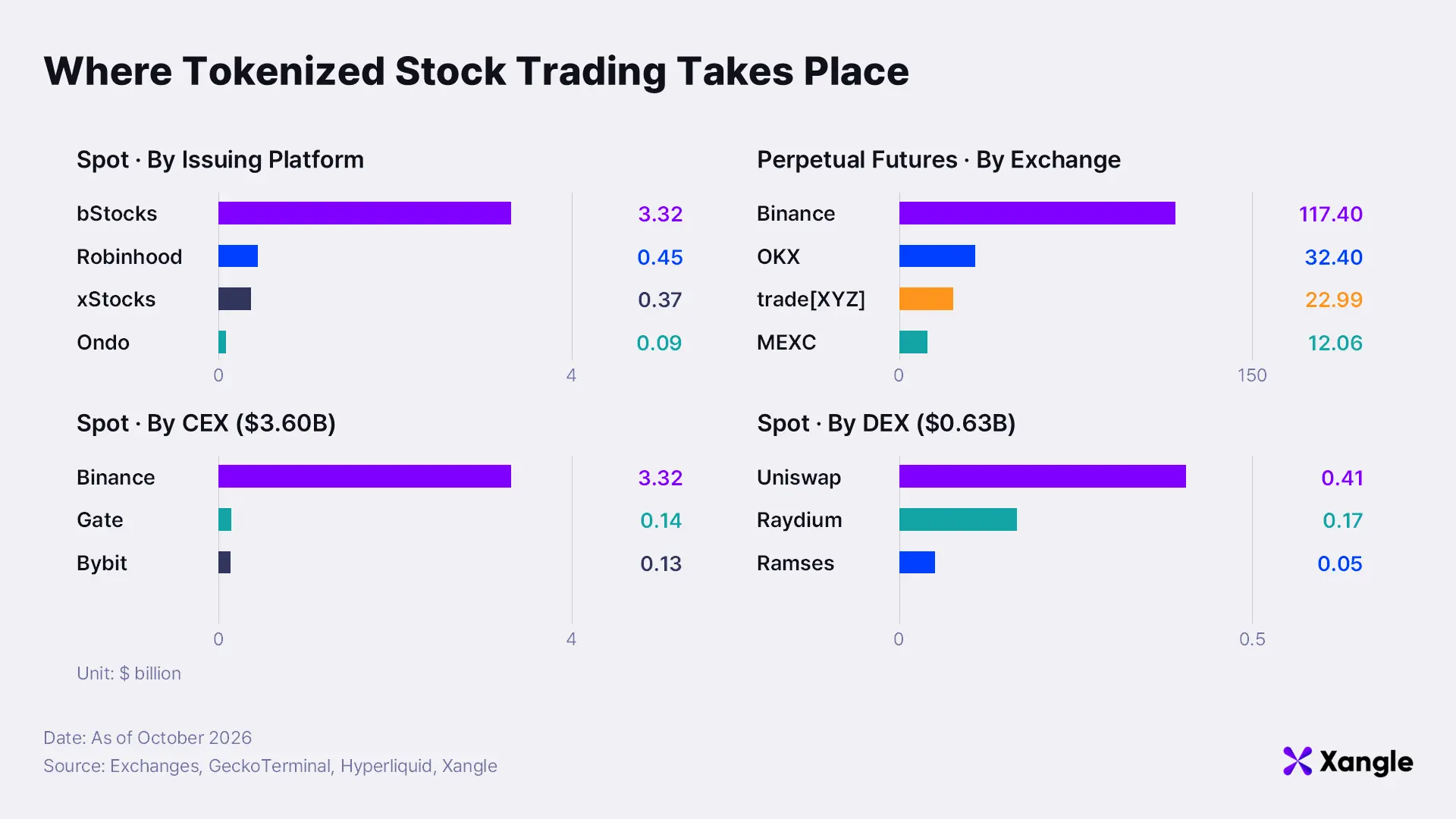
Spot trading volume of tokenized stocks was $4.22 billion in October 2026. Of this, Binance's bStocks and products issued by US online investment platform Robinhood accounted for about 89%. Distribution explains why the two companies hold such a large share: Binance through its exchange, and Robinhood through its investment app and wallet, can deliver the tokens they issue straight to existing customers.
Even when the same US stocks are tokenized, actual trading volume varies widely depending not only on issuance technology but also on the customer base, trading channels and liquidity a company has secured. Distribution of tokenized stocks also extends beyond the issuer. About 15% of spot trading took place on external DEXs, and through such external channels, issuers can reach investors outside their own services and grow demand for their tokenized assets.
2.2. Stock-Linked Perpetual Futures Trading
Crypto exchanges are also drawing in stock investment demand through stock-linked perpetual futures. Binance, OKX and trade[XYZ] are leading examples. Perpetual futures let traders settle gains and losses from stock price moves by posting only collateral, without holding the underlying stock or token, and allow leveraged trading just like existing crypto futures.
Perpetual futures volume already far exceeds spot. In October 2026, notional volume of stock-linked perpetual futures on major platforms was about $184.8 billion, about 44x spot trading in the same month. Because leverage and repeated trading quickly build up volume, these products give exchanges a way to capture customers' stock investment demand and grow trading fee revenue.
They are also easy to add. Spot tokens require buying and holding the underlying stock 1:1 and running an issuance and redemption system, but perpetual futures only need a contract that tracks the stock price on top of an exchange's existing futures collateral and liquidation systems. Users can also invest with their existing accounts and collateral without a separate brokerage account, so both exchanges and customers face little burden in launching and using new products.
A path into the US regulated market is also opening for perpetual futures. On November 3, 2026, the CFTC announced that single-stock perpetual futures can trade on exchanges registered under the SEC and CFTC supervisory framework. If products that have grown on offshore crypto platforms connect with US investors and regulated distribution channels, trading volume is likely to grow further.
2.3. Trading Volume and Growth Compared with Incumbent Brokerages
How large is this market compared with incumbent brokerages? To get an intuitive sense of scale, we combined spot and perpetual futures volume linked to stocks and ETFs and compared it with Robinhood's equity trading volume.
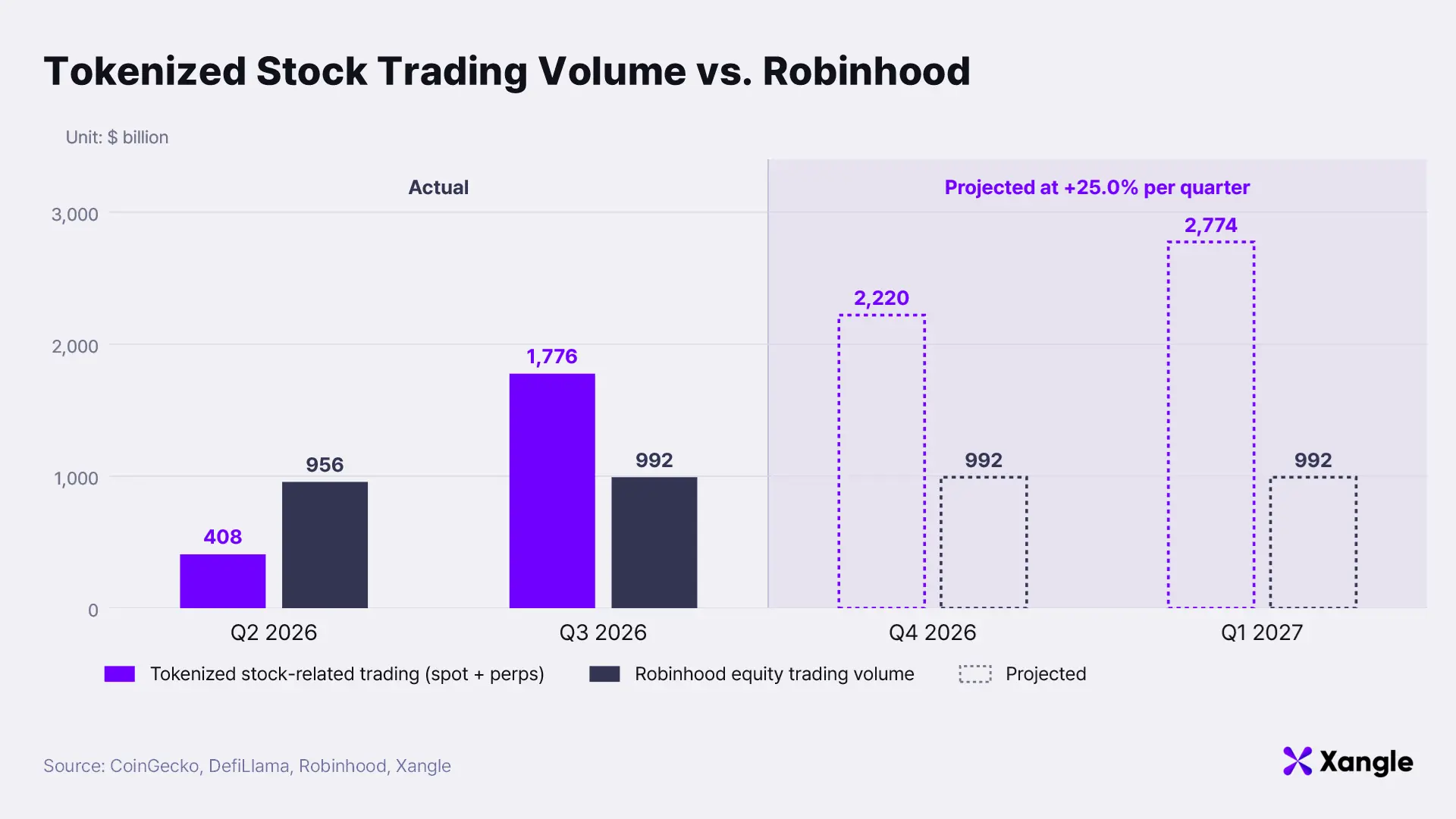
In Q3 2026, spot and perpetual futures volume related to tokenized stocks was about $1.78 trillion, about 1.79x Robinhood's equity trading volume of $991.8 billion in the same quarter. However, most of the combined total is the notional volume of perpetual futures, which reflects leverage. It is therefore better read as a reference indicator of how much trading the stock investment demand of crypto users generates, rather than as a one-to-one comparison with spot stock trading at brokerages.
Growth is also fast. Combined monthly volume rose 50.5% between June and September 2026. Assuming that growth in this early market gradually slows to 25% per quarter, about half that pace, over the next two quarters, quarterly volume would rise to about $2.22 trillion in Q4 2026 and about $2.77 trillion in Q1 2027. If Robinhood's trading stays at its Q3 level, the gap between the two would widen to about 2.80x.
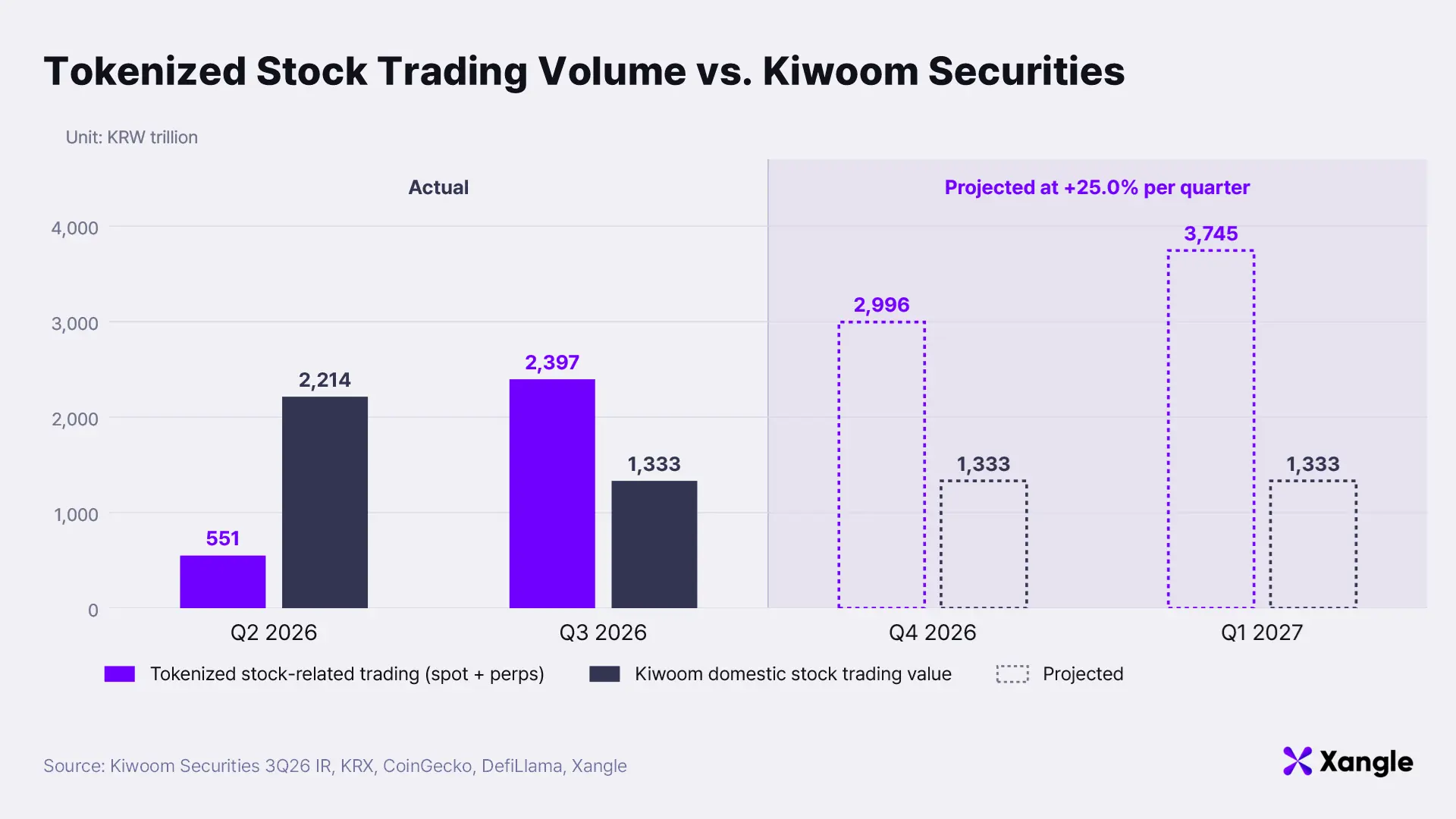
The comparison with a Korean brokerage points the same way. Kiwoom Securities' domestic stock trading value in Q3 2026 was about KRW 1,333 trillion, based on a daily average of KRW 21.5 trillion over 62 trading days. Converted at a fixed rate of KRW 1,350 per US dollar, global tokenized stock-related trading volume comes to about KRW 2,397 trillion, about 1.80x Kiwoom's domestic stock trading value. Applying the same growth assumption, the ratio would rise to about 2.81x in Q1 2027 if Kiwoom's trading holds steady.
Recent trends are even more contrasting. On a quarterly basis, Kiwoom's domestic stock trading value fell 39.8% from Q2 to Q3, while tokenized stock-related trading volume in KRW terms rose 334.8% over the same period. Even as domestic stock brokerage slowed, stock-related trading on global spot and futures platforms grew rapidly. Demand that growth in existing markets alone cannot explain is forming in new products and distribution channels, and this demand is both a threat and an opportunity for financial institutions.
3. Threats and Opportunities Facing Financial Institutions
3.1. Crypto Platforms Moving into Stock Brokerage
Crypto platforms that captured this demand first are now expanding into regular stock trading. Kraken and Coinbase, two of the leading US crypto exchanges, offer US stock and ETF trading through broker-dealers that are registered with the SEC and are members of the Financial Industry Regulatory Authority (FINRA). As customers who traded crypto can now invest in stocks on the same platform, the area in which these platforms compete with incumbent brokerages for customers is growing.
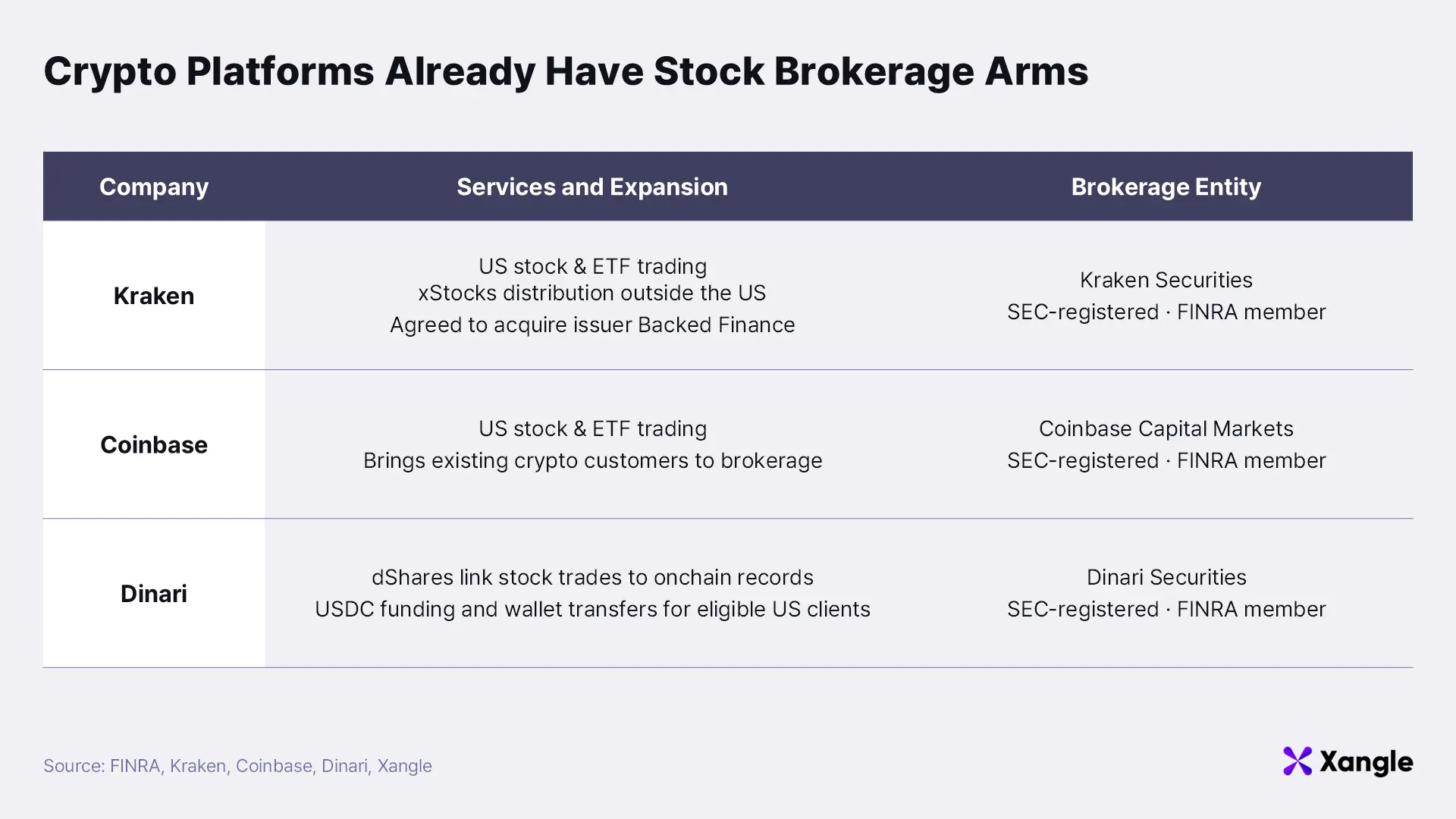
Kraken offers stock and ETF trading in the US through its broker-dealer Kraken Securities, and distributes xStocks stock tokens outside the US. It has also agreed to acquire Backed Finance, the issuer of xStocks. The move shows Kraken aiming to run not only order routing but also the issuance and distribution of tokenized products.
Coinbase also offers stock and ETF trading through its broker-dealer Coinbase Capital Markets. Existing crypto customers can open a brokerage account directly within Coinbase, broadening what they can invest in without moving to a separate brokerage app. The customer base a crypto platform has built effectively becomes a distribution network for stock brokerage.
Tokenized stock issuer Dinari connects the two markets even more directly. Through its subsidiary Dinari Securities, which obtained broker-dealer status in June 2025, it offers stock trading to eligible US customers, who can fund their accounts with USDC, a dollar-pegged stablecoin. Stock positions are represented as dShares recorded on blockchains and can be moved to personal wallets. As more businesses combine brokerage licenses with tokenization services, brokerages' competition is expanding beyond crypto exchanges to token issuers.
3.2. Diverse Revenue Opportunities from the Growth of Tokenized Stocks
At the same time, this market is a new source of revenue for financial institutions. As tokenized stocks grow, revenue opportunities are emerging not only in trading fees but also in token issuance and management, collateralized lending and DeFi use.
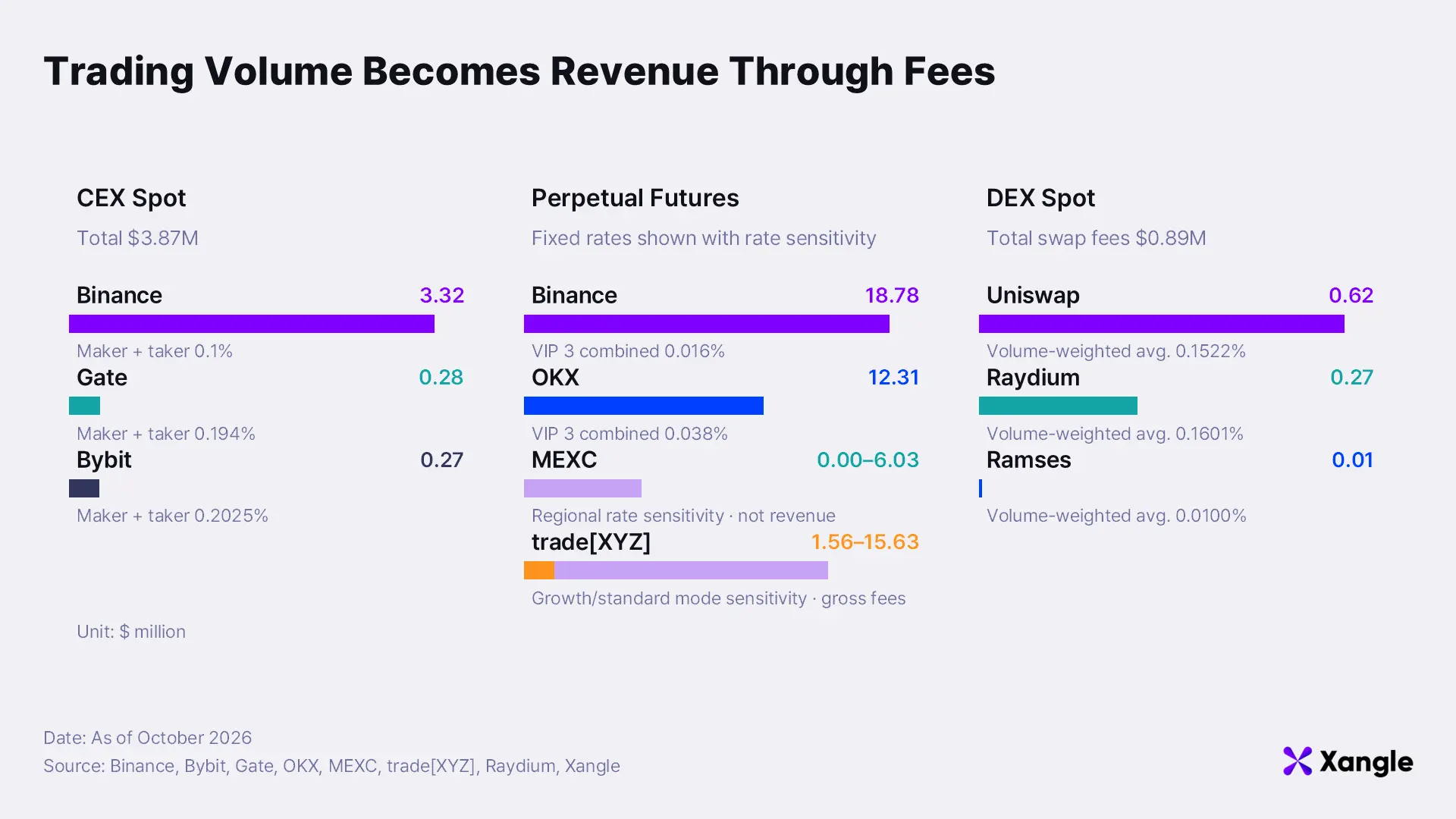
The most direct source of revenue is trading fees. Applying each exchange's fee rate to published trading volume gives an estimate of how much fee revenue current trading demand produces. Monthly fees on CEX spot come to about $3.87 million, and perpetual futures fees reach about $18.78 million at Binance alone. Monthly swap fees on DEX spot amount to about $0.89 million, part of which goes to liquidity providers (LPs) who supply the assets needed for trading.
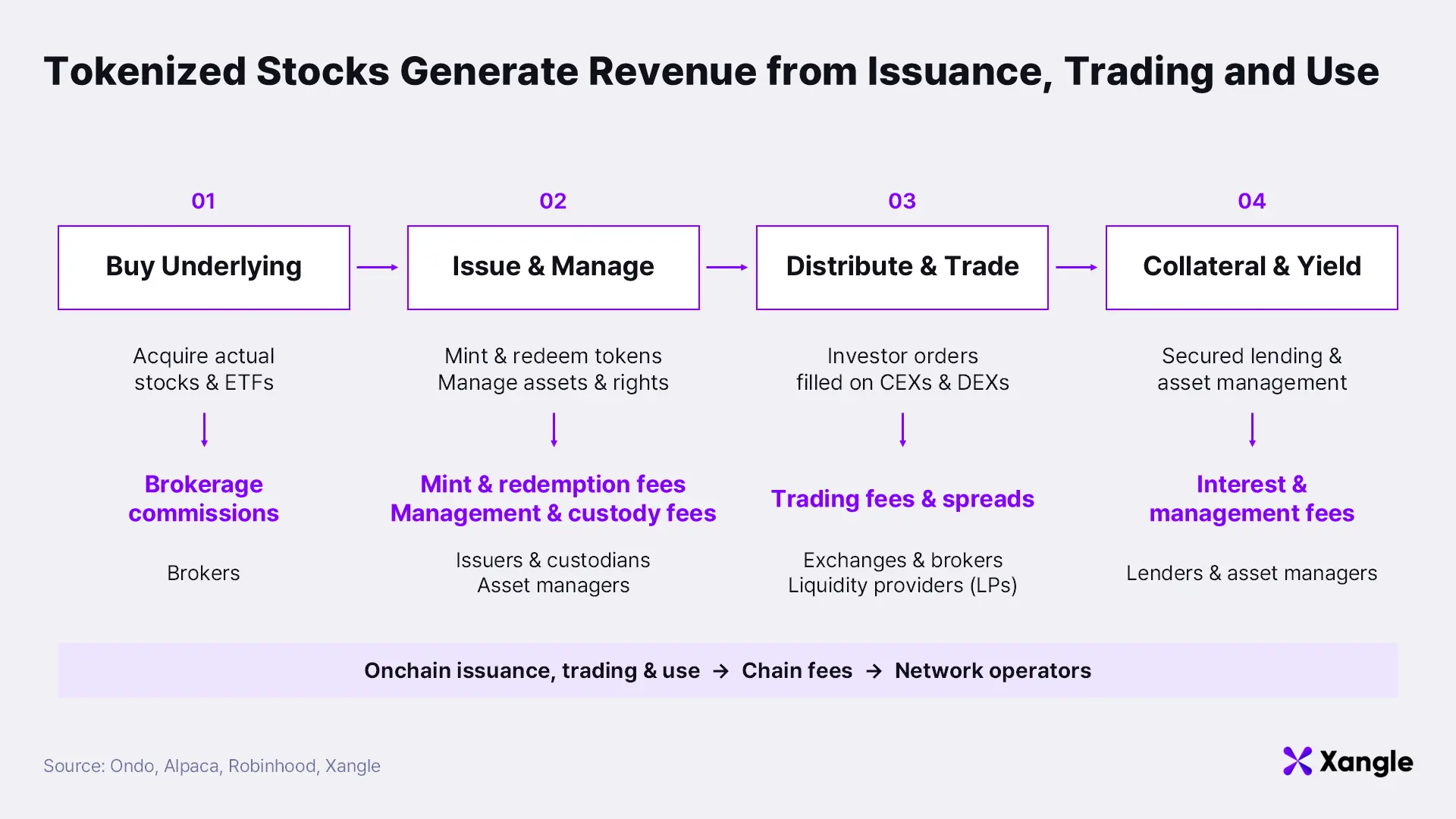
Beyond direct trading fees, supplying and managing tokens also generates revenue. Spot tokens backed by underlying stocks involve buying and holding actual shares and handling rights such as dividends, and the businesses that take on this work can earn brokerage and custody fees or issuance and redemption fees. When money flows into underlying ETFs or funds through tokens, the management fees earned by asset managers also increase.
Issued tokens generate revenue not only when they are traded but also when they are used for collateralized lending or in DeFi. DeFi lending service Kamino lets users borrow stablecoins against xStocks as collateral. Token holders can raise funds without selling their assets, and participants who supply loan funds earn interest. The blockchains that process this trading and collateral use also collect network fees.
In short, tokenized stocks can generate revenue for multiple businesses at every stage, from issuance to trading to the use of held assets. With government bonds, MMFs and credit and lending assets also being tokenized, the range of assets to which these revenue opportunities apply keeps widening. Revenue sources and fee structures by business model are covered in detail in “Business Models in the Tokenized Stock Market.”
4. How Traditional Financial Institutions Are Responding and Regulation Is Taking Shape
4.1. How Far Have Financial Institutions Come in Tokenization?
As threats and revenue opportunities grow together, traditional financial institutions' entry is turning into concrete businesses. Asset managers, brokerages, exchanges and depositories are taking part with their own products and infrastructure, and in the US, fund operations, token issuance and even live trade testing have taken place. Major Korean financial institutions are also preparing to enter the market through partnerships with overseas tokenization firms.
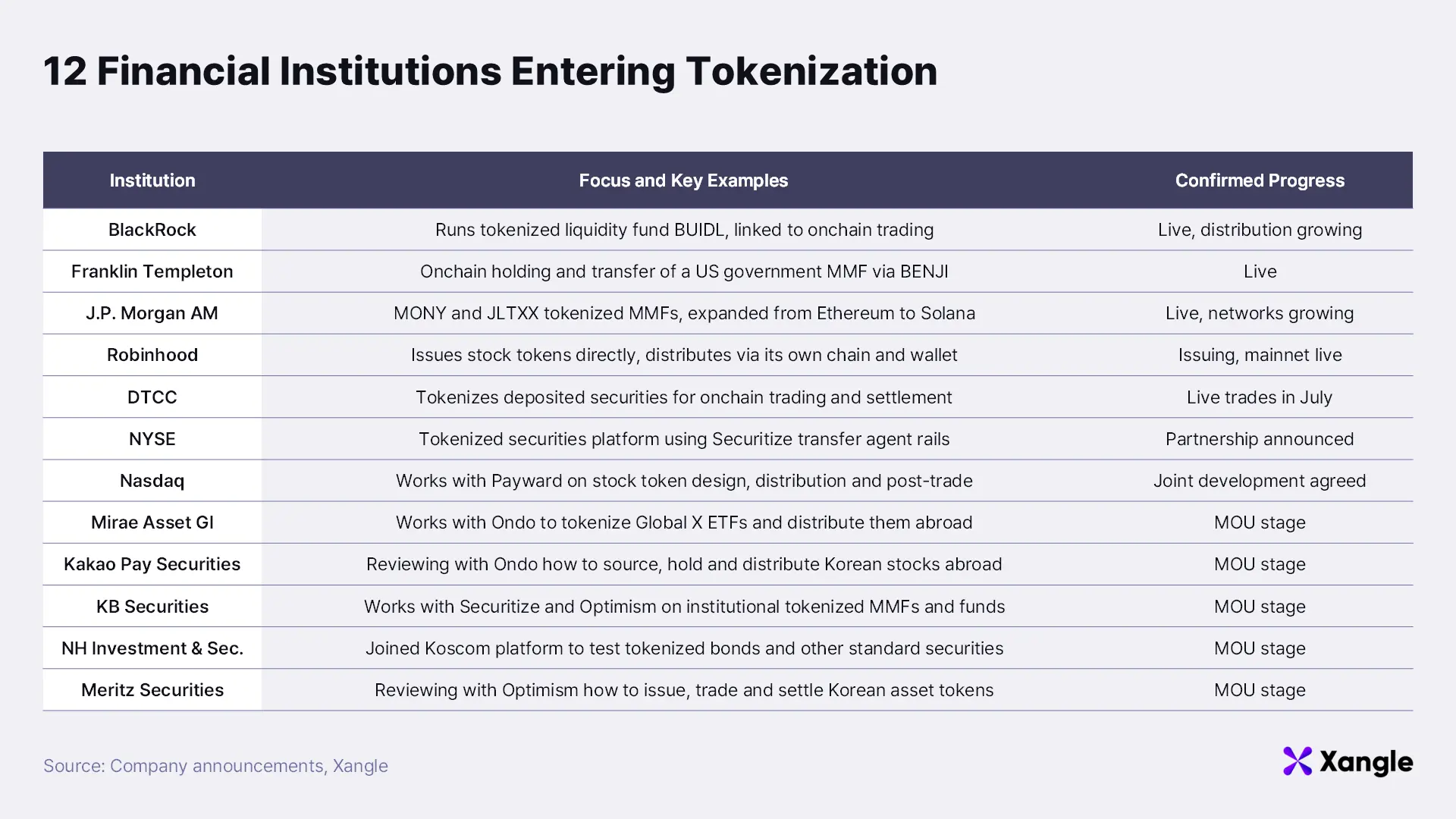
US asset managers already run tokenized funds. BlackRock operates BUIDL, a tokenized liquidity fund, and Franklin Templeton runs BENJI, which lets investors hold and transfer shares of a US government MMF on blockchains. J.P. Morgan Asset Management also runs tokenized MMFs and is expanding the networks on which they are offered.
Depositories have moved into live transactions, and exchanges are working on joint development. DTCC, the US securities depository and settlement infrastructure provider, converted deposited securities into tokens and used them in live transactions in July 2026, with more than 30 institutions and companies participating. The New York Stock Exchange (NYSE) is working with tokenization infrastructure firm Securitize to develop a tokenized securities trading platform, and Nasdaq plans to jointly develop tokenized stocks and trading infrastructure with crypto company Payward.
In Korea, asset managers and brokerages continue to form partnerships. Mirae Asset Global Investments signed an MOU with Ondo to tokenize Global X ETFs, and Kakao Pay Securities signed one with Ondo to source and hold Korean stocks and distribute them overseas. The scope of cooperation among Korean financial institutions covers stocks and ETFs as well as MMFs, funds, bonds and issuance and distribution infrastructure. However, because the relevant amended law has yet to take effect and detailed rules are still being prepared, most remain at the MOU stage.
4.2. Robinhood: From Token Issuance to Financial Services
Some financial institutions go beyond developing and supplying products to directly handle token issuance, distribution networks and even blockchain operations. Robinhood is the leading example. Having offered trading in stocks, ETFs, options and crypto, Robinhood now issues its own stock tokens, Stock Tokens, operates its own blockchain, Robinhood Chain, and has secured touchpoints through which customers trade and manage their assets via its wallet and financial products.
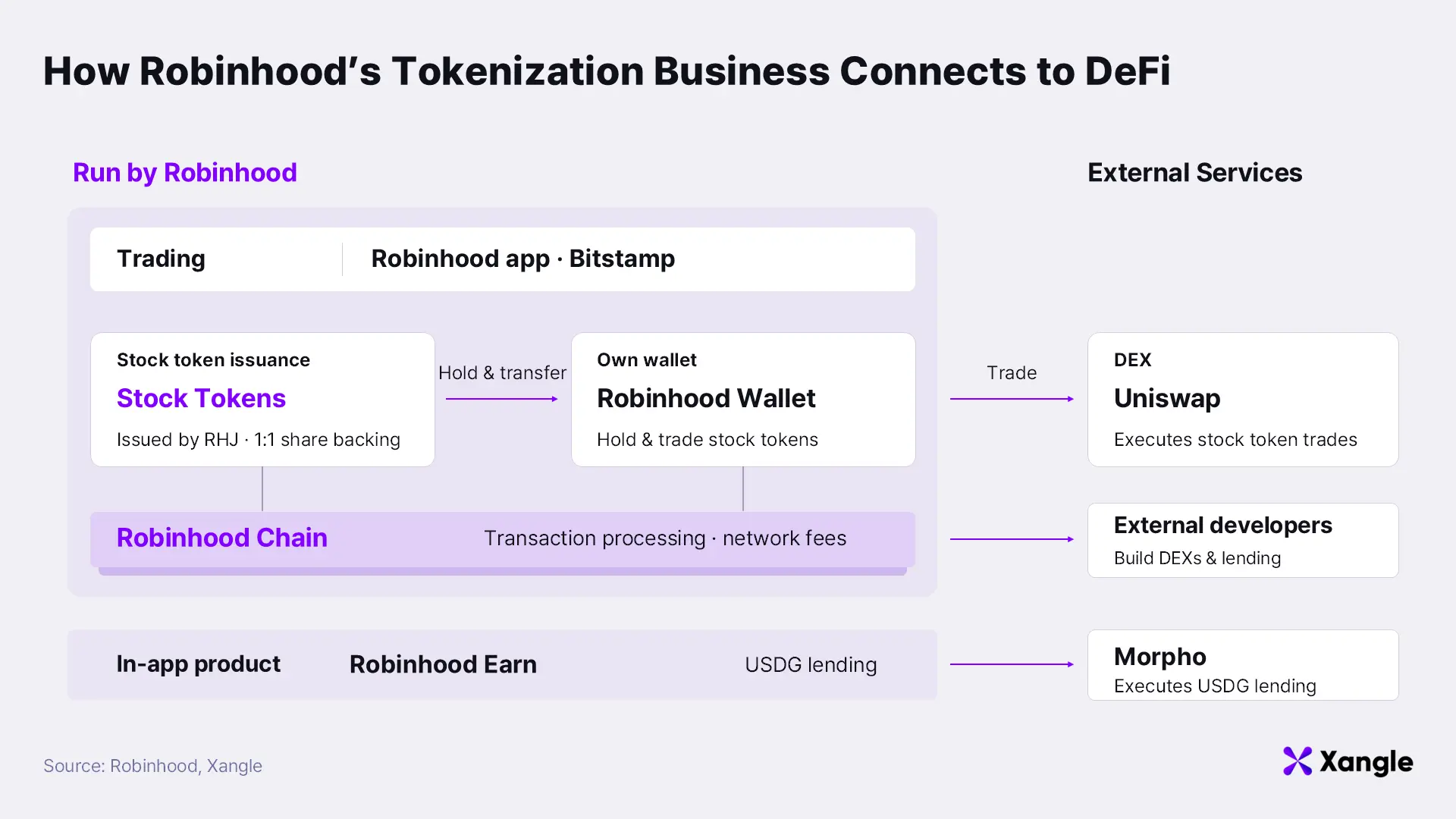
Stock Tokens are issued by its subsidiary Robinhood Assets (Jersey) Limited and backed 1:1 by underlying shares held by a US custody partner. Legally, they are debt securities linked to the performance of the underlying shares. Dividends and stock splits are reflected by adjusting the number of shares each token represents, but holders do not receive shareholder rights such as voting rights.
These tokens trade on Robinhood Chain, which Robinhood operates. It is a layer 2 blockchain built with Arbitrum technology that processes transactions quickly and cheaply on its own network and posts transaction records to Ethereum for security. Its mainnet launched on July 1, 2026, and external developers can also build decentralized exchanges or lending services that accept stock tokens as collateral on top of it.
Robinhood has also broadened its customer touchpoints with a wallet and a crypto exchange. Its own wallet, Robinhood Wallet, lets users hold and transfer stock tokens and trade them by connecting to decentralized exchanges such as Uniswap. Beyond its existing investment app, Robinhood added another trading channel by acquiring crypto exchange Bitstamp.
Robinhood Earn, offered in its investment app, lets users lend USDG, a dollar-pegged stablecoin, and earn interest, while the actual lending takes place on Morpho, an external DeFi lending protocol. Robinhood runs the customer-facing front end itself and leaves trading and lending to external exchanges and lending services.
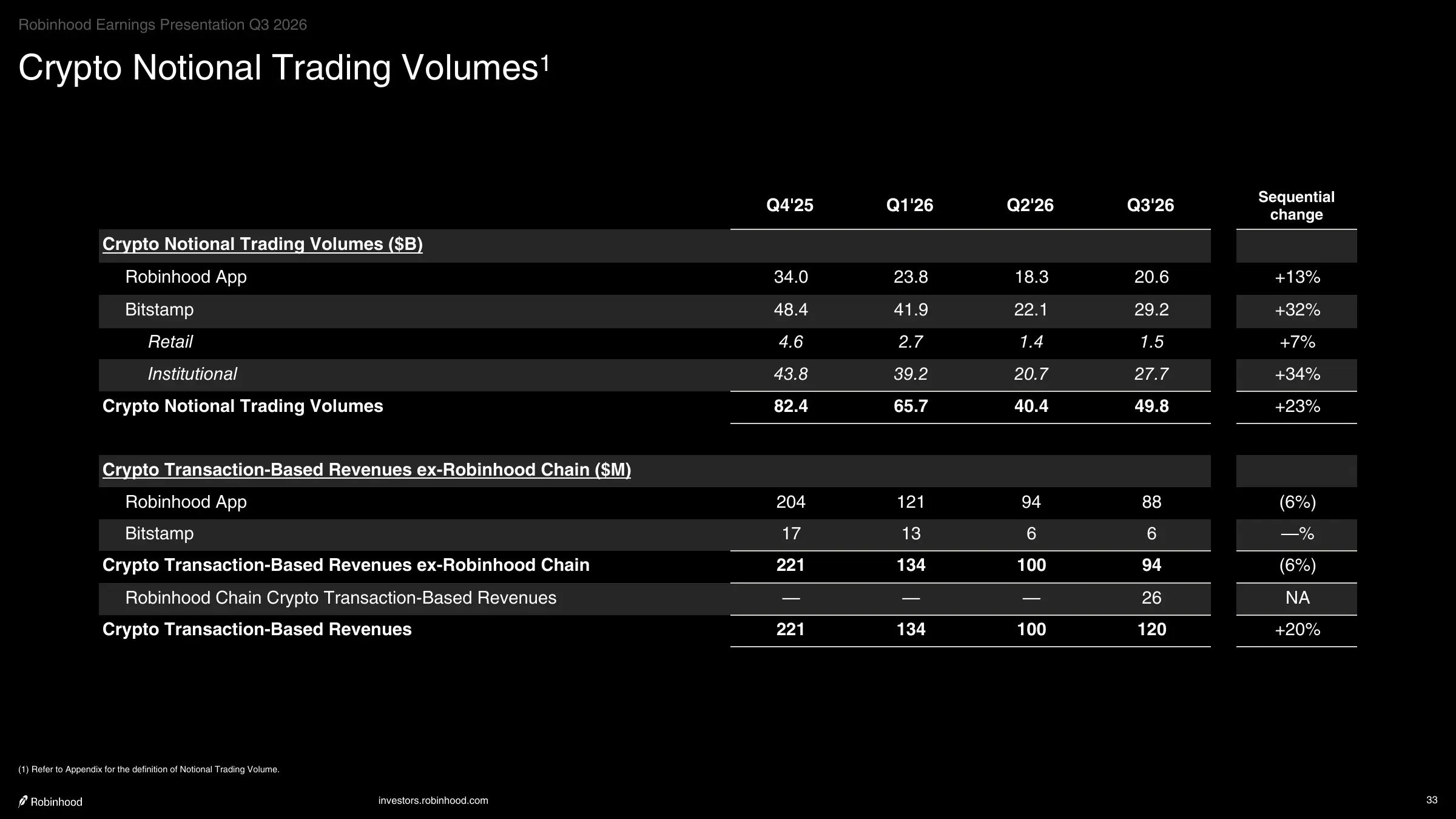
This expansion is already turning into revenue. In Q3 2026, its first quarter after the mainnet launch, Robinhood Chain recorded more than $80 billion in DEX volume and more than $50 million in chain fees. Robinhood shares with its launch partners the revenue from sequencer operations, which batch and process transactions, and its share rises from an initial 50% to 70% and 85% based on cumulative performance. Posting transaction records to Ethereum and running the chain carry costs, but the more the network is used, the more fees accumulate and the larger Robinhood's share becomes.
That said, Q3 trading was boosted in part by a surge of interest in memecoins linked to stock tokens. As pairing memecoins with stock tokens became a trend, memecoin trading accounted for about 79% of DEX volume in July. Average daily volume of trading pairs combining memecoins and stock tokens peaked at about $440 million in early September, then plunged 96% from that high.
In Q3, Robinhood recognized $26 million in net revenue from Robinhood Chain. Crypto transaction-based revenue excluding the chain fell from $100 million in the previous quarter to $94 million, but with chain revenue added, total crypto transaction-based revenue rose 20% to $120 million. Robinhood is not stopping at order routing: it is turning token issuance and distribution, and even network use by external DeFi, into revenue. The memecoin frenzy has already cooled, but this revenue structure shows how large the business opportunities from tokenization can be for financial institutions.
4.3. US Business Expansion and Korea's Preparations for Commercialization
The tokenized products and services financial institutions can offer depend on each country's regulations. The US has conditionally allowed tokenization from securities infrastructure through to trading, while Korea has finished amending its law and is preparing to implement it.
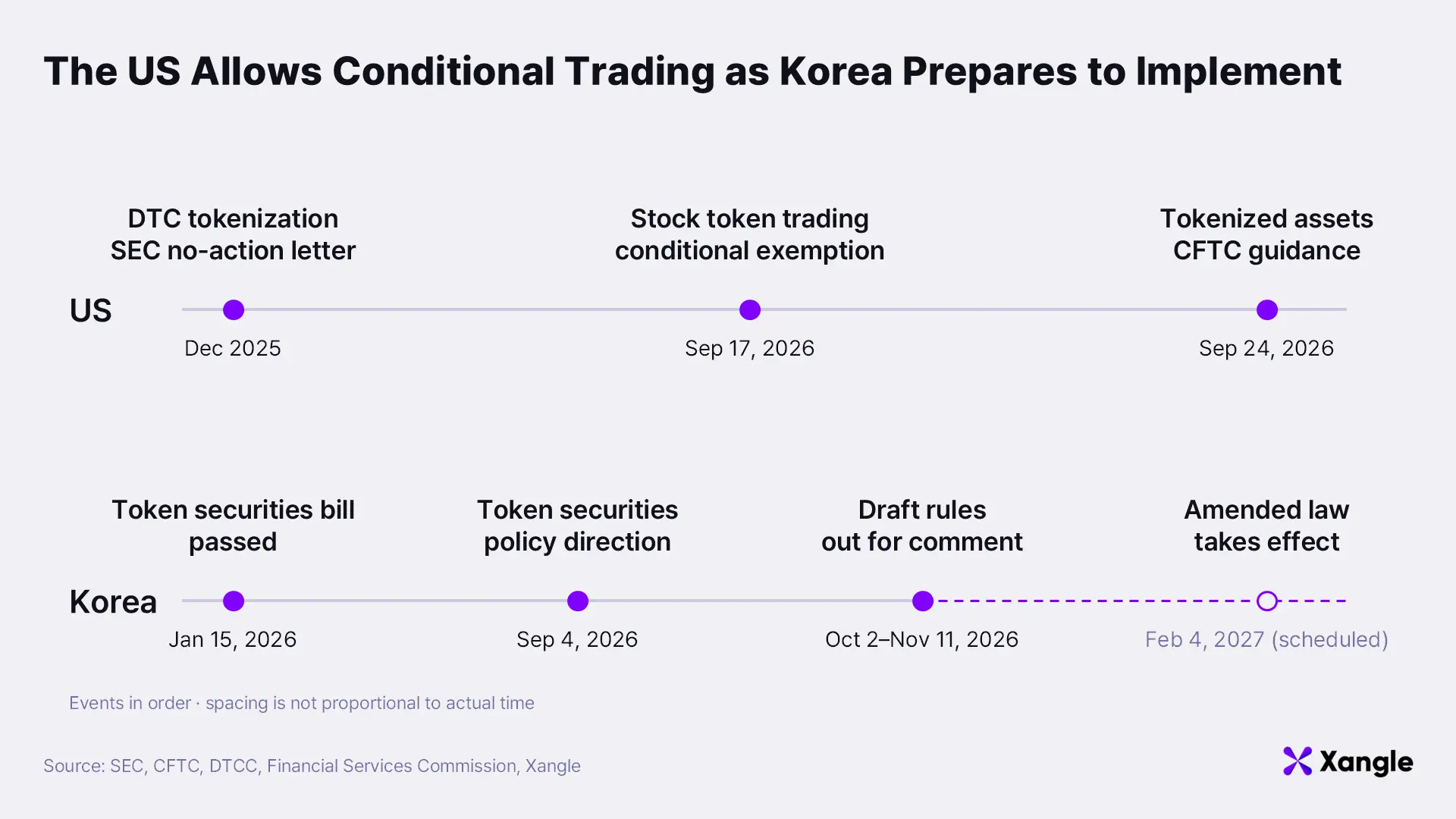
In the US, the SEC issued a no-action letter in December 2025 allowing DTC, the depository under DTCC, to offer securities tokenization services. Then on September 17, 2026, it applied a temporary conditional exemption to stock token trading, allowing eligible investors to buy and sell qualifying tokenized listed stocks in automated trading pools. The tokens must carry the same rights as the underlying shares, and token trading must stop whenever trading in the underlying stock is halted. A week later, the CFTC also clarified standards for tokenizing assets eligible for customer fund investment and for keeping records on blockchains.
Even when trading happens onchain, ownership records and rights such as dividends must still be handled to regulated standards. That is why the work long done by brokerages, custodians and transfer agents is also needed for tokenized trading. In turn, bringing tokenized stock trading into the regulated system gives incumbent financial institutions an opportunity to supply their assets and securities services to new platforms.
In Korea, the legal basis was established when the National Assembly passed amendments on token securities on January 15, 2026. The amendments cover the range of securities that can be issued, requirements for distributed ledgers, requirements for issuers to manage investor accounts directly, and the authorization and trading limits of OTC exchanges. The Financial Services Commission then announced its policy direction on token securities in September and published draft subordinate regulations for public comment from October 2 to November 11. The amended law is scheduled to take effect on February 4, 2027, and the detailed rules and systems needed for actual business must be in place before then.
While regulations are being finalized, Korean financial institutions are signing MOUs with overseas firms and reviewing product supply and distribution structures. However, until domestic issuance and distribution systems are up and running, this preparation will be hard to turn into actual products and business. While the US is already expanding products and trading infrastructure, Korea is still putting business conditions in place, so the gap between the two markets is likely to widen for some time.
5. Conclusion: Why Financial Institutions' Participation Is Becoming Inevitable
Stock-related trading on crypto platforms already exceeds the stock trading volume of major brokerages in both the US and Korea. To protect existing customers and revenue bases and capture new demand, financial institutions are finding participation in the tokenization market increasingly hard to avoid. There are three reasons.
First, competition for customers is spreading to crypto platforms. A sizable volume of stock-related trading already takes place on these platforms, and Kraken and Coinbase have entered regular stock brokerage. Now that investors can invest in stocks within the crypto services they already use, brokerages have a growing need to protect existing customers' trading and to add touchpoints for reaching new investors.
Second, revenue opportunities are expanding beyond trading to product supply and asset use. By supplying funds and ETFs as tokens, asset managers and brokerages can secure crypto exchanges and wallets as new sales channels, and as money flows in through tokens, management fees also grow. When issued tokens are used for collateralized lending or in DeFi, they generate revenue such as interest and network fees in addition to trading fees.
Third, the more tokenized trading grows, the greater the demand for the securities services that handle underlying assets. Spot tokens backed by underlying stocks involve buying and holding actual shares and handling rights such as dividends. Just as securities infrastructure provider Alpaca offers brokerage, custody and clearing of underlying stocks to issuers such as Ondo, custody, clearing and rights processing for tokenization firms become a business in their own right. Brokerages, custodians and transfer agents can connect their existing services to this demand to create new revenue.
How institutions participate will depend on their strengths. Brokerages can distribute tokenized products directly, asset managers can broaden the sales channels for their funds, and some firms may, like Robinhood, take on issuance and network operations. Commercialization timing will differ with the pace of regulation in each country, but competition to secure customers and revenue bases will keep drawing financial institutions in. Before the gap with the US widens further, Korean financial institutions, with the amended law about to take effect, need to move quickly to turn their MOUs into actual products and business.
Disclaimer
I confirm that I have read and understood the following: The information contained in this article is strictly the opinions of the author(s). This article was authored free from any form of coercion or undue influence. The content represents the author's own views and does not represent the official position or opinions of CrossAngle. This article is intended for informational purposes only and should not be construed as investment advice or solicitation. Unless otherwise specified, all users are solely responsible and liable for their own decisions about investments, investment strategies, or the use of products or services. Investment decisions should be made based on the user’s personal investment objectives, circumstances, and financial situation. Please consult a professional financial advisor for more information and guidance. Past returns or projections do not guarantee future results.
Xangle or its affiliated partners own all copyrights of the written or otherwise produced materials and content provided on the platform. Any illegal reproduction of such content, including, but not limited to, unauthorized editing, copying, reprinting, or redistribution will result in immediate legal actions without prior notice.