BOB: From Bitcoin to Onchain Financial Infrastructure

Table of Contents
1. Bitcoin’s Expanding Role Beyond a Store of Value
2. BOB Gateway: Connecting Native BTC to DeFi
3. BOB’s Expansion into Onchain Financial Infrastructure
4. Conclusion: From a Bitcoin Gateway to Onchain Financial Infrastructure
1. Bitcoin’s Expanding Role Beyond a Store of Value
Bitcoin is the largest crypto asset by market capitalization and has gained a place in traditional financial markets as an asset to invest in and hold. The approval of spot Bitcoin exchange-traded funds (ETFs) for listing and trading in the United States in January 2024 broadened access through brokerage accounts. As of October 19, 2026, BlackRock’s spot Bitcoin ETF, IBIT, held approximately $65.7 billion in net assets. National policies for long-term holdings have also emerged. In March 2025, the United States issued an executive order to place holdings including finally forfeited Bitcoin in a strategic reserve and, as a rule, prohibit their sale. As Bitcoin’s role expands from the underlying asset of investment products to a national reserve asset, both its holder base and the reasons for holding it are broadening.
Bitcoin is discussed alongside gold as a store of value, supported by its scarcity and demand from long-term holders. Holders can keep and transfer BTC, the native asset of the Bitcoin network, in self-custody wallets where they control their own private keys. Borrowing against these holdings, putting them to work in financial services, or converting them into stablecoins gives holders more ways to meet their funding needs. They can maintain a long-term holding strategy while using their assets for financial purposes when needed.
Using BTC for these activities onchain requires a connection between the network where BTC exists and the networks where financial services operate. To use BTC from Bitcoin mainnet in decentralized finance (DeFi) on Ethereum or Base, holders need a token supported by the target market. BTC wrappers such as WBTC, cbBTC and tBTC serve this purpose, but their issuance and redemption structures, supported chains and available financial services differ. Although they track the same Bitcoin price, the asset a holder needs depends on the market they want to access.
These differences mean that even after choosing a financial service, BTC holders must obtain an asset it accepts, move that asset to the required chain and acquire gas tokens to pay transaction fees. Choosing a financial product and preparing the assets needed to use it are effectively separate tasks. Turning Bitcoin’s broader ownership base into financial activity therefore requires a way to reduce the cost and complexity of this preparation.
2. BOB Gateway: Connecting Native BTC to DeFi
BOB Gateway is a non-custodial service that provides swap routes from native BTC to major BTC wrappers, stablecoins and tokenized gold. Users can send a single transaction from their own Bitcoin wallet to receive an asset on their chosen chain, with swaps typically settling in 5 to 10 minutes. A single order can thus replace a process that previously required depositing funds into an exchange account or combining multiple services.
2.1 Intent-Based Swaps Across Assets and Chains
Gateway supports 13 chains and 450 or more swap routes, allowing users to select the asset they want to receive based on the market they intend to access. By selecting the required BTC wrapper, such as WBTC on Ethereum, cbBTC on Base or tBTC on Arbitrum, users can prepare to access DeFi services that support it. They can also receive stablecoins such as USDT and USDC or tokenized gold such as PAXG and XAUt. The same service can therefore be the starting point for obtaining assets needed to put BTC to work or changing the composition of their holdings.
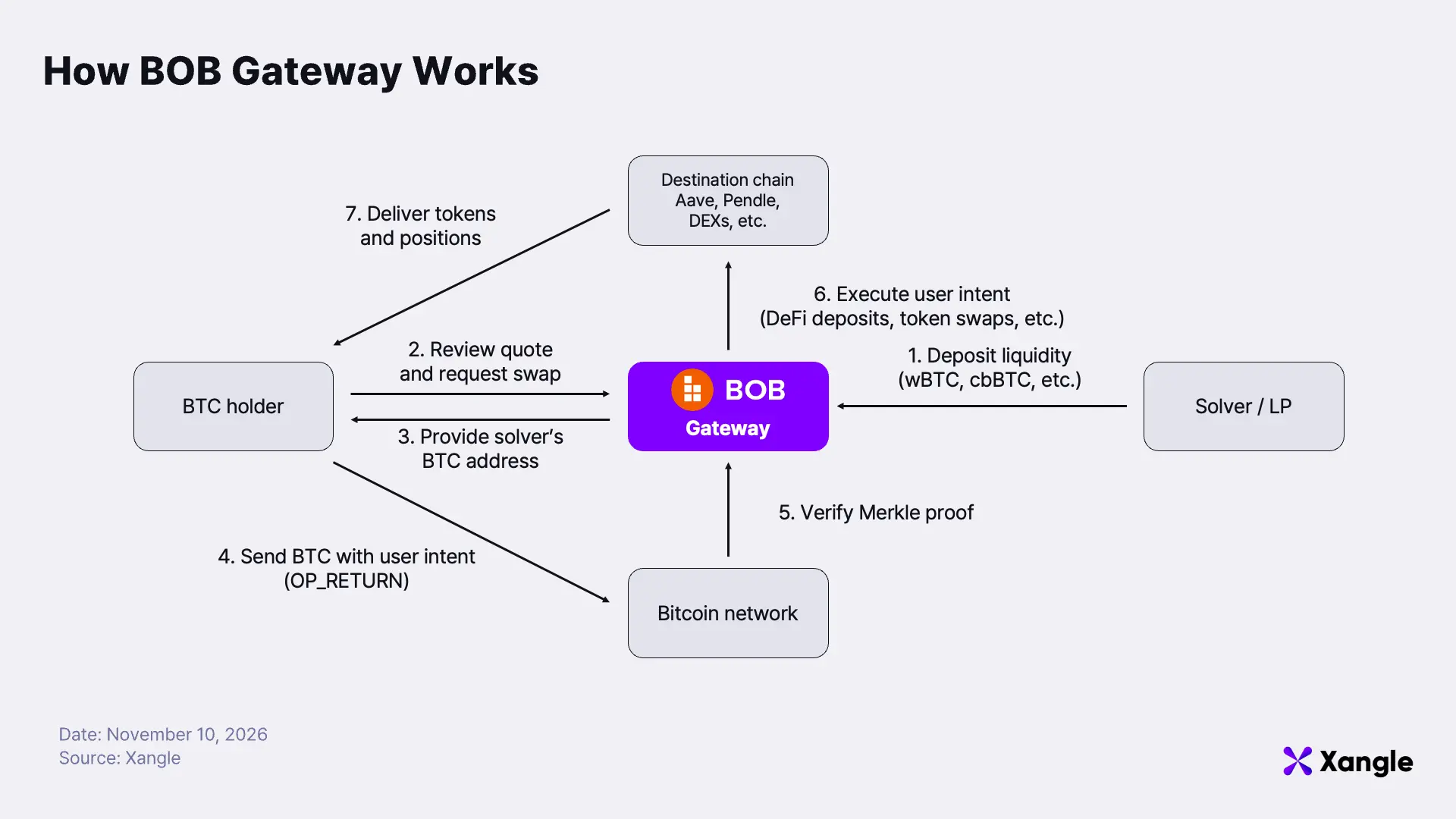
For example, a user seeking to swap native BTC for cbBTC on Base requests a quote by specifying the input amount, destination chain and asset. Gateway and the solver arrange the necessary route and liquidity. Once the user accepts the quote and sends BTC, the solver delivers the destination asset. Destination gas is included in the quote, reducing the need to obtain ETH or BNB separately to receive the asset. Users can focus on choosing what to receive and on what terms, rather than assembling and executing multiple intermediate transactions themselves.
After using a DeFi service, users can swap their assets back into native BTC and receive it in their own Bitcoin wallet. These two-way routes allow them to hold BTC by default while using the same service to enter and exit the markets they need.
2.2 Trust-Minimized Settlement
Swapping BTC for an asset on another chain involves a Bitcoin transfer and a destination-asset payout processed on separate networks. If the operator connecting them can decide at its discretion whether a payment has occurred or move funds in its custody, users must rely on that operator’s judgment and fund management after sending their assets. Trust minimization limits these powers through contract conditions and onchain verification. By restricting authority over asset movements to what is necessary to fulfill a trade, it aims to reduce the risk that an operator’s incorrect approvals or transfers cause losses for users.
Gateway uses a solver for each order and has a process for returning BTC to a designated refund address when an order originating in BTC cannot be completed. In the reverse direction, when users send another asset to receive BTC, the solver must prove that it has completed the Bitcoin payout before it can collect the funds held in escrow. A Bitcoin light client verifies the actual payment transaction, and that verification is a condition for releasing the funds. Under the normal settlement process, the solver cannot collect payment merely by claiming to have completed the payout.
Garden, another solver-based service, locks both assets in hash time-locked contracts (HTLCs), which combine hash and time conditions. If the counterparty fails to complete the trade, users can reclaim their funds themselves after the timelock expires. This differs from Gateway’s refund process in who initiates the recovery. THORChain and Chainflip use vaults in which multiple operators jointly sign to authorize transfers. Trust therefore centers on the signer group authorized to move vault funds and its key management system, rather than on the solver for an individual order.
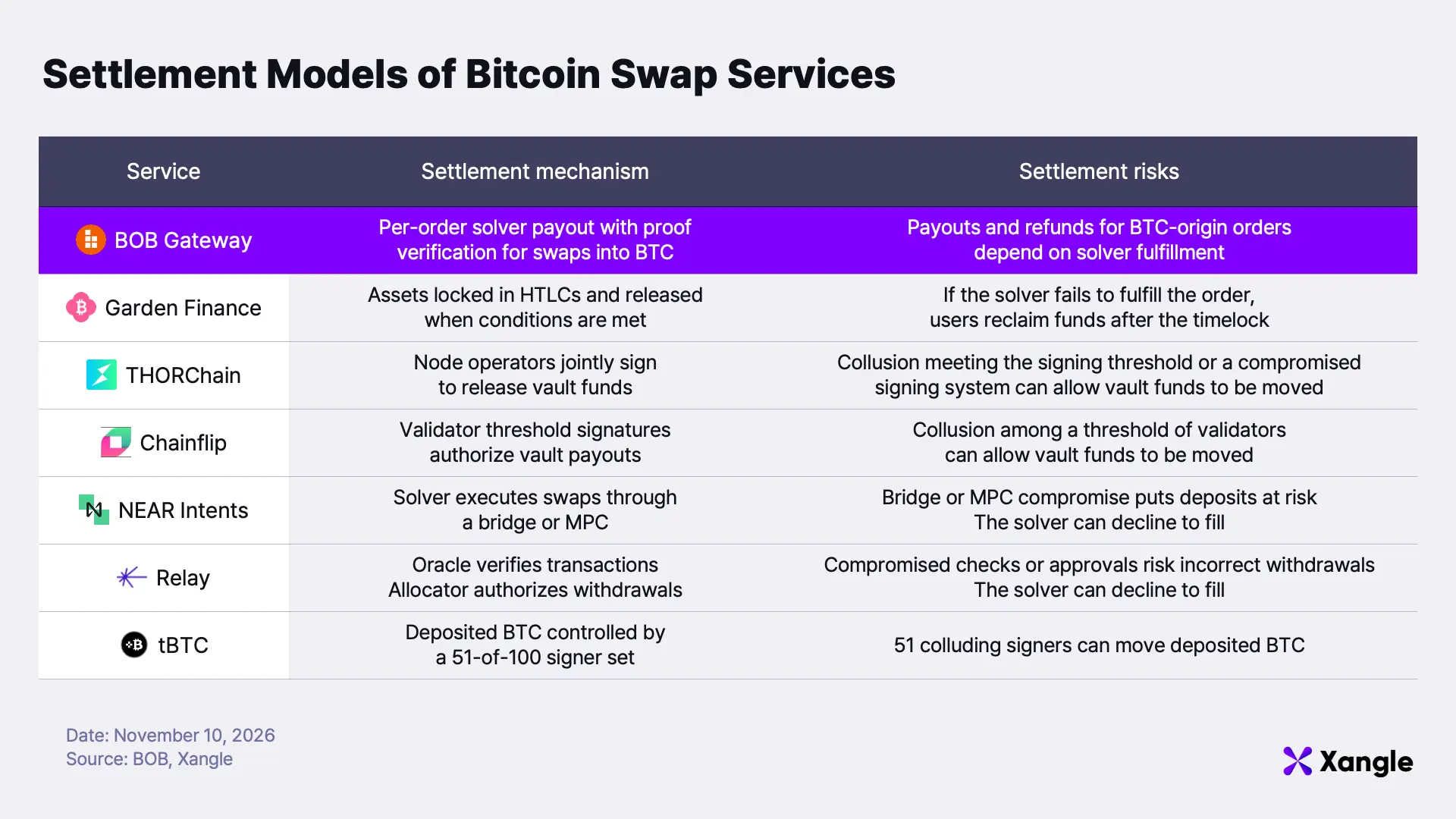
Gateway’s advantage for swaps into BTC is that payment confirmation is tied to Bitcoin transaction proofs rather than relying solely on a separate operator’s judgment. A solver must prove that it has completed the payout to collect payment. This reduces the trust required to confirm payment compared with arrangements in which a shared vault’s signer group or a bridge’s approving parties decide whether to authorize withdrawals. Users returning BTC to their own wallets after using DeFi services across multiple chains thus have verifiable settlement conditions.
2.3 Price Competitiveness in Native BTC Swaps
Like Gateway, Garden, THORChain, NEAR Intents and Relay offer routes that accept native BTC and convert it into assets on other chains. Bitcoin holders can choose among these services to obtain the same destination asset. Comparing quoted outputs for an identical BTC input amount and destination therefore provides a measure of each route’s price competitiveness.
On September 14, 2026, BOB compared swap quotes from Gateway and other services across five scenarios for converting native BTC into USDT, USDC or ETH on Ethereum. The table below shows each quoted output’s gap from the best quote in the same scenario, expressed in basis points (bps). BOB Gateway offered the highest quoted output in four of the five scenarios and was just 1.3 bps behind the best quote in the remaining scenario, demonstrating strong price competitiveness across the tests.
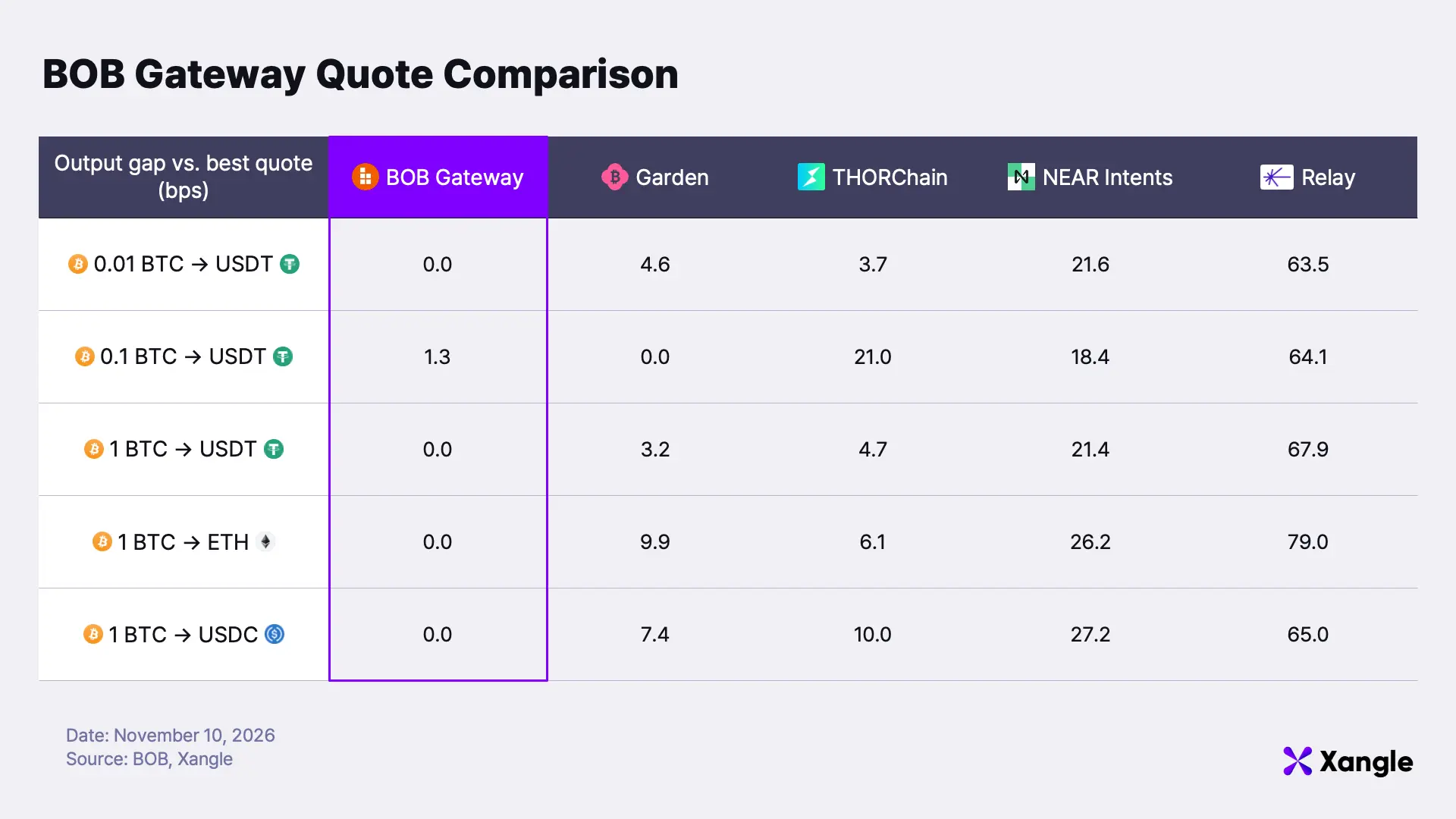
These results show that Gateway can simplify access to financial services from native BTC while offering better quoted outputs than competing services. For users to realize the benefit of that price difference, however, the advantage in the quote must carry through to the amount they receive when the trade settles.
Price movements while users wait for Bitcoin confirmations and subsequent swaps can create a gap between the initial quote and the amount received. To reduce this uncertainty, Gateway introduced a fixed-rate pilot on October 14 for the native BTC to USDT route on Ethereum. On this route, the output in the quote accepted by the user is fixed as the amount to be paid, so the terms users compare and select before the trade remain valid at settlement.
3. BOB’s Expansion into Onchain Financial Infrastructure
Integrations with external wallets and apps can bring Gateway’s ease of access and competitive quotes to a wider user base. Alongside expanding the range of tradable assets, BOB is making its trading capabilities available through existing services and to artificial intelligence (AI) agents.
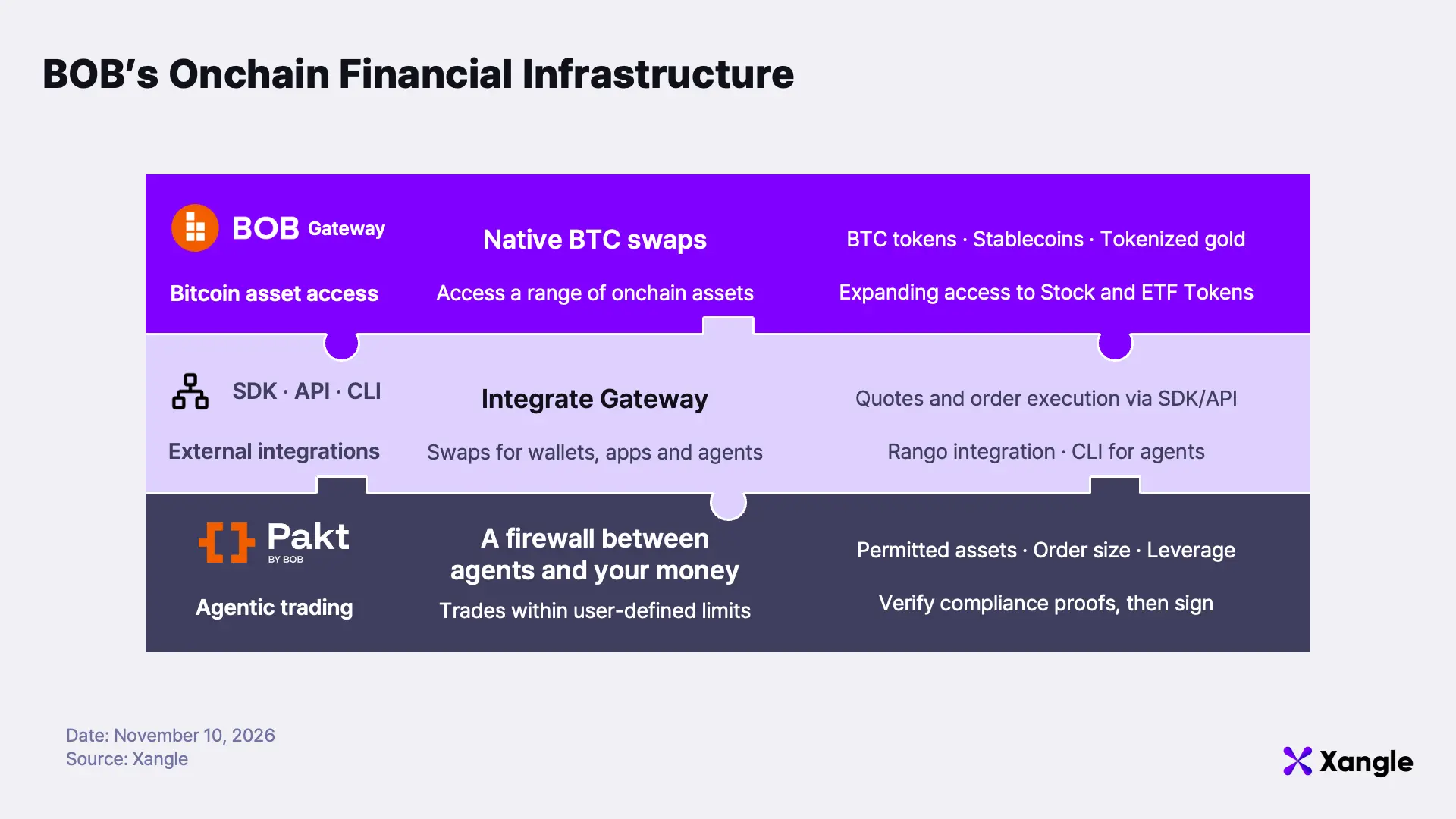
The addition of Stock and ETF Token routes on Robinhood Chain on October 21 illustrates this broader asset access. Gateway began supporting two-way swaps between native BTC and 44 Stock and ETF Tokens. BTC holders can send funds from their own Bitcoin wallets to receive Stock and ETF Tokens and later swap them back into native BTC. Bitcoin’s uses have thus expanded from DeFi lending and investment strategies to investments in stocks and ETFs.
These routes are also available to external wallets and apps through Gateway’s software development kit (SDK) and application programming interface (API). Users of integrated apps select a quote in the interface they already use to hold or trade assets, while Gateway handles the swap needed to fulfill the request. The integrating service provides the user interface and Gateway supplies the underlying swap route. This division allows BOB to process orders originating in other services without requiring their users to move to its own app.
Gateway has been integrated as a native BTC quote provider into Rango, an aggregator that compares swap routes across multiple chains. On October 19, a swap from USDT on Tron to BTC was completed through Rango, demonstrating an actual transaction in which Gateway handled an order from an external app. When Gateway’s route is selected on Rango, Gateway executes the order. Offering a competitive output therefore both gives users favorable terms and helps Gateway attract orders from external services.
Alongside providing asset access through Gateway, BOB developed Pakt to make agentic trading more reliable. As BOB enabled agents to execute trades through Gateway, it identified the need to enforce users’ conditions on how funds could be used in automated orders. If an agent misinterprets instructions or miscalculates an order size, simply enabling it to execute trades is insufficient to keep its actions within the user’s intended limits.
Pakt lets users define rules specifying permitted assets, order sizes and leverage. It verifies zero-knowledge proofs that an agent’s submitted order complies with those rules and signs only orders that meet the conditions. An order exceeding the permitted leverage, for example, cannot obtain a signature and therefore cannot proceed to execution. Pakt enforces these limits as a condition of execution, so users do not need to review every order. Users can thus delegate market decisions and order preparation to agents while retaining control over how their assets are used.
4. Conclusion: From a Bitcoin Gateway to Onchain Financial Infrastructure
BOB Gateway connects native BTC held in personal wallets to financial markets across multiple chains, reducing the complex process of preparing assets to a single order. It has demonstrated competitive pricing in quote comparisons with other services and implemented trust-minimized settlement based on payout proofs for swaps from other assets into native BTC. By reducing the steps users must take and improving the terms on which they access a range of onchain financial services with BTC, Gateway provides infrastructure that broadens Bitcoin’s financial uses.
Bitcoin is the largest crypto asset, and spot ETFs and national holdings are reinforcing its role as a store of value. Services that enable holders to use this accumulated value as collateral, put it to work in financial strategies or invest it in other assets are expected to become the next area of growth in Bitcoin finance. As financial products expand across chains and assets, infrastructure that prepares assets and executes trades will play a larger role in enabling holders to use their directly held BTC in the markets they choose.
BOB provides Gateway to external wallets and apps while supporting tokenized stocks and ETFs on Robinhood Chain, expanding the routes through which BTC holders can invest in a wider range of assets. Alongside this broader access, its work on agent trading permissions through Pakt prepares BOB for changes in how users engage with finance. By building both trading capabilities and permission controls that external services can use, BOB is expected to expand Bitcoin’s financial utility while developing into infrastructure supporting onchain finance more broadly.
Disclaimer
I confirm that I have read and understood the following: The information contained in this article is strictly the opinions of the author(s). This article was authored free from any form of coercion or undue influence. The content represents the author's own views and does not represent the official position or opinions of CrossAngle. This article is intended for informational purposes only and should not be construed as investment advice or solicitation. Unless otherwise specified, all users are solely responsible and liable for their own decisions about investments, investment strategies, or the use of products or services. Investment decisions should be made based on the user’s personal investment objectives, circumstances, and financial situation. Please consult a professional financial advisor for more information and guidance. Past returns or projections do not guarantee future results. This article was written at the request of BOB. All content in this article was written independently by the author(s), and neither CrossAngle nor BOB had any editorial control or influence over the content. The author(s) may hold the cryptocurrencies mentioned in this article at the time of writing.
Xangle or its affiliated partners own all copyrights of the written or otherwise produced materials and content provided on the platform. Any illegal reproduction of such content, including, but not limited to, unauthorized editing, copying, reprinting, or redistribution will result in immediate legal actions without prior notice.