
When Magic Meets Newton: Onchain Finance Unlocked


Table of Contents
1. The Next-Generation Infrastructure Built by PayPal Ventures-backed Magic Labs
2. A Financial Landscape Reshaped by AI and Institutions Onchain
3. A Financial Infrastructure That Automates Compliance
4. Beyond AI: Expanding Newton Protocol Applications to Stablecoins and RWAs
5. Conclusion: An Agentic Financial Era Built on Regulation and Trust
1. The Next-Generation Infrastructure Built by PayPal Ventures-backed Magic Labs
Magic Labs, founded in 2018, pioneered the Wallet-as-a-Service model and has since built foundational infrastructure for Web3 mass adoption. The company enables wallet creation with nothing more than an email or social account—eliminating the need for cumbersome seed phrases or browser extensions—through embedded wallets and an API SDK that have already connected more than 50 million wallets onchain. Over 200,000 developers and global brands including Polymarket, WalletConnect, Helium, Forbes, and Naver Financial now rely on Magic Labs’ technology. In doing so, Magic Labs has set the standard for Web3 onboarding infrastructure, establishing a user experience that makes entry into Web3 both simple and secure.
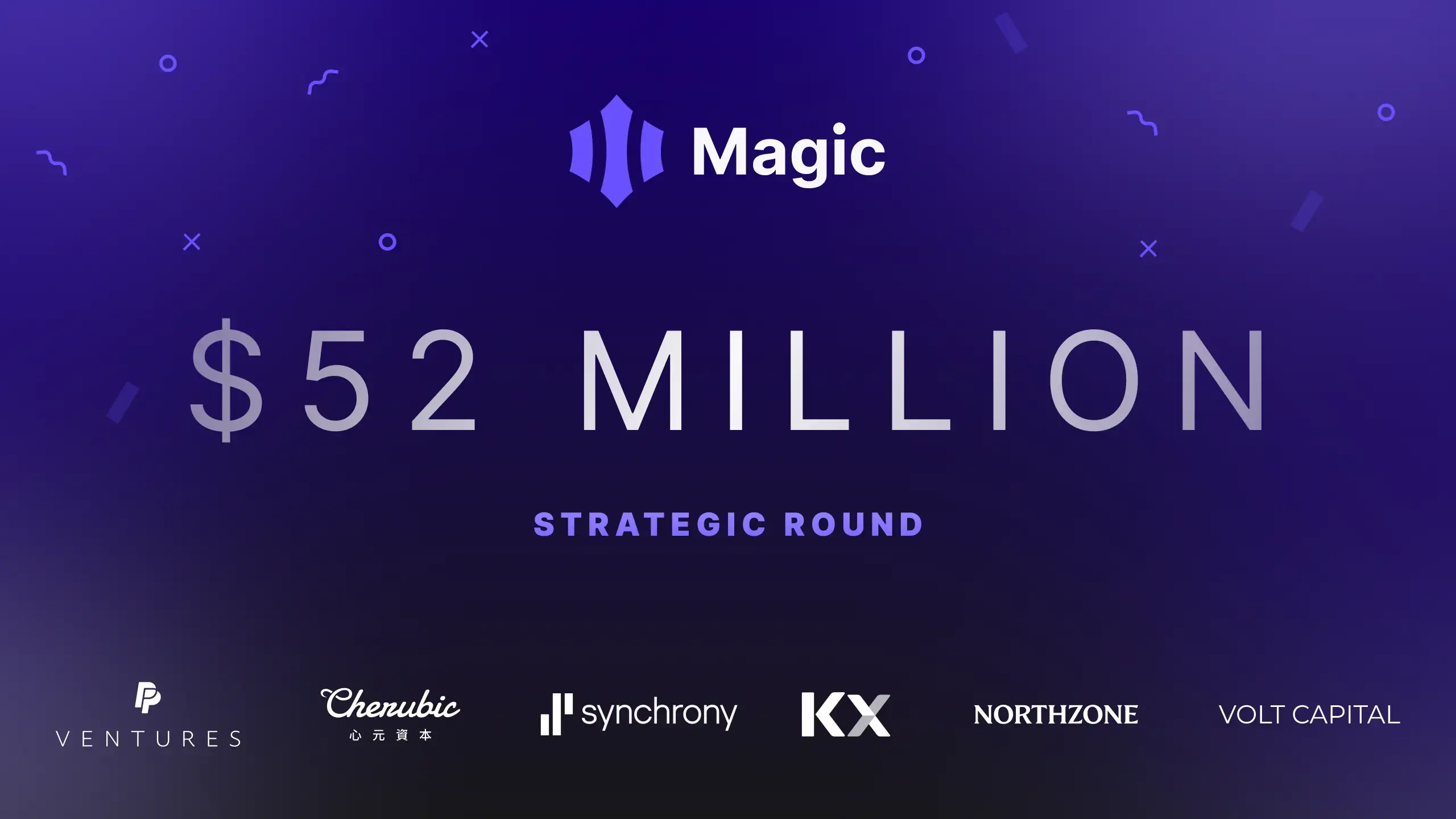
Announcing Magic’s $52M Strategic Funding Round led by PayPal Ventures
Building on these achievements, Magic Labs secured approximately $90 million in funding from leading venture firms including PayPal Ventures, Placeholder, DCG, Volt Capital, Polygon, and Balaji Srinivasan. The company’s founding philosophy and early milestones ultimately converged in the development of the Newton Protocol. Led by the Magic Newton Foundation and Magic Labs in collaboration with Eigen Labs and Succinct Labs, Newton was designed not merely as another wallet solution but as the next-generation entry point layer for the onchain economy.
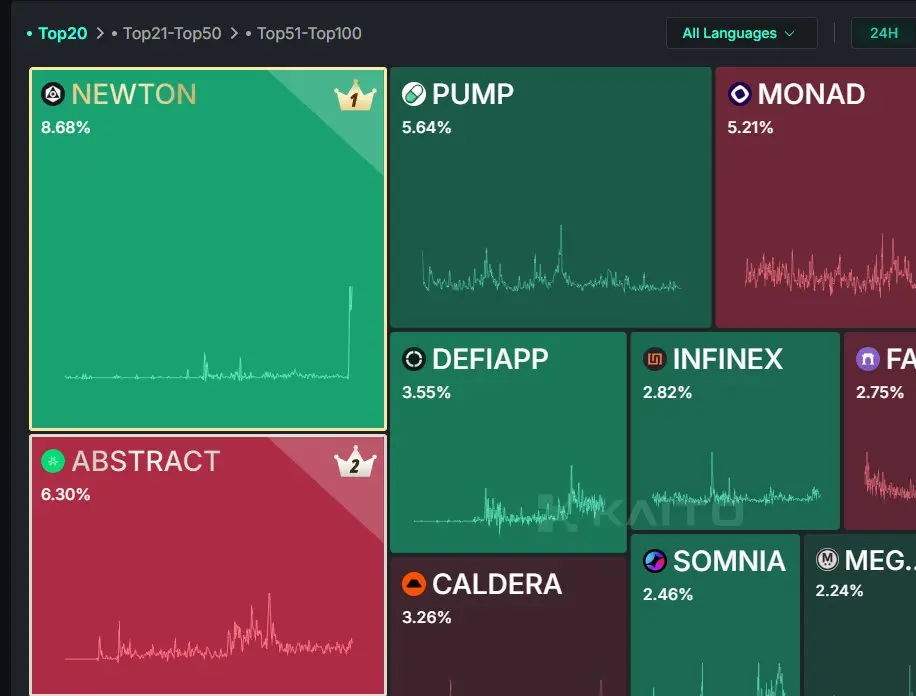
Newton Protocol, which also ranked #1 in Mindshare on Kaito
The protocol recently captured market attention through its Token Genesis Event (TGE), allocating 0.9% of its tokens to the Kaito ecosystem and expanding retail participation via an airdrop. That momentum has been reinforced by new initiatives. At its core, Newton seeks to reduce the complexity of operating across multiple blockchains and build a financial infrastructure layer where AI agents can naturally perform economic activity in real-world-linked environments. Most recently, the launch of a policy engine initiative, embedding compliance directly into the protocol, has allowed Newton to combine regulatory alignment with scalability, offering not just retail users but also enterprises and institutions a credible pathway into Web3.
2. A Financial Landscape Reshaped by AI and Institutions Onchain
Compliance in traditional finance has long depended on document-based, ex-post procedures. Customer identification (KYC), transaction monitoring, and sanctions screening are typically handled after the fact, with regulators checking compliance through submitted documents and sample audits. While this model has helped maintain order in financial markets, it carries structural weaknesses in a digital-native environment: high costs, delays, and limited real-time responsiveness. In 2023, global financial institutions spent more than $274 billion on compliance, yet the majority of reported cases were still retrospective checks on transactions that had already taken place.
That legacy framework stands in direct conflict with the real-time nature of onchain finance. Transactions settle instantly and liquidity moves at high velocity, operating on a 24/7 basis. Regulatory systems that rely on daily or even quarterly reporting cycles simply cannot keep pace. For institutions, participation under such conditions amplifies uncertainty and legal exposure, discouraging engagement with open DeFi and public blockchains.
Jurisdictional fragmentation further complicates matters. The U.S. Travel Rule and the EU’s AMLD directives both mandate the sharing of counterparty information, yet a unified infrastructure to enforce such requirements directly onchain is still lacking. Institutions often fall back on private networks or permissioned blockchains to remain compliant, but in doing so, they dilute the very openness and interoperability that define public blockchains. Instead of enabling innovation, a document-centric compliance model inflates costs, multiplies complexity, and creates barriers to onchain growth.
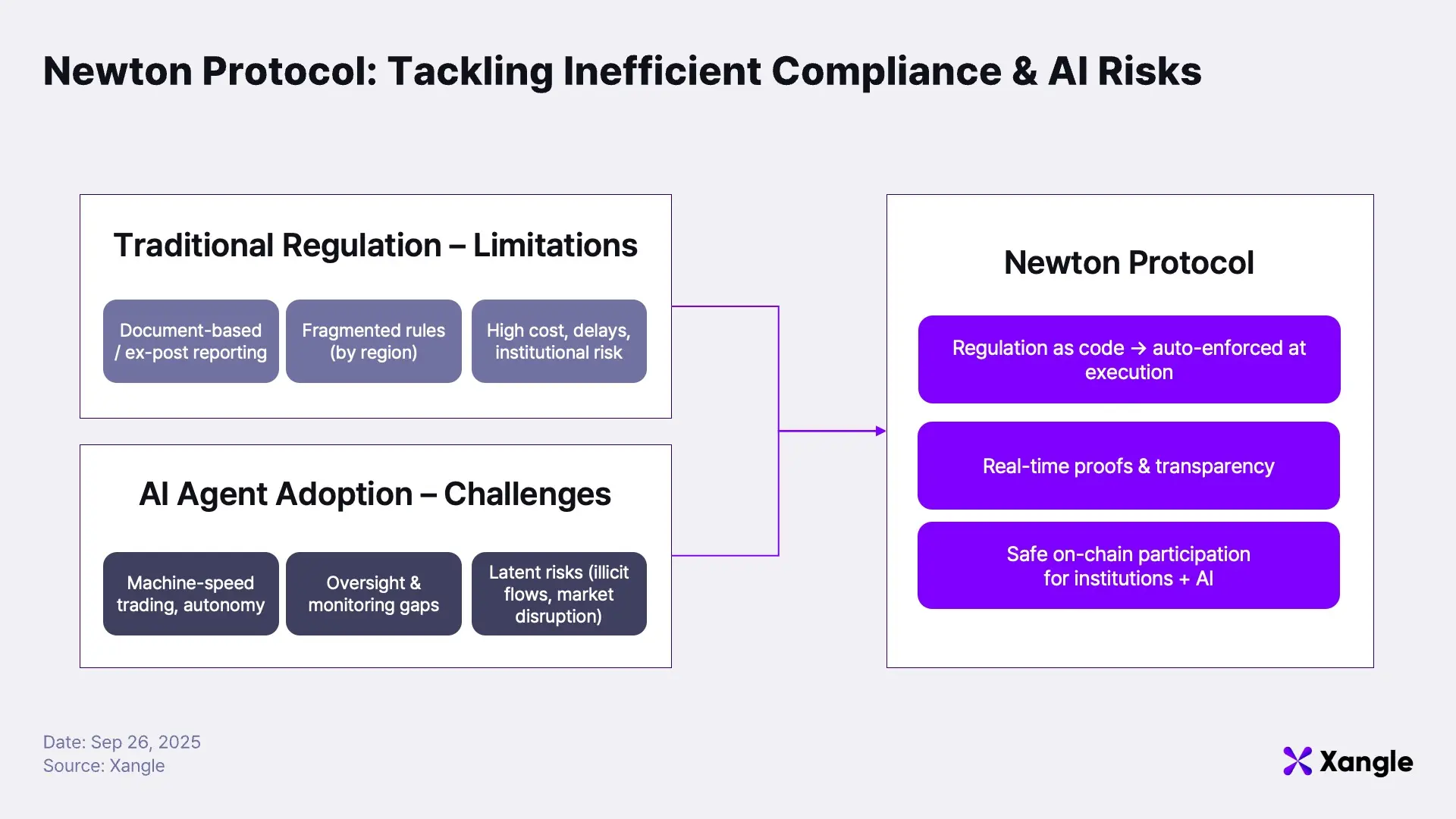
Newton Protocol approaches this challenge by codifying regulation into a Policy Engine that enforces compliance at the moment of transaction execution. Institutions no longer need to rely on extensive documentation or closed networks to meet regulatory standards on public blockchains. Regulators, in turn, gain access to transparent evidence from the instant a transaction occurs. Compliance shifts from an after-the-fact reporting exercise to a native function embedded within the transaction itself, fundamentally lowering the barriers for institutional adoption of public blockchains.
The urgency of this transformation becomes even clearer with the rise of AI agents. Autonomous agents make decisions and execute trades at machine speed, well beyond the capacity of legacy oversight mechanisms. Newton Protocol equips not only institutional participants but also AI agents with real-time policy enforcement and safeguards, laying the groundwork for a financial environment where AI and institutional actors can coexist onchain with trust, compliance, and sustainability at the core.
3. A Financial Infrastructure That Automates Compliance
Newton Protocol addresses the inefficiencies of document-driven regulation by codifying policies and enforcing them directly at the point of transaction execution. Unlike legacy models that verify compliance only after transactions are recorded onchain, Newton validates policies in real time, instantly determining whether to approve, hold, or reject a transaction. This design enables institutions to access the liquidity and openness of public blockchains without incurring excessive compliance risk, while regulators gain transparent, real-time evidence of adherence.
At its core, Newton’s design philosophy is grounded in the practical demands of regulatory environments:
- Security is underpinned by Ethereum restaking and a slashing-based incentive model.
- Flexibility is achieved by writing policies in human-readable languages (e.g., Rego) and compiling them into zkVMs for onchain verification.
- Privacy is preserved through zero-knowledge proofs (ZK) and TEE-based oracles, allowing compliance with minimal data disclosure.
- Efficiency is realized through pre-verification, proof aggregation, and gas-optimized architecture.
- Decentralization is maintained by an open operator structure, avoiding reliance on a single vendor.
- Composability is emphasized, enabling DeFi and fintech applications to apply policies simply by integrating the Newton Policy Client contract.
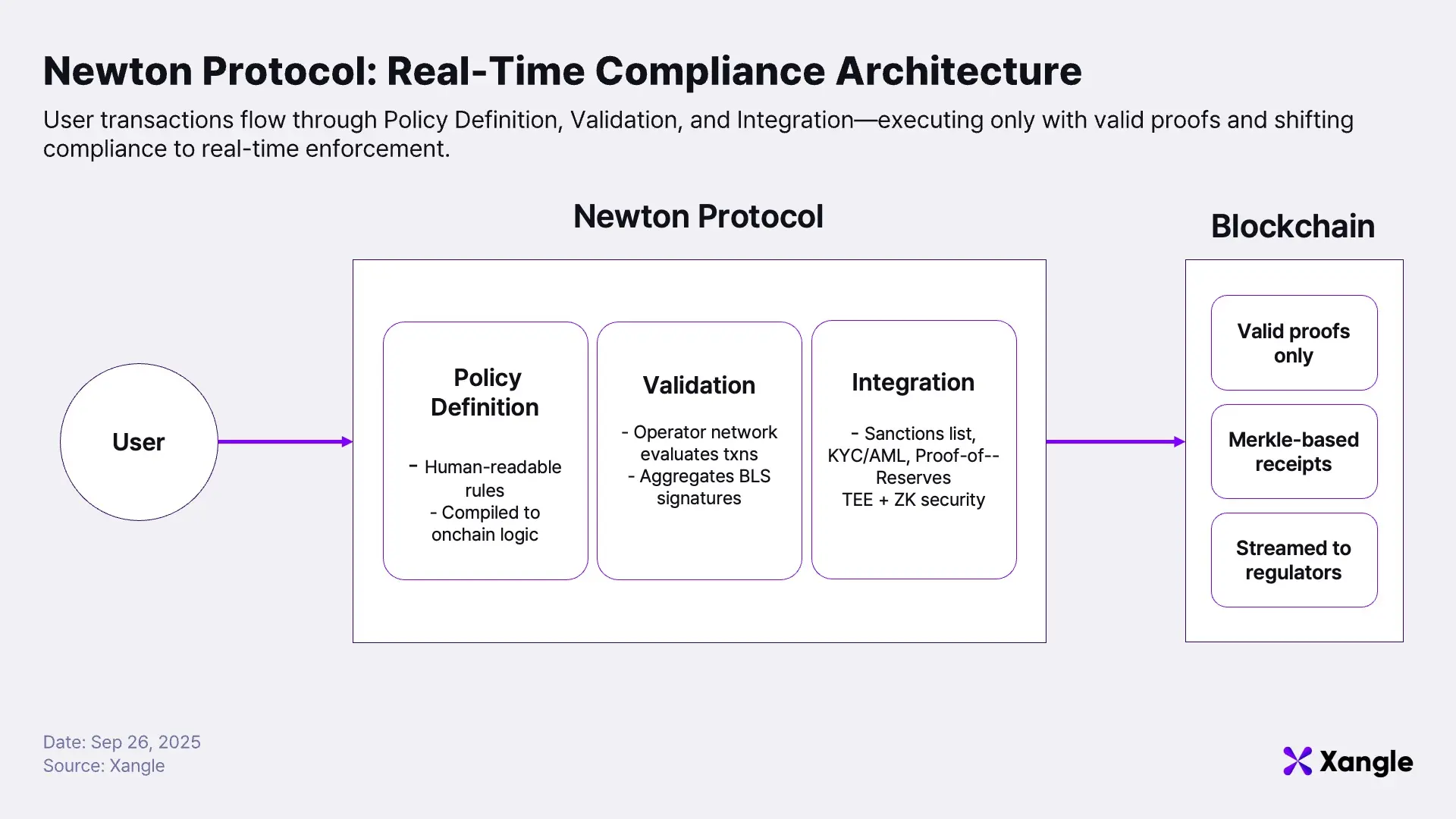
The architecture is designed as a neutral middleware layer operating on Ethereum’s security model, rather than as a standalone blockchain, and can extend across multiple chains. It is structured into three layers:
- Definition Layer – Policies can be authored in high-level, human-readable languages by entities such as regulators or enterprises.
- Verification Layer – A decentralized operator network evaluates transactions against those policies, aggregates the results, and produces cryptographic proofs and signatures.
- Integration Layer – Oracles and data providers supply inputs including sanctions lists, geographic restrictions, investor accreditation, and proof of reserves, with TEEs and ZK ensuring both trust and privacy.
All verification results are compiled into Merkle-based receipts, which can be recorded onchain alongside the transaction or streamed directly to regulators in real time.
The execution flow is equally efficient. Once a user submits a transaction, Newton’s Task Manager broadcasts it to the operator network. Operators evaluate it against defined policies, aggregate BLS signatures, and return a compliance proof. Applications embed this proof into the transaction before submitting it onchain, and the blockchain executes only if the proof is valid. Every onchain transaction is therefore cryptographically guaranteed to meet policy requirements from the moment of execution, transforming compliance from retrospective reporting into real-time enforcement.
This structure reframes regulation as a trust asset within financial infrastructure rather than a barrier to participation. Institutions can expand onchain operations with legality and openness intact, regulators gain continuous transaction-level visibility in place of periodic reporting, and users can demonstrate lawful activity without compromising personal privacy. In effect, every stakeholder benefits. Still, Newton remains in an early stage. The degree to which these mechanisms will operate seamlessly across diverse real-world use cases is a key factor to monitor going forward.
4. Beyond AI: Expanding Newton Protocol Applications to Stablecoins and RWAs
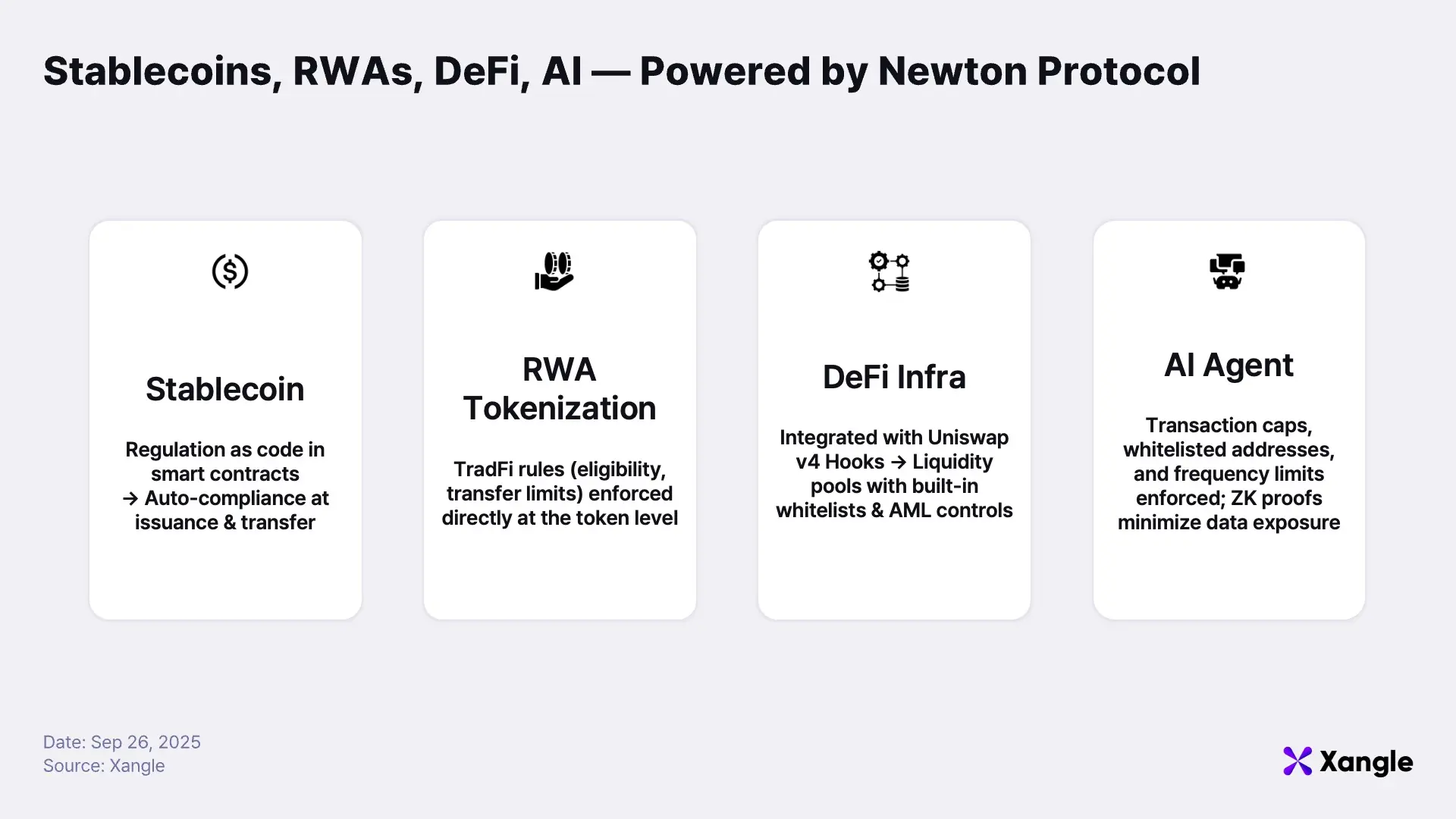
The utility of Newton Protocol comes into sharper focus when viewed through practical use cases that link traditional finance with the emerging digital economy. A clear starting point is stablecoin issuance. Current frameworks depend heavily on centralized KYC databases and ex-post monitoring, leaving compliance contingent on issuers’ internal systems. By embedding regulatory logic directly into the stablecoin smart contract, Newton ensures compliance at the execution layer itself. Sanctioned wallets can be blocked, geographic restrictions enforced, and Travel Rule requirements met instantly as transactions occur. The result is a system where issuers reduce backend costs, regulators secure real-time transparency, and users transact freely within defined regulatory bounds.
In the RWA (Real World Asset) tokenization space, Newton delivers a structural breakthrough. Investor accreditation, redemption lock-ups, and jurisdiction-specific transfer limits have historically been cumbersome to implement onchain. Newton allows these conditions to be directly encoded into tokens, enabling investors to maintain the liquidity and openness of public blockchains while adhering to traditional financial rules. This not only lowers the barriers for institutional capital to enter onchain markets but also strengthens the legitimacy and trustworthiness of RWA assets across DeFi ecosystems.
From a DeFi infrastructure perspective, Newton also expands the design space. Integrated with Uniswap v4’s hook architecture, it enables institutional-grade controls to be embedded directly in liquidity pools, such as whitelisting accredited participants or restricting activity to AML-verified addresses. These functions, once only possible within closed networks, can now operate in the open environment of public blockchains. The outcome is safer institutional participation in DeFi, accompanied by deeper liquidity and stronger market-wide confidence.
For regulators, Newton fundamentally redefines oversight. Compliance checks have traditionally relied on periodic reports and audits submitted long after transactions occurred. Newton, by contrast, generates cryptographic receipts at the moment of execution, streamable to regulators in real time. Oversight shifts from static documents to dynamic, data-driven monitoring, enabling continuous supervision, improving efficiency, and reducing institutions’ compliance management costs.
Equally important, Newton provides the guardrails needed for the age of AI agents. Autonomous trading agents may unlock new opportunities, but they also present risks ranging from uncontrolled capital flows to market manipulation or illicit activity. Newton enforces constraints directly at the protocol layer, such as transaction caps, whitelisted address sets, or frequency limits. With zero-knowledge proofs, AI agents can prove they hold necessary permissions without exposing irrelevant personal data. Financial activity carried out by AI can therefore remain safe and compliant—even in the absence of human oversight.
Taken together, Newton reframes regulation across stablecoins, RWAs, DeFi, and AI—not as a limitation but as a foundation for trust and growth. Regulators gain real-time visibility, institutions preserve the openness of onchain systems while operating within legal frameworks, and both users and AI agents extend their activities securely. Positioned as infrastructure bridging traditional finance, digital assets, and the agentic economy, Newton is set to play a pivotal role in shaping the next stage of onchain finance.
5. Conclusion: An Agentic Financial Era Built on Regulation and Trust
Onchain finance has moved well past its experimental phase, evolving into a complex economic domain that now spans institutions, retail users, and AI agents. The primary obstacle to further growth, however, remains unchanged: ensuring compliance and building trust. Document-based regulatory systems rooted in traditional finance simply cannot match the speed of digital-native markets, burdening both institutions and users with high costs and persistent uncertainty.
Newton Protocol addresses this gap by transforming regulation into real-time, automated, and codified infrastructure. The impact extends beyond cost reduction. Regulation itself becomes reframed as the foundation for growth and innovation. Sensitive domains such as stablecoins, RWAs, DeFi, and AI-driven financial activity can all expand securely atop Newton, enabling institutions to maintain legal certainty while still leveraging the openness of public blockchains.
Financial markets are now moving toward a new paradigm: the agentic economy, where humans and AI agents operate side by side as economic actors. In such an environment, neither sustainable growth nor institutional adoption is possible without credible regulatory infrastructure. Newton Protocol is positioned as a core mechanism of this era—converting regulation from a constraint on innovation into an asset of trust, and laying the groundwork for the next stage of onchain finance.
Disclaimer
I confirm that I have read and understood the following: The information contained in this article is strictly the opinions of the author(s). This article was authored free from any form of coercion or undue influence. The content represents the author's own views and does not represent the official position or opinions of CrossAngle. This article is intended for informational purposes only and should not be construed as investment advice or solicitation. Unless otherwise specified, all users are solely responsible and liable for their own decisions about investments, investment strategies, or the use of products or services. Investment decisions should be made based on the user’s personal investment objectives, circumstances, and financial situation. Please consult a professional financial advisor for more information and guidance. Past returns or projections do not guarantee future results. This article was written at the request of Newton Protocol. All content in this article was written independently by the author(s), and neither CrossAngle nor Newton Protocol had any editorial control or influence over the content. The author(s) may hold the cryptocurrencies mentioned in this article at the time of writing.
Xangle or its affiliated partners own all copyrights of the written or otherwise produced materials and content provided on the platform. Any illegal reproduction of such content, including, but not limited to, unauthorized editing, copying, reprinting, or redistribution will result in immediate legal actions without prior notice.



![[CIS Partner Summit Highlights] Ault's Financial Super App Strategy: OnlyBulls](https://resource.xangle.io/files/content/C1A19E1DB41B7FB86076143803C40D8E_1790125531662.webp)