
Espresso, The Starbucks of Layer 2s Brewing a Richer Internet


Table of Contents
1. Redefining the Internet Stack: Espresso’s Vision for the Modular Web
2. Built for Rollups: Espresso as the Base Layer
3. Building the Espresso Network Effect: From Infrastructure to Ecosystem
4. Espresso’s Growth Capital: Funding, Community Sale, and Strategic Backing
5. Brewing the Future: Toward a Caffeinated Internet
1. Redefining the Internet Stack: Espresso’s Vision for the Modular Web
 Source: L2Beat
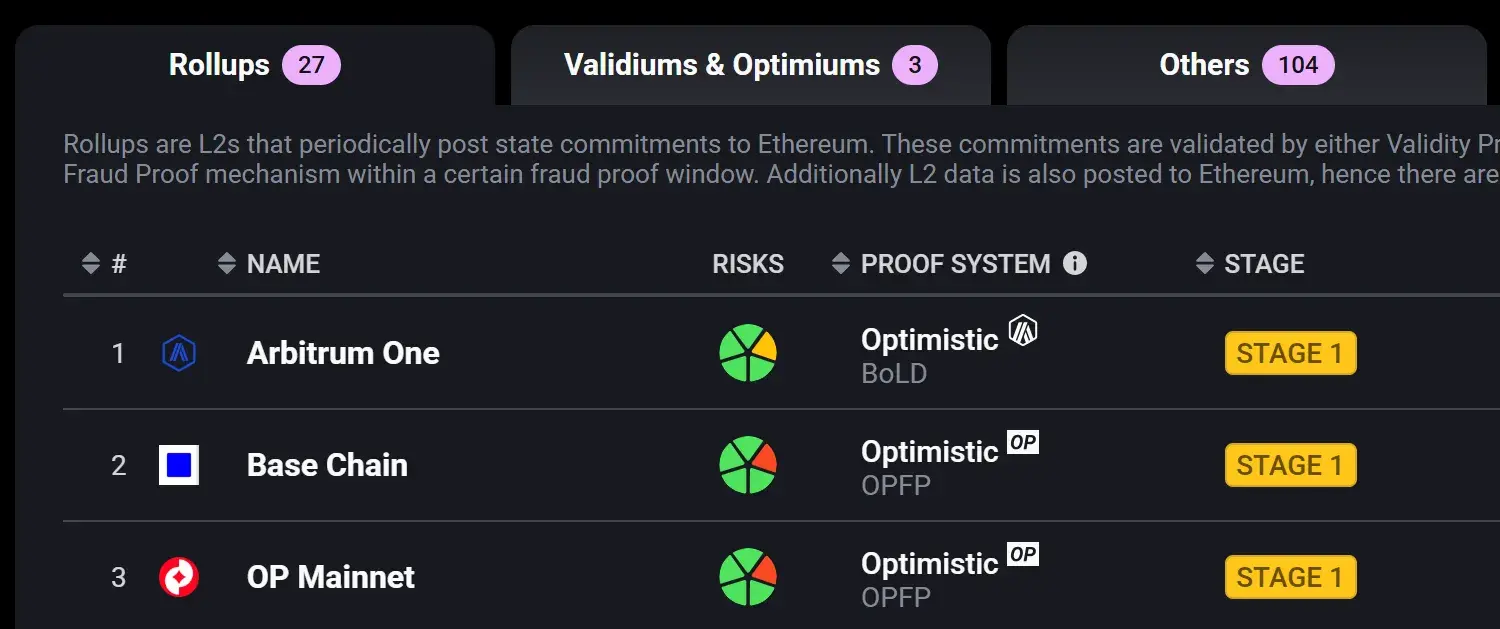
Since 2020, numerous Layer 2 (L2) chains have emerged to tackle Ethereum’s scalability limits. Leading examples include Arbitrum, Optimism, ZKsync, Scroll, and StarkNet. In recent years, Rollup-as-a-Service (RaaS) models have further lowered the barrier to launching custom L2 or even L3 networks. According to L2Beat, more than 134 L2 chainsare currently active — a number growing exponentially year over year. This rapid expansion is not a passing trend but a direct response to the market’s demand for faster and cheaper transactions that retain Ethereum’s security guarantees.
Espresso views this explosive growth of L2s as a preview of what the future Internet will look like. In the world Espresso envisions, Web3 will not consist of all services running on a single monolithic chain through smart contracts. Instead, each application will evolve into a customized L2, optimized for its own logic and architecture, forming an ecosystem of autonomous, app-specific blockchains.
This paradigm mirrors the Web2 era, where each service operated independent servers yet remained connected through the shared Internet backbone. Similarly, every L2 maintains its own execution environment and data structure while being linked through a common foundational layer, creating what Espresso describes as an “application-centric Internet architecture.”
At present, Ethereum serves as the foundational base layer for most rollups. However, it was never designed with Layer 2 scalability in mind. Its slow finality and high transaction costs have become major bottlenecks for the rollup ecosystem. In addition, most L2s prioritize speed by adopting centralized, single-sequencer architectures, introducing another structural limitation. The sequencer plays a critical role by batching transactions on the L2 and submitting them to the L1 for finalization. Yet reliance on a single sequencer exposes networks to censorship and manipulation risks, while waiting for L1 verification creates the opposite problem—delayed confirmation times. This trade-off reflects a fundamental dilemma between speed and trustlessness.
Espresso was designed precisely to overcome these constraints. Powered by its HotShot consensus, it introduces a dedicated high-speed confirmation layer, allowing rollups to finalize transactions quickly without relying on a centralized sequencer. Users can confirm and verify their transactions securely without waiting for Ethereum’s full finality, bridging the gap between scalability and trust.
Ultimately, Espresso’s ambition extends far beyond serving as auxiliary infrastructure for rollups. It seeks to establish itself as the integration hub of the L2 ecosystem, unifying the three defining challenges of L2 architecture—fast finality, efficient data availability (DA), and cross-chain interoperability—within a single framework. The vision reaches further still: enabling Web2 services to transition on-chain as independent L2 instances without the complexity of building bespoke proof systems. In this sense, Espresso aspires to become the foundational layer of the next-generation Internet, bridging both L2 and Web2 ecosystems through a shared layer of confirmation and trust.
2. Built for Rollups: Espresso as the Base Layer
Unlike Ethereum, which was never originally designed with Layer 2s in mind, Espresso was built from day one as a blockchain purposefully architected to support the L2 ecosystem. By dedicating its functionality exclusively to verifying and storing L2 transactions, Espresso removes unnecessary overhead, achieving exceptional scalability and processing efficiency.
This section first examines the fundamental architecture and structural limitations of L2s, before outlining how Espresso overcomes and extends those constraints. The discussion centers on how Espresso’s confirmation and data availability (DA) services enhance the scalability, security, and operational integrity of L2 networks. It also explores Espresso’s broader vision: a future where an ever-growing number of L2s are connected through a shared, composable infrastructure, enabling deeper interoperability and expanding beyond Web3 to include Web2 applications—realizing Espresso’s ambition as the foundational layer of the next-generation Internet.
2-1. How L2s work and the layers that power them
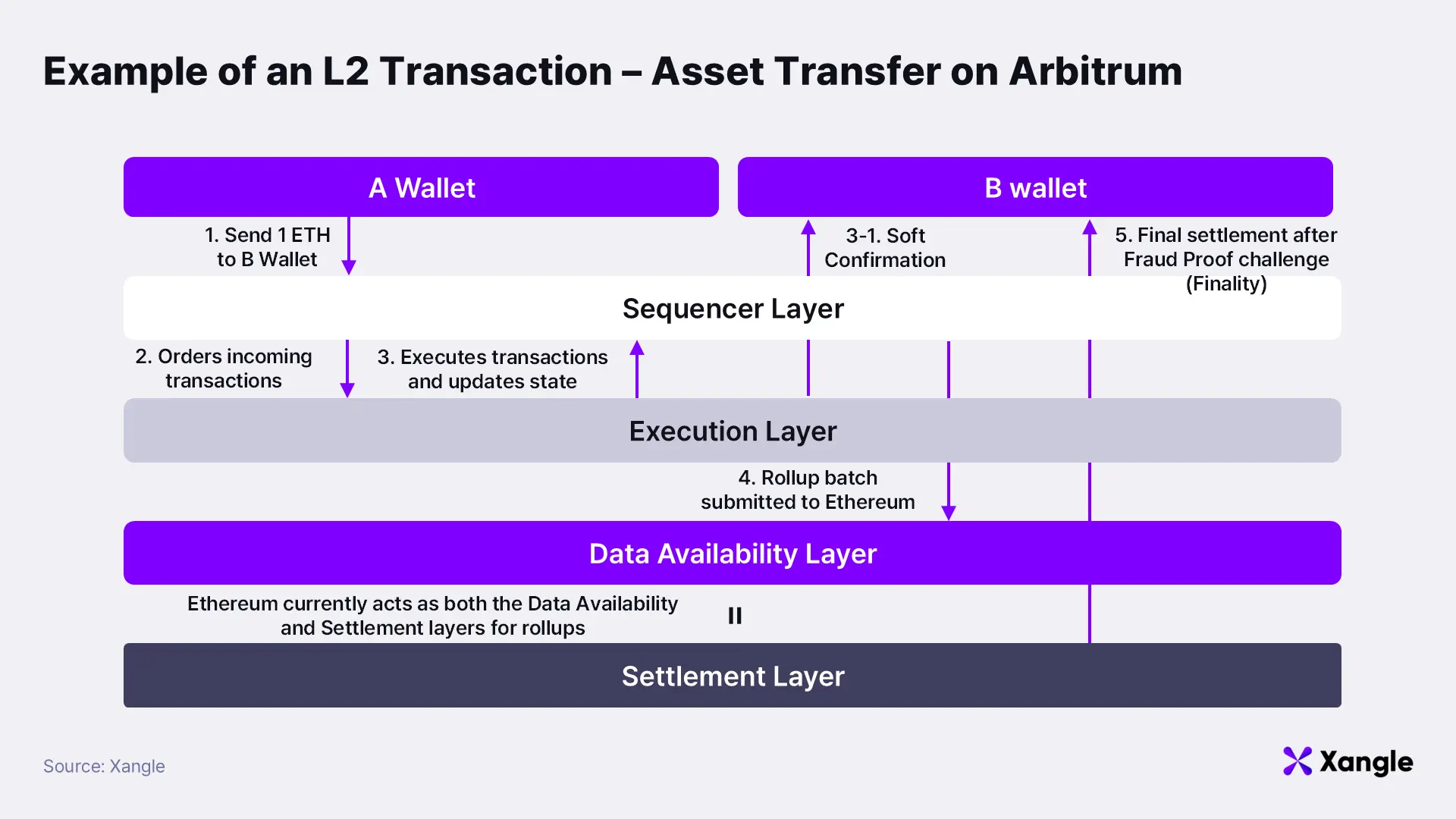
While implementation details differ across rollup stacks, a typical Layer 2 (L2) architecture is composed of four key layers: (1) Sequencer, (2) Execution, (3) Data Availability (DA), and (4) Settlement. Understanding how these layers interact provides insight into how transactions are executed, verified, and finalized within an L2 environment.
Consider a transaction on Arbitrum, one of the most widely adopted L2s, where A sends 1 ETH to B.
-
Transaction Request:
A initiates a request to send 1 ETH to B using an Arbitrum-compatible wallet (e.g., MetaMask or OKX Wallet). The transaction is transmitted via the wallet’s RPC to the Sequencer Layer.
-
Sequencing:
Arbitrum’s centralized single sequencer aggregates incoming transactions and determines their processing order.
-
Execution:
Ordered transactions are executed within Arbitrum’s Nitro VM (the Execution Layer), which updates the network state to reflect
[A’s balance –1 ETH, B’s balance +1 ETH].At the same time, both A and B receive confirmation that the transaction has been executed, and they can already see the updated balances in their wallets. This stage is known as Soft Confirmation. From this point, B can use or transfer the received ETH within Arbitrum. However, because the transaction has not yet been finalized on Ethereum (L1), it may still be reversed in rare cases, and withdrawals to L1 are not yet possible. Since this confirmation depends solely on the single sequencer’s approval, the trust level remains relatively low.
-
Batch Submission:
The sequencer compiles multiple transactions into a rollup batch and submits it to Ethereum, which functions as both the Data Availability Layer and the Settlement Layer. Arbitrum validators then verify the validity of the batch.
-
Validation and Finality:
Validators stake ETH as collateral and propose a new rollup block, asserting that it is valid. Other validators may challenge this claim. If a fraudulent state transition is detected, a Fraud Proof is submitted—dishonest validators are slashed, and challengers are rewarded. Once the challenge period (typically seven days) passes without dispute—or any disputes are resolved in favor of the correct block—the batch is finalized and permanently recorded on Ethereum. At this stage, A’s transfer of 1 ETH to B becomes irreversible, and B can safely withdraw the funds to the Ethereum mainnet.
In summary, the transaction flow on Arbitrum can be described as follows:
- Sequencer Layer: Collects and orders transactions.
- Execution Layer: Executes transactions sequentially → Updates state (A –1 ETH, B +1 ETH) → Temporarily reflects results in user wallets (Soft Confirmation).
- Data Availability Layer: Uploads rollup batch data to Ethereum.
- Settlement Layer: Completes final settlement on Ethereum after the Fraud Proof challenge period.
2-2. Inside Espresso — HotShot Consensus, Confirmation, and Data Availability
As illustrated in the earlier example, the soft confirmations generated by a single sequencer in conventional L2s carry inherent trust limitations, leaving room for transaction reversions. Espresso addresses this structural weakness by introducing a network of 100 nodes operating under HotShot, an open-source consensus protocol built in-house by Espresso, enabling fast and verifiable confirmations. In parallel, the project introduces EspressoDA, its own data availability (DA) layer, allowing L2s to achieve data availability that is both cost-efficient and high-performance.
Espresso Network
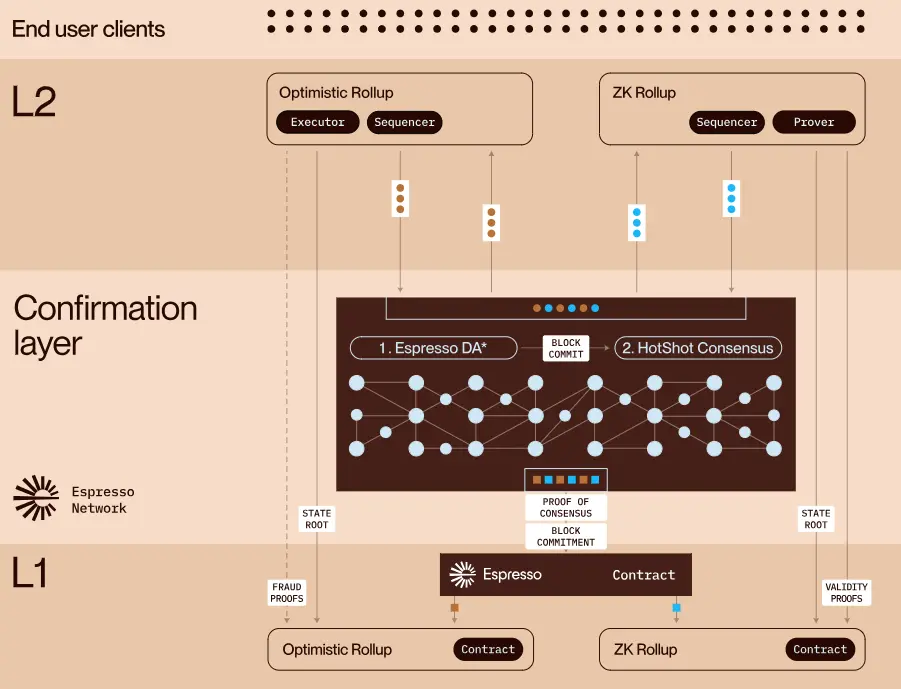
The Espresso Network is a decentralized infrastructure layer built on the HotShot consensus algorithm, serving as the operational foundation for all Espresso solutions. Currently, the network comprises 100 active nodes, with plans to evolve into a permissionless Proof-of-Stake (PoS) structure. It powers two core services within the ecosystem: Espresso Confirmations and Espresso Data Availability (EspressoDA).
- HotShot Consensus Algorithm: A high-performance consensus mechanism independently developed by Espresso and inspired by the HotStuff BFT protocol. HotShot is engineered to deliver fast finality and high throughput, leveraging efficient message propagation and an asynchronous gossip network to minimize block confirmation times. It acts as the core enginethat allows L2s to operate securely and synchronously on a shared, trust-minimized confirmation layer provided by Espresso.
Espresso Confirmations
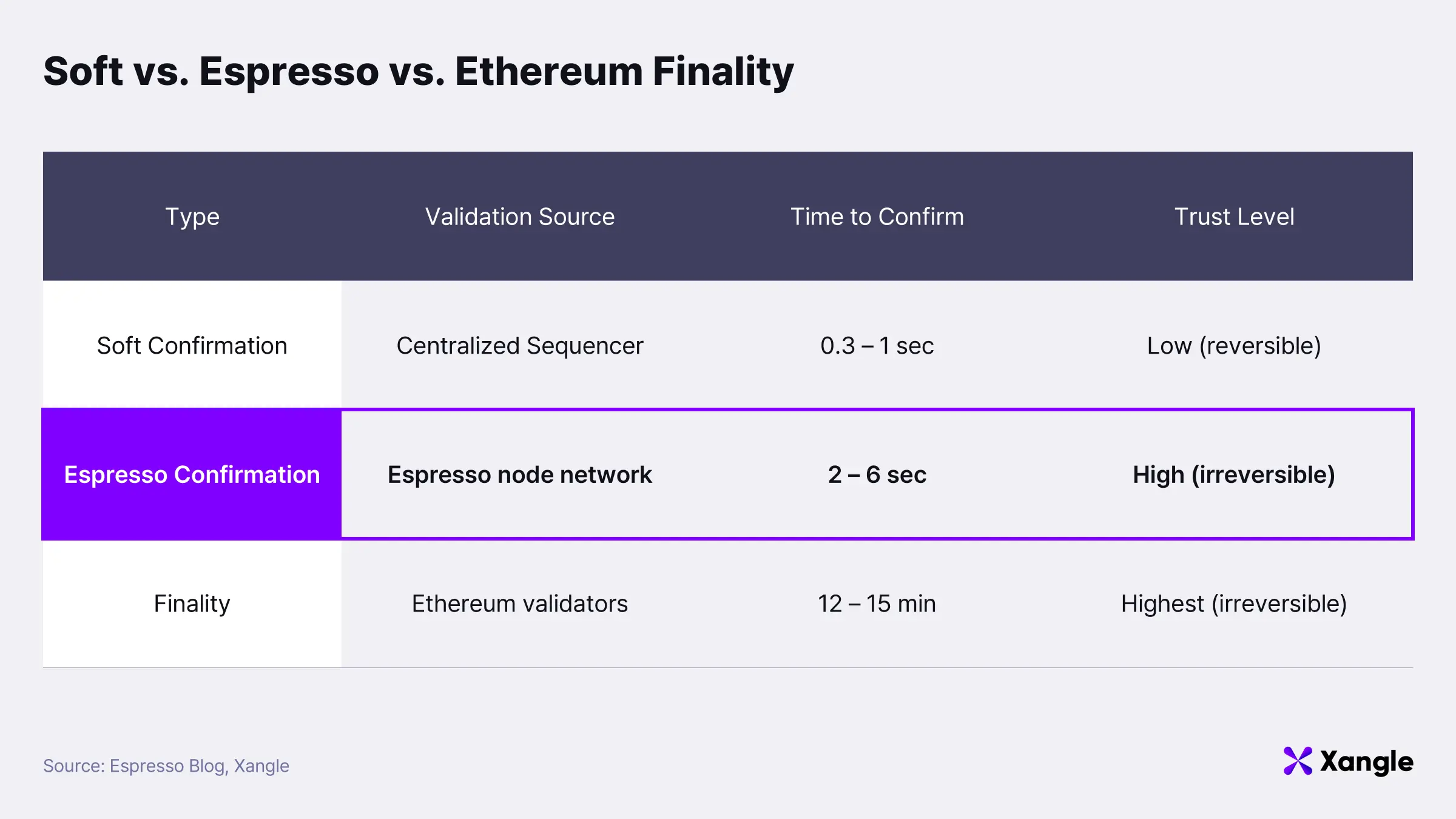
In traditional L2s, transaction confirmation depends entirely on blocks proposed by a centralized sequencer. If the sequencer experiences downtime or a chain reorganization (re-org) occurs, transactions may be rolled back. This temporary state—known as soft confirmation—achieves quick responsiveness (around 0.3 to 1 second) but carries a high probability of reversal, offering limited trust guarantees.
Espresso’s consensus model introduces an intermediate confirmation layer positioned between soft confirmation and L1 finality. In a typical rollup, soft confirmation occurs immediately after the sequencer proposes a block, but the guarantee remains fragile and reversible. By contrast, HotShot consensus allows a majority of nodes within the Espresso Network to validate and sign each proposed block, producing strong confirmation within 2–6 seconds that is theoretically irreversible.
While marginally slower than soft confirmation, Espresso Confirmations deliver significantly stronger trust—making the confirmed state effectively irreversible. Once the corresponding block data and proofs are later finalized on L1 (e.g., Ethereum), full finality is achieved within approximately 12–15 minutes.
Espresso’s confirmation layer thus achieves a balanced architecture between speed and reliability. L2 networks can maintain their existing sequencer structures while integrating Espresso for finality assurance: the sequencer continues to order and propose transactions, while HotShot consensus provides multi-node validation and cryptographic attestation of those blocks.
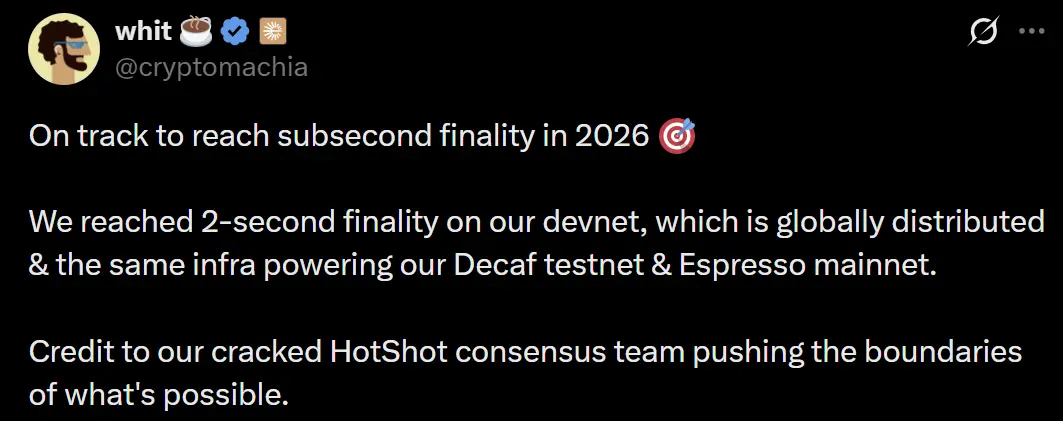
https://x.com/cryptomachia/status/1986091530096881713?s=20
The Espresso team has set a 2026 roadmap target to reduce confirmation time to under one second, achieving near-L1 decentralization and sub-second finality through consensus optimization and network-level refinements. As team member @cryptomachia noted on X, the devnet has already reduced finality to roughly two seconds, and the team reaffirmed its commitment to pushing this below one second in 2026.
As a result, Espresso provides the same type of finality as Ethereum, but achieves it through a performance-optimized architecture, in contrast to Ethereum’s pursuit of broader decentralization. Built on an optimized validator set and its own data-availability mechanisms, Espresso delivers Ethereum-comparable reliability and finality in real operational environments. Users can obtain confirmed states within seconds after block proposal, offering a particularly strong advantage for applications that demand both real-time responsiveness and high stability—such as payments, exchanges, and gaming.
Data Availability - EspressoDA
Data Availability (DA) is a fundamental security attribute for Layer 2 (L2) networks, ensuring that all participants can access the blockchain's transaction data at any given time. Even if a state transition is validated, users cannot check their balances or initiate new transactions without access to the relevant transaction data. This makes securing DA critical for both the functionality and security of L2 networks.
Traditionally, most L2s have ensured DA by posting transaction data directly to Ethereum. While this approach provides strong guarantees—allowing anyone to verify and inspect transaction data—it is plagued by high costs, limited block space, and slower speeds due to fixed block times. To overcome these limitations, Espresso introduces EspressoDA, its own native data availability layer. L2s can store their transaction data in EspressoDA, bypassing Ethereum's high costs and slow speeds while achieving faster and more cost-effective access to secure, verifiable data.
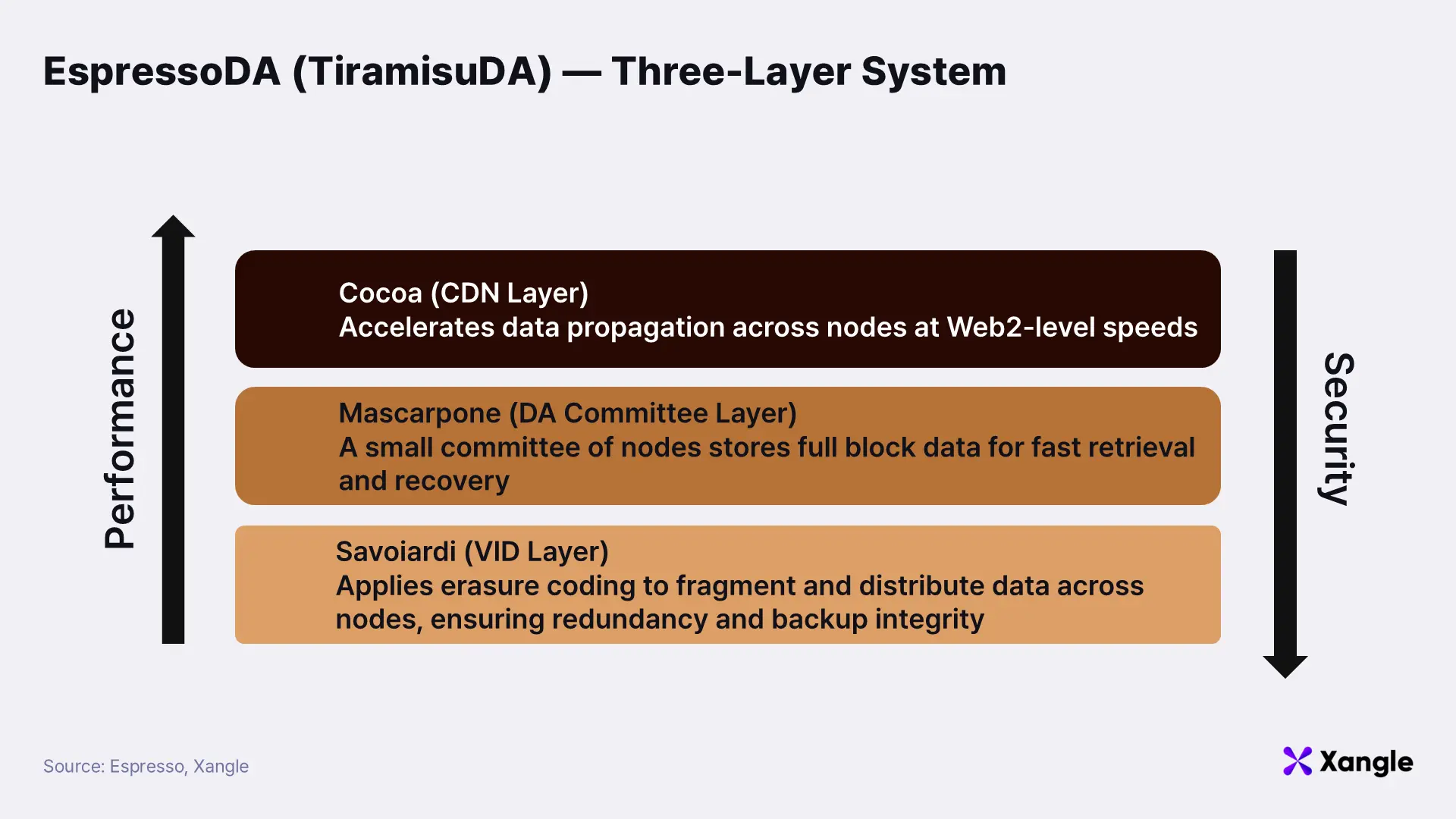
- CDN Layer: Uploads full data for retrieval efficiency.
- DA Committee Layer: A small committee stores the full data and guarantees efficient recovery of data.
- VID Layer: Stores erasure-coded data chunks across all nodes.
CDN (Content Delivery Network) Layer
A performance acceleration layer that rapidly distributes transaction data across multiple nodes, enabling Web2-level delivery speeds. During testnet trials, data was transmitted to 100 nodes at speeds of 5.7 MB/s. The CDN layer does not affect the security of data availability (DA)—its sole purpose is to improve propagation speed. Even if there are issues with the CDN layer, the DA process continues to function normally with only minor increases in latency.
DA Committee Layer
A smaller subset of nodes (less than several hundred) selected from the full network forms a committee that stores and serves the complete block data, providing fast retrieval and recovery paths. If the committee is compromised or attempts to withhold data, the VID (Verifiable Information Dispersal) layer automatically restores it, ensuring both data availability and security.
VID (Verifiable Information Dispersal) Layer
This layer uses erasure coding to fragment block data and distribute it across the network. The data can be reconstructed as long as a fraction of honest nodes remains active—an attacker would need to control virtually the entire network to successfully censor or hide data. This mechanism offers Danksharding-level security while minimizing redundant storage, significantly improving communication efficiency.
These three layers operate in parallel, offering Web2-level data access speeds under normal conditions, while maintaining strong security guarantees in adverse or attack scenarios. With the integration of HotShot consensus, which enables immediate block confirmation, EspressoDA achieves much lower latency and higher throughput compared to using Ethereum as the sole DA layer.
As a result, L2s can rely on EspressoDA instead of Ethereum for cost-effective, fast, and secure data availability. Additionally, under HotShot consensus rules, blocks cannot be finalized unless their data availability is verified, ensuring that users can always reconstruct the network state whenever needed.
2-3. Beyond Rollups: Espresso’s Vision for the Next Internet Layer
Espresso’s vision goes far beyond providing technical infrastructure for L2 integration. Its ultimate goal is to become the foundational layer of the next-generation Internet—a unified environment where all chains and applications connect seamlessly, and where even Web2 services can naturally extend on-chain. In this paradigm, blockchain is no longer a niche technology for select industries but a universal trust and interoperability layer underpinning the entire Internet.
Integration with Hyperlane and LayerZero
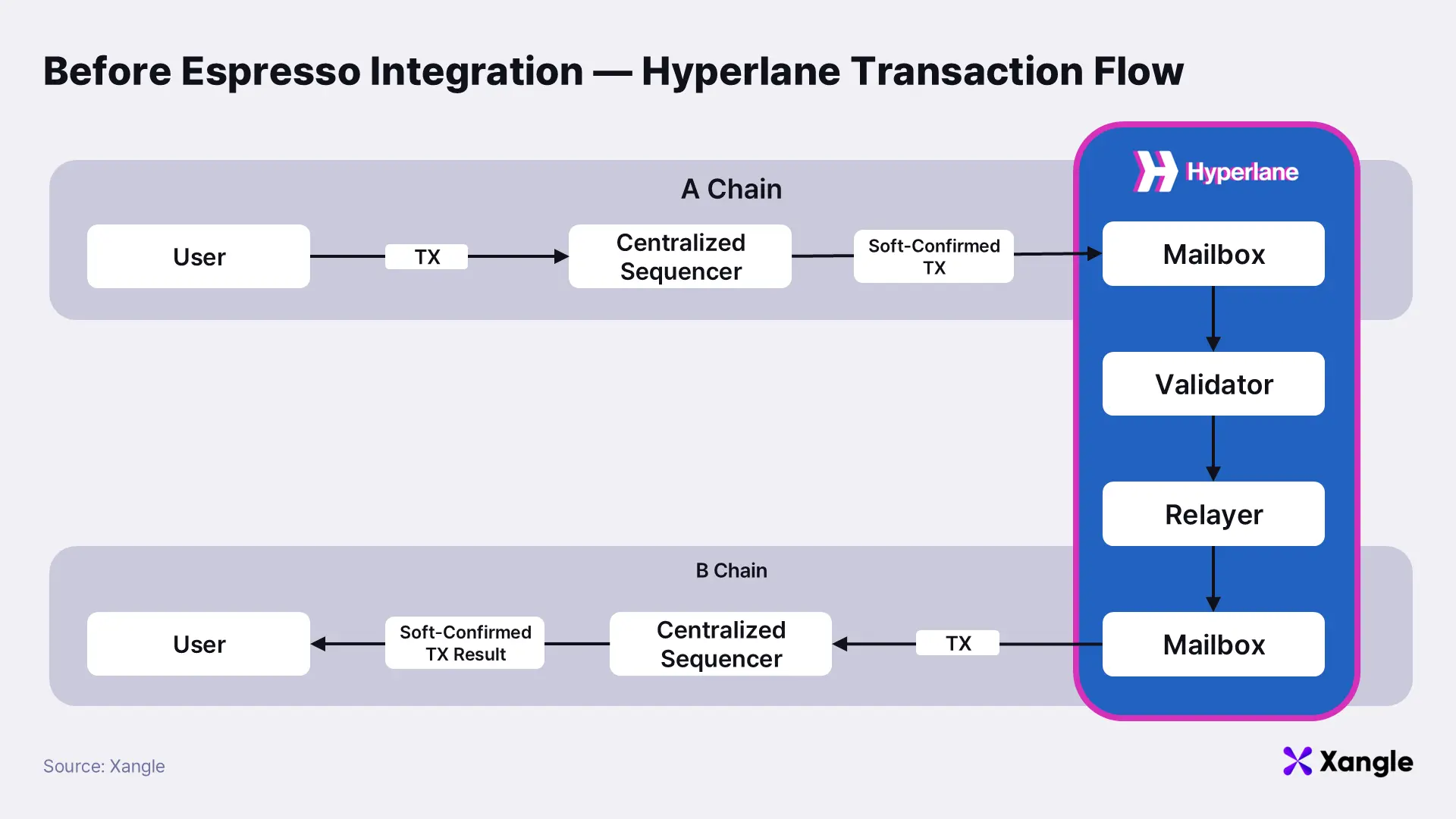
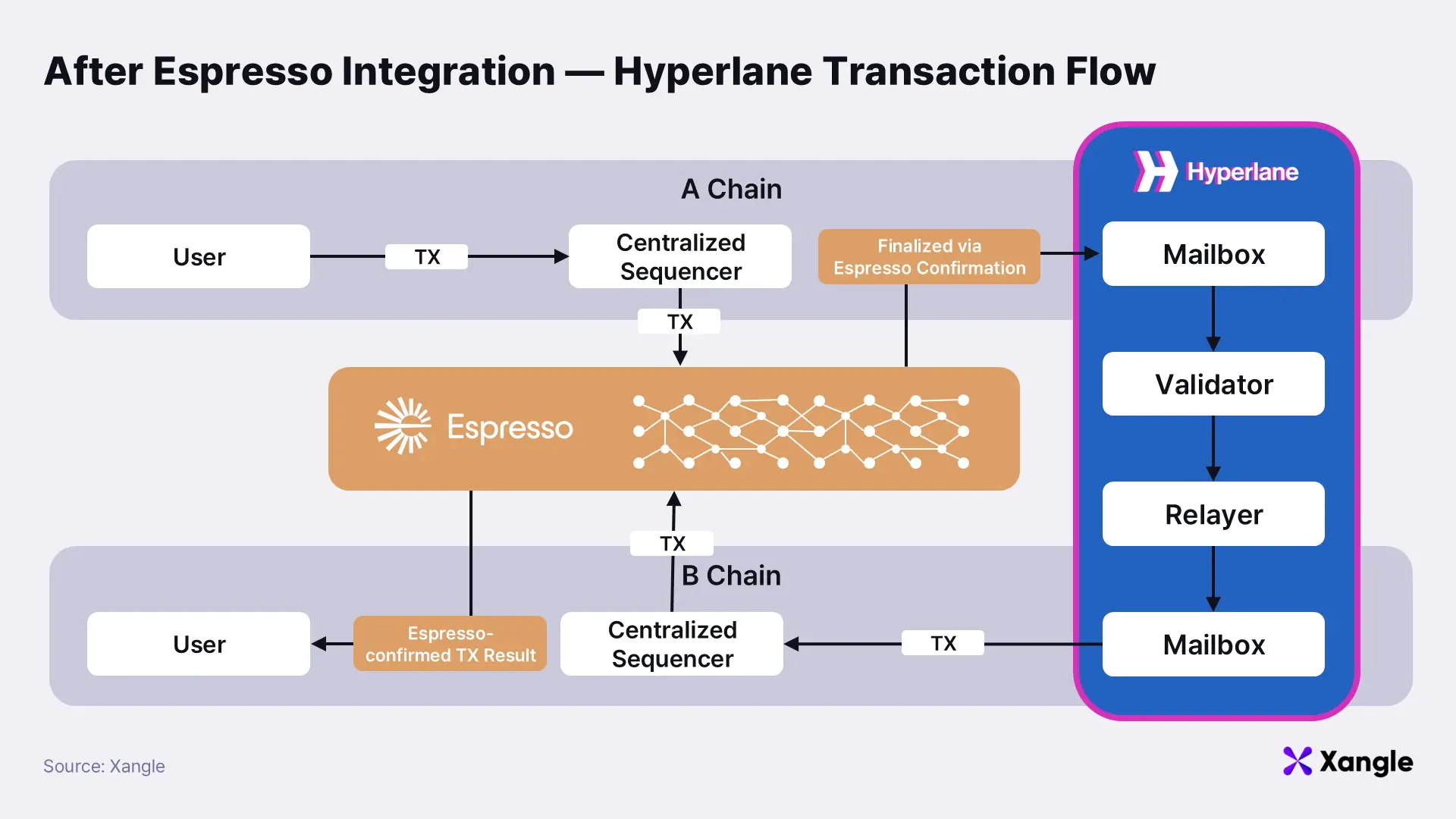
To advance cross-chain interoperability, Espresso integrates with Hyperlane and LayerZero to establish a finality-based communication framework across blockchains. Traditional bridges depend on soft confirmations produced by each L2’s sequencer, combined with off-chain agents such as validators and relayers. This model introduces structural weaknesses: if a sequencer experiences a reorganization (re-org) or downtime, cross-chain messages can be reverted, duplicated, or executed inconsistently.
Espresso mitigates these vulnerabilities by shifting the trust anchor from the sequencer to the HotShot consensus finality layer. Messages are no longer processed based on the transient soft confirmations of individual sequencers but instead on the verifiable finality generated by HotShot consensus. This architecture reduces the likelihood of re-orgs, eliminates single points of failure, and ensures deterministic message finality. By providing a confirmation-secured trust layer beneath interoperability protocols like Hyperlane and LayerZero, Espresso strengthens both the speed and reliability of cross-chain communication. Additionally, they are developing solutions that enable validating the cross-chain messages using TEEs and ZKPs, reducing the need to rely on trusted committees. In doing so, it evolves from a confirmation engine into the foundational trust layer for interoperability across the broader Web3 ecosystem.
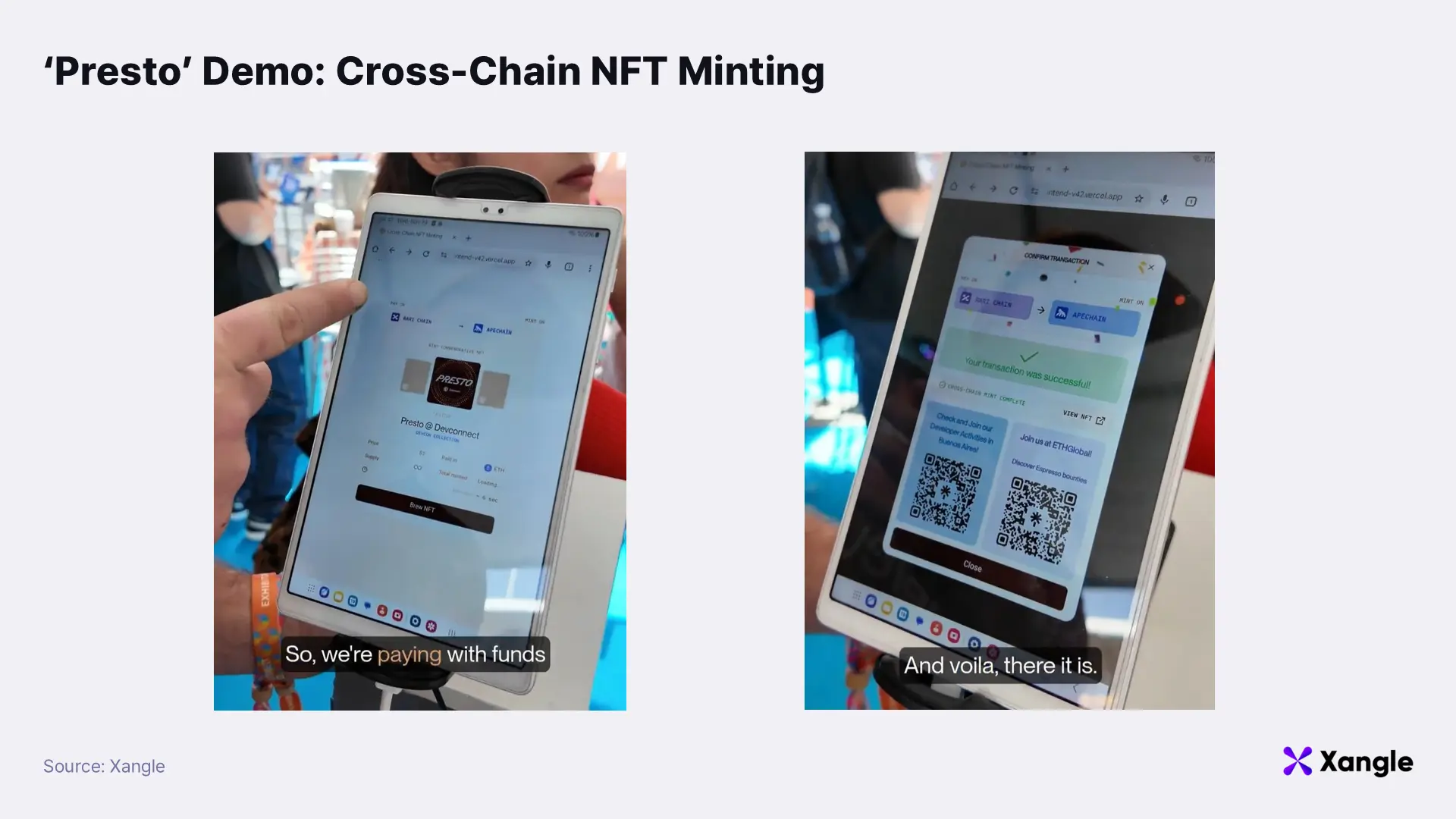
The Presto demo showcased at Devconnect 2025 (November) demonstrated how Espresso can function not merely as a finality layer, but as a foundational trust layer for interoperability. In the demo, cross-chain NFT minting was executed between the RARI chain and an AppChain using Espresso’s confirmation layer. The flow proceeded as follows: when a user initiated a transfer on the RARI chain, the transaction was finalized through Espresso; based on this finalized state, ApeChain then read the confirmation from Espresso and minted the corresponding NFT. The NFT minting transaction was subsequently finalized on Espresso as well, ensuring that the user could safely view the NFT in their wallet without any risk of chain reorganization or duplicate execution. Throughout this process, cross-chain message delivery was handled by Hyperlane, combining Espresso’s confirmation with Hyperlane’s messaging to produce a robust demonstration of seamless cross-chain execution.
On-chain expansion of Web2 services
Espresso began as a project focused on improving efficiency and decentralization within the L2 ecosystem, but its long-term vision reaches far beyond. The project envisions a future Internet where every service operates on-chain, and it positions itself as the infrastructure backbone that will make such a future possible.
Traditionally, Web2 enterprises seeking to migrate on-chain have faced two main options: building a new Layer 1 blockchain from scratch or creating a custom Layer 2 on top of Ethereum using ZK (zero-knowledge) or OP (optimistic rollup) systems. Both paths demand substantial technical expertise, complex engineering, and high development and operational costs.
Espresso’s model fundamentally redefines this process. A Web2 service no longer needs to design a custom proof system or launch an independent chain—it simply publishes transactions to the Espresso Network. Once integrated, the service functions as an independent L2 instance atop Espresso’s infrastructure, without managing a separate blockchain environment.
For example, platforms such as PayPal, Zelle, Nasdaq, or Coinbase would not need to deploy their own EVM chains or build complex messaging and bridging layers to Ethereum L1. Leveraging Espresso’s confirmation and data availability (DA) infrastructure, they can finalize transactions within seconds, publish data efficiently, and interoperate securely with Web3 ecosystems through standardized cross-chain connections. This allows traditional companies to focus on their core business logic, while delegating on-chain functions such as security, confirmation, and data transparency to the Espresso layer.
Ultimately, Espresso’s ambition is to serve as the gateway between Web2 and Web3, lowering the technical and operational barriers that have long constrained blockchain adoption. By allowing any service to run securely on-chain without specialized infrastructure, Espresso moves the Internet toward a future where trust, composability, and verifiable execution become intrinsic properties of the web itself.
3. Building the Espresso Network Effect: From Infrastructure to Ecosystem
Realizing Espresso’s vision requires more than technical sophistication—it depends on cultivating a powerful network effect. In ecosystems driven by network effects, adoption does not spread automatically, even when the underlying technology is superior. Ethereum’s success, despite its technical limitations, exemplifies this dynamic. Developers continue to build on Ethereum not simply for its architecture, but because of the standardized development environment, extensive tooling, vibrant community, and established distribution channels that together create a self-reinforcing cycle of growth and adoption.
Espresso clearly understands this principle. The project is expanding its trust base and ecosystem footprint through active partnerships and integrations across the L2 and L3 landscape. By collaborating with Rollup-as-a-Service (RaaS) providers, appchains, bridge and messaging protocols, and other infrastructure players, Espresso is embedding its finality and data availability (DA) solutions directly into live rollup environments. In doing so, it is positioning itself as the shared infrastructure layer that unifies the fragmented L2 ecosystem—providing the technical and economic foundation for the next phase of interoperable growth.
3-1. Strategic integrations driving the modular ecosystem
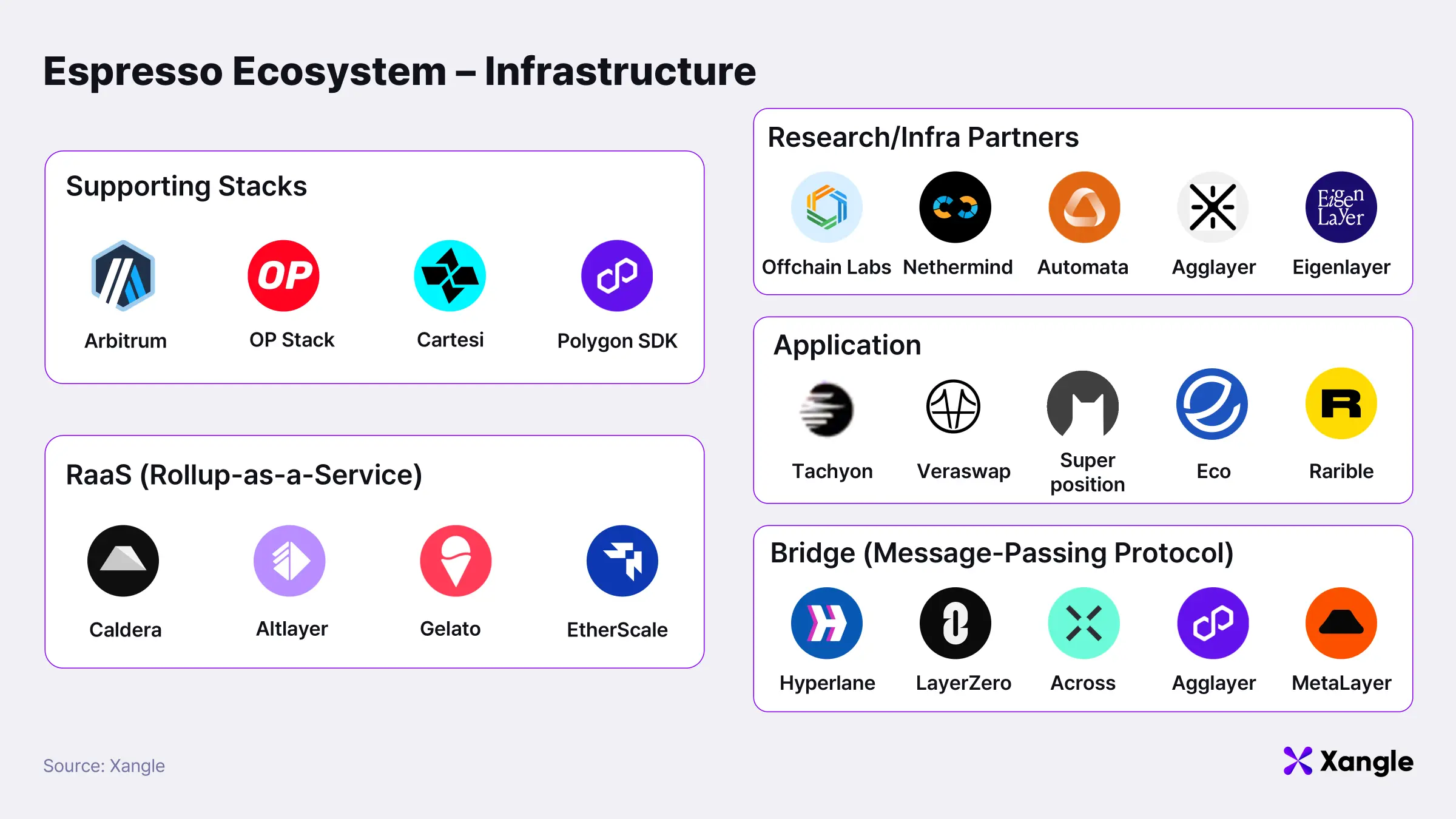
Espresso Systems is building a diverse network of partnerships across both technical and business domains, positioning itself not merely as an L2 infrastructure provider but as a core infrastructure operator of the next-generation modular blockchain ecosystem.
On the technical front, Espresso supports major rollup stacks such as Arbitrum Nitro Stack, Orbit chains, OP Stack, Cartesi Rollup, and Polygon SDK, aiming to ensure broad compatibility across modular blockchain environments. The team is actively experimenting with integrating Espresso’s shared sequencer and HotShot consensus protocol as a common infrastructure layer across these ecosystems. This architecture allows multiple rollups to synchronize transaction ordering, fostering a fairer and more interoperable network environment across diverse L2 architectures.
Espresso is also deepening its integration with RaaS (Rollup-as-a-Service) providers, including Caldera, AltLayer, and EtherScale, enabling rollups built on these platforms to natively leverage Espresso’s confirmation and data availability (DA) functionalities. Over the long term, Espresso aims to interconnect with all major RaaS providers, providing standardized finality and interoperability across the entire rollup ecosystem.
In the area of security and staking, Espresso has developed a decentralized sequencing protocol based on Sailfish. This enables rollups to assign a small committee of nodes to run their sequencer (e.g. by using their token to vote on who can enter the committee), while maintaining sub 200ms block times. This further improves the censorship resistance and liveness guarantees of rollups integrated with Espresso
In messaging and bridging, Espresso’s confirmation framework is already being adopted by leading cross-chain protocols such as Across Protocol, Hyperlane, and LayerZero. These projects are experimenting with HotShot-based consensus to improve the speed, reliability, and determinism of cross-chain message passing and asset bridging. As these integrations mature, Espresso is evolving beyond a finality layer into a trust foundation for interoperability, anchoring the modular blockchain ecosystem with secure, high-throughput, and verifiable cross-chain coordination.
3-2. Adoption in action across L2 and L3 networks
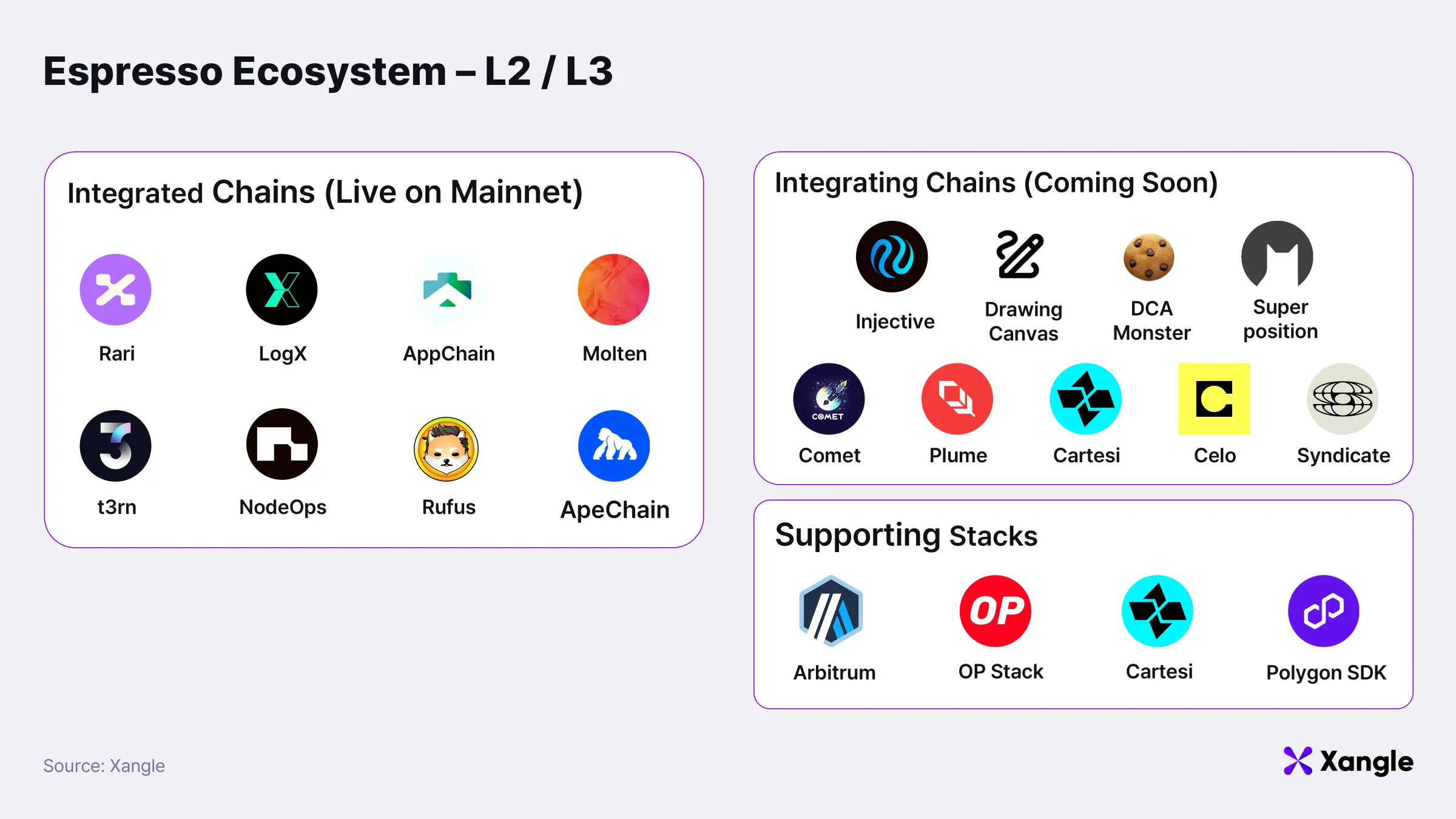
Espresso’s modular architecture is designed to be compatible with most major rollup frameworks, and a growing number of L2 and L3 chains have already integrated—or are preparing to integrate—Espresso’s finality and data availability (DA) solutions.
-
RARI Chain
Built by Rarible as an Arbitrum Orbit L3 chain, RARI aims to create a sustainable NFT ecosystem that guarantees creator royalties. By integrating Espresso’s finality layer, RARI can validate and finalize transactions within seconds while restricting L2 uploads to only those blocks that Espresso has already finalized—eliminating reorganization (re-org) risk. The result is a secure and transparent trading environment, establishing the groundwork for future cross-chain NFT interoperability.
-
LogX
A DeFi-focused Arbitrum Orbit L2 chain centered on perpetual DEX services, LogX seeks to deliver both high-speed execution and robust security. It integrates Espresso’s HotShot consensus-based finality layer, providing secure confirmations within roughly five seconds, and is deployed using AltLayer’s RaaS infrastructure. Espresso’s architecture prevents sequencers from publishing inconsistent or unfinalized data to Ethereum, structurally eliminating re-org risks. This enables faster, more stable transaction finalization compared to conventional single-sequencer-based systems.
-
AppChain
A developer-friendly L2 built on the Arbitrum Nitro stack using Caldera’s RaaS infrastructure, AppChain abstracts away blockchain complexity to deliver a Web2-grade user experience. Through integration with Espresso’s finality layer, transactions are finalized within seconds, providing decentralized finality without dependence on a centralized sequencer. This structure also enables efficient cross-chain connectivity, forming the backbone of a user-centric multichain application ecosystem.
-
Molten Network
A trading-optimized Arbitrum Orbit L3 chain, Molten powers perp-DEX and real-time trading applications. By embedding Espresso’s HotShot consensus-based finality layer, Molten achieves both speed and security, ensuring high responsiveness and reliability even during heavy trading activity. The network plans to expand by implementing cross-chain liquidity routing and optimization, enhancing scalability and interoperability across rollup ecosystems.
-
t3rn
A cross-chain execution-focused Arbitrum Orbit L3, t3rn enables smart contract execution across multiple chains within a unified environment. With Espresso’s finality layer integrated, cross-chain execution latency is reduced to just a few seconds, while real-time state access across chains becomes possible. This infrastructure powers cross-chain orchestration and automated asset transfers, establishing a reliable environment for interoperable smart contract execution.
-
NodeOps Network
A DePIN-based decentralized cloud marketplace, NodeOps connects global hardware providers with developers and protocols, serving as a Web3-native equivalent of AWS. Built on Arbitrum Orbit L3 and deployed via Caldera’s RaaS, NodeOps integrates Espresso’s HotShot-based finality layer to finalize transactions within seconds. Payments and data settlements between node providers and users are processed securely and near-instantly, while other rollups, bridges, and solver networks can reference NodeOps’ state in real time. This dramatically enhances the coordination efficiency and interoperability of decentralized compute resources.
-
Rufus
The metaverse chain powering Dogelon’s “Land on Mars” project, Rufus combines AI-generated content with on-chain asset trading to build a unified virtual economy. By integrating Espresso’s HotShot consensus-based finality layer, Rufus secures fast and reliable transaction finality and cross-chain composability. The network is currently working with ApeChain and RARI Chain to test “bridgeless minting”, enabling real-time asset utilization across metaverse and NFT ecosystems without intermediary bridges.
-
ApeChain
Built atop the Arbitrum Orbit L3 framework, ApeChain supports the ApeCoin DAO ecosystem, providing shared infrastructure for all ApeCoin-based applications. The integration of Espresso’s finality layer allows transactions to be verified and finalized within seconds, eliminating latency and inconsistency in cross-chain synchronization and asset transfers. ApeChain also enables real-time data and asset interoperability with other Espresso-integrated chains, forming a bridgeless environment where NFT minting, trading, and content interaction occur seamlessly—without relying on external bridge protocols.
Beyond these integrations, a number of additional networks—including Injective, Plume, and Celo—are preparing to adopt Espresso’s finality and data availability layers, with multiple deployments already underway in collaboration with RaaS infrastructure providers. Espresso is expanding rapidly across major rollup frameworks such as Arbitrum, Optimism, and Cartesi, broadening its presence across the modular blockchain stack.
There are three core reasons Espresso continues to be chosen across the industry:
- Eliminating Single-Sequencer Trust Risks: Rather than replacing the single sequencer, it strengthens it with HotShot’s multi-validator consensus to reduce re-org, censorship, and downtime risks.
- Institutional-Grade Finality: Espresso provides verifiable, consensus-driven finality instead of soft confirmations—meeting the trust and compliance standards required by exchanges and institutional participants.
- Decentralization Without UX Trade-Offs: Espresso achieves Ethereum-level security and finality while maintaining L2-grade speed and low latency, delivering a frictionless user experience.
Espresso is therefore not just a performance enhancement layer for L2s, but a core infrastructure foundation that delivers both speed and reliability. Integrating Espresso marks a shift for L2 projects—from relying on centralized sequencers to adopting a secure, verifiable, and interoperable architecture that defines the future of modular blockchain ecosystems.
4. Espresso’s Growth Capital: Funding, Community Sale, and Strategic Backing
4-1. Backed by builders and long-term partners
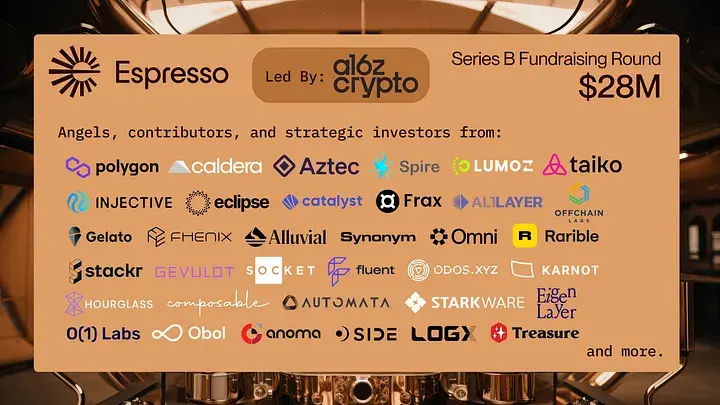
Including both private rounds and community sales, Espresso has raised a total of $63.9 million to date. The project began in 2020 with a $2 million seed round, and in 2022, it secured $29.9 million in a Series A led jointly by Greylock Partners and Electric Capital, with participation from Sequoia Capital, Blockchain Capital, and Slow Ventures.
In 2024, Espresso raised an additional $28 million through a Series B round led by a16z crypto, followed later that year by a $4 million community sale on Kaito Launchpad, bringing its total cumulative funding to $63.9 million.
The consistent participation of top-tier global venture firms—including Greylock, Sequoia, Electric Capital, and a16z—underscores more than just fundraising success. It reflects the market’s growing recognition of Espresso’s role as a foundational blockchain infrastructure layer, and suggests that the project will benefit from broad strategic support—spanning technology development, governance design, and business expansion—as its ecosystem continues to scale.
4-2. Community meets capital on Kaito launchpad
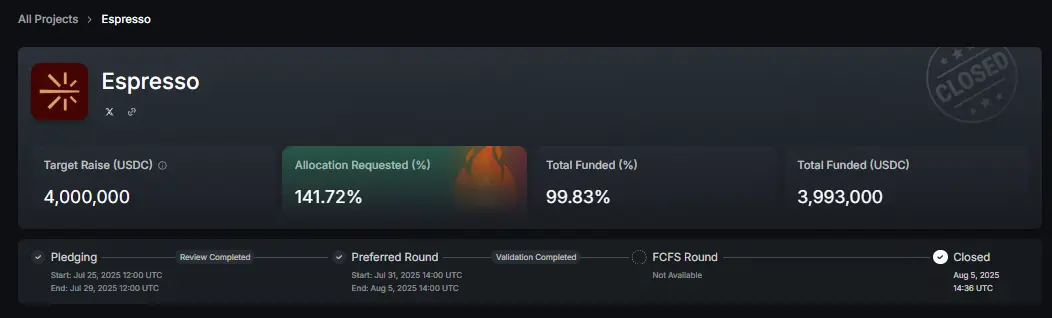
Among Espresso’s fundraising milestones, the token sale conducted via Kaito Launchpad stands out as one of its most noteworthy events. As the first-ever project to debut on Kaito’s platform, Espresso garnered significant community attention and ultimately closed its sale at 141.72% oversubscription, marking a highly successful launch in Kaito’s early history.
Under the sale structure, 1% of the total 3,590,000,000 $ESP supply was offered at a fully diluted valuation (FDV) of $400 million. Participants were subject to a one-year lockup, followed by an additional one-year linear vesting period. While many potential investors viewed these terms as restrictive and opted not to participate, Espresso later announced a bonus allocation program to reward those who demonstrated long-term conviction in the project.
Under this program, every community participant, regardless of investment size, received a flat 25,000 $ESP bonus, in addition to an extra airdrop equal to 33% of their pledged amount. Both allocations were fully unlocked at the Token Generation Event (TGE), while the base allocation adhered to the original 1-year lockup + 1-year vesting schedule.
For instance, an investor who pledged $10,000 but received an actual allocation of $7,000 was assigned 62,825 ESP as their base investment. On top of that, they received 54,916 ESP in bonuses—comprising 25,000 ESP plus one-third of their pledged amount (89,750 ESP ÷ 3). The bonus portion (54,916 ESP) was immediately unlocked at TGE, while the 89,750 ESP base allocation followed the vesting timeline. Moreover, holders of Espresso’s genesis NFT collection, The Composables, received an additional 10% ESP bonus based on their pledged amount.
The sale structure was purposefully designed to reward long-term believers who resonated with Espresso’s vision and technical foundation, rather than short-term speculators seeking quick exits. In essence, the program sought to build a core community aligned with the protocol’s sustainable growth, prioritizing ecosystem maturity and alignment over near-term liquidity incentives.
Although detailed $ESP tokenomics have not yet been disclosed, the token is expected to serve as the economic backbone of the Espresso Network, underpinning essential on-chain functions such as validator staking, transaction fee payments, and governance participation.
5. Brewing the Future: Toward a Caffeinated Internet
Espresso is not simply a module supporting L2 rollups—it aspires to become the foundational layer upon which L2s, L3s, and even Web2 services can reliably operate. The network addresses the inherent weaknesses of single-sequencer soft confirmations through HotShot’s multi-validator consensus, bridging the gap between L2 confirmations and Ethereum finality with near-instant (seconds-level) confirmations. At the same time, EspressoDA delivers low-cost, low-latency data availability, minimizing dependency on Ethereum while enabling finality-based cross-chain communication through integrations with messaging and bridge stacks.
Espresso’s long-term success will hinge on ecosystem onboarding and verifiable performance metrics. As integrations expand across RaaS providers, rollup stacks, bridge and messaging protocols, and appchains, Espresso must demonstrate superiority through objective KPIs such as re-org frequency, confirmation latency, and DA cost efficiency. Parallel to this, transitioning HotShot consensus into a permissionless PoS framework—alongside restaking integrations—will be key to achieving credible decentralization and strengthening the network’s trust layer.
The onboarding of Web2 enterprises represents the natural evolution of Espresso’s vision. Large-scale Web2 platforms in sectors such as payments, trading, and gaming will no longer need to construct complex proof systems from the ground up. Instead, they can function as service-based L2s, delegating confirmation, data availability, and messaging functions to Espresso’s infrastructure layer. To support this migration, Espresso will need to offer enterprise-grade SDKs, standardized APIs, and options for regulatory compliance and data sovereignty, allowing businesses to integrate seamlessly without compromising operational flexibility.
Once this model matures, the Internet will no longer be a single monolithic chain but an organically interconnected ecosystem, where diverse services are linked through Espresso’s confirmation layer. Just as every good coffee gains richness from a single shot of espresso, the web itself may soon be infused with trust and finality—becoming, quite literally, a caffeinated internet.
Disclaimer
I confirm that I have read and understood the following: The information contained in this article is strictly the opinions of the author(s). This article was authored free from any form of coercion or undue influence. The content represents the author's own views and does not represent the official position or opinions of CrossAngle. This article is intended for informational purposes only and should not be construed as investment advice or solicitation. Unless otherwise specified, all users are solely responsible and liable for their own decisions about investments, investment strategies, or the use of products or services. Investment decisions should be made based on the user’s personal investment objectives, circumstances, and financial situation. Please consult a professional financial advisor for more information and guidance. Past returns or projections do not guarantee future results. This article was written at the request of Espresso. All content in this article was written independently by the author(s), and neither CrossAngle nor Espresso had any editorial control or influence over the content. The author(s) may hold the cryptocurrencies mentioned in this article at the time of writing.
Xangle or its affiliated partners own all copyrights of the written or otherwise produced materials and content provided on the platform. Any illegal reproduction of such content, including, but not limited to, unauthorized editing, copying, reprinting, or redistribution will result in immediate legal actions without prior notice.



![[CIS Partner Summit Highlights] Ault's Financial Super App Strategy: OnlyBulls](https://resource.xangle.io/files/content/C1A19E1DB41B7FB86076143803C40D8E_1790125531662.webp)