Bread Wallet: Bringing Privacy to the Public

Table of Contents
1. Bread: Miden’s Private Wallet
2. Designing Privacy for an Everyday Wallet
3. From Transfers to Cross-Chain and Earn
4. Conclusion: Making Private Finance Usable
1. Bread: Miden’s Private Wallet
On September 15, 2026, privacy-focused blockchain Miden introduced Bread Wallet, a private wallet designed to let users manage their own assets while keeping their balances and detailed account information private from other users by default.
Miden is building a blockchain that protects detailed account information while allowing transactions to be verified on a public network. Transactions are executed on users’ devices, which submit zero-knowledge proofs of their validity to the network.
This design also means a wallet has more work to do. In addition to the signing and sending functions familiar from EVM wallets, it must execute transactions, generate proofs, and manage private account data. When a device is lost or replaced, the user also needs a way to recover account data that is not stored on the public ledger. Managing each of these steps separately can make a wallet more complicated to use. Miden’s technical architecture and design direction are explored in greater detail in our previous research, “Miden: An Invisibility Cloak for Everyone’s Privacy”.
Bread aims to reduce this burden by handling transaction execution and private data management within the wallet. Users hold the keys that authorize asset transfers and can send, receive, or swap assets. An infrastructure service called Guardian supports account data backup, synchronization, and recovery.
This article examines how Bread reduces the work involved in managing and recovering an account while preserving account privacy and user control over assets. It then follows the use of transfers, swaps, cross-chain transfers, and Earn, examining what information each function protects and what it makes public.
2. Designing Privacy for an Everyday Wallet
2.1 Private Accounts Protect Balances and Account State
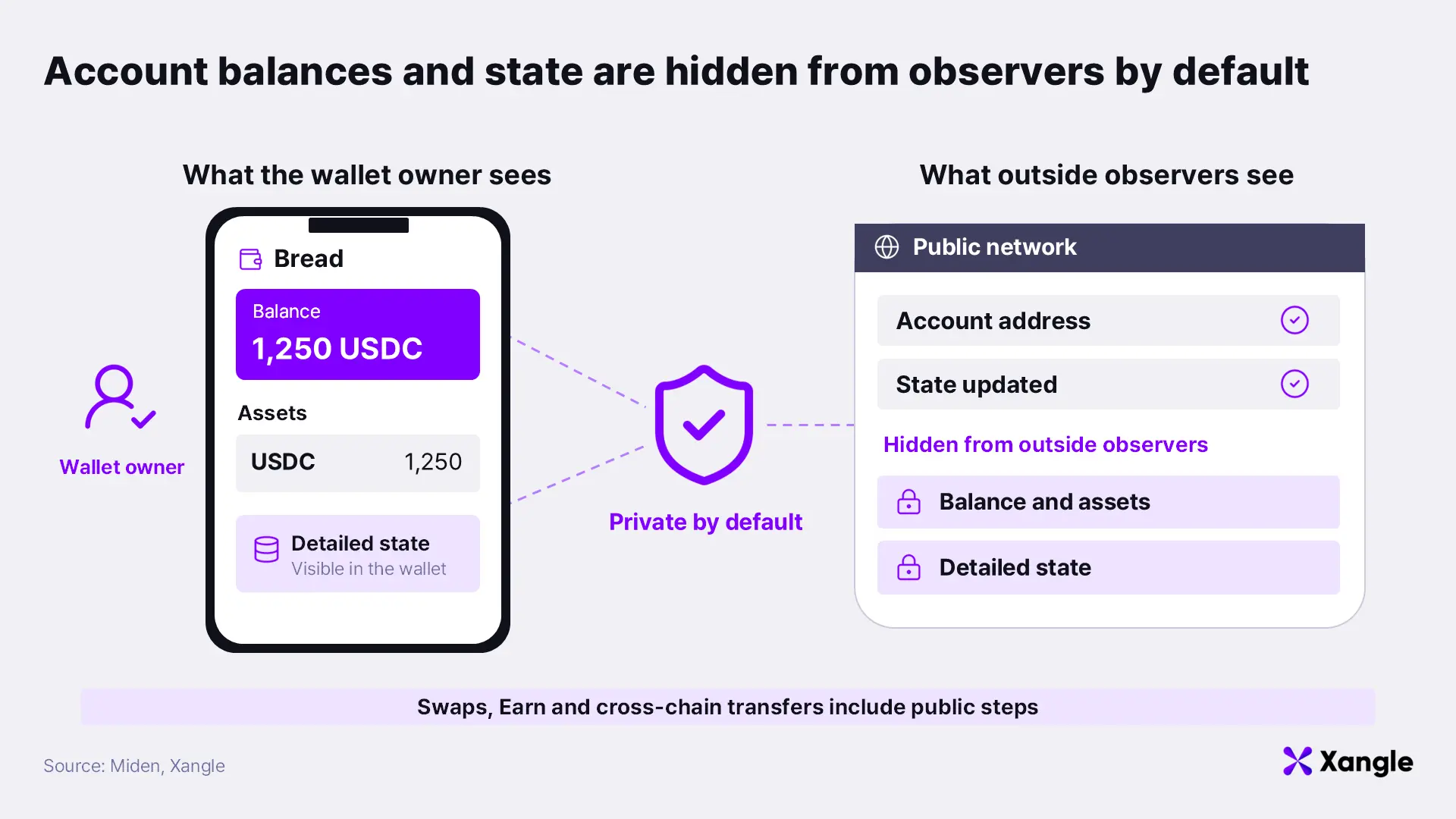
In Bread’s private accounts, the data needed to operate an account—including balances and holdings—is managed by the user. This data is known as the account state, and its details are not published on the public ledger.
The public network records a cryptographic value called a commitment that represents the account state. Like a digital fingerprint, the commitment provides a way to identify the finalized state without revealing its contents. When a transaction changes the state, the network verifies the transaction proof and records a commitment to the new state.
Users can view their own balances and transaction activity in the wallet. Outside observers can see public addresses and that an account’s state has changed, but they cannot see its full balance or detailed state from that information. A counterparty can see information about a transaction it participates in, but cannot use it to view the other assets held in the account.
This privacy protection applies to account balances and detailed state. Individual transaction information may become visible when assets are swapped or moved to another chain or service. In the public swaps currently available, information such as the assets being exchanged and the amounts is visible.
Miden is developing confidential swaps to provide more privacy during the exchange process. These are designed to hide which account participates in a trade while keeping transaction amounts and the order book public.
2.2 How the Parts of a Private Account Work Together
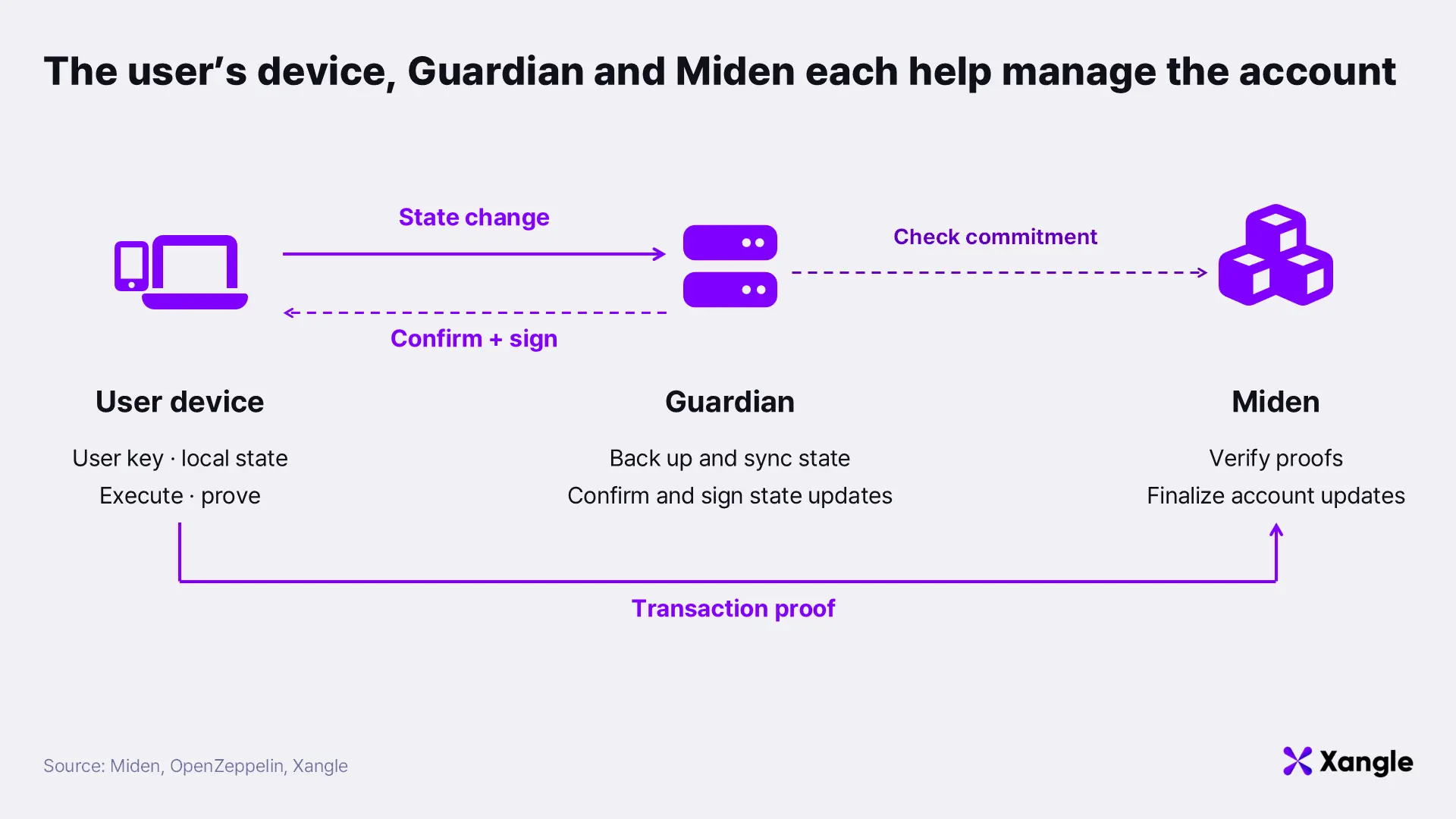
Bread brings together the user’s device, Guardian, and the Miden network, each with a distinct role. The device executes transactions with the user’s approval, Guardian signs everyday transactions and backs up account data, and the Miden network verifies transaction proofs and finalizes account updates.
When a user approves a transfer, the device uses current account information, including the balance, to calculate the resulting state and generate a proof that the result follows the rules. The user holds the key that authorizes asset transfers.
Guardian is an account data backup and synchronization service built by Miden with OpenZeppelin. In a Guardian-backed Bread account, everyday transactions use both the user’s key and a Guardian signature. Guardian confirms state changes and stores copies of the account state and its updates outside the device, helping the wallet use the latest data.
The Miden network uses the submitted proof to verify that the transaction follows the rules. It finalizes the account update for a valid transaction and records a commitment to the resulting state. Guardian synchronizes its backup against the state finalized by the network.
2.3 Supporting Recovery with Account State Backups
In a self-custody wallet on a public blockchain such as Ethereum, users manage their own private keys. If a device is lost or replaced, a recovery phrase can restore the keys on a new device. The wallet can then retrieve balances and transaction history recorded on the public ledger, allowing users to access their existing account again.
Miden private accounts do not record detailed account data, such as balances and holdings, directly on the public ledger. This data is managed on the user’s device and can be lost with it. Recovering an existing account therefore requires users to retrieve that data as well as restore their key.
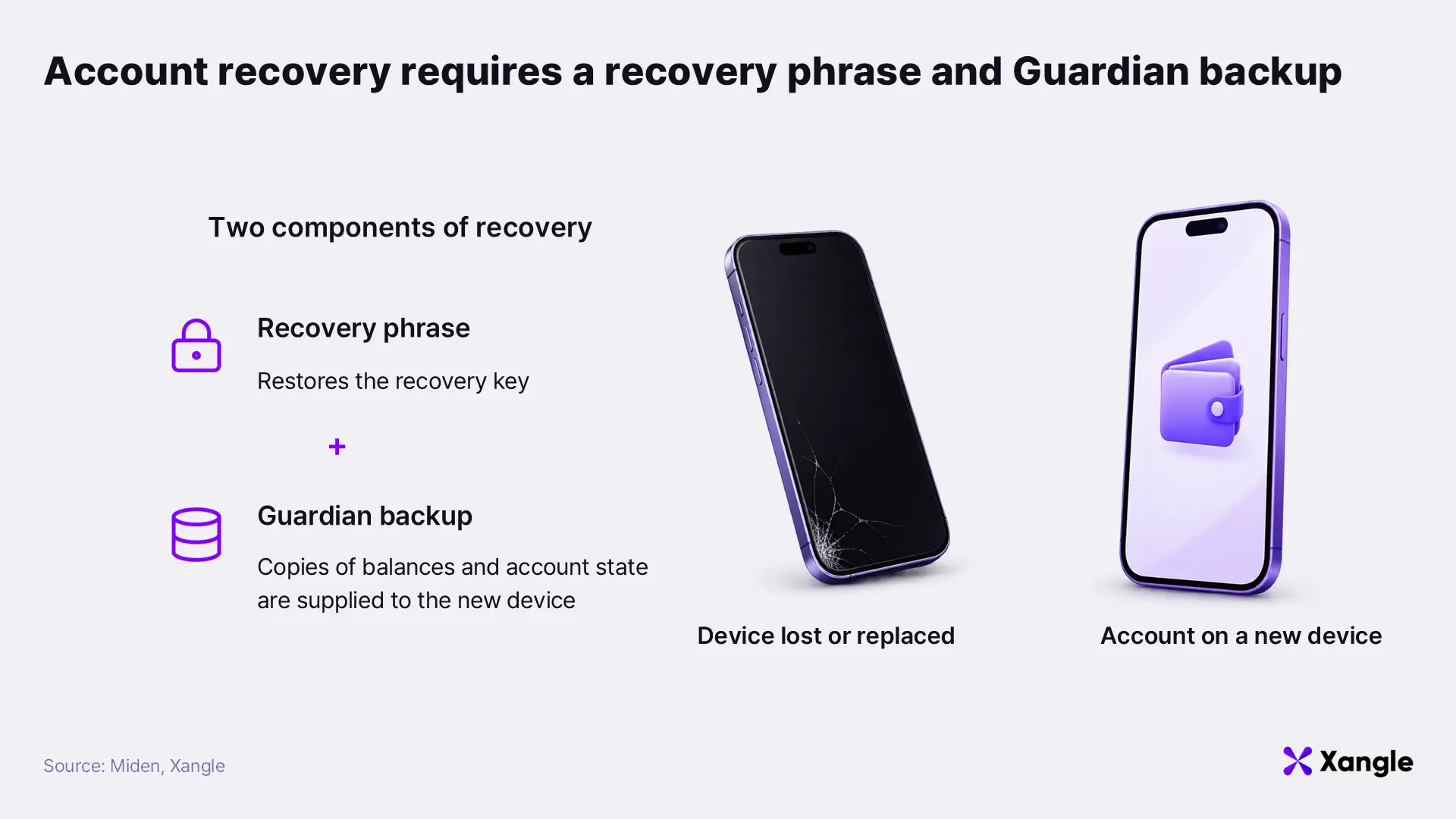
Guardian’s backup helps users recover account data lost from a device. It stores a copy of the account state and its changes outside the device. When users enter their recovery phrase on a new device, Bread uses it to restore their recovery key. They can then use the recovery key and Guardian to retrieve their backed-up account data and set up a new everyday key for the device. This lets users continue using the same account without publishing detailed balances on the public ledger.
The Guardian operator can see backed-up account information, but cannot move funds without the user’s approval. Guardian does not store the recovery phrase, so an account cannot be recovered if both the phrase and every device holding the user’s keys are lost. If the phrase is still stored on a device where the user can unlock the wallet, it can be viewed again.
3. From Transfers to Cross-Chain and Earn

Bread launched on Miden’s Partner Mainnet on October 26, 2026, and is available as an iOS and Android app and a Chrome extension. Built on private accounts, it lets users manage and transfer assets while protecting balances and detailed account information. Bread is extending that experience beyond holding and sending assets with cross-chain transfers and Earn, which allows users to deposit assets into an external lending market to earn a return.
3.1 Transfers and Swaps on Miden
Bread users can send and receive assets through Miden private accounts. To receive assets, they share their account address or QR code; to send them, they select the recipient, asset, and amount and approve the transfer. The wallet displays balances and transfer history to help users manage their assets.
Transfers use a piece of data called a note, which contains the assets being sent and the conditions for using them. Once the sender’s transaction is finalized, the recipient adds the note to their account. The assets then become part of the recipient’s balance and can be used for another transfer or swap.
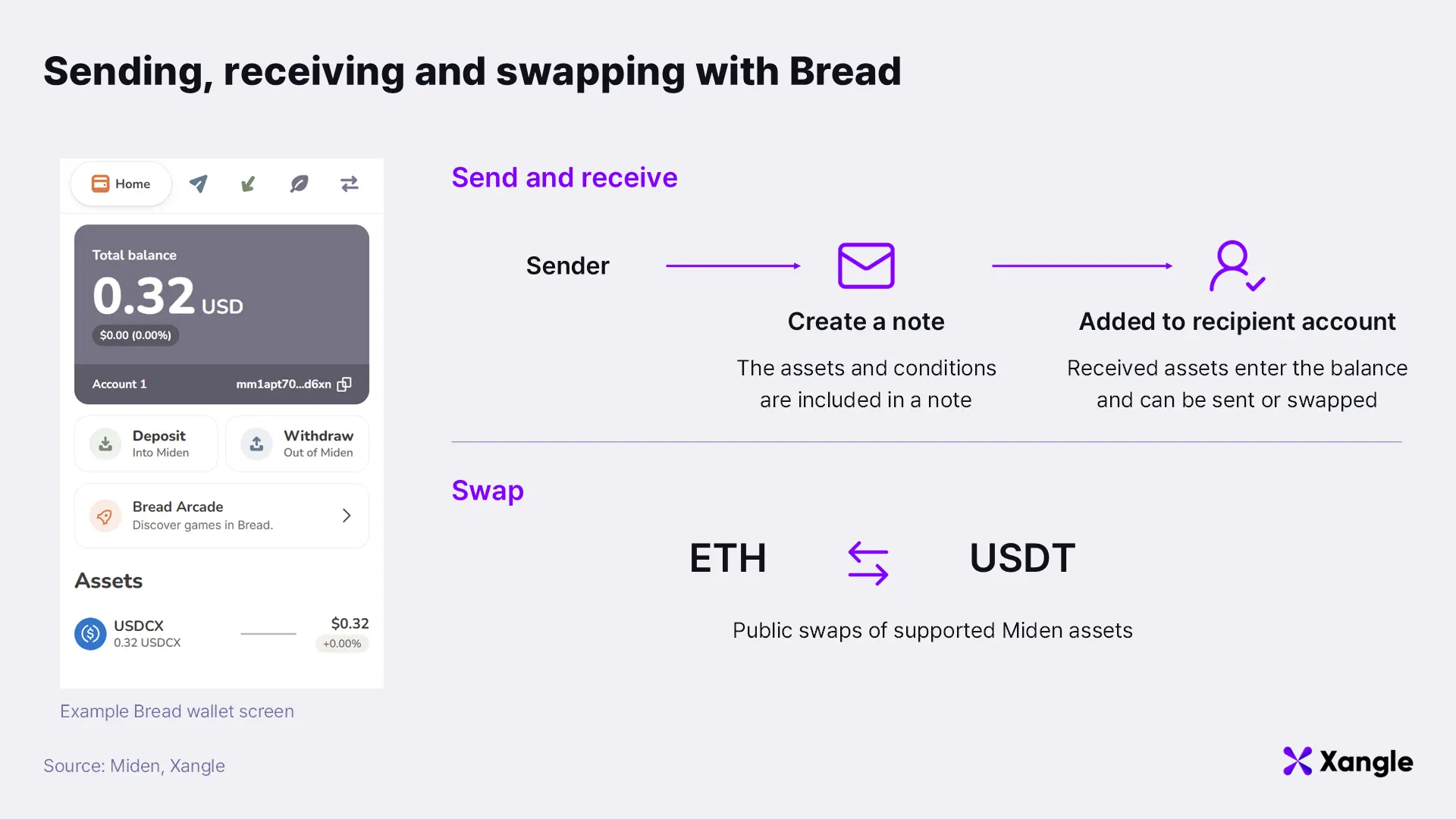
Users can hold the assets they receive or swap them for another supported asset in the wallet. For example, ETH can be exchanged for USDT, and USDCx, a USDC-backed asset issued on Miden, is also available for swaps. The swaps currently available are public swaps between supported Miden assets, so information such as the assets and amounts exchanged is visible. Miden is also developing confidential swaps designed to hide the account participating in a trade from outside observers.
3.2 Cross-Chain Asset Transfers
Cross-chain transfers let Bread users move assets to other networks to use their services, or bring assets from those networks into Miden. Bread supports USDC deposits and withdrawals across Ethereum, Base, Arbitrum, and Arc using xReserve, an infrastructure service provided by Circle, the issuer of USDC.
xReserve enables USDC-backed assets to be issued and redeemed on other chains. When USDC from an external chain is deposited, USDCx is issued on Miden against that collateral. For withdrawals, USDCx is burned and the user receives USDC on the external chain.
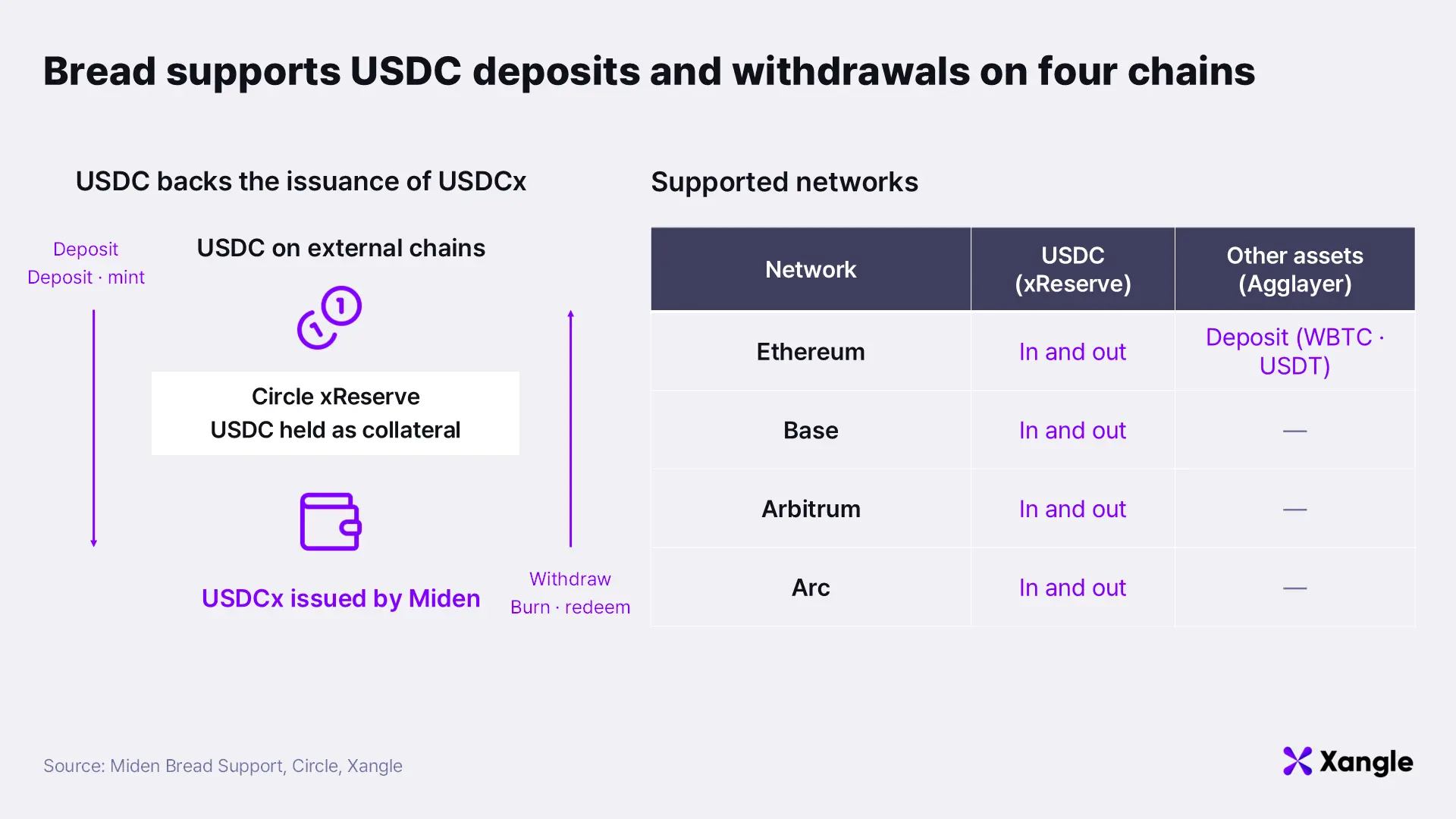
Ethereum assets other than USDC, including WBTC and USDT, can also be brought into Miden through the Agglayer bridge. As with swaps, the transfer process involves public information: when assets move across chains, sending and receiving addresses and amounts are recorded on the external chain. Miden plans to expand its supported assets and connected chains, while developing private cross-chain transfers to extend privacy to the transfer process.
3.3 Putting Assets to Work with Earn
Earn lets users deposit USDCx held in Bread into an external lending market and monitor their position and make withdrawals from the wallet. Aave on Ethereum was included as an initial market when Partner Mainnet launched. Users can now deposit into six USDC lending markets: Aave V3 and Compound III on each of Ethereum, Base, and Arbitrum.
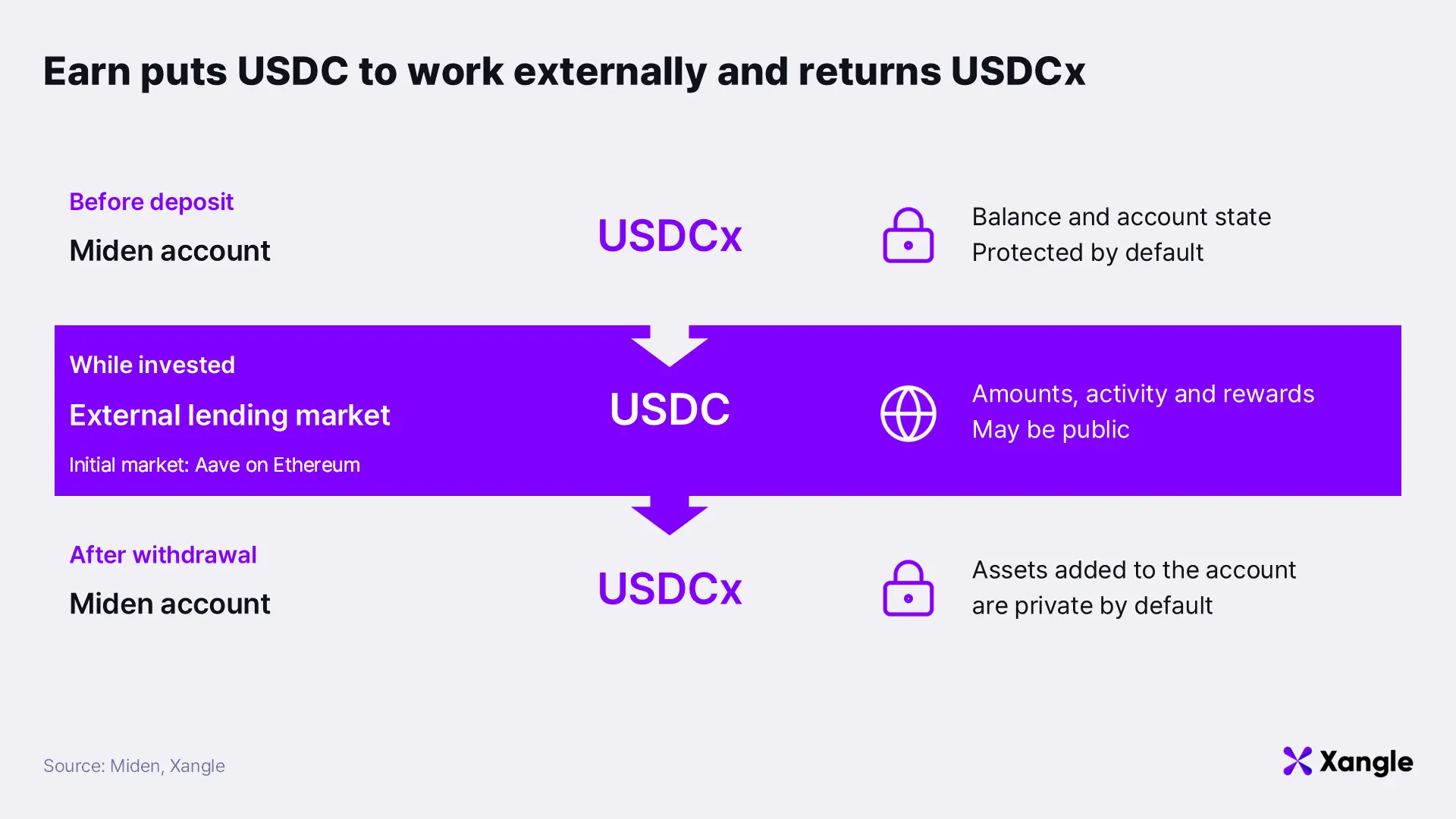
When users deposit USDCx through Bread, the assets move from Miden to an external chain, where the chain’s native USDC is supplied to the selected lending market. To withdraw, users recover USDC from the lending market and receive USDCx on Miden. The final amount received reflects the fees for moving assets between chains and processing the transaction. Users can view their deposited balance and any returns in Bread.
The scope of privacy also depends on where the assets are held. Detailed balances in a Bread private account are protected by default, while the amounts deposited in an external lending market, activity in that market, and returns may be visible on the external chain. Once the withdrawn assets are added back to the Miden account, they are again covered by the account’s privacy protections.
4. Conclusion: Making Private Finance Usable
Bread brings the privacy technology Miden has developed into a wallet people can use directly. Users retain control of their assets while protecting their balances and detailed account information, and Guardian’s backups help them continue using their accounts after changing devices.
For a private wallet to become an everyday asset management tool, it needs to protect information while also offering services that allow users to put their holdings to work. Bread’s cross-chain transfers and Earn are designed to make assets managed on Miden usable in financial services on other chains. If confidential swaps and private cross-chain transfers are implemented in the future, they could reduce the information disclosed during those activities as well as while assets are held.
Partner Mainnet provides an environment for testing these functions with real funds. Bread’s next challenge is to expand the assets and chains it supports while ensuring that transfers and swaps run smoothly and that assets deposited in external services can be withdrawn reliably. If users return to these services regularly, Bread could become an everyday wallet for people who want privacy while managing and using their assets.
Bread is currently accepting applications for early Partner Mainnet access on its official page. Users who receive an invitation code can create a mainnet account in the wallet and use the services with real funds. Partner Mainnet is temporary, and users will need to withdraw their funds before the network reset for the transition to Public Mainnet. Withdrawal instructions and the deadline will be announced later.
Disclaimer
I confirm that I have read and understood the following: The information contained in this article is strictly the opinions of the author(s). This article was authored free from any form of coercion or undue influence. The content represents the author's own views and does not represent the official position or opinions of CrossAngle. This article is intended for informational purposes only and should not be construed as investment advice or solicitation. Unless otherwise specified, all users are solely responsible and liable for their own decisions about investments, investment strategies, or the use of products or services. Investment decisions should be made based on the user’s personal investment objectives, circumstances, and financial situation. Please consult a professional financial advisor for more information and guidance. Past returns or projections do not guarantee future results. This article was written at the request of Miden. All content in this article was written independently by the author(s), and neither CrossAngle nor Miden had any editorial control or influence over the content. The author(s) may hold the cryptocurrencies mentioned in this article at the time of writing.
Xangle or its affiliated partners own all copyrights of the written or otherwise produced materials and content provided on the platform. Any illegal reproduction of such content, including, but not limited to, unauthorized editing, copying, reprinting, or redistribution will result in immediate legal actions without prior notice.