The Center of Gravity in Stablecoin Competition Is Shifting

Table of Contents
1. Stablecoin Competition Is Shifting from Issuance to Distribution
2. Stablecoin Monetization Models Vary by Distribution Strategy
2-1. Tether's USDT: Market Dominance Built on Network Effects
2-2. Circle's USDC: Expanding Market Position Through Close Integration with a Core Distribution Partner
2-3. Global Dollar Network's USDG: Building a Distribution Network Through Revenue Sharing
2-4. PayPal's PYUSD: Distribution Advantage from an Existing Payments and Remittance Network
3. Distribution Strategy Shapes Stablecoin Profitability
1. Stablecoin Competition Is Shifting from Issuance to Distribution
The early stablecoin business model was relatively straightforward. Fiat on/off-ramp infrastructure was limited in the early crypto market, and Bitcoin served as the primary quote asset for altcoin trading. When USDT launched in 2014, it brought the value of the U.S. dollar onto blockchains, allowing exchanges to offer dollar-denominated trading without relying on a bank transfer for every transaction. As exchanges and users adopted USDT, liquidity accumulated. That liquidity, in turn, attracted more exchanges and users, creating a network effect.
Under this model, Tether had little need to aggressively share reserve income to expand distribution. Exchanges could attract trading volume simply by supporting USDT, which already had strong demand, and monetize that activity through trading fees and conversion revenue. Tether earned interest income by investing the reserve assets backing USDT's growing circulating supply in U.S. Treasuries and repo, while exchanges and on/off-ramp providers earned their own revenue as USDT was traded and converted. The issuer and distributors earned revenue at different stages.
As the market has grown, stablecoins have expanded from products offered by a small group of crypto companies into a market contested by financial institutions, payments firms, and fintech companies. The enactment of the GENIUS Act in the United States in July 2025 was significant not because it drove the market's growth, but because it clarified a regulatory pathway for stablecoin issuance within the regulated financial system as the market was already expanding. By defining standards for permitted issuers, reserve assets, redemption, and supervision, it laid the groundwork for a broader set of participants, including banks and payments companies, to enter the market.
Market entry is no longer limited to direct issuance. Networks such as Paxos's Global Dollar Network (GDN) have emerged, allowing exchanges, payments firms, fintechs, and on-chain financial businesses to distribute a single stablecoin together and share income generated from its reserves. Issuance infrastructure is becoming separated from businesses with direct customer relationships and use cases, with multiple companies jointly building a single stablecoin ecosystem.
As the number of competitors grows, a stablecoin pegged 1:1 to the dollar offers limited differentiation on its own. Exchanges, wallets, payments companies, and fintechs with direct customer relationships and use cases inevitably gain influence over which stablecoins users choose to hold and trade. This is also changing how reserve income is used. In the past, most interest generated from reserves remained with the issuer. Increasingly, a portion is being distributed to exchanges and platforms or paid to users and merchants as rewards to expand stablecoin distribution and usage. Reserve income is starting to function not only as issuer profit, but also as a cost of expanding the network.
This shift also broadens the set of participants that can earn from stablecoins. Platforms with customers and trading liquidity, payments companies that connect consumers and merchants, and fintechs with remittance and FX networks can drive distribution and real-world use, capture part of the reserve income, and generate additional revenue opportunities from their existing financial services at the same time.
2. Stablecoin Monetization Models Vary by Distribution Strategy
How reserve income is deployed depends on each stablecoin's market position and distribution structure. Businesses with strong network effects can retain a relatively larger share of reserve income at the issuer level, while later entrants offer economic incentives to exchanges, platforms, and payments companies to secure distribution networks and use cases.
2-1. Tether's USDT: Market Dominance Built on Network Effects
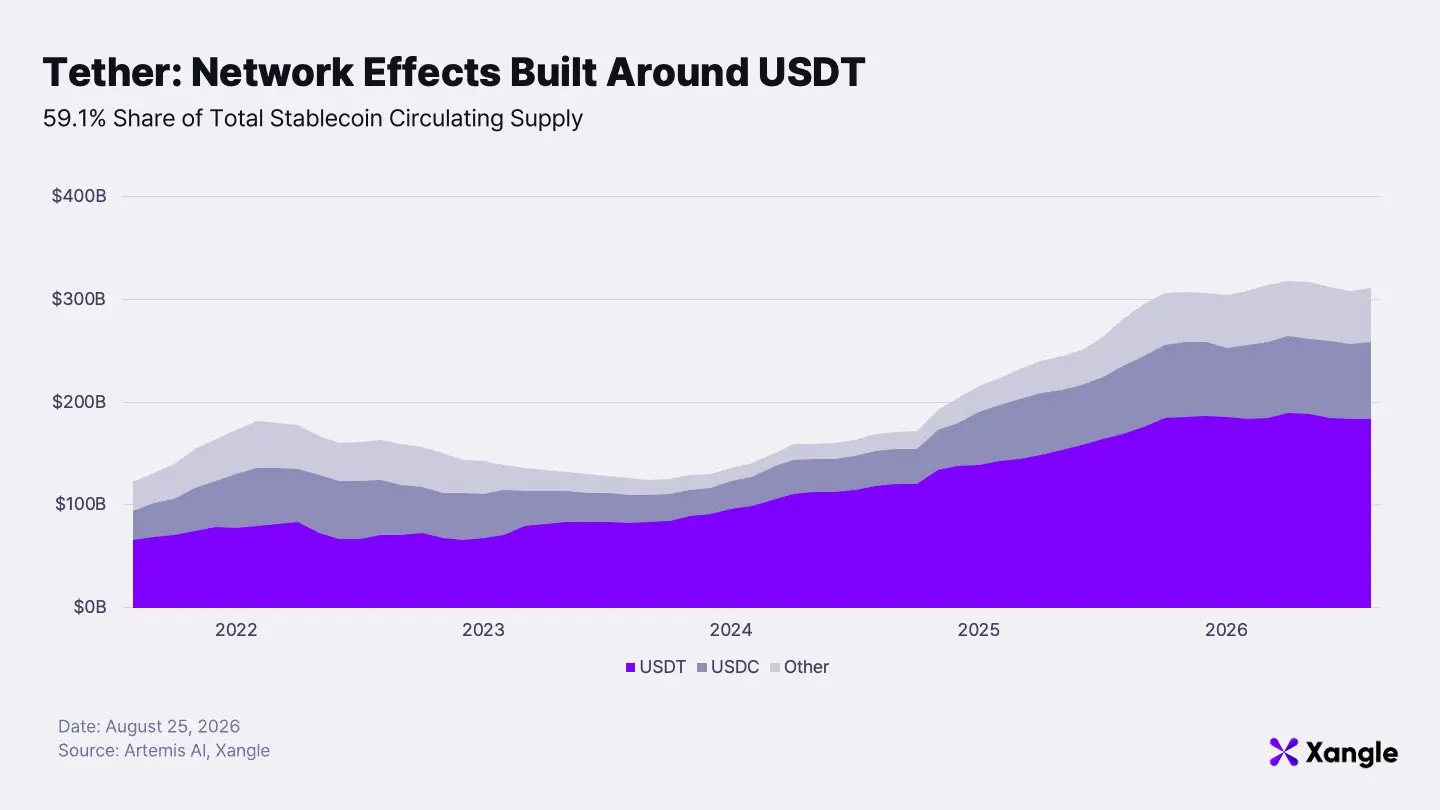
USDT's greatest competitive advantage lies in the trading liquidity and network effects it has built over many years. After establishing itself as a primary quote asset in the early crypto market, it grew alongside exchanges and users, creating a structure in which deep liquidity generated additional trading demand. In July 2026, 73.5% of spot trading volume on major centralized exchanges came from USDT-denominated trading pairs. For exchanges, supporting USDT is itself a way to access the largest pool of trading demand.
USDT can create revenue opportunities for distributors even when Tether does not share reserve income with them. Demand is already strong enough that exchanges can earn trading fees, while OTC desks and on/off-ramp providers can capture spreads when converting between USDT and local currencies. In fact, stablecoin activity processed by fintechs, exchanges, payment platforms, and on/off-ramp providers shows USDT leading USDC by a wide margin across most regions. USDT also accounts for the largest share of actual stablecoin payment flows when investment and trading activity are excluded. Distributors can therefore turn strong USDT demand into revenue through trading, FX conversion, remittances, and payments without receiving a direct share of Tether's reserve income.
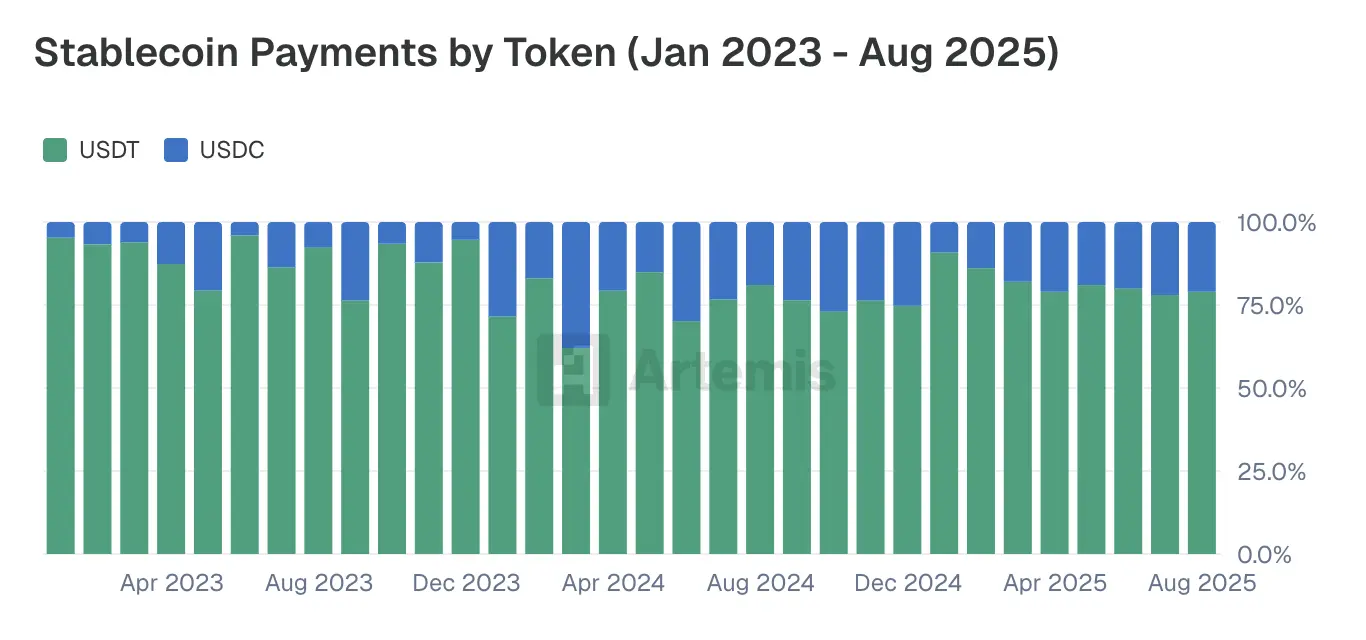
Source: Artemis.ai
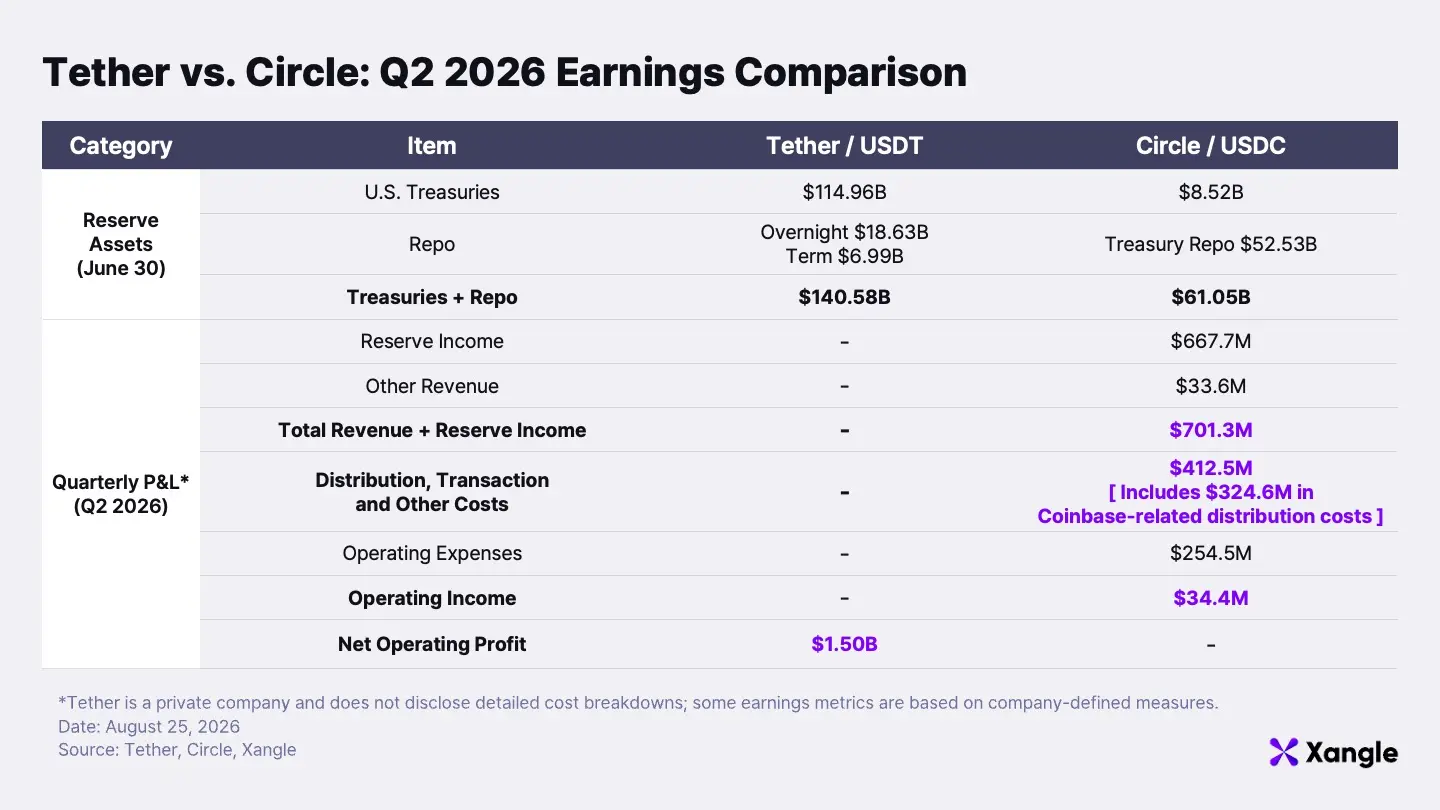
Tether earns income by investing the reserve assets backing this larger USDT circulating supply in U.S. Treasuries and repo. In Q2 2026, it recorded approximately $1.5 billion in net operating profit, driven primarily by reserve asset management. By contrast, Circle spent around 46% of roughly $700 million in revenue during the same period on Coinbase-related distribution costs, leaving operating income of only about $34.4 million. Circle allocates a significant share of revenue to its core distribution partner to expand USDC distribution, while USDT's existing trading demand and liquidity act as a distribution incentive in their own right. This helps explain why Tether can retain a larger share of reserve income at the issuer level.
2-2. Circle's USDC: Expanding Market Position Through Close Integration with a Core Distribution Partner
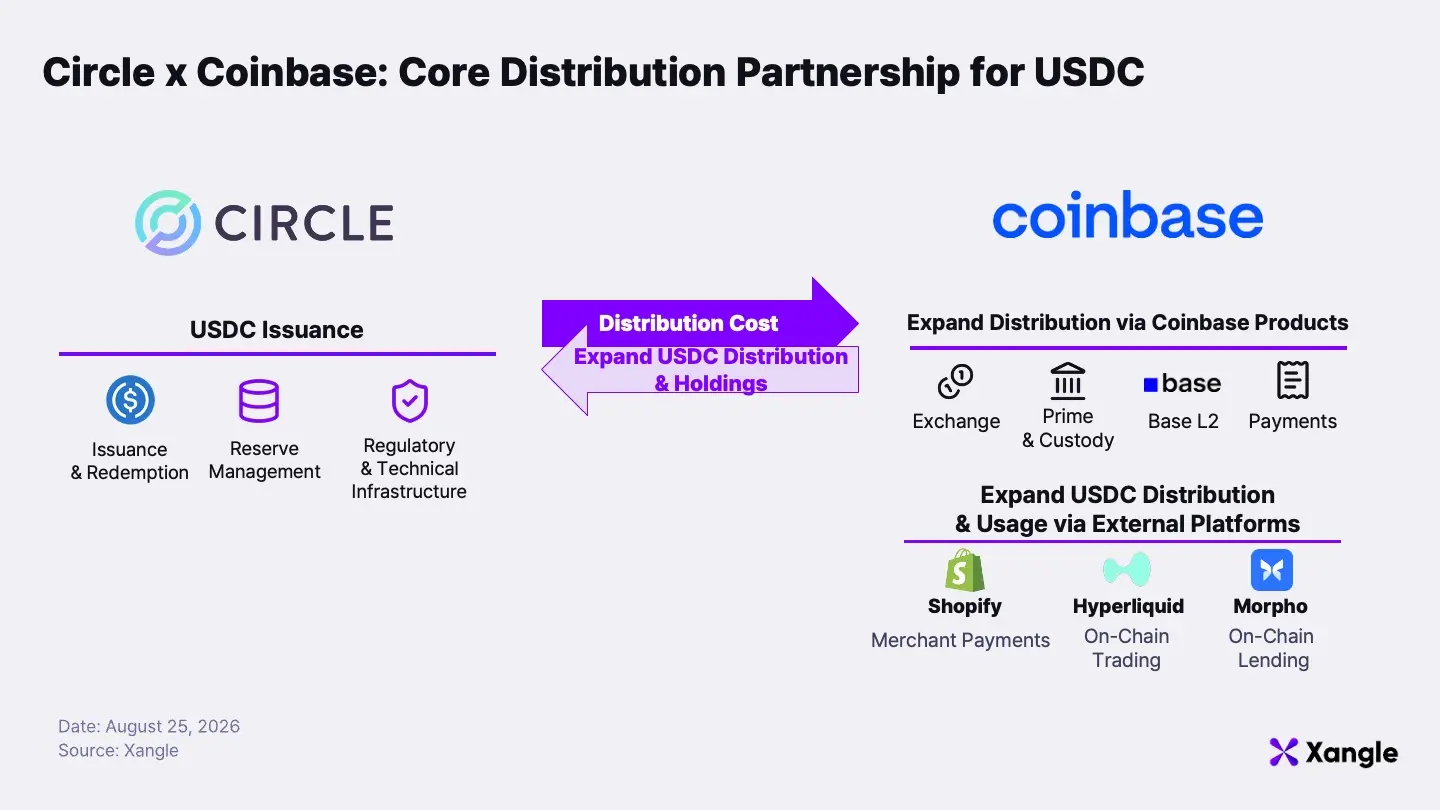
Circle launched USDC in 2018, entering a market where USDT had already established strong network effects. Circle chose to focus on issuance, reserve management, regulatory matters, and technical infrastructure, while partnering closely with Coinbase, a major crypto exchange, to expand USDC's circulating supply and use cases.
Coinbase expands USDC holdings among both retail and institutional users through its exchange, while also bringing USDC on-chain through Base, the Ethereum Layer 2 network it operates. On Base, USDC is used across trading, payments, lending, and other financial activity. Coinbase is also extending USDC into merchant payments through Shopify and into external on-chain trading venues such as Hyperliquid. USDC Rewards further incentivizes users to keep USDC on Coinbase.
Token Terminal's on-chain metrics also show this distinction. USDC's Asset TVL stands at $8.3 billion, about 1.9 times that of USDT, while its DEX trading volume over the past three years reached $2.1 trillion, about 2.9 times that of USDT. USDT has the larger circulating supply, but USDC is relatively more active in DeFi and on-chain trading.
This distribution strength is also evident in the amount of USDC held within Coinbase. In Q2 2026, average USDC held across Coinbase products reached an all-time high of $20 billion. At quarter-end, USDC held across Coinbase products represented more than 30% of USDC's total circulating supply.
Circle incurs substantial costs to secure this distribution network. In the first half of 2026, Circle generated approximately $1.4 billion in total revenue and reserve income, while recognizing about $655.3 million in Distribution Cost related to its Coinbase agreement over the same period. A simple comparison puts the latter at roughly 47% of the former.
In exchange for committing a significant share of reserve income to its distribution relationship with Coinbase, Circle gains access not only to the customers and trading liquidity of a major exchange, but also to a distribution network spanning Base, payments, and external on-chain markets. Coinbase, meanwhile, uses USDC to expand activity across both its exchange and on-chain ecosystem, capturing income from Circle alongside growth in its existing businesses.
2-3. Global Dollar Network's USDG: Building a Distribution Network Through Revenue Sharing
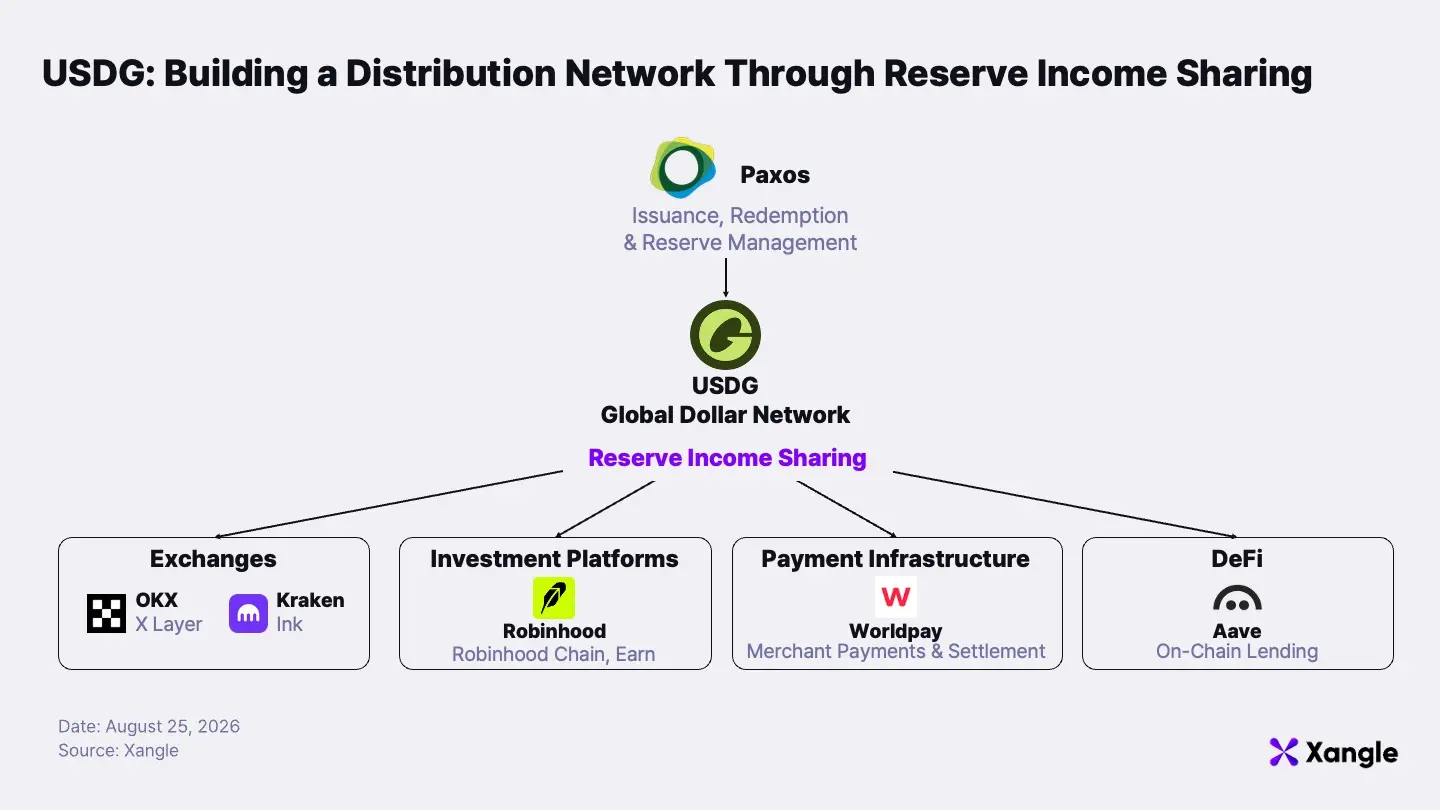
Paxos handles USDG issuance and reserve management, while companies participating in the Global Dollar Network (GDN) expand distribution through their own customer bases and services. Rather than building every distribution channel itself, Paxos brings together companies that already have customer bases, ranging from trading platforms such as Kraken, OKX, and Robinhood to payments providers such as Worldpay. Each participant integrates USDG into its own infrastructure to create new use cases across trading, holding, payments, and on-chain finance.
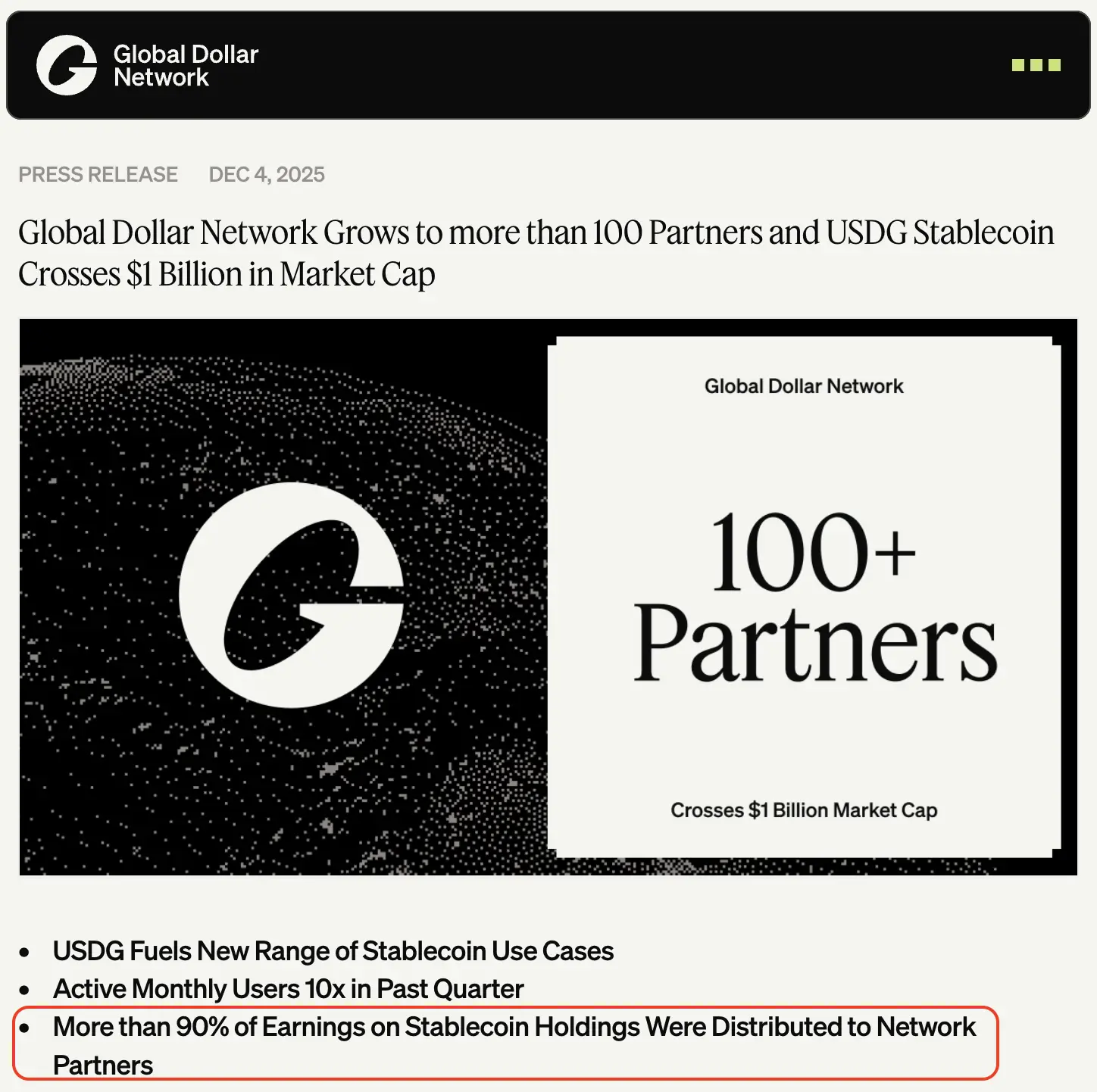
The key incentive bringing these firms into the network is the sharing of reserve income. GDN participants can receive up to 100% of the reserve rewards generated by USDG held on their platforms, and can earn additional rewards based on contributions to USDG issuance, trading, payments, and other forms of growth. In December 2025, GDN said it had distributed more than 90% of the income generated from USDG holdings to network partners. Revenue sharing is therefore not merely a participation incentive. In practice, most reserve income is being distributed back into the network.
Participants then redeploy the reserve income they receive into their own businesses. OKX and Kraken offer rewards on USDG balances and Earn products, Robinhood integrates USDG into its own chain and on-chain financial products, and payments providers expand its use in merchant settlement and payments. GDN therefore gives distribution partners an incentive to hold and use more USDG, while those partners use reserve income to encourage customers to hold and use more USDG.
Where Circle expands USDC distribution by sharing reserve income with a core distribution partner, Coinbase, GDN extends the model into a network that can accommodate many companies at once. A significant share of reserve income is distributed to exchanges, fintechs, and payments companies, with the system designed so that participants benefit economically as they distribute and drive greater use of USDG. USDG is a case in which reserve income itself is used as an incentive to build the distribution network.
2-4. PayPal's PYUSD: Distribution Advantage from an Existing Payments and Remittance Network
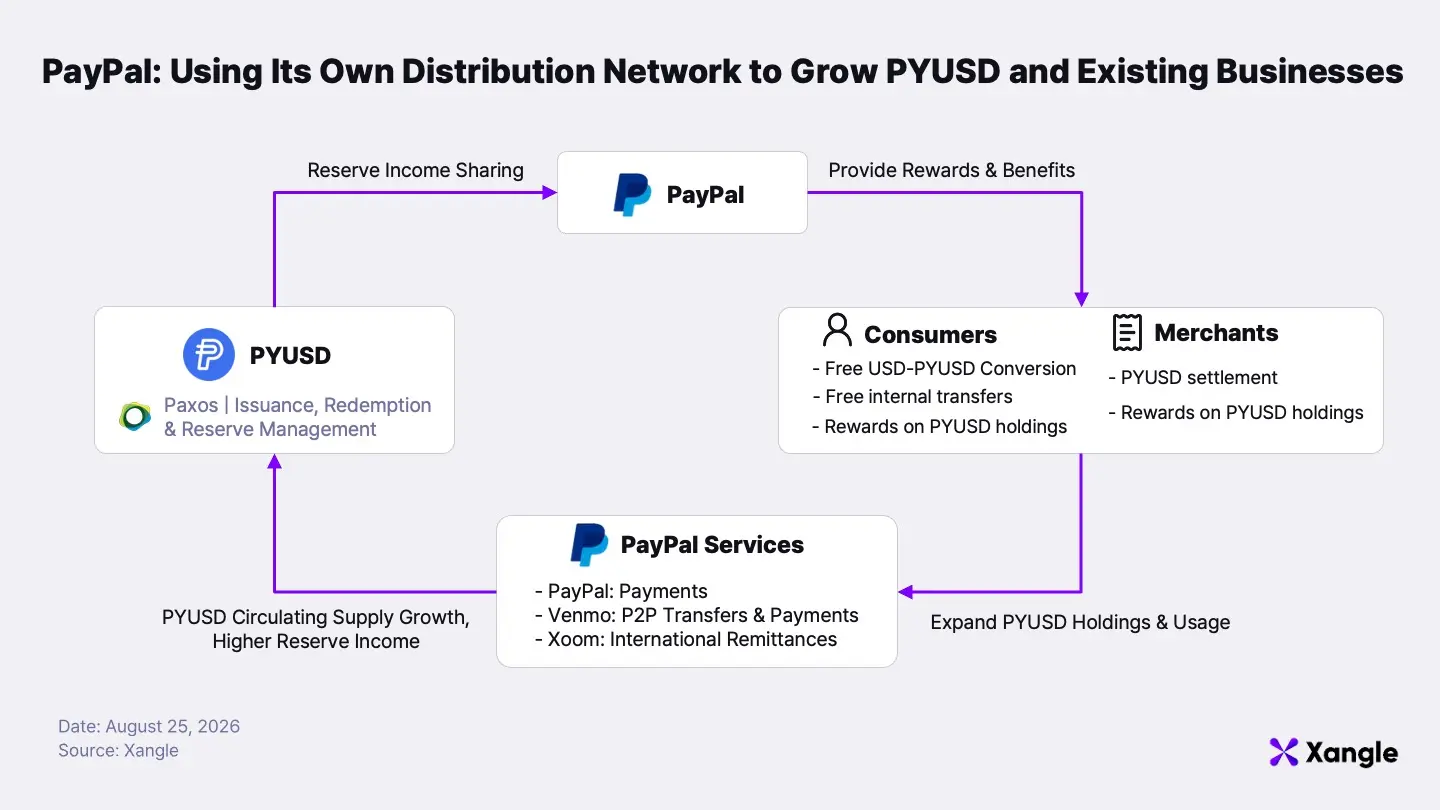
PYUSD uses a structure in which PayPal, with its existing consumer and merchant networks, relies on Paxos's issuance infrastructure. While Paxos handles issuance and reserve management, PayPal connects PYUSD directly to its existing services, including consumer wallets on PayPal and Venmo, merchant payments and settlement, and international remittances through Xoom. Unlike Circle or USDG, which expand distribution through the customers and services of external distribution partners, PayPal uses its existing consumer base, merchant network, and payments infrastructure as PYUSD's distribution network.
This also allows PayPal to provide distribution incentives directly to consumers and merchants. PayPal offers free conversion between dollars and PYUSD as well as free internal transfers between eligible users. It also pays a variable annual reward of 4% to consumers who hold PYUSD and merchants that settle and retain balances in PYUSD. With USDC and USDG, reserve income is distributed to external distribution partners such as Coinbase or GDN participants, which can use it as their own revenue or to fund user rewards. PayPal, by contrast, can encourage PYUSD holding and usage by providing benefits directly to consumers and merchants without going through a separate distribution partner.
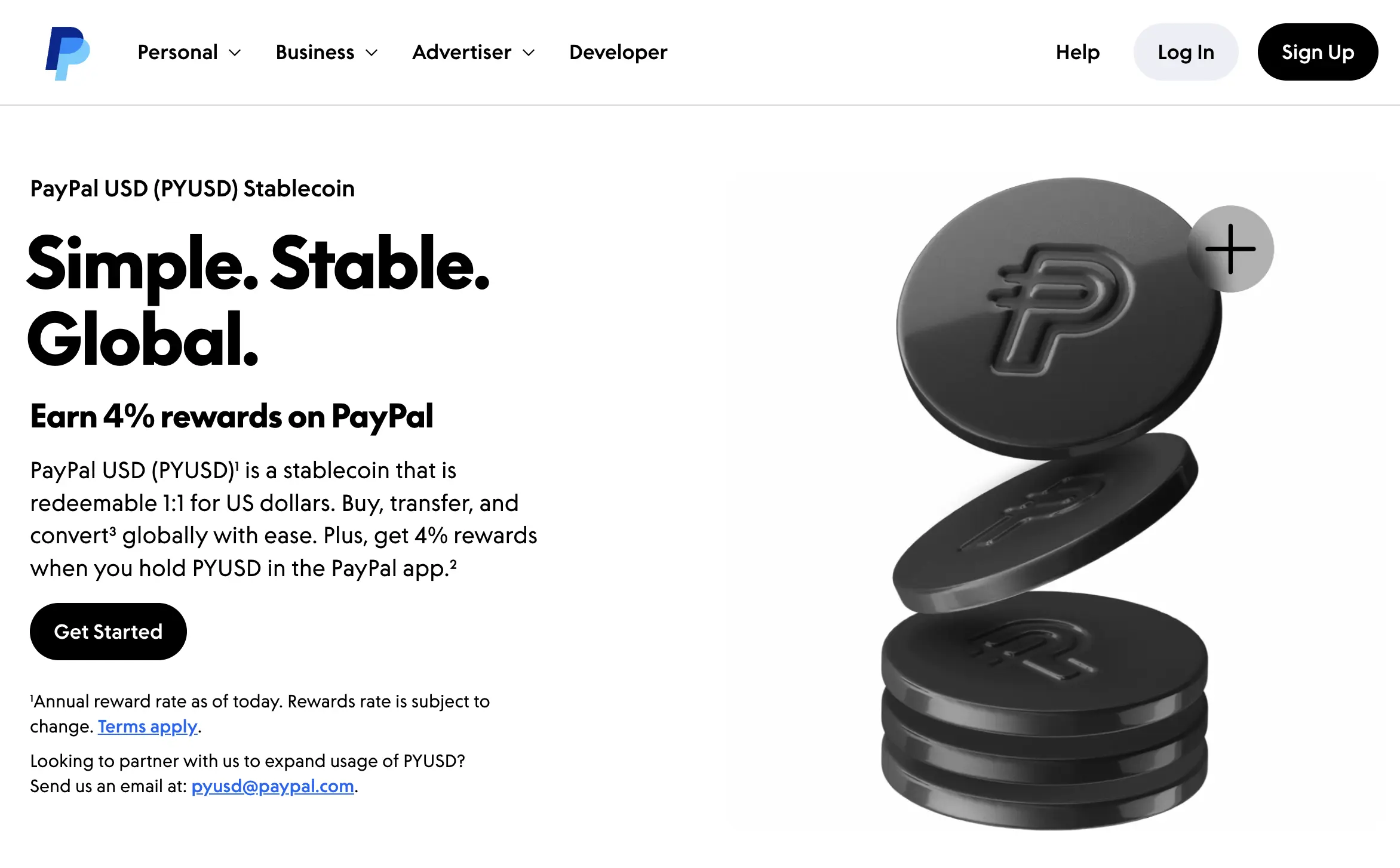
Source: PayPal
The distinction extends to monetization. Through its arrangement with Paxos, PayPal can receive a share of the income generated from PYUSD reserve assets, while also having a strong incentive to actively reward consumers and merchants to increase PYUSD holdings and usage. As more PYUSD is held and used for payments, settlement, and remittances within the PayPal ecosystem, use of PayPal's existing financial services, including payments, FX conversion, and international remittances, can expand as well. PayPal can therefore participate in the income generated by PYUSD while using wider distribution to drive growth in its existing financial businesses.
3. Distribution Strategy Shapes Stablecoin Profitability
The clearest shift across these cases is that income generated from reserve management is no longer retained solely by issuers. It is increasingly being used to secure stablecoin distribution. Circle shares part of its reserve income with major distributors such as Coinbase to increase USDC holdings and usage, while USDG uses a model in which GDN participants receive a share of reserve income based on their contribution to distribution and usage. For later stablecoin entrants, securing a distribution network that drives holdings and usage matters more than issuance alone. This is driving issuers to share part of their reserve income with distributors.
This process is also changing the value of distributors. Issuance and reserves alone are not enough to build a stablecoin market. Holding, trading, payments, and remittances take place on platforms that already have established customer relationships and financial services. Because issuers need access to these distribution networks to scale their stablecoins, businesses with direct customer relationships and use cases are becoming more important in how reserve income is allocated.
The income available to distributors is not limited to reserve income shared by issuers. As more stablecoins are held and used within their services, activity across their existing businesses, including trading, custody, payments, FX conversion, and remittances, can also rise. The resulting structure is one in which issuers share part of reserve income to secure distribution, while distributors participate in reserve income and capture growth in their existing businesses at the same time.
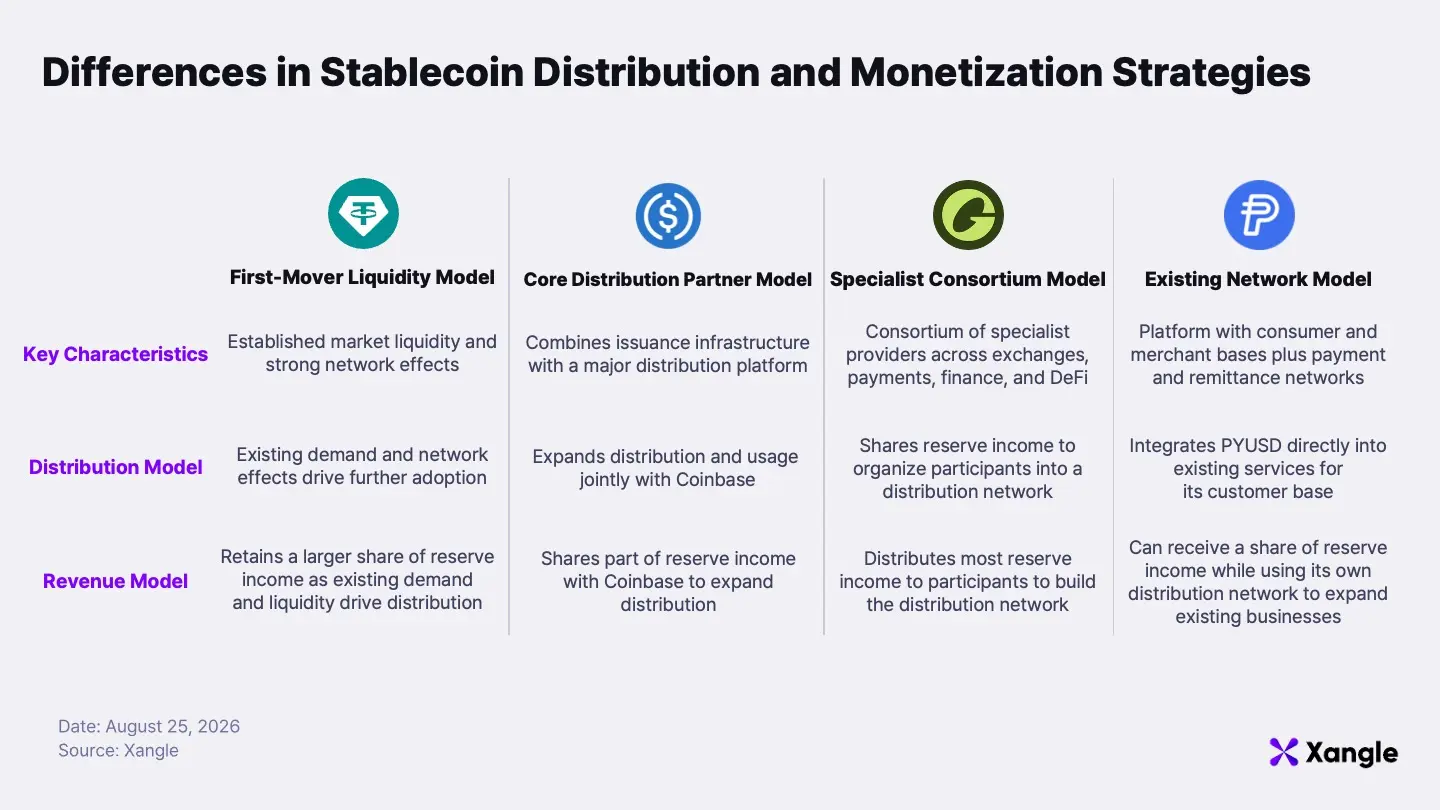
This shift also shapes how new entrants can secure distribution networks. Depending on their existing customers and infrastructure, three broad models are possible.
- The Core Distribution Partner Model pairs an issuer with a business that has a large trading customer base and distribution infrastructure such as its own blockchain, with that business taking the lead on distribution. One could imagine a major exchange such as Upbit playing the role that Coinbase plays for USDC.
- The Specialist Consortium Model combines the customer bases and use cases of multiple businesses when a single company's distribution network is not enough to reach sufficient scale. GDN for USDG is an operating example. Open USD is pursuing a similar structure in which exchanges, banks, card companies, and payments providers participate in one network and share reserve income.
- The Existing Network Model uses external issuance infrastructure to connect a branded stablecoin directly to the existing services of a platform that already has a large consumer and merchant base and payments infrastructure. This model could be used by a platform such as KakaoTalk that combines a large user base with payments services.
The difference among these three models ultimately comes down to who bears the cost of securing stablecoin distribution, and how. As reserve income begins to fund distribution, a new trade-off is emerging between reserve income and distribution costs. The more an issuer relies on external distribution networks, the more of its reserve income it must share in return. By contrast, companies that already have established user and merchant bases, as well as payment and remittance networks can reduce the distribution costs paid to external parties and deploy the necessary incentives directly within their own services. In that case, distribution spending can generate returns not only through stablecoin growth but also through greater use of existing financial services. As reserve income increasingly becomes a resource for securing distribution, stablecoin profitability is likely to depend not only on issuance scale, but also on how efficiently distribution is secured and how effectively its benefits feed back into the existing business.
Globally, issuers, exchanges, payments companies, and fintechs are already experimenting with different stablecoin revenue-sharing structures based on their respective distribution strengths. In Korea, we hope the discussion around stablecoins moves beyond issuance itself to encompass business models built around distribution, use cases, and incentive design among participants. Readers interested in these changes and the opportunities for the Korean market can join the discussion at EastPoint 2026.
Disclaimer
I confirm that I have read and understood the following: The information contained in this article is strictly the opinions of the author(s). This article was authored free from any form of coercion or undue influence. The content represents the author's own views and does not represent the official position or opinions of CrossAngle. This article is intended for informational purposes only and should not be construed as investment advice or solicitation. Unless otherwise specified, all users are solely responsible and liable for their own decisions about investments, investment strategies, or the use of products or services. Investment decisions should be made based on the user’s personal investment objectives, circumstances, and financial situation. Please consult a professional financial advisor for more information and guidance. Past returns or projections do not guarantee future results.
Xangle or its affiliated partners own all copyrights of the written or otherwise produced materials and content provided on the platform. Any illegal reproduction of such content, including, but not limited to, unauthorized editing, copying, reprinting, or redistribution will result in immediate legal actions without prior notice.