ETHGas, Institutional Blockspace

Table of Contents
1. The Realtime Ethereum Breakthrough
2. Ethereum's Strengths and the Limits of Institutional Adoption
3. The Role of ETHGas Institutional Blockspace
4. Practical Use Cases for Institutional Blockspace
5. Closing Remarks: A Trust Layer Between Regulated Finance and Public Ethereum
1. The Realtime Ethereum Breakthrough
Ethereum is already one of the most powerful public blockchains. Its strong security, global liquidity, deep DeFi ecosystem, and smart contract-based settlement capabilities make Ethereum one of the first networks institutions consider when evaluating public blockchains. Yet these attributes alone are not enough for institutions to use Ethereum in real operating environments. They must be able to explain, after the fact, the route through which a transaction was submitted, the order in which it was included, which validator proposed the block, and the standards under which the transaction was approved and processed.
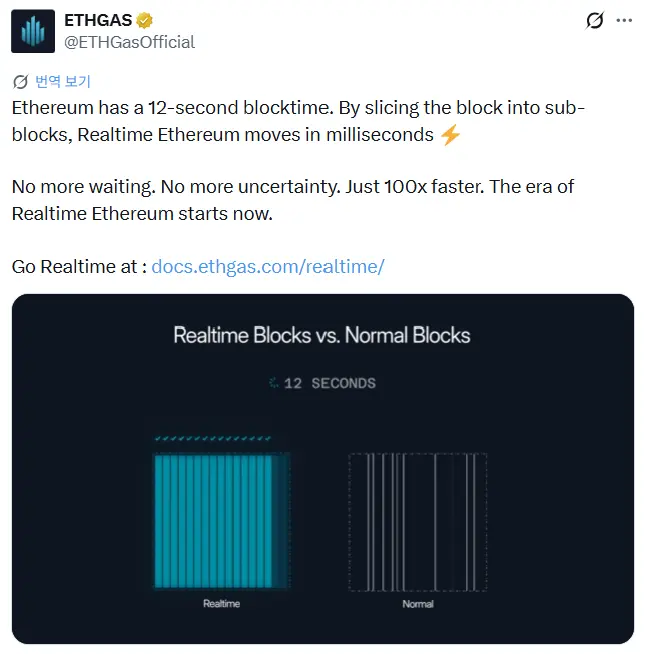
ETHGas addresses this issue through the structure of the blockspace market. Without changing Ethereum's consensus architecture, it makes transactions predictable before they are included in a block. In today's Ethereum, users submit a transaction and then wait for mempool competition and the builder's block construction process to play out. Until the block is produced, inclusion and execution order remain uncertain. ETHGas provides a structure in which blockspace in future slots can be secured in advance, and validators can commit ahead of time to including a specific transaction in a specific block. This makes it possible to define the transaction submission route, inclusion status, execution order, and validator accountability more clearly. Xangle's previous ETHGas research, "ETHGas, Enabling Real-Time Ethereum," also discussed this structure as a way to improve perceived speed and predictability through blockspace trading and preconfirmations.
 https://x.com/ETHGasOfficial/status/2016519215948484963
In this structure, Realtime Ethereum does not mean shortening the block time itself. Ethereum's canonical blocks are still produced roughly every 12 seconds. What changes is that users no longer have to experience those 12 seconds as one continuous wait. Within the block production window, they can receive ordering guarantees and state updates at shorter intervals. In practice, ETHGas is designed to divide a single block into 240 intervals of roughly 50ms each, giving users an experience that feels 240 times faster than the current model.
From an institutional perspective, this shift is not just about speed. The blockspace trading and preconfirmation structure proposed by ETHGas can make execution conditions clearer before a transaction is included in a block. For transactions such as large asset transfers, fund rebalancing, issuance and redemption of tokenized assets, and automated collateral management, execution certainty, MEV protection, validator accountability, and whether the transaction has been pre-approved are just as important as fast processing. Institutions must be able to explain the route through which a transaction was submitted, the order in which it was included, and which validator processed it.
ETHGas extends these requirements into an institutional finance framework through the concept of Institutional Blockspace. Built on ETHGas's blockspace trading and preconfirmation technology, it adds compliance controls, MEV protection, and validator trust to institutional transactions. While preserving public Ethereum as the settlement layer, it incorporates the required checks and execution conditions into a separate institutional route before block inclusion. This allows institutions to process transactions on public Ethereum in a more controlled way, without moving to private chains or closed networks.
2. Ethereum's Strengths and the Limits of Institutional Adoption
As discussed above, Ethereum already provides the kind of public settlement and execution environment that institutions want to use. Global liquidity, security, and a smart contract-based execution environment are clear advantages for institutional users. To use Ethereum in actual operations, however, institutions also need to show which criteria a transaction satisfied before block inclusion, how it was protected during execution, and which operators were involved in processing it.
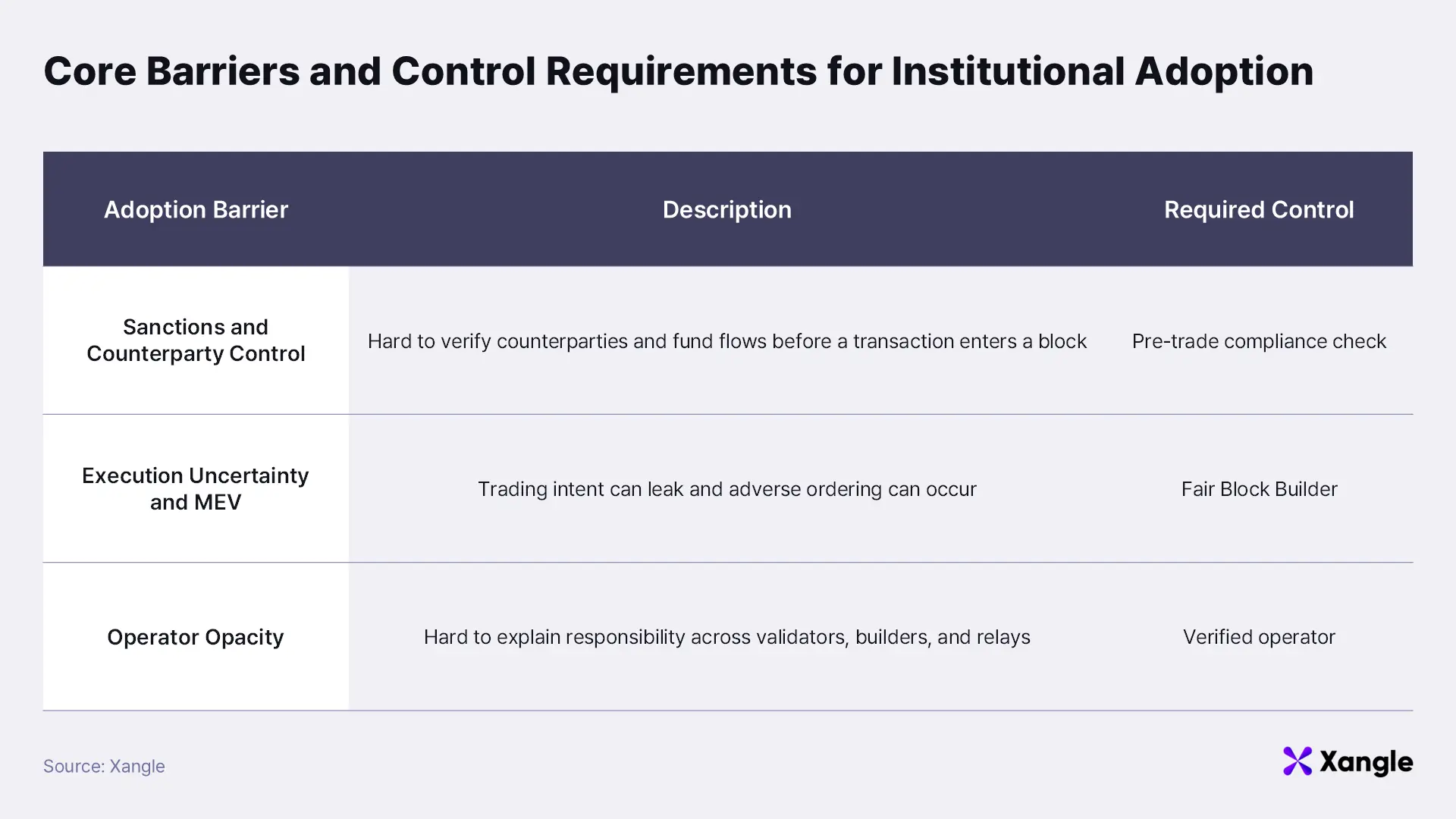
This is where the institutional adoption gap emerges. Public Ethereum has grown on the basis of openness and neutrality, but those same qualities create burdens for regulated financial institutions: sanctions and counterparty controls, execution uncertainty and MEV, and operator opacity. To understand Institutional Blockspace, we first need to examine why these three issues become barriers to institutional adoption.
2-1. Challenges in Sanctions and Counterparty Controls
Public Ethereum is an open network where anyone can participate and transact. This structure improves liquidity and accessibility, but institutions must directly verify, before anything is recorded on-chain, whether counterparties and fund flows comply with internal policies and regulatory standards. Once a transaction has been included in a block and confirmed, it is difficult to reverse. Handling problematic transactions after the fact therefore creates a significant burden for institutions.
In institutional transactions, an address effectively becomes the counterparty. Yet an address alone is not enough to identify the beneficial owner, source of funds, or potential links to sanctioned entities. Institutions must verify whether the receiving address is an approved wallet, whether the counterparty has any links to sanctioned entities, whether the transaction size remains within internal limits, and whether the asset movement complies with client or fund policy.
As a result, institutions need pre-screening and an approved execution route even when operating on an open network. The final transaction outcome may be recorded on public Ethereum, but before block inclusion, the transaction itself must satisfy internal policies and regulatory standards.
2-2. Execution Uncertainty and MEV Risk
Institutional transactions often involve large amounts moving at once, such as major swaps, portfolio rebalancing, or collateral adjustments. If these transactions are exposed to the public mempool, external participants can identify in advance which assets the institution intends to buy or sell, then place their own transactions before or after them. The institution may then execute at a worse price than expected, leading to poorer execution quality and higher costs.
In today's Ethereum, the actual execution order is not fixed until a transaction is included in a block. If transaction intent is exposed during this process, users may see their transactions filled at worse-than-expected prices due to front-running, back-running, sandwich attacks, and similar strategies. Because institutions manage client assets and must explain why a particular execution outcome occurred, MEV becomes more than a cost issue. It becomes a matter of transaction execution management.
For institutions to process large transactions reliably on public Ethereum, they need to manage the order in which transactions are included, the extent to which transaction intent is exposed, and whether execution occurs close to the expected conditions. This is why MEV protection and execution certainty are essential conditions for Institutional Blockspace.
2-3. Operator Opacity
Ethereum block production involves multiple operators, including validators, builders, and relays. This structure contributes to network stability, but for institutions, a key challenge is explaining which operators handled a major transaction and where accountability lies if something goes wrong.
Many blockchain operators are anonymous or based offshore. This is natural in a public network, but it creates a burden from the standpoint of institutional third-party risk management. When institutions use critical external infrastructure, they want to identify the operating entity and have a responsibility structure that can be explained if a problem arises.
For institutional execution routes, then, it is not enough for transactions simply to be processed successfully. The trustworthiness of the validator and block production route also matters. If institutions are to use public Ethereum, they need clearer transparency and accountability around the operators that process their transactions.
3. The Role of ETHGas Institutional Blockspace
The institutional adoption gap described above comes less from Ethereum's settlement capability itself than from how transactions are handled before settlement. Institutions want to use public Ethereum's liquidity, security, and composability, but they must be able to check sanctions and counterparty risk before block inclusion, mitigate MEV-driven deterioration in execution quality, and explain the operators involved in transaction processing.
To narrow this gap, ETHGas introduces the concept of Institutional Blockspace. This approach creates distinct transaction processing routes within Ethereum itself. General users can continue using existing public blockspace, while institutions can opt for an institutional route that adds compliance checks, MEV protection, and validator trust. The final transaction outcome is still recorded on Ethereum L1, but the process before block inclusion is configured to meet institutional standards.
3-1. How Institutional Blockspace Works
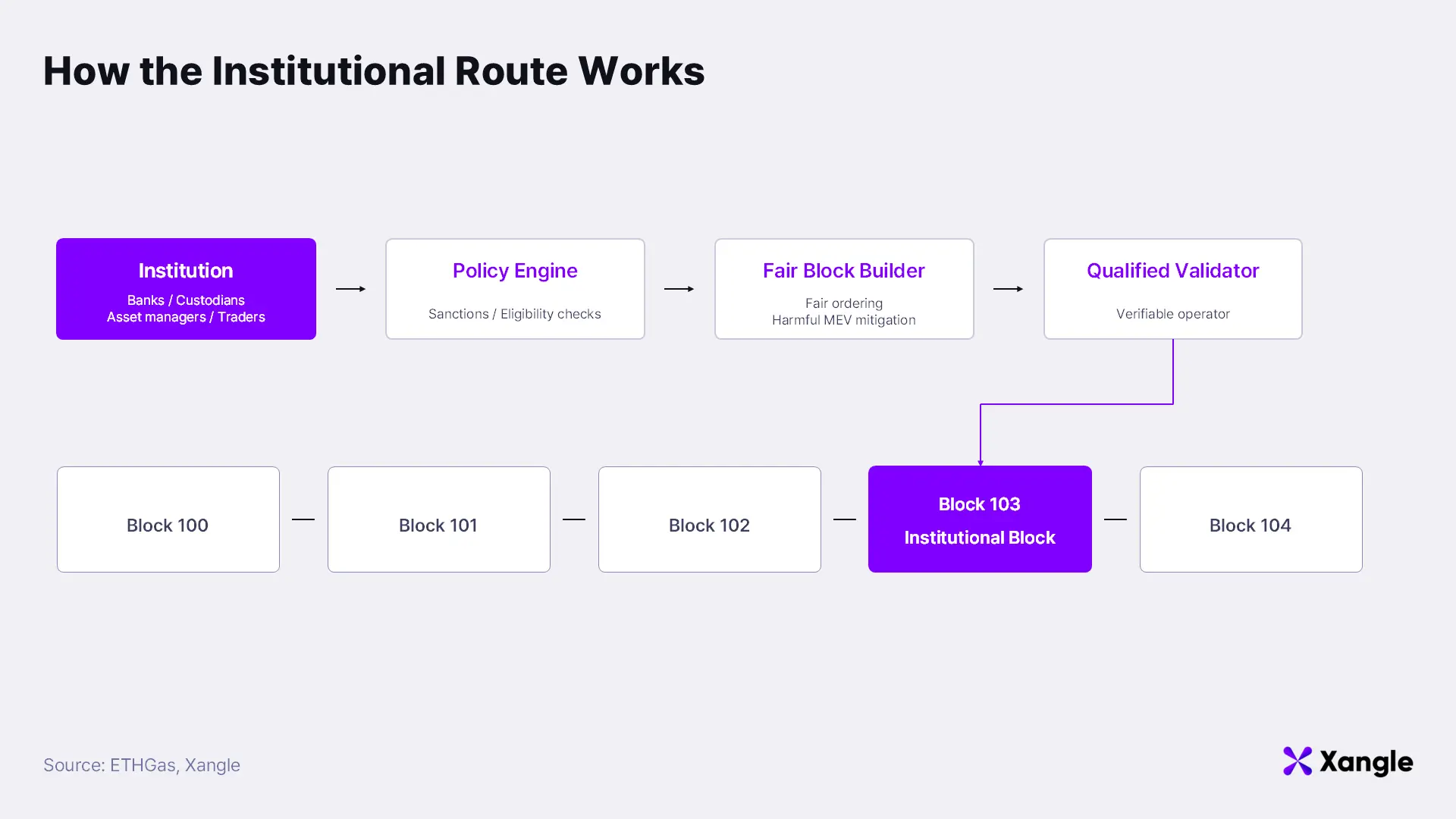
The basic structure of ETHGas Institutional Blockspace is straightforward. Institutional transactions are not immediately exposed to the public mempool. Instead, they pass through several steps before being included in an institutional block. Final settlement, however, does not take place on a separate closed network. It happens on public Ethereum. In other words, the pre-settlement stage applies the checks required by institutions, while final settlement occurs on the existing Ethereum L1.
The flow can be summarized as follows:
- Institution → Policy Engine → Fair Block Builder → Qualified Validator → Inclusion in Institutional Block → Ethereum Settlement
First, institutions such as banks, custodians, asset managers, and trading desks create transactions. These transactions pass through the first stage of the institutional route, the policy engine. At this stage, the engine checks the items institutions need to verify before settlement, including counterparties, sanctions risk, fund flows, and internal approval standards. From the institution's perspective, this allows them to confirm before block inclusion that the transaction complies with internal policies and regulatory standards.
Transactions that pass the policy engine are forwarded to the Fair Block Builder. The Fair Block Builder reduces the risk that institutional transactions are placed in a disadvantageous order or that transaction intent is exposed and exploited for MEV. For transactions where execution order matters, such as large swaps, portfolio rebalancing, or collateral adjustments, this stage can determine execution quality.
The transaction is then included in an institutional block through a qualified validator. Qualified validators make up a trusted validator route for institutions. In the general public route, it may be difficult for institutions to explain which operators processed a transaction. In the institutional route, validator trust is embedded into the execution structure.
Finally, the institutional block is recorded and confirmed on public Ethereum. ETHGas Institutional Blockspace does not create a new settlement network. What changes is the transaction handling process before block inclusion. Institutional transactions go through compliance checks, MEV-protected block construction, and an inclusion commitment from a qualified validator. In the process, records are created showing the standards under which the transaction was approved and the route through which it was processed.
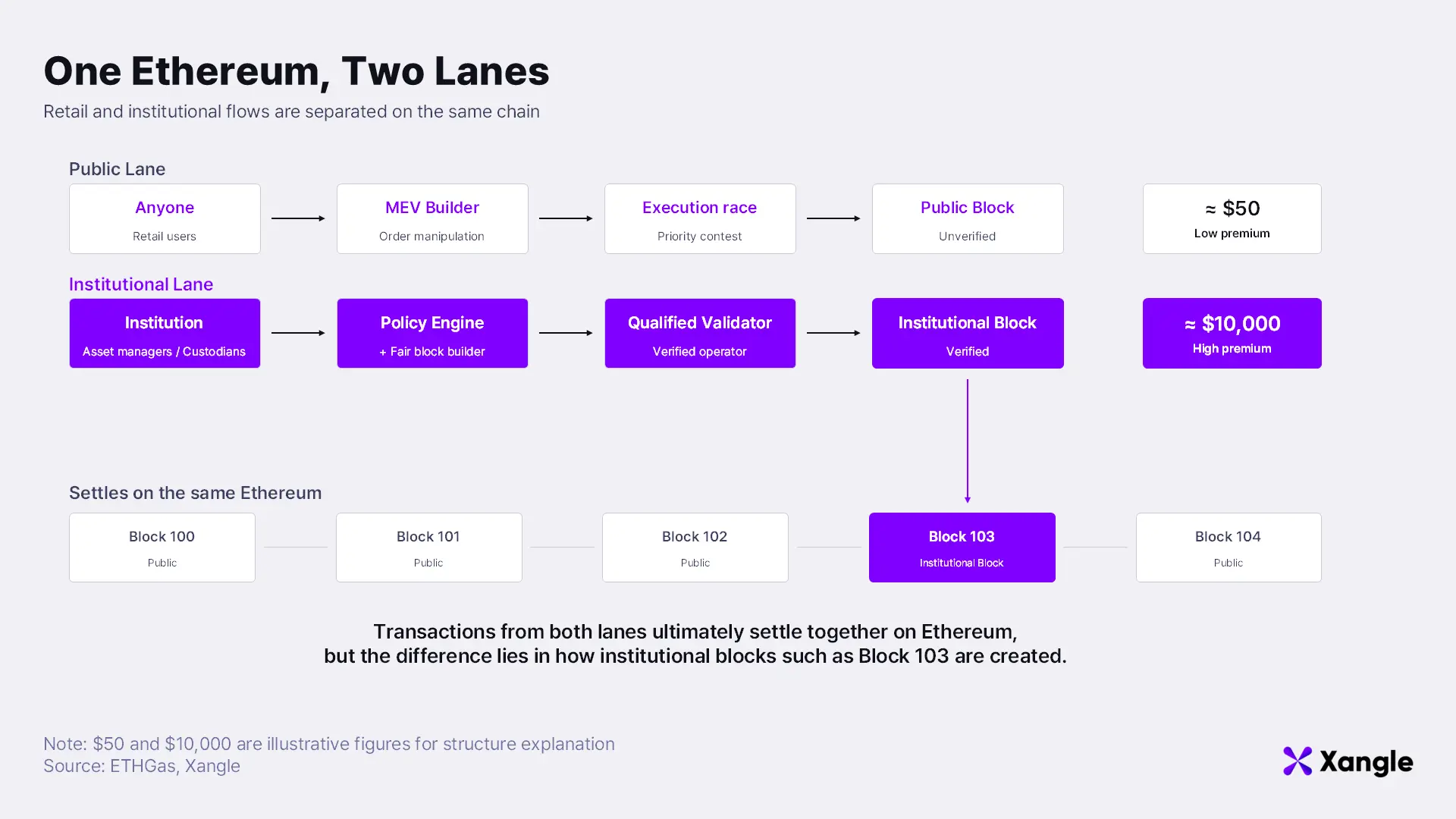
The supply of Institutional Blockspace is tied to the level of qualified validator participation. Institutional blocks can be formed in slots where qualified validators hold block proposal rights. As the number of qualified validators increases, so do the frequency and predictability with which institutions can use this route when needed.
For validators, Institutional Blockspace can also create a new revenue opportunity. The value of general blockspace mainly comes from gas fees and MEV opportunities. Institutional Blockspace can add a premium for compliance controls, MEV protection, and validator trust. If institutions are willing to pay more for blocks with these conditions, validators can earn additional revenue by selling Institutional Blockspace without relying on harmful MEV.
On top of this secured Institutional Blockspace, transactions are processed through three stages. The policy engine checks which transactions can enter the institutional route. The Fair Block Builder constructs the block so that approved transactions are not ordered unfavorably. The qualified validator is responsible for including that block on Ethereum. We now look more closely at how each of these three stages works.
3-2. Policy Engine Stage: Checking Whether a Transaction Is Permitted Before Block Inclusion
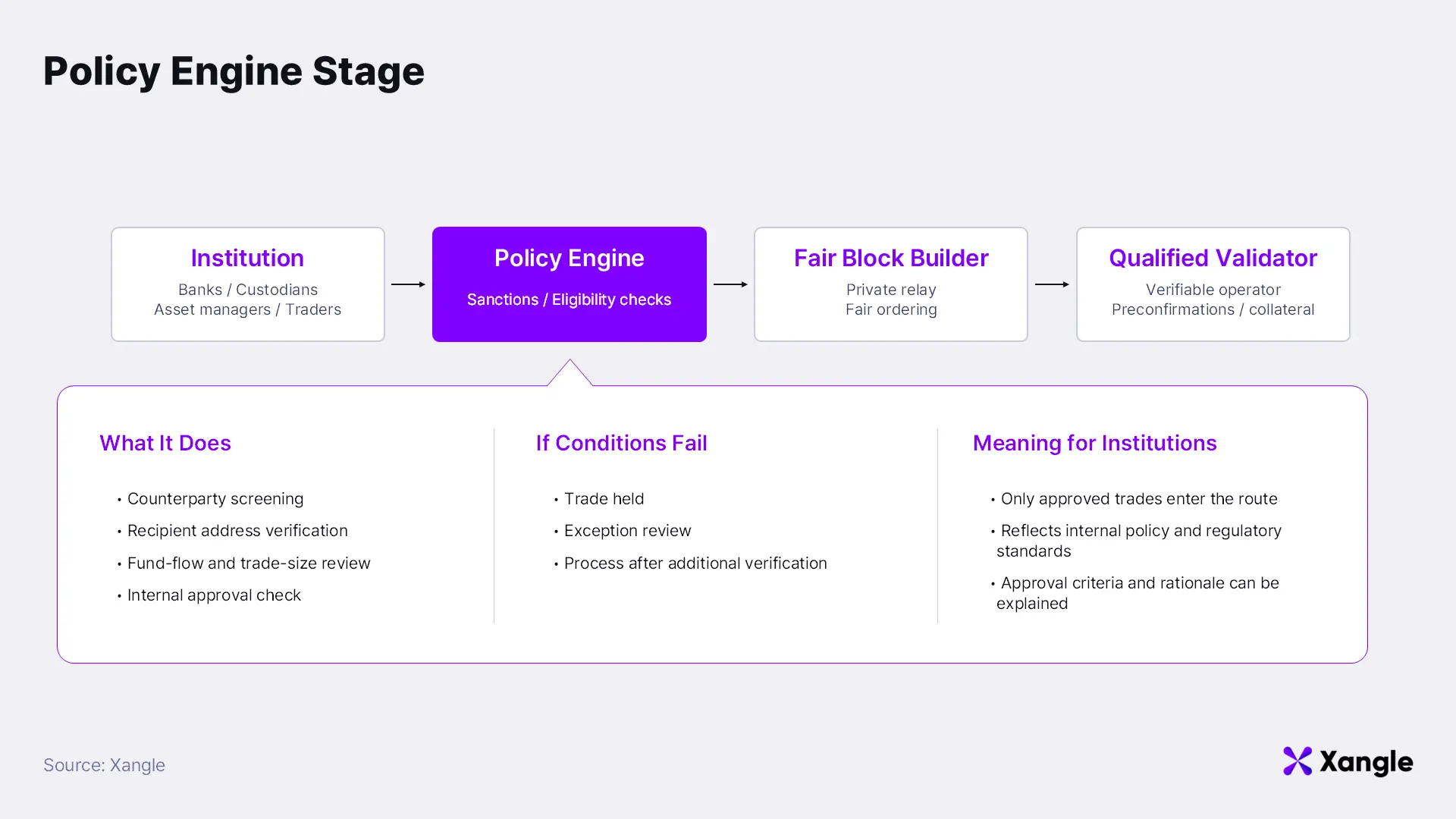
The first checkpoint in the institutional route is the policy engine. A transaction created by an institution is not sent directly to the Fair Block Builder. It first goes through a process that determines whether the transaction is eligible to enter Institutional Blockspace. The key point is not to determine after a transaction is recorded on-chain whether it has issues, but to determine before block inclusion whether it meets internal policies and regulatory standards.
The policy engine checks counterparties, receiving addresses, fund flows, sanctions risk, internal approvals, and related factors. For example, it can review whether the receiving wallet is an approved address, whether the counterparty may be connected to a sanctioned entity, whether the transaction size exceeds internal limits, and whether the asset movement aligns with client instructions or fund operating policies. For assets where holder eligibility matters, such as tokenized funds or institutional stablecoins, investor eligibility and jurisdictional restrictions may also be part of the review.
Transactions that satisfy the conditions are sent to the Fair Block Builder. Transactions that do not may be blocked or classified for additional review. If the transaction size is close to an internal limit, for instance, a separate approval may be required. If address risk is unclear, the transaction may be resubmitted after manual review. In this sense, the policy engine prevents institutional transactions from flowing automatically on-chain and adds exception handling or additional approval procedures where necessary.
For institutions, this process is also important because it creates auditable records. They need to maintain an audit trail showing the standards under which a transaction was permitted before block inclusion, which addresses and fund flows were checked, and, if there was an exception approval, who approved it and on what basis. Anyone can verify the transaction outcome on public Ethereum. What institutions need is evidence that the transaction was permissible before it was recorded on-chain.
Only transactions that pass the policy engine are forwarded to the next stage, the Fair Block Builder. From this point on, the focus moves beyond whether a transaction is permissible to how it is placed and executed within the block. The policy engine filters transactions that can enter the institutional route, while the Fair Block Builder constructs the block so that those transactions are not exploited for MEV.
3-3. Fair Block Builder Stage: Reducing Transaction Intent Exposure and Harmful MEV
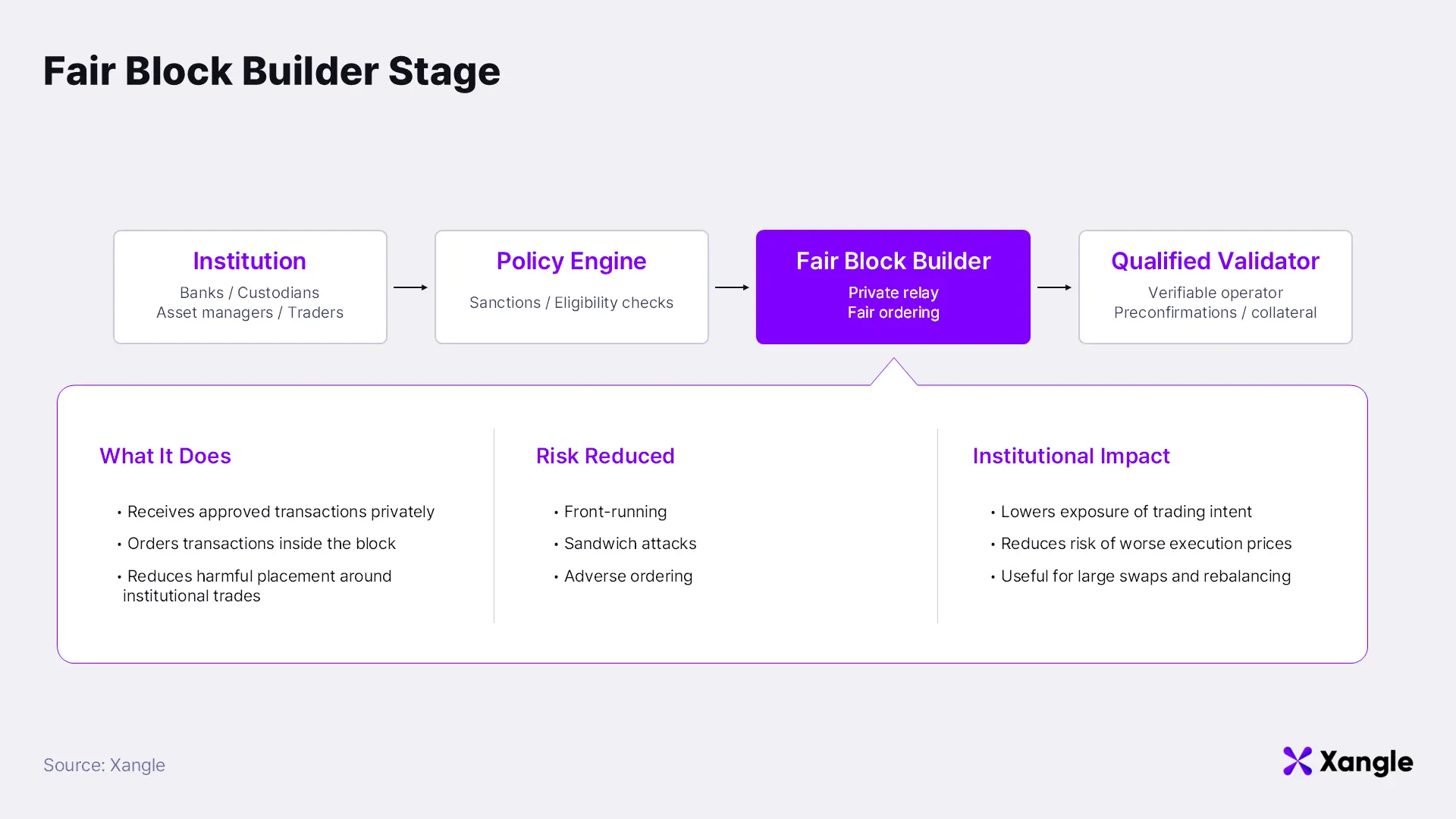
Transactions that pass the policy engine are sent to the Fair Block Builder. The Fair Block Builder receives institutional transactions and determines their ordering inside the block. It decides which transactions will be included together, which transactions will be excluded from positions before or after the institutional transaction, and the order in which transactions will be processed.
In a typical public route, transactions can be exposed to the public mempool. In that case, external attackers can observe a large swap or rebalancing transaction first and place their own transactions before or after it. One example is buying ahead of a large institutional buy order, then selling after the institution's trade pushes the price higher. Sandwich attacks, where buy and sell transactions are inserted before and after a user's transaction, operate on the same logic. Even if the transaction is included normally in a block, the institution may execute at a worse price than expected.
To reduce this problem, the Fair Block Builder does not simply pass institutional transactions into the public mempool. It receives them through the institutional route and uses them to construct the block. The transaction is delivered privately, and transaction ordering inside the block is set according to predefined ordering standards. This reduces the chance that front-running or sandwich trades built around the institutional transaction are placed before or after it, and helps the transaction execute according to the conditions set in advance.
By using a Fair Block Builder, institutions can reduce transaction intent exposure and avoid fills resulting from unexpected reordering. This is especially important for transactions that are sensitive to execution order and price conditions, such as large swaps, portfolio rebalancing, collateral adjustments, and tokenized fund redemptions.
However, a block constructed by the Fair Block Builder has no value unless it is actually settled on-chain on Ethereum. In the next stage, a qualified validator is responsible for including that block on public Ethereum. This is where validator trust and economic responsibility are added.
3-4. Qualified Validator Stage: Adding Trust and Accountability to Institutional Blocks
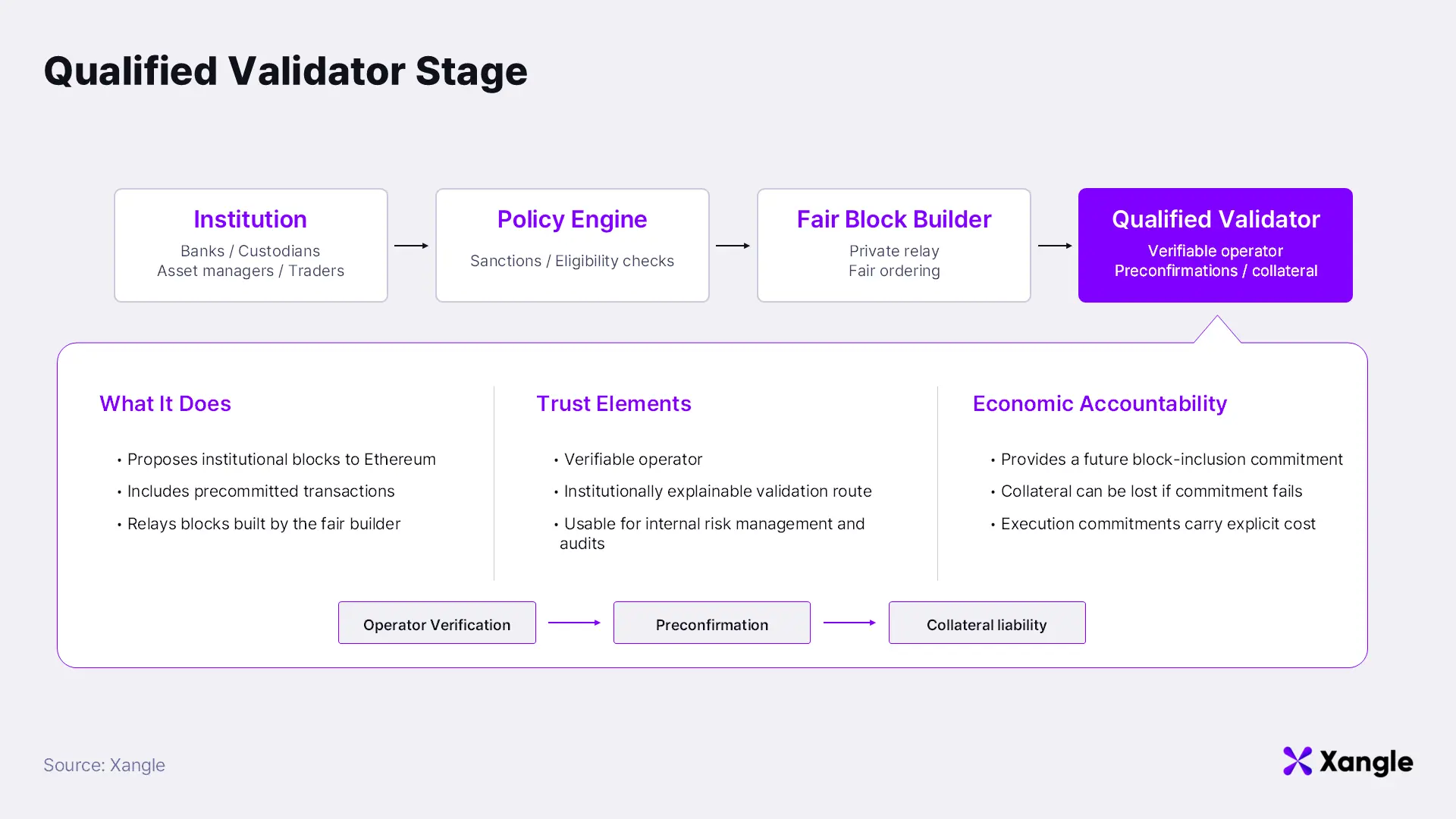
Once the Fair Block Builder constructs an institutional block, the validator responsible for that slot must propose the block to Ethereum. ETHGas connects this process by having the Fair Block Builder secure future blockspace from qualified validators in the market and place approved institutional transactions into the secured blockspace.
Here, a qualified validator refers to a validator whose operating entity and scope of responsibility institutions can verify. On public Ethereum, anonymous or offshore validators can participate freely. In the institutional route, however, blockspace is structured around validators vetted through ETHGas. Institutions can understand which validator route processed a transaction and explain this in internal risk management and audit processes.
Being able to identify the operator is not enough on its own. Institutions also need to know whether the validator will actually include the transaction in the promised block. In ETHGas's blockspace trading structure, a validator can commit in advance to including a specific transaction in a block it will propose in the future. This is a preconfirmation commitment.
This commitment carries economic responsibility. Validators back preconfirmation commitments with collateral. If they fail to include the promised transaction or fail to satisfy the agreed conditions, they may lose collateral. As a result, transaction inclusion shifts from a process dependent on validator goodwill to an execution commitment that imposes a cost for non-performance.
For institutions, this creates both operator visibility and economic responsibility. They can verify which validator route processed a transaction, and if the validator fails to honor its commitment, losses can be covered by collateral. If the Fair Block Builder manages the order and composition of institutional transactions, the qualified validator backs the inclusion of that constructed block on Ethereum.
In the end, the full Institutional Blockspace route separates responsibilities by stage. The policy engine screens transactions that can enter the institutional route. The Fair Block Builder constructs the block so that those transactions are not ordered unfavorably. The qualified validator provides operational and economic backing for the block inclusion commitment. Because the final transaction outcome is recorded on public Ethereum, institutions can use Ethereum's liquidity and settlement foundation without moving to a separate closed network.
4. Practical Use Cases for Institutional Blockspace
The previous section examined the route through which ETHGas Institutional Blockspace processes institutional transactions. The policy engine checks whether a transaction meets the required standards before settlement. The Fair Block Builder reduces transaction intent exposure and harmful MEV. The qualified validator supports the block's inclusion on Ethereum. The key question now is where this structure can be used in actual institutional operations.
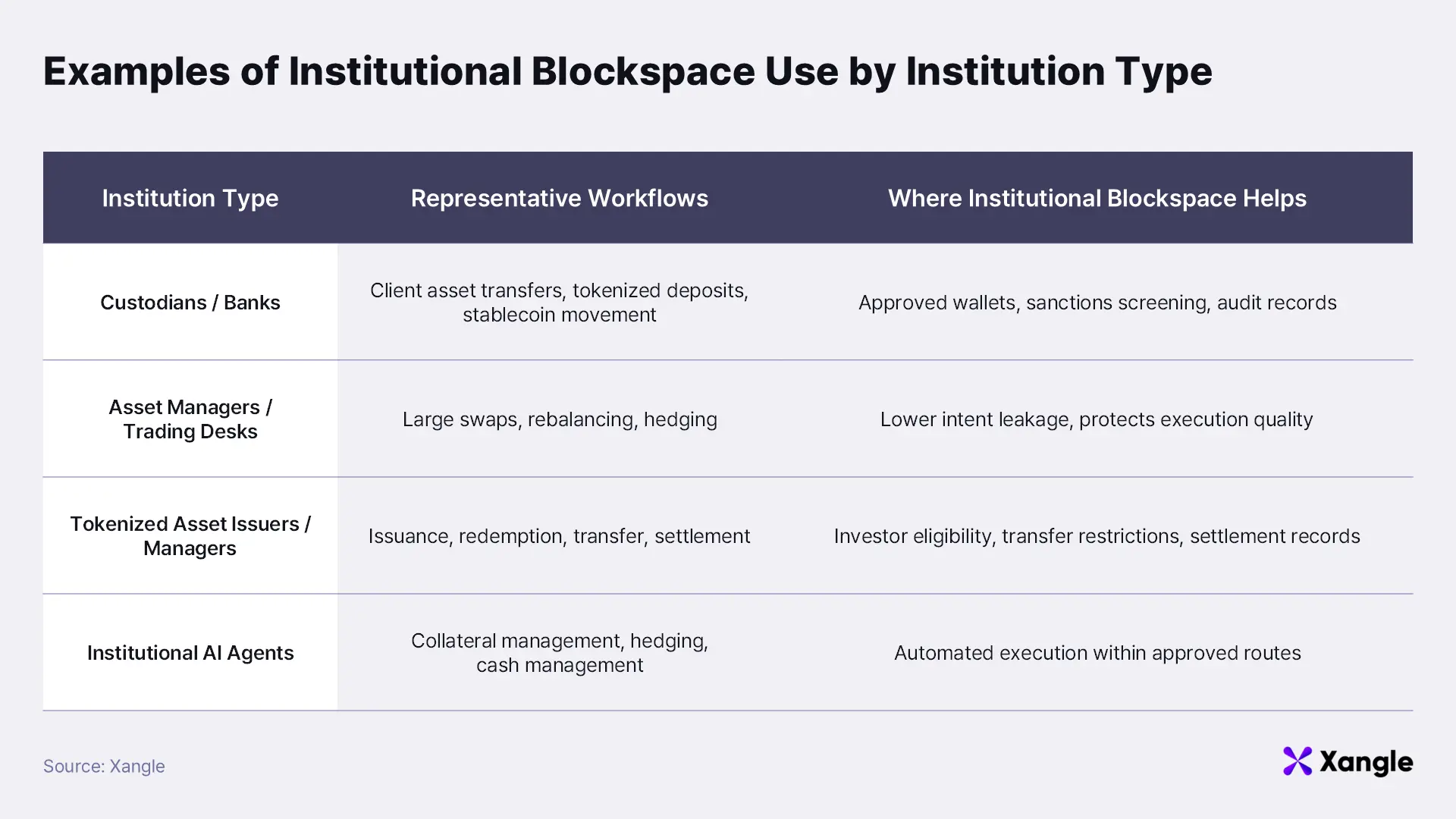
Institutional Blockspace is needed in most cases where "transactions are processed on-chain, but the process must conform to the control standards of traditional institutional finance." Custodians and banks need to check sanctions and counterparty risk when moving client assets. Asset managers and trading desks need to manage execution quality in large transactions. Issuers and managers of tokenized assets need to maintain approved transaction flows across issuance, redemption, transfer, and settlement. In the future, institutional agents will need to move funds only within predefined policies.
The use cases for Institutional Blockspace are therefore not limited to a single dApp. The structure can apply wherever institutional funds move on public Ethereum. Below, we examine practical applications across custodians and banks, asset managers and trading desks, tokenized assets, and institutional AI agents.
4-1. Custodians and Banks
Custodians and banks are among the first institutions likely to evaluate Institutional Blockspace. They custody client assets, approve transfers between wallets, and support staking, collateral management, and tokenized asset operations. As more client assets move on public chains, the burden of verifying counterparties, receiving addresses, fund flows, and internal approvals before settlement increases.
The most direct use case is the movement of large client assets. Suppose a custodian moves ETH, stablecoins, or tokenized Treasuries from a cold wallet to an exchange wallet, external custody wallet, or fund management wallet at an institutional client's request. This transaction is based on client instructions, is large in size, and requires internal approvals and audit records. With Institutional Blockspace, the transaction first passes through the policy engine, which checks approved wallets, transaction limits, links to sanctioned addresses, and consistency with client instructions. It is then placed into a block through the Fair Block Builder with reduced MEV exposure and settled on public Ethereum through a qualified validator.
For banks, this can also be applied to tokenized deposits or institutional stablecoin transfers. Payment instructions from a specific corporate client may need to be delivered only to approved wallets, and transfers may need to be permitted only between institutions that meet the requirements of a particular jurisdiction. Institutional Blockspace can verify these conditions before block inclusion and leave an auditable record of the route through which the transaction was processed.
For custodians and banks, the key is to maintain existing financial institution operating standards while using public chains. Client asset transfers may occur on-chain, but they must be accompanied by the necessary approvals, checks, and explainability around the execution route before assets move. Institutional Blockspace can serve as an execution path that addresses this need.
4-2. Asset Managers and Trading Desks
Asset managers and trading desks are highly sensitive to execution quality. In large swaps, portfolio rebalancing, fund creation and redemption, and hedging transactions, even a few basis points of price difference can affect performance and risk management. If transaction intent is exposed to the public mempool, external participants can react to it first and extract value by using the ordering around the transaction.
Institutional Blockspace is especially useful for large swaps and portfolio rebalancing. For example, suppose an asset manager wants to sell part of its ETH holdings and convert the proceeds into stablecoins. This process may involve a series of transactions: selling ETH on a DEX, receiving stablecoins, and, if necessary, moving assets to a custody wallet or lending protocol.
If these transactions are exposed to the public mempool, external participants can identify the direction and size of the sell order in advance. If only part of the transaction sequence is processed first or the order changes, the asset manager may sell ETH at a lower price than expected or end up with a position that differs from the target allocation after rebalancing. Institutional Blockspace can be used to verify before block inclusion that the transaction has been approved, then reduce transaction intent exposure and disadvantageous ordering through the Fair Block Builder.
Trading desks can use Institutional Blockspace for hedging transactions. For example, if a desk offers a structured product to a client off-chain, it may need to reduce market price risk through on-chain options, perpetual futures, or DEX swaps. If the hedge transaction is exposed to the public mempool, external participants can identify the desk's position direction in advance and place their own transactions around it. Institutional Blockspace can be used to submit these hedge transactions through a private route and reduce MEV and related risks through the Fair Block Builder.
4-3. Tokenized Assets
Tokenized assets are a natural fit for Institutional Blockspace. Tokenized Treasuries, money market funds, bonds, fund interests, and institutional stablecoins continue to go through transfers, redemptions, collateral provision, and settlements after issuance. The key is therefore not just to bring assets on-chain, but to operate post-issuance transaction flows in a way institutions can control.
A representative use case is issuance and redemption of tokenized funds. When an investor subscribes to a tokenized money market fund or tokenized Treasury fund, the issuer or manager must check investor eligibility, KYC/KYB, sanctions lists, wallet ownership, and jurisdictional restrictions. During redemption, it must also verify whether the wallet returning the tokens and the wallet receiving the proceeds match the investor's information. With Institutional Blockspace, issuance and redemption transactions pass through the policy engine before block inclusion. Records can then show the standards under which they were approved, which block they were included in, and which wallet received the proceeds.
The same structure is needed for transfers between holders. Institutional tokenized assets cannot be freely transferred to any wallet. Transfers may be restricted to approved investors, subject to jurisdictional limits, lock-up periods, or transfer restrictions under fund terms. Even if transfer restrictions are implemented in smart contracts, checking the receiving wallet and investor eligibility once more before the transaction enters a block makes the operating process clearer. If issuance or redemption proceeds are paid in stablecoins, the system can also check whether the movement is between approved wallets and whether payment is processed in the correct order.
What matters in tokenized asset markets is repeated post-issuance operations. Institutional Blockspace can provide an execution route where issuance, transfers, redemptions, and payments occur on public Ethereum while also applying the investor checks, wallet checks, and transaction record management required by institutions.
4-4. Institutional AI Agents
Institutional AI agents can be viewed as a longer-term use case for Institutional Blockspace. If agents are to handle real funds on-chain, fast execution alone is not enough. The assets they can handle, the protocols they can use, the wallets they can send funds to, and the daily transaction limits must all be predefined.
The most intuitive applications are collateral management and hedging. If an institution uses an on-chain lending protocol or tokenized collateral system, it may need to add collateral or repay part of a debt when the collateral ratio declines. An agent can automatically detect this situation and create the transaction. An agent for an asset manager or trading desk can monitor market prices and portfolio exposure, and create hedge transactions when predefined limits are breached.
This structure can also support cash management. An agent can check stablecoin balances across multiple wallets and move part of the funds into tokenized Treasuries or on-chain money market products according to predefined conditions. When redemption proceeds arrive, the agent can move them to a settlement wallet or convert cash that is not immediately needed back into yield-bearing assets.
The key is to prevent agents from executing arbitrary transactions. Even if an agent creates a transaction, actual execution should occur only within approved assets, approved protocols, permitted wallets, and defined limits. Institutional Blockspace can keep automated on-chain execution within institutional controls by requiring agent-created transactions to be processed through the policy engine, Fair Block Builder, and qualified validator route.
5. Closing Remarks: A Trust Layer Between Regulated Finance and Public Ethereum
The reason institutions have struggled to use public Ethereum is not that Ethereum lacks settlement capability. Ethereum is already a public settlement layer with strong security, liquidity, and composability. The issue is that execution controls, compliance audit trails, and operator accountability required by institutions have not been sufficiently embedded into the default execution route.
Because of this, institutions have been caught between two options. Public Ethereum offers strong liquidity and network effects, but creates burdens around sanctions controls, execution quality, and operator due diligence. Private chains or permissioned networks, by contrast, are easier to control, but they limit liquidity, interoperability, and the benefits of an open ecosystem.
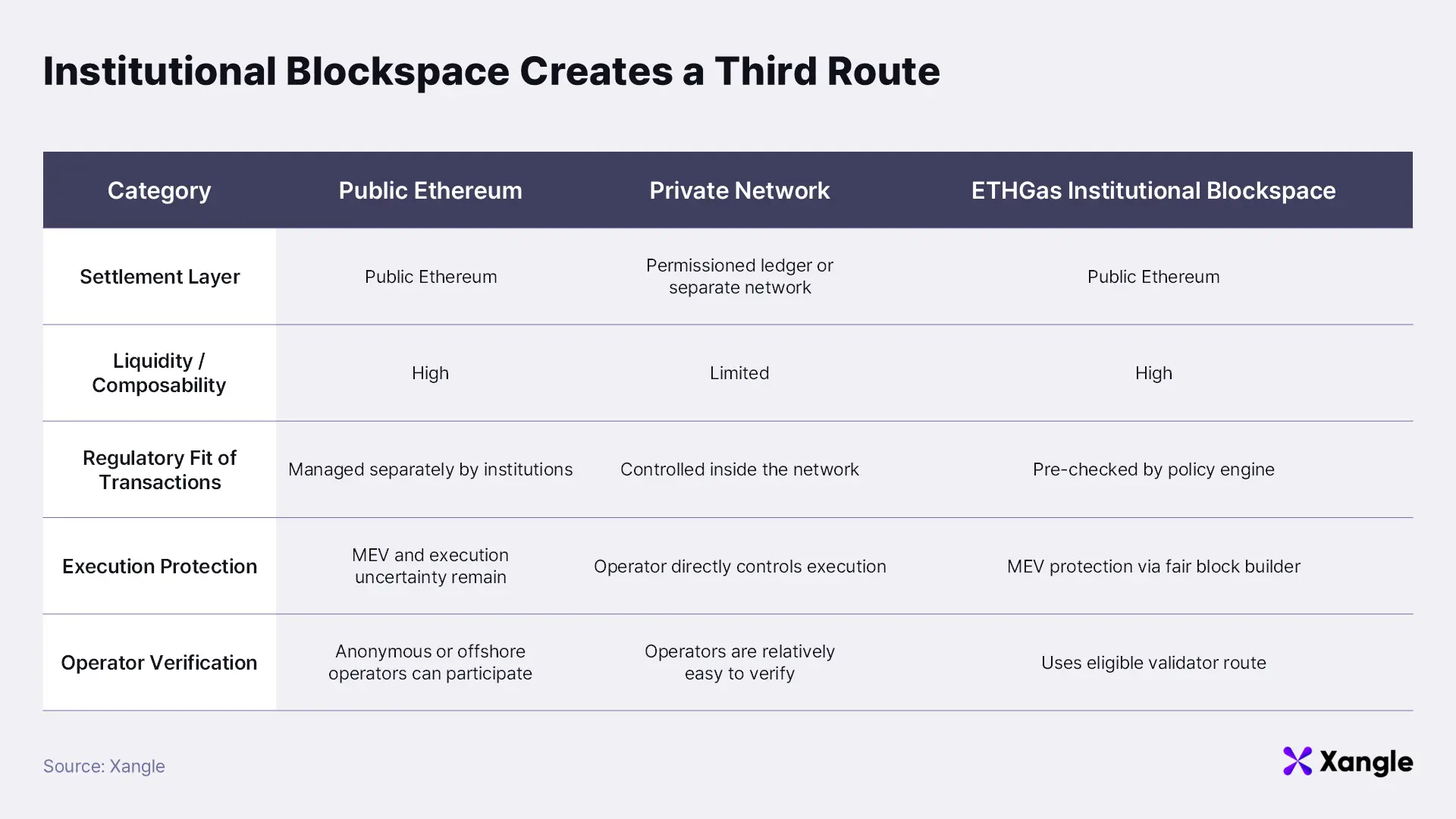
ETHGas Institutional Blockspace presents a third path. Rather than moving institutional activity outside Ethereum, it adds the control conditions institutions require directly to the Ethereum L1 access route. Transactions settle on public Ethereum, but before that settlement occurs, sanctions checks, fair ordering, private submission, qualified validator participation, and audit trails are applied.
For this approach to work in real institutional environments, three conditions are required. First, there must be a sufficient supply of qualified validators capable of proposing institutional blocks. Institutional blocks can be formed in slots where qualified validators hold block proposal rights. If the share of participating validators is low, institutions will find it difficult to use this route when they need it. ETHGas is currently expanding its validator supply base through a collaboration with ether.fi and testing the Institutional Blockspace route at roughly 5%. Its goal is to increase this share to more than 20% by year-end, allowing institutions to use the route more frequently and predictably.
Second, the Fair Block Builder's block construction standards need to become clearer. Simply receiving institutional transactions is not enough. Institutions need to understand which transactions the Fair Block Builder excludes before or after an institutional transaction, the standards used to filter front-running or sandwich attacks, and how this process is recorded. For institutions to use this route, they need not only a general commitment to reducing MEV, but also concrete standards for actual block construction rules.
Third, the policy engine must be able to reflect both institution-specific internal rules and jurisdiction-specific regulatory requirements. If Institutional Blockspace is to be used globally, applying the same standards across every region would be difficult. Markets such as the United States, Dubai, Korea, and Japan may differ in sanctions screening methods, investor eligibility standards, approved wallet management, transaction limits, and reporting obligations. Institutional Blockspace therefore needs to adjust policy standards to the regulatory environment of each regional hub and verify before block inclusion that a transaction satisfies those standards.
Even so, the direction is clear. Public Ethereum already provides the settlement foundation institutions want. ETHGas Institutional Blockspace adds the transaction processing route institutions require on top of it. If this structure takes hold, Ethereum can remain the default settlement layer used by tokenized assets, institutional DeFi, automated treasury management, and institutional AI agents.
What regulated finance and public Ethereum need is not merely a separate closed chain. They need a blockspace access route that institutions can trust. ETHGas Institutional Blockspace is an attempt to create that route. By preserving the openness of public Ethereum while adding the pre-screening, MEV protection, and validator trust required for institutional transactions, it can become a connection point between regulated finance and public blockchains.
Disclaimer
I confirm that I have read and understood the following: The information contained in this article is strictly the opinions of the author(s). This article was authored free from any form of coercion or undue influence. The content represents the author's own views and does not represent the official position or opinions of CrossAngle. This article is intended for informational purposes only and should not be construed as investment advice or solicitation. Unless otherwise specified, all users are solely responsible and liable for their own decisions about investments, investment strategies, or the use of products or services. Investment decisions should be made based on the user’s personal investment objectives, circumstances, and financial situation. Please consult a professional financial advisor for more information and guidance. Past returns or projections do not guarantee future results. This article was written at the request of ETHGas. All content in this article was written independently by the author(s), and neither CrossAngle nor ETHGas had any editorial control or influence over the content. The author(s) may hold the cryptocurrencies mentioned in this article at the time of writing.
Xangle or its affiliated partners own all copyrights of the written or otherwise produced materials and content provided on the platform. Any illegal reproduction of such content, including, but not limited to, unauthorized editing, copying, reprinting, or redistribution will result in immediate legal actions without prior notice.