Spacecoin: Decentralized Internet Infrastructure for Everyone

1. The Connectivity Gap and Centralization Risks in Internet Infrastructure
2. Spacecoin: Expanding Connectivity Through Satellite Infrastructure
3. SpaceRouter: Reshaping Privacy and Access Beyond Connectivity
4. Roadmap and Tokenomics
5. Final Thoughts
1. The Connectivity Gap and Centralization Risks in Internet Infrastructure
1-1. The Global Digital Divide
Modern life runs on the internet. We wake up and check messages, open maps on the way to work, and exchange documents in the cloud throughout the workday. We make video calls with friends, transfer money, book medical appointments, and ask AI when questions come up. The internet has moved beyond being a communications tool. It now functions as the access layer for nearly every essential service, including education, finance, healthcare, and employment. For this reason, the UN adopted a resolution in 2016 recognizing internet access as a human right.
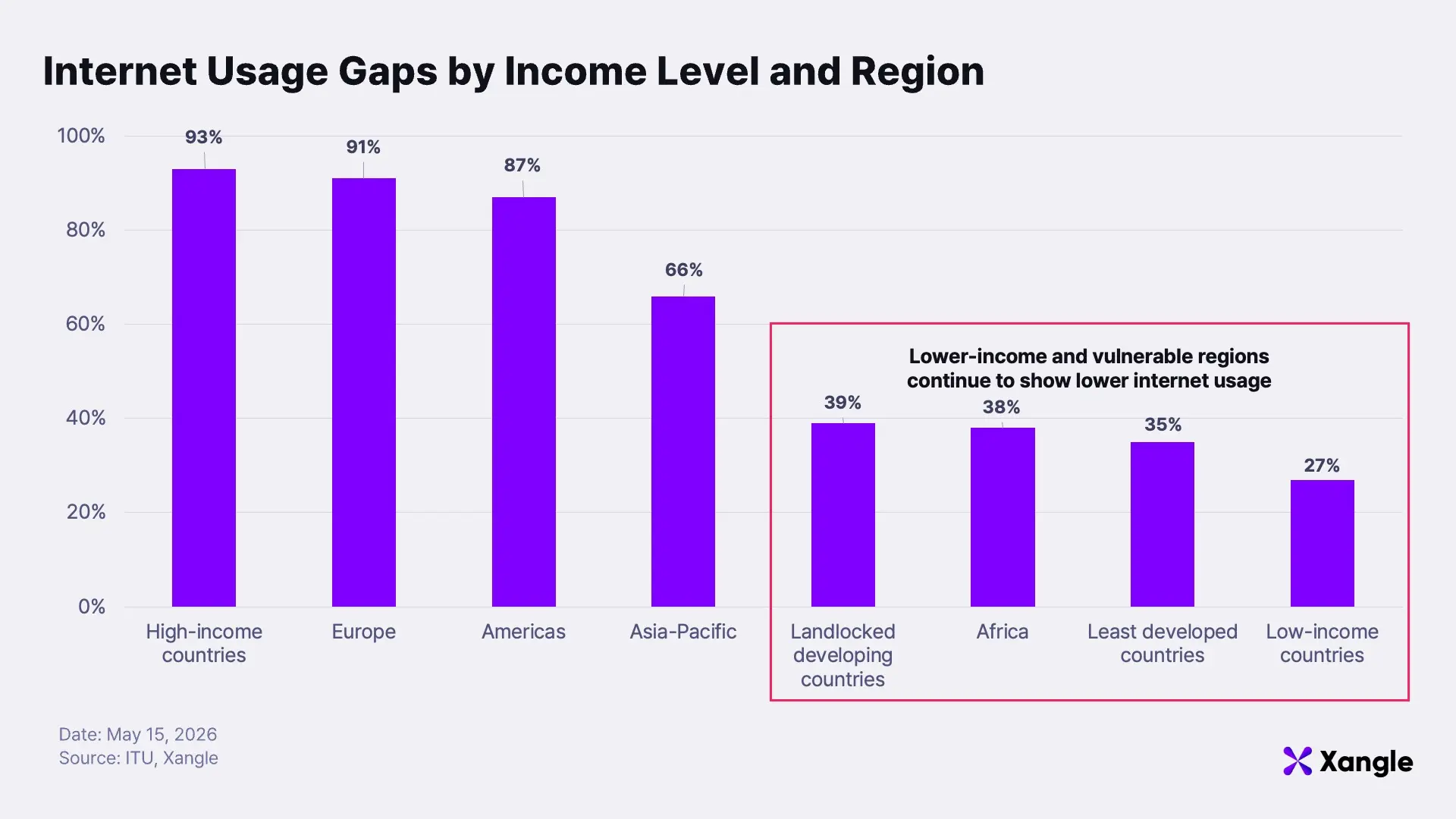
Yet around 2.1 billion people still remain beyond the reach of this access layer. They account for roughly one-quarter of the global population, with most concentrated in developing countries across Africa, South Asia, and Southeast Asia. For them, everyday services such as messaging, maps, video calls, remittances, and search, the very services listed above, remain part of an inaccessible world.
The gap persists for economic, not technological, reasons. According to a report published by the International Telecommunication Union (ITU) in 2025, connecting the global population at a meaningful level by 2030 would require approximately $1.5 trillion in investment. The required capital would go toward building digital infrastructure such as fiber-optic cables, 4G wireless networks, and satellites. For telecom operators, recovering such an investment is difficult. In most developing countries, GDP per capita is around $2,000, while telecom spending per person is roughly $2 per month. In other words, these markets lack the purchasing power needed to justify expensive infrastructure investments. Governments face a similar constraint. The required investment is too large for developing countries to shoulder on their own, and most developing-country governments must prioritize more urgent needs such as healthcare, education, and electricity, pushing internet infrastructure further down the agenda.
Telecom operators wait for markets to emerge, while governments wait for private capital to enter first. The outcome is a stalemate: neither side moves, and 2.1 billion people remain offline. Over the past two decades, this structure has barely changed. More importantly, the digital divide is not the internet’s only structural limitation.
1-2. Structural Risks of a Centralized Internet
The problem is not limited to those who remain unconnected. Even connected users often underestimate how tightly controlled the internet they use actually is. Today’s internet sits on invisible single points of dependency, and its architecture creates risks in three directions.
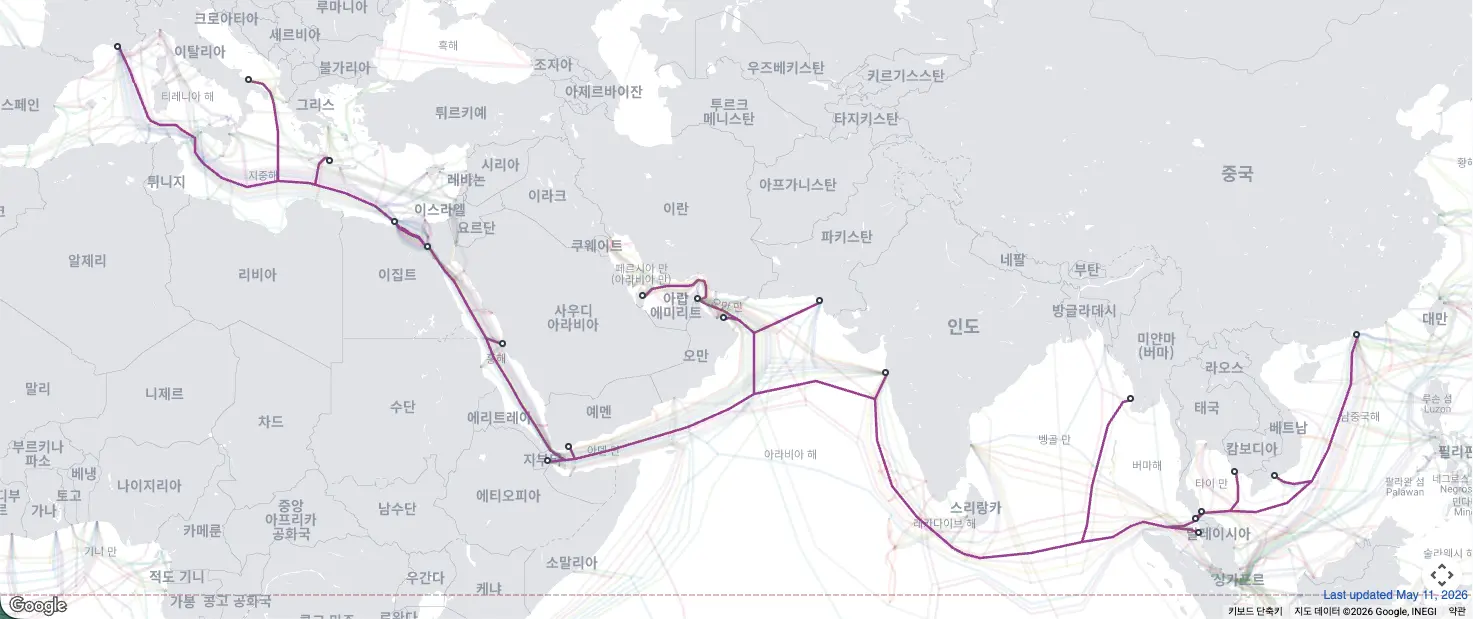
Source : Google Maps, Submarine Cable Map
The first is physical disconnection. A single cut fiber-optic cable can disconnect a city, a country, and at times even an entire continent from communications. In November 2024, two undersea cables in the Baltic Sea were severed in succession by a Chinese-flagged cargo vessel, affecting communications between Sweden and Lithuania as well as between Finland and Germany. In May 2026, Tasnim, a media outlet affiliated with Iran’s Islamic Revolutionary Guard Corps, proposed measures targeting seven major undersea cables passing through the Strait of Hormuz, including licensing fees, the application of Iranian law to foreign companies, and exclusive maintenance rights. Undersea cables in the Strait of Hormuz relay approximately $10 trillion in financial transactions every day, while Gulf states rely on these cables for more than 90% of their internet connectivity. Cable cuts are a risk, but placing cables under the control of a specific state creates the same kind of risk.
The second is censorship and surveillance. The internet does not operate with the same degree of freedom everywhere. In some countries, content is blocked, access to specific platforms is restricted, and users’ online activity is tracked. Censorship also extends beyond content blocking. As long as internet access runs through centralized infrastructure, infrastructure operators can observe who connects from where, who communicates with whom, and when each connection starts and ends. Tools such as VPNs and encrypted messengers can protect the contents of communication, but they cannot fully conceal this metadata. Their limitation comes from the fact that they, too, ultimately operate on top of centralized networks.
The third is a deeper problem for Web3: even blockchains built around decentralization ultimately run on the centralized internet. Bitcoin miners, Ethereum validators, and every dApp must pass through communications infrastructure provided by ISPs, or internet service providers, in order to connect to the network. Nodes may be distributed globally, but as long as the communication paths between those nodes remain under the control of a small number of ISPs, blockchain decentralization can only function within the limits permitted by that infrastructure.
Across all of these cases, the same infrastructure constraint appears. About 2.1 billion people remain unconnected, billions more are connected but exposed to disconnection, control, and surveillance, and even decentralized technologies built on top of the internet are bound by the same underlying limitations. Redesigning this structure requires infrastructure that can operate without permission from any single actor. The path forward is not terrestrial cables, but satellites in orbit. Not a single controlling entity, but a distributed network. Spacecoin is attempting exactly this redesign.
2. Spacecoin: Expanding Connectivity Through Satellite Infrastructure
2-1. Small-Satellite Communications Beyond the Cost Barrier
Spacecoin’s chosen architecture centers on small satellites in low Earth orbit. Two recent shifts have made this approach viable. The first is the steep decline in launch costs. SpaceX’s reusable rockets have pushed the cost of placing satellites into orbit down from $100,000 per kg to around $1,400 per kg. Rockets that were once discarded after a single launch are now recovered and reused, fundamentally rewriting the cost structure of satellite launches. The second is component standardization. Low-cost, high-performance components scaled by the smartphone industry have started finding their way into satellites, allowing small satellites weighing only a few dozen kilograms to take over functions that once required multi-ton spacecraft. As these two shifts converged, satellite communications, once a domain reserved for governments and large corporations, entered an era in which private companies can launch their own satellites and operate services directly.
Spacecoin has built on this shift by choosing low Earth orbit, or LEO. Located roughly 500 km above the Earth’s surface, LEO offers low latency, making it suitable for real-time communications. It can also be served effectively by small satellites, which helps lower the overall cost structure. SpaceX’s Starlink was the first to bring large-scale satellite internet to this same orbital layer. With more than 10,000 LEO satellites providing high-speed internet worldwide, Starlink has become the leading example showing that satellite-based global internet can be a viable business.
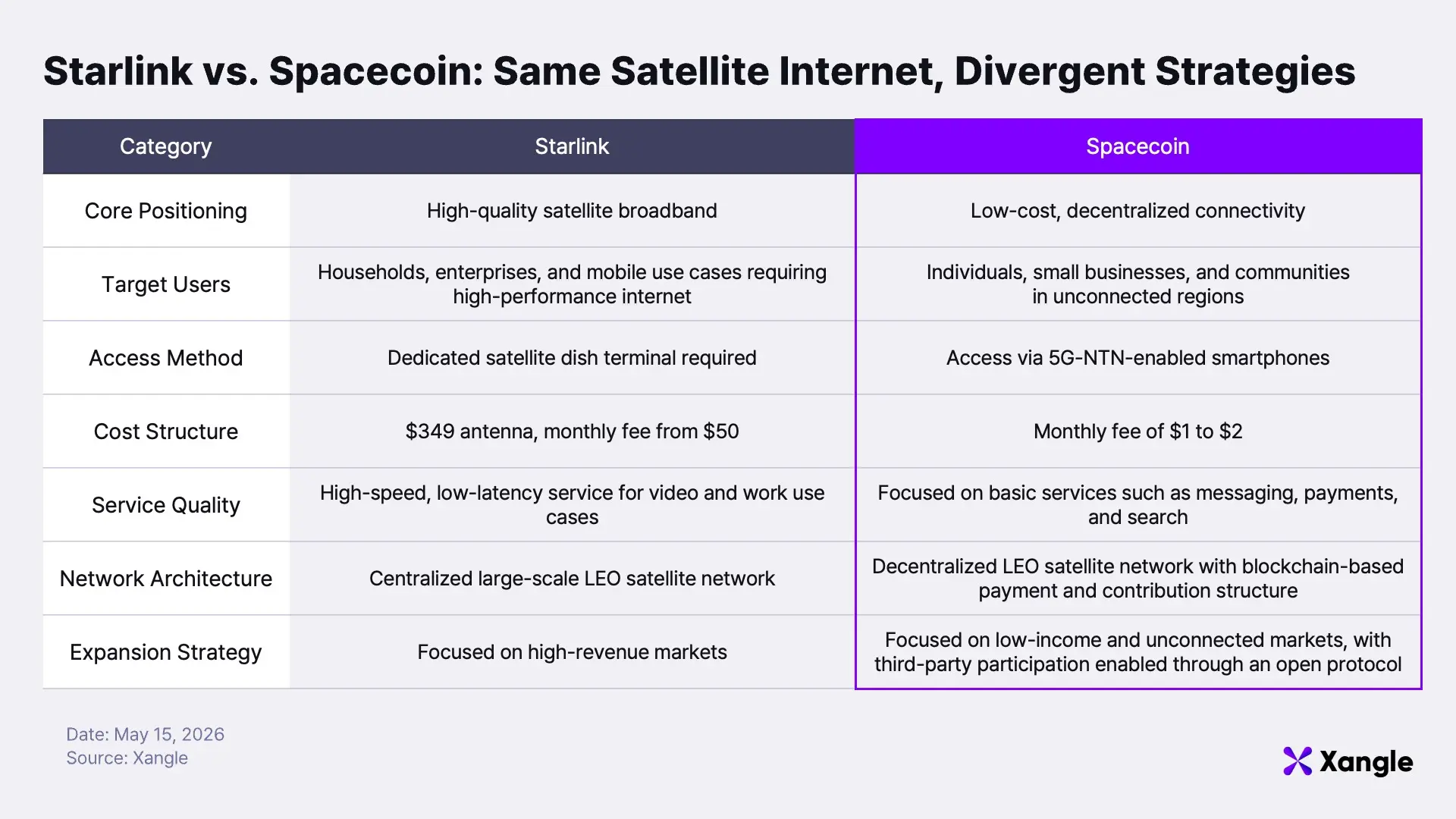
Starlink and Spacecoin may operate in the same orbit, but they are built for different directions. Starlink is a premium service optimized for high-bandwidth, high-quality connectivity. Its target users are those who can pay $349 for a satellite dish antenna and more than $50 in monthly subscription fees. Such a pricing model is competitive in developed markets, but it sits far outside the purchasing power of developing countries. In Kenya, for example, Starlink has reached only around 22,000 subscribers and a 0.9% market share roughly two years after entering the market. Equipment costs and monthly subscription fees remain high relative to local income levels.
Spacecoin, by contrast, targets developing countries where Starlink’s pricing is out of reach. Rather than maximizing bandwidth, Spacecoin focuses on connecting more people at a lower cost. Its goal is to provide basic connectivity, including messaging, payments, and search, at data fees of around $1 to $2 per month. The network architecture also differs. Starlink is a centralized network in which one company launches, operates, and controls the satellites directly. Spacecoin aims to build a decentralized satellite network in which anyone can participate. Rather than competing head-on, the two projects are trying to serve different markets with different architectures from the same low Earth orbit.
2-2. Small Satellites as Orbital Base Stations
Spacecoin’s small satellites function as base stations in the sky. Rather than deploying base stations on the ground, the network assigns that role to satellites in orbit. The architecture is based on 5G-NTN, or Non-Terrestrial Network, a standard defined by 3GPP, the body responsible for international mobile communications standards. In simple terms, 5G-NTN is a technical specification that treats satellites as mobile network base stations. Any smartphone that supports this standard can directly receive satellite signals without a separate satellite dish or dedicated device. Major global manufacturers such as Apple and Samsung have already released devices supporting 5G NTN, and Spacecoin is designing its network around this standard.
For the architecture to work, one physical constraint must be addressed. A satellite orbiting roughly 500 km above the Earth’s surface completes one orbit around the planet in about 90 minutes. The window during which a single satellite passes over a specific region lasts only 5 to 15 minutes, after which the connection drops. Just as a phone call does not disconnect when a mobile device switches from one cell tower to another while in motion, the next satellite must take over the connection before the current satellite moves out of range. The process is known as handover.
Seamless handover requires one additional capability. Satellites must be able to send and receive data directly with one another. Routing data through the ground every time would increase latency and make the network architecture more complex. Direct satellite-to-satellite communication in orbit is known as an inter-satellite link. Spacecoin’s three CTC-1 constellation satellites are validating precisely these capabilities, handover and inter-satellite links, in orbit.
At the level of individual satellites, these functions define what each satellite needs to do. Once those satellites are linked together in orbit, however, they form an independent communications network that does not rely on ground infrastructure. When dozens or hundreds of small satellites are connected through handover and inter-satellite links, data can move across continents by traveling along the satellite network without coming back down to the ground. Spacecoin is not trying to build individual satellites in isolation. It is trying to build the network itself, and the network has been designed from the outset as an open protocol. In other words, the architecture is intended to allow other satellite companies or telecom operators to connect their own satellites to the same network in the future. For such a network to operate in practice, one more layer is required: a structure that enables data transmission and settlement to occur automatically, without third-party intermediation, even among participants who do not know one another.
2-3. Trustless Data Transmission and Settlement
Sending data via satellite is a technical challenge. Operating a network where satellite operators and users do not know one another introduces a separate trust and settlement challenge. In a decentralized network without a central operator, the protocol must verify two things: first, whether payments can settle between unfamiliar participants, and second, whether a satellite's claimed location and activity are genuine. Spacecoin addresses these two problems respectively with blockchain escrow and a consensus mechanism called Proof of Location, or POL.
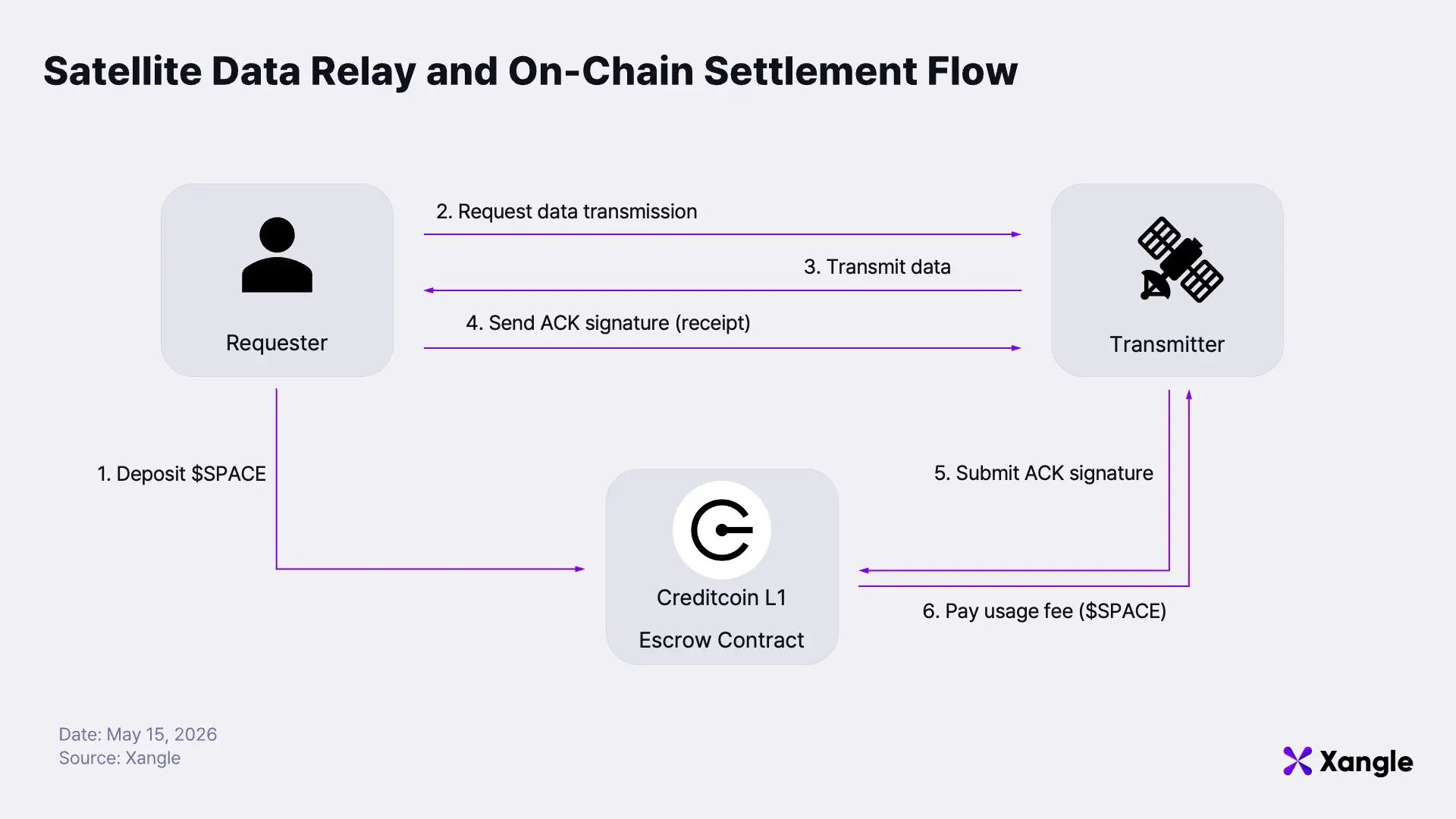
Payment risk emerges in two scenarios: when a requester receives data but fails to pay, or when a transmitter fails to transmit the data properly. Spacecoin's escrow structure removes both risks at once. Before requesting data, the requester first locks $SPACE tokens in escrow, eliminating receivables risk for the transmitter. Once transmission is complete, the transmitter submits the requester's ACK, a cryptographic receipt proving that the data was delivered, to the blockchain. The escrow contract then executes settlement automatically, without requiring a third party or mediator.
A requester could still receive data and refuse to return the ACK to the transmitter. Spacecoin treats this as a free-riding problem and addresses it through an on-chain credit system. When a transmitter submits evidence to the blockchain showing that a requester received data but refused to sign, an abuse record accumulates against that user. As the record builds, other transmitters can reject the requester's future requests. Since the user has already locked $SPACE tokens in escrow to request data, losing network access also reduces the utility of the locked tokens. Free-riding therefore carries a higher cost than benefit, leaving little structural economic incentive for abuse.
Once escrow and the credit system establish trust in payments, the next issue is trust in the satellite itself. In a network where a single company owns every satellite, the operator can directly verify which satellite sent data, when it sent it, and from where. In an open network where anyone can participate, however, each low Earth orbit satellite passes over a given region for only 5 to 15 minutes while performing its tasks. The network therefore needs a way to verify whether the satellite actually passed over the region and how fast it was moving.
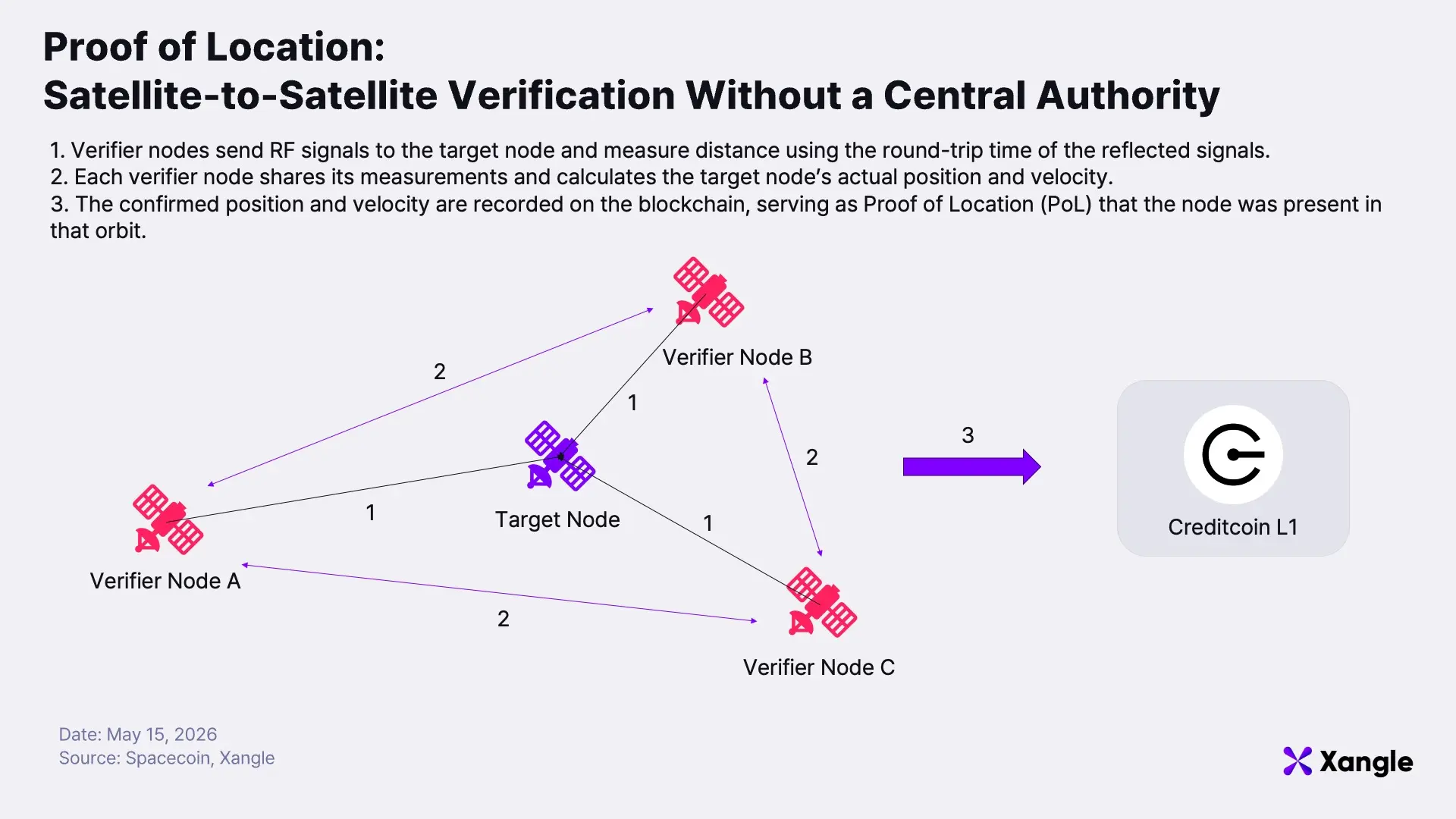
Spacecoin solves this problem with its own consensus mechanism, Proof of Location, a technology protected by a registered U.S. patent. The core idea is for satellites to verify one another's positions. A verifier satellite sends a radio frequency, or RF, signal to a target satellite, and the target satellite reflects the signal back. The verifier satellite measures the signal's round-trip time, calculates the maximum distance to the target satellite, and uses that distance to define a three-dimensional spherical region in which the target satellite could exist. When multiple verifier satellites perform the same process and share their results, the target satellite's actual location is confirmed at the intersection of those spherical regions. A key distinction from existing positioning systems is that the process does not require time synchronization between nodes. The verified location and velocity are recorded on the blockchain, turning the record into the satellite's activity history.
2-4. Orbital Validation and Market Entry
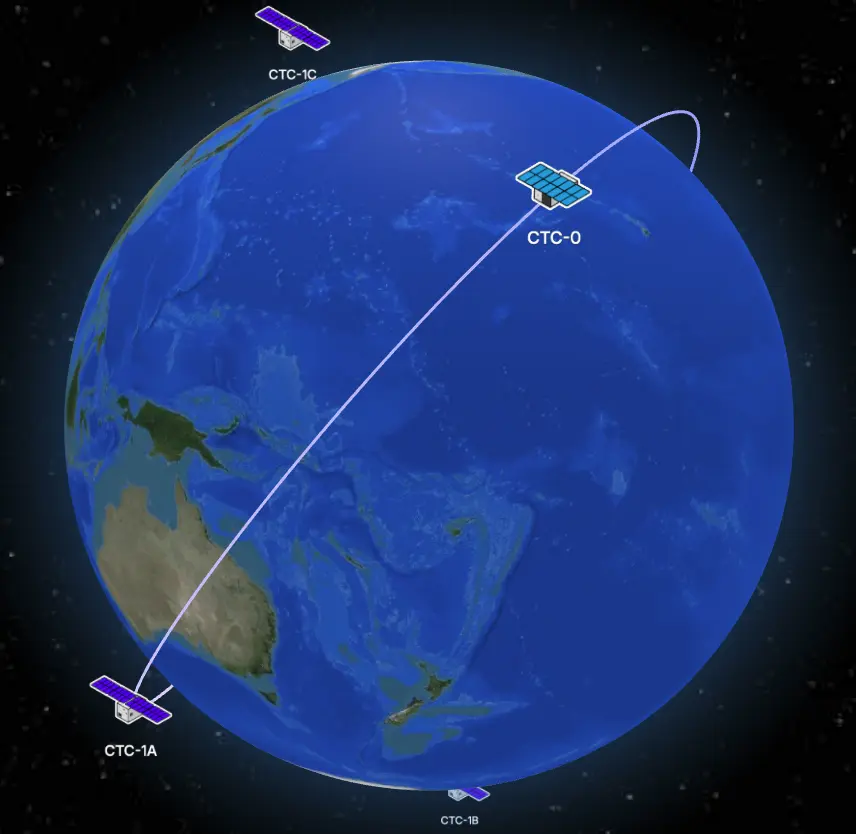
Spacecoin has placed a total of four satellites into orbit across two launches to date. In December 2024, its first satellite, CTC-0, was launched aboard SpaceX’s Falcon 9. In October 2025, Spacecoin successfully transmitted encrypted blockchain transaction data via satellite from Chile to Portugal, covering a distance of approximately 7,000 km. The test marked the first demonstration that escrow-based settlement and blockchain communications can function in a real satellite environment. In November 2025, three additional satellites, CTC-1A, CTC-1B, and CTC-1C, were launched. Spacecoin is now validating satellite-to-satellite handover and inter-satellite links in orbit.
As orbital validation continues, Spacecoin is already building toward real-world adoption on the ground. The company is currently entering four markets: Kenya, Nigeria, Indonesia, and Cambodia. All four countries have large populations, but internet infrastructure remains concentrated in cities, leaving areas outside urban centers underserved or entirely disconnected. Nigeria has more than 100 million people under the age of 25, yet outside major cities, most regions have unstable connectivity, sometimes not even reliable 2G. Indonesia consists of roughly 17,000 islands, making cable deployment physically difficult even before economic feasibility enters the equation. Combined with an economic structure where infrastructure investment is difficult to recover even when connectivity is provided, these are markets where both telecom operators and governments have remained unable to move.
In these markets, Spacecoin is designing a model where users connect to satellites via smartphones and access data by paying around $1 to $2 worth of $SPACE per month. The model does not stop at simple fee payment. Each time a user pays for data, the record accumulates on the blockchain. Over time, those records become a verifiable credit history. Even users without bank accounts can use this history to access loans or other financial services. Internet connectivity therefore becomes a path not only to communication, but also to financial inclusion. The same development team also operates Creditcoin, which has been building blockchain-based credit infrastructure in developing countries, for this reason.
Alongside technology development, Spacecoin is directly laying the groundwork in the markets where the technology is intended to be used. In Nigeria, it is working with the Office of the Vice President and Jigawa State to operate a program that trains 1,000 young people each year in blockchain and AI technologies. Spacecoin has also met directly with presidents and vice president-level officials from Ghana, Sierra Leone, and Liberia to discuss the deployment of satellite networks across Africa. Pilots have been announced in all four countries, and Spacecoin has presented the longer-term goal of reaching 10 million users within three years and achieving break-even on the back of these pilots.
3. SpaceRouter: Reshaping Privacy and Access Beyond Connectivity
Where the satellite network decentralizes connectivity itself, SpaceRouter decentralizes the path that data takes across that connection, namely routing. The issue with a centralized internet does not end at disconnection or blocking. Even when users are connected, the underlying architecture still exposes who is communicating with whom, and from where, to infrastructure operators. SpaceRouter targets this routing layer, addressing privacy and access at the same time through two approaches.
3-1. SpaceRouter Onion: Routing-Layer Privacy Infrastructure
Most privacy tools available to users today remain confined to the application layer. Encrypted messengers protect message content, while VPNs mask the IP address used to connect. Yet because these tools ultimately run on centralized networks, metadata such as where a user is located, who they connect to, and when a connection starts and ends remains visible to infrastructure operators. With VPNs, traffic passes through a single company’s server, requiring users to trust that company’s promise not to keep logs. In practice, privacy depends on a corporate policy.
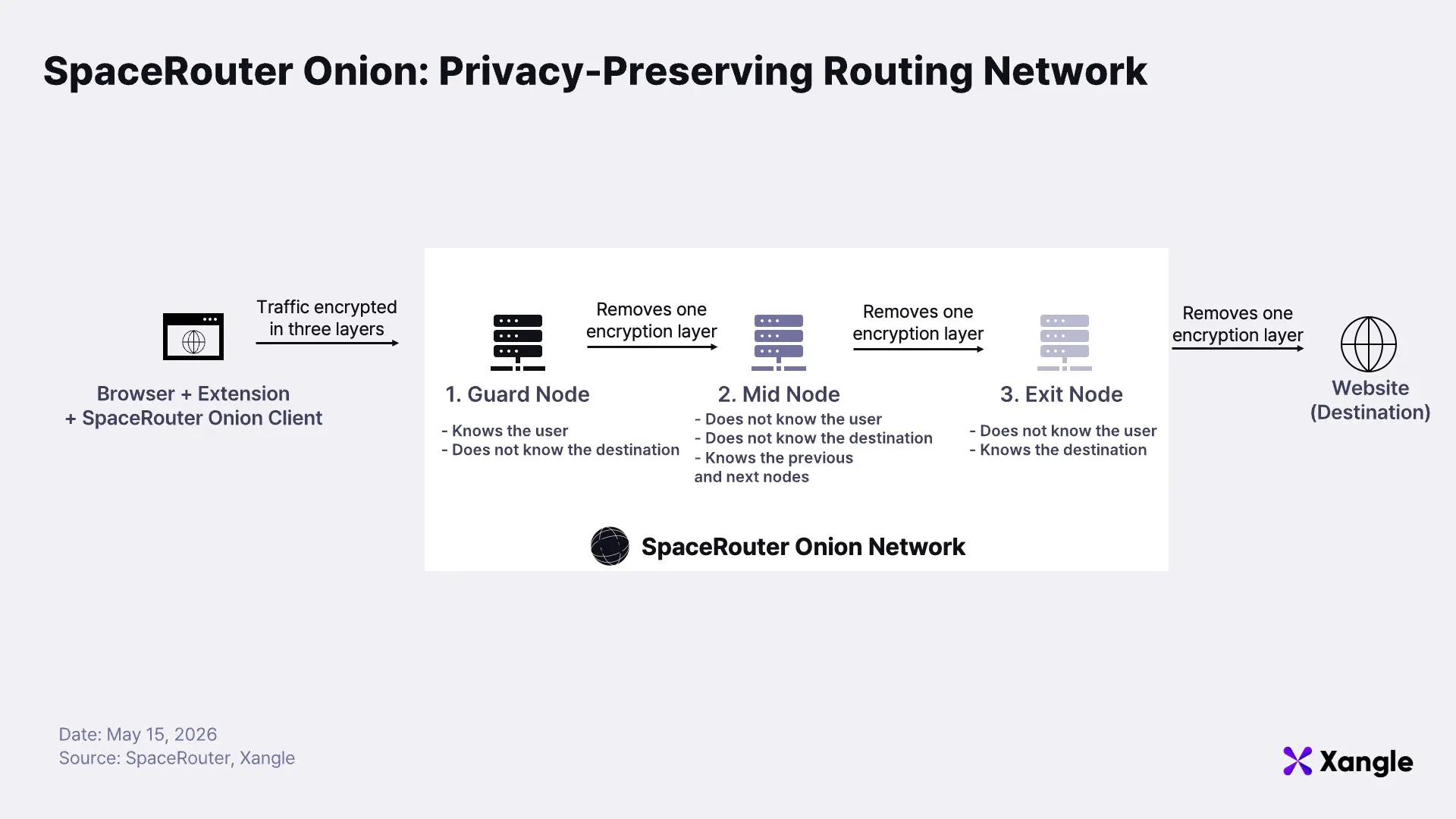
SpaceRouter Onion attempts to solve this problem at the architectural level. It uses onion routing inspired by Tor, the best-known privacy network: traffic is wrapped in multiple layers of encryption, and each node removes one layer before forwarding it to the next. The name comes from the way encryption is peeled away layer by layer, like the layers of an onion. Traffic passes sequentially through three independent nodes, with each node seeing only the information immediately before and after it. The first node, the Guard, knows who the user is but not where the traffic is going. The final node, the Exit, knows where the traffic is headed but not who sent it. No single node and no single company can see the full route. Privacy is therefore enforced by path design, not delegated to someone’s promise.
Why build a new system when Tor already works on the same principle? Although Tor is a long-tested privacy network, it carries two structural limitations. First, nodes are operated by volunteers. The network is open in the sense that anyone can register a node, but openness also means the design cannot fully exclude malicious nodes from entering. Second, the absence of economic rewards makes node supply unstable, contributing to slower speeds and inconsistent quality. Over time, this has reinforced the perception that privacy requires users to accept degraded performance.
SpaceRouter Onion aims to address these limitations with blockchain-based node verification and token incentives. Nodes are registered and verified on the Creditcoin L1 blockchain using cryptographic keys. Because node identities and activity histories are recorded on-chain, the network can maintain integrity without relying on a separate trusted authority. The design also embeds a token-based economic incentive for node operators, aiming to create a sustainable node supply model that does not depend on volunteer participation.
SpaceRouter Onion is currently in open testing. Anyone can use it by installing the Chrome extension and desktop app, and the browser toolbar lets users inspect the connection path and the country of each node directly. The current network still has a limited node count and a limited set of available countries. Future updates are expected to add a node reputation system, open participation so anyone can operate a node, and on-chain reward settlement based on the bandwidth actually relayed.
3-2. SpaceRouter Proxy: Decentralized Routing for AI Agents
Where SpaceRouter Onion addresses privacy for human users, SpaceRouter Proxy tackles an entirely different problem on the same infrastructure. AI agents are emerging as a new class of internet users, browsing the web on behalf of humans, filling out forms, comparing prices, making reservations, and even completing purchases. As this market expands, AI agents will inevitably account for a larger share of web traffic. Yet AI agents typically run in data centers, and many websites classify data center IPs as bots, blocking them or restricting access. CAPTCHA, IP blocking, and rate limits all operate on the same logic. As long as traffic originates from a data center, the problem cannot be avoided.
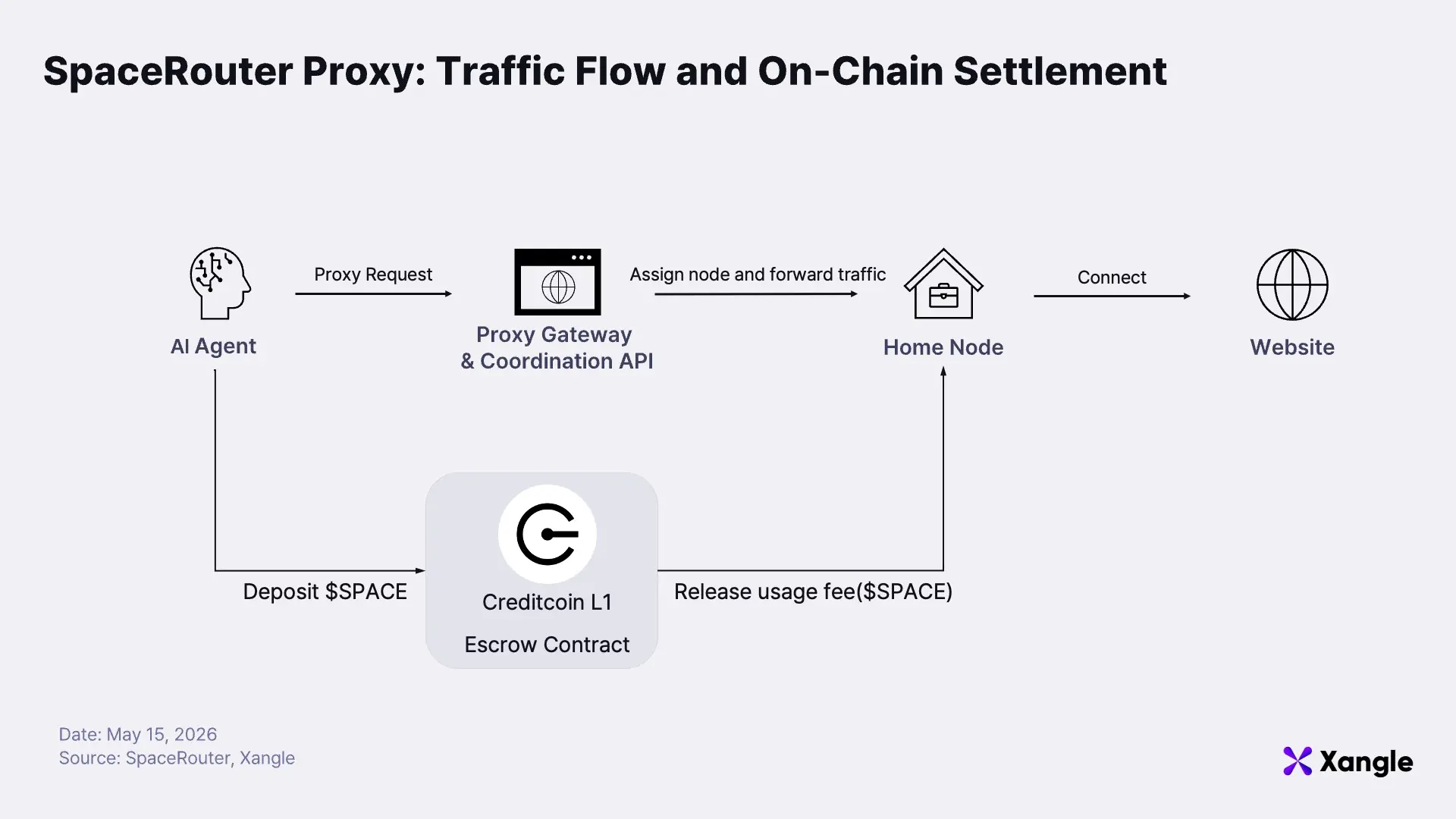
SpaceRouter Proxy addresses this problem at the infrastructure layer. It is a distributed proxy infrastructure that routes agent traffic through real residential internet connections rather than data centers. From a website’s perspective, an AI agent’s request becomes indistinguishable from an ordinary user browsing from home. The architecture consists of three layers: the Proxy Gateway that the agent connects to, the Coordination API that determines which residential node should receive the traffic, and the Home Node that forwards the traffic to the website through its own home internet connection. When an agent sends a request to the Proxy Gateway, the gateway uses the Coordination API to select the most suitable Home Node based on node status and location, and the traffic reaches the website through that node’s residential IP.
The payment model differs fundamentally from existing proxy services. Conventional proxy services require users to create an account, register a card, and pay a monthly subscription fee. In SpaceRouter Proxy, a wallet address serves as the user’s identity. Without separate sign-up or API keys, users can start using the service simply by depositing $SPACE into on-chain escrow. Each request automatically deducts a small amount, and the Home Node operator that relayed the traffic receives settlement on-chain. SpaceRouter has also released an SDK for developers, allowing anyone to connect existing agents to SpaceRouter without separate approval.
$SPACE token holders can stake their tokens, install the Home Node app, and operate their own residential internet connection as a relay node. Spacecoin refers to this node operation model as active staking. In conventional staking models, users lock up tokens and receive rewards through newly issued tokens or protocol allocations. Active staking, by contrast, generates rewards only when both staking and actual bandwidth contribution are satisfied. Rewards come not from new token issuance, but from real traffic flowing through the network.
SpaceRouter Onion and Proxy solve different problems, but they run on the same infrastructure. Spacecoin uses satellites in orbit to create connectivity that does not depend on centralized telecom operators. Onion structurally guarantees user privacy on top of that connection, while Proxy solves the access problem facing AI agents. Decentralized connectivity, decentralized privacy, and decentralized routing are combined into a single stack. What Spacecoin is designing is nothing less than a reconstruction of internet infrastructure itself.
4. Roadmap and Tokenomics
4-1. SpaceCoin Roadmap
A common design principle runs through both the satellite network and SpaceRouter discussed above. Spacecoin’s satellite protocol is open to other satellite companies that want to connect their own satellites to the same network, while SpaceRouter’s SDK is publicly available so anyone can connect their own agents or applications without separate approval. Spacecoin calls this principle Open Architecture. A closed network can scale only as far as a single company’s capital and decision-making speed allow, whereas an open network expands its infrastructure as participation grows. On the back of Open Architecture, Spacecoin lays out a three-stage roadmap for expanding the reach of satellite internet.
The first stage, currently underway, connects the ground with satellites. With CTC-0 and CTC-1, Spacecoin is validating satellite-to-ground blockchain communications, handover, and inter-satellite links in orbit, while first proving out $SPACE tokenomics on the ground through pilot programs in four countries and SpaceRouter.
The second stage is satellite-to-satellite connectivity. In the first stage, each satellite communicates with the ground individually. In the second stage, satellites form an orbital mesh network that sends and receives data directly among themselves. Once the mesh network is in place, data can move along the orbital layer without passing through ground stations. Data uploaded from one region can travel along the orbit to a satellite above another continent, and then return to the ground from there. At this stage, satellite internet’s coverage, reliability, and speed become fundamentally different from the first stage. Because the network gains an independent communications path that does not pass through terrestrial cables at all, it becomes structurally insulated from physical submarine cable cuts and state-level control. The satellite network also opens the possibility of serving as secure communications infrastructure for aviation, maritime, and defense sectors.
The third stage is interplanetary communication. With SpaceX filing for authorization for 1 million satellites and Google exploring space-based data centers, the broader space industry is moving toward an orbital data economy. Against this backdrop, Spacecoin defines its ultimate goal as building a decentralized protocol for interplanetary communication. The inter-satellite communications technology and decentralized settlement mechanisms developed in the first two stages can carry directly into interplanetary communication. If a system can operate in Earth orbit where satellites exchange data with one another and settle trustlessly, extending the same structure to Mars orbit becomes a matter of distance, not design. The vision rests on the same technical trajectory Spacecoin is building today.
4-2. $SPACE Tokenomics
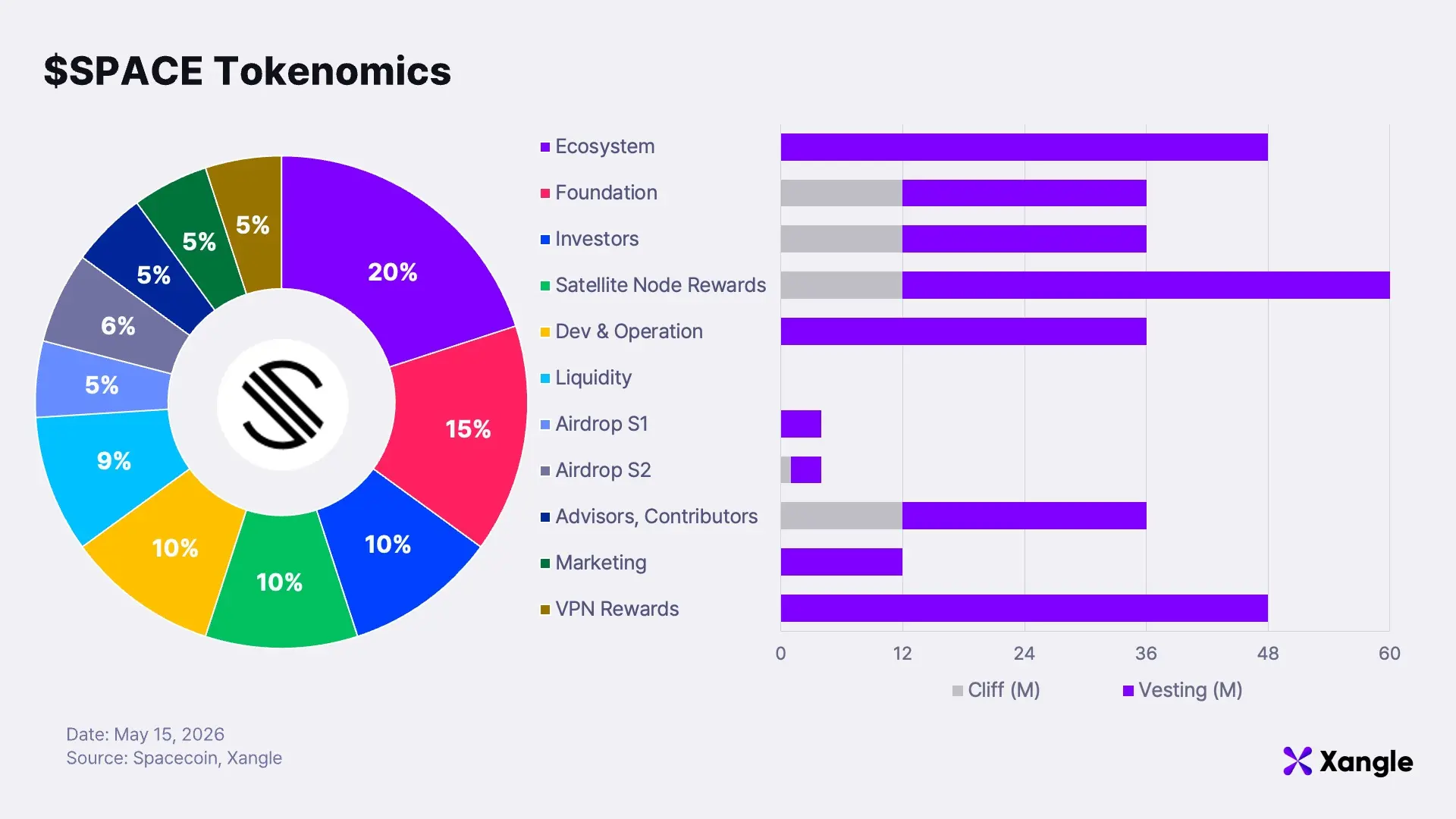
For most blockchain projects, token utility rarely extends beyond governance voting. Apart from voting on protocol upgrades, the token has little actual use, and the network itself can continue operating without it. When a token is not essential to network operations, its value depends less on real usage and more on market expectations. $SPACE occupies a fundamentally different position. Spacecoin has three products: low Earth orbit satellite internet, SpaceRouter Proxy, and SpaceRouter Onion. Across all three products, $SPACE is used in actual payment and staking flows. Users lock $SPACE in escrow when requesting data via satellite, pay with $SPACE when routing traffic through SpaceRouter, and stake $SPACE to operate a Home Node. In other words, Spacecoin has built tokenomics tied to real product usage.
A natural question follows: if $SPACE is used for payments and staking across all three products, why does it need to be a native token? Adopting widely used stablecoins such as USDC or USDT as payment methods may seem like the simpler option. Stablecoin issuers, however, can freeze specific accounts, and there have been actual cases where accounts were frozen due to regulatory requests or suspected illicit transactions. Spacecoin’s architecture is designed to decentralize everything from network infrastructure to settlement. Exposure to centralized control at the payment layer would undermine the consistency of its decentralized and censorship-resistant design. $SPACE exists as Spacecoin’s own payment medium to ensure that the network has no centralized control point anywhere in its stack, including payments.
5. Final Thoughts
Most blockchain projects operate on top of the existing internet. Ethereum, Solana, and every dApp built on them all rely on communications infrastructure provided by ISPs. Even when blockchains claim decentralization, decentralization remains incomplete if the infrastructure they must pass through is controlled by a single actor. Spacecoin turns that premise on its head. It uses blockchain to rebuild the very internet on which blockchains depend. It places satellites directly into orbit, designs the routing layer itself, and processes settlement on-chain. The result is an approach in which a blockchain project moves beyond software and directly builds physical infrastructure.
Spacecoin’s use of blockchain has a clear rationale. Providing connectivity to the 2.1 billion people who remain offline, while guaranteeing censorship-resistant privacy for users who are already connected, requires infrastructure that can operate without anyone’s permission. Blockchain is the technology that meets this condition. Automated settlement between satellite operators and users who do not know one another, verification of satellite locations and activity, and a payment medium that is not exposed to censorship all need to function without a central administrator. Demand for $SPACE therefore comes from a different source than typical crypto tokens. Real demand comes from people sending messages in rural Kenya, users making payments in Nigeria, users accessing private networks, and AI agents that need to bypass data centers. The token’s value is designed to emerge from real user traffic, not investor expectations.
The expansion of this infrastructure does not depend solely on the capabilities of the Spacecoin team. Spacecoin plans to open-source its satellite protocol and technology stack, while designing a structure that allows other satellite companies, telecom operators, and governments to build compatible satellites themselves and participate in the network without permission. A closed network can scale only as far as one company’s capital and decision-making speed allow. An open network, by contrast, expands its infrastructure as more participants join. The path from today’s four satellites to a global network rests not only on Spacecoin’s own launch plans, but also on this open architecture.
Challenges remain, of course. The satellite mesh network is still under development. Whether communication fees can translate into recurring revenue in real markets remains to be proven after the pilots. Regulation and spectrum access also vary by market. Even so, these challenges do not stem from the absence of technology. They arise from the process of scaling validated technology. Ultimately, execution, not technology, will be the key variable.
The basis of competition in internet infrastructure is changing. Faster speeds and higher bandwidth alone cannot solve markets that remain unconnected. Going forward, the key question is who can provide connectivity at lower cost, across wider regions, through a more open structure, and in a more censorship-resistant way. By combining satellites, blockchain, and tokenomics, Spacecoin is filling the gaps left by existing communications infrastructure and building the next stage on top of a new infrastructure.
Disclaimer
I confirm that I have read and understood the following: The information contained in this article is strictly the opinions of the author(s). This article was authored free from any form of coercion or undue influence. The content represents the author's own views and does not represent the official position or opinions of CrossAngle. This article is intended for informational purposes only and should not be construed as investment advice or solicitation. Unless otherwise specified, all users are solely responsible and liable for their own decisions about investments, investment strategies, or the use of products or services. Investment decisions should be made based on the user’s personal investment objectives, circumstances, and financial situation. Please consult a professional financial advisor for more information and guidance. Past returns or projections do not guarantee future results. This article was written at the request of Spacecoin. All content in this article was written independently by the author(s), and neither CrossAngle nor Spacecoin had any editorial control or influence over the content. The author(s) may hold the cryptocurrencies mentioned in this article at the time of writing.
Xangle or its affiliated partners own all copyrights of the written or otherwise produced materials and content provided on the platform. Any illegal reproduction of such content, including, but not limited to, unauthorized editing, copying, reprinting, or redistribution will result in immediate legal actions without prior notice.