[Xangle RWA Series] Blockchain

Table of Contents
1. Introduction: Why Does an RWA Business Need Blockchain?
2. What Should Institutions Consider When Choosing a Blockchain for RWA?
3. How Do Public and Private Blockchains Differ?
4. Major Blockchain and DLT Architectures and Institutional Use Cases
5. Closing Remarks: Blockchain Selection Should Follow the Business Structure
1. Introduction: Why Does an RWA Business Need Blockchain?
1-1. Streamlining Trading and Settlement
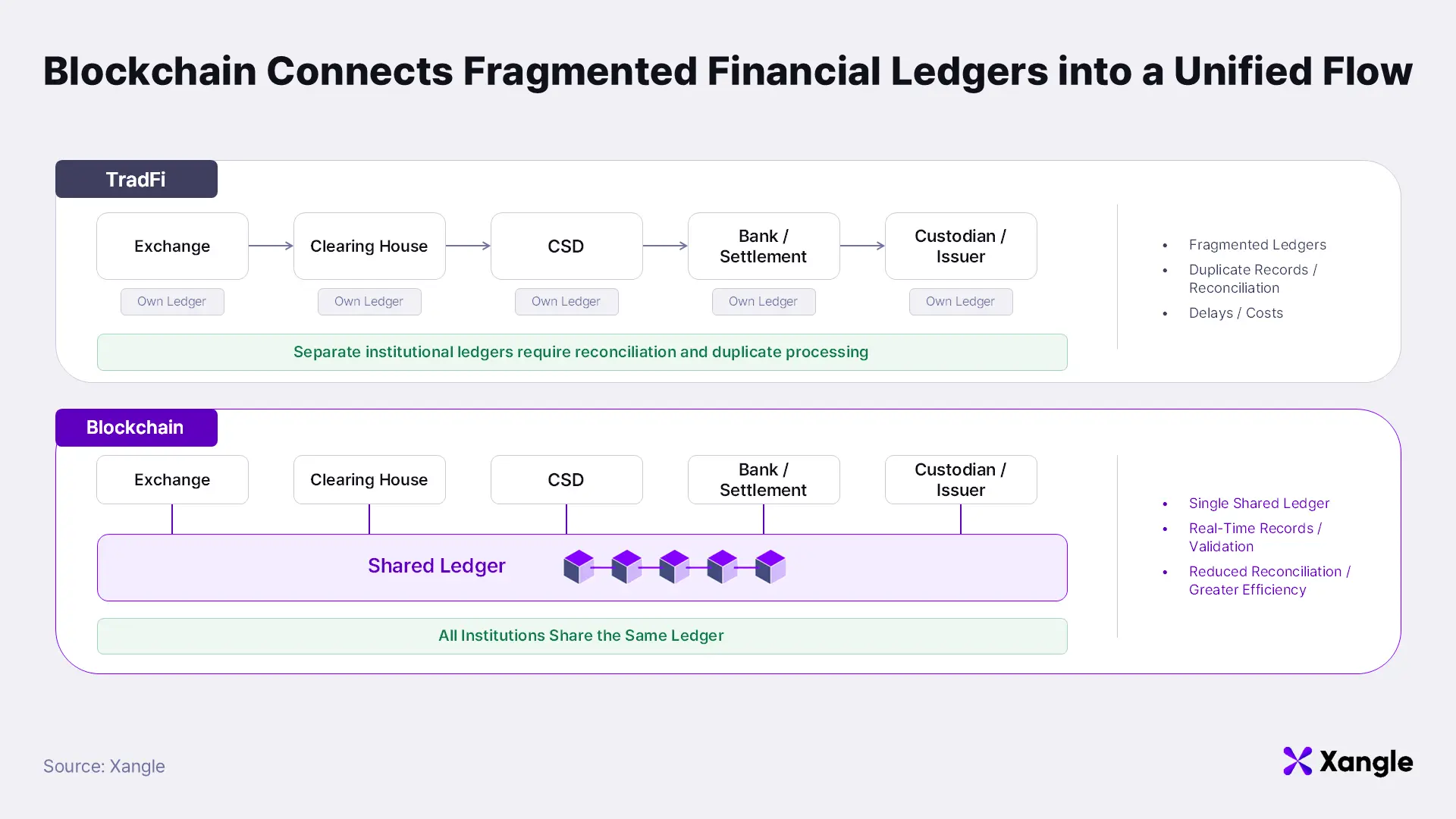
In traditional finance, a trade leaves numerous steps unfinished after execution, including clearing, securities transfer, cash settlement, investor-register updates, and ledger reconciliation. Brokerages, clearing houses, central securities depositories, custodians, and banks each operate their own systems and ledgers. The same trade is therefore recorded multiple times, and institutions must verify that their records match. This fragmented structure is a major source of post-trade processing time and operating costs.
Blockchain provides an environment in which multiple institutions can share the same asset state and execute post-trade procedures sequentially under predefined rules. When security tokens and settlement assets exist on the same network or on connected ledgers, smart contracts can link securities transfers with cash payments and reduce the risk that only one side settles. Repetitive tasks such as dividend and interest payments, redemptions, and the creation or release of collateral can also be executed automatically when specified conditions are met.
This can reduce duplicated records and reconciliation across institutions, manual adjustments, and settlement delays. It can also provide the foundation for continuous processing not only of trade execution but also of asset transfers and settlement. If supporting infrastructure such as settlement assets, price data, and investor screening operates alongside it, 24-hour trading and settlement outside traditional financial-market hours may also become possible.
1-2. Expanding Investor Access
Traditional financial products are generally distributed through financial accounts, intermediaries, and trading platforms tied to specific countries. For example, offering a US-issued fund or bond to Korean investors requires connecting domestic distributors and securities accounts with local brokers, custodians, foreign-exchange infrastructure, and settlement accounts, then reconciling records across those institutions. Expanding distribution into each new country requires additional financial institutions and sales channels that comply with local regulations. As a result, the venues where products trade and the routes through which investors gain access remain fragmented by national and institutional infrastructure.
Assets issued on a blockchain can be handled in a common format by wallets, custodians, and digital platforms that support the same network. An issuer can use digital wallets and on-chain platforms as additional distribution channels alongside traditional distributors and securities accounts, while investors can transfer assets among supported services. Public blockchains offer the added advantage of connecting products to a broader range of users and services without relying on a single system operated by one country or institution.
Fractionalizing token units can also improve access by lowering high minimum investment amounts. However, blockchain issuance does not mean that anyone can invest from anywhere. National securities regulations, investor-eligibility rules, and KYC and AML requirements continue to apply. Blockchain does not erase regulatory boundaries. Instead, it broadens the technical distribution channels and investment units available within the scope permitted by regulation.
1-3. Extending On-Chain Finance
Tokenized assets can do more than exist and move in digital form. When connected to smart contracts, they can serve as underlying assets for collateral, lending, repo, liquidity provision, automated asset management, and other financial services. For example, tokenized government bonds or fund interests can be posted as loan collateral, while rules can automatically require additional collateral or liquidate a position if the collateral value falls below a specified threshold.
The ability to combine multiple smart contracts and assets is known as composability. It means that assets, settlement instruments, identity verification, price data, and trading rules can be linked like modules to form a single financial service. Similar services can be built in traditional finance, but each institution and system requires separate contracts and technical integrations. Blockchain places standardized assets and execution rules in a common environment, allowing services to connect more directly.
This extensibility broadens the meaning of RWA from simple digital issuance to on-chain financial infrastructure. As issued assets circulate through external wallets and trading platforms and are then used for lending, collateral, settlement, and asset management, a single financial product can function as a component across multiple services.
Blockchain can therefore streamline trading and settlement in traditional finance, broaden product distribution, and connect issued assets with a wide range of financial services. How those possibilities should be applied depends on the product structure, participants, and regulatory requirements. Institutions should first define the conditions their business requires, then select a network structure that meets them.
2. What Should Institutions Consider When Choosing a Blockchain for RWA?
There is no single blockchain structure suited to every RWA business. An institution may offer on-chain financial services broadly to retail investors on a public chain, use a public chain while limiting asset ownership to approved investors, operate a separate network, or share transaction information only among the institutions involved.
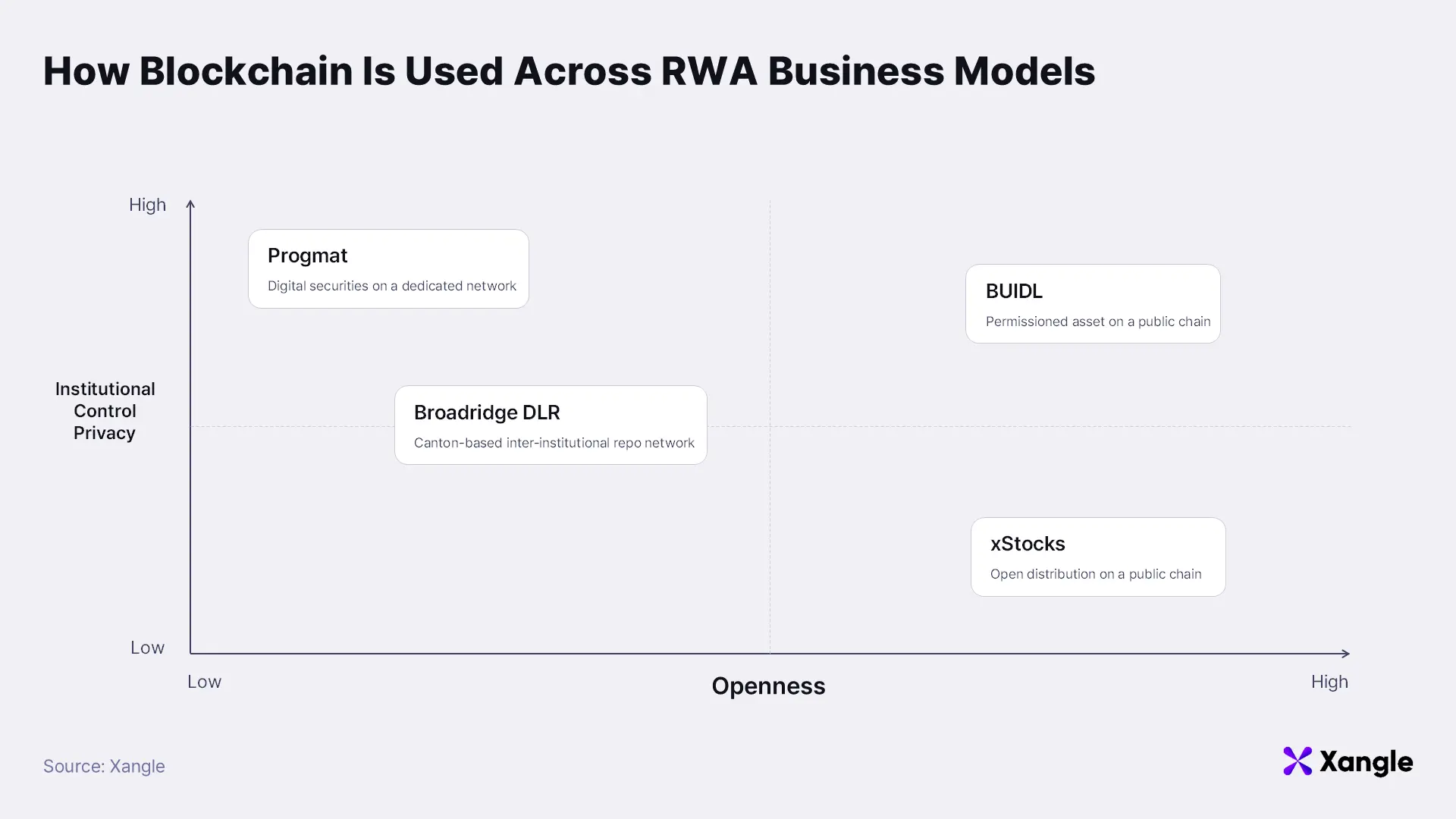
Backed's xStocks connects tokenized equities on Solana with external wallets, trading venues, and lending services. It focuses on using the liquidity and applications of a public chain to expand asset distribution and on-chain utility. BlackRock's BUIDL, by contrast, is issued on public chains including Ethereum, but only approved wallets that have passed qualified-investor screening can hold and transfer fund interests. Both products use public chains, but xStocks places relatively greater weight on open distribution and utility, while BUIDL emphasizes investor-access controls and regulatory compliance.
Institutions can also operate the network on which an asset is issued. Japan's digital-securities platform Progmat migrated the underlying ledger for its existing digital securities to an Avalanche L1, creating a dedicated network on which institutions can design validator participation, fees, and operating policies directly. Rather than distributing the product unchanged on an external public chain, it chose a structure closer to a private network under the control of financial institutions.
Canton, by contrast, is an open network, but transaction information is shared only with the relevant institutions. Broadridge's Distributed Ledger Repo (DLR) manages repo contracts and collateral states on Canton while allowing only necessary participants, including banks, dealers, and custodians, to view counterparties and terms. It combines the connectivity of an open network with private transaction processing.
The appropriate structure for an RWA therefore depends on the scope of distribution, investor-access conditions, level of information disclosure, and the party responsible for network operations. Instead of choosing a chain first, institutions should begin by defining who may hold the asset, how far it should connect with external financial services, who may view transaction information, and whether the institution will operate the network itself. Blockchain selection is the outcome of defining these business requirements.
2-1. Asset and Business Structure: What Will Be Offered, and to Whom?
Before choosing a chain, an institution should define what asset it will offer, to which investors, and through what structure. More than the asset category itself, the investor scope, distribution jurisdictions, range of utility, and the blockchain's role determine the actual network requirements.
The legal right represented by a token also differs by product. A token may itself be a security, represent an interest in a fund or trust, or embody a redemption claim against an issuer. Blockchain is only the mechanism for recording and transferring the right. The substance of that right is determined by the issuance agreement and legal structure.
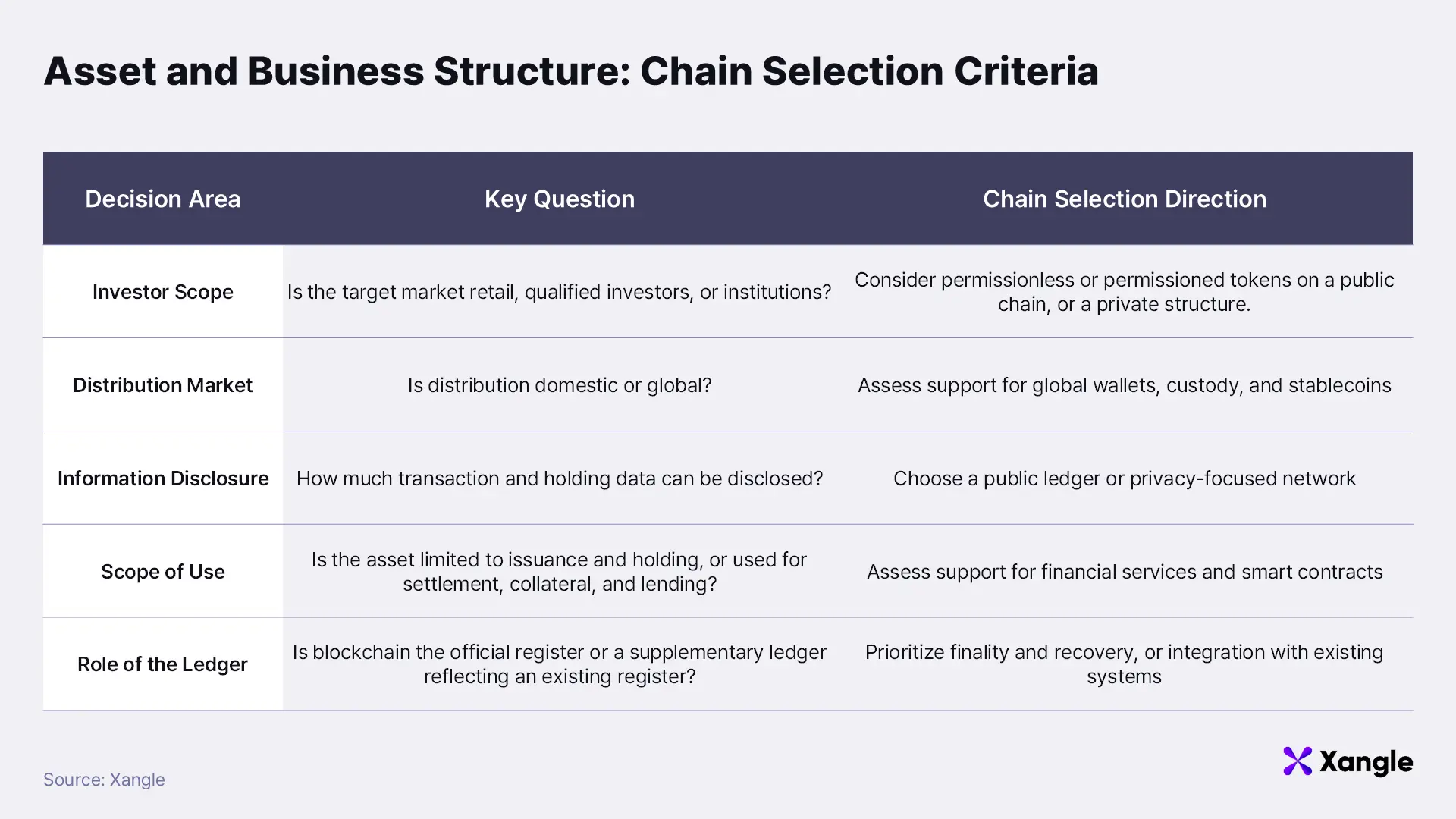
As the investor base and geographic distribution expand, the openness and accessibility of a network that can connect with diverse wallets, custodians, and settlement instruments become more important. If investors are limited to qualified investors or institutions, or if the product involves sensitive transaction information, participant control and data protection may matter more than broad access. Such products require a structure that can restrict who holds and transfers the asset and disclose transaction and holding data only to the parties that need it.
If the issued asset will be used for settlement, collateral, and lending, an ecosystem that supports diverse smart contracts and financial services is important. If blockchain is used only to record issuance and holdings, connectivity with an external financial ecosystem may matter less than whether transactions reach finality quickly and unambiguously, whether records can be corrected and recovered after errors, and whether the ledger can integrate reliably with the official register. Institutions should therefore apply different network functions and evaluation criteria depending on how extensively the asset will be used on-chain.
2-2. Regulatory Compliance, Asset Controls, and Privacy
Institutional RWA products differ from decentralized applications that allow the public to participate without prior approval. They require clearly defined accountability for assets and transactions. The design must specify not only who may hold and transfer the asset, but also who can suspend a transaction or freeze and recover assets when problems occur, and who may access investor and transaction information. Financial institutions and issuers remain responsible for regulatory compliance and investor protection, so code-based transaction execution alone is not sufficient.
These functions are not all supplied by a single blockchain. For institutional RWA products, regulatory compliance and asset controls divide responsibilities among the underlying blockchain, token and application layers, and legal and operational infrastructure.
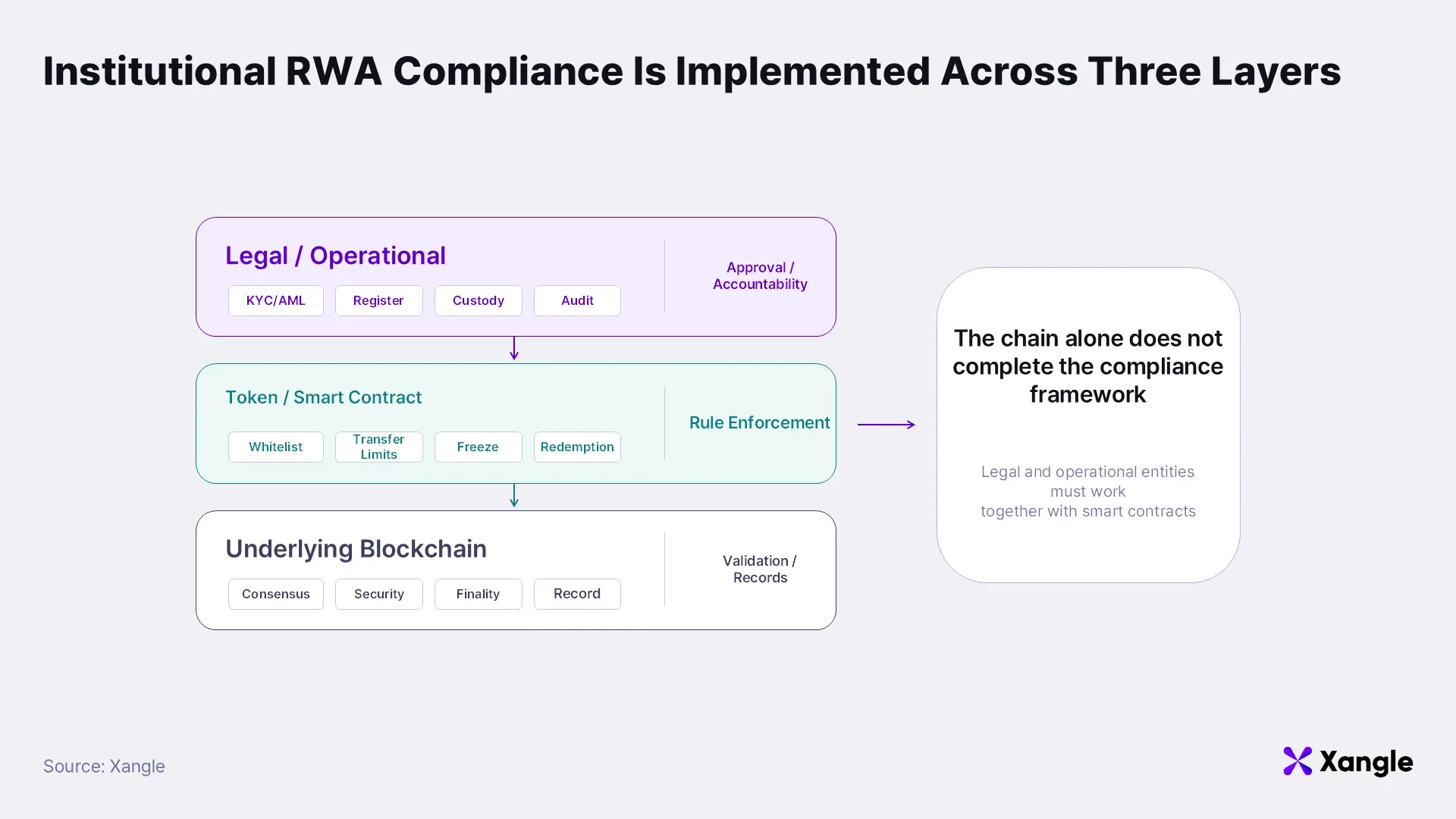
An Ethereum-based RWA product makes the division clearer. Ethereum validates and records transactions and provides a smart-contract execution environment, but it does not perform investor KYC or directly enforce jurisdiction-specific distribution restrictions. Instead, a token smart contract can connect to identity and compliance systems so that tokens move only among approved wallets. ERC-3643 is a prominent standard that combines an identity registry with transfer rules to implement whitelisting, wallet freezes, forced transfers, and lost-wallet recovery.
A smart contract does not determine investor eligibility on its own. Issuers, transfer agents, custodians, and other operating institutions perform KYC and AML reviews, register approved wallets, and maintain the official investor register. Those institutions also decide when an asset freeze or forced transfer is required and exercise administrator privileges, retaining the associated legal and operational responsibility. Address permissions and restrictions established by operating institutions are reflected in the smart contract's transfer rules, blocking transfers to unapproved wallets.
Public-blockchain products such as BENJI follow the same structure. Blockchain serves as a common ledger for transactions and holdings, while operating institutions such as the transfer agent control eligible investors and the powers to transfer, freeze, and recover assets through smart contracts.
In inter-institutional transactions and private assets, transaction amounts, counterparties, and positions may themselves be sensitive. A product using a public chain should therefore separate identity data off-chain or apply an additional privacy structure and configure disclosure to meet operational needs.
Institutions should not stop at asking whether a particular chain supports regulatory compliance. They must also design where each required control resides among the underlying blockchain, token smart contracts, and operating institutions, and determine who makes decisions and bears responsibility when problems occur.
2-3. Stability and Reliability as a Financial Ledger
Blockchain is used as a financial ledger that records asset ownership and transaction outcomes. Institutions must therefore examine not only throughput and fees, but also when transactions become final and whether assets and records remain secure during disruptions.
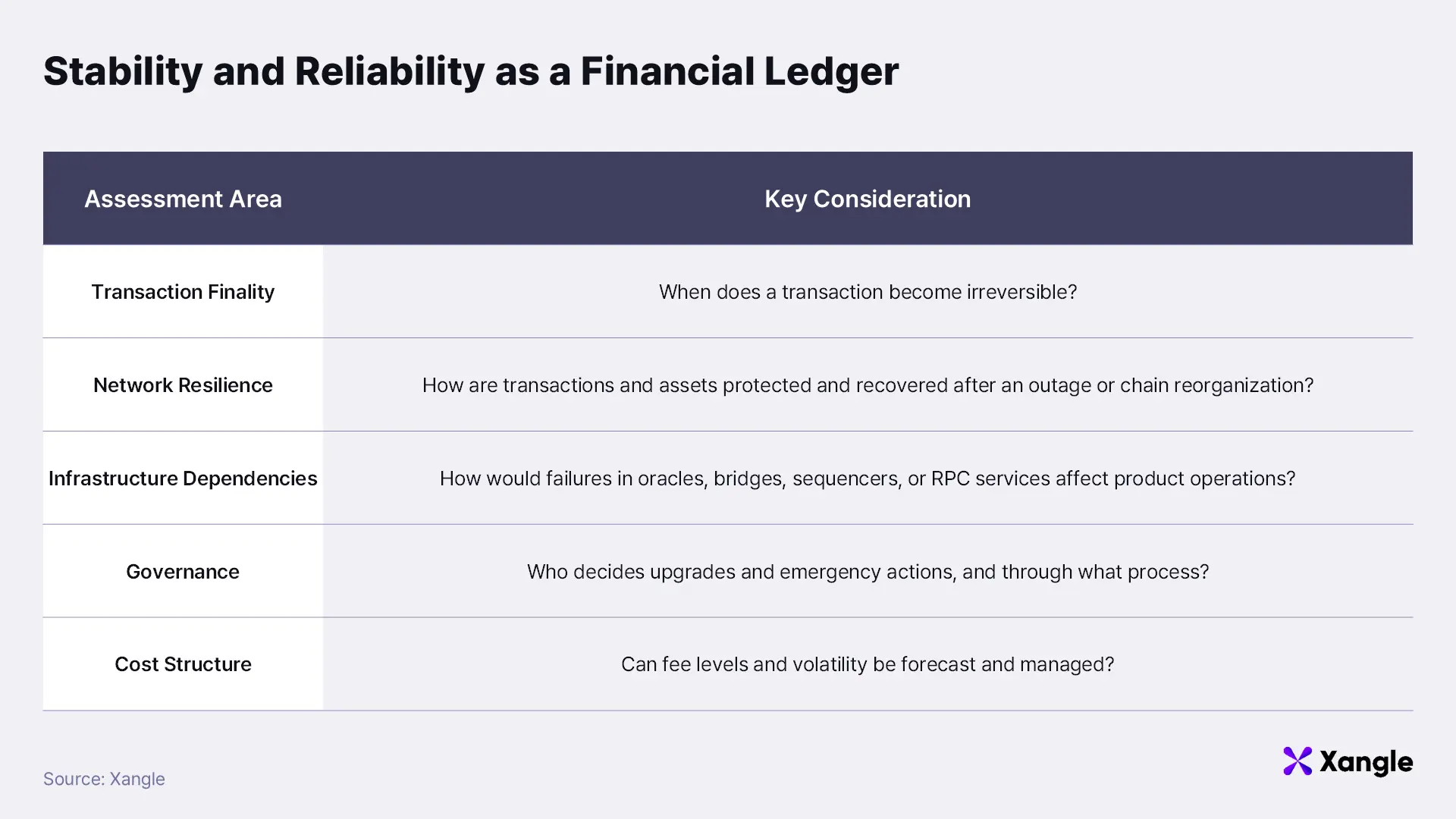
The transaction-finality point must first be defined clearly. Even after a transaction is included in a block, some networks may retain the possibility of reversal for a period of time. If a chain reorganization or network failure changes the record after a tokenized fund redemption is processed, discrepancies may arise among on-chain holdings, the transfer agent's register, the applicable net asset value, and settlement records. Institutions should understand each chain's finality mechanism and establish in advance when a transfer is recognized as legally and operationally complete and how records will be restored after an outage.
External infrastructure required for product operations can fail even when the underlying blockchain continues to operate normally. Examples include oracles that provide prices, bridges that move assets between chains, sequencers that order transactions, and RPC services that provide network access. If an oracle or sequencer fails in a loan backed by tokenized assets, collateral-value updates, margin calls, and liquidation may all be delayed. When using an L2 in particular, institutions must assess not only the security of the underlying L1, but also the sequencer, data availability, withdrawal path, and administrator privileges.
Governance determines who can respond to outages and security incidents. Institutions should identify who decides protocol and smart-contract upgrades, transaction suspensions, and emergency recovery, and what approval procedures and audit records apply. A high degree of decentralization does not by itself clarify responsibility and response processes. Conversely, excessive concentration of administrator privileges can create new operational risks.
Cost predictability matters more than average fees. Temporary fee spikes can directly affect operating expenses and processing schedules for activities concentrated at particular times, such as dividend and interest payments or redemptions. Institutions should also determine whether investors must hold a separate gas token, whether the issuer can sponsor transaction fees, and whether costs can remain manageable as transaction volume grows.
2-4. Asset Utility and Connectivity with the Financial Ecosystem
The value of an RWA token depends less on issuance itself than on how easily it can circulate and be used afterward. Investors must be able to subscribe and redeem, while other institutions and financial services need the ability to use the asset for trading, settlement, and collateral. This requires supporting infrastructure such as settlement instruments, wallets, custodians, and oracles.
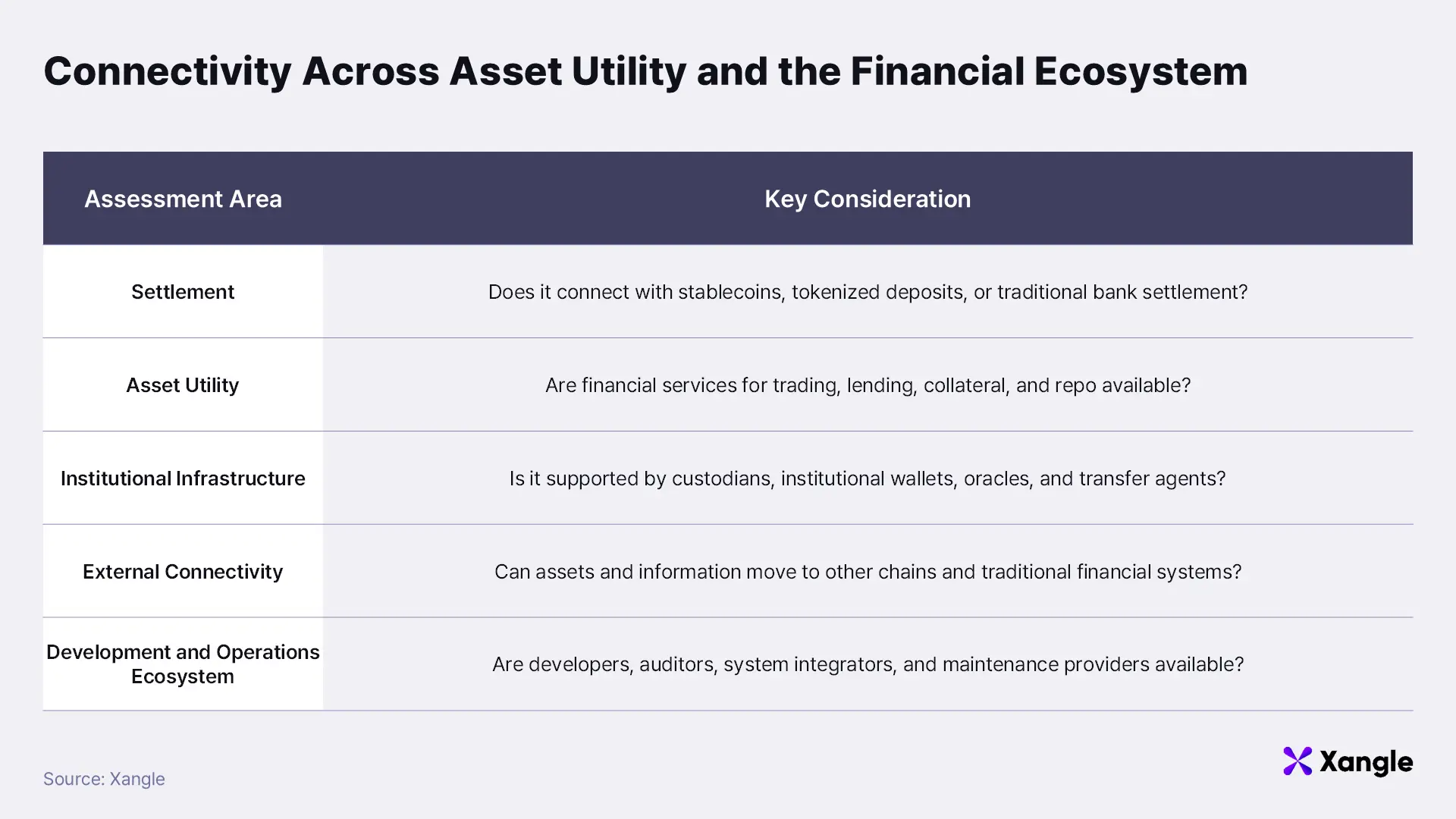
Settlement instruments provide the foundation for subscriptions and redemptions. If the asset transfer occurs on a blockchain while cash settles through banking rails, the outcomes of the two systems must be connected and verified. Using a security token together with a stablecoin or tokenized deposit in the same environment can enable more direct delivery versus payment (DvP). Institutions should also assess the liquidity of the settlement asset, whether institutional users can access it, and the available fiat on-ramp and off-ramp routes. Without this foundation, actual subscriptions and redemptions may remain difficult even after a token is issued.
The range of asset utility depends on the chain's financial ecosystem. Institutions should determine whether trading venues and lending protocols operate on the network, whether services accept RWA tokens as collateral, and whether participants provide price data and liquidity. Access for institutions and qualified investors also matters. Using assets for trading, collateral, lending, and repo can allow holders to raise funding or earn additional returns without selling the underlying position.
Institutional infrastructure is needed for product custody and administration. Institutional wallets and custodians support secure storage and permission management, while oracles supply prices for trading and collateral valuation. Transfer agents connect on-chain records with the official investor register. Without support from these providers, institutions may struggle to satisfy existing operational processes and regulatory requirements even if they use the chain.
External connectivity determines the scope of asset distribution. RWA products must exchange information continuously with financial services on other chains, bank payment rails, and internal systems operated by issuers and transfer agents. A multichain product must reconcile issuance, subscriptions, and redemptions across chains within a single product ledger. Moving assets through bridges also creates security risks and questions of responsibility after incidents.
A professional development and operations ecosystem is also necessary. Smart-contract development and security audits, legacy-system integration, incident response, and upgrades continue after launch. On chains with few developers, auditors, and system integrators, operating costs and the burden of incident response can increase.
BUIDL launched on Ethereum and later expanded across several public networks. Each new chain required the product to connect that network's wallets, custodians, settlement instruments, and financial services with its operating structure. It also created the need to manage fund interests, issuance, and redemptions consistently across multiple chains. BUIDL's expansion shows why chain selection must assess the entire ecosystem supporting subscription, custody, settlement, utility, and redemption.
3. How Do Public and Private Blockchains Differ?
When institutions evaluate a blockchain for an RWA business, the first question is often whether to use a public or private structure. A public blockchain is a shared network on which anyone can submit transactions and inspect records, while multiple independent participants validate transactions and operate the network under a defined protocol. A private blockchain is a structure in which an institution or consortium directly manages network participants and validators, data-access boundaries, and operating policies.
The distinction cannot be reduced to a chain used by everyone versus one used only by institutions. A public chain can limit token ownership and transfers to approved investors, while a private chain can operate as shared infrastructure connecting multiple financial institutions and external systems. Canton combines an open network with selective disclosure, while Avalanche L1 can support both public and private configurations. The actual structure should therefore be evaluated in terms of who submits and validates transactions, who can view which information, and who controls operations and changes.
3-1. Four Permissions That Distinguish Blockchain Architectures
The distinction between public and private blockchains is not determined by a single permission. Institutions should separately examine who can operate the network, access the asset, view the data, and change the system.
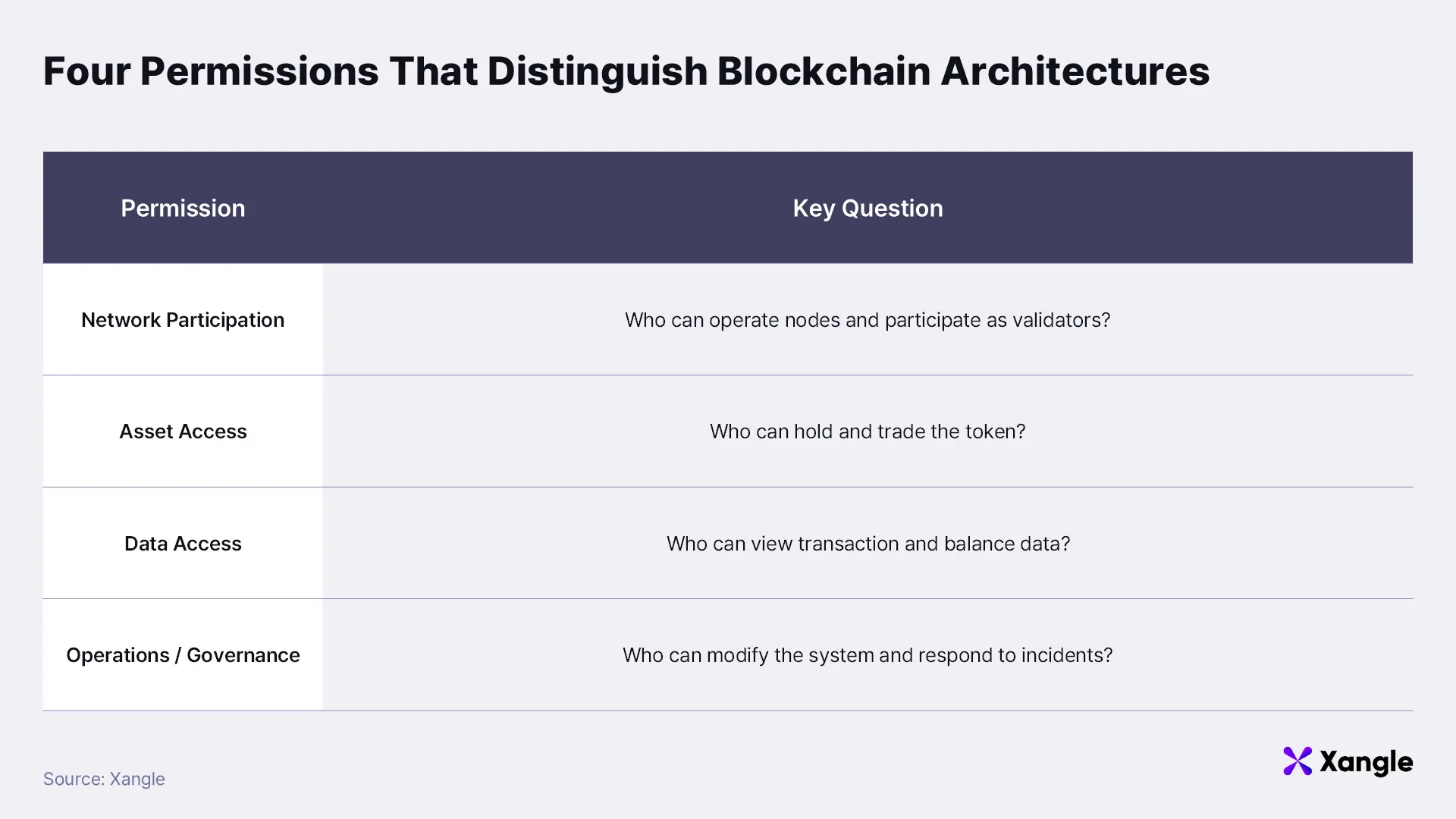
These four permissions do not have to point in the same direction. Network participation can be open while asset access is limited to approved investors, and transaction outcomes can be recorded on-chain while identity and contract information remain in external systems. Institutions should map the investor scope, disclosure level, asset utility, and ledger role discussed in Section 2 to these permissions when determining the required structure.
3-2. Public Blockchains: Openness, Liquidity, and Ecosystem
A public blockchain is a shared network that anyone can access without the approval of a specific institution and whose transaction records are openly available. Multiple independent validators process transactions under a defined protocol, and no single issuer controls the underlying network.
- Network participation: Anyone can submit transactions, while multiple independent parties validate transactions and operate the network.
- Asset access: The network is open, but token smart contracts can restrict eligible holders and transfer recipients.
- Data access: Transactions and balances are public by default, while investor identities and contract information can be managed in separate systems.
- Operations and governance: The underlying network follows protocol governance, while the issuer exercises product-level powers such as freezes, redemptions, and transfer restrictions.
Public chains offer greater advantages when the investor base and geographic distribution are broad and the asset will be used for trading, settlement, collateral, and lending. Existing wallets, custodians, stablecoins, oracles, and financial applications reduce the need to build an entire network and ecosystem from scratch.
Choosing a public chain does not make the product freely tradable by everyone. BUIDL and BENJI use public networks but permit only investors who have completed KYC to hold or transfer the product. Issuers and transfer agents conduct identity checks and maintain the official register, while smart contracts apply whitelists, freezes, and transfer restrictions.
This approach operates a permissioned financial product on top of a public blockchain. It uses the openness and financial ecosystem of the network while allowing institutions to control asset access and product operations. Separate considerations include public transaction and balance data, variable fees, and the issuer's limited ability to control underlying-network policy. Transaction ordering, delayed inclusion or censorship, unsolicited token transfers, and dependencies on external infrastructure should also be assessed.
3-3. Private Blockchains: Confidentiality, Control, and Inter-Institutional Operations
A private blockchain is a structure in which an institution or consortium manages network participants and validators, data-access boundaries, and operating policies. In general, only approved institutions participate, and rights to submit transactions, view information, and change the system are divided according to the business process.
- Network participation: Only approved institutions operate nodes or validate transactions, with roles and operating responsibilities established in advance.
- Asset access: The structure can limit transaction submission and asset ownership to approved institutions or investors.
- Data access: Relevant information can be disclosed only to necessary parties, such as transaction counterparties and regulators.
- Operations and governance: The operator or consortium manages procedures for upgrades, emergency suspensions, record recovery, and enforcement of legal orders.
A private structure may suit activities in which investors are institutional and transaction prices, counterparties, collateral, or positions are sensitive. Data confidentiality and operational accountability matter more than external access in inter-institutional bond trading, repo, and collateral transfers with clearly defined participants. Using blockchain as an official ledger or core operating system can also make it easier to design record correction and recovery, incident response, and legacy-system integration directly.
Transaction fees and processing policies can follow rules agreed by participating institutions. However, adding new institutions and services requires separate approvals and system integrations, and public-chain wallets, liquidity, and financial applications cannot generally be reused as they are. Concentrating operational authority in a small number of institutions can increase dependencies and governance risks, while institutions must also manage validator outages or collusion, vendor lock-in, and backup and disaster recovery for nodes and keys.
Institutions may use public chains and private networks simultaneously through a multi-network strategy that assigns different networks to different activities. Sensitive inter-institutional transactions can run in a private environment, while public chains support external distribution and connections to on-chain financial services. Such a structure must separately define how records and issuance remain reconciled across networks, which ledger serves as the official record, and who resolves discrepancies.
4. Major Blockchain and DLT Architectures and Institutional Use Cases
Blockchains used for RWA businesses differ in how they operate. Ethereum, Solana, and Stellar are public networks with existing validators and users. Canton Network is also an open L1, but it selectively discloses transaction information to relevant institutions rather than replicating it across the entire network. Avalanche L1s and Ethereum-based appchains can be configured as public or private networks, while Hyperledger Besu, Fabric, and Corda are software platforms used by institutions or consortia to build private distributed ledgers.
Distributed ledger technology (DLT) refers to technology through which multiple institutions jointly store and validate transaction records, and blockchain is one type of DLT. Because networks differ in their operators and deployment models, suitability cannot be judged from throughput and fees alone. Public chains provide observable performance and reliability from live networks. Private DLTs allow institutions to choose validator counts, hardware, consensus mechanisms, and operating policies, so actual performance and reliability depend on the deployment. Canton combines an open network with institutional information controls and therefore requires evaluation across both categories. This section assesses each network against five criteria.
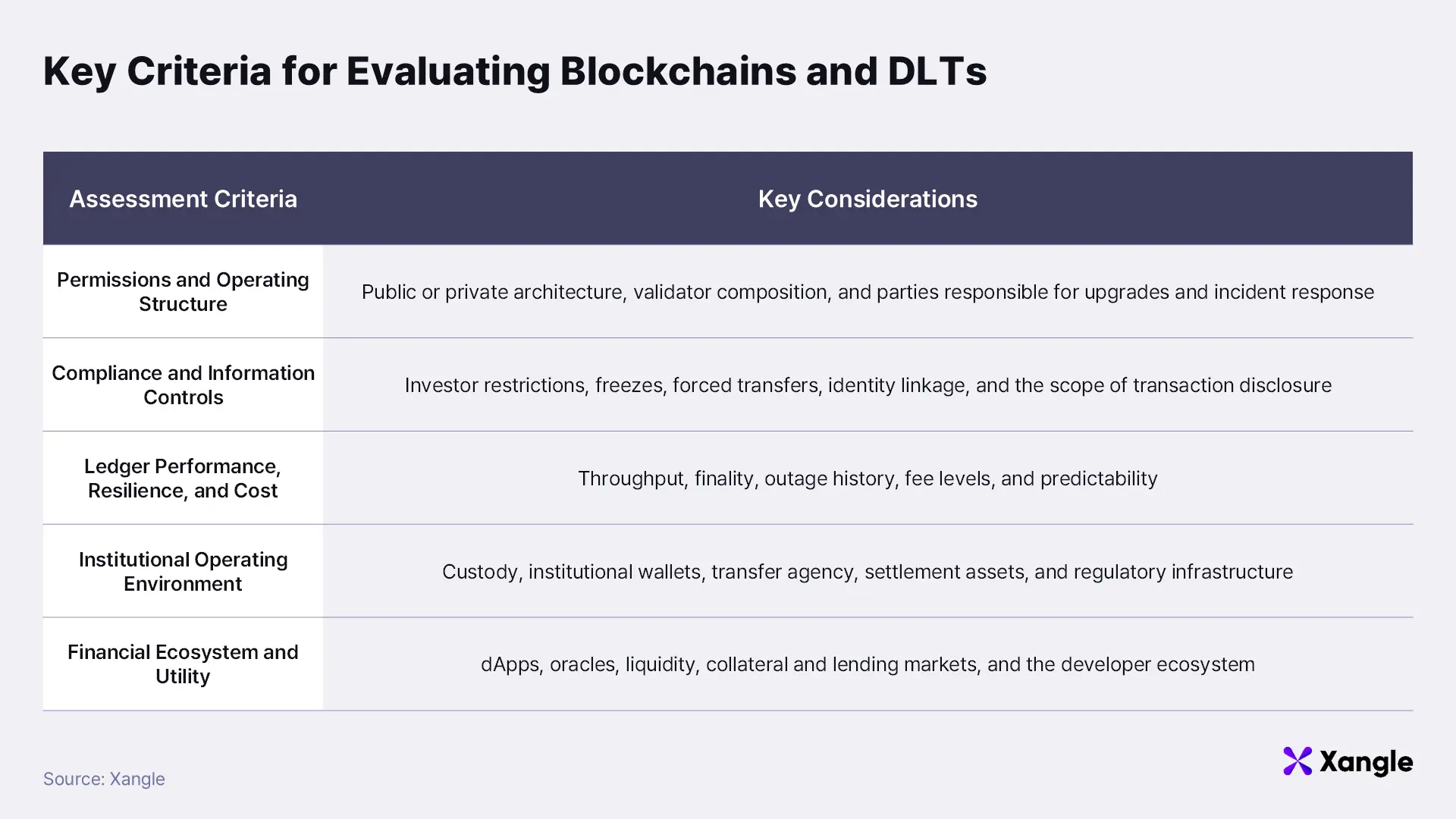
4-1. Ethereum: A Public Ledger with the Broadest Financial Ecosystem
Ethereum is a leading smart-contract platform with a long operating history and established security. It has a large network and developer ecosystem, along with broad support from institutional custodians, stablecoins, oracles, and DeFi infrastructure. Major tokenized funds and government-bond products, including BUIDL, were first deployed on Ethereum, making it the largest core network for RWA issuance today. According to RWA.xyz, Ethereum's on-chain RWA value was approximately $17.1 billion as of August 2026.
Ethereum operates as a public proof-of-stake (PoS) network. Users can submit transactions and participate as validators without approval from a separate operator. There is no single network operator. Protocol changes proceed through Ethereum Improvement Proposals (EIPs) and adoption by client developers, validators, and the community. Transactions are included in blocks in 12-second slots, and economic finality currently takes approximately 15 minutes on average.
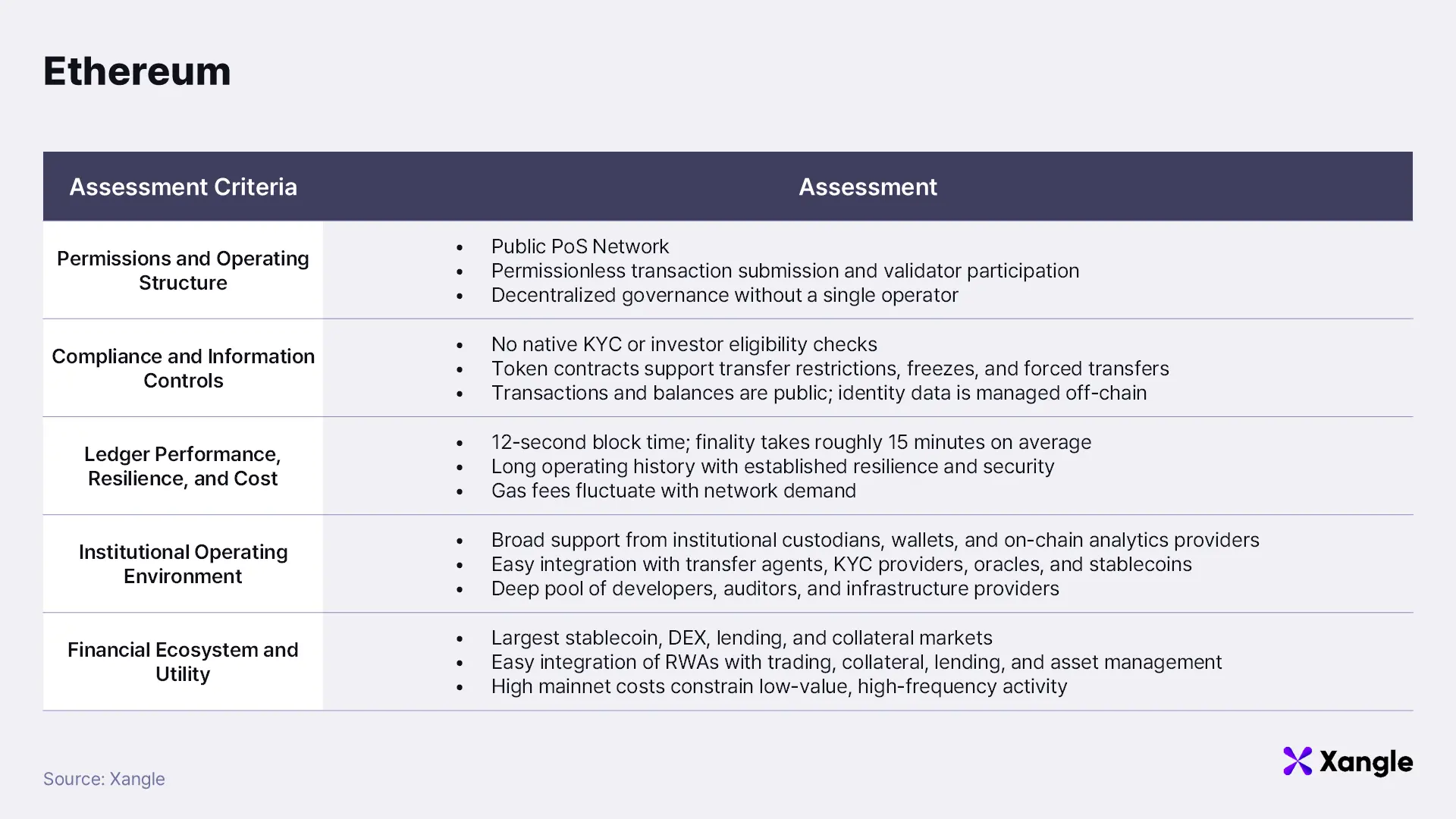
Ethereum does not natively verify investor identities or restrict transfers of securities. Instead, an issuer can apply approved-wallet lists, transfer restrictions, freezes, forced transfers, and redemption functions in the token contract, allowing a permissioned financial product to operate on a public ledger. The visibility of counterparties and balances, along with the issuer's inability to control transaction ordering or the underlying network's operating policies, remains a separate operational risk.
BlackRock's tokenized money-market fund BUIDL is a leading example. It first launched on Ethereum in 2024 and permits only qualified investors with approved wallets to hold and transfer fund interests. Securitize provides tokenization and transfer-agent functions, while BNY handles cash and securities custody, combining a public ledger with existing regulated financial infrastructure. BUIDL later expanded to several other chains, but Ethereum remains its original issuance network and a principal liquidity base.
Overall, Ethereum is well suited to RWA products that prioritize global distribution and connectivity with external financial services while implementing product-level access controls on a public ledger.
4-2. Ethereum L2: Scaling Networks for Lower Costs and Faster Processing
Ethereum L2 networks such as Base, Arbitrum, and Optimism execute transactions on separate networks, then publish data and results to Ethereum. They retain Ethereum's security and EVM development environment while processing transactions faster and at lower cost than mainnet, making them useful for settlement, mass distribution, and small transactions where cost and speed are important.
Their operating structures differ from Ethereum L1. Major L2s currently use centralized sequencers to collect and order transactions, while network-upgrade and emergency-response powers are relatively concentrated in foundations or development companies. The default OP Stack architecture assumes a single dedicated sequencer, and Base also uses a sequencer to order transactions quickly before posting them to Ethereum.
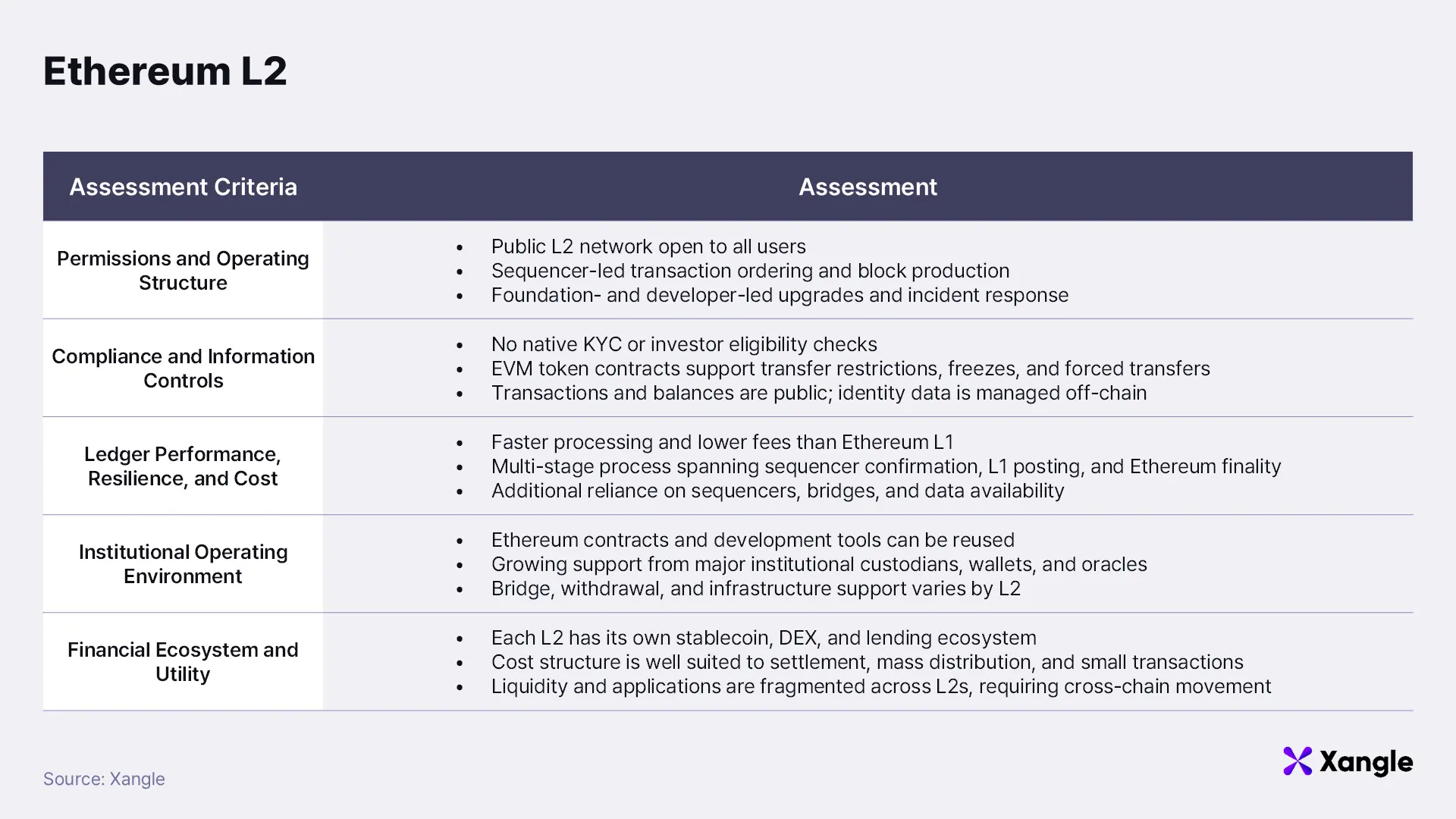
Users may treat a sequencer's fast confirmation as transaction completion, but Ethereum-level finality is reached only after the data is posted to L1 and finalized. Institutions should therefore distinguish the completion time shown to a user from legal and accounting finality. Withdrawals to L1 may involve a separate waiting period and should also be distinguished from ordinary transactions within an L2.
J.P. Morgan's JPMD is a leading example. JPMD is a US dollar deposit token issued on Base. It uses an open L2, but only institutional customers approved by J.P. Morgan may use it. After a proof of concept in 2025, it became a commercial service supporting 24-hour payments and settlement for institutional customers. The structure uses the accessibility and efficiency of an open network while the bank controls issuance, ownership, and redemption.
BUIDL also deployed separate share classes on Arbitrum and Optimism. This provides access to wallets and applications on each L2, but issuance, redemption, custody, settlement assets, and liquidity must be managed separately by chain. The expansion shows how multichain distribution broadens reach while increasing operational complexity.
Ethereum L2s suit RWA products seeking lower costs and faster processing while retaining the EVM ecosystem. Institutions must evaluate the sequencer, bridge, data availability, and upgrade powers separately rather than relying only on Ethereum's reliability.
4-3. Dedicated Ethereum-Based Appchains: Purpose-Built Networks for Institutional Requirements
Arbitrum and OP Stack support not only applications on shared L2s but also separate Ethereum-based chains operated by institutions or projects. A dedicated appchain uses its own blockspace and sequencer, allowing transaction fees, data availability, validation, and upgrade policies to be configured for the business. A chain that settles directly to Ethereum can be classified as an L2, while one that uses another L2 as its parent settlement network can be classified as an L3. This report uses the broader term dedicated appchain for both.
On a shared L2, multiple services share the same network and operating policies. A dedicated appchain instead allows an institution to reserve processing capacity and set its own sequencer, validator, and access-control structure. KYC and AML policies and trading restrictions for regulated assets can also be reflected at the chain level. However, the institution must operate or outsource the sequencer, bridge, data availability, RPC, and upgrade infrastructure.
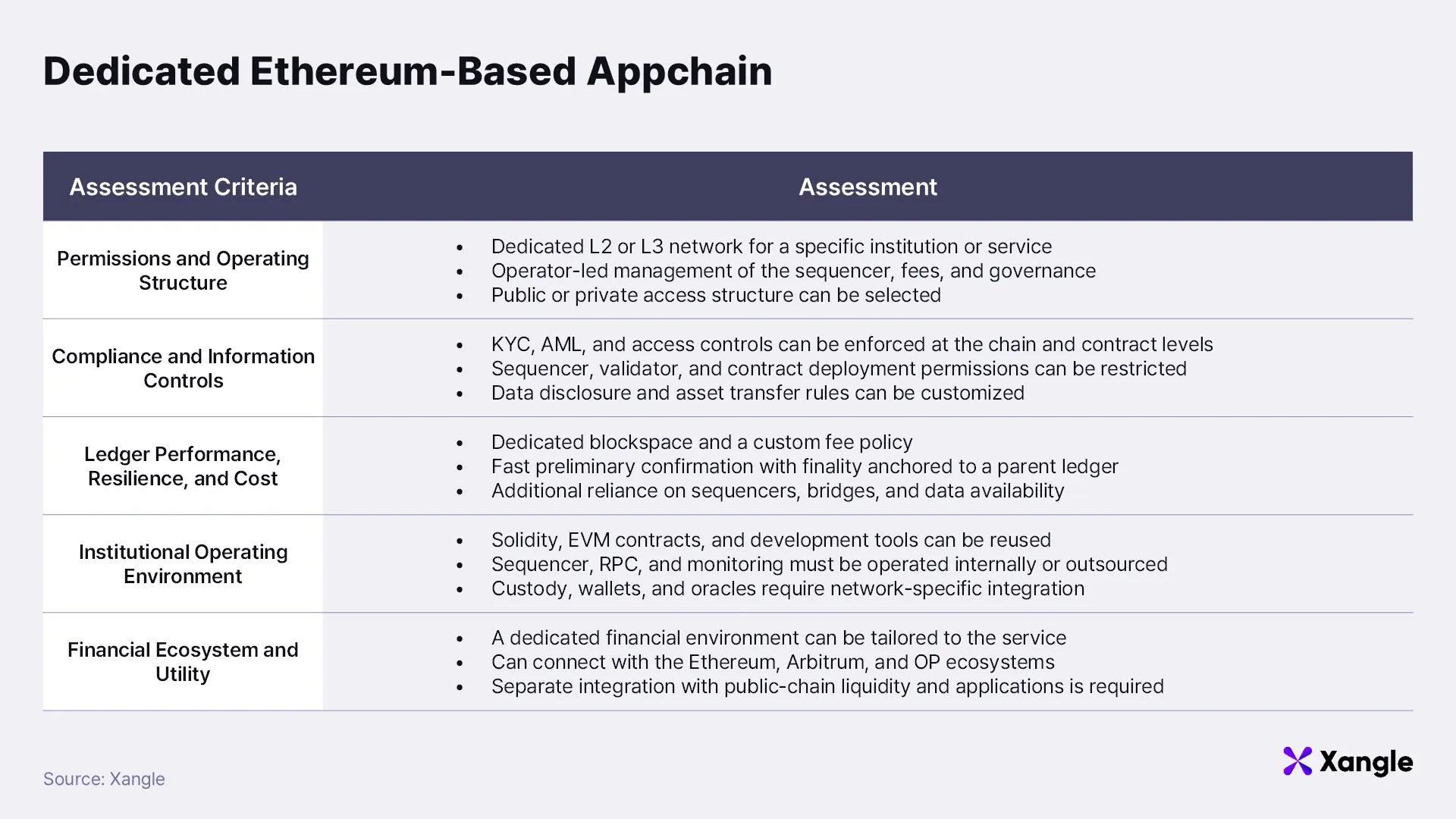
A dedicated Arbitrum chain can configure block time, gas token, fees, data availability, transaction ordering, validators, and governance. OP Stack likewise combines execution, consensus, data-availability, and settlement modules to build a separate Ethereum L2. The structure offers greater control than a shared chain, but also places more responsibility for network operations on the institution.
Robinhood Chain is a leading example. Robinhood initially issued equity tokens on Arbitrum One in 2025, then launched the mainnet of Robinhood Chain, a dedicated L2 built with the Arbitrum stack, in July 2026. It illustrates a business validating the market on a shared L2 before moving to a purpose-built chain tailored to transaction volume and product structure.
An institutional example using OP Stack is DB Securities' Jeju STO and RWA infrastructure. In July 2026, DB Securities agreed to work with Optimism on a dedicated platform tokenizing smart farms, livestock, and Korean intellectual property. DB Securities will build and operate the platform using OP Stack as the underlying blockchain infrastructure. The project should be distinguished from a live commercial service because it remains a phased, two-year development plan.
A dedicated appchain is suitable for an RWA operator that wants to use the Ethereum ecosystem and security while directly controlling transaction processing, costs, and regulatory policies. Compared with distributing a product on a public chain, however, it creates greater burdens for operations and liquidity development.
4-4. Solana: A Public L1 Optimized for Fast Execution and Low Costs
Solana is a high-performance public L1 that processes transactions and smart contracts against a single shared state. Unlike Ethereum's use of separate L2 networks, Solana connects settlement, trading, lending, and asset-management applications within one integrated network. Its low fees make it well suited to mass distribution, small transfers, and frequent transactions, while deployment of tokenized funds, equities, and private credit has expanded recently.
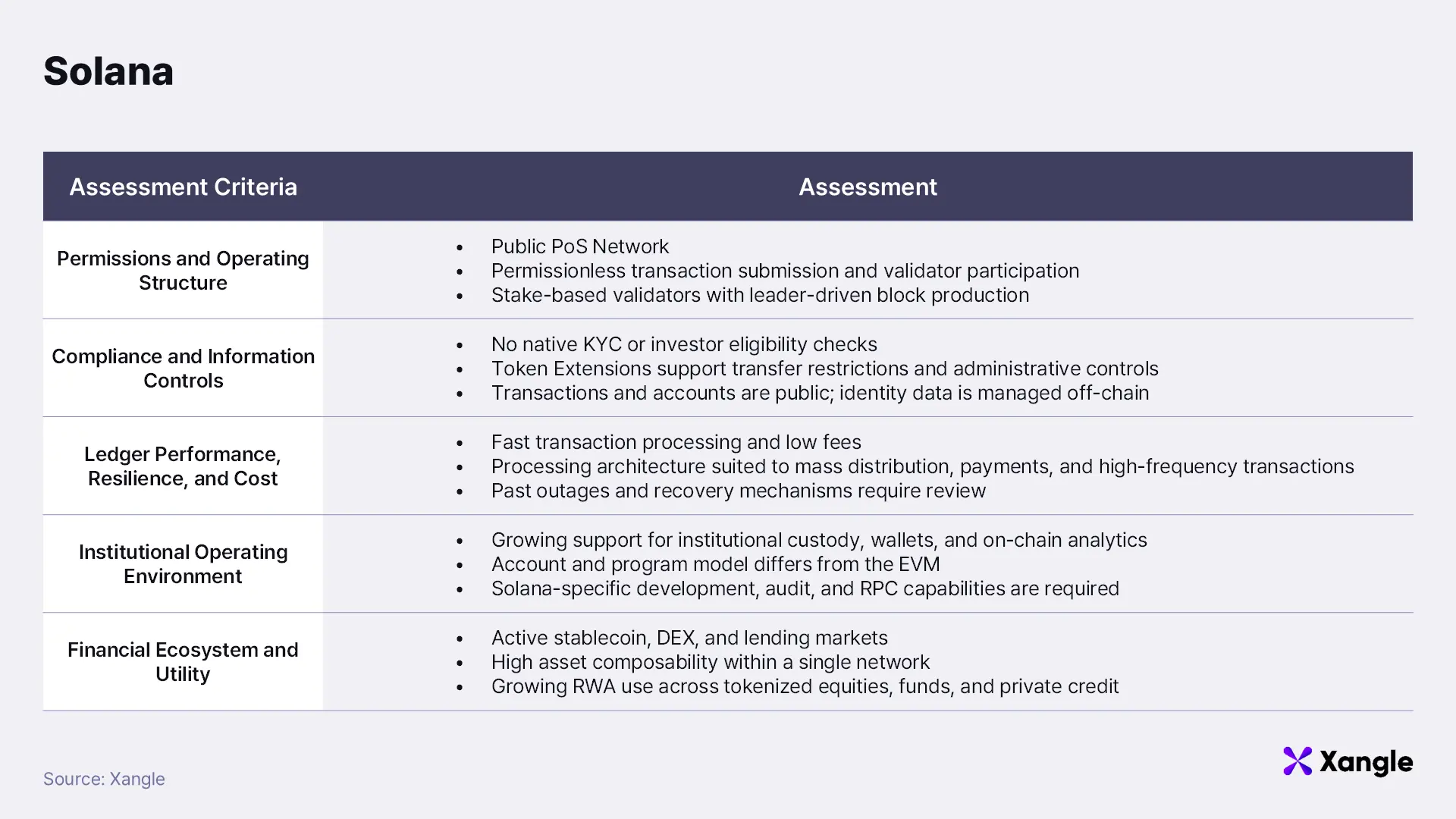
Solana provides Token Extensions, which can add controls required for regulated and institutional tokens in a manner similar to ERC-3643 on Ethereum. Issuers can select features such as transfer restrictions, administrative powers, and confidentiality for certain transaction information when creating a token.
Token Extensions do not directly conduct KYC or determine investor eligibility. Issuers or KYC providers must screen investors and manage approved addresses, then reflect those results in token-transfer rules. Certain transaction information can be concealed, but account addresses remain visible, so the feature does not provide complete privacy.
Solana's current consensus structure provides preliminary confirmation within approximately 400 milliseconds and finality in approximately 12.8 seconds. Solana is preparing to transition to Alpenglow, which aims to reduce this to approximately 150 milliseconds, but as of August 2026 the change remains under development and implementation. Institutions should assess finality based on the current production structure and evaluate how future consensus changes may affect nodes, wallets, and indexing systems.
Backed's xStocks is a leading use case. xStocks are tokenized products backed one-to-one by US-listed equities and ETFs and launched on Solana in 2025. On Solana, they can move through wallets like ordinary SPL tokens and connect not only with centralized exchanges such as Kraken and Bybit, but also with on-chain trading services including Raydium and Jupiter. Certain xStocks can also be used as collateral on Kamino, demonstrating how Solana can extend exposure to traditional equities into trading, liquidity provision, and lending.
Apollo's ACRED, BlackRock's BUIDL, and Franklin Templeton's BENJI have also expanded to Solana, broadening the network's RWA coverage from tokenized equities to government-bond funds and private credit.
Solana is suitable when a product needs to process many transactions at low cost and use RWA assets across diverse on-chain financial services. Direct EVM compatibility is absent, however, so existing Ethereum-based contracts and infrastructure may require additional development to migrate or connect.
4-5. Stellar: A Public Network Specialized in Asset Issuance and Payments
Stellar is a public network designed around asset issuance, transfers, exchange, and payments. An issuer can limit asset ownership to approved accounts, freeze specific accounts, or claw back previously transferred assets. These controls are native asset features rather than functions that require a separate token contract.
Transactions typically reach finality within seconds, with low and relatively predictable fees. Native functionality supports basic asset issuance, control, exchange, and settlement, while separate smart contracts can add complex financial logic for lending, collateral, and automation. This makes it comparatively easy to implement the basic structure of tokenized funds and payment products without developing a complex token contract from the ground up.
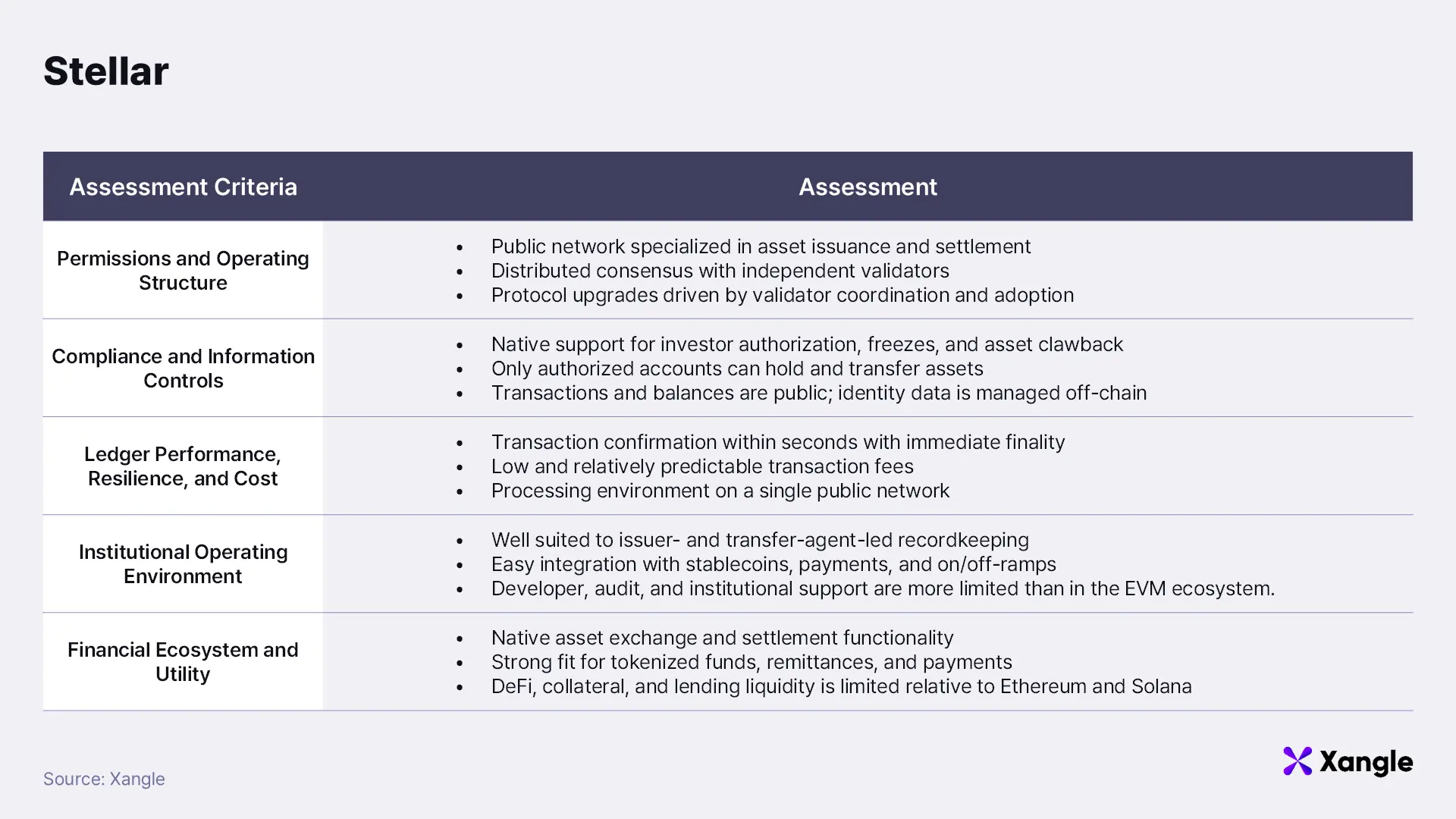
Stellar implements these features through per-account asset permissions. The issuer of a token can approve whether each account may hold and transfer that asset and can suspend the permission if an investor loses eligibility or becomes subject to sanctions or legal action. The issuer can also claw back assets that have already been distributed when necessary. Transfer agents or external providers conduct KYC and investor-eligibility reviews off-chain, and only the resulting permissions are reflected in each account's on-chain status.
Franklin Templeton's FOBXX and its BENJI token are leading examples. BENJI first launched on Stellar in 2021 and later expanded to several public networks. The transfer agent permits only approved investor wallets to hold the token and can freeze or recover interests when necessary. It is a prominent example of applying Stellar's native asset controls to the holder register and share transfers of a regulated fund.
DTCC's Tokenization Service is also expected to connect with Stellar. DTCC is pursuing the tokenization on Stellar of equities, ETFs, and US Treasuries held at DTC, targeting availability in the first half of 2027. Although the commercial service has not yet launched, the initiative is significant because Stellar, already used for a live fund register, would extend into depository and tokenization infrastructure for traditional securities markets.
Overall, Stellar suits RWA products that issue and transfer fund interests or payment assets at low cost while allowing the issuer to manage holder approvals, freezes, and clawbacks directly. It is particularly strong for products centered on transfer agency and settlement, but its connectivity to complex DeFi applications and large collateral and lending markets is more limited than Ethereum's or Solana's. It is therefore better suited to regulated asset issuance, ownership records, and payments than to broad on-chain financial utility.
4-6. Avalanche L1: An Independent Network with Public and Private Options
An Avalanche L1 allows an institution or project to build an independent network with its own validator set, execution environment, gas token, fees, and participation policies. An Avalanche L1 is not inherently a private blockchain. It can be configured as a private network with restricted validators and RPC access, a network with permissioned validators but open user and data access, or a public network on which anyone meeting defined requirements can validate.
An operator can impose jurisdictional, KYC, and licensing requirements on validators and configure transaction submission, contract deployment, fees, and execution rules for the business. Using Subnet-EVM as the execution environment allows Solidity smart contracts and Ethereum development tools to be reused, while another virtual machine can provide a different execution environment. Each Avalanche L1 operates independently but can exchange information and support asset movement through Avalanche's cross-chain messaging. It does not automatically share C-Chain validators, liquidity, or applications, so external assets, users, and infrastructure require separate integration and onboarding.
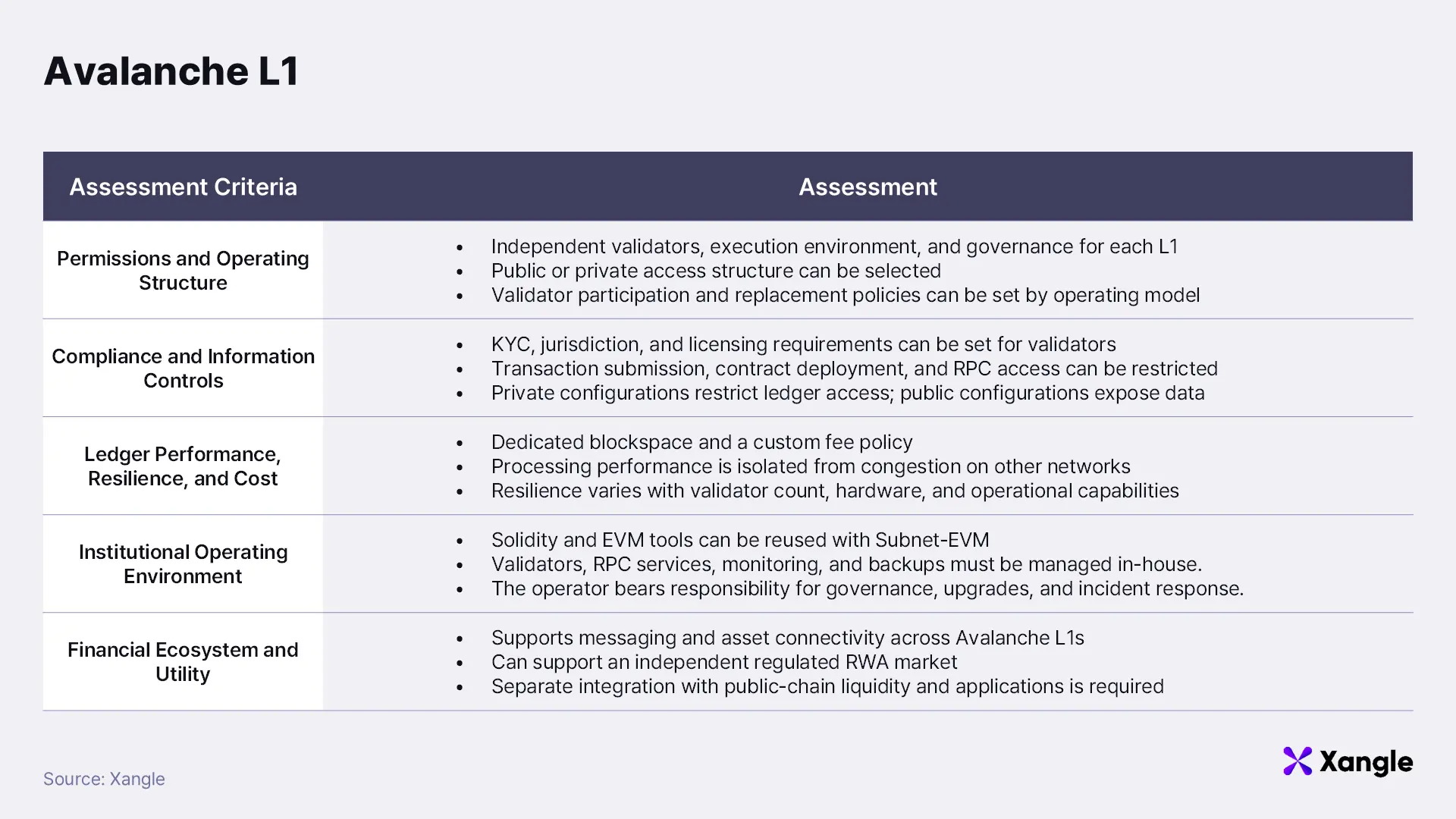
Because an Avalanche L1 uses dedicated blockspace, activity on other Avalanche L1s or applications does not directly affect its performance and fees. The institution or consortium that builds the L1 is responsible for validator operations and upgrades, key management, and incident recovery. Managed infrastructure providers can assist, but they do not eliminate the institution's ultimate responsibility for network operations and regulatory compliance.
Japan's digital-securities platform Progmat is a leading example. In July 2026, Progmat migrated at least JPY 452 billion of digital securities issued on its platform to an Avalanche L1. This was not simply a move to a closed private chain. It more closely represented a replacement of the underlying ledger with an EVM-compatible environment that preserves the authorities and workflows of existing financial institutions while expanding connectivity with the public-blockchain ecosystem.
Intain, a financial-infrastructure company that digitizes the issuance and administration of asset-backed securities, operates IntainMARKETS, a permissioned Avalanche L1. The network connects issuance, investment, verification, underwriting, custody, and post-issuance administration for asset-backed securities within a single on-chain process. Intain later worked with FIS to launch a Digital Liquidity Gateway on the same L1 infrastructure, creating a market through which US regional banks can sell or securitize loan portfolios for institutional investors.
Avalanche L1 suits institutions that want to design an independent execution environment, validator set, fees, and operating policies. A public configuration can increase connectivity with external users and ecosystems, while a private configuration can restrict validators, RPC access, and transaction submission. Operating a separate L1, however, requires the institution to assume direct responsibility for validator management, security, incident response, and upgrades, while separately integrating external liquidity and applications.
4-7. Canton Network: Institutional Infrastructure Combining Open Connectivity with Selective Disclosure
Canton Network officially operates as an open L1, but its architecture differs from conventional public blockchains that replicate every transaction and state across the entire network. A transaction is divided into information units, and each participant stores and validates only the portions for which it is designated as a party or observer. As a result, participants can use the same network without exposing counterparties, prices, positions, or contract terms to everyone.
Canton should therefore not be classified as a conventional private blockchain. The Global Synchronizer is shared open infrastructure connecting multiple institutions and applications. It coordinates transaction ordering and finality without directly viewing encrypted transaction content. Institutions can also deploy Private Synchronizers to process specific activities within their own infrastructure. A single institutional node can connect simultaneously to the Global Synchronizer and multiple Private Synchronizers, combining open connectivity with private operating environments.
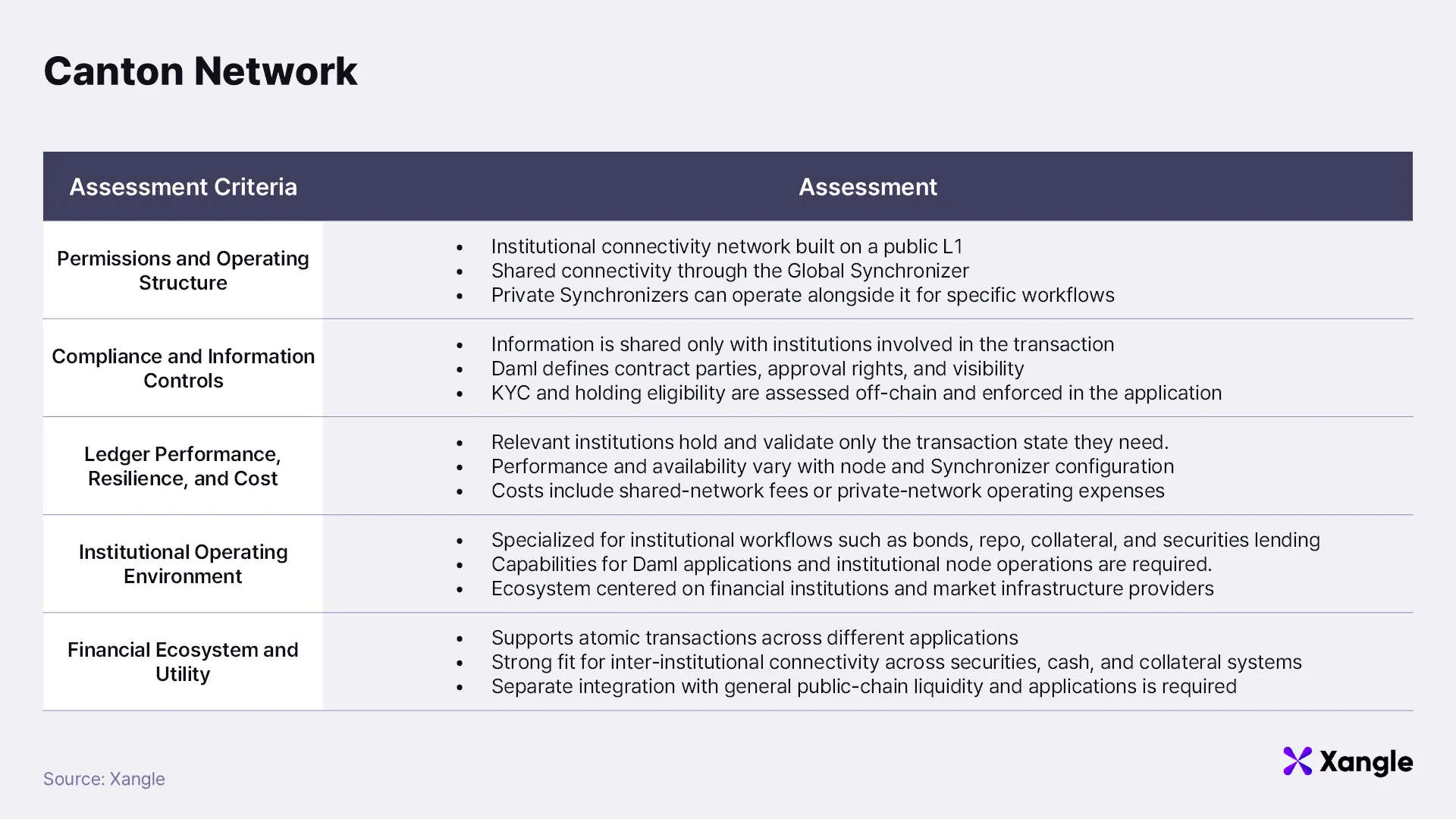
Daml is a smart-contract language for financial agreements developed by Digital Asset, the company behind Canton. It defines contract parties, approval rights, and information-disclosure boundaries in code, and Canton enforces those rules across institutional nodes. In a DvP transaction, for example, the settlement bank can view only the information required for the cash transfer and the securities system only the information required for the securities transfer, while both legs execute atomically.
Broadridge's Distributed Ledger Repo (DLR) is a leading example. DLR manages contract terms and collateral states for repo transactions backed by US Treasuries on Canton, linking the workflows of banks, dealers, custodians, and other participants in a common process. Each institution views only the transaction information it needs while sharing the overall transaction state, and the platform can connect with existing depository and settlement systems.
DTCC, which operates depository, clearing, and settlement infrastructure for US securities markets, also uses Canton as a tokenization network. DTCC has developed a service that converts US Treasuries, equities, and other securities held at DTC into on-chain tokens while preserving the original rights and investor protections. In July 2026, DTCC tokenized real securities on Canton and on its private Besu network and processed operating transactions including Treasury repo DvP, collateral pledges, securities lending, and equity transfers. The project demonstrates how securities administered by an incumbent central securities depository can connect with and be used across multiple blockchains.
Canton combines the shared connectivity of a public network with selective disclosure associated with private ledgers. It suits activities that connect siloed securities, cash, and collateral systems while limiting sensitive prices, counterparties, and positions to relevant institutions. This report discusses Canton alongside private DLTs to compare institutional financial workflows and information controls, but the network itself remains an open L1.
4-8. Hyperledger Besu: A Private EVM Built by Institutions
Hyperledger Besu is an open-source Ethereum client that institutions can use to build their own Ethereum-compatible private networks. Institutions can reuse Solidity smart contracts and Ethereum development tools such as Hardhat and Remix while directly choosing participating nodes and accounts, validator composition, fees, and upgrade policies.
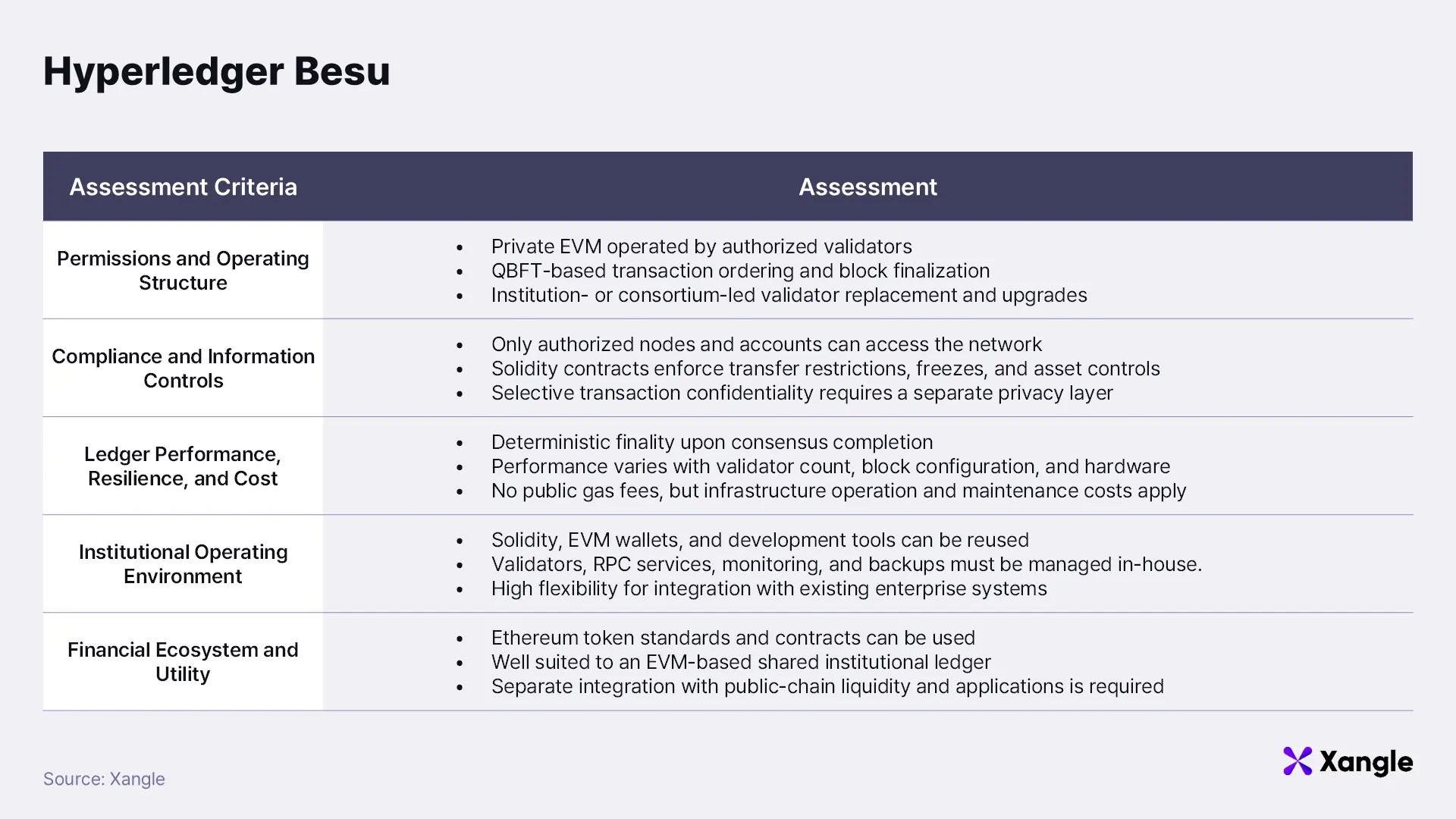
An institutional private Besu network generally uses QBFT consensus. Preapproved validators take turns proposing blocks, and a block becomes immediately final once at least two-thirds of all validators agree. The network can continue operating when some validators fail or send incorrect information, and at least four validators are needed to tolerate one validator failure. As the validator count grows, however, inter-node communication also increases, so actual throughput depends on the network configuration.
QBFT does not itself provide transaction confidentiality. In Besu's default architecture, participating nodes share the same transactions and ledger state. Restricting particular transaction content to relevant institutions requires a separate privacy layer such as Paladin.
DTCC's Collateral AppChain is a leading use case. DTCC is building shared Besu-based infrastructure that allows financial institutions to move and manage traditional and tokenized assets as collateral. Collateral providers, receivers, custodians, and other participants share a common workflow that automates price verification, eligibility checks, collateral movement, and settlement. Production launch is scheduled for the fourth quarter of 2026.
In July 2026, DTCC tokenized Treasuries, equities, and ETFs held at DTC on a private Besu network and on Canton Network, then used them in collateral pledges, securities lending, repo DvP, and equity transfers. This shows that Besu can serve not only as an isolated private network within an institution, but also as a ledger connected to existing market infrastructure and other blockchains.
Besu suits institutions that want to retain the Ethereum development environment while directly controlling validators, network participants, data access, and operating policies. It is particularly useful for shared ledgers operated by multiple financial institutions and for businesses requiring close integration with existing systems. EVM compatibility does not automatically provide the security, liquidity, or application ecosystem of public Ethereum, however. The deploying institutions remain responsible for network operations and external connectivity.
4-9. Hyperledger Fabric: Consortium DLT with Granular Permissions
Hyperledger Fabric is an open-source DLT for private networks jointly used by enterprises and institutions. Rather than deploying an application on an existing public chain, participating banks, exchanges, custodians, and other institutions build a separate network accessible only to approved members. Fabric is not an EVM chain, so Ethereum smart contracts and wallets cannot be reused directly.
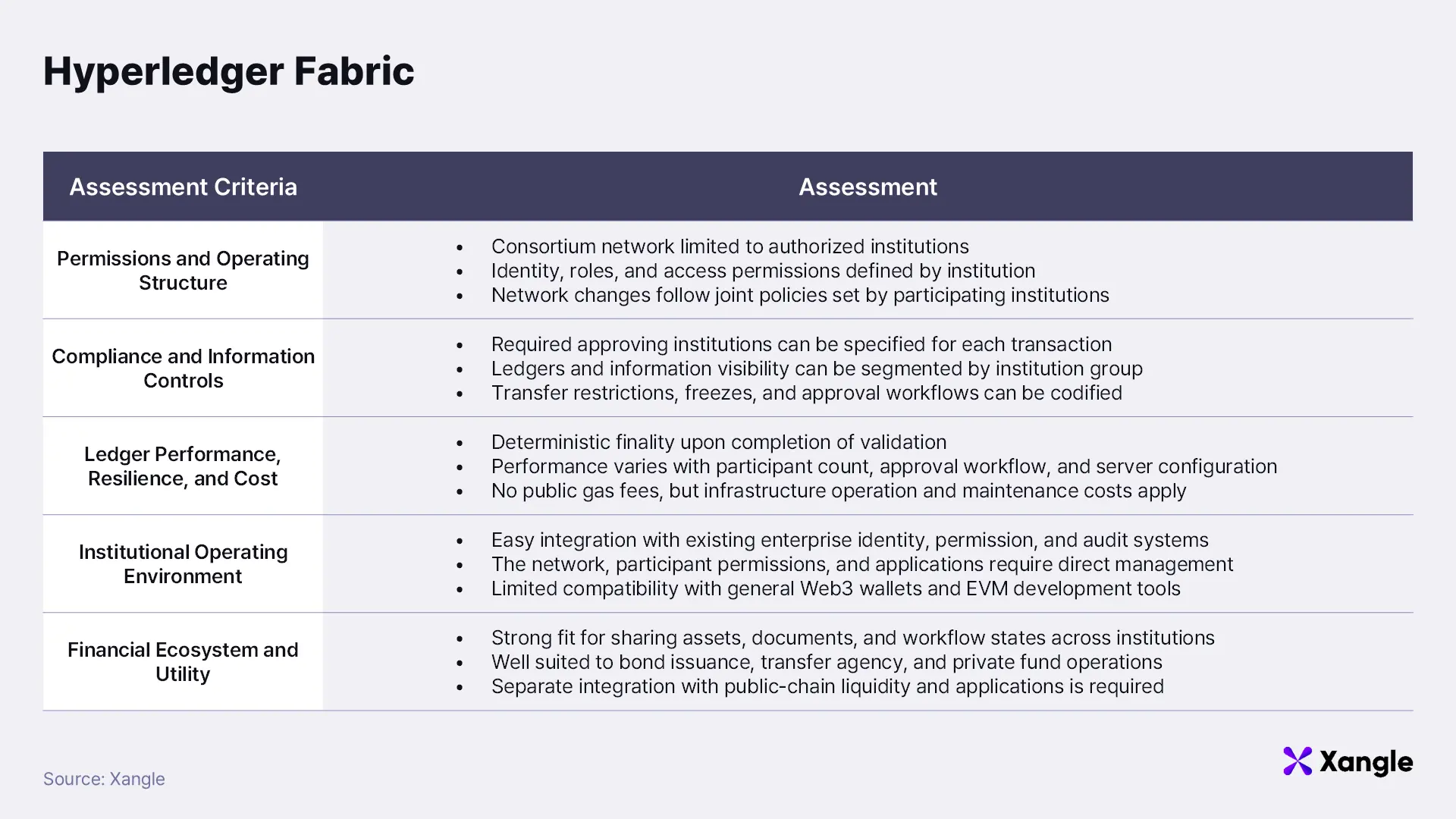
Each transaction can specify the institutional approvals it requires. A bond issuance, for example, may require approval from the issuer and transfer agent, while an asset transfer may require confirmation from the seller, buyer, and custodian. A transaction is recorded on the ledger only after all required approvals are collected, making inter-institutional workflows easier to encode directly in the system.
Information disclosure can also be segmented by institution. Only the institutions involved in a particular process may share a separate ledger, while sensitive data such as transaction prices and customer information can be stored solely by the relevant institutions. Other participants retain only a cryptographic record proving that the data exists and has not changed.
The Bank of Thailand's DLT Scripless Bond is a leading example. The central bank built a shared-ledger system connecting the Ministry of Finance, depository, Thai Bond Market Association, and four distributor banks to manage issuance, sales, and registration of government savings bonds. In the first operation in 2020, THB 50 billion of bonds sold within one week, and the time required for investors to receive their bonds fell from as much as 15 days to two days. The system used IBM Blockchain Platform, which is based on Hyperledger Fabric.
Fabric suits closed consortium workflows with clearly defined participants and granular institutional approval and disclosure requirements. It is particularly strong for bond issuance, transfer agency, private-fund operations, and inter-institutional document sharing, where multiple institutions manage a common record. Connecting assets to external wallets, public-market liquidity, or DeFi requires separate tokenization, settlement, and bridging structures.
4-10. Corda: DLT Specialized in Financial Contracts and Bilateral Transactions
Corda is a private DLT designed for financial institutions and enterprises to manage contracts and asset states jointly. Unlike conventional blockchains that replicate every transaction to every participant, Corda shares necessary information only with institutions that participate directly in the transaction or hold approval rights. Each node corresponds to a real legal entity such as a bank, custodian, or exchange, and only approved institutions can join the network.
Corda uses a separate verification service known as a Notary to prevent double spending. After counterparties agree to transaction terms, the Notary verifies that the asset being transferred has not already been consumed in another transaction and signs the transfer. Once signed, the asset transfer is final, and another transaction attempting to use the same asset is rejected. Depending on its configuration, a Notary may view the complete transaction or only the minimum information required to determine whether the asset has been spent, preserving transaction confidentiality.
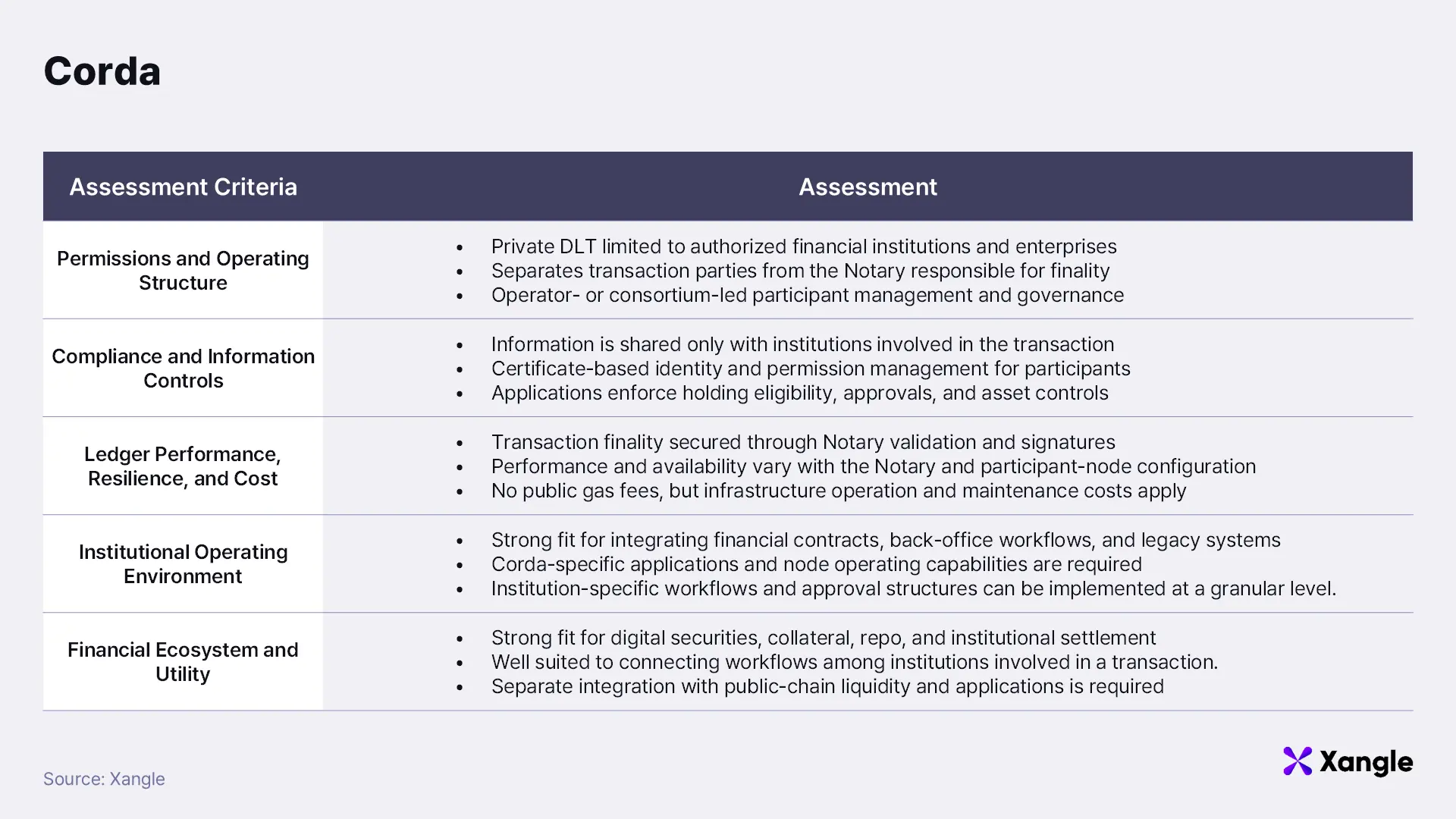
SIX Digital Exchange (SDX), Switzerland's digital-securities market infrastructure, is a leading example. Built on Corda, SDX connects digital-security issuance, trading, settlement, and custody in one system. Transaction participants share only the information they need while processing DvP settlement that transfers securities and settlement assets simultaneously. The platform demonstrates Corda's use in a regulated market to connect the full process from issuance through settlement and custody.
HQLAX uses Corda to improve transfers of collateral assets used by banks in repo and securities lending. The underlying securities remain with existing custodians or depositories, while only the collateral rights to those securities move through digital records. Institutions can therefore substitute or reallocate collateral without physically moving the underlying securities between depositories for every transaction.
Corda suits use cases that connect legal agreements, asset transfers, settlement, and back-office workflows while keeping sensitive prices, counterparties, and positions visible only to transaction participants. It is particularly strong in digital-securities, collateral, and repo markets with clearly defined institutions and counterparties. Direct use of public-chain wallets, liquidity, and DeFi is difficult, however, and networks and liquidity can fragment by application, requiring separate structures for external-market connectivity.
4-11. Network Comparison
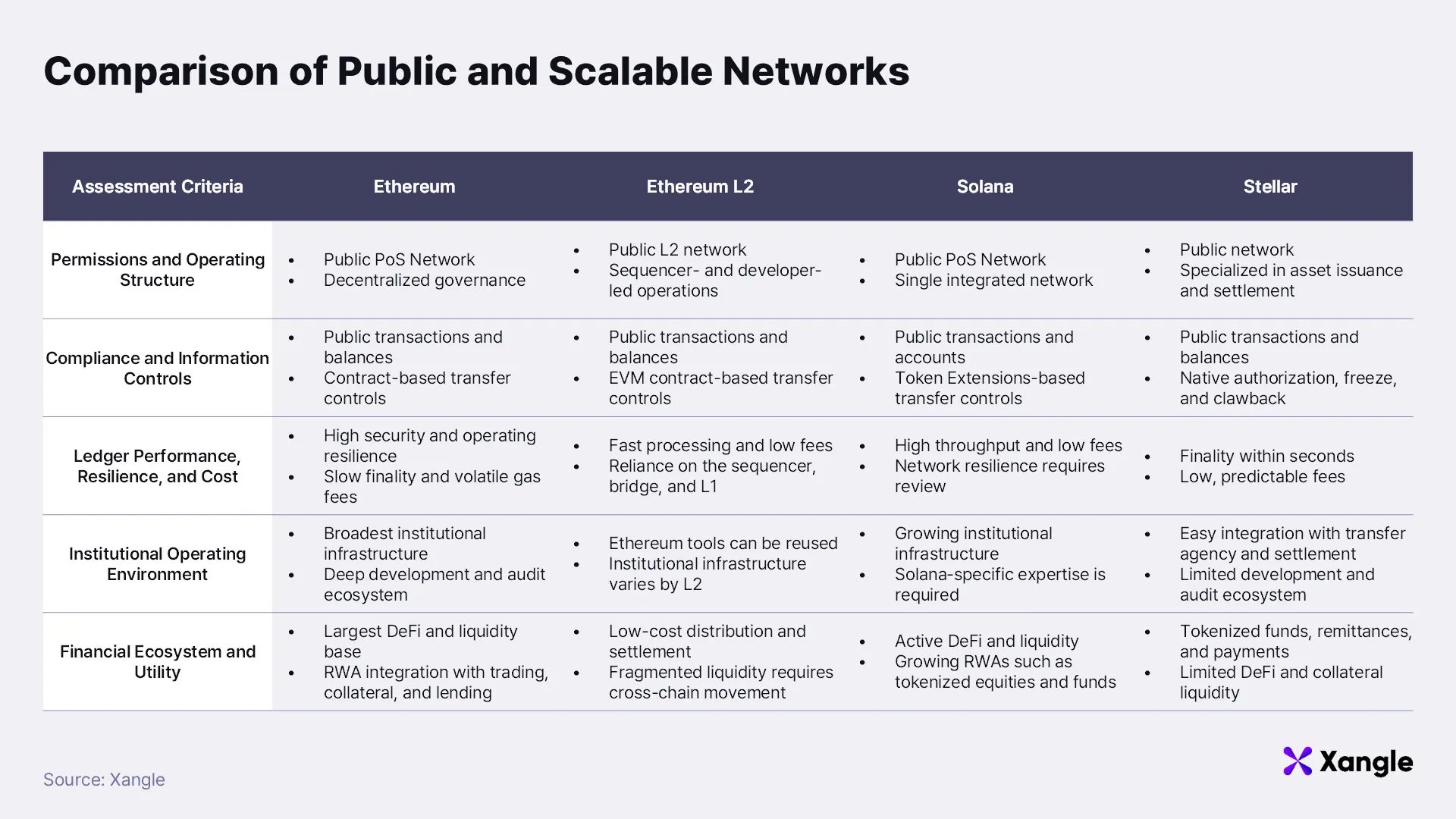
Public and Scalable Networks
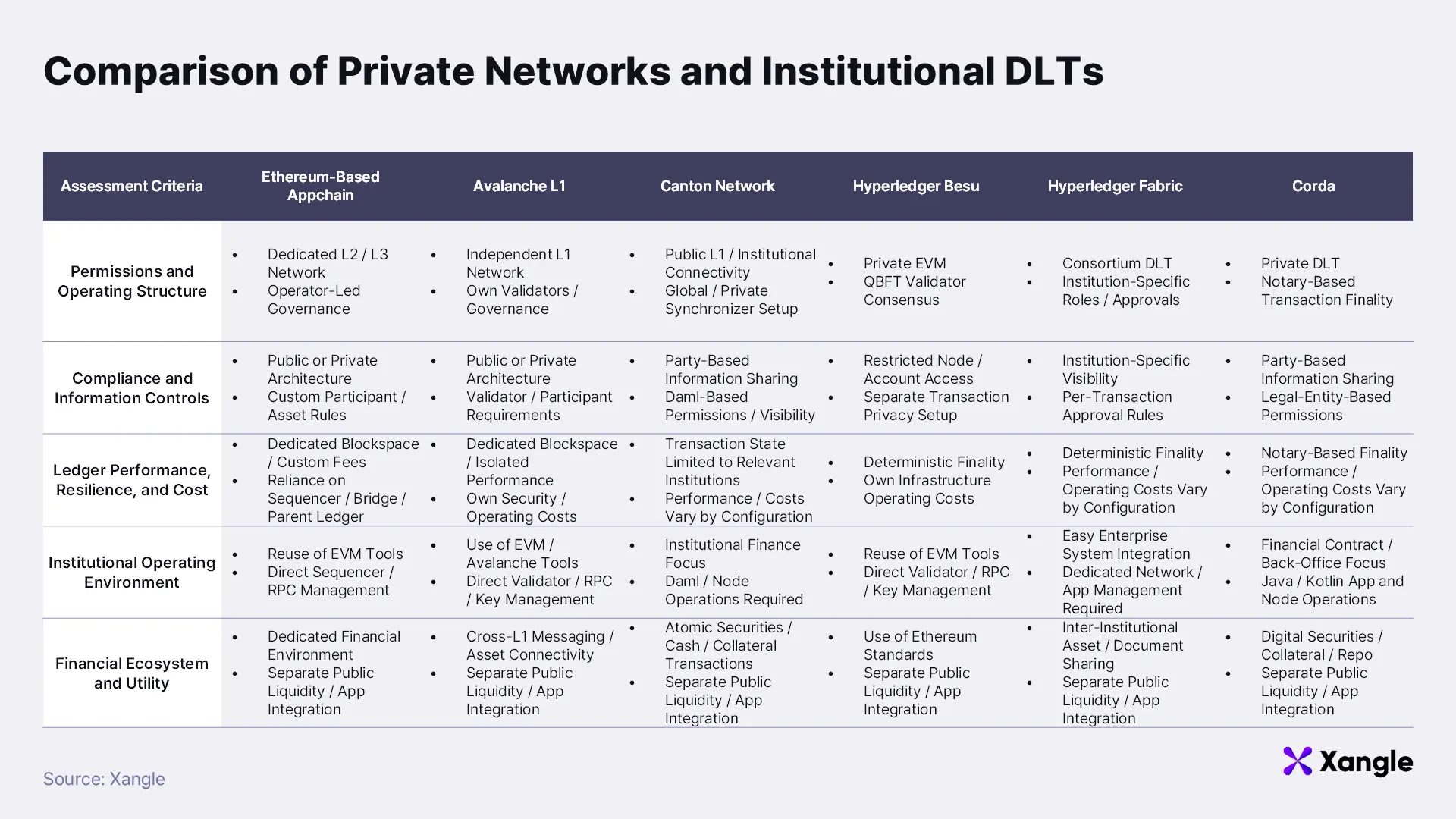
Private Networks and Institutional DLTs
Canton Network is an open L1, but it is included in this table to compare institutional financial workflows and selective-disclosure structures.
The differences among networks cannot be explained by the public versus private distinction alone. Among public networks, Ethereum provides the broadest institutional infrastructure and DeFi liquidity, making it well suited to global distribution and collateral and lending utility. Solana is strong in mass distribution and frequent transactions because of its low costs, fast processing, and integrated financial ecosystem. Stellar emphasizes asset authorization, freezes, clawbacks, and payments over ecosystem scale, making it suitable for products that prioritize issuer control, including regulated-fund issuance and transfer agency.
Ethereum L2s lower costs and improve processing speed while retaining Ethereum's development environment and ecosystem, but they do not share an identical architecture with L1. They add a sequencer that orders transactions, bridges that move assets, and a system for posting transaction data, while fast confirmation and final settlement on Ethereum occur at different times. Institutions should therefore assess sequencer control, withdrawal architecture, and incident response instead of treating an L2 simply as a less expensive Ethereum.
Dedicated appchains, Avalanche L1s, and Besu all allow institutions to design operating policies directly, but they secure the network in different ways. An Ethereum-based appchain uses a dedicated sequencer and blockspace while potentially relying on a parent Ethereum network for finality or data publication. An Avalanche L1 is an independent L1 secured by its own validators and can use either a public or private structure. Besu is a private EVM jointly operated by approved institutions. As the scope of institutional control expands, so does institutional responsibility for validator and node operations, key management, upgrades, and incident recovery.
Canton, Corda, and Fabric all serve institutional finance, but their network structures and primary functions differ. Canton connects securities, cash, and collateral applications across institutions on an open L1 while disclosing transaction information only to relevant parties. Corda connects financial agreements and asset transfers directly among counterparties and finalizes transactions through a Notary. Fabric enables multiple institutions to conduct a shared process with granular approval and data-disclosure rights. Canton is therefore closer to a connectivity network for institutional financial markets, Corda to counterparty-centric financial contracts, and Fabric to consortium workflows.
Institutions should first decide how broadly the asset will be distributed, who may view transaction information, and who will be responsible for network operations and incident response. Public ecosystems such as Ethereum and Solana are advantageous when external wallets and on-chain financial utility matter. Stellar may be considered when issuer controls and settlement are central. Appchains, Avalanche L1, and Besu suit businesses requiring dedicated processing environments and direct operating policies, while Canton, Corda, and Fabric are better suited to confidential inter-institutional transactions and shared workflows.
Not every activity needs to run on one network. Issuance and transfer agency can use a private network while external distribution and collateral utility connect to a public chain, or internal transactions and inter-institutional settlement can use different networks. The objective is not simply to reduce the number of chains, but to manage the assets, legal rights, issuance, redemption, and settlement states recorded on each ledger consistently within a unified product operating framework.
5. Closing Remarks: Blockchain Selection Should Follow the Business Structure
The right blockchain for an RWA business depends on the asset being tokenized and the business model. Public chains are advantageous when products will be distributed broadly and connected to on-chain trading, collateral, and lending. Private networks or institutional DLTs may be better suited when participants are predefined and transaction confidentiality or network operating authority is important. The first question is not the chain's throughput or scale, but which activities will be processed, with whom, and through what structure.
The public versus private distinction does not determine regulatory compliance. Whitelists and transfer restrictions can limit a product on a public chain to approved investors. Conversely, building a private network does not replace the legal and operational arrangements required for asset rights, investor screening, custody, audits, and dispute resolution. Blockchain is a mechanism for enforcing those rules and connecting records across institutions, not a substitute for every legal and operating requirement of the business.
There is also no need to insist on a single chain. Asset issuance and transfer agency can run on a private network while external distribution and collateral utility connect to public chains. The same product may be distributed across multiple public chains, or different networks may support internal operations and inter-institutional transactions. A multichain structure must manage issuance and redemption, settlement instruments, asset movements, and incident response consistently across chains.
Institutions should therefore begin by defining the legal rights embedded in the asset, the investor scope, the information to be disclosed, and the activities to be processed on-chain. They should then compare network control and confidentiality, security and operating costs, settlement and custody infrastructure, and external liquidity and utility. The final choice is not necessarily one blockchain, but the combination of networks and existing financial infrastructure that best fits the business's issuance, distribution, settlement, and administration structure.
Disclaimer
I confirm that I have read and understood the following: The information contained in this article is strictly the opinions of the author(s). This article was authored free from any form of coercion or undue influence. The content represents the author's own views and does not represent the official position or opinions of CrossAngle. This article is intended for informational purposes only and should not be construed as investment advice or solicitation. Unless otherwise specified, all users are solely responsible and liable for their own decisions about investments, investment strategies, or the use of products or services. Investment decisions should be made based on the user’s personal investment objectives, circumstances, and financial situation. Please consult a professional financial advisor for more information and guidance. Past returns or projections do not guarantee future results.
Xangle or its affiliated partners own all copyrights of the written or otherwise produced materials and content provided on the platform. Any illegal reproduction of such content, including, but not limited to, unauthorized editing, copying, reprinting, or redistribution will result in immediate legal actions without prior notice.
![[Xangle RWA Series] Interoperability Infrastructure](https://resource.xangle.io/files/content/534B14099724490BA14B1CC0A33E7C22_1792654741620.webp)
![[CIS Seoul Partner Summit] Anchorage Digital: A Starting Point for Institutional Digital Assets](https://resource.xangle.io/files/content/0659D651970125CC9D95F3066EACD686_1790818652341.webp)
![[CIS Partner Summit Highlights] Dinari: Bringing Tokenized Stocks to Financial Services](https://resource.xangle.io/files/content/44F77D1727A765045015596C9652011C_1789696427279.webp)