[Xangle RWA Series] Tokenized Alternatives

Table of Contents
1. Tokenized Alternative Assets: How Illiquid Assets Become On-Chain Financial Products
2. Why Tokenize Alternative Assets?
3. Four Asset Classes in Alternative Asset Tokenization
4. Korea Is Moving from Fractional Investing Toward a Formal Security Token Framework
5. Closing Remarks: Alternative Asset Tokenization Expands Across Asset Classes
1. Tokenized Alternative Assets: How Illiquid Assets Become On-Chain Financial Products
An ownership stake in a Manhattan building, gold stored in a vault, and a rare Pokémon card. These three seemingly unrelated assets can now sit side by side in a single mobile wallet. RealT and Lofty divide ownership of rental properties into smaller tokenized units and distribute rental income to investors. Each PAX Gold token represents ownership of one fine troy ounce of gold held in a vault. On Collector Crypt, a Solana-based platform, cumulative trading volume for tokenized physical Pokémon cards has surpassed approximately $1 billion. Assets that only a few years ago required direct purchase, physical custody, and complex contracts can now be issued and traded on-chain in fractional units.
These assets are known as alternative assets. They include real estate, commodities, private credit, art, and collectibles, all of which sit outside traditional publicly listed stocks and bonds. The market is substantial. According to Preqin, assets under management (AUM) across global alternatives and private markets are projected to exceed approximately $30 trillion by 2030. Yet high minimum investments, slow transactions, and demanding custody requirements have long kept this vast market out of reach for most individual investors. Tokenization seeks to lower those barriers.
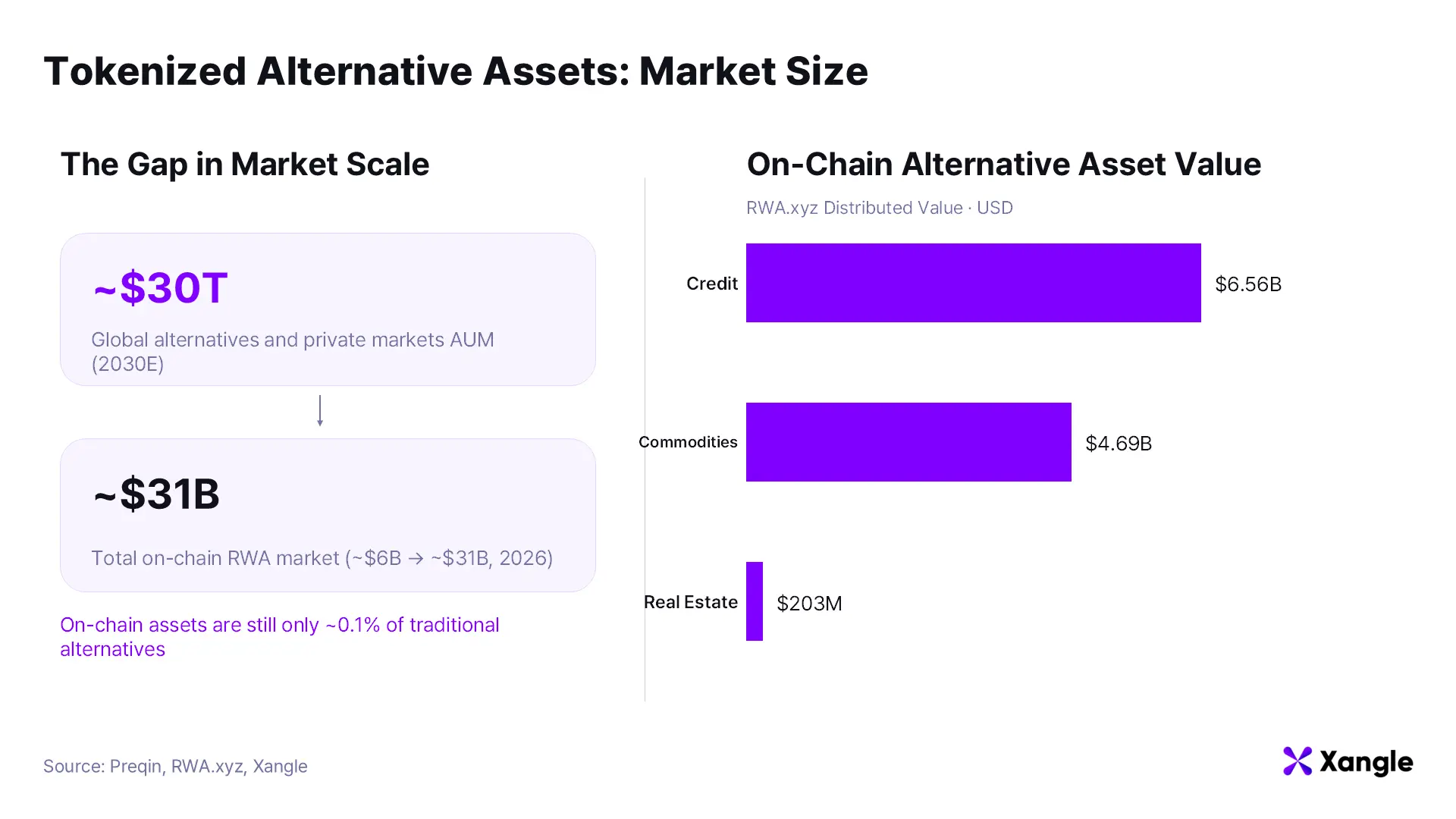
The data already reflect this shift. The on-chain real-world asset (RWA) market has grown from roughly $6 billion to approximately $31 billion, supported by stablecoins and tokenized government bonds, and alternative assets are emerging as the next area of expansion. RWA.xyz tracks approximately $6.56 billion in Distributed Value for tokenized credit, including private credit, as of July 9, 2026; about $4.69 billion in tokenized commodities as of June 23, 2026; and roughly $203 million in tokenized real estate as of July 5, 2026.
Scale alone, however, does not tell the full story of alternative asset tokenization. Tokenizing real-world assets involves more than simply turning an asset into a token. Even tokens backed by the same asset can differ substantially depending on the rights, cash flows, custody arrangements, and redemption structure attached to them. These structures are relatively clear for stocks and bonds. For equities, the key elements are ownership, dividends, voting rights, and corporate actions. For bonds, they are interest, principal, maturity, and default treatment. Alternative assets span a much broader range. Property title and rental income shape real estate products; physical custody and withdrawal rights define commodity products; principal and interest cash flows shape private credit; and authenticity, grading, and storage conditions determine the characteristics of collectibles.
This report divides alternative asset tokenization into four asset classes: real estate, commodities, private credit, and collectibles, and examines leading players and representative cases in each. It explains how each asset is being tokenized. For businesses and institutions considering entering the market, it highlights business models and structures already working in practice. For investors, it provides a framework for assessing the rights, cash flows, and risks involved and for deciding how to approach these products.
2. Why Tokenize Alternative Assets?
2-1. Types of Alternative Assets
Alternative assets are investments outside traditional publicly listed stocks and bonds. They generally include real estate, commodities, infrastructure, private credit, private equity, venture capital, hedge funds, art, and collectibles. They are treated as a distinct asset class because their characteristics differ from those of conventional stock and bond portfolios.
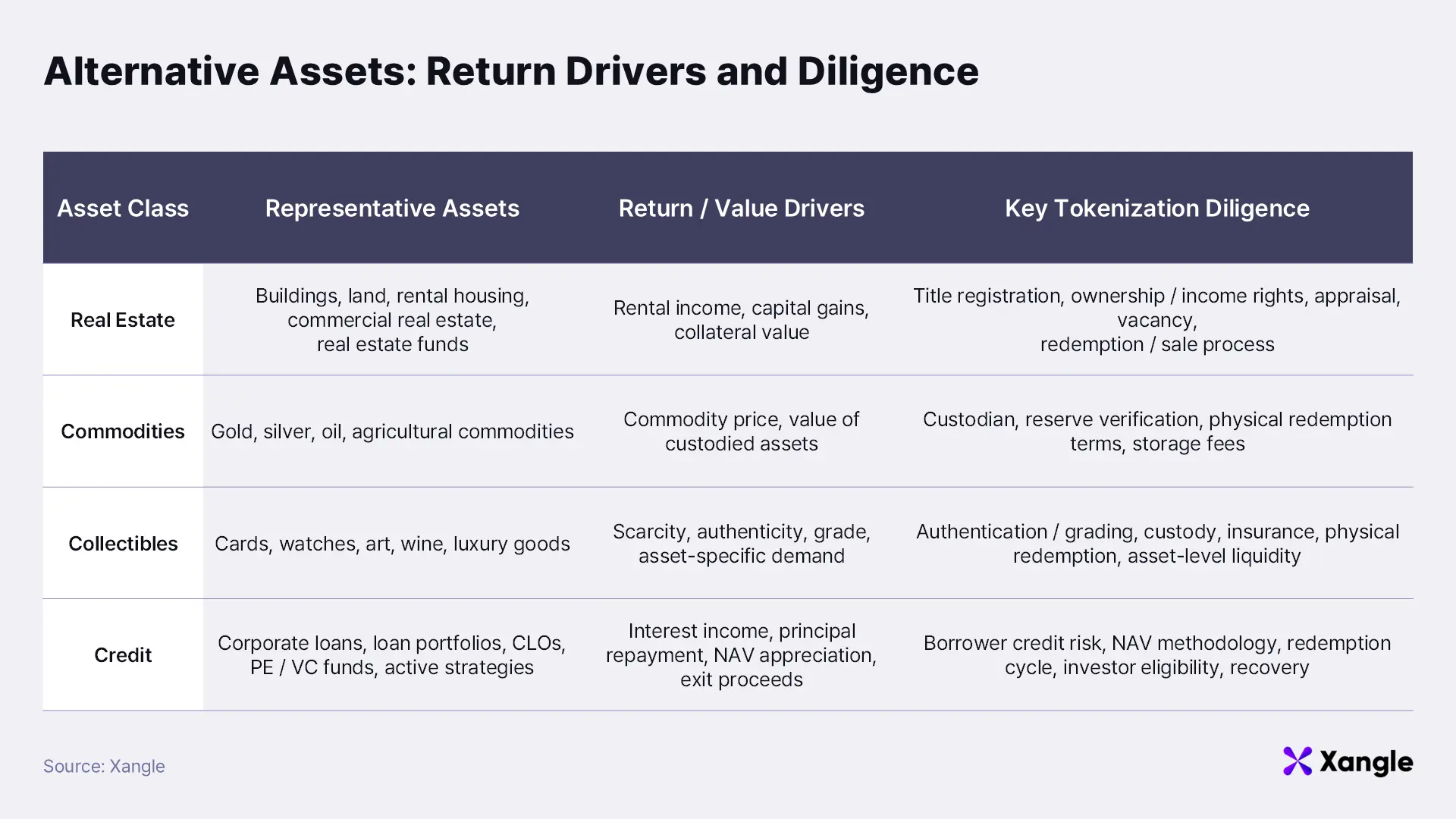
Alternative assets are used to diversify sources of return and portfolios. Real estate offers rental income and capital gains, commodities provide an inflation hedge and a store of tangible value, private credit generates interest income, and collectibles offer return opportunities based on scarcity and asset-specific value. These assets, however, generally have large ticket sizes, limited investor access, and greater complexity than listed assets in terms of valuation and liquidity. Tokenization is therefore being explored as a potential way to address these constraints.
Tokenized alternative assets can be classified as real estate, commodities, collectibles, or credit based on the type of underlying asset represented by the token. Each asset class generates returns differently and presents a different set of risks for investors to assess.
2-2. Problems Tokenization Seeks to Address
Alternative assets can be attractive portfolio holdings, but they remain difficult for individual investors to access. Three broad issues explain why.
First, barriers to entry are high. Private credit and alternative investment funds often require minimum investments ranging from hundreds of thousands to several million dollars, and many impose strict eligibility restrictions such as accredited investor requirements. These markets are difficult to access without the capital and qualifications of an institution or high-net-worth investor.
Second, liquidity is limited and trading frictions are high. Real estate has large transaction sizes and slow sale processes, while prices vary across individual collectibles and artworks, making it difficult to find a counterparty. Many assets are hard to resell after purchase, leaving capital locked up for long periods.
Third, custody and operations are complex. Physical commodities are difficult to store directly and incur withdrawal and storage costs, while collectibles require authentication and secure storage. Processes such as subscription, investor verification, income distribution, reporting, and redemption are also largely manual, adding cost and friction.
Tokenization targets all three problems at once. It can lower entry barriers by dividing large assets into smaller units, smooth transfers and trading by maintaining holdings records on a distributed ledger, and reduce operational burdens by automating subscriptions, investor verification, transfer restrictions, income distributions, and redemptions through smart contracts. Real estate tokens, for example, can process rental distributions in smaller units. Gold-backed tokens connect physical custody with on-chain transferability. Private credit tokenization can enable fund interests or cash flows from loan portfolios to be held, transferred, and used as collateral in digital markets.
Credit assets are particularly well suited to yield-bearing on-chain financial products because loans generate interest income and principal repayments. In private credit, which is dominated by institutions and high-net-worth investors, there is also strong demand to digitize investor verification, subscriptions, ownership records, distributions, reporting, and redemptions.
3. Four Asset Classes in Alternative Asset Tokenization
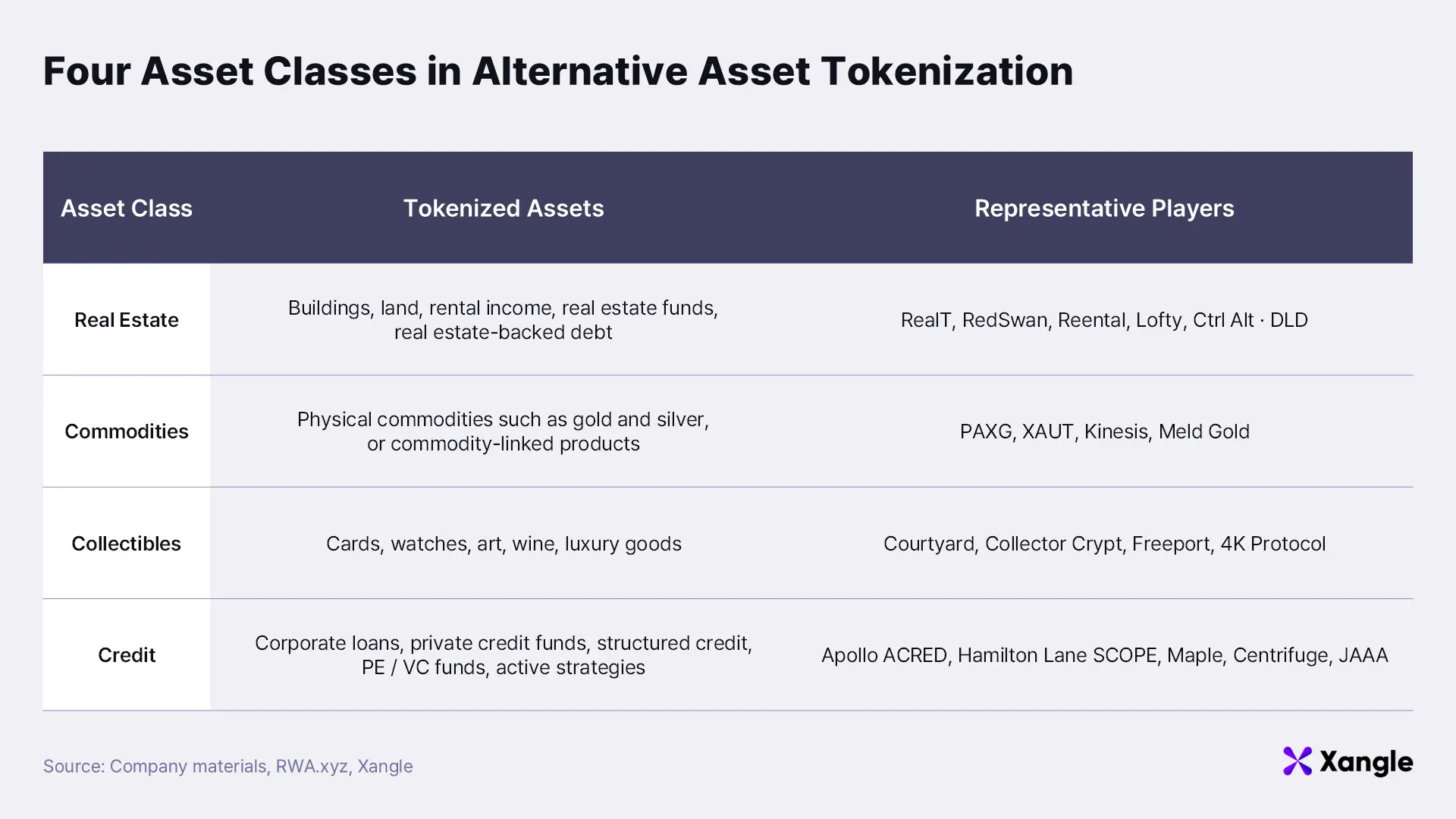
Alternative asset tokenization can be divided into real estate, commodities, collectibles, and credit based on the nature of the underlying asset. This section reviews the four asset classes in turn and introduces key players and representative cases in each. For each case, it outlines what is being tokenized, how the structure works, and the current scale. Risks and key diligence points are discussed in the relevant sections.
3-1. Real Estate: Turning Property Title and Rental Income into On-Chain Interests
Real estate tokenization represents fractional ownership of buildings or land, or rights to rental and sale proceeds, as tokens. According to RWA.xyz, tokenized real estate has approximately $203 million in Distributed Value and $280 million in Represented Value. Distributed Value refers to assets that can be transferred to external wallets, while Represented Value refers to assets held and managed within the issuing platform.
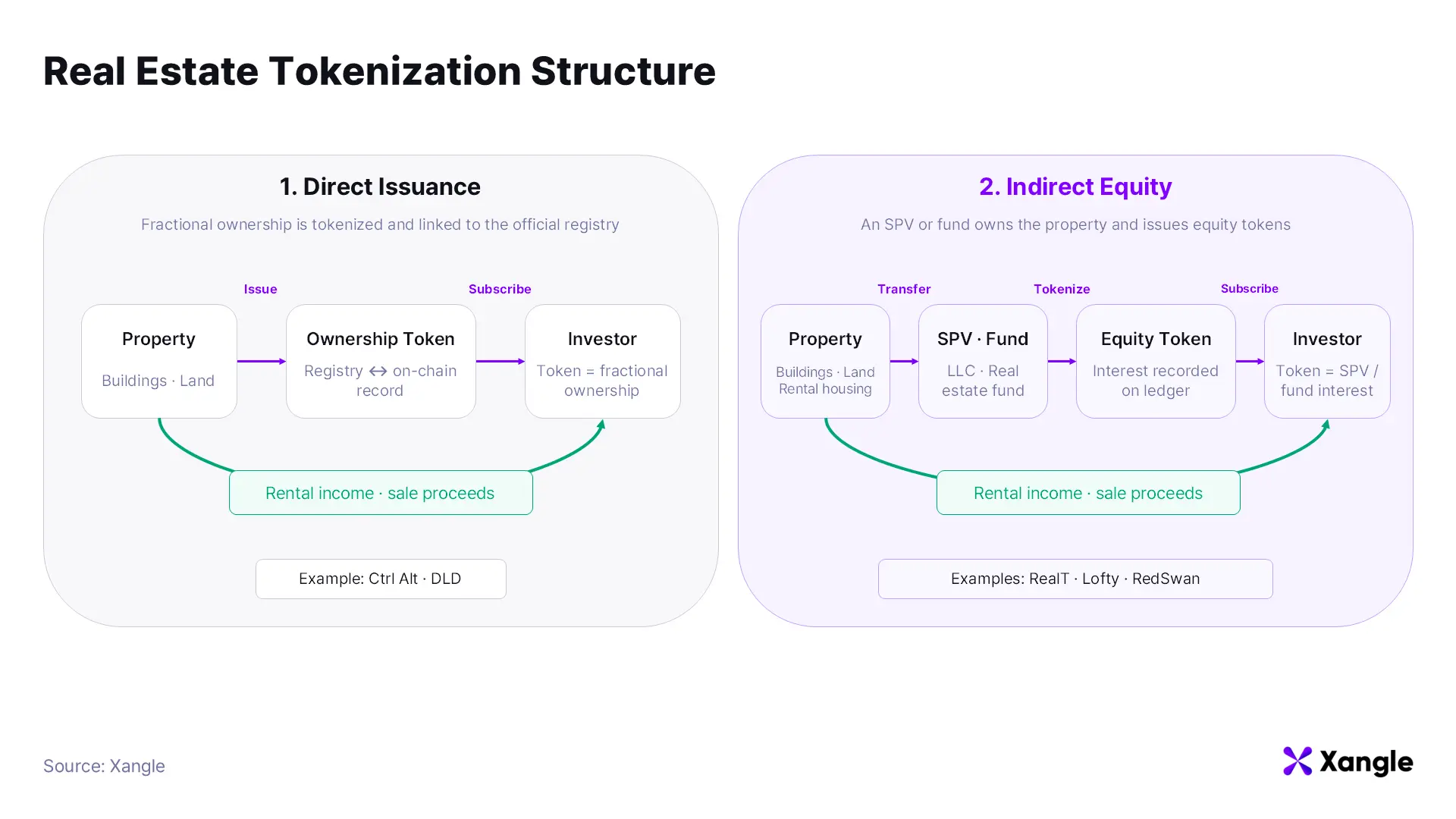
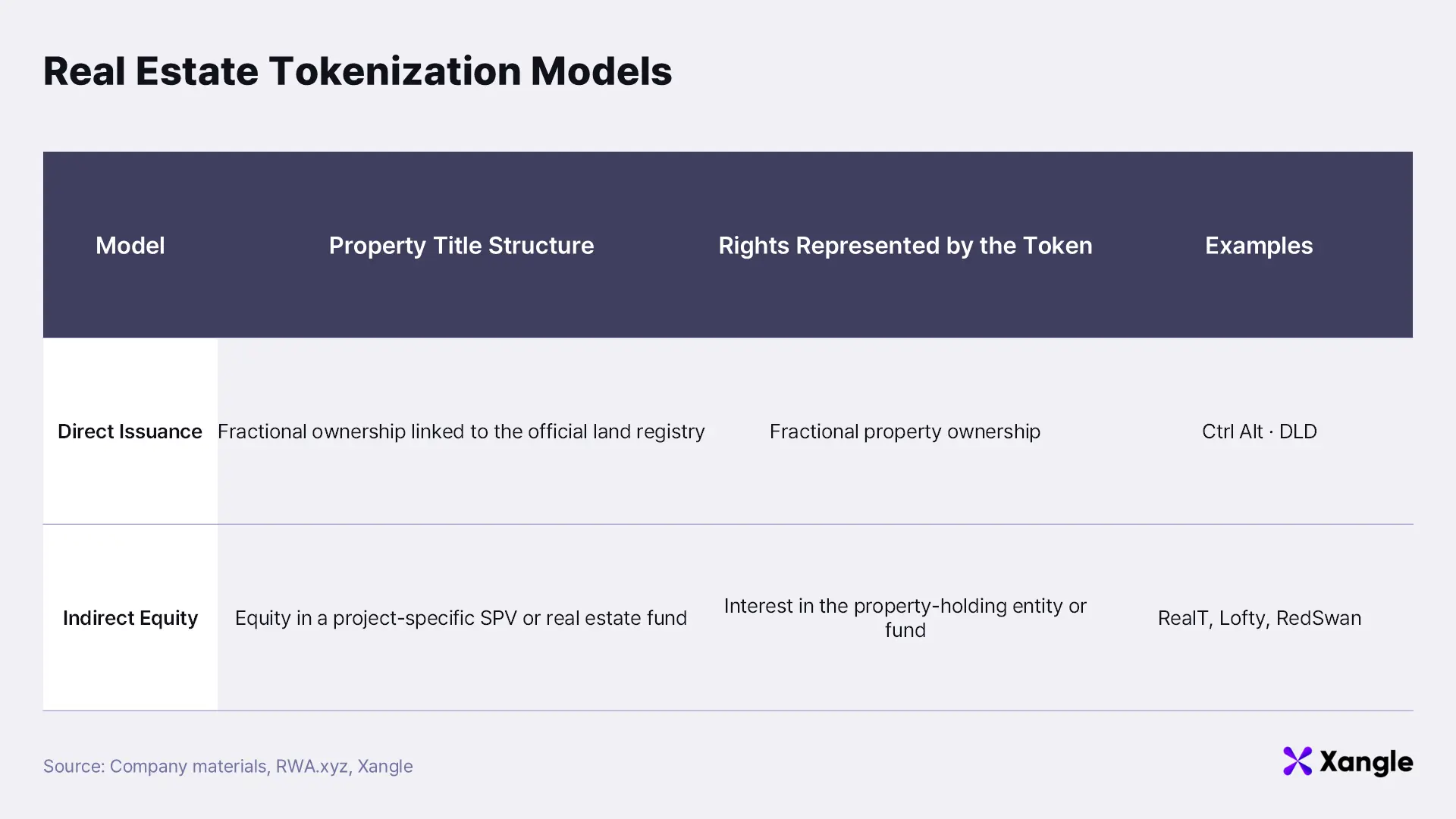
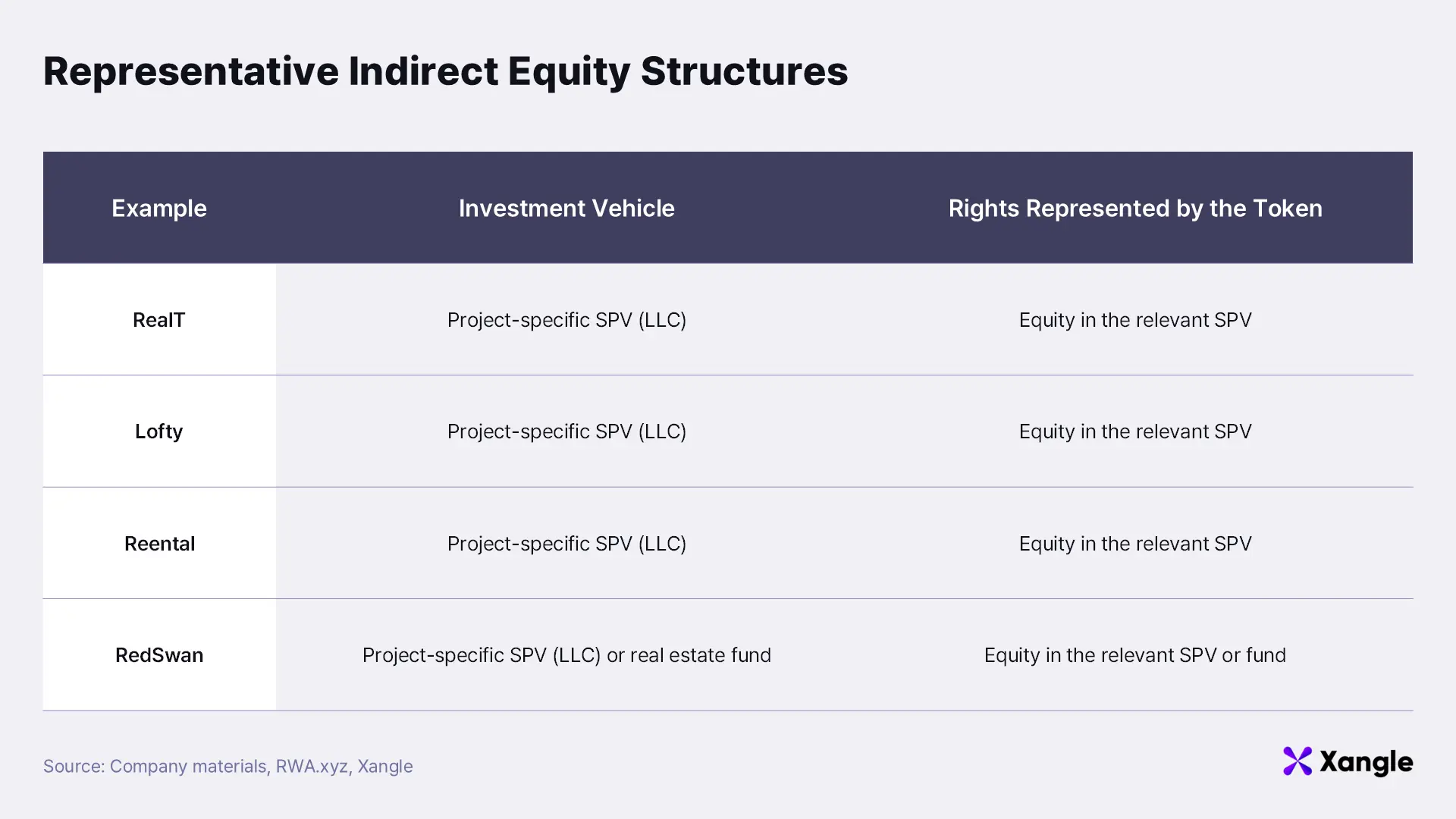
Real estate tokenization can be divided into direct issuance and indirect equity models based on the rights represented by the token. In a direct issuance model, fractional ownership of the property is tokenized and token ownership records are linked to the official land registry. In an indirect equity model, the real estate project is held through a separate special purpose vehicle (SPV) or fund, and investors hold tokens representing an interest in that SPV or fund.
1) Direct Issuance Model
The direct issuance model tokenizes fractional ownership of real estate and records the resulting issuance and transfers in the official land registry. Because investor rights are directly tied to ownership of the property, land registry authorities and regulators must participate. At present, this model is being tested mainly through limited government-led projects.
Ctrl Alt and Dubai Land Department (DLD)
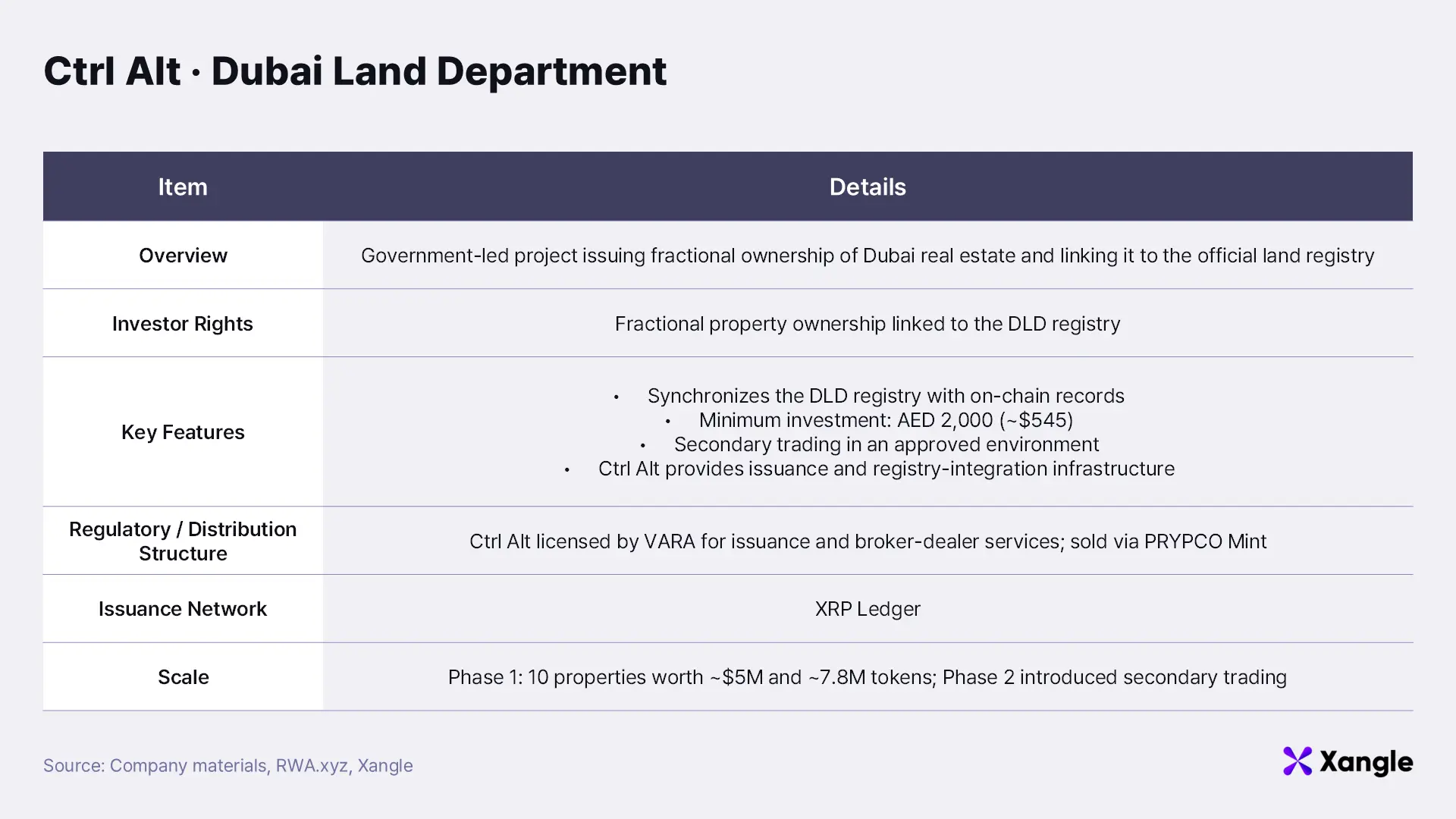
The collaboration between Ctrl Alt and the Dubai Land Department (DLD) is a government-led project that issues tokens representing fractional real estate ownership and connects them to the official registry. Trading takes place through the PRYPCO Mint platform, while Ctrl Alt provides token structuring, issuance, and registry integration infrastructure. Ctrl Alt holds licenses from Dubai's Virtual Assets Regulatory Authority (VARA) for virtual asset issuance and broker-dealer services.
In Phase 1, launched in May 2025, 10 Dubai properties with a combined value of AED 18.5 million (approximately $5 million) were tokenized. About 7.8 million ownership tokens were issued on the XRP Ledger. UAE residents with an Emirates ID could participate through PRYPCO Mint with a minimum investment of AED 2,000 (approximately $545). Ctrl Alt synchronizes token issuance data with the DLD system to keep on-chain holdings records aligned with the official property registry.
Phase 2, launched in February 2026, added a secondary trading function that allows tokens issued in Phase 1 to be resold in a regulated environment. Trades occur within an approved platform, and token transfers are reflected in the DLD's official registry. The ownership tokens cannot be freely transferred to external wallets or exchanges chosen by holders. Investors must complete regulated procedures, including investor verification and transfer approval.
The direct issuance model handles token issuance and transfer alongside property-title records within a single framework. Implementing it requires land registry authorities, regulators, and issuing platforms to jointly design registration and transfer standards. This is why the DLD initiative began as a government-led regulatory pilot.
2) Indirect Equity Model
In the indirect equity model, each real estate project is placed in a project-specific SPV or real estate fund, and interests in that entity are issued as tokens. The SPV or fund may own the property directly or invest in a local property-holding company or developer. Rental income and sale proceeds generated by the project flow through the SPV or fund and are distributed in proportion to each investor's ownership interest.
A special purpose vehicle (SPV) is an entity formed solely to hold a specific asset or carry out a specific business activity. The term describes an entity's function rather than a particular legal form. An SPV may be structured as a limited liability company (LLC), corporation, partnership, or trust. LLCs are the most common form used in real estate tokenization.
A limited liability company (LLC) is an entity established under state law in the United States. It can own property and enter into contracts in its own name, while investors hold membership interests in the LLC. As a rule, members' liability is limited to the amount they contributed. Using a separate property-level LLC as an SPV allows each property's income and liabilities to be isolated from other projects.
The indirect equity model is currently the most widely used structure. It allows the existing property title system to remain in place while digitizing the issuance and transfer of SPV or fund interests and the distribution of income. Investors' distribution, voting, and liquidation rights, as well as transfer restrictions, are determined by the SPV operating agreement, fund governing documents, and individual offering documents.
RealT
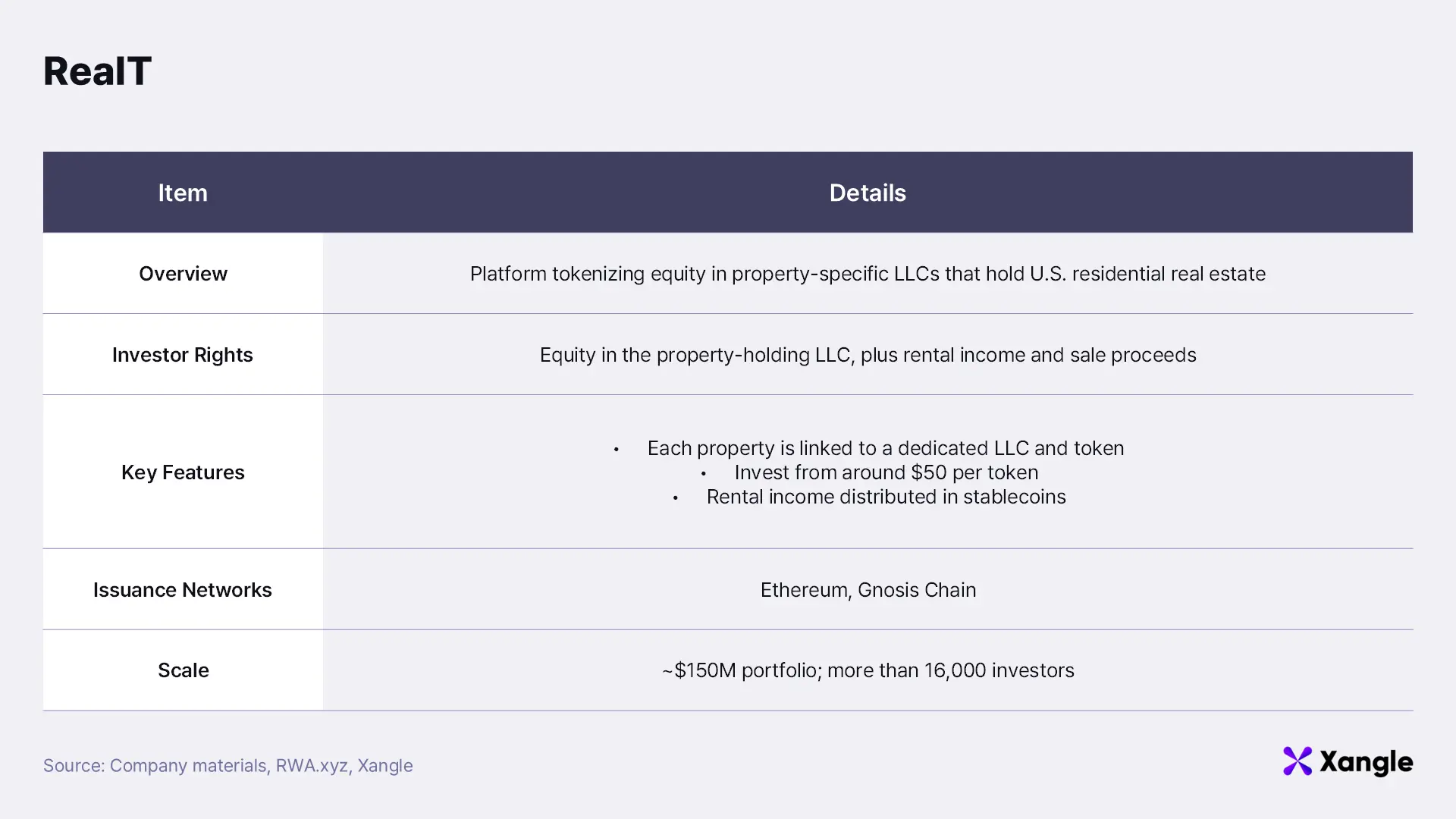
RealT is a platform that places U.S. residential properties into project-specific SPVs structured as LLCs and tokenizes the equity interests in those LLCs. Each property has a separate LLC and corresponding token, and the LLC is the owner of record. By holding the token, investors acquire a membership interest in the LLC and receive rental income and final sale proceeds in proportion to their ownership.
Net rental income, after taxes, insurance, management fees, repair costs, and other expenses are deducted, is paid in stablecoins. Tokens are issued on Ethereum and Gnosis Chain, and investors can select individual properties with investments starting at approximately $50. Each property's income and expenses are managed separately within its own LLC.
Lofty
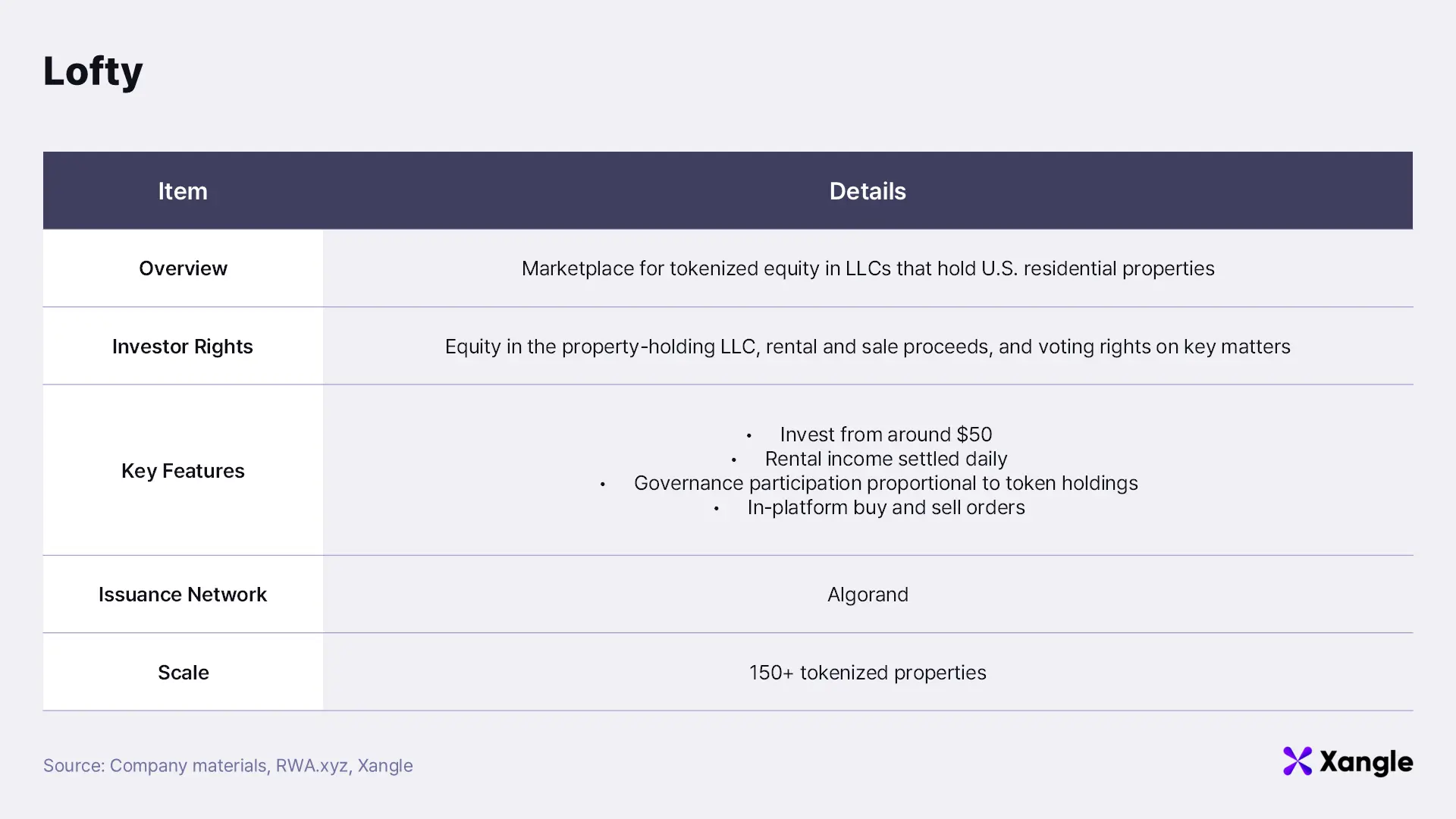
Lofty also uses a single-asset SPV model in which a property-specific LLC owns the asset and investors purchase tokens representing equity in that LLC. Tokens are issued on Algorand, and investors can access U.S. residential real estate from approximately $50. Rental income is distributed daily in proportion to token holdings.
Lofty also gives token holders decision-making authority over property operations. They can vote in proportion to their token holdings on matters such as lease terms, repairs, replacing the property manager, and whether to sell the asset. The LLC interest establishes the investor's legal rights, while token-based voting is used to determine how the LLC operates.
Investors can place buy and sell orders for tokens through the platform's marketplace at any time. Execution and pricing, however, depend on demand for the relevant property token. When trading volume for a property is low, investors may be unable to sell their interests when they want to.
Reental
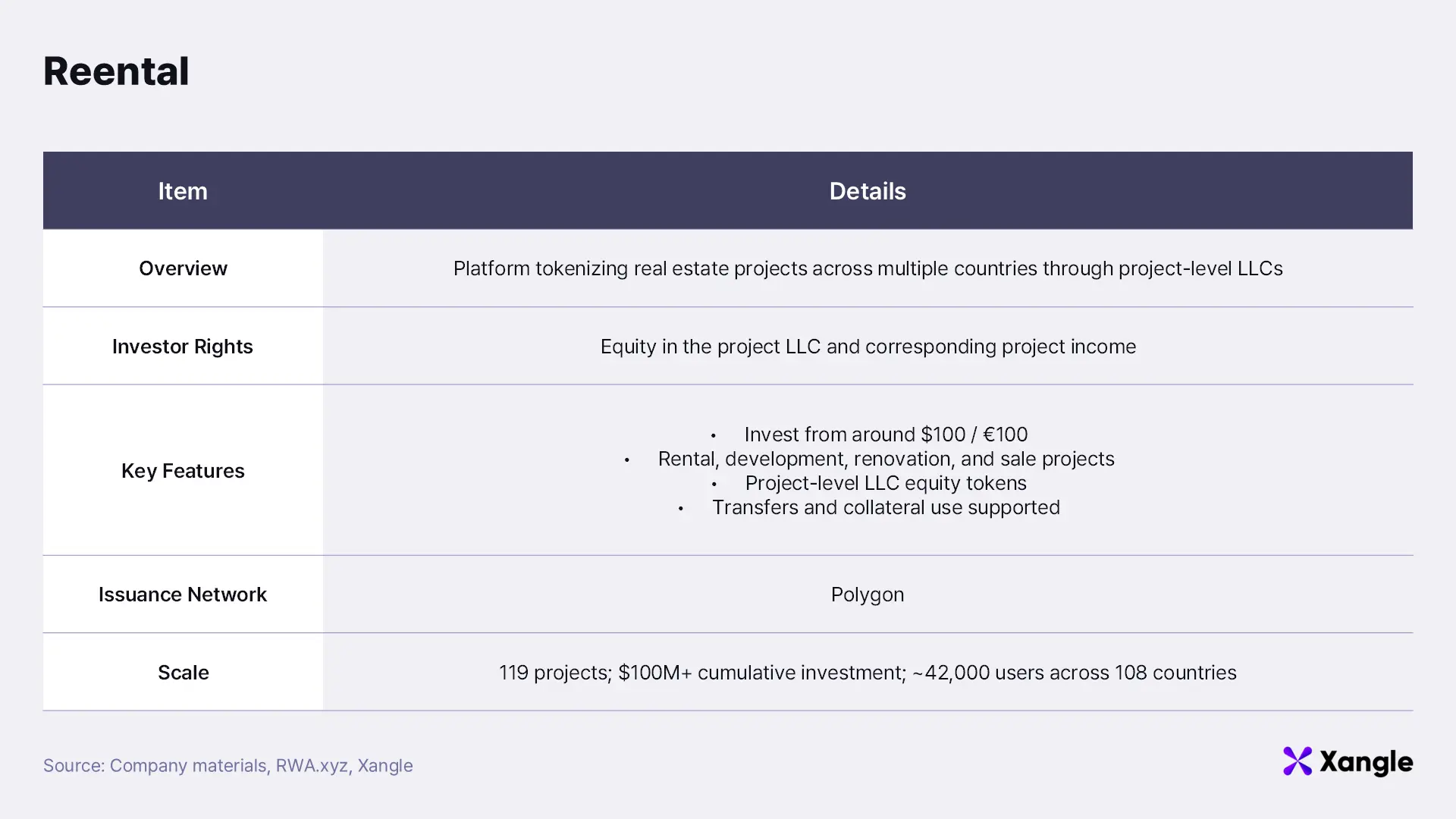
Reental structures real estate projects in countries including the United States, Spain, Mexico, the Dominican Republic, and the UAE through project-specific SPVs organized as LLCs, then tokenizes the equity in those entities. It covers residential and tourism-related properties as well as development, renovation, and short-term acquisition and resale projects. According to its official website, the platform has approximately 42,000 users across 108 countries and has tokenized more than $100 million of real estate through 119 projects.
The link between a project LLC and the underlying property varies by country and product. The LLC may own the property directly, invest in a local property-holding company or developer, or lend to a real estate operator. Investors hold equity tokens in the project LLC and receive a pro rata share of the income generated by that project.
Rental products distribute rental income and final sale proceeds, while development and renovation products distribute the profit remaining after costs are deducted from sale proceeds at the end of the project. Project tokens are issued on Polygon, with minimum investments of approximately $100 or €100. The project token represents equity in the real estate SPV, while RNT is a separate utility token used for platform benefits and governance.
RedSwan CRE
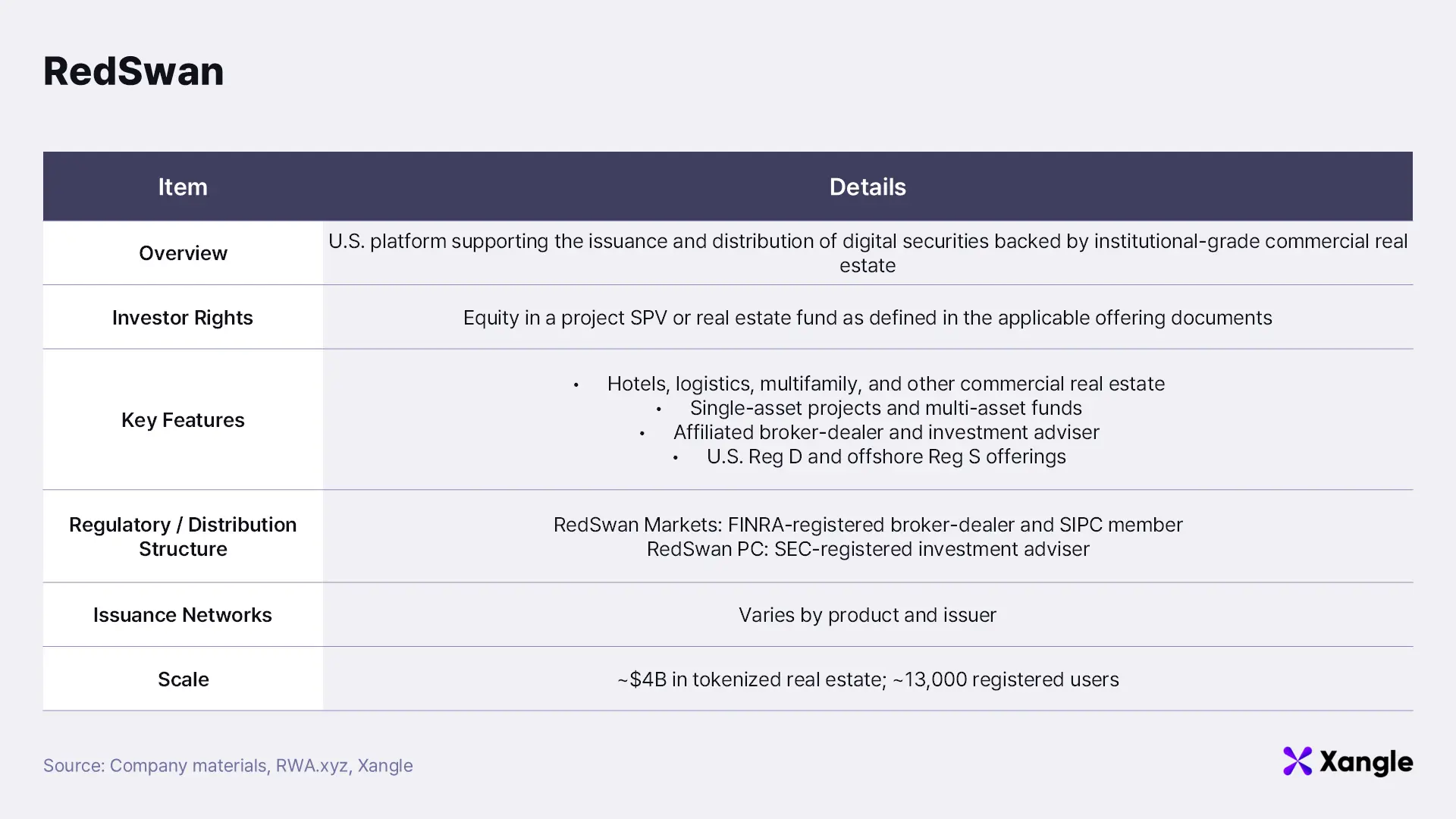
RedSwan is a U.S. platform that supports the issuance and sale of digital securities backed by institutional-grade commercial real estate. Its offerings range from individual assets such as hotels and logistics facilities to portfolios and closed-end funds holding multiple commercial properties. Depending on the product, investors hold tokenized interests in a project SPV or real estate fund.
RedSwan PC provides technology and investment advisory services that enable issuers to issue digital real estate securities. Sales are handled by its affiliate, RedSwan Markets. RedSwan Markets is a broker-dealer registered with the Financial Industry Regulatory Authority (FINRA) and a member of the Securities Investor Protection Corporation (SIPC), while RedSwan PC is an investment adviser registered with the U.S. Securities and Exchange Commission (SEC). U.S. investors generally participate as accredited investors under Reg D, while non-U.S. investors use offshore offering structures under Reg S.
RedSwan states that it has tokenized approximately $4 billion of real estate based on its own figures, with another $5.2 billion of assets under review or preparation for tokenization. The pipeline does not represent completed issuance, and the company has not disclosed its detailed counting methodology or the stage of each project.
The indirect equity model is now widely used in real estate tokenization. Because it preserves existing title systems while tokenizing interests in SPVs or funds, it can be applied more readily across jurisdictions and asset types. The direct issuance model links token transfers and changes in official ownership within a single process. Because it requires participation from land registry authorities and regulators, it remains concentrated in limited government-led projects. Both models lower minimum investment sizes and digitize income distributions and ownership transfers. Property appraisals, taxes, leasing, facility management, and sales, however, still depend on local law and off-chain operating systems.
3-2. Commodities: Turning Vaulted Assets into On-Chain Claims
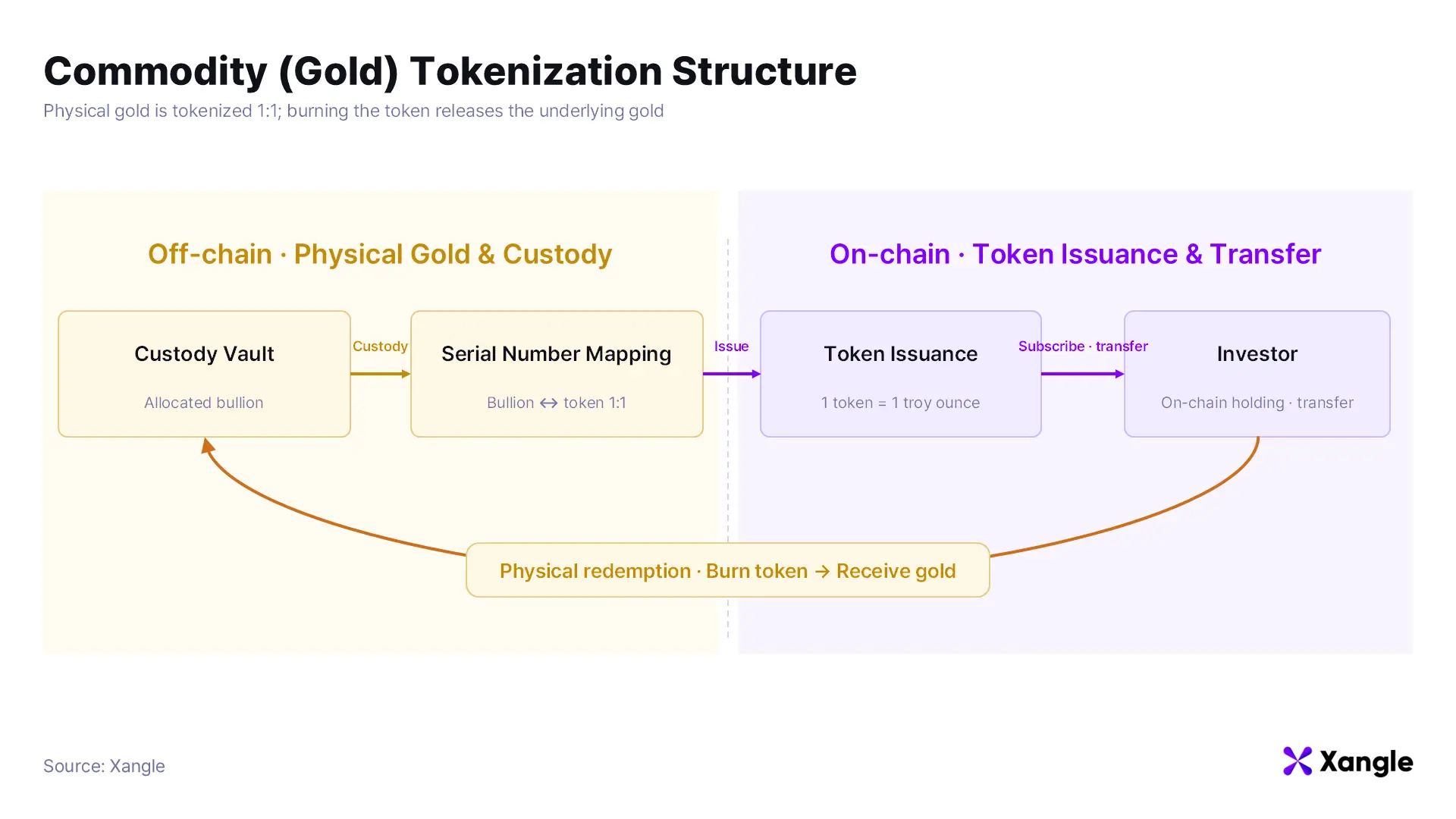
Commodity tokenization involves storing physical commodities such as gold, silver, oil, and agricultural products, then representing rights to those assets or price exposure through tokens. Gold-backed tokens are currently the most mature example. Gold trades in a large global market, has standardized quality criteria, and can be stored over long periods, making it well suited to physically backed token structures. According to RWA.xyz, as of July 22, 2026, tokenized commodities had a market capitalization of approximately $7.46 billion, monthly transfer volume of roughly $12.76 billion, and around 203,000 holders. Gold-backed tokens issued by Tether and Paxos account for a large share of the market.
Paxos: PAX Gold (PAXG)
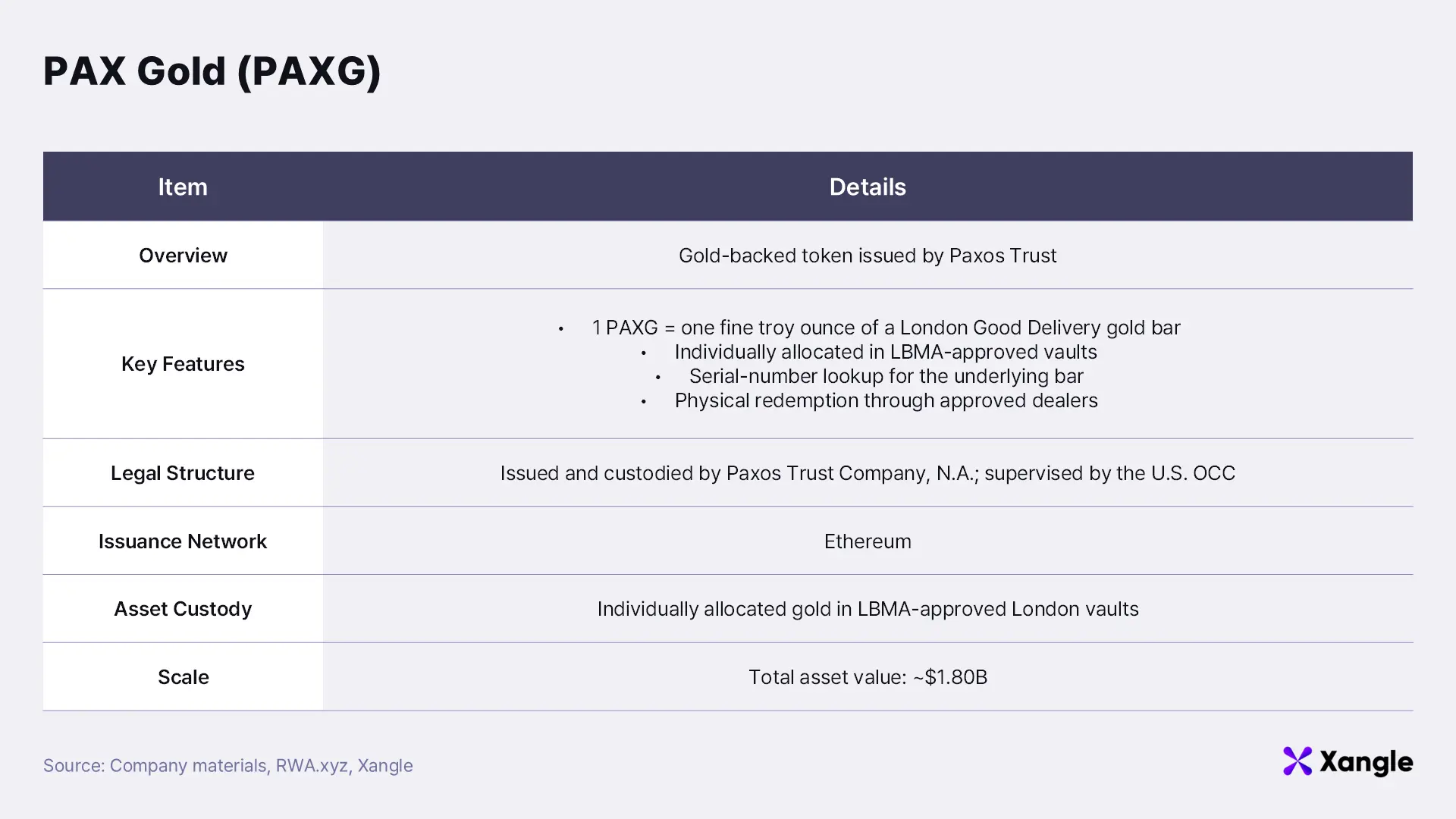
PAX Gold (PAXG) is a gold-backed token issued by Paxos Trust Company, N.A., a federally chartered U.S. trust bank. One PAXG represents ownership of one fine troy ounce of gold in a London Good Delivery bar. The physical gold is held on an allocated basis in London vaults accredited by the London Bullion Market Association (LBMA), and holders can look up the bar's serial number, weight, and vault location. Paxos is supervised by the U.S. Office of the Comptroller of the Currency (OCC). Physical redemption generally requires holdings equivalent to a full London Good Delivery bar, while smaller holders can redeem for USD or arrange partial redemption through approved dealers.
Tether: Tether Gold (XAUT)
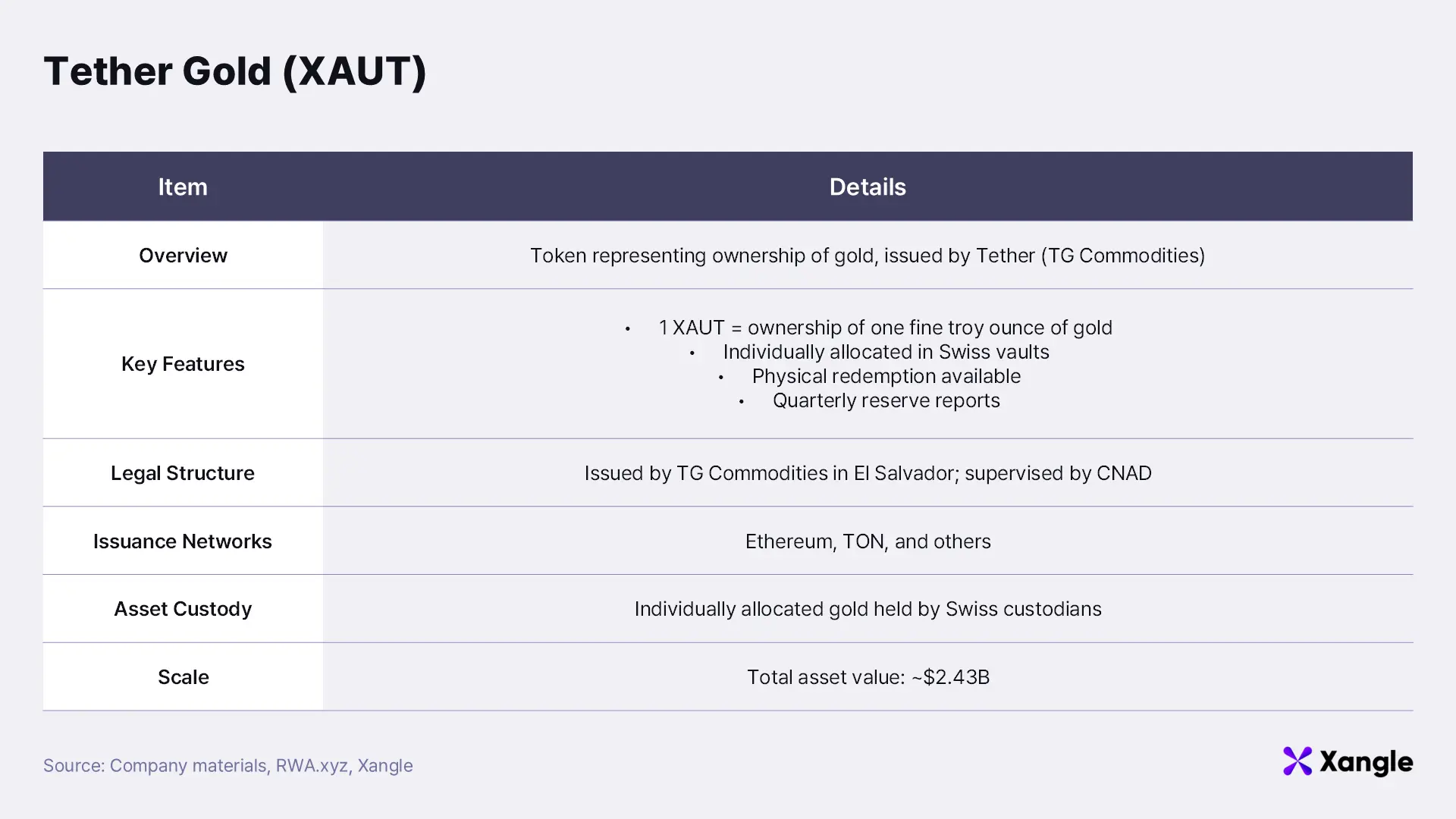
Tether Gold (XAUT) is a token representing ownership of gold, issued by TG Commodities, S.A. de C.V., an entity incorporated in El Salvador. One XAUT represents an undivided ownership interest in one fine troy ounce of gold allocated to a specific bar. The physical gold is held on an allocated basis by a Swiss custodian, and the issuer is supervised by El Salvador's National Commission of Digital Assets (CNAD). XAUT is issued on Ethereum, while XAUT0 enables cross-chain transfers across networks including TON and Solana.
Kinesis: KAU / KAG
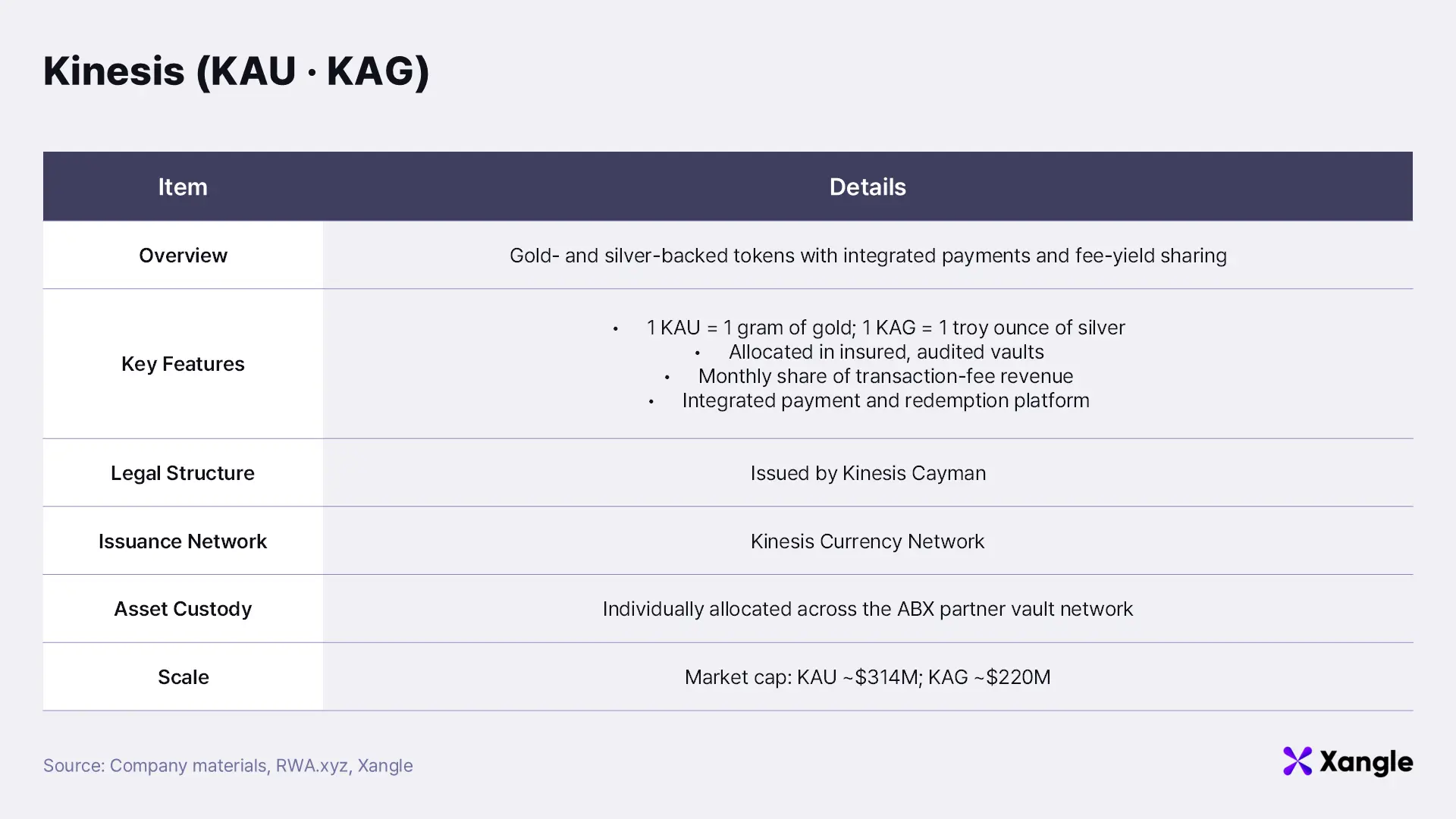
Kinesis combines physically backed gold and silver tokens with payment and revenue-sharing functions. One KAU represents 1 gram of gold, while one KAG represents 1 ounce of silver. The physical metals are held on an allocated basis across an ABX-affiliated vault network with insurance and external audits. Holders of native KAU and KAG have proportional ownership of the pooled gold and silver in custody. The platform also distributes a portion of transaction fee revenue to holders each month.
Commodity tokenization has a relatively straightforward structure. Gold is stored in a vault and tokens are issued to represent rights to that gold, allowing investors to gain transferable on-chain exposure to the gold price without storing the physical metal themselves. Investors still need to verify which gold their token gives them rights to, where it is held, how it is audited, whether physical withdrawal is available, and what minimum quantities and fees apply. The structure becomes more complex as tokenization expands beyond gold. Silver is less efficient to store, while oil and agricultural products introduce variables such as quality, transportation, storage life, inventory turnover, and futures maturities. This is why commodity tokenization developed first around gold. Expansion into other commodities requires careful consideration of each asset's physical characteristics and market structure.
3-3. Collectibles: Tokenizing Rights to Physical Assets in Custody
Collectibles tokenization follows a model similar to commodity tokenization. Individual physical assets such as cards, watches, art, wine, and luxury goods are held in custody, while ownership or redemption rights are represented as non-fungible tokens (NFTs) or other tokens. The product's characteristics depend on the physical asset linked to the token, its authenticity and grade, the custody location and insurance, and whether physical redemption is available.
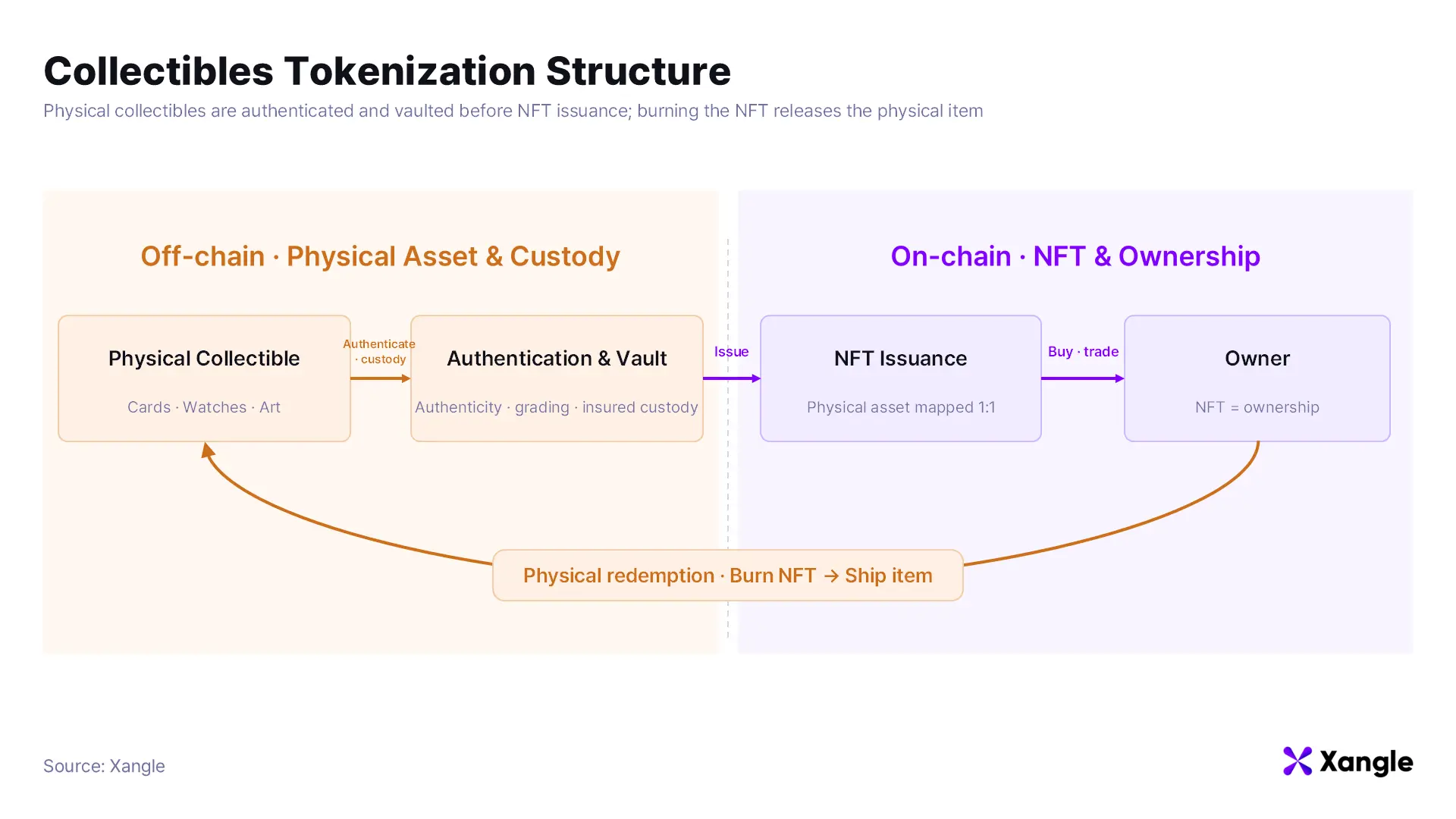
Courtyard
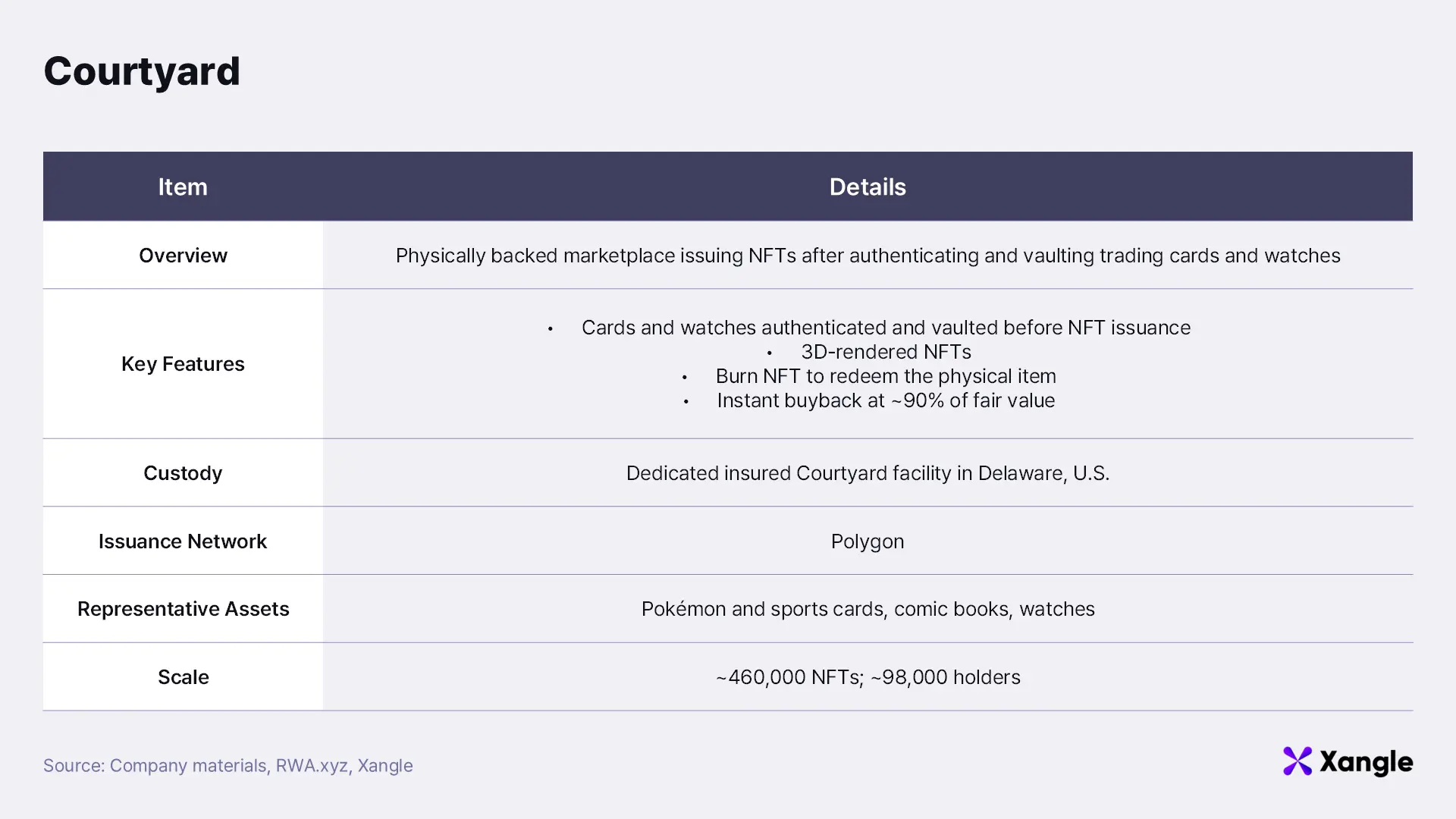
Courtyard is a Polygon-based platform that stores appraised physical collectibles, including Pokémon and sports cards, comic books, and watches, and issues one NFT for each asset. NFT holders can trade the token or burn it to take delivery of the physical item. The platform also offers randomized pack openings and an instant buyback feature at approximately 90% of market value. It used Brink's vaults in 2022 and now uses a dedicated, insured Courtyard storage facility in Delaware, United States.
Collector Crypt
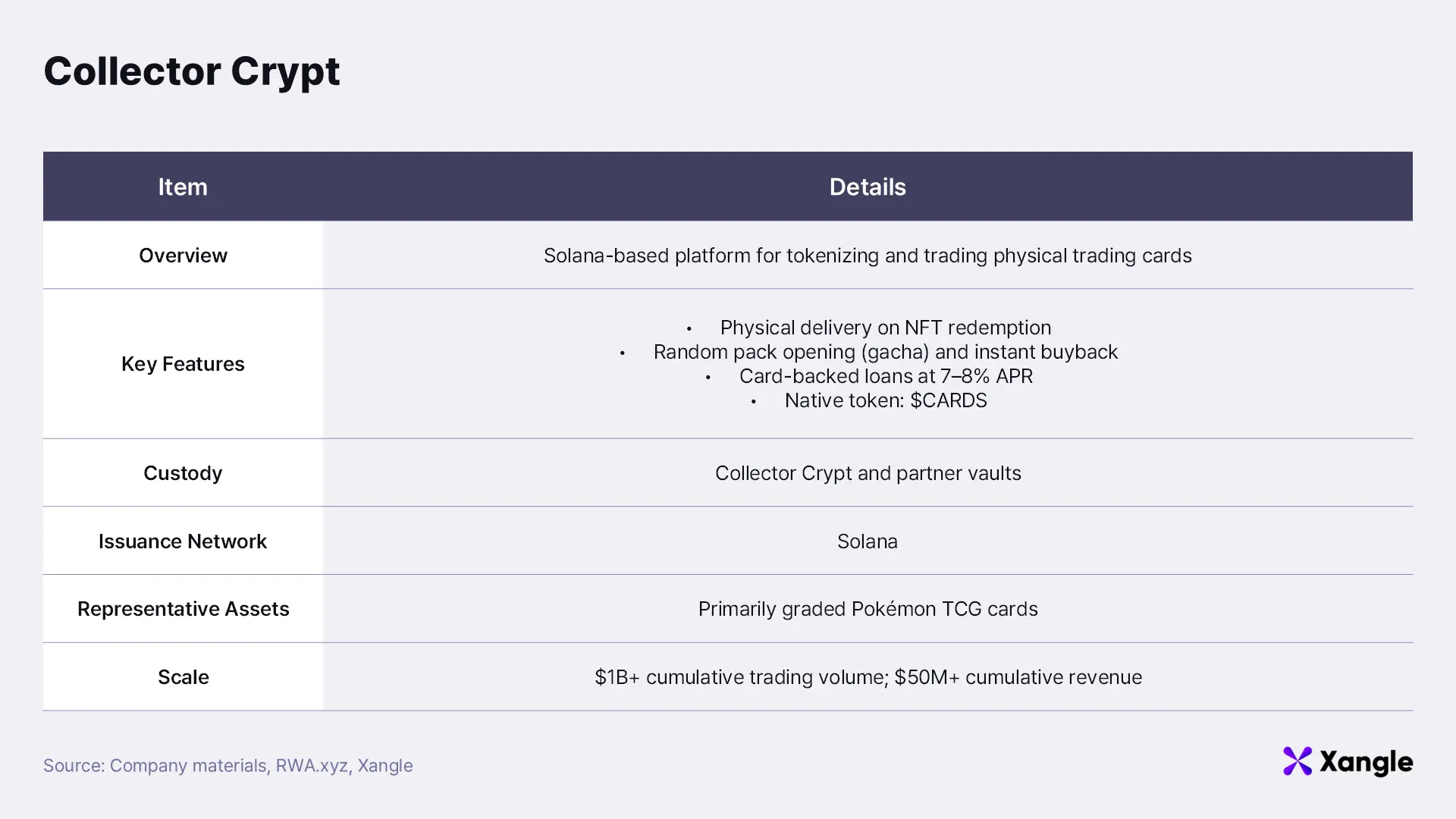
Collector Crypt stores graded Pokémon trading cards and issues NFTs on Solana that can be redeemed for the physical cards. Users can trade the NFTs or burn them to have the cards delivered. The platform also offers randomized pack openings and an instant buyback at approximately 85% of market price. On third-party on-chain money markets such as Loopscale, users can borrow USDC against card NFTs, with interest rates varying according to market conditions. CARDS, the native utility token, is used for randomized pack purchases and user rewards. Cumulative trading volume surpassed $1 billion in May 2026, and cumulative revenue exceeded $50 million according to reports published in June 2026.
Freeport
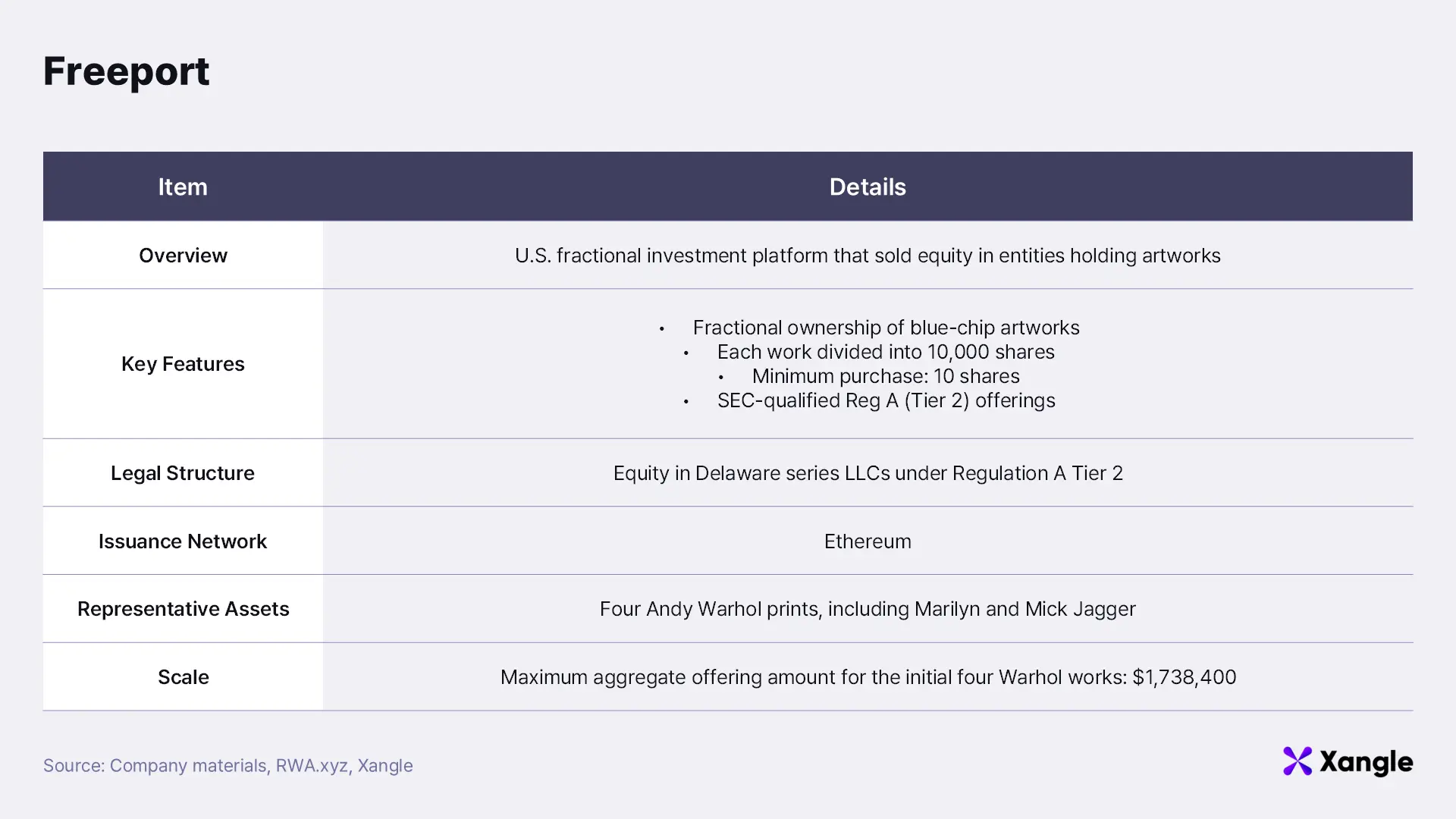
Freeport is a U.S. fractional art investment platform that sold fractional interests in entities holding works by Andy Warhol. It established a separate Delaware series LLC for each artwork and issued 10,000 Class A shares, with a minimum subscription of 10 shares. Investors acquired an interest in the series LLC that owned the artwork and the right to receive a share of the proceeds when the artwork was sold. Tokens issued on Ethereum represented those interests.
The series LLC owns the artwork, while Freeport Services manages storage through external specialist facilities and arranges insurance. Investors cannot redeem the physical artwork. When the manager sells the work, sale proceeds are distributed in proportion to ownership. In 2023, Freeport's offering statement was qualified under Regulation A Tier 2. The maximum aggregate offering amount for its initial four Andy Warhol works was approximately $1.74 million.
The market for collectibles tokenization is smaller than the markets for real estate or private credit tokenization, and values vary much more from asset to asset. Even so, it provides the clearest illustration of a "physical asset-backed NFT" structure. By holding the NFT, users obtain rights to a card, watch, or artwork stored in a vault and can burn the NFT to withdraw the physical item when needed. Collectibles are difficult to standardize. Even watches from the same brand or cards featuring the same athlete can differ sharply in value depending on condition, grade, rarity, history, and market demand. In collectibles tokenization, appraisal and grading standards, the custodian, insurance coverage, physical redemption procedures, and secondary-market demand therefore matter more than issuance volume alone.
3-4. Credit: Tokenizing Private Credit and Structured Credit
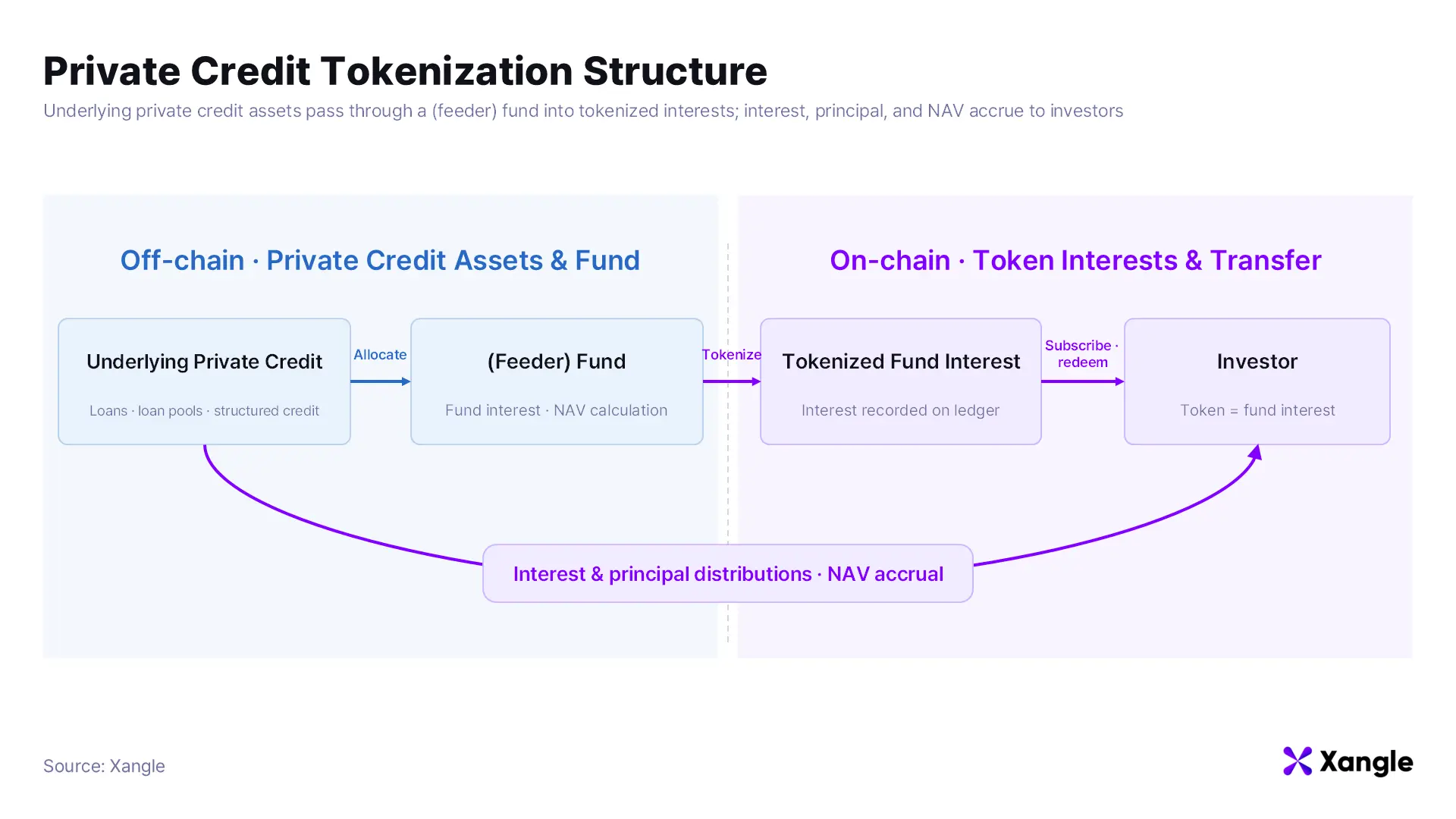
Credit products provide capital to companies or asset owners in exchange for interest and principal repayments. Tokenized credit issues fund interests or loan-pool tokens that represent rights to cash flows from corporate loans, asset-backed loans, loan portfolios, and similar assets. Private credit refers to financing that companies raise through bilateral loan agreements with asset managers or private credit funds rather than through public corporate bond markets. Structured credit pools multiple loans and divides the resulting exposure into tranches with different repayment priorities and loss allocations. Collateralized loan obligations (CLOs), asset-backed securities (ABS), and mortgage-backed securities (MBS) are common examples. Principal, interest, maturity, collateral, and repayment terms are determined by each loan agreement and product structure.
Private credit and structured credit have traditionally been sold mainly to institutions and high-net-worth investors because of high minimum investments and eligibility requirements. Tokenization can fractionalize fund interests and digitize investor verification, subscriptions, ownership records, income distributions, and redemption requests. Structures range from tokenized interests in a feeder fund that invests in an existing credit fund to standalone on-chain funds and smart contract-based loan pools. Representative examples include Apollo's ACRED, Hamilton Lane's SCOPE, Janus Henderson's JAAA, and Maple Finance's syrupUSDC and syrupUSDT.
Apollo ACRED (Securitize)
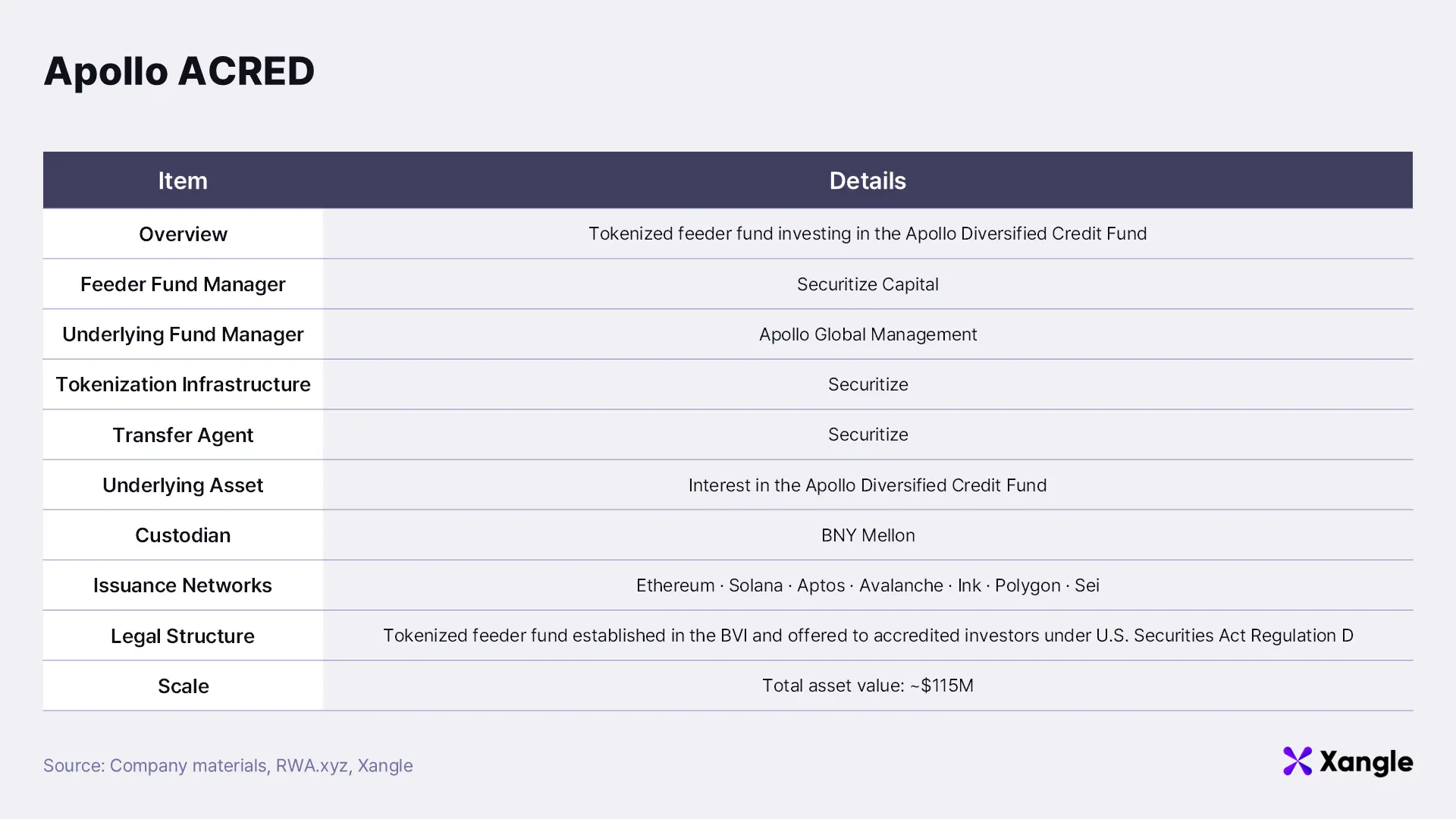
Apollo ACRED is a tokenized feeder fund established to provide on-chain access to the existing Apollo Diversified Credit Fund. When an investor purchases ACRED tokens, the feeder fund uses the capital to acquire interests in the underlying fund, and the underlying fund's performance is reflected in ACRED's net asset value. Securitize Capital manages the feeder fund, while Apollo Global Management oversees the underlying fund's credit strategy.
The underlying fund diversifies across five strategies: corporate direct lending, asset-backed lending, performing credit, dislocated credit, and structured credit. ACRED's legal issuer is a feeder fund established in the British Virgin Islands (BVI), and the product is offered to eligible investors in the United States under Reg D of the Securities Act. Securitize handles token issuance and transfer-agent services, while BNY Mellon acts as custodian. ACRED has been issued on multiple networks, including Ethereum, Solana, and Aptos, and has a total asset value of approximately $115 million.
ACRED is also used in on-chain lending markets. Eligible holders can post sACRED, a wrapped version of ACRED, as collateral in on-chain money markets such as Morpho and Drift Institutional and borrow USDC. This allows them to obtain liquidity or deploy capital in other on-chain yield strategies while maintaining exposure to the underlying credit fund.
Hamilton Lane SCOPE (Securitize)
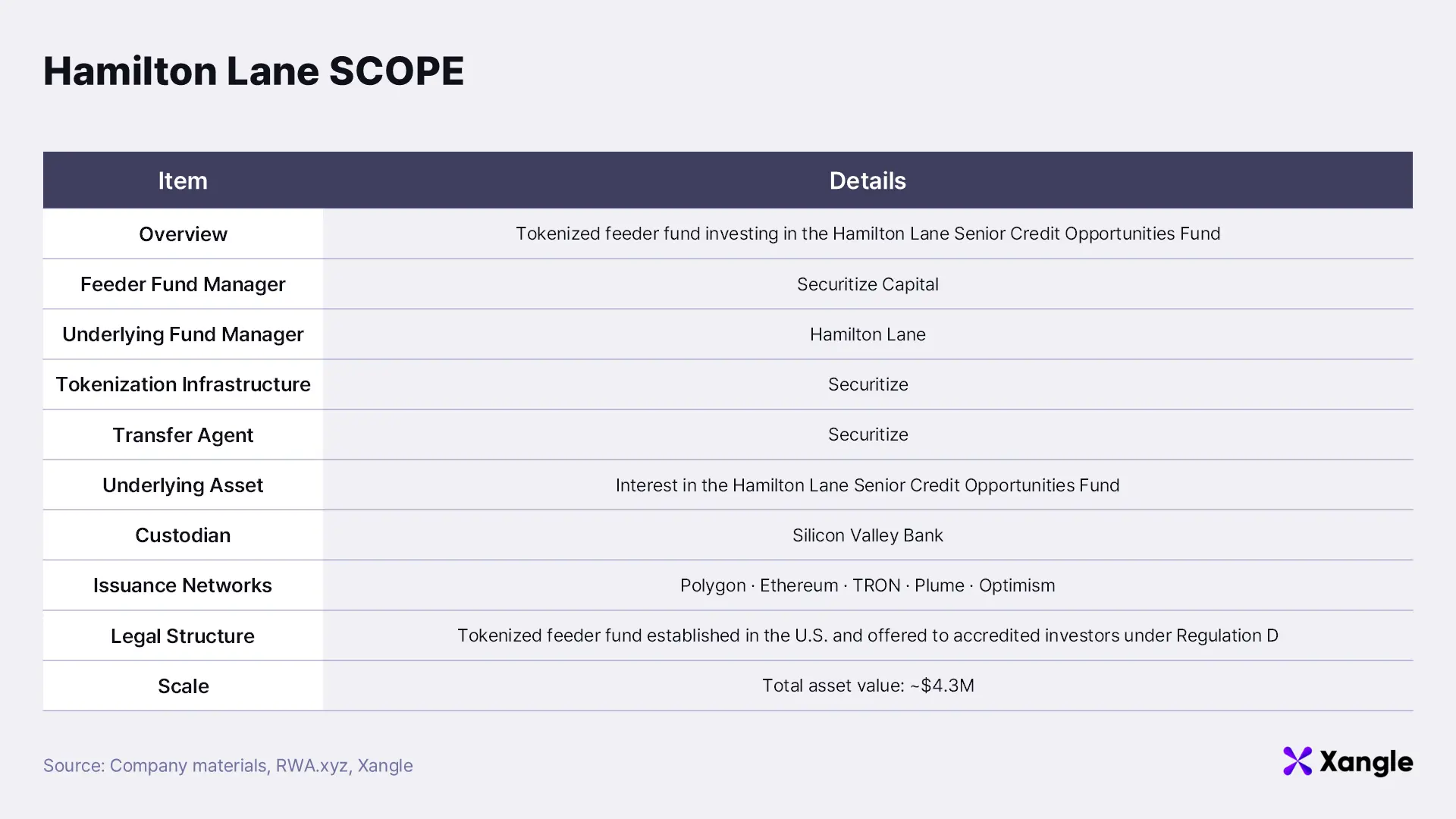
Hamilton Lane SCOPE is a tokenized feeder fund that invests in the Senior Credit Opportunities Fund. Securitize Capital manages the feeder fund, while Hamilton Lane manages the underlying fund's credit strategy. The HLSCOPE token represents an interest in the feeder fund. The underlying portfolio focuses on senior secured private loans.
SCOPE lowers the minimum investment for a strategy that previously required approximately $2 million through traditional access channels, making it available from around $10,000. It supports digital subscriptions and monthly redemption requests, although actual redemption timing may depend on fund liquidity and redemption limits. The feeder fund is established in the United States and offered to eligible investors under Reg D of the Securities Act. Securitize handles tokenization and transfer-agent services, Silicon Valley Bank acts as custodian, and the fund has a total asset value of approximately $4.3 million.
Janus Henderson Anemoy JAAA
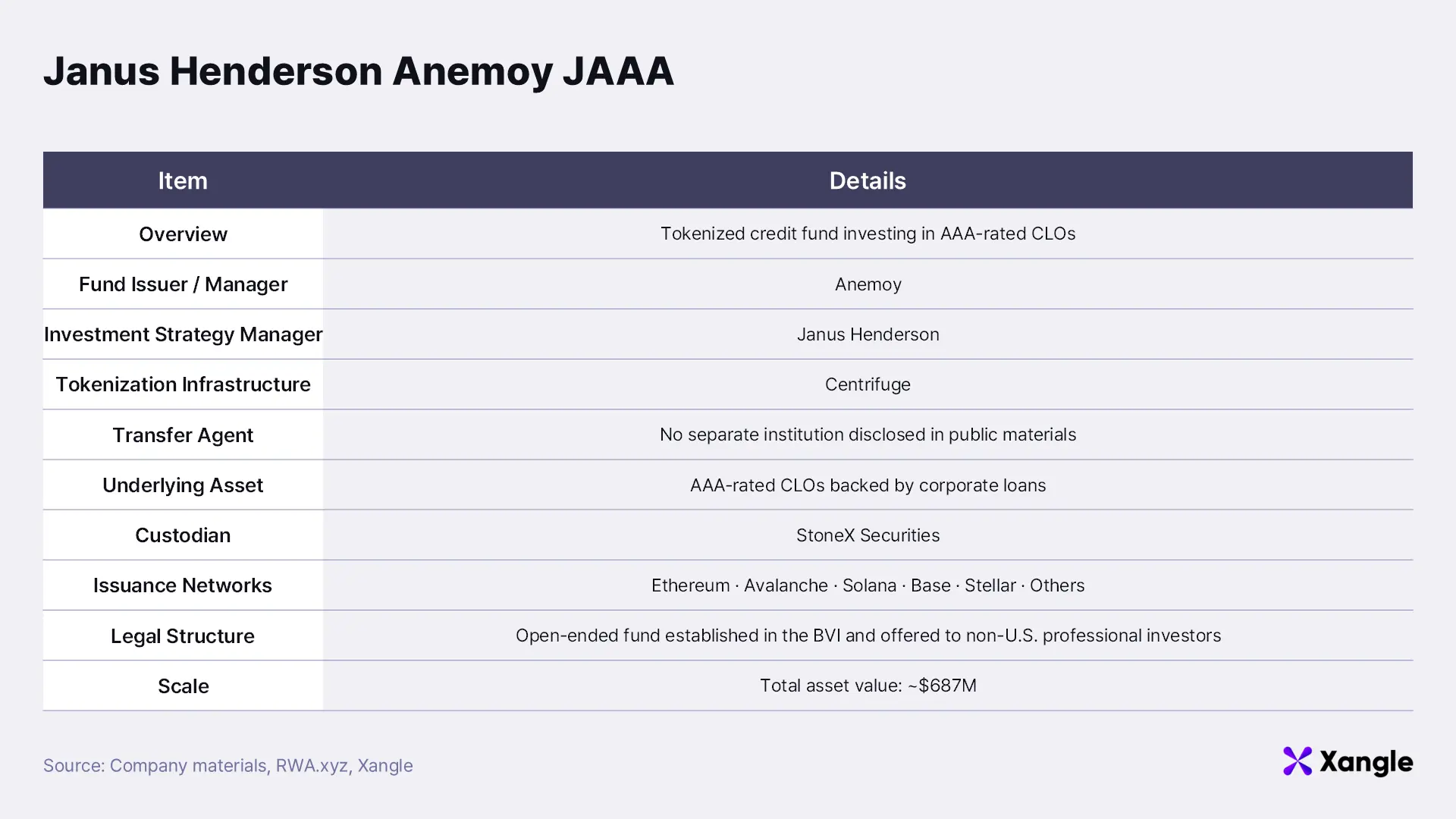
JAAA is a tokenized credit fund that invests in AAA-rated collateralized loan obligations (CLOs). A CLO is a structured credit product that pools multiple corporate loans and divides them into tranches based on repayment priority and loss absorption. JAAA invests primarily in AAA-rated CLO tranches with the highest repayment priority. It is a newly established on-chain fund that draws on Janus Henderson's existing AAA CLO strategy and investment team.
Anemoy issues and manages the fund, Janus Henderson is responsible for the investment strategy, and Centrifuge supports investor verification, subscriptions in stablecoins, token issuance, ownership records, and redemptions. The fund is an open-ended vehicle established in the BVI. Non-U.S. professional investors can submit subscriptions and redemptions daily after registering an approved wallet. JAAA has been issued on multiple networks, including Ethereum, Avalanche, and Solana, and has a total asset value of approximately $687 million.
Maple Finance: syrupUSDC and syrupUSDT
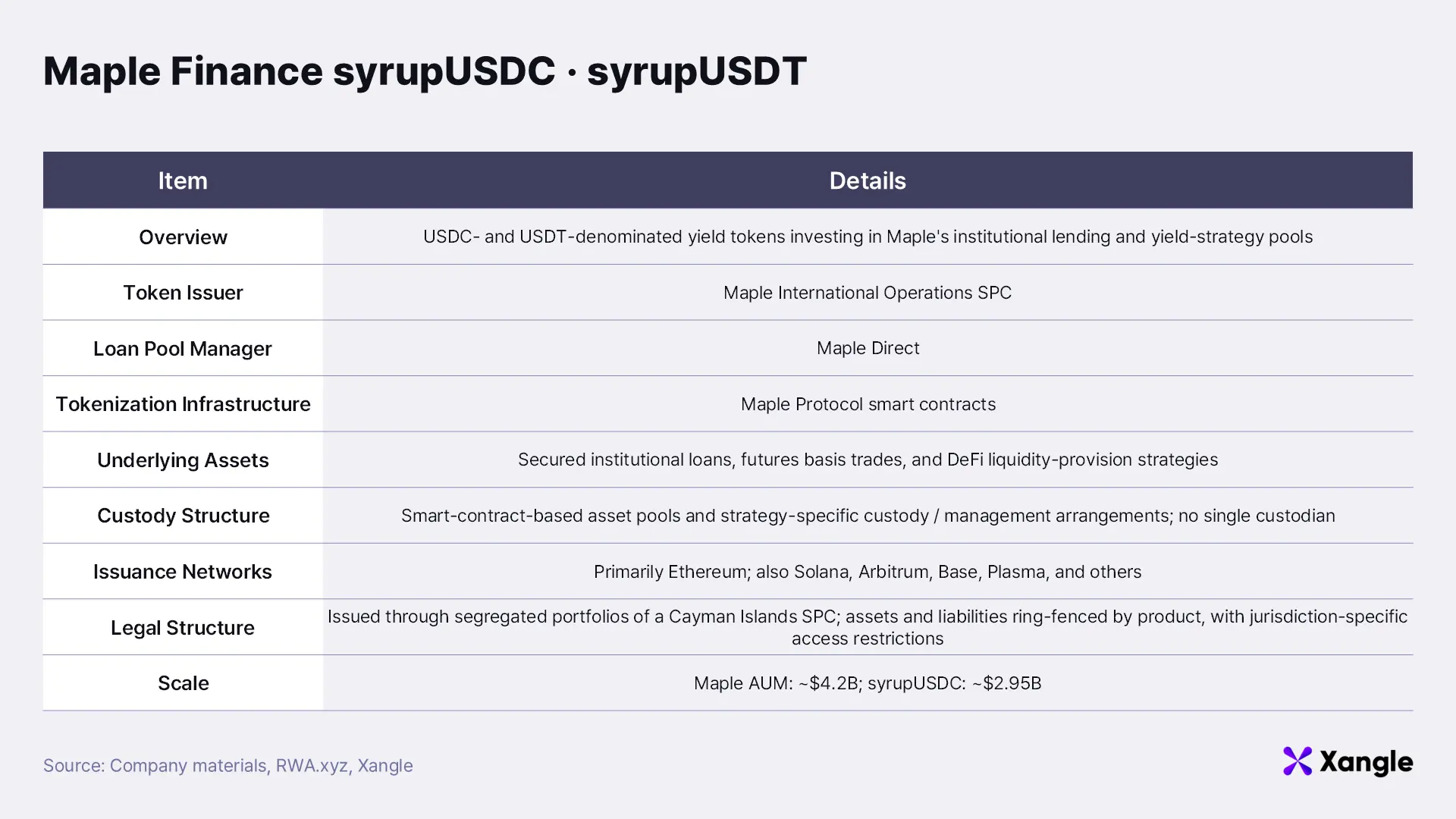
syrupUSDC and syrupUSDT are products in which investors deposit USDC or USDT and Maple deploys the capital into institutional loans and other strategies. Returns accrue in the token's value. Investors do not lend directly to individual institutions, but they hold an interest in a pool containing multiple loans and investment strategies. Because interest paid by borrowers is the primary source of returns, the products are classified as tokenized credit.
Economically, the structure resembles a credit fund that Maple creates and manages directly on-chain. ACRED and SCOPE invest in existing credit funds through separate feeder funds. By contrast, the smart contract-based asset pools behind syrupUSDC and syrupUSDT perform the role of the fund itself. Investors deposit stablecoins into the asset pool and receive share tokens, while Maple Direct underwrites, originates, and manages institutional loans using that capital.
Each asset pool uses an ERC-4626 tokenized vault structure, with deposits, ownership records, return accrual, and redemptions handled primarily through smart contracts. The legal issuer is Maple International Operations SPC in the Cayman Islands. syrupUSDC and syrupUSDT are issued through separate portfolios, which segregate the assets and liabilities of each product. Because a portion of capital is also allocated to futures basis trades and DeFi liquidity provision, these products are better understood as on-chain credit products that combine institutional lending with several return strategies rather than as pure lending products. Maple's total AUM is approximately $4.2 billion, of which syrupUSDC accounts for around $2.95 billion.
4. Korea Is Moving from Fractional Investment to a Formal Security Token Framework
4-1. Alternative Asset Tokenization Was First Tested Through Fractional Investment
Korea began experimenting with fractional investment in alternative assets before a formal security token framework was in place. Examples cited by the Financial Services Commission (FSC) include real estate for Kasa, Lucentblock (SOU), and Funble; claims on music royalty income for Musicow; loan receivables for A-Panda Partners; and aircraft engines for Galaxia Moneytree. These products have been brought into the regulated securities framework as beneficiary certificates or investment contract securities.
Korea's fractional investment policy has evolved around securities classification and investor protection. In April 2022, the FSC issued the "Guidelines on New Securities Businesses, Including Fractional Investment" and reviewed issuance and distribution structures on the premise that fractional investment products may constitute securities under the Financial Investment Services and Capital Markets Act. Some operators subsequently ran services through the financial regulatory sandbox and refined their issuance and distribution systems within the regulated securities framework.
This development parallels global alternative asset tokenization. While real estate, commodities, private credit, and collectibles have been tested globally as on-chain tokens, Korea first experimented with assets such as real estate, music rights, loan receivables, aircraft engines, and art through fractional investment and beneficiary certificate structures. The technologies and legal structures differ, but all seek to lower minimum investment sizes for expensive, illiquid assets and digitize the allocation of rights and returns.
4-2. Formalizing the Security Token Framework and the Remaining Challenges
Korea is building a legal foundation for alternative asset tokenization as it formalizes a security token framework. On January 15, 2026, amendments to the Electronic Securities Act and the Financial Investment Services and Capital Markets Act passed the National Assembly's plenary session. The amended Electronic Securities Act recognizes distributed ledgers as a means of recording rights in securities, while the amended Capital Markets Act establishes a legal basis for trading investment contract securities.
The amendments were promulgated on February 3, 2026, and are scheduled to take effect on February 4, 2027. In March 2026, the FSC launched a joint public-private Security Token Council. At its second meeting on May 15, the council discussed eligibility requirements for underlying assets, issuance disclosures, licensing for over-the-counter exchanges, infrastructure, and on-chain settlement. In a May press release, the FSC also stated that it aimed to publish draft amendments to implementing regulations and related guidelines in July 2026.
As the framework takes shape, four issues must be resolved before alternative asset tokenization can expand meaningfully in Korea. First, each product must clearly define whether its token represents ownership, equity, or income rights, and specify how rent, interest, and sale proceeds will be distributed to investors. Because many of these assets lack real-time market prices, standards are also needed for custody, valuation, and disclosure, covering custody providers, insurance, security interests, and appraisal frequency.
Secondary markets and pricing standards are also needed so issued tokens can be sold. Without sufficient liquidity, investor capital may remain locked up for long periods, while isolated transactions can distort prices. Products must also provide adequate disclosure of risks such as default, physical damage, and failed asset sales, and establish investor protection measures including segregation of assets, external audits, and controls over conflicts of interest.
5. Conclusion: Alternative Asset Tokenization Expands Across Asset Classes
The cases reviewed in this report show that alternative asset tokenization takes different forms depending on the economic characteristics of the underlying asset. Real estate and private credit are structured primarily around investment interests and rights to income, while commodity and collectible tokens reflect ownership and redemption claims tied to physical assets held in custody. Even within the same broad universe of alternative asset RWAs, the rights and cash flows represented by the token, and the way the underlying asset is managed, vary by asset class.
Businesses and institutions entering this market should first understand how each asset is currently being tokenized, then design a participation model that matches their capabilities and objectives. They may perform some functions in-house while partnering with specialized providers, or add token issuance and distribution capabilities to existing financial products. Product structures will need to evolve continuously as securities classifications, investor eligibility requirements, disclosure and custody standards, and secondary-market rules change. Investors likewise need to understand the rights granted by the token and how returns are generated, while also assessing how the underlying asset is managed and the likelihood of recovering their capital.
Among the four asset classes, private credit appears to have particularly strong growth potential. The Financial Stability Board (FSB) estimates the global private credit market at approximately $1.5 trillion to $2 trillion in 2026, while tokenized credit assets tracked by RWA.xyz stood at only about $6.93 billion as of July 21, 2026. Tokenized penetration remains low, and the contractual principal and interest cash flows generated by credit products make them well suited to digitizing investment interests and income distributions. As tokenized credit funds begin to be accepted as collateral in on-chain lending markets, their post-issuance use cases are also expanding.
Korea has already accumulated fractional investment experience across real estate, art, music rights, and loan receivables. As detailed security token rules and distribution infrastructure become clearer, that experience could extend into new assets such as private credit, intellectual property, and aircraft engines. As the number of cases grows and participation by financial institutions and investors expands, the use cases for alternative asset tokenization are likely to broaden. Over the long term, alternative asset tokenization is expected to become part of a sustainable financial ecosystem connecting regulated finance with on-chain markets.
Disclaimer
I confirm that I have read and understood the following: The information contained in this article is strictly the opinions of the author(s). This article was authored free from any form of coercion or undue influence. The content represents the author's own views and does not represent the official position or opinions of CrossAngle. This article is intended for informational purposes only and should not be construed as investment advice or solicitation. Unless otherwise specified, all users are solely responsible and liable for their own decisions about investments, investment strategies, or the use of products or services. Investment decisions should be made based on the user’s personal investment objectives, circumstances, and financial situation. Please consult a professional financial advisor for more information and guidance. Past returns or projections do not guarantee future results.
Xangle or its affiliated partners own all copyrights of the written or otherwise produced materials and content provided on the platform. Any illegal reproduction of such content, including, but not limited to, unauthorized editing, copying, reprinting, or redistribution will result in immediate legal actions without prior notice.
![[CIS Seoul Partner Summit] Anchorage Digital: A Starting Point for Institutional Digital Assets](https://resource.xangle.io/files/content/0659D651970125CC9D95F3066EACD686_1790818652341.webp)
![[CIS Partner Summit Highlights] Dinari: Bringing Tokenized Stocks to Financial Services](https://resource.xangle.io/files/content/44F77D1727A765045015596C9652011C_1789696427279.webp)