[Xangle RWA Series] Tokenized Bonds

Table of Contents
1. Tokenized Bonds: How Are They Different from Stocks?
2. Four Models of Bond Tokenization
3. On-Chain Use Cases
4. Closing Remarks: From Investment Products to Collateral Infrastructure
1. Tokenized Bonds: How Are They Different from Stocks?
Tokenized equities are drawing significant attention in today's RWA sector. On-chain activity, however, is still more heavily anchored in bonds. This also reflects the structure of traditional finance. Bonds are one of the most fundamental ways governments and companies raise capital, and government bond yields serve as reference points for pricing a wide range of financial assets. Public attention may appear to be focused on equities, but much of the market's financial infrastructure is built around bonds.
Bond tokenization has a different rights structure from stock tokenization. Stock tokens are usually analyzed through ownership, dividends, voting rights, and corporate actions. Bond tokens are analyzed through interest payments, principal repayment, maturity, and default handling. For this reason, a bond token should be evaluated by the claim it represents and the party against whom that claim can be exercised. The token may give the holder a direct claim for interest and principal against the issuer, or it may represent a claim against a fund or note issuer that holds the underlying bonds.
1-1. The Size of the Bond Market: Traditional Finance and On-Chain
The scale of the bond market also shows why bonds form part of the foundation of financial markets. According to OECD data, the global bond market, including both government and corporate bonds, reached about $109 trillion at the end of 2025. According to WFE data, the global equity market capitalization was about $152 trillion. If the credit market is expanded to include both bonds and bank loans, the number becomes even larger. Based on BIS/FRED data, outstanding credit to the G20 non-financial sector reached about $244 trillion in the fourth quarter of 2025, roughly 1.6 times the market capitalization of listed equities worldwide. The gap becomes even more pronounced when looking at the amount of new financing raised each year. In 2025, governments and companies borrowed about $27 trillion through bond markets, while global equity issuance, including IPOs and additional capital raising by listed companies, amounted to only about $638.3 billion. This is because bonds are assets that repeatedly mature and are refinanced. Governments and companies continuously issue bonds to repay existing debt and raise new capital, and the interest rates and liquidity formed through this process serve as reference points for valuing other assets.
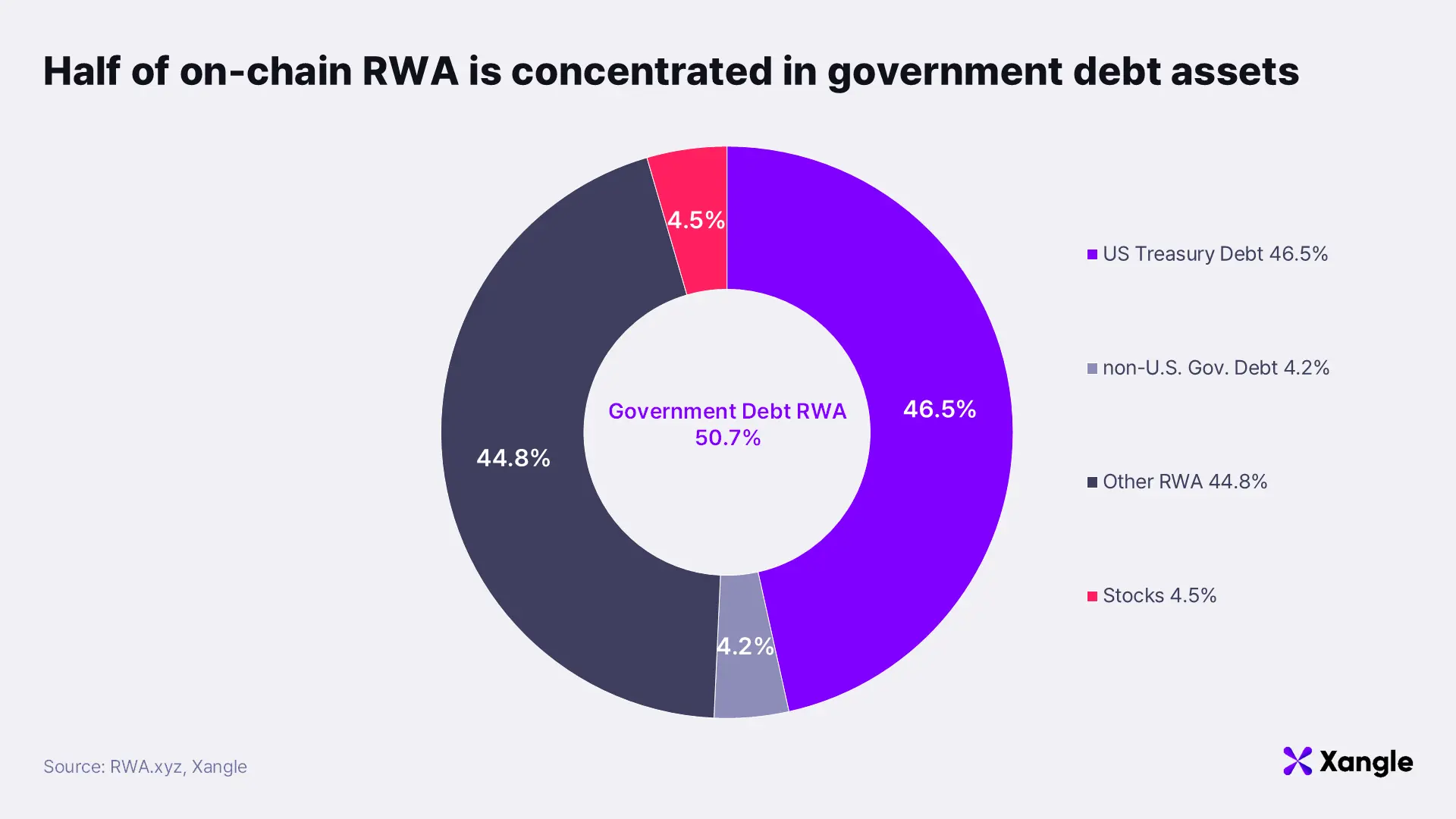
This structure is even more visible in the on-chain RWA market. According to RWA.xyz data, as of June 28, 2026, total on-chain RWA value stood at about $31.36 billion. Of this, U.S. Treasury debt accounted for about $14.59 billion, or 46.5% of the total. When about $1.32 billion of non-U.S. government debt is added, government debt RWAs reached about $15.91 billion, or 50.7% of the total. By contrast, the Stocks category stood at about $1.42 billion at the same point, or roughly 4.5% of the total. Tokenized equities have grown quickly and attracted market attention, but nearly half of the actual on-chain RWA market still remains concentrated in government bond-type assets.
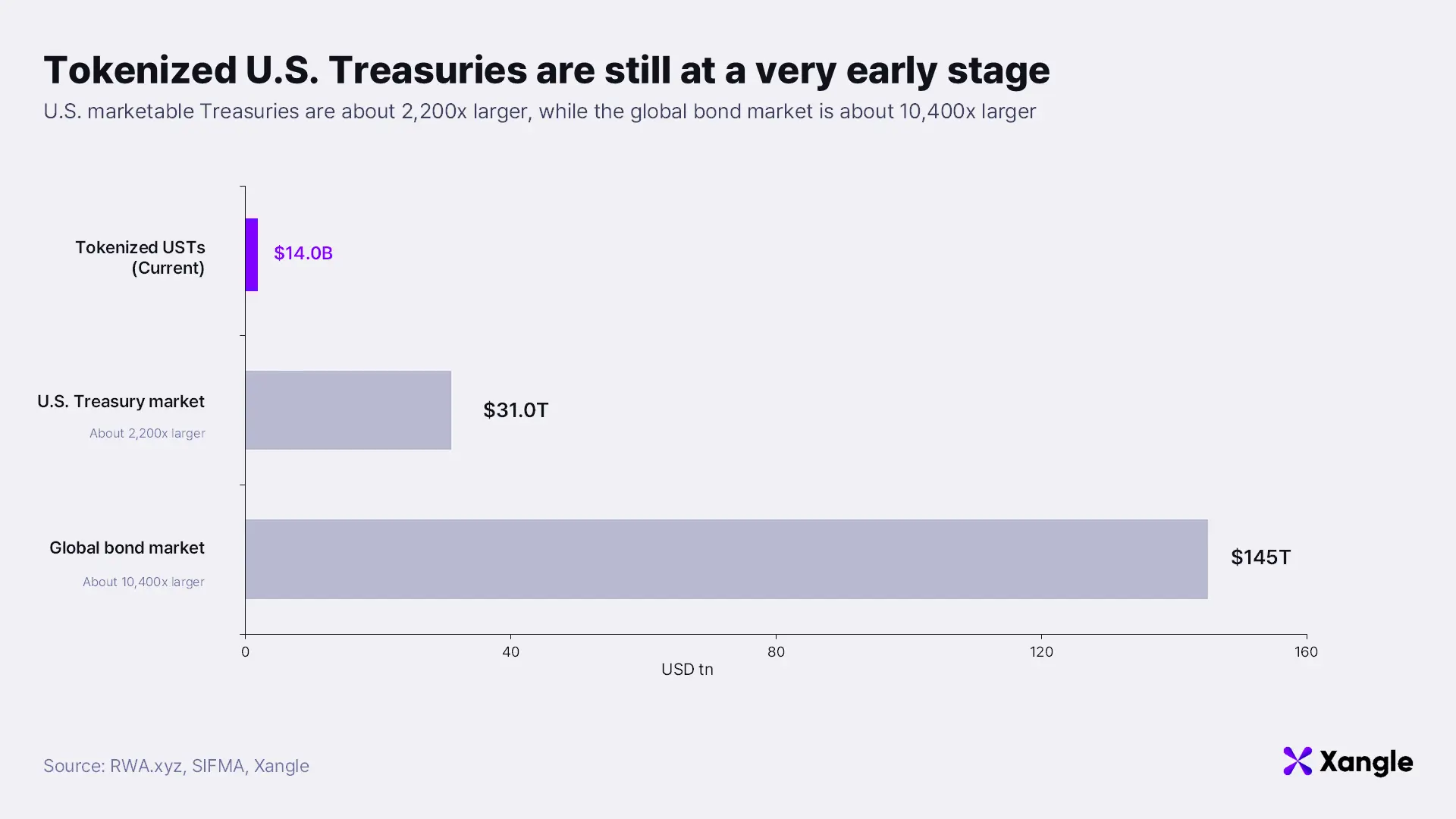
The penetration rate of on-chain tokenized bonds relative to the traditional bond market is still very low. About $14 billion of tokenized U.S. Treasuries represents less than 0.05% of the roughly $31 trillion U.S. marketable Treasury market, and around only 0.01% of the roughly $145 trillion global bond market. Even so, Treasury-type RWAs have become the center of the market first because their use cases are clear. Short-term Treasury products have relatively low credit risk, generate interest, and are denominated in dollars, which allows them to connect naturally with stablecoin liquidity. For on-chain investors, they become yield-bearing assets for idle stablecoins. For institutions, they become digital assets that can be used for short-term cash management and collateral management. As a result, bond tokenization in today's RWA market is expanding beyond a simple investment product into cash management and collateral infrastructure for on-chain finance.
1-2. The Starting Point of Bond Tokenization: The Rights Represented by the Token
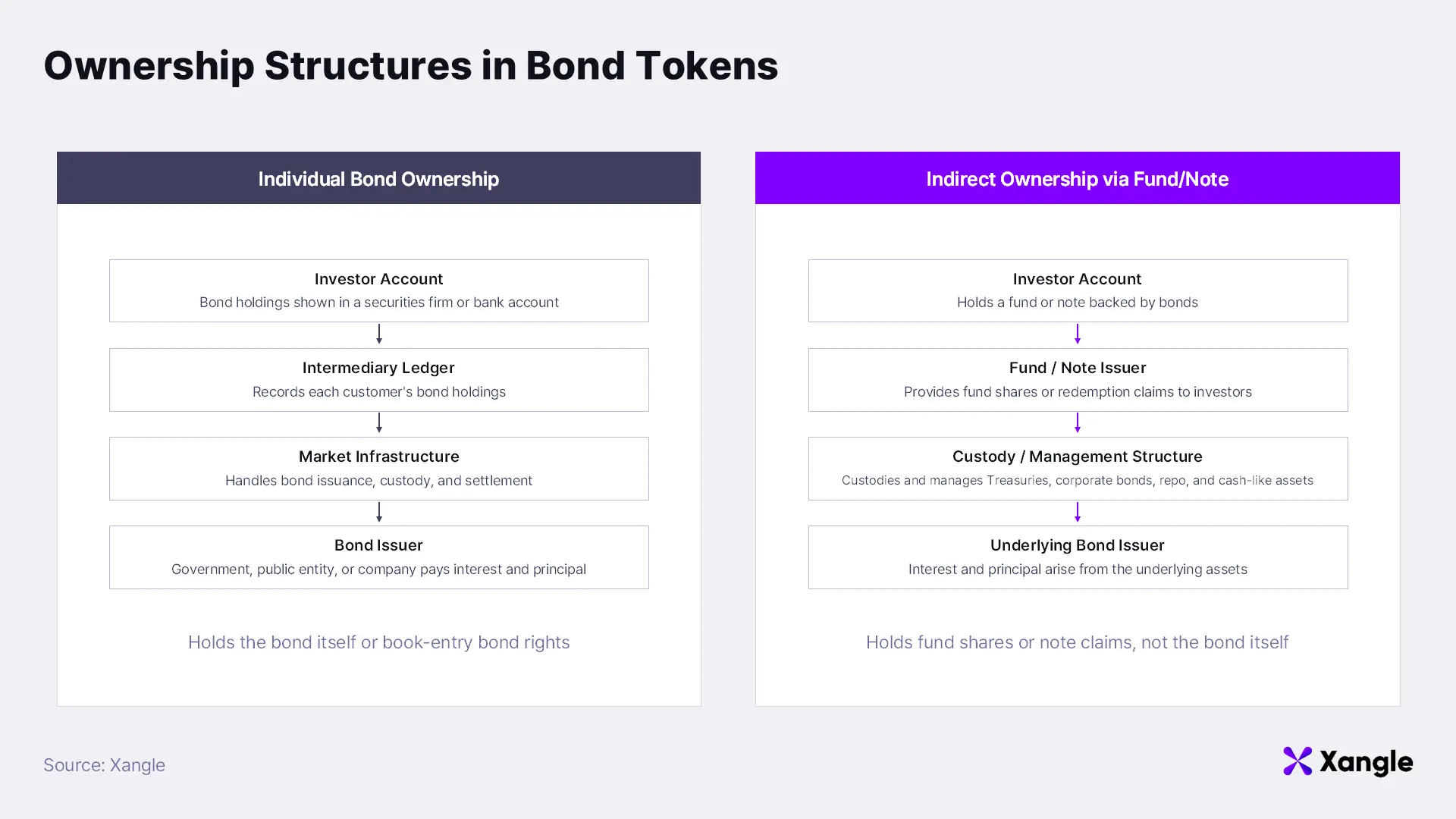
To understand bond tokenization, the first question is where the bond or related claim is recorded, and who the investor can ultimately claim against. This research covers government bonds, corporate bonds, and fund or note-type products that hold these assets. Even when tokens are based on the same type of bond, the rights investors hold, the way those rights are exercised, and the risks involved differ depending on the records and claims connected to the token.
The first way to gain bond exposure is direct ownership of an individual bond. When an investor buys a government bond or corporate bond through a securities firm or bank, that bond position appears in the investor's account. The securities firm or bank records each customer's holdings on its own books, and the position behind that record is connected to the market infrastructure responsible for issuance, custody, and settlement of the bond. The exact ledger structure differs by country and bond type, but in general, investors exercise rights such as receiving interest, receiving principal at maturity, selling, and transferring the bond through the rights recorded in the account at the intermediary they used for the transaction.
In this structure, investors look to the issuer of the underlying bond for interest and principal. If it is a government bond, the government has the obligation to pay interest and principal. If it is a corporate bond, the company or financial institution has that obligation. However, investors are only rarely listed directly on the issuer's books. In practice, rights are processed through multiple institutions, including securities firms, banks, custodians, depositories, paying agents, and trustees. Structures that issue bonds directly as digital securities, or direct issuance models, and structures that represent existing book-entry bond positions on-chain, or Security Entitlement models, are linked to this individual bond ownership structure.
The second way is indirect ownership through a fund or note. Investors can also hold shares or claims in products that contain multiple bonds or cash-like assets, such as money market funds, bond funds, short-term Treasury funds, and tokenized notes. In this structure, the claim is against the fund, asset manager, special purpose vehicle, or note issuer. Returns are reflected through mechanisms such as fund distributions, increases in net asset value, increases in the token reference price, or redemption payments.
This indirect ownership model is also the structure most commonly used in today's on-chain bond RWA market. Fund and note structures buy, custody, and manage the underlying bonds within existing financial markets, while providing investors with shares or claims in token form. This means the issuance and settlement structure of the underlying bonds does not need to be rebuilt. Instead, the records of fund shares or note holdings can be connected to an on-chain ledger. For this reason, short-term Treasury funds and notes, which already have established processes for management, custody, valuation, redemption, and investor verification, have spread quickly as on-chain cash management products.
When evaluating bond tokenization, it is necessary to check not only the type of underlying asset, but also the legal and economic claim recorded by the token. The investor's counterparty and risk profile vary depending on whether the token evidences the individual bond itself, a bond position recorded on a depository or custody ledger, a fund share, or a redemption claim against a note issuer. The differences among the direct issuance model, Security Entitlement model, fund share model, and linked securities model discussed below all begin with this rights structure.
This research classifies bond tokenization structures based on the ledgers and rights to which the token is connected. For individual investors, it aims to provide a framework for understanding the structure and risks of bond tokens. For RWA businesses, it aims to offer perspectives needed when designing issuance, custody, and distribution structures.
2. Four Models of Bond Tokenization
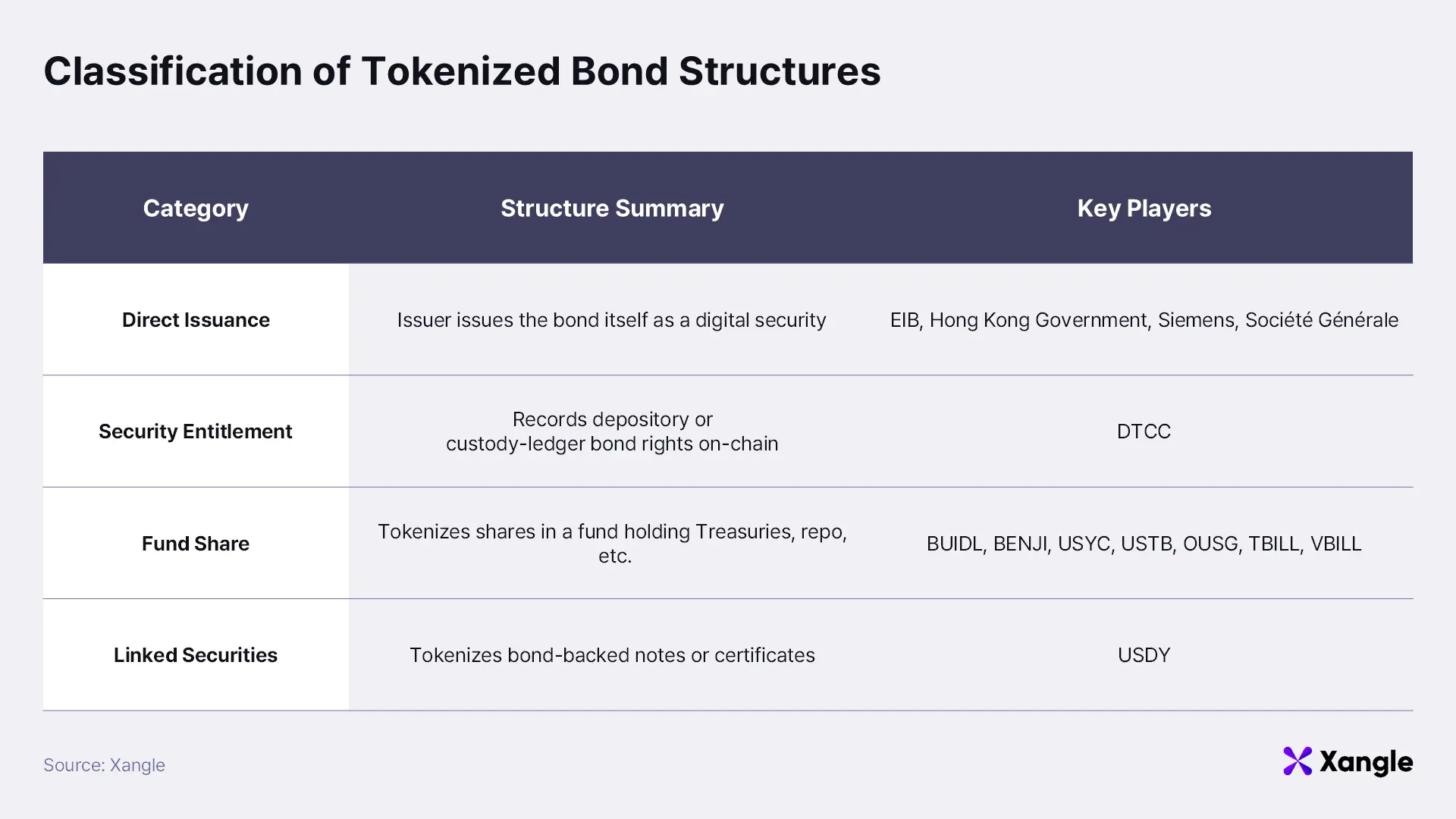
In the previous research on stock tokenization, tokenized stocks were divided into five categories based on the issuer and the way rights are structured. Bond tokenization can be divided into four categories based on the claim recorded by the token and the party responsible for that claim. The first is the ① direct issuance model, where the bond itself is issued as a digital security and the investor directly claims interest and principal from the issuer. The second is the ② Security Entitlement model, where rights to bonds that already exist on depository or custody ledgers are recorded on-chain. The third is the ③ fund share model, where a fund holds bonds and the token records shares in that fund. The fourth is the ④ linked securities model, where a third-party issuer issues a separate linked security based on bonds, and investors hold a claim against that issuer. These four models differ by whether the token is the bond itself or a right layered on top of a bond, and by the party responsible for the investor's claim.
2-1. Direct Issuance Model
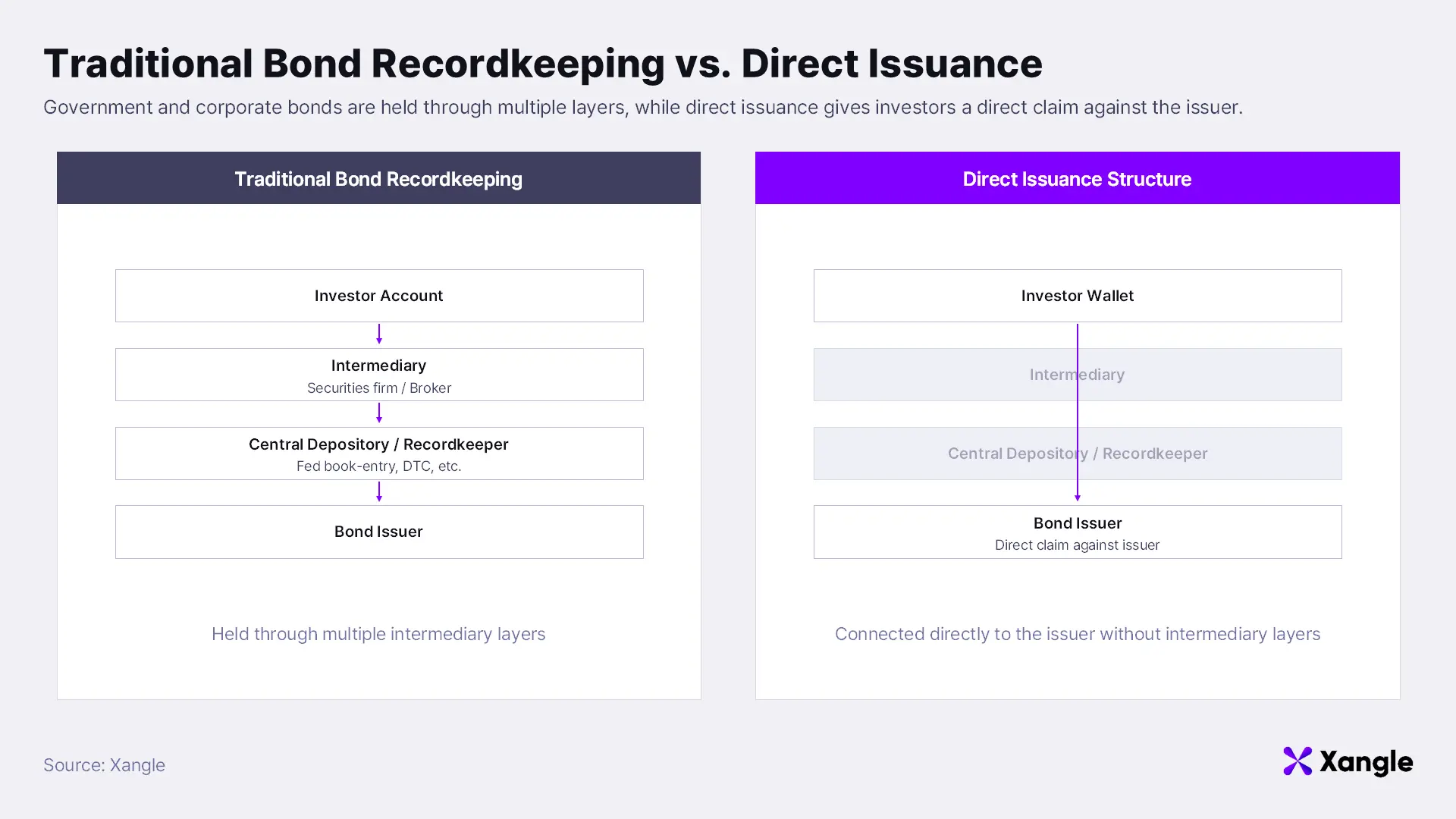
Under the direct issuance model, the bond itself is issued as a digital security on a distributed ledger. By holding the token, investors directly hold a claim against the issuer for interest and principal. This model can be divided into native digital bonds, which are issued in digital form on a distributed ledger from the outset, and tokenized traditional bonds, where an already-issued traditional bond is immobilized and a corresponding token is issued. In both cases, the token evidences the bond right itself.
The direct issuance model has become possible because legal frameworks have developed. Germany's Electronic Securities Act permits the issuance of crypto securities managed on distributed ledgers, while Switzerland and Luxembourg have also established legal foundations that allow the issuance, recording, and transfer of digital securities within the regulated financial system. On top of these frameworks, the direct issuance model can reduce the need to print and custody physical certificates, shorten issuance and settlement procedures, and reduce settlement failure risk through delivery-versus-payment processing. Since these bonds are connected to actual bond rights, however, directly issued digital bonds are generally operated with conditions such as qualified investors, approved wallets, and jurisdictional restrictions. So far, many cases have been one-off issuances or limited institutional transactions, and there have not yet been many examples that expanded into active secondary markets.
Direct issuance can be divided by issuer type into government and public-sector bonds, and corporate bonds. Government and public-sector examples include Hong Kong's tokenized green bonds and EIB digital bonds, where a government or public-sector issuer issued the bond itself in digital security form. Corporate examples include digital corporate bonds issued by ordinary companies, such as Siemens digital bonds, and digital debt securities issued by financial institutions, such as Société Générale's U.S. digital bond. These can all be viewed as direct issuance examples because they are designed so investors hold the right to interest and principal repayment on the issued bond itself on a digital ledger, without going through a fund or SPV.
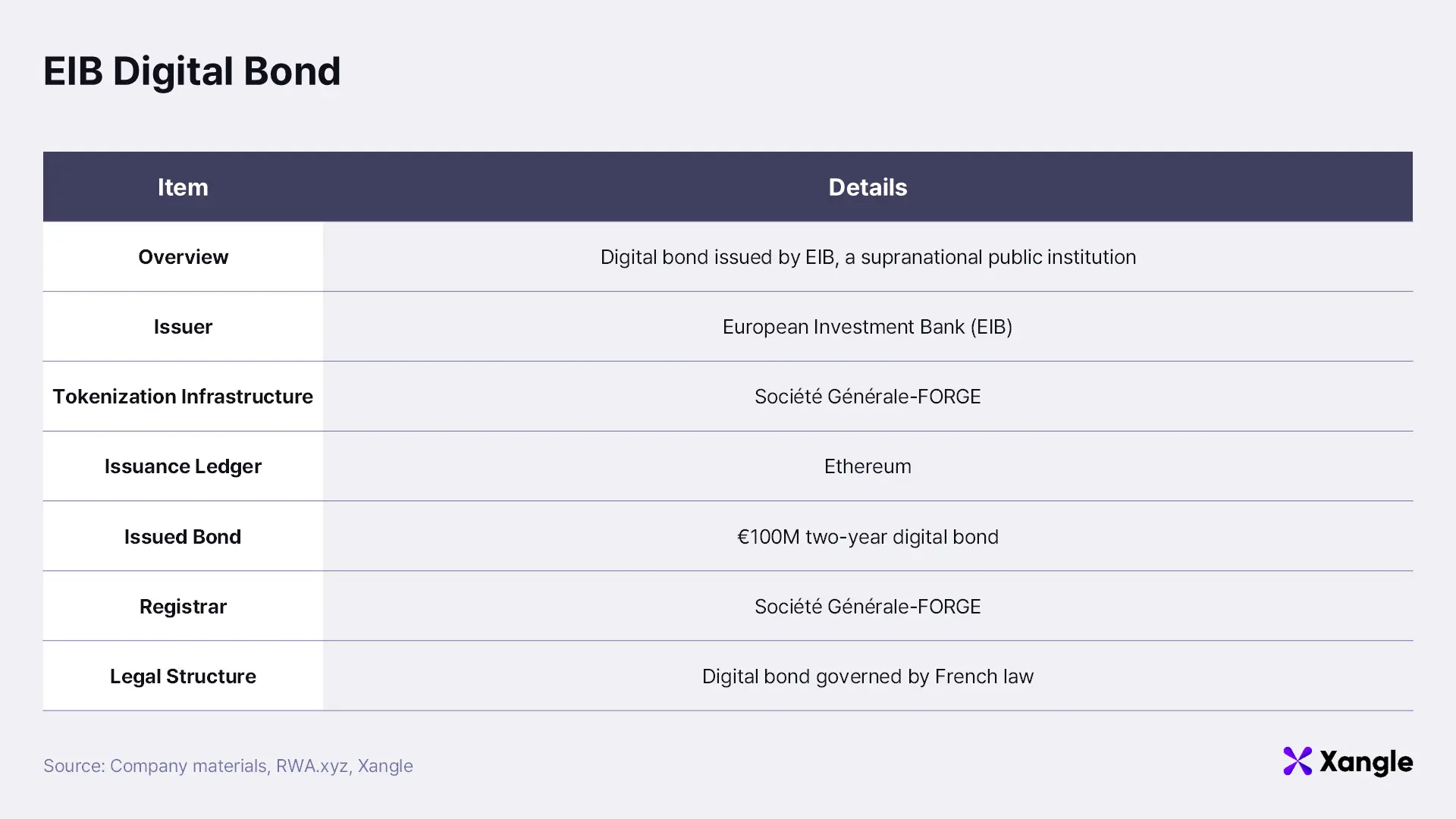
European Investment Bank (EIB) Digital Bond
The European Investment Bank, or EIB, is a policy finance institution jointly owned by EU member states. It provides long-term funding to projects connected to Europe's policy goals, including infrastructure, climate, innovation, SMEs, and sustainable finance. EIB is a major supranational issuer that raises large-scale funding in traditional bond markets, and it has also experimented with the digitalization of capital market infrastructure through digital bond issuance.
In April 2021, EIB issued a two-year digital bond of about €100 million on the public Ethereum blockchain. This is considered the first digitally native bond issuance using a public blockchain. The issuance proceeds were settled on-chain through an experimental central bank digital currency project by the Banque de France, and settlement that typically takes several days was shortened to one day. EIB has since continued issuing digital bonds in multiple currencies, including a private blockchain-based euro bond in 2022 and a sterling bond in 2023.
Hong Kong Government Digital Green Bonds
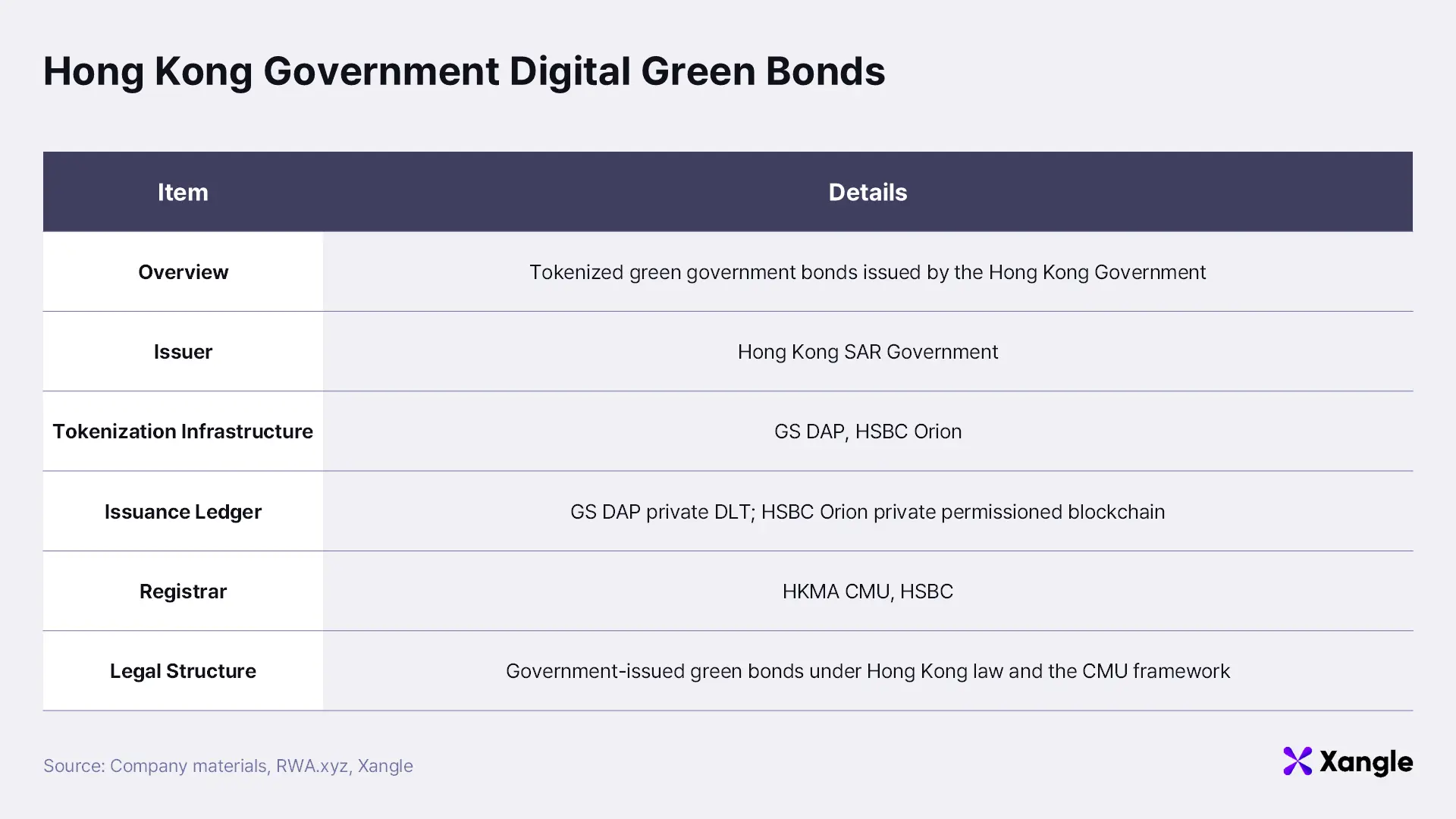
The Hong Kong government issued its first tokenized green bond in 2023 and continued issuing digital green bonds in 2024 and 2025. Green bonds are issued to use the proceeds for environmental and climate-related projects. As with ordinary government bonds, investors hold claims against the issuer for interest and principal repayment.
In the first issuance, Goldman Sachs Digital Asset Platform, or GS DAP, was used as the tokenization infrastructure, and the bonds were issued and recorded on GS DAP's private DLT. In the 2024 and 2025 issuances, HSBC Orion was used as the tokenization infrastructure, and the bonds were issued and recorded on HSBC Orion's private permissioned blockchain. Clearing and settlement were processed through the Central Moneymarkets Unit, or CMU, operated by the Hong Kong Monetary Authority, and HSBC acted as the bond registrar, managing holder records and transfer procedures.
Siemens Digital Bonds
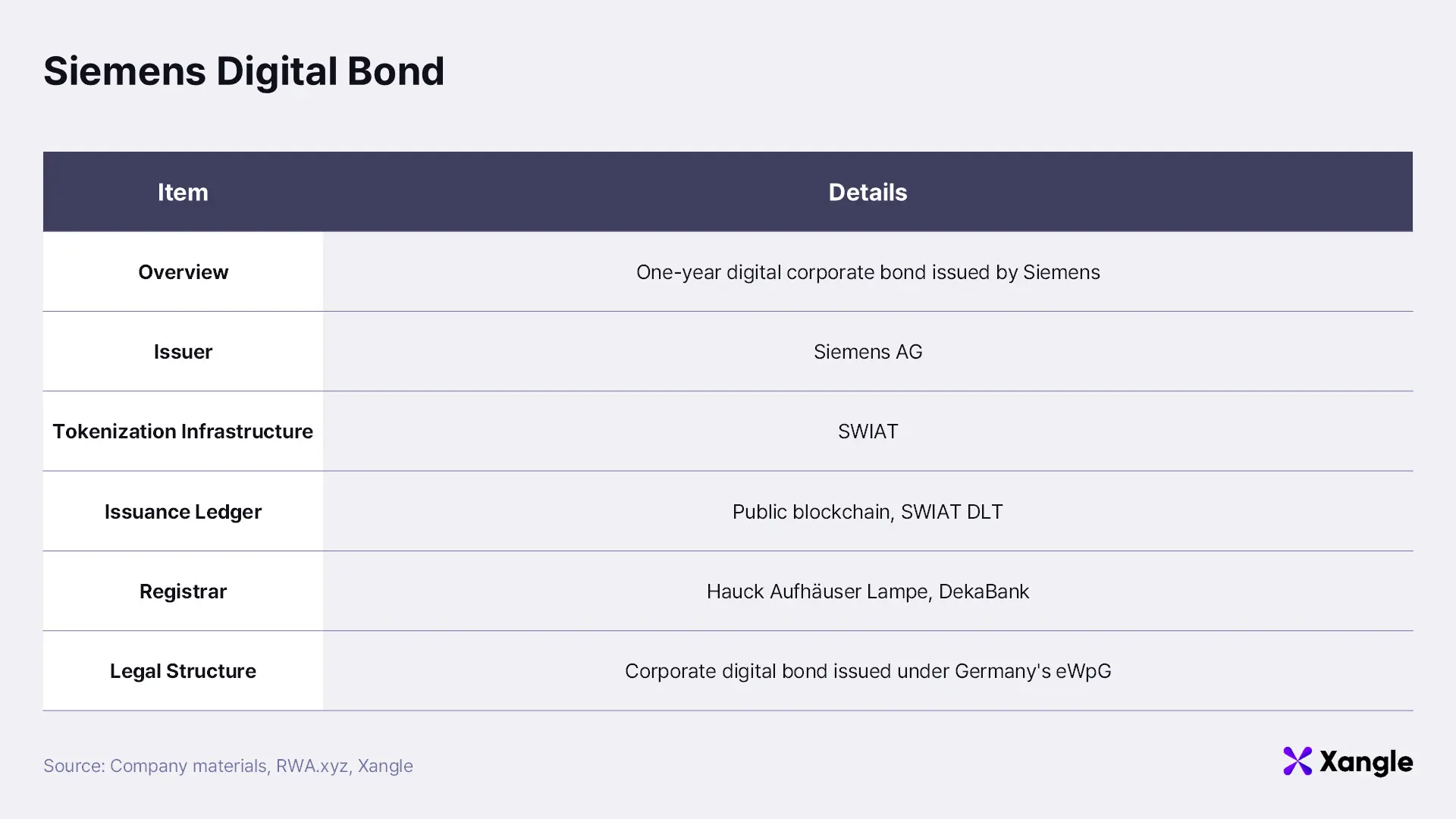
Siemens is a representative corporate bond case in which bonds were issued directly on a distributed ledger under Germany's Electronic Securities Act, or eWpG. In February 2023, Siemens issued a one-year digital bond of about €60 million on a public blockchain, with Hauck Aufhäuser Lampe serving as the bond registrar responsible for managing holder records and transfer procedures.
In September 2024, Siemens issued an additional one-year digital bond of €300 million. In the second issuance, Secure Worldwide Interbank Asset Transfer, or SWIAT, was used as the tokenization infrastructure, and the bond was issued and recorded on SWIAT's private permissioned blockchain. DekaBank served as the bond registrar.
Société Générale U.S. Digital Bond
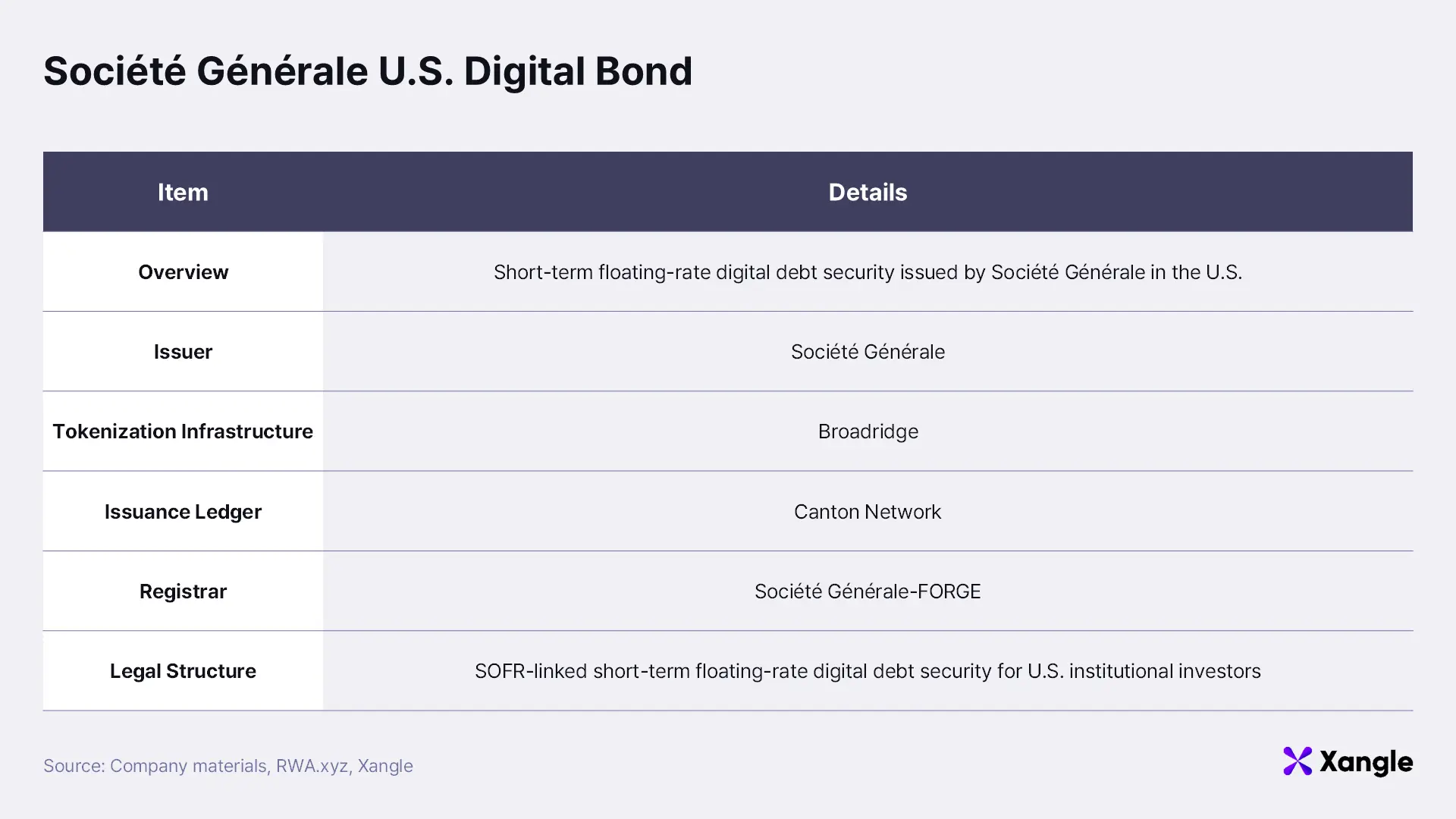
Société Générale is a large European financial group headquartered in France, with businesses spanning corporate finance, investment banking, asset management, and retail banking. In November 2025, Société Générale completed a digital bond issuance in the United States. The bond was a short-term floating-rate debt security linked to SOFR, and it was purchased by DRW, an institutional investor.
Broadridge's tokenization infrastructure was used for the token issuance, and the bond was issued and recorded as a security token on Canton Network, the issuance and recordkeeping ledger. As in the EIB case, Société Générale's digital asset subsidiary, Société Générale-FORGE, or SG-FORGE, served as the registrar, while BNY participated as the paying agent.
Public-sector digital bond experiments began even earlier. Before EIB, the World Bank issued bond-i in 2018, a bond issued and managed using blockchain technology, which became an early example of blockchain-based bond issuance. However, early issuances by international organizations such as the World Bank and EIB largely remained limited issuances for regulated institutional investors. Although they demonstrated the potential for greater efficiency in issuance and settlement, they did not expand into free on-chain transferability or DeFi use.
2-2. Security Entitlement Model
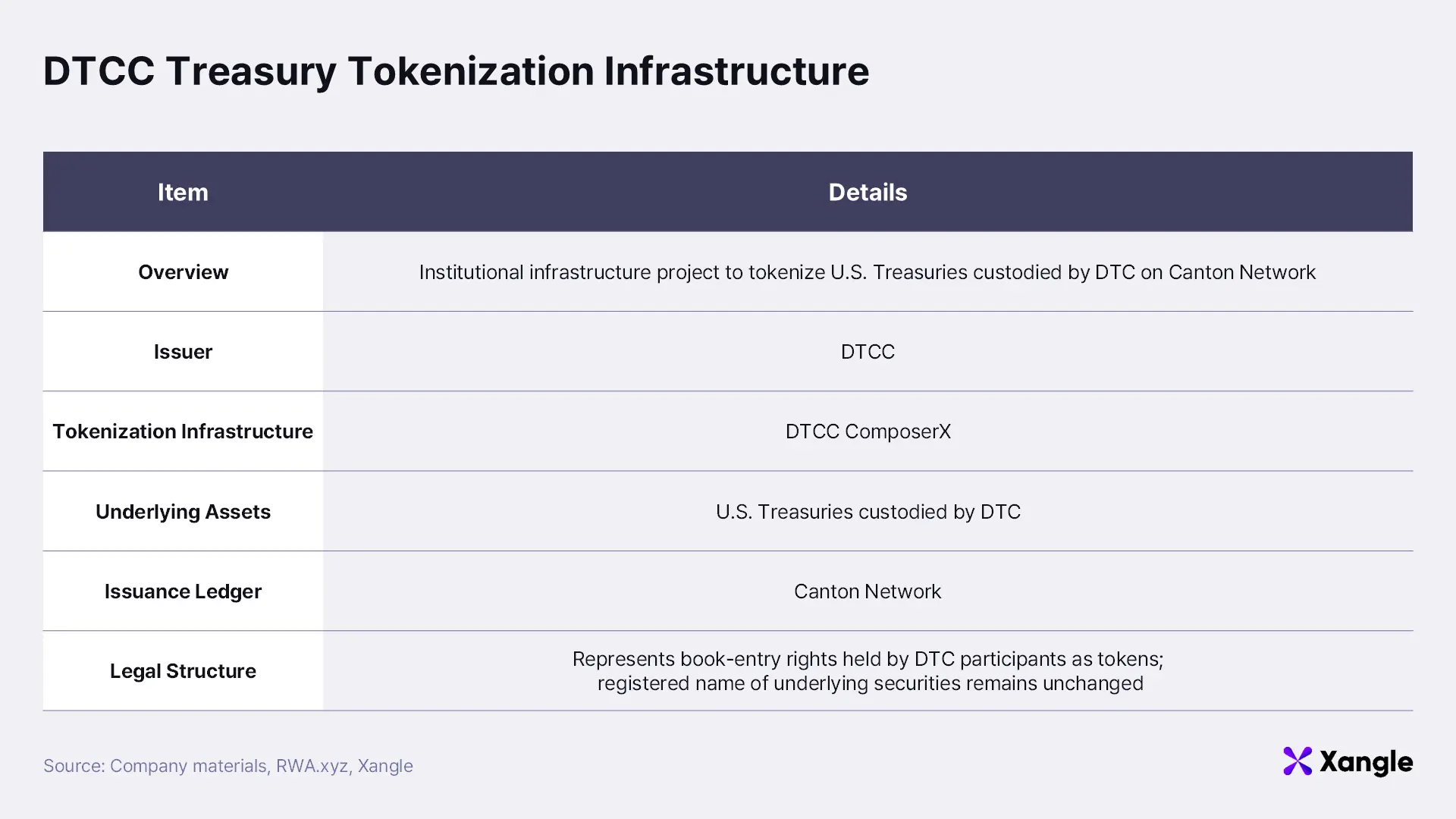
The Security Entitlement model does not issue a new fund or note. It records bond rights that already exist on the books of a central securities depository or custodian as tokens or on-chain records. Unlike direct issuance, where the bond itself is newly issued, the registered name of the underlying security remains within the existing custody system. The change occurs at the level of how the security entitlement is recorded and transferred. This is essentially the same structure as the Security Entitlement model in stock tokenization, where rights recorded on securities firm or depository ledgers are connected to the on-chain environment. Large-scale commercialization has not yet emerged, and most activity remains at the level of regulated infrastructure experiments. The representative example is DTCC's tokenization project in the United States.
DTCC
Through the tokenization service of its subsidiary, The Depository Trust Company, or DTC, DTCC is developing institutional tokenization infrastructure that allows securities custodied by DTC to be used on-chain. After receiving an SEC no-action letter in December 2025, DTCC announced a project with Digital Asset to tokenize U.S. Treasuries held in DTC custody on Canton Network. DTCC later also announced a partnership with the Stellar Development Foundation, or SDF, presenting a multichain strategy that starts with Canton Network and expands to multiple networks, including Stellar.
In this structure, the underlying U.S. Treasuries remain within the existing DTC custody system, while corresponding tokenized representations are created on approved blockchain networks such as Canton Network. This makes it possible to transfer and use rights recorded on DTC's books on-chain and to exchange them with stablecoins and similar assets in near real time. DTCC plans to begin limited live transactions in July 2026 and aims to launch the service in October 2026.
2-3. Fund Share Model
The fund share model is currently the most commonly used structure in the bond tokenization market, and it is also the structure with the fastest accumulation of real use cases. A fund holds government bonds, short-term Treasuries, repo, money market funds, or similar assets, and the token records shares in that fund. The investor's claim is against the fund. Holding the token is equivalent to holding a share in that fund.
This model has spread quickly because it allows on-chain products to be created without significantly changing existing financial structures. To issue an individual government or corporate bond directly as a digital bond, the issuer, registrar, settlement infrastructure, investor requirements, and distribution structure all need to be coordinated. The fund share model does not newly issue the underlying bonds as digital securities, so the management and custody of the bonds are handled within existing fund infrastructure. For this reason, the fund share model is easier to implement using existing financial structures than direct issuance of individual bonds, and it has become the most widely used approach in today's on-chain bond RWA market.
The fund share model is also actively used on-chain. Tokenized fund shares can be used not only for wallet-to-wallet transfers, but also as DeFi collateral, exchange margin collateral, and stablecoin reserve assets. Funds backed by U.S. Treasuries and repo in particular have relatively low credit risk and high liquidity, and they are widely used in traditional finance as collateral assets and short-term liquidity management tools. These characteristics carry over to the on-chain environment. Investors can hold cash-like products that provide yields close to Treasury yields and also reuse them as collateral or reserve assets. This is why today's on-chain bond RWA market is growing around structures that tokenize shares in funds holding bonds, rather than structures that issue individual bonds directly.
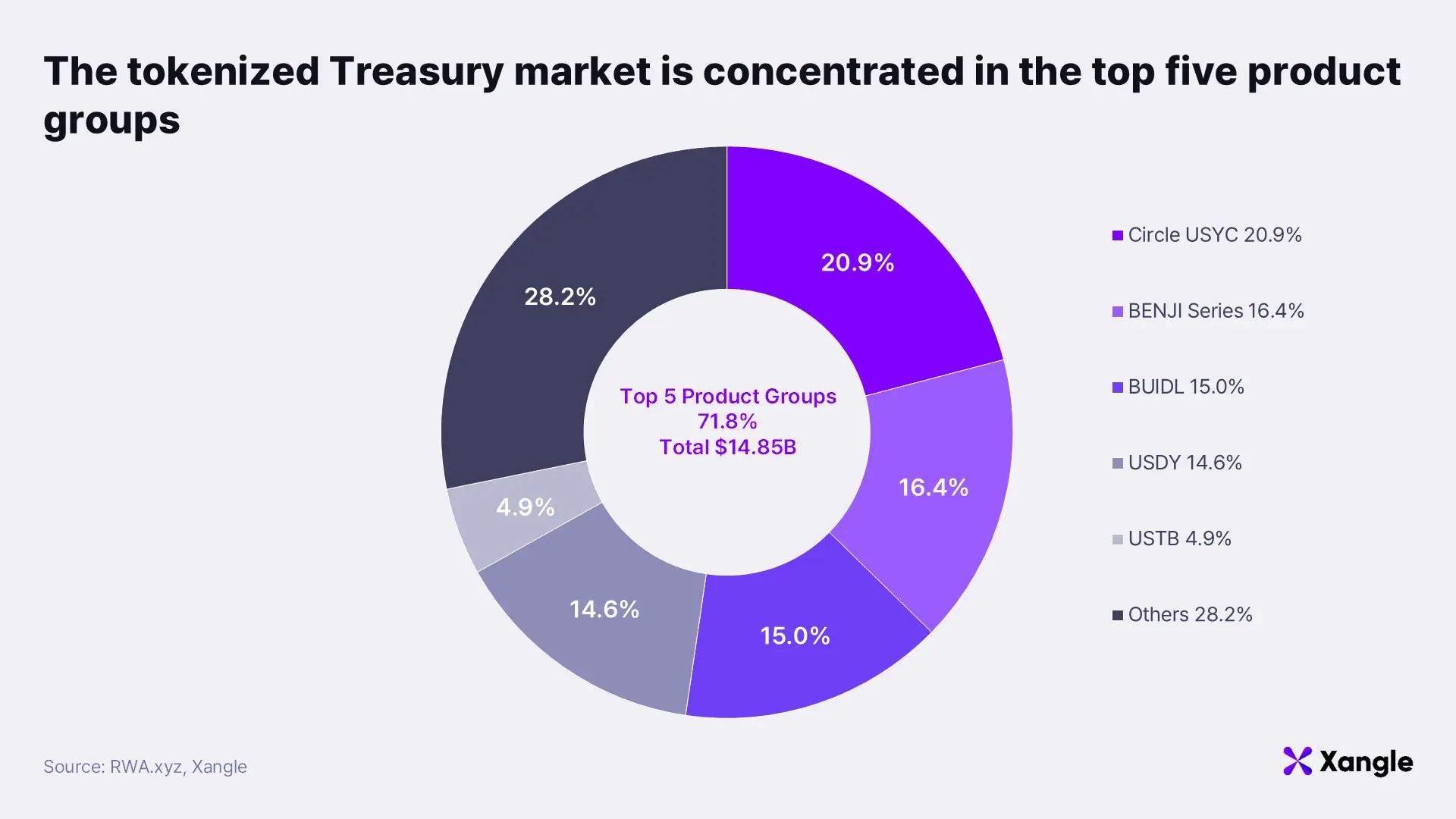
Unless otherwise noted, product sizes in this section are based on RWA.xyz data as of July 1, 2026. As of that date, the tokenized Treasury product market stood at about $14.85 billion. Five product groups, Circle USYC, the BENJI series, BUIDL, USDY, and USTB, accounted for 71.8% of the total, showing a high level of market concentration. USYC, the BENJI series, BUIDL, and USTB are fund share products based on Treasuries, repo, and money market-type assets, and a significant portion of the current tokenized Treasury market is formed within this structure. USDY, by contrast, has a different character because it is structured as a tokenized note backed by short-term Treasuries and bank deposits. It is discussed separately in section 2-4, the linked securities model.
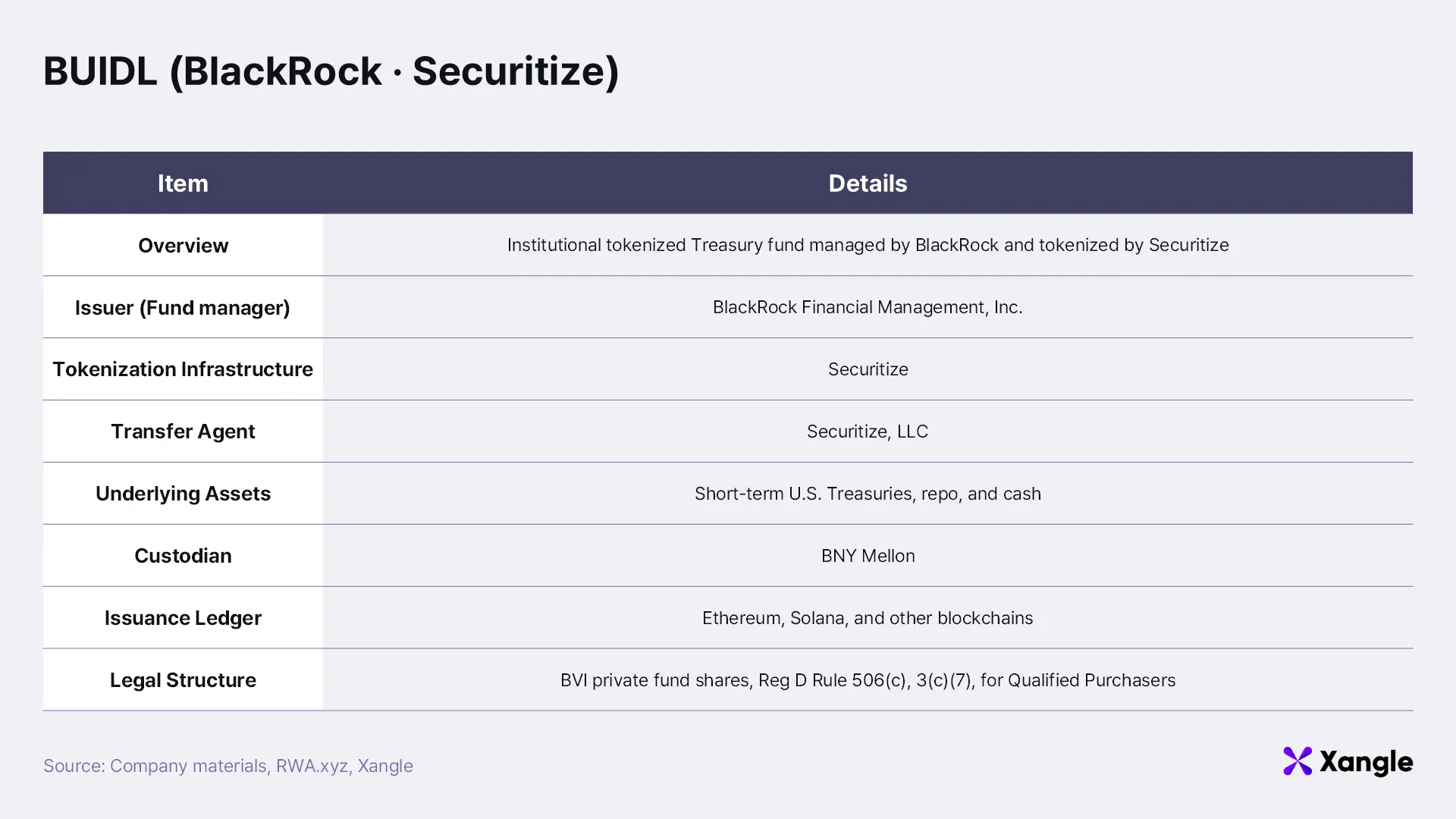
BUIDL (BlackRock · Securitize)
BUIDL is an institutional tokenized Treasury fund managed by BlackRock and tokenized by Securitize. Its formal name is the BlackRock USD Institutional Digital Liquidity Fund, and the fund invests in cash, short-term U.S. Treasuries, and repurchase agreements. BUIDL is designed so that each token remains close to $1 in value. Income generated by the fund accrues daily and is distributed monthly to investor wallets in the form of newly issued BUIDL tokens. BUIDL is structured as a private offering based on a Regulation D exemption under U.S. securities law and is offered to Qualified Purchasers. Securitize acts as transfer agent and paying agent, while BNY Mellon handles fund administration and traditional financial infrastructure.
BUIDL is a representative example of a fund share product expanding into an on-chain collateral asset. BUIDL is deployed across multiple blockchains and can be used as trading collateral on Crypto.com and Deribit, and as off-exchange collateral on Binance. Investors can earn Treasury-based yield while also using the token as trading collateral. As of that date, BUIDL's size was about $2.23 billion, accounting for about 15.0% of the tokenized Treasury product market.
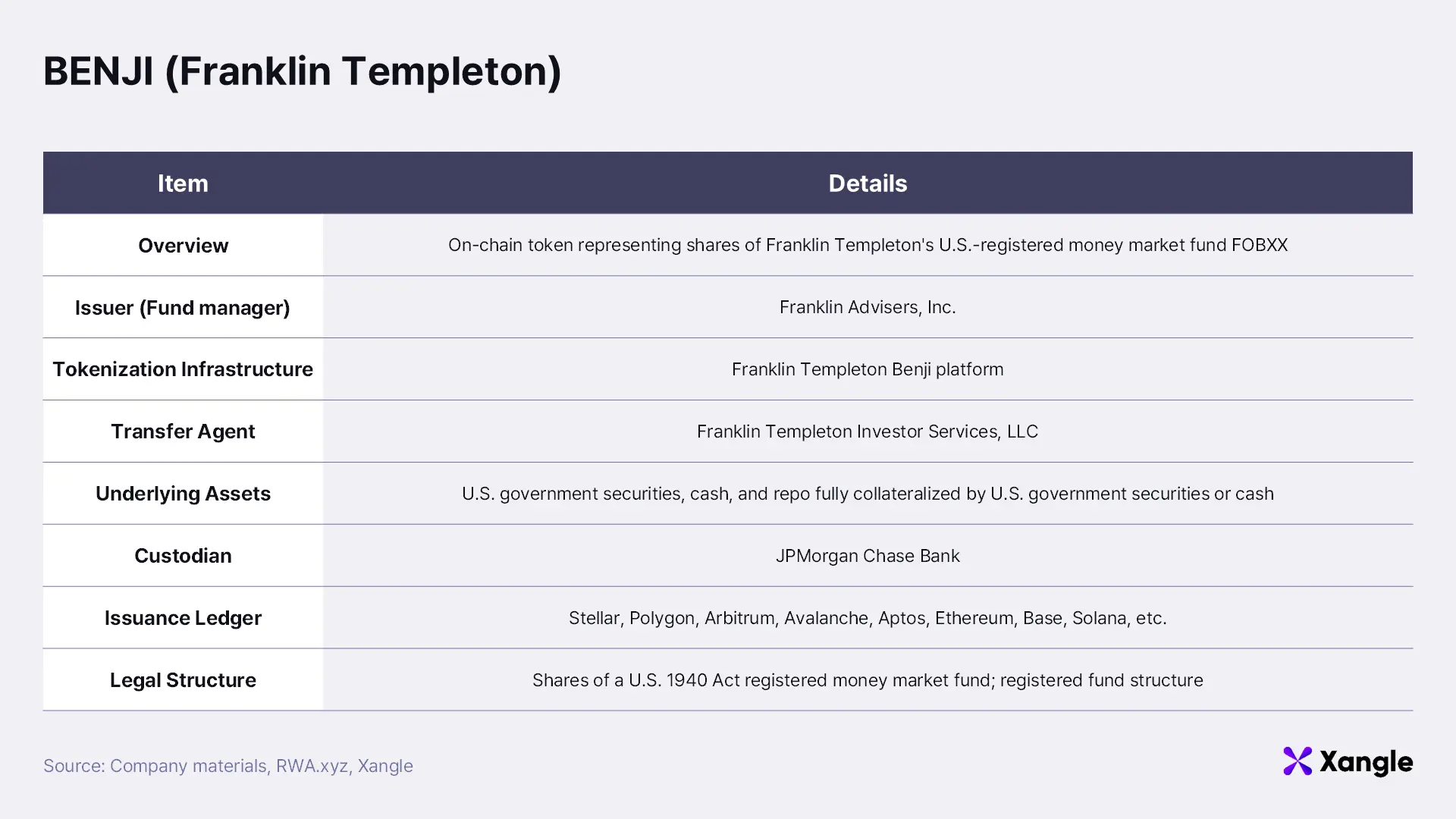
BENJI Series (Franklin Templeton)
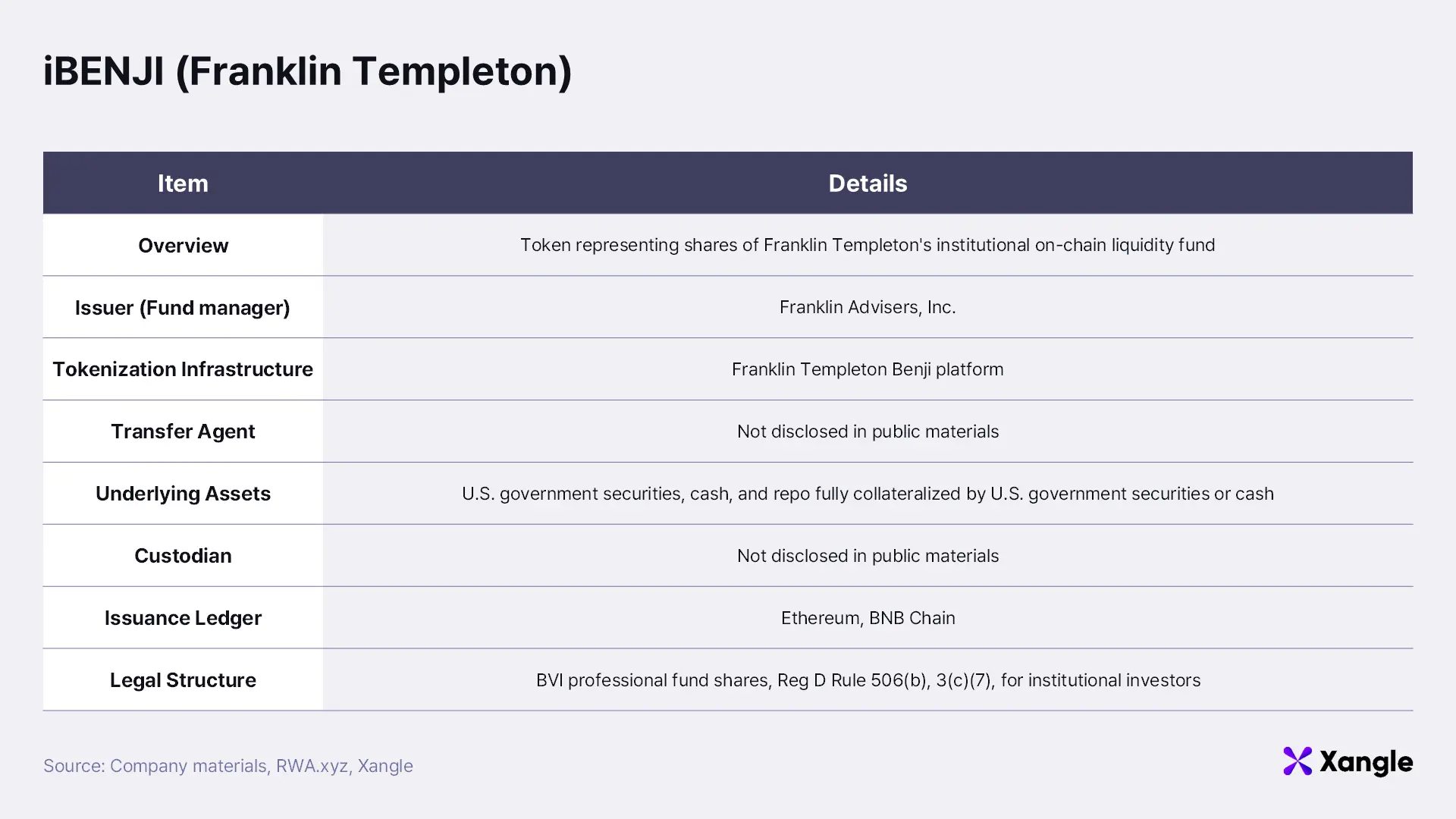
Franklin Templeton's Benji series is a representative example of how fund share tokenization connects to regulated fund ledgers. The series can be divided into BENJI, the token for shares in a U.S.-registered money market fund, and iBENJI, the token for shares in an institutional liquidity fund. Launched in 2021, BENJI records shares of the Franklin OnChain U.S. Government Money Fund, or FOBXX. FOBXX is a U.S.-registered money market fund that invests at least 99.5% of its assets in U.S. government securities, cash, or repurchase agreements fully collateralized by U.S. government securities or cash. The transfer agent for FOBXX is Franklin Templeton Investor Services, LLC, which manages the official share ownership record.
iBENJI belongs to the same Benji series, but it is a separate institutional product. iBENJI records shares in Franklin OnChain Institutional Liquidity Fund Ltd. Unlike BENJI, it is not a U.S.-registered fund, but a BVI-based money fund structured as a Regulation D exempt product under U.S. securities law. In other words, both BENJI and iBENJI are fund share structures based on Treasuries, cash, and repo, but the underlying funds, target investors, and legal jurisdictions differ. BENJI records shares of FOBXX, a U.S.-registered money market fund, on-chain. iBENJI records shares of an institutional liquidity fund on-chain.
As of that date, Franklin Templeton's Benji series had a combined size of about $2.44 billion. Of this, iBENJI accounted for about $1.59 billion, while BENJI accounted for about $750 million. This shows that Franklin Templeton's tokenized fund strategy began with a U.S.-registered money market fund accessible to retail and institutional investors and is expanding into an institutional-only on-chain liquidity fund.
USYC (Circle · Hashnote)
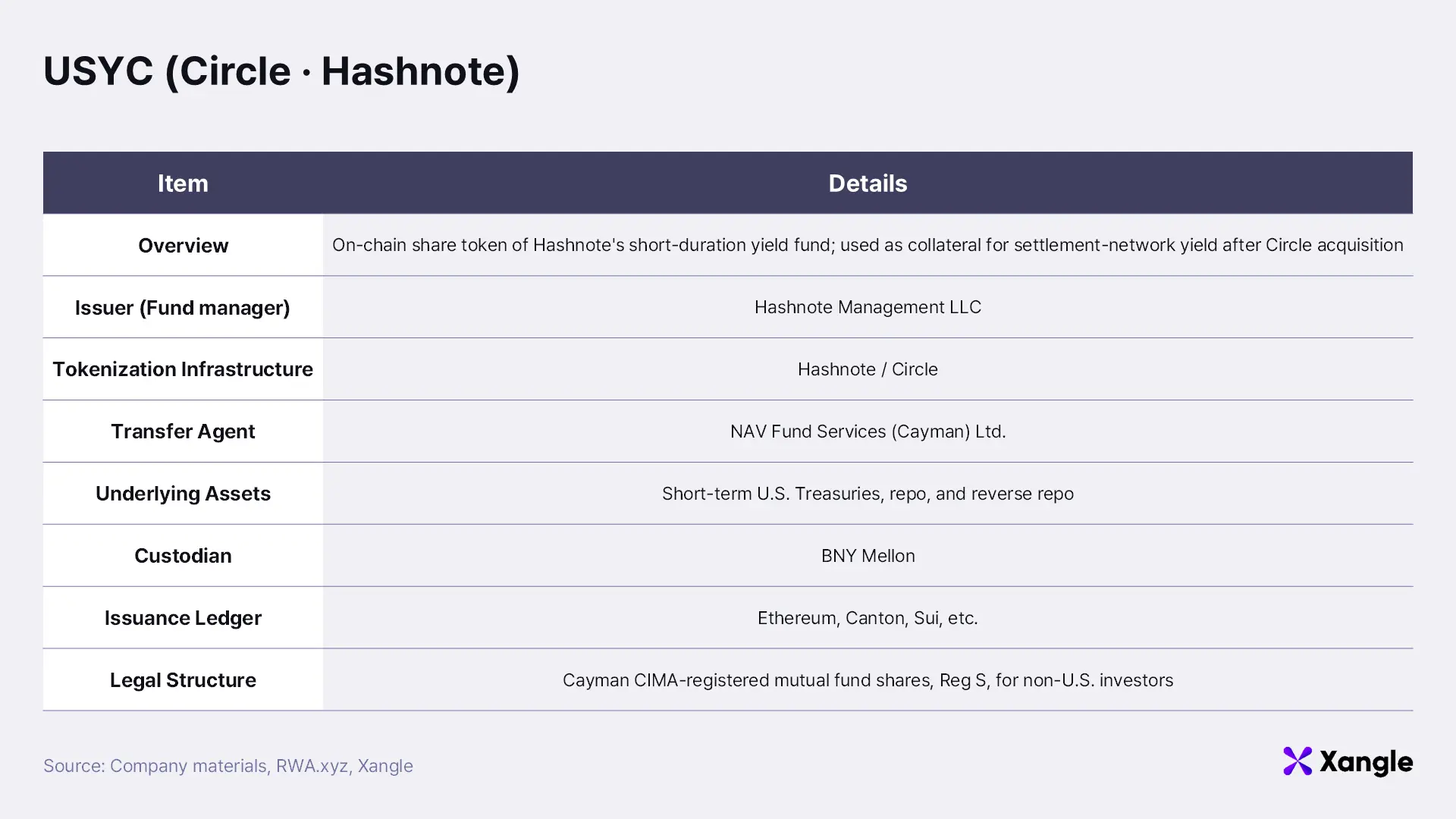
Hashnote is a digital asset manager for institutional investors. Through its flagship product, USYC, it provides an on-chain short-duration Treasury yield product. USYC records fund shares of Hashnote International Short Duration Yield Fund Ltd. The underlying fund is managed mainly through short-term U.S. Treasuries, repurchase agreements, and reverse repurchase agreements. The fund is a mutual fund registered in the Cayman Islands and is offered to non-U.S. investors under Regulation S.
USYC reflects income not through separate distributions, but through an increase in token value. By holding USYC, investors gain exposure to short-duration Treasury-type yield and can redeem into USDC when needed. Since Circle acquired Hashnote, USYC has drawn more attention for its convertibility with USDC, institutional cash management use cases, and use as off-exchange collateral. On Binance in particular, USYC can be used as off-exchange collateral for institutional clients, positioning it as both a yield-bearing cash management product and an on-chain asset used as institutional trading collateral. As of that date, USYC had a size of about $3.10 billion, accounting for about 20.9% of the tokenized Treasury product market and representing the largest share among individual products.
USTB (Superstate · Invesco)
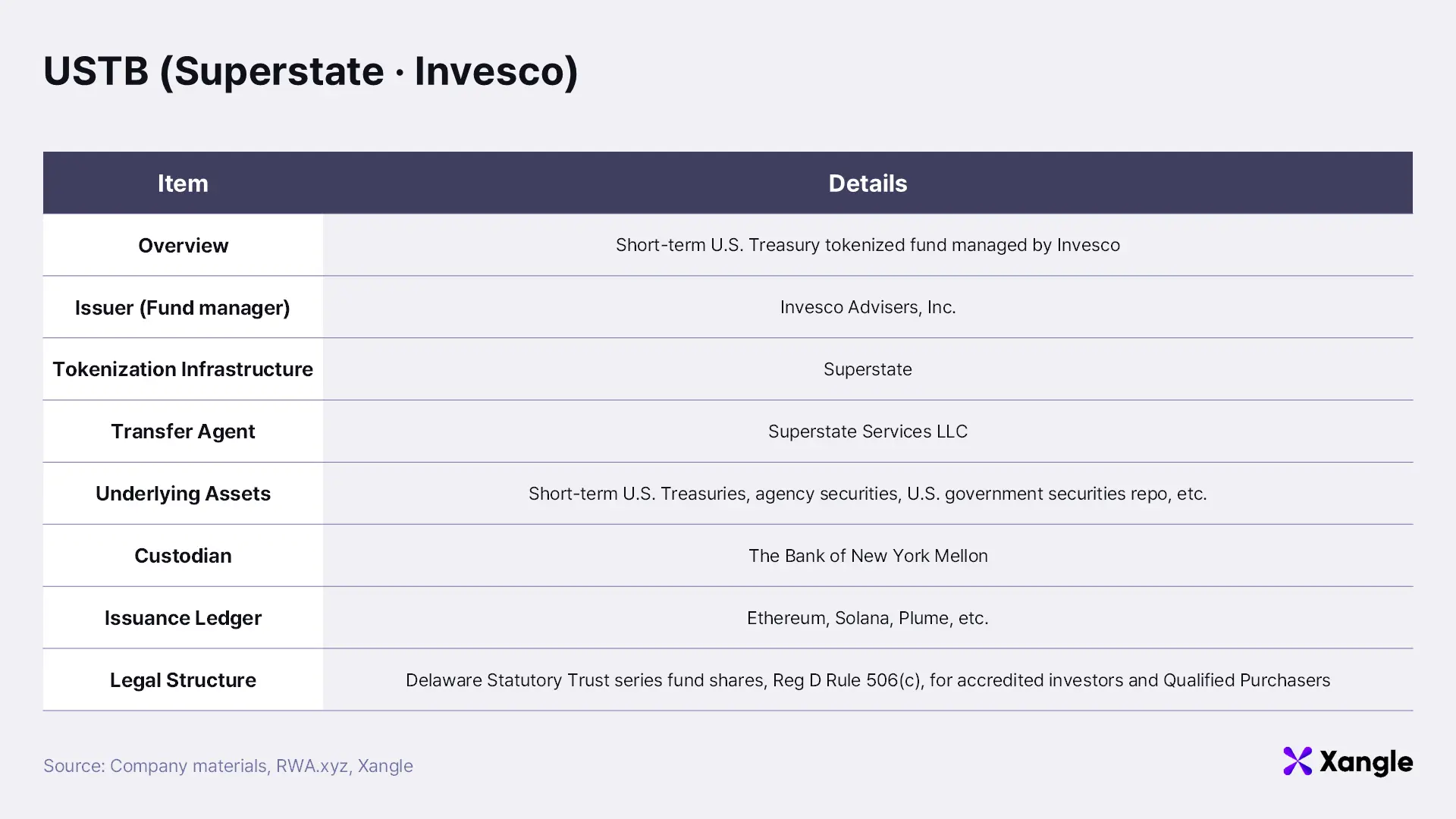
USTB is a short-duration U.S. Treasury tokenized fund managed by Invesco, with Superstate providing the tokenization infrastructure. The formal product name is the Invesco Short Duration US Government Securities Fund, and the fund invests in short-term U.S. Treasuries and repurchase agreements. A notable feature of USTB is that investors can hold USTB either as an on-chain token or through traditional book-entry records. Subscriptions and redemptions can be processed in U.S. dollars or USDC, and Superstate Services LLC acts as the transfer agent, managing fund share ownership records and the on-chain transfer structure.
Structurally, USTB records shares of a series fund under a Delaware Statutory Trust as on-chain tokens. Invesco Advisers manages the portfolio as investment manager, while Superstate Services LLC manages share ownership records and the on-chain transfer structure as transfer agent. As of that date, USTB had a size of about $730 million, accounting for about 4.9% of the tokenized Treasury product market.
OUSG (Ondo Finance)
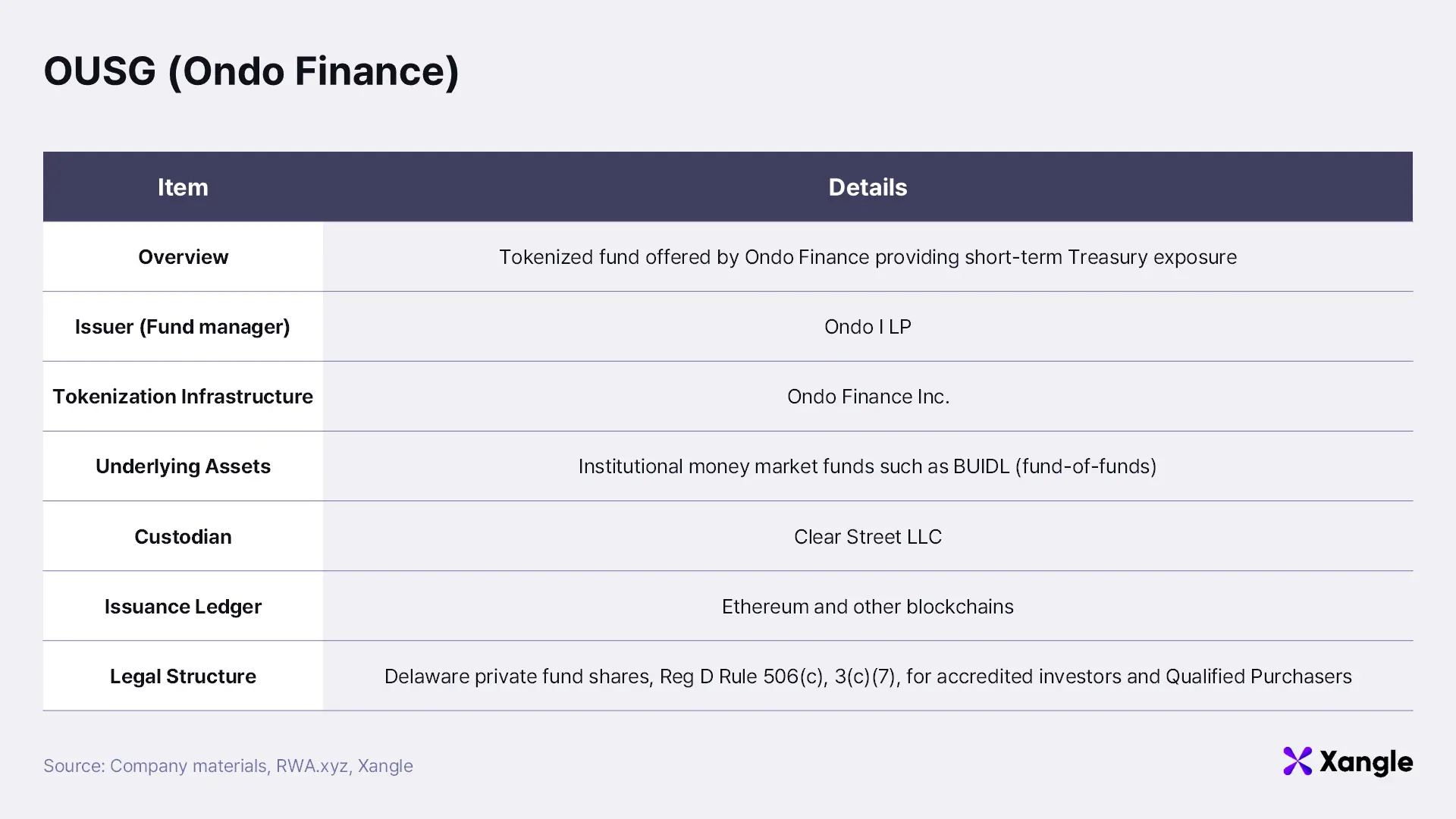
OUSG is a tokenized fund offered by Ondo Finance that provides exposure to short-term Treasuries. A key feature is that, rather than directly holding individual Treasuries, OUSG has a fund-of-funds structure that invests in Treasury funds and money market funds from major asset managers such as BlackRock, Franklin Templeton, WisdomTree, and Fidelity. OUSG supports 24/7 issuance and redemption using USDC and PYUSD, allowing investors to access short-term Treasury-type yield on-chain and redeem into stablecoins when needed. OUSG is structured as a private fund for Qualified Purchasers sold under Regulation D Rule 506(c) of U.S. securities law. As of that date, OUSG had a size of about $480 million, accounting for about 3.2% of the tokenized Treasury product market.
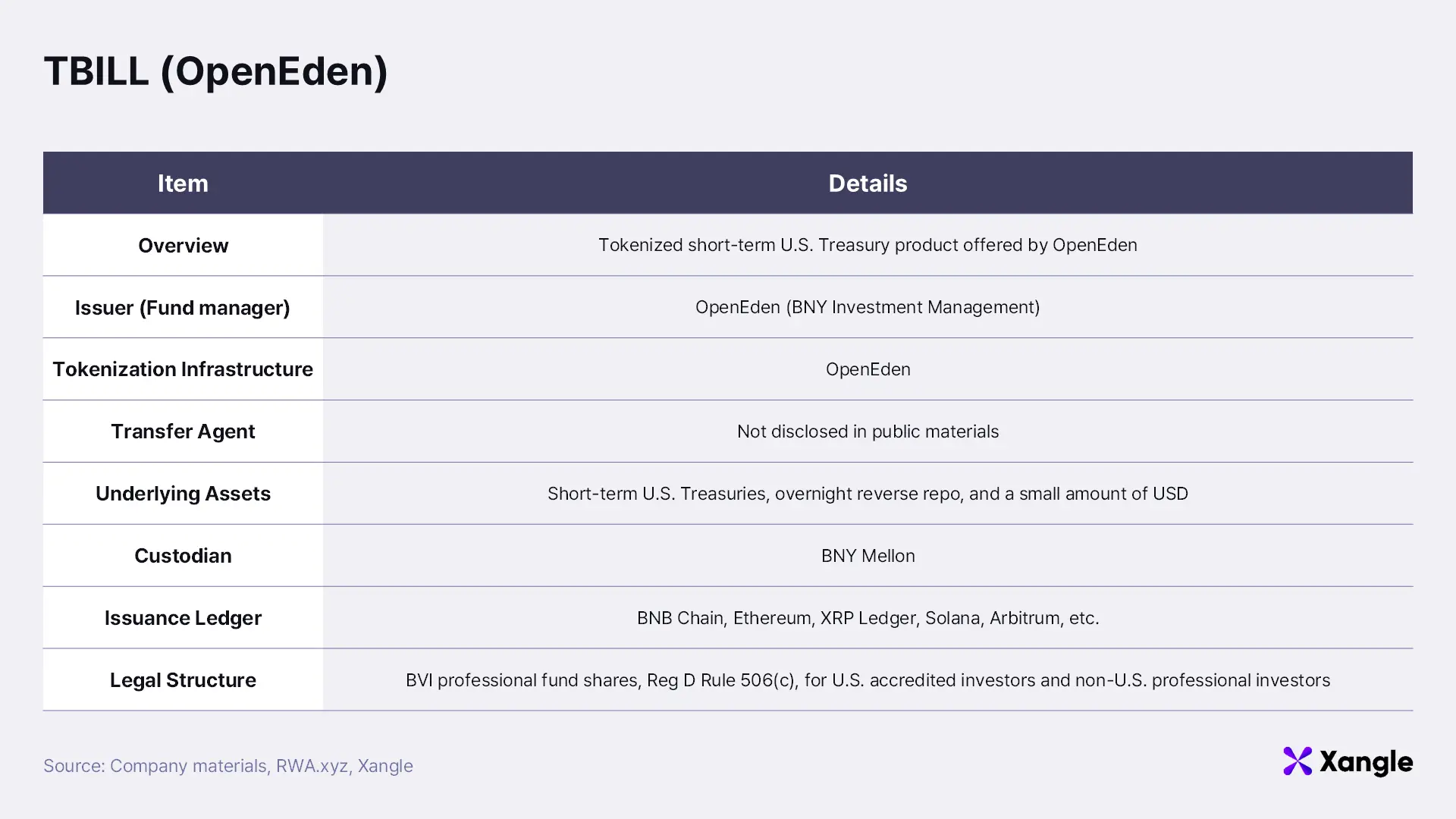
TBILL (OpenEden)
TBILL is a tokenized U.S. Treasury bill product offered by OpenEden. TBILL records shares of the Treasury Bills Institutional Liquidity Fund. The underlying assets consist of Treasury bills, overnight reverse repurchase agreements, and a small amount of USD. Portfolio management is handled by BNY Investment Management, and BNY Mellon provides custody. TBILL is structured as a BVI-based fund and follows a private offering structure based on Regulation D Rule 506(c) under U.S. securities law.
TBILL reflects yield through an increase in token price. Income generated from Treasury bills and repo is reflected in the fund's net asset value, and the TBILL price is calculated by dividing NAV by the token supply. Issuance and redemption are conducted through USDC, and TBILL has been issued on multiple networks, including BNB Chain, Ethereum, XRP Ledger, Solana, and Arbitrum. In early July 2026, TBILL had a size of about $210 million. OpenEden is also expanding follow-on products based on TBILL, including the yield-bearing stablecoin USDO.
VBILL (VanEck · Securitize)
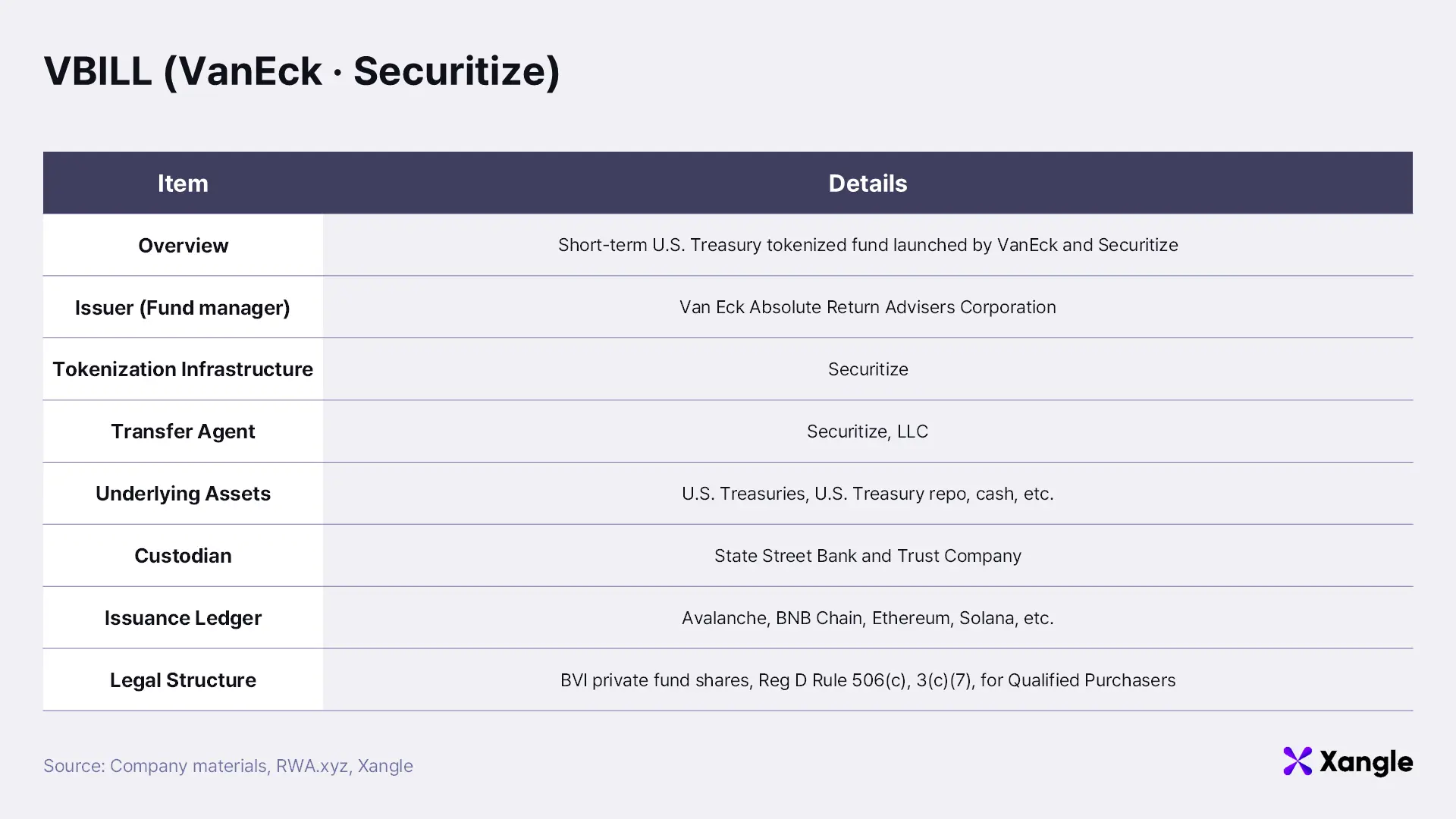
VBILL is a short-term U.S. Treasury tokenized fund launched by VanEck and Securitize. Its formal product name is VanEck Treasury Fund, Ltd., and the fund invests in U.S. Treasuries and repurchase agreements collateralized by U.S. Treasuries, with the goal of maintaining a $1 NAV per share. VBILL is a fund share product in which shares of VanEck Treasury Fund are issued and recorded on a blockchain. The fund was established under BVI law and is structured as a private fund for Qualified Purchasers sold under Regulation D Rule 506(c) of U.S. securities law. Securitize Fund Services handles fund administration, Securitize Markets participates as placement agent, and State Street Bank and Trust Company custodies the fund assets. RedStone provides oracle infrastructure for VBILL's daily NAV calculation.
As of that date, VBILL had a size of about $55 million, or roughly 0.4% of the tokenized Treasury product market. In terms of size, it is smaller than BUIDL, USYC, BENJI, USTB, and OUSG, but it has been expanding its use cases by being integrated as collateral in DeFi lending markets such as Aave Horizon and Euler. Aave Horizon added VBILL as a collateral asset, and Euler enabled users to borrow other crypto assets using VBILL as collateral.
In this way, fund share products commonly provide share rights against the fund rather than rights against bond issuers, and eligibility requirements and redemption terms are determined by the structure of each fund.
2-4. Linked Securities Model
The linked securities model is a structure in which a third-party issuer or special purpose vehicle holds the underlying bonds, and investors hold tokenized claims in the form of notes or certificates against that issuer. An SPV, or special purpose vehicle, is a separate legal entity established for a specific asset or transaction. While the fund share model records fund shares, the linked securities model is closer to a debt instrument issued by an issuer based on bonds. The investor's rights therefore arise from the terms of the note. This is the same structure as the linked securities model in stock tokenization, where a third-party issuer issues linked securities backed by underlying shares. For now, examples based on corporate bonds are still rare, and the model remains closer to a stage of partial experimentation in adjacent areas such as private credit tokenization.
USDY (Ondo Finance)
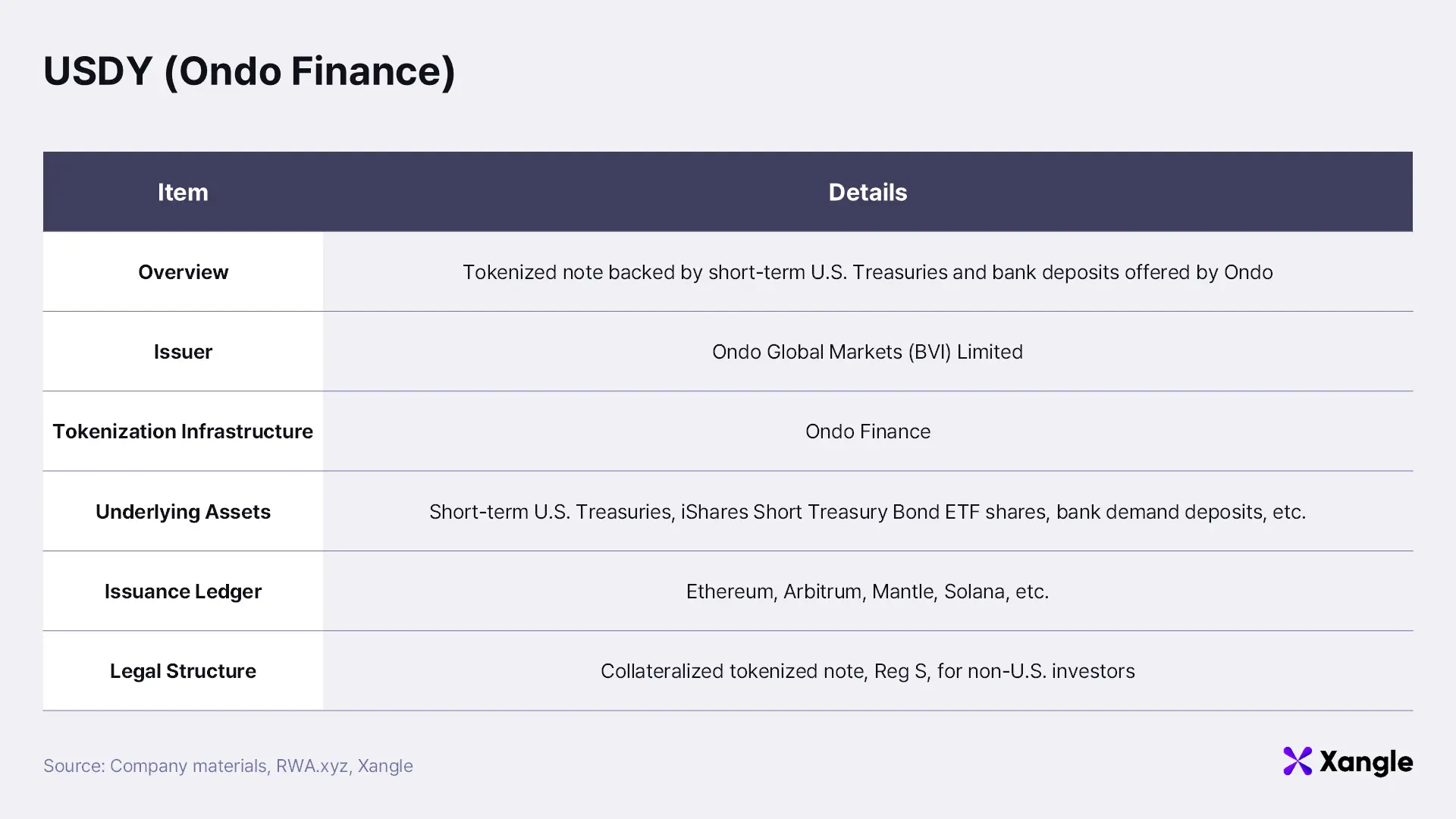
USDY is a tokenized note backed by short-term U.S. Treasuries and bank deposits. In the USDY structure, an SPV designed to issue the specific product and hold collateral assets issues a tokenized note called USDY to investors. The SPV allocates funds received from investors into cash-like assets such as short-term U.S. Treasuries, Treasury ETF shares, and bank demand deposits. These assets are used as collateral supporting the redemption claims of USDY holders. Yield is reflected through an increase in USDY's reference price over time. USDY is offered to non-U.S. offshore investors under Regulation S of U.S. securities law.
3. On-Chain Use Cases
The tokenized bond products examined in the previous section do more than simply convert bonds into digital form and hold them. The real meaning of tokenization comes from the fact that these tokens can move on-chain, combine with other assets and protocols, and perform actual economic functions. Tokenized Treasuries became central to the RWA market because they are assets with low credit risk and interest generation, while also being usable on-chain as collateral or settlement instruments. This section looks at how tokenized bonds, especially short-term Treasury products, are actually used on-chain across four areas: cash management, DeFi collateral, exchange and institutional margin collateral, and stablecoin reserve assets.
3-1. On-Chain Cash Management
The most basic use case is on-chain cash management. Here, cash management means placing idle funds that are not needed immediately into safe, interest-generating short-term products and converting them back into cash quickly when needed. For individuals or institutions holding stablecoins, stablecoins themselves are standby funds that generate little to no interest. By moving those idle funds into short-term Treasury tokens, investors can receive interest from U.S. Treasuries while also being able to convert back into stablecoins 24/7 on-chain.
Products such as BUIDL, OUSG, USYC, and USDY all target this demand. BUIDL, OUSG, USYC, and USDY are designed to support 24/7 issuance and redemption primarily through USDC, and BUIDL has also announced a feature that allows 24/7 exchange with Ripple's stablecoin RLUSD. For institutions, the appeal lies in the ability to manage and recover funds directly on-chain instead of leaving them tied up in bank accounts or traditional money market funds. The DeFi collateral and stablecoin reserve use cases discussed below can also be understood as extensions built on top of this cash management function.
3-2. DeFi Collateral
The next step in the use of tokenized bonds is collateral use in decentralized finance, or DeFi. Tokenized Treasuries have low credit risk, relatively stable value, and generate interest. By depositing them as collateral and borrowing stablecoins, holders can secure liquidity without selling their assets. This can be viewed as an on-chain implementation of the traditional finance practice of borrowing against bonds. However, accepting RWAs as collateral requires solving several issues, since trading hours, reliability of price information, investor eligibility checks, and liquidation procedures differ by asset. Major lending protocols address these problems in different ways.
Aave Horizon
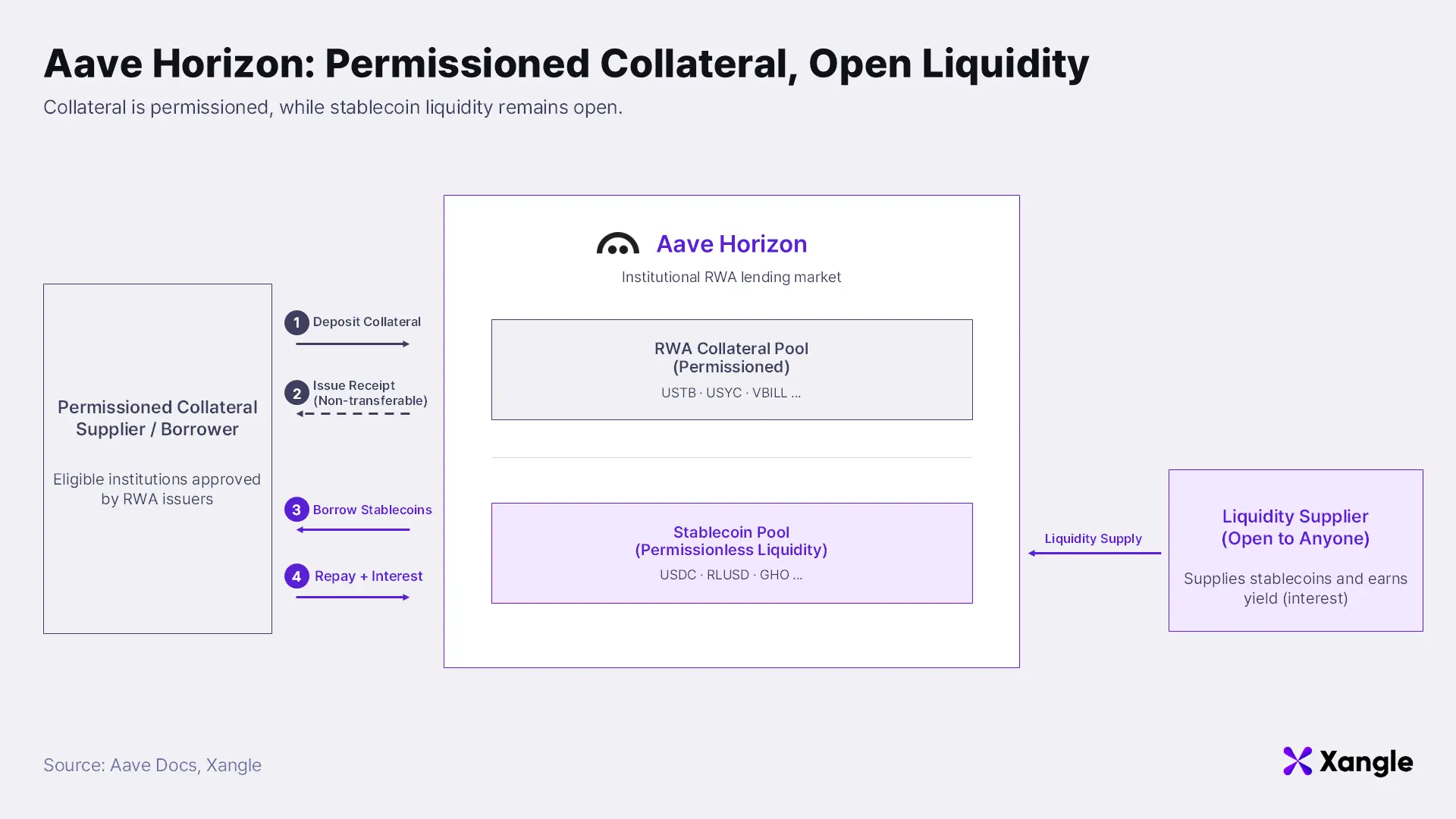
Aave Horizon is an institutional RWA lending market launched separately on Ethereum by Aave, the largest lending protocol, in August 2025. Its structure separates collateral permissions from borrowing permissions. Tokenized Treasuries or fund shares deposited as collateral are permissioned assets that can only be held by institutions that have passed investor eligibility checks at issuance. The stablecoin borrowing side backed by that collateral, however, is open and permissionless. By restricting only the parts required by regulation while opening liquidity supply, Aave Horizon connects institutional assets with on-chain liquidity. Regulated tokenized Treasuries and funds such as Superstate's USTB, Circle's USYC, and VanEck's VBILL are accepted as collateral, and the value of collateral assets is reflected in real time through Chainlink's on-chain NAV oracles. The deposit receipt tokens received after collateral is supplied are designed to be non-transferable, preventing collateral from flowing outside eligible institutions.
Euler
 Source: Euler Finance
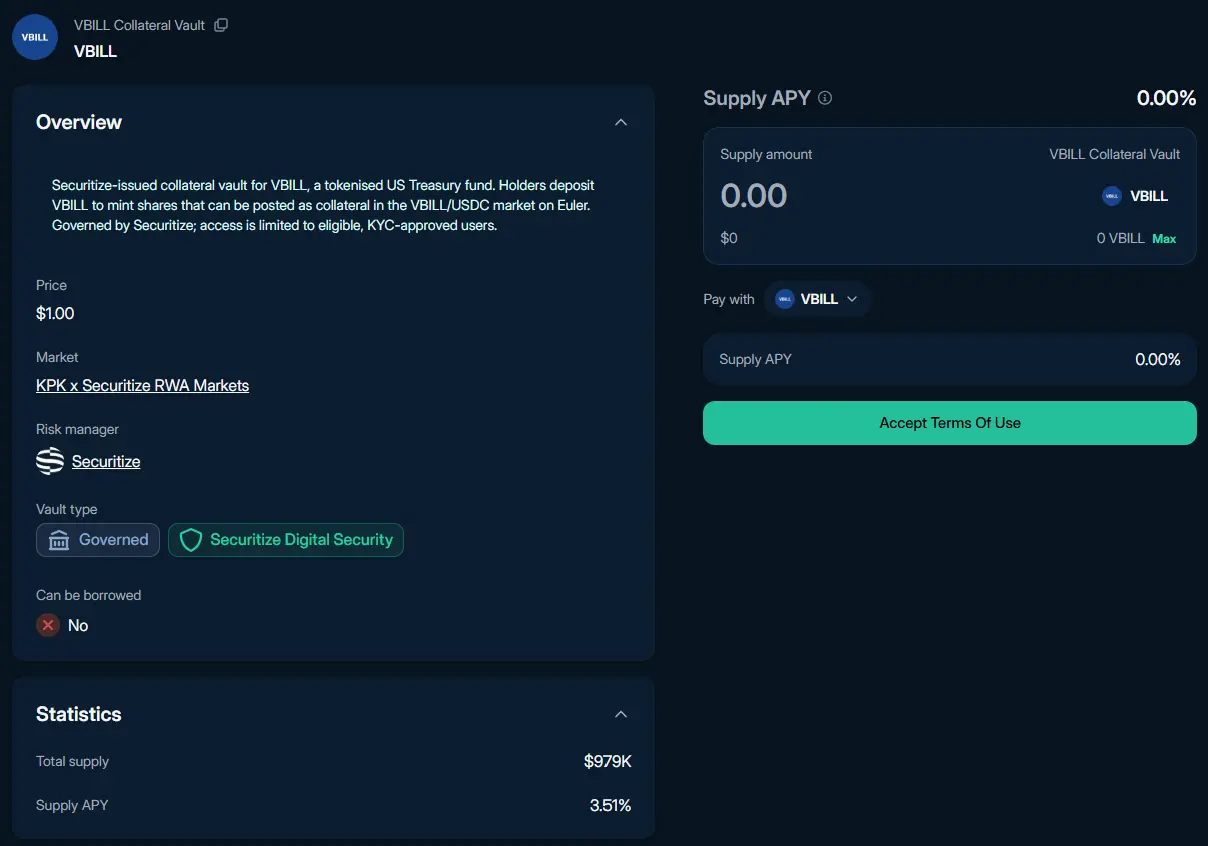
Euler is a modular lending protocol that creates independent vaults for each asset and allows each vault to set its own collateral ratios, oracles, and liquidation conditions. Recently, Euler introduced ERC-4626-based collateral-only vaults with Securitize, enabling tokenized assets with holder eligibility and transfer restrictions to be used as DeFi collateral. In the Securitize market curated by KPK, Securitize-issued assets such as VanEck's VBILL are used as collateral. Eligible investors deposit VBILL into a collateral-only vault, and then use the receipt tokens they receive as collateral in Euler to borrow liquidity from a separate USDC borrowing vault. These receipt tokens can move within the same owner, but transfers to another owner or liquidation processes apply Securitize's DS Protocol transfer verification and recipient eligibility checks. This allows a broader range of institutional assets to enter on-chain lending markets without breaking the framework required for regulated assets.
Morpho
 Source: Morpho
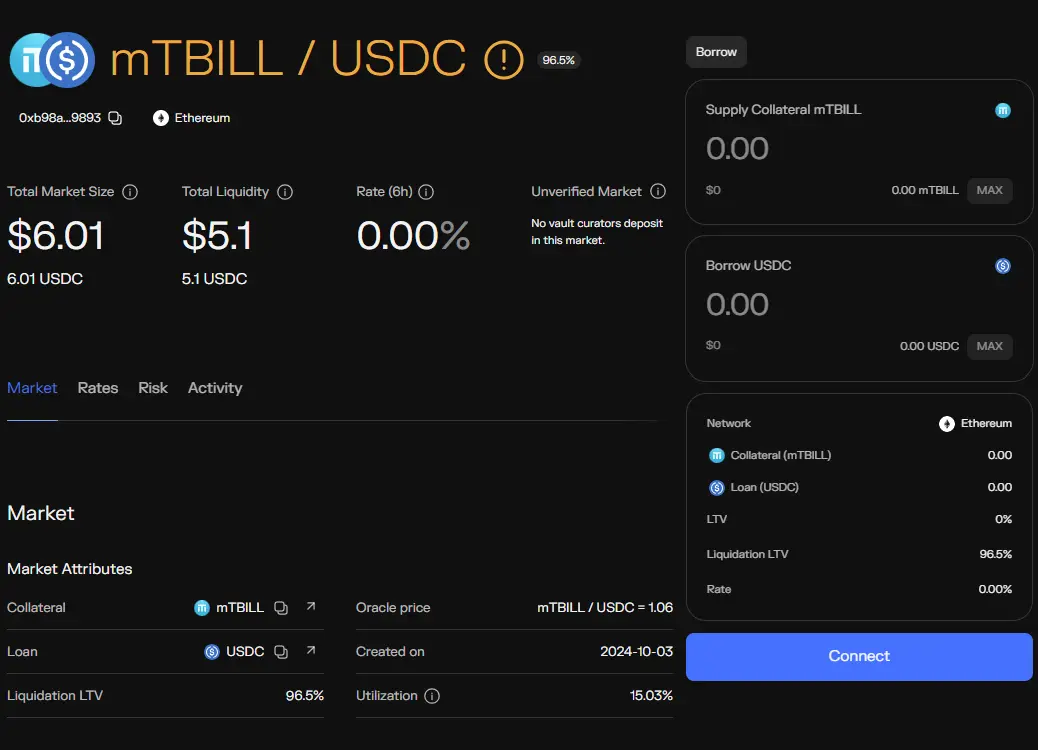
Morpho is a lending protocol that isolates risk at the market level. Each market consists of one collateral asset and one borrow asset, with separate oracles, liquidation LTVs, and interest rate models. This structure allows RWAs with different characteristics, such as mTBILL, mF-ONE, and sACRED, to be handled as independent collateral markets. Because a pricing error, redemption delay, or liquidation risk related to a specific asset is less likely to spread to other markets, Morpho has a structure well suited to accepting RWAs with heterogeneous conditions, such as tokenized bonds, private credit, and fund shares, as collateral.
RWA holders who satisfy KYC and eligibility requirements can supply the relevant asset as collateral to a Morpho market and borrow USDC supplied from curated vaults. This allows investors to secure liquidity without selling the asset, or to increase exposure to the same asset using borrowed stablecoins. Morpho's RWA use cases go beyond simply adding new collateral. They show how tokenized assets can become usable assets within on-chain credit markets.
3-3. Exchange and Institutional Margin Collateral
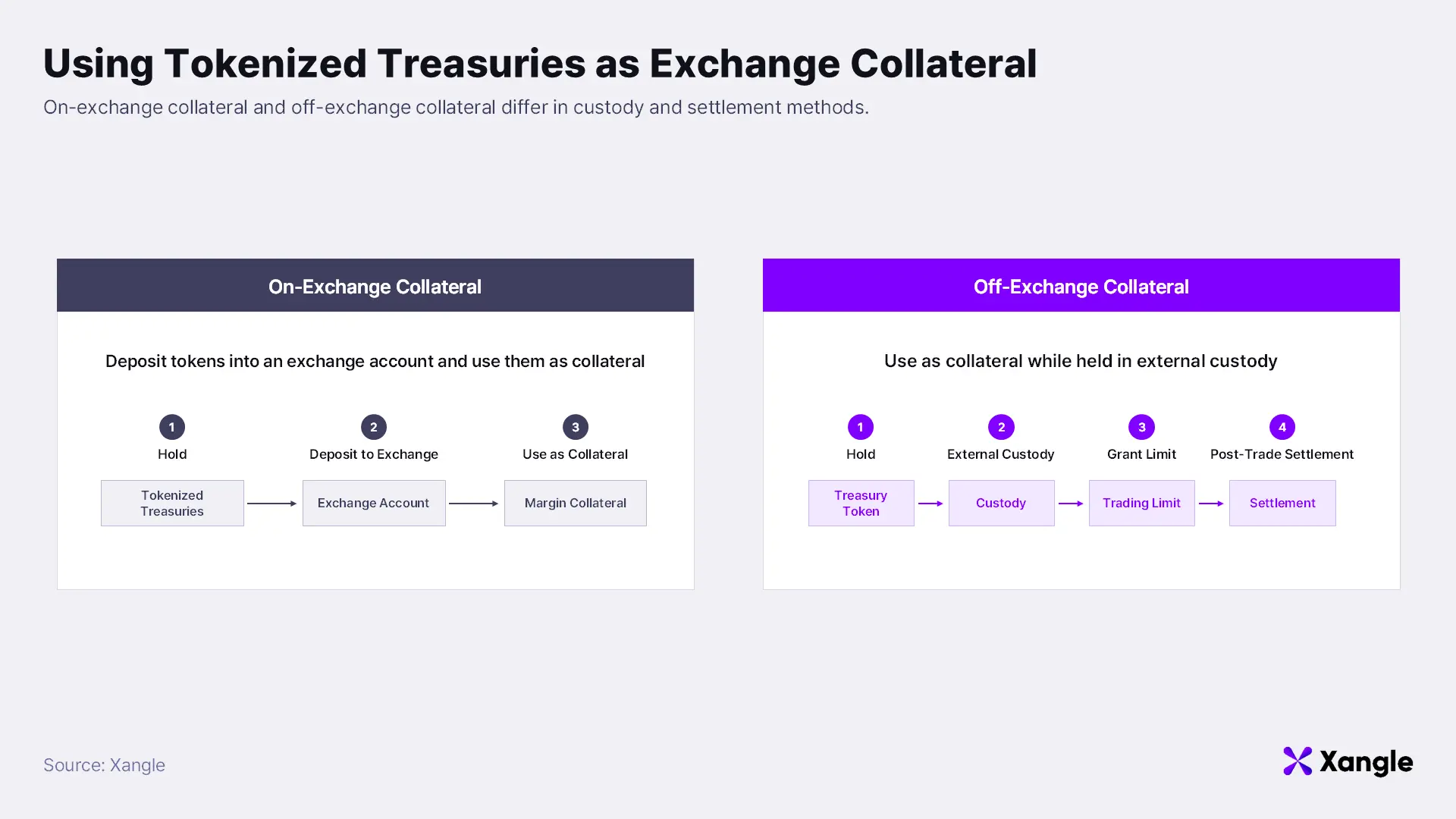
Tokenized Treasuries are also used outside DeFi as margin collateral for centralized exchanges and institutional derivatives trading. There are two main approaches. The first is to deposit tokenized Treasuries inside an exchange account and have the exchange reflect their collateral value for futures, options, or margin trading. Crypto.com and Deribit recognized BUIDL as trading collateral, and Deribit added BUIDL as a cross-collateral asset. In this case, investors can post yield-generating tokenized assets as collateral instead of cash or ordinary stablecoins.
The second approach is based on off-exchange collateral or off-exchange settlement, known as OES. Investors do not deposit tokenized Treasuries or money market fund shares directly into an exchange account. Instead, they keep them with an external custodian or partner bank. The exchange verifies the value of the externally held assets and grants trading limits, and only the necessary amount is settled afterward when position PnL or collateral shortfalls arise. Binance supports BUIDL, USYC, and cUSDO as off-exchange collateral, and Franklin Templeton's BENJI series tokenized money market funds have also been integrated into Binance and Ceffu's institutional off-exchange collateral program.
This trend is extending beyond centralized exchanges into on-chain derivatives markets as well. Drift introduced Ondo's USDY as collateral for margin trading and perpetual futures, allowing users to trade derivatives while holding Treasury-type yield assets. Ondo Perps has also presented a structure that allows users to open perpetual futures positions using tokenized assets, including tokenized equities, as collateral. In this way, tokenized Treasury and money market-type assets such as BUIDL, USYC, BENJI, and USDY are expanding from short-term cash management products into yield-bearing collateral assets for institutional trading and on-chain derivatives markets.
3-4. Stablecoin Reserve Assets
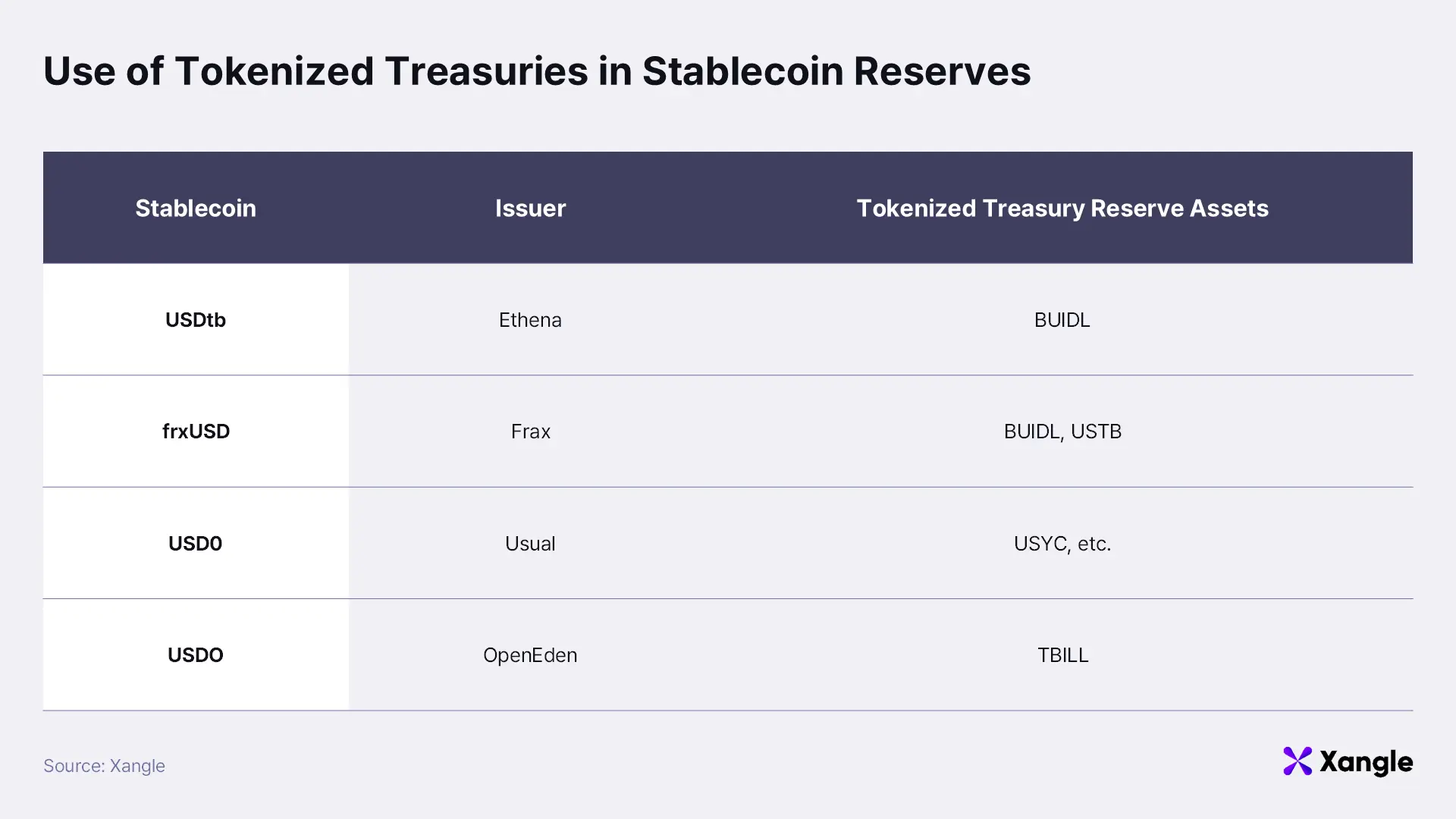
The final use case is stablecoin reserve assets. Reserve assets are the underlying assets that support the issuance amount of a stablecoin so it can maintain a value of one dollar. In the past, stablecoin reserve assets were mainly cash and directly held Treasuries. Recently, however, there have been more cases where tokenized Treasury funds themselves are included as reserve assets. This allows issuers to capture Treasury interest generated by reserve assets while also managing reserves on-chain with greater transparency and faster settlement.
Ethena's USDtb is a representative example. USDtb is a stablecoin launched in December 2024 that uses BUIDL as a major reserve asset, showing a structure where a tokenized Treasury fund supports a stablecoin. Frax's frxUSD also includes tokenized Treasury-type assets as reserve assets. Through governance proposals, the Frax community approved BUIDL as collateral for frxUSD and later expanded the scope to allow USTB to be used as a reserve asset as well.
Usual's USD0 is a stablecoin issued against tokenized U.S. Treasuries and repo, using tokenized money market-type assets such as Circle's USYC as collateral. OpenEden's USDO also has a structure that includes tokenized Treasury products such as OpenEden TBILL as reserve assets. In this way, tokenized Treasury products such as BUIDL, USYC, USTB, and TBILL are expanding their role from on-chain cash management products into DeFi collateral, exchange margin collateral, and stablecoin reserve assets, becoming foundational assets for on-chain finance.
4. Closing Remarks: From Investment Products to Collateral Infrastructure
So far, we have classified products based on which ledgers and claims bond tokens are connected to, and examined how these tokens are used on-chain. This final section looks at how this trend is appearing in Korea and what to watch going forward.
4-1. Tokenized Bond Experiments Are Also Beginning in Korea
While overseas cases are expanding quickly around tokenized Treasuries, early experiments toward bond tokenization are also beginning in Korea. These efforts still remain at the stage of structural validation and collaboration rather than full-scale commercial products, but they are meaningful because financial institutions that actually handle government bonds are directly participating.
Kyobo Life Insurance · Ripple
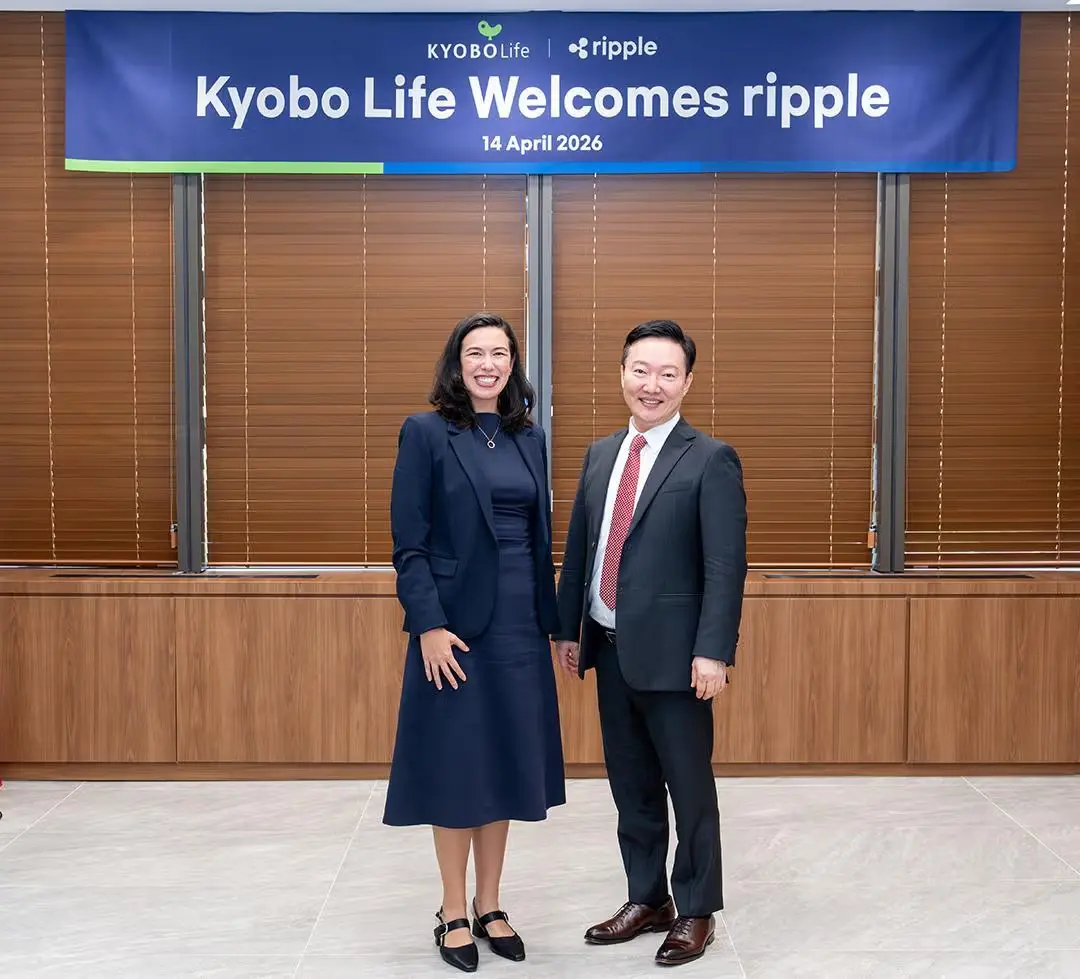
Kyobo Life Insurance is working with Ripple on a proof of concept, or PoC, to validate a tokenized government bond trading structure. A proof of concept refers to a stage where a technology or structure is tested in a limited environment to see whether it actually works. After formalizing their collaboration in September 2025, the two companies entered the stage of validating a tokenized government bond trading structure in a testnet environment from April 2026. Currently, government bond trading separates trade execution from cash settlement, and settlement usually takes at least two business days. The main idea is that if trading and settlement are processed simultaneously on a single blockchain, that time can be significantly reduced. Issuance, custody, and settlement of tokenized government bonds are expected to be supported by Ripple's digital asset custody solution, while stablecoin-based settlement and the possibility of 24/7 trading are also being tested.
Shinhan Securities · Etherfuse
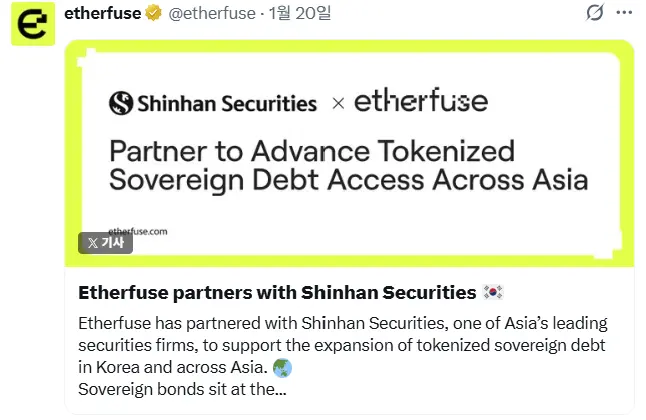 Source: https://x.com/etherfuse/status/2013340772175585571?s=20
In January 2026, Shinhan Securities signed a memorandum of understanding with Etherfuse, a global RWA platform company, to collaborate on issuing Stablebonds backed by Korean government bonds. Etherfuse has been issuing Stablebonds backed by Mexican and Brazilian government bonds since 2024. Through this partnership, it plans to issue Stablebonds backed by Korean government bonds on several public blockchains, including Solana, Stellar, Canton, and Monad. Shinhan Securities will only support government bond brokerage, meaning intermediation, acquisition of real-world assets, and custody management. The Stablebonds will not be offered in Korea or sold to domestic investors. Structurally, this is an attempt to connect dollar-based digital asset liquidity to Korean government bonds, creating a route for overseas investors to access Korean government bonds 24/7.
Shinhan Securities · KIP
Separately from the case above, there have also been reports that Shinhan Securities is preparing a product called Yield5 with Kaia Investment Partners, or KIP, by tokenizing bonds held by Shinhan Securities with a target annual yield of around 5%. Kaia Investment Partners, an investor in the Kaia ecosystem, previously introduced Yield8, which targeted an annual yield of around 8%. Yield5 is reportedly being prepared for release around July 2026.
The institutional foundation is also being prepared. In January 2026, a legal amendment recognized blockchain and distributed ledger technology as valid methods for securities registration. After further rulemaking and infrastructure development, the framework is scheduled to take effect in February 2027. Once this framework comes into effect, Korea will have a legal foundation for the issuance and distribution of tokenized securities. Whether the experiments described above can move into commercial stages will be an important point to watch.
4-2. What to Watch Going Forward
The most important shift running through this research is that bond tokenization is expanding from a simple investment product into on-chain collateral infrastructure. In the previous research on tokenized stocks, the direction of tokenization was described as moving toward regulated and institutionalized rails. Bonds are already one step further along that path. Tokenized Treasuries are quickly becoming more than products for earning interest. They are becoming on-chain cash management tools, collateral for DeFi and exchanges, and reserve assets supporting stablecoins.
Corporate bond tokenization, by contrast, still has a long way to go. While Treasury-type products are spreading quickly, corporate bond examples remain limited because of the particular challenges of corporate bonds. Unlike government bonds, corporate bonds still need to address how issuer credit risk should be assessed and reflected in price, how default situations should be handled on-chain when issuers fail to meet their payment obligations, and how liquidity can be improved for corporate bonds that do not trade actively. In on-chain private credit markets, when borrowers defaulted, liquidation and loss handling often did not take place automatically and instead depended on manual processes and negotiation. This shows why tokenizing credit-risk assets, including corporate bonds, is difficult to make as seamless as Treasury-type products.
Going forward, the way tokenized bonds are evaluated needs to change. Until now, the common question when looking at tokenized Treasury products has been how much interest they pay, or how high the APY is. From here, a more important criterion is where the token is accepted as collateral. The more DeFi protocols, exchanges, and stablecoin issuers accept a tokenized bond as collateral, the more that token can move beyond being a simple yield product and become a foundational asset for on-chain finance. The center of gravity in determining the value of bond tokens is shifting from yield to usability as collateral, or where the token is recognized.
Disclaimer
I confirm that I have read and understood the following: The information contained in this article is strictly the opinions of the author(s). This article was authored free from any form of coercion or undue influence. The content represents the author's own views and does not represent the official position or opinions of CrossAngle. This article is intended for informational purposes only and should not be construed as investment advice or solicitation. Unless otherwise specified, all users are solely responsible and liable for their own decisions about investments, investment strategies, or the use of products or services. Investment decisions should be made based on the user’s personal investment objectives, circumstances, and financial situation. Please consult a professional financial advisor for more information and guidance. Past returns or projections do not guarantee future results.
Xangle or its affiliated partners own all copyrights of the written or otherwise produced materials and content provided on the platform. Any illegal reproduction of such content, including, but not limited to, unauthorized editing, copying, reprinting, or redistribution will result in immediate legal actions without prior notice.
![[CIS Seoul Partner Summit] Anchorage Digital: A Starting Point for Institutional Digital Assets](https://resource.xangle.io/files/content/0659D651970125CC9D95F3066EACD686_1790818652341.webp)
![[CIS Partner Summit Highlights] Dinari: Bringing Tokenized Stocks to Financial Services](https://resource.xangle.io/files/content/44F77D1727A765045015596C9652011C_1789696427279.webp)