QuackAI, The Engine Powering Web3’s Autonomous Future

1. Blockchain and AI: The Rails and the Engine of the Digital Economy
2. The x402 Protocol: Web3’s Transactional Endpoint
3. QuackAI: The High-Speed Engine Powering the Agentic Economy
4. EIP-7702 and QuackAI: The Engine Room of Autonomous Agents
5. Governed AgentFi: Bridging Payments, Ownership, and Governance
1. Blockchain and AI: The Rails and the Engine of the Digital Economy
On September 15, 2025, the Ethereum Foundation launched a new division dedicated to advancing Decentralized AI. Its mandate is to build an autonomous AI economy free from intermediaries by fusing blockchain with artificial intelligence, and over the long term, to establish a censorship-resistant, open AI ecosystem that stands as an alternative to centralized models. At the same time, Coinbase’s x402, an online payment protocol introduced in May, recorded a 1,078% increase in transaction activity in October, underscoring the accelerating demand for AI-native payment infrastructure. AI agents have rapidly become the focal point of global attention.
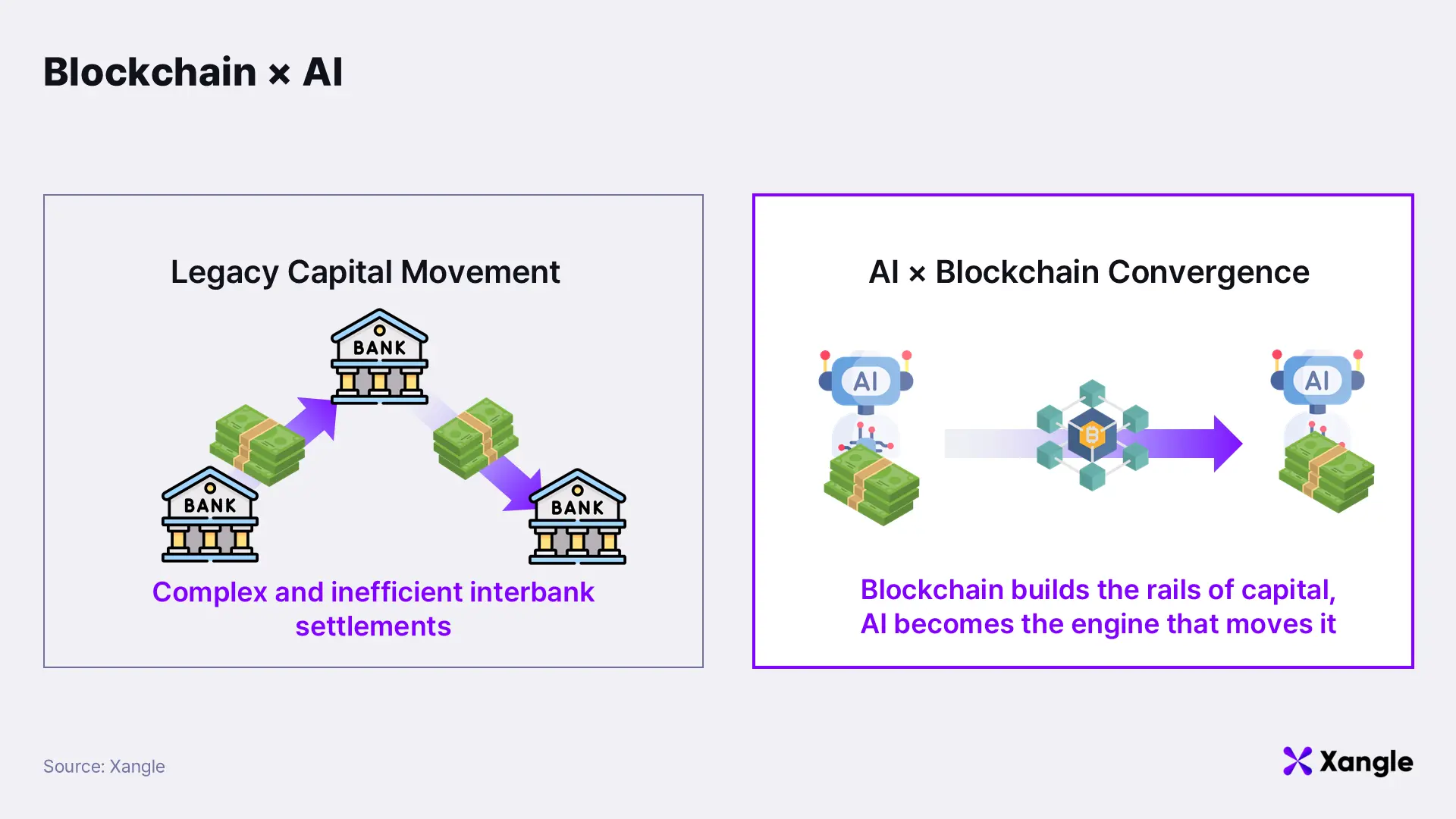
The reason behind this surge in interest is closely tied to Web3’s ultimate direction. Web3 envisions a world where resources and value move freely across the internet, unconstrained by intermediaries or barriers. Within this system, Bitcoin serves as digital gold, a store of value anchoring the network, while Layer-1 networks such as Ethereum function as the railroads of capital, carrying assets across the globe. In such an architecture, wealth can circulate far more efficiently and democratically than in traditional financial systems.
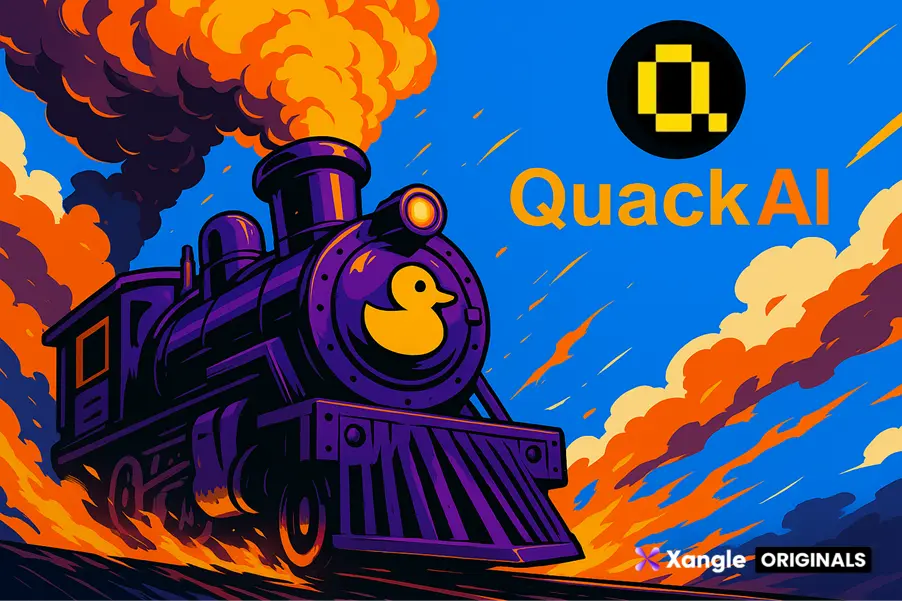
Yet the existence of these “railroads of capital” alone does not guarantee that vision. The reason is simple: not everyone has access to the same information. On-chain markets are transparent by design, but interpreting their vast troves of data and extracting actionable insights requires both high costs and specialized expertise. The tracks have been laid, but the trains running on them still lack speed. AI introduces the missing layer of intelligence and efficiency that can finally bring blockchain’s vision of frictionless capital flow to life.
On BNB Chain, QuackAI is attempting to make that vision a reality. The project aims to enable AI agents to move, allocate, and verify value autonomously, without human oversight. To understand how this works in practice, one must first look at the x402 protocol, the foundation on which this entire mechanism operates.
2. The x402 Protocol: Web3’s Transactional Endpoint
For blockchain to serve as the railroad of capital and AI as the train that runs on it, a signaling system is required to orchestrate how those trains move. Blockchain secures the ownership and transfer of assets, yet the operational layers of authentication, approval, receipt handling, and access control during payment have remained fragmented. The x402 protocol emerged to solve precisely that problem.
Developed by Coinbase, x402 is an open payment protocol built to support autonomous payments and settlements between AI agents. It extends the HTTP 402 (Payment Required) response code, an element of Web2 web infrastructure, into a Web3-native standard, allowing AI to automatically pay for services, purchase datasets, renew subscriptions, and execute contracts without human involvement. Anchored by blockchain’s guarantee of asset ownership, x402 unifies payment and authentication within a single transaction: when a payment request is sent, ownership is simultaneously verified, and once settlement completes, access is automatically granted. In this model, payment becomes authentication.
Under Web2 paradigms, every transfer required a third party to verify account authenticity and available balance. Intermediaries such as banks or card networks inevitably inserted delays and fees. In Web3, however, these functions are embedded directly into the network itself. Wallet addresses and digital signatures instantly validate both identity and asset authenticity, enabling transactions that are faster, simpler, and natively verifiable.
If blockchain laid the rails for wealth to move, x402 built the signaling and road systems that make that movement safe and efficient. Automated entities such as AI agents can process both payment and authentication simultaneously, eliminating reliance on manual approval workflows. In effect, x402 functions as the transactional transport system of the AI era, connecting blockchain’s throughput with real-world payment efficiency.
From a technical standpoint, x402 leverages the HTTP 402 (Payment Required) response code to handle both payment initiation and authentication within a unified process. The 402 code, originally reserved to indicate that a request cannot be processed without payment, was rarely used in Web2. x402 reinterprets it as a payment trigger, embedding it into a new semantic layer for Web3 transactions.
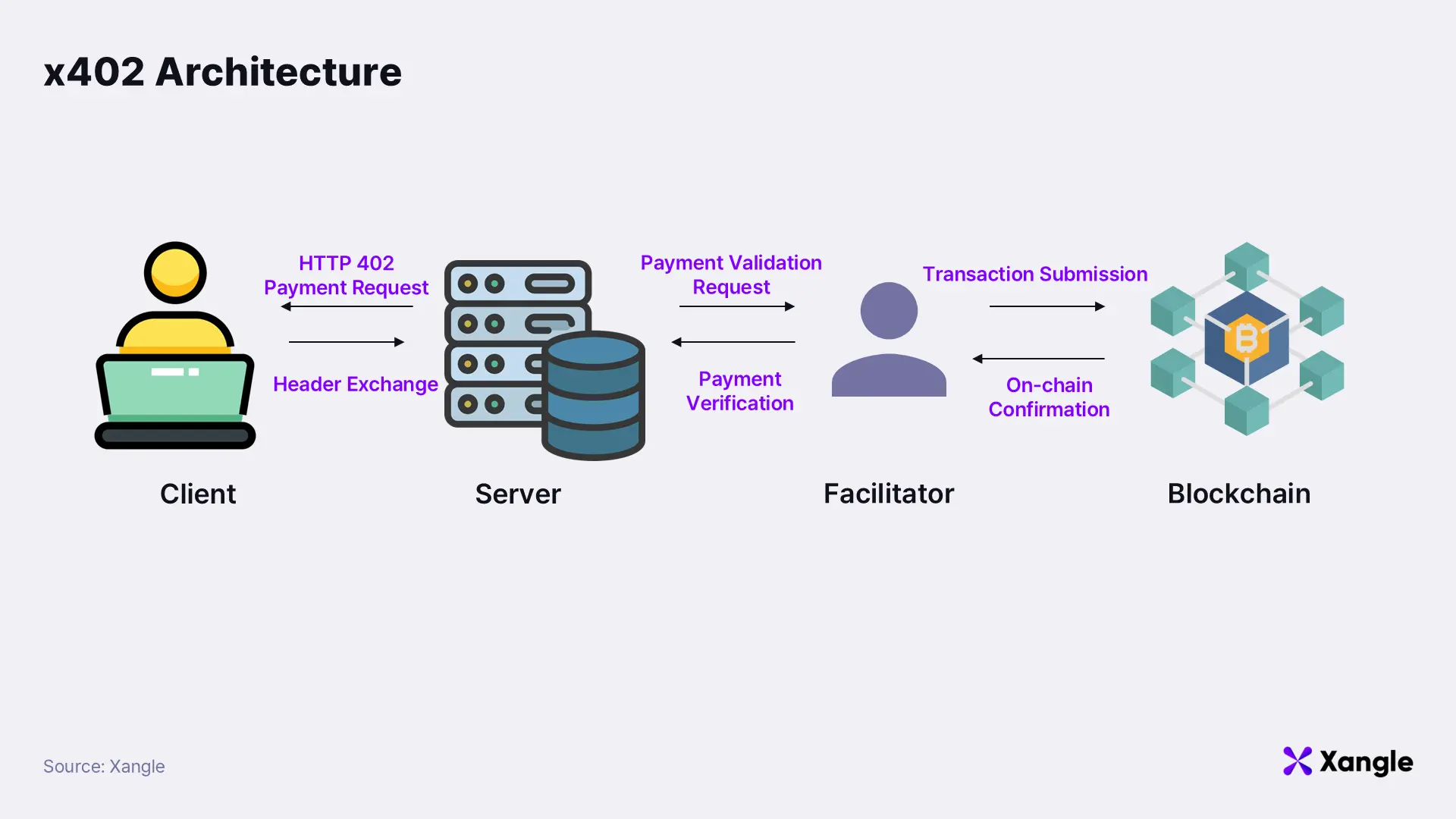
Here’s how it works in practice: when an AI agent requests data from a server (API provider), the server responds with a message such as “HTTP 402 – Payment Required: 0.01 USD (USDC)”, along with detailed payment parameters. These parameters specify the payment asset and amount, chain ID, recipient address, expiration time, domain and resource bindings, a unique payment ID for idempotency, and the facilitator endpoint that will submit the transaction.
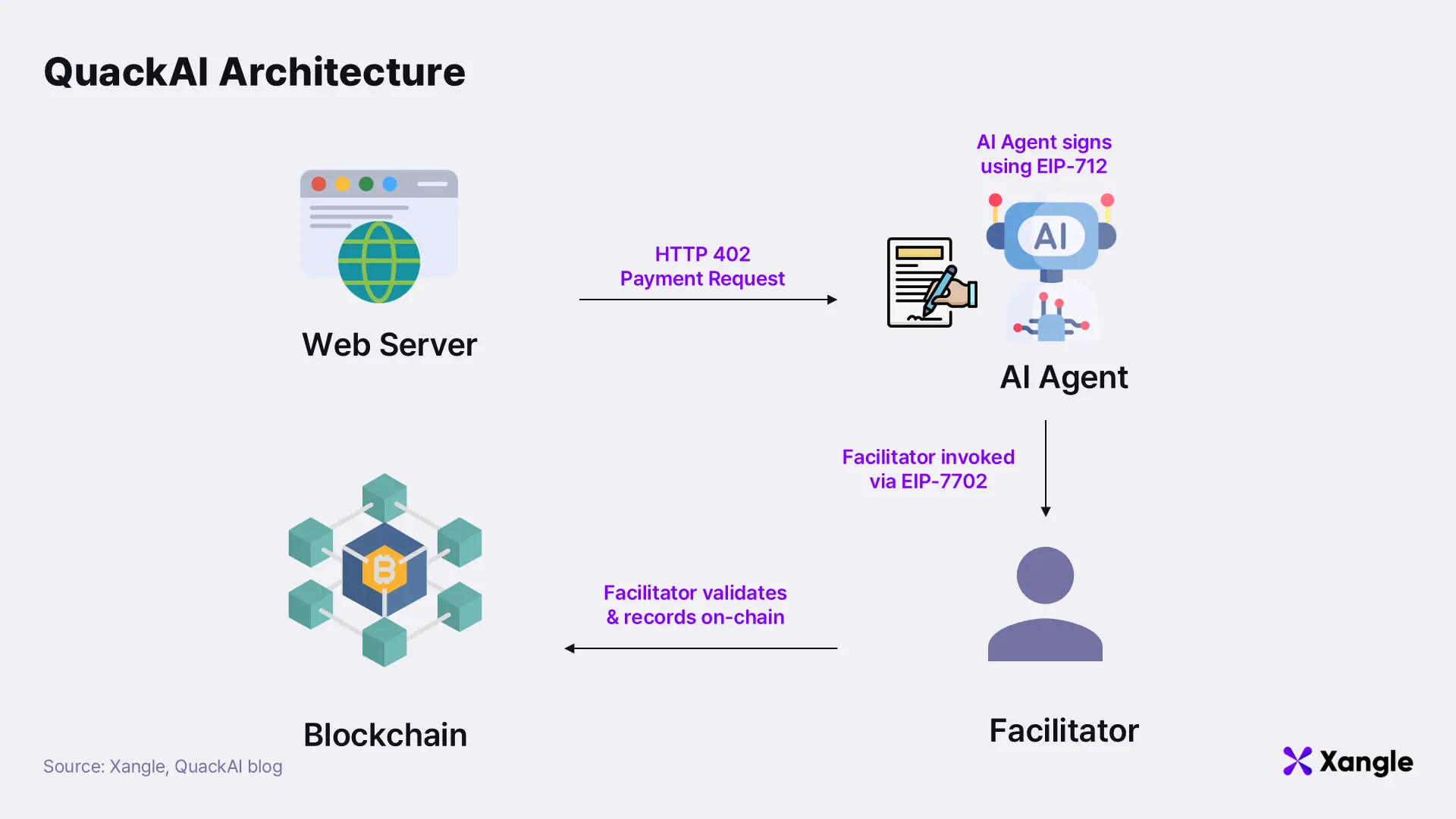
Upon receiving this data, the AI agent constructs a payment payload formatted according to EIP-712, an Ethereum standard for signing typed structured data. By signing explicit fields, such as amount, chain ID, expiration, and so forth, the signature becomes cryptographically bound to the request domain and parameters, rendering it tamper-proof and valid only for that specific transaction. The agent then sends the signed payload to a Facilitator, which uses the signature to activate the transaction context and submit it on-chain. The transaction typically involves a stablecoin transfer (e.g., USDC), which the blockchain network immediately verifies and finalizes.
Once settlement is confirmed, the Facilitator sends a “payment settled” signal back to the server. The server automatically grants access and delivers the response to the client, including an “X-PAYMENT-RESPONSE” header that confirms the transaction. In this architecture, payment and authentication merge into one process. Users no longer need to log in or register API keys; the payment signature itself acts as verification. Payment is identity. Access is instantaneous.
In essence, x402 transforms a long-ignored HTTP status code into a universal payment signal, creating a seamless bridge between Web2 convenience and Web3 security. When an AI agent receives a payment request, it produces an EIP-712 structured signature that simultaneously proves wallet ownership and intent to pay. The result is a system where payment, authentication, and settlement occur within a single, self-contained flow; no intermediaries, no redundant checks, no friction.
This architecture allows AI agents to evolve from passive data consumers into active financial actors. Operating on x402’s payment stack, AI can autonomously execute payments, rebalance portfolios, distribute yields, file tax obligations, and manage capital at a scale impossible for human operators. What emerges is a fully automated capital engine; a protocol layer where AI drives the flow of value with zero human intervention. x402 is rapidly establishing itself as the core infrastructure of AI-native finance, enabling an economy in which intelligent systems not only transact but also allocate, settle, and audit value autonomously. And at the forefront of this transformation stands QuackAI, the project bringing this protocol to life on the BNB Chain.
3. QuackAI: The High-Speed Engine Powering the Agentic Economy
QuackAI began as a governance-driven AI agent system on DuckChain, a Layer-2 network of the TON Chain. Its initial focus was the automation of on-chain voting and decision-making, but the project has since evolved far beyond those boundaries. Now expanding into a multi-chain environment, QuackAI is developing into a fully on-chain agent framework—one where AI autonomously manages assets, executes contracts, and handles both payments and authentication without human oversight.
At the heart of this expansion lies the x402 protocol. Built atop the BNB Chain, QuackAI leverages the x402 BNB infrastructure to enable AI agents to execute payments and authentication processes simultaneously. The result is a system where agents go beyond task execution or governance automation to perform complex administrative and regulatory functions entirely on-chain. Within this environment, an agent can distribute DAO treasury funds, formalize partnership agreements, assess risk, or even perform tax settlements; activities that traditionally required multiple layers of human and institutional mediation.
Such a structure represents the foundation of the Agentic Economy: an autonomous, intelligent market where assets enter contracts on their own, follow codified rules, and move across markets via the most efficient paths. Tasks once managed by humans, such as accounting, payments, reporting, and investment decisions, are now executed by AI agents, with every transaction transparently recorded on-chain. At the center of this self-governing economy stands QuackAI.
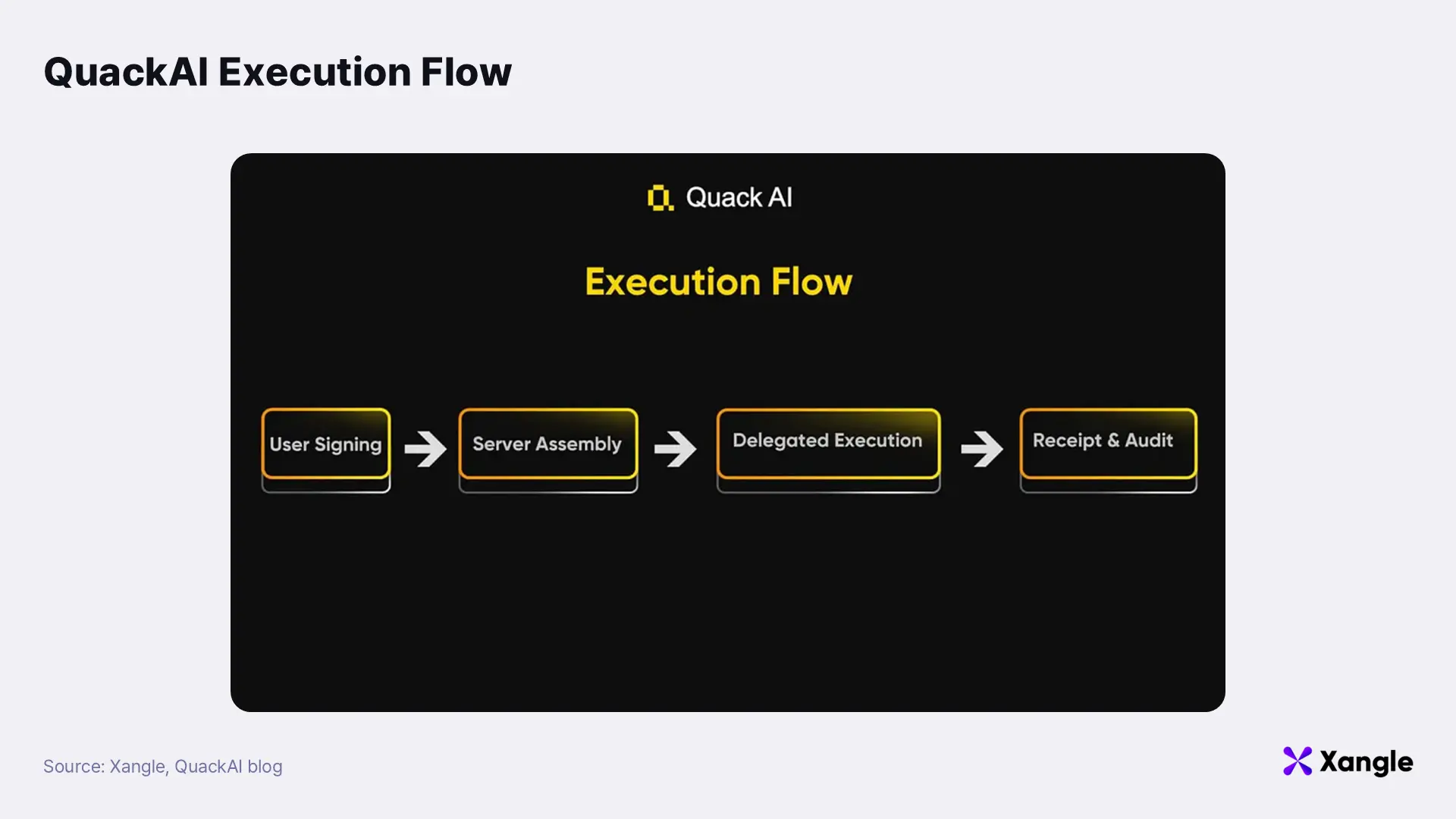
On the BNB Chain, QuackAI is building a user-centric system that unifies payment and authentication in a single flow. The essence of this architecture is not automation for its own sake, but a seamless orchestration where the AI agent autonomously manages four sequential stages, User Signing, Server Assembly, Delegated Execution, and Receipt & Audit, allowing payment and identity verification to occur in a single, trust-minimized process.
Users no longer face repetitive approval steps, private-key handling, or API-key inputs. A single action at the User Signing stage initiates the entire sequence. The AI agent then constructs detailed payment data during Server Assembly, and in the Delegated Execution stage, submits the transaction on-chain via a Facilitator node. Finally, during Receipt & Audit, results are verified, instantly recorded on-chain, and an auditable transaction log is automatically generated for every interaction.
With one signature, payment and authentication are finalized, while the AI agent completes settlement and recordkeeping end-to-end without human involvement. Transactions are executed through the facilitator’s gas-sponsorship model, offering users a fully gasless experience, with no direct gas payments required.
QuackAI also plays an active role in shaping the broader x402 Public Roadmap, contributing to the evolution of AI-agent-native payment standards. Current roadmap initiatives center on the Usage-Based Payment Scheme, MCP (Model Context Protocol) integration, and A2A (Agent-to-Agent) transaction support. Within this framework, QuackAI leads the development of the BNB payment stack and AgentFi governance automation components.
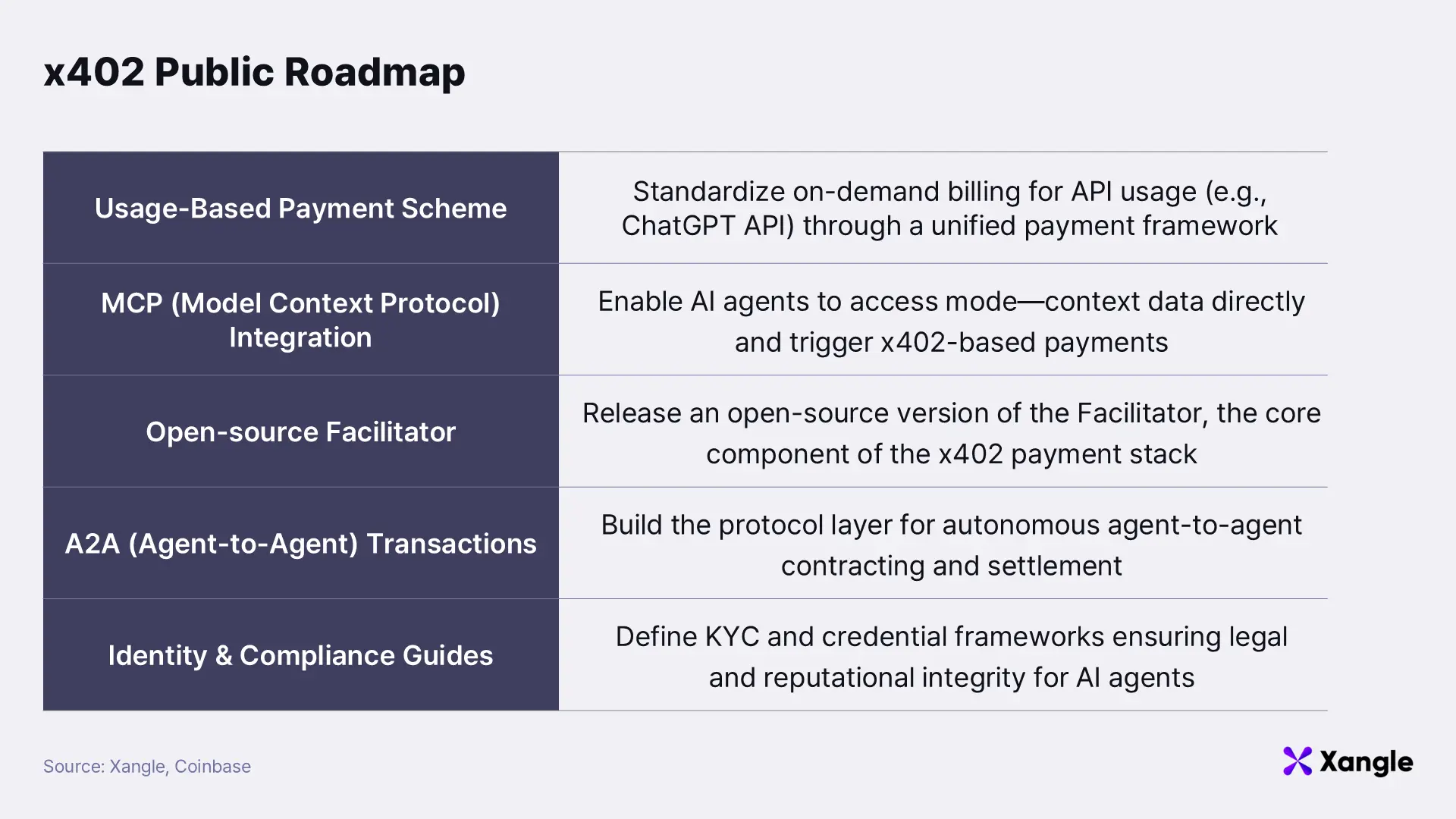
Beyond the BNB ecosystem, the roadmap also encompasses multi-chain and multi-asset payment support, including Solana, Sui, and ERC-8004 Trustless Agent integration, XMTP-based messaging payments, and Arbitrary Token payment specifications. Within this multi-network expansion, QuackAI functions as the primary implementation layerfor AI payment standards across the BNB Chain and the broader EVM ecosystem.
Ultimately, x402 positions QuackAI as the economic engine driving a new form of on-chain autonomy; one where AI manages assets, executes governance, and conducts payments and audits without human direction. The Agentic Economy being built atop this foundation marks the transition to a fully AI-driven economic paradigm, minimizing human intervention while maximizing capital efficiency. QuackAI stands at the center of that shift; the high-speed train of the Agentic Economy, propelling capital across the BNB railroad with unprecedented precision and velocity.
4. EIP-7702 and QuackAI: The Engine Room of Autonomous Agents
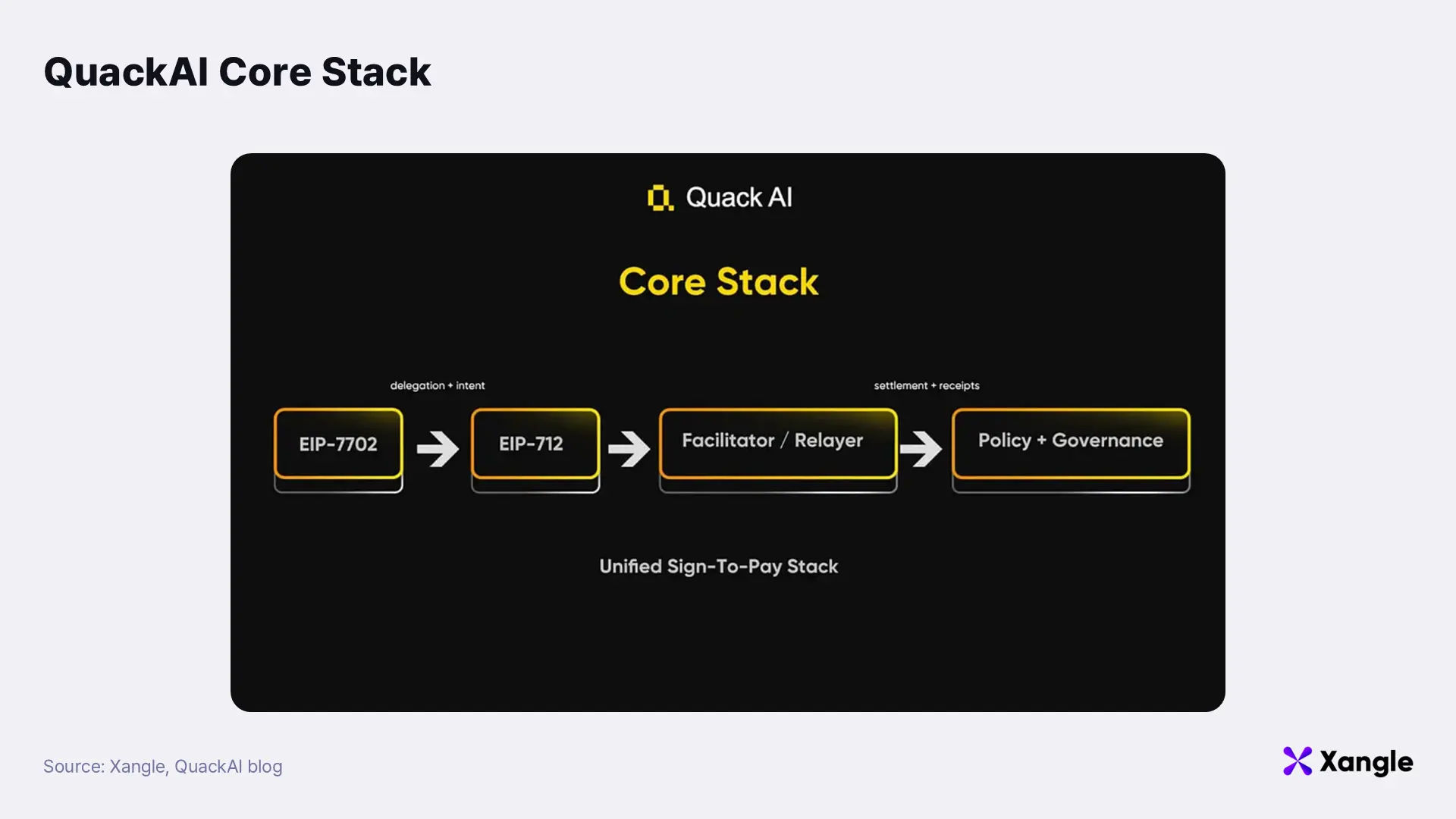
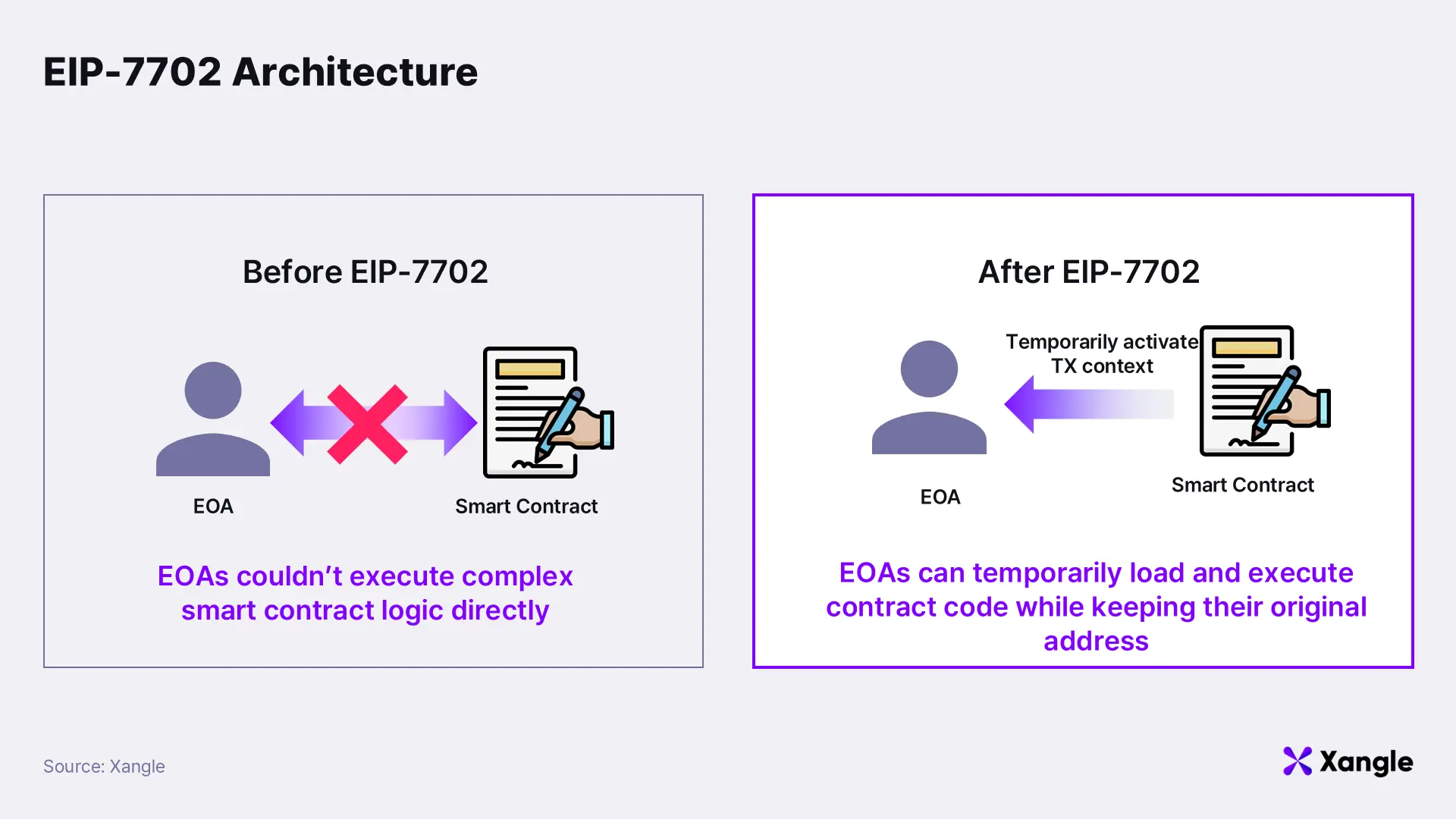
Understanding how QuackAI operates begins with its technological foundation: EIP-7702. The proposal introduces a new transaction type that allows Externally Owned Accounts (EOAs) to behave like smart-contract wallets during a single transaction. Building on the principle of Account Abstraction, it advances the model by enabling an EOA to temporarily execute smart-contract logic within a defined transaction scope.
With EIP-7702, an EOA can function as a “code-enabled account” only within that limited boundary. A user first creates an authentication tuple off-chain, and a facilitator submits it on-chain to activate a one-time execution context. Within this temporary environment, the account behaves like a contract account, executing predefined logic before reverting to its original EOA state. This architecture lets QuackAI grant temporary execution rights without proxy deployments or account switching, which is an approach that makes its x402 protocol both lightweight and highly efficient.
The connection between EIP-7702 and the x402 protocol lies in how payments are semantically expressed. The x402 specification standardizes HTTP 402 (Payment Required) as a payment-request signal. When an AI agent sends a data request to a server (API provider), the server responds with “HTTP 402 – Payment Required” and returns a package of payment details. These include the payment asset and amount, chain ID, recipient address, expiration time, domain and resource bindings, a payment ID for idempotency, and the facilitator endpoint that will process the transaction.
After receiving the details, the AI agent constructs an EIP-712 structured signature bound to that dataset. Each field, amount, chain ID, expiration, and resource domain, is explicitly defined, producing a tamper-proof, single-use signature valid only for the specified transaction. The agent then submits this signed payload to the facilitator, which invokes EIP-7702 to activate the user’s temporary execution context and broadcast the transaction on-chain. Once finalized, the payment outcome becomes instantly verifiable and auditable.
In essence, QuackAI integrates EIP-7702’s one-time execution context, x402’s HTTP-402 signaling framework, and EIP-712’s structured signature standard to form a self-governing payment and authentication flow; an infrastructure where AI agents operate autonomously, without human intervention. What emerges is not simple automation but a tangible implementation of the Agentic Economy, where AI functions as a fully independent on-chain actor.
The advantages are clear. A user needs only one wallet signature that does not require repeated approvals, API-key management, or manual confirmations. The facilitator verifies and submits the transaction, keeping server overhead low and scalability high. Even in the event of errors, retries and failovers occur seamlessly. From the provider’s standpoint, the workflow is standardized and minimal: issue an HTTP-402 request → confirm settlement → return result.
In summary, QuackAI standardizes payment requests at the web layer through HTTP 402, securely verifies user intent and ownership with EIP-712, enables delegated execution without prior approval through EIP-7702, and offers a fully gasless user experience powered by the facilitator’s gas-sponsorship model. By seamlessly integrating the x402 protocol on the BNB Chain, QuackAI has evolved into one of the most efficient AI agents of the Agentic Economy era, setting a benchmark for how AI can autonomously manage capital flows on-chain.
However, QuackAI’s ultimate vision extends a step further. The project is not content with merely revolutionizing payment systems through the x402 protocol; its ambition is to redefine the very nature of asset ownership and operation. The goal is to build a system in which AI agents transcend their role as payment executors and evolve into intelligent asset managers, autonomously optimizing how ownership, transfer, and utilization are executed across networks.
This vision marks the arrival of the Governed AgentFi era, the ultimate stage of the Agentic Economy that QuackAI aims to realize. Within this fully autonomous economic system, where assets enter into contracts on their own, AI verifies them, and blockchain guarantees trust, QuackAI stands as the core engine that transforms human governance into algorithmic execution, anchoring a new model of transparent, self-regulating digital economies.
5. Governed AgentFi: Bridging Payments, Ownership, and Governance
In modern society, contractual relationships are becoming increasingly complex. Transactions are no longer confined to the simple act of purchasing goods. The same product may be owned through installments, accessed via subscription, or temporarily rented. As the line between ownership and usage blurs, the concept of ownership itself grows ever more intricate. Managing these multilayered contractual structures already exceeds the limits of both human cognition and the capacity of traditional systems.
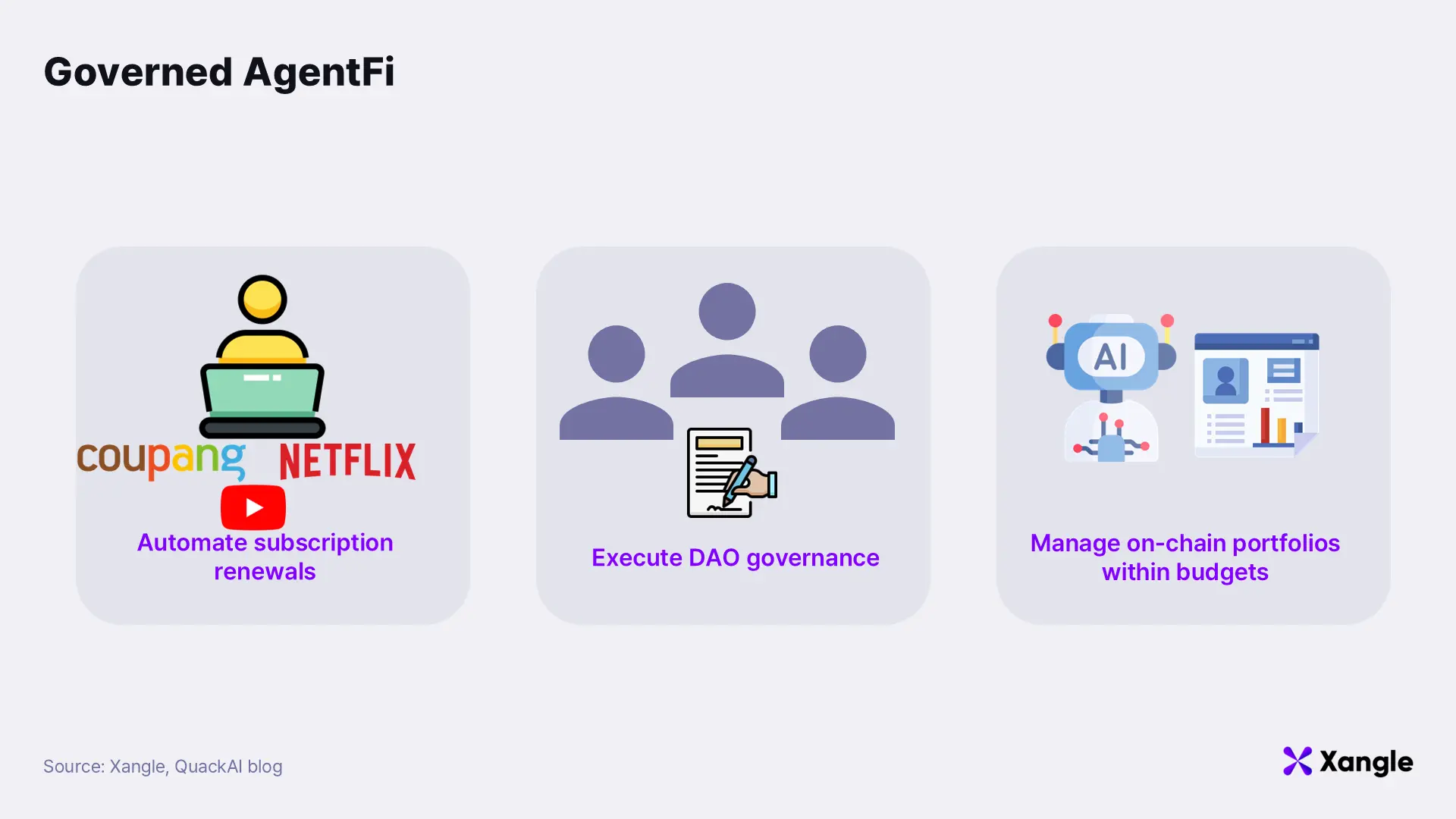
QuackAI seeks to address these structural limitations through AI and automation. Beyond simply executing votes on behalf of users, it aims to establish a framework where AI agents internalize users’ values and governance principles, enabling them to make autonomous, context-aware decisions. Leveraging the x402 protocol, QuackAI not only streamlines today’s fragmented payment processes but also provides the foundation for AI agents and autonomous systems to operate safely and transparently on-chain. Within this framework, AI agents can automatically renew service subscriptions, participate in DAO voting, manage budgets within predefined parameters, and distribute or stream payments according to transparent, verifiable on-chain rules — all without human intervention.
The question that follows is fundamental: “How trustworthy is such a system?” No matter how advanced AI becomes, users will naturally be cautious of a machine that can reassign ownership or move assets at will. The issue, then, is not only whether AI can be trusted, but how that trust can be proven and explained convincingly. To ground this trust, QuackAI defines three foundational principles: Verifiable, Defined, and Accountable.
First, Verifiable — every action must be recorded on-chain and open for anyone to audit.
Second, Defined — all rules and permissions must be explicitly encoded, leaving no room for subjective interpretation.
Third, Accountable — each outcome must have a clearly identifiable actor, and all historical actions must remain fully traceable.
When QuackAI operates, every process is verifiable, every rule is defined, and every result is accountable. Under these conditions, QuackAI’s envisioned model, Governed AgentFi, takes shape. It represents a financial ecosystem where autonomy and compliance coexist: AI makes independent decisions, yet every action is transparently recorded and publicly verifiable on-chain. QuackAI provides the trust infrastructure that enables this world, forming the foundational layer on which AI agents can perform true governance finance, executing not only payments but policy itself.
This marks the culmination of the Agentic Economy. The Agentic Economy extends beyond the efficiency of payments and settlements into the broader realms of asset ownership, management, and governance. In the economy of the future, AI agents will evolve from simple transaction executors into intelligent, accountable entities that design ownership architectures, manage rights transfers, and automatically fulfill regulatory and legal obligations.
In that future, humans will define the high-level principles and strategic direction, while AI will handle ownership transfers, contract execution, accounting, and risk evaluation entirely on its own. Governance over ownership itself will become increasingly precise and optimized through AI’s reasoning and computational capabilities. This progression represents the ultimate trajectory of the Agentic Economy — a paradigm where decision-making intelligence and economic trust converge seamlessly on-chain.
Closing Statement: The Agentic Economy Defines the Next Era of Web3
The convergence of AI and blockchain is no longer a distant possibility — it stands at the center of a transformation already underway. If the internet of the past reshaped how information moves, Web3 is becoming the railroad that unifies the flow of global capital. Now, AI is evolving into the intelligent locomotive racing along that track, capable of driving economic systems with its own reasoning and intent.
Disclaimer
I confirm that I have read and understood the following: The information contained in this article is strictly the opinions of the author(s). This article was authored free from any form of coercion or undue influence. The content represents the author's own views and does not represent the official position or opinions of CrossAngle. This article is intended for informational purposes only and should not be construed as investment advice or solicitation. Unless otherwise specified, all users are solely responsible and liable for their own decisions about investments, investment strategies, or the use of products or services. Investment decisions should be made based on the user’s personal investment objectives, circumstances, and financial situation. Please consult a professional financial advisor for more information and guidance. Past returns or projections do not guarantee future results.
Xangle or its affiliated partners own all copyrights of the written or otherwise produced materials and content provided on the platform. Any illegal reproduction of such content, including, but not limited to, unauthorized editing, copying, reprinting, or redistribution will result in immediate legal actions without prior notice.
![[CIS Partner Summit Highlights] R25, Vault Infrastructure for the Next Generation of Finance](https://resource.xangle.io/files/content/6957A34223D0EE05827E59990EB751D2_1790656054398.webp)