Mantle (MNT) Accelerates Toward Becoming a Banking Chain

Table of Contents
1. Mantle Network Solidifies Its Identity as a Banking Chain
2. Mantle’s On-Chain Financial Platform Strategy Linking Institutions and Retail
2-1. MI4 launch marks a major step in driving institutional capital on-chain
2-2. UR pre-launch: A “Smart Money App” for retail users
3. Localizing Stablecoins — Can Mantle Capture Opportunities in Asia?
4. Technology and Product Updates Converging into a Financial Network
5. Closing Statement: Mantle as a Financial Infrastructure Serving Both Institutions and Retail
1. Mantle Network Solidifies Its Identity as a Banking Chain
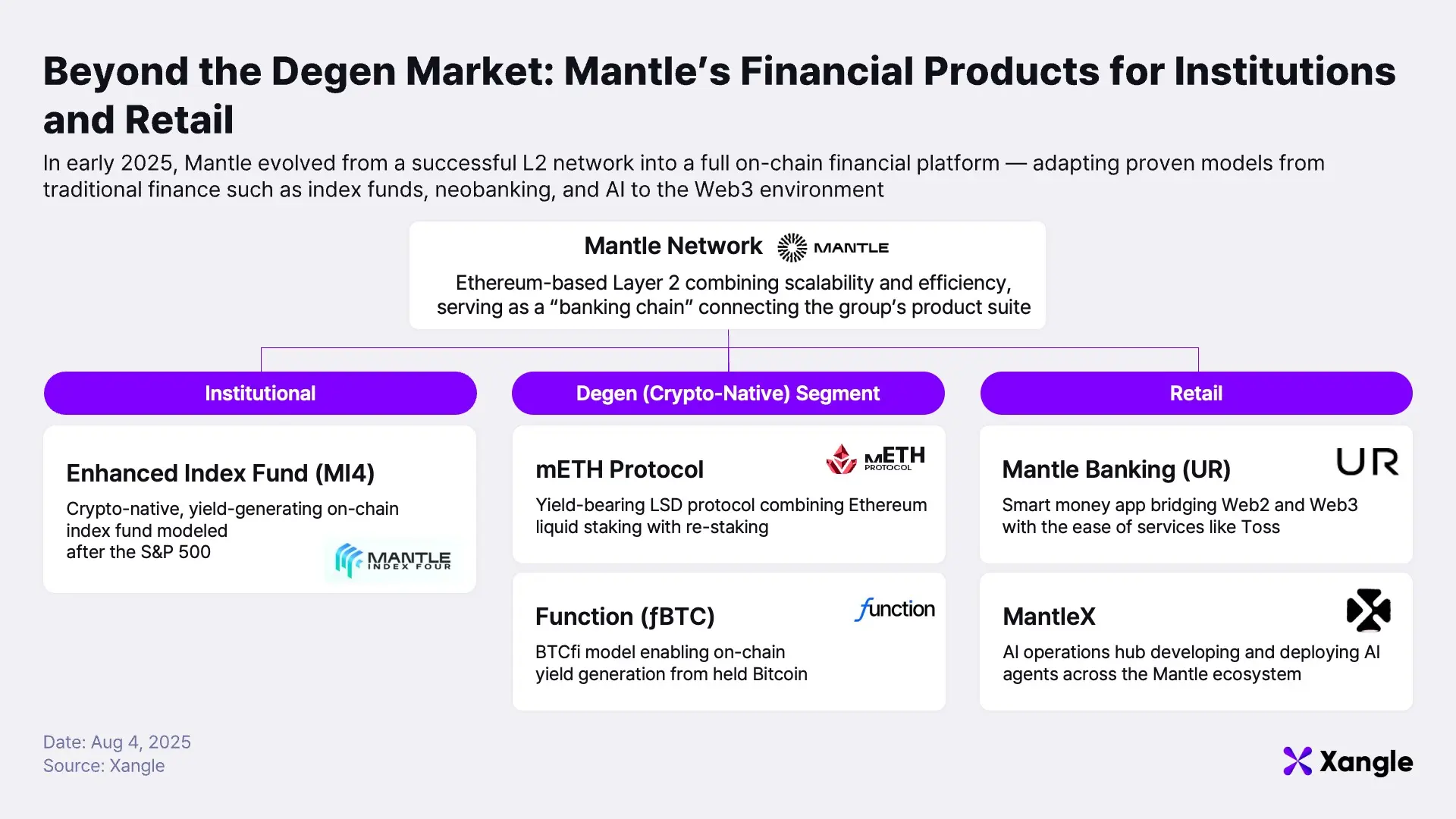
In 2024, Mantle concentrated on building performance-driven blockchain infrastructure, reinforcing its technical foundation as a Layer 2 network. In 2025, however, the project has made its identity as a financial system far more pronounced. While most Layer 2 initiatives have emphasized generic scalability or decentralization, Mantle charted an early strategic course toward becoming a “finance hub,” rolling out a suite of products aligned with that vision. The Mantle Network is now accelerating its evolution beyond a pure infrastructure layer into a network where financial services can operate seamlessly — in other words, a “banking chain.”
This strategic shift is closely intertwined with broader macroeconomic and regulatory developments. In major jurisdictions, digital asset regulations framed around integration into the traditional financial system are taking shape, enabling institutional investors to participate on-chain both legally and technically. This is driving a sharp rise in demand for compliant, well-structured financial products. At the same time, retail users are moving away from the complex architectures of legacy DeFi protocols and increasingly expect financial services with simplified, abstracted user experiences.
Mantle is positioning itself at the intersection of these two trends. Products such as MI4, mETH, UR, ƒBTC (Function), and MantleX are being deployed in sequence, together shaping the outline of a financial layer capable of serving both institutional and mass-market users. (For detailed product descriptions following Mantle’s rebranding, refer to the previous Xangle research report.)
What is particularly notable is that these offerings are not being developed as stand-alone verticals, but are being integrated under the unifying architectural vision of a “banking chain.” MI4 acts as the institutional entry point, UR provides a debit-card-style interface designed for real-world spending, and mETH and cmETH underpin both from the technical and asset layers. Each component is designed to function as part of a continuous, coherent flow enabling end-to-end on-chain financial activity. By advancing user-focused financial accessibility across the dimensions of technology, asset infrastructure, and interface, Mantle is moving beyond the boundaries of a “DeFi ecosystem” toward the reality of a fully-fledged “on-chain financial system.”
2. Mantle’s On-Chain Financial Platform Strategy Linking Institutions and Retail
2-1. MI4 launch marks a major step in driving institutional capital on-chain
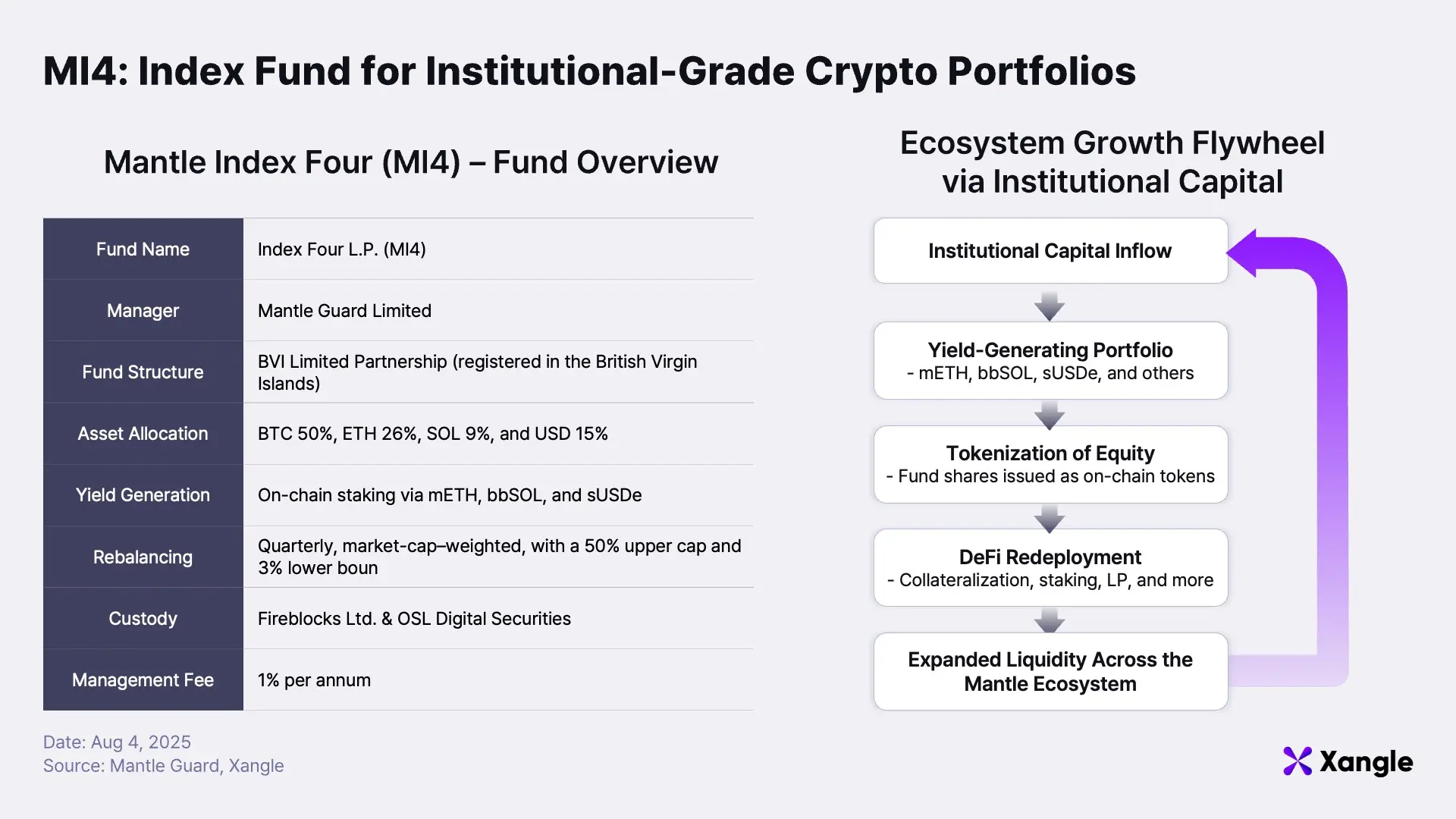
In April 2025, Mantle launched the “Mantle Index Four (MI4),” an institutional investor–exclusive digital asset index fund, as part of its strategy to structure the on-chain financial ecosystem around regulated capital. The MI4 portfolio includes a basket of major digital assets — Bitcoin (BTC), Ethereum (ETH), Solana (SOL), and USD-denominated stable assets — while layering in yield-bearing, staking-based strategies such as mETH, sUSDe, and bbSOL. The product is positioned as an advanced “crypto beta + yield” vehicle, giving investors market exposure without requiring them to select individual tokens or arrange custody themselves, all within a fund structure familiar to traditional finance.
MI4’s most distinctive feature lies in its on-chain fund tokenization model combined with a regulation-aligned design. Mantle has partnered with Securitize to issue MI4 fund shares as tokenized assets on the Mantle Network. This approach transforms the product from a simple investment instrument into a composable on-chain asset that can be used for collateralization, traded on exchanges, or integrated into derivatives markets. The fund is managed by Mantle Guard Ltd., an entity within the Mantle ecosystem, and operates under an SEC- and MiFID-compliant distribution framework, targeting U.S. accredited investors and global institutional participants.
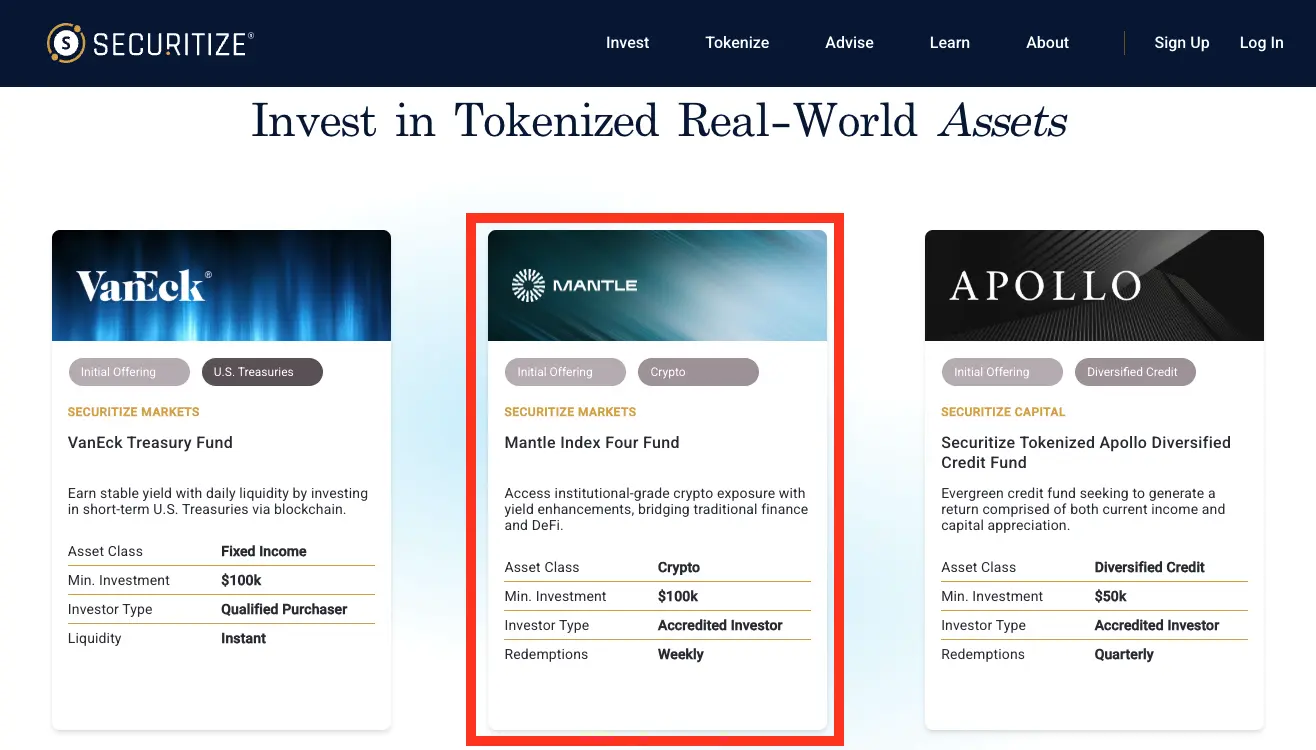
Mantle Index Four Fund on Securitize Platform
Structurally, MI4 blends the institutional-grade stability of traditional asset markets with the real-time flexibility unique to Web3. The private fund framework — featuring quarterly rebalancing, market-cap–based weighting adjustments, and a 1% management fee — offers a format that institutional players are accustomed to. Asset custody is handled via Fireblocks. Adding to its credibility, Mantle DAO governance has pre-approved up to $400 million in treasury anchor investment, ensuring substantial early liquidity. This confidence is reflected in MI4’s performance: on the Securitize platform, it has ranked first in PnL among all offerings except for BlackRock funds.
Within the blockchain industry as a whole, MI4 represents a rare and distinctive approach. It is uncommon in today’s infrastructure-focused Web3 landscape for a single project to design a fund structure in-house and manage on-chain assets under DAO-based governance. Much like how index funds in traditional finance rapidly gained market share on the back of stable returns, MI4 has the potential to establish a new on-chain benchmark by providing a structural framework that meets the operational and compliance needs of regulated investors. As the crypto market approaches a turning point for institutional capital inflow, MI4 is positioned to serve as a formal, compliant gateway.
2-2. UR pre-launch: A “Smart Money App” for retail users
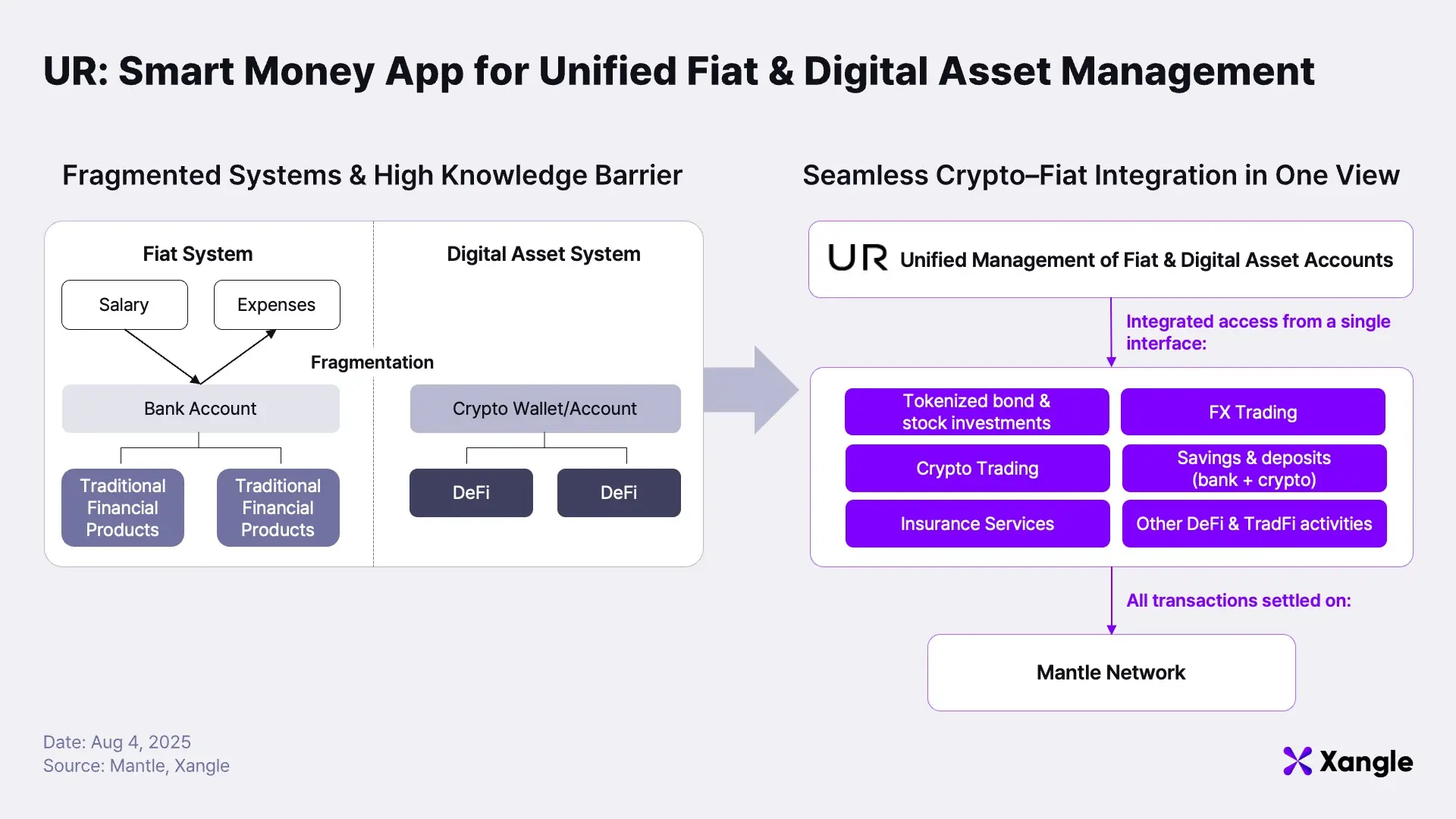
In July 2025, Mantle pre-launched “UR,” a smart money application designed to unify traditional finance (TradFi) and digital assets (DeFi) within a single account and interface. Historically, moving between the two systems required a multi-step, often cumbersome process. UR eliminates this friction by integrating them into a single, intuitive UI, delivering usability comparable to everyday mobile banking or fintech apps. In the same way that platforms like Toss and Revolut redefined the retail banking experience, UR aims to bring the UI/UX of on-chain finance up to an everyday, consumer-ready standard.
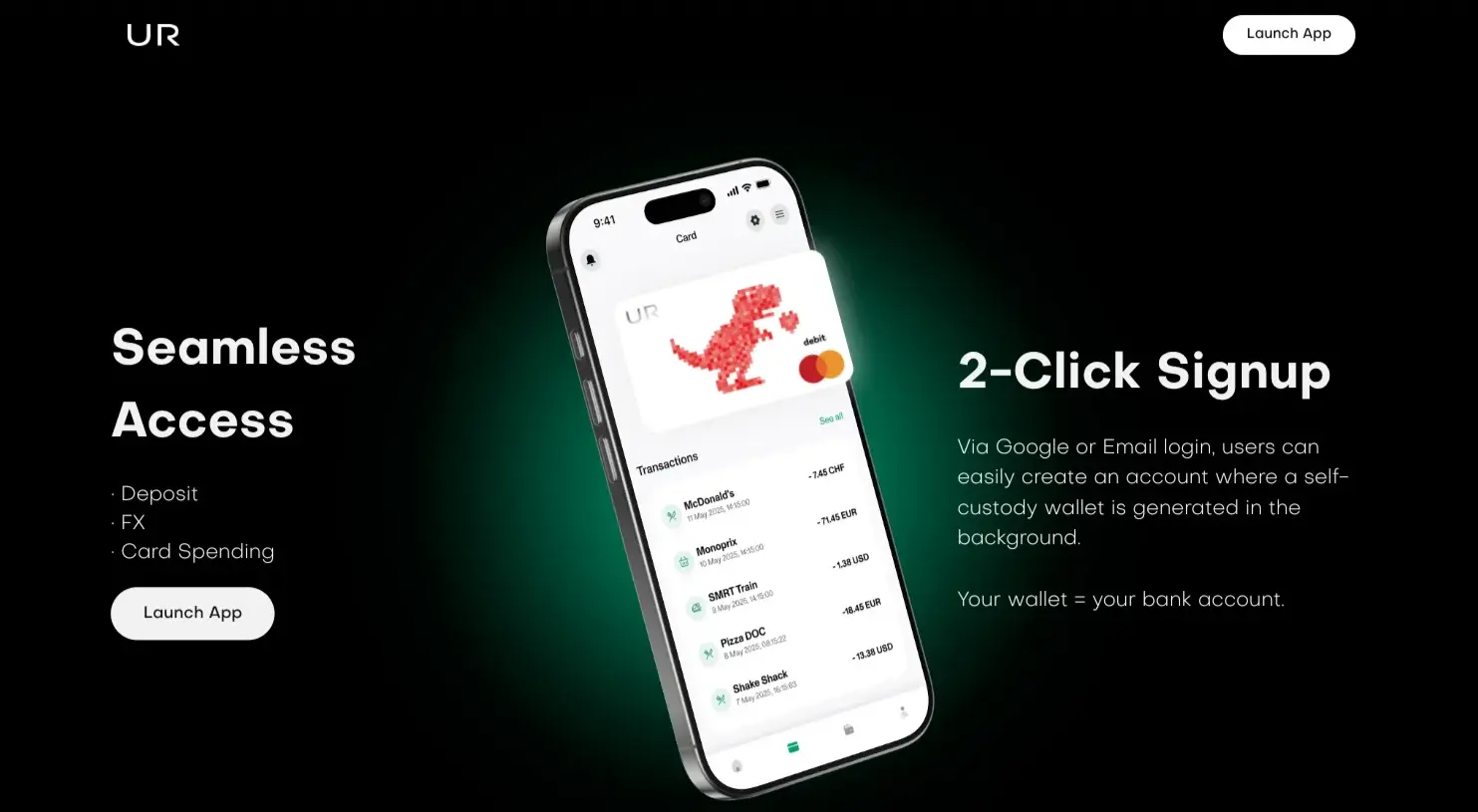
The application offers, all in one place, Swiss-based multi-currency accounts, on-chain KYC and ID verification, crypto-to-fiat off-ramps, debit payments, FX conversion, digital asset investment, and rewards accumulation. This design allows users to experience banking, investing, and payments in a blockchain-native environment without technical barriers. With a single UR account, users can access a broad spectrum of assets — from stocks, bonds, FX, insurance products, and deposits to stablecoins and DeFi instruments — with every transaction settled and recorded in real time on the Mantle Network.
UR is set to evolve beyond a standalone retail app into a direct distribution channel for Mantle’s flagship DeFi products, including MI4, mETH, and ƒBTC. By making these offerings easily accessible, UR is intentionally designed to convert user activity into tangible demand for $MNT. Deposits, trades, and DeFi participation within UR all feed into a token value-accrual structure, forming a flywheel of adoption and value growth for the Mantle ecosystem. The roadmap for UR extends further — into becoming a full Banking-as-a-Service (BaaS) infrastructure. External projects will be able to integrate UR’s regulatory-grade KYC, payment rails, asset management, and rewards modules into their own offerings. This positions UR as a financial diffusion layer, expanding both retail adoption and regulatory compatibility across the Mantle network. Backing this strategy is Mantle DAO’s $3 billion treasury and EcoFund, which serve as key financial resources for attracting UR-based applications and developer participation. The recent launch of the “Lightning Grants” program, designed to provide rapid funding to early-stage teams — is accelerating this ecosystem build-out.
While still in pre-launch, UR is already shaping expectations as the central hub of Mantle’s “Blockchain for Banking”strategy. All financial flows within the app are processed natively on the Mantle Network, binding token utility and ecosystem expansion into a single operational layer. With global demand for index funds, automated asset management, and stablecoin-based payments on the rise, UR is well positioned to become a next-generation financial platform tailored to the digital-native generation.
3. Localizing Stablecoins — Can Mantle Capture Opportunities in Asia?
Stablecoins have reemerged as a central narrative in the global crypto market. In the U.S., regulation and institutionalization of dollar-backed stablecoins are moving into full swing, while in Asia — historically more conservative — discussions are gaining momentum around issuing and utilizing stablecoins pegged to local currencies. Efforts to digitize national currencies such as the Chinese yuan, Japanese yen, and Korean won are accelerating, and interest is rising in blockchain infrastructure capable of addressing both local policy frameworks and regional demand. Within this landscape, Mantle is positioning itself as a chain with a competitive architecture for stablecoin settlement and distribution.
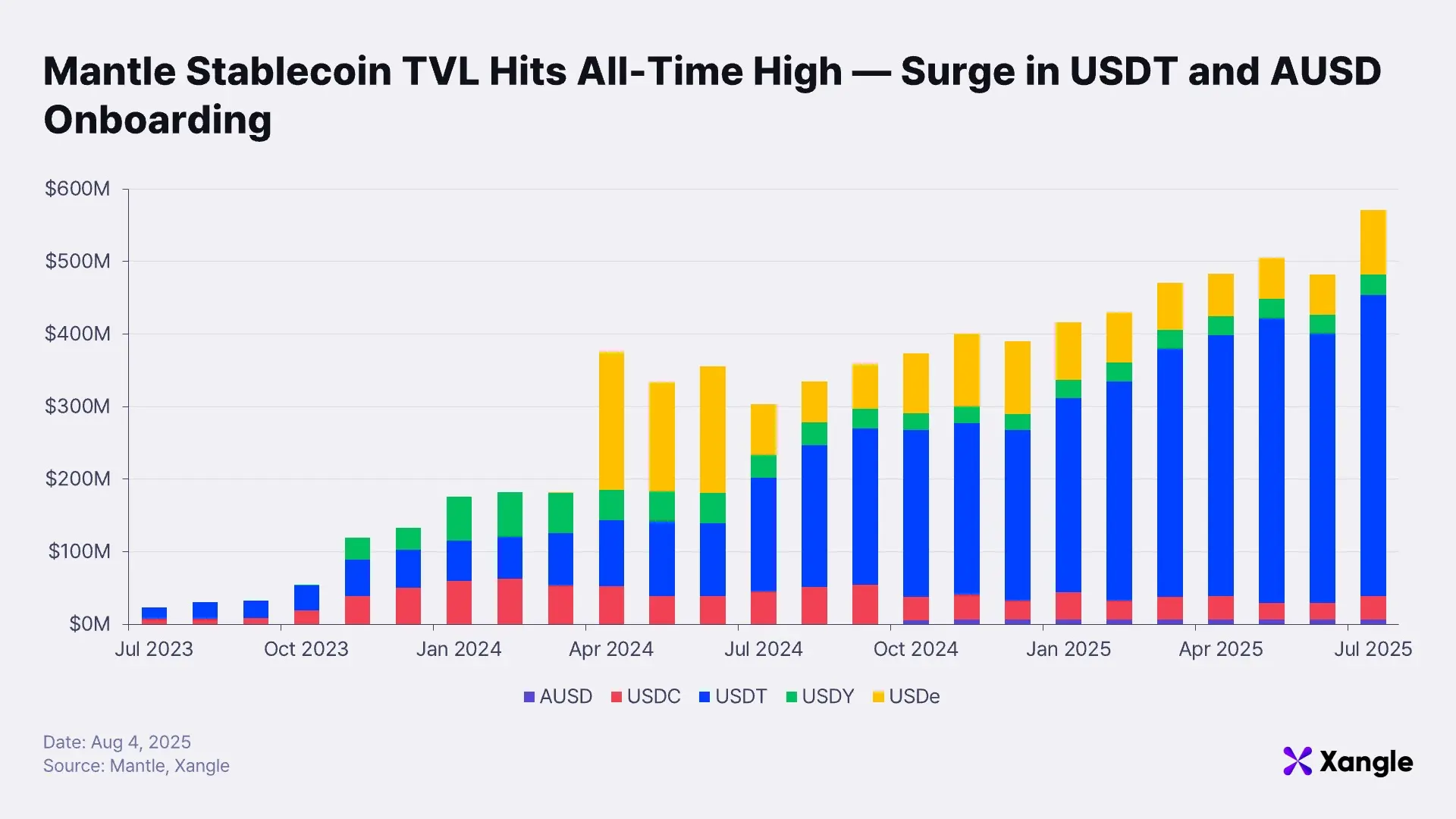
From an early stage, Mantle prioritized building an on-chain financial infrastructure with stablecoins at its core. This focus has paid off: stablecoin TVL on the Mantle Network recently reached an all-time high, establishing the chain as a central asset hub. Mantle was also the first among major Layer 2s to secure an exclusive partnership with Ethena’s algorithmic stablecoin USDe, enabling early distribution and liquidity capture. Today, USDT holds the largest share of Mantle’s stablecoin TVL, followed by USDC, with active efforts underway to onboard new entrants such as AUSD (Agora). Behind this aggregation lies a deliberate strategy, combining targeted partnerships with the direct design and expansion of Mantle’s native liquidity infrastructure. These initiatives have positioned Mantle as a differentiated Layer 2 with clear competitive strength as a stablecoin hub.
The addition of UR as a user-friendly access point is set to bring Mantle’s stablecoin strategy even closer to real-world adoption. UR’s Swiss-based multi-currency accounts can directly support Asian currencies such as the yuan, while integrating practical, everyday functionalities — on-chain KYC, digital asset investment, rewards, and both fiat off-ramps and on-ramps — into a single application. Furthermore, several of Mantle’s founding members hail from Bybit, bringing deep global finance experience rooted in Greater China markets including China, Hong Kong, and Singapore. This gives Mantle an edge in local networks and regional market understanding. As global stablecoin competition fragments along local currency lines, Mantle, with its ready-made infrastructure, consumer-facing interface, and strategically aligned partnerships, is emerging as one of the strongest contenders for the title of “Asia Stablechain.”
4. Technology and Product Updates Converging into a Financial Network
From the outset, Mantle has pursued scalability and efficiency through a modular architecture coupled with external data availability solutions (EigenDA). In 2025, the network began a full-scale migration to an OP-Succinct–based ZK validity rollup, a move aimed not only at improving scalability but also at meeting institutional and large-scale investor demands for privacy guarantees and rapid asset withdrawals. The integration of EigenDA v2 delivered substantial performance gains, achieving data throughput in excess of 50 Mbps and block re-execution latency under 10 seconds, further strengthening Mantle’s foundation as a financial-grade infrastructure layer.
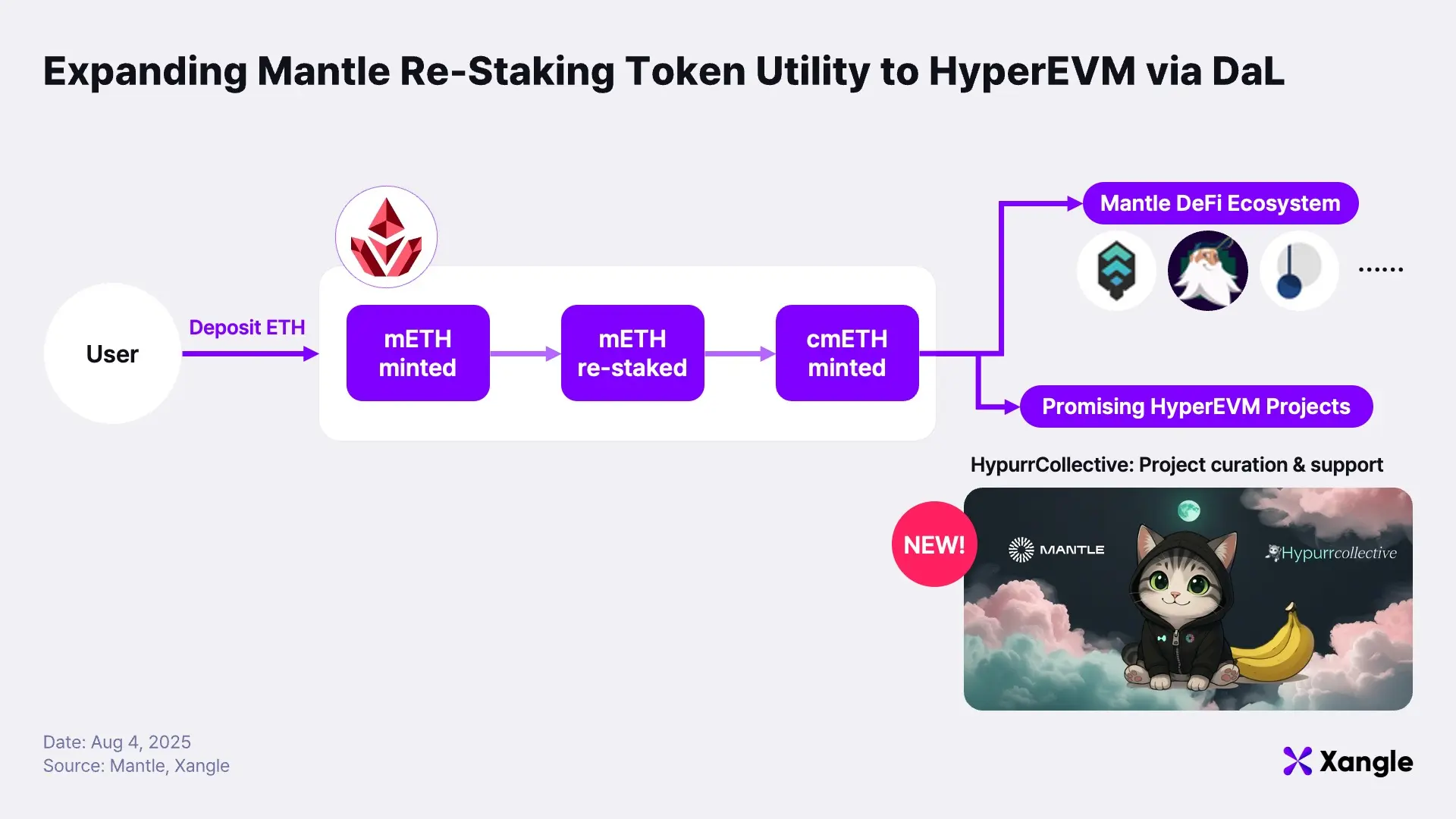
Mantle’s flagship financial protocol, mETH, has also seen meaningful progress. Users can deposit ETH to mint mETH, which automatically accrues staking rewards. Re-staking mETH converts it into cmETH, enabling integration with AVSs such as EigenLayer, Karak, and Symbiotic to earn additional rewards — making it a versatile component in DeFi strategies across the Mantle ecosystem. Leveraging the structural advantages of re-staking protocols, Mantle has prioritized expanding the real-world utility of these tokens.
To advance this goal, June 2025 saw the launch of the DaL (Double Adaptive Liquidity) program under the Mantle Scouts Program. DaL is designed to deploy cmETH liquidity more proactively and strategically across the ecosystem, with a focus on connecting it to high-potential dApps built on HyperEVM. Partner Hypurr — a community of founders and traders active on HyperEVM — curates quality projects that can generate real transactional demand for cmETH, supporting them with grants and resources. This initiative broadens the demand base for cmETH, cultivates a liquidity environment where assets are actively utilized rather than passively held, and enhances both asset circulation and capital efficiency.
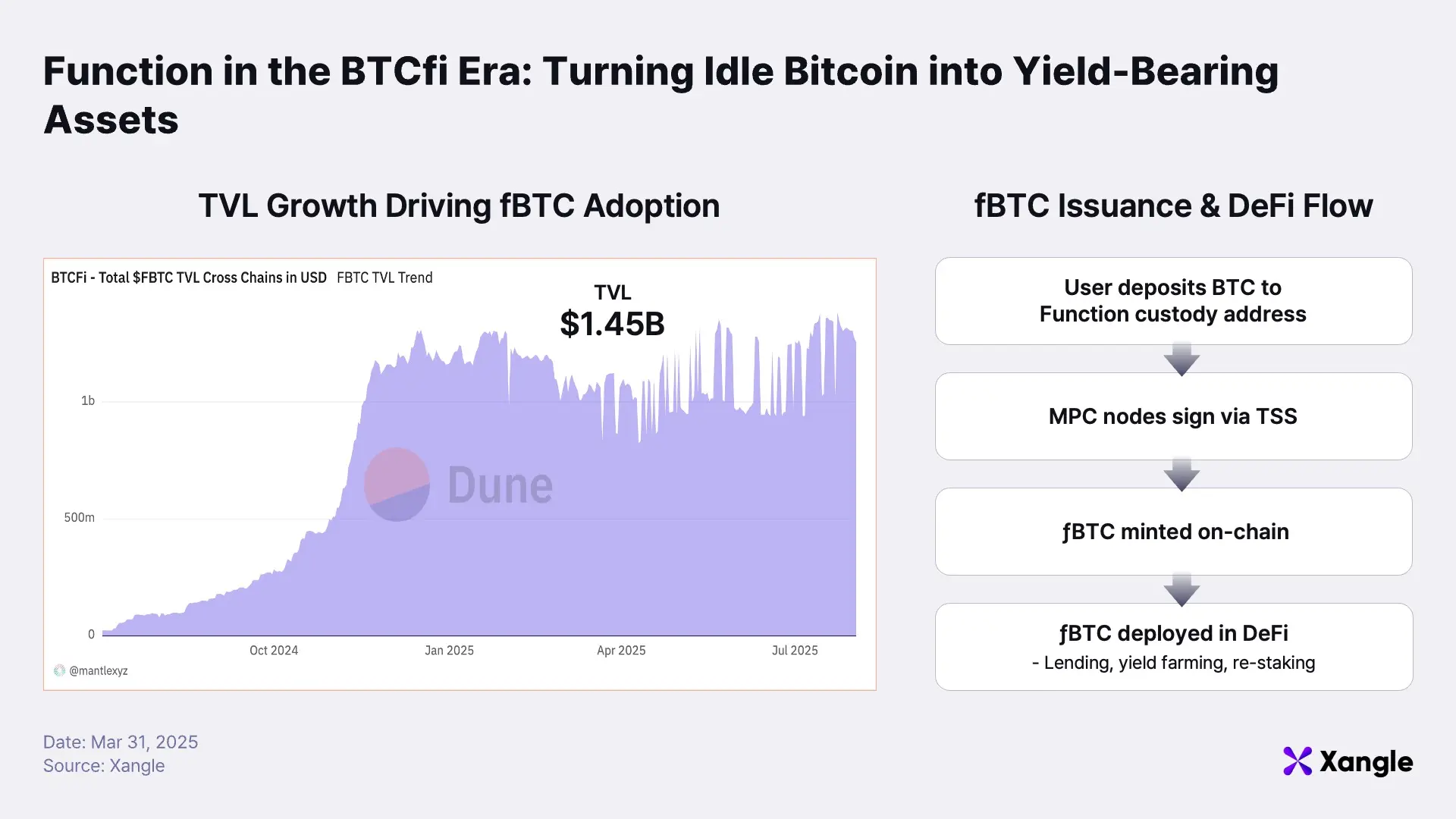
Mantle’s strategy extends beyond Ethereum-based assets to include Bitcoin liquidity and productivity expansion. A prime example is FBTC, an omnichain BTC asset developed in partnership with Function. Built with a fully collateralized model and smart-contract–based yield mechanics, FBTC has been positioned as one of Mantle Group’s core products. It is integrated with over 25 protocols, including Ethereum, Arbitrum, and Aave, and has surpassed $1.5 billion in TVL. Additionally, Mantle has invested in ReserveOne, an institutional platform managing strategic reserves of Bitcoin, Ethereum, and Solana, while rolling out staking, lending, and asset management products linked to Mantle ecosystem assets such as FBTC, mETH, and bbSOL.
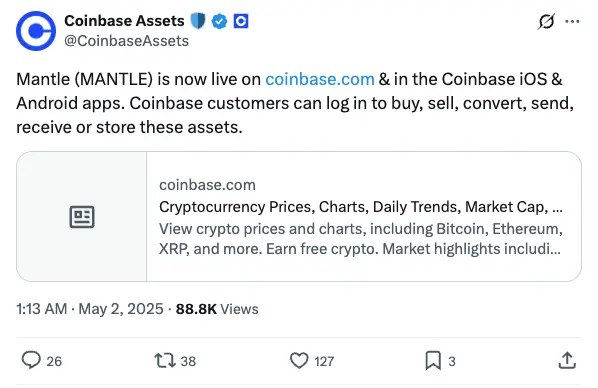
Mantle ecosystem gaining attention through new major exchange listings
Mantle’s continuous technical and product evolution has translated into concrete market results, including major exchange listings. It is generally difficult for projects closely tied to a single exchange at launch to secure listings elsewhere. While Mantle originated within the Bybit ecosystem, it achieved the rare milestone of being listed on Coinbase in May, followed in June by the simultaneous listing of mETH and cmETH, its re-staking yield tokens, on Kraken. This marks Mantle’s shift from being exchange-anchored to becoming a universal financial infrastructure with expanding connections to global regulated markets. With technology, assets, partnerships, and listing strategy now operating in concert, Mantle is steadily advancing its vision of becoming a true banking chain.
5. Closing Statement: Mantle as a Financial Infrastructure Serving Both Institutions and Retail
The benchmarks for blockchain infrastructure have shifted dramatically in the wake of evolving regulatory frameworks worldwide. Beyond delivering high throughput and low transaction fees, the critical measure now is whether an ecosystem can support a functioning financial structure — one where real users engage and capital actively circulates. Mantle stands out as one of the fastest and most precise responders to this shift. MI4 is establishing a compliant, on-chain gateway for institutional capital. UR is enhancing everyday financial accessibility for retail users. Between them, structured asset layers such as mETH, ƒBTC, and a diverse set of stablecoins are interlinked across the Mantle Network, creating an organically connected financial system.
One of the most timely aspects of Mantle’s strategy is its nuanced approach to stablecoins. With U.S.-driven regulation of dollar-backed stablecoins accelerating and Asian markets — including China, Japan, and Korea — intensifying discussions on local-currency stablecoins, Mantle has already expanded its TVL to all-time highs by onboarding multiple global stablecoins. UR’s design also anticipates regional currency settlement, including the Chinese yuan, offering a user experience aligned with cross-border and local payment needs.
Mantle’s vision of becoming a “banking chain” is the product of a deliberately integrated approach spanning technology, asset infrastructure, and user interface. As the market moves into its next phase under the umbrella of regulatory oversight, Mantle is positioned to operate at the forefront — bridging institutional and retail finance within a unified on-chain framework.
Disclaimer
I confirm that I have read and understood the following: The information contained in this article is strictly the opinions of the author(s). This article was authored free from any form of coercion or undue influence. The content represents the author's own views and does not represent the official position or opinions of CrossAngle. This article is intended for informational purposes only and should not be construed as investment advice or solicitation. Unless otherwise specified, all users are solely responsible and liable for their own decisions about investments, investment strategies, or the use of products or services. Investment decisions should be made based on the user’s personal investment objectives, circumstances, and financial situation. Please consult a professional financial advisor for more information and guidance. Past returns or projections do not guarantee future results. This article was written at the request of Mantle. All content in this article was written independently by the author(s), and neither CrossAngle nor Mantle had any editorial control or influence over the content. The author(s) may hold the cryptocurrencies mentioned in this article at the time of writing.
Xangle or its affiliated partners own all copyrights of the written or otherwise produced materials and content provided on the platform. Any illegal reproduction of such content, including, but not limited to, unauthorized editing, copying, reprinting, or redistribution will result in immediate legal actions without prior notice.