GRVT: Building an On-Chain Asset Management Platform Beyond Trading


Table of Contents
1. After Trading Fees Disappeared, How Do Exchanges Make Money?
2. GRVT's Strategy: Grow Trading Activity and Asset Retention Together
3. How GRVT Connects Trading, Yield, and RWAs
4. Closing Remarks: GRVT's Competitive Edge Hinges on Asset Retention
1. After Trading Fees Disappeared, How Do Exchanges Make Money?
Historically, trading fees have fallen steadily as the internet and electronic trading developed. When investors relied on branches or telephone orders, order execution itself generated high commissions. Online brokers and mobile apps pushed stock-trading fees close to zero. Brokerages responded by expanding into cash management, margin lending, securities lending, and wealth management, all supported by assets left in customer accounts.
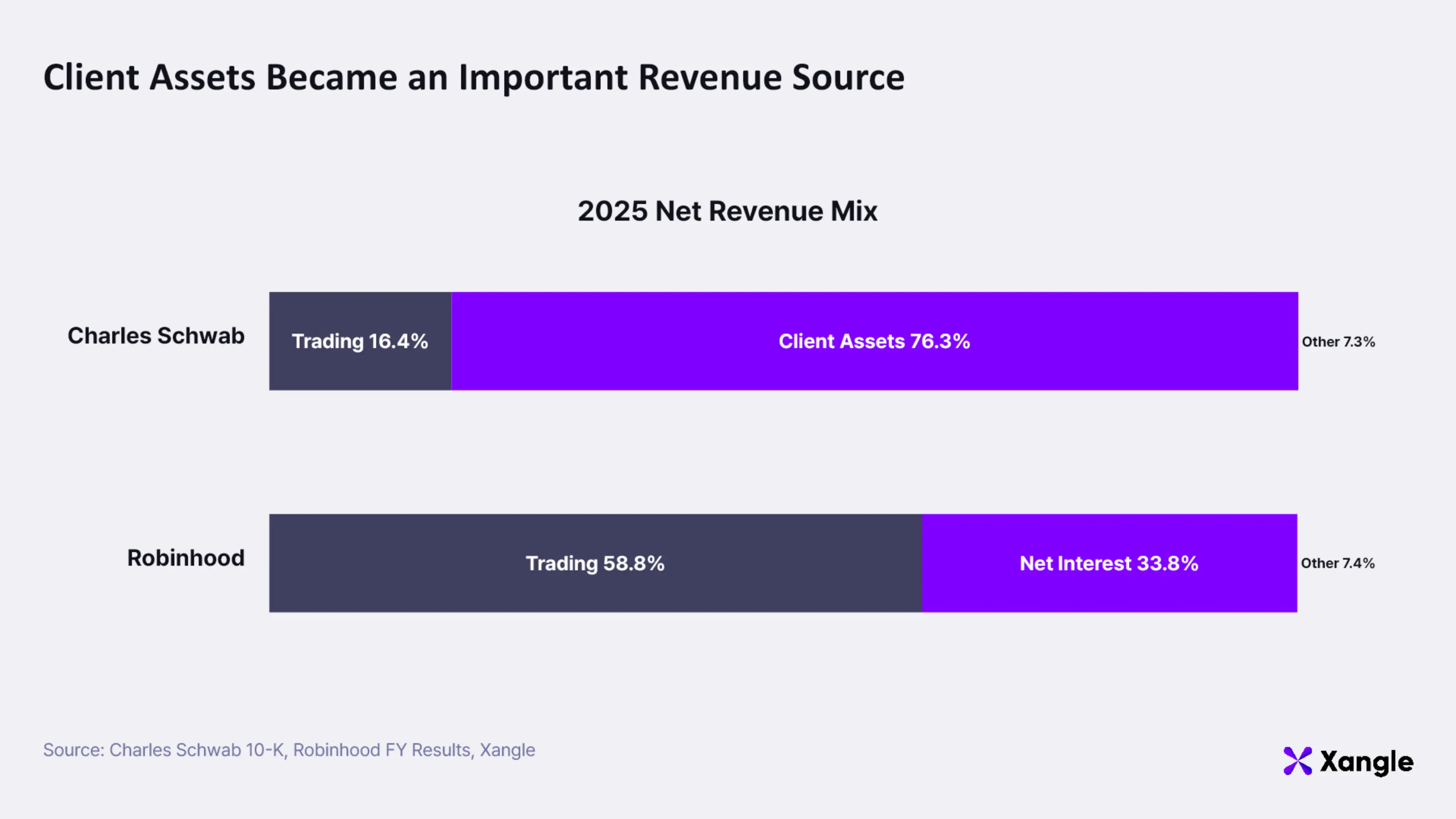
Charles Schwab generated $23.9 billion in total net revenue in 2025. Net interest revenue tied to customer cash, lending, and securities portfolios contributed $11.75 billion, or 49.1%, while asset management and administration fees contributed $6.51 billion, or 27.2%. Together, revenue generated from customer assets accounted for 76.3% of the total. Trading revenue was $3.92 billion, or just 16.4%.
Of Robinhood's $4.47 billion in total net revenue in 2025, transaction-based revenue contributed $2.63 billion, or 58.8%, while net interest revenue contributed $1.51 billion, or 33.8%. Trading still represents the larger share, but revenue generated from customer assets is also significant. Even a platform built around commission-free stock trading relies on customer cash, margin balances, securities lending, and other customer assets as major revenue sources.
Perpetual futures DEXs are facing a similar shift. The average monthly trading volume of the 12 largest perpetual futures DEXs rose 12%, from $531.65 billion in 2025 to $611.57 billion in 2026. Annual trading volume reached $6.38 trillion in 2025, more than four times the $1.50 trillion recorded in 2024.
Perpetual futures generate exchange revenue and liquidity when users open and close positions. Lower activity reduces both execution fees and funding-related revenue. The market expanded rapidly through incentives such as points and airdrops, making users more likely to move toward higher rewards or deeper liquidity as trading features and reward structures converge. Trading volume alone therefore provides a weak foundation for long-term customer retention.
Many users want to hold cash or stablecoins, earn yield, and trade or invest only a portion when needed. Exchanges can serve this demand by connecting cash management, investment products, and collateral utility within a single account. Competition is expanding beyond the ability to generate large trading volumes toward giving customers a reason to leave assets on the platform between trades. GRVT is building around this shift.
2. GRVT's Strategy: Grow Trading Activity and Asset Retention Together
GRVT began as a perpetual futures DEX and aims to connect trading, yield, investment, and payments within one account. Its strategy is to attract customers and liquidity through trading, generate yield on collateral between trades, and distribute external RWA products so that assets remain productive within the platform.
2-1. A Customer and Liquidity Base Built Through a Perpetual Futures DEX
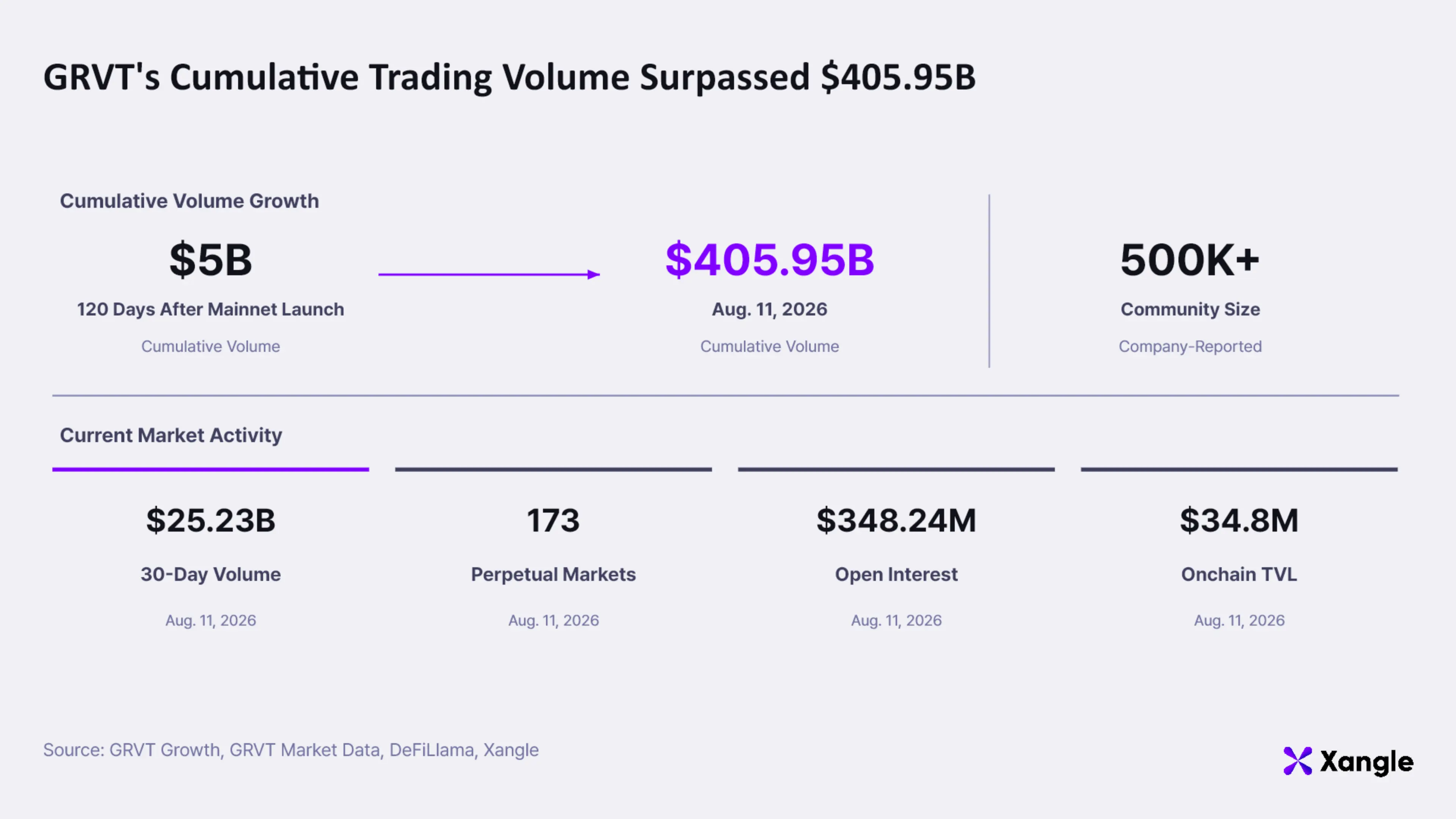
As of Aug. 11, 2026, GRVT offered 173 perpetual futures markets. The lineup included products tracking crypto assets, equities, exchange-traded funds (ETFs), and commodities, giving traders access to price movements across multiple markets. On the same date, DeFiLlama reported approximately $521 million in 24-hour trading volume, $25.233 billion in 30-day volume, roughly $348 million in open interest, and approximately $34.8 million in on-chain total value locked (TVL).
GRVT recorded $5 billion in cumulative trading volume during the first 120 days after its mainnet launch, rising to $177 billion by the end of 2025. DeFiLlama placed cumulative volume at $405.953 billion as of Aug. 11, 2026. The company also reported a community of at least 500,000 members.
GRVT has already established a broad product lineup and billions of dollars in monthly trading activity. Its next challenge is retaining this customer base and liquidity between trades. If deposited assets can earn yield while continuing to serve as margin, users gain a reason to keep funds on the platform after closing a position.
2-2. One Platform for Trading, Yield, Investment, and Payments
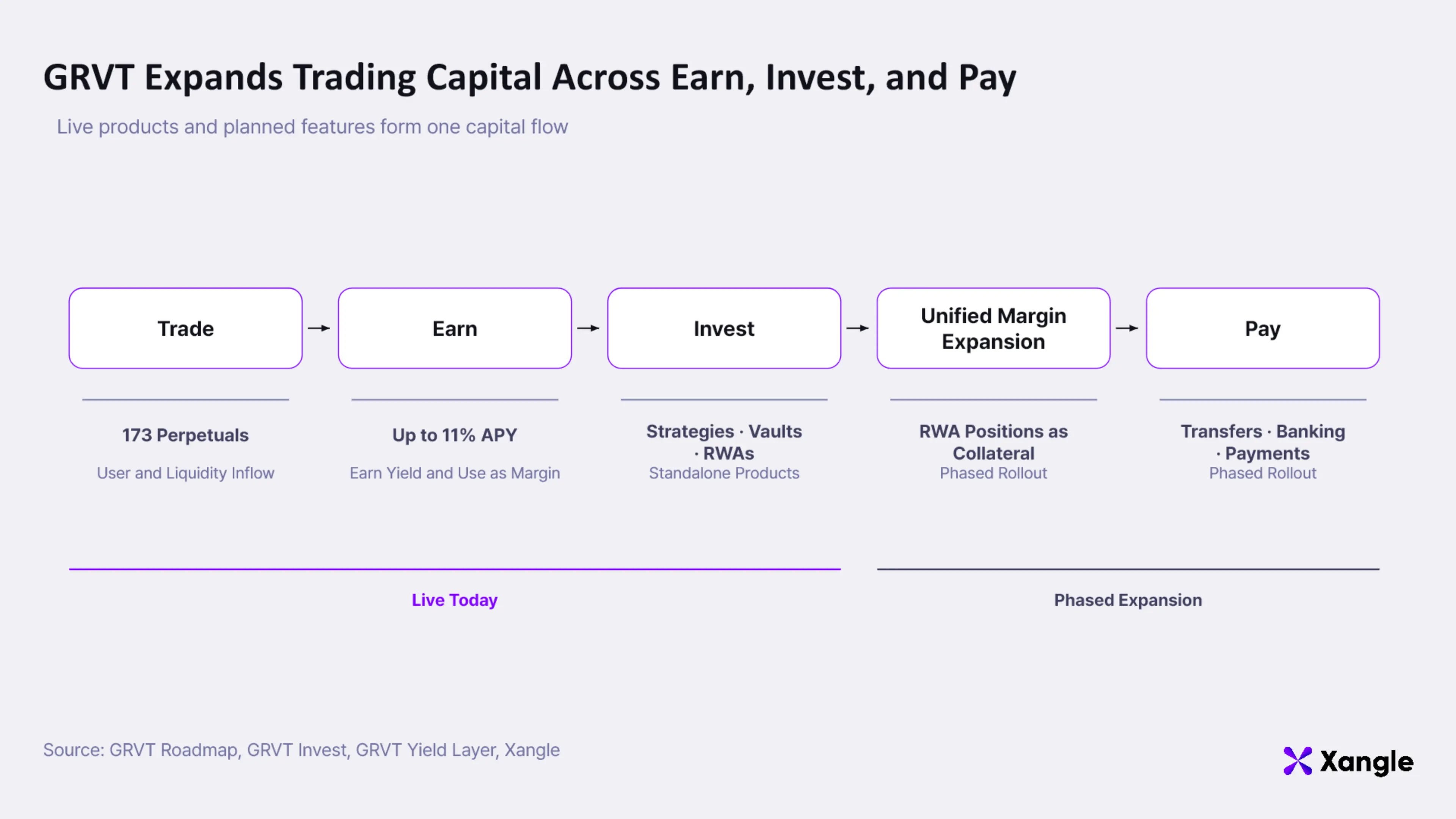
GRVT uses Trade to attract customers and liquidity, then aims to connect Earn, Invest, and Pay within the same account. Trade provides perpetual futures and other trading products. Earn pays interest on trading-account USDT and USDC while allowing the same balance to serve as margin. Invest offers managed strategies, yield vaults, and RWA products. Pay is planned to connect peer-to-peer transfers, cards, bank deposits and withdrawals, and payments to the same balance.
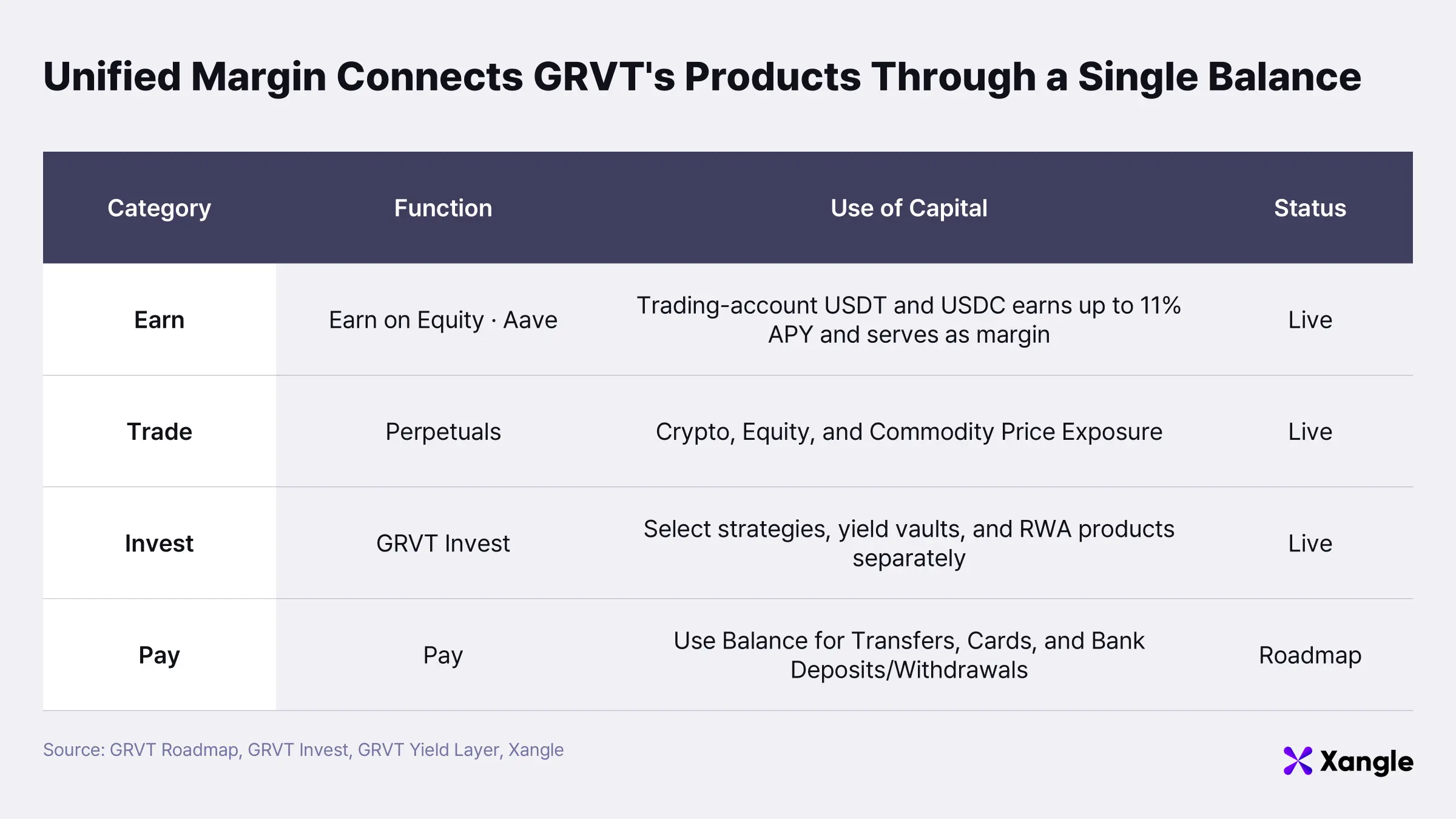
Unified margin is the core mechanism linking these functions. Trading-account USDT and USDC can already earn yield through Earn on Equity while serving as margin for perpetual futures. If RWA investment positions also become eligible collateral, capital could flow from cash and stablecoins into yield products, trading margin, and exposure to crypto assets, equities, and commodities. Users could reduce the need to move assets across applications or fully redeem investments whenever they switch functions. GRVT could keep customer assets productive even when users are not trading.
3. How GRVT Connects Trading, Yield, and RWAs
This section examines how the currently available Earn on Equity, Yield Layer, and GRVT Invest products work. It then explains how RWA collateralization and ZKsync-based interoperability could connect these components over time.
3-1. Earn on Equity and the Yield Layer: Turning Trading Margin into Yield
Earn on Equity provides an annual percentage yield on assets in the trading account while allowing the same balance to serve as margin for perpetual futures. USDT and USDC are currently eligible for Earn on Equity. Users can earn interest inside the trading account without moving assets to a separate lending application.
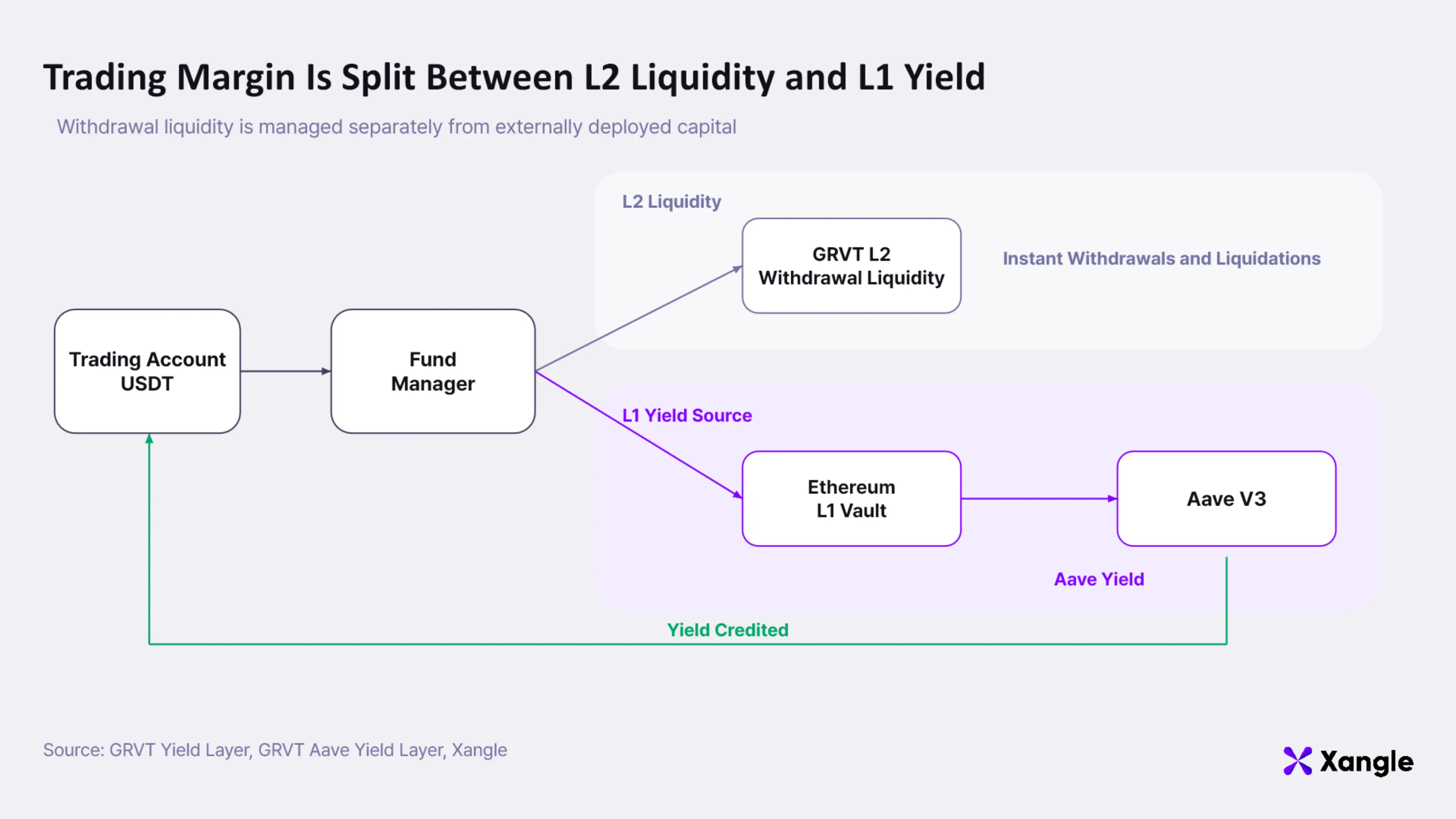
Earn on Equity sources its yield through the Yield Layer. The Yield Layer separates user funds between withdrawal liquidity on GRVT L2 and deployed capital on Ethereum L1. GRVT keeps enough USDT on L2 to support routine withdrawals, while the GRVT DeFi Vault on L1 supplies part of the funds to the Aave V3 USDT market. The Fund Manager Service monitors both balances and moves capital in response to withdrawal demand. Users see a single trading balance, while immediately available liquidity and externally deployed capital are managed separately in the background.
Earn on Equity's maximum 11% annual percentage yield combines a base yield with referral and trading-volume incentives. The actual rate depends on the user's activity, with the detailed conditions summarized in the exhibit below.
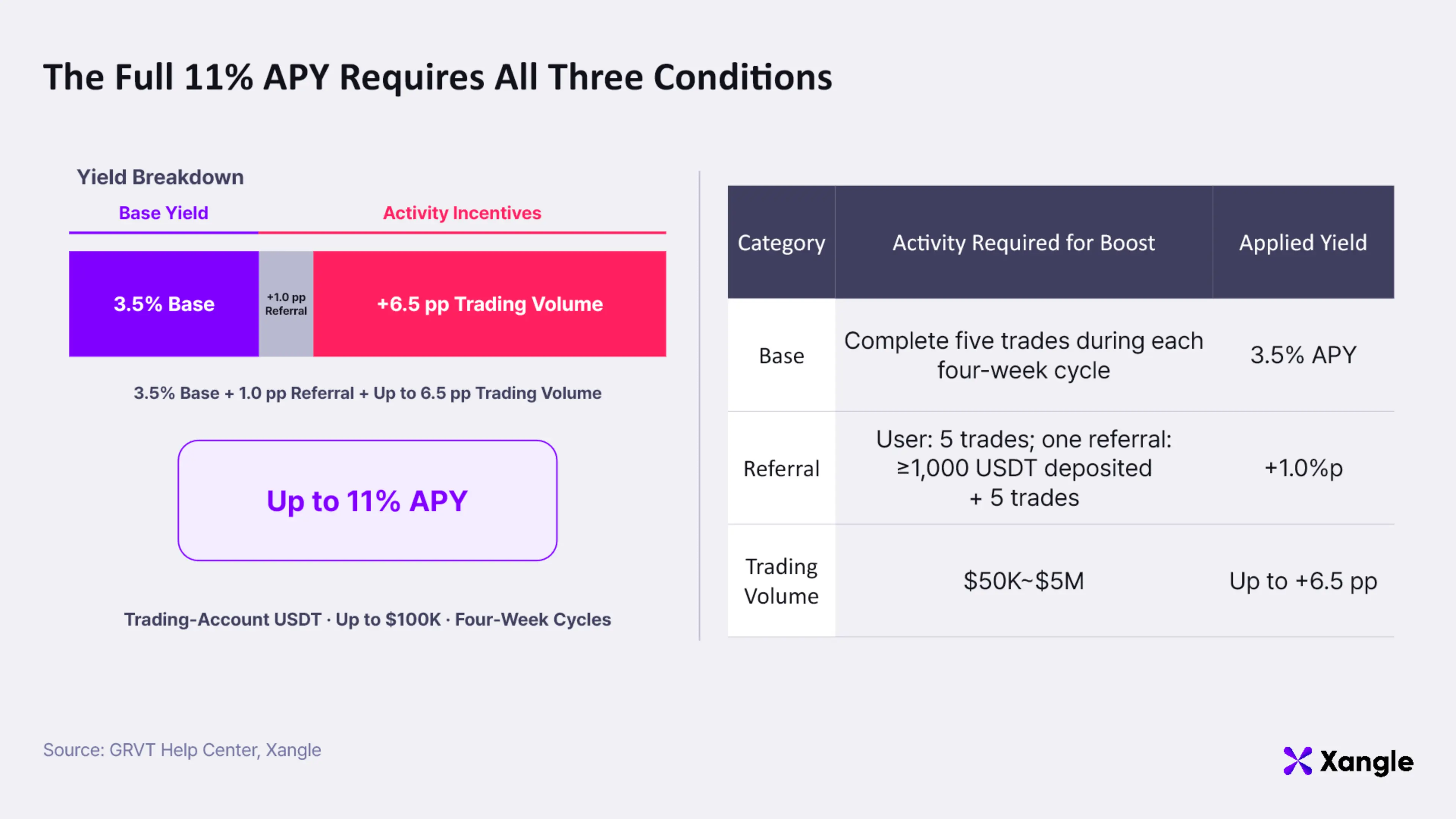
The base yield draws on Aave lending returns and GRVT's platform revenue. Referral and trading-volume conditions add incentives designed to attract customers and encourage trading activity. Users should evaluate trading fees, spreads, funding costs, and position risk alongside the additional yield. The program's long-term sustainability will also depend on whether the underlying yield sources remain stable without incentives.
3-2. GRVT Invest: Expanding from Strategies and Yield Vaults into RWAs
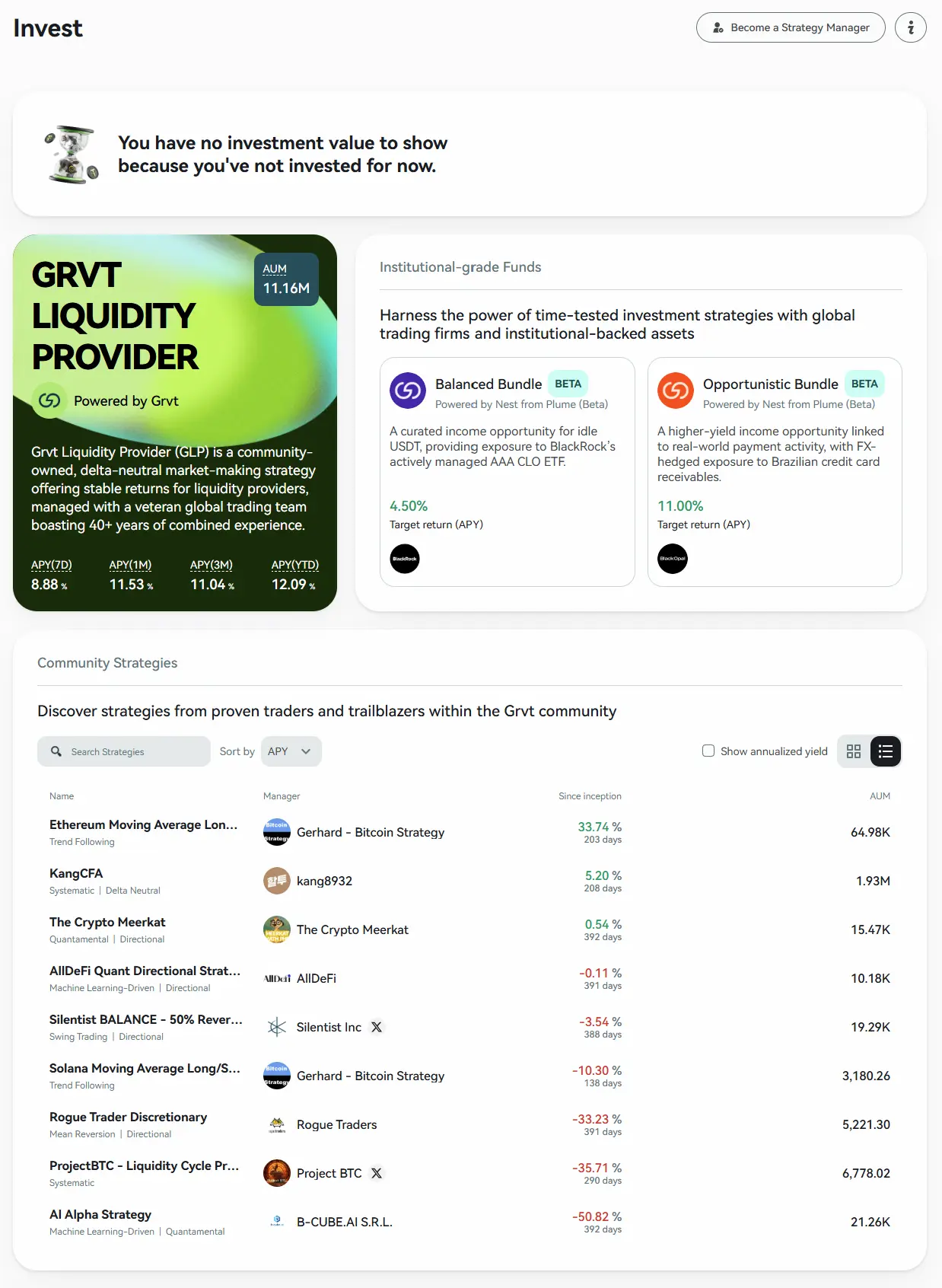
GRVT Invest offers investment strategies and on-chain yield vaults managed by vetted operators. Its lineup includes algorithmic trading, market-neutral yield, community strategies, and GLP-based products. In June 2026, Invest added RWA-based yield products using Plume's RWA infrastructure and Centrifuge's tokenized funds. GRVT selects products and conducts due diligence on them, manages user access and redemption procedures, displays balances, and monitors operations.
The products introduced in GRVT Invest's June 2026 beta were the Balanced Bundle and the Opportunistic Bundle. The Balanced Bundle targets approximately 4.5% annually, with a focus on senior exposure through an AAA-rated collateralized loan obligation (CLO) ETF. The Opportunistic Bundle targets approximately 11% through a currency-hedged Brazilian card-receivables strategy. These are target returns rather than guaranteed yields. Redemptions can typically take 0 to 7 days, and the underlying strategies may change.
Additional RWA products are expected to roll out in phases after risk reviews and eligibility checks. GRVT Invest offers products with different underlying assets and return structures. Users should confirm availability and terms for each product through GRVT's website and application.
3-3. ZKsync: The Foundation for Fast Trading and External Capital Connectivity
ZKsync allows GRVT to process private trades quickly while making the results verifiable on Ethereum. Orders are matched through an off-chain central limit order book (CLOB), while post-trade settlement and account states are recorded on GRVT's dedicated ZKsync Chain. The design uses off-chain execution for speed and Ethereum verification for integrity. GRVT reports processing capacity of up to 600,000 transactions per second.
The Atlas upgrade introduced in 2026 allows GRVT to process post-trade settlement and account states more quickly and reduces the time required to prove the results on Ethereum. Elastic Network connects multiple ZKsync Chains through Ethereum's shared bridge and verification system, allowing them to exchange assets and messages. GRVT could use this structure to connect assets held on the exchange to external financial services, including Ethereum DeFi, tokenized funds, and institutional chains. Atlas accelerates GRVT's internal execution and proof generation, while Elastic Network expands its connection to external markets.
Serving institutions requires control over how much transaction information becomes public. Prividium is ZKsync's institutional architecture for keeping sensitive transaction details private while allowing Ethereum to verify that transactions were processed according to the rules. If GRVT adopts this structure, it could connect trading, yield products, and tokenized assets within one platform while preserving institutional privacy.
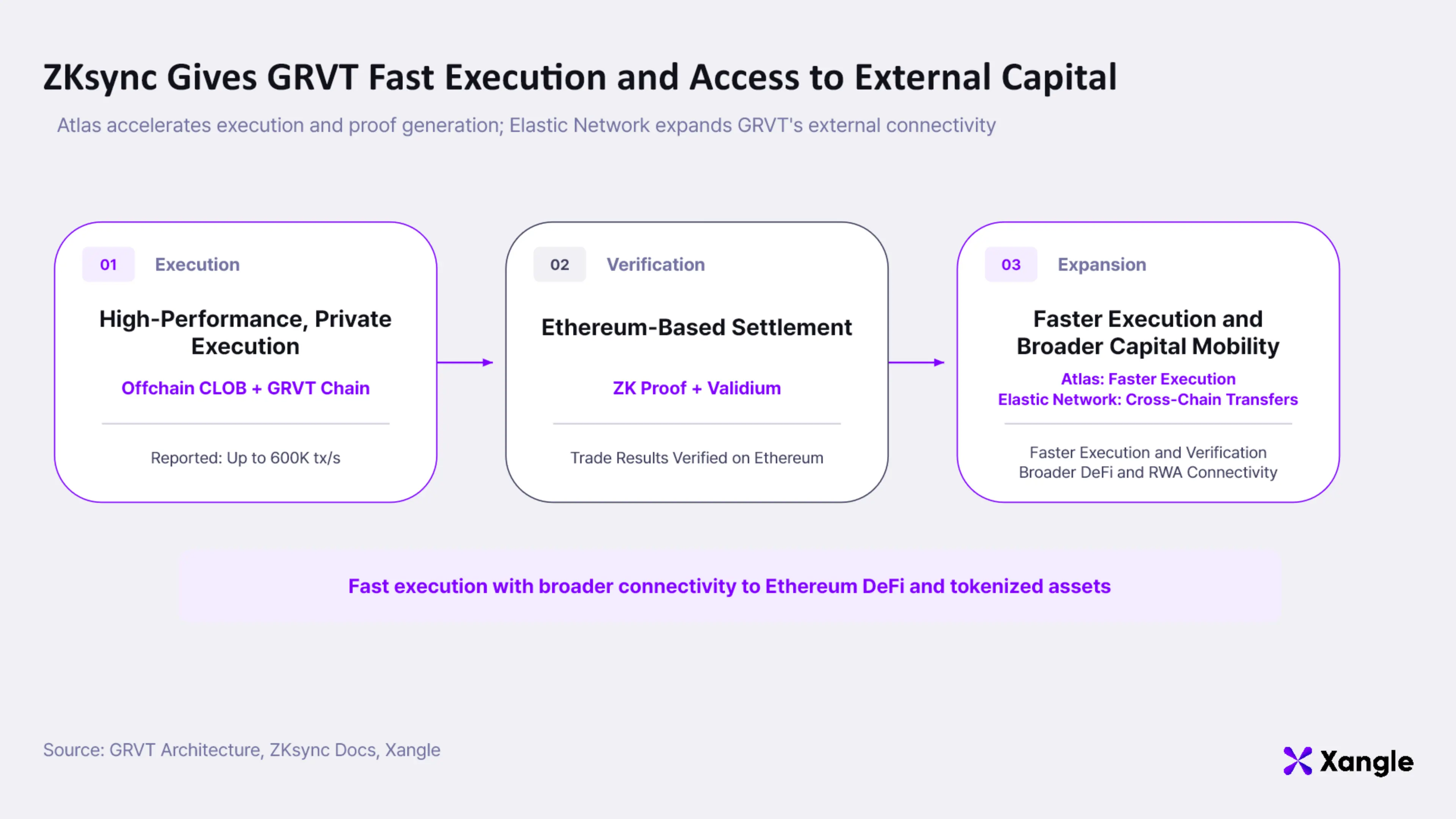
ZKsync provides GRVT with fast processing and privacy inside the exchange, Ethereum-based verification of transaction results, and the ability to connect other chains and assets when needed. Its competitive value will depend on how quickly GRVT integrates DeFi and RWA products and turns collateral utility and cross-chain asset movement into usable services.
3-4. GRVT's Roadmap: Connecting and Expanding a Unified Capital Flow
GRVT's 2026 roadmap focuses on linking currently separate yield, trading, and investment products into a unified capital flow. The first step adds more DeFi and RWA yield sources to Earn on Equity and the Aave-based Yield Layer, then extends that liquidity into lending tied to trading demand. The trading business is expected to expand from perpetual futures into spot, foreign exchange, and traditional assets.
The next step for Invest is to make RWA investment positions usable as margin while expanding its product lineup. Peer-to-peer transfers, cards, and bank deposits and withdrawals would let users apply the same balance to payments as well as investment and trading. Over time, ZKsync interoperability could connect this capital flow to other institutional chains and tokenized financial products.
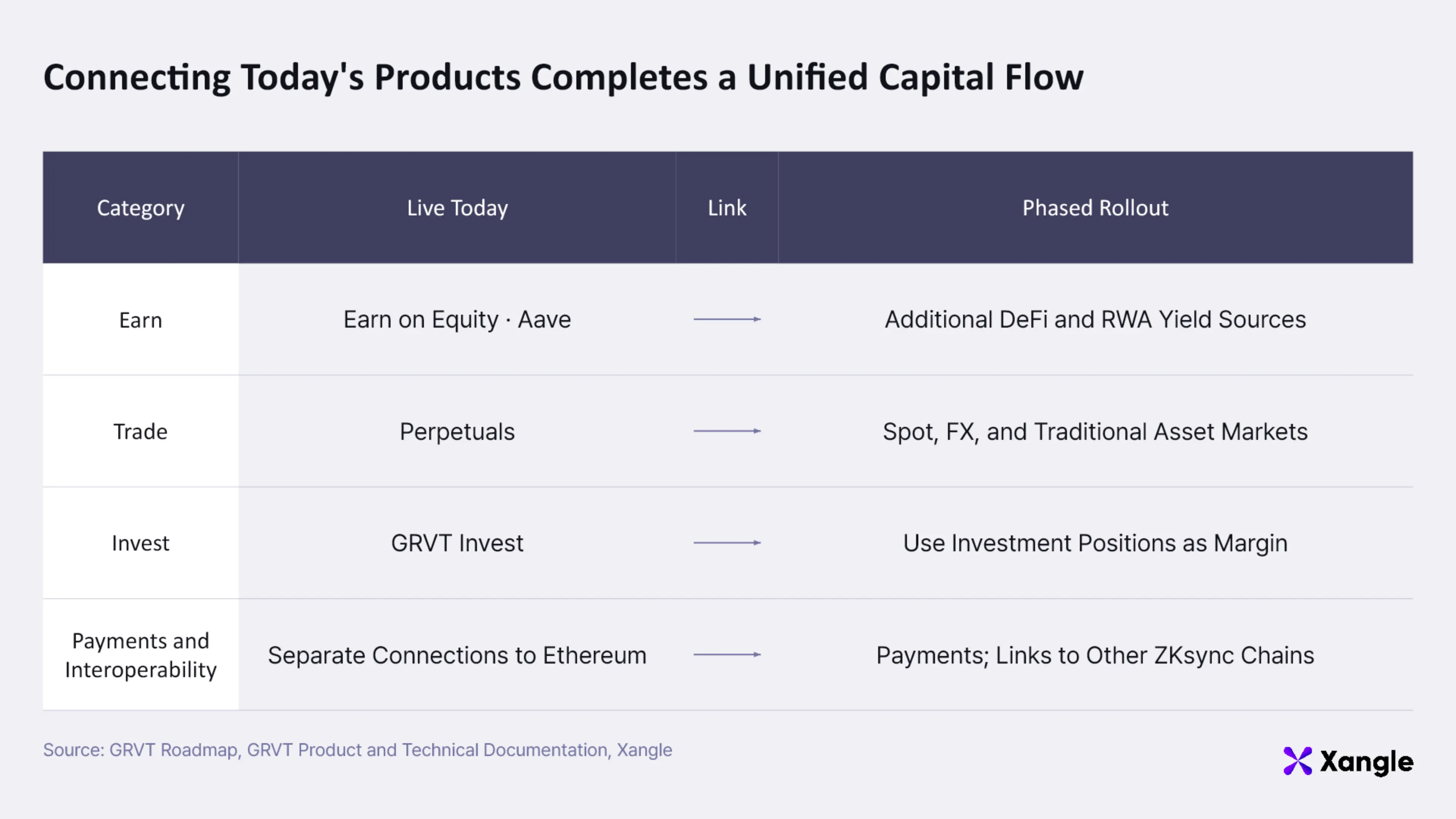
Earn on Equity, the Aave-based Yield Layer, perpetual futures, and GRVT Invest are currently offered as separate products. If RWA investment positions become eligible collateral and the same balance supports spot trading and payments, users could reduce the waiting time and lost yield caused by moving assets whenever they change functions. GRVT could also retain customer assets and maintain customer engagement between trades.
4. Closing Remarks: GRVT's Competitive Edge Hinges on Asset Retention
GRVT is using perpetual futures as the entry point for connecting yield on idle margin, RWA investments, and future payment services. Traditional brokerages expanded revenue sources tied to customer cash, interest income, margin lending, and asset management after trading became free. GRVT is following a similar path by seeking to increase both trading activity and the amount of time customer assets remain productive on the platform.
GRVT's direction resembles “Slow Finance,” a model in which assets continue to generate yield and serve investment and margin functions during the long periods between trades. Customers can trade when needed and put their assets to work for the rest of the time.
Product selection and due diligence, reliable redemptions, sustainable base yields, and clear risk disclosures must develop together for this strategy to take hold. GRVT has already implemented much of its core stack, including perpetual futures, Earn on Equity, the Yield Layer, and GRVT Invest. The next step is expanding unified margin and RWA collateralization to connect these functions into a single capital flow.
Key indicators to watch include how planned functions are implemented in live services, the frequency of repeat use across multiple products, and whether customer and asset retention improves. If these trends become clear, GRVT could evolve from a platform visited only for trading into one where users also have a reason to keep assets between trades.
Disclaimer
I confirm that I have read and understood the following: The information contained in this article is strictly the opinions of the author(s). This article was authored free from any form of coercion or undue influence. The content represents the author's own views and does not represent the official position or opinions of CrossAngle. This article is intended for informational purposes only and should not be construed as investment advice or solicitation. Unless otherwise specified, all users are solely responsible and liable for their own decisions about investments, investment strategies, or the use of products or services. Investment decisions should be made based on the user’s personal investment objectives, circumstances, and financial situation. Please consult a professional financial advisor for more information and guidance. Past returns or projections do not guarantee future results. This article was written at the request of GRVT. All content in this article was written independently by the author(s), and neither CrossAngle nor GRVT had any editorial control or influence over the content. The author(s) may hold the cryptocurrencies mentioned in this article at the time of writing.
Xangle or its affiliated partners own all copyrights of the written or otherwise produced materials and content provided on the platform. Any illegal reproduction of such content, including, but not limited to, unauthorized editing, copying, reprinting, or redistribution will result in immediate legal actions without prior notice.