Scroll in 2026: Payments, Stablecoins, and the Privacy Play


Table of Contents
1. Introduction: Payments and Stablecoins as Crypto’s Closest Path to PMF
2. What the ether.fi Card Revealed About Real-World User Onboarding—and What Scroll Must Do Next
3. Scroll’s Native Financial Layer Built Around Stablecoins and a Neobank Stack
3-1. USX: Scroll’s Native Stablecoin Linking Payments and Yield
3-2. Garden and Honeypop: Scroll’s In-House Neobank and Core DeFi Stack
4. Cloak and Institutional Expansion: Privacy Infrastructure as Scroll’s Strategic Edge
5. Conclusion: Scroll’s 2026 Challenge Is No Longer Narrative, but Execution
1. Introduction: Payments and Stablecoins as Crypto’s Closest Path to PMF
Over the years, crypto has made meaningful progress at the infrastructure level—improving scalability, security, and cost efficiency. And yet, when it comes to mainstream adoption, it has still remained relatively limited. DeFi proved the potential of on-chain finance through capital efficiency and composability, but for many users, crypto has continued to feel more like a financial experiment centered on token speculation and trading.
Payments are different. They solve problems people encounter in everyday life, repeatedly and directly, while also showcasing crypto’s core strengths in the clearest possible way: borderless operation, fewer intermediaries, and open access. More importantly, payments create recurring, non-speculative transaction demand. They are not tied to a single platform or geography, which is why many see payments as one of the clearest areas where crypto is beginning to approach real product-market fit.
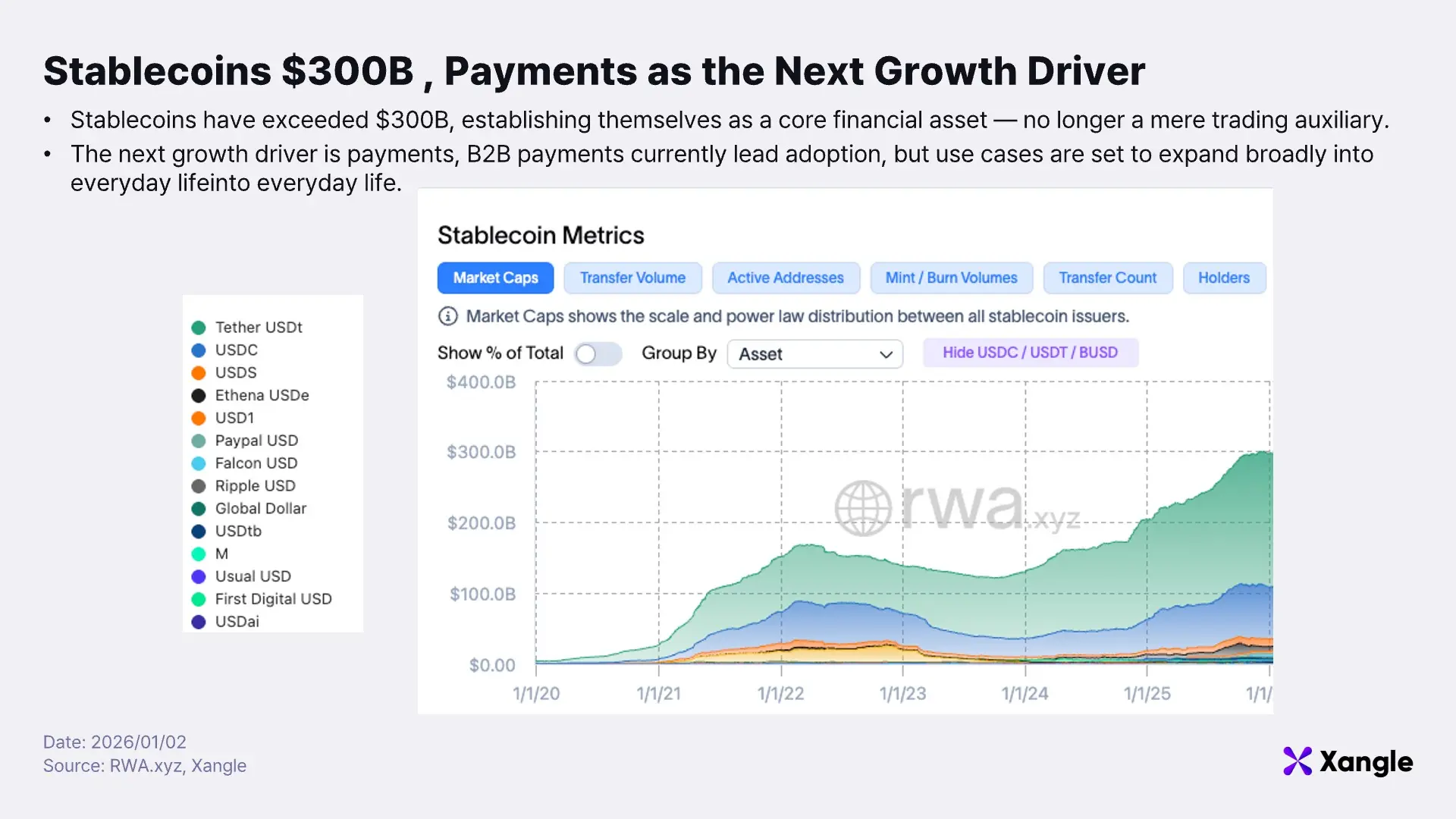
The key driver behind this shift has been the rise of stablecoins. By anchoring value to fiat, stablecoins reduce one of crypto’s biggest structural weaknesses—volatility—while preserving what blockchains do best: global access, permissionless usage, and round-the-clock settlement. As a result, stablecoins have evolved far beyond the idea of a “digital dollar.” They are increasingly functioning as the default unit for real-world remittance and payments, the common settlement layer across DeFi, and, more broadly, a new type of global financial rail. Their relevance is especially clear in areas such as cross-border payments, payroll, and B2B settlement, where speed, cost, and certainty all matter at once. In these use cases, stablecoins are no longer theoretical tools. They are emerging as practical alternatives that can improve on the limitations of traditional financial infrastructure.
This trend became even more visible around 2025 as regulatory frameworks began to catch up. In both the U.S. and Europe, efforts to bring stablecoins into the regulated financial system accelerated. Transparent reserves, credible collateral structures, audits, and disclosures have started to become standard expectations. As a result, the market is no longer focused only on incumbent stablecoins like USDT and USDC. It is expanding toward more regulation-friendly models, including discussions around stablecoins issued directly by banks and financial institutions. That matters because it changes how stablecoins are perceived. They are no longer just experimental assets operating in a gray area. Increasingly, they are being treated as digital payment and settlement infrastructure that can connect to the broader financial system.
Korea, despite having been relatively conservative toward digital assets, is also being pulled into this shift. Discussions around KRW- and FX-linked stablecoins, user protection, issuance and distribution structures, and regulatory consistency have become much more active. In a market where mobile payments and digital finance are already highly developed, there is growing interest in whether stablecoins can move beyond the realm of investment and become real payment instruments.
Against this backdrop, the market is now asking a more important question. It is no longer simply about which stablecoin is best designed. It is about which chain can make stablecoins feel genuinely usable in practice. That means looking not only at the asset itself, but also at the broader environment in which it moves: low fees, fast finality, intuitive wallet UX, and compatibility with regulatory requirements. Only chains that can meet those conditions in a structural way will be able to absorb real user activity and durable liquidity tied to payments and settlement. For a time, Scroll was one of the clearest attempts to answer that challenge. By combining payments, stablecoins, and privacy, it presented a compelling vision for a new kind of on-chain financial infrastructure.
But the question facing Scroll in 2026 is more demanding than before. Its payment-led growth narrative was meaningful, but now the market wants more than a proof of concept. Scroll has entered a phase where it needs to prove that this model can stand on its own—not only through the success of external partners, but through its own financial layer and privacy infrastructure.
2. What the ether.fi Card Revealed About Real-World User Onboarding—and What Scroll Must Do Next
After the airdrop cycle ended and early incentives faded, Scroll’s DeFi ecosystem went through a short-term pullback in both liquidity and TVL. But this was less a sign of weakening demand than a natural normalization process, as capital that had entered mainly for incentives began to rotate out.
The recovery that followed in the second half of 2025 was meaningfully different. It was not driven by renewed airdrop expectations or short-term farming capital. Instead, it was led by real-world usage centered around specific applications, most notably the ether.fi cash card. In that sense, Scroll’s TVL rebound was significant not because the number itself went back up, but because it reflected a different kind of capital entering the network—capital tied to actual payments and spending. That makes the ether.fi card an important case study. It was not just one successful application. It showed that payment-ready capital could form on-chain and that Scroll could support a genuine consumer-facing financial use case beyond speculative DeFi activity.
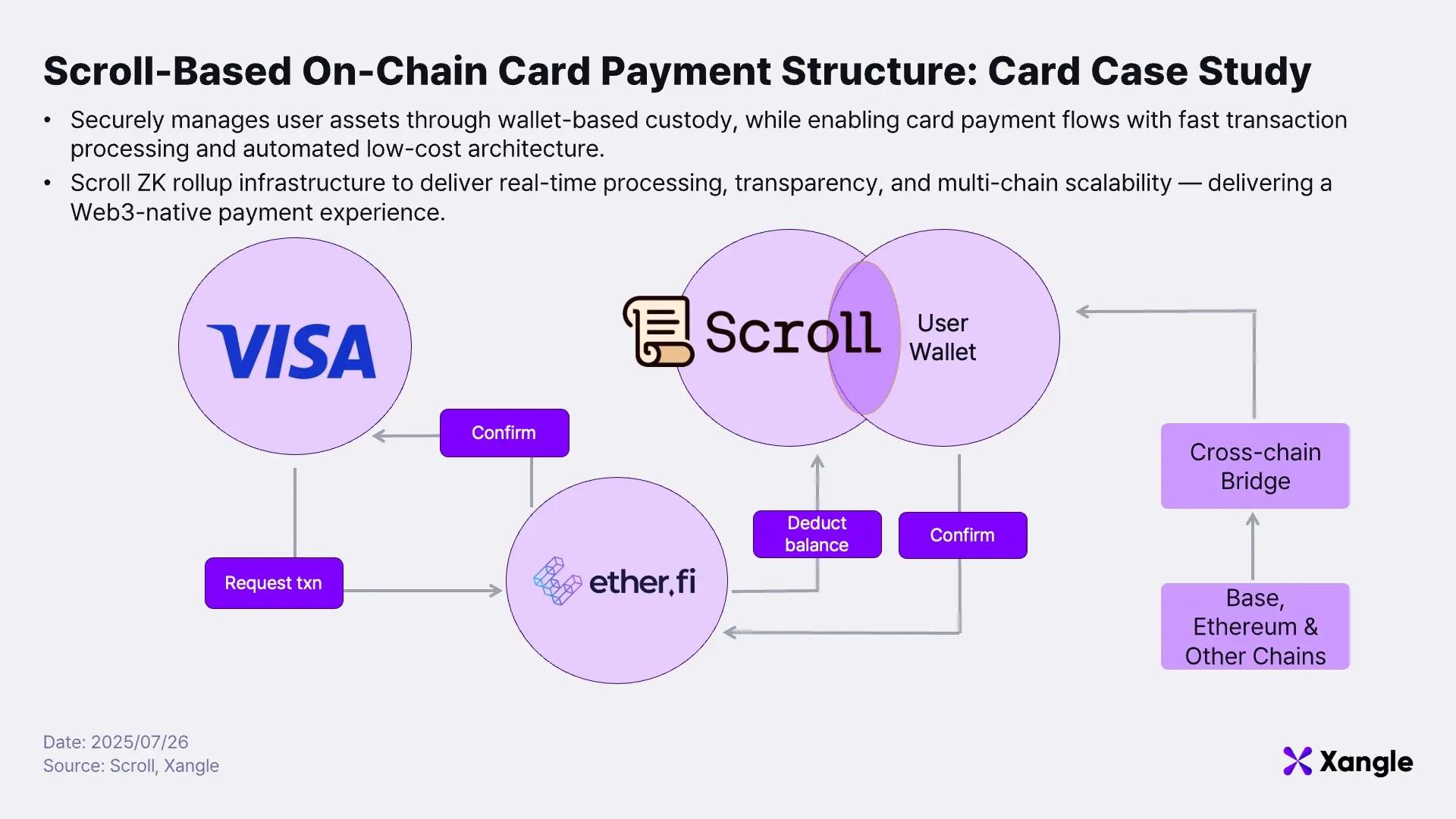
Its importance goes beyond TVL. As crypto payments matured, the benchmark was no longer whether a card “works,” but whether it could create a user experience people would return to repeatedly in everyday life. The ether.fi card stood out because it used Visa and Mastercard rails while allowing users to spend against crypto-collateralized assets such as eETH without giving up custody. Users did not need to pre-sell their assets just to spend, and the combination of spending rewards and app-based asset management made the experience feel more like a reusable financial product than a novelty. For Scroll, this mattered because it showed that on-chain assets could be turned into something usable in real life.
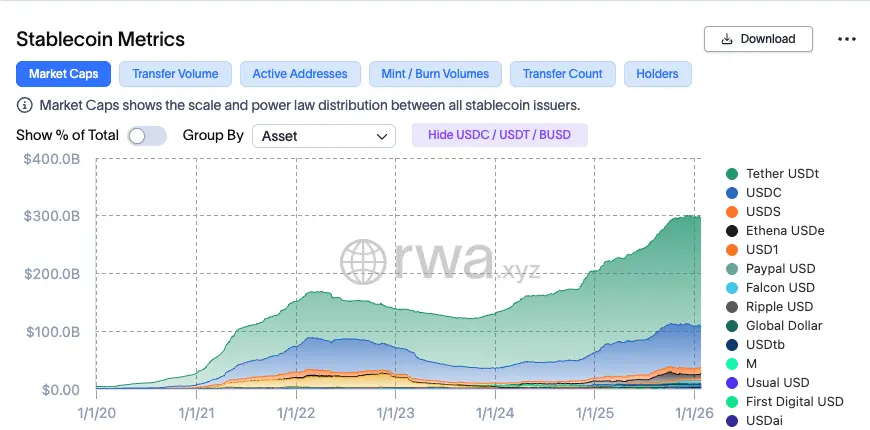
Growth in EtherFi Cash Card spend volume on Scroll
Even more importantly, the ether.fi card changed the quality of the liquidity flowing into Scroll. The capital it brought in was not simply chasing yield. It was sitting on-chain as payment-ready capital—funds waiting to be spent or settled. That changed how Scroll’s TVL could be interpreted. It was no longer just deposited DeFi capital, but a pool of on-chain funds that could potentially convert into everyday economic activity. In that sense, the ether.fi card was one of the clearest demonstrations that payment-centric on-chain finance could work on Scroll, both in terms of metrics and user experience.
That said, the story entered a new phase in February 2026, when ether.fi announced that it would move its Cash Card operating chain to Optimism mainnet. The reasons it cited—access to deeper DeFi liquidity, broader support for deposit and withdrawal assets, and better payment UX including gas sponsorship—were understandable. From Scroll’s perspective, it was clearly a loss. But it was also a revealing moment.
The departure did not invalidate Scroll’s payment thesis. If anything, it confirmed that real user demand for on-chain payment products could exist on Scroll. It also made clear what Scroll needed to do next: move beyond a model dependent on external applications and begin building its own financial infrastructure more directly. The push into USX, Garden, and Cloak should be understood in that context.
3. Scroll’s Native Financial Layer Built Around Stablecoins and a Neobank Stack
3-1. USX: Scroll’s Native Stablecoin Linking Payments and Yield
Following the ether.fi card’s departure, Scroll has focused on bringing payment experiences created by external applications into its own native product and asset layers. Recent updates make this direction increasingly clear. The next phase for Scroll is less about relying on outside partners, and more about building a self-sustaining financial infrastructure centered on USX, Garden, and Cloak.
In this structure, USX functions as the asset layer that connects payments and asset deployment, while Garden acts as the user-facing interface that turns those functions into an actual financial experience. Combined with Scroll’s effort to internalize key DeFi infrastructure, the chain is moving away from app-led growth and toward a more coherent in-house financial stack.
USX is a fully collateralized stablecoin issued on Scroll. On the surface, it resembles other USD-pegged stablecoins: users can mint USX 1:1 with USDC and redeem it at the same ratio. But Scroll is positioning USX as more than a basic payment token or stable store of value. It is designed as something closer to a chain-native digital dollar—an asset that can be spent instantly, yet also circulate inside the network as part of broader financial activity. That is what makes it important. USX is not just a stablecoin. It is the starting point for a financial layer in which holding, spending, and deploying capital are all connected within the same on-chain flow.
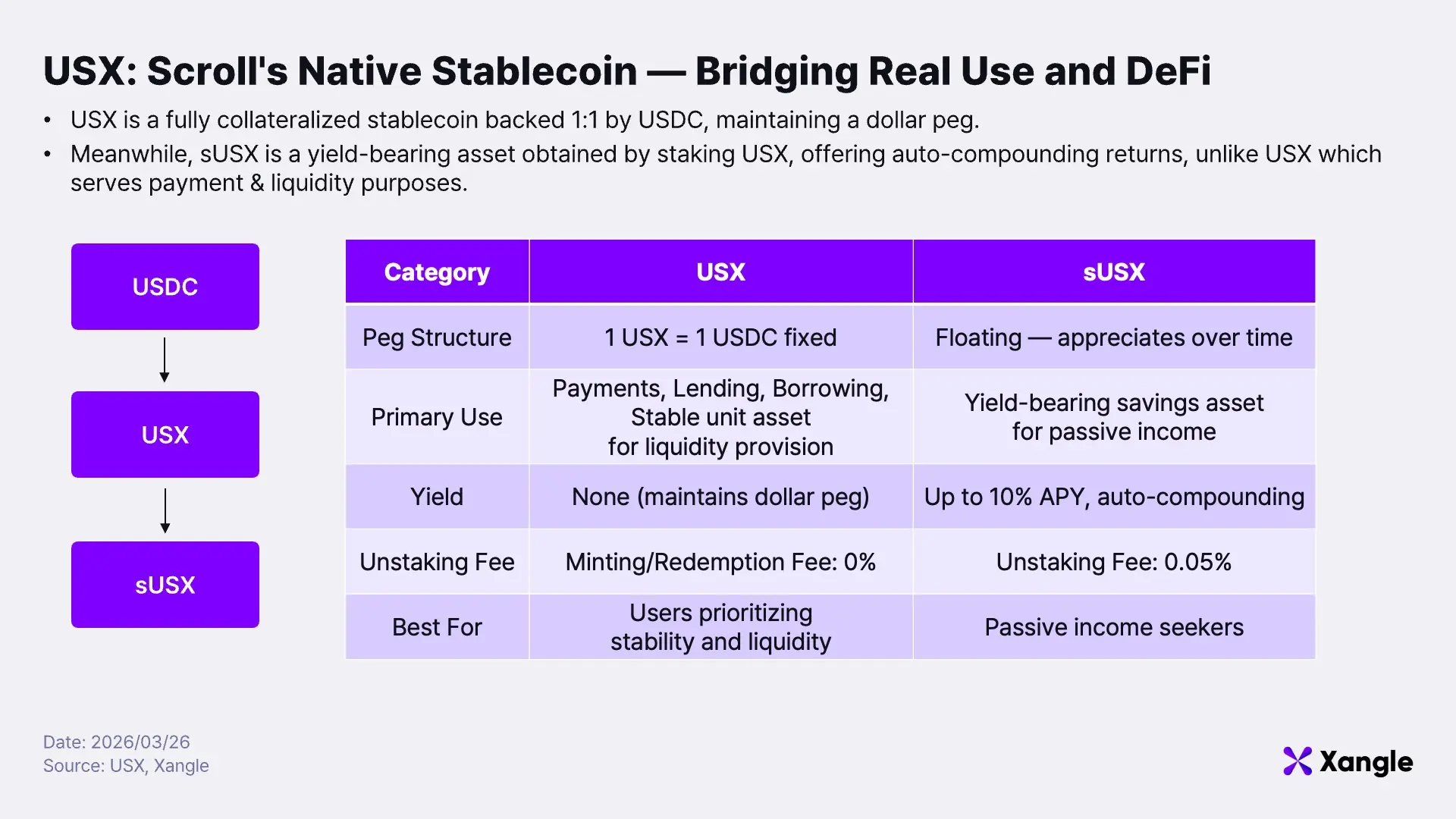
This becomes even clearer in the relationship between USX and sUSX. If USX is the “money you spend,” then sUSX is the “money you put to work.” Users can deposit USX and receive sUSX in return, using it as a yield-bearing asset. Technically, there is also gUSX, a governance token, but in practical terms the capital flow revolves around USX and sUSX. The point of this structure is not complexity for its own sake. It is to separate spending and yield functions rather than forcing both into one token, making the system more usable and more capital efficient. That design reflects Scroll’s broader goal: to keep capital used for payments from immediately leaving the network, and instead have it remain and circulate within Scroll’s own financial stack.
The way sUSX generates yield supports that same direction. Asset deployment is handled through Blend’s non-custodial infrastructure, with capital allocated across established DeFi protocols such as Aave, Euler, Morpho, and Pendle. The emphasis is not on directional speculation, but on creating relatively stable cash flow through interest differentials, liquidity premiums, and structured yield opportunities. Scroll also includes an on-chain reserve fund intended to absorb losses, reinforcing the idea that USX is not meant to be a short-term liquidity mining mechanism, but a more durable financial product. Ultimately, what matters about USX is not simply that Scroll now has “its own stablecoin.” What matters is that it sits at the center of Scroll’s strategy to connect payments and capital deployment inside one chain-native financial loop.
3-2. Garden and Honeypop: Scroll’s In-House Neobank and Core DeFi Stack

If USX is Scroll’s asset layer, then Garden and Honeypop are the core pieces that connect it to real user experience and on-chain liquidity. Garden, in particular, is better understood not as just another payments app, but as a neobank-style interface that makes it possible to hold, spend, and save through USX-based assets. Users can convert dollars into USX, deposit it into Garden, receive sUSX, and participate in yield strategies. In that sense, Garden represents Scroll’s attempt to turn USX from a simple payment asset into something more complete: a digital financial asset connected to both spending and saving.
Its appeal lies in the balance it tries to strike between usability and safety. Deposited assets are allocated across on-chain strategies and partner-managed strategies designed to reduce volatility risk, with targeted yields reaching up to around 15% APY. At the same time, users are given a more approachable interface through email- and phone-based login and recovery, while still retaining control over their assets through a self-custodial structure. Garden therefore plays an important role in Scroll’s broader direction. It is the point where a payment-oriented stablecoin begins to look like a real financial product for everyday users.
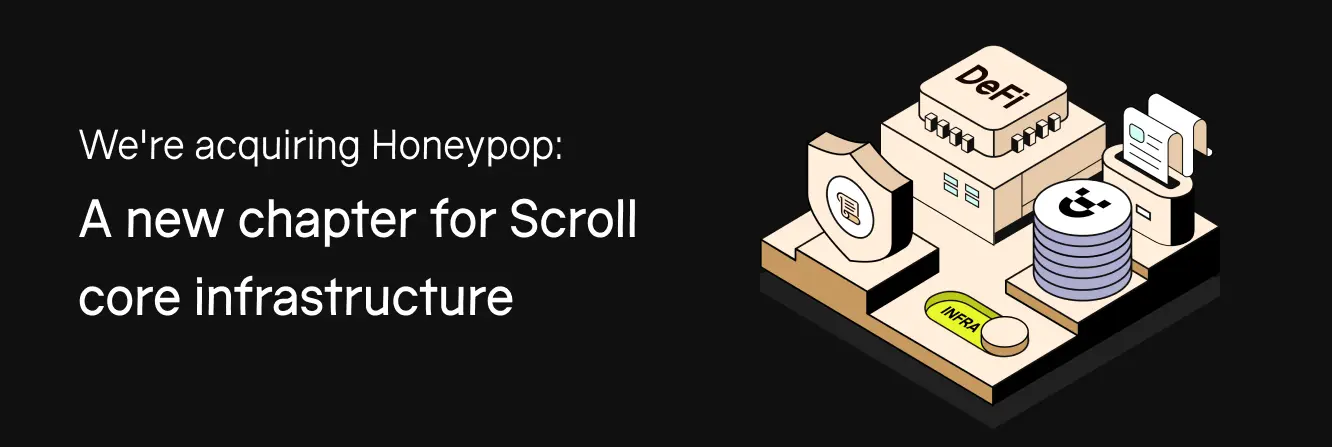
Scroll’s announcement of the Honeypop acquisition
Honeypop, by contrast, matters less at the UX level and more at the infrastructure level. By acquiring Honeypop and reworking it into Scroll Swap and Scroll Lend, Scroll signaled that it wants tighter, longer-term control over core DeFi primitives such as liquidity and lending. This reflects a broader realization: an ecosystem built mainly through grants and external teams does not necessarily produce durable, incentive-aligned infrastructure. Scroll’s direction now is to make sure that key building blocks—AMMs, lending markets, stablecoins, and yield-bearing assets—are not loosely scattered across the ecosystem, but are increasingly connected at the chain level.
That is why Garden and Honeypop matter together. They are not standalone products. They complete the USX-centered structure described above. USX and sUSX form the asset base for spending and yield. Garden turns that into a usable consumer experience. Honeypop supports it with liquidity and lending infrastructure. The result is a more integrated financial flow in which capital used for payments can remain on-chain and be recycled into savings, lending, or liquidity provisioning. If Scroll’s challenge after ether.fi is to internalize financial experiences once created by external apps, Garden and Honeypop are among the clearest examples of how it is trying to do exactly that.
4. Cloak and Institutional Expansion: Privacy Infrastructure as Scroll’s Strategic Edge
As payments and stablecoins become more practical and widely used, the standard for blockchain infrastructure is shifting. It is no longer enough to be fast or cheap. The more meaningful question is whether the infrastructure can actually support institutional financial activity. That is where privacy begins to matter in a different way. In this context, privacy is not just about protecting personal data. It becomes a structural requirement for enterprises and institutions to operate on-chain at all.
Public blockchains are powerful because they are transparent and verifiable. But in areas such as payments, payroll, B2B settlement, and treasury management, that same transparency becomes a problem. Transaction details, fund flows, and counterparties can all become visible to the market, effectively exposing business-sensitive information and internal risk-management structures.
What institutions need is not total opacity, nor total transparency. What they need is selective disclosure—a system where regulators and auditors can verify what they need to, while the broader market cannot see sensitive operational data. The moment a chain can support that kind of structure, privacy stops being a nice-to-have feature. It becomes a source of long-term strategic differentiation, especially in real-world financial infrastructure.
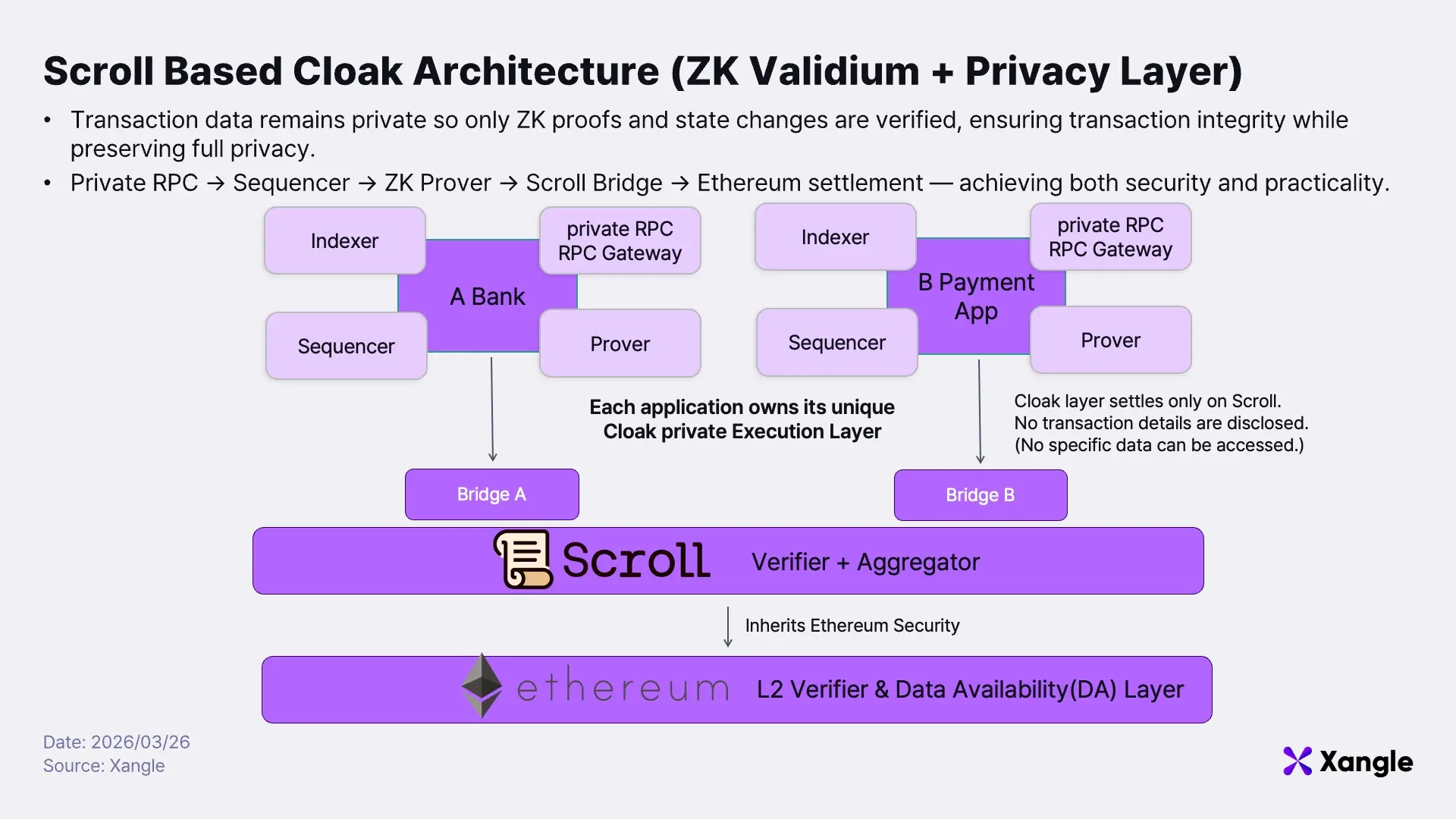
Scroll is trying to address this not at the application layer, but at the infrastructure layer itself. Cloak, launched on mainnet in September 2025, is a privacy-oriented validium architecture powered by ZK proofs. It allows transaction amounts and addresses to remain hidden, while still enabling selective verification when needed. That is important because it moves beyond the usual binary between complete anonymity and full transparency. Instead, it introduces a regulation-friendly model of selective disclosure directly into the protocol design. In enterprise finance and tokenization, that kind of setup is essential: visible to auditors and regulators, but shielded from the market. Cloak is Scroll’s attempt to make that operationally viable.
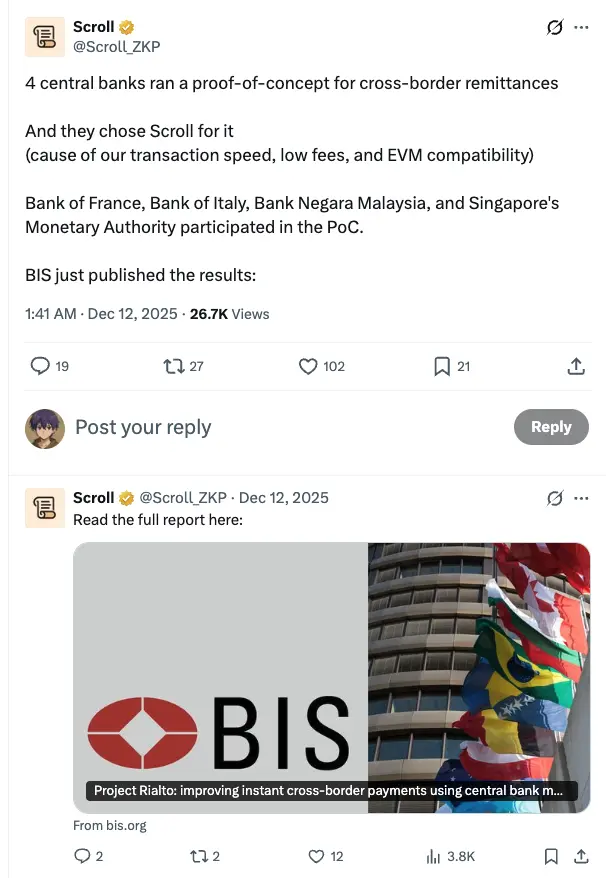
Scroll network used as cross-border payment infrastructure in a BIS-led PoC project
This is not just theoretical positioning. It has already started to show up in institution-led experiments. A key example is Project Rialto, led by the Bank for International Settlements (BIS), where Scroll was selected as the base chain for a cross-border payments DLT network. The project focused on using tokenized central bank money (CeBM) to connect with instant payment systems and support atomic settlement, including payment-versus-payment (PvP) flows in FX. Scroll’s inclusion reflected several strengths at once: privacy via ZK infrastructure, Ethereum security inheritance, relatively fast finality, low operating cost, and compatibility with established DeFi infrastructure such as Uniswap v3.
That matters because it suggests Scroll is no longer being evaluated only as a zkEVM or scaling solution. It is increasingly being seen as infrastructure that may be capable of meeting the operating requirements of central-bank and financial-institution-grade payment systems. This also reflects a broader shift in Scroll’s positioning. Over the course of 2025, it began to move away from being seen simply as a developer-friendly Layer 2 in the performance race. Instead, it is increasingly trying to position itself as a practical financial rail—one that links payments, settlement, and institutional adoption through privacy.
5. Conclusion: Scroll’s 2026 Challenge Is No Longer Narrative, but Execution
In 2026, the crypto market no longer treats raw technical performance as the defining edge it once was. Scalability, low fees, fast settlement, and composability are increasingly baseline features. Many chains now offer them to some degree. What the market is becoming more demanding about is something else: whether those technical capabilities can be translated into real financial usage. Stablecoins and payments sit at the front of that test, because they are among the first areas where digital assets are being evaluated for institutional integration. That means the next phase of competition will likely be defined less by performance numbers, and more by whether a chain can actually support a financial system where payments, settlement, and capital deployment come together as one coherent user experience.
Viewed from that perspective, Scroll’s past year was both encouraging and revealing. The ether.fi cash card showed that payment-centric on-chain finance could create real demand on Scroll. But it also revealed the limitations of relying too heavily on external applications to produce that demand. That is exactly why Scroll is now leaning harder into USX and Garden. For the payment story to become something durable rather than episodic, Scroll needs to control more of the underlying structure itself: the asset used for spending, the capital that remains inside the chain, and the interfaces through which users connect that capital to saving and consumption. If Cloak’s privacy infrastructure can then make the same system viable for institutions, Scroll’s positioning expands further—from a consumer-facing payment environment into a broader on-chain financial system.
So Scroll’s challenge in 2026 is not to come up with another compelling narrative. The market already recognizes that payments, stablecoins, and privacy matter. The real question now is whether Scroll can prove that it can turn those themes into a working, self-sustaining financial stack. Can USX become a meaningful asset layer? Can Garden become a financial interface people actually return to? Can Cloak make institutional adoption more realistic in practice? Those are the questions that now matter. And for that reason, 2026 is less a year of “comeback” for Scroll than a year of validation—one in which it must show that its own native financial infrastructure can stand on its own, beyond the success of outside partners.
Disclaimer
I confirm that I have read and understood the following: The information contained in this article is strictly the opinions of the author(s). This article was authored free from any form of coercion or undue influence. The content represents the author's own views and does not represent the official position or opinions of CrossAngle. This article is intended for informational purposes only and should not be construed as investment advice or solicitation. Unless otherwise specified, all users are solely responsible and liable for their own decisions about investments, investment strategies, or the use of products or services. Investment decisions should be made based on the user’s personal investment objectives, circumstances, and financial situation. Please consult a professional financial advisor for more information and guidance. Past returns or projections do not guarantee future results. This article was written at the request of Scroll. All content in this article was written independently by the author(s), and neither CrossAngle nor Scroll had any editorial control or influence over the content. The author(s) may hold the cryptocurrencies mentioned in this article at the time of writing.
Xangle or its affiliated partners own all copyrights of the written or otherwise produced materials and content provided on the platform. Any illegal reproduction of such content, including, but not limited to, unauthorized editing, copying, reprinting, or redistribution will result in immediate legal actions without prior notice.