Nado, Where Tokenized Stocks Become “Living Capital”


Table of Contents
1. Growth of the Tokenized Equity Market and the Limits of Its Utility
2. Key Highlights: Nado Updates in H1 2026
3. Vertical Integration Across Kraken, Backed, Ink, and Nado: The Significance of xStocks
4. A Points Program for Capital Efficiency: xPoints
5. Closing Remarks: Challenges and Outlook for Nado
1. Growth of the Tokenized Equity Market and the Limits of Its Utility
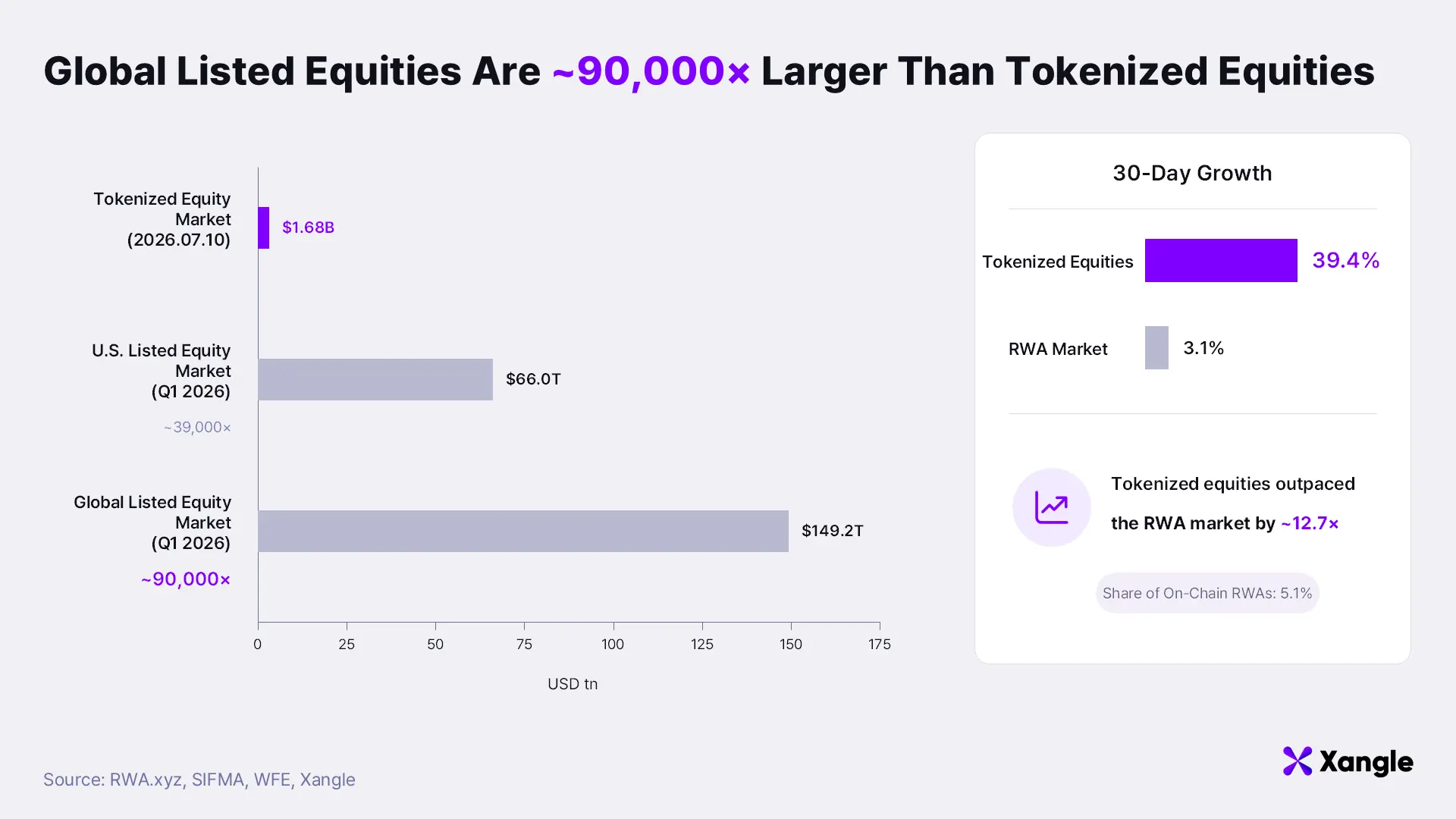
Tokenization of real-world assets (RWAs) is no longer merely a narrative. It is now a measurable trend, reflected in market size and growth rates. According to RWA.xyz, approximately $33.1 billion of RWAs had been deployed on-chain as of July 10, 2026. Tokenized equities represented around $1.68 billion, or 5.1% of the total. While still smaller than government bonds, credit, and commodities, tokenized equities grew 39.4% over the past 30 days, far outpacing the broader RWA market's 3.1% growth. They are now one of the fastest-growing asset classes in the RWA market.
Compared with the broader equity market, however, tokenized equities remain at a very early stage. As of Q1 2026, the market capitalization of U.S.-listed equities was approximately $66 trillion, about 39,000 times the size of the current tokenized equity market. At that point, the global listed equity market had a capitalization of approximately $149.2 trillion, around 90,000 times the size of the tokenized equity market. This shows that the vast majority of equities have yet to move on-chain. Given both the recent growth rate and the enormous size of the underlying market, tokenized equities can still be viewed as an early market with considerable room to expand over the long term.
However, expanding the issuance and distribution of tokenized equities does not automatically create an on-chain capital market. Two gaps remain in today's tokenized equity market.
First, use cases remain limited. Some lending markets and liquidity pools support certain tokenized equities, but the range of available assets, chains, and protocols remains narrow. As a result, most tokenized equities are still held in wallets or traded on spot markets, with few ways to borrow against them or use them in other investment strategies.
Second, managing spot and derivatives positions together still requires separate collateral. An investor who holds tokenized equities and wants to hedge downside with perpetual futures generally has to deposit additional stablecoins on a derivatives exchange before opening a short position. This is because the tokenized equities already held by the investor are not recognized as collateral for derivatives trading. As a result, executing a single hedging strategy requires capital to be allocated separately across spot and derivatives accounts.
Nado focuses on expanding the utility of tokenized equities and reducing the capital that must be committed separately to spot and derivatives positions. It supports xStocks spot trading and recognizes xStocks holdings themselves as collateral for USDT0 borrowing and perpetual futures trading. Users can maintain their equity exposure while putting the asset's collateral value to work in other trades. This report reviews Nado's major updates from H1 2026 onward, then briefly introduces the integrated structure linking Kraken, Backed, Ink, and Nado, as well as xPoints, the points program recently launched by xStocks.
2. Key Highlights: Nado Updates in H1 2026
As discussed in Xangle's previous research report, "NADO: Rewriting the Execution Model for On-Chain Markets" Nado is a hybrid exchange built on Ink, Kraken's Ethereum Layer 2. Asset and risk management are handled by on-chain smart contracts, while order matching is managed by an off-chain central limit order book and sequencer. At the time of the previous report in December 2025, Nado was still in Private Alpha, having unveiled this architecture and its core features.
In H1 2026, that design became a live trading service. Private Alpha ended, Open Beta began, and xStocks were listed for spot trading. By adding tokenized U.S. equities as both tradable assets and collateral, Nado also began expanding from a crypto-focused exchange into a cross-asset trading platform.
2-1. Private Alpha Ends and Open Beta Expands
Nado's first major change was the conclusion of Private Alpha and the transition to Open Beta. Nado announced the end of Private Alpha on January 20, 2026. Over several weeks of alpha testing, the platform recorded more than $21 billion in cumulative trading volume, an average of 5,000 daily users, and $140 million in open interest. Early users traded real assets to test order execution, liquidity, and the risk engine, and Nado used the results to improve the trading environment and key features.
Nado then launched Open Beta Season 1 on January 30. The season offered incentives for trading and liquidity provision, marking the start of a broader push to grow Nado's user base and deepen liquidity. However, Season 1 remained a limited public release that required an invite code. Season 2, which began in May, removed the invite-code requirement and opened account creation and trading to everyone. This rollout made the platform, whose trading model was validated during Private Alpha, available to the broader public and enabled the service to scale.
2-2. xStocks Spot Listings
 https://x.com/nadoHQ/status/2070308066898141206?s=20
The second change was that tokenized equities went live on Nado. xStocks are tokenized securities issued by Backed against underlying U.S. stocks and ETFs. Their economic performance tracks that of the underlying assets, including price movements and dividends. Investors can hold xStocks in blockchain wallets and trade or use them across on-chain services.
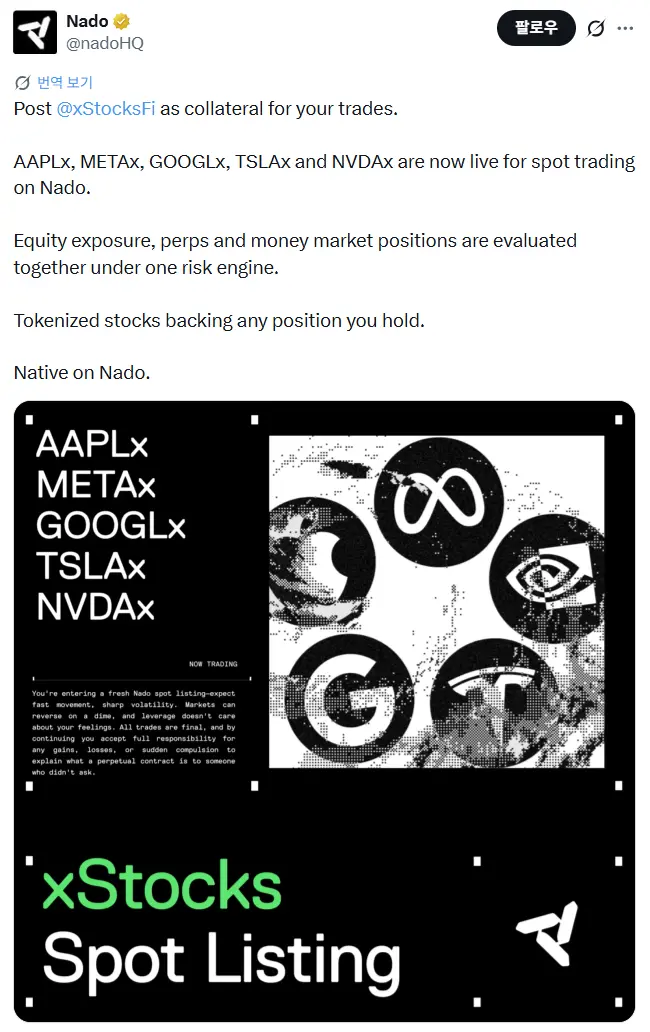
On June 9, Nado first listed two major U.S. ETFs, SPYx and QQQx, on its spot market. It then added five individual equities, AAPLx, METAx, NVDAx, GOOGLx, and TSLAx, on June 26, expanding total spot support to seven assets. Users can therefore trade and manage on-chain exposure to both crypto assets and U.S. stocks and ETFs within a single Nado account.
Nado also operates equity perpetual markets alongside spot. It supports 21 equity perpetuals in total, including contracts based on spot-listed assets as well as DELL, AMD, and INTC, with maximum leverage ranging from 5x to 20x depending on the market. Users can hold xStocks spot positions and hedge price risk through corresponding perpetuals, or gain leveraged exposure to individual stock price movements without holding the spot asset directly.
In July 2026, Nado also integrated xPoints, the xStocks ecosystem's points program. Users can earn xPoints by holding or trading xStocks on Nado, while spot trading also earns Nado Points. Section 4 examines the accrual structure and incentive effects in detail.
2-3. Tokenized Equities Added as Collateral
 https://x.com/nadoHQ/status/2064354979767275685?s=20
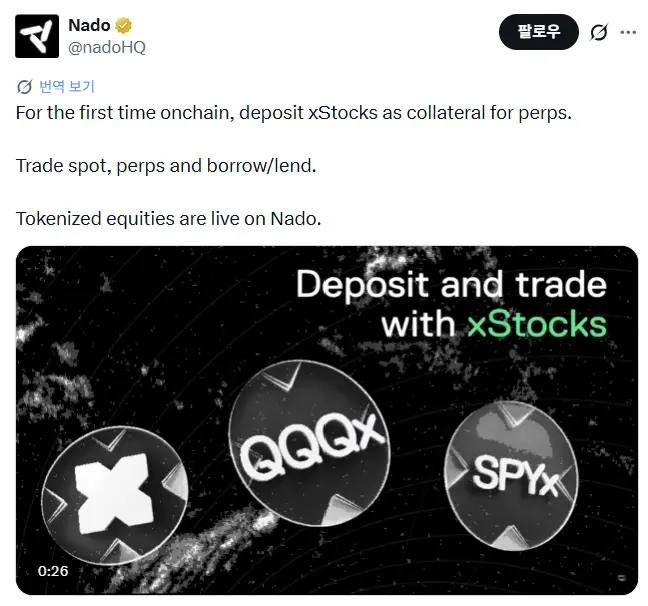
The third change was Nado's decision to expand xStocks beyond spot trading assets by allowing them to serve as collateral within its portfolio margin system. On June 9, 2026, Nado added spot trading and collateral support for SPYx and QQQx, and announced that it was the first on-chain exchange to accept U.S. equities as trading collateral. On June 26, it added AAPLx, METAx, NVDAx, GOOGLx, and TSLAx, extending both spot and collateral support to individual equities.
Users can hold xStocks and use their collateral value to trade crypto, equity, commodity, and foreign exchange perpetuals. On Nado, xStocks spot balances, perpetual positions, and outstanding borrowings are evaluated together within a single portfolio. Users can therefore borrow USDT0 or manage other perpetual positions without selling their tokenized equities, while reducing the need to post separate collateral for spot and derivatives trading.
Through this update, xStocks expanded from spot assets that provide price exposure into collateral that supports borrowing, hedging, and leveraged strategies. The next section examines how this structure addresses the utility constraints of tokenized equities and how the integrated structure linking Kraken, Backed, Ink, and Nado supports it.
3. Vertical Integration Across Kraken, Backed, Ink, and Nado: The Significance of xStocks
3-1. Tokenized Equities Still Limited to Buy-and-Hold
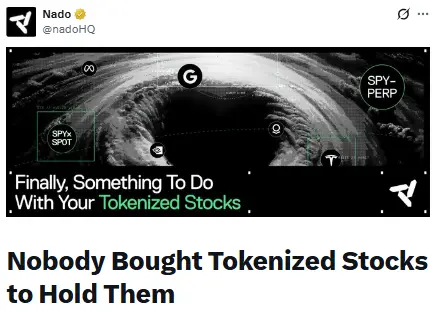 https://x.com/nadoHQ/status/2072016859017183672
In July 2026, Nado published an article titled "Nobody Bought Tokenized Stocks to Hold Them." It argues that tokenized equities cannot fully realize their potential as on-chain assets if they remain confined to buying and holding. Even with around-the-clock transfers and trading, their practical utility relative to traditional brokerage accounts remains limited unless they can also support collateralization, borrowing, and hedging.
In traditional finance, equities are not only held in anticipation of price appreciation. They are also used as collateral and underpin securities lending, hedging, and leveraged strategies. Tokenized equities, by contrast, have largely remained limited to wallet holdings and spot trading because the lending markets, derivatives, and unified margin infrastructure needed to support these uses are still underdeveloped. The assets have been onboarded on-chain, but market structures that connect their economic value to other financial activity have yet to mature.
Nado's move to accept tokenized equities as collateral is an attempt to close precisely this gap. Users can borrow stablecoins without selling xStocks, or short perpetuals against their spot positions to hedge price risk and pursue funding yield. By managing spot balances and derivatives positions within a single margin account, users can employ the same asset simultaneously as an investment, as collateral, and as the basis for a trading strategy. For Nado, putting tokenized equities to work ultimately means going beyond moving stocks on-chain and connecting them to financial activity.
3-2. Kraken's Acquisition of Backed and Vertical Integration
The broader expansion of the Kraken ecosystem helped create the conditions for Nado to support xStocks as both spot assets and collateral. Kraken announced its acquisition of xStocks issuer Backed in December 2025 and completed the transaction in January 2026. At the time of the announcement, xStocks had generated more than $10 billion in combined exchange and on-chain trading volume within roughly six months of launch and supported more than 60 tokenized stocks and ETFs. With Backed joining the group, the Kraken ecosystem added issuance capabilities to its existing role in tokenized equity trading and distribution.
Before that, Kraken unveiled Ink, its own Layer 2 chain, in October 2024 and launched mainnet in December of the same year. Ink is a Superchain network built on Optimism's OP Stack, designed to connect Kraken users and assets to on-chain finance. With low transaction costs and EVM compatibility, it provides an execution environment for DeFi applications including decentralized exchanges, lending, and staking. Nado is also an on-chain exchange operating on Kraken-built Ink.
With Backed added to the ecosystem, the value chain connecting tokenized equity issuance, on-chain distribution, trading, and utility took the following form.
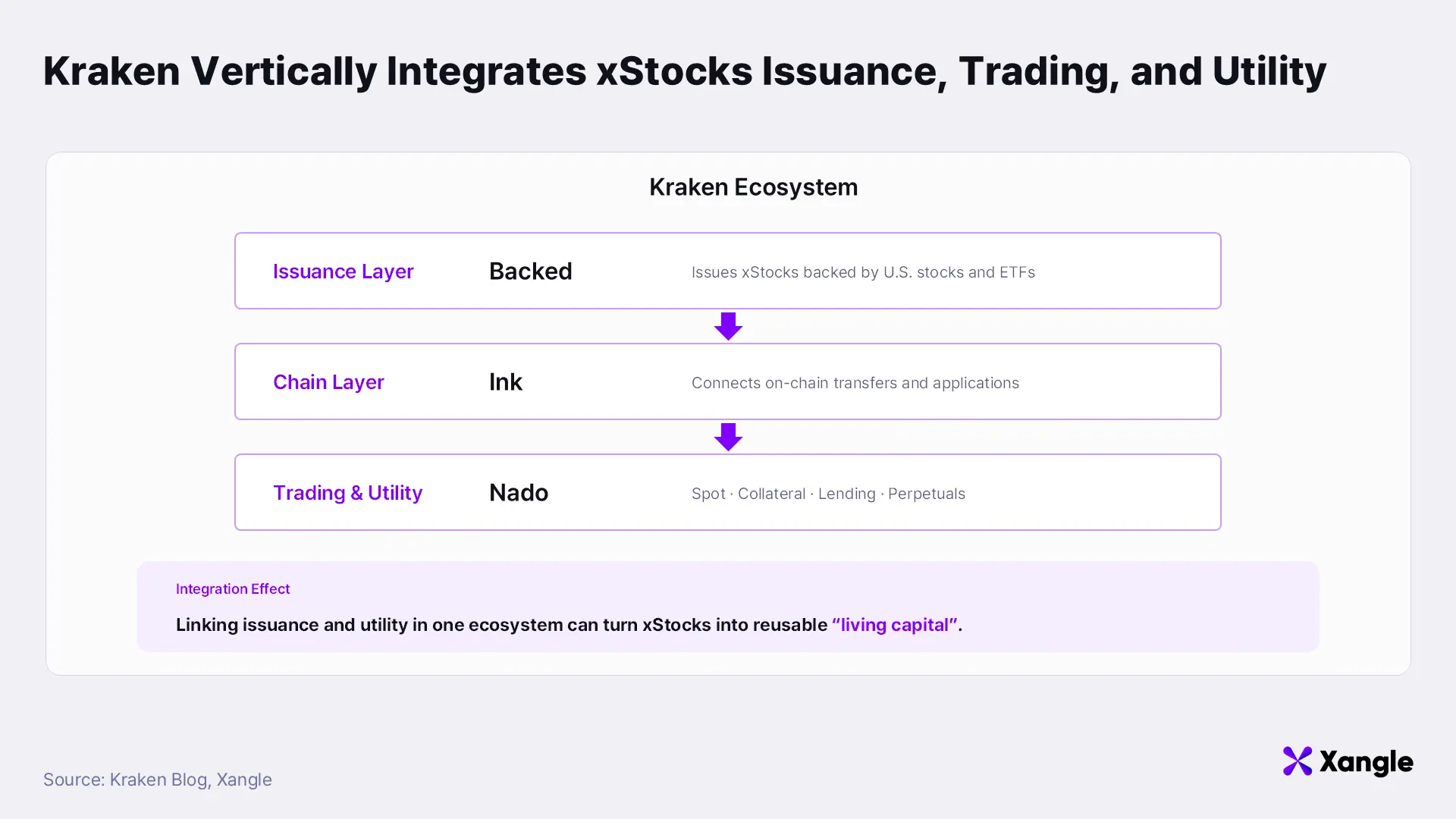
Backed holds underlying U.S. stocks and ETFs and issues xStocks linked to those assets. Ink provides the blockchain environment in which xStocks can move and connect with a range of on-chain applications. Nado lists xStocks on its spot market and supports lending, borrowing, and perpetual futures trading using them as collateral. The result is a single ecosystem spanning the issuer, blockchain, spot trading, collateral utility, and derivatives.
This integration narrows the gap between issuing tokenized equities and putting them to practical use. For a newly tokenized asset to function as a financial product, exchange listing alone is not enough. Spot liquidity, price oracles, collateral standards, liquidation mechanisms, and derivatives markets must be built alongside it. The integrated structure linking Kraken, Backed, Ink, and Nado allows on-chain distribution, spot listing, collateral onboarding, and integration with perpetual futures to be coordinated across the same ecosystem after xStocks are issued.
Within the ecosystem, issuance and downstream usage reinforce one another. As the number of supported xStocks grows, spot trading and deposited assets can increase, expanding Nado's collateral base and lending liquidity. Broader use as collateral and in derivatives markets can in turn increase demand to hold and trade xStocks. Assets issued by Backed move through Ink to be traded and used as collateral on Nado, and that demand then supports further xStocks issuance and distribution.
The vertical integration across Kraken, Backed, Ink, and Nado extends the utility of tokenized equities beyond issuance and exchange listing. This is because the path from issuance to on-chain distribution, spot liquidity, borrowing, collateralization, and hedging is built as an integrated whole. This connected structure is also what allows Nado to transform xStocks from passive holdings into "living capital" that can be put to work repeatedly.
3-3. xStocks as Living Capital
Building on this vertically integrated foundation, Nado turns tokenized equities into "living capital." xStocks trade on Nado's spot markets while also qualifying as collateral under portfolio margin. Users can borrow USDT0 or manage crypto, equity, commodity, and foreign exchange perpetual positions without selling assets such as NVDAx, TSLAx, or QQQx. When there is borrowing demand for deposited xStocks, users can also receive a portion of the interest paid by borrowers through the money market. The structure allows them to maintain equity exposure while using the same assets both as collateral and in lending markets.
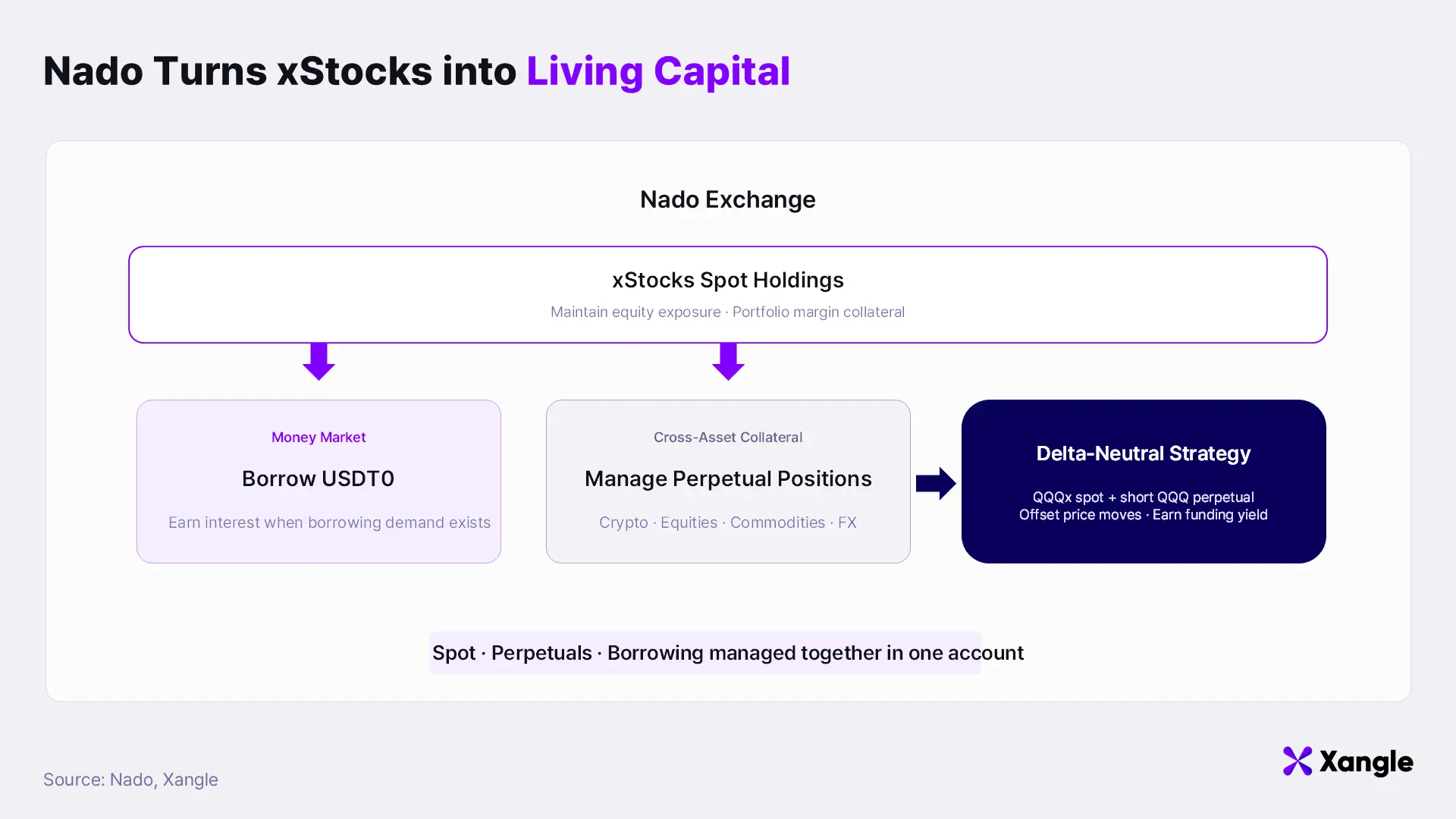
With xStocks and corresponding perpetuals placed within a single margin engine, basis trades and delta-neutral strategies can also be executed from one account. A delta-neutral strategy combines long and short positions in the same asset so that gains and losses from price movements offset each other. For example, a user can hold QQQx spot while shorting QQQ perpetuals, reducing directional equity exposure while seeking funding yield. Cross-asset collateralization also becomes possible, allowing equity spot holdings to support positions in crypto or other assets.
These strategies are already widely used in traditional finance. Nado brings them into a single on-chain account, reducing the need to allocate collateral separately across spot and derivatives or move funds between platforms. xStocks therefore move beyond spot assets that merely provide price exposure and become collateral that supports borrowing, hedging, and other positions. Once xStocks evolve from instruments that provide price exposure into assets that can be used as collateral and support trading strategies, tokenized equities begin to function as "living capital."
3-4. From Trading Strategies to Financial Products
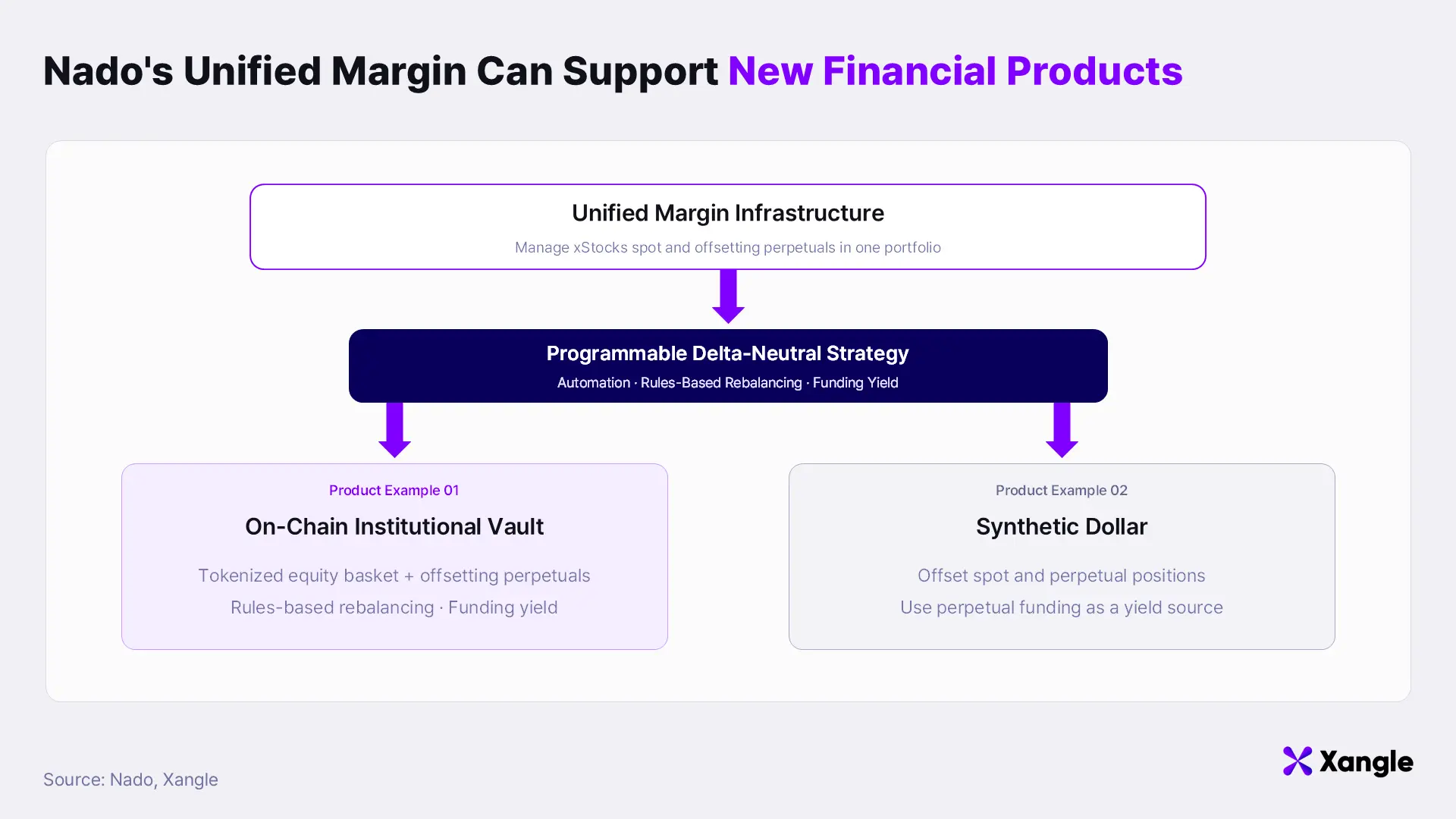
Nado believes its unified margin infrastructure could support new financial products beyond individual trading strategies. If delta-neutral positions combining spot and perpetuals can be managed within one portfolio and implemented in programmable form, they can be automated, packaged, and offered to other users.
The first example Nado presents is an on-chain institutional vault. The vault would construct offsetting positions in a basket of tokenized equities and corresponding perpetuals, rebalance under predefined conditions, and collect funding yield. Users could participate in the strategy by holding shares in the vault rather than managing each position directly.
The second is a synthetic dollar. This structure offsets price movements by taking opposing positions in spot and perpetuals, while using perpetual funding as its source of yield. Adding tokenized equities and commodities could diversify the yield sources of existing synthetic dollars, which are concentrated in crypto markets, across multiple asset markets.
However, these are not products that Nado has announced it will launch, nor are they part of a confirmed roadmap. Rather, Nado is highlighting the possibility that its infrastructure, which can manage xStocks and perpetuals within one margin engine, could serve as the foundation for more sophisticated financial products such as on-chain vaults and synthetic dollars.
4. A Points Program for Capital Efficiency: xPoints

xPoints is a rewards program that measures participation across the xStocks ecosystem. It is designed to award higher point tiers as users put their assets to more active use, from simply holding xStocks in a wallet to supplying collateral to lending protocols and participating in liquidity pools. The program incentivizes users to deploy xStocks across on-chain services for trading, collateral, and liquidity.
Nado has linked its own quests to the program. Users can receive xPoints boosts by depositing and holding xStocks on Nado or trading them on its spot market. Spot trading also earns Nado Points. xPoints reward activity across the broader xStocks ecosystem, while Nado Points measure trading activity within Nado. A single xStocks position can therefore contribute to both programs at once.
xPoints helps draw xStocks dispersed across external platforms into Nado and encourages deposited assets to be used as trading collateral and spot liquidity. In effect, the "living capital" structure discussed in Section 3 is paired with incentives designed to attract early users and liquidity.
4-1. Two Ways to Participate: Holding and Trading
xPoints accrue even when users simply hold xStocks. More points are available when xStocks are used more actively, such as by supplying them to lending platforms or participating in DeFi liquidity pools. On Nado, users can receive additional boosts on top of these base xPoints for holding and spot trading. To participate, users must first register their wallet on the xStocks points page.
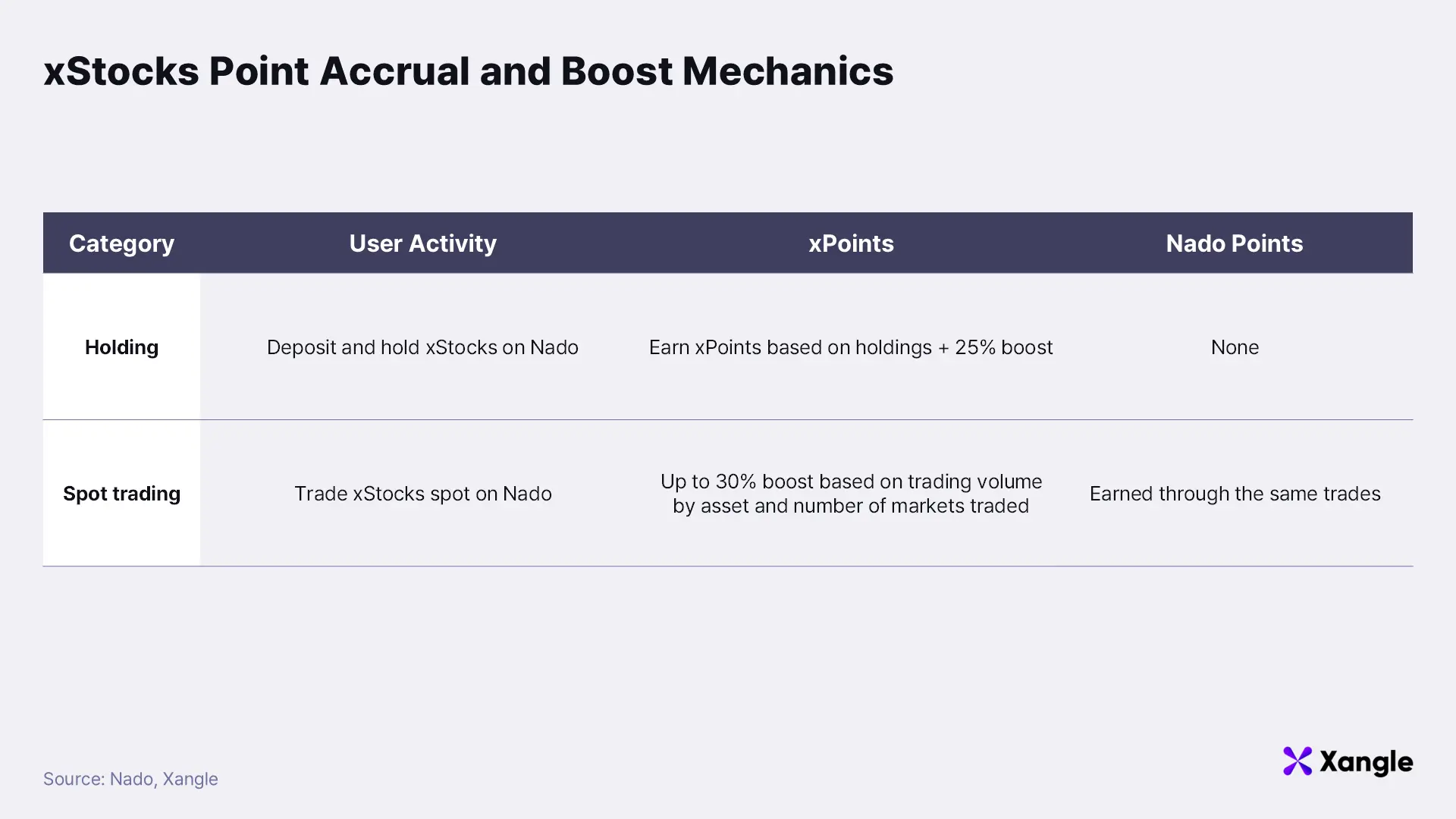
The first participation method is holding. xPoints accrue based on the amount of xStocks held, even if the assets simply remain in a wallet. Users receive an additional 25% boost when they move xStocks held on another chain to Ink and deposit them on Nado, or buy and hold them directly in Nado's spot market. Deposited xStocks can be used as trading collateral on Nado, and users may also receive a portion of the borrowing interest when other users borrow those assets.
The second is the spot trading quest. Users trading xStocks on Nado receive a 1% to 5% boost based on daily trading volume for each asset.
- $1,000 or more: 1%
- $10,000 or more: 2%
- $25,000 or more: 3%
- $100,000 or more: 4%
- $250,000 or more: 5%
Trading boosts are summed across up to five markets, selecting those with the highest boost tiers achieved by the user. An additional 5% diversification bonus applies when the user trades at least $1,000 in each of five or more different xStocks markets. Therefore, reaching the 5% tier in five markets yields a maximum 30% boost: 25% from the five market-level boosts plus a 5% diversification bonus. The same spot trades also earn Nado Points.
Users can participate in the holding and trading quests simultaneously. Buying xStocks on Nado earns the spot trading boost and Nado Points. Continuing to hold the purchased assets also keeps the base xPoints and 25% holding boost in effect.
4-2. Keeping Held Assets Productive as Collateral
The key feature of Nado's xPoints integration is that holding and active use are not mutually exclusive. xStocks deposited on Nado receive the 25% holding boost while also being valued as collateral under portfolio margin. Users can manage perpetual positions or borrow USDT0 against the same assets without moving xStocks into a separate margin account.
For example, a user who deposits TSLAx can receive the xPoints boost on that balance while using TSLAx's collateral value to open other perpetual positions. Buying additional xStocks on Nado earns xPoints and Nado Points from spot trading, while the post-purchase balance continues to receive the holding boost. The same capital thus serves multiple roles across spot exposure, trading collateral, and points accrual.
Spot Margin Mode allows users to trade spot at up to 5x leverage using held assets as collateral. However, leverage magnifies losses and can lead to liquidation depending on market conditions. Users should therefore avoid excessive leverage solely to earn points.
5. Closing Remarks: Challenges and Outlook for Nado
The tokenized equity market is moving beyond a focus on issuance volume and entering a phase centered on practical utility. The ability to transfer and trade assets on-chain alone is not enough to create a clear advantage over conventional brokerage services. Tokenized equities become more meaningful as on-chain capital market assets when they can support collateralization, borrowing, hedging, and yield strategies.
Nado provides a concrete example of this utility layer. By listing xStocks on spot markets and adding them as collateral under unified margin, it allows users to maintain equity exposure while managing borrowing and perpetual trades in parallel. The integrated structure linking Kraken, Backed, Ink, and Nado brings token issuance, on-chain distribution, spot trading, and collateral utility into a single flow. xPoints and Nado Points also serve as early incentives to draw externally dispersed xStocks and trading demand into Nado.
Going forward, the key question is whether this structure can generate sufficient liquidity and trading demand. If xStocks spot markets remain shallow, or corresponding perpetuals lack open interest and funding demand, the utility of basis trades and cross-asset collateral will also be constrained. It will also be important to assess whether users and liquidity remain after incentives are reduced, and whether oracles, collateral valuation, and liquidation systems operate reliably during sharp price moves. Geographic restrictions on xStocks sales, investor eligibility requirements, and dependence on the custody and redemption structure of the underlying assets will also require continued management as the platform scales.
Over the medium to long term, it is worth watching whether more stocks, ETFs, and other RWAs are brought into Nado's unified margin system. If external asset managers and protocols use Nado's infrastructure to build on-chain vaults or multi-asset products, Nado's role could expand beyond an exchange into execution infrastructure for RWA strategies. If the current structure translates into real liquidity and sustained user activity, Nado could establish itself as a leading on-chain trading platform that turns tokenized equities from passive holdings into deployable capital.
Disclaimer
I confirm that I have read and understood the following: The information contained in this article is strictly the opinions of the author(s). This article was authored free from any form of coercion or undue influence. The content represents the author's own views and does not represent the official position or opinions of CrossAngle. This article is intended for informational purposes only and should not be construed as investment advice or solicitation. Unless otherwise specified, all users are solely responsible and liable for their own decisions about investments, investment strategies, or the use of products or services. Investment decisions should be made based on the user’s personal investment objectives, circumstances, and financial situation. Please consult a professional financial advisor for more information and guidance. Past returns or projections do not guarantee future results. This article was written at the request of Ink Chain. All content in this article was written independently by the author(s), and neither CrossAngle nor Ink Chain had any editorial control or influence over the content. The author(s) may hold the cryptocurrencies mentioned in this article at the time of writing.
Xangle or its affiliated partners own all copyrights of the written or otherwise produced materials and content provided on the platform. Any illegal reproduction of such content, including, but not limited to, unauthorized editing, copying, reprinting, or redistribution will result in immediate legal actions without prior notice.