[Xangle RWA Series] Centralized Exchanges

Table of Contents
1. Why Tokenized Assets Use Centralized Exchanges
2. How Centralized Exchanges Work and How They Are Used
3. Major Centralized Exchanges
4. How Exchange Jurisdiction Shapes Products and Investor Access
5. Closing Remarks: Centralized Exchanges Move On-Chain
1. Why Tokenized Assets Use Centralized Exchanges
Once stocks or bonds have been tokenized on a blockchain, trading them on an on-chain venue such as a decentralized exchange (DEX) may seem like the natural next step. If assets are moved onto a blockchain only to be traded through centralized exchanges involving brokers and market makers, it is reasonable to ask how this differs from traditional financial markets.
Tokenization moves records of asset issuance, ownership, and transfers onto a blockchain. An exchange brings together investor orders to facilitate trades. Both centralized and decentralized exchanges use order matching and requests for quotes from counterparties. Issuers use centralized exchanges because they offer an established customer base alongside a regulated framework for managing trading.
An issuer raising capital independently must find investors, arrange account opening, and verify their eligibility. Centralized exchanges already bring together investors who have completed these steps, allowing issuers to reach buyers by listing products or selling to the exchange's customers. Conversely, brokers, wallet providers, and fintech firms that already have customers but lack tokenized products and trading systems can integrate an exchange's products and trading capabilities into their own services.
Regulation determines who may buy tokenized securities and how their trading must be monitored. Decentralized exchanges that allow anyone to participate through a wallet, however, have no operator responsible for investor verification and market surveillance. On a centralized exchange, the exchange or the broker routing orders verifies investors' identities, residency, and qualifications to determine who may trade each product. If a product may be held only by professional investors, these checks apply both to buyers in the primary market and to investors acquiring it through secondary trading. Once trading begins, the exchange monitors market abuse and system anomalies, halts trading when problems arise, and responds to regulatory investigations. Tokenized assets return to centralized exchanges because these venues offer both prospective buyers and the systems needed to verify investors and monitor trading.
2. How Centralized Exchanges Work and How They Are Used
2.1 Combining Exchange Operations with Blockchain
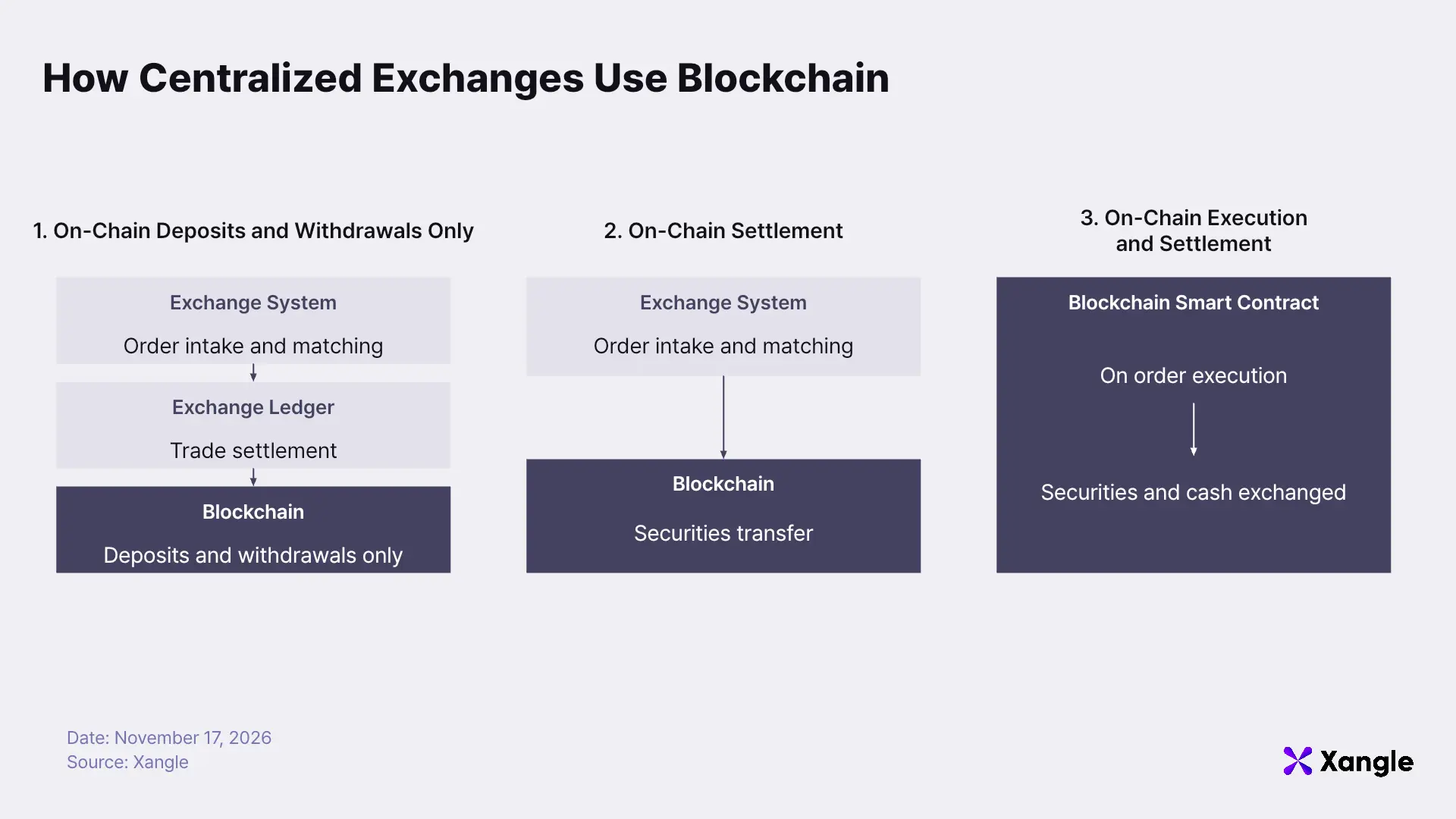
Centralized exchanges handling tokenized assets fall into three categories: those that use blockchain only for deposits and withdrawals, those that extend its use to settlement, and those that use it for both trade execution and settlement.
Exchanges that use blockchain only for deposits and withdrawals handle order matching and settlement through their own ledger systems, much like conventional spot trading on Binance or Upbit. Tokens deposited by investors are held in the exchange's wallets, while trades are reflected in investor balances on its internal ledger. Tokens move on-chain when investors deposit or withdraw assets between the exchange and external wallets. Tokenized assets listed on these exchanges are therefore traded in the same way as conventional crypto assets.
Exchanges that use blockchain for settlement match orders in their exchange systems and settle executed trades on-chain. Once a trade is executed, the security tokens move from the seller to the buyer on the blockchain. This extends blockchain to the settlement stage of the traditional securities exchange model, in which execution and settlement are separate.
Exchanges that also use blockchain for execution run both order matching and settlement through smart contracts. Approved participants submit orders to the contracts, which match them and exchange securities for payment. Execution and settlement records are therefore stored on the same blockchain. Although trading and settlement take place on-chain, these venues qualify as centralized exchanges because the exchange approves participants and the instruments available for trading.
2.2 Three Ways to Use Exchanges
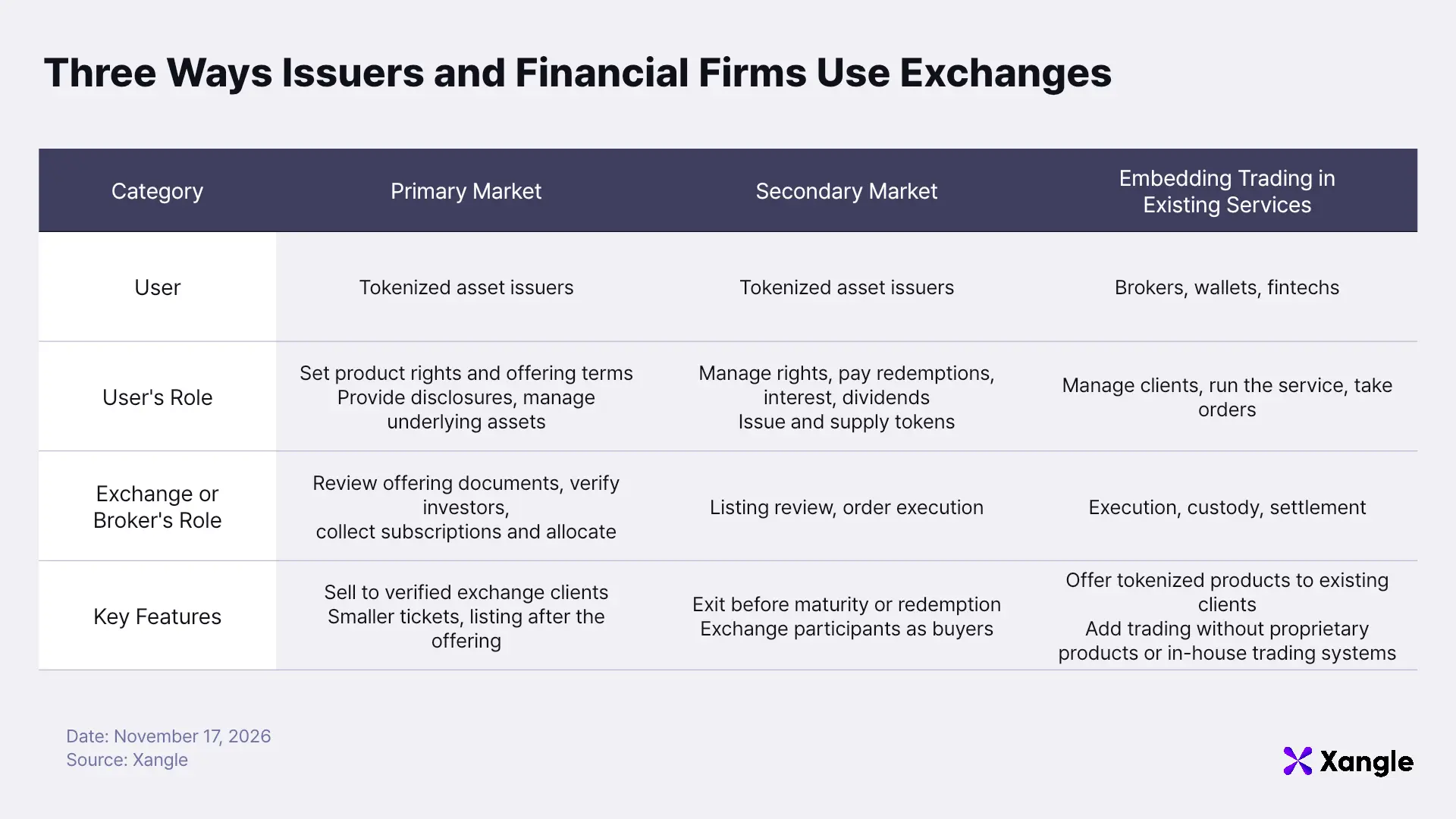
Issuers and financial firms use the exchanges described above in three ways. Issuers use them as primary markets to attract buyers for newly offered products and as secondary markets where investors trade products that have already been issued. Brokers, wallet providers, and fintech firms integrate the trading capabilities of external exchanges and brokers into their own services.
1) Primary Markets
Issuers can use an exchange's capital-raising services to sell newly offered products to its registered investors. The issuer sets the product and offering terms and prepares the offering materials. The exchange reviews the materials, opens subscriptions, collects subscription funds, and allocates the products to investors. Tokens may be issued directly by the issuer or by the exchange on its behalf. This model is used for public share offerings, bond offerings, and private fund placements to accredited investors. For private funds with high minimum investments, a separate company investing in the fund may issue tokenized securities in smaller subscription amounts, extending access to individual accredited investors.
2) Secondary Markets
Issuers can list existing products on an exchange to give holders a market in which to sell them. They submit product information for the exchange's listing review, and the exchange determines investor eligibility in line with the product's transfer restrictions. Listings have made it possible to sell unlisted shares, private bonds, and private fund interests before maturity or redemption, even where individual investors previously had few opportunities to exit.
A product can also be listed on the same exchange that handled its offering. Investors who received an allocation can then trade it through the same exchange account once the offering closes. The issuer can present the listing plan and the process for selling before maturity or redemption during the offering.
The same token can be listed on multiple exchanges. Issuers of tokenized stocks list tokens backed by U.S. stocks and exchange-traded funds (ETFs) on European exchanges or crypto exchanges. Overseas investors without U.S. securities accounts can then trade these tokens through exchanges they already use.
3) Embedding Trading in Existing Services
Brokers, wallet providers, and fintech firms can use external exchanges or brokers to offer tokenized asset trading to their existing customers. Which functions they outsource, including customer order handling, execution, and securities custody, depends on the licenses and systems they already have.
Brokers already have customer accounts and authorization to handle customer orders. They can participate in an external exchange or route customer orders through its API, then reflect executions in customer accounts. They contract with custodians or transfer agents to handle tokenized securities custody and changes to ownership records. Customers can trade tokenized securities through their existing broker, while the broker can offer access to tokenized products listed on external exchanges.
Wallet providers and fintech firms without securities brokerage licenses outsource regulated functions to brokers. Customers open accounts and place orders within the firm's app, but investor verification, order execution, and asset custody are handled by the partner broker, together with the other brokers and custodians it works with. This allows the firm to offer securities trading without obtaining its own brokerage license, although the available products are limited to those handled by the partner broker. Depending on their development resources, firms can implement trading through APIs or offer the broker's white-label service under their own brand.
3. Major Centralized Exchanges
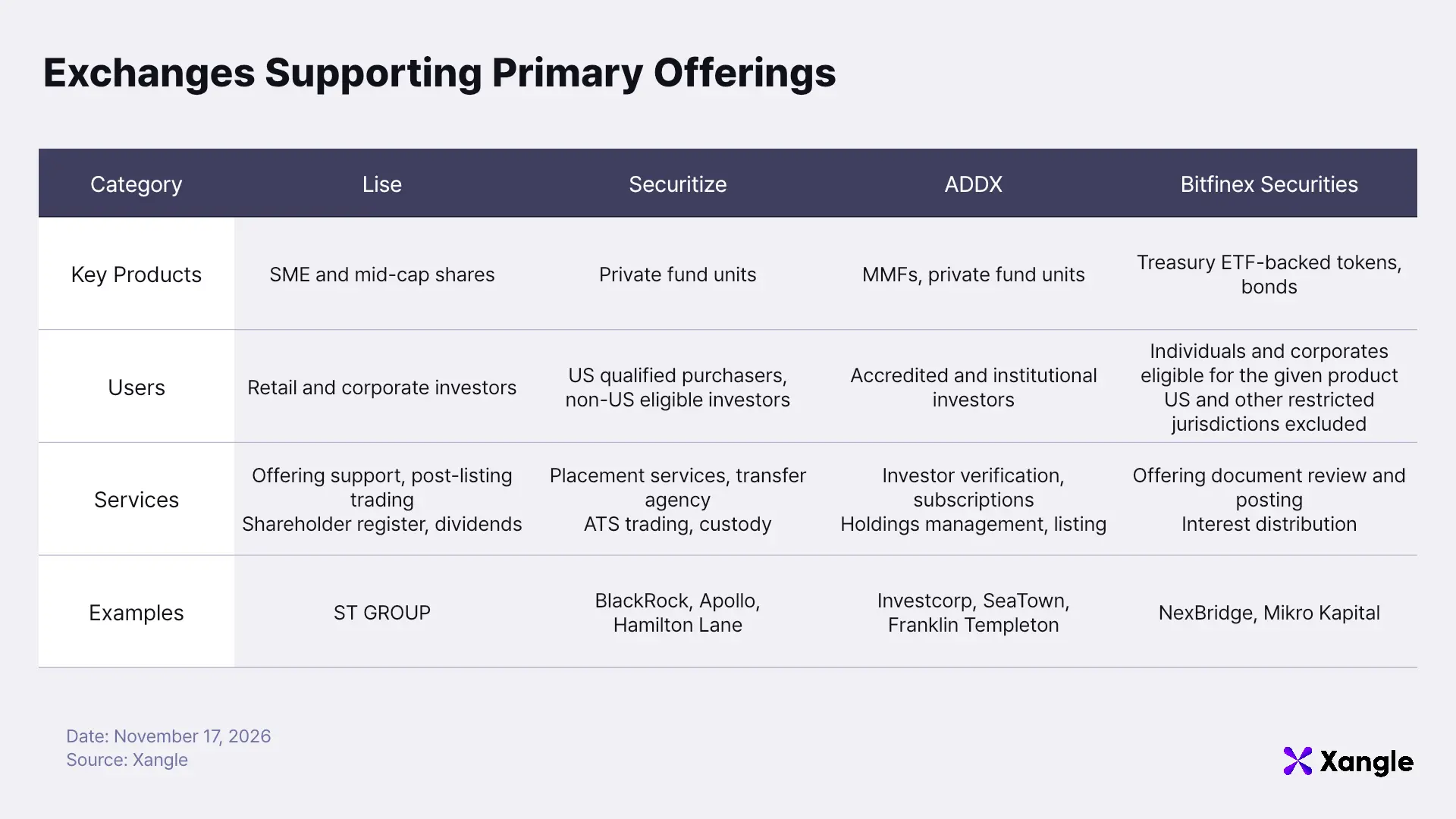
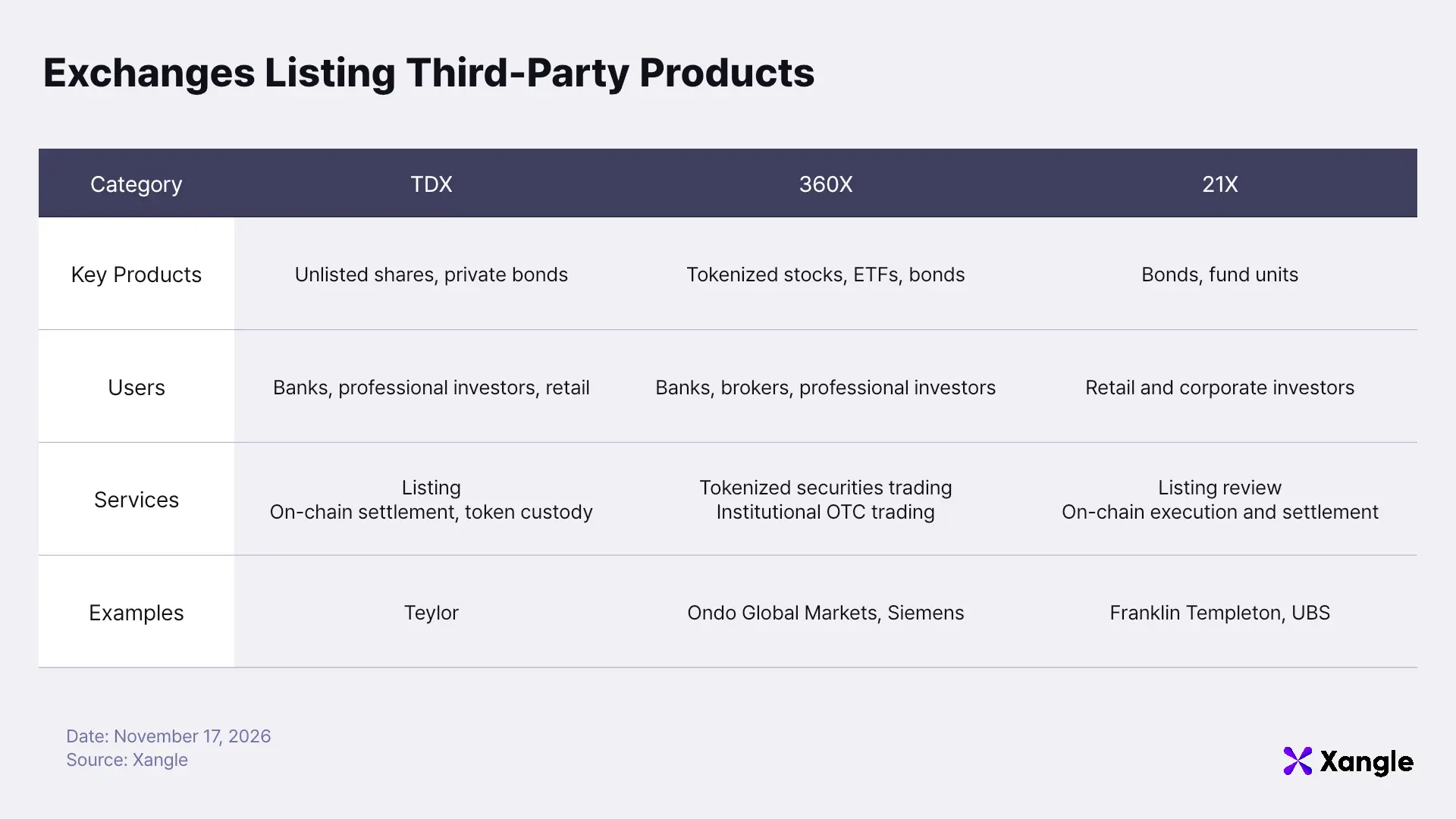
This section focuses on venues that external issuers or financial firms have used to list products or integrate trading capabilities. Given the number of examples and the different roles exchanges play, they are organized around the three uses outlined above: primary markets, secondary markets, and embedded trading.
3.1 Primary Markets
Lise: Public Share Offerings for SMEs and Mid-Cap Companies
Lise is an exchange that helps French small and medium-sized enterprises (SMEs) and mid-cap companies raise capital through public offerings of tokenized shares and supports subsequent share trading. In October 2025, it received authorization from the French Prudential Supervision and Resolution Authority (ACPR) under the European Union (EU) pilot regime for distributed ledger technology (DLT). This authorization allows Lise to operate a DLT trading and settlement system (DLT TSS). The DLT Pilot Regime exempts the trading and settlement of blockchain-issued securities from certain existing regulatory requirements. Companies preparing an offering produce materials covering their business plans, financial information, shareholder rights, offer price, offering size, and subscription period. Lise assists with documentation and investor presentations. Individual and corporate investors register with Lise and complete investor verification, including a suitability assessment, before reviewing the offering terms and subscribing.
Investors subscribe by depositing euros from European bank accounts in their own names, then hold and trade their allocated shares through Lise accounts. Share records and transfers use a permissioned blockchain built on Hyperledger Besu, with Lise handling both custody and settlement. Sale proceeds can be withdrawn to investors' own bank accounts.
ST GROUP used this service in April 2026 to raise approximately €2.07 million through a public offering of ordinary shares carrying dividend and voting rights. The shares became available for trading on Lise on April 25, with the first trade executed the following day. Buyers are entered in the issuer's shareholder register in their own names upon execution. Lise maintains this register on the issuer's behalf, distributes dividends funded by the issuer to holders as of the record date, and handles shareholder meeting notices and electronic voting. The issuer uses the register to identify dividend beneficiaries and eligible voters.
Securitize: Placement and Transfer Agency Services
Through its affiliates, Securitize provides issuers with both placement and transfer agency services. Securitize Markets intermediates securities offerings and sales and operates an alternative trading system (ATS), a broker-dealer-operated trading facility that is not registered as a securities exchange. Securitize Transfer Agent is a transfer agent registered with the U.S. Securities and Exchange Commission (SEC) that records securities ownership and transfers on issuers' behalf. Issuers can allocate securities to investors verified during the offering and subsequently manage ownership changes, redemptions, and distributions.
BlackRock's tokenized fund BUIDL is a prominent example, using Securitize to place fund interests and administer holdings. Securitize Markets conducts the offering with a minimum investment of $5 million for accredited investors who are either U.S. qualified purchasers or non-U.S. investors. Once investors subscribe and acquire fund interests, Securitize records the tokenized interests and their holders and administers subscriptions, redemptions, and distributions. BUIDL invests in cash, short-term U.S. Treasuries, and repurchase agreements (repos), while BlackRock manages the fund.
Tokenized products can also be added without changing how an existing fund is managed. For ACRED, which invests in an Apollo credit fund, and the product investing in Hamilton Lane's senior private credit fund SCOPE, Securitize established separate feeder funds that pool subscriptions and invest in the underlying funds, then issued tokens representing the feeder fund interests. Securitize Capital, Securitize's asset management affiliate, manages the SCOPE feeder fund. For ACRED, Securitize provides transfer agency and fund administration services. Apollo and Hamilton Lane continue to manage their existing funds, with capital raised through the feeder funds by Securitize Markets providing an additional source of inflows.
In May 2026, Securitize Markets received approval from the Financial Industry Regulatory Authority (FINRA), the self-regulatory organization overseeing U.S. broker-dealers, to provide custody for tokenized securities and participate in securities underwriting and selling groups. This enabled it to support on-chain settlement involving the exchange of securities for stablecoins, underwrite issuers' securities, and conduct offerings alongside other distributors.
ADDX: Distributing Investment Products to Accredited Investors
Singapore-based ADDX distributes money market funds (MMFs), private funds, and other products to individual and corporate accredited investors and institutional investors who are eligible to use the platform. U.S. persons and other restricted categories are excluded. ADDX also supports the issuance, custody, and trading of digital securities. Fund managers are responsible for investment strategy and management of the underlying assets, while ADDX verifies investors, accepts subscriptions, and administers their securities holdings.
Investcorp's U.S. multifamily real estate fund issued digital securities on ADDX through a separate company investing in the fund, with a minimum investment of $20,000. Individual investors subscribed for these securities, and the company invested in the fund. This structure made it possible to set subscription amounts suited to ADDX customers while preserving the underlying real estate investment and management arrangements. After the offering, the tokens were listed on ADDX for trading.
SeaTown used the same approach for a private credit fund investing in corporate loans and other assets. It reduced the minimum investment from $5 million to $20,000 and raised $7 million from individual accredited investors on ADDX. The securities were listed on ADDX after the offering, enabling secondary trading among investors.
In November 2025, Franklin Templeton launched a tokenized MMF investing in short-term U.S. dollar debt instruments on ADDX. Although the fund was registered for distribution to retail investors in Singapore, it was offered to accredited investors on ADDX. By tokenizing the fund interests, the manager extended distribution to ADDX's customers.
Bitfinex Securities: Subscriptions and Distribution for Issuers
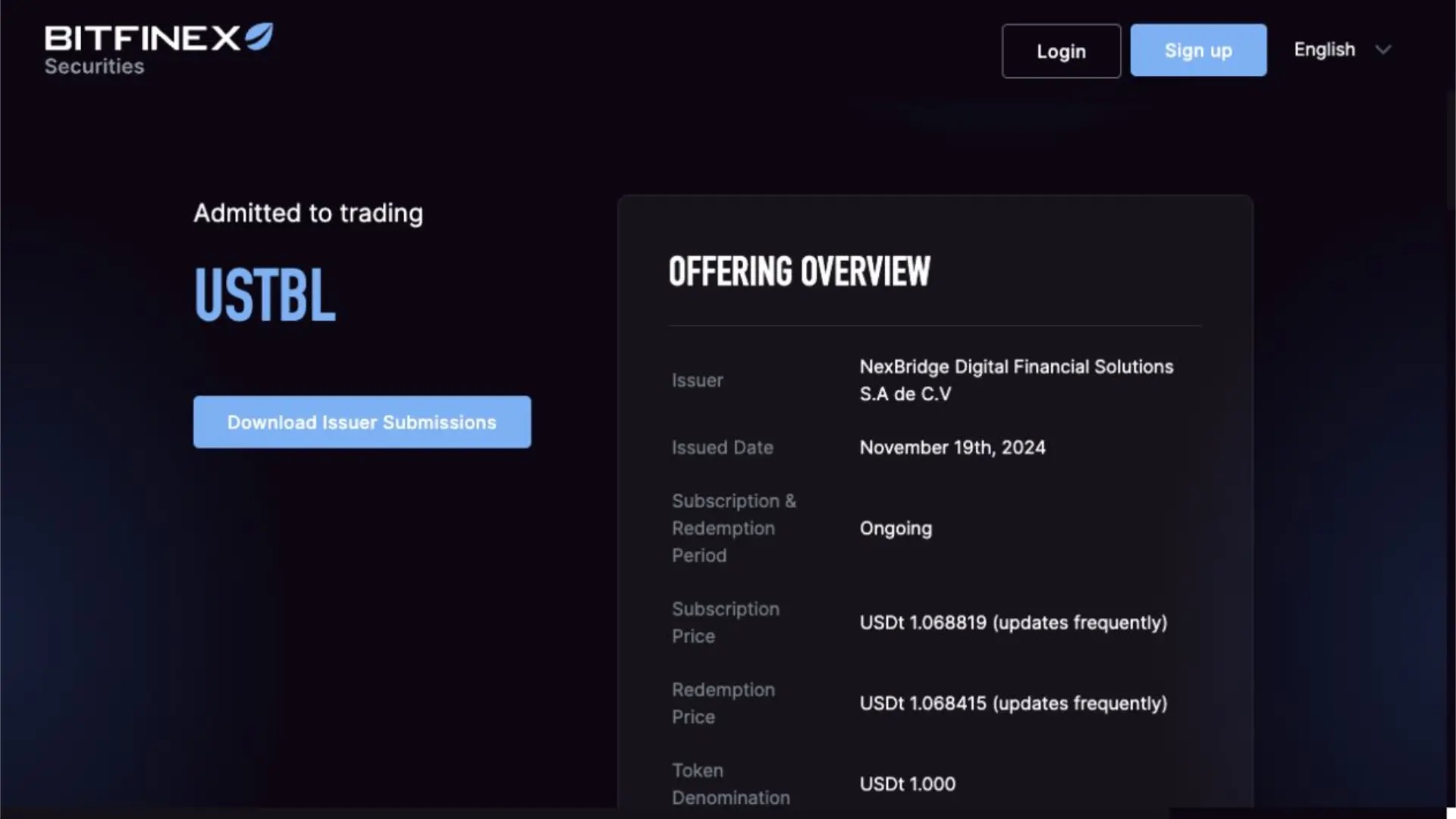
Bitfinex Securities is a securities exchange operated by separate legal entities within the same group as the crypto exchange Bitfinex. One entity is licensed as a digital asset service provider by El Salvador's National Commission of Digital Assets (CNAD), while another operates within the fintech regulatory sandbox of Kazakhstan's Astana International Financial Centre (AIFC). Each operates an exchange and handles offerings and trading for products listed on its venue. Offerings are conducted through the Capital Raise service. The issuer supplies documentation explaining the product's rights and risks, along with the subscription period and target amount. The exchange reviews these materials, publishes product information, and prepares promotional materials. Issuers can issue the tokens themselves or have the exchange do so on their behalf. Subscriptions are open only to investors whose eligibility for the product has been confirmed through investor verification.
Source: Bitfinex Securities
NexBridge issued USTBL, backed by an ETF investing in short-term U.S. Treasuries, on the Liquid Network blockchain and used Bitfinex Securities for the initial offering. Token holders have a pro rata claim against the issuer for the underlying assets. Subscription funds are collected in the issuer's exchange account. Once the minimum fundraising threshold is reached, the funds are transferred to a custodian bank to purchase the ETF, and tokens are issued to investors' wallets. The exchange handles the offering, while the issuer acquires and manages the underlying assets.
Mikro Kapital's Alternative, which invests in microfinance companies and other businesses, also raised approximately $5.2 million on the exchange through its ALT2612 tokenized bond, issued on Liquid Network. ALT2612 investors can withdraw tokens to permitted external wallets for self-custody or transfer them between approved wallets. The issuer funds interest payments in USDT, which the exchange allocates and pays to investor accounts.
3.2 Secondary Markets
TDX: An Exchange for Unlisted and Private Securities
TDX is an exchange for tokenized securities, including unlisted shares and private bonds, operated by Taurus, a securities firm licensed by the Swiss Financial Market Supervisory Authority (FINMA). Products listed on TDX can be purchased by professional investors and banks, as well as individual customers with TDX accounts, subject to the securities' transfer restrictions. Settlement takes place on-chain, but Taurus holds customers' tokens in custody, allowing investors to trade through accounts without having their own wallets.
German SME lending platform Teylor securitized part of its loan portfolio through an investment vehicle, issued the securities as tokens, and listed them on TDX. Dividing a private credit product previously distributed through bilateral transactions with large financial firms into securities made it accessible to smaller family offices and individual professional investors, who could also sell their holdings. Principal and interest from the underlying loans are paid monthly to token holders through TDX.
360X: An Exchange for Financial Firms and Professional Investors
Germany's 360X is an exchange serving banks, brokers, and professional investors. It is authorized to operate a multilateral trading facility (MTF), which matches orders from multiple participants, and also holds authorization under the DLT Pilot Regime to trade blockchain-issued securities. Participating financial firms submit orders through their existing systems. Securities held with the central securities depository Clearstream can be settled through their existing Clearstream accounts. 360X also offers an over-the-counter (OTC) service through which institutions negotiate trades bilaterally.
Since April 2026, tokenized stock issuer Ondo Global Markets has listed tokenized stocks and ETFs on 360X, extending distribution of its existing tokenized products to European brokers and institutional investors. These tokens are certificates that do not confer ownership of, or a right to receive, the underlying shares. Ondo manages the underlying assets and handles token issuance and redemption.
360X's OTC service has also been used for institutional trading of blockchain-issued bonds. German bank DekaBank and asset manager Union Investment used the service to trade a Siemens bond and settled the transaction on SWIAT, the financial-sector blockchain maintaining the bond's records.
21X: On-Chain Trading and Settlement of Tokenized Securities
Germany's 21X is authorized by the Federal Financial Supervisory Authority (BaFin) to operate a DLT TSS under the EU DLT Pilot Regime, combining trading and settlement. Products listed on 21X are issued as tokens on Polygon or Stellar, the blockchains supported by the exchange, and undergo its listing review. Investors place orders through wallets approved by 21X and pay with stablecoins such as USDC. Each executed trade is processed in a single blockchain transaction and settles immediately.
Franklin Templeton's tokenized MMF interests, grBENJI, are issued on Stellar and trade against USDC on 21X. In addition to redeeming through the fund, holders can exit by selling their interests to other investors on the exchange. Since a sale requires a buy order, issuers may contract with market makers to maintain bid and ask quotes. Tradevest provided market making when USMO, a debt security structured as a tracker note linked to the performance of a UBS U.S. dollar MMF, was listed on 21X.
3.3 Embedding Trading in Existing Services
ODX: Adding Tokenized Securities Trading to Brokerage Accounts
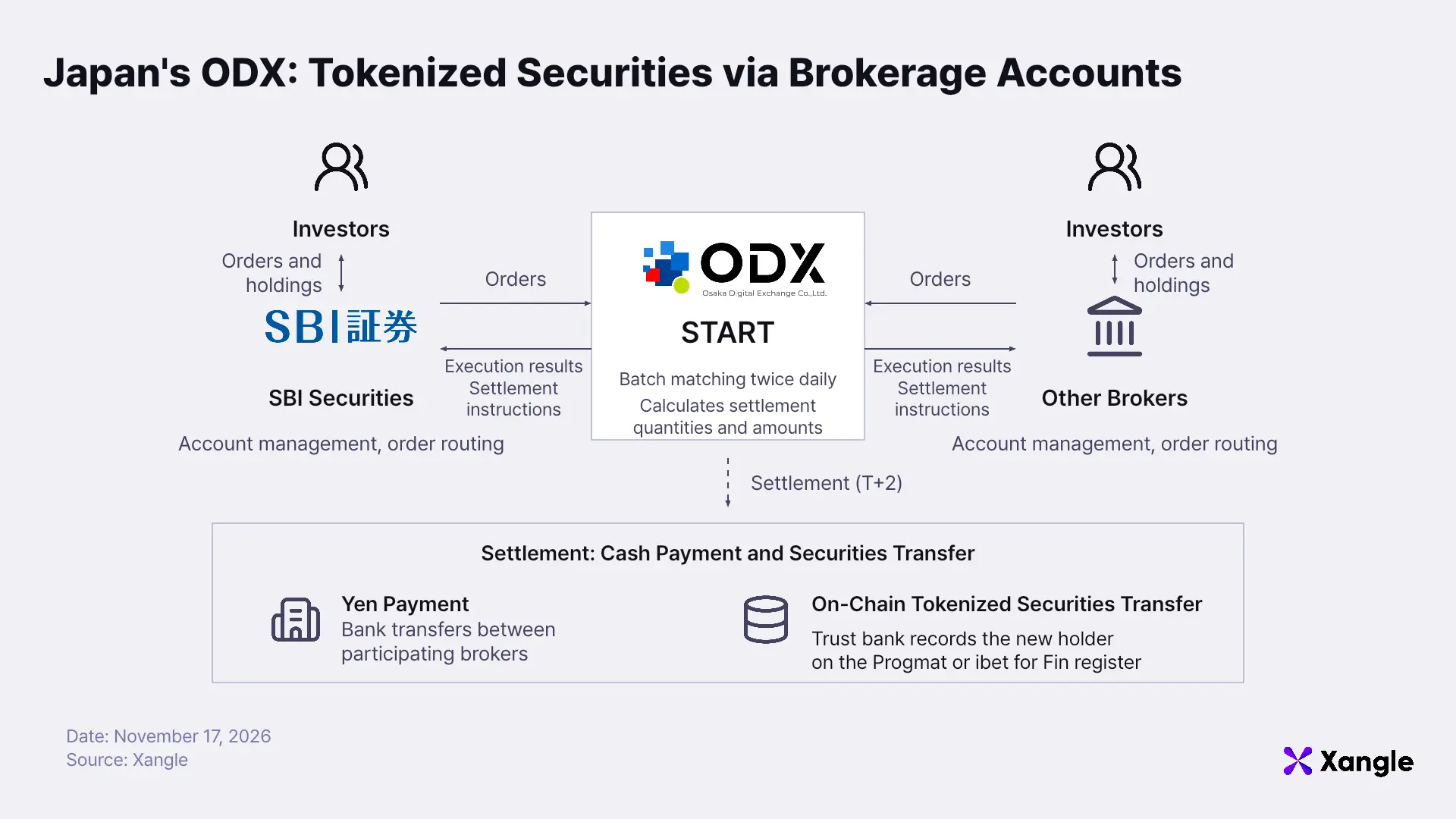
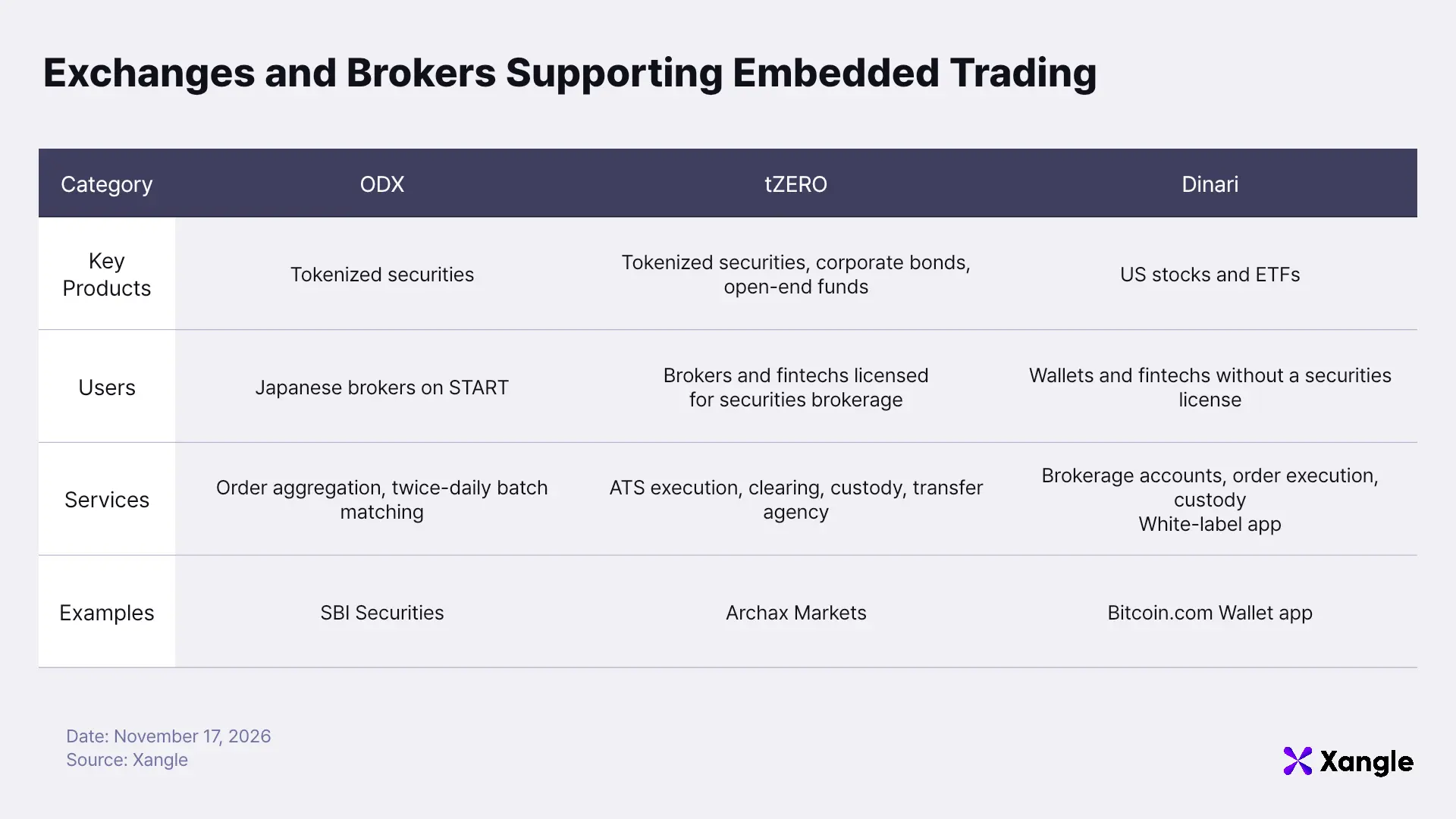
Japan's Osaka Digital Exchange (ODX) operates START, a proprietary trading system (PTS), an authorized trading facility outside a securities exchange, where tokenized securities are traded. Brokers participate in START and route customer orders to it. Before handling customer orders for a particular security, they must enter into custody and transfer agency agreements with its trustee. START matches the accumulated orders in two batches each trading day.
SBI Securities used this model to add tokenized securities trading to its brokerage accounts. Customers open a tokenized securities trading account with SBI and place orders for START-listed instruments. As with conventional shares, trades settle in yen two business days after execution (T+2). On the settlement date, the trustee bank records the new holder in the ownership register on a blockchain-based platform, Progmat or ibet for Fin, at SBI's request.
tZERO: Transfer Agency, Trading, and Custody Infrastructure
Through its affiliates, U.S.-based tZERO provides securities brokerage, ATS operation, tokenized securities custody, and transfer agency services. Its custody affiliate, tZERO Digital Asset Securities, is authorized as a special purpose broker-dealer (SPBD), allowing it to hold tokenized securities directly in custody in the United States. In 2025, brokerage affiliate tZERO Securities expanded its product coverage after receiving FINRA approval for corporate bond trading and retail distribution of open-end funds, including tokenized mutual funds. Financial firms integrating trading use the Connect API to display market prices in their own services, route customer orders to the tZERO ATS, and reflect executions in customer accounts. Customers can trade purchased tokenized securities while holding them either with tZERO's custody affiliate or in their own wallets.
Archax Markets, the U.S. broker-dealer established by U.K. tokenized securities exchange Archax, chose this infrastructure when it received FINRA approval in 2026 and entered the U.S. market. Archax Markets manages customers and handles their orders, while tZERO affiliates provide clearing, custody, and ATS trading services.
Dinari: U.S. Stock Trading for Financial Apps and Wallets
Dinari combines brokerage accounts, order processing, custody, and token recordkeeping to help financial platforms with existing customers and apps add U.S. stock and ETF trading. In the United States, its brokerage affiliate Dinari Securities handles account opening, investor verification, and order intake, while U.S. broker Alpaca executes orders and provides custody for shares and cash. Dinari issues dShares tokens on a blockchain in quantities corresponding to customers' shareholdings, recording their ownership. Customers can deposit USDC from their wallets to buy shares. Integrating firms can implement trading through APIs or offer Hosted Trading, a white-label service for browsing securities, placing orders, and viewing holdings, under their own brands.
Bitcoin.com, which operates a crypto wallet app, integrated Dinari's white-label trading service in May 2026 to offer U.S. stock and ETF trading to users outside the United States. In September, it expanded access to U.S. users who met the eligibility requirements. Users trade stocks within the Bitcoin.com wallet app, but Dinari supplies the trading interface, brokerage accounts, order processing, and share custody. dShares tokenized stocks issued in quantities matching the purchased shares are held in users' own wallets on the Base blockchain.
4. How Exchange Jurisdiction Shapes Products and Investor Access
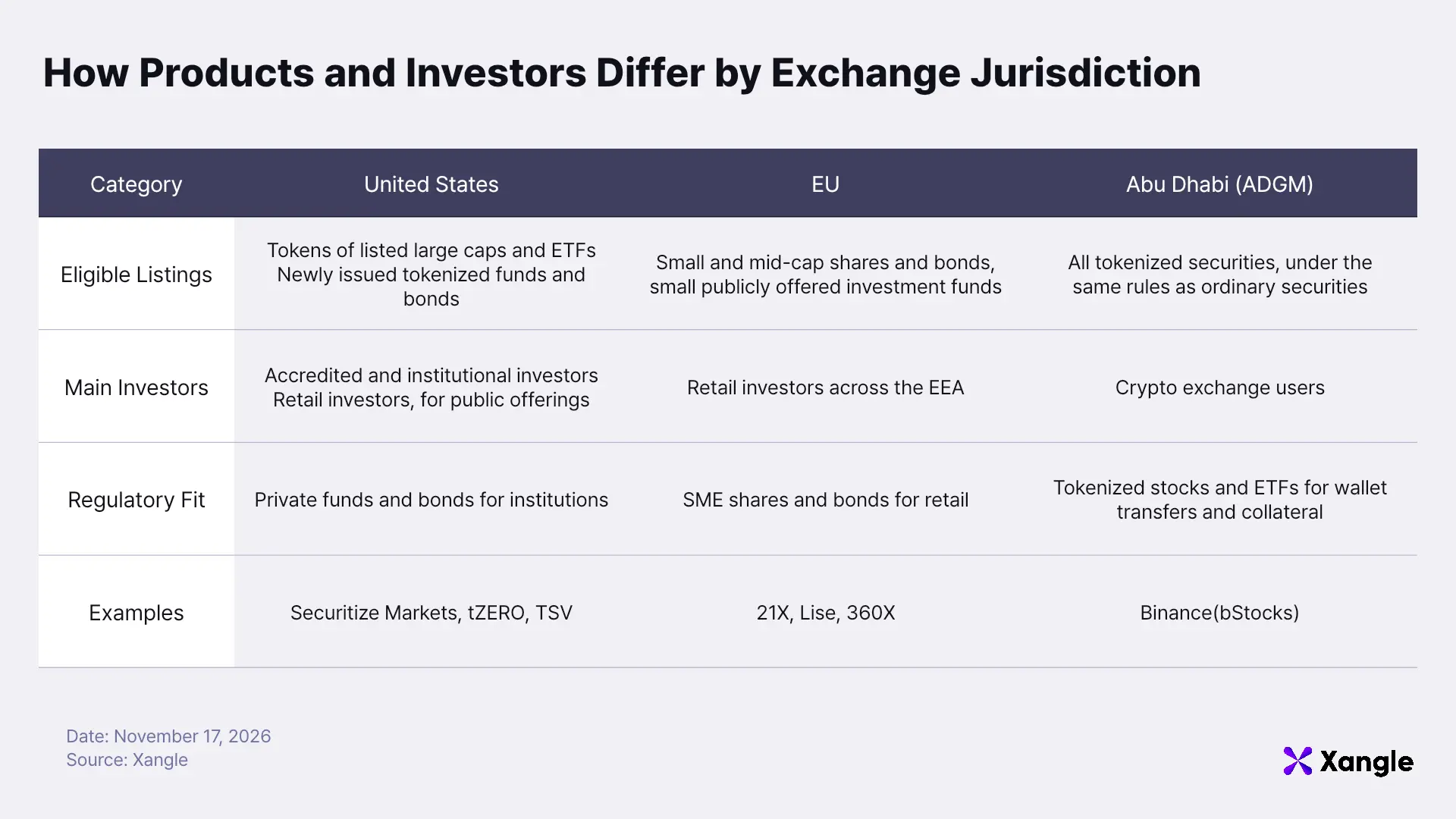
An exchange's jurisdiction determines which products can be listed and which investors they can be sold to. This section compares the United States, the European Union, and Abu Dhabi Global Market (ADGM), Abu Dhabi's financial free zone, which take different approaches to permitting exchanges for tokenized securities.
1) United States
In the United States, existing listed large-cap stocks and ETFs can be traded as tokens without issuing new securities. Under SEC approval granted in March 2026, Nasdaq trades Russell 1000 constituents and major index ETFs through its existing order book, with settlement in tokenized form if the broker elects it. On tokenized securities venues (TSVs) permitted under the SEC's September 2026 Innovation Exemption order, investors use verified wallets to trade tokens representing listed stocks and ETFs directly on-chain.
Newly issued tokenized products are offered through broker-dealers operating ATSs, such as Securitize Markets and tZERO, and traded on those systems. Eligibility to participate in offerings and trading is determined by the same public offering and private placement rules that apply to conventional securities. Products registered with the SEC for public offering can be subscribed for and traded by retail investors. Products privately issued without SEC registration can be subscribed for only by accredited investors meeting asset or income requirements and by institutional investors, and can be traded only among those investors. Since tokenized funds and bonds are predominantly issued through private placements, U.S. ATSs are suited to placing these products with accredited and institutional investors and enabling holders to sell to them before maturity or redemption.
2) EU
In the EU, tokenized securities can be listed on exchanges operating under the DLT Pilot Regime, including 21X, Lise, and 360X, for on-chain trading and settlement. Retail investors can participate directly on Lise and 21X without going through a broker. Eligible instruments are limited to shares of companies with a market capitalization below €500 million, plain-vanilla bonds with an issuance size below €1 billion, and units in EU retail funds, known as undertakings for collective investment in transferable securities (UCITS), with assets under management below €500 million. Private funds, which account for much of the U.S. tokenized product market, and products exceeding these limits must be listed on conventional exchanges. In that case, the securities are recorded on the books of a central securities depository (CSD) and settled through CSD accounts like conventional securities.
As in the United States, investor eligibility is governed by the public offering rules for conventional securities. A public offering to retail investors requires prospectus approval from a member state's regulator. From June 2026, however, small offerings with an issuer's total public fundraising over 12 months at or below the threshold set by the member state can be sold to retail investors without that approval. Otherwise, sales are restricted to professional investors. Prospectus approval and securities business authorization obtained in one member state can be used in other member states through passporting, allowing a product listed on an exchange in one member state to be sold to investors across the European Economic Area (EEA). Non-EU issuers and brokers can also use this regime by obtaining the requisite approval and authorization in a member state.
The United States is therefore suited to private placements for accredited and institutional investors, while the EU is suited to public offerings of smaller securities, such as SME shares and bonds, to retail investors across the EEA, with direct investor participation in subsequent trading. If the amendment proposed by the European Commission in December 2025 and currently moving through the legislative process takes effect, restrictions on product types and sizes will be removed. Private funds and larger bond issues could then also be traded and settled on-chain through exchanges operating under the DLT Pilot Regime.
3) Abu Dhabi Global Market
ADGM regulates tokenized securities in the same way as conventional securities. Unlike the EU DLT Pilot Regime, it imposes no restrictions on the types or sizes of products that can be listed. Crypto assets and securities are supervised by the same Financial Services Regulatory Authority (FSRA). A crypto exchange that obtains MTF authorization can therefore list tokenized securities alongside crypto assets, provided the FSRA has approved their prospectuses.
In ADGM, tokenized stocks listed alongside crypto assets can be transferred and used freely in the same way as crypto assets. The U.S. and EU tokenized securities exchanges discussed above either record securities on private blockchains or allow transfers only between approved wallets. By contrast, global crypto exchange Binance, which has operated under ADGM regulation since January 2026, lists bStocks as standard tokens on the public BNB Chain. Once withdrawn, they can be transferred freely between wallets like other crypto assets. They can also be used as margin collateral for futures trading on the exchange. Launched in June 2026 with five instruments, bStocks had expanded to 105 instruments and $1.3 billion in assets under management by November. ADGM is therefore suited to issuers seeking to distribute tokenized stocks and ETFs that can be freely transferred on public blockchains and used as collateral.
5. Closing Remarks: Centralized Exchanges Move On-Chain
Centralized exchanges are listing tokenized assets, but blockchain is still used for only part of the trading process. Most exchanges use it either solely for token deposits and withdrawals, as Binance does, or only to settle executed trades, as TDX does. Orders are executed through the exchanges' own systems. Some venues, such as 21X, process both execution and settlement on-chain, but they operate within the EU DLT Pilot Regime, which limits the types and sizes of products they can list. Even when assets are issued on a blockchain, trading still largely takes place on exchanges' internal ledgers.
Most products listed on these exchanges also tokenize the underlying assets indirectly. Actively traded tokenized stocks such as bStocks are certificates linked to share prices rather than the shares themselves. The securities linked to real estate and private credit funds listed on ADDX are likewise issued by separate companies investing in those funds. Investors buy and sell tokens on the exchange, but what they hold is a claim against the certificate issuer or intermediary entity rather than the underlying asset.
Exchanges are now emerging that change both how trading works and how assets are tokenized. Under its Innovation Exemption, the United States has allowed large-cap listed stocks and ETFs to be traded on-chain as tokens representing the securities themselves. Intercontinental Exchange (ICE), the parent of the New York Stock Exchange (NYSE), and crypto exchange OKX established OKXICE, which is scheduled to begin trading on November 23. OKXICE will trade tokens representing security entitlements backed one-to-one by underlying shares. Token holders receive the same shareholder rights as holders of the same class of underlying shares, including dividends, voting rights, and a share of residual assets upon liquidation. Execution and settlement will take place on-chain, while the exchange handles investor verification and market surveillance. The EU is also pursuing amendments to remove restrictions on the types and sizes of products that exchanges under the DLT Pilot Regime can list.
The next stage in tokenized asset trading is the migration of centralized exchanges onto blockchains. Many exchanges currently trade indirectly tokenized products on their own ledgers, while venues such as 21X already offer on-chain execution and settlement. This model is expected to expand to more exchanges. Exchanges will still be responsible for investor verification and market surveillance, so their role will grow as more assets are tokenized.
Disclaimer
I confirm that I have read and understood the following: The information contained in this article is strictly the opinions of the author(s). This article was authored free from any form of coercion or undue influence. The content represents the author's own views and does not represent the official position or opinions of CrossAngle. This article is intended for informational purposes only and should not be construed as investment advice or solicitation. Unless otherwise specified, all users are solely responsible and liable for their own decisions about investments, investment strategies, or the use of products or services. Investment decisions should be made based on the user’s personal investment objectives, circumstances, and financial situation. Please consult a professional financial advisor for more information and guidance. Past returns or projections do not guarantee future results.
Xangle or its affiliated partners own all copyrights of the written or otherwise produced materials and content provided on the platform. Any illegal reproduction of such content, including, but not limited to, unauthorized editing, copying, reprinting, or redistribution will result in immediate legal actions without prior notice.