
[CIS Seoul Partner Summit] Chainlink: Connecting Traditional Finance to the Onchain Economy


Table of Contents
1. Introduction: The Need to Connect Blockchains and Financial Systems
2. Oracles Connecting the Real World and Blockchains
3. CCIP: A Protocol for Cross-Chain Interoperability
4. ACE: Extending Financial Compliance to Blockchains
5. CRE: A Runtime Environment Connecting Traditional Finance and Blockchains
6. Closing Remarks: Chainlink’s Expanding Role as Infrastructure for Tokenized Assets and Financial Systems
1. Introduction: The Need to Connect Blockchains and Financial Systems
Financial institutions are increasingly exploring the issuance of financial assets, including funds, as tokens that can be traded onchain or used as collateral. Similar initiatives are likely to emerge in Korea, with tokenization helping funds expand their investor base overseas. Making these services work requires providing each fund’s net asset value (NAV) per unit, verifying investors, and linking payment to the delivery of fund units. With the necessary information and processes spread across blockchains and institutions’ existing systems, token issuance needs to be accompanied by infrastructure that connects them.
The challenge is that smart contracts cannot directly connect to systems in the world outside the blockchain, known as offchain systems, to retrieve information. Blockchains validate transactions based on the data and rules recorded within them, but this consensus alone cannot establish the accuracy of NAV per unit calculated by external institutions. A separate mechanism is therefore needed to verify information from trusted sources and deliver it onchain in a form that smart contracts can use. Oracles provide this infrastructure.
Institutions building these connections themselves must design everything from external system integrations to data verification and updates. Avoiding reliance on a single operator for data delivery and verification also requires a structure in which independently operated oracle nodes check information and reach consensus on the results. Institutions must also bear the costs of running nodes, compensating operators, and responding to failures. These development and operating burdens can create barriers to entry for institutions pursuing tokenization businesses.
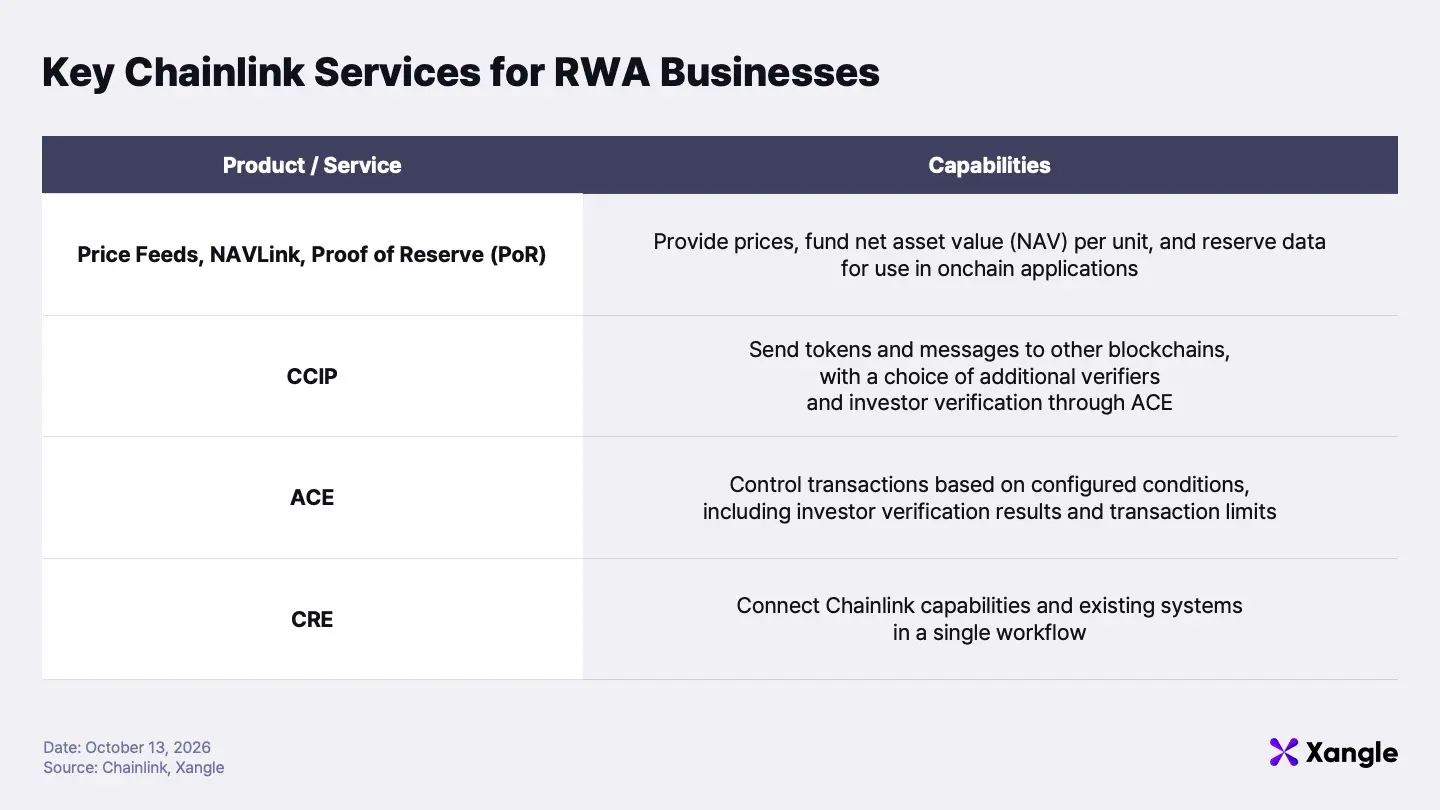
Chainlink is an oracle platform that provides a comprehensive set of capabilities for connecting blockchains with external financial systems. Through decentralized oracle networks, it delivers asset data and supports asset transfers and communication between blockchains. It also offers compliance functions, including investor verification and transaction policy enforcement, alongside an environment for executing processes while protecting sensitive information. Institutions can combine the capabilities their businesses need to connect existing financial operations with onchain services.
2. Oracles Connecting the Real World and Blockchains
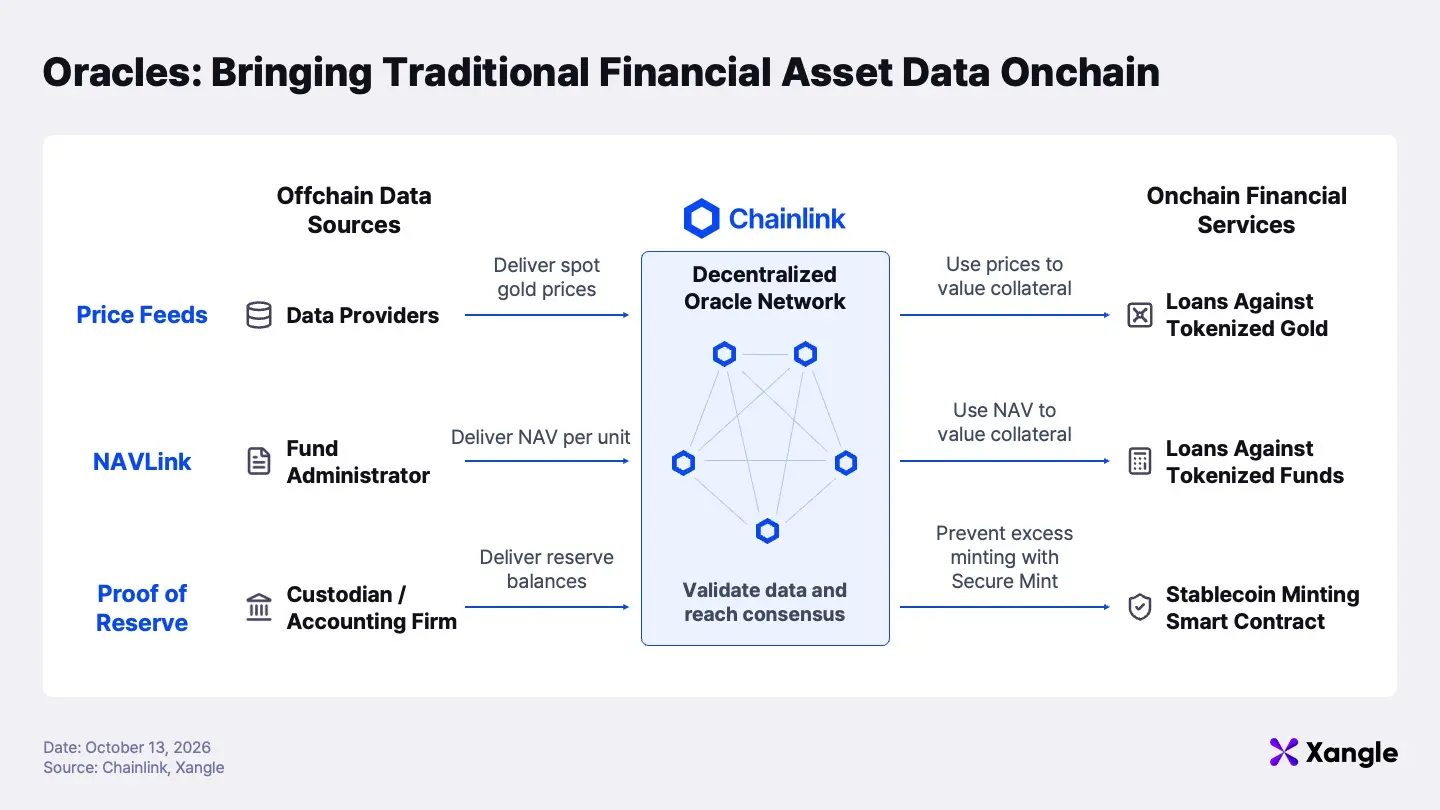
Trading tokenized assets or using them as collateral requires information to assess their value. Chainlink’s Data Feeds service makes external data available in a form that smart contracts can read. Price Feeds aggregate price data collected by oracle nodes and publish the agreed values onchain. For example, a spot gold price feed allows services handling tokens linked to gold to use that price as a trading benchmark or for collateral valuation. Published values are updated according to conditions configured for each feed, such as price deviation or elapsed time.
Data Streams can be used for trades that require a faster response to price changes. A service retrieves data reports signed by the oracle network when needed, then verifies and uses them onchain. The focus is on providing market information at the point of trade execution without posting every update to the blockchain. Robinhood Chain, which launched its mainnet in July 2026, has adopted Chainlink Data Feeds and Data Streams to supply onchain price information for tokenized stocks, including those linked to NVIDIA and Apple.
Beyond market prices, services also need information on asset valuations and collateral status. Chainlink’s SmartData is a product family that addresses this information for tokenized assets, including NAVLink and Proof of Reserve (PoR). NAVLink delivers NAV data calculated by fund administrators and other providers onchain to support the valuation of tokenized funds. Lending services can use the supplied NAV per unit to value fund units deposited as collateral.
PoR provides the onchain information needed to verify the reserves backing tokenized assets. Integrating Chainlink’s Secure Mint into the issuance smart contract allows new minting to be restricted so that total token supply after minting is capped at the reserve amount reported by PoR. World Liberty Financial’s dollar-pegged stablecoin USD1 also uses PoR to disclose reserve information onchain. In September 2026, the U.S. state of Wyoming adopted PoR for FRNT, its state-issued dollar-pegged stablecoin, making reserve information verified by a third party available onchain. Wyoming is also pursuing the adoption of Secure Mint, extending its use of reserve data from disclosure to issuance controls.
3. CCIP: A Protocol for Cross-Chain Interoperability
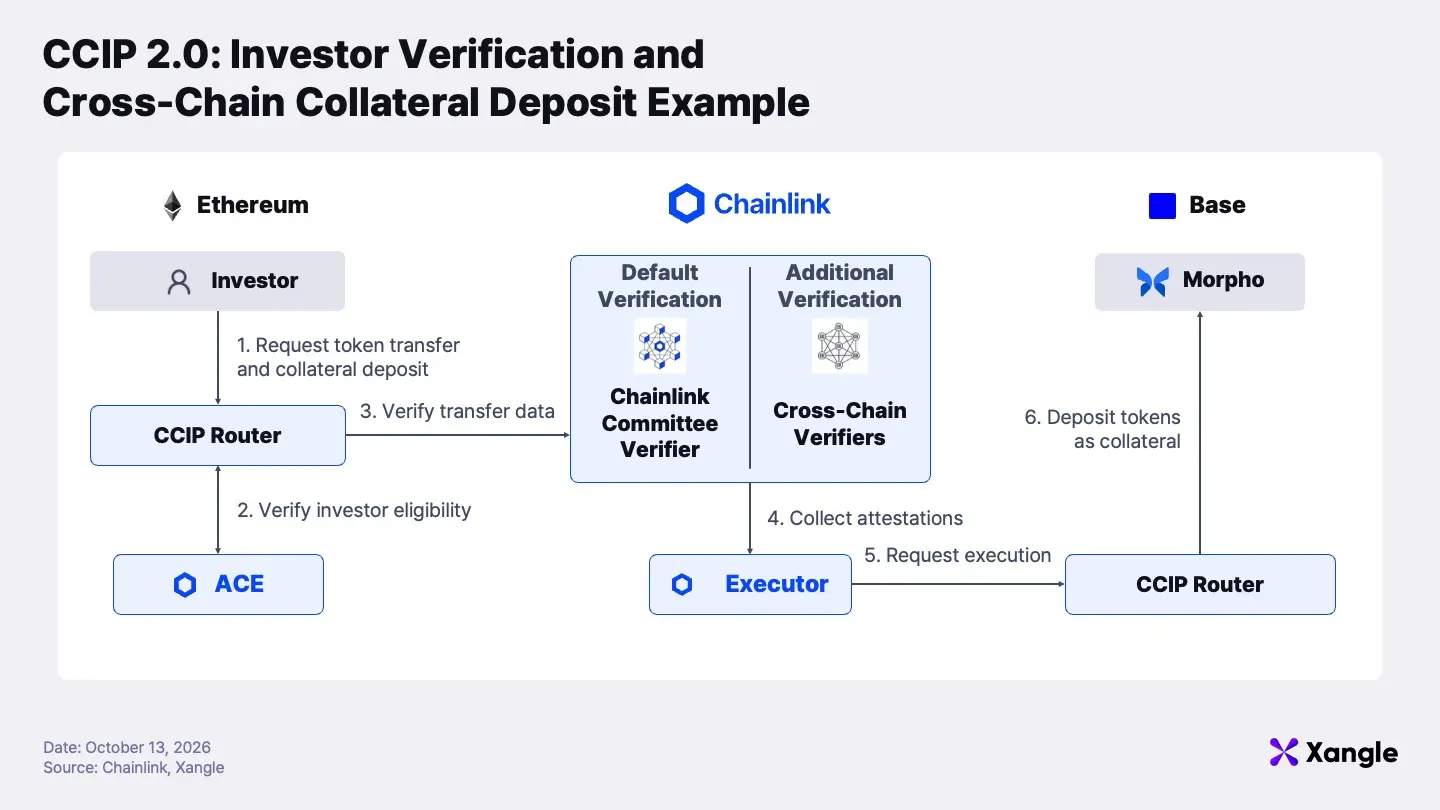
The blockchain on which a tokenized asset is issued may differ from the one an investor uses. Chainlink’s Cross-Chain Interoperability Protocol (CCIP) supports token transfers and messaging between these blockchains. Where both the asset and the transfer route are integrated with CCIP, an investor can send tokenized stocks from Ethereum to a lending service on Base, together with instructions to deposit them as collateral. Configuring the receiving service to process these instructions allows the asset transfer and collateral deposit to be linked in a single request.
CCIP 2.0, introduced on September 28, 2026, expanded these capabilities to let issuers configure the verification framework for their transfers. In addition to the default verification performed by Chainlink oracle networks, institutions can add Cross-Chain Verifiers (CCVs) that they operate themselves or that are provided by third parties, and require their verification before a transfer can execute. Each verifier independently checks transfer information on the source chain and provides a signed attestation. Smart contracts on the destination chain check that these attestations satisfy the configured verification requirements before executing the transfer.
Confirmation wait times are also configurable. By default, CCIP 2.0 waits for transactions on the source chain to reach finality, but transfers using Faster-Than-Finality (FTF) can execute after a specified number of block confirmations, before finality. Shortening the wait requires accounting for the risk that a source-chain transaction could be reversed. Issuers can therefore set the minimum number of block confirmations required for a transfer in line with their risk tolerance.
Integration with the Automated Compliance Engine (ACE) allows policies such as investor eligibility requirements and transaction limits to be applied to transfers. Issuers can use investor verification results, including know-your-customer (KYC) checks, and sanctions lists to allow tokenized assets to move only between wallets that meet the transfer requirements. They can also apply policies governing asset distribution, such as restricting transactions that exceed issuer-defined limits.
Wyoming has adopted CCIP for cross-chain transfers of its state-issued stablecoin FRNT. Combining such asset transfers with messaging also allows tokenized asset subscriptions and settlement to be connected across multiple chains. Chainlink’s Digital Transfer Agent (DTA) technical standard uses this combination to connect tokenized fund distribution and subscription payments, while delivery-versus-payment (DvP) arrangements can use it to send payment tokens and purchase instructions together, linking asset delivery with payment.
4. ACE: Extending Financial Compliance to Blockchains
Some tokenized funds and bonds need to restrict trading and transfers to accredited investors. Chainlink’s compliance solution ACE can be used in these cases.
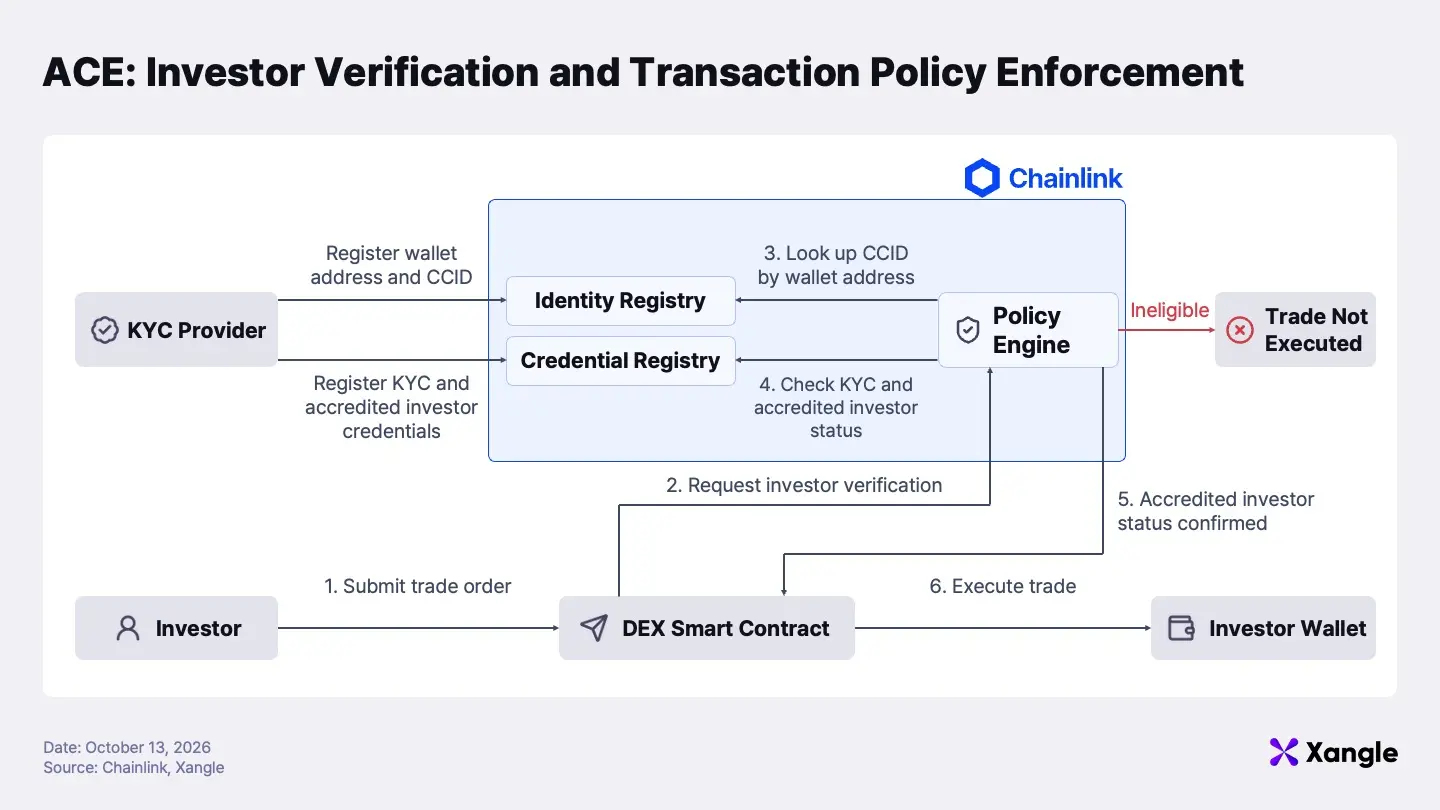
ACE checks investor verification results and applies institution-defined policies, such as transaction limits, before a smart contract executes a transaction. Transaction policies can be managed separately from a service’s core code, allowing institutions to update the relevant policies when investor requirements or limits change. ACE is currently available in private beta and can be applied to smart contracts based on the Ethereum Virtual Machine (EVM).
Cross-Chain Identity manages investor verification information by linking an investor’s multiple wallet addresses to a single Cross-Chain Identifier (CCID) and registering credentials containing verification results against that identifier. Authorized identity verification providers verify investors offchain before registering this information, while the underlying personal data remains offchain. Each service looks up the registered credentials to check whether the investor verification requirements in its own policies have been met. Reusing verification results accepted by an institution across supported chains and services reduces the need to repeat investor verification on each chain.
For example, when an investor buys a tokenized bond on a decentralized exchange (DEX), the DEX smart contract calls ACE’s policy engine before executing the trade. The engine runs the investor verification policy, looking up the CCID linked to the wallet address and valid credentials to confirm that the investor has completed KYC checks and holds accredited investor status. It then runs the transaction limit policy to check whether the purchase would exceed the investor’s daily trading limit. If the configured checks pass, the DEX executes the trade and delivers the tokenized bond to the investor. If they fail, the transaction is reverted and the trade does not go through.
ACE is also being used in tokenization infrastructure jointly developed by financial institutions. Global Layer One (GL1), a public-private initiative involving J.P. Morgan, HSBC, Standard Chartered, and the Monetary Authority of Singapore (MAS), among others, is developing common operating standards and technical specifications for trading and settling tokenized assets across borders and blockchains. As part of this effort, it is integrating ACE into a compliance framework that checks investor verification results and applies transaction conditions.
5. CRE: A Runtime Environment Connecting Traditional Finance and Blockchains
Building trading or collateral management services for tokenized assets requires connecting functions such as data retrieval, investor verification, and asset transfers according to predefined conditions and sequences. Collateral management alone involves checking an asset’s price, determining whether it is eligible as collateral, and comparing its assessed value with collateral requirements to handle top-ups or transfers. Chainlink Runtime Environment (CRE) provides an environment for organizing and executing these procedures as a single workflow. Institutions can connect data retrieval from external systems, conditional logic, and smart contract calls so that the result of one step determines the next.
CRE executes a preconfigured workflow at a scheduled time, when a blockchain event occurs, or when it receives an external request. The oracle network then retrieves the required data and verifies the results, calling external APIs or delivering reports for onchain execution according to the defined conditions. By connecting institutions’ existing systems with blockchains, CRE can also support a workflow that receives payment confirmation from a bank and requests token delivery. Rather than building these connections from scratch for each service, institutions can combine CRE’s capabilities to suit their operations.
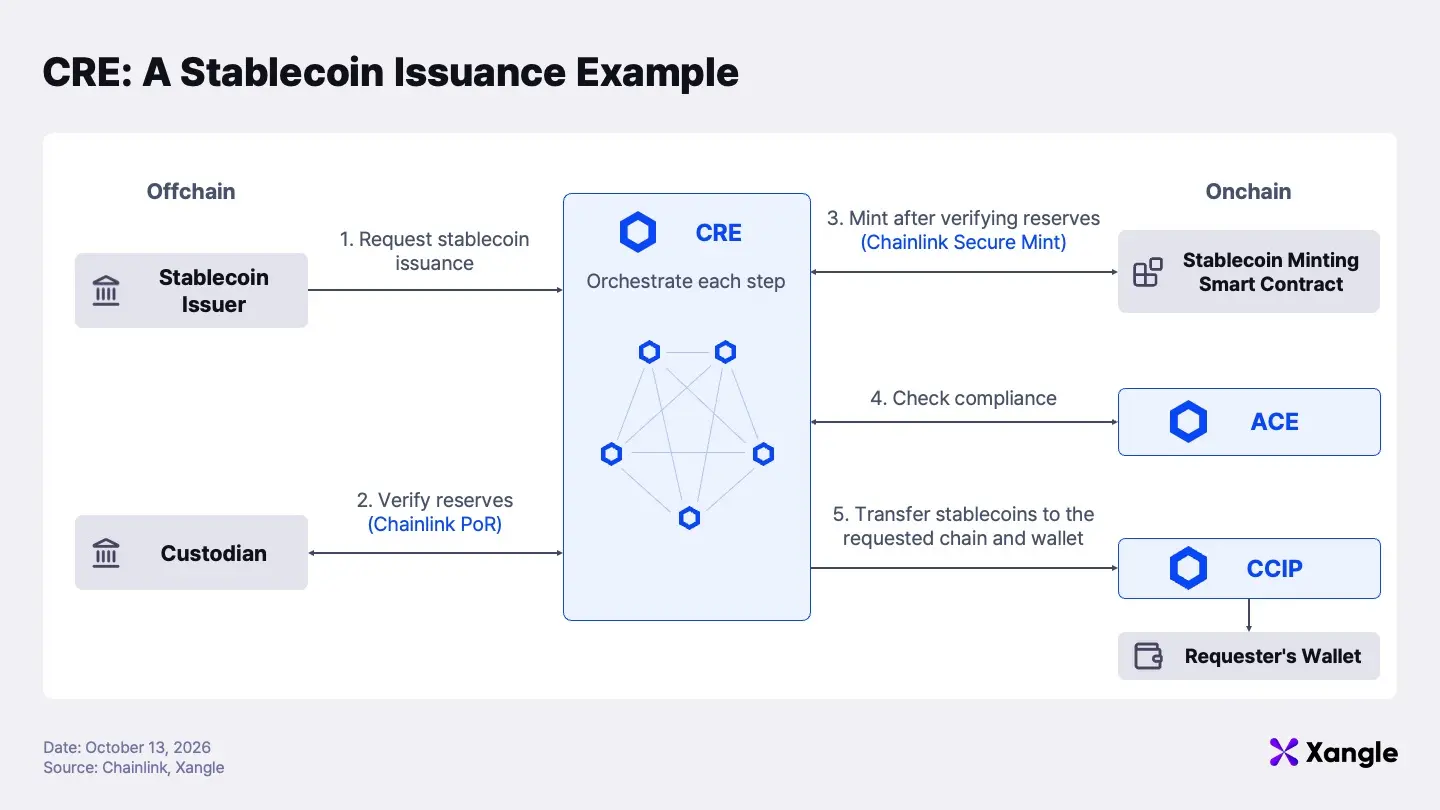
In May 2026, the Depository Trust & Clearing Corporation (DTCC), the U.S. clearing and settlement infrastructure provider, announced plans to use CRE and Chainlink’s data services for its Collateral AppChain. It aims to connect asset prices, valuation data, and collateral movements to automate processes including collateral eligibility checks, valuation, margin management, collateral allocation, and settlement. A key aspect of this approach is using CRE as a foundation for extending existing workflows as new data types and asset classes are added.
Processes connected to institutional systems also use data that needs to remain confidential, such as API credentials, customer information, and transaction records. CRE’s Confidential HTTP calls external APIs by injecting credentials and sensitive request parameters within a Trusted Execution Environment (TEE), an isolated, secure execution environment. Responses can also be encrypted as needed. When protection needs to extend beyond external calls to the processing involved in combining data or performing calculations, Confidential Workflows, currently in private beta, can run designated portions of that processing inside a TEE. Institutions can thus connect financial processes while identifying the steps that use confidential information and controlling which results are disclosed onchain.
6. Closing Remarks: Chainlink’s Expanding Role as Infrastructure for Tokenized Assets and Financial Systems
Chainlink has supported decentralized finance (DeFi) lending and trading as an oracle that delivers external price data to smart contracts. As the tokenization market expands, demand is growing for trading and managing traditional financial assets onchain. The scope of what needs to be connected to blockchains is therefore expanding from price data to existing financial systems and transaction processes.
What matters in this expansion is the range of financial transactions that connected services can handle, rather than the variety of individual services. When asset transfers, compliance, and data delivery are integrated with existing financial systems, financial institutions can combine them to create trading and settlement processes for tokenized assets. Chainlink’s role is thus extending beyond delivering external information to blockchains to enabling transactions across financial systems.
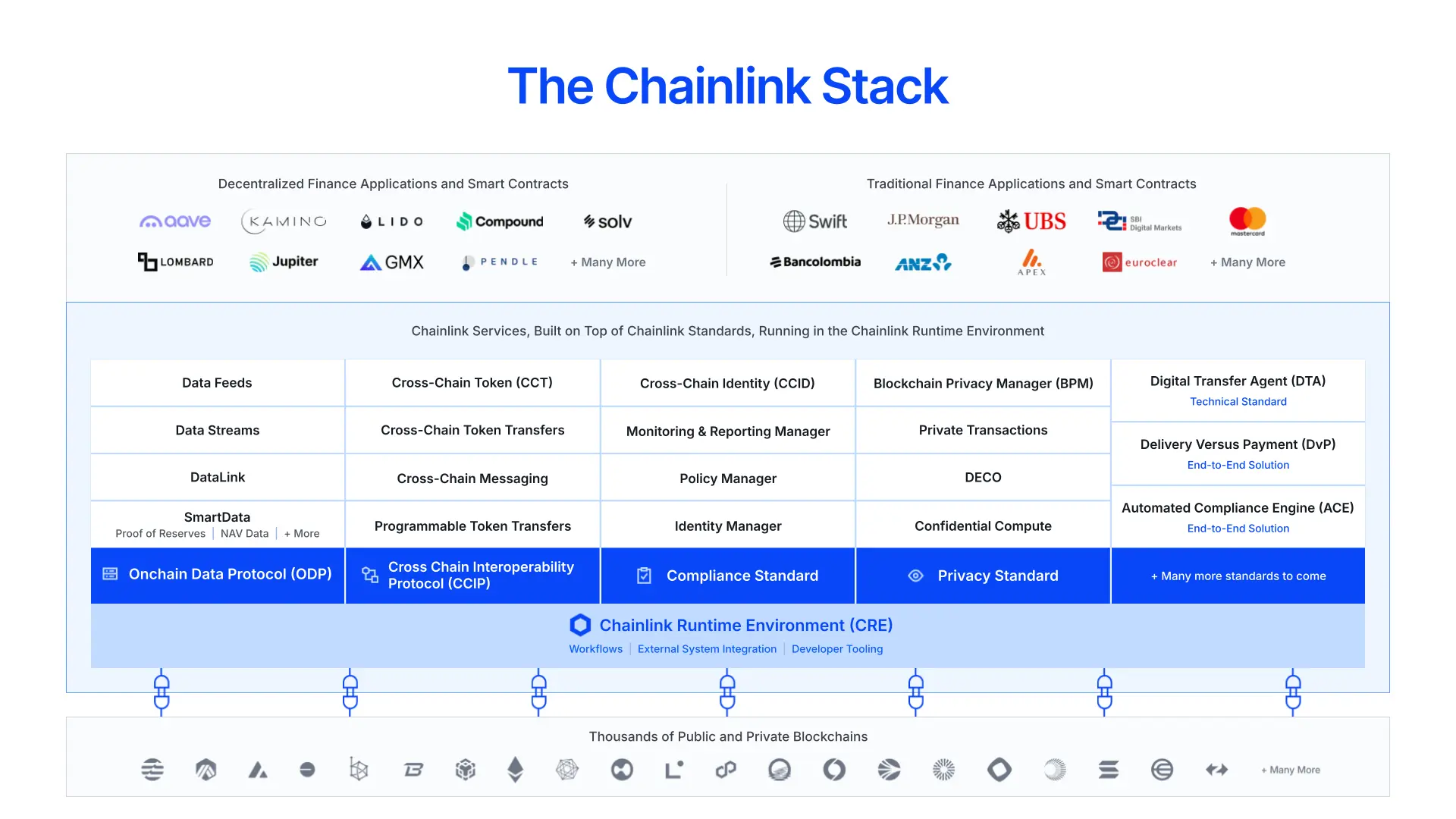
Project Pangea illustrates how these capabilities can be used together. Announced in June 2026, the project aims to build a framework for real-time payment-versus-payment settlement using won- and euro-denominated stablecoins. Participants include Chainlink, FairSquareLab, Korea’s UniKA alliance, and Qivalis, a euro stablecoin consortium of European banks. UniKA includes Shinhan Bank, Jeonbuk Bank, and Kbank, among others. The design uses CCIP to move euro-denominated stablecoins to a settlement chain, Data Streams to supply exchange-rate data, and CRE to connect existing Swift messages with blockchain processing. These Chainlink capabilities are combined to enable financial institutions to participate in onchain settlement through their existing systems.
These developments show how Chainlink’s connectivity technology is taking shape as financial middleware supporting the trading and management of tokenized assets. As the range of tokenized assets and the services that use them grows, oracle platforms such as Chainlink, which connect different blockchains and existing financial systems, will become increasingly important.
Further information on Chainlink’s solutions and services is available at chain.link.
Disclaimer
I confirm that I have read and understood the following: The information contained in this article is strictly the opinions of the author(s). This article was authored free from any form of coercion or undue influence. The content represents the author's own views and does not represent the official position or opinions of CrossAngle. This article is intended for informational purposes only and should not be construed as investment advice or solicitation. Unless otherwise specified, all users are solely responsible and liable for their own decisions about investments, investment strategies, or the use of products or services. Investment decisions should be made based on the user’s personal investment objectives, circumstances, and financial situation. Please consult a professional financial advisor for more information and guidance. Past returns or projections do not guarantee future results. This article was written at the request of Chainlink. All content in this article was written independently by the author(s), and neither CrossAngle nor Chainlink had any editorial control or influence over the content. The author(s) may hold the cryptocurrencies mentioned in this article at the time of writing.
Xangle or its affiliated partners own all copyrights of the written or otherwise produced materials and content provided on the platform. Any illegal reproduction of such content, including, but not limited to, unauthorized editing, copying, reprinting, or redistribution will result in immediate legal actions without prior notice.
![[CIS Partner Summit Highlights] Sumsub: AI-Powered Trust Infrastructure for Digital Asset Businesses](https://resource.xangle.io/files/content/746AECF01E9094566488AD287BDF5977_1789025319904.webp)

![[Xangle RWA Series] Compliance](https://resource.xangle.io/files/content/9EB5169D9605BBF00DEC081C07A10955_1784185676780.webp)