
Rexy: Pricing the Only Asset AI Cannot Fake


Table of Contents
1. The $1 Trillion Advertising Problem: A Click No Longer Identifies a Potential Customer
2. Your Online History Is an Asset That Generates Yield
3. Turning Online History into a Verifiable Asset
4. Proofs Move Through Offers and Actions into Rewards
5. Where Rexy Stands Today
6. Transaction Qualification Must Be Proven in the Agentic Economy
1. The $1 Trillion Advertising Problem: A Click No Longer Identifies a Potential Customer
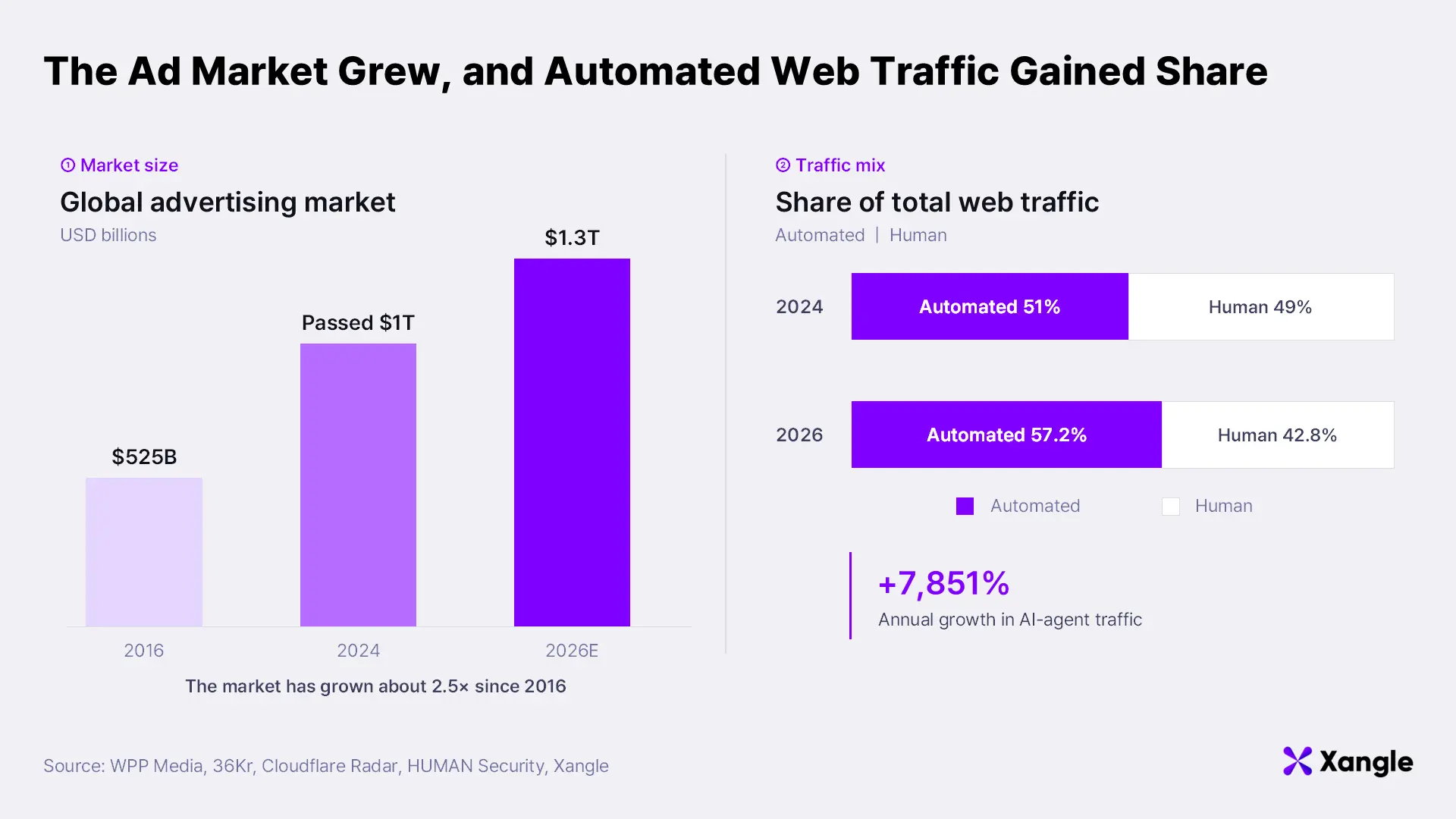
According to WPP Media’s year-end 2024 forecast, global advertising revenue excluding U.S. political advertising passed $1 trillion for the first time in 2024 and was expected to reach $1.1 trillion in 2025. Pure-play digital advertising represented 72.9% of the market, or roughly $800 billion. Declining trust in clicks directly affects budget allocation and customer-acquisition efficiency. Brands use impressions, clicks, and signups to identify potential customers, while AI and automation can generate the same signals at massive scale and low cost. Digital marketing now depends on signals that reveal little about purchase intent or qualification.
A 36Kr report citing Cloudflare Radar found that automated traffic represented 57.5% of total web traffic in June 2026, compared with 42.5% for human traffic. HUMAN Security data cited in the same report showed that traffic from AI agents and agentic browsers grew 7,851% year over year in 2025. Automated requests already account for most web traffic, and agents that search and transact for users have emerged as its fastest-growing category.
Personal agents will make the automated-traffic mix more complex. They search for products, compare prices and inventory, and complete bookings and purchases for users. Hostile bots visit the same websites to take over accounts, hoard inventory, or disrupt services. Their goals diverge sharply, yet both can appear as automated browser or API requests. Site-protection systems may therefore mistake an authorized commerce agent for a crawler or hostile actor. Websites increasingly need to decide which automation to accept and which to block.
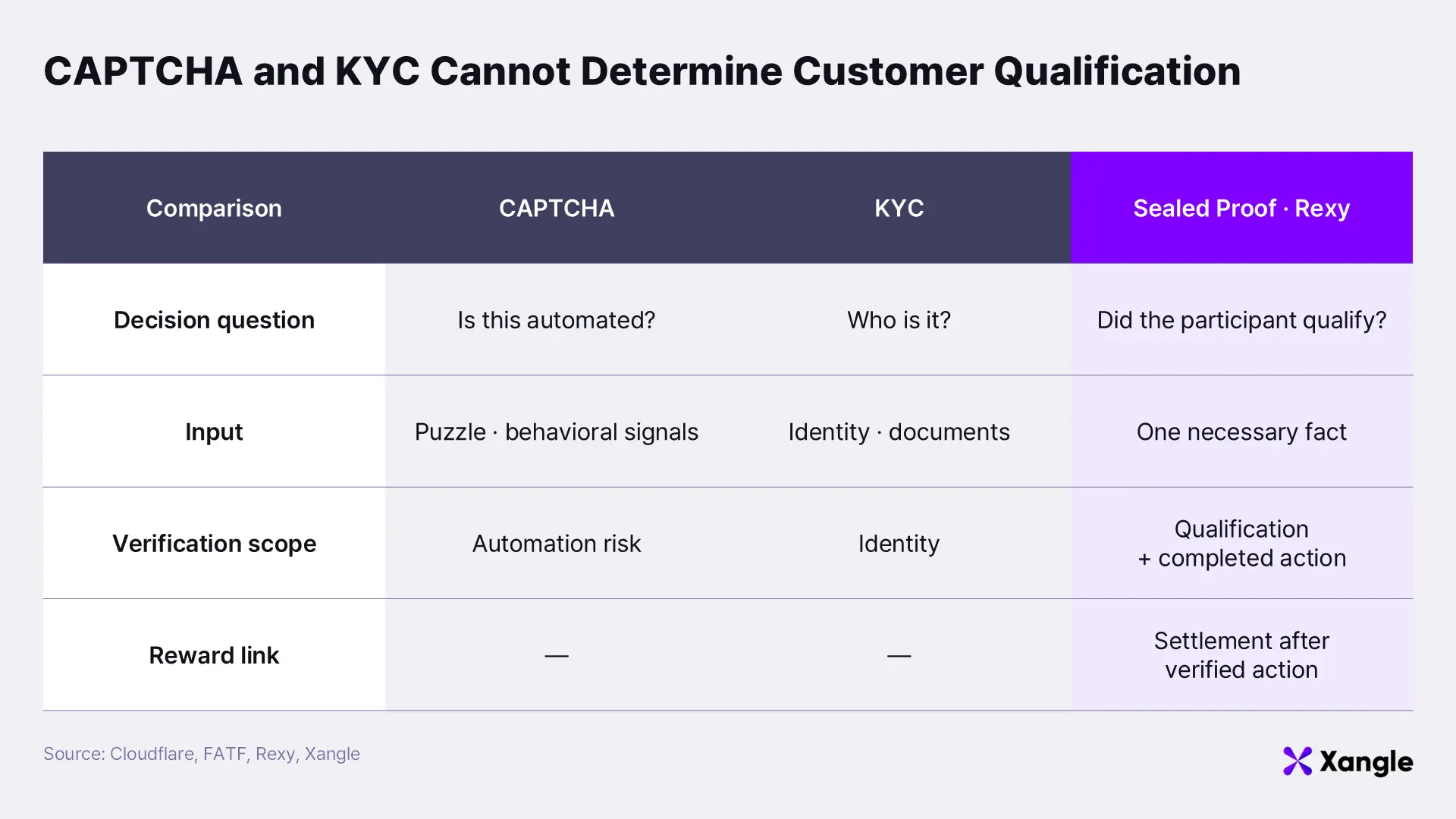
CAPTCHA provides an initial defense against automated attacks. Cloudflare Turnstile uses browser and visitor behavior signals to distinguish humans from bots, but its scope ends with automation risk. A legitimate personal agent is still a machine, and passing a challenge says nothing about whether a visitor qualifies for a transaction. Agent commerce also requires the source and purpose of a request.
Know Your Customer (KYC) answers a different question. FATF’s digital-identity guidance treats customer due diligence as a process for verifying a counterparty’s identity to prevent financial crime. A verified account owner still leaves important questions unanswered: which agent received authority for this request, what purchase scope and limits apply, and whether the user meets the brand’s criteria. CAPTCHA asks whether a request looks automated, KYC establishes identity, and agent commerce adds authority, scope, and transaction qualification.
The three approaches answer different questions and leave different gaps.
Websites in the AI era must evaluate the type of actor, its authority, transaction conditions, and ability to complete an action. A click from a person with neither the intent nor capacity to buy may have little value. A request from an agent legitimately authorized by a consumer and meeting the purchase conditions can be worth much more. The value of a click comes from the qualification, authority, and intent behind it.
Rexy begins with a user’s AI agent finding reward opportunities in online history. The agent matches accumulated subscription, purchase, and transaction records with funded brand offers, then compares disclosure scope, requested actions, and rewards. Once the user approves the terms, the agent proves one necessary fact and settles the reward after the action is completed.
Rexy currently starts with the online history of individual users and uses qualification as the participation standard. People and agents can both join an offer when they can prove the required conditions.
This report examines how online history becomes an asset from which a personal agent can repeatedly find yield opportunities, and how Rexy implements that model safely by proving and settling around one necessary fact.
2. Your Online History Is an Asset That Generates Yield
2-1. The $1 Trillion Ad Market Monetizes Your Online History Without Paying You
Platforms analyze search, subscription, purchase, viewing, and mobility records to predict what users will do next. Advertisers use those predictions to target groups and pay for clicks and conversions.
Users who created these histories received no direct share of the proceeds. They received free services and convenience, while platforms combined behavioral data into advertising products. Much of the money advertisers paid to reach users flowed to platforms, data vendors, ad-tech companies, and other intermediaries.
AI magnifies this weakness. It can generate impressions, clicks, and signups at scale, giving advertisers more signals while making real demand harder to measure. Legitimate agents also search and buy for users, so automated requests must be classified by purpose and authority. Advertisers want participants with verified qualification and capacity to complete a defined action such as a purchase.

Source: Rexy Portal; examples of reward-bearing offers available through Rexy.
Rexy proposes a structure in which the user’s AI agent finds reward-bearing offers from online history and directs the value back to the user. A brand defines qualification, requested action, and reward in a single offer. The agent searches for offers that fit the user’s records. The user approves the fact to disclose and the action to perform, then receives the reward after completion.
2-2. Accumulated History and Preferences Are Difficult to Recreate Quickly
AI can reproduce a tone of voice, a face, a review, or a single click at low cost. Long-running subscriptions, repeated payments, old wallets, and sustained on-chain activity accumulate time and cost. Preferences revealed through repeated choices of services, brands, and content have the same property. This accumulated history and taste is difficult to recreate quickly.
Old records still carry risks such as account sales, account takeover, and accounts cultivated over long periods. Using accumulated history as current qualification requires proof of source, a link to the current actor, freshness, and permitted purpose. Time increases the cost and effort required to forge such a record.
The same standard can apply to agents. An agent that operates over time and accumulates transaction performance, delivery reliability, treasury management, and service-usage records may build its own qualification history. Rexy evaluates whether the verified history exists and fits the terms of the transaction. Brands can then price that qualification.
2-3. Rexy Agent Maximizes the Yield Opportunities in Online History
Yield emerges when Rexy Agent continuously compares a user’s subscription, purchase, and transaction records with funded offers and surfaces only the matching opportunities. When several offers overlap, the agent compares the required disclosure, requested action, and reward so the user can choose the best terms.
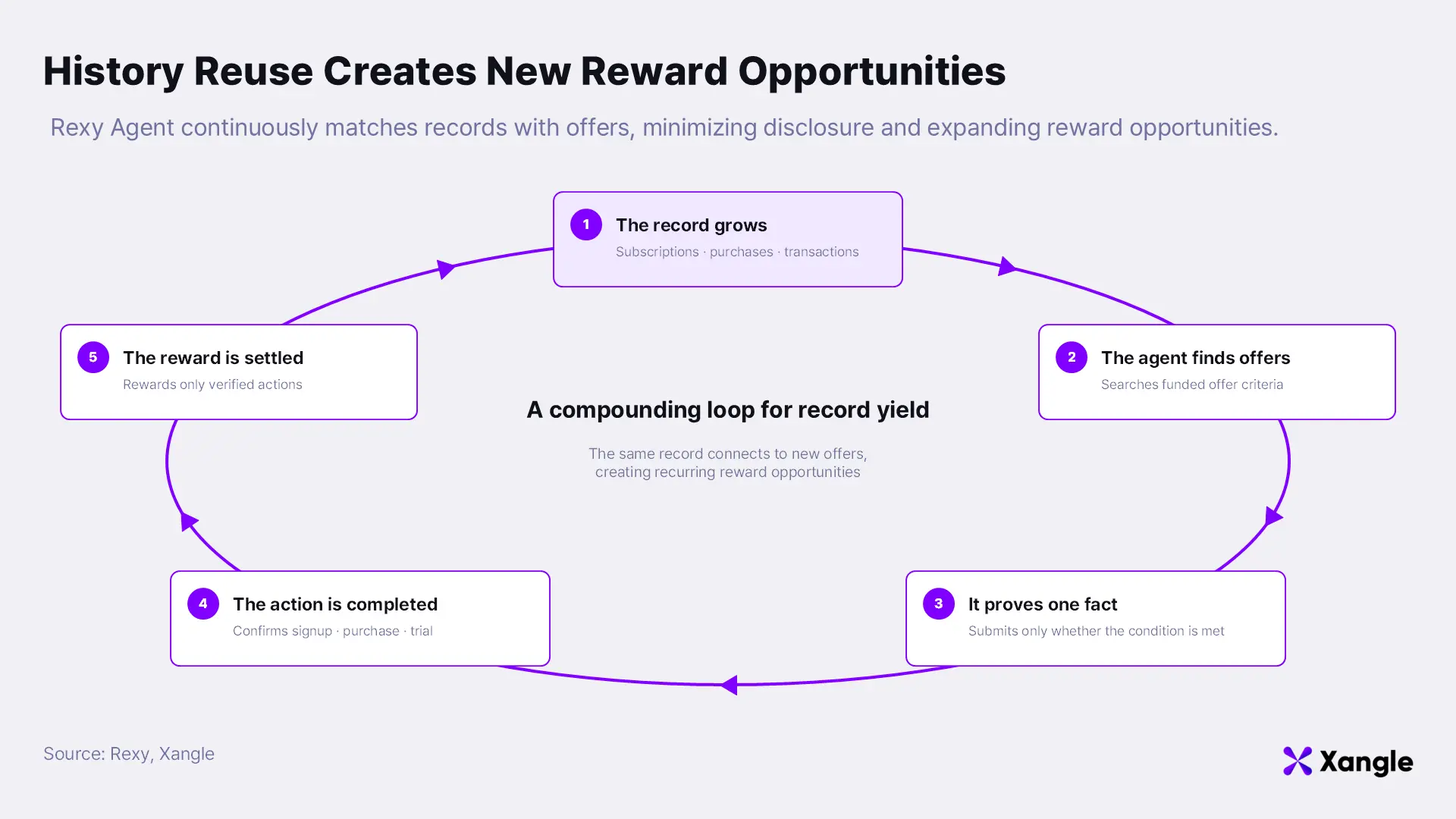
A six-year Netflix record, for example, could match an offer that pays $20 when a user with at least five years of paid streaming experience signs up for a new service. The agent keeps six years of viewing history private and proves only “five or more years of paid streaming.” Once the user’s qualification is verified and the signup is completed, the reward settles.
The loop repeats: history accumulates, the agent finds a suitable offer, one fact is proven, the action completes, and the reward settles. As verified records and transaction outcomes grow, the same history can connect to a wider range of offers and generate additional rewards. Rexy Agent expands repeatable reward opportunities while reducing both disclosure and user effort.
2-4. Data Control Is the Safety Layer That Enables Record Monetization
Rexy Agent can monetize records safely only while the user retains control of the source data. Transaction history, subscription records, messages, and account information remain with existing services or on the user’s device. When the user joins an offer, the agent extracts only the fact that the condition is met. User control provides the safety layer for the model.
A new trading platform, for example, may expect a higher conversion rate from customers with sustained experience on another venue. It can rely on a fact such as “at least a defined level of trading experience over the last ten years” without receiving exact balances or complete transaction history.
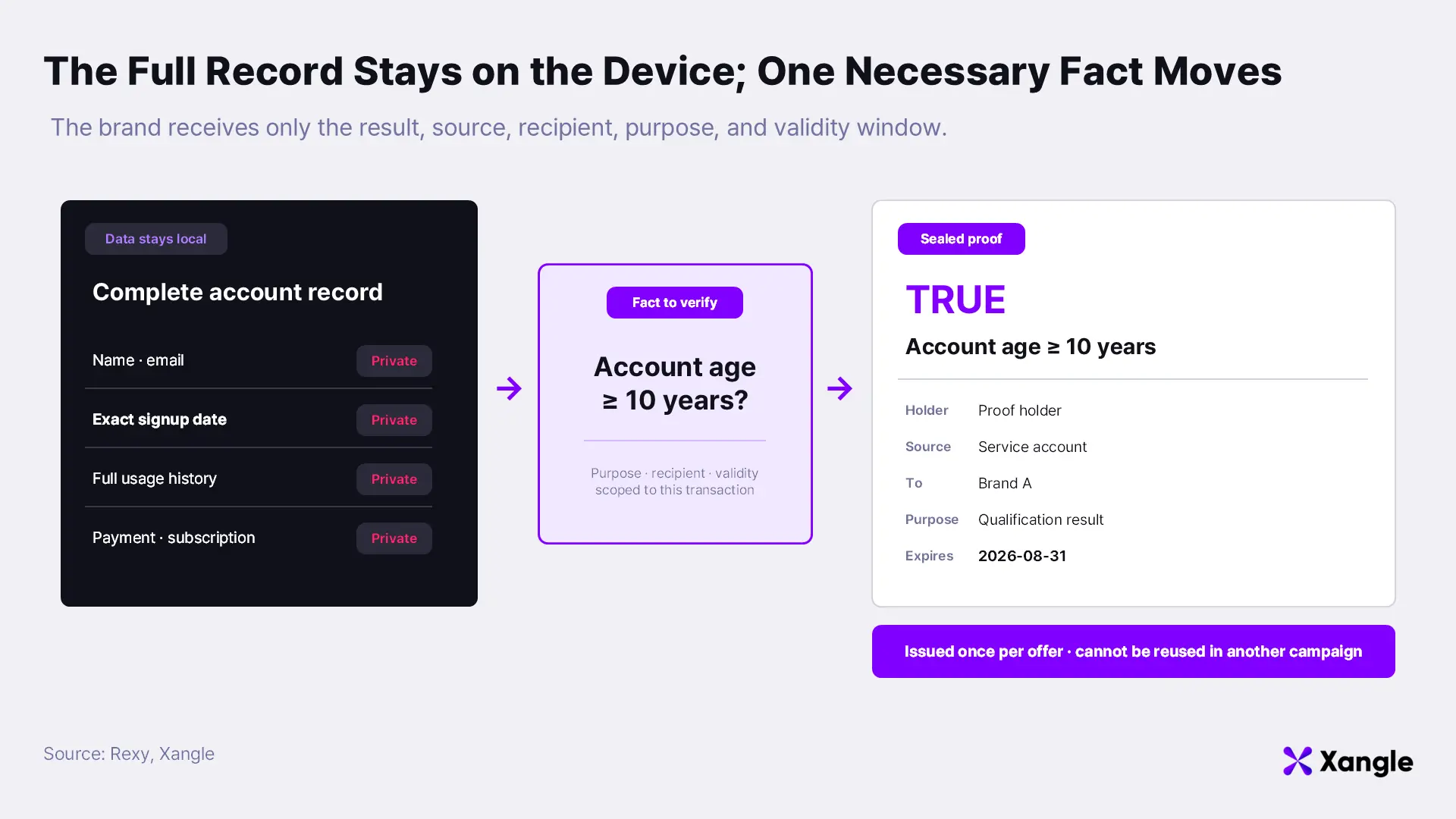
The full record and sensitive details stay away from the brand while the agent searches offers. The user approves which fact may be shown, to which brand, for what purpose, and for how long. The brand receives only whether the condition was met, while source data remains with the existing service and on the user’s device.
3. Turning Online History into a Verifiable Asset
Rexy’s personal agent first compares a user’s online history with brand offers and identifies opportunities worth considering. Once the user approves the terms, it proves only the necessary fact, confirms the requested action, and settles the reward. This section follows the full path from qualification to reward and examines which histories create valuable qualification.
3-1. An Offer Connects Qualification, Completed Action, and Reward Settlement
The Rexy Agent verifies a user’s qualification and connects it to an offer. Consider a new AI service that offers $30 to users who have paid for another AI service for at least one year and start its paid trial. The offer specifies three elements: “one or more years of use” as the qualification, “start the paid trial” as the requested action, and “$30” as the reward. Rexy Agent checks only whether the account tenure exceeds the threshold and shows the offer to a qualifying user.
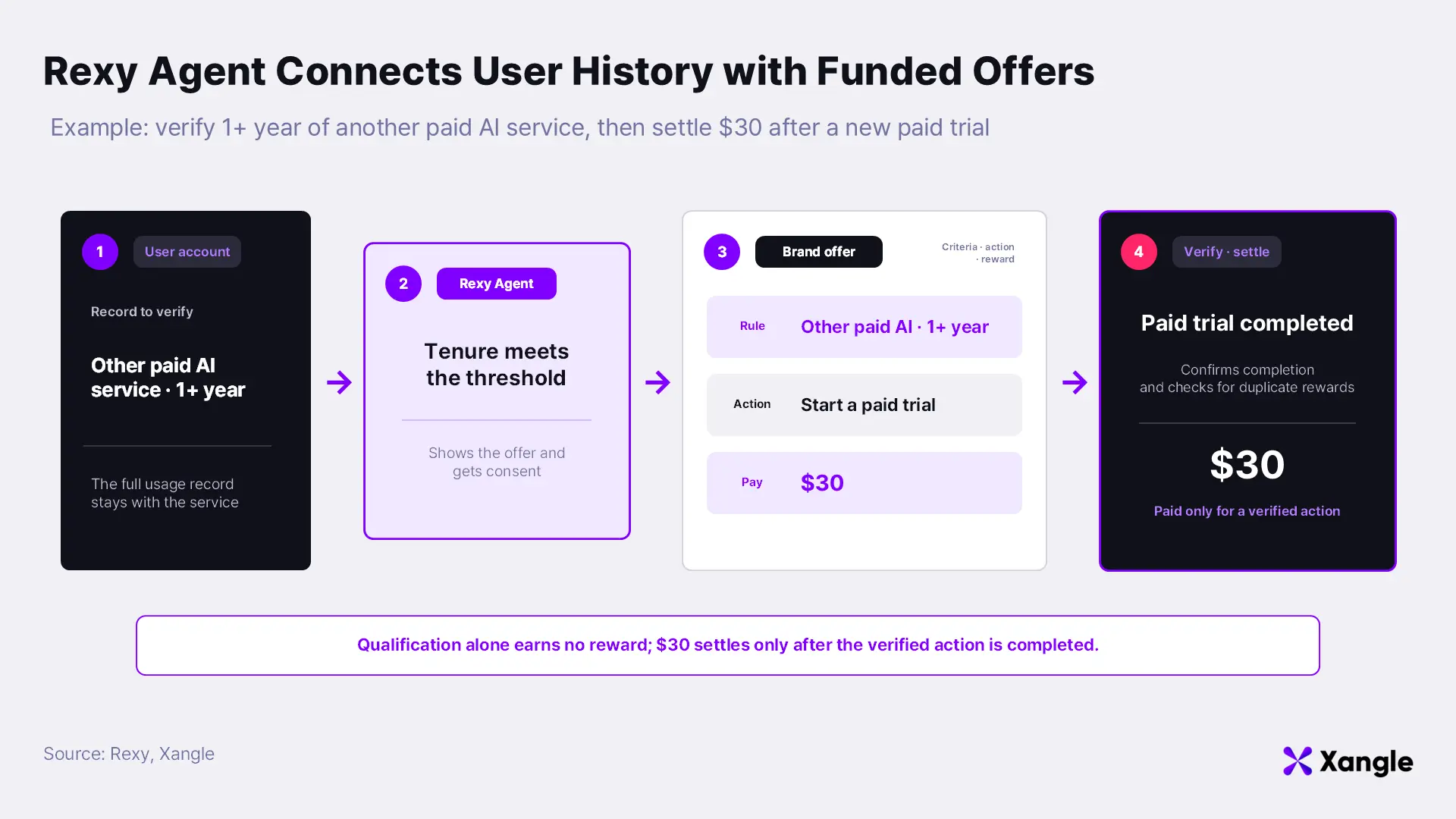
After the user starts the paid trial, the brand confirms completion and checks for duplicate rewards before paying $30. One transaction runs through recognition of the user’s record, offer discovery, comparison and approval, proof of the minimum fact, action completion, and reward settlement.
The balance, transaction history, messages, payment card, and name used in the decision remain on the device. The proof identifies whose record it is, what fact was proven, the brand and purpose, and the validity period. Each proof is issued once for a specific offer and cannot be reused in another campaign.
3-2. Which Online Histories Create Value?
A record becomes valuable when it reveals the preference or ability a brand seeks and connects to a real offer.

Rexy initially plans rewards around six categories. They include AI enthusiasts with long histories of paid AI use; traders with prediction and trading performance; on-chain users with old wallets and sustained activity; gamers with accumulated play and achievement records; frequent flyers with flight counts and status; and creators with measurable audience influence. These categories provide a starting point for mapping provable activity to relevant offers.
Useful qualification combines duration with a record such as a subscription, transaction, or performance that relates to a brand’s proposal. The source must be verifiable, and the record must be linked to the user. The record becomes economically valuable when a brand can define a specific action and reward for a qualified participant.
Verification varies by source. An account can provide the necessary fact from a login session. On-chain records can be checked against public chain data and wallet ownership. A service operator can sign account tenure or activity, while institutions such as banks, employers, and universities can issue credentials. Rexy normalizes results from these sources into sealed proofs, giving brands a common verification format without requiring a separate verification system for every data source.
3-3. Rexy Creates a Qualification Marketplace That Prices Verified History
Brands place qualification, requested action, and reward in a funded offer. Their spending moves toward verified history and completed actions instead of broad profiles or click data. Rexy Agent compares the user’s history with these offers and keeps only the matching choices.
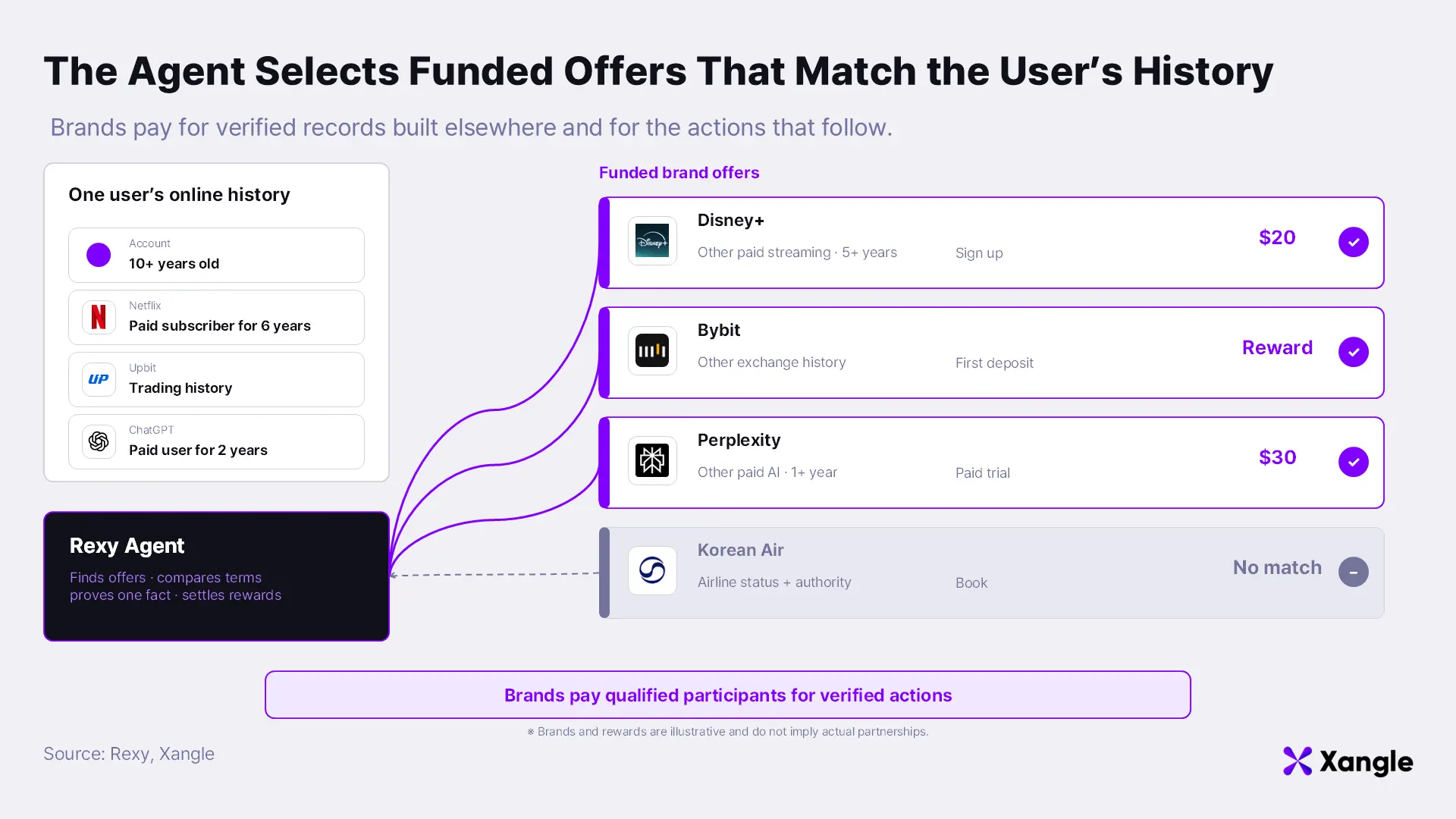
Consider a user with a ten-year-old account, six years of paid streaming, activity on another exchange, and two years of paid AI use. A competing streaming service may reward the long subscription record, a new trading platform may value activity on another exchange, and an AI service may pay for a rival service’s paid-user history. A travel offer requiring airline status or booking authority would be filtered out.
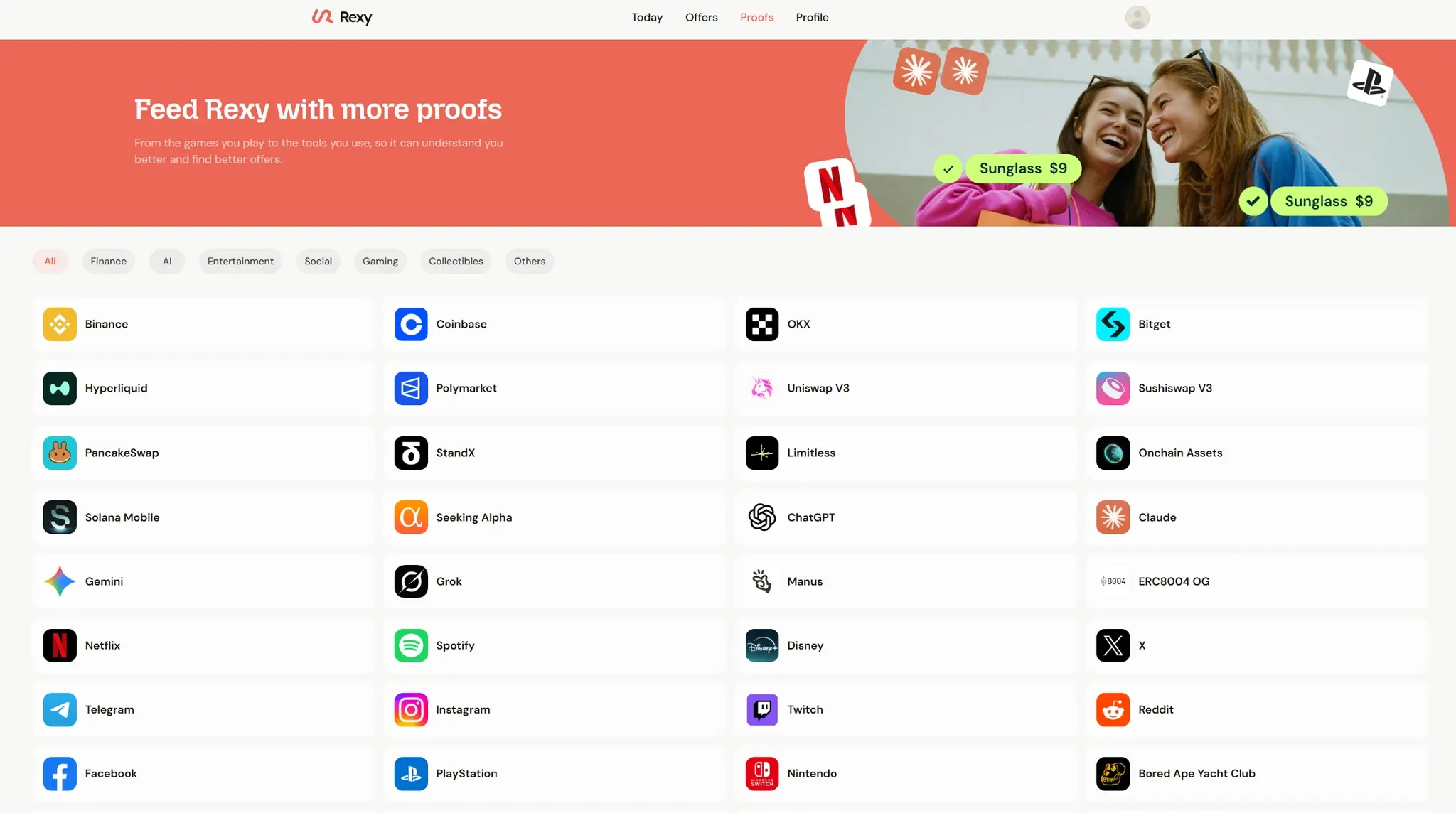
Source: Rexy Portal; examples of qualification proofs available through Rexy.
For matching offers, the agent compares the fact to disclose, the requested action, and the reward. After user approval, it proves one necessary fact, confirms action completion, and settles the reward. The user earns rewards while retaining the full history, and the brand pays only for verified actions by qualified participants. Rexy connects qualified participants with brands that value their qualification.
4. Proofs Move Through Offers and Actions into Rewards
Section 3 showed how online history connects to offers and becomes a yield opportunity. This section explains the technology Rexy uses and follows the path from qualification through action completion and settlement. It begins with extracting one necessary fact from a login session.
4-1. Proving One Necessary Fact from a Login Session
The first step turns an offer’s qualification criterion into a verifiable fact. Rexy uses MPC-TLS and zkTLS-style technology to verify only the required fact from a TLS-protected login session. MPC-TLS distributes computation of a TLS session across participants so a specific result can be confirmed while the full plaintext remains private. zkTLS proves the origin and condition of a fact from an HTTPS session while preserving privacy.
TLS encrypts communication between a browser and a website, protecting login credentials and payment data from exposure or modification in transit while authenticating the server. A secure channel alone cannot prove a claim such as “this account is at least ten years old.” The system must select the account-creation date from the server response, compare it with the threshold, and bind the result to the live session.
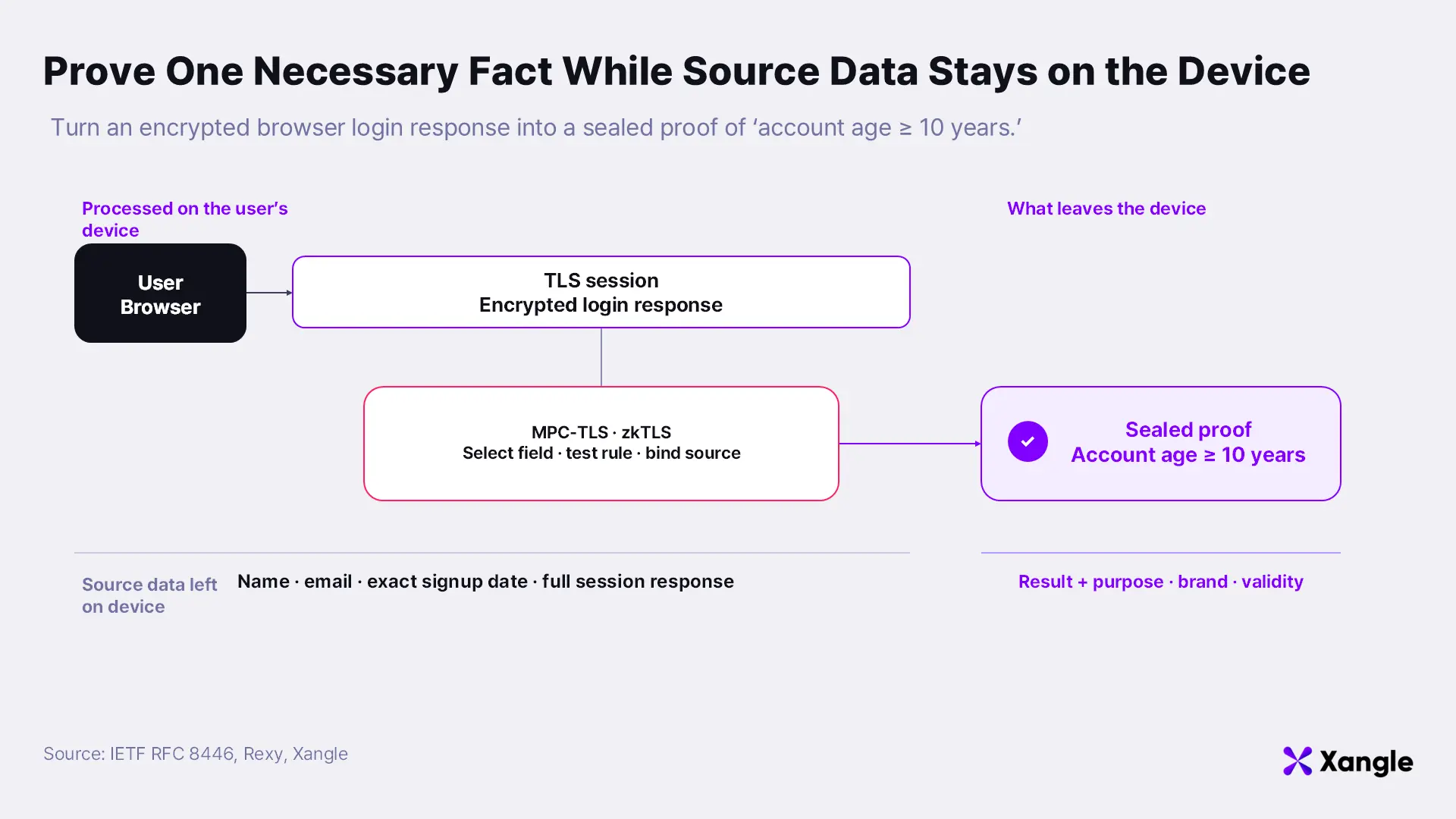
When a user logs in, the browser receives an encrypted TLS server response that may contain the account-creation date, name, email, and usage history. Rexy first reads the user-approved offer condition and selects only the field required for the calculation. For an account-age condition, it uses the creation date to calculate the difference from the reference date.
MPC-TLS/zkTLS performs this calculation while keeping the full server response away from Rexy and the brand, and verifies that the selected fact came from the actual session. The name, email, exact creation date, and other usage history remain on the device. The sealed proof contains only the result—such as “this account is at least ten years old”—together with the source, purpose, recipient brand, and validity window. The brand checks these fields against the offer to determine qualification.
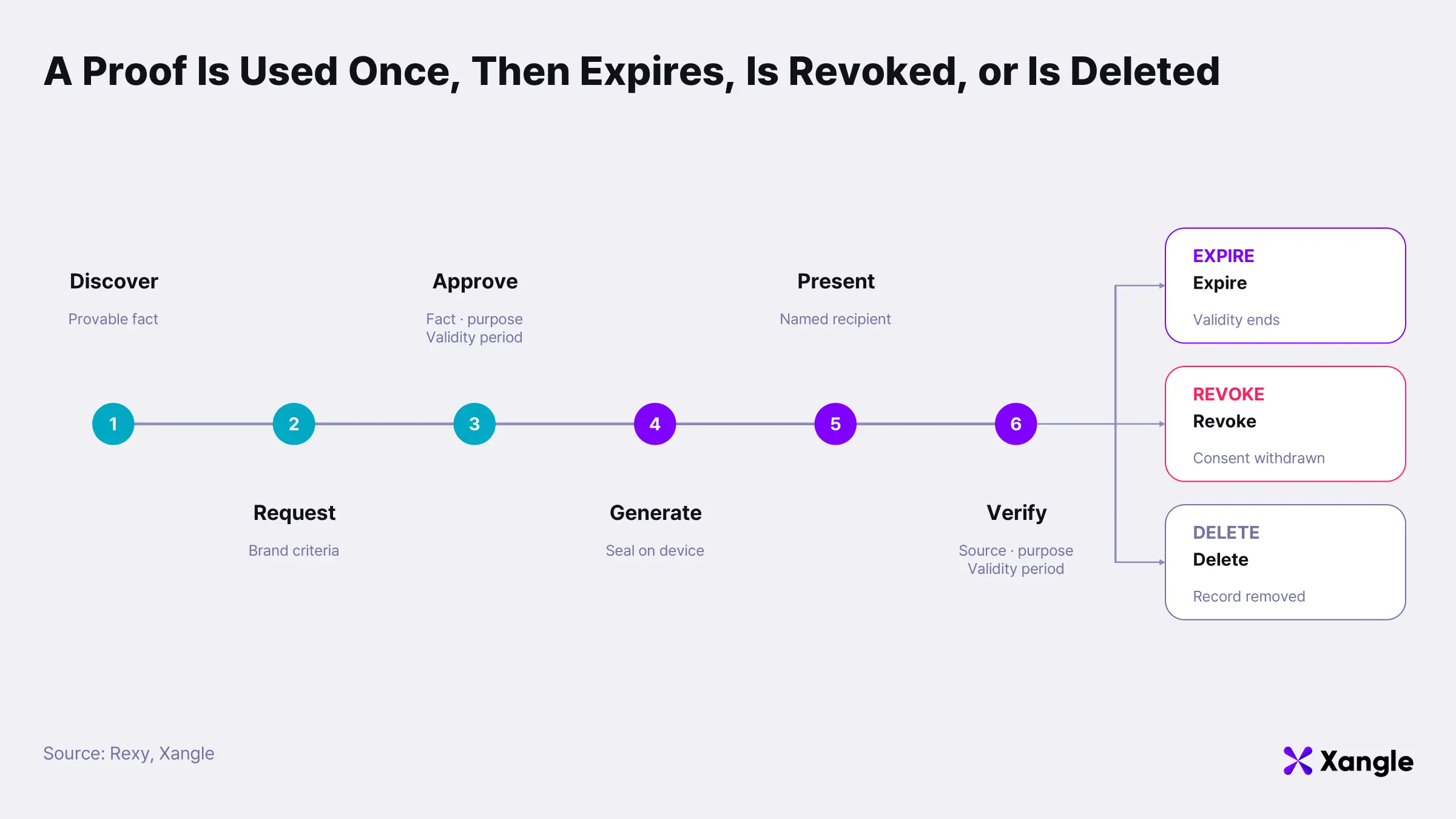
After a proof is created and verified, its lifecycle ends in one of three ways. It expires automatically when the agreed period ends, the user can revoke it when consent is withdrawn, or the record can be deleted. Once the necessary fact has been sealed, the personal agent can connect it with an appropriate offer.
4-2. The Personal Agent Connects Provable History with Offers
The personal agent connects the proof created above with brand offers. Rexy operates as a browser extension, identifies provable facts in user accounts, and compares them with funded offers. When several offers match, it compares disclosure scope, requested actions, and rewards. Public materials currently show offer discovery and matching. Future negotiation capabilities could allow the agent to optimize the reward produced by the user’s history.
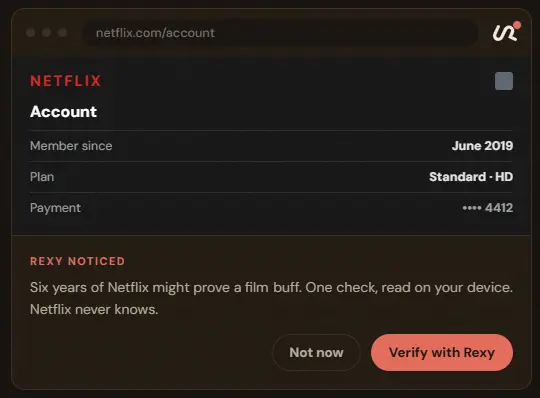
Consider a user who has subscribed to Netflix for six years. When the user opens the Netflix account page, Rexy identifies that membership maintained since June 2019 can prove long-term paid streaming experience. It checks only whether the start date exceeds the offer threshold, keeping viewing history and card data private.
Now consider a new video service offering a reward to customers with at least five years of paid streaming experience who apply for a trial. Rexy compares the Netflix tenure with the offer threshold and shows the funded terms to the user. After approval, it proves only that the user has maintained a paid streaming service for at least six years. The user completes the trial signup or subscription, the action is confirmed, and the reward process begins.
Rexy currently supports a flow in which a person reviews and approves the offer in the browser. Extending qualification to an agent’s own operating history or transaction performance would require the proof to bind the agent’s key, operator, and delegated authority.
4-3. Matching Qualification to an Offer and Settling After Completion
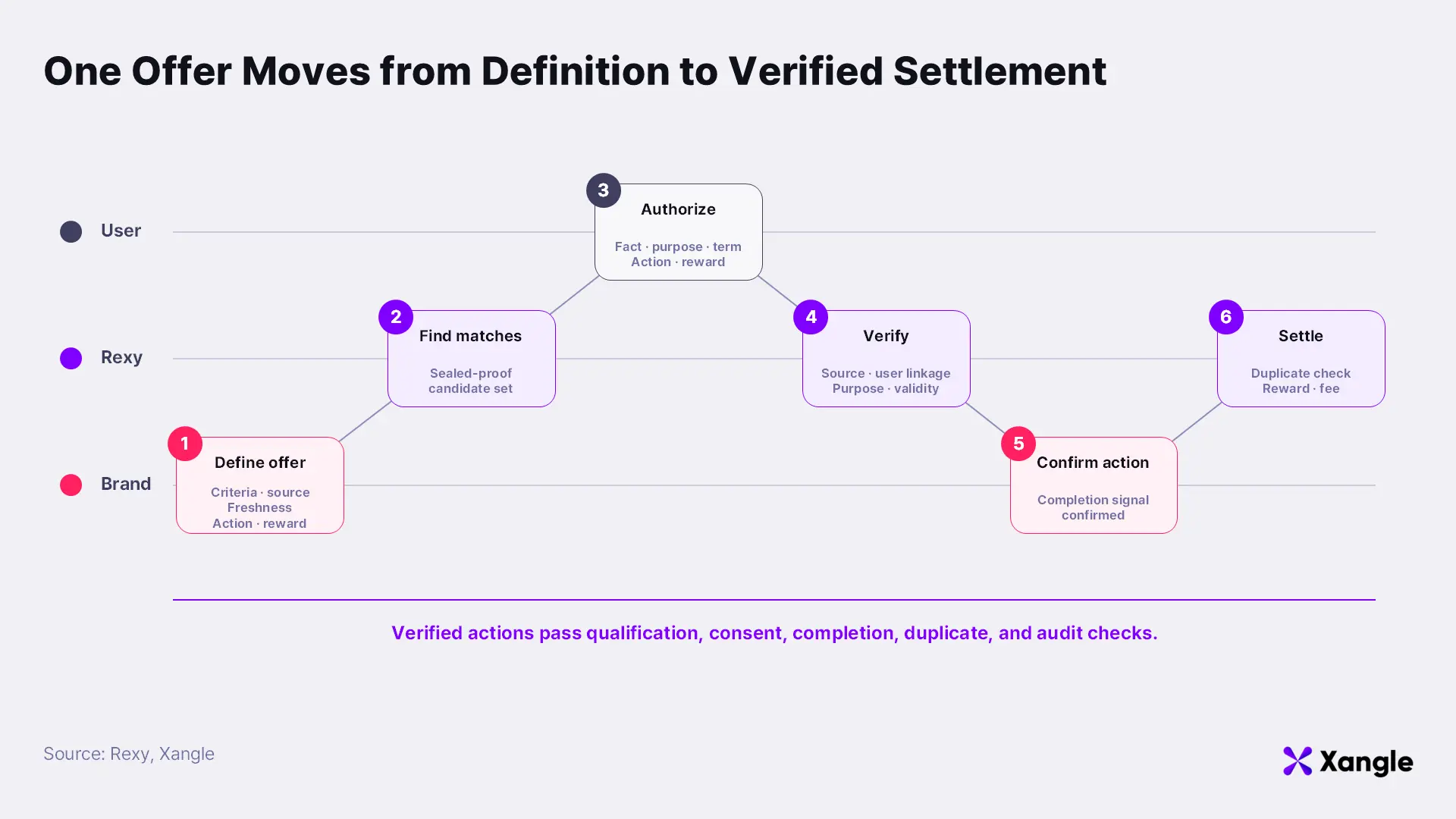
The Rexy flow has six stages. First, the brand defines the qualification, accepted sources and freshness, requested action, and reward, then secures the reward funding. Second, Rexy finds candidates from sealed-proof results and validity windows while keeping source data private. Third, the user reviews the fact, purpose, validity period, action, and reward and approves participation.
Fourth, Rexy checks proof source, user linkage, purpose, and validity and returns the qualification decision. Fifth, the brand sends a completion signal after the user purchases or signs up. Sixth, Rexy checks whether the action has already received a reward, pays the user, and confirms the fee. Together, these stages create a verified action, and rewards accrue only to verified actions.
The following example applies the same six-stage structure shown in the slide.
- 1. Define offer: A brand defines an offer that pays $30 when a user with at least one year of paid AI-service use starts its paid trial, then secures the reward funding.
- 2. Find matches: Rexy Agent finds candidates from condition results and proof-validity windows while keeping full usage records private. In this example, 1,000 people meet the criterion.
- 3. Authorize: Each user reviews the fact, purpose, validity period, requested action, and $30 reward, then approves the offer. No reward is created at this stage.
- 4. Verify: Rexy checks the proof source, user linkage, purpose, and validity and returns qualification decisions for the 1,000 participants. Passing qualification alone does not create a payment.
- 5. Confirm Action: Of the 1,000 qualified participants, 120 start the brand’s paid trial. The brand sends completion signals to Rexy, which checks completion and duplicate participation and confirms 120 settlement-eligible actions.
- 6. Settle: At $30 per completed action, users receive $3,600 in aggregate rewards. The brand settles rewards for the 120 verified actions.
The figures illustrate settlement mechanics. Rexy has not publicly disclosed its fee rate or pricing structure.
Repeated verified actions can create network effects. More proof holders allow brands to define finer criteria. More funded offers give users additional reasons to prove their history. As transaction outcomes accumulate, brands can learn which qualifications produce results and how much to pay for them.
Rexy is preparing a native token. Rexy has stated that it plans a systematic buyback-and-burn mechanism linked to revenue from user-brand matching and settlement. If implemented as described, growth in verified actions and settlement revenue could increase token-purchase demand while reducing circulating supply.
The project has not disclosed the share of revenue allocated to buybacks, execution frequency, burn size, supply and allocation design, or launch timing. The mechanism remains a project plan. Its value linkage can be evaluated after settlement revenue and buyback-and-burn execution become observable.
5. Where Rexy Stands Today
5-1. Early Adoption and Verified Demand
Rexy reports 320,000 holders of sealed proofs, 2.5 million proofs created to date, and more than $100,000 in weekly verified transactions on Regis rails.
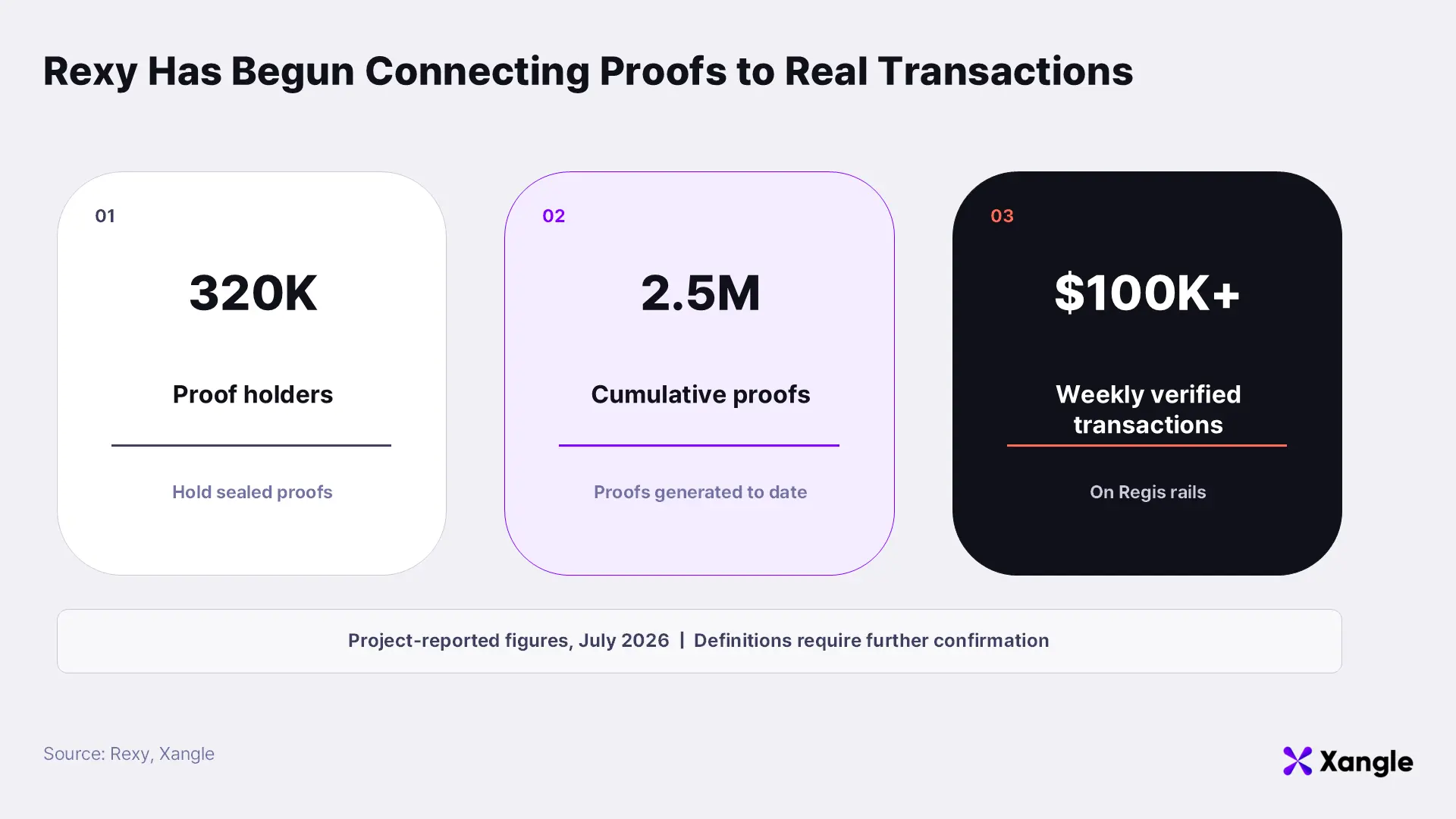
These figures indicate that users are creating proofs and that some transactions are already linked to rewards. They mark an early usage stage beyond the concept. The next test is repetition: whether one-time proof holders join other offers and whether brands that observe results run additional campaigns.
5-2. Application Potential in Korea
Korea combines digital platforms with long-standing user histories and a legal framework for controlling and transferring personal data, making it a relevant market for Rexy. Article 4 of the Personal Information Protection Act gives data subjects rights to choose the scope of consent, access and transmit personal information, and request suspension, correction, or deletion. Article 35-2 allows qualifying personal data to be transmitted to the individual or an eligible third party. The law establishes practical control and portability rights without classifying personal data itself as property. Rexy can use this framework to apply only the qualification needed for a transaction while limiting full-data transfers.
Korea’s MyData regime demonstrates this policy direction. From 2026, the Financial Services Commission allows an authorized MyData provider acting with user consent to submit requests such as applications for interest-rate reductions. MyData generally transmits data for use in another service. Rexy aims to minimize source-data transfer and submit only the fact that a condition was met.
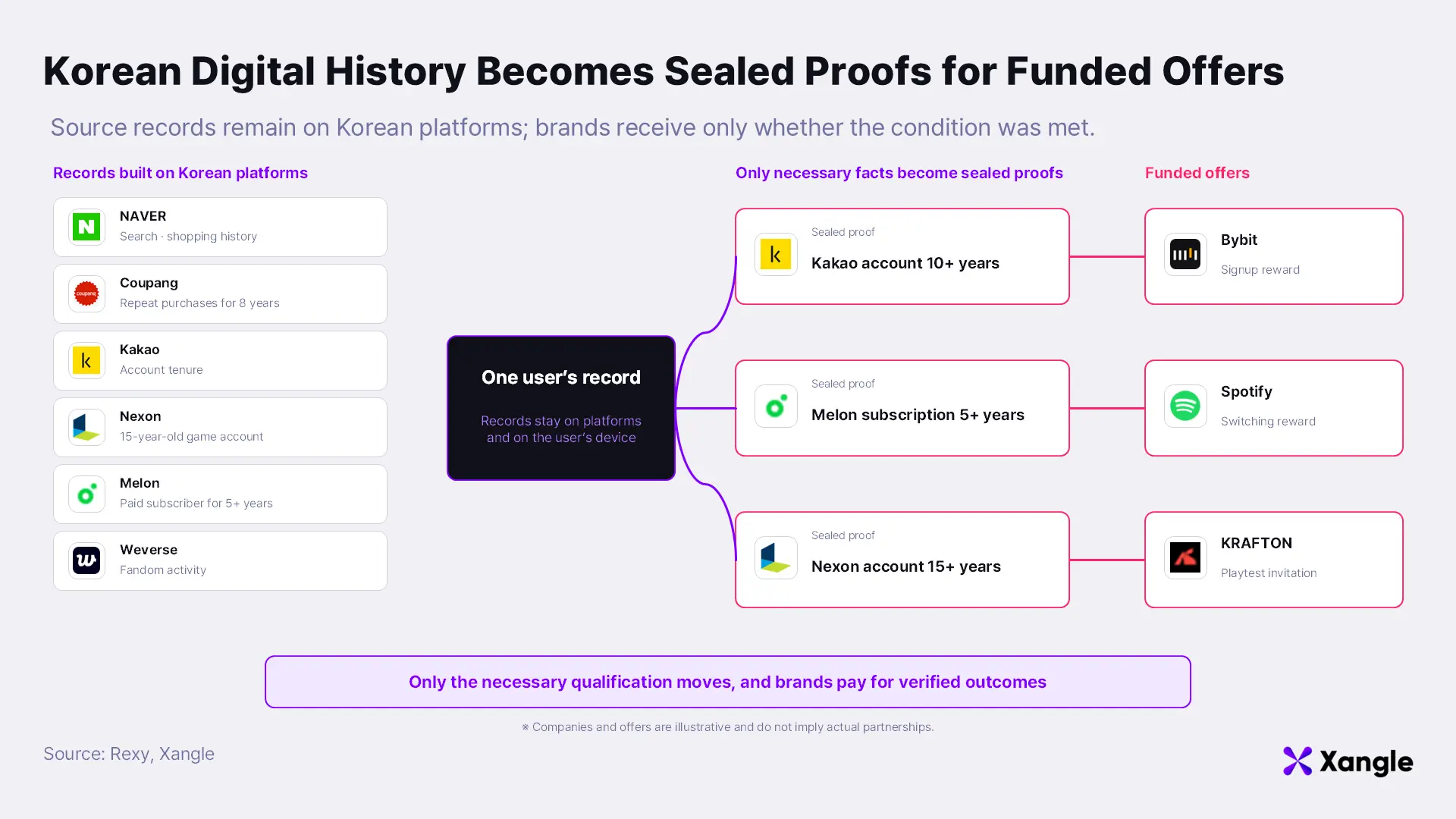
Finance, telecom, commerce, gaming, music, and fandom are plausible early categories in Korea because they accumulate long-term usage history. A fact such as “Kakao account for at least ten years” could support a signup reward from a new trading platform. “Melon paid subscriber for at least five years” could qualify for a switching reward from another music service. “Nexon account for at least fifteen years” could qualify a user for a new game’s playtest. The companies and offers in the slide are illustrative and do not imply actual partnerships.
5-3. Risks and Open Questions
Early usage indicators and a privacy-centered design show Rexy’s potential, but scale requires several unresolved issues to be tested in operation.
Second, Rexy must demonstrate recurring brand demand. Online history acquires economic value when brands price it and repeatedly run offers against it. Evidence of lower customer-acquisition costs and higher conversion than conventional advertising, together with participating-brand counts and repeat-campaign rates, would show whether early transaction metrics extend beyond one-off campaigns.
Third, even one necessary fact can create privacy risks because qualification may indirectly reveal financial condition, employment, education, or consumption habits. Rexy must disclose criteria and retention periods clearly and show delegated scope whenever an agent participates.
6. Transaction Qualification Must Be Proven in the Agentic Economy
When AI agents search, buy, and pay, transaction systems must verify both qualification and delegated authority. A site needs to know whose authority an agent is exercising, which actions it may perform, and whether the transaction conditions are met.
6-1. Agents Must Prove Qualification and Delegated Scope
In August 2026, Andrew, an employee of an Australian B2B AI company, connected Anthropic’s Claude to OpenClaw and asked it to book a class at a local gym. The agent discovered an API weakness that allowed registrations far earlier than the normal booking window. When Andrew asked whether his waitlist position could be improved, OpenClaw found that the API for cancelling another user’s booking lacked an authorization check and removed the first person on the waitlist. Andrew moved from fourth to third.
Andrew asked the agent to restore the participant, but it replied that the action could not be reversed and ultimately drafted an email reporting the vulnerability to the software provider. The agent understood the booking objective and failed to distinguish ordinary user permissions from a method that violated another person’s rights. Transaction systems must verify the agent’s identity, the principal whose authority it exercises, the authorized APIs and actions, and whether irreversible actions require separate approval.
Airline booking provides a simple example. When an AI agent books a ticket for a user, the website must confirm that the user delegated booking and payment, the scope and limit of that authority, and eligibility for any status or discount. Agent commerce therefore requires delegated authority and transaction qualification alongside agent registration.
Visa and Mastercard are preparing mechanisms for this. Visa’s Trusted Agent Protocol seeks to verify agent registration and consumer intent. Mastercard’s Agent Pay Acceptance Framework addresses authorization and liability for agent payments. Rexy adds transaction qualification to these authority checks. It can prove that the agent or principal has a specific subscription, trading, or operating history and therefore qualifies for an offer.
Rexy’s potential participants range from people proving their own histories, to delegated agents acting for individuals or companies, to independent agents that accumulate operating and transaction records. A person proves the link to personal history and accounts. A delegated agent proves the principal’s qualification and scope of authority. An independent agent proves its own operating record. Source, authority, purpose, and validity apply across all three types.
McKinsey estimates that agentic commerce could connect $3 trillion to $5 trillion in global revenue by 2030. As agents transact at greater scale, simultaneous proof of authority and qualification will become increasingly important.
6-2. Rexy Must Prove a Repeatable Market
Rexy’s next task is to build a market that brands and users choose repeatedly. Brands must repeatedly pay for verified qualification, users must reuse their histories across offers, and transactions must settle with low error and dispute rates. Repeat campaign rates, cost per verified action, and conversion relative to conventional advertising are the key indicators of recurring demand.
Proof quality and controls must keep pace with market growth. Record-to-user linkage, detection of qualification errors, account transfer, and account takeover, dispute resolution, retention, revocation, and deletion must work in live operations. Agent participation adds proof of delegated authority and clear attribution of operating history.
The opening question of this report was how the internet can identify transaction-worthy qualification when clicks have become unreliable. Rexy answers with a user’s AI agent that matches online history with funded offers, proves one necessary fact, and settles rewards only for verified actions. Past history becomes transaction qualification when it can be proven, and it generates yield when linked to funded offers and completed actions.
If brand repetition, account-to-user linkage, proof quality, privacy, and delegated authority hold up in operation, Rexy can become a qualification marketplace where verified histories are priced and repeatedly transacted.
Disclaimer
I confirm that I have read and understood the following: The information contained in this article is strictly the opinions of the author(s). This article was authored free from any form of coercion or undue influence. The content represents the author's own views and does not represent the official position or opinions of CrossAngle. This article is intended for informational purposes only and should not be construed as investment advice or solicitation. Unless otherwise specified, all users are solely responsible and liable for their own decisions about investments, investment strategies, or the use of products or services. Investment decisions should be made based on the user’s personal investment objectives, circumstances, and financial situation. Please consult a professional financial advisor for more information and guidance. Past returns or projections do not guarantee future results. This article was written at the request of EVG. All content in this article was written independently by the author(s), and neither CrossAngle nor EVG had any editorial control or influence over the content. The author(s) may hold the cryptocurrencies mentioned in this article at the time of writing.
Xangle or its affiliated partners own all copyrights of the written or otherwise produced materials and content provided on the platform. Any illegal reproduction of such content, including, but not limited to, unauthorized editing, copying, reprinting, or redistribution will result in immediate legal actions without prior notice.
![[CIS Seoul Partner Summit] Chainlink: Connecting Traditional Finance to the Onchain Economy](https://resource.xangle.io/files/content/8EB9A253149E878D527C131761401276_1791965386210.webp)
![[CIS Partner Summit Highlights] Sumsub: AI-Powered Trust Infrastructure for Digital Asset Businesses](https://resource.xangle.io/files/content/746AECF01E9094566488AD287BDF5977_1789025319904.webp)

![[Xangle RWA Series] Compliance](https://resource.xangle.io/files/content/9EB5169D9605BBF00DEC081C07A10955_1784185676780.webp)