
Project Hangang: Korea’s Answer to the Stablecoin Era

Table of Contents
1. Where Money’s Trust Layer and Payment Rails Diverge
2. Can Stablecoins Be the Answer?
3. Project Hangang: A Testbed for Digital KRW Infrastructure
4. How Far Can Project Hangang Extend?
5. Conclusion
The Han River has long been one of Korea’s central arteries. It moved people, goods, commerce, and administrative power across the peninsula, giving economic activity a shared route around which to organize. The infrastructure along the river has changed dramatically, and the vessels that once moved through it are no longer the same. Yet its function as a connective layer has endured.
Digital economies are now looking for their own version of such a connective layer. Money and assets need rails that can move across borders, platforms, and markets, while allowing financial services and institutions to build around them. Stablecoins emerged as the first large-scale attempt to fill that role. A dollar-denominated stablecoin can move from Busan to New York outside banking hours and plug directly into on-chain financial services.
Korea, however, is not starting with private KRW stablecoins. Its first major experiment is Project Hangang, a framework that combines wholesale CBDC with deposit tokens. After completing the first real-transaction pilot, the Bank of Korea announced Phase 2 in March 2026. With Hyun Song Shin, who researched digital monetary infrastructure based on wholesale CBDC and deposit tokens during his time at the BIS, taking office as Governor on April 21, 2026, this direction is likely to remain a key policy track. At first glance, the approach may look cautious, institution-heavy, and somewhat slow for a market already moving around stablecoins.
Precisely for that reason, Project Hangang deserves closer attention. The project is not simply asking how money can move faster. It is asking how a monetary system should preserve trust, finality, and accountability once money becomes programmable. Why do Korea and other jurisdictions believe private stablecoins alone are not enough? Why are they experimenting with tokenized central bank money and tokenized commercial bank deposits instead? The article examines what problem Project Hangang is trying to solve, which design details still require caution, and where private-sector opportunities may emerge within this new monetary architecture.
1. Where Money’s Trust Layer and Payment Rails Diverge
1-1. Cash Is Fading, but Digital Payments Are Already the Default
Korea’s payment market has changed quietly, but fundamentally, over the past decade. According to the Bank of Korea’s survey on payment instrument usage, cash accounted for 41.3% of all payment transactions in 2013. By 2024, the figure had fallen to 15.9%, more than halving in 11 years. Mobile payments now account for more than half of all card payments, making digital payments the default for everyday transactions.
For users, the shift already feels complete. KakaoPay, Naver Pay, and Toss are now used to buy meals, pay for transportation, and shop online. A payment feels final once the user confirms the amount, authenticates on a smartphone, and receives a completion notification. Merchants also treat the transaction as completed in real time.
The underlying rails tell a different story. A real-time payment experience at the front end still sits on top of bank ledgers, payment instructions, clearing processes, and settlement systems that operate behind the scenes. What looks instant at the user interface is often a claim that still has to be reconciled and settled across multiple institutions.
The question, then, is no longer whether money has become digital. At the user layer, it already has. The real issue is what trust layer stands behind that digital money, what rails carry it to final settlement, and how efficiently the two are connected.
1-2. The Two-Tier Monetary System: Money’s Trust Layer
To understand money’s trust layer, we first need to separate the money people use in everyday life from the money banks use for final settlement. Most of the money used for account transfers and simple payments is not physical cash directly issued by the Bank of Korea. It is commercial bank money recorded as deposits on bank ledgers. Interbank settlement works differently. When banks settle obligations with one another, they use central bank money. Each bank maintains a current account at the Bank of Korea, and when funds move from Bank A to Bank B, final settlement between the two banks takes place through transfers between these accounts. The settlement asset held in these Bank of Korea current accounts is called required reserves, or simply reserves.
Under this structure, the central bank supplies the money used for final settlement between financial institutions, while commercial banks provide money to households and businesses in the form of deposits. The arrangement is known as the two-tier monetary system. It allows a KRW 10,000 deposit at KB Kookmin Bank and a KRW 10,000 deposit at Shinhan Bank to be accepted as the same Korean won, while interbank fund movements are ultimately finalized through the central bank settlement system.
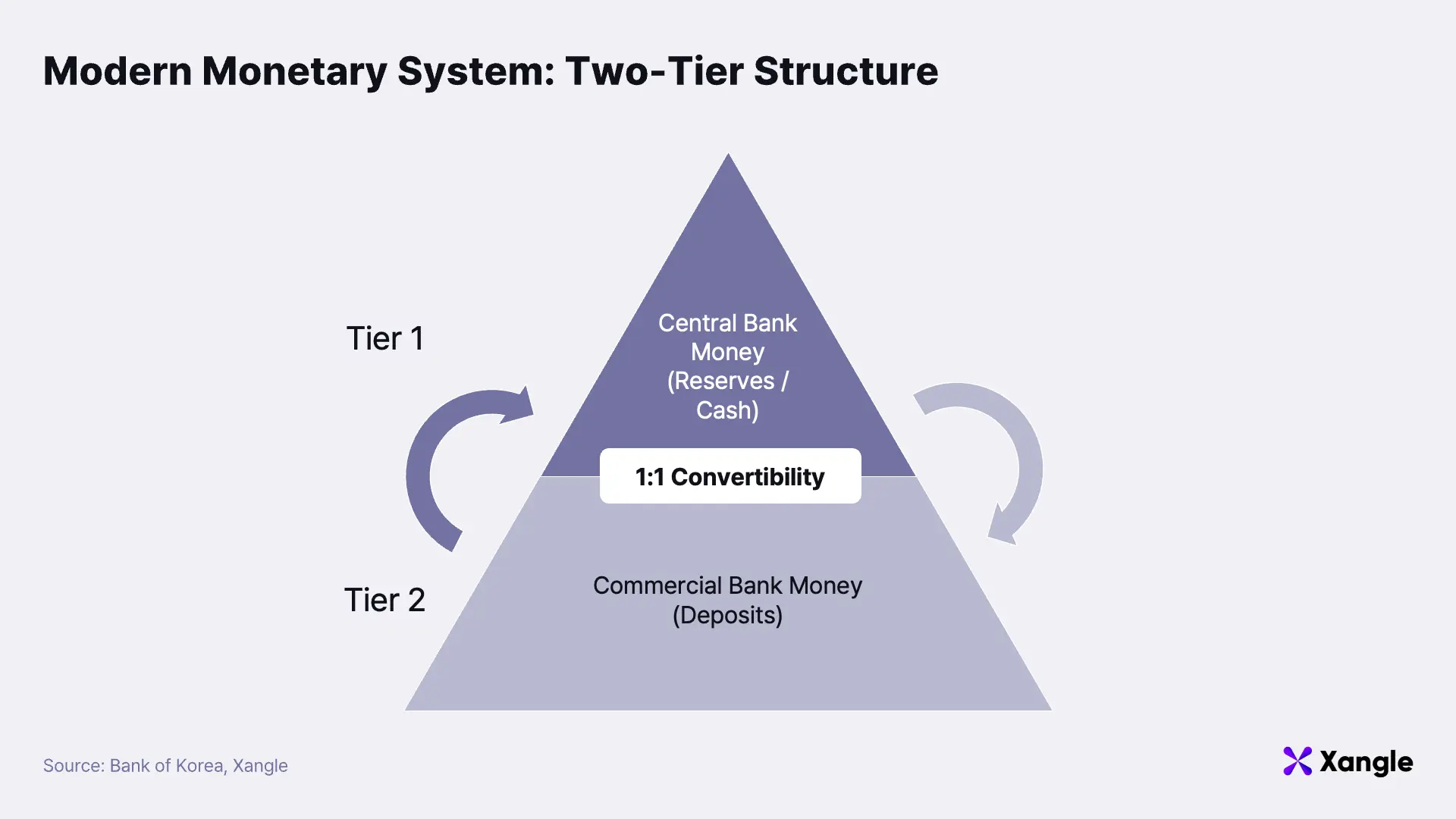
Within the two-tier monetary system, the central bank, or the first tier, plays two core roles. It provides the settlement asset that finalizes payments between banks, and it acts as the lender of last resort by supplying liquidity to the financial system during periods of stress.
Commercial banks, or the second tier, play a different role. Based on reserves, they provide deposits and loans to companies and individuals. The important point is that banks can create far more deposits than the reserves they actually hold. This is the fractional reserve banking system. In Korea, demand deposits are subject to a 7% reserve requirement ratio, meaning banks only need to hold 7% of those deposits as reserves at the Bank of Korea. The remaining 93% can be deployed through lending and other activities. This process is called credit creation, and it becomes the source of elasticity discussed later.ctivities. This is called credit creation and becomes the source of elasticity discussed later.
1-3. Payment and Settlement Systems: The Operating Layer Behind Monetary Trust
The two-tier monetary system defines the trust stack of money: who issues which form of money, and how confidence in that money is maintained. Payment and settlement systems are the operating layer that turns that trust structure into actual transactions. They determine how money is paid, cleared, and ultimately settled when economic activity takes place.
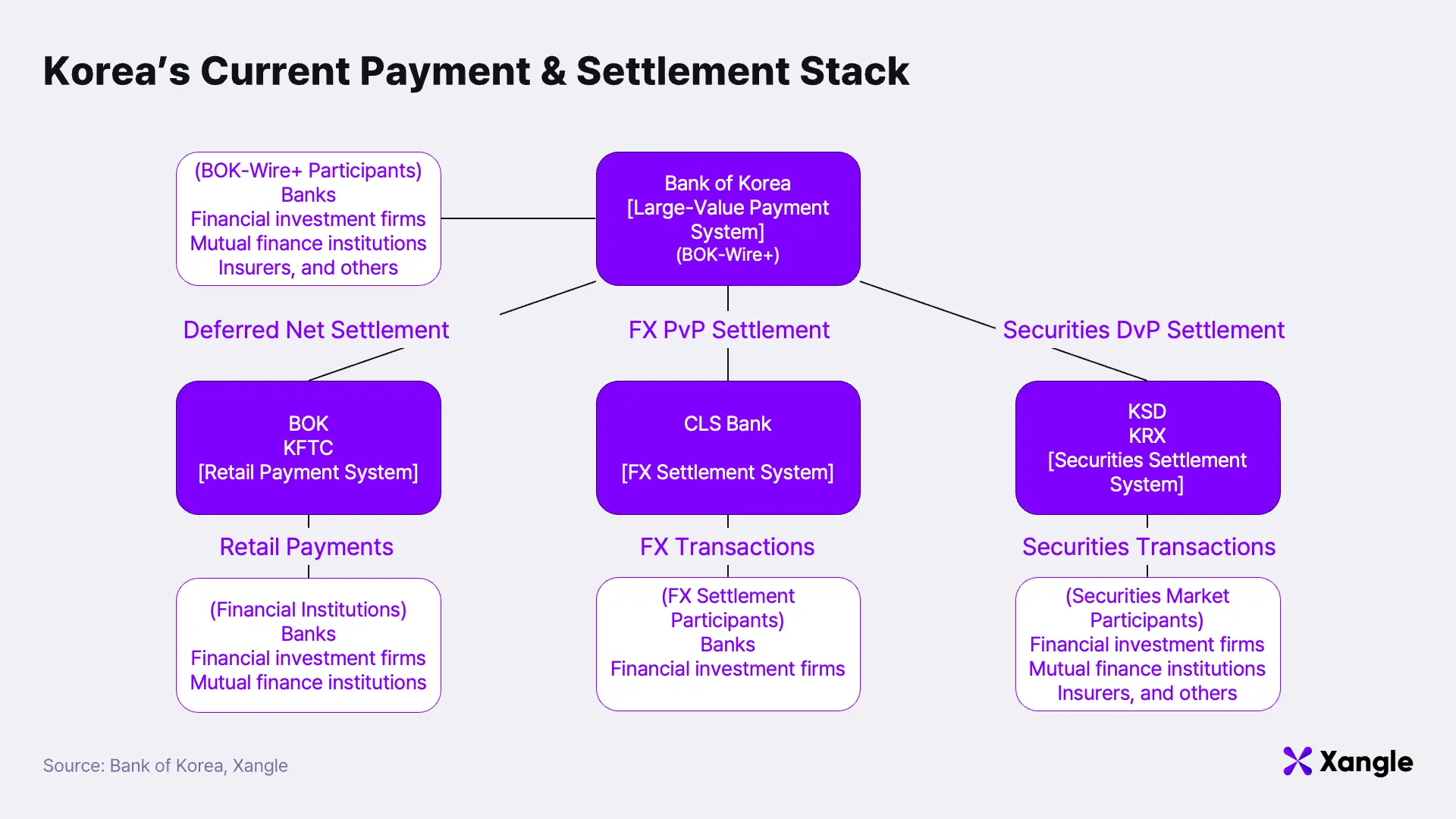
Korea’s current payment and settlement architecture is built around BOK-Wire+, with retail payment, foreign exchange settlement, and securities settlement systems connected to it. Payment instructions, clearing, and asset transfers are handled across separate systems. Final settlement between financial institutions, however, is ultimately completed through each country’s central bank-operated large-value payment system, such as BOK-Wire+. The structure provides settlement safety by anchoring finality in central bank money, but it also creates inefficiency because multiple systems and ledgers must be synchronized after the fact.
1) Settlement Risk in Batch Settlement
In ordinary retail payments, the user interface often shows a payment as completed almost immediately. Interbank finality, however, happens later. Korea’s retail payment system does not move reserves between banks every time an individual transaction occurs. Instead, payment instructions are accumulated over a certain period, each bank’s net receivables and net payables are calculated, and only the net positions are finally settled through BOK-Wire+.
The model reduces liquidity usage compared with settling every transaction on a gross, real-time basis. Yet it also creates a gap between user-facing payment completion and the actual movement of central bank money between banks. If a participating bank fails to meet its final settlement obligation during that interval, payments already treated as completed at the user layer may no longer match the actual flow of funds between banks. Each retail transaction may be small, but the volume of transactions is massive. Deferred net settlement therefore embeds settlement risk alongside its liquidity efficiency.
2) Sequential Separation in Cross-Border Payments
Cross-border payments make this fragmentation even more visible. When a Korean company sends dollars to a U.S. counterparty, the payment message moves through interbank networks, while the actual funds move through correspondent banks, local payment systems, operating-hour constraints, and regulatory checks across jurisdictions. Each step depends on a different institution, ledger, time zone, and compliance process. Delays, errors, costs, and uncertainty over payment status build up along the way.
FSB and BIS identify high costs, slow speed, low transparency, and limited access as core pain points in cross-border payments for precisely this reason. When payment systems across jurisdictions do not share overlapping operating hours, settlement can be delayed, increasing liquidity costs and settlement risk. For person-to-person remittances, the result may simply be inconvenience. For agent-based payments or automated B2B workflows, the impact can be much larger. In systems where payment confirmation triggers the next action, uncertainty over settlement status can become a bottleneck that stalls the entire process.
3) Separation Between the Securities Ledger and the Cash Ledger
Securities transactions face a similar structural issue. Securities ownership is recorded and managed in the securities settlement system of the Korea Securities Depository, while cash moves through bank accounts or the central bank settlement system. Current market infrastructure connects these two flows through DvP, or delivery versus payment, which links securities delivery and cash payment to reduce principal risk.
DvP, however, does not eliminate all settlement friction. In today’s infrastructure, securities and cash are not exchanged directly on a single ledger. The securities settlement system operated by the central securities depository and the cash settlement system operated by the central bank or commercial banks are conditionally linked on the settlement date. As a result, time still remains between trade execution and final settlement. During that window, market risk, liquidity pressure, and operational risk continue to exist.
2. Can Stablecoins Be the Answer?
2-1. Stablecoins Have Proven Market Demand for Digital Money
Stablecoins were the market’s first major answer to the gap left by legacy payment rails. Dollar-denominated stablecoins such as USDT and USDC expanded rapidly in the 2020s, moving beyond crypto trading into remittances and payments. In emerging markets with limited access to dollars, stablecoins increasingly function as digital substitutes for physical dollars. Around them, exchanges, wallets, DeFi protocols, and payment services have formed one of the most active settlement networks in crypto.
Their appeal is easy to understand. Stablecoins move outside banking hours, operate as payment assets on public blockchains, and can be embedded directly into smart contracts for automated payments and financial services. Compared with the slow cross-border transfers, fragmented payment networks, and closed account structures of traditional finance, stablecoins look like money built for internet-native markets.
Market adoption sends a clear signal. Users want money that can move 24/7, cross borders with minimal friction, and plug into digital services without waiting for legacy financial infrastructure to catch up.
2-2. The Three Standards Stablecoins Have Yet to Meet
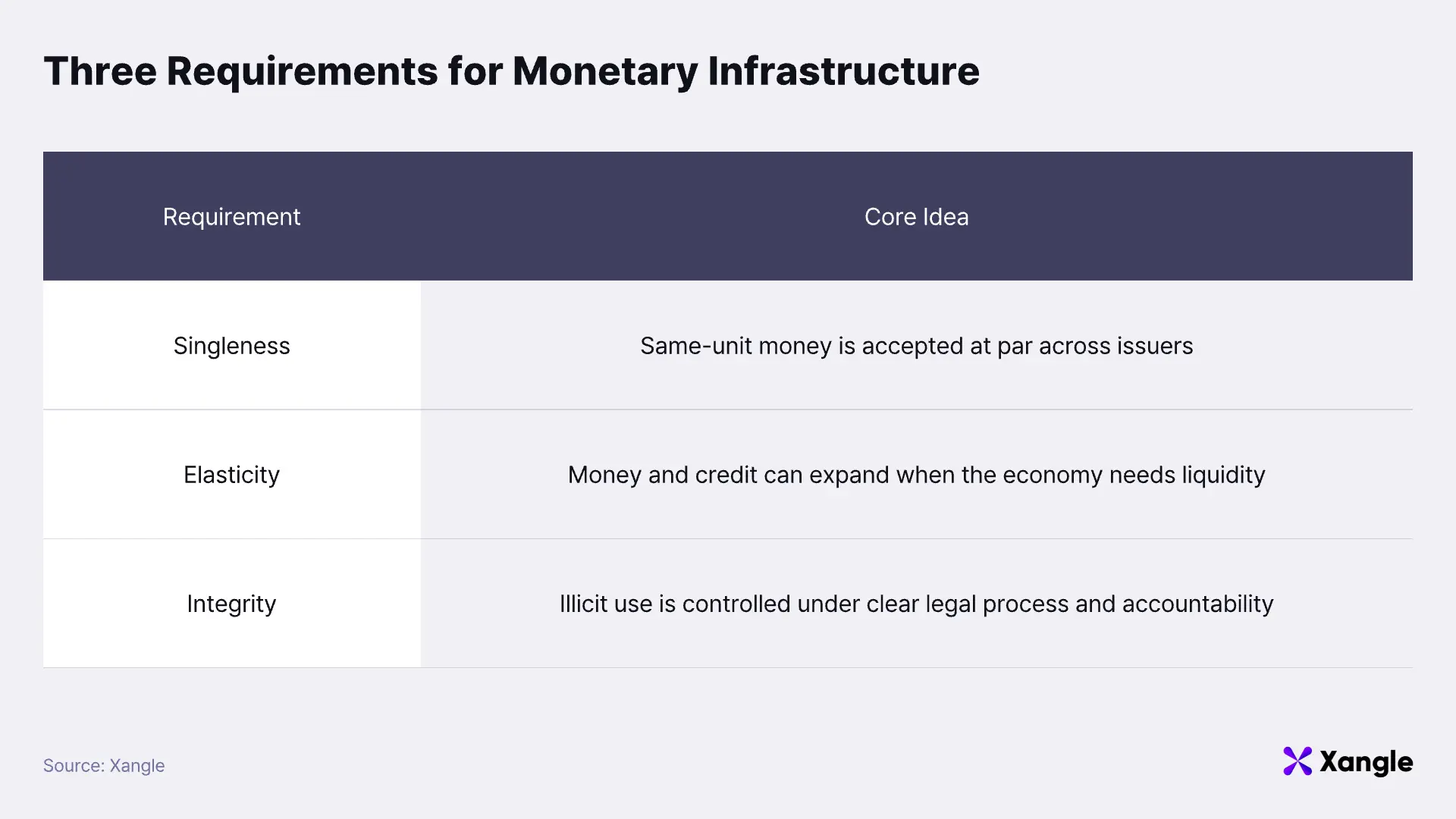
Yet the BIS argued in its 2025 Annual Economic Report that stablecoins still fall short of the requirements needed to sit at the center of the monetary system. The three standards are singleness, elasticity, and integrity.
1) Singleness
Singleness means that money denominated in the same unit is accepted at par, regardless of who issued it. A KRW 10,000 deposit at KB Kookmin Bank and a KRW 10,000 deposit at Shinhan Bank are treated as the same Korean won not because the two banks carry identical credit risk, but because interbank settlement ultimately takes place in central bank money, namely reserves held at the Bank of Korea. Central bank money acts as the common settlement anchor that ties different commercial bank deposits into a single unit of account.
Stablecoins are weaker on this front. Even when two tokens are both marketed as “one-dollar stablecoins,” their issuers, regulatory environments, reserve composition, disclosure practices, and redemption structures can differ meaningfully. USDT and USDC both target one dollar, but the market does not price them as identical credit risks. A stablecoin’s value therefore depends not only on the promise of one-dollar redemption, but also on confidence that the issuer safely holds the reserves and can honor redemptions when needed.
The USDC depeg in March 2023 made this risk visible. After Silicon Valley Bank collapsed, the market learned that Circle held $3.3 billion of USDC reserves at the bank. USDC briefly traded down to around $0.87. The episode showed that even tokens designed to represent the same “one dollar” can trade differently when confidence in the issuer or reserve assets comes under pressure.
2) Elasticity
Elasticity refers to the ability of money and credit to expand when the economy needs liquidity. In the traditional banking system, the central bank serves as the lender of last resort, while commercial banks extend credit to households and businesses based on deposits and reserves. During periods of stress, central bank liquidity provision, payment system stabilization, and supervisory action can help prevent a sudden credit contraction from spilling into the real economy.
Stablecoin markets also generate credit through DeFi lending protocols such as Aave and Compound. A user can deposit USDC as collateral, borrow DAI or USDT, and then redeploy the borrowed assets into another protocol to access additional liquidity. In other words, collateral-based credit multiplication can exist on top of stablecoins as well.
The weakness lies in how that credit behaves under stress. DeFi credit is heavily tied to collateral prices and automated liquidation rules. In bull markets, rising collateral values increase borrowing capacity and allow leverage to expand. When prices fall, collateral values decline, borrowing limits shrink, and liquidations can add more selling pressure. Rather than supplying credit countercyclically, the structure tends to expand and contract procyclically with market prices.
Traditional finance also has procyclical tendencies, but the decisive difference is the presence of a lender of last resort. In the banking system, the central bank can inject liquidity during crises and reduce stress across payment networks and credit channels. DeFi has no public backstop that plays this role. Smart contracts execute liquidations once collateral prices breach predefined thresholds; they do not maintain or expand credit by considering system-wide liquidity conditions. As a result, stablecoin- and DeFi-based credit can look efficient in normal markets, but may amplify credit contraction during crises.
3) Integrity
Integrity means that a monetary system must be able to control illicit use, including money laundering, terrorist financing, and sanctions evasion, while exercising those controls under clear legal procedures and accountability. In the traditional financial system, customer due diligence, suspicious transaction reporting, sanctions screening, and court-ordered freezing or confiscation procedures form the basic control framework. The system is not perfect, but the responsible parties and legal basis for restricting fund movements are relatively clear.
Public blockchain-based stablecoins face a structural dilemma here. On one side, non-custodial wallets and pseudonymous addresses allow users to access stablecoins without prior KYC, making it difficult to block illicit funds before they enter the system. On the other side, centralized stablecoin issuers such as Circle and Tether have the technical ability to freeze specific addresses. Weak access control leaves room for illicit funds to enter, while broad freezing powers in the hands of private issuers can make the standards and procedures for asset control opaque.
The Drift Protocol hack in April 2026 illustrates the dilemma. The attacker moved approximately $232 million worth of stolen USDC from Solana to Ethereum via Circle’s CCTP. On-chain investigator ZachXBT criticized Circle for not freezing the funds, noting that the transfers took place during U.S. business hours over roughly six hours and across more than 100 transactions. Circle responded that it freezes assets only when there is a legal basis, such as sanctions, law enforcement requests, or court orders. Just a few days earlier, however, reports had also surfaced that Circle had frozen 16 wallets without an official explanation, sparking controversy. The case shows that private issuers may have powerful technical control rights, but the consistency and accountability around the use of those rights remain contested.
2-3. Why the Two-Tier Monetary System Still Matters
The limits of stablecoins are not just technical. Speed, programmability, and 24/7 settlement are powerful features, but a monetary system needs more than fast transaction processing. Money issued by different institutions must trade at par. Credit and liquidity need mechanisms that can absorb stress rather than amplify it. Controls against illicit use also need to operate under clear legal authority and accountability.
The two-tier monetary system has historically provided those functions by combining central bank money with commercial bank deposits. Central bank reserves serve as the final settlement asset between banks, anchoring different bank deposits to the same unit of account. Central banks and commercial banks together supply payment liquidity and credit, while bank regulation and supervision support the integrity of the financial system.
Replacing the two-tier system altogether is therefore not a realistic path. A more practical approach is to preserve the trust layer of the existing monetary system, while rebuilding the operating layer around digital and programmable rails.
The same logic is now shaping policy discussions beyond Korea. BIS Project Agorá, together with participating central banks, is exploring whether tokenized commercial bank deposits and wholesale central bank money can improve cross-border payments without abandoning the two-tier structure. Project Hangang is Korea’s answer to the same design question.
3. Project Hangang: A Testbed for Digital KRW Infrastructure
Project Hangang is Korea’s attempt to implement the BIS concept of a unified ledger in a live digital currency test environment. Rather than replacing the two-tier monetary system, the project explores whether that system can be rebuilt on programmable infrastructure while preserving singleness, elasticity, and integrity.
3-1. Unified Ledgers
A unified ledger, as proposed by the BIS, is a next-generation financial market infrastructure where tokenized money and tokenized assets can be issued, transferred, and settled on a shared programmable platform, or across highly interoperable platforms. Tokenized assets in this context can include equities, bonds, carbon credits, digital vouchers, and other financial or real-world assets.
The goal is to integrate payment instructions, clearing, asset transfer, and cash settlement, which remain separated in today’s financial transactions, into a single continuous workflow. By placing tokenized money and tokenized assets in the same execution environment, or on tightly connected platforms, asset delivery and cash payment can be processed as one atomic transaction.
3-2. Wholesale CBDC and Deposit Tokens
Project Hangang maps the two layers of Korea’s monetary system onto tokenized rails: central bank money becomes wholesale CBDC, while commercial bank deposits become deposit tokens. Both may look like forms of “digital money” at the interface layer, but they sit in different parts of the stack. The design tokenizes central bank money and commercial bank deposits without blurring their issuers, user base, or settlement functions.
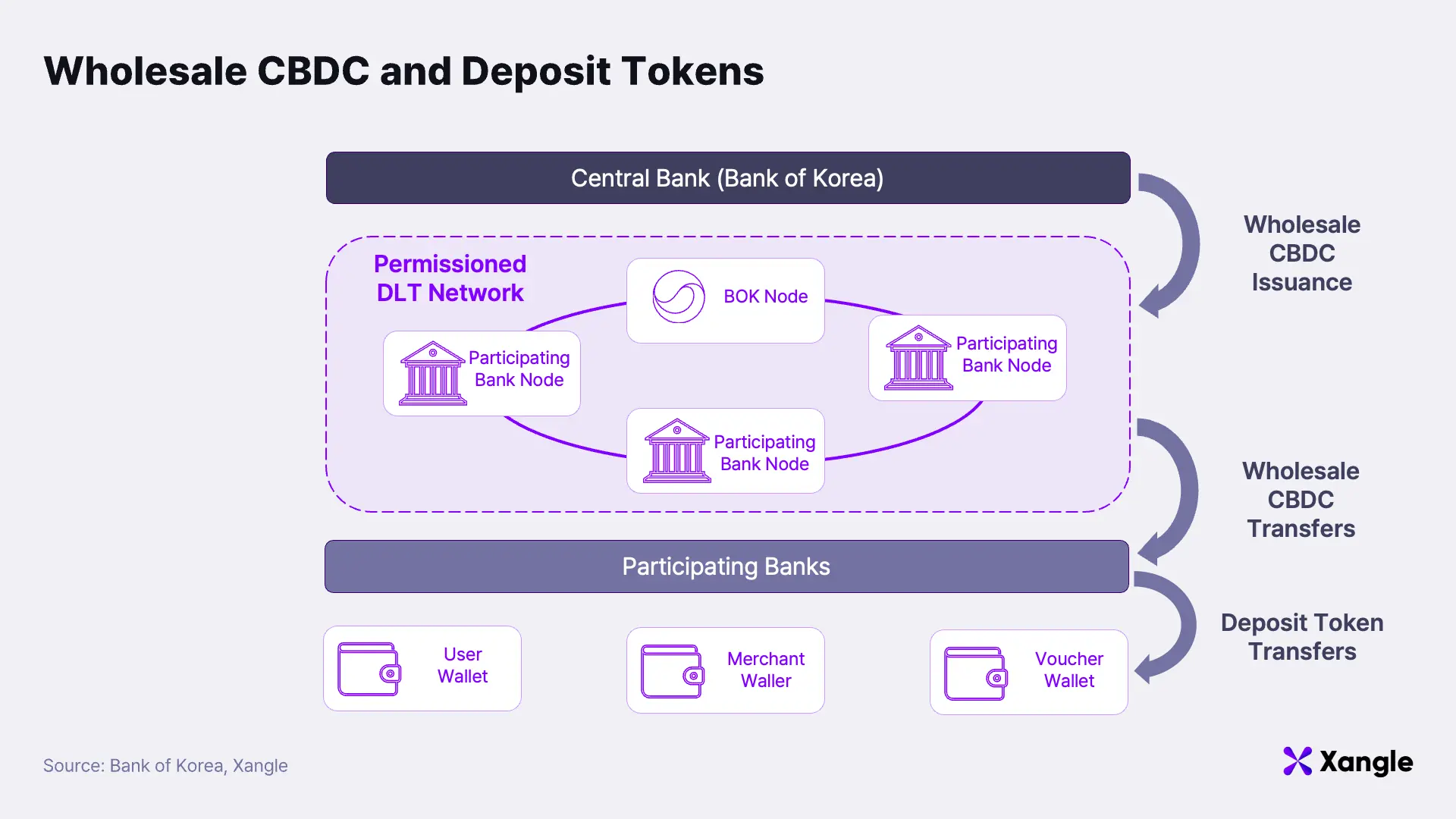
Wholesale CBDC is digital central bank money issued by the Bank of Korea. It is not a retail CBDC held and spent directly by the public. It is wholesale money used by banks and other financial institutions for interbank settlement. Just as reserves serve as the final settlement asset between banks today, wholesale CBDC handles interbank transfers and final settlement inside the digital currency system. In other words, wholesale CBDC is not the user-facing payment instrument. It is the interbank settlement layer that ultimately anchors the value of deposit tokens.
Deposit tokens, by contrast, are tokenized deposits issued by commercial banks. Users can convert their bank deposits into deposit tokens and spend them through e-wallets at online and offline merchants. The Bank of Korea describes deposit tokens as deposit-like instruments implemented as digital currency using tokenization technology. Rather than a separate virtual asset that replaces bank deposits, a deposit token is an extension of bank deposits into a token-based payment environment.
The burn-and-issue flow for cross-bank transfers shows how this structure works in practice. Suppose a customer of Bank A pays KRW 30,000 to a merchant banking with Bank B. Bank A’s smart contract burns KRW 30,000 worth of deposit tokens from the user’s e-wallet. At the same time, Bank A’s wholesale digital currency is transferred to Bank B within the Bank of Korea’s digital currency system. Bank B’s smart contract then issues KRW 30,000 worth of new deposit tokens to the merchant’s e-wallet.
The three steps are bundled into a single conditional flow. The burn of Bank A’s deposit tokens, interbank settlement through wholesale digital currency, and reissuance of Bank B’s deposit tokens must all succeed for the payment to complete. As a result, the deposit tokens spent by Bank A’s customer and the deposit tokens received by Bank B’s merchant remain linked to the same KRW value.
Transfers within the same bank are simpler. When the user’s e-wallet and the merchant’s e-wallet are issued by the same participating bank, deposit tokens do not need to be burned and reissued. The tokens move directly from the user’s e-wallet to the merchant’s e-wallet within the same bank.
3-3. Deposit Tokens vs. Stablecoins
Deposit tokens may look similar to stablecoins because both appear to be digital tokens that track a fiat currency. The starting point, however, is different. A stablecoin is issued by a private issuer against reserve assets. A deposit token is a tokenized representation of a bank deposit designed for a token-based payment environment.
Stablecoins are issued by private companies such as Tether and Circle on public blockchains. Dollar deposits, short-term Treasuries, cash-equivalent assets, and other reserves held by the issuer support the token’s value. Users therefore rely on the issuer’s reserve management and redemption capacity. Deposit tokens follow a different model. They are designed as deposits, or electronic certificates equivalent to deposits, handled by banks on the Bank of Korea’s CBDC network. Under Korea’s Act on the Protection of Virtual Asset Users, they have also been classified as instruments excluded from the scope of virtual assets.
Project Hangang, then, is not an attempt to replace private stablecoins with central bank money. It is closer to an experiment that extends the existing two-tier monetary system onto tokenized payment rails, with wholesale CBDC serving as the final settlement anchor and deposit tokens serving as the user-facing payment instrument.
4. How Far Can Project Hangang Extend?
4-1. E-Money Tokens and Special-Purpose Payment Tokens
Project Hangang is not only about deposit tokens. The report and the Bank of Korea’s official materials also introduce two additional instruments: e-money tokens and special-purpose payment tokens. Together, they offer an important clue into how Project Hangang could connect privately issued digital money with external digital asset transactions.
Deposit tokens are designed for everyday payments. E-money tokens and special-purpose payment tokens, by contrast, are designed to support the cash leg of external asset transactions. When assets such as carbon credits, digital vouchers, or RWAs are traded on separate ledgers, these tokens can help link asset delivery and cash payment in a safer, more synchronized way.
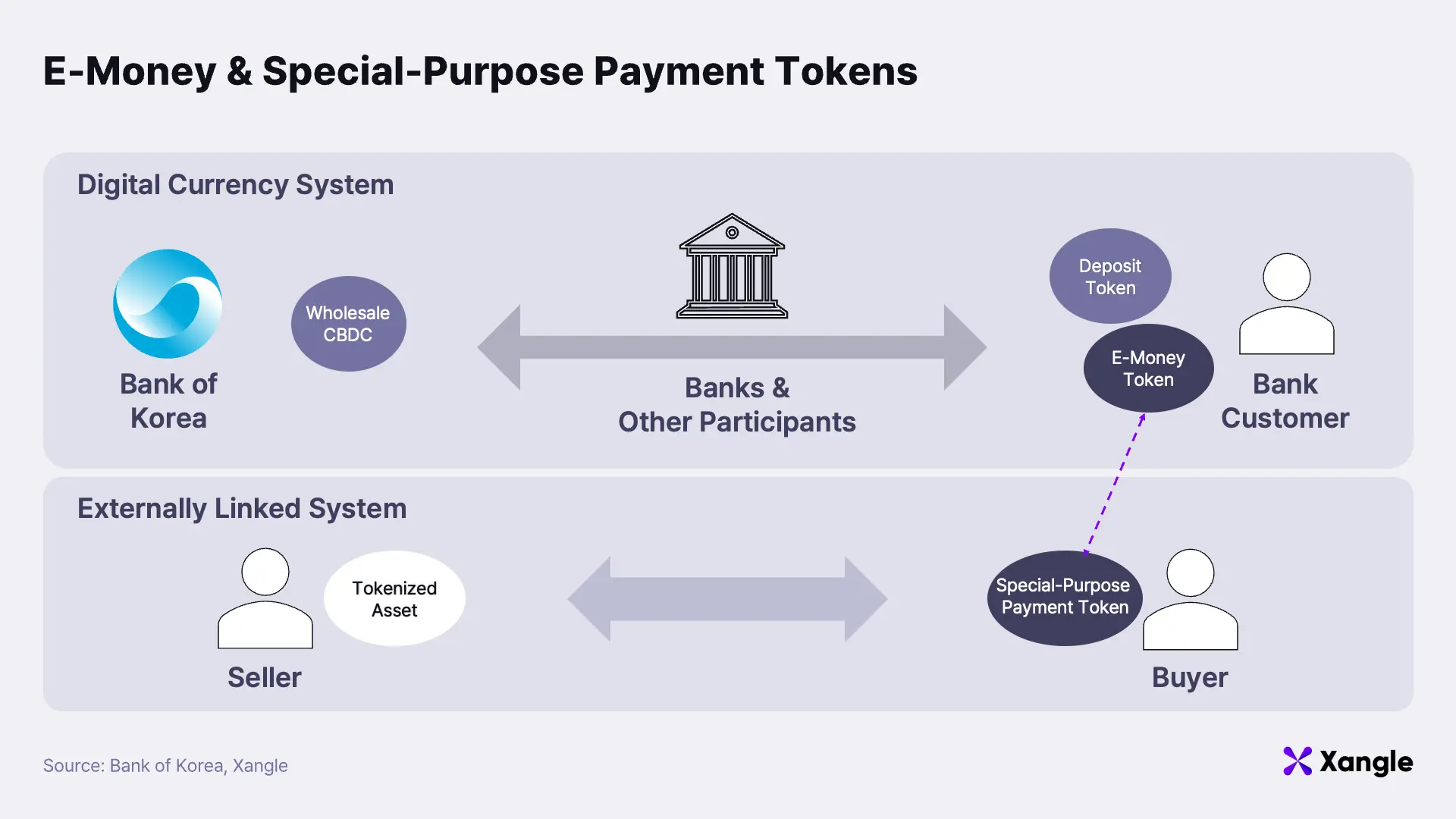
E-money tokens are privately issued digital money backed by digital currency. While deposit tokens tokenize bank deposits themselves, e-money tokens follow a different structure: wholesale CBDC corresponding to the issuance amount is held as reserve backing, and a separate private payment token is issued on top of it.
Special-purpose payment tokens then act as the bridge between e-money tokens and settlement on external ledgers. A unified ledger is designed to make asset delivery and cash payment flow like a single transaction, even when tokenized assets and tokenized money sit in different systems. Directly issuing and circulating wholesale CBDC on external ledgers, such as carbon credit platforms or digital asset trading platforms, may not be appropriate because wholesale CBDC is fundamentally an interbank final settlement asset.
Project Hangang therefore adds an intermediate layer. E-money tokens are first issued inside the digital currency system with wholesale CBDC as backing. In the externally connected system, special-purpose payment tokens are then issued against those e-money tokens. In theory, special-purpose payment tokens could be issued directly against CBDC. Under such a model, however, non-bank institutions that cannot hold current accounts at the Bank of Korea could be excluded from the issuance structure. By placing e-money tokens in the middle, the system can create a cash leg for external asset transactions through privately issued digital money, without putting central bank money directly onto external ledgers.
The distinction matters because each instrument plays a different role in the monetary stack. Deposit tokens are tokenized bank deposits and are closer to user-facing KRW payment instruments for everyday use. They can support merchant payments, peer-to-peer transfers, and online payments through bank apps or e-wallets. E-money tokens and special-purpose payment tokens, by contrast, are backed by wholesale CBDC and are better suited to environments where settlement stability and atomic linkage between asset delivery and cash payment matter more than general retail payments.
In other words, CBDC is not the instrument directly used on external ledgers. Special-purpose payment tokens are. Their value, however, ultimately traces back to wholesale CBDC through e-money tokens. The key point is that special-purpose payment tokens are not payment instruments backed by deposit tokens. External-ledger tokens could also be created against deposit tokens, but such tokens would then represent claims on deposits at a specific bank, or on banking-sector deposits more broadly.
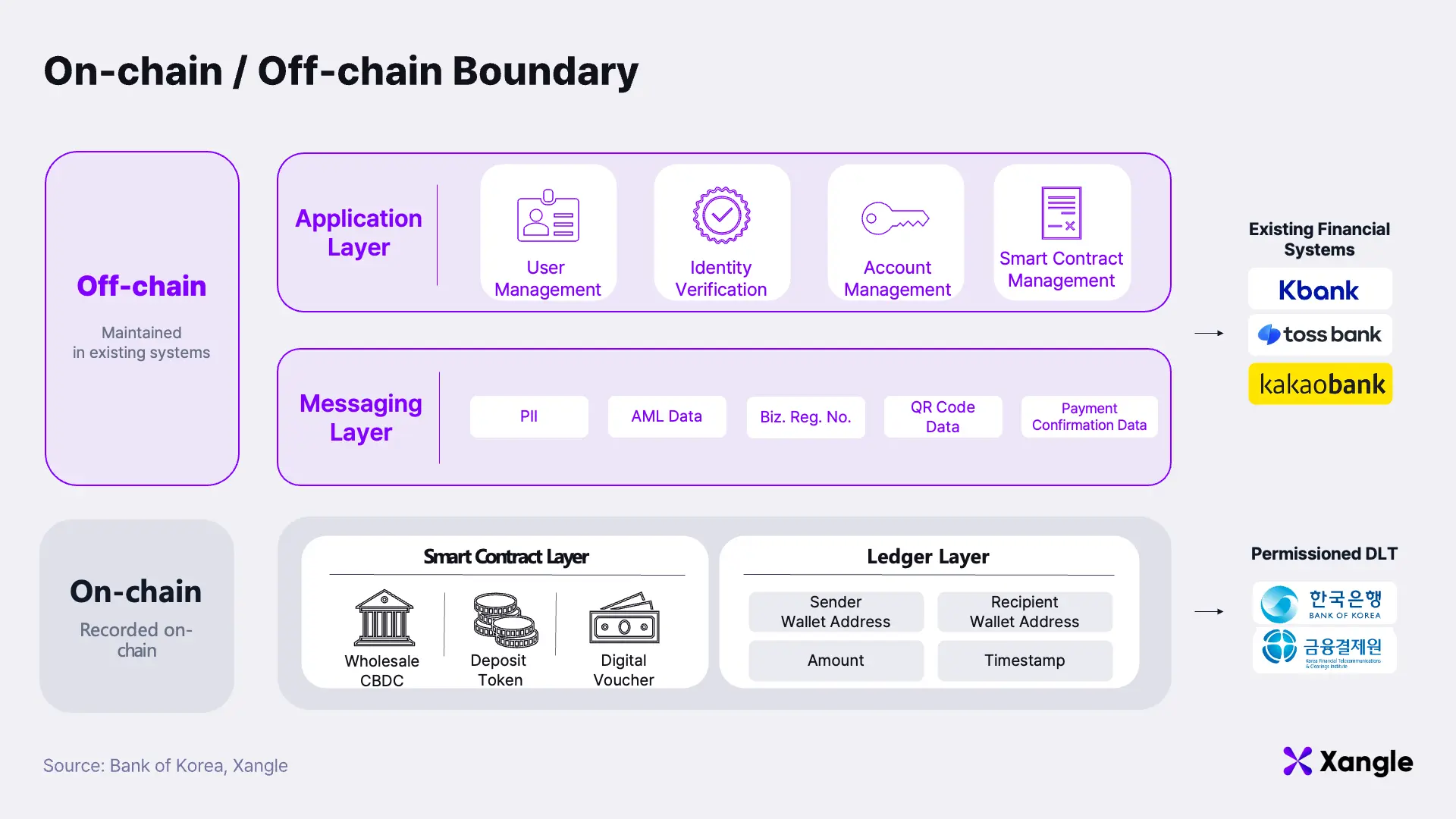
In summary, wholesale CBDC tokenizes central bank money and anchors final settlement between banks. Deposit tokens tokenize bank deposits and serve as user-facing payment instruments. E-money tokens and special-purpose payment tokens add a cash settlement leg for external asset transactions.
4-2. What Lives On-Chain and What Stays Off-Chain
Project Hangang does more than assign different roles to tokenized central bank money, bank deposits, private payment tokens, and external-ledger payment instruments. The next question is where each of these functions sits in the actual system architecture.
Project Hangang does not move the entire financial stack onto a single blockchain. It follows a hybrid design: core state changes and smart contract execution required for payments are handled on-chain, while personal data, identity verification, account management, mobile apps, merchant management, and existing payment device integrations remain off-chain within legacy financial and external systems. The boundary matters because Project Hangang is not designed to replace Korea’s financial infrastructure wholesale. It is designed to connect an on-chain payment layer with the off-chain systems that already support the financial market.
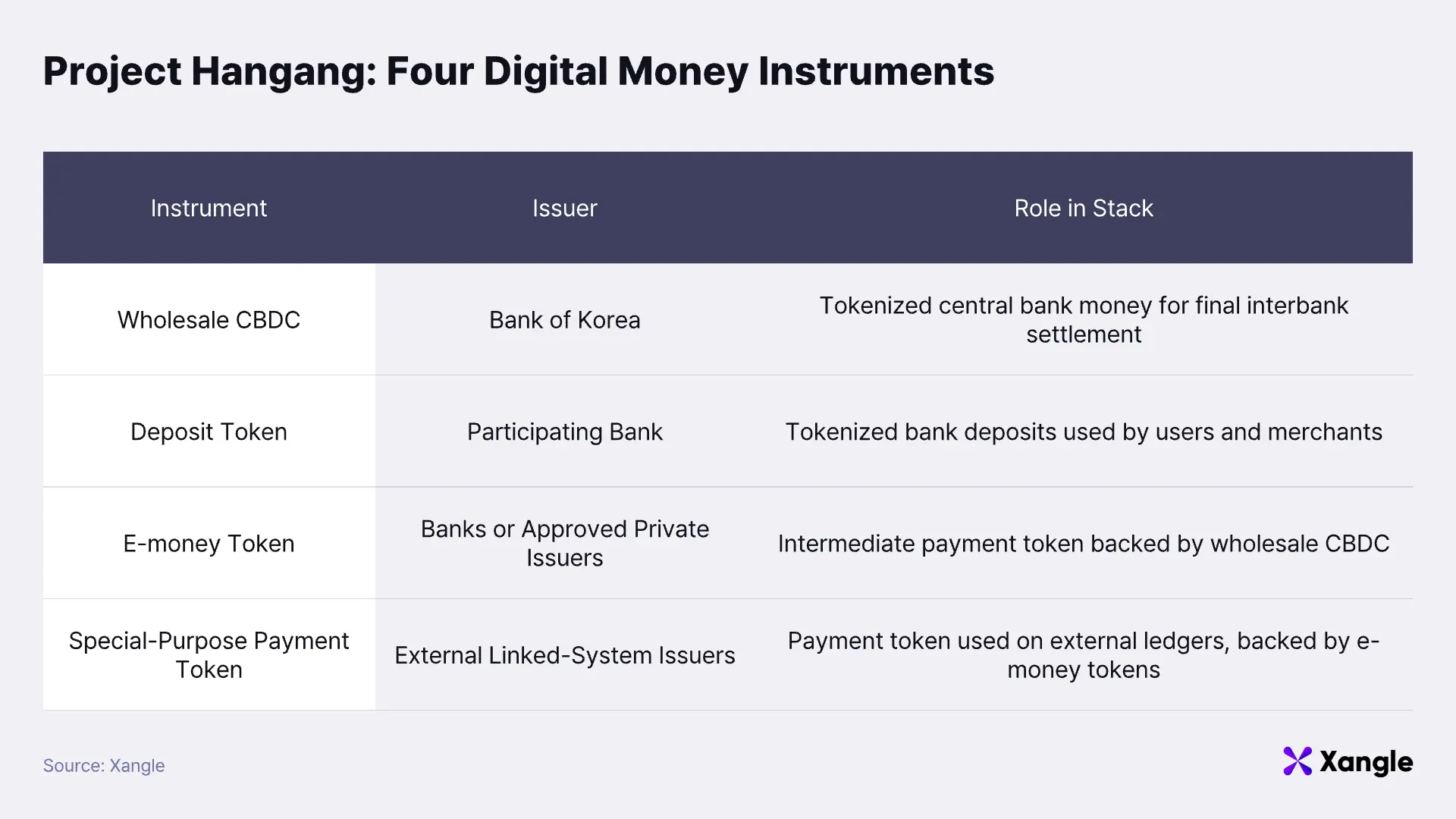
The on-chain part of Project Hangang is the distributed ledger layer. It consists of two sublayers: the ledger layer and the smart contract layer. The ledger layer is a permissioned distributed ledger network jointly operated by the Bank of Korea and participating banks. It records and verifies transactions involving wholesale CBDC and deposit tokens. The smart contract layer handles issuance, transfer, burning, and conditional execution for wholesale CBDC, deposit tokens, and digital vouchers. In other words, on-chain infrastructure does not contain every function of the digital currency system. It handles the core state transitions and execution logic required for payment finality.
Personal data and additional payment information do not sit directly on the ledger. The distributed ledger only records the minimum data required for payment execution, such as user wallet addresses, merchant wallet addresses, transaction amounts, and timestamps. AML-related data, personally identifiable information, business registration numbers, QR code data, payment completion details, and other auxiliary information are exchanged through off-chain messaging channels. The design allows the ledger to provide integrity and conditional execution, while sensitive data and operational information remain under the responsibility of existing financial institutions and external systems.
Most legacy financial infrastructure also remains in place. BOK-Wire+, participating banks’ core banking systems and mobile banking apps, merchants’ POS terminals and kiosks, and identity verification systems are not replaced by the ledger. They are connected to the digital currency system only where needed. Users open e-wallets through existing bank apps, convert deposits into deposit tokens, and pay via QR codes. Behind the interface, however, core state transitions such as deposit token burning, wholesale CBDC transfer, and deposit token reissuance are processed through the distributed ledger and smart contracts.
4-3. The Market Will Form at the Off-Chain Connection Points
The boundary between on-chain and off-chain is where the real market begins. Project Hangang has already outlined how wholesale CBDC, deposit tokens, e-money tokens, and special-purpose payment tokens can be issued, transferred, and settled on a distributed ledger. The open question is not only how the ledger works, but how the systems around it will connect to users, institutions, public chains, and RWA platforms.
Users do not need to understand the technical structure of deposit tokens. What matters is whether they can access them easily through existing bank apps or wallets, where they can spend them, and how safely those tokens can connect to public chains or RWA platforms.
The next design challenge therefore sits outside the on-chain monetary layer. It is about how off-chain systems are opened, integrated, and connected to the on-chain application layer. Only when those connection points are defined can the CBDC and deposit token experiment move beyond a payment test and evolve into KRW-based digital financial infrastructure.
5. Conclusion
Before discussing how far KRW-based digital currency infrastructure can scale, one issue needs to be addressed first. Project Hangang combines central bank money, smart contracts, and a permissioned ledger, so it cannot be fully separated from the broader concerns surrounding CBDCs.
5-1. General Concerns Around CBDCs
The biggest concerns around CBDCs are surveillance and control. Critics worry that a central bank or government could directly monitor individual wallets and transaction histories, freeze specific funds, or issue programmable money that can only be used for approved purposes. A system that combines central bank money, smart contracts, and a permissioned ledger naturally raises these concerns.
Project Hangang, however, is not designed as the retail CBDC people usually imagine. The Bank of Korea’s digital currency is not money held and spent directly by the public. It is wholesale digital money held by participating banks and used for interbank settlement. Users do not directly spend CBDC issued by the Bank of Korea. They use deposit tokens converted from their own bank deposits. In other words, Project Hangang does not give the public wallets directly at the central bank. It restructures bank deposits and central bank settlement infrastructure for a tokenized environment.
The privacy design also does not concentrate all transaction data at the central bank. According to the Bank of Korea, the government and the central bank cannot directly identify or control each individual’s deposit token holdings under Project Hangang. Personal information is managed by the bank that issues the user’s e-wallet, in accordance with relevant laws and regulations. The distributed ledger can therefore handle transaction integrity and conditional execution, while personally identifiable information and customer management remain under the responsibility of existing financial institutions.
CBDC concerns do not go away entirely. Smart contracts can improve the efficiency of voucher execution, automated payments, and tokenized asset settlement when they are designed with clear limits. Poorly governed programmability, however, can also become a channel for excessive spending restrictions or administrative control. Future debates should therefore focus on where CBDCs and deposit tokens are used, how privacy is protected, and who has the authority to program constraints into money, under what legal process, and with what accountability.
5-2. A Blueprint for Bank-Led Stablecoins Is Already Taking Shape
Stablecoins should be revisited from this perspective. Deposit tokens and stablecoins do not have to be direct substitutes. If deposit tokens serve as digital representations of bank deposits inside a permissioned monetary ledger, stablecoins, or stablecoin-like payment tokens, could extend that trust into external applications and public chain environments. Once regulatory standards are clarified, KRW payment tokens backed by KRW deposits and deposit tokens could be issued on external ledgers for payments, remittances, and RWA transactions.
Project Hangang’s proof-of-concept already points in this direction. The experiment used the Secure Asset Transfer Protocol (SATP) to connect with external distributed ledgers, and introduced a special-purpose payment token structure for the cash leg of specific digital asset transactions. At the same time, the experiment should not be read as a commercial public-chain bridge model. It is better understood as a PoC that tested secure asset transfer and interoperability across separate distributed ledgers.
Canton Network offers a useful reference point. Canton was built for institutional finance, but it has been expanding connectivity to public chains by adopting Chainlink CCIP and LayerZero’s cross-chain messaging. The direction is clear: institutional networks are moving beyond closed, purpose-built environments and toward architectures that preserve privacy and compliance while connecting to public-chain liquidity, assets, and applications. Over the long term, Project Hangang will also need to think beyond BOK-Wire+ and the banking system, and consider on/off-ramp structures that connect to RWA platforms and public blockchains.
Corporate opportunities, therefore, are not limited to the question of who gets to issue KRW stablecoins. A more important question is what role non-bank companies can play if issuance begins with banks. KRW stablecoin issuance may first open to the banking sector, but the interfaces, integrations, and services that scale the actual market are likely to be built by private companies outside the on-chain monetary layer.
5-3. Korea’s Opportunity and Risk: Building On/Off-Ramps for KRW Liquidity
The opportunity is already visible. With Project Hangang, Korea has tested wholesale CBDC and deposit tokens in a real-transaction environment, while also running proof-of-concept experiments around e-money tokens and external ledger connectivity. Direct participation from regulators and major banks also matters. Korea is not merely following overseas precedents; it is in a position to help define the early standards for KRW-based digital currency infrastructure.
The main risk is isolation. If deposit tokens remain confined to a permissioned distributed ledger and fail to connect meaningfully with global public chains, offshore stablecoins, and RWA markets, Korea’s digital currency experiment could end up as a domestic payment-efficiency project. The real issue is not whether the system is permissioned or public. It is how the legal nature of tokens, KYC continuity, redemption rights, and accountability are defined when the two environments are connected.
The Bank of Korea’s participation in BIS Project Agorá helps reduce this risk. Agorá brings together central banks and private financial institutions from multiple jurisdictions to test cross-border connectivity between tokenized commercial bank deposits and wholesale CBDC. Korea’s participation suggests that Project Hangang is not intended to remain a domestic pilot only. It is also being positioned within the broader evolution of global tokenized financial infrastructure.
International participation alone, however, does not secure Korea’s window of opportunity. Domestically, virtual asset taxation is scheduled to take effect, while comprehensive rules for the legal status and accountability structure of stablecoins and tokenized assets remain underdeveloped. Korea does not need a tax-first discussion. It needs clear legal standards for on/off-ramps that allow KRW-based digital money to move across bank deposits, deposit tokens, e-money tokens, private stablecoins, RWAs, and public blockchains. To avoid missing the market opportunity despite leading in infrastructure experimentation, Korea needs to define the connection points in time: who can bring KRW liquidity on-chain, under what conditions, and how that liquidity can return to the off-chain financial system.
Disclaimer
I confirm that I have read and understood the following: The information contained in this article is strictly the opinions of the author(s). This article was authored free from any form of coercion or undue influence. The content represents the author's own views and does not represent the official position or opinions of CrossAngle. This article is intended for informational purposes only and should not be construed as investment advice or solicitation. Unless otherwise specified, all users are solely responsible and liable for their own decisions about investments, investment strategies, or the use of products or services. Investment decisions should be made based on the user’s personal investment objectives, circumstances, and financial situation. Please consult a professional financial advisor for more information and guidance. Past returns or projections do not guarantee future results.
Xangle or its affiliated partners own all copyrights of the written or otherwise produced materials and content provided on the platform. Any illegal reproduction of such content, including, but not limited to, unauthorized editing, copying, reprinting, or redistribution will result in immediate legal actions without prior notice.


![[ADOPTION] L1 - Why Global Enterprises Are Betting on Avalanche](https://resource.xangle.io/content/thumbnails/2063/content_2063_thumbnail_7f6244bf.webp)