
MicroStrategy’s Bankruptcy Narrative: Inside MSTR’s Bitcoin-Backed Capital Architecture


1. Introduction: Is MicroStrategy Actually at Risk of Bankruptcy?
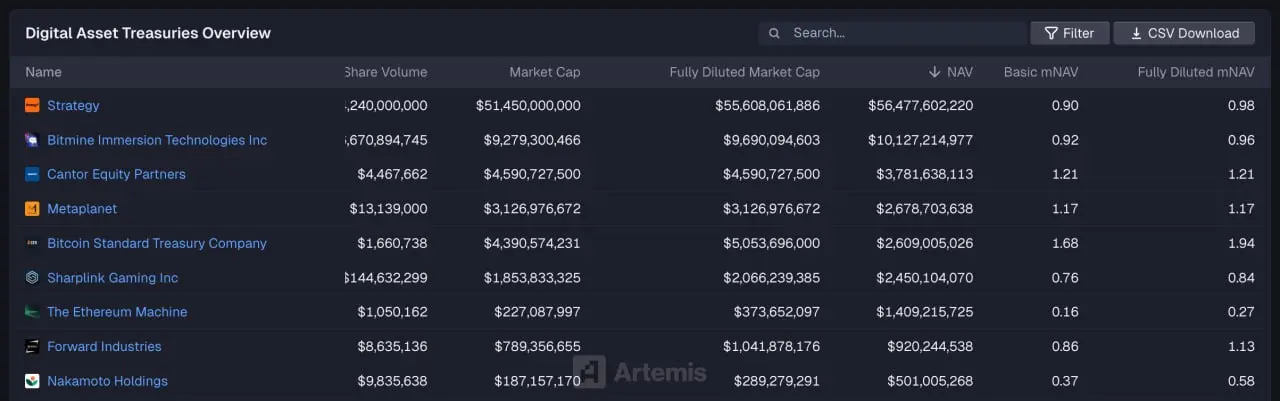
Source: Artemis
A sharp pullback in Bitcoin, paired with a surge in volatility, has amplified market concerns around Digital Asset Treasury (DAT) firms such as MicroStrategy (MSTR). Several DAT stocks have slipped into NAV-discount territory; unease has also grown following their failure to secure inclusion in MSCI indices. Against this backdrop, pockets of the market have revived extreme bearish narratives: from a looming “Bitcoin Doomsday” to outright corporate bankruptcy scenarios. The spotlight has centered particularly on the idea that if Bitcoin were to fall below MSTR’s average acquisition cost, the company could face repayment pressure or be forced to unload part of its treasury to defend the share price—an assumed “forced liquidation.”
A closer examination of MicroStrategy’s balance-sheet architecture, however, shows that much of this anxiety is overstated. Extreme-case selling cannot be dismissed in absolute, theoretical terms; even so, MSTR’s current capital structure is sturdy enough to be considered effectively insulated from external shocks. Assessing this resilience requires understanding the mechanics underlying how MicroStrategy actually raises capital.
The company is not financed through straightforward equity issuance or plain-vanilla corporate debt. Its approach is rooted in a far more deliberate use of financial engineering: a framework that has allowed MicroStrategy to maintain operational stability even amid Bitcoin’s characteristically violent volatility cycles.
2. How Buffett Turned Volatility Into Capital: A Primer for MSTR’s Playbook
When an investor holds firm conviction that an asset will appreciate over the long term, the most rational way to amplify returns is to employ leverage. Borrowed capital enables exposure to upside that cannot be captured through equity alone. Yet leverage comes with a cost: interest payments erode returns, and in adverse market conditions, those obligations can threaten a company’s very survival. A different outcome emerges, however, when the volatility embedded in an asset can be inverted and sold with precision. Funding costs can fall dramatically — at times nearing zero. Warren Buffett’s long-dated put-selling program remains the canonical example.
From 2004 to 2008, Buffett sold a substantial amount of long-term put options linked to major global equity indices. Institutional investors at the time were preoccupied with the risk of a broad market collapse and were eagerly seeking hedges to protect their portfolios. Sensing this demand, Buffett offered what was effectively “insurance against a market downturn.” His message was simple: If equity markets collapse 15 or 20 years from now, I will absorb the losses. In exchange for assuming that risk, he received the premium upfront — roughly $4.9 billion.
The substance of the trade lies in the character of the cash he collected. On the surface, the strategy appears anchored in Buffett’s belief that equity markets would trend upward over the long run. In financial-engineering terms, however, the structure functioned like ultra-low-cost financing over a 15–20 year horizon. Even if markets finished below the strike and he were required to pay the difference, the multi-decade benefit of effectively accessing interest-free leverage far outweighed the eventual settlement cost. Put differently, Buffett engineered an asymmetric payoff profile that allowed him to win across virtually all scenarios short of a global market collapse.
He did not let that capital sit idle. The “free money” was deployed into undervalued businesses and promising equities, compounding for years; the resulting gains accrued entirely to Buffett. In essence, he converted other investors’ demand for downside protection into near-zero-cost capital — a decisive demonstration of how volatility can be monetized. In modern markets, Bitcoin’s explosive volatility has enabled a parallel model. Buffett monetized equity-market volatility to create liquidity; MicroStrategy, by contrast, taps into Bitcoin’s volatility to raise capital and expand its asset base. This dynamic sits at the core of MSTR’s strategy.
3. Turning Equity Into Synthetic BTC Exposure: MSTR’s Convertibles Strategy
Buffett secured his massive capital float because markets were full of participants trying to suppress volatility; selling that volatility back to them allowed him to raise capital at close to zero cost. MicroStrategy inverted the same logic. Rather than offering insurance to volatility-averse investors, it sought out participants eager to monetize Bitcoin’s extreme price swings. Institutions were actively looking for structured volatility exposure, and MSTR spotted the opening.
A structural problem remained: traditional markets simply did not offer products with the scale and duration MSTR needed. Typical Bitcoin call options expire within one or two years — far too short to serve as the stable, long-dated capital required for multi-year BTC accumulation. MSTR needed five- to ten-year funding with no interim repayment pressure to withstand Bitcoin’s long upward cycles. Financial engineering provided the workaround. Instead of selling options on Bitcoin, MicroStrategy recreated Bitcoin’s payoff profile through its own equity and issued convertible bonds linked to that synthetic proxy. Effectively, MSTR manufactured a publicly traded “Bitcoin clone” and sold convertibles that behaved like long-dated Bitcoin calls the market had never been able to provide.
A convertible bond merges debt with a call option on the issuer’s stock. By leveraging that structure, MSTR effectively manufactured a five-year Bitcoin call option that did not exist before. Hedge funds lined up for access to this scarce long-term volatility, and in return they were willing to lend to MicroStrategy at rates as low as 0–1%. A company with MSTR’s credit standing would normally borrow at well above 10%, yet by monetizing Bitcoin’s volatility premium, it collapsed its cost of capital to nearly zero. This mechanism explains why MicroStrategy can lever up to buy Bitcoin without being crushed by interest expenses; it effectively transformed volatility into usable capital. In effect, MSTR converted itself into a synthetic Bitcoin tracker, and its convertible bonds became the structural equivalent of Bitcoin call options.
For the strategy to work, two conditions had to hold. First, MSTR’s equity needed to remain tightly correlated with Bitcoin — ideally trading at a premium to NAV. Second, proceeds from each convertible issuance had to be recycled directly into additional BTC purchases, reinforcing the structural alignment between BTC and MSTR’s market value.
A breakdown in this alignment would strip MicroStrategy of its “Bitcoin proxy” status, create dislocation from the underlying asset, and stall the capital flywheel. To avoid that scenario, MSTR accumulated Bitcoin aggressively from the outset and positioned itself as the corporate standard-bearer for BTC, cultivating both investor confidence and a strong brand identity anchored in Bitcoin’s narrative.
This structured financing approach inevitably generates a substantial short interest. The reason is mechanical rather than purely bearish sentiment. Market makers and hedge funds that purchase MSTR convertibles do not bet on the equity’s appreciation; they aim to capture the embedded volatility premium. Given that a convertible combines a bond with a call option, the option’s value is determined by five variables: time value, strike price (K), underlying price (S), volatility (σ), and the risk-free rate (r).
Whenever the market price of a convertible trades below its theoretical option value, an attractive arbitrage setup emerges — one that often approximates a near risk-free spread. Actual returns, however, vary with market conditions; shifts in hedge costs, volatility, and directional noise can widen or compress the profit potential. To neutralize directional risk, hedge funds short MSTR stock in proportion to the bond’s delta. As a result, the more convertibles MicroStrategy issues, the more mechanical short pressure floods into the market.
Specialized investors such as Jim Chanos add another layer of pressure. When MSTR trades at a premium to the value of its underlying Bitcoin, they buy BTC and short MSTR to lock in the spread, pushing borrow fees even higher. Such dynamics set the stage for MSTR’s real risk. It is not forced liquidation triggered by a Bitcoin drawdown; the capital structure is far too over-collateralized for that scenario.
The actual existential pressure point is a funding bottleneck: if borrow costs surge to levels where institutions refuse to purchase additional convertibles, MicroStrategy loses access to its ultra-low-cost capital engine. That breakdown, rather than BTC volatility, is the true threat. In response, MSTR pivoted. Rather than relying solely on monetizing volatility premium, the firm adopted a more durable, albeit slightly more expensive, funding structure: the preferred-share program introduced in 2025.
4. Bitcoin-Backed Perpetual Capital: Inside MSTR’s Preferred Share Architecture
On January 27, 2025, MicroStrategy announced the issuance of its first preferred-share product, the STRK (Series A Perpetual Strike Preferred Stock). As part of the company’s 2025 funding roadmap, MSTR later introduced STRF, which offers fixed-rate dividends, and STRD, which pays variable dividends, to be rolled out sequentially after STRK. On July 29, 2025, the company also launched STRC, a retail-focused instrument designed for easy trading on platforms such as Robinhood.
STRK, issued on January 31, 2025, provides an 8.00% fixed dividend along with the right to convert into MSTR equity at an initial strike price of $1,000. Its design targets institutional and growth-oriented funds seeking both stable yield and potential upside. To appeal to more fixed-income–oriented investors, MicroStrategy followed with STRF (10.00% Series A Perpetual Strife Preferred Stock) and STRD (10.00% Series A Perpetual Stride Preferred Stock). STRF functions as a pure bond-like instrument with a 10.00% fixed dividend and no conversion rights, while STRD seeks a comparable target yield with a dividend rate that adjusts depending on market conditions.
On July 29, 2025, the company completed the lineup with STRC (Variable Rate Series A Perpetual Stretch Preferred Stock), a retail-focused instrument offering variable dividend rates and high liquidity. By enabling seamless trading on platforms like Robinhood, STRC is positioned to absorb flows from MMFs and high-yield cash-like accounts.
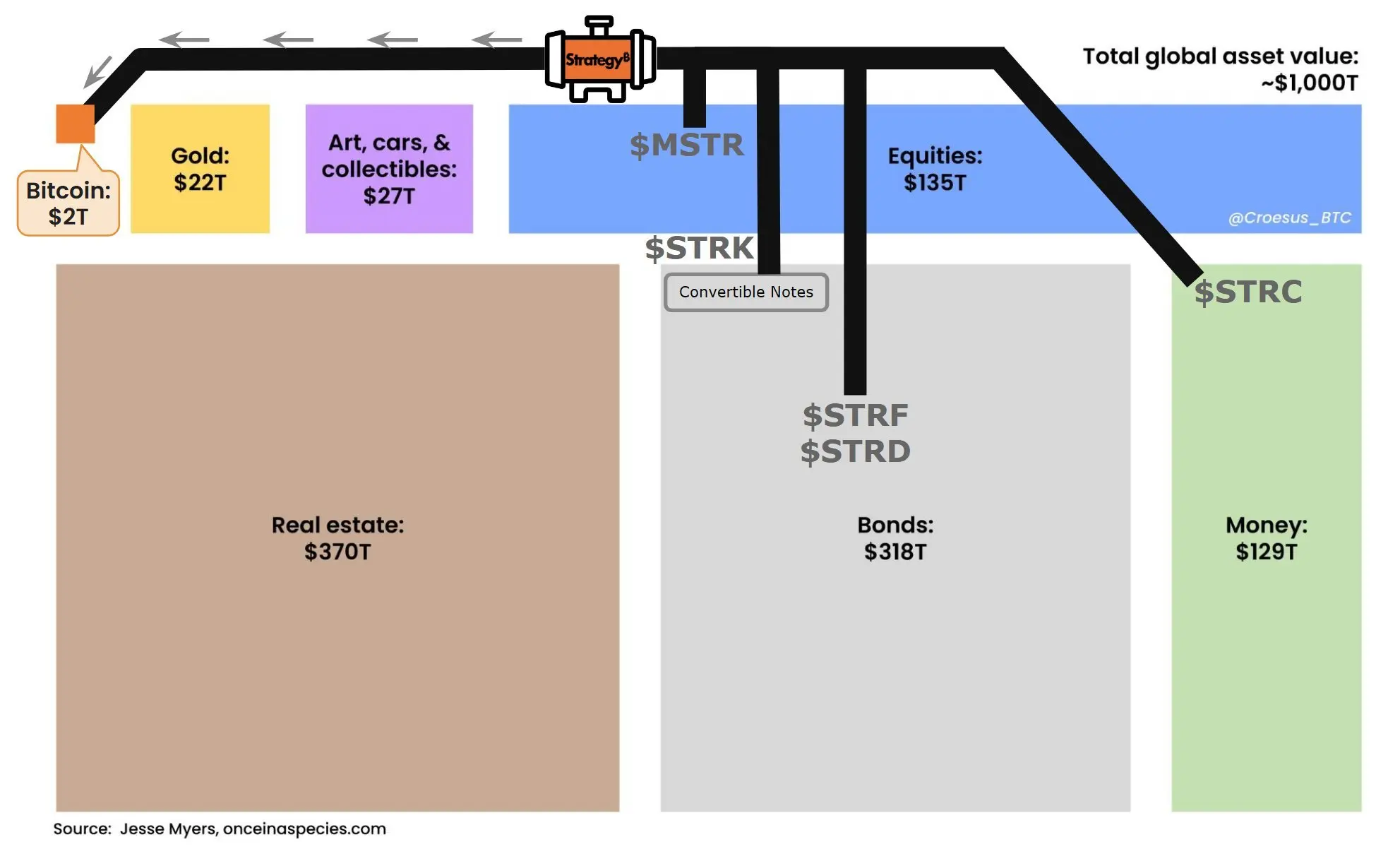
https://x.com/BitcoinArchive/status/1983504370311274948
Although classified as equity under accounting rules, MicroStrategy’s new preferred-share suite functions economically like a set of perpetual bonds. The firm segmented investor profiles with precision to diversify its capital pipeline: STRK appeals to investors seeking both income and potential appreciation; STRF and STRD serve fixed-income investors prioritizing stable, coupon-like returns; and STRC attracts retail capital seeking MMF-level liquidity with variable rates.
Across these diverse instruments, the unifying principle is the same: assuming Bitcoin appreciates over the long term, MSTR “shaves off” volatility to offer yield to investors. From the investor’s perspective, buying STRF or the limited-conversion STRK means exchanging the massive upside potential that Bitcoin could deliver during a bull cycle for a guaranteed, stable annual return of 8–10%. In other words, MSTR attracts conservative capital into its ecosystem by monopolizing Bitcoin’s explosive upside and distributing safe, predictable income in exchange.
The strategy, however, comes with a meaningful trade-off. The cost of capital is materially higher than the 0–1% borrowing rates MSTR previously achieved through convertible bonds. Even so, the company secures clear advantages that justify the expense. Newly issued preferred shares come with either no conversion rights or only restricted ones, which protects existing shareholders from dilution unless dividend payments must be made in-kind (PIK) due to insufficient cash. The perpetual structure, combined with the optional use of PIK payments, effectively grants MSTR infinite-duration capital, eliminating repayment pressure entirely.
This shift in strategy reflects MicroStrategy’s conviction in Bitcoin’s long-term upward trajectory. The company is willing to accept higher upfront funding costs to reduce volatility, control risk, and secure permanent capital. Such a pivot signals that MSTR is not merely levered long Bitcoin; it is deliberately reinforcing its capital structure to sustain long-term BTC accumulation through a more advanced and resilient financial architecture.
5. Assessing the Real Risk: Over-Collateralization, Breakeven ARR, and Market Misconceptions
MicroStrategy has secured capital far more efficiently and at substantially lower cost than most companies by precisely controlling and monetizing volatility. This structure has produced a notably resilient balance sheet, which is why current bankruptcy fears circulating in the market are materially overstated.
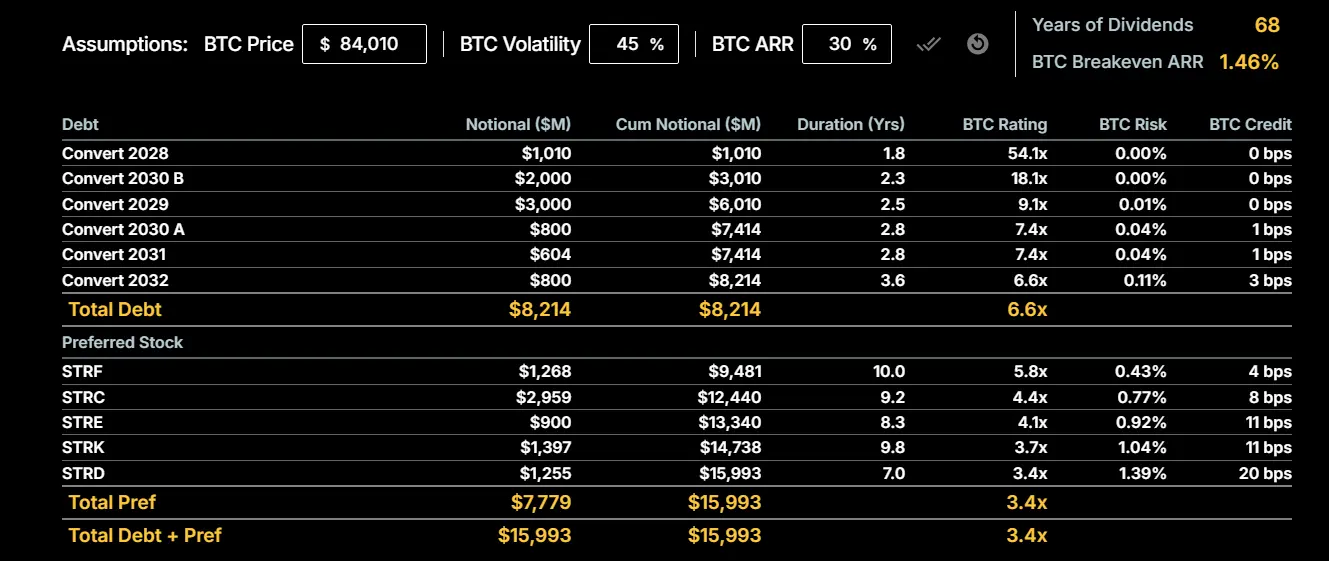
https://www.strategy.com/purchases
MicroStrategy provides transparent disclosures on these risks directly on its website. Approximately $8.2 billion in convertible notes maturing between 2028 and 2032 sits at the top of its capital structure. Simulations indicate a coverage ratio of 6.6x, meaning the company’s Bitcoin holdings exceed its debt obligations by more than six times. Even an 80 percent decline in Bitcoin from current levels would not trigger a default. The default probability on these notes ranges from 0.00% to 0.11%, a range that converges toward “risk-free” from a financial-engineering perspective. In practical terms, the scenario of “forced Bitcoin liquidation due to repayment pressure” is mathematically close to impossible.
The preferred-stock layer—the STR series, including STRK and STRF—also remains solid despite ranking below senior debt. This portion of the capital stack amounts to roughly $7.8 billion and consists of perpetual or long-duration capital with maturities that can extend up to a decade. Even after assuming that all senior liabilities are paid first, the preferred shares maintain a 3.4x coverage ratio. Their default probability is similarly low at around 1 percent. These figures show that MicroStrategy is not taking on reckless leverage to purchase Bitcoin; it is operating with a safety margin that meaningfully exceeds conservative benchmarks. In periods of liquidity stress, STRK’s PIK feature can further limit downside, which reinforces the stability of preferred dividends.
One metric captures the company’s resilience particularly well: the BTC Breakeven Annualized Return Rate (BTC Breakeven ARR). Simulations suggest that MicroStrategy can continue paying current interest and dividends as long as Bitcoin appreciates by 1.46 percent per year. Bitcoin does not need to rally; even growth below a typical savings-account yield is sufficient for MicroStrategy’s capital engine to operate smoothly for the next 68 years. The conclusion becomes clear once the numbers are considered. MicroStrategy is not structurally exposed to Bitcoin’s volatility. It is over-collateralized to a degree that comfortably absorbs such fluctuations. Much of the fear in the market stems from misunderstanding the company’s capital-raising architecture. In reality, MicroStrategy is better positioned than any other DAT firm to withstand a prolonged Bitcoin downturn.
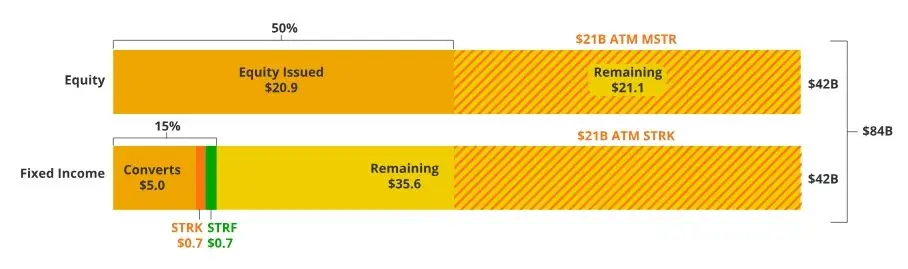
A review of the company’s capital-raising roadmap, known as the 21/21 Plan, provides further clarity. Most of the targeted equity capital raised through ATM issuances has already been completed. The focus of future fundraising will shift away from equity markets and toward the convertible-bond and preferred-stock (fixed-income) markets.
Flow-related headwinds, such as failure to secure MSCI index inclusion or potential removal, are therefore unlikely to harm MicroStrategy’s fundamentals. The company has already reduced its reliance on equity issuance and pivoted toward a funding structure centered on convertibles and preferreds. As a result, concerns that index-related issues could trigger a funding squeeze or force the company to liquidate Bitcoin have very little basis.
Disclaimer
I confirm that I have read and understood the following: The information contained in this article is strictly the opinions of the author(s). This article was authored free from any form of coercion or undue influence. The content represents the author's own views and does not represent the official position or opinions of CrossAngle. This article is intended for informational purposes only and should not be construed as investment advice or solicitation. Unless otherwise specified, all users are solely responsible and liable for their own decisions about investments, investment strategies, or the use of products or services. Investment decisions should be made based on the user’s personal investment objectives, circumstances, and financial situation. Please consult a professional financial advisor for more information and guidance. Past returns or projections do not guarantee future results.
Xangle or its affiliated partners own all copyrights of the written or otherwise produced materials and content provided on the platform. Any illegal reproduction of such content, including, but not limited to, unauthorized editing, copying, reprinting, or redistribution will result in immediate legal actions without prior notice.


![[ADOPTION] L1 - Why Global Enterprises Are Betting on Avalanche](https://resource.xangle.io/content/thumbnails/2063/content_2063_thumbnail_7f6244bf.webp)