Scroll (SCR): Powering Real-World Crypto with Open Economy


Table of Contents
1. Introduction: The Next Challenge for Rollups Is Not Technology—It's Users
2. From Local to Global: Scroll’s Open Economy Strategy
3. From DeFi to Real-World Products: The Expanding Scroll Ecosystem
4. Euclid Upgrade: The First ZK Rollup to Reach Stage-1
5. Final Thoughts: Scroll’s Open Economy, Built on Proven Strategies
1. Introduction: The Next Challenge for Rollups Is Not Technology—It's Users
Ethereum Layer 2 solutions, particularly ZK rollups, have moved past the concept validation phase and are now entering the stage of tangible implementation. While major ZK rollup projects have sequentially launched their mainnets and established a certain level of technical foundation, they’ve revealed limitations in acquiring and retaining users—evident in sharp post-token-launch drops in core metrics like TVL. Where once technological prowess and performance were the keys to attracting users, the current stage demands practical usability and clearly defined use cases for sustainable ecosystem growth. High TPS and low fees alone are no longer enough to deliver tangible value to users. Without reduced entry barriers, intuitive UX, and real-world applicability, mass adoption of Layer 2s remains challenging.
Scroll, which also saw a TVL decline following its token launch, is not merely content with providing a decentralized network infrastructure. Instead, it places priority on structurally designing entrepreneurial pathways that allow builders to solve real problems through product development and secure an initial user base. While technological advancement is a necessary prerequisite, the true determinant of long-term viability lies in effectively linking that technology to real users. In this landscape, builders are encouraged to design problem-solving products and validate Product-Market Fit (PMF), while users engage with tangible, locally grounded solutions that deliver meaningful value.
Scroll’s open economy strategy can ultimately be interpreted as an attempt to move beyond a tech-centric blockchain ecosystem and realize a sustainable economic model grounded in usability and market fit. To achieve this, Scroll continues to implement strategic initiatives across various fronts—from organizing community-driven hackathons, to nurturing real-problem-solving DApps, and carrying out protocol-level technological upgrades.
2. From Local to Global: Scroll’s Open Economy Strategy
https://scroll.io/blog/scroll-open
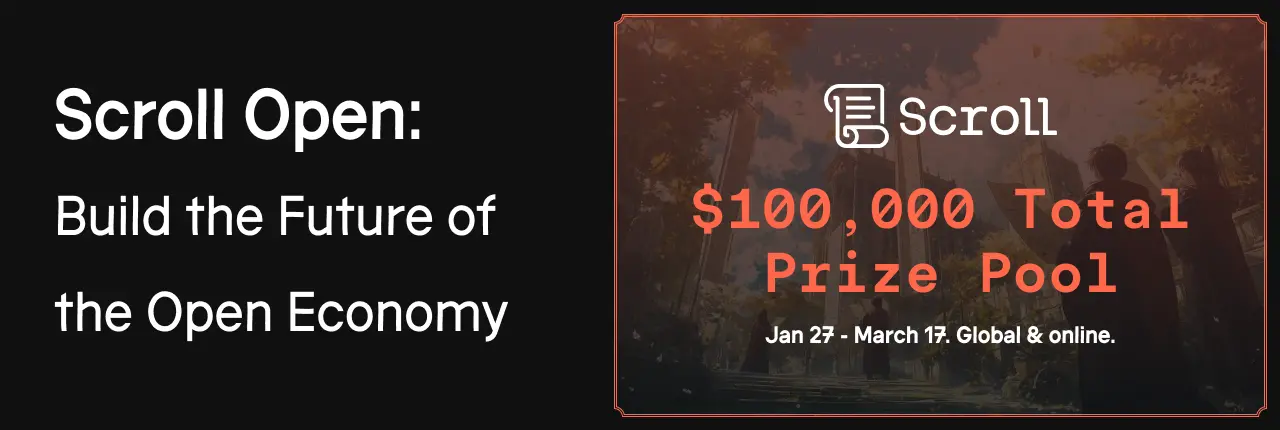
In the first half of 2025, Scroll laid the foundation for global ecosystem expansion by discovering local talent through its Scroll Open program. This large-scale online hackathon and startup support initiative ran for six weeks and attracted over 750 builders worldwide, resulting in the submission of more than 70 projects. Participants represented 68 countries, creating a genuinely global competitive environment, and competed for a total prize pool of $100,000. The program structure went beyond conventional coding tasks, emphasizing comprehensive skill-building with weekly lectures, mentorship sessions, and practical exercises centered on Minimum Viable Product (MVP) development. These activities were deliberately designed to help participants build capabilities in product design and validate their solutions' Product-Market Fit (PMF). Ultimately, Scroll Open aimed to lower barriers to entry in the Web3 ecosystem, enabling developers from diverse geographical backgrounds to easily engage and innovate within the blockchain space.
During the intensive six-week development period, three overall winning teams gained particular attention for their practical, globally targeted services:
- 1st Place – Foresight: A decentralized prediction market platform enabling investors to profit from market insights.
- 2nd Place – PolyStream: A DeFi earnings dashboard that prioritized Web2-friendly UX, gasless transactions, and intuitive design to improve accessibility and usability.
- 3rd Place – SynthOS: A no-code platform for automating DeFi strategies, where users could create and deploy AI agents based on policy logic.
These projects perfectly aligned with Scroll Open’s core mission, prioritizing practical utility and user accessibility.
Award-winning projects across the thematic tracks also showcased diverse ideas underscoring Scroll’s potential for ecosystem expansion. Winners and runners-up in each of the four categories enabled Scroll to explore various dimensions of growth within its open economy:
- DeFi Track:
- deSync proposed a zero-interest lending protocol, enabling both interest-free borrowing and profit-generating lending simultaneously.
- Bulwark developed an AI-based DeFi strategy optimization tool enabling automated yield management across multiple protocols.
- RWA (Real-World Assets) Track:
- Fractionax created a platform for fractional trading of high-value physical assets.
- Blocknogotchi expanded the link between Web3 and tangible assets through an NFT card-based battle game.
- Consumer/Mobile Track:
- AI Betworks introduced an AI-driven predictive gaming interface.
- Chama presented a savings platform that digitizes traditional rotating savings schemes via smart contracts on-chain.
- Payments Track:
- 0xSeree developed a Telegram MiniApp enabling local-currency-based remittances in Ethiopia.
- Constella (Duin) delivered a specialized wallet infrastructure tailored for autonomous AI agents, demonstrating advanced technical execution.
Scroll Open Campus (Source: https://x.com/0xNazreen/status/1923569606595314086)
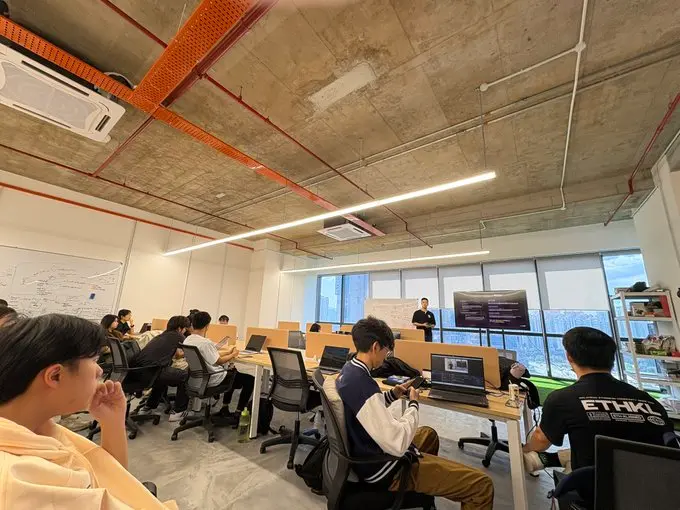
Scroll Open didn’t end with prize money distribution. To ensure sustained product development, top-performing teams were offered an opportunity to join Scroll Open Campus. After the hackathon, Scroll invited 10 outstanding project teams to a local residency program in Kuala Lumpur, Malaysia, for eight weeks of intensive incubation. In this program, teams cohabitated at a startup campus where they received support for product refinement, user acquisition, and investor connections. Of particular note was the inclusion of Web3 entrepreneurs from emerging regions such as Africa, Latin America, and Southeast Asia—a strategic choice that made Malaysia an ideal hub where builders from various nationalities could easily gather. This global incubation model allows promising local teams to scale their projects into global services within the Scroll ecosystem.
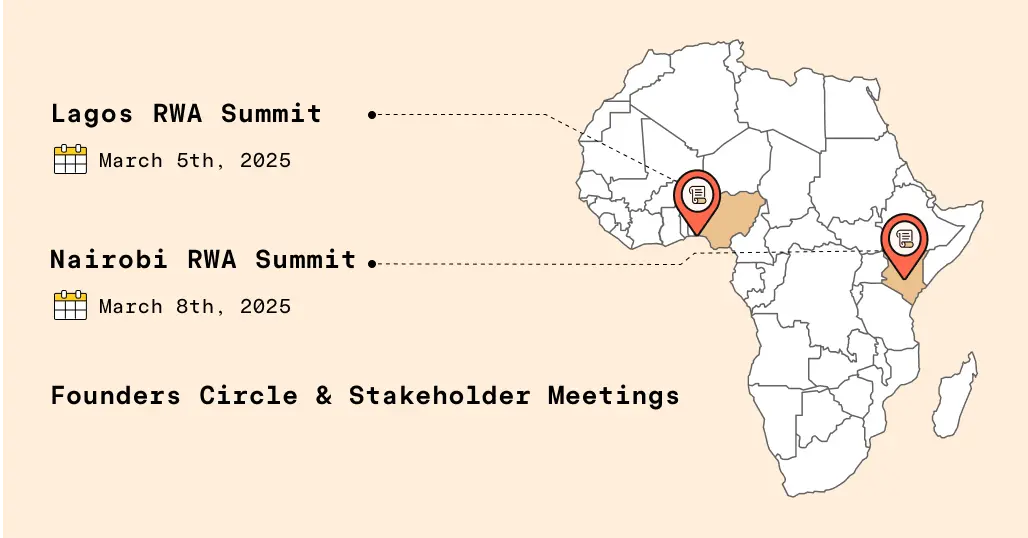
In tandem with these efforts, Scroll also launched its Scroll Africa Tour in the first half of 2025 to expand its regional ecosystem footprint. In Lagos, Nigeria, and Nairobi, Kenya, Scroll hosted RWA Summits to facilitate in-depth discussions around real-world asset tokenization, stablecoin design, and on-chain payments—linking blockchain with Africa’s real economy. These events validated the demand for on-chain financial solutions in emerging markets, spotlighting local projects like ViFi and highlighting the kinds of products that can deliver real value to users. Scroll also held closed-door roundtables and a Founders Circle program with policymakers, fintech companies, and local startup founders, effectively building strategic connections between talent and infrastructure while laying a solid foundation for long-term partnerships.
https://scroll.io/blog/scroll-africa-tour
These region-centric strategies have already produced tangible results. In Africa, for example, ViFi is addressing excessive international remittance fees through blockchain technology, providing meaningful financial accessibility improvements. Another notable example is Transakt, which has launched cGHS, a stablecoin pegged 1:1 to the Ghanaian Cedi, aiming to deliver a more stable and reliable digital payment method throughout West Africa. Through these solutions tailored to unique local demands, Scroll continues to validate blockchain’s practical efficacy.
Similarly, Scroll’s localized open economy strategy has delivered visible results in the Southeast Asian (SEA) market. As of May 2025, Scroll’s native token, $SCR, has successfully listed on five prominent exchanges with strong regional presence: Thailand’s largest exchange Bitkub, the Philippines’ leading exchange Coins.ph, Coinstore (primarily active in Indonesia and the Philippines), Bitrue, which maintains significant user coverage across SEA, and the globally recognized exchange HotcoinGlobal. These strategic listings have substantially streamlined the onboarding process by enabling transactions with local currencies, significantly lowering entry barriers for SEA users and laying a solid foundation for enhanced ecosystem participation.
In summary, Scroll’s expansion strategy, driven by its Open Economy initiative, prioritizes addressing specific regional financial challenges and securing authentic user adoption rather than merely showcasing advanced technology. This demand-driven approach has delivered notable achievements in a relatively short span of time. Scroll’s leadership is particularly committed to investing in projects originating from emerging markets, recognizing that grassroots innovation will serve as a critical catalyst for broader global ecosystem expansion. From an investor’s perspective, this strategic orientation is particularly appealing because it prioritizes sustainable user-base growth alongside technological advancement.
3. From DeFi to Real-World Products: The Expanding Scroll Ecosystem
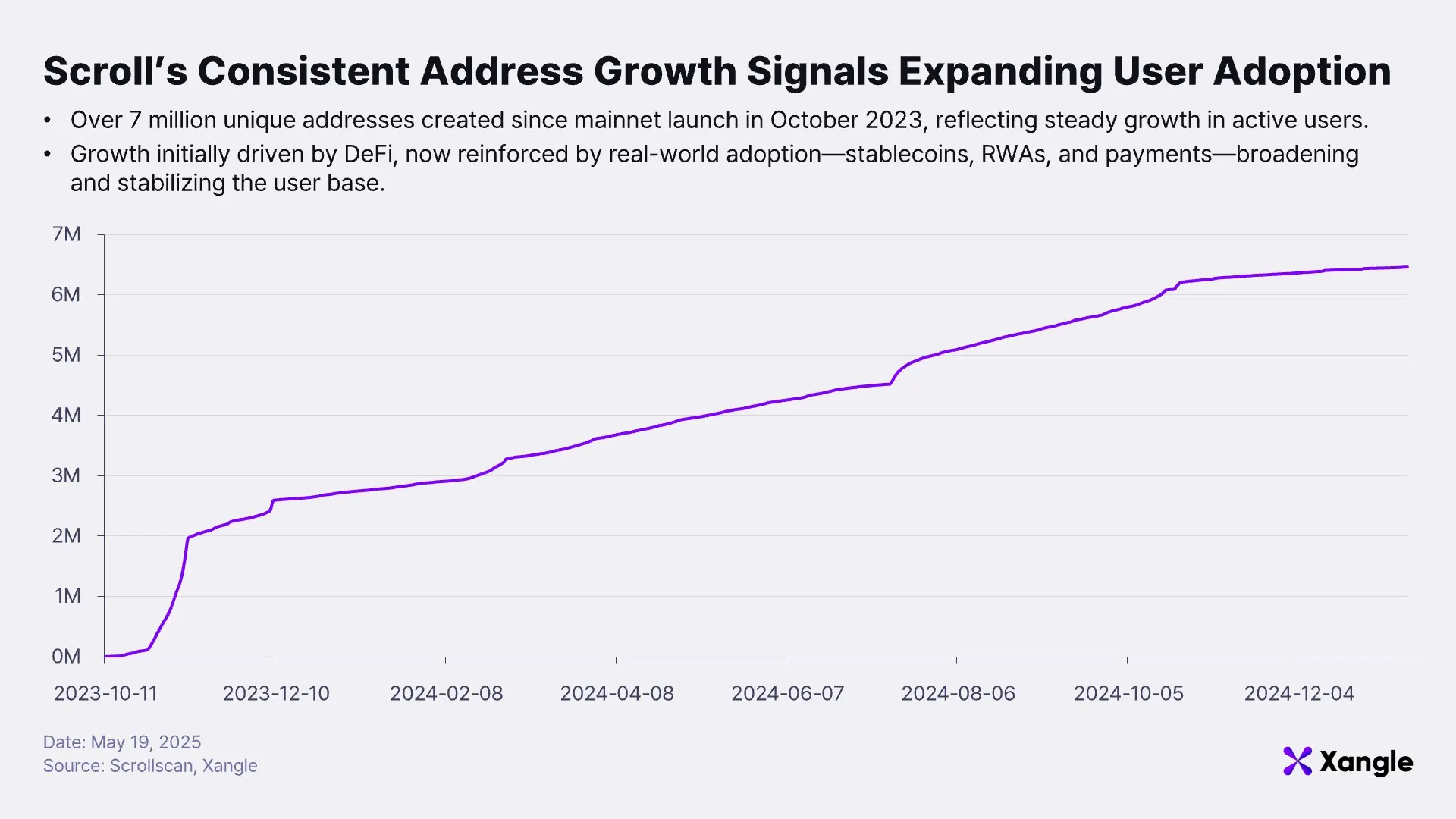 The number of unique addresses on the Scroll network has been steadily increasing—a trend driven not only by DeFi, but also by the onboarding of services focused on real-world use cases. In Q1 2025, Scroll accelerated ecosystem diversification through real-world DeFi and consumer-oriented applications. One representative case is ether.fi, which launched ether.fi Cash, a non-custodial crypto card service built on Scroll. This innovative service enables users to collateralize their crypto assets to establish credit limits and use these cards for payments at any Visa-accepting merchant globally. Users receive up to 3% cashback in $SCR, and the integration of passkey-based authentication along with a gasless transaction structure significantly enhances real-world usability and accessibility.
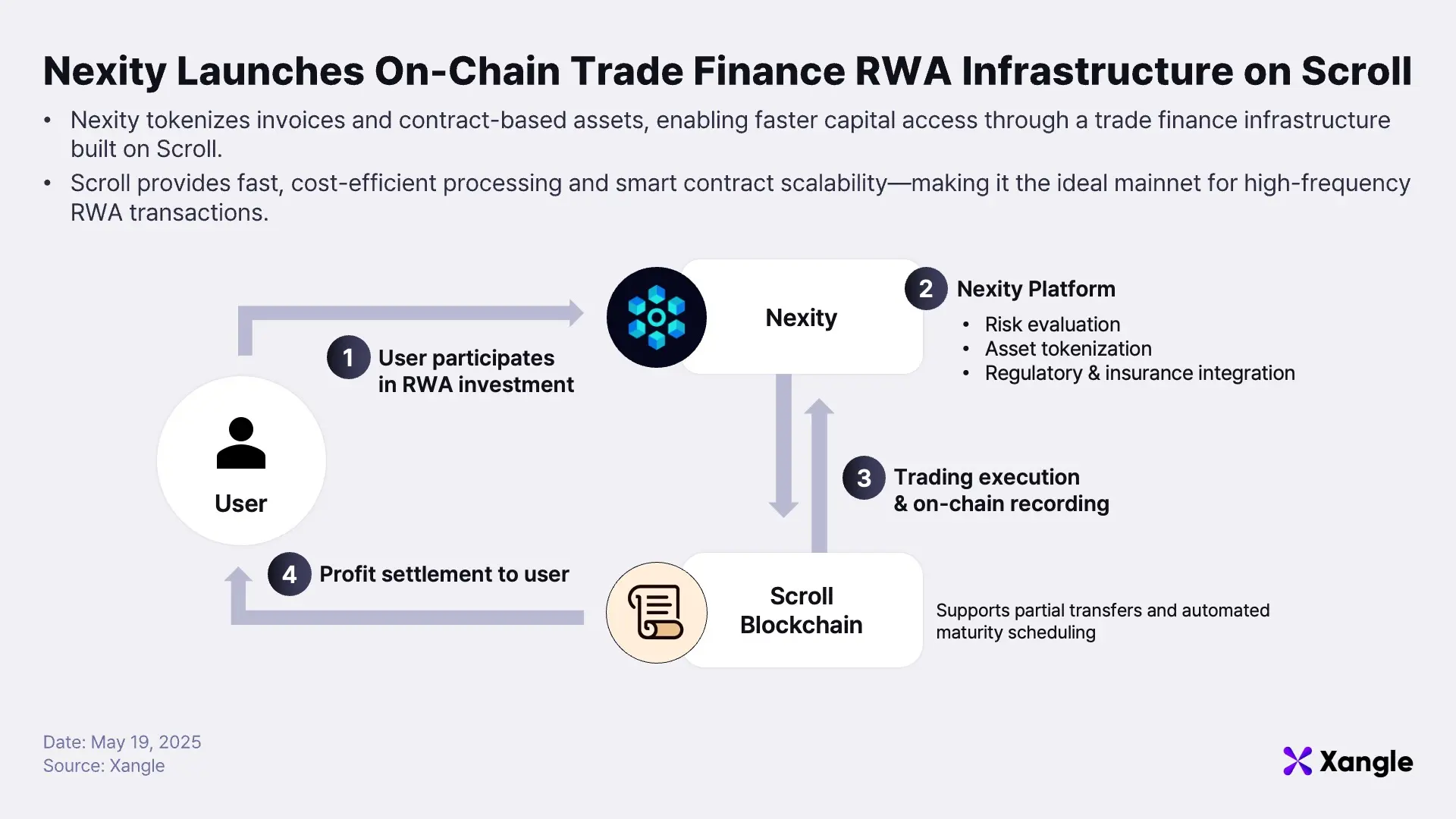
In the Real-World Asset (RWA) sector, Nexity has drawn significant attention by joining Scroll’s ecosystem. Nexity focuses on tokenizing trade finance and real-world contract-based assets, enabling SMEs to quickly raise capital by collateralizing invoices, contracts, or tangible assets. Addressing traditional challenges of trade finance—high costs and lengthy settlement times associated with cross-border payments—Nexity plans to facilitate high-frequency trading of real-world assets via smart contracts incorporating features like bond tokenization, partial asset transfers, and automated maturity handling. Nexity highlights Scroll’s low transaction fees and rapid settlement finality as pivotal factors influencing its platform selection.
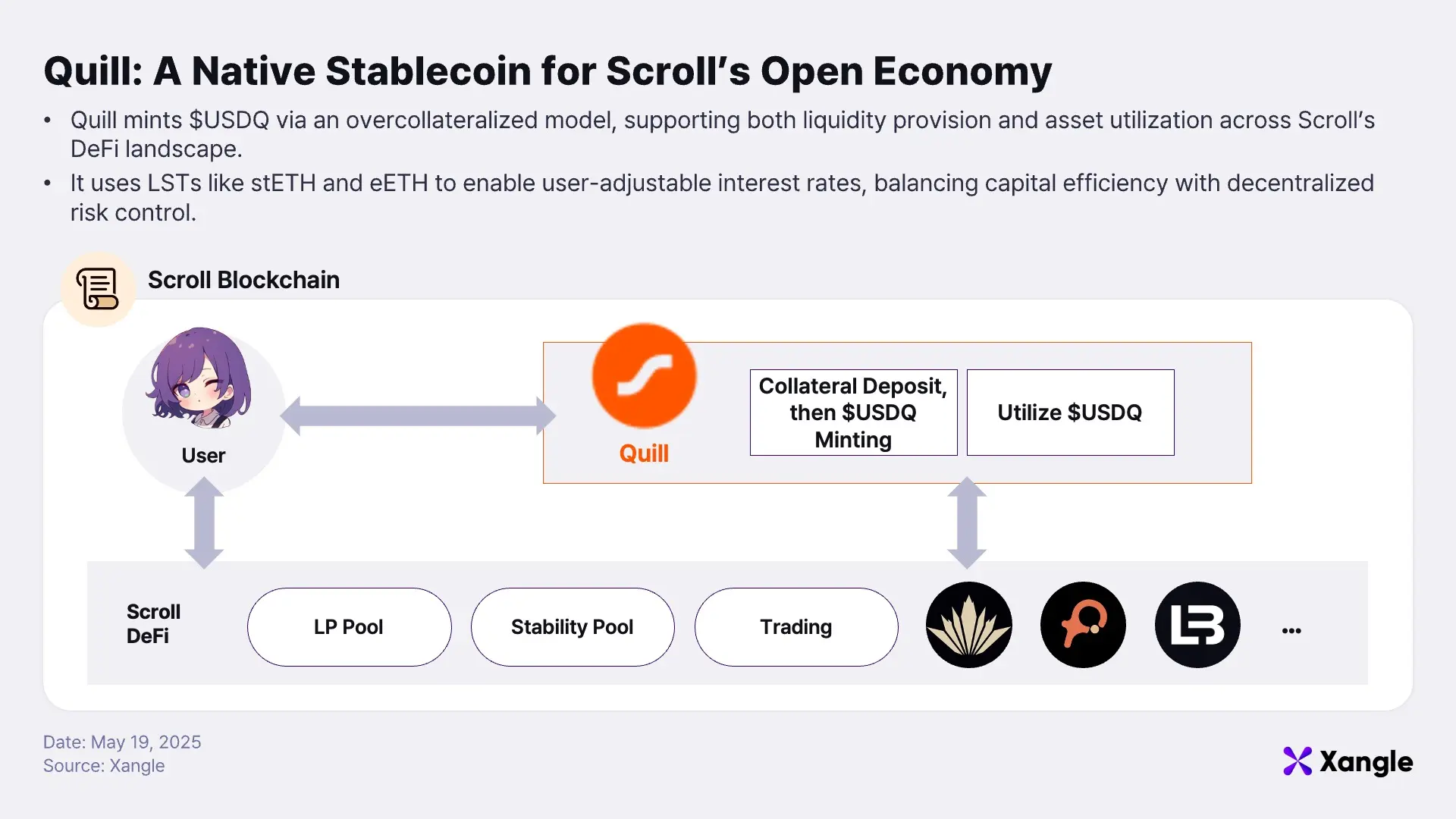
In the stablecoin sector, Quill is expanding around its overcollateralized stablecoin $USDQ, which is backed by LSTs such as stETH and eETH. This model boosts capital efficiency while enhancing system stability and transparency. Based on Liquity V2, the protocol allows users to flexibly set interest rate ranges and features an efficient liquidation mechanism. Scroll’s contribution here extends beyond minting mechanics, helping shape a stablecoin ecosystem tightly integrated with LSTs—contributing to the real-world viability of decentralized financial systems.
Scroll is also strengthening its collaboration with key infrastructure layers to enhance the developer experience. For instance, Tenderly, a comprehensive full-stack infrastructure platform for Web3 developers, supports the Scroll ecosystem by offering simulation, debugging, and gas profiling tools, enabling rapid and stable application development on Scroll’s mainnet and testnet environments. Meanwhile, Chainlink supplies Scroll’s mainnet with low-latency data streams, facilitating high-performance DeFi application development. Crucially, collaboration with Chainlink is strategically important as it lays the infrastructural groundwork necessary for attracting institutions and traditional financial entities in the long term.
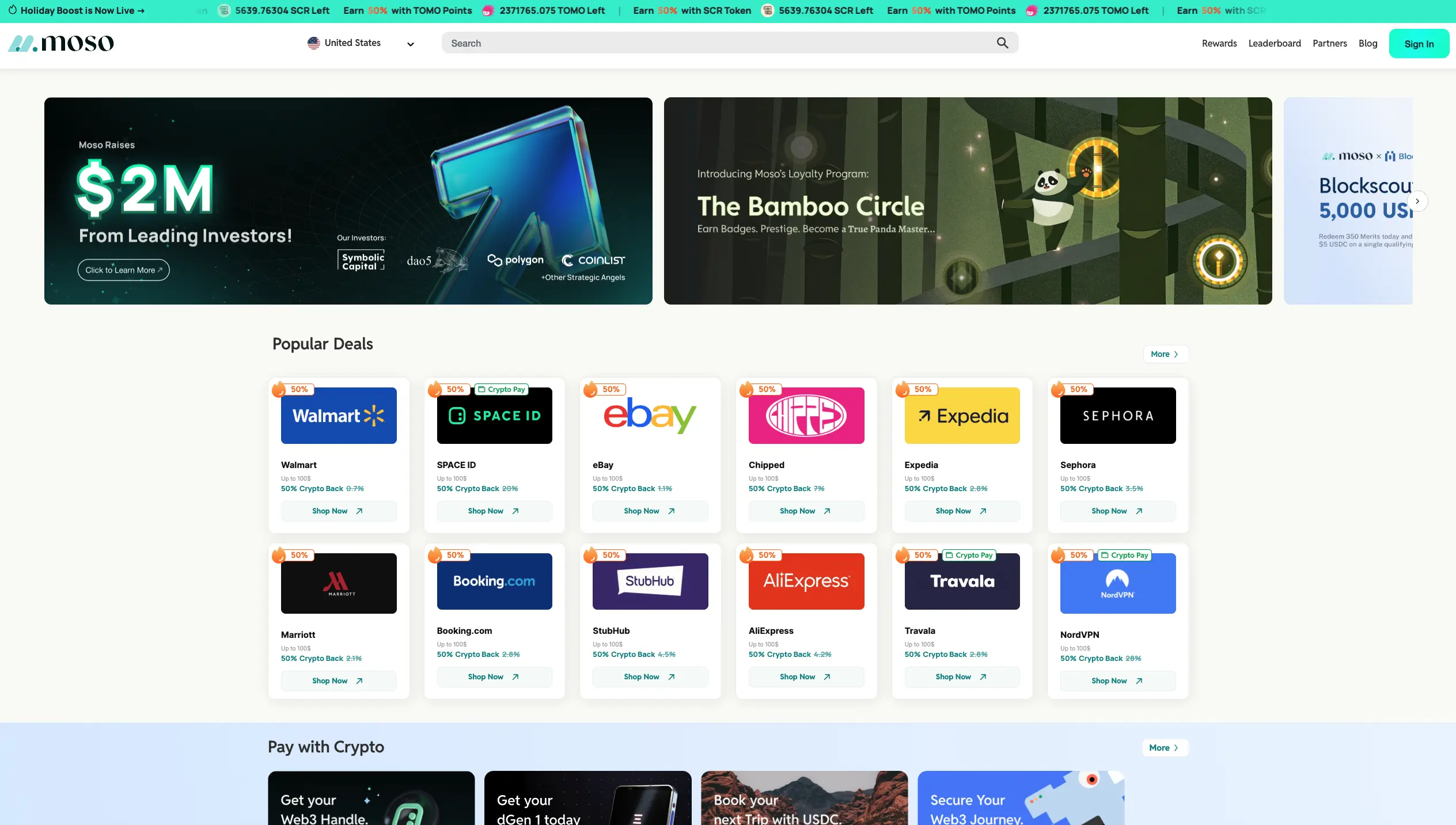
Meanwhile, Scroll’s ecosystem is also expanding into tangible consumer-facing applications. A noteworthy example is Moso, a service enabling direct crypto payments for products tagged with "Crypto Pay" across various prominent global retailers—including Walmart, eBay, Expedia, AliExpress, Space ID, and Sephora. By extending beyond conventional on/off-ramp structures, Moso is creating a practical environment wherein users can directly utilize cryptocurrencies for everyday purchases, a meaningful step toward mainstream adoption.
While Scroll’s expansion strategy until last year primarily centered on DeFi-driven bootstrapping, the focus has now clearly shifted toward applications and products emphasizing real-world utility—such as stablecoins, crypto cards, RWAs, and practical payments. This evolving trajectory highlights Scroll’s transformation from a basic infrastructure-level rollup solution into a comprehensive open economy platform bridging DeFi seamlessly into everyday life.
4. Euclid Upgrade: The First ZK Rollup to Reach Stage-1
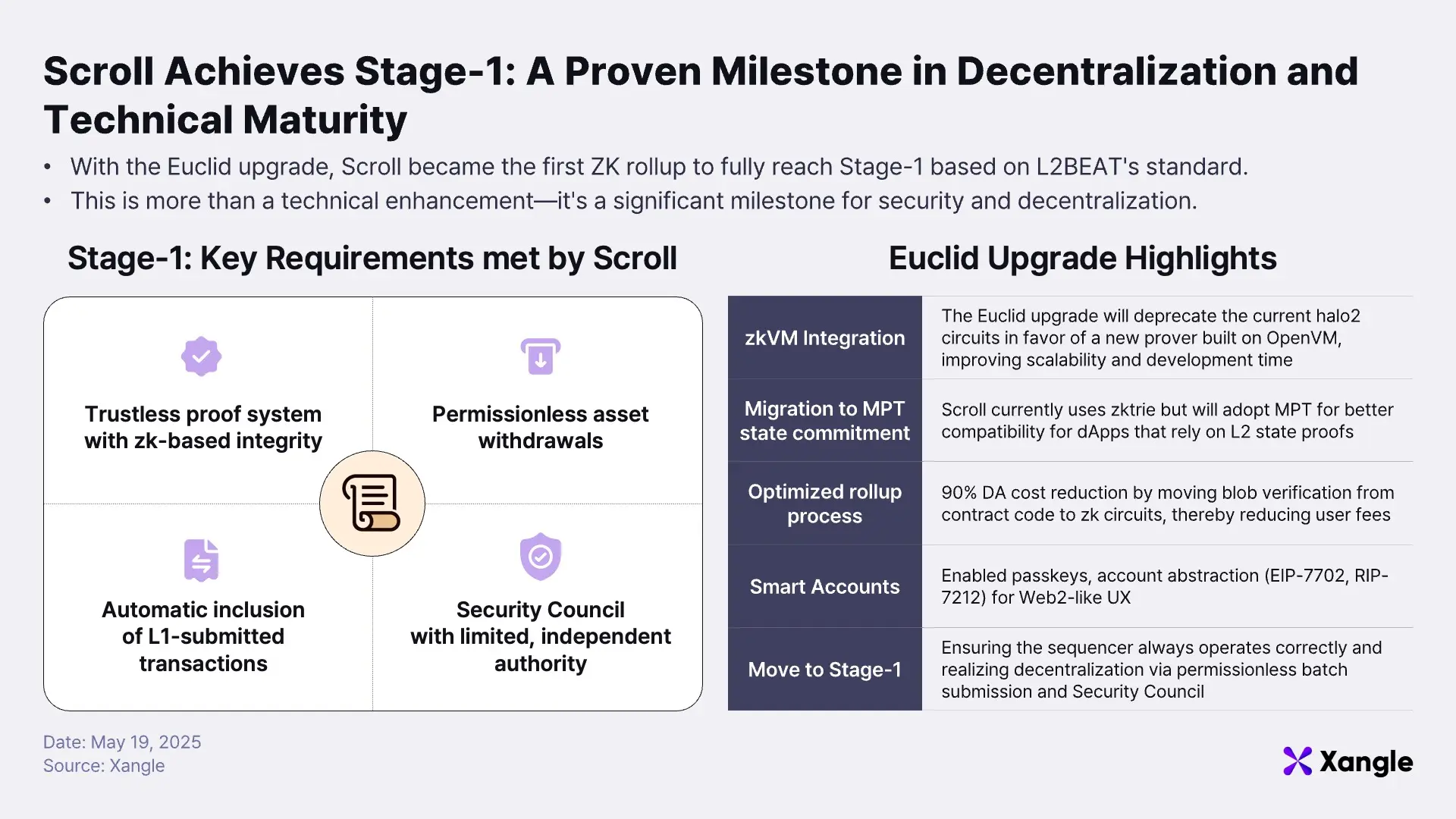
In April 2025, Scroll completed the Euclid upgrade—its most significant protocol enhancement since the mainnet launch—becoming the first ZK rollup to attain "Stage-1" status as defined by L2BEAT. Stage-1 represents more than mere functional improvements; it evaluates whether a rollup protocol satisfies critical decentralization criteria. Specifically, users must securely withdraw assets without relying on a centralized sequencer, enforced inclusion of Layer-1 submitted transactions must be implemented, and protocol upgrades must include a minimum seven-day delay. Additionally, an independently governed Security Council with clearly limited powers must exist for emergency responses. Through Euclid, Scroll successfully satisfied these stringent criteria, officially positioning itself as the first ZK rollup to structurally embed comprehensive user protection and censorship resistance, both technically and operationally.
Although Scroll previously functioned as a fully ZK-based rollup, it was structurally constrained by its dependency on a centralized sequencer. The Euclid upgrade transformed Scroll into a true zero-operator-trust system. In this model, if the sequencer becomes unresponsive or attempts censorship, a permissionless mode automatically activates, enabling anyone to submit blocks and provide proofs. Concurrently, Scroll introduced a general-purpose zkVM architecture based on OpenVM, substantially increasing flexibility and performance in proof processing. It also established foundational infrastructure for future expansions, including smart account functionalities and EIP-7702 compatibility. Ultimately, achieving Stage-1 status signifies that Scroll has transcended mere technical performance to deliver a genuinely decentralized ZK rollup that prioritizes user protection at the protocol level.
The Euclid upgrade included five major technical improvements across performance, security, and scalability—setting a new standard for ZK rollup architecture:
-
Migration to OpenVM zkVM Architecture
Transitioning from the prior Halo2 circuits to an OpenVM-based general-purpose zkVM significantly improves scalability, flexibility, and development speed.
-
State Commit Structure Transition to MPT
Moving from zkTrie to Ethereum’s standard Merkle-Patricia Trie (MPT) simultaneously enhances dApp compatibility and state verification efficiency.
-
Optimized Rollup Process
Data Availability (DA) costs are estimated to be reduced by up to 90% through optimized message queue handling, redesigned blob structures, and multi-blob commitments, directly translating to significantly reduced user transaction fees.
-
Implementation of Smart Accounts (EIP-7702 & RIP-7212)
Euclid will implement sophisticated smart account functionalities—including account abstraction and passkey-based authentication—bringing user experience on par with traditional Web2 standards.
-
Move to Stage-1 & Permissionless Batch Submission:
Euclid introduces enforced transaction inclusion via L1, which will enable anyone to submit blocks and proofs in the event of sequencer failure or censorship. A 12-member multi-signature Security Council governs upgrades, all of which require a 3-day timelock for transparent execution.
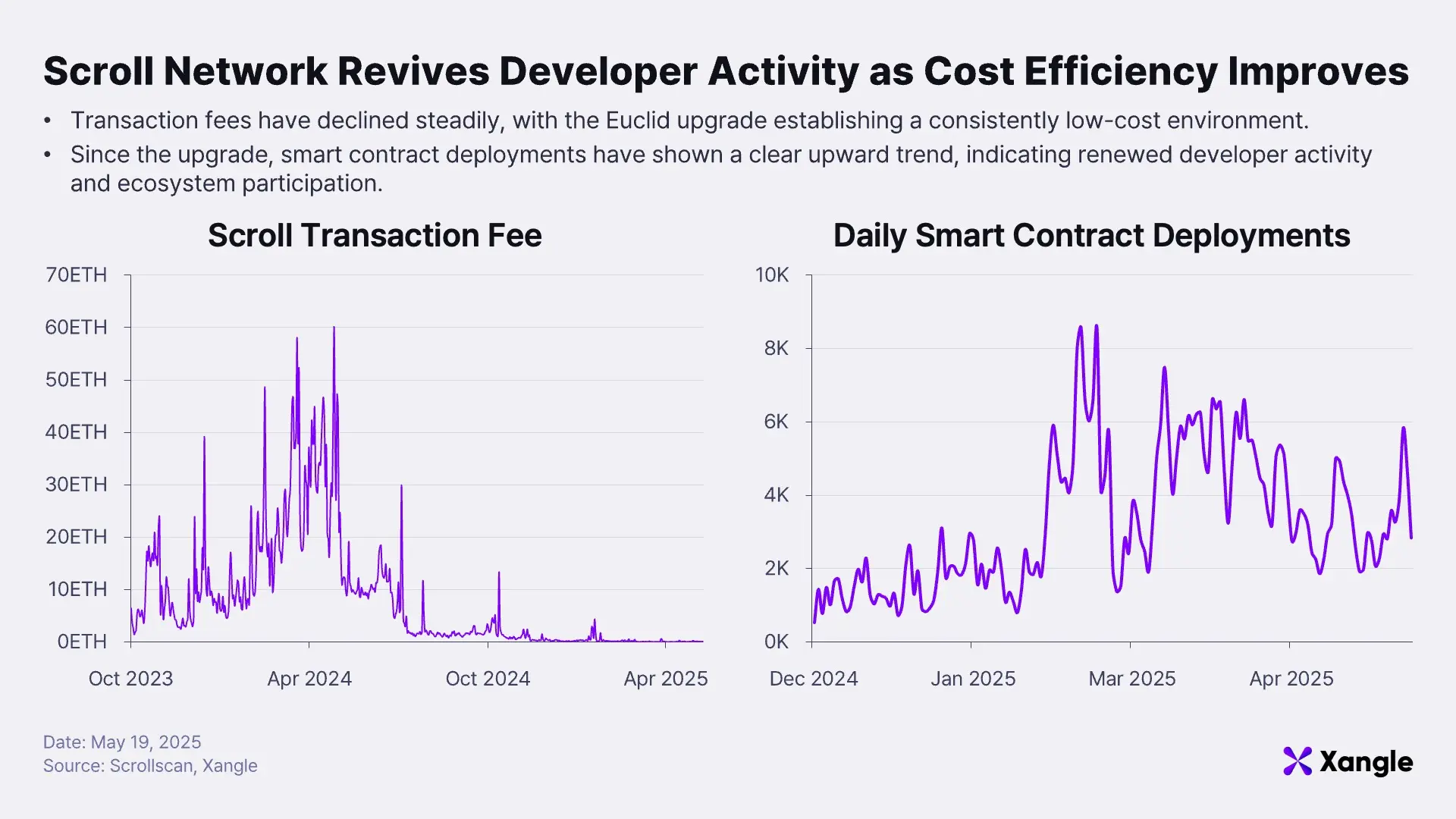
.In essence, the Euclid upgrade marked Scroll’s leap from technical enhancement to true decentralization—eliminating one of the most criticized vulnerabilities in rollup architecture: operator risk. The upgrade delivered up to 90% reduction in fees, over 4x increase in throughput, and unlocked greater flexibility for developers through zkVM and smart accounts. These advancements clearly demonstrate Scroll’s commitment beyond purely infrastructure-level technological improvements, emphasizing meaningful user-centric usability. The introduction of censorship resistance, permissionless operations, and smart account infrastructure lays a robust foundation upon which practical dApps and real-world financial services can reliably flourish on the Scroll network.
While Scroll has executed numerous technological updates previously, the Euclid upgrade is particularly noteworthy as it formally initiates Scroll’s ambitious 2025 roadmap, clearly focused around three strategic goals: becoming the safest rollup, the fastest rollup, and providing a Web2-level user experience. By the end of the year, Scroll aims to transition further into Stage-2 rollup status, implementing a multi-prover architecture, enabling sub-30-second block proofs, and deploying real-time proving mechanisms. Simultaneously, Scroll is transitioning its sequencer to a Reth-based structure and introducing advanced data compression techniques to achieve 10,000 TPS and sub-one-cent transaction fees. User experience enhancements—including comprehensive account abstraction, passkey authentication, and expanded global on/off-ramp integrations—are also concurrently advancing. With these developments, Scroll is progressively transitioning beyond merely technical competition, strategically positioning itself as a foundational digital economy infrastructure that prioritizes practical real-world usability—thus fully embracing its evolution from a technology-centric rollup into a user-driven open economy platform.
5. Final Thoughts: Scroll’s Open Economy, Built on Proven Strategies
With the Euclid upgrade, Scroll has established a well-balanced infrastructure in terms of performance, security, and user experience—marking its transition into a full-scale ecosystem expansion phase. This trajectory mirrors the strategic path taken by many leading blockchain networks, which first focused on refining core infrastructure and then rapidly expanded by fostering native dApp ecosystems. For example, Solana built a high-performance infrastructure from the outset, characterized by fast processing and low fees. It then swiftly scaled its user base around core DeFi applications like Serum, Jupiter, and Mango. Mantle, similarly, has gradually improved its Layer 2 performance and is now pivoting to ZK technology. Through its mETH-centered LST-based liquidity design, it rapidly increased TVL in a short time.
Scroll is following a comparable trajectory. Native projects based on real-world demand are actively onboarding, and the Euclid upgrade has provided the technical and governance foundations necessary for these projects to stabilize and grow. There is also a strong likelihood that Scroll will adopt LST and LRT-based DeFi protocols—an increasingly common strategy among Layer 2s aiming to boost TVL and enhance user retention. Leveraging this strategy could enable Scroll to meaningfully accelerate the expansion of its asset base.
Concurrently, Scroll has strategically targeted emerging markets—including Africa, Southeast Asia, and LATAM—through its Open Campus programs, emphasizing locally tailored, practical use cases to secure an initial user base. This regional approach also suggests potential future expansion into other prominent Web3 hubs, including Korea. Alongside these initiatives, Scroll continues to deliver educational programs such as "Stable School," aimed at deepening users' understanding and practical application of stablecoins, thereby fostering a robust infrastructure environment primed for stablecoin-based application development. Ultimately, should Scroll cultivate a "killer dApp" comparable to Solana’s Hyperliquid or Sui’s Bluefin—capable of driving substantial ecosystem-wide growth—it would firmly establish itself as a benchmark example of a ZK-based rollup successfully integrating advanced technology with tangible real-world usability.
Disclaimer
I confirm that I have read and understood the following: The information contained in this article is strictly the opinions of the author(s). This article was authored free from any form of coercion or undue influence. The content represents the author's own views and does not represent the official position or opinions of CrossAngle. This article is intended for informational purposes only and should not be construed as investment advice or solicitation. Unless otherwise specified, all users are solely responsible and liable for their own decisions about investments, investment strategies, or the use of products or services. Investment decisions should be made based on the user’s personal investment objectives, circumstances, and financial situation. Please consult a professional financial advisor for more information and guidance. Past returns or projections do not guarantee future results. This article was written at the request of Scroll. All content in this article was written independently by the author(s), and neither CrossAngle nor Scroll had any editorial control or influence over the content. The author(s) may hold the cryptocurrencies mentioned in this article at the time of writing.
Xangle or its affiliated partners own all copyrights of the written or otherwise produced materials and content provided on the platform. Any illegal reproduction of such content, including, but not limited to, unauthorized editing, copying, reprinting, or redistribution will result in immediate legal actions without prior notice.