[Xangle Comment] DTCC’s Tokenization Service Goes Live
1. DTCC Launches a Tokenization Service Linking Existing Securities to Blockchains

Key Developments
- Tokenization of existing custodied securities goes live: DTC, DTCC’s depository, launched DTS (DTCC Tokenization Service) on October 28. Using a “digital twin” model, the service enables securities held at DTC to move between conventional and tokenized form while preserving ownership, investor protections, and economic rights.
- 24/7 transfers between registered wallets: The service supports round-the-clock token transfers between wallets registered with DTC. Institutions can register their own wallets and sub-wallets for clients, with token minting and burning connecting the existing depository system to blockchain networks.
- Initial support for Canton and Besu, with network expansion planned for 2027: The service currently supports Canton and DTCC’s private Besu network. Additional networks will be connected based on requirements for security, operational resilience, governance, and compliance.
- Twenty participants, including Mirae Asset Securities’ U.S. subsidiary, sign service agreements: Fidelity, J.P. Morgan, and Morgan Stanley are among the firms that have signed agreements to use the service. The broader ecosystem also includes Ondo, BitGo, Fireblocks, and Taurus, bringing together traditional financial institutions and Web3 infrastructure providers.
Xangle Comment | Joey Kim
DTCC has been laying the regulatory and operational groundwork for the service since last year. After receiving an SEC no-action letter in December 2025, DTC processed tokenized securities transactions in a live production environment with more than 30 firms in July 2026. The launch marks the transition from preparation to broader use by financial institutions.
In the U.S., regulation is taking shape around tokenized equities that offer the same rights as conventional shares. The SEC’s temporary, conditional exemption for tokenized equity trading platforms, introduced in September, requires rights equivalent to those of the underlying shares and excludes products that track prices through separate linked securities or swaps. Applying the taxonomy in our previous report “Business Models in the Tokenized Equity Market,” trading under this framework is expected to expand primarily through the direct issuance and securities rights models.
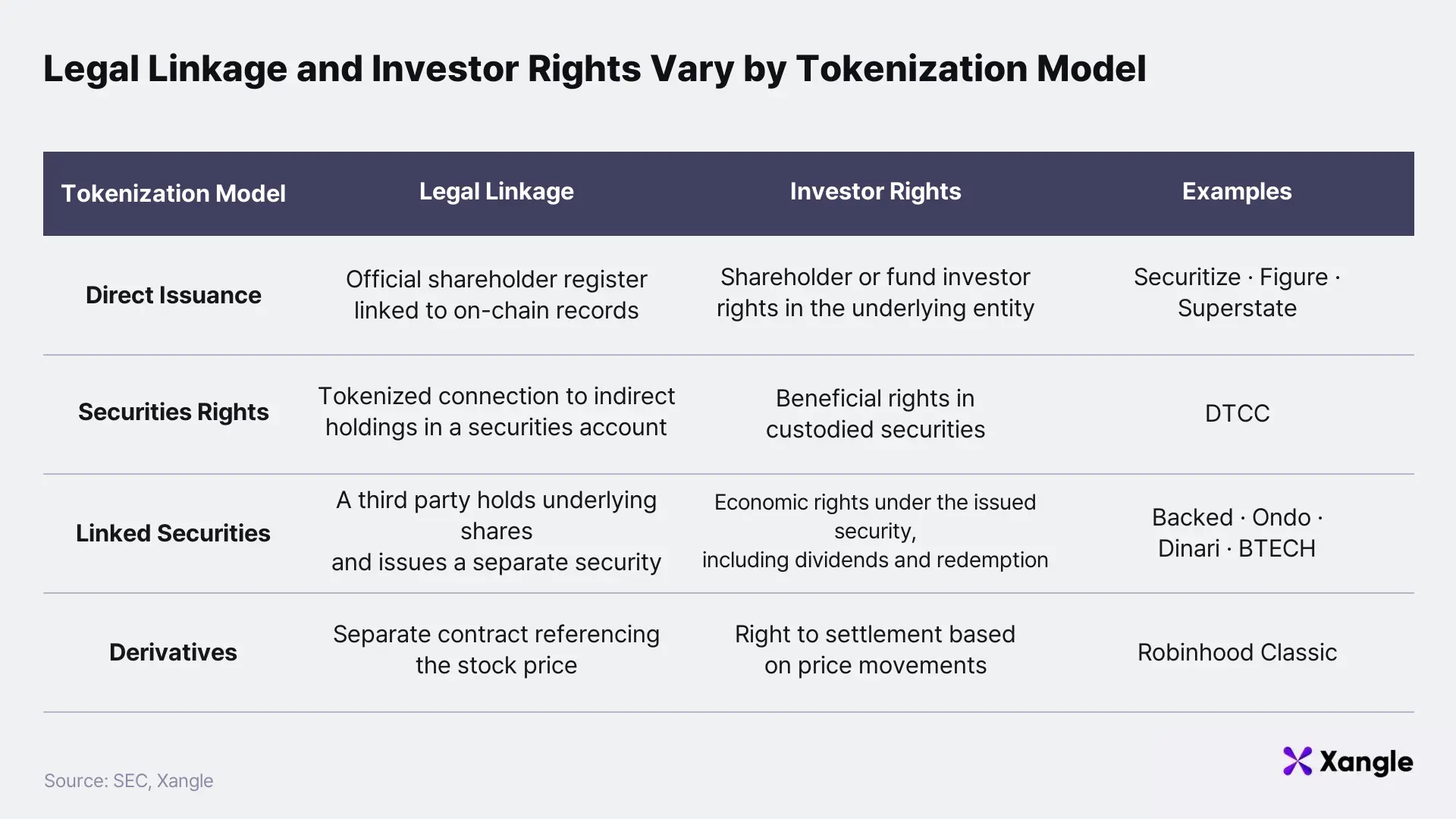
As a core securities depository in the U.S. market, DTC is well positioned to expand the securities rights model of tokenization. The service represents a participant’s rights in securities deposited at DTC as tokens. The existing chain of intermediaries, including brokers, custodians, and DTC, remains in place, along with the responsibilities and procedures for custody and asset administration. Financial institutions can therefore transfer and use their securities on-chain within a familiar depository relationship.
DTS provides infrastructure for financial institutions to tokenize securities deposited at DTC and transfer them between registered wallets. Participants can also register wallets for clients, giving brokers a route to incorporate the service into their customer offerings. If this infrastructure connects to brokers’ order and settlement systems, it could support longer trading hours for retail investors and collateralized financing services.
In the U.S., the securities rights model led by DTCC and the direct issuance model supported by firms such as Securitize and Superstate are expected to expand the regulated tokenization market. Outside the U.S., linked securities and derivatives models are also likely to develop, emphasizing investment access and DeFi utility. It remains uncertain whether regulation will bring these products into a single regulated market or whether they will grow in a market separate from the U.S. regulatory framework. However, given the U.S. push to bring the broader crypto market within its regulatory perimeter, we expect these products to be progressively integrated into the regulatory framework over time as they meet investor protection and distribution requirements.
2. Securitize Plans Support for Tokenized Asset Issuance and Management on Stellar
Key Developments
- Expansion of institutional tokenization infrastructure through Stellar integration: Securitize announced plans to integrate with Stellar on October 28, coinciding with Meridian 2026 in Lisbon, Portugal. Once completed, the integration will allow asset managers to issue and manage tokenized financial assets on Stellar through Securitize’s infrastructure.
- More network options for an established institutional client base: Securitize works with BlackRock, Apollo, and Hamilton Lane on tokenization initiatives. At the end of September, tokenized securities on its platform totaled about $5 billion. The planned integration expands the network options available to institutional clients to meet their operational and distribution requirements.
- Supported products and completion schedule to follow: Securitize is pursuing the integration. The first supported assets and a specific service timeline have not been announced; details will be shared as they become available.
Xangle Comment | Hyeongseok
Securitize has supported tokenized product issuance and investor management for major asset managers such as BlackRock, Apollo, and Hamilton Lane. The SEC’s recent conditional exemption for tokenized equity trading requires tokenized equities to carry rights equivalent to those of conventional shares, including dividend and voting rights. This has placed greater emphasis on preserving investor rights after tokenization. As a transfer agent, Securitize maintains ownership and transfer records. Through product launches with multiple institutions, it has become a leading provider in this field.
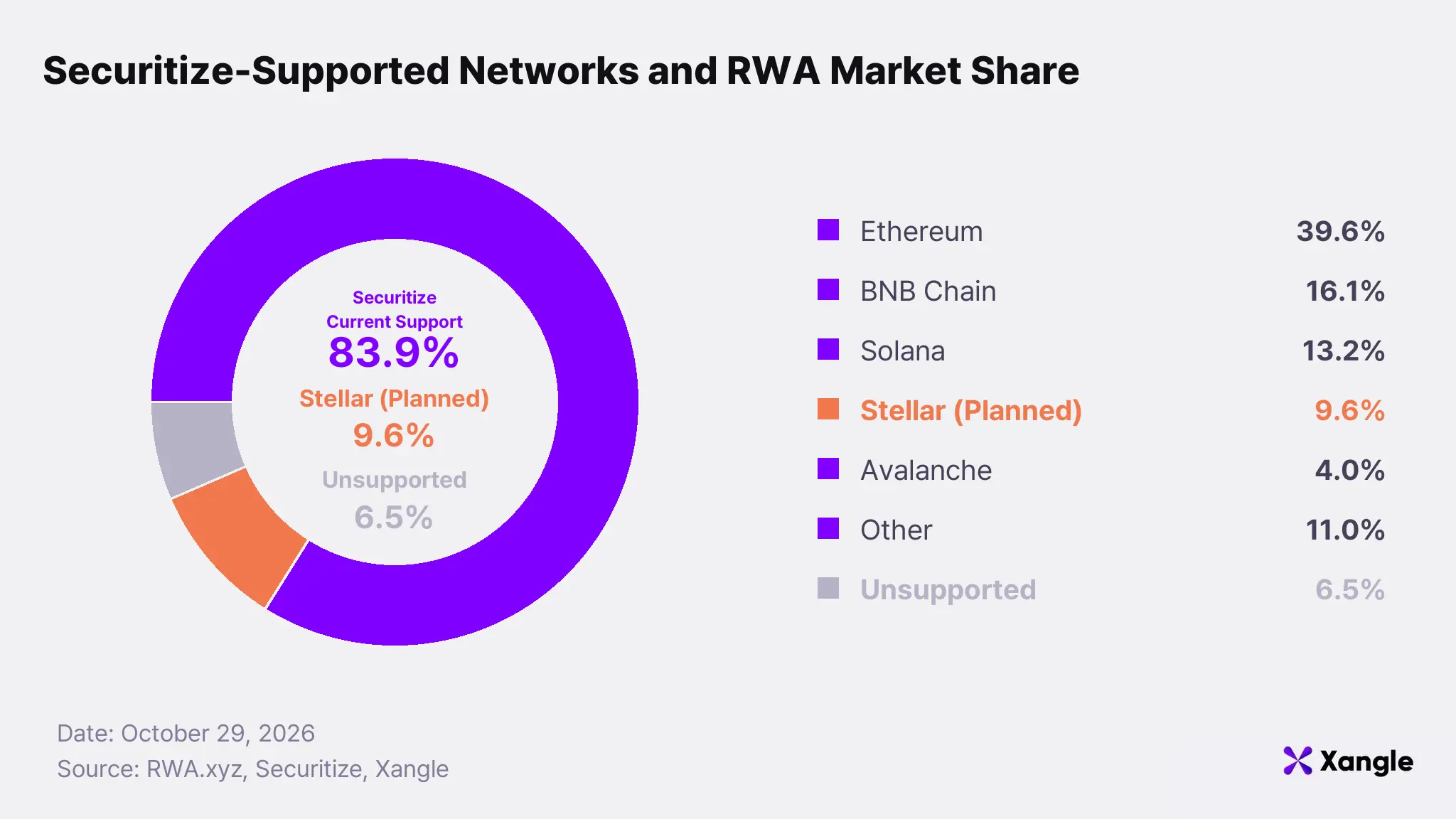
Having expanded issuance support across multiple blockchains, Securitize is now pursuing Stellar integration. Stellar has supported institutional tokenization initiatives, including a fund Franklin Templeton has operated since 2021. More recently, DTCC, a core part of U.S. securities market infrastructure, has also been working to connect its tokenization service to Stellar. Stellar already ranks fourth in the value of issued RWAs, behind Ethereum, BNB Chain, and Solana. Its track record with institutional products, asset base, and the emerging route for existing securities through DTCC make the network a suitable foundation for Securitize’s expansion.
Based on our aggregation of RWA.xyz data, about 83.9% of total RWA value has been issued on networks supported by Securitize. Including Stellar, where integration is planned, brings the figure to 93.5%. Having extended issuance support across major networks, Securitize is likely to place more emphasis on enabling more investors to trade and use these assets.
Securitize has in fact recently launched its own tokenized equity product, “Securitize Stocks,” while working with Jump and Jupiter on liquidity provision and investor access. The company is moving beyond supporting asset managers’ product issuance to offer products directly and enable their trading. Alongside the expansion of its issuance footprint through Stellar, we expect it to continue broadening retail access and DeFi use.
References
- DTCC: Tokenization Service Launch and Participating Institutions
- DTCC: Tokenization Service Overview
- DTCC: Background to Tokenizing DTC-Custodied Assets
- DTCC: Tokenized Securities Transactions in July 2026
- SEC: Temporary, Conditional Exemption for Tokenized Securities Exchanges
- SEC: No-Action Letter for DTC’s Tokenization Service
- Stellar: Securitize’s Planned Stellar Integration
- Stellar: Asset Issuance and Management
Disclaimer
I confirm that I have read and understood the following: The information contained in this article is strictly the opinions of the author(s). This article was authored free from any form of coercion or undue influence. The content represents the author's own views and does not represent the official position or opinions of CrossAngle. This article is intended for informational purposes only and should not be construed as investment advice or solicitation. Unless otherwise specified, all users are solely responsible and liable for their own decisions about investments, investment strategies, or the use of products or services. Investment decisions should be made based on the user’s personal investment objectives, circumstances, and financial situation. Please consult a professional financial advisor for more information and guidance. Past returns or projections do not guarantee future results.
Xangle or its affiliated partners own all copyrights of the written or otherwise produced materials and content provided on the platform. Any illegal reproduction of such content, including, but not limited to, unauthorized editing, copying, reprinting, or redistribution will result in immediate legal actions without prior notice.