[Xangle RWA Series] Solana RWA: A Look at the Vendor Ecosystem


Table of Contents
1. Introduction: The State of the RWA Market and Solana
2. Solana's RWA Ecosystem: From Issuance to Operations
3. Two Approaches to Building a Tokenization Business on Solana
4. Conclusion: Solana's Competitive Strengths in the RWA Market
1. Introduction: The State of the RWA Market and Solana
1.1 Solana in the Growing Tokenized Asset Market
The range of assets available in crypto markets is expanding as funds that invest in government bonds and tokens linked to equities circulate on-chain. Fund shares are issued as tokens, while tokens linked to stock prices can be held in wallets or traded on exchanges. This gives asset managers and issuance platforms a distribution channel to reach on-chain users, while investors gain broader access to traditional assets alongside their existing crypto investments. Real-world asset (RWA) tokenization is expanding the market for both tokenization businesses and investors who use tokenized assets.
Tokenized assets are issued across multiple blockchains, and Solana is becoming a major network in this market. As the overall tokenized asset market expanded from the end of 2025 through the end of August 2026, the value of tokenized assets issued on Solana also increased. Its market share exceeded 10% for the first time at the end of August.

Tokenized assets brought to Solana can be traded and used as collateral through its existing decentralized finance (DeFi) markets. xStocks, which track the prices of stocks and exchange-traded funds (ETFs), trade on decentralized exchanges such as Raydium and Meteora. Some also serve as collateral for stablecoin loans on decentralized lending protocols such as Kamino and Jupiter Lend. Tokenization businesses can connect their assets to exchanges and lending markets with established user bases, while investors can broaden their investments through familiar DeFi services. As new asset supply connects with existing on-chain markets, Solana's tokenized asset market is expanding both in the scale of issuance and in the range of uses available for those assets.
1.2 The Solana Foundation's Progress Toward Internet Capital Markets
The Solana Foundation envisions Internet Capital Markets (ICM), where a wide range of assets can be issued and traded with the speed and accessibility of the internet. Realizing this vision in tokenized asset markets requires participation from both traditional financial institutions that supply assets and vendors that provide the capabilities needed for issuance and ongoing operations. The Foundation is expanding their participation by creating a development environment that makes vendor services easier to integrate, while working with traditional financial institutions on asset issuance and distribution.
Unveiled in March 2026, Solana Developer Platform (SDP) brings vendor capabilities into a single development environment. Tokenization businesses can combine the wallet, custody, and compliance services needed for asset issuance and payments through the platform, reducing the development work required to integrate vendors individually. As of September 2026, SDP is available on Devnet, Solana's development test network, with preparations underway for a mainnet launch.
Collaboration with traditional financial institutions focuses on expanding asset supply and distribution channels. In Japan, the Foundation announced a strategic alliance with SBI Holdings in July 2026 to pursue the tokenization of Japanese assets, including corporate bonds, commercial paper, funds, and real estate, on Solana for distribution across Asian and global markets. The Foundation will participate in SBI R3 Japan and develop the business alongside existing shareholders SBI Holdings and Sumitomo Mitsui Financial Group (SMFG). The initiative plans to combine tokenized asset issuance and distribution with stablecoin settlement.
In Korea, the Solana Foundation is also working with asset managers to test fund issuance and distribution through DeFi. In August 2026, it signed a memorandum of understanding with Shinhan Asset Management, Etherfuse, and Orca for a proof of concept (PoC) involving a Korean won-denominated tokenized fund. The initiative aims to test investor screening and asset distribution by combining a Shinhan Asset Management fund with Etherfuse's issuance and compliance capabilities and Orca's on-chain liquidity. Through partnerships that connect traditional financial institutions' assets with Solana's issuance and trading infrastructure, the Foundation is translating its Internet Capital Markets vision into concrete business designs.
2. Solana's RWA Ecosystem: From Issuance to Operations
Building a tokenization business on Solana requires planning for asset issuance, ongoing operations, and how assets will be used after issuance. This involves connecting an issuance platform with compliance, wallet, and custody services, then enabling trading and collateral use on exchanges or in DeFi as appropriate for the asset. Rather than developing every capability themselves, tokenization businesses can build their services by selecting and integrating vendors that provide them.
Our previous report, Solana RWA: A Look at the Key Players, examined Solana's tokenized asset ecosystem through issuance platforms, oracles, and DeFi. This report broadens the analysis to cover compliance, wallets, custody, asset transfers, and security. It examines the capabilities required to issue and operate tokenized assets and how leading vendors in each area provide them.
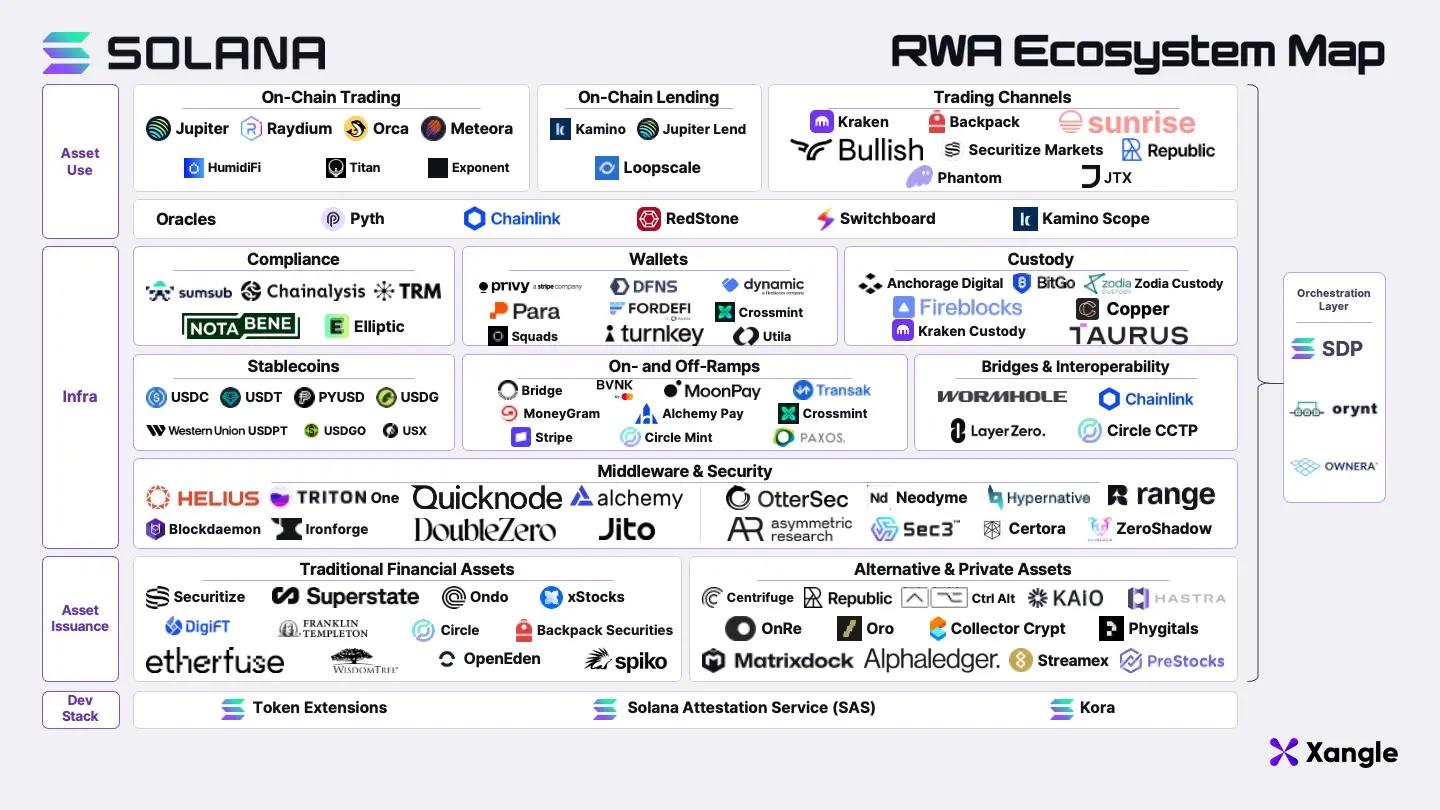
2.1 Compliance
Solana allows investor eligibility requirements and token transfer conditions to be tailored to the characteristics of each tokenized asset. A fund can restrict purchases to investors with specific qualifications, for example, or allow tokens to be sent only to approved wallets. Compliance vendors support the issuance and trading of these assets by verifying investor identities and analyzing transaction risk.

Sumsub verifies individual identities and corporate information, and enables previously verified materials to be reused in screening by other services. In May 2025, it demonstrated how identity verification results from Sumsub ID could be linked to a Solana wallet address through Solana Attestation Service (SAS). SAS is Solana's credential service, allowing verification providers to issue attestations of identity verification or investment eligibility and associate them with wallet addresses. Tokenization businesses that integrate SAS can use attestations confirming that an investor has completed identity verification, reducing the need to request the same documents repeatedly.
Solana's Token Extensions can be used to apply investor screening results to token transfers. One of these extensions, Transfer Hook, runs a program that checks predefined conditions whenever tokens are sent. Tokenization businesses can add a check for approved wallets so that tokens can be transferred only to wallets belonging to investors who have passed screening.
Chainalysis and TRM Labs analyze the origins and movement of funds used in transactions. Both vendors examine wallet addresses and transaction histories to trace dealings with sanctioned entities and the movement of funds stolen in hacks. Chainalysis offers KYT for automated transaction monitoring and Reactor for investigating fund flows. KYT automatically analyzes the deposit and withdrawal transactions connected by a tokenization business and alerts compliance staff when it detects links to sanctioned entities or funds stolen in hacks. Staff can then use Reactor to trace the wallets and exchanges through which the funds have passed and determine whether further checks or a hold on deposits or withdrawals are warranted. Newly issued stablecoins and tokenized assets on Solana are automatically added to these services' coverage.
Notabene provides a Travel Rule network through which exchanges, custody vendors, and other businesses exchange sender and recipient information. It helps businesses check a counterparty's registration details and anti-money laundering controls before sharing customer information, and allows them to configure transfer processing rules according to jurisdictional requirements and counterparties. Notabene's transaction authorization service, Transact, automatically approves asset transfer requests that meet the tokenization business's criteria and routes requests requiring further review to its compliance staff.

2.2 Wallet Infrastructure
Wallet vendors provide the capabilities needed to build wallets for investors to hold and transfer tokenized assets, as well as wallets for tokenization businesses to manage funds. Consumer wallets are designed to be easy to create and use within an app. Enterprise wallets protect private keys while managing staff permissions and transaction approval processes.

Privy, Dynamic, and Para offer embedded wallets that investors can create and use within an app. All three support Solana and allow wallet creation through email or social account login, reducing the need to install a separate wallet app. By integrating these capabilities, tokenization businesses enable investors to create wallets, hold tokenized assets, and transfer them within the same app they use to access those assets.
Enterprise wallets also need controls over who can move funds and under what conditions. Dfns combines wallet creation and private key protection with employee permissions and transaction approvals. Tokenization businesses can separate the roles of staff who request transfers from those who approve them, require additional approvals based on transaction size, or set daily transfer limits. Balances and transaction histories across multiple wallets can also be viewed together, supporting corporate treasury management and operations.

2.3 Custody
Custody services safeguard assets on behalf of businesses and investors and process deposits and withdrawals. They reduce the need for crypto holders to build their own teams and security systems for private key protection and asset management. Tokenization involves both custody of underlying assets, such as actual shares or government bonds, and crypto custody of the issued tokens. This section focuses on vendors providing the latter.

Anchorage Digital provides custody through Anchorage Digital Bank, a federally chartered trust bank approved by the U.S. Office of the Comptroller of the Currency (OCC) in 2021. The bank manages clients' crypto assets under federal banking supervision, subject to capital, liquidity, and risk management requirements. Such custody arrangements can also be used to hold underlying assets, and Anchorage Digital provides custody for BlackRock's BUIDL tokens issued on Solana.
BitGo also provides custody through an OCC-chartered institution, BitGo Bank & Trust. Its settlement service, Go Network, enables custody clients to exchange crypto assets and payments with one another. Clients can keep assets in custody and use delivery versus payment (DvP) to exchange assets and payment simultaneously with their counterparties. This reduces the risk of sending assets first and then waiting for the counterparty to pay.
Zodia Custody was jointly established by SC Ventures, Standard Chartered's venture arm, and Northern Trust. Zodia safeguards investors' crypto assets, including BlackRock's BUIDL fund tokens issued on Solana. Its exchange connectivity service, Interchange, allows clients to trade on supported exchanges while keeping assets with Zodia, then settle according to the trades executed. Clients therefore do not need to deposit assets with an exchange in advance.
Fireblocks provides crypto custody under a limited purpose trust company charter from the New York State Department of Financial Services (NYDFS). It uses cold storage that keeps private keys isolated and segregates assets by client. It also offers tri-party custody, holding collateral in a separate account between borrowers and lenders. This structure supports both long-term asset safekeeping and collateral management during lending. Its custody clients include Galaxy, FalconX, and Bakkt.

2.4 Fiat and Stablecoin On- and Off-Ramps
On- and off-ramp vendors connect banking networks with blockchains to handle conversions and payments involving fiat currencies and stablecoins. Investors buying tokenized assets traded in USDC can use these services to fund their purchases. After selling their assets, they can convert the USDC proceeds into fiat currency and withdraw the funds to a bank account.

Bridge, a Stripe subsidiary, offers virtual accounts that automatically convert bank deposits into stablecoins. When fiat currency is deposited into an account assigned to a user, stablecoins are delivered to a designated wallet. The process repeats automatically for subsequent deposits into the same account.
BVNK, acquired by Mastercard in August 2026, specializes in collections, payouts, and settlement for traditional financial institutions, payment providers, and global businesses. A business can supply funds in fiat currencies such as dollars or euros, which BVNK converts into stablecoins and distributes to multiple recipients. This supports bulk payouts such as payroll and sales proceeds. Payment provider Worldpay has integrated BVNK so that its business clients can use stablecoins for payouts without holding or managing them directly.
For users buying stablecoins directly through a wallet, MoonPay offers a broad range of payment methods. Alongside cards and bank transfers, users can pay with services such as PayPal and Venmo in supported regions. MoonPay Balance also allows users to preload funds in currencies such as dollars or euros for future purchases. Wallet apps including Phantom and Ledger have integrated MoonPay to let their users purchase crypto assets.
Transak offers a white-label approach that allows tokenization businesses to provide stablecoin purchases under their own branding and interface. Transak handles payments and identity verification, while the tokenization business tailors the interface and purchase flow to its investors. MetaMask's Deposit feature is one example, allowing users to buy stablecoins by card or bank transfer within the wallet. In addition to embedding a separate checkout interface, businesses can integrate purchasing functionality into the design and user flow of their tokenized asset platforms.

2.5 Bridges and Interoperability
Tokenized assets and stablecoins are issued across blockchains such as Solana and Ethereum, with users and liquidity spread across networks. Cross-chain transfers allow investors to move their holdings to another chain and access trading, collateralized lending, and other DeFi services that support those assets. They also allow tokenization businesses to distribute assets to users across multiple chains. Bridge and interoperability vendors provide these asset transfers and cross-chain messaging services, connecting assets and liquidity distributed across networks.

USDC, a widely used dollar stablecoin, can move between chains through its issuer Circle's Cross-Chain Transfer Protocol (CCTP). CCTP processes transfers by burning USDC on the source chain and minting USDC on the destination chain. Investors can move USDC held on Ethereum to Solana to pay for tokenized assets, allowing liquidity spread across multiple chains to participate in Solana's market.
Wormhole provides cross-chain transfer capabilities for BlackRock's tokenized fund, BUIDL. Securitize, BUIDL's issuance platform, uses this functionality to enable transfers of fund tokens issued across chains including Solana and Ethereum. Investors can move their tokens to another supported chain while maintaining their investment in the same fund, giving them more choice over where to manage and use their assets.
For tokenized equities, changes to holdings resulting from dividends and stock splits must continue to be reflected accurately after a cross-chain transfer. In December 2025, xStocks introduced a pilot of xBridge connecting Solana and Ethereum using Chainlink's Cross-Chain Interoperability Protocol (CCIP).

2.6 Middleware and Security
Tokenized asset services use middleware to submit transactions to Solana and retrieve data, including transaction results and asset balances, for their users. Remote procedure call (RPC) infrastructure vendors such as Helius and QuickNode provide these connectivity and data processing capabilities, reducing the need for tokenization businesses to build and operate their own nodes. Security vendors audit the code governing asset issuance and transfers before deployment. Once programs are live, they monitor execution and the use of permissions to help address hacks and unauthorized issuance.

Helius specializes in RPC infrastructure for Solana, providing transaction submission and on-chain data access. Its real-time data service, LaserStream, delivers updates on token transfers and wallet balance changes, while Sender helps submit investor-approved transactions to Solana quickly. Tokenization businesses can use these capabilities to update investors' holdings and deposit and withdrawal histories while reducing the work required to build and operate their own RPC nodes.
QuickNode provides RPC and data services for multiple blockchains, including Solana, through a single management environment. Its data service, Streams, filters and delivers records for specific wallets or tokens, allowing tokenization businesses to collect relevant transaction histories and reconcile them with their own deposit and withdrawal records. It provides both real-time and historical data. Businesses operating across multiple chains can therefore use the same vendor to submit transactions and collect data.
The code governing asset issuance and transfers directly affects asset security. Misconfigured permissions for minting additional tokens, freezing assets, or executing transfers, as well as code vulnerabilities, can lead to unauthorized issuance or theft. OtterSec audits code before programs are deployed, identifying vulnerabilities and recommending fixes. Its work on Solana has included audits of the credential service SAS and trading programs for the decentralized exchange Meteora.
Hypernative is a security vendor that monitors the execution of live programs and the use of permissions. It monitors both issuance activity on the tokenization platform Tessera and liquidity pools on the decentralized exchange Meteora. If minting authority is abused and unauthorized tokens are sold into the market, token prices can fall sharply, causing losses for investors and liquidity providers. Hypernative tracks token issuance, wallet activity, and changes in pool assets to detect signs of these risks, triggering alerts and predefined response procedures.

2.7 Orchestration Layers
Orchestration layers connect the vendors needed to issue, operate, and use tokenized assets, coordinating workflows that involve multiple providers. Asset managers, securities firms, fintech companies, and other businesses can use them to incorporate the capabilities of each platform's supported vendors into their services. They can also manage transactions spanning multiple systems, such as asset transfers and payments.

Solana Developer Platform (SDP) is an integrated development platform that connects vendors needed for token issuance and payments through a common application programming interface (API) and dashboard. Tokenization businesses can connect wallet, custody, compliance, and RPC vendors and use SDP's capabilities for token issuance and management, on-chain transfers, and payouts. Conversions between fiat currencies and stablecoins are handled by connected on- and off-ramp vendors. The common API also supports the addition or replacement of supported vendors, reducing the need to develop separate integrations for each provider. SDP is currently preparing for its mainnet launch.
Ownera provides the FinP2P router to coordinate asset trading, transfers, and payment settlement between institutions using different systems. Through adapters, institutions connect their internal systems, blockchains such as Solana, and custody and payment vendors to the router. They then exchange transaction requests, approvals, and processing results with other institutions' routers. SuperApps, business applications for issuance, trading, and collateral management, also use these connections. A single router allows an institution to connect with multiple counterparties and reuse those connections across different workflows.
Orynt OS is designing a business-to-business (B2B) orchestration layer that connects tokenization services with external vendors. Its architecture connects the providers required across issuance platforms, compliance, wallets, custody, payments, and DeFi. It also reduces the need to develop separate vendor integrations when supported providers are added or replaced.

3. Two Approaches to Building a Tokenization Business on Solana
The preceding sections examined the capabilities needed to issue and operate tokenized assets and representative vendors providing them in the Solana ecosystem. In practice, tokenization businesses select the vendors they need and connect their capabilities to build services for investors. BlackRock's tokenized fund BUIDL, which is also issued on Solana, illustrates how these responsibilities can be shared among multiple vendors.
BlackRock manages BUIDL, while Securitize handles investor screening and token issuance and serves as transfer agent. Securitize verifies investors' identities and eligibility to participate in the fund based on the information and documents they submit. It also restricts token transfers to preapproved investors. Under this structure, BlackRock is responsible for the fund's investments and management, while Securitize handles investor verification, token issuance, and holder recordkeeping.
Separate custody providers safeguard the underlying assets and the tokens. BNY Mellon holds the fund's cash and securities, while vendors such as Anchorage Digital provide custody for investors' BUIDL tokens. Anchorage Digital also supports BUIDL tokens issued on Solana, allowing investors to hold them through a custody service instead of managing private keys themselves.
A tokenized asset business therefore involves multiple parties responsible for asset management and issuance, as well as investor screening, safekeeping, and transfers. The tokenization business must connect these capabilities so they work together within its service and address changes and issues that arise during operations. Building and managing these connections directly carries different development and operational demands from using an orchestration layer that brings multiple vendors together.
3.1 Integrating Vendors Directly to Fit the Business
Tokenization businesses can select their own issuance platforms and vendors, negotiate terms with each provider, and assemble their services accordingly. For example, a business might retain its existing custody and wallet providers while connecting a new issuance platform and adding capabilities for investor screening and fund deposits and withdrawals. To support trading and collateral use for issued assets, it would also connect exchanges and lending protocols.

The advantage of direct integration is the freedom to choose vendors and capabilities that fit the business. Tokenization businesses can configure investor screening and asset transfer approvals around an asset's eligibility requirements and their own operating policies. A service might initially offer issuance and trading, then expand by connecting a lending protocol that accepts the asset as collateral, allowing investors to raise funds without selling their holdings.
This flexibility also brings responsibility for maintaining the integrations. If payment for an asset has been made but the token transfer has not completed, the tokenization business must examine the relevant vendors' processing records and resolve the issue. Changes to a vendor's integration method or the addition of new capabilities also require assessing the impact on other workflows and making adjustments. Greater freedom to tailor a service therefore requires the development and operational capacity to respond to changes and disruptions across multiple vendors.
3.2 Connecting Through an Orchestration Layer
As a service adds assets and capabilities, both the number of vendors it must connect and the number of integrations it must maintain increase. The orchestration layers discussed earlier provide a common way to access issuance platforms and operational vendors that are already connected. They handle differences between vendor interfaces and coordinate transactions involving multiple providers, bringing these capabilities into the service.
For example, Ownera's FinP2P combines transaction approval and signing by a custody vendor with payment by a payment vendor in a single transaction workflow. It coordinates asset transfers and payments according to procedures approved by the participating institutions, sharing processing results at each stage. Tokenization businesses can use these capabilities to manage asset and payment movements processed in different systems as one transaction.

This structure can also support vendor changes or the addition of new assets during operations. When switching to another payment vendor supported by the orchestration layer, a business can focus its modifications on the shared integration module, limiting the changes required elsewhere in the service. When introducing a new tokenized asset, it can reuse existing investor screening, wallet, and custody integrations while adding the conditions and capabilities specific to that asset.
This allows tokenization businesses to expand their assets and capabilities on top of the services they have already built. They can reduce repetitive integration work as the business grows and respond more consistently to vendor changes during operations. An orchestration layer with broad support for the required vendors can reduce the resources devoted to connecting and maintaining individual systems, allowing tokenization businesses to focus more on their asset offerings and improvements to investor services.
4. Conclusion: Solana's Competitive Strengths in the RWA Market
Choosing a blockchain for a tokenization business also means choosing a market in which to offer assets. Solana has seen the value of assets issued on its network rise alongside growth in the tokenized asset market. At the end of August 2026, its market share reached double digits for the first time, at 10.5%. There are also markets where issued assets can be put to use: xStocks trade on decentralized exchanges, and some tokens are used as loan collateral. Tokenization businesses can access these markets subject to the participation requirements for each asset and offer new products to existing investors.
On Solana, businesses can also build the operational infrastructure needed to participate in this market through specialist vendors. They can adopt investor screening, wallet, custody, asset transfer, and security capabilities, then integrate them directly or use an orchestration layer to build the services their businesses need. The Foundation is also expanding participation by traditional financial institutions through collaborations on asset issuance and distribution with SBI Holdings in Japan, Shinhan Asset Management in Korea, and others. By also developing an environment through SDP for integrating vendor capabilities, it is combining efforts to attract assets with support for building tokenization businesses.
With these foundations for tokenization in place, businesses on Solana can adopt existing capabilities and devote more resources to designing products and attracting investors. A wider range of assets to invest in and ways to use them can encourage investor participation. Greater investment demand and trading liquidity, in turn, give businesses an incentive to supply new assets. This creates the potential for a virtuous cycle in which asset supply and investor participation reinforce each other. For those looking to launch a tokenization business in this market, we hope this report serves as a guide to understanding Solana's competitive strengths and setting a direction for their business.
Disclaimer
I confirm that I have read and understood the following: The information contained in this article is strictly the opinions of the author(s). This article was authored free from any form of coercion or undue influence. The content represents the author's own views and does not represent the official position or opinions of CrossAngle. This article is intended for informational purposes only and should not be construed as investment advice or solicitation. Unless otherwise specified, all users are solely responsible and liable for their own decisions about investments, investment strategies, or the use of products or services. Investment decisions should be made based on the user’s personal investment objectives, circumstances, and financial situation. Please consult a professional financial advisor for more information and guidance. Past returns or projections do not guarantee future results.
Xangle or its affiliated partners own all copyrights of the written or otherwise produced materials and content provided on the platform. Any illegal reproduction of such content, including, but not limited to, unauthorized editing, copying, reprinting, or redistribution will result in immediate legal actions without prior notice.
![[ADOPTION] Application - Binary Korea](https://resource.xangle.io/content/thumbnails/2080/content_2080_thumbnail_3e33e401.webp)
![[ADOPTION] Infra - NTT Digital, Circle, Fireblocks](https://resource.xangle.io/content/thumbnails/2064/content_2064_thumbnail_94c7c4ca.webp)