Doma Protocol, Bringing Liquidity to Domains

Table of Contents
1. The Problem with the Domain Market
2. Doma's Solution: Doma Chain and DomainFi
3. Doma's Expansion Strategy
4. Conclusion: A Domain Capital Market and Doma at Its Center
1. The Problem with the Domain Market
A domain is the address you enter to reach a website. Like google.com or x.com, it is the internet's basic addressing system, mapping a name people can remember to an actual server address. Domains are secured by registering them for a fixed term through a registrar accredited by ICANN (Internet Corporation for Assigned Names and Numbers), the global body that oversees the internet's addressing system, and a registration lapses once the expiration date passes without renewal.
A domain is more than an address; it is also a tradable asset. A short, memorable name serves as the face of a brand and the entry point for search traffic, so demand to secure a good domain has been steady. AI.com sold for $70 million this past February, and Voice.com sold for $30 million in 2019. According to the quarterly domain industry report published by Verisign, 392.5 million domains were registered worldwide as of the end of Q1 2026.
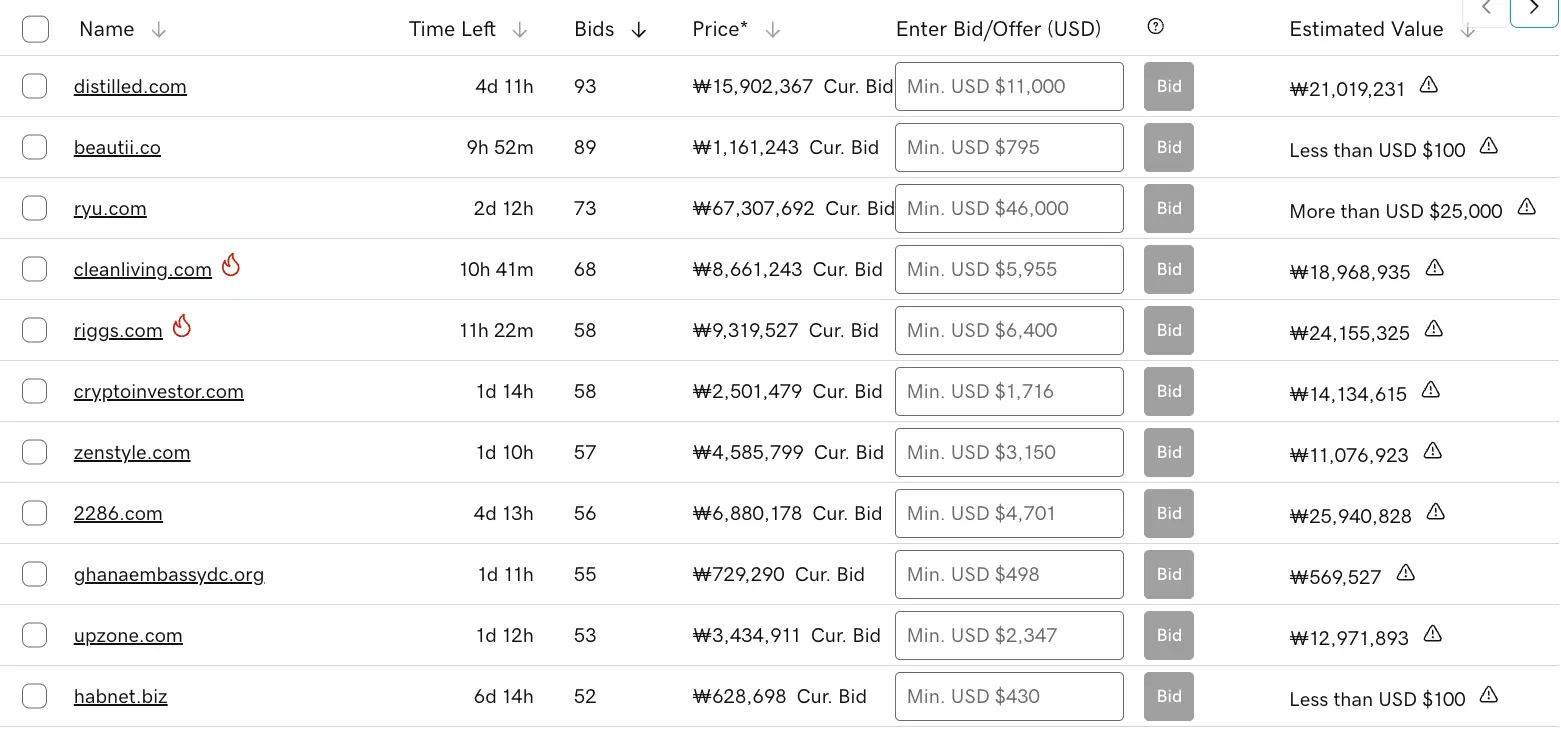
An aftermarket for trading already-registered domains has also existed for a long time. Listings are posted continuously on marketplaces such as Sedo, Afternic, and GoDaddy Auctions. According to a 2026 report jointly published by Sedo and InterNetX, Sedo's average sale price in 2025 was $2,753 and the median was $818, with most transactions falling below the $10,000 range.
Source : auctions.godaddy.com
Yet a domain traded this way has no known price until it is sold. Listing it on a marketplace does not produce a sale until a buyer steps forward, and in the meantime there is no continuous market price to reference. To learn what their domain is worth right now, an owner has no option but to begin a sale. Because the price is unknown, lenders cannot assess a domain as collateral. Valuing collateral requires estimating what it would fetch in a default, and there is no market price to anchor that estimate. As a result, even an investor holding tens of thousands of domains has no way to unlock their value short of selling assets one at a time when capital is needed. The value is real, but until a sale it can be neither confirmed nor put to use.
The higher the value of a domain, the worse the problem becomes. Premium domains worth tens of millions of dollars do not trade on a marketplace order book. Buying AI.com requires the ability to pay $70 million at once, and only a handful of buyers can absorb such a sum. Because buyers are scarce, premium domains trade only through brokers who approach candidate buyers individually while the two sides negotiate a price. A single deal can take months, and the agreed price and terms are never disclosed.
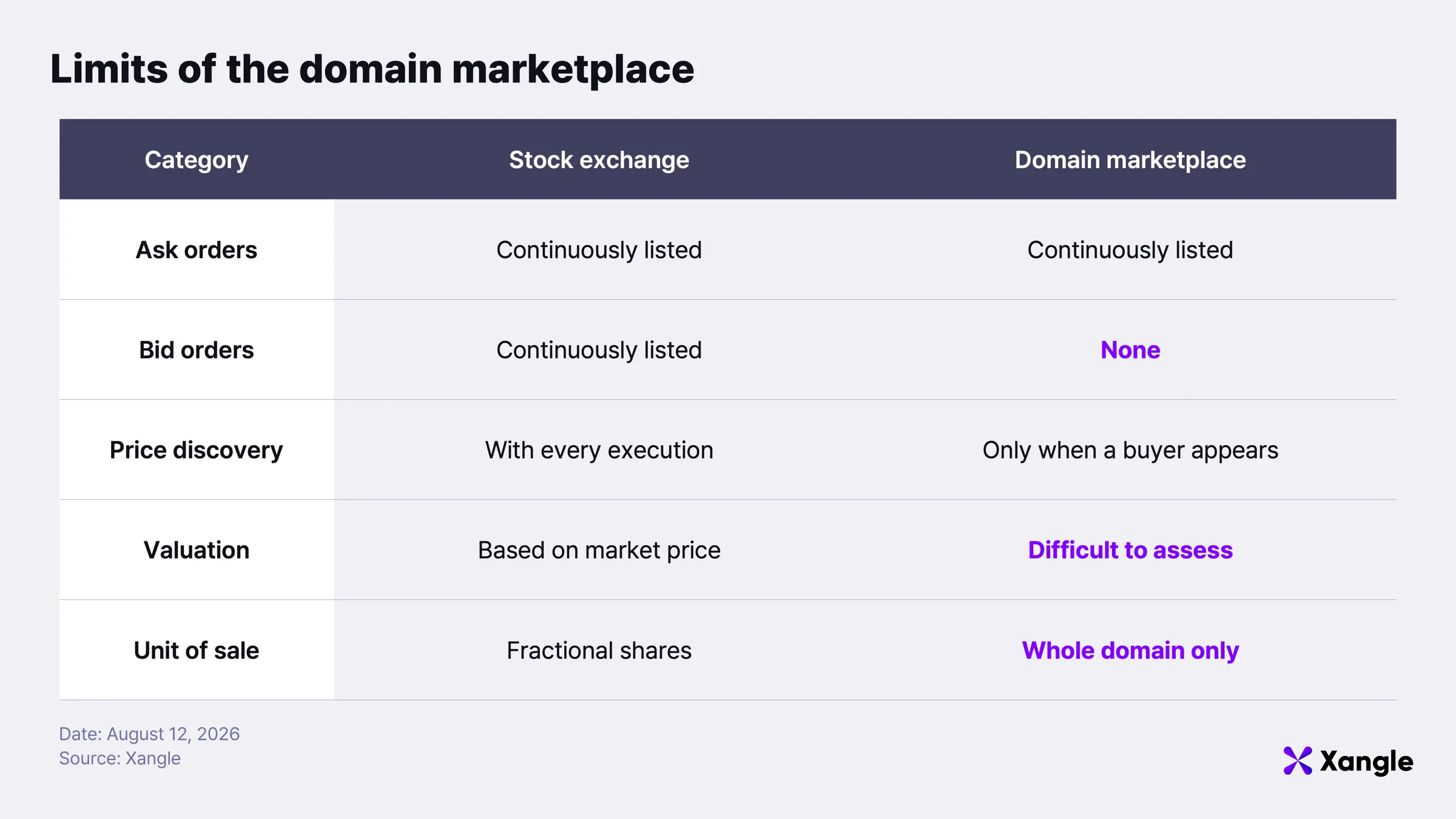
The bottleneck in the domain market, then, is the absence of an open market where prices are discovered. What is needed is to build an open market in which domains trade continuously, and the starting point for that is tokenization.
For a domain to trade as an asset, three things must come together: tokenization that divides the domain into shares, an open market where those shares trade and prices are discovered, and a buyback that reconsolidates the scattered shares to reclaim full ownership. This is precisely the problem Doma sets out to solve.
2. Doma's Solution: Doma Chain and DomainFi
2-1. Doma Chain, Built for Tokenizing Domains
David and Michael Castello have been acquiring category-defining .com domains since 1994. PalmSprings.com, registered for $300 a year, generated over $15 million in profit in its first decade, and Whisky.com sold for $3.1 million in 2014. When a competitor spent millions on TV advertising for Rate.net, the viewers who saw those ads went to Rate.com, the name the brothers held, because the public defaults to .com when recalling a brand. A name like that behaves like real estate in a prime location: location is the value, and no one can build a second copy of the same location.
Yet for thirty years the only way to realize the value of those domains was to sell them. On July 1, 2026, the brothers brought Smoothie.com onto Doma Chain, and the domain began trading onchain. Cumulative trading volume on Doma Chain has since passed $231M.
Doma is a purpose-built blockchain ("Doma Protocol") dedicated to domains, which launched on November 25, 2025, bringing a functional bridge between the existing, global DNS system and decentralized finance by enabling traditional web domains to become onchain, tradable assets. Each domain maps to a single ownership token, and whoever holds that token is the domain's owner. Since launch, tokenized domains have reached 238K, wallets holding ownership tokens have passed 55+K, and transactions on the chain have surpassed 27 million.
The reason Doma built its own coordinating chain rather than relying solely on an existing general-purpose blockchain comes down to how domain ownership actually works. Ownership, expiration, and revocation of a domain are governed by ICANN and the registrars, and other chains have no built-in mechanism for a registrar to intervene in token state. If a registrar revoked a domain, an NFT issued on a chain with no registrar hooks would just keep circulating, disconnected from the real-world state of the domain, and whoever bought that token would be left holding an ownership claim with nothing behind it. Doma solves this by embedding registrar authority directly into the token and by designating Doma Chain as the single source of truth that every other supported chain defers to, so no matter which chain a token currently lives on, there's only ever one authoritative record of who owns it.
Ahead of the mainnet launch, Doma secured domains to tokenize by partnering with several ICANN-accredited registrars. Participants include InterNetX, which operates global domain infrastructure; NicNames, which provides wholesale registration services; and EnCirca, which specializes in trademark and brand domains, and the domains they manage alone number more than 30 million. Bringing a domain in is the same standard cross-registrar transfer used anywhere in the domain industry: before a domain can be tokenized, it generally needs to sit with a registrar that's integrated with Doma, so an owner holding it elsewhere first unlocks the domain at their existing registrar and provides the auth code (EPP code) to transfer it in, after which tokenization happens in the background.
2-2. DomainFi, the Onchain Market for Domains
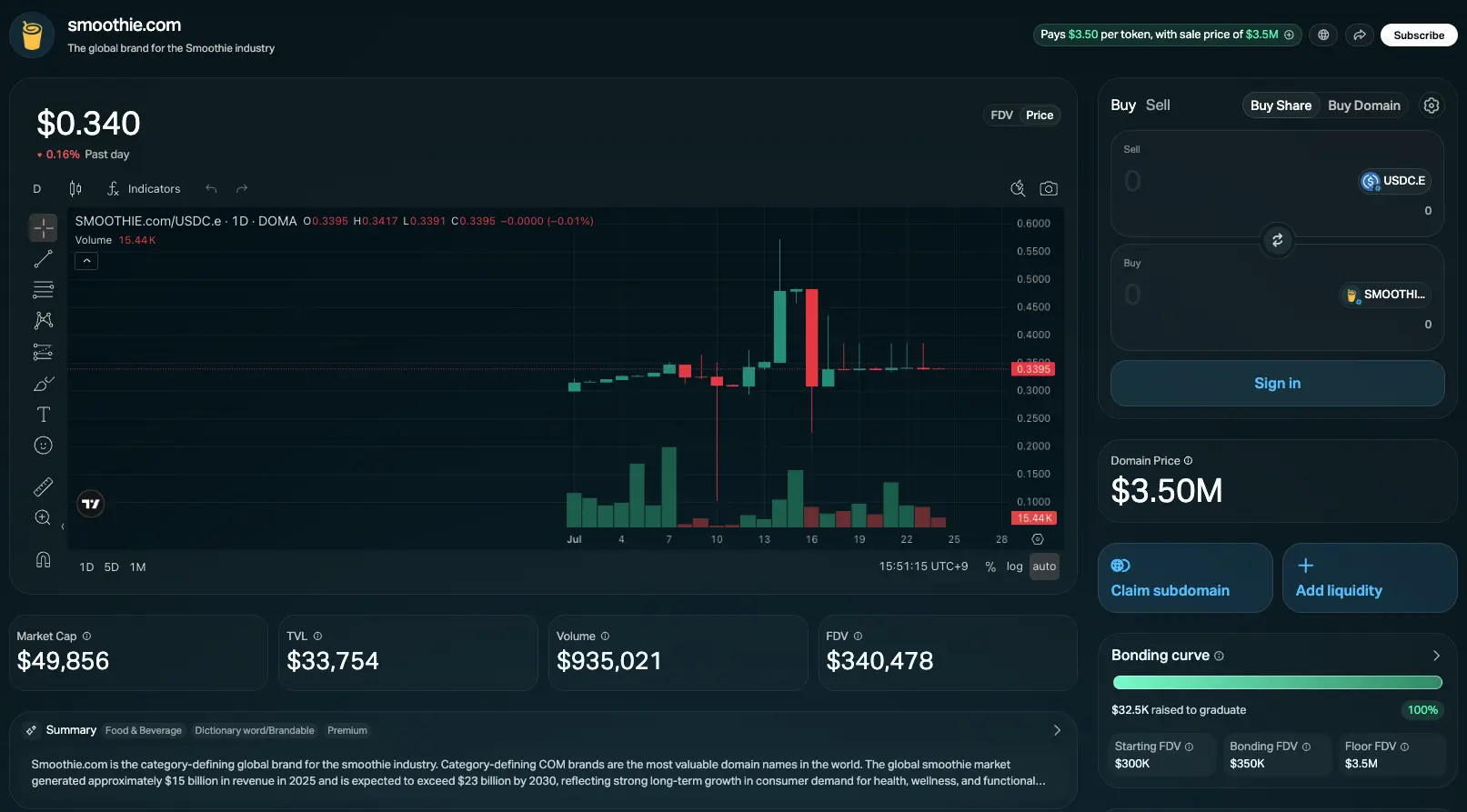
Smoothie.com ran an onchain offering at the same time it was tokenized. The offering started at a valuation of $300,000 and went into public trading after reaching $350,000. A name that represents the food-and-beverage category through the single word "smoothie" had its value set by a market for the first time.
That mechanism is fractionalization. Doma divides what was a single ownership into shares that multiple people can hold, in the same way domestic real estate fractional investment in Korea splits one building into shares that can be bought in small amounts. The ownership that once stood for the whole domain is split into multiple share tokens, and Doma calls the market where those share tokens trade DomainFi. It's DeFi for domains, tokenizing an RWA asset, fractionalizing it and trading it on the public market. A participant who could never buy a $70 million name outright can hold a piece of one here.
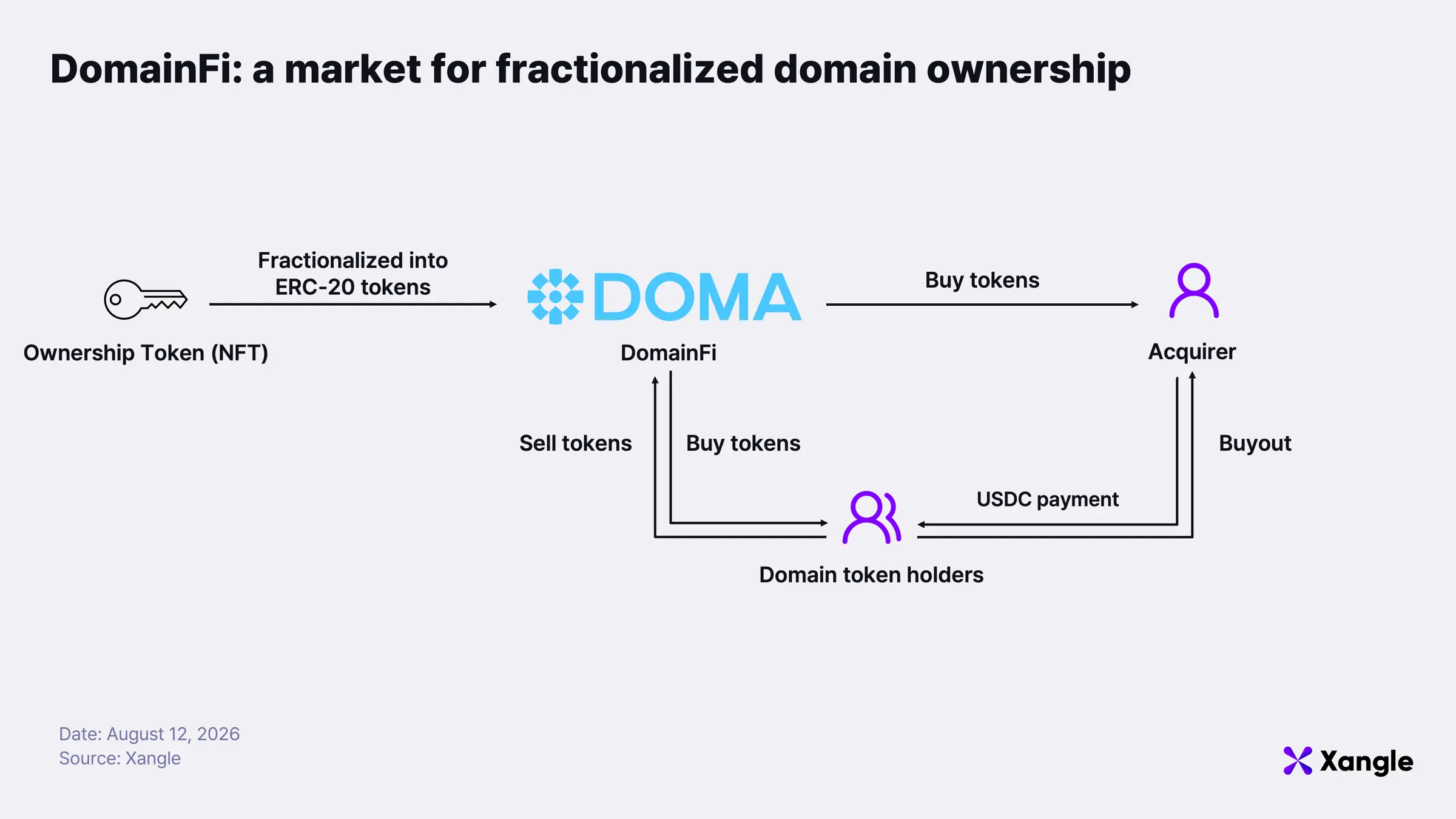
Fractionalization happens on the Doma launchpad, and more than 620 domains have launched through it so far. Pricing is set against the valuation of the whole domain, calculated as the fully diluted valuation (FDV) of all issued shares. The offering runs on a bonding curve, a mechanism already common onchain: as with the agent token offerings on Virtuals Protocol, the valuation and the share price move up as buying continues, so the earliest buyers get the best price. Once the offering reaches its predetermined valuation it closes, and the share tokens move into a liquidity pool on a decentralized exchange where they can be traded at any time. Investors who missed the offering can buy and sell from that point on.
In this way an owner can earn and unlock liquidity for their domain, without selling the entire domain, while keeping a controlling part of the share. Software.ai, launched alongside mainnet, sold only 25% of its total supply, and Brag.com allocated just 5% to its offering at an $18 million valuation, raising $43,750.
Once an offering closes, the shares trade continuously, and as trades accumulate the share price becomes the market price of the whole domain. An asset whose value could not be known before a sale acquires a continuous price. Cumulative volume has grown roughly ninefold from $25M at the start of the year, and the range of domains coming to market has widened with it: disintermediation.com and agenttoken.com completed their offerings, and premium domains like Rides.com traded onchain.
When shares are scattered across many holders, a buyer who actually wants to use the domain is left having to negotiate with every shareholder. A buyout is the mechanism that lets one party reacquire all of a share-divided domain's ownership and exercise full rights over the domain, and Doma provides a way to purchase ownership in a single move according to a set formula, called Domain Buyout. The buyout price is set from the minimum buyout price the owner defined at the offering stage and the current market price, so the higher the market values the domain, the higher the buyout price rises. Once a domain gets bought out, token holders have their shares settled against the buyout proceeds and can redeem their part of the owned share in USDC.
This past February tradetheinternet.com was bought out for $750, and payportal.ai and savemybrain.xyz were acquired for 675 USDC and 200 USDC respectively, carrying the whole process onchain, from issuing the ownership token through the share offering, trading, acquisition, and redemption.
3. Doma's Expansion Strategy
3-1. DAV, Turning a Domain Portfolio Into a Single Product
The way an asset gets absorbed into the capital markets has tended to follow the same path. Real estate spent decades trading building by building before REITs turned portfolios into a product whose shares traded on an exchange, and institutional capital followed. Equities went the same way: buying and selling individual names came first, and the money from pension funds and large asset managers arrived at scale only after indices and ETFs existed. A market makes the leap into a capital market at the point where a structured product exists and trading in that product gets deep. Onchain, real-world assets (RWA) such as treasuries and equities have walked the same path through channels like Ondo Finance.
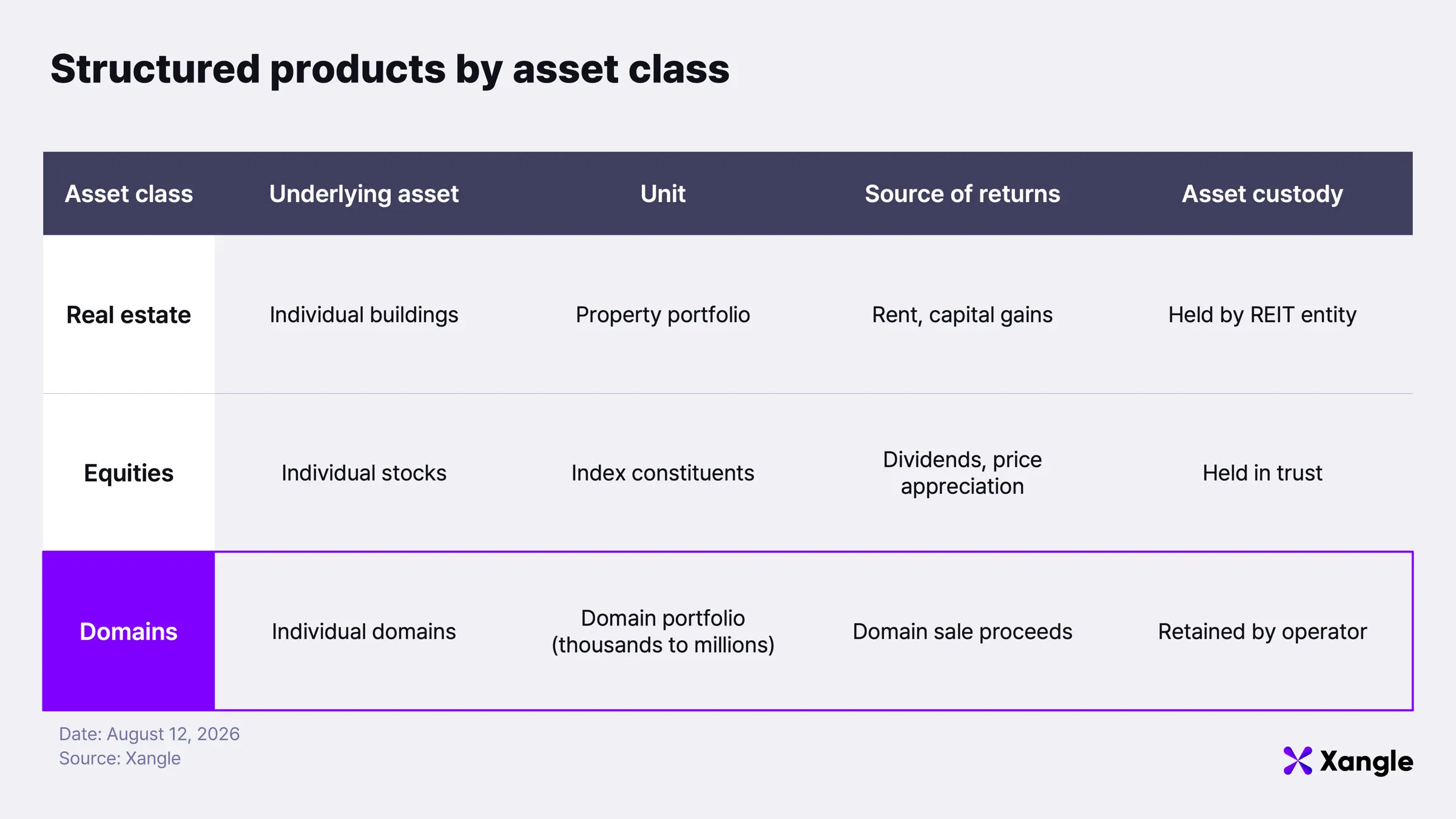
A $360 billion domain market had no equivalent product. The Domain Asset Vehicles (DAVs) that Doma is bringing in Q3 fill that gap by bundling an entire premium domain portfolio into a single tradable onchain asset.
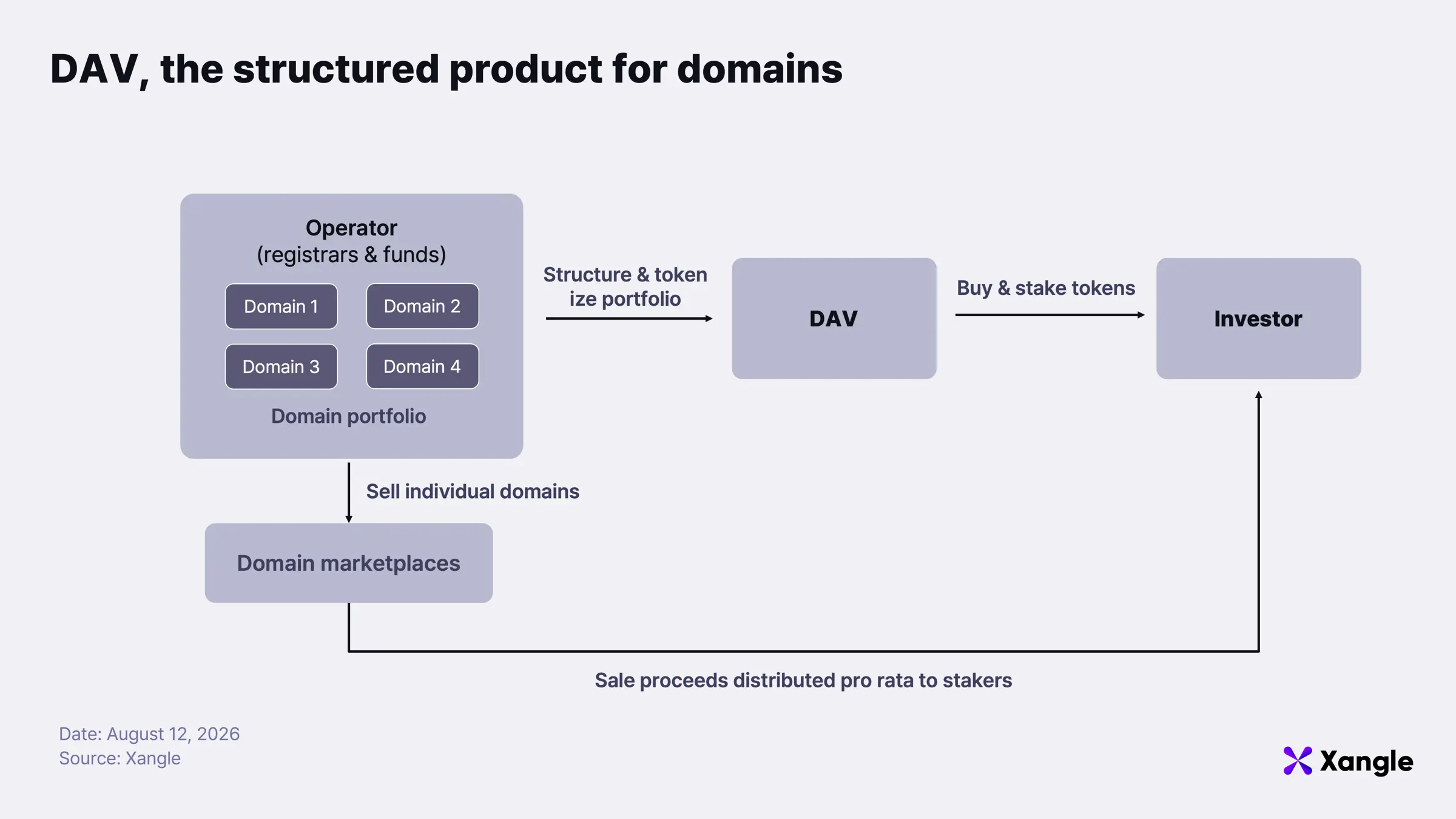
What DAV exploits is the statistical difference between an individual asset and a portfolio. For an owner holding a single domain, the timing of a sale is an unpredictable event, but when premium domains are combined by the thousand, an annual sell-through rate recurs in the 3% to 6% range. Cash flows that are irregular when domains are held one by one become estimable within a stable band at the portfolio level, and that predictability becomes the condition for structuring a financial product. That professional investors have acquired portfolios at a wholesale value discounted from retail asking prices was itself the price of bearing the time, execution, and sell-through risk themselves.
DAV implements this wholesale-pricing logic onchain. A registrar, a domain fund, or a large portfolio operator bundles the thousands to millions of domains it holds into a single asset, issues shares in that asset as DAV tokens, and sells a portion to the market. An investor who once had to appraise and negotiate individual domains can now diversify across an entire portfolio with a single DAV token, and its price is set against the wholesale value of the whole portfolio rather than the retail price of any one domain. Participants can invest in a structured portfolio without any domain-appraisal expertise.
The benefits for operators are just as clear.
- Through DAV an operator raises capital by liquidating part of its assets while continuing to sell its domains on existing marketplaces, retaining control over pricing and strategy
- When a domain in the portfolio is actually sold, the sale proceeds are distributed, in proportion to holdings, to those who have staked DAV tokens
The first DAV is scheduled to launch on Solana in Q3 2026, and pre-registration for portfolio holders is already underway at dav.doma.xyz. Solana was chosen for its sub-second settlement speed, its low fees, and its already established RWA ecosystem.
3-2. The Agentic Engine, Domain Demand in the AI Era
If DAV expands the scale of capital, the Agentic Engine expands the nature of demand. The way people find things is changing. Instead of typing words into a search box and clicking through results, they ask an AI, and the AI goes and looks on their behalf. Google search volume fell 25% year over year while AI-driven traffic grew 79-fold. Yet where an AI goes is still a domain. The web's addressing system has not changed, so agents are filling the space people have left.
The problem is that most websites are designed for human eyes. An agent that arrives at a domain cannot read what it is able to do there, and 63% of agent visits leave without taking any action. The Agentic Engine publishes what functions a domain offers and what actions are possible in a format an agent can read. A user presets a per-session spending limit and scope of use, and the agent executes payment only within that scope. Within a week of the announcement, more than 1,000 domains had been made agent-readable. As domain demand, once dependent on human memory and search, expands to agent-driven discovery, the basis on which domains are priced may change with it.
4. Conclusion: A Domain Capital Market and Doma at Its Center
Domains have long been valuable assets, but the path to putting that value to work as an asset was blocked. On blockchain, that path has opened up new ways to generate liquidity for a traditional illiquid asset class. As domains can be divided into fractions, traded in small amounts, and priced by the market, they move beyond being merely tradable to becoming part of the capital markets; and as they become assets with an assigned value, the path to assessing them as collateral opens alongside.
Doma aims to build the domain capital market from its center. Within six months of launching a chain that issues and trades individual domains onchain, cumulative trading volume rose roughly ninefold, showing that a real market is taking shape, and the investors who spent thirty years assembling premium domain portfolios began moving their domains onchain.
The next step is DAVs, launching on Solana in the third quarter. Doma Chain and DomainFi built the stage where an individual domain's value gets confirmed by a market, and DAV puts a portfolio of thousands on top of it as a single product. An investor with no ability to appraise a domain can take part through one token, and when a sale happens inside the portfolio the proceeds are distributed to holders. Once institutional capital enters that product and trading in it gets deep, the way REITs and ETFs did before it, domains move past a market for buying and selling individual assets and settle in as a capital-market asset class.
The tokenization that brings real-world and financial assets onchain has only just entered its early stage. If, within that current, domains too can open an onchain market as an asset class of their own, the one standing at its center will ultimately be Doma, the first to generate real trading activity and to lay down the market's rules.
Disclaimer
I confirm that I have read and understood the following: The information contained in this article is strictly the opinions of the author(s). This article was authored free from any form of coercion or undue influence. The content represents the author's own views and does not represent the official position or opinions of CrossAngle. This article is intended for informational purposes only and should not be construed as investment advice or solicitation. Unless otherwise specified, all users are solely responsible and liable for their own decisions about investments, investment strategies, or the use of products or services. Investment decisions should be made based on the user’s personal investment objectives, circumstances, and financial situation. Please consult a professional financial advisor for more information and guidance. Past returns or projections do not guarantee future results. This article was written at the request of Doma. All content in this article was written independently by the author(s), and neither CrossAngle nor Doma had any editorial control or influence over the content. The author(s) may hold the cryptocurrencies mentioned in this article at the time of writing.
Xangle or its affiliated partners own all copyrights of the written or otherwise produced materials and content provided on the platform. Any illegal reproduction of such content, including, but not limited to, unauthorized editing, copying, reprinting, or redistribution will result in immediate legal actions without prior notice.
![[Xangle RWA Series] Solana RWA: A Look at the Vendor Ecosystem](https://resource.xangle.io/files/content/7D721A6B16F3EA8E0F457EA07039DAD7_1789118522689.webp)
![[ADOPTION] Application - Binary Korea](https://resource.xangle.io/content/thumbnails/2080/content_2080_thumbnail_3e33e401.webp)
![[ADOPTION] Infra - NTT Digital, Circle, Fireblocks](https://resource.xangle.io/content/thumbnails/2064/content_2064_thumbnail_94c7c4ca.webp)