
KGeN, the Verified-User Infrastructure Accelerating Web3 Mass Adoption

Table of Contents
1. Verified Users: The Core Driver of Business Success
2. KGeN: Building Infrastructure for Verified User Acquisition
2-1. The PoG Engine and Oracle Network: Analyzing and Verifying Users On-Chain
2-2. Tokenomics Designed to Accelerate User Growth
2-3. Scaling a Verified-User Ecosystem
3. KGeN’s Strategic Opportunity in the Web3 Economy
3-1. Restoring Data Sovereignty and Redefining Value Capture
3-2. Verified Users as the Key to Web3 Adoption — KGeN as Core Infrastructure
4. Closing Statement – KGeN and the Road to Web3 Mass Adoption
1. Verified Users: The Core Driver of Business Success
In digital industries such as gaming, e-commerce, and content, verified users—those who actually engage with a service and create measurable value—represent the most critical driver of business performance. A large number of sign-ups alone does not guarantee growth; only when those users convert into real revenue and traffic does a business truly scale.
The data underscores this point. According to a study analyzing mobile gameplay data across 214 countries and regions, the top 1% of players account for 44.83% of total playtime. A similar pattern emerges in revenue distribution. SuperData reports that within the mobile gaming market, the top 1% of paying users generate more than half of total revenue, while the top 5–10% contribute between 80–90%. This concentration of value creation is not unique to gaming. Across e-commerce, streaming, and online entertainment, a small cohort of verified users consistently drives the majority of monetization.
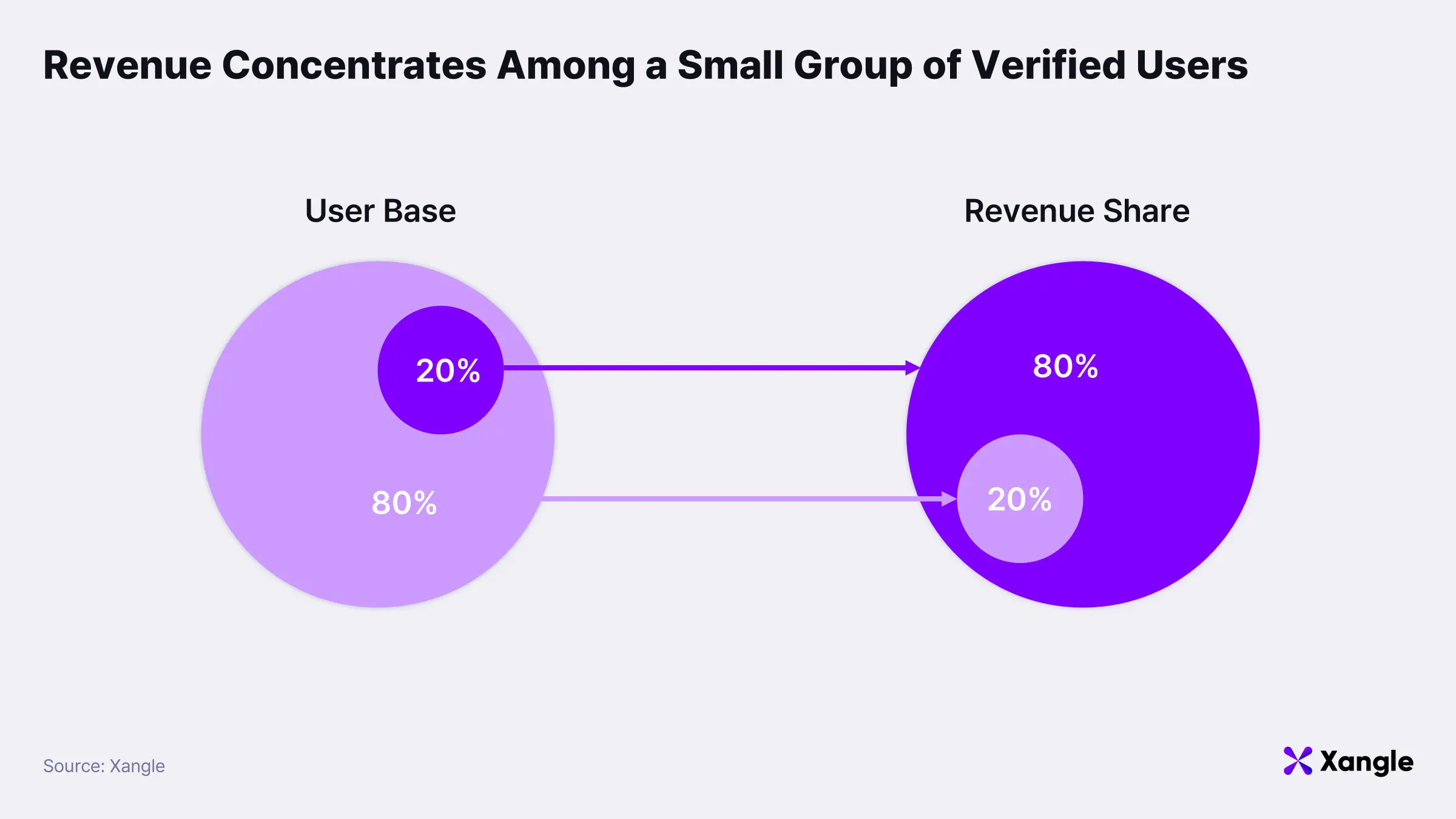
Economists refer to this imbalance as the Pareto Principle, which explains how a disproportionate share of outcomes often stems from a small number of causes. Commonly known as the “80/20 rule,” it suggests that roughly 20% of customers generate 80% of sales. Businesses have long applied this principle to customer segmentation and marketing, and it remains one of the most enduring frameworks for identifying and cultivating core user bases.
It is self-evident that securing verified users is indispensable for business success. Yet in practice, doing so remains highly challenging. Most user data is controlled and monetized by large, centralized corporations. For instance, game activity data resides with developers and publishers, while consumer behavior data is siloed within e-commerce platforms. Companies seeking verified users must therefore overcome these platforms’ entrenched barriers to entry; a dynamic that deepens data access asymmetry and inflates User Acquisition Costs (UAC).
This structural inefficiency sets the stage for KGeN. The reason this report begins by emphasizing both the importance and the difficulty of verified user acquisition is that KGeN was built to address precisely this problem. The project envisions an infrastructure where user data, once monopolized by centralized intermediaries, can be managed transparently and verifiably on-chain. By establishing an open, cryptographically auditable data layer, KGeN lowers the barrier between businesses and verified users, while empowering individuals to reclaim sovereignty over the data they create.
2. KGeN: Building Infrastructure for Verified User Acquisition
KGeN is building infrastructure designed to secure verified users, initially focused on the gaming and AI sectors. It was founded by Manish Agarwal, former CEO of Nazara Technologies, one of India’s largest gaming firms, and Ishank Gupta, a strategy expert with global consulting and consumer-goods experience. Drawing on deep insight into user behavior and data-driven ecosystems, they set out to solve one of Web3’s most persistent challenges — verifying and acquiring real, value-creating users. Originally launched as a game-focused publisher platform, KGeN soon realized that the demand for verified users extends far beyond gaming. The team has since expanded into multiple verticals where user authenticity, data integrity, and engagement verification are becoming essential to ecosystem growth.
Backed by a strong founding team and clear vision, KGeN has attracted major institutional support. The project raised about $43.5 million from Accel, Prosus Ventures, and Jump Crypto, alongside strategic investors such as Aptos Labs and Polygon. Its latest round valued the company near $500 million, reflecting strong market conviction in its execution and positioning within the emerging verified-user economy.
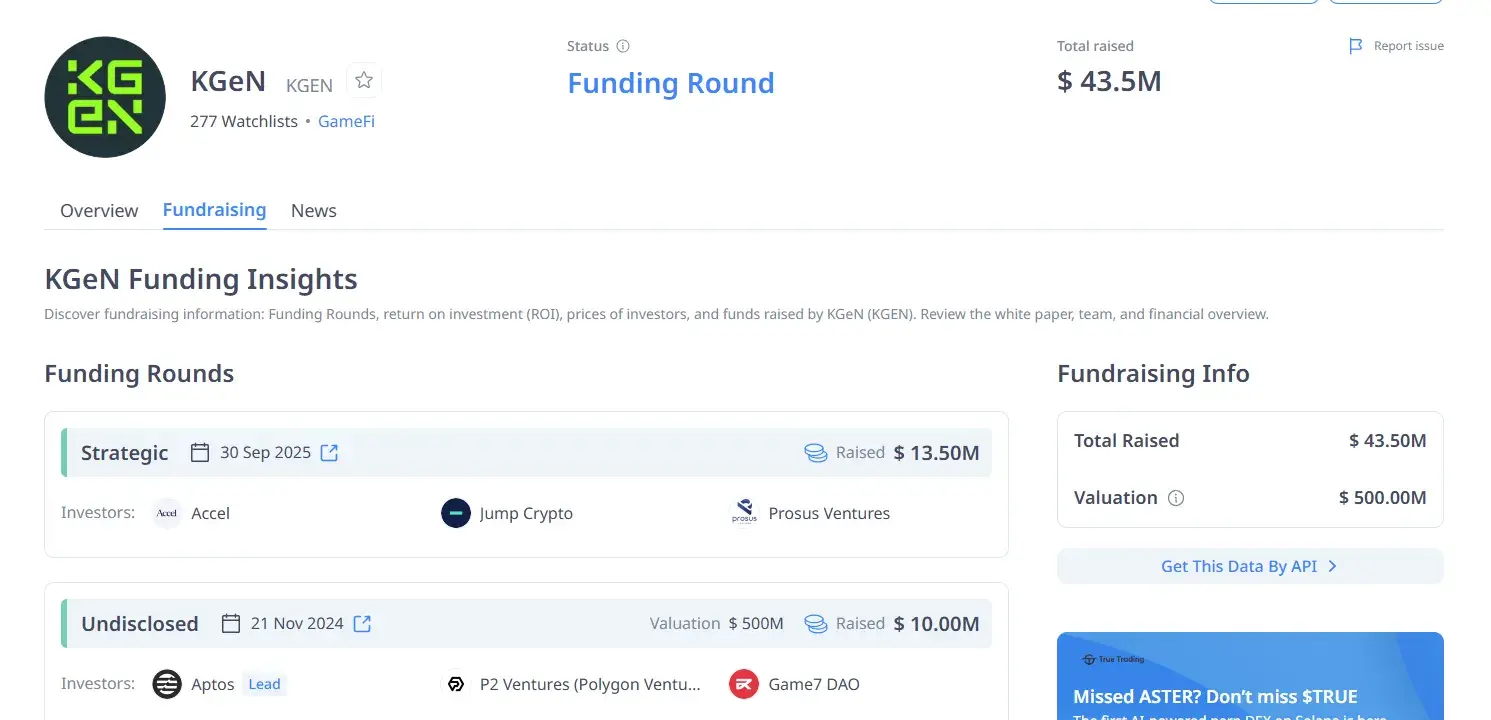
Source: CryptoRank
2-1. The PoG Engine and Oracle Network: Analyzing and Verifying Users On-Chain
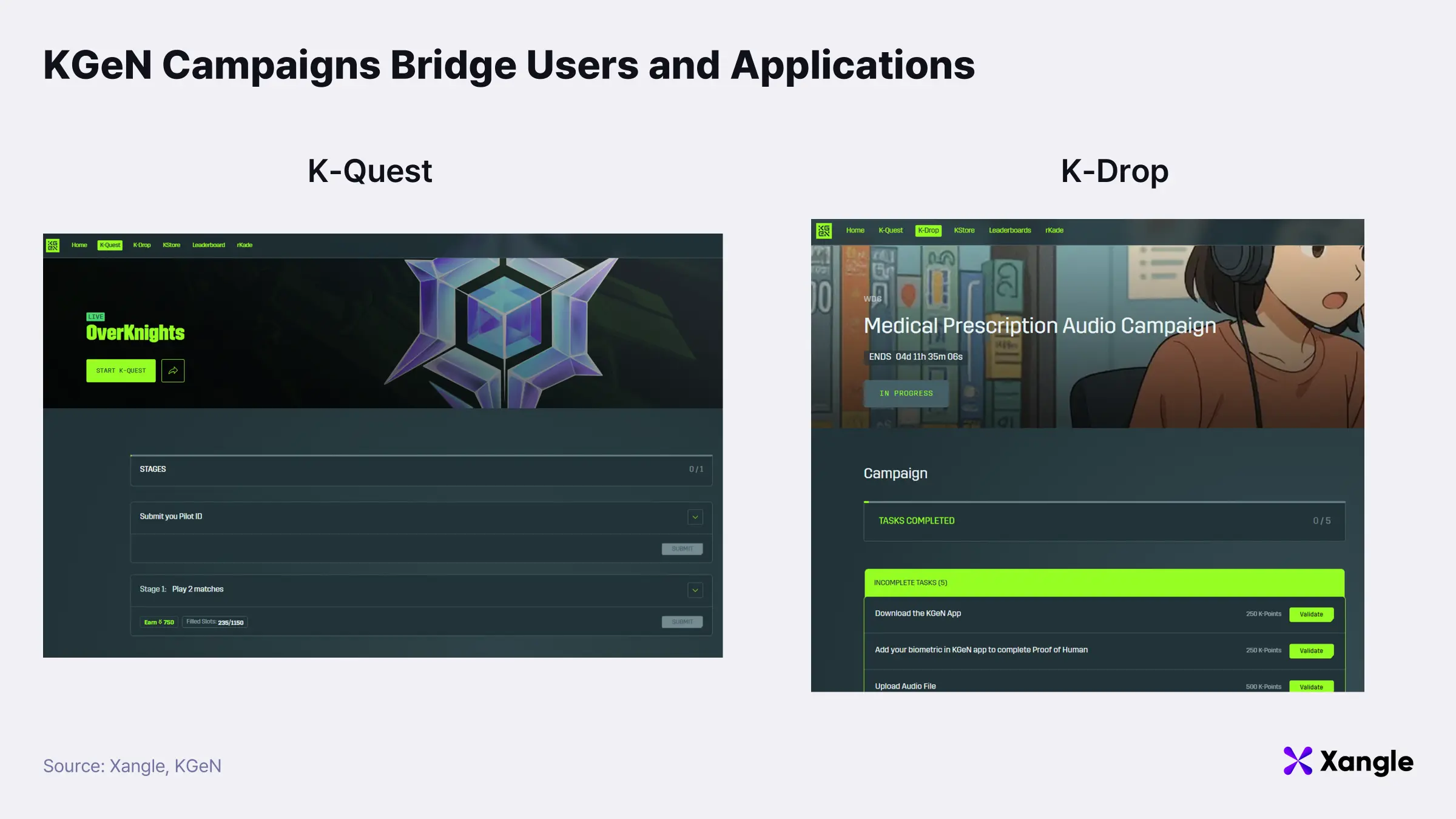
KGeN provides an environment where users engage across applications, mainly gaming and AI, and leave verifiable activity data. Within the platform, users join two participation programs: K-Quest and K-Drop. K-Quest uses a manual verification process, confirming actions through human review or submitted proof (e.g., screenshots of mission completion). K-Drop applies an automated verification system connected to API endpoints that validate activity in real time, ideal for on-chain events such as NFT minting or token transactions.
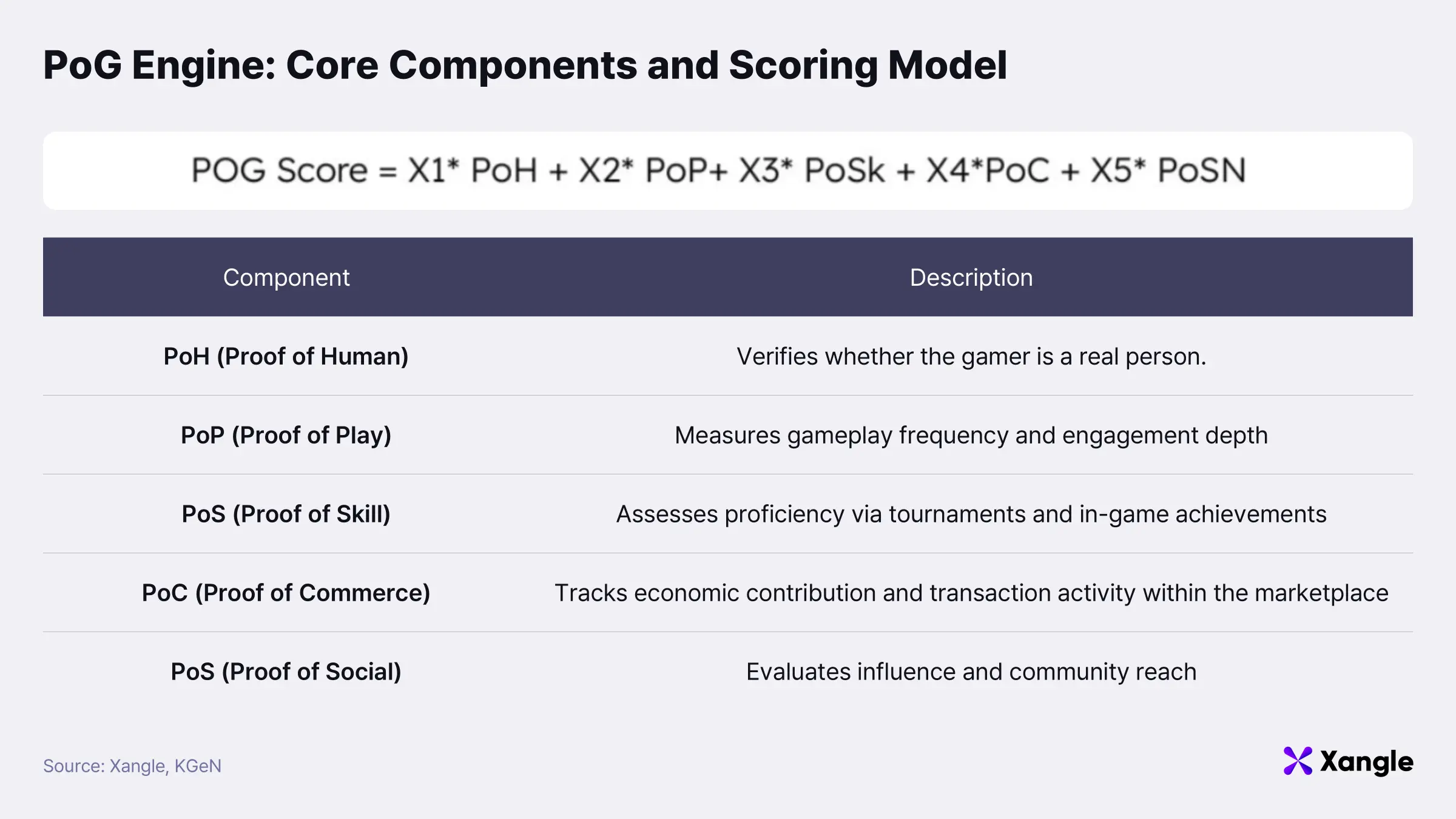
The collected data is processed by the PoG (Proof of Gamer) Engine, which performs multi-dimensional behavioral and performance analysis to quantify each user’s authenticity and contribution.
User data is classified across five axes:
- Proof of Human – verifies that the user is a real person.
- Proof of Play – measures gameplay frequency and depth.
- Proof of Skill – assesses proficiency via tournaments and in-game achievements.
- Proof of Commerce – captures the user’s economic activity.
- Proof of Social Network – evaluates influence and community reach.
Together these axes produce a composite PoG Score, which is a verifiable on-chain reputation metric unique to each user.
Once calculated, PoG Scores are verified through the KGeN Oracle Network and permanently recorded on the Aptos blockchain.
Each oracle collects data from multiple sources—such as game activity logs, APIs, and internal performance metrics—to generate individual scores. The results are finalized through a Byzantine Fault Tolerant (BFT) consensus mechanism, which requires at least 67% of participating oracles to submit matching results. The network then determines the final PoG Score by calculating the median or weighted average of all valid submissions. Oracles providing incorrect data or faulty signatures are excluded from consensus and, in severe cases, may have their staked assets slashed as a penalty.
Currently operating under a Proof-of-Authority (PoA) model, the oracle network relies on a curated set of trusted operators to ensure early-stage stability. Over time, KGeN plans to transition toward a Proof-of-Stake (PoS) architecture, allowing any token holder to participate in oracle validation and further decentralizing the verification layer.
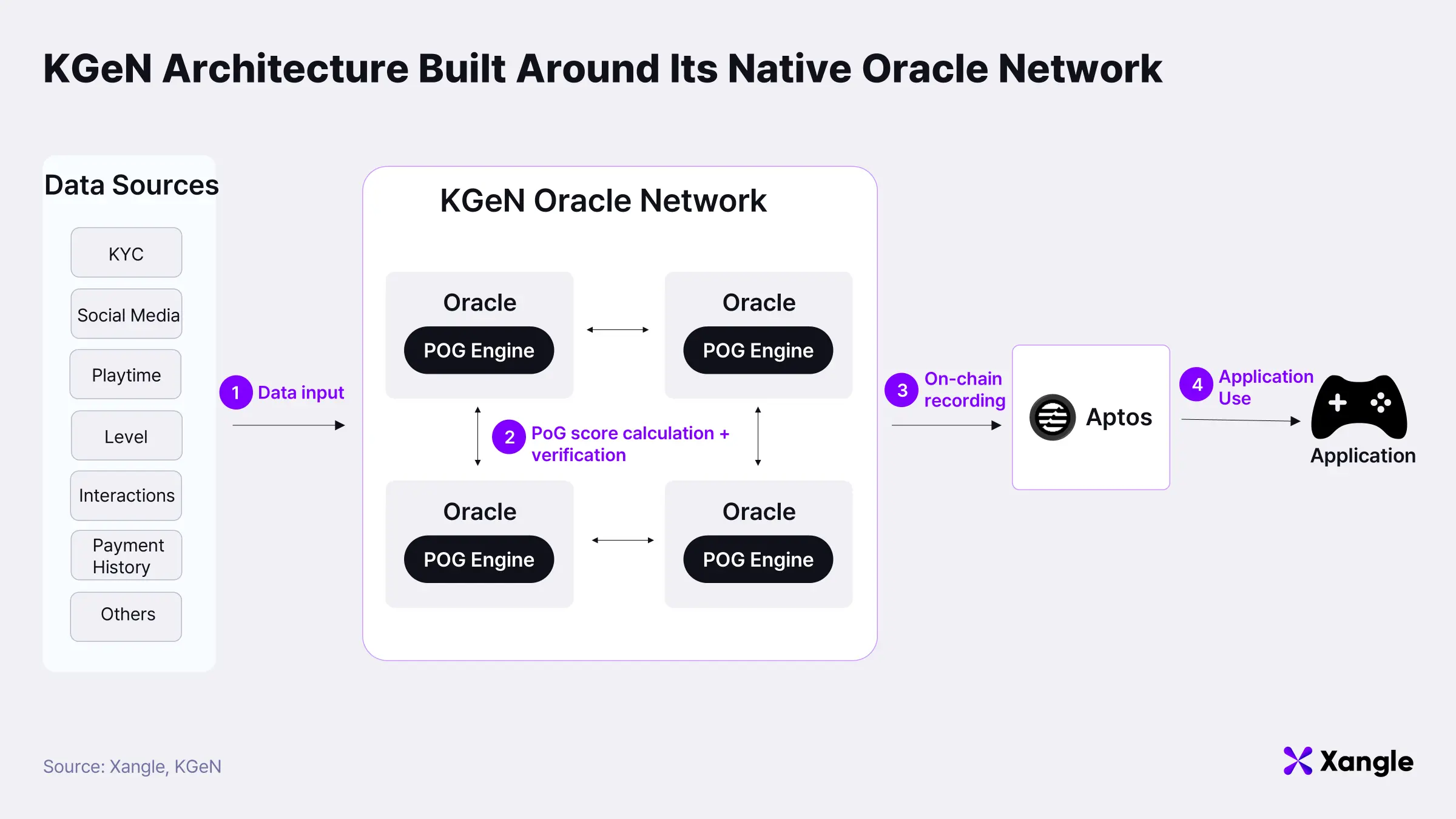
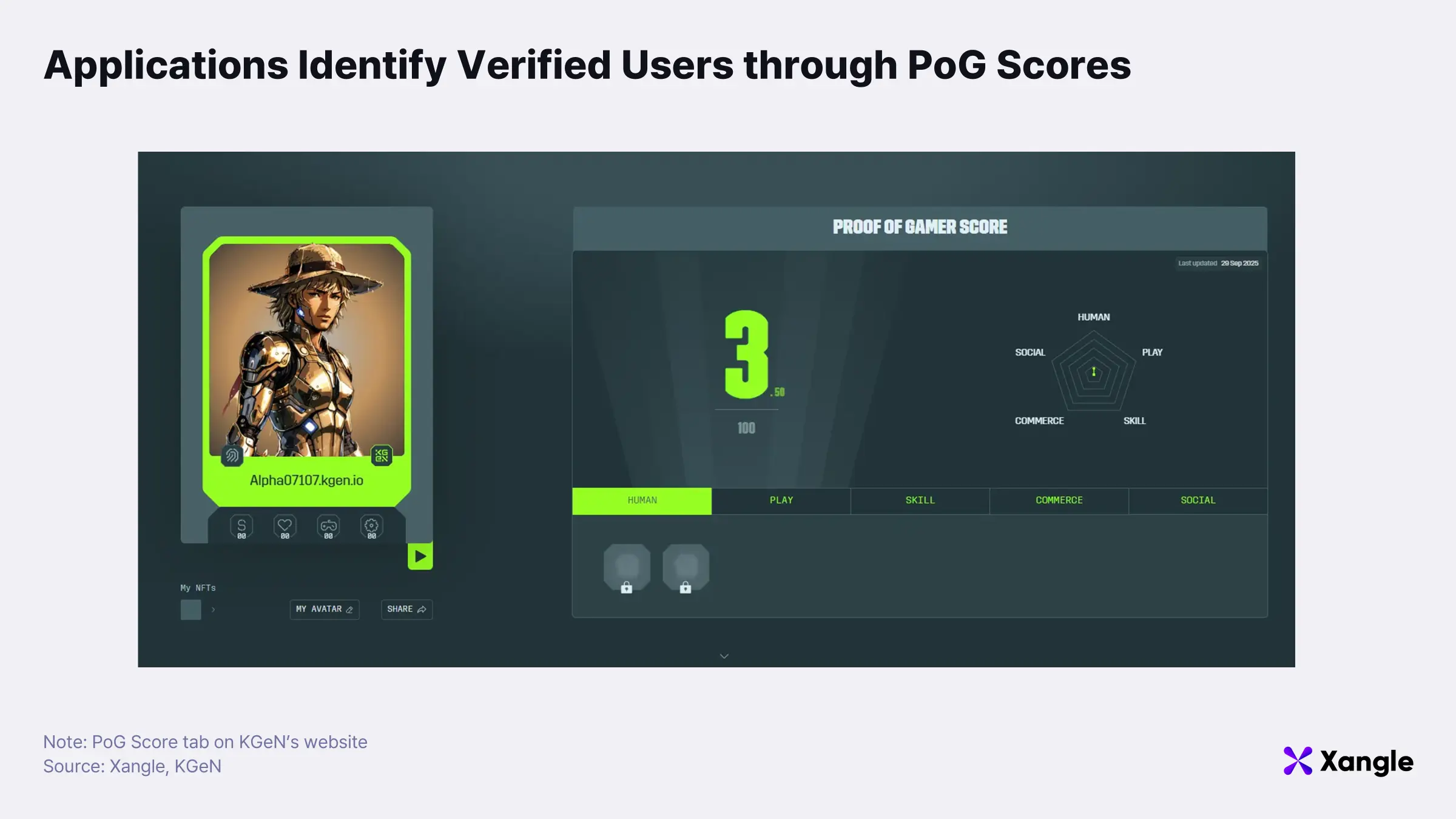
Once written on-chain, PoG Scores become reusable across the ecosystem. dApps can design personalized reward or incentive systems to lower User Acquisition Costs (UAC), while Layer 1 chains can integrate them into identity or reputation-based governance. By turning behavioral data into programmable trust, KGeN establishes a scalable foundation for verified-user growth, bridging activity, identity, and economic value across Web3.
2-2. Tokenomics Designed to Accelerate User Growth
Securing users has become increasingly difficult for new publisher platforms. A small group of incumbents already command the majority of market share, reinforced by years of accumulated user data, capital, and entrenched network effects. According to 2024 data from Udonis Research, the top 10 out of 46 global game publishers account for 78% of total industry revenue. Within such a concentrated environment, emerging platforms must spend aggressively on marketing and user incentives just to compete—a strategy that is rarely sustainable.
KGeN addresses this structural challenge through a token-based incentive model. Instead of allowing data ownership to remain centralized, KGeN returns data sovereignty to users and builds a transparent reward system where both users and the platform grow together. User acquisition is accelerated through three complementary incentive layers:
1. Data-Based Rewards
Users retain full ownership of their activity data and receive direct revenue shares when that data is accessed or monetized by advertisers and publishers. This framework transforms users from passive participants into active economic stakeholders within the data economy, rewarding them for the value they generate. (For details on value capture and data rights, see Section 3-1.)
2. Participation and Performance Rewards
Applications and advertisers seeking verified users offer targeted incentives—grants, reward multipliers, airdrops—to those with high PoG Scores. The result is a dual-sided growth loop: applications acquire verified users more efficiently, while users are motivated to deepen engagement and improve their PoG Scores to unlock higher rewards.
3. Token Incentives
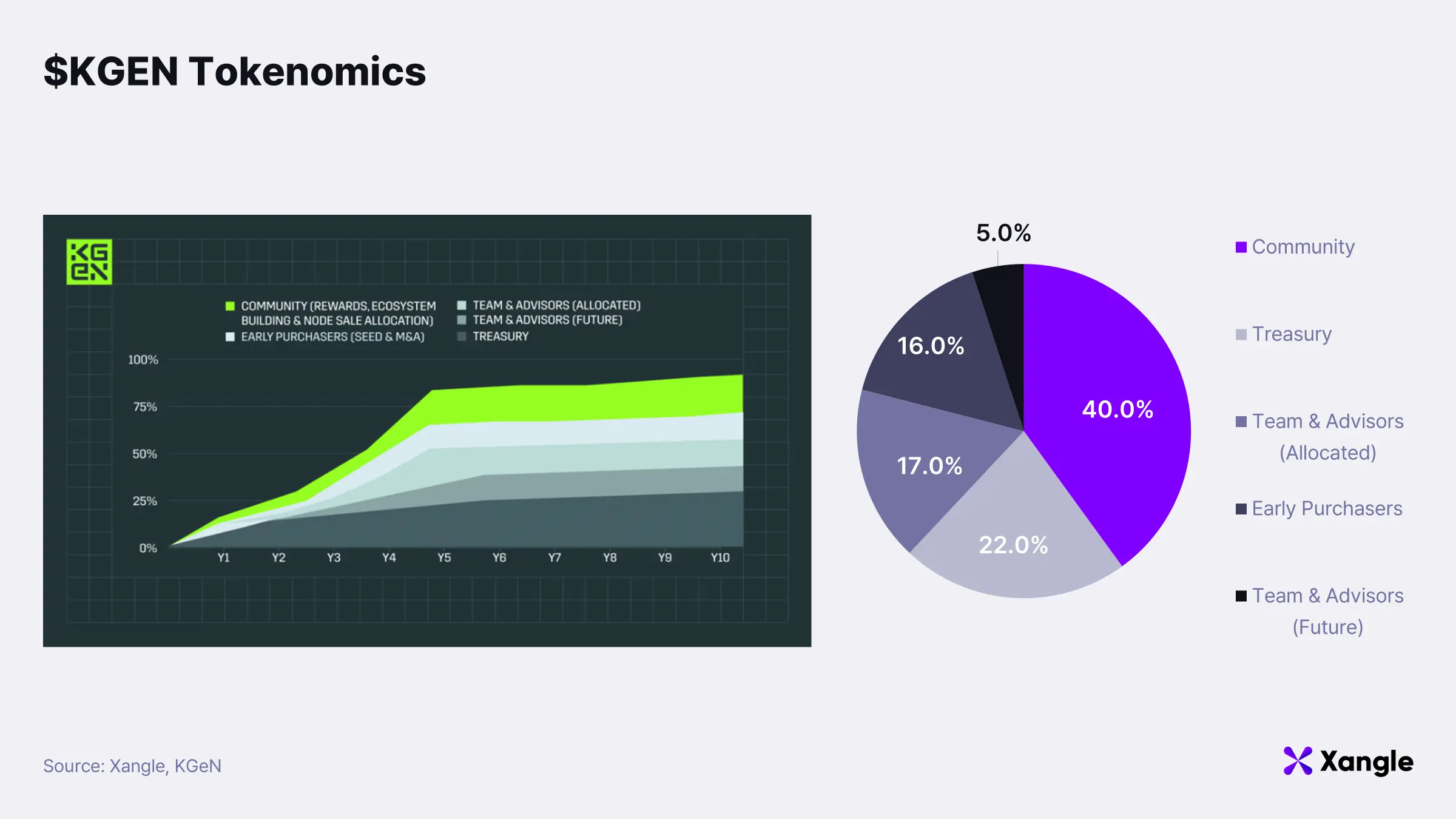
KGeN introduces a dual-token system comprising rKGEN and $KGEN, each fulfilling a distinct role within its incentive economy.
- rKGEN serves as a pre-TGE reward token, distributed equitably based on on-platform activity. Following the Token Generation Event (TGE), it converts 1:1 into $KGEN and can be staked for additional yield. This design functions as a bootstrapping mechanism that catalyzes user participation during the network’s early phase.
- $KGEN, by contrast, establishes the long-term reward layer. Users can stake $KGEN to expand quest participation limits, apply reward multipliers, or gain exclusive access to premium campaigns and events. Staked tokens also grant participation rights in oracle validation, generating continuous on-chain yield and providing both short-term incentives and sustainable, recurring income streams.
Together, rKGEN and $KGEN form a cohesive incentive engine—driving early-stage onboarding through immediate rewards while sustaining long-term ecosystem expansion via staking yields and user participation.
2-3. Scaling a Verified-User Ecosystem
In just two and a half years since launch, KGeN has achieved remarkable growth, emerging as one of the fastest-scaling ecosystems in Web3. According to Dune Analyst (@kgen), as of October 2, the number of wallets that have interacted with KGeN exceeds 29 million. Data from DappRadar further shows 6.8 million active wallets in the past 30 days, ranking third among all blockchain dApps worldwide.
Network activity has expanded just as quickly. Over the past year, KGeN processed roughly 153 million on-chain transactions, with another 4.3 million recorded in the most recent month—evidence of steady, recurring engagement rather than short-term campaign spikes. These metrics confirm that KGeN’s users are not passive sign-ups but part of a large, continuously active user base, positioning the project among the top Web3 platforms in both scale and participation.
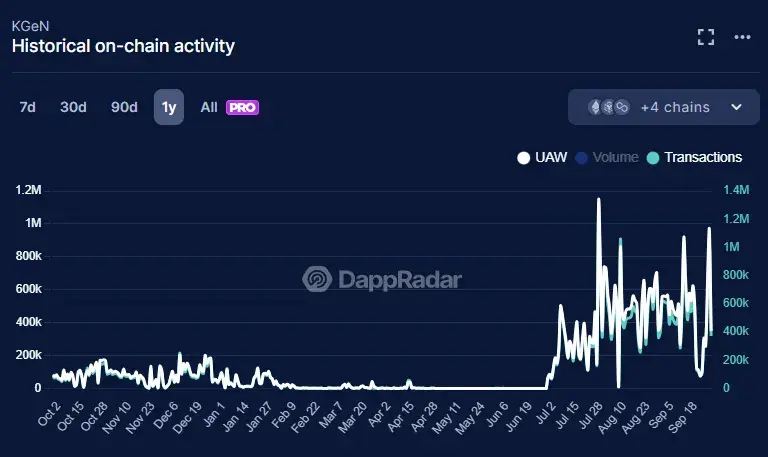
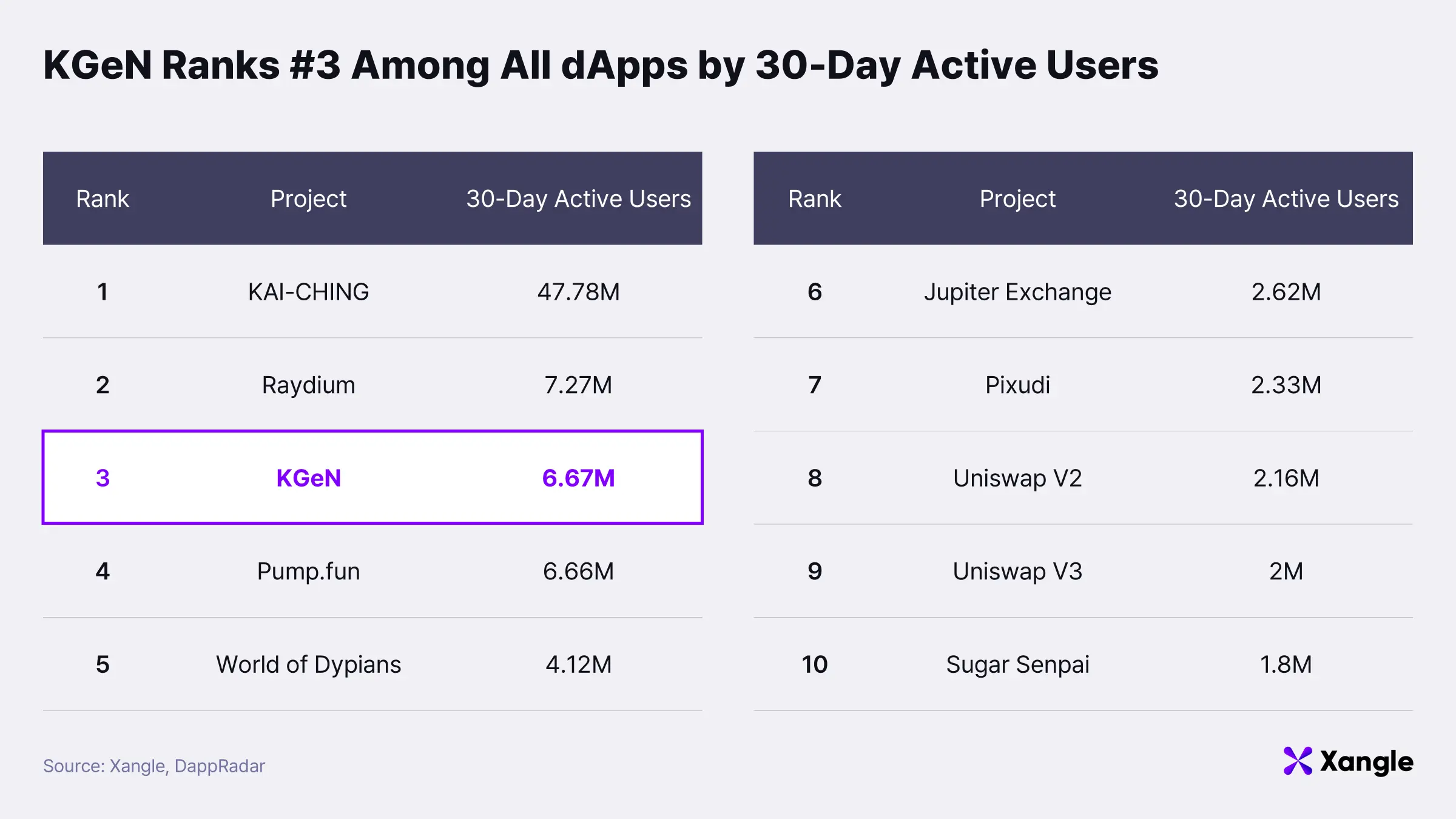
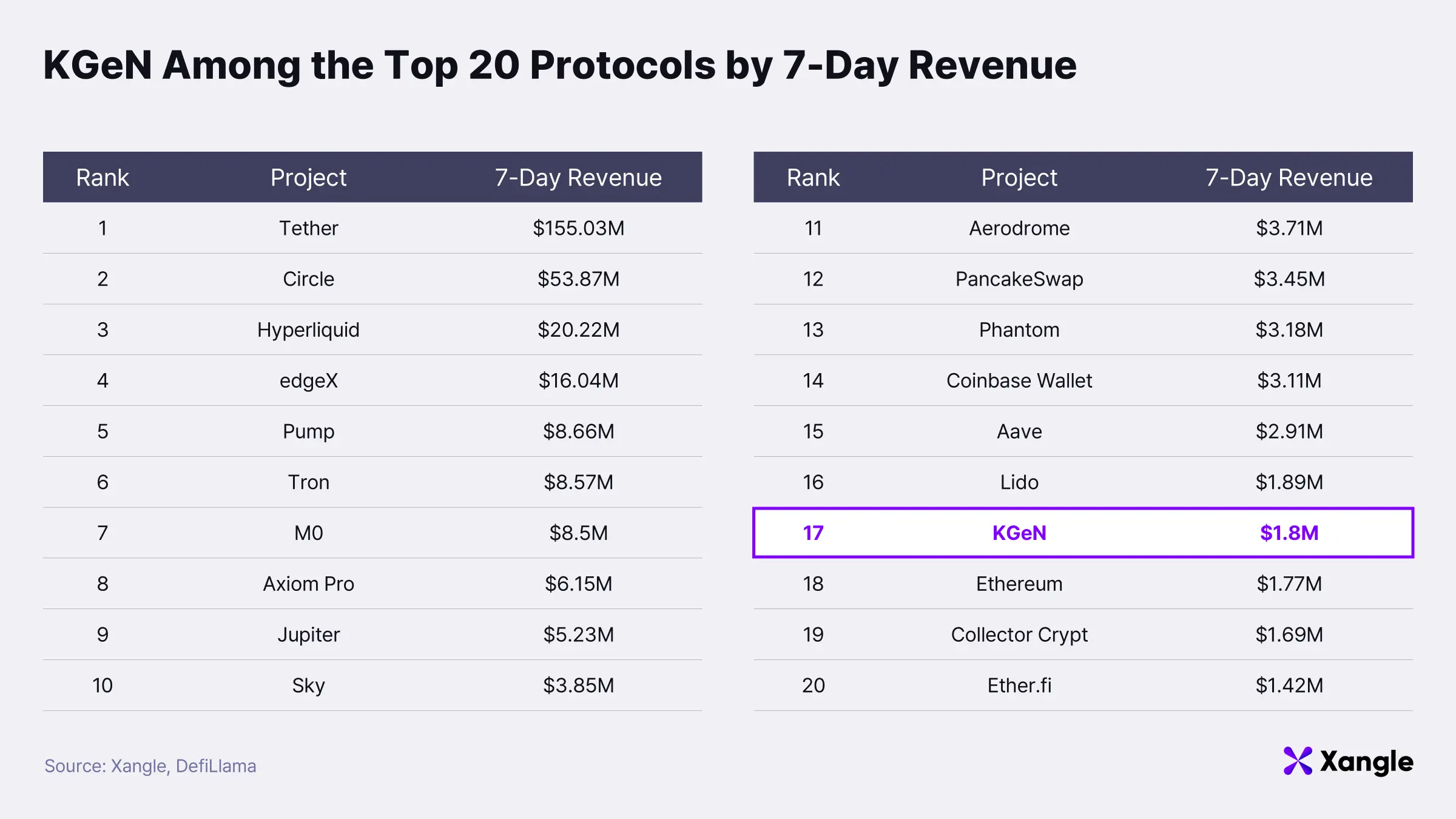
Financial performance tells the same story. According to DeFiLlama data as of October 2, KGeN generated $1.8 million in revenue over the past seven days, ranking 17th among all protocols globally. On an annualized basis, this equals about $62 million in revenue, showing that KGeN’s value creation stems from real service usage and transaction volume, not token-based incentives.
KGeN’s progress can be distilled into three defining pillars:
- A multi-million-strong active user base
- Explosive growth in on-chain transaction activity
- Revenue scale placing the protocol among global top performers
Together, these demonstrate that KGeN has evolved beyond experimental infrastructure—now operating as a sustainable, revenue-generating protocol backed by an active and verifiable user network.
3. KGeN’s Strategic Opportunity in the Web3 Economy
3-1. Restoring Data Sovereignty and Redefining Value Capture
A fundamental flaw of today’s Web2 digital ecosystem is its data monopoly structure. Centralized corporations and publisher platforms store massive volumes of user-generated data on private servers and exploit it exclusively for profit. Information such as login patterns, service preferences, and spending behavior remains in corporate hands, while users are denied any real data sovereignty.
This asymmetry creates two major problems. First, a concentration of economic value—users generate the data and traffic that power these platforms, yet profits accrue almost entirely to the corporations. Second, a lack of transparency—users cannot see how their data is collected, stored, or monetized, as companies manage it unilaterally according to internal strategy.
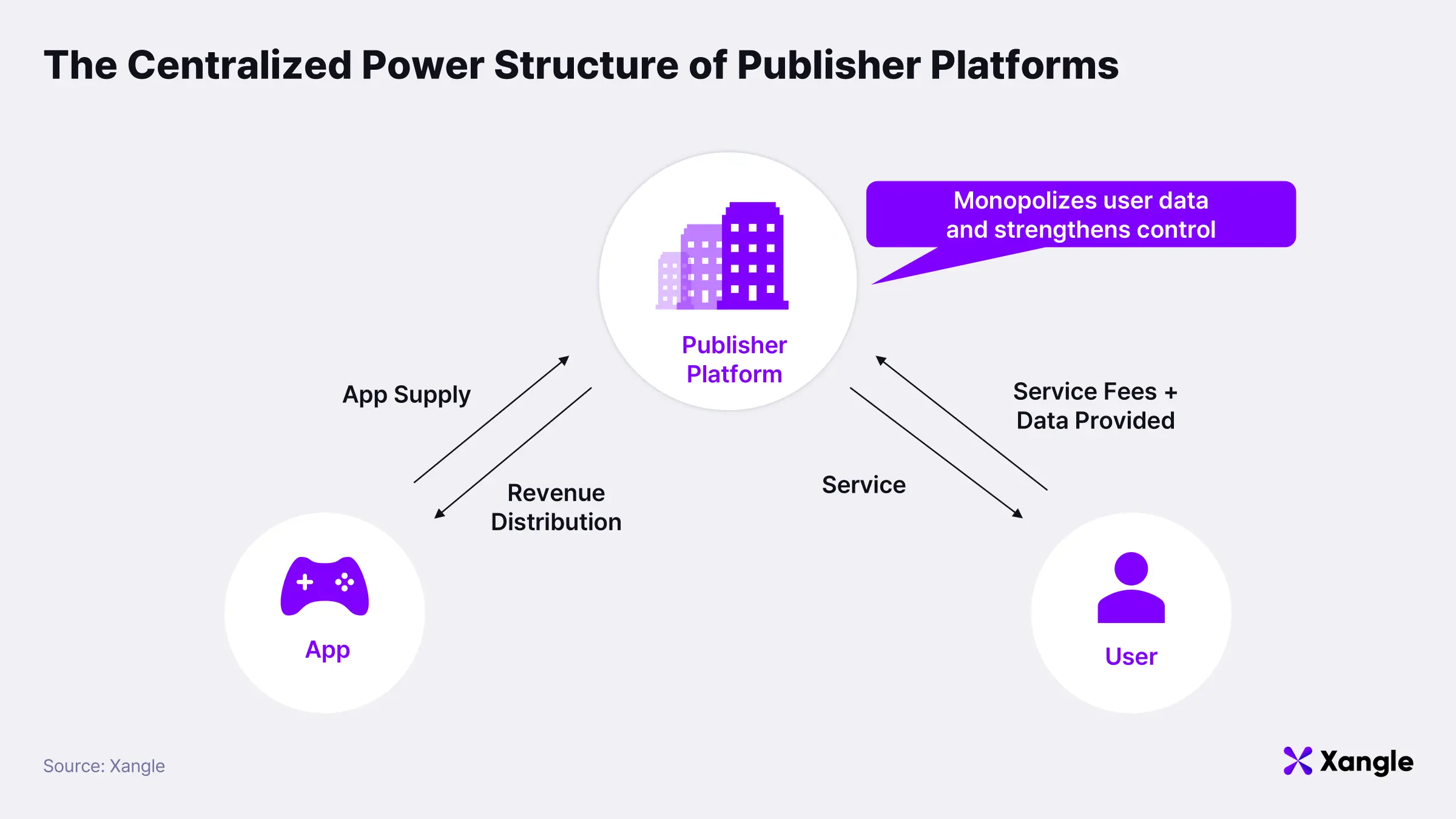
KGeN aims to dismantle this imbalance through a blockchain-based infrastructure that restores data ownership to users. All user data is stored on IPFS as encrypted metadata, with access governed by a multi-signature mechanism jointly controlled by the user and KGeN. When advertisers or publishers request access, explicit user consent is required, and resulting revenue is automatically distributed via smart contracts between the user and the platform. Beyond protection, KGeN enables users to actively manage their data rights—deciding which information to disclose, whether to record it on- or off-chain, and even exercising the right to delete it when desired.
At its core, KGeN establishes a new value-capture model in which the economic value created from data returns directly to its originators. Users gain real economic rewards and control over their digital assets, transforming the traditional Web2 paradigm into a user-centric economy that redistributes value to rightful creators. This structural shift not only rebalances the data economy but also underpins KGeN’s rapid user adoption and sustained revenue growth within Web3.
3-2. Verified Users as the Key to Web3 Adoption — KGeN as Core Infrastructure
Web3’s path to mass adoption ultimately hinges on users. The history of the IT industry reveals a recurring pattern: infrastructure first, applications next, and only then large-scale adoption. The rise of the internet offers a clear precedent—foundational layers such as Ethernet, TCP/IP, and Java enabled applications like Amazon, Facebook, and Uber to reach global scale. Once those rails were in place, the ecosystem unlocked billions of everyday users.
Web3 is following a similar evolutionary curve. Foundational layers such as Ethereum, Solana, Sui, and Aptos are already established, and the ecosystem is maturing with the emergence of innovative applications like Hyperliquid. Yet, for Web3 to reach its next inflection point, it will require not just more applications, but applications capable of effectively acquiring and retaining verified users.
This is where KGeN’s opportunity becomes clear. By enabling transparent, on-chain management of user data and providing the infrastructure for verified user acquisition, KGeN builds the foundation for sustainable ecosystem growth. Applications integrating KGeN can identify authentic users more efficiently, execute data-driven acquisition strategies, and lower User Acquisition Costs (UAC). For users, the shift is equally transformative. Individuals gain sovereignty over their data and direct economic rewards from the value it generates—ushering in a digital economy where participation and ownership are intrinsically linked.
Ultimately, Web3’s success depends on the success of its applications, and application success depends on their ability to secure verified users. Positioned at the center of this equation, KGeN is emerging as the key infrastructure capable of driving Web3’s next phase of growth and mainstream adoption.
4. Closing Statement – KGeN and the Road to Web3 Mass Adoption
Web3’s next leap forward will be driven by applications—and the defining factor behind any breakthrough application is its ability to acquire and retain verified users. The question is not whether this is necessary, but how it can be achieved. At this critical juncture, KGeN emerges as one of the few projects addressing that challenge head-on.
By combining transparent blockchain-based data management with its PoG (Proof of Gamer) engine–driven reputation metrics, KGeN gives applications access to a reliable, verified user base while enabling users to regain data sovereignty and earn economic rewards. This dual value creation explains why KGeN stands out as a core enabler in the next phase of Web3 growth.
The model is already translating into measurable traction. With 29 million cumulative wallets, 6.8 million active wallets in the past month, and an annualized revenue run rate of roughly $62 million, KGeN has proven itself as a live, revenue-generating protocol with both scale and sustainability—far beyond a conceptual vision.
Ultimately, KGeN is building the infrastructure that could accelerate Web3’s path toward mainstream adoption. Its model reshapes how users, data, and value interact across the decentralized internet, and its next phase of growth will show how far this verified-user framework can redefine Web3’s economic foundation.
Disclaimer
I confirm that I have read and understood the following: The information contained in this article is strictly the opinions of the author(s). This article was authored free from any form of coercion or undue influence. The content represents the author's own views and does not represent the official position or opinions of CrossAngle. This article is intended for informational purposes only and should not be construed as investment advice or solicitation. Unless otherwise specified, all users are solely responsible and liable for their own decisions about investments, investment strategies, or the use of products or services. Investment decisions should be made based on the user’s personal investment objectives, circumstances, and financial situation. Please consult a professional financial advisor for more information and guidance. Past returns or projections do not guarantee future results. This article was written at the request of KGeN. All content in this article was written independently by the author(s), and neither CrossAngle nor KGeN had any editorial control or influence over the content. The author(s) may hold the cryptocurrencies mentioned in this article at the time of writing.
Xangle or its affiliated partners own all copyrights of the written or otherwise produced materials and content provided on the platform. Any illegal reproduction of such content, including, but not limited to, unauthorized editing, copying, reprinting, or redistribution will result in immediate legal actions without prior notice.
![[CIS Partner Summit Highlights] Sumsub: AI-Powered Trust Infrastructure for Digital Asset Businesses](https://resource.xangle.io/files/content/746AECF01E9094566488AD287BDF5977_1789025319904.webp)

![[Xangle RWA Series] Compliance](https://resource.xangle.io/files/content/9EB5169D9605BBF00DEC081C07A10955_1784185676780.webp)